Category Archives: Country Analytics

BRICS+: Assessing the Cohesion, Capabilities, and Challenge of a Reconfigured Global Bloc

This report assesses the strategic capabilities, internal cohesion, and geopolitical implications of the expanded BRICS+ group of nations. The analysis concludes that BRICS+ represents a significant, long-term systemic challenge to the U.S.-led international order. However, its potential to act as a unified, revisionist bloc is severely constrained by profound internal divisions and structural contradictions. It is best understood not as a monolithic anti-Western alliance, but as a heterogeneous coalition of convenience, leveraging its collective economic weight to pursue often divergent national interests under the shared banner of creating a multipolar world.

The bloc’s primary strengths are formidable and growing. Demographically and economically, BRICS+ now constitutes the center of gravity for global growth, commanding approximately 45% of the world’s population and a larger share of global GDP (in purchasing power parity terms) than the G7. Its strategic power is further magnified by its substantial control over global energy and critical mineral supply chains, positioning it as a gatekeeper of the resources essential for both the 20th-century industrial economy and the 21st-century green transition. Diplomatically, it has successfully branded itself as the preeminent voice of the “Global South,” attracting widespread interest from developing nations seeking alternatives to Western-led institutions.

Conversely, the bloc is plagued by critical weaknesses. The intractable strategic rivalry between its two largest members, China and India, represents a fundamental fault line that prevents deep political or security integration. This core tension is exacerbated by the vast economic and political heterogeneity among its members—a mix of democracies and autocracies, wealthy creditors and indebted nations—whose divergent interests frequently preclude consensus on contentious issues. The group’s intentionally informal, consensus-based structure, which lacks a binding charter or a central secretariat, provides necessary flexibility but simultaneously renders it incapable of decisive, unified action in a crisis.

The primary threat to U.S. interests is not military but systemic. It is most acute in the financial domain, where a concerted, albeit slow-moving, effort toward “de-dollarization” aims to create parallel payment systems and trade settlement in local currencies. The goal is less to replace the U.S. dollar than to insulate member economies from the reach of U.S. financial sanctions, thereby eroding the effectiveness of a key instrument of American foreign policy. Geopolitically, the bloc challenges U.S. primacy by creating alternative diplomatic forums, promoting a narrative of multipolarity that resonates across the Global South, and providing a “safe harbor” for states seeking to counter U.S. pressure.

In response, this report recommends that U.S. policy shift from a posture of broad confrontation, which has proven counterproductive in fostering BRICS+ unity, to a nuanced strategy of “competitive coopetition.” This strategy involves:

  1. Exploiting Internal Fissures: Treating the bloc not as a monolith but as a collection of individual actors, deepening strategic ties with members like India and Brazil whose interests often align with a rules-based order, thereby exacerbating internal divisions.
  2. Reinforcing the U.S.-led Financial Architecture: Proactively pursuing governance reforms at the IMF and World Bank to give emerging economies a greater voice, and scaling up high-quality, transparent development finance alternatives to outcompete the New Development Bank.
  3. Building Counter-Coalitions: Strengthening alliances with key democratic and market-oriented partners in the Global South to offer a more compelling alternative to the BRICS+ model of governance.
  4. Employing Targeted Economic Statecraft: Replacing blunt instruments like broad tariffs with precise, surgical measures designed to impose costs on specific adversarial actions, such as prohibiting dual participation in SWIFT and alternative payment systems, without alienating neutral parties.

Section 1: The Architecture of a Counter-Hegemonic Coalition

The BRICS+ grouping is not an accidental collection of emerging economies but a deliberate, albeit imperfect, political project designed to alter the global balance of power. Its evolution from a market-driven investment concept to a state-driven political forum reflects a calculated response to perceived inequities in the post-Cold War international order. Understanding its current architecture—its strategic purpose, expanded membership, and institutional ambitions—is essential to accurately assessing its capabilities and intentions.

1.1 From Acronym to Alliance: A Deliberate Evolution

The bloc’s origin as the “BRIC” acronym, coined in 2001 by Goldman Sachs economist Jim O’Neill to highlight promising investment markets, is a historical footnote that belies its current geopolitical significance.1 The critical transformation began when political leaders, particularly in Russia, recognized the potential to forge a political grouping from this economic concept.4 The intellectual groundwork for a multipolar coalition can be traced back to Russian Foreign Minister Yevgeny Primakov in the late 1990s, who envisioned a “strategic triangle” of Russia, India, and China to balance U.S. influence.4

This political ambition began to crystallize with the first meeting of BRIC foreign ministers on the sidelines of the UN General Assembly in 2006, followed by the inaugural leaders’ summit in Yekaterinburg, Russia, in 2009.1 The timing was not coincidental. The 2008 global financial crisis, which originated in the United States and Europe, severely damaged the credibility of Western economic stewardship and created what analysts have termed a “legitimacy crisis of the international financial order”.7 As Western economies faltered, the relative resilience and continued growth of the BRIC nations, particularly China and India, imbued them with a newfound confidence and a shared purpose.7 This crisis served as the primary catalyst, providing the political will and strategic opportunity for the BRIC countries to institutionalize their cooperation. They transitioned from an informal discussion forum to an action-oriented bloc with the explicit goal of reforming the global financial and political architecture to better reflect the rising weight of emerging powers.8

The group’s stated objectives, reiterated across numerous summit declarations, have consistently centered on advocating for a “more democratic and just multipolar world order” and demanding reforms of global governance institutions like the International Monetary Fund (IMF), the World Bank, and the United Nations Security Council.8 This is not merely aspirational rhetoric but a core strategic goal that provides the foundational ideological glue for its otherwise disparate members. The admission of South Africa in 2011, transforming BRIC into BRICS, was the first step in broadening its geographic and political representation, explicitly positioning the group as a champion for the broader developing world.1

1.2 The Logic of Expansion: Consolidating Resource Power and Geopolitical Reach

The 2024-2025 expansion was the most significant development in the bloc’s history, bringing in Egypt, Ethiopia, Iran, the United Arab Emirates (UAE), and Indonesia as full members.2 While Argentina’s subsequent withdrawal under a new administration and Saudi Arabia’s initial hesitation underscore the complexities of consensus-based enlargement, the overall move represents a strategic consolidation of the bloc’s power.3 More than 40 countries have expressed interest in some form of affiliation, signaling the group’s growing international appeal.16

The expansion’s logic is best understood through two primary lenses: strategic resources and geopolitical influence.

First, the inclusion of major energy producers fundamentally transforms BRICS+ into a dominant energy bloc. By uniting some of the world’s largest oil and gas exporters (Russia, Iran, UAE, and potentially Saudi Arabia) with two of the world’s largest importers (China and India) within a single political forum, the group has created an unprecedented platform to coordinate on energy policy and potentially challenge the petrodollar system.9 This internalizes a significant portion of the global energy supply chain, creating opportunities for trade settlement in local currencies and insulating members from the volatility of Western-controlled markets.

Second, the expansion deepens the bloc’s geopolitical footprint across the Middle East and Africa, reinforcing its claim to be the authentic voice of the “Global South”.11 The addition of regional powers like Egypt, Iran, and Ethiopia enhances its diplomatic weight and extends its influence into critical geostrategic zones. To manage the high demand for affiliation, the bloc institutionalized a “partner country” category at the 2024 Kazan summit.7 This creates a tiered system of engagement, allowing BRICS+ to build a wider network of aligned states (including countries like Belarus, Bolivia, Cuba, Kazakhstan, Malaysia, Nigeria, Thailand, Uganda, Uzbekistan, and Vietnam) without diluting the core decision-making process or importing new internal conflicts associated with full membership.2

1.3 Institutional Ambition: Building a Parallel Financial Universe

The most concrete manifestation of the bloc’s ambition to reshape global governance is its creation of a parallel financial architecture. The establishment of the New Development Bank (NDB) and the Contingent Reserve Arrangement (CRA) at the 2014 Fortaleza summit marked the group’s transition from rhetoric to institution-building.6

The New Development Bank (NDB)

The NDB was established to “mobilize resources for infrastructure and sustainable development projects” in member states and other emerging economies, explicitly to “complement the existing efforts of multilateral and regional financial institutions”.22 With an authorized capital of $100 billion and a subscribed capital of over $52.7 billion, the NDB is a significant financial institution, though still much smaller than the World Bank.21 As of early 2025, its total assets stood at $33.5 billion, and it had approved over $32.8 billion in financing for more than 96 projects across sectors like clean energy, transport infrastructure, and water sanitation.21

The NDB’s true strategic innovation lies not in its scale but in its operating model. Its key value proposition is the provision of financing without the political conditionalities related to governance and economic policy that are often attached to loans from the IMF and World Bank.27 This approach directly addresses a long-standing grievance of many Global South nations. Furthermore, the NDB is increasingly focused on lending in the local currencies of its members, a direct effort to reduce dependence on the U.S. dollar in development finance and insulate projects from exchange rate volatility.18 While the NDB’s balance sheet cannot replace that of the World Bank, its strategic significance lies in its ability to exert competitive pressure. By providing a viable, non-aligned alternative, it grants developing nations greater leverage in their negotiations with Bretton Woods institutions, forcing the existing order to be more responsive and thereby achieving a core BRICS objective of reform through competition.

The Contingent Reserve Arrangement (CRA)

The CRA is a $100 billion framework of mutual financial support among BRICS central banks, designed to provide liquidity during balance of payments difficulties.21 The contribution structure is intentionally asymmetric, reflecting the economic weight of its members: China provides $41 billion, Brazil, India, and Russia contribute $18 billion each, and South Africa provides $5 billion.21

Although the CRA has never been activated, its existence serves a powerful symbolic and strategic purpose. It functions as a collective financial safety net, intended to deter currency speculation and provide a first line of defense against financial shocks, reducing the need to turn to the IMF in a crisis.21 It represents a foundational pillar of an alternative global financial architecture, signaling a collective commitment to financial self-sufficiency and providing a hedge against the perceived weaponization of Western-led financial rescue mechanisms.

Section 2: A Strategic Audit of BRICS+ Capabilities (Strengths)

The expanded BRICS+ bloc commands a formidable array of assets that make it a significant actor on the global stage. Its power is not merely symbolic; it is rooted in quantifiable demographic, economic, and resource-based strengths. These capabilities, even when not wielded by a perfectly cohesive group, collectively shift the global center of gravity and provide the foundation for its challenge to the existing international order.

2.1 The Demographic and Economic Engine: A Center of Global Gravity

The sheer scale of the BRICS+ countries is its most fundamental strength. Following its 2024-2025 expansion, the bloc now comprises approximately 45% of the world’s population, or over 3.5 billion people.16 This immense demographic weight translates into vast consumer markets, a deep labor pool, and significant long-term growth potential that cannot be ignored.

This demographic scale is matched by growing economic clout. While the G7 still leads in nominal GDP, a measure reflecting financial market depth, the more telling metric for real economic activity—Purchasing Power Parity (PPP)—reveals a historic shift. The BRICS+ share of global GDP (PPP) has already surpassed that of the G7. Projections for 2025 place the BRICS+ share at nearly 40%, compared to the G7’s 28.4%.30 This is not a future forecast but a present reality, indicating that the bulk of the world’s industrial production, manufacturing of goods, and provision of services now occurs within the BRICS+ nations.33 China alone accounts for over half of the bloc’s economic output and is the world’s top merchandise exporter, anchoring a shift in the center of global manufacturing gravity.4

The bloc’s role in international commerce is correspondingly large, accounting for approximately 21-24% of global exports.34 Critically, trade within the BRICS+ group is expanding at a faster rate than global trade, fostering the development of increasingly resilient, non-Western-centric supply chains.35 This growing intra-bloc trade reduces dependence on traditional markets in North America and Europe and enhances the group’s collective economic security.


Table 1: BRICS+ vs. G7: A Comparative Dashboard (2025 Projections)

MetricBRICS+G7Global Share (BRICS+)Global Share (G7)
Population~$3.7$ billion~$0.8$ billion~$45%~$10%
GDP (Nominal)~$30.8$ trillion~$51.1$ trillion~$27%~$44%
GDP (PPP)~$65$ trillion~$48$ trillion~$39%~$28%
Share of Global Exports~$5.5$ trillion~$6.7$ trillion~$24%~$29%
Military Expenditure~$0.48$ trillion~$1.20$ trillion~$19%~$49%

Note: Figures are estimates based on 2024-2025 data and projections. GDP figures are approximate based on combined member data. Population data is based on 2025 estimates. Trade and military spending shares reflect recent available data. Sources:.4


2.2 Dominance in Strategic Commodities: The Gatekeepers of the Global Economy

The expansion of BRICS+ has consolidated its position as a “resource superpower”.39 The bloc now exerts significant, and in some cases dominant, influence over the global supply of commodities that are essential for both the legacy energy system and the emerging green economy.

In the energy sector, the inclusion of Iran and the UAE, alongside Russia and founding members Brazil and China, creates a formidable concentration of power. The expanded bloc now accounts for approximately 43.6% of global crude oil production.19 This gives the group—which includes the world’s largest producers and two of its largest consumers—unprecedented potential to coordinate energy policy and influence global prices, operating as a political counterpart to the economic function of OPEC+. Its control extends to other fossil fuels, with members producing 36% of the world’s natural gas and over 78% of its mineral coal.36

Even more strategically significant in the long term is the bloc’s dominance over critical minerals required for high-tech manufacturing and the clean energy transition. This concentration of resource control gives BRICS+ immense structural power over the global supply chains of the future. Members have already demonstrated a willingness to leverage this power through export restrictions, as China has done with rare earths and graphite, signaling the potential for coordinated action to achieve geopolitical objectives.19 This power is not just over raw materials, but also processing; China alone processes an estimated 90% of the world’s rare earth elements.40


Table 2: BRICS+ Control of Key Global Resources

Commodity/ResourceEstimated BRICS+ Share of Global Production/Reserves
Crude Oil Production~$43.6%
Natural Gas Production~$36%
Mineral Coal Production~$78.2%
Rare Earths (Reserves)~$72%
Manganese (Reserves)~$75%
Graphite (Reserves)~$50%
Nickel (Reserves)~$28%
Copper (Reserves)~$10%
Wheat Production~$42%
Rice Production~$52%
Soybean Production~$46%

Note: Figures are estimates based on the expanded BRICS+ membership. Percentages can vary slightly by year and data source. Sources:.4


2.3 The “Voice of the Global South”: A Diplomatic Counterweight

Beyond its material strengths, BRICS+ has successfully cultivated significant soft power by positioning itself as the primary political and diplomatic forum for the Global South.8 This appeal is rooted in a shared historical narrative—many members experienced European colonialism—and a common desire for a more equitable international order that is less dominated by the United States and its Western allies.3

The bloc offers a platform for countries to pursue “strategic autonomy,” allowing them to maintain productive relationships with a range of global powers without being forced into rigid, binding alliances.42 This message resonates deeply in an era of renewed great-power competition, particularly with nations wary of being caught in the crossfire of U.S.-China rivalry. For many developing countries, BRICS+ represents a “safe harbor” from U.S. diplomatic coercion and economic statecraft, providing an alternative path to development and international recognition.29

The high level of interest in joining the group is empirical evidence of this growing diplomatic magnetism. The fact that over 40 countries have formally applied or expressed a desire to join demonstrates that the BRICS+ vision of a multipolar world has a broad and receptive audience.16 This allows the bloc to act as a powerful diplomatic counterweight in multilateral institutions like the UN and the G20, where it can coordinate positions and amplify the collective voice of the developing world.20

The power of BRICS+ is therefore asymmetric when compared to the G7. Its dominance in production, population, and raw materials (reflected in its PPP GDP and resource control) directly challenges the G7’s long-standing dominance in finance and military power (reflected in nominal GDP and defense spending). The core geopolitical dynamic of the coming decades will be the contest between these two forms of power: the BRICS+ leverage over the physical economy versus the G7’s control over the financial and security architecture that governs it. This structural conflict is the fundamental driver behind initiatives like de-dollarization and the creation of the NDB.

Section 3: An Assessment of Inherent Vulnerabilities (Weaknesses)

Despite its formidable collective strengths, the BRICS+ bloc is fundamentally constrained by deep-seated internal contradictions and structural weaknesses. These fissures are not temporary disagreements but enduring features of the group’s composition that cap its potential to act as a coherent, unified global actor. Its aspirations are consistently checked by the divergent realities of its members.

3.1 The Sino-Indian Fault Line: The Rivalry at the Core

The single greatest impediment to BRICS+ cohesion is the intractable strategic rivalry between its two most populous members, China and India. This is not merely a bilateral issue but a structural flaw that permeates the entire bloc. The unresolved border dispute along the Line of Actual Control (LAC), which escalated into the first deadly clashes in decades in 2020, is the most visible symptom of a much deeper competition for regional and global influence.45

This rivalry manifests in fundamentally competing visions for the purpose of BRICS itself. China, increasingly aligned with Russia, views the bloc as a key instrument in an explicitly anti-Western, revisionist project aimed at directly challenging U.S. hegemony and creating an alternative world order centered on Beijing.3 In contrast, India, often finding common cause with Brazil and South Africa, espouses a “non-Western, not anti-Western” stance.48 New Delhi sees BRICS as a vehicle to achieve a “multipolar” world, enhance its own “strategic autonomy,” and reform—not necessarily overturn—the existing global governance system to gain a more prominent seat at the table.3

This divergence is amplified by a stark power asymmetry. China’s economy is larger than that of all other ten BRICS+ members combined, fueling Indian and Brazilian fears that the bloc could devolve into a “pro-China alliance” or a mere instrument of Chinese foreign policy.49 India’s initial resistance to China’s push for rapid expansion, its insistence on establishing clear membership criteria, and its concurrent participation in the U.S.-led Quadrilateral Security Dialogue (Quad) are all direct consequences of this deep-seated suspicion.49 This central rivalry ensures that on any critical geopolitical or security issue that requires deep trust, bloc-wide consensus is virtually unattainable.

3.2 Economic and Political Heterogeneity: A Coalition of Contradictions

The expansion in 2024 has amplified the group’s already vast internal diversity, creating a coalition of profound contradictions. The economic disparities are stark, undermining the potential for common policy. The bloc includes some of the world’s wealthiest nations on a per capita basis, such as the UAE (GDP per capita PPP of ~), and some of the poorest, like Ethiopia (GDP per capita PPP of ~).14 It contains major global creditors like China and nations struggling with high public debt, such as Brazil, Egypt, and South Africa, where public debt has approached or exceeded 90% of GDP.53 Members face vastly different domestic challenges, from China’s looming demographic crisis and real estate bubble to India’s massive informal labor market and South Africa’s chronic unemployment and infrastructure decay.54 These divergent economic realities make harmonizing fiscal, monetary, or trade policies exceptionally difficult.

The political divergence is equally pronounced. The group is a mixture of established, albeit stressed, democracies (India, Brazil, South Africa), consolidated one-party states (China), managed autocracies (Russia, Egypt, UAE), and a theocracy (Iran). This is not a trivial distinction; it leads to fundamentally different values and approaches to critical issues such as human rights, internet freedom, data governance, and the principles of international law. While research on voting patterns in the UN General Assembly indicates a degree of cohesion on broad development and economic issues, it also reveals that the BRICS countries are least cohesive on matters of international security and human rights, where their core national interests and political systems diverge most sharply.57 Furthermore, the expansion has imported new potential bilateral conflicts into the group’s internal dynamics, notably the historic rivalry between Saudi Arabia and Iran and the ongoing dispute between Egypt and Ethiopia over the Grand Ethiopian Renaissance Dam on the Nile River.13

3.3 The Cohesion Paradox: The Weakness of an Informal Structure

BRICS+ remains a fundamentally informal political grouping. It operates without a binding charter, a permanent secretariat to drive initiatives, or a centralized budget.1 Its primary operating principle is consensus, meaning all substantive decisions must be agreed upon by all members.8

This informality creates a “cohesion paradox.” On one hand, it is a necessary feature, not a bug. The loose, consensus-based structure is what allows such a diverse and internally competitive group to coexist. It provides the flexibility for members to cooperate on areas of clear mutual interest (such as funding infrastructure through the NDB) while avoiding direct confrontation on deeply divisive issues. For a country like India, the consensus rule acts as a crucial veto, preventing the bloc from being hijacked by a more radical Sino-Russian agenda that would compromise its strategic autonomy.48 The institutional weakness is, in effect, a precondition for the group’s continued existence.

On the other hand, this same structure severely limits the bloc’s capacity to act as a decisive and effective global actor, especially in response to fast-moving crises. The need for consensus among eleven countries with competing interests ensures that the group’s collective actions will almost always gravitate toward the lowest common denominator.60 This structural reality prevents BRICS+ from evolving into a true military or political alliance with the capacity for unified, binding action, in stark contrast to treaty-based organizations like NATO. The “spaghetti bowl” effect, where overlapping and sometimes competing subgroups and initiatives exist (such as the IBSA Dialogue Forum of India, Brazil, and South Africa), further complicates coordination and dilutes the bloc’s focus.62


Table 3: BRICS+ Strengths and Weaknesses Matrix

DomainAssessed StrengthCorresponding Weakness/Constraint
EconomicMassive share of global GDP (PPP), trade, and growth potential.Extreme internal economic disparities (GDP per capita, debt), trade imbalances, and the overwhelming structural dominance of China’s economy.
ResourcesSignificant to dominant control over strategic energy and critical mineral supply chains.Limited tangible intra-bloc cooperation on resource development and investment; nationalistic resource policies and competition often prevail over collective strategy.
Political/DiplomaticGrowing appeal as the “Voice of the Global South” and a platform for strategic autonomy.Divergent political systems (democracies vs. autocracies) and competing national interests prevent a unified foreign policy on contentious issues.
InstitutionalCreation of parallel financial institutions (New Development Bank, Contingent Reserve Arrangement).An informal, consensus-based structure (no charter) limits capacity for decisive action and enforces a lowest-common-denominator approach to policy.
SecurityDeepening Sino-Russian military axis and targeted trilateral exercises with members (e.g., South Africa, Iran).The intractable Sino-Indian rivalry and other bilateral tensions (e.g., Egypt-Ethiopia) make any form of bloc-wide security alliance or mutual defense pact impossible.

Section 4: Threat Assessment: A Systemic Challenge to U.S. Primacy

The threat posed by the BRICS+ bloc to United States national interests is not primarily a conventional military one, but rather a long-term, systemic challenge aimed at eroding the foundational pillars of U.S. global power: its financial dominance, its diplomatic leadership, and the effectiveness of its economic statecraft. While the bloc’s internal fractures limit its ability to act as a unified adversary, its collective weight and targeted initiatives are actively reshaping the geopolitical and geoeconomic landscape.

4.1 The Financial Challenge: De-Dollarization and Parallel Systems

The most potent and coordinated challenge from BRICS+ is directed at the central role of the U.S. dollar in the global financial system. This effort is driven by a shared desire among members to reduce their vulnerability to U.S. financial sanctions and what they perceive as the “weaponization” of the dollar.63 The unprecedented sanctions imposed on Russia’s central bank following the 2022 invasion of Ukraine served as a powerful catalyst, demonstrating to other nations the profound risks of dependence on the Western-led financial infrastructure.63 The threat is not the imminent replacement of the dollar as the world’s primary reserve currency, but rather the construction of a parallel financial system large enough to render U.S. sanctions increasingly ineffective.

The mechanisms being pursued include:

  • Promotion of Local Currency Trade: Members are actively working to bypass the dollar in bilateral trade. This is most advanced in Russia-China energy trade, which is now largely settled in yuan and rubles, but also includes initiatives like India’s rupee-based trade experiments.64 The share of the Chinese renminbi in total intra-BRICS trade transactions has reportedly reached approximately 47%.4
  • Development of Alternative Payment Systems: China’s Cross-Border Interbank Payment System (CIPS) is being promoted as a potential alternative to the SWIFT messaging network for international bank transfers.66 Concurrently, the bloc is exploring a unified payment platform, often referred to as “BRICS Pay” or the “BRICS Bridge,” to facilitate seamless cross-border transactions in members’ national currencies, potentially leveraging blockchain technology.63
  • Institutional Support: The New Development Bank is mandated to increase the share of its lending in local currencies, further reducing dollar dependency in development finance.18

Despite these efforts, the de-dollarization project faces formidable headwinds. The dollar’s dominance is entrenched, accounting for roughly 58% of global foreign exchange reserves and being on one side of nearly 90% of all foreign exchange trades.54 This is due to the unparalleled depth, liquidity, and perceived safety of U.S. financial markets, which no BRICS+ member can currently replicate.54 China’s own capital controls and the non-convertibility of its currency remain significant obstacles to the yuan’s emergence as a true global reserve currency.66 Therefore, the BRICS+ financial strategy should be understood as a long-term project to build “hedging options” and create financial insulation, rather than an attempt to dethrone the dollar overnight.69

4.2 The Geopolitical Challenge: A Fragmented but Assertive Bloc

Geopolitically, BRICS+ erodes U.S. influence by creating a high-profile and increasingly institutionalized diplomatic venue where major global issues are discussed without U.S. or Western participation. This normalizes a multipolar world where Washington is no longer the indispensable convener for every significant international conversation, thereby diminishing U.S. diplomatic centrality.20

The bloc’s most effective geopolitical tool is its successful positioning as the champion of the “global majority”.64 It actively promotes a narrative that contrasts its stated principles of equality, sovereignty, and mutual respect with what it portrays as a coercive and hegemonic Western approach.64 This narrative is highly resonant across the Global South, granting BRICS+ significant soft power and making it an attractive forum for developing nations seeking to amplify their voice on the world stage.8

This diplomatic appeal allows the bloc to function as a “safe harbor” for countries seeking to resist U.S. diplomatic or economic pressure. By offering alternative trade partners, sources of investment (via the NDB), and a platform of political legitimacy, BRICS+ undermines the efficacy of U.S. sanctions and other coercive measures against states like Russia and Iran.29 Aggressive U.S. policies, such as the broad application of tariffs, have proven to be a primary catalyst for BRICS+ cohesion, providing the shared external threat that helps its members overcome their internal differences and accelerates their anti-hegemonic agenda.65

4.3 The Security Challenge: Nascent but Evolving Cooperation

It is crucial to assess that BRICS+ is not, and shows no sign of becoming, a collective security alliance akin to NATO. The deep-seated Sino-Indian rivalry, along with the divergent security interests of other members, makes any form of mutual defense pact a political impossibility.47

However, specific security alignments are deepening within the BRICS+ framework. The most significant of these is the strengthening military-to-military relationship between China and Russia.75 This “no limits” partnership, while bilateral in nature, is politically amplified within the BRICS context. Their joint military exercises are increasing in frequency, complexity, and geographic scope, moving from counter-terrorism drills to simulated joint operations in regional wars and expanding into contested maritime zones like the Sea of Japan and the Bering Sea.75 These exercises signal a clear alignment of security interests in countering U.S. power and provide the People’s Liberation Army with valuable operational experience.75

Furthermore, this axis is expanding to include other BRICS+ members in targeted trilateral and multilateral formats. The “Mosi” naval exercises involving Russia, China, and South Africa off the coast of Africa, and the “Maritime Security Belt” exercises with Russia, China, and new member Iran in the Gulf of Oman, demonstrate an expanding web of security cooperation that deliberately bypasses the U.S. and its traditional alliance structures.76 While not representing a unified BRICS+ military posture, these exercises enhance interoperability among key members and project a coordinated challenge to U.S. power projection in vital strategic regions.


Table 4: U.S. Threat Vector Analysis

Threat DomainThreat Vector (Specific BRICS+ Action)Impact on U.S. InterestsCurrent SeverityFuture Trajectory
FinancialPromotion of local currency trade & commodity pricing.Reduces global demand for USD; weakens efficacy of financial sanctions.MediumIncreasing
FinancialDevelopment of SWIFT alternatives (e.g., CIPS, BRICS Pay).Creates sanctions-proof payment channels for strategic trade, eroding U.S. economic leverage.Low-MediumIncreasing
FinancialNDB lending without political conditionality.Undermines U.S. influence in development finance via IMF/World Bank; offers alternative for sanctioned states.MediumIncreasing
GeopoliticalBloc expansion and creation of “partner” status.Normalizes a non-Western-led global governance structure; erodes U.S. diplomatic centrality.HighIncreasing
GeopoliticalUse of BRICS+ as a platform for the “Global South.”Challenges U.S. soft power and leadership narrative; creates a powerful diplomatic counter-bloc in multilateral forums.HighIncreasing
SecurityDeepening Sino-Russian strategic and military alignment.Creates a coordinated military counterweight to U.S. and allies in key theaters (Indo-Pacific, Europe).HighIncreasing
SecurityTrilateral exercises with U.S. adversaries (e.g., Iran, Russia).Enhances military interoperability and power projection of adversarial states in strategic chokepoints.MediumIncreasing

Section 5: Strategic Recommendations for U.S. Policy

In response to the systemic challenge posed by BRICS+, the United States must adopt a sophisticated and forward-looking strategy that moves beyond a reactive, confrontational posture. A policy framework built on broad opposition and punitive tariffs has proven counterproductive, inadvertently fostering greater unity within a bloc rife with internal contradictions.65 An effective U.S. strategy must be proactive and nuanced, designed to leverage American strengths while exploiting BRICS+ weaknesses. The overarching goal should be to manage the rise of this coalition through a policy of “competitive coopetition.”

5.1 Recalibrating U.S. Engagement: From Confrontation to “Competitive Coopetition”

The foundational error in past U.S. policy has been to treat BRICS+ as a monolithic entity.74 A more effective approach requires a differentiated strategy that recognizes the deep fissures within the group and tailors U.S. engagement accordingly.

  • Deepen the Strategic Partnership with India: India is the critical swing state and the primary counterweight to Chinese dominance within BRICS+. The U.S. should prioritize and accelerate security, intelligence, technology, and economic cooperation through bilateral channels and minilateral formats like the Quad. The strategic objective is not to force India to leave BRICS—an unrealistic goal that would undermine its principle of strategic autonomy—but to ensure that its calculus remains more aligned with a U.S.-backed vision of a free and open, rules-based multipolar order, rather than a Chinese-led, revisionist one.50
  • Cultivate Ties with Brazil and South Africa: As fellow democracies, Brazil and South Africa share U.S. interests in areas such as climate action, public health, and the rule of law. The U.S. should intensify diplomatic engagement and offer tangible benefits, including enhanced trade access, investment in their green transitions, and a greater voice in Western-led institutions. This provides these countries with viable alternatives and reduces their incentive to align with the more explicitly anti-Western agenda of the Russia-China axis.69
  • Isolate and Contain Revisionist Actors: For members like Russia and Iran, whose core strategic goals are fundamentally hostile to U.S. interests, a policy of containment and pressure should continue. The U.S. should work with allies to maintain and enforce targeted sanctions while clearly communicating that their inclusion in BRICS+ will not shield them from accountability for malign activities.

5.2 Reinforcing the U.S.-led Financial Architecture

The most effective long-term defense against the appeal of the NDB and the push for de-dollarization is to address the legitimate grievances that fuel their existence. The U.S. must lead a proactive effort to reform and strengthen the Bretton Woods system.

  • Champion Meaningful Institutional Reform: The U.S. should publicly and vigorously champion a redistribution of voting shares at the IMF and World Bank to give major emerging economies like India and Brazil a stake that is commensurate with their growing economic weight. Such a move would significantly diminish the appeal of creating parallel institutions by demonstrating that the existing system is capable of evolution and inclusivity.69
  • Offer a Superior Development Finance Proposition: The U.S., in coordination with G7 partners, must scale up, streamline, and better market its own development finance offerings through mechanisms like the Development Finance Corporation (DFC) and regional initiatives. These projects must be faster to approve, more transparent in their terms, and focused on high-quality, sustainable infrastructure to present a clear and superior alternative to the often opaque and debt-heavy financing offered by Chinese state-led entities.33
  • Lead in Financial Innovation: To maintain the dollar’s primacy, the U.S. financial system must remain the most efficient, secure, and innovative in the world. This requires the U.S. to take a leading role in setting global standards for digital currencies, cross-border payment systems, and financial technology, ensuring that the next generation of global finance is built on a dollar-based foundation.

5.3 Building a Counter-Coalition of Like-Minded Partners

The U.S. cannot counter the diplomatic weight of BRICS+ alone. It must actively build and reinforce a network of allies and partners who share a commitment to a rules-based international order.

  • Revitalize the G7 and Expand its Outreach: The G7 should be reinforced as the core steering committee of the world’s advanced democracies. The U.S. should push for a more permanent and structured outreach format that regularly includes key non-BRICS democratic partners from the Global South, such as Mexico, Nigeria, and South Korea, effectively creating a “Democracies 10 (D10)” or similar grouping. This would offer an alternative vision of global governance based on shared values and mutual interests.67
  • Double Down on Minilateralism: The U.S. should continue to invest in flexible, issue-based coalitions. Formats like the Quad, AUKUS, and the India-Middle East-Europe Economic Corridor (IMEC) are powerful tools for countering BRICS+ influence in specific domains (e.g., maritime security, infrastructure) and regions without requiring the rigid consensus of a formal alliance.13

5.4 Targeted Economic Statecraft

U.S. economic policy must become more surgical and strategic, abandoning blunt instruments that have proven counterproductive in favor of precise measures that impose costs on adversarial behavior without alienating neutral countries.

  • Abandon Broad, Unilateral Tariffs: The use of broad, punitive tariffs against entire blocs or countries has demonstrably failed, serving only to unify BRICS+ members and drive them toward closer cooperation.73 U.S. trade policy should pivot to negotiating high-standard bilateral and regional trade agreements with willing partners and using targeted, multilaterally-coordinated sanctions against specific entities for specific violations of international law or trade rules.
  • Impose Costs for Bypassing the System: In response to the development of alternative payment systems designed to evade sanctions, the U.S. should adopt a clear and narrowly defined policy of prohibiting dual participation. Any global financial institution that chooses to transact through a designated parallel system like CIPS for illicit purposes should risk losing its access to the U.S. dollar clearing system. This forces a clear choice and leverages the dollar’s enduring centrality, making the cost of circumvention prohibitively high for most major international banks.66
  • Compete on Strategic Supply Chains: Rather than simply attempting to block BRICS+ consolidation of resource control, the U.S. should accelerate its own “allied-shoring” and “friend-shoring” initiatives. This involves co-investing with allies and partners in the development of secure, transparent, and resilient supply chains for critical minerals, semiconductors, and other strategic goods, thereby reducing Western dependence on BRICS+ controlled resources.33

If you find this post useful, please share the link on Facebook, with your friends, etc. Your support is much appreciated and if you have any feedback, please email me at in**@*********ps.com. Please note that for links to other websites, we are only paid if there is an affiliate program such as Avantlink, Impact, Amazon and eBay and only if you purchase something. If you’d like to directly contribute towards our continued reporting, please visit our funding page.


Sources Used

  1. Learn about BRICS – Ipea, accessed October 7, 2025, https://www.ipea.gov.br/forumbrics/en/learn-about-brics.html
  2. Understanding BRICS: Brazil, Russia, India, China, South Africa & Beyond – Investopedia, accessed October 7, 2025, https://www.investopedia.com/terms/b/brics.asp
  3. BRICS | Members, History, Name Origin, Proposed Currency, & Facts | Britannica, accessed October 7, 2025, https://www.britannica.com/topic/BRICS
  4. BRICS – Wikipedia, accessed October 7, 2025, https://en.wikipedia.org/wiki/BRICS
  5. The Emerging Powers and Global Governance: Why the BRICS Matter Leslie Elliott Armijo and Cynthia Roberts, accessed October 7, 2025, https://www.hunter.cuny.edu/pending-migration/polsci/faculty/roberts/brics-global-governance-final-july-2013.pdf
  6. Timeline: How Has BRICS Evolved Over the Years? – COGGS, accessed October 7, 2025, https://thegeoeconomics.com/timeline-how-has-brics-evolved-over-the-years/
  7. Explainer: What Are the BRICS? – AS/COA, accessed October 7, 2025, https://www.as-coa.org/articles/explainer-what-are-brics
  8. About the BRICS, accessed October 7, 2025, https://brics.br/en/about-the-brics
  9. The Future of BRICS: Between Objectives and Challenges – Stimson Center, accessed October 7, 2025, https://www.stimson.org/2023/the-future-of-brics-between-objectives-and-challenges/
  10. What is BRICS and what are the goals of this alliance, accessed October 7, 2025, https://tvbrics.com/en/news/what-is-brics-and-what-are-the-goals-of-this-alliance/
  11. Fifth BRICS Summit – general background – South African Government, accessed October 7, 2025, https://www.gov.za/events/fifth-brics-summit-general-background
  12. BRICS Previous Summits, accessed October 7, 2025, https://brics.br/en/about-the-brics/brics-previous-summits
  13. Expansion of BRICS: A quest for greater global influence? – European Parliament, accessed October 7, 2025, https://www.europarl.europa.eu/RegData/etudes/BRIE/2024/760368/EPRS_BRI(2024)760368_EN.pdf
  14. Member states of BRICS – Wikipedia, accessed October 7, 2025, https://en.wikipedia.org/wiki/Member_states_of_BRICS
  15. BRICS grows, adding 13 new ‘partner countries’ at historic summit in Kazan, Russia, accessed October 7, 2025, https://mronline.org/2024/10/31/brics-grows-adding-13-new-partner-countries-at-historic-summit-in-kazan-russia/
  16. BRICS welcomes five new members to the bloc – Universiteit Leiden, accessed October 7, 2025, https://www.universiteitleiden.nl/en/news/2024/03/brics-welcomes-five-new-members-to-the-bloc
  17. BRICS Vs. the G7 – The Globalist, accessed October 7, 2025, https://www.theglobalist.com/brics-brics-g7-economy-population-just-the-facts/
  18. BRICS: Here’s what to know about the international bloc – The World Economic Forum, accessed October 7, 2025, https://www.weforum.org/stories/2024/11/brics-summit-geopolitics-bloc-international/
  19. Six New BRICS: Implications for Energy Trade – CSIS, accessed October 7, 2025, https://www.csis.org/analysis/six-new-brics-implications-energy-trade
  20. The BRICS Summit 2024: An Expanding Alternative – Council on Foreign Relations, accessed October 7, 2025, https://www.cfr.org/councilofcouncils/global-memos/brics-summit-2024-expanding-alternative
  21. New Development Bank – Brics, accessed October 7, 2025, https://brics.br/en/about-the-brics/new-development-bank
  22. About NDB – New Development Bank, accessed October 7, 2025, https://www.ndb.int/about-ndb/
  23. New Development Bank – Wikipedia, accessed October 7, 2025, https://en.wikipedia.org/wiki/New_Development_Bank
  24. Agreement on the New Development Bank – BRICS Information Centre, accessed October 7, 2025, http://www.brics.utoronto.ca/docs/140715-bank.html
  25. New Development Bank – Daiwa Capital Markets Europe, accessed October 7, 2025, https://www.uk.daiwacm.com/media/286051/ndb_issuer-profile_jun2025_eng.pdf
  26. Investor Presentation – New Development Bank, accessed October 7, 2025, https://www.ndb.int/wp-content/uploads/2023/10/Investor-Presentation-Q1_2024-NDB.pdf
  27. BRICS Bank: learn how the financial mechanism that drives developing economies works, accessed October 7, 2025, https://brics.br/en/news/brics-bank-learn-how-the-financial-mechanism-that-drives-developing-economies-works?utm_source=chatgpt.com
  28. Projects – New Development Bank, accessed October 7, 2025, https://www.ndb.int/projects/
  29. BRICS Expansion and the Future of World Order: Perspectives from Member States, Partners, and Aspirants, accessed October 7, 2025, https://carnegieendowment.org/research/2025/03/brics-expansion-and-the-future-of-world-order-perspectives-from-member-states-partners-and-aspirants?lang=en
  30. How BRICS sees the world – RBC Wealth Management, accessed October 7, 2025, https://www.rbcwealthmanagement.com/en-us/insights/how-brics-sees-the-world
  31. BRICS GDP outperforms global average, accounts for 40% of world economy, accessed October 7, 2025, https://brics.br/en/news/brics-gdp-outperforms-global-average-accounts-for-40-of-world-economy
  32. G7 vs. the World: GDP, Population, and Military Strength – Visual Capitalist, accessed October 7, 2025, https://www.visualcapitalist.com/g7-vs-the-world-gdp-population-and-military-strength/
  33. BRICS vs G7 GDP: How the Balance Tips — and What the “Free World” Does Next | by Brian Iselin | The Geopolitical Economist – Medium, accessed October 7, 2025, https://medium.com/the-geopolitical-economist/brics-vs-g7-gdp-how-the-balance-tips-and-what-the-free-world-does-next-40ee61a423f7
  34. A Positive Trade and Environment Agenda for the BRICS – Third World Network (TWN), accessed October 7, 2025, https://www.twn.my/title2/wto.info/2024/ti240510/BRICS%20Trade%20and%20Environment%20Agenda.pdf
  35. Is BRICS Expansion Significant for Global Trade and GDP?, accessed October 7, 2025, https://brics-econ.arphahub.com/article/139877/
  36. BRICS Data, accessed October 7, 2025, https://brics.br/en/about-the-brics/brics-data
  37. What the BRICS Summit 2025 Means for Global Trade Flows: Tariff Threats & Trade Agreements – TradeImeX Blog, accessed October 7, 2025, https://www.tradeimex.in/blogs/brics-summit-2025-global-trade-flows-tariff-threats-agreements
  38. BRICS, BRICS plus, and the G7: a look at global military expenditure, accessed October 7, 2025, https://www.giga-hamburg.de/en/publications/contributions/brics-brics-plus-and-the-g7-a-look-at-global-military-expenditure
  39. Resource powers? Minerals, energy and the rise of the BRICS – ResearchGate, accessed October 7, 2025, https://www.researchgate.net/publication/274099022_Resource_powers_Minerals_energy_and_the_rise_of_the_BRICS
  40. The BRICS+: economic alliance or future private club of raw materials? – Polytechnique Insights, accessed October 7, 2025, https://www.polytechnique-insights.com/en/columns/geopolitics/the-brics-economic-alliance-or-future-private-club-of-raw-materials/
  41. Expansion of brics: Implications for global energy markets, accessed October 7, 2025, https://brics-econ.arphahub.com/article/117048/list/18/
  42. Competing visions of international order | 01 The fracturing of the US-led liberal international order – Chatham House, accessed October 7, 2025, https://www.chathamhouse.org/2025/03/competing-visions-international-order/01-fracturing-us-led-liberal-international-order
  43. Why is BRICS so popular among Global South countries?, accessed October 7, 2025, https://www.idcpc.org.cn/english2023/opinion/202411/t20241108_165925.html
  44. Bloc Politics at the UN: How Other States Behave When the United States and China–Russia Disagree – Oxford Academic, accessed October 7, 2025, https://academic.oup.com/isagsq/article/3/3/ksad034/7223049
  45. How China–India relations will shape Asia and the global order | The evolution of the border dispute – Chatham House, accessed October 7, 2025, https://www.chathamhouse.org/2025/04/how-china-india-relations-will-shape-asia-and-global-order/evolution-border-dispute
  46. (PDF) BRICS amidst India‐China Rivalry – ResearchGate, accessed October 7, 2025, https://www.researchgate.net/publication/354697304_BRICS_amidst_India-China_Rivalry
  47. BRICS amidst India-China Rivalry – Global Policy Journal, accessed October 7, 2025, https://www.globalpolicyjournal.com/articles/global-governance/brics-amidst-india-china-rivalry
  48. India-China Rivalry and its Long Shadow Over the BRICS, accessed October 7, 2025, https://www.e-ir.info/2024/11/02/india-china-rivalry-and-its-long-shadow-over-the-brics/
  49. China and India are at odds over BRICS expansion – Atlantic Council, accessed October 7, 2025, https://www.atlanticcouncil.org/blogs/new-atlanticist/china-and-india-are-at-odds-over-brics-expansion/
  50. The political gaps in the BRICS wall – East Asia Forum, accessed October 7, 2025, https://eastasiaforum.org/2024/11/22/the-political-gaps-in-the-brics-wall/
  51. Wang: The Evolving BRICS – BRICS Information Centre, accessed October 7, 2025, http://www.brics.utoronto.ca/biblio/wang-evolving-brics-230705.html
  52. Rivalry Within Unity: The Impact of India-China Competition on the Future of BRICS, accessed October 7, 2025, https://trendsresearch.org/insight/rivalry-within-unity-the-impact-of-india-china-competition-on-the-future-of-brics/
  53. External Debt and Economic Growth of BRICS Nations: How can BRICS Integration help them?, accessed October 7, 2025, https://brics-econ.arphahub.com/article/129299/
  54. U.S. vs. BRICS in an Emerging Economic Rivalry – ETF Trends, accessed October 7, 2025, https://www.etftrends.com/etf-strategist-channel/global-fracturing-u-s-vs-brics-emerging-economic-rivalry/
  55. BRICS inequalities fact sheet – Oxfam Digital Repository, accessed October 7, 2025, https://oxfamilibrary.openrepository.com/bitstream/10546/276312/1/ib-inequality-matters-brics-140313-en.pdf
  56. What Is the BRICS Group and Why Is It Expanding? | Council on …, accessed October 7, 2025, https://www.cfr.org/backgrounder/what-brics-group-and-why-it-expanding
  57. Rising powers at the UN: An analysis of the voting behaviour of brics in the General Assembly | Request PDF – ResearchGate, accessed October 7, 2025, https://www.researchgate.net/publication/262583156_Rising_powers_at_the_UN_An_analysis_of_the_voting_behaviour_of_brics_in_the_General_Assembly
  58. Voting Cohesion of the BRICS Countries in the UN General …, accessed October 7, 2025, https://www.researchgate.net/publication/306225902_Voting_Cohesion_of_the_BRICS_Countries_in_the_UN_General_Assembly_2006-2014_A_BRICS_Too_Far
  59. Institutionalization of BRICS: From Literature Review to Making Reality – RIAC, accessed October 7, 2025, https://russiancouncil.ru/en/analytics-and-comments/columns/around-brics/institutionalization-of-brics-from-literature-review-to-making-reality/
  60. BRICS 2025 – Friedrich Naumann Foundation, accessed October 7, 2025, https://www.freiheit.org/brics-what-are-key-issues-2025
  61. The BRICS are back, but for what purpose? – Friends of Europe, accessed October 7, 2025, https://www.friendsofeurope.org/insights/critical-thinking-the-brics-are-back-but-for-what-purpose/
  62. A New Era of “Greater BRICS Cooperation”: The Future of the World and China’s Role, accessed October 7, 2025, https://brics-econ.arphahub.com/article/129530/
  63. How Would a New BRICS Currency Affect the US Dollar? | INN – Investing News Network, accessed October 7, 2025, https://investingnews.com/brics-currency/
  64. Impact of BRICS On Global Politics: Challenging The US-led Order | Crescent International, accessed October 7, 2025, https://crescent.icit-digital.org/articles/impact-of-brics-on-global-politics-challenging-the-us-led-order
  65. BRICS making progress on payment system – GIS Reports, accessed October 7, 2025, https://www.gisreportsonline.com/r/brics-payment-system/
  66. How to Counter BRICS and Preserve Global Dollar Dominance …, accessed October 7, 2025, https://www.hudson.org/foreign-policy/how-counter-brics-preserve-global-dollar-dominance-zineb-riboua
  67. BRICS Expansion, the G20, and the Future of World Order | Carnegie Endowment for International Peace, accessed October 7, 2025, https://carnegieendowment.org/research/2024/10/brics-summit-emerging-middle-powers-g7-g20?lang=en
  68. The Difficult Realities of the BRICS’ Dedollarization Efforts—and the Renminbi’s Role, accessed October 7, 2025, https://carnegieendowment.org/research/2023/12/the-difficult-realities-of-the-brics-dedollarization-effortsand-the-renminbis-role?lang=en
  69. The U.S. Shouldn’t Dismiss BRICS Challenge, accessed October 7, 2025, https://carnegieendowment.org/russia-eurasia/politika/2024/10/brics-summit-us-challenge?lang=en
  70. BRICS as a Strategic Challenge to the Liberal International Order …, accessed October 7, 2025, https://www.internationalaffairs.org.au/australianoutlook/brics-as-a-strategic-challenge-to-the-liberal-international-order/
  71. Engaging the BRICS: a view from the Global South, accessed October 7, 2025, https://feps-europe.eu/engaging-the-brics-a-view-from-the-global-south/
  72. With BRICS Expansion, the Global South Takes Centre Stage …, accessed October 7, 2025, https://www.cigionline.org/articles/with-brics-expansion-the-global-south-takes-centre-stage/
  73. Trump’s Tariffs and BRICS: Towards a Resilient Bloc? – MP-IDSA, accessed October 7, 2025, https://www.idsa.in/publisher/issuebrief/trumps-tariffs-and-brics-towards-a-resilient-bloc
  74. US Policy on BRICS: A Temporary Fix or a Strategic Reset?, accessed October 7, 2025, https://www.internationalaffairs.org.au/australianoutlook/us-policy-on-brics-a-temporary-fix-or-a-strategic-reset/
  75. China-Russia Military-to-Military Relations: Moving Toward a Higher Level of Cooperation – U.S.-China Economic and Security Review Commission, accessed October 7, 2025, https://www.uscc.gov/sites/default/files/Research/China-Russia%20Mil-Mil%20Relations%20Moving%20Toward%20Higher%20Level%20of%20Cooperation.pdf
  76. Rehearsing for war: China and Russia’s military exercises …, accessed October 7, 2025, https://www.iss.europa.eu/publications/briefs/rehearsing-war-china-and-russias-military-exercises
Ronin’s Grips: Analyzing the Invisible Battlefield—Why Social Media Sentiment is the New Decisive Terrain

The character of conflict has irrevocably shifted. We are no longer operating in a world of episodic, declared wars, but in a condition of persistent, unending competition that actively exploits strategic ambiguity. For the national security community, this means the battlefield has expanded from physical territory to encompass critical infrastructure, financial systems, and, most crucially, the cognitive domain of public perception itself.

The Ronin’s Grips approach recognizes this shift and leverages sophisticated social media analysis to provide superior intelligence. We treat the global digital ecosystem not as noise, but as the primary center of gravity in modern, non-kinetic warfare.

Here is how our focus on social media sentiment and trends yields better analysis for military and national security decision-makers.


I. Decoding the Cognitive Battlefield

Adversaries, particularly major powers, prioritize achieving victory by disintegrating an adversary’s societal and military will to fight—the Sun Tzu ideal of “winning without fighting”. Social media is the primary vector for this attack, having fused completely with modern psychological operations (PSYOP).

Our analysis focuses on identifying large-scale, digitally-driven strategic trends:

  1. Mapping Systemic Stress and Vulnerability: We analyze social media and public discourse to identify Indicator 6: Loss of Social Cohesion & Legitimacy. Adversarial influence operations are explicitly designed to exacerbate existing social divisions and erode trust in democratic institutions. By tracking these narratives, we observe direct symptoms of internal decay, such as the alarming trend toward political polarization in the United States, where partisans view the opposing party as a “threat to the nation’s well-being”. The ultimate objective of AI-driven information warfare is the erosion of trust itself, leading to a state of “epistemic exhaustion” where coherent, collective decision-making becomes impossible.
  2. Tracking Adversary Doctrine in Real-Time: We monitor digital discourse to track the operationalization of doctrines like China’s “Three Warfares” (Public Opinion, Psychological, and Legal warfare). This doctrine uses AI and social platforms to seize control of the dominant narrative, legitimize China’s actions, and undermine alliances. Our analysis can track when a PLA commander is applying political warfare to achieve a victory before a major kinetic battle is fought, often targeting the political will of the U.S. and its allies.
  3. Predicting Disinformation Payloads: By analyzing platform architecture and psychological vulnerabilities, we identify how adversaries exploit human nature at scale. For instance, content that elicits strong, negative emotions like anger and outrage spreads faster and wider because social media algorithms are designed to maximize engagement. The analysis identifies the use of deepfakes and generative AI to create hyper-realistic, fabricated content designed to exploit sensitivities like corruption or sow distrust. This is a direct assault on the integrity of democratic processes, as seen in unconventional conflict scenarios targeting the Philippines.

Understanding Social Media Sentiment for Decision Advantage

In the 21st century, strategic competition is defined by the speed and quality of decision-making, summarized by Colonel John Boyd’s OODA loop (Observe, Orient, Decide, Act). Social media sentiment analysis significantly improves the crucial Observe and Orient phases:

  • Accelerating the PSYOP Cycle: Military Information Support Operations (MISO) planning, traditionally time-consuming, can be compressed dramatically by AI-powered analysis. Generative AI and LLMs can scrutinize massive, multilingual social media datasets in minutes to extract an adversary’s goals, tactics, and narrative frames. This instantly automates the most difficult phase—Target Audience Analysis—allowing MISO teams to generate hyper-personalized digital campaigns tailored to specific cultural or demographic sub-groups “at the speed of conflict”.
  • Targeting the Civilian Center of Gravity: The PLA employs a concept called “Social A2/AD” (Anti-Access/Area Denial), which uses non-military actions like fostering political divisions and economic dependencies to fracture American society. By analyzing sentiment and narratives, we can detect when these operations are attempting to degrade the capacity of a nation or alliance to respond effectively. For example, in the U.S.-Philippines alliance, the goal of information warfare is often to poison the perception of the alliance for years to come by eroding public trust. Ronin’s Grips tracks these vectors to provide warning.

II. Why Readers Should Value and Trust Ronin’s Grips Reports

Our primary value proposition is analytical rigor and candor in a contested information environment, setting our reports apart from simple data aggregation or biased sources.

1. Commitment to Asymmetric Insight

We reject “mirror-imaging”—the critical error of projecting U.S. strategic culture and assumptions onto adversaries like China. Instead, we use a structured analytical methodology designed to produce second- and third-order insights.

  • Beyond the Surface: We move beyond describing what an adversary is doing (e.g., “China is building a metaverse”) to analyzing the strategic implication (e.g., China’s military metaverse, or “battleverse,” is a core component of its Intelligentized Warfare, representing a priority to win future wars, potentially serving as strategic misdirection for external audiences).
  • Connecting the Dots: We connect tactical phenomena to grand strategic shifts. For instance, mapping the destruction of high-value Russian armor by low-cost Ukrainian FPV drones (a tactical observation) to its third-order implication: a systemic challenge to the Western military-industrial complex’s focus on producing exquisite, high-cost platforms (a strategic outcome).

2. Rigorous, Multi-Source Validation

Our analysis is not based on a single stream of information. We employ a multi-source collection strategy, systematically cross-referencing information from official doctrine, real-world battlefield reports, and expert third-party analysis.

  • Validation through Conflict: We rigorously cross-reference doctrine with operational efficacy. For example, a formal U.S. Army doctrine emphasizing the importance of targeting a drone’s Ground Control Station (GCS) is validated and given urgency by battlefield reports from Ukraine, confirming that drone operators are high-value targets for both sides.
  • Candor and Risk Assessment: Unlike institutions constrained by political narratives, our methodology demands a candid risk assessment. This means actively seeking out contradictions, documented failures, and technical vulnerabilities. For instance, while AI accelerates decision-making, we highlight its “brittleness”—the fact that AI models are only as good as their training data, and the enemy’s job is to create novel situations that cause models to fail in “bizarre” ways. We analyze the threat of adversarial AI attacks, such as data poisoning, which could teach predictive models to confidently orient commanders to a false reality.

3. Actionable Intelligence

Our final output is structured for utility. We synthesize complex data into clear, actionable recommendations. For military commanders operating in the hyper-lethal drone battlespace, this translates into definitive “Imperatives (Dos)” and “Prohibitions (Don’ts)” needed for survival and victory. This focus ensures that our analysis translates directly into cognitive force protection and improved decision-making capacity.


The Bottom Line: Social media is the nervous system of modern conflict, constantly broadcasting signals about political will, societal fracture, and adversarial intent. While traditional intelligence focuses on the movement of tanks and ships, Ronin’s Grips focuses on the movement of ideas and the degradation of trust. In an age where adversaries seek to win by paralyzing our C2, eroding our will, and exploiting our democratic debates, analyzing the sentiment and trends in the cognitive domain is an operational imperative. We provide the resilient, synthesized intelligence required to out-think, out-decide, and out-pace this new era of warfare.

Our reports provide the commander, policymaker, and informed citizen with the decisive edge to understand reality, not just react to noise. If the goal of the adversary is to destroy confidence in all information, our mission is to provide the validated analysis needed to restore that confidence and reinforce societal resilience.

European Nuclear Posture: Sovereign Arsenals, Shared Deterrence, and Geopolitical Alignments

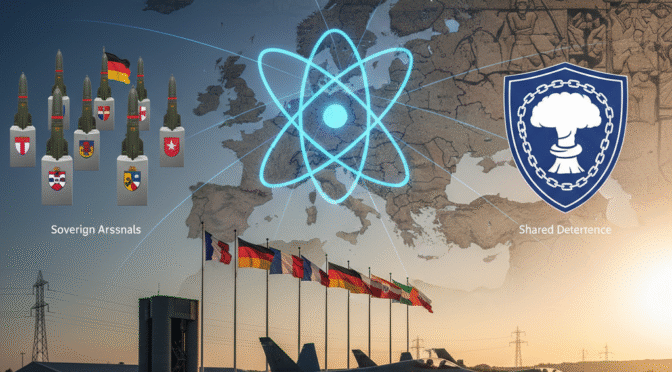
The European security landscape is defined by a complex, multi-layered nuclear deterrent posture designed to preserve peace and deter aggression. This posture is composed of two distinct but complementary elements: the sovereign, independent nuclear arsenals of the United Kingdom and France, and the extended deterrence framework of the North Atlantic Treaty Organization (NATO), which includes the forward-deployment of United States tactical nuclear weapons on the territory of five allied nations. This report provides a comprehensive analysis of these components, detailing the capabilities, doctrines, command structures, and geopolitical alignments of the relevant European states.

The United Kingdom maintains a singular, sea-based deterrent through its policy of Continuous At-Sea Deterrence (CASD). Its four Vanguard-class ballistic missile submarines, armed with U.S.-sourced Trident II D5 missiles, provide a secure second-strike capability. In a significant policy shift reflecting a deteriorating security environment, the UK has reversed a decades-long disarmament trend by announcing an increase to its nuclear warhead stockpile cap. While operationally sovereign, the UK’s deterrent is technologically intertwined with the United States and doctrinally committed to the defense of NATO.

France, in contrast, adheres to a doctrine of staunch strategic autonomy for its Force de dissuasion. Its nuclear dyad, comprising sea-based M51 ballistic missiles and air-launched ASMPA cruise missiles, operates entirely outside of NATO’s integrated military command. Governed by a principle of “strict sufficiency,” France’s arsenal is designed to protect its vital interests, which it has increasingly stated possess a “European dimension.” This has opened a strategic dialogue with European partners who are reassessing their security architecture amid questions about the long-term reliability of the U.S. security guarantee.

The most tangible expression of this guarantee is NATO’s nuclear sharing program. An estimated 100 U.S. B61 tactical gravity bombs are hosted at six air bases in Belgium, Germany, Italy, the Netherlands, and Turkey. While host nations provide dual-capable aircraft and participate in consultations through the Nuclear Planning Group, the United States retains absolute custody and control of the weapons. This arrangement serves not only as a military deterrent but also as a critical tool for alliance cohesion and non-proliferation. The strategic environment has been further complicated by Russia’s forward-deployment of nuclear weapons in Belarus, a direct counter to NATO’s posture, and the return of U.S. nuclear weapons to the United Kingdom, re-establishing a layered deterrent posture in Northern Europe.

Geopolitically, all European nuclear-armed and host nations are firmly aligned with the United States within the NATO framework, with their collective posture oriented against the primary threat posed by the Russian Federation. The relationship with China is more complex, characterized by a dichotomy of economic interdependence and systemic rivalry, but it does not supersede the primary transatlantic security alignment. The central dynamic shaping the future of European security is the burgeoning debate over “strategic autonomy,” driven by concerns over the durability of the U.S. nuclear umbrella. This has prompted an unprecedented discussion about a more independent European deterrent, a development that signals the end of the post-Cold War security order and will define the continent’s strategic trajectory for decades to come.

Part I: Sovereign European Nuclear Arsenals

Two European nations, the United Kingdom and France, possess independent, sovereign nuclear arsenals. As recognized nuclear-weapon states under the Treaty on the Non-Proliferation of Nuclear Weapons (NPT), their forces represent distinct centers of nuclear decision-making on the continent.1 While both contribute to the overall deterrence posture of the North Atlantic Treaty Organization (NATO), they operate under unique national doctrines and command and control structures that reflect different strategic traditions and philosophies.

The United Kingdom’s Continuous At-Sea Deterrent (CASD)

The United Kingdom’s nuclear strategy is defined by the principle of “minimal credible deterrence,” a posture designed to be the smallest and most cost-effective force capable of deterring a major attack by inflicting a level of damage that any potential aggressor would deem unacceptable.3 This doctrine is executed through a singular, sea-based delivery system governed by a policy of “Continuous At-Sea Deterrence” (CASD), an operational imperative known as Operation Relentless.3 This posture ensures that at least one of the Royal Navy’s nuclear-armed ballistic missile submarines (SSBNs) is on patrol, submerged and undetected, at all times. This provides a highly survivable, guaranteed second-strike capability, meaning the UK can retaliate even after absorbing a surprise first strike. The UK is the only one of the five officially recognized nuclear-weapon states to have consolidated its deterrent into a single system, having retired its air-delivered tactical nuclear weapons in 1998.3

A unique feature of the UK’s doctrine is that its nuclear forces are explicitly assigned to the defense of NATO, a commitment dating back to 1962.3 While the ultimate decision to launch remains a sovereign act of the British Prime Minister, this doctrinal integration underscores the UK’s deep commitment to the transatlantic alliance. In line with this, the UK does not adhere to a ‘no-first use’ policy. Instead, it maintains a posture of deliberate ambiguity regarding the precise circumstances under which it would employ its nuclear arsenal, stating only that it would be in “extreme circumstances of self defence, including the defence of NATO allies”.4

The physical manifestation of this deterrent is centered on a fleet of four Vanguard-class SSBNs, which are based at Her Majesty’s Naval Base Clyde in Scotland.1 These submarines are armed with the Trident II D5 submarine-launched ballistic missile (SLBM), a weapon system manufactured in the United States and procured through the deep technological and strategic partnership between the two nations.4 While each submarine is capable of carrying up to sixteen missiles, as a disarmament measure, the number of operational missiles per patrol has been reduced to eight.4 The Trident II D5 missile has an intercontinental range of approximately 12,000 km, allowing it to hold targets at risk from vast, remote patrol areas in the Atlantic Ocean.5

The nuclear warheads atop these missiles are designed and manufactured indigenously by the UK’s Atomic Weapons Establishment.5 As of early 2025, the UK’s total military stockpile is estimated at approximately 225 warheads, with an operational ceiling of 120 available for deployment on the SSBN fleet.1 Each deployed Trident missile can be equipped with up to eight Multiple Independently Targetable Re-entry Vehicles (MIRVs), enabling a single missile to strike multiple targets. However, in practice, the number of warheads loaded per submarine has been reduced from a maximum of 48 to 40 as part of past disarmament commitments.4

The United Kingdom is in the midst of a comprehensive, multi-decade modernization of its nuclear deterrent to ensure its viability well into the mid-21st century. The cornerstone of this effort is the Dreadnought program, which will see the four Vanguard-class submarines replaced by a new class of four Dreadnought-class SSBNs, scheduled to begin entering service in the early 2030s.3 Concurrently, the UK is participating in the U.S.-led service-life extension program for the Trident II D5 missile and is actively developing a new, replacement nuclear warhead to maintain the credibility of the system against evolving adversary defenses.3

This modernization program is occurring alongside a significant shift in the UK’s nuclear posture. The 2021 Integrated Review of Security, Defence, Development and Foreign Policy marked a formal end to the UK’s post-Cold War trajectory of gradual disarmament. Citing a worsening global security environment, the review announced that the UK would no longer pursue a previously stated goal of reducing its stockpile to 180 warheads. Instead, it raised the ceiling on its total warhead stockpile to no more than 260.3 Simultaneously, the government declared it would no longer provide public figures on its operational stockpile of warheads or deployed missiles, reversing a long-standing transparency policy.3 This decision predated Russia’s full-scale invasion of Ukraine but clearly reflected a strategic reassessment of the threat posed by a resurgent Russia and the proliferation of advanced military technologies. In this sense, the UK’s policy reversal can be seen as a strategic bellwether for Europe. It signaled that a major European power, one with deep intelligence and security ties to the United States, had concluded that the era of post-Cold War optimism was over and that a more robust and opaque nuclear posture was necessary. This shift helped legitimize and likely foreshadowed the broader turn toward hard-power security policies and increased defense spending seen across the continent in subsequent years.

The structure of the UK’s deterrent reveals a strategic paradox of interdependent sovereignty. Legally and operationally, the deterrent is entirely sovereign; the British Prime Minister alone holds the authority to authorize a launch, a power symbolized by the “letters of last resort” carried on board each SSBN. This sovereign capability is a cornerstone of the UK’s status as a major global actor.5 However, the deterrent’s technological foundation is deeply dependent on the United States. The Trident II D5 missiles are procured from and maintained with the support of the U.S. Navy under the terms of the Polaris Sales Agreement.5 This deep integration means that while the UK provides NATO with a valuable separate center of decision-making that complicates an adversary’s strategic calculations, the long-term viability of its nuclear force is inextricably linked to the health of the US-UK “Special Relationship” and the broader transatlantic alliance. A severe political rupture with Washington could, over time, jeopardize the very sustainability of the UK’s independent deterrent, a reality that stands in stark contrast to the French model of complete strategic autonomy.

France’s Force de Dissuasion

France’s nuclear doctrine is rooted in the Gaullist tradition of absolute national independence and strategic autonomy.9 The country’s nuclear arsenal, known as the Force de dissuasion (Deterrent Force), was developed in the 1960s to ensure France could defend itself and deter a major-power aggressor without relying on the security guarantees of other nations, particularly the United States.9

The primary purpose of the force is to deter a state-level attack on France’s “vital interests” (intérêts vitaux). This term is deliberately left undefined in public doctrine to create uncertainty in the mind of a potential adversary and thereby enhance the deterrent effect by complicating their risk calculations.10

The French posture is governed by the principle of “strict sufficiency” (stricte suffisance), which dictates that the arsenal should be maintained at the lowest possible level necessary to inflict damage so catastrophic as to be unacceptable to any aggressor, thereby deterring an attack in the first place.12 In sharp contrast to the United Kingdom, France’s nuclear forces are not integrated into NATO’s military command structure. France does not participate in the Alliance’s Nuclear Planning Group, a decision that preserves the absolute and unilateral authority of the French President to order the use of nuclear weapons.10

France currently maintains a nuclear dyad, having dismantled its land-based missile silos at the Plateau d’Albion in 1996.12 The two remaining components are:

  1. The Sea-Based Component (Force Océanique Stratégique – FOST): This is the backbone of the French deterrent, providing a permanent, survivable, and secure second-strike capability. It consists of a fleet of four Triomphant-class SSBNs, which ensures that at least one submarine is on patrol at all times, with a second often able to deploy on short notice.12 These submarines are armed with the domestically developed M51 SLBM. The M51 is a modern, solid-fueled missile with a range reported to be over 9,000 km and is capable of carrying up to six MIRVed warheads.14 This sea-based leg accounts for the vast majority of France’s nuclear firepower, with approximately 83 percent of its warheads assigned to the FOST.15
  2. The Air-Based Component (Forces Aériennes Stratégiques – FAS): This component provides the French President with greater strategic flexibility, including the ability to conduct a single, limited strike known as the ultime avertissement (final warning). This doctrinal concept envisions a carefully calibrated nuclear strike intended to demonstrate resolve and signal the unacceptable cost of continued aggression, thereby restoring deterrence before a full-scale strategic exchange. The delivery platforms are the Dassault Rafale multirole fighter aircraft. The French Air and Space Force operates nuclear-capable Rafale BF3/4 aircraft from land bases, while the French Navy operates a squadron of carrier-based Rafale MF3/4 aircraft from the nuclear-powered aircraft carrier Charles de Gaulle.1 These aircraft are armed with the ASMPA (
    Air-Sol Moyenne Portée-Amélioré) medium-range, ramjet-powered supersonic cruise missile. The ASMPA has a range of approximately 600 km and is armed with a 300-kiloton thermonuclear warhead.15

France possesses the world’s fourth-largest nuclear arsenal. Its stockpile has remained remarkably stable for several decades, currently estimated at approximately 290 operational warheads, with no weapons held in reserve.1 This reflects the doctrine of strict sufficiency, which does not require a large arsenal for counterforce targeting but rather a survivable force sufficient for a counter-value (city-targeting) retaliatory strike.

Like the UK, France is engaged in a comprehensive modernization of its deterrent. The M51 SLBM is being progressively upgraded, with the M51.3 variant expected to be operational by 2025.13 A new class of third-generation SSBNs (SNLE 3G) is under development to begin replacing the Triomphant-class in the 2030s.12 The air-based component is also being enhanced, with a program underway to develop a next-generation hypersonic air-launched missile, the ASN4G, to replace the ASMPA.

While fiercely protective of its strategic independence, France has in recent years begun to cautiously evolve its declaratory policy. Successive French presidents have stated that France’s vital interests have a “European dimension”.10 This concept was given more substance in 2020 when President Emmanuel Macron formally invited European partners to engage in a “strategic dialogue” on the role of the French deterrent in their collective security.11 This dialogue is not an offer to share command and control, which remains a sovereign prerogative of the French President. Rather, it is an effort to build a common strategic culture and understanding of the deterrent’s contribution to European stability. This has led to symbolic but significant gestures of cooperation, such as the participation of an Italian air-to-air refueling tanker in a French FAS nuclear exercise.11

This evolution in French policy can be understood as a cautious pivot from a purely national sanctuary to a potential European umbrella. Historically, the Force de dissuasion was conceived solely to guarantee the inviolability of French territory.9 However, the contemporary security environment, marked by a newly aggressive Russia and growing doubts about the long-term reliability of the U.S. security guarantee for Europe, has created a potential strategic vacuum.17 As the European Union’s only sovereign nuclear power, France is uniquely positioned to address this void.9 President Macron’s rhetoric is a calculated and incremental response to this new reality, signaling a willingness to extend the deterrent’s protective logic beyond France’s borders. This is a profound strategic development, but one that faces significant hurdles. France’s categorical refusal to share nuclear decision-making means that any French guarantee would be unilateral. This raises questions of credibility for potential beneficiary states, who may be hesitant to rely on a guarantee over which they have no influence. Nonetheless, this strategic dialogue represents the first, tentative step in a long and complex process of building the political trust that would be necessary for a credible, French-led European deterrent to emerge.

Part II: NATO’s Extended Deterrence and Nuclear Sharing

A cornerstone of the transatlantic alliance’s collective defense is the framework for U.S. nuclear weapons hosted on European soil. This posture, a direct legacy of the Cold War, is the most tangible expression of the U.S. “nuclear umbrella” over Europe. It is designed not only as a military deterrent but also as a critical political instrument for maintaining alliance cohesion and preventing nuclear proliferation among member states.

Framework and Strategic Rationale

Nuclear sharing is a unique arrangement within NATO whereby non-nuclear member states participate directly in the Alliance’s nuclear mission.19 This participation involves two key commitments from the host nations: allowing the United States to store nuclear weapons on their territory and maintaining fleets of national aircraft, known as dual-capable aircraft (DCA), that are certified to deliver these weapons in the event of a conflict.19 The underlying logic of this program is threefold and has remained consistent for decades.21

First and foremost is deterrence. The forward-deployment of U.S. tactical nuclear weapons on the continent is intended to deter aggression, principally from the Russian Federation. It signals to any potential adversary that a major conflict in Europe could cross the nuclear threshold, thereby ensuring the direct and immediate involvement of the United States’ strategic forces. This coupling of European security with American nuclear might is meant to raise the perceived costs of aggression to an unacceptably high level.

Second is alliance cohesion. By sharing the risks, responsibilities, and political burdens of nuclear deterrence, the program binds the alliance together. It provides the non-nuclear host nations with a direct role and a “seat at the table” in the formulation of NATO’s nuclear policy, primarily through their participation in the Nuclear Planning Group (NPG).19 This sense of shared ownership reinforces the principle of collective defense and demonstrates transatlantic unity and resolve.

Third is non-proliferation. Historically, the nuclear sharing program was a critical tool to dissuade key allies, notably West Germany, from pursuing their own indigenous nuclear weapons programs during the Cold War.22 By providing a credible security guarantee and a role within the NATO nuclear framework, the U.S. obviated the need for these states to develop their own arsenals. This function remains relevant today, as the presence of the U.S. nuclear umbrella is seen as a key factor in preventing further nuclear proliferation in Europe.19

The legality of these arrangements under the NPT has been a subject of debate since the treaty’s inception. Articles I and II of the NPT prohibit the transfer of nuclear weapons from nuclear-weapon states to non-nuclear-weapon states.25 NATO and the United States argue that the sharing program is fully compliant with the treaty based on a specific legal interpretation: in peacetime, the U.S. maintains absolute and exclusive custody and control of the weapons. No “transfer” of weapons or control over them occurs. The scenario in which a transfer might take place—a decision to go to war—is considered a circumstance under which the treaty’s peacetime constraints would no longer be controlling.16 While this interpretation was understood and accepted by the Soviet Union during the NPT negotiations, it remains a point of contention for many non-aligned states and disarmament advocates who view the practice as a violation of the spirit, if not the letter, of the treaty.

Host Nations and Forward-Deployed Assets

The sole type of U.S. nuclear weapon currently deployed in Europe under the sharing arrangement is the B61 tactical gravity bomb.1 These weapons are undergoing a comprehensive Life Extension Program to modernize them into the B61-12 variant. This new version is a significant upgrade; it incorporates a new tail kit that provides GPS guidance, dramatically increasing its accuracy and allowing it to be used against a wider range of targets. It also features a variable-yield capability, allowing its explosive power to be dialed down for more limited, tactical strikes or up for greater effect, making it a more flexible and, in the view of some strategists, a more “usable” weapon.28

An estimated 100 of these U.S.-owned B61 bombs are stored in highly secure underground WS3 vaults at six air bases across five NATO host nations.1 The table below provides a consolidated overview of these deployments.

Host NationAir BaseEstimated U.S. B61 WarheadsHost Nation Dual-Capable Aircraft (Current/Planned)
BelgiumKleine Brogel10–15F-16 Fighting Falcon (being replaced by F-35A)
GermanyBüchel10–15PA-200 Tornado (being replaced by F-35A)
ItalyAviano & Ghedi30–45 (total)PA-200 Tornado (at Ghedi, being replaced by F-35A)
NetherlandsVolkel10–15F-16 Fighting Falcon (replaced by F-35A)
TurkeyIncirlik20–30F-16 Fighting Falcon (Note: Turkey removed from F-35 program)
Data compiled from sources 1, and.25

The modernization of the host nations’ DCA fleets is a critical component of maintaining the credibility of the sharing program. Belgium, Germany, Italy, and the Netherlands are all in the process of procuring the nuclear-capable F-35A Lightning II stealth fighter to replace their aging F-16 and Tornado aircraft.27 This transition to a 5th-generation platform significantly enhances the survivability of the delivery mission against modern air defense systems. Turkey’s participation has been complicated by its removal from the F-35 program in 2019 following its purchase of the Russian S-400 air defense system, leaving its future role in the nuclear mission reliant on its existing F-16 fleet.27

Command, Control, and Consultation

The command and control structure for NATO’s shared nuclear weapons is designed to ensure absolute political control and safety. Despite the weapons being hosted on allied territory and designated for delivery by allied aircraft, the United States maintains absolute and unilateral custody and control over them at all times during peacetime.6 The security of the weapons on the ground is handled by U.S. Air Force personnel. Crucially, the Permissive Action Link (PAL) codes, which are sophisticated cryptographic locks required to arm the weapons, remain exclusively in American hands.28 Without these codes, the bombs are inert.

The term “dual-key” is often used to describe the arrangement, but this can be misleading. It does not refer to a physical system where two parties must turn a key simultaneously. Instead, it represents the dual political authority required for any use of the weapons. Any decision to employ a shared nuclear weapon would require explicit authorization from the President of the United States. This presidential authorization would only be given following a collective political decision reached through intense consultation among the allies within NATO’s highest nuclear policy body, the Nuclear Planning Group (NPG).19 In a conflict scenario, following such a dual political decision, U.S. personnel would release the armed weapon to the host nation’s certified DCA crew for the delivery mission.

The NPG is the primary consultative body for all matters concerning NATO’s nuclear policy and posture. All NATO allies are members with the notable exception of France, which has chosen to remain outside this structure to preserve its strategic independence.6 The NPG provides the formal forum where non-nuclear allies, particularly the host nations, can participate in shaping the Alliance’s nuclear strategy, doctrine, and operational planning. It is the institutional heart of the political dimension of nuclear sharing.19

The persistence and modernization of the nuclear sharing program, despite ongoing debates about the military utility of air-delivered gravity bombs against an adversary with sophisticated air defenses like Russia, points to its deeper strategic value.31 While some strategists question whether a non-stealthy aircraft could successfully penetrate Russian airspace to deliver a B61 bomb, the program’s political and symbolic importance to the Alliance is consistently emphasized by NATO officials.19 The program is a prime example of a military posture whose political value is arguably greater than its purely operational utility. The physical presence of U.S. weapons and personnel on European soil serves as the ultimate “tripwire,” a tangible commitment that inextricably links America’s security to that of its European allies. It is this political act of sharing the nuclear burden and risk that binds the alliance, making the program a vital instrument of transatlantic cohesion, irrespective of the evolving military-technological landscape.

Part III: The Broader European Nuclear Landscape

Beyond the sovereign arsenals of the UK and France and the formal NATO nuclear sharing arrangements, several other crucial developments shape the European nuclear environment. These elements, occurring both as a direct counter to and as an evolution of the established NATO posture, are reshaping the strategic calculus and introducing new complexities to deterrence and stability on the continent.

The Russian Counterpart: Nuclear Basing in Belarus

In a significant strategic development that alters the post-Cold War security architecture, the Russian Federation has forward-deployed tactical nuclear weapons onto the territory of its ally, Belarus.2 Moscow has explicitly framed this action as a direct and symmetric response to NATO’s long-standing nuclear sharing arrangements, arguing that it is merely mirroring a practice the West has engaged in for decades.2 This move, however, carries profound strategic implications that extend far beyond simple reciprocity.

Geographically, placing nuclear assets in Belarus moves them significantly closer to NATO’s eastern flank. This positioning drastically reduces warning times for potential targets and holds key political centers, military bases, and critical infrastructure in Poland, the Baltic States, and even eastern Germany at greater risk. The deployment provides Russia with additional, more flexible options for nuclear signaling or limited use in a regional conflict. It complicates NATO’s defense planning and escalation management by creating new attack vectors and forcing the Alliance to account for nuclear threats originating from outside Russian sovereign territory.

Furthermore, the deployment serves as a powerful tool of political subjugation. It effectively cements Belarus’s status as a military client state of Russia, stripping Minsk of any remaining strategic autonomy and transforming its territory into a forward operating base for Russian power projection. This move is not merely a tactical repositioning of military assets; it is a deliberate political act designed to dismantle a key pillar of the post-Cold War European security order. Following the collapse of the Soviet Union, the 1991 Presidential Nuclear Initiatives led to a mutual, albeit informal, withdrawal of thousands of tactical nuclear weapons from forward deployments by both the United States and Russia. Former Soviet republics like Ukraine, Kazakhstan, and Belarus voluntarily returned their inherited nuclear weapons to Russia, establishing a de facto norm against the stationing of Russian nuclear weapons outside its own borders.2 The deployment to Belarus shatters this three-decade-old norm, signaling Russia’s definitive rejection of past arms control conventions and its intent to pursue a more confrontational, nuclear-backed coercive diplomacy against NATO.

A Special Case: U.S. Nuclear Weapons in the United Kingdom

The nuclear landscape in Europe is further layered by the unique situation in the United Kingdom. After being withdrawn in 2008, marking the end of a 50-year presence, U.S. nuclear weapons are confirmed to be returning to the Royal Air Force (RAF) base at Lakenheath.5 It is anticipated that these weapons will be the modernized B61-12 gravity bombs, intended for delivery by U.S. Air Force F-35A aircraft stationed at the base.20

This deployment is strategically distinct from the NATO nuclear sharing program. The UK is a sovereign nuclear-weapon state in its own right. The weapons at Lakenheath will be stored, maintained, and, if ever used, delivered by U.S. forces, not by RAF pilots.5 This arrangement does not involve the “sharing” of nuclear burdens with a non-nuclear host but rather the forward-basing of U.S. assets on the territory of a nuclear-armed ally.

The rationale for this move is multifaceted. Operationally, it provides the U.S. and NATO with an additional, highly secure forward-basing location in Northern Europe. This increases the survivability of the tactical nuclear force by dispersing the assets and enhances operational flexibility. Politically, the move is a powerful reaffirmation of the unique US-UK “Special Relationship” in defense and security matters. It creates a multi-layered nuclear deterrent posture on British soil, combining the UK’s sovereign sea-based deterrent with hosted U.S. air-delivered assets. Most importantly, the return of U.S. nuclear weapons to a location from which they were previously removed sends an unambiguous signal to Moscow. It demonstrates a heightened threat perception and a renewed, long-term commitment to nuclear deterrence in Europe in response to Russian aggression.

This development signifies a full-circle return to a more robust and complex deterrence architecture reminiscent of the Cold War. During that era, the UK hosted a vast array of U.S. nuclear systems, including gravity bombs, missiles, and artillery, in addition to its own sovereign force, creating a dense, “layered” deterrent posture.5 The post-Cold War period saw a dramatic consolidation and reduction of this presence, culminating in the 2008 withdrawal.25 The decision to return U.S. weapons to Lakenheath, coupled with the UK’s own arsenal modernization and its recent decision to acquire F-35As to contribute to the NATO nuclear mission, effectively re-establishes this layered model.3 This suggests that strategic planners in Washington and London have concluded that a single deterrent system is no longer sufficient to address the current threat environment. The new posture aims to maximize complexity for Russian military planners by creating multiple, redundant, and geographically dispersed nuclear options under different command structures (USAFE and UK sovereign), thereby strengthening the overall credibility and resilience of NATO’s deterrent posture.

Part IV: Geopolitical Alignment and Strategic Imperatives

The technical details and operational doctrines of Europe’s nuclear forces are underpinned by a clear and deeply entrenched geopolitical alignment. This section synthesizes the preceding analysis into a broader assessment of the strategic posture of European nuclear actors, the overarching purpose of their capabilities, and the emerging dynamics that will shape the future of deterrence on the continent.

Unaltered Alignment within the Transatlantic Alliance

The geopolitical posture of all European nations possessing or hosting nuclear weapons—the United Kingdom, France, Belgium, Germany, Italy, the Netherlands, and Turkey—is fundamentally and unequivocally aligned with the United States through their membership in the North Atlantic Treaty Organization (NATO).24 This alliance forms the bedrock of their national security policies. Their collective defense posture, including its nuclear dimension, is explicitly oriented against the primary perceived military and existential threat from the Russian Federation.

Russia’s full-scale invasion of Ukraine in 2022 served as a powerful and clarifying event, forcing a hard realignment of European security policy and dispelling any lingering post-Cold War illusions about a potential partnership with Moscow. The war effectively terminated decades of policies predicated on economic engagement, such as Germany’s Ostpolitik (Eastern Policy) and the concept of Wandel durch Handel (change through trade), which posited that economic interdependence would lead to political moderation.34 Across the continent, from Rome to Brussels, national governments subordinated economic interests to the overriding imperative of collective defense against Russian aggression.37

Even France, which maintains a posture of strategic independence from NATO’s integrated military command, remains a core political member of the Alliance. Its independent deterrent is widely understood, both in Paris and within NATO, to contribute significantly to the overall security of the Alliance. By creating a second, sovereign center of nuclear decision-making, France complicates the strategic calculations of any potential adversary, thereby strengthening NATO’s overall deterrent effect.6

Navigating the China Challenge

The relationship of these European nations with the People’s Republic of China is significantly more nuanced and complex. For all European capitals, China represents a multifaceted challenge, simultaneously acting as a vital economic partner, a formidable technological competitor, and a systemic rival that promotes an alternative vision of global governance that challenges the Western-led, rules-based international order.35

This has led to the adoption of a strategy broadly defined as “de-risking, not decoupling”.40 This approach seeks to reduce critical strategic dependencies on Chinese supply chains—particularly in sensitive areas like rare earth minerals, semiconductors, and pharmaceuticals—without completely severing the deep economic ties that are vital to European prosperity.41 This creates a persistent tension within European policymaking, as governments attempt to balance pressing economic interests against long-term security concerns.

However, despite these deep economic entanglements, the primary security alignment of European nations remains firmly with the United States. In the face of a direct military threat, there is no ambiguity. European nations are increasingly coordinating with Washington on strategic challenges posed by China, including through increased naval presence in the Indo-Pacific and stricter controls on technology transfers. Nevertheless, this relationship lacks the formal, treaty-based collective defense obligation that defines their posture towards Russia. In the strategic hierarchy of European capitals, China is a long-term, systemic challenge; Russia is a direct and present existential threat.

Strategic Implications and Future Trajectories

The core strategic purpose of Europe’s multifaceted nuclear posture remains threefold. First is deterrence: to prevent a major conventional or nuclear attack by the Russian Federation by ensuring the costs of such aggression would be unacceptably high. Second is reassurance: to assure non-nuclear NATO allies that they are protected under a credible nuclear umbrella, thereby obviating any incentive for them to develop their own nuclear weapons and preventing proliferation on the continent. Third is political solidarity: to serve as the ultimate symbol of the transatlantic security bond, demonstrating that an attack on one member is an attack on all.

The central dynamic shaping the future of European nuclear policy is a growing crisis of confidence in the long-term reliability and durability of the U.S. security guarantee.16 This uncertainty is driven by a perception of a long-term U.S. strategic pivot towards Asia to counter China, as well as by concerns about American political volatility and the potential for a future administration to adopt a more isolationist or transactional foreign policy.17

This crisis of confidence has ignited an unprecedented and increasingly mainstream debate across Europe about the need for greater “strategic autonomy” and the potential development of a more independent European nuclear deterrent.7 This discussion, once confined to academic circles, is now being publicly broached by senior political leaders. Proposals range from the more plausible, such as extending the existing French and/or British deterrents to formally cover other allies, to more radical and complex ideas of a “Eurobomb” with shared financing, command, and control.23 Key nations like Germany and Poland, which have historically been the primary beneficiaries of and strongest advocates for the U.S. nuclear umbrella, are now openly engaging in strategic dialogues with France about these very options.10 This emerging debate confronts Europe with a fundamental strategic trilemma: accept a future of potential vulnerability under a possibly wavering U.S. guarantee; pursue a collective European deterrent that would require an unprecedented ceding of national sovereignty over matters of ultimate survival; or risk a future of uncontrolled national proliferation as individual states seek their own security solutions.42

These developments collectively signal the definitive end of the post-Cold War interregnum. For three decades following the fall of the Berlin Wall, the European security order was predicated on a set of assumptions: the unchallenged military and political supremacy of the U.S./NATO alliance, the relative weakness and integration of Russia, and the primacy of economic interdependence as a guarantor of peace. Nuclear weapons were often viewed as a legacy issue, their relevance fading in a new era of cooperation. Russia’s revanchist war in Ukraine, China’s rise as a systemic rival, and a perception of U.S. strategic retrenchment have shattered all three of these foundational pillars. As a result, nuclear deterrence has returned to the forefront of European strategic thought for the first time in a generation.7 Europe is at the end of a historical interregnum and is being forced to fundamentally re-architect its security framework. The current nuclear posture is a product of the Cold War. The ongoing debates about extending the French deterrent, the return of U.S. nuclear weapons to the UK, and Russia’s forward-deployment in Belarus are not isolated events but symptoms of a system in profound flux. The key strategic question for the next decade is whether the existing transatlantic framework will be reinforced and adapted, or if it will be supplemented—or even partially replaced—by a new, more distinctly European nuclear deterrent structure. The outcome of this debate will define the continent’s security landscape for the 21st century.

Summary of European Nuclear Deployments

Table 1: Sovereign European Nuclear Arsenals

This table details the nuclear arsenals under the independent, sovereign control of European nations.

CountryEstimated Total WarheadsPrimary Locations / Delivery Systems
United Kingdom~225 1Sea-based: Four Vanguard-class ballistic missile submarines operating from HMNB Clyde, Scotland, armed with Trident II D5 missiles.5
France~290 2Sea-based: Four Triomphant-class ballistic missile submarines armed with M51 missiles.12
Air-based: Rafale fighter aircraft (land and carrier-based) armed with ASMPA cruise missiles.12

Table 2: U.S. Forward-Deployed Nuclear Weapons in Europe

This table details the U.S.-owned B61 tactical nuclear bombs deployed in Europe under NATO’s nuclear sharing program and other bilateral agreements. The U.S. retains absolute custody and control of these weapons.6

Host NationAir Base(s)Estimated U.S. B61 Warheads
BelgiumKleine Brogel 110–15 20
GermanyBüchel 110–15 20
ItalyAviano & Ghedi 130–45 20
NetherlandsVolkel 110–15 20
TurkeyIncirlik 120–30 20
United Kingdom*RAF Lakenheath 525–30 20

*Note: The deployment to the UK is distinct from the NATO nuclear sharing program. The weapons are for delivery by U.S. forces stationed at the base, not RAF pilots.5

Table 3: Combined Summary of All Nuclear Weapons in Europe

This table provides a consolidated overview of all known nuclear weapons physically located in Europe, combining sovereign arsenals and U.S. forward-deployed assets.

CountryArsenal TypeEstimated Warhead CountLocation(s) / Base(s)
FranceSovereign~290Sea-based (SSBNs) & Air-based (Rafale aircraft) 12
United KingdomSovereign~225HMNB Clyde (Sea-based SSBNs) 5
ItalyHosted U.S.30–45Aviano & Ghedi Air Bases 1
United KingdomHosted U.S.25–30RAF Lakenheath 5
TurkeyHosted U.S.20–30Incirlik Air Base 1
BelgiumHosted U.S.10–15Kleine Brogel Air Base 1
GermanyHosted U.S.10–15Büchel Air Base 1
NetherlandsHosted U.S.10–15Volkel Air Base 1
Total Estimated~620–685

Conclusion

The nuclear posture in Europe is a complex tapestry woven from sovereign capabilities, alliance commitments, and a shared perception of threat. It is not a monolithic entity but a dynamic, multi-layered system with distinct centers of command and diverse strategic logics. The independent arsenals of the United Kingdom and France provide two sovereign pillars of deterrence. The UK’s sea-based force is technologically linked to the United States and doctrinally integrated with NATO, while France’s dyad stands as a testament to the enduring Gaullist ideal of strategic autonomy. Complementing these is the NATO nuclear sharing arrangement, a Cold War legacy that remains a potent symbol of transatlantic cohesion and the ultimate guarantee of the U.S. commitment to European security.

All European nations involved in this nuclear architecture—whether as sovereign powers or as hosts for U.S. weapons—are firmly aligned within the transatlantic security framework. Their collective deterrent is unambiguously aimed at countering the primary threat posed by the Russian Federation, a reality that has been starkly reinforced by the war in Ukraine. While navigating a complex economic relationship with China, their fundamental security orientation remains fixed on the Euro-Atlantic area.

However, this long-standing architecture is now facing its most significant challenge since the end of the Cold War. A crisis of confidence in the long-term reliability of the U.S. nuclear umbrella has forced European nations to confront uncomfortable questions about their own security. The resulting debate on strategic autonomy and the potential for a more independent European deterrent marks a pivotal moment. The decisions made in the coming years in Paris, London, Berlin, and Warsaw will determine whether the continent reinforces its reliance on the transatlantic partnership or begins to forge a new, more autonomous path. The nuclear landscape in Europe, stable for decades, has entered a period of profound and consequential transformation.


If you find this post useful, please share the link on Facebook, with your friends, etc. Your support is much appreciated and if you have any feedback, please email me at in**@*********ps.com. Please note that for links to other websites, we are only paid if there is an affiliate program such as Avantlink, Impact, Amazon and eBay and only if you purchase something. If you’d like to directly contribute towards our continued reporting, please visit our funding page.


Sources Used

  1. Nuclear Weapons: Who Has What at a Glance – Arms Control Association, accessed September 26, 2025, https://www.armscontrol.org/factsheets/nuclear-weapons-who-has-what-glance
  2. List of states with nuclear weapons – Wikipedia, accessed September 26, 2025, https://en.wikipedia.org/wiki/List_of_states_with_nuclear_weapons
  3. Nuclear weapons profile: United Kingdom – The House of Commons Library, accessed September 26, 2025, https://commonslibrary.parliament.uk/research-briefings/cbp-9077/
  4. Nuclear Disarmament United Kingdom – Nuclear Threat Initiative (NTI), accessed September 26, 2025, https://www.nti.org/analysis/articles/united-kingdom-nuclear-disarmament/
  5. Nuclear weapons of the United Kingdom – Wikipedia, accessed September 26, 2025, https://en.wikipedia.org/wiki/Nuclear_weapons_of_the_United_Kingdom
  6. NATO’s nuclear deterrence policy and forces, accessed September 26, 2025, https://www.nato.int/cps/en/natohq/topics_50068.htm
  7. Taking the Pulse: Can Europeans Build Their Independent Extended Nuclear Deterrent?, accessed September 26, 2025, https://carnegieendowment.org/europe/strategic-europe/2025/04/taking-the-pulse-can-europeans-build-their-independent-extended-nuclear-deterrent?lang=en
  8. en.wikipedia.org, accessed September 26, 2025, https://en.wikipedia.org/wiki/Nuclear_weapons_of_the_United_Kingdom#:~:text=As%20of%202025%2C%20the%20UK,at%20RAF%20Lakenheath%20since%202025.
  9. France and weapons of mass destruction – Wikipedia, accessed September 26, 2025, https://en.wikipedia.org/wiki/France_and_weapons_of_mass_destruction
  10. Can Europe Build Its Own Nuclear Umbrella? | Carnegie …, accessed September 26, 2025, https://carnegieendowment.org/emissary/2025/04/can-europe-build-its-own-nuclear-umbrella?lang=en
  11. The French nuclear deterrent in a changing strategic environment :: Note de la FRS, accessed September 26, 2025, https://www.frstrategie.org/en/publications/notes/french-nuclear-deterrent-changing-strategic-environment-2025
  12. France – Nuclear Threat Initiative (NTI), accessed September 26, 2025, https://www.nti.org/countries/france/
  13. Nuclear Disarmament France, accessed September 26, 2025, https://www.nti.org/analysis/articles/france-nuclear-disarmament/
  14. France’s Nuclear Inventory – Center for Arms Control and Non-Proliferation, accessed September 26, 2025, https://armscontrolcenter.org/wp-content/uploads/2020/03/France.pdf
  15. Arms Control and Proliferation Profile: France, accessed September 26, 2025, https://www.armscontrol.org/factsheets/arms-control-and-proliferation-profile-france
  16. Can France and the United Kingdom Replace the U.S. Nuclear …, accessed September 26, 2025, https://www.csis.org/analysis/can-france-and-united-kingdom-replace-us-nuclear-umbrella
  17. US Extended Nuclear Deterrence in Europe: Three Scenarios …, accessed September 26, 2025, https://www.swp-berlin.org/publikation/us-extended-nuclear-deterrence-in-europe-three-scenarios
  18. The Trump card: What could US abandonment of Europe look like?, accessed September 26, 2025, https://www.iss.europa.eu/publications/briefs/trump-card-what-could-us-abandonment-europe-look
  19. NATO’s Nuclear Sharing Arrangements, accessed September 26, 2025, https://www.nato.int/nato_static_fl2014/assets/pdf/2022/2/pdf/220204-factsheet-nuclear-sharing-arrange.pdf
  20. Nuclear sharing – Wikipedia, accessed September 26, 2025, https://en.wikipedia.org/wiki/Nuclear_sharing
  21. 11. Nuclear Sharing and NATO as a ‘Nuclear Alliance’ – Egmont Institute, accessed September 26, 2025, https://www.egmontinstitute.be/app/uploads/2021/12/ch11.pdf?type=pdf
  22. Articulating the logic of nuclear-sharing – Egmont Institute, accessed September 26, 2025, https://www.egmontinstitute.be/app/uploads/2019/09/SPB116.pdf
  23. European Nuclear Weapons – Verfassungsblog, accessed September 26, 2025, https://verfassungsblog.de/nuclear-weapons/
  24. Six of the ten locations with nuclear weapons in Europe are American – Reddit, accessed September 26, 2025, https://www.reddit.com/r/nuclearweapons/comments/1glpjv8/six_of_the_ten_locations_with_nuclear_weapons_in/
  25. United States nuclear weapons in Europe | CND, accessed September 26, 2025, https://cnduk.org/wp/wp-content/uploads/2018/02/US-nuclear-weapons-in-Europe.pdf
  26. NATO: Nuclear Sharing or Proliferation?, accessed September 26, 2025, https://www.files.ethz.ch/isn/90409/05-04%20NATO%20Nuclear%20Sharing%20or%20Proliferation.pdf
  27. Nuclear Disarmament NATO, accessed September 26, 2025, https://www.nti.org/analysis/articles/nato-nuclear-disarmament/
  28. Fact Sheet: U.S. Nuclear Weapons in Europe, accessed September 26, 2025, https://armscontrolcenter.org/fact-sheet-u-s-nuclear-weapons-in-europe/
  29. Countries with nuclear weapons – ICAN, accessed September 26, 2025, https://www.icanw.org/nuclear_arsenals
  30. COMMANDING AND CONTROLLING NUCLEAR WEAPONS – Program on Science and Global Security, accessed September 26, 2025, https://sgs.princeton.edu/sites/default/files/2020-01/mian-2012b.pdf
  31. Reconsidering U.S. nuclear weapons in Europe – Defense Priorities, accessed September 26, 2025, https://www.defensepriorities.org/reports/reconsidering-us-nuclear-weapons-in-europe/
  32. More investment in nuclear deterrence will not make Europe safer | SIPRI, accessed September 26, 2025, https://www.sipri.org/commentary/essay/2023/more-investment-nuclear-deterrence-will-not-make-europe-safer
  33. Turkiye And The West: Between Geopolitical Risks And Strategic Roots – Hoover Institution, accessed September 26, 2025, https://www.hoover.org/research/turkiye-and-west-between-geopolitical-risks-and-strategic-roots
  34. Germany–Russia relations – Wikipedia, accessed September 26, 2025, https://en.wikipedia.org/wiki/Germany%E2%80%93Russia_relations
  35. Germany’s Continued Illusions About China and Russia, accessed September 26, 2025, https://carnegieendowment.org/europe/strategic-europe/2022/10/germanys-continued-illusions-about-china-and-russia?lang=en
  36. Russian Geopolitical Challenges: Economic Relations with Germany | Defense.info, accessed September 26, 2025, https://defense.info/global-dynamics/2025/08/russian-geopolitical-challenges-economic-relations-with-germany/
  37. Belgium–Russia relations – Wikipedia, accessed September 26, 2025, https://en.wikipedia.org/wiki/Belgium%E2%80%93Russia_relations
  38. Italy’s challenging divorce from Russia | ECFR – European Council on Foreign Relations, accessed September 26, 2025, https://ecfr.eu/article/italys-challenging-divorce-from-russia/
  39. The ambassador – Russian Federation – Netherlandsandyou.nl, accessed September 26, 2025, https://www.netherlandsandyou.nl/web/russian-federation/about-us/ambassador
  40. Why we won’t abandon China | FPS Foreign Affairs – Foreign Trade and Development Cooperation – Belgium.be, accessed September 26, 2025, http://diplomatie.belgium.be/en/policy/policy-areas/highlighted/why-we-wont-abandon-china
  41. Germany’s China Policy: Has It Learned From Its Dependency on Russia?, accessed September 26, 2025, https://www.cfr.org/in-brief/germanys-china-policy-has-it-learned-its-dependency-russia
  42. How can Europe’s nuclear deterrence trilemma be resolved? – Bruegel, accessed September 26, 2025, https://www.bruegel.org/working-paper/how-can-europes-nuclear-deterrence-trilemma-be-resolved
  43. Europe’s Nuclear Deterrent: The Here and Now, accessed September 26, 2025, https://www.iiss.org/online-analysis/survival-online/2025/06/europes-nuclear-deterrent-the-here-and-now/

Systemic Fragility Analysis of the Philippines: A 36-Month Predictive Outlook – Q4 2025

  • Overall Fragility Score: 6.8 / 10.0
  • Lifecycle Stage Assessment: STRESSED. The state maintains core functionality but exhibits significant erosion in institutional resilience, social cohesion, and capacity to absorb shocks. Chronic stressors are accumulating faster than they are being mitigated, increasing systemic brittleness.

Key Drivers of Fragility:

  1. Extreme Climate Vulnerability: Acts as a primary systemic risk multiplier, capable of triggering cascading failures across all other domains.
  2. Entrenched Corruption and Dynastic Politics: Systematically erodes state capacity, public trust, and economic efficiency, creating a vicious cycle of institutional decay.
  3. Geopolitical Pressure in the South China Sea: Creates a high-stakes “sovereignty dilemma” that consumes strategic bandwidth and risks a destabilizing confrontation the state is ill-prepared for.
  4. Structural Economic Weaknesses: High dependence on volatile remittances and imports, coupled with deep-seated inequality, creates a fragile foundation for household and national financial health.
  • Forecast Trajectory (36-Month Horizon): Deteriorating. The confluence of acute external shocks (geopolitical, climate) and chronic internal weaknesses (governance, inequality) makes a gradual decline in stability the most likely trajectory. The probability of a rapid, non-linear shift to a Crisis stage, triggered by a specific tipping point event, is assessed as significant and rising.

State Fragility Dashboard

Domain/IndicatorCurrent Score (1-10)Trend (Δ)VolatilityWeighted Impact (%)Brief Rationale & Key Data Points
A. ECONOMIC(25%)
A.1 Public Finances7Med7%Debt-to-GDP persists above 60% threshold.1 Structural deficit (5.7% of GDP) 3 limits fiscal space for shock response.
A.2 Economic Structure6High8%High reliance on remittances (8.3% of GDP) 5 and food/energy imports 7 creates external vulnerability. FDI lags ASEAN peers.9
A.3 Household Financial Health7Med10%Deep inequality (Gini 39.3) 11 and high poverty (15.5%) 12 erode social contract. Household debt at all-time high.14
B. POLITICAL(30%)
B.1 Governance/Rule of Law8Low15%Endemic corruption (CPI Score 33/100) 16 and dynastic politics (~80% of governors) 18 are chronic and deeply entrenched.
B.2 Geopolitical Posture7High10%Escalating SCS incidents with China 19 create high-impact/high-volatility risk. Alliance with US strengthening but strains state capacity.21
B.3 Internal Security5Med5%NPA/ASG threats diminished but still divert resources.23 BARMM peace process fragile, transition extended.25
C. SOCIAL(20%)
C.1 Social Fragmentation7High10%Deep urban-rural divide in services.27 Disinformation fuels polarization and erodes institutional trust.29
C.2 Public Services/Welfare7Med10%Chronic underperformance in public health, education, and infrastructure 31 is a primary source of public grievance.
D. ENVIRONMENTAL(25%)
D.1 Climate Vulnerability9High15%Ranked among world’s most at-risk nations.34 A single major typhoon can trigger systemic shock.36 Metro Manila highly exposed.37
D.2 Resource Stress6Med10%Chronic rice import dependency (~15-30%) 7, urban water stress 40, and declining fish stocks 41 undermine resilience.
OVERALL FRAGILITY SCORE6.8100%Assessed Lifecycle Stage: STRESSED

Detailed Domain Analysis

Module A: Economic Resilience and State Capacity

The Philippine economy presents a paradox of surface-level dynamism undercut by deep structural vulnerabilities. While exhibiting strong headline growth relative to its regional peers, its foundations are brittle, characterized by constrained public finances, high external dependencies, and severe household precarity.

A.1 Public Finances

The state’s fiscal position is a primary source of systemic constraint. The national government’s debt-to-GDP ratio stood at 60.7% at the end of 2024, hovering persistently above the 60% international benchmark for prudence.1 This elevated debt level constrains the government’s ability to respond to shocks. The budget deficit for 2024 was recorded at 5.7% of GDP, an improvement from post-pandemic highs but still indicative of a significant structural gap between revenue and expenditure.3 This deficit slightly overshot the government’s own target of 5.6%, highlighting the difficulty of fiscal consolidation.4

This dynamic illustrates a “fiscal pincer” movement. On one side, spending pressures are immense and growing. These include the ambitious “Build Better More” infrastructure program, allocated ₱1.5 trillion (5.2% of GDP) in the 2025 budget, and a massive ₱2.1 trillion allocation for social services.45 Added to this are the rising costs of defense modernization required to address external threats.46 On the other side, revenue capacity, despite recent improvements, is structurally limited by a large informal economy and persistent tax collection inefficiencies.

While revenue collection as a percentage of GDP reached a 27-year high of 16.72% in 2024, this positive headline figure is deceptive.47 Government expenditures grew by a substantial 11.04% in the same period, driven not only by programmatic spending but also by soaring debt servicing costs.47 Interest payments alone are projected to consume 13.8% of the entire 2025 national budget, a 25.4% increase from the previous year.45 This demonstrates that even with improved revenue generation, an increasing share of state funds is immediately consumed by past liabilities rather than being invested in new services or infrastructure. The state’s discretionary fiscal space is shrinking, pushing it into a cycle of debt financing that erodes its capacity to manage future crises.

A.2 Economic Structure & Productivity

The Philippine economic model is defined by its heavy reliance on external factors, creating significant volatility. The economy is critically dependent on remittances from its overseas workforce (OFWs), which reached a record $38.34 billion in 2024, equivalent to 8.3% of GDP.5 These inflows are the primary engine of domestic consumption, but they tether the nation’s economic health to the employment markets and political stability of host countries, which are beyond Manila’s control.

This “remittance-consumption model” has fostered a structural dependency that inhibits the development of a robust domestic productive base. The steady supply of foreign currency from remittances supports consumption, much of which is directed toward imported goods. This disincentivizes long-term investment in a competitive, export-oriented industrial sector. The consequences are evident in the country’s struggle to attract high-value foreign direct investment (FDI). Net FDI inflows were stagnant at $8.9 billion in 2024, a negligible 0.1% increase from 2023 and below the government’s target.48 The Philippines continues to lag far behind its ASEAN neighbors, such as Indonesia, which attracted $24.2 billion in FDI.10

The underlying data on FDI reveals an even more concerning trend. While the headline figure was flat, greenfield investments—new projects built from the ground up, which represent long-term strategic commitments—plummeted by 58% in 2024.10 This sharp decline suggests that while existing investors may be maintaining their operations, new strategic capital is flowing elsewhere in the region, deterred by persistent issues like high power costs, poor infrastructure, and regulatory uncertainty.50

This lack of a strong productive base is reflected in the country’s import dependency. The Philippines is a net importer of critical commodities, running a trade deficit of $3.54 billion in August 2025 alone.51 It consistently imports 15-30% of its annual rice supply, a core food staple, leaving it vulnerable to global price volatility and export bans.7 Similarly, the energy sector is highly import-dependent, with fossil fuels accounting for 79% of electricity and over half of the total energy supply being imported.8 While the labor market shows a low official unemployment rate (3.8% for 2024), this masks a high underemployment rate (11.9% in 2024, rising to 14.8% in July 2025), which points to a prevalence of low-quality, low-wage jobs.53

A.3 Household Financial Health

The financial condition of the average Filipino household is precarious, defined by deep inequality and a thin buffer against economic shocks. The Gini coefficient, a measure of income inequality, was 39.3 in 2023.11 While this represents an improvement and falls just below the technical threshold for “high inequality,” it still signifies a vast chasm between the wealthy elite and the rest of the population.13

Poverty remains widespread, with a national poverty incidence of 15.5% in 2023, translating to 17.5 million Filipinos unable to meet their basic needs.12 This poverty is disproportionately concentrated in rural areas (22.1%) and among agricultural and fishing communities, where poverty rates for farmers (27.0%) and fisherfolk (27.4%) are dramatically higher than the national average.55

Against this backdrop of low incomes and inequality, household debt is rising to alarming levels. As a percentage of GDP, household debt reached an all-time high of 11.7% in December 2024, with the total amount hitting $53.2 billion.14 This increase is not a sign of a confident, thriving consumer class taking on leverage for investment. Rather, when viewed alongside high underemployment and food price volatility, it indicates financial distress. Households, particularly the large cohort of “near-poor” living just above the poverty line, are increasingly resorting to debt to finance basic daily consumption. This creates a significant, often hidden, vulnerability within the financial system. A systemic shock, such as a sharp drop in remittances or a wave of layoffs, could trigger widespread defaults, posing a risk to the banking sector—a concern highlighted by the IMF’s monitoring of rapid consumer loan growth.56 This deep-seated financial precarity corrodes the social contract, eroding trust in institutions and making the population more susceptible to populist politics and social unrest.

Module B: Political Legitimacy and Institutional Integrity

The integrity of the Philippine state is chronically undermined by systemic governance failures, while its stability is increasingly challenged by a complex external security environment and persistent internal conflicts.

B.1 Governance and Rule of Law

The institutions of governance suffer from a profound legitimacy deficit rooted in endemic corruption and elite capture. The Philippines scored a dismal 33 out of 100 on the 2024 Transparency International Corruption Perception Index, ranking 114th out of 180 countries.16 This score has stagnated for years, reflecting deep structural barriers that include weak law enforcement, opaque public procurement processes, and significant judicial delays that undermine accountability.17

This environment of corruption is enabled and perpetuated by the increasing dominance of political dynasties. By 2025, an estimated 80% of provincial governors and 67% of the House of Representatives belonged to these powerful families.18 This concentration of power transforms politics from a competition of policy into a mechanism for resource extraction by a few elite clans. Research indicates that jurisdictions governed by dynasties are correlated with lower standards of living and higher levels of inequality, as public office is treated more like a family asset than a public trust.57

This system creates a vicious “corruption-distrust cycle.” The misallocation of public funds leads directly to the failure of public services (Module C.2), which the public experiences on a daily basis. This visible failure fuels widespread cynicism and destroys trust in government institutions.58 A population that believes its government is fundamentally corrupt is less likely to comply with laws or pay taxes, which in turn starves the state of resources and further weakens its capacity, reinforcing the cycle of decay. While the Supreme Court has issued some important rulings upholding human rights, such as declaring “red-tagging” a threat to life and liberty, impunity for abuses committed by state security forces remains a significant problem.60 This is compounded by a climate of pressure on media freedom, with 135 documented attacks and threats against journalists between mid-2022 and early 2024, a significant portion of which were allegedly perpetrated by state agents.62

B.2 Geopolitical Posture and External Pressure

The Philippines is at the forefront of a major geopolitical flashpoint, facing escalating pressure from China in the South China Sea (SCS). Under the current administration, Manila has adopted a more assertive posture in defending its sovereign rights, leading to frequent and increasingly dangerous confrontations with the China Coast Guard and maritime militia, particularly during resupply missions to Philippine outposts.19

This external pressure has precipitated a significant strategic realignment. The Philippines has revitalized its alliance with the United States, most notably by expanding US access to military bases under the Enhanced Defense Cooperation Agreement (EDCA).21 Concurrently, the Armed Forces of the Philippines (AFP) has initiated an ambitious modernization program, dubbed “Re-Horizon 3,” aimed at pivoting the military’s focus from decades of internal counter-insurgency to external, territorial defense.46 This transition is a monumental and costly undertaking that will take years to achieve tangible results.

This situation places the government in a “sovereignty dilemma.” Asserting its rights in the SCS is a political necessity at home and a requirement under international law, but it risks direct military confrontation with a superior power and invites economic coercion that could cripple the fragile economy. However, failing to act would be perceived as a surrender of sovereignty, leading to a collapse of political legitimacy. This high-stakes dilemma consumes immense strategic bandwidth and creates deep political divisions, as pro-China factions actively work to undermine the government’s pro-US stance through coordinated influence and disinformation operations.66 The conflict is not merely a matter of abstract sovereignty; it has direct economic consequences, particularly for food security, as Chinese vessels harass and block Filipino fisherfolk from their traditional fishing grounds, directly impacting livelihoods and contributing to the national decline in fish stocks.42

B.3 Internal Security

While external threats have become the primary strategic concern, the Philippine state’s monopoly on violence remains contested in parts of the archipelago. The peace process in the Bangsamoro Autonomous Region in Muslim Mindanao (BARMM) is at a critical and fragile juncture. The transition period has been extended again, to 2026, and the crucial “normalization” track—which involves decommissioning former combatants and delivering socioeconomic development—is beset by delays and growing discontent among former fighters who feel promises have been broken.25 This failure to deliver tangible “peace dividends” is the most significant threat to stability in the region, creating a risk of the peace process unraveling not into full-scale insurgency, but into localized criminality and conflict as disillusioned former combatants seek alternative livelihoods.25

Elsewhere, the communist insurgency led by the New People’s Army (NPA) has been severely degraded, with its active strength estimated at just over 1,000 fighters.23 However, the group is attempting to rebuild and continues to tie down military resources that are urgently needed for the external defense pivot.67 Remnants of the Abu Sayyaf Group (ASG) and other ISIS-affiliated factions still pose a localized terrorist threat, though their capabilities have been significantly reduced by years of military pressure and a wave of surrenders.24

This situation creates an “internal security trap.” The AFP’s institutional focus, training, and equipment have been shaped by over 50 years of counter-insurgency. A significant resurgence of conflict in Mindanao or a successful revitalization of the NPA could force the state to divert its limited resources and strategic attention back inward. This feedback loop, where internal conflicts prevent the state from adequately addressing existential external threats, leaves the nation dangerously exposed on multiple fronts.

Module C: Social Cohesion and Human Development

Philippine society is characterized by deep fragmentation along economic and geographic lines, exacerbated by a dysfunctional information environment. These social cleavages are compounded by the state’s chronic failure to invest adequately in human development and public welfare.

C.1 Social Fragmentation

The most significant societal fault line is the extreme disparity in wealth and opportunity, which manifests as a stark urban-rural divide.27 Hyper-modern, wealthy urban centers like Metro Manila coexist with impoverished rural areas that lack access to basic services, jobs, and infrastructure.28 This geographic and economic gap limits social mobility and fuels deep-seated grievances.70 While overt Christian-Muslim conflict has subsided with the establishment of the BARMM, underlying tensions remain, and the region continues to be a pocket of fragility.71

This fragile social fabric is being actively torn apart by the weaponization of social media. The Philippines, often called “patient zero” for global disinformation, has a public discourse that is heavily influenced by coordinated, politically motivated campaigns designed to polarize society, rewrite history, and attack opponents.29 This phenomenon of “digital atomization” fragments the populace into mutually hostile information bubbles, making it nearly impossible to form a national consensus on critical issues. It erodes public trust in key institutions, including the media, the judiciary, and the government itself, leaving the political environment highly volatile and susceptible to populist manipulation.58 This internal political warfare, now fought between the allied-turned-rival Marcos and Duterte factions through their respective disinformation networks, paralyzes the state’s ability to project a coherent national narrative, particularly on sensitive issues like foreign policy toward China.57

C.2 Public Services and Welfare

The state’s capacity to deliver basic public services is severely constrained, representing a constant and tangible source of public frustration. The public healthcare system is chronically underfunded, receiving only 5.6% of the 2024 national budget, and is marked by a severe shortage of facilities and personnel in rural areas.31 This underinvestment creates a negative feedback loop: poor working conditions and low pay drive a “brain drain” of skilled doctors and nurses to other countries, which further degrades the quality of care for those who remain, particularly the poor who rely on the public system.75

The public education system is in a state of crisis. International assessments show Filipino students performing at or near the bottom globally in reading, math, and science.32 A staggering nine out of ten Filipino children cannot read and understand a simple text by age 10.77 The system is plagued by a massive shortage of classrooms, an outdated curriculum, and a profound quality gap between urban and rural schools.78

Public infrastructure is similarly inadequate, with the Philippines ranking a low 61st out of 67 countries in 2024.33 Despite the government’s massive “Build Better More” infrastructure program, implementation is chronically slow, hampered by bureaucratic red tape, right-of-way acquisition problems, and corruption.50 The power grid is notoriously unreliable, prone to outages, and vulnerable to attacks, while millions in rural areas still lack access to safe, potable water.80 For the average citizen, these daily failures in service delivery constitute a direct breach of the social contract. They are the most visible evidence of state incompetence or corruption, directly fueling the institutional distrust and political delegitimization detailed in Module B.

Module D: Environmental and Resource Security

The Philippines exists in a state of extreme environmental precarity. Its extreme vulnerability to climate change acts as the ultimate systemic risk multiplier, while growing stress on its natural resource base undermines both economic and food security.

D.1 Climate Change Vulnerability

The Philippines is one of the world’s most vulnerable nations to the impacts of climate change, consistently ranking at or near the top of global risk indices.34 Located in the typhoon belt, the archipelago is battered by an average of 20 tropical cyclones each year, and climate science indicates these storms are becoming more frequent and intense.36 The economic and human costs are staggering; a single major storm can cause billions of dollars in damage, displace millions, and claim thousands of lives.84

This vulnerability is acutely concentrated in Metro Manila. A low-lying, densely populated megacity of over 13 million people, the capital is highly exposed to catastrophic flooding from extreme rainfall and storm surge.37 A direct hit on the National Capital Region by a super-typhoon on the scale of 2013’s Haiyan is a high-impact scenario that would trigger a cascading failure across the entire national system. Such an event would simultaneously cripple the economy, paralyze the functions of the central government, and create a humanitarian crisis of unimaginable proportions.

The state’s capacity for disaster response has improved since Haiyan, with the National Disaster Risk Reduction and Management Council (NDRRMC) leading better-coordinated efforts in pre-emptive evacuations and relief operations.85 However, the scale and frequency of disasters often overwhelm these capabilities.87 Critically, the state’s fiscal weakness (Module A.1) and endemic corruption (Module B.1) cripple long-term prevention and adaptation efforts. Insufficient funds are allocated for resilient infrastructure, and a significant portion of what is allocated is lost to graft, as seen in scandals involving flood control projects.37 This forces the state into a reactive cycle of spending on post-disaster relief rather than pre-disaster mitigation, ensuring continued vulnerability.

D.2 Resource Stress and Environmental Degradation

The nation’s resource base is under severe and growing pressure. Food security is precarious, particularly concerning the national staple, rice. The country is not self-sufficient, importing between 15% and 30% of its annual rice consumption, and this production deficit is projected to widen.7 This dependency exposes the country’s 115 million people to the volatility of international grain markets and the risk of export restrictions by supplier nations.7

Water security is also a growing concern. Metro Manila relies on a single source, the Angat Dam, for over 90% of its water supply.40 While officials project adequate supply through 2025 due to favorable rainfall, the system is highly vulnerable to prolonged El Niño-induced droughts, which are expected to become more common with climate change.88

The country’s natural ecosystems are in a state of decline. Deforestation continues, with 43,800 hectares of natural forest lost in 2024 alone.89 Marine ecosystems are severely degraded, leading to a sharp decline in fisheries production. Total output fell by 5% in 2024, with the catch for small-scale municipal fishers dropping by 8.8% to its lowest level in over two decades.41 This decline, driven by overfishing, habitat destruction, and foreign encroachment, is an existential threat to coastal communities, who are among the nation’s poorest.55 This dynamic fuels a “climate-poverty feedback loop”: environmental shocks and degradation impoverish rural communities, whose subsequent struggle for survival can lead to unsustainable practices like illegal logging or blast fishing, which in turn further degrades the environment and deepens their vulnerability to the next shock.

Synthesis and Predictive Outlook

The analysis of the Philippines as a complex adaptive system reveals a state caught in several reinforcing, negative feedback loops. These vicious cycles are accelerating the erosion of state capacity and social cohesion, making the system increasingly brittle and susceptible to a rapid transition from a Stressed to a Crisis condition.

Critical Feedback Loops

1. The “Geopolitical Squeeze” (Reinforcing Vicious Cycle): This loop is triggered by external pressure and amplified by internal political division.

  • Trigger: China intensifies its gray-zone coercion in the South China Sea against Philippine vessels.19
  • State Reaction: The Philippine government deepens its security alliance with the United States and other partners, conducting joint patrols and condemning Beijing’s actions.21
  • Systemic Reaction: China retaliates with a combination of economic pressure (e.g., informal restrictions on Philippine agricultural exports) and intensified disinformation campaigns. These campaigns, amplified by domestic pro-China political factions, portray the government as a US puppet provoking a needless conflict.30
  • Outcome: The government becomes trapped. Asserting sovereignty leads to economic pain and heightened military risk. Acquiescing would mean a catastrophic loss of domestic legitimacy. This strategic paralysis consumes political capital, polarizes the public, and weakens the state’s ability to forge a coherent national strategy, making it even more vulnerable to the next round of external pressure.

2. The “Corruption-Distrust-Decay” Cycle (Reinforcing Vicious Cycle): This is a chronic, internally driven loop that systematically hollows out the state.

  • Initial Condition: Endemic corruption is a baseline feature of the political and bureaucratic system.16
  • Systemic Effect (Service Failure): Public funds intended for essential services like infrastructure, healthcare, and education are systematically siphoned off or mismanaged. The result is substandard roads, under-equipped hospitals, and failing schools.31
  • Behavioral Response (Erosion of Trust): The citizenry experiences these failures daily, leading to a profound loss of faith in the government’s competence and integrity. Trust in institutions evaporates.58
  • Outcome: A cynical and distrustful population has a lower propensity for civic compliance. Tax evasion becomes more justifiable, and cooperation with state programs diminishes. This reduces state revenues and capacity, further degrading its ability to deliver services, which in turn reinforces the public’s initial perception of a corrupt and ineffective state, accelerating the cycle of decay.

3. The “Climate-Poverty-Instability” Loop (Reinforcing Vicious Cycle): This loop demonstrates how environmental shocks translate into social and security crises.

  • Trigger: A powerful typhoon or a severe drought devastates a rural, agriculture-dependent region.36
  • Immediate Impact: Livelihoods are destroyed as crops fail and fishing fleets are lost. The rural poor, who have minimal savings, are pushed into destitution.55
  • Social Consequence: Desperation drives unsustainable coping mechanisms. This can include migration to overburdened urban slums, engagement in illicit resource extraction (e.g., illegal logging) that further degrades the environment, or recruitment into criminal gangs or insurgent groups like the NPA that offer an alternative source of income and power.
  • Outcome: Poverty deepens, the environmental resource base is further weakened, and localized social instability and conflict increase. This requires a state security response that diverts scarce resources away from recovery and development, ensuring the community remains highly vulnerable and the cycle will repeat with greater intensity during the next climate shock.

Reasonable Worst-Case Scenario (36-Month Horizon): “The Perfect Storm”

This scenario models the convergence of multiple stressors, leading to a cascading failure that pushes the state into a Crisis stage.

  • Phase 1 (Q1-Q2, Year 1): Geopolitical Miscalculation. An aggressive encounter in the South China Sea results in Filipino military casualties, forcing Manila to formally invoke the Mutual Defense Treaty with the US. Washington responds with strong diplomatic support and increased military presence. Beijing retaliates by imposing a de facto blockade on a Philippine-held feature and enacting broad, punitive tariffs on key Philippine agricultural exports. Pro-China disinformation networks within the Philippines amplify a narrative of the government recklessly leading the country to war.
  • Phase 2 (Q3, Year 1): Economic Shock. The Chinese sanctions, coupled with a mild global recession, trigger a sharp contraction in Philippine exports. The global downturn also leads to significant layoffs of OFWs, causing a 10-15% drop in remittances. This dual shock causes domestic consumption to collapse, pushing the economy into recession. The Philippine Peso plummets against the US dollar, dramatically increasing the cost of servicing foreign debt and importing essential goods like fuel and food.
  • Phase 3 (Q4, Year 1): The Catalyst. A catastrophic Category 5 super-typhoon makes a direct hit on Metro Manila. The storm surge and extreme rainfall inundate vast swathes of the capital, causing mass casualties and displacing millions.37 The national power grid collapses, communications are severed, and critical infrastructure like the international airport and seaports are rendered inoperable. The economic damage is estimated to exceed 15% of GDP.
  • Phase 4 (Year 2): Cascade Failure. The government, already fiscally constrained and facing a recession, is completely overwhelmed. State revenues collapse while emergency needs skyrocket, forcing a sovereign debt crisis and an emergency bailout from the IMF. The disaster response is crippled by destroyed infrastructure and rampant corruption in the procurement of aid. Public order breaks down in parts of the devastated capital, with looting and gang violence becoming widespread. The AFP is forced to redeploy units from external defense and counter-insurgency roles to impose order in Metro Manila, effectively ceding ground on other security fronts. Public fury at the government’s perceived incompetence and corruption explodes into massive, sustained protests, precipitating a full-blown political crisis. The state transitions from Stressed to Crisis.

Tipping Points and Final Assessment

A transition from the current Stressed condition to a Crisis is most likely to be triggered by a specific event that overwhelms the system’s limited coping capacity. Key potential tipping points include:

  • Geopolitical Tipping Point: An armed clash in the South China Sea resulting in Filipino military fatalities, forcing a kinetic response that escalates beyond the state’s control.
  • Economic Tipping Point: A sudden, simultaneous contraction of >20% in OFW remittances and a sovereign credit downgrade that triggers a capital flight and currency collapse.
  • Environmental/Social Tipping Point: A direct hit on Metro Manila by a Haiyan-level (or stronger) super-typhoon, causing damage exceeding $50 billion and a complete breakdown of governance in the National Capital Region for over a month.
  • Political Tipping Point: A successful impeachment or extra-constitutional removal of the sitting president, triggered by a major corruption scandal or the fallout from one of the other tipping points, leading to a violent power struggle between elite factions.

Concluding Assessment: The Republic of the Philippines is a paradigmatic Stressed state, defined by low institutional resilience and high exposure to multiple, severe, and interacting shocks. Its chronic internal weaknesses—particularly in governance and economic structure—severely inhibit its ability to mitigate these risks. While the system currently maintains a degree of elasticity, the analysis indicates a steady accumulation of pressure and a dangerous thinning of safety margins.

Over the 36-month forecast horizon, the probability of the system remaining in the Stressed stage but with progressively worsening indicators is High (70-80%). The probability of a specific tipping point event occurring and triggering a rapid, cascading failure into a Crisis stage is assessed as Significant and Increasing (20-30%). The likelihood of a full Collapse of central state authority within this timeframe remains Low (<5%), but is no longer a zero-probability outcome.

Works cited

  1. National debt of the Philippines – Wikipedia, accessed October 7, 2025, https://en.wikipedia.org/wiki/National_debt_of_the_Philippines
  2. Philippines Public Debt (% of GDP) – FocusEconomics, accessed October 7, 2025, https://www.focus-economics.com/country-indicator/philippines/public-debt/
  3. Philippines Government Budget – Trading Economics, accessed October 7, 2025, https://tradingeconomics.com/philippines/government-budget
  4. Budget gap exceeds full-year ceiling – BusinessWorld Online, accessed October 7, 2025, https://www.bworldonline.com/top-stories/2025/02/28/656225/budget-gap-exceeds-full-year-ceiling/
  5. OFW remittances hit record-high $38.34 billion in 2024 – Gulf News, accessed October 7, 2025, https://gulfnews.com/your-money/ofw-remittances-hit-record-high-3834-billion-in-2024-1.500038796
  6. Remittances – Bangko Sentral ng Pilipinas Media and Research Press Releases, accessed October 7, 2025, https://www.bsp.gov.ph/SitePages/MediaAndResearch/MediaDisp.aspx?ItemId=7426
  7. Shall we still have sufficient rice on the table? – Inquirer Opinion, accessed October 7, 2025, https://opinion.inquirer.net/186522/shall-we-still-have-sufficient-rice-on-the-table
  8. Energy Security and the U.S.-Philippine Alliance – CSIS, accessed October 7, 2025, https://www.csis.org/analysis/energy-security-and-us-philippine-alliance
  9. 2024 Foreign Direct Investments – Facts igures – House of Representatives, accessed October 7, 2025, https://cpbrd.congress.gov.ph/wp-content/uploads/2025/04/FF2025-28-2024-FOREIGN-DIRECT-INVESTMENTS.pdf
  10. UNCTAD: PH 2024 FDI inflows up 38.5% but still trail Asean peers, accessed October 7, 2025, https://www.pids.gov.ph/details/news/in-the-news/unctad-ph-2024-fdi-inflows-up-38-5-but-still-trail-asean-peers
  11. GINI Index for the Philippines (SIPOVGINIPHL) – ALFRED | St. Louis Fed, accessed October 7, 2025, https://alfred.stlouisfed.org/series?seid=SIPOVGINIPHL
  12. Philippines Poverty and Equity Brief : April 2025 – World Bank Documents and Reports, accessed October 7, 2025, https://documents.worldbank.org/pt/publication/documents-reports/documentdetail/099257004222532085
  13. Philippines Overview: Development news, research, data | World Bank, accessed October 7, 2025, https://www.worldbank.org/en/country/philippines/overview
  14. Philippines Household Debt, 2009 – 2025 | CEIC Data, accessed October 7, 2025, https://www.ceicdata.com/en/indicator/philippines/household-debt
  15. Philippines Household Debt: % of GDP, 2009 – 2025 | CEIC Data, accessed October 7, 2025, https://www.ceicdata.com/en/indicator/philippines/household-debt–of-nominal-gdp
  16. Corruption in the Philippines – Wikipedia, accessed October 7, 2025, https://en.wikipedia.org/wiki/Corruption_in_the_Philippines
  17. The Corruption Perceptions Index and the Philippines’ Struggle for Integrity, accessed October 7, 2025, https://jocellebatapasigue.com/2025/09/07/the-corruption-perceptions-index-and-the-philippines-struggle-for-integrity/
  18. Political families of the Philippines – Wikipedia, accessed October 7, 2025, https://en.wikipedia.org/wiki/Political_families_of_the_Philippines
  19. Asia Maritime Transparency Initiative: Home, accessed October 7, 2025, https://amti.csis.org/
  20. Timeline: China’s Maritime Disputes – Council on Foreign Relations, accessed October 7, 2025, https://www.cfr.org/timeline/chinas-maritime-disputes
  21. Next Steps for the U.S.–Philippine Alliance | The Heritage Foundation, accessed October 7, 2025, https://www.heritage.org/global-politics/report/next-steps-the-us-philippine-alliance
  22. U.S.-Philippines: A Partnership Evolving, accessed October 7, 2025, https://www.usphsociety.org/2025/09/19/u-s-philippines-a-partnership-evolving/
  23. New People’s Army rebellion – Wikipedia, accessed October 7, 2025, https://en.wikipedia.org/wiki/New_People%27s_Army_rebellion
  24. Demobilization and Disengagement: Lessons from the Philippines – The Soufan Center, accessed October 7, 2025, https://thesoufancenter.org/intelbrief-2025-may-30/
  25. Philippines | United States Institute of Peace, accessed October 7, 2025, https://www.usip.org/regions/asia/philippines
  26. Moro conflict – Wikipedia, accessed October 7, 2025, https://en.wikipedia.org/wiki/Moro_conflict
  27. Rural Healthcare Access in the Philippines with NowServing, accessed October 7, 2025, https://nowserving.ph/blog/rural-healthcare-access-philippines/
  28. Bridging the Gap: Limited Education Funding in Philippine Rural Areas, accessed October 7, 2025, https://www.childrenofthemekong.org/bridging-the-gap-limited-education-funding-in-philippine-rural-areas/
  29. 2024/53 “Digital Autocratisation and Electoral Disinformation in the Philippines” by Aries A. Arugay & Maria Elize H. Mendoza, accessed October 7, 2025, https://www.iseas.edu.sg/articles-commentaries/iseas-perspective/2024-53-digital-autocratisation-and-electoral-disinformation-in-the-philippines-by-aries-a-arugay-maria-elize-h-mendoza/
  30. The disinformation paradox gripping the Philippines – East Asia Forum, accessed October 7, 2025, https://eastasiaforum.org/2025/06/28/the-disinformation-paradox-gripping-the-philippines/
  31. 2024 Status of Philippine Healthcare – Hospital News, accessed October 7, 2025, https://www.hospitalnews.ph/health-articles/2024-status-of-philippine-healthcare
  32. Where is PH now in terms of learning recovery? | GMA News Online, accessed October 7, 2025, https://www.gmanetwork.com/news/topstories/nation/953932/where-is-ph-now-in-terms-of-learning-recovery/story/
  33. PH infra: 61st out of 67 countries in 2024 – Global News, accessed October 7, 2025, https://globalnation.inquirer.net/253380/ph-infra-61st-out-of-67-countries-in-2024
  34. Climate Risk Index 2025 – Germanwatch e.V., accessed October 7, 2025, https://www.germanwatch.org/sites/default/files/2025-02/Climate%20Risk%20Index%202025.pdf
  35. Climate Risk Index 2025 – Germanwatch e.V., accessed October 7, 2025, https://www.germanwatch.org/en/cri
  36. Climate change supercharged late typhoon season in the Philippines, highlighting the need for resilience to consecutive events – World Weather Attribution, accessed October 7, 2025, https://www.worldweatherattribution.org/climate-change-supercharged-late-typhoon-season-in-the-philippines-highlighting-the-need-for-resilience-to-consecutive-events/
  37. PHL still most disaster-prone nation | Metrobank Wealth Insights, accessed October 7, 2025, https://wealthinsights.metrobank.com.ph/bworldonline/phl-still-most-disaster-prone-nation/
  38. Chaos in Philippines Today! Super Typhoon Nando Swept Away Homes in Metro Manila, accessed October 7, 2025, https://www.youtube.com/watch?v=6FMXx2HuU0c
  39. PHL rice production shortfall seen at 6.1 MMT by 2028/29 – BusinessWorld Online, accessed October 7, 2025, https://www.bworldonline.com/economy/2025/03/11/658773/phl-rice-production-shortfall-seen-at-6-1-mmt-by-2028-29/
  40. Mind the Tap: Water Security in a ‘Thirsty’ Metropolis | Earth Journalism Network, accessed October 7, 2025, https://earthjournalism.net/stories/mind-the-tap-water-security-in-a-thirsty-metropolis
  41. PSA reports decline in fisheries production in the third quarter of 2024 – Industry Strategic Science and Technology Plans (ISPs) Platform, accessed October 7, 2025, https://ispweb.pcaarrd.dost.gov.ph/psa-reports-decline-in-fisheries-production-in-the-third-quarter-of-2024/
  42. Oceana raises alarm on 5% decline in 2024 fishery production, accessed October 7, 2025, https://ph.oceana.org/press-releases/oceana-raises-alarm-on-5-decline-in-2024-fishery-production/
  43. Philippines Government Debt: % of GDP, 1993 – 2025 | CEIC Data, accessed October 7, 2025, https://www.ceicdata.com/en/indicator/philippines/government-debt–of-nominal-gdp
  44. Philippines Government Debt to GDP – Trading Economics, accessed October 7, 2025, https://tradingeconomics.com/philippines/government-debt-to-gdp
  45. 2025-People’s-Proposed-Budget-(as-of-10.2).pdf – DBM, accessed October 7, 2025, https://www.dbm.gov.ph/wp-content/uploads/Our%20Budget/2025/2025-People’s-Proposed-Budget-(as-of-10.2).pdf
  46. AFP Modernization Act – Wikipedia, accessed October 7, 2025, https://en.wikipedia.org/wiki/AFP_Modernization_Act
  47. KAWANIHAN NG INGATANG-YAMAN – Bureau of the Treasury PH, accessed October 7, 2025, https://www.treasury.gov.ph/wp-content/uploads/2025/02/COR-Press-Release-FY-2024.pdf
  48. FF2025-28: 2024 FOREIGN DIRECT INVESTMENTS | CPBRD – congress, accessed October 7, 2025, https://cpbrd.congress.gov.ph/ff2025-28-2024-foreign-direct-investments/
  49. FDI net inflows inch up 0.1% in 2024 – Philippine Institute for Development Studies, accessed October 7, 2025, https://pids.gov.ph/details/news/in-the-news/fdi-net-inflows-inch-up-0-1-in-2024
  50. 2024 Investment Climate Statements: Philippines – State Department, accessed October 7, 2025, https://www.state.gov/reports/2024-investment-climate-statements/philippines
  51. Highlights of the Philippine Export and Import | Philippine Statistics Authority – Psa.gov.ph, accessed October 7, 2025, https://psa.gov.ph/statistics/export-import/monthly
  52. The Philippines – Ember, accessed October 7, 2025, https://ember-energy.org/countries-and-regions/philippines-the/
  53. Participation in the labor force in July 2025 decreased to 48.64 million Filipinos aged 15 years and over – Content | Philippine Statistics Authority | Republic of the Philippines, accessed October 7, 2025, https://psa.gov.ph/statistics/labor-force-survey/node/1684080098
  54. 2024 unemployment, underemployment rate lowest since 2005 – Philippine News Agency, accessed October 7, 2025, https://www.pna.gov.ph/index.php/articles/1243452
  55. Poverty Statistics | Philippine Statistics Authority | Republic of the …, accessed October 7, 2025, https://psa.gov.ph/statistics/poverty
  56. IMF Executive Board Concludes 2024 Article IV Consultation with the Philippines, accessed October 7, 2025, https://www.imf.org/en/News/Articles/2024/12/17/pr-24478-philippines-imf-concludes-2024-article-iv-consultation
  57. The Philippines in 2024: the Collapse of the UniTeam and Contest for Power of the Political Dynasties – ResearchGate, accessed October 7, 2025, https://www.researchgate.net/publication/394723889_The_Philippines_in_2024_the_Collapse_of_the_UniTeam_and_Contest_for_Power_of_the_Political_Dynasties
  58. Trust and Choice – Management Association of the Philippines, accessed October 7, 2025, https://map.org.ph/trust-and-choice/
  59. (PDF) Trust in Legal Institutions: An Examination of the Philippines – ResearchGate, accessed October 7, 2025, https://www.researchgate.net/publication/384072978_Trust_in_Legal_Institutions_An_Examination_of_the_Philippines
  60. Yearender: Significant Supreme Court Decisions in 2024, accessed October 7, 2025, https://sc.judiciary.gov.ph/yearender-significant-supreme-court-decisions-in-2024/
  61. 2024 Country Reports on Human Rights Practices: Philippines – State Department, accessed October 7, 2025, https://www.state.gov/reports/2024-country-reports-on-human-rights-practices/philippines
  62. State of Media Freedom in the Philippines 2024 – PCIJ.org, accessed October 7, 2025, https://pcij.org/2024/05/03/state-media-freedom-philippines-2024-cmfr/
  63. State of Media Freedom in the Philippines 2024, accessed October 7, 2025, https://teaching.globalfreedomofexpression.columbia.edu/resources/state-media-freedom-philippines-2024
  64. China–Philippines relations – Wikipedia, accessed October 7, 2025, https://en.wikipedia.org/wiki/China%E2%80%93Philippines_relations
  65. DND to Senate: Amend modernization law; it ‘doesn’t make sense’ – News, accessed October 7, 2025, https://newsinfo.inquirer.net/2120835/dnd-to-senate-amend-modernization-law-it-doesnt-make-sense
  66. China takes aim at Philippine democracy | The Strategist, accessed October 7, 2025, https://www.aspistrategist.org.au/china-takes-aim-at-philippine-democracy/
  67. PRWC » Hail the steadfast revolutionary spirit of the New People’s Army, accessed October 7, 2025, https://philippinerevolution.nu/statements/hail-the-steadfast-revolutionary-spirit-of-the-new-peoples-army/
  68. Abu Sayyaf Group (ASG) – National Counterterrorism Center | Groups, accessed October 7, 2025, https://www.dni.gov/nctc/groups/abu_sayyaf.html
  69. Population and Housing | Philippine Statistics Authority – Psa.gov.ph, accessed October 7, 2025, https://psa.gov.ph/statistics/population-and-housing
  70. 2024/102 “The Middle Class in the Philippines: Growing but Vulnerable” by Jose Ramon G. Albert – ISEAS-Yusof Ishak Institute, accessed October 7, 2025, https://www.iseas.edu.sg/articles-commentaries/iseas-perspective/2024-102-the-middle-class-in-the-philippines-growing-but-vulnerable-by-jose-ramon-g-albert/
  71. Balancing Acts in the Philippines – International Christian Concern, accessed October 7, 2025, https://persecution.org/2024/01/03/balancing-acts-in-the-philippines/
  72. States of Fragility 2025 – OECD, accessed October 7, 2025, https://www.oecd.org/en/publications/states-of-fragility-2025_81982370-en.html
  73. Dealing with fake news in sci-comm, among the highlights of DOST 8th NRDC, accessed October 7, 2025, https://www.dost.gov.ph/knowledge-resources/news/86-2025-news/4132-dealing-with-fake-news-in-sci-comm-among-the-highlights-of-dost-8th-nrdc.html
  74. Bridging the Gap: Reducing Health Inequities in Access to Preventive Health Care Services in Rural Communities in the Philippines – PubMed, accessed October 7, 2025, https://pubmed.ncbi.nlm.nih.gov/39193813
  75. Bridging the Gap: Reducing Health Inequities in Access to Preventive Health Care Services in Rural Communities in the Philippine – eScholarship, accessed October 7, 2025, https://escholarship.org/content/qt6zq2q4n6/qt6zq2q4n6.pdf
  76. Health and Access in Metro Manila – UP CIDS – University of the Philippines, accessed October 7, 2025, https://cids.up.edu.ph/wp-content/uploads/2022/02/UP-CIDS-Policy-Brief-2020-11.pdf
  77. In education, start early but offer top quality | Philstar.com, accessed October 7, 2025, https://www.philstar.com/opinion/2024/07/04/2367520/education-start-early-offer-top-quality
  78. Philippine Education Today: Statistics, Challenges, Opportunities – Trinity University of Asia, accessed October 7, 2025, https://www.tua.edu.ph/blogs/philippine-education-statistics-challenges-and-opportunities/
  79. Philippines Infrastructure Development Market Report, Market Size, Market Revenue, Market Major Players – Nexdigm, accessed October 7, 2025, https://www.nexdigm.com/market-research/report-store/philippines-infrastructure-development-market-report/
  80. Philippines Grid Modernization Market Size, Share & Forecast 2032 – Credence Research, accessed October 7, 2025, https://www.credenceresearch.com/report/philippines-grid-modernization-market
  81. Philippine Power Outlook: – Institute for Climate and Sustainable Cities, accessed October 7, 2025, https://icsc.ngo/wp-content/uploads/2024/04/2024_PowerOutlook_Briefer.pdf
  82. Water access for all – Philstar.com, accessed October 7, 2025, https://www.philstar.com/business/2025/02/27/2424412/water-access-all
  83. How the Philippines’ central bank is helping financial institutions become climate resilient, accessed October 7, 2025, https://greencentralbanking.com/2025/10/06/how-the-philippines-central-bank-is-helping-financial-institutions-become-climate-resilient/
  84. 2024 Super Typhoon Yagi – Center for Disaster Philanthropy, accessed October 7, 2025, https://disasterphilanthropy.org/disasters/2024-super-typhoon-yagi/
  85. Philippines disaster management reference handbook (2025) – PreventionWeb.net, accessed October 7, 2025, https://www.preventionweb.net/publication/documents-and-publications/philippines-disaster-management-reference-handbook-2025
  86. National Disaster Risk Reduction and Management Council (Philippines) | PreventionWeb, accessed October 7, 2025, https://www.preventionweb.net/organization/national-disaster-risk-reduction-and-management-council-philippines
  87. Palace orders implementation of 2024 National Disaster Response Plan, accessed October 7, 2025, https://pia.gov.ph/news/palace-orders-implementation-of-2024-national-disaster-response-plan/
  88. No water shortage seen until end of 2025 — MWSS | GMA News Online, accessed October 7, 2025, https://www.gmanetwork.com/news/topstories/nation/938510/no-water-shortage-seen-until-end-of-2025-mwss/story/
  89. Philippines Deforestation Rates & Statistics | GFW – Global Forest Watch, accessed October 7, 2025, https://www.globalforestwatch.org/dashboards/country/PHL/

Systemic Fragility Analysis of the Islamic Republic of Iran: A 36-Month Predictive Outlook – Q4 2025

Overall Fragility Score: 8.2 / 10 (Highly Fragile)

Lifecycle Stage Assessment: CRISIS

The Islamic Republic of Iran is assessed to be in a Crisis stage of state fragility. The foundational pillars of the state are critically compromised, and its capacity to withstand further shocks is minimal. Core state functions, particularly in the economic and public service domains, are severely impaired. The social contract that once existed between the clerical regime and the populace has been not merely broken, but replaced by a system of pure coercion, where political legitimacy rests almost exclusively on the state’s security apparatus. The regime faces compounding, cross-domain pressures that are locked in reinforcing feedback loops, threatening its medium-term viability and making state failure a plausible outcome within the 36-month forecast horizon.

The key drivers of this advanced state of fragility are interconnected and mutually exacerbating:

  • Catastrophic Loss of Political Legitimacy: The regime’s authority is no longer derived from popular consent but is maintained through force. This is empirically demonstrated by historically low electoral turnouts in the 2024 parliamentary and presidential elections, with participation falling below 41%.1 This quantitative rejection of the system is mirrored by the qualitative reality of recurring, nationwide anti-regime protests, such as the 2022-2023 “Woman, Life, Freedom” movement, which have evolved into a state of perpetual, cross-sectoral unrest targeting the regime’s core institutions, including the Islamic Revolutionary Guard Corps (IRGC) and the Supreme Leader’s financial conglomerates.3
  • Structural Economic Collapse: The Iranian economy is characterized by systemic dysfunction and is incapable of providing for the basic well-being of its population. It is crippled by a combination of severe international sanctions, institutionalized corruption, and chronic hyperinflation, with the real rate estimated to exceed 40%.5 The national currency has experienced a near-total collapse on the open market, with the black market exchange rate exceeding 1,100,000 rials per U.S. dollar, a more than 25-fold deviation from the official rate.8 This economic decay is structurally embedded, with a parasitic “military-bonyad complex” dominated by the IRGC stifling all productive capacity and fueling the widespread popular anger that drives continuous social unrest.11
  • Accelerating Environmental Breakdown: An acute water crisis, driven by decades of catastrophic mismanagement and amplified by climate change, has transitioned from a long-term risk into an immediate national security threat. Plummeting water reservoir levels are actively threatening food security, displacing populations, and serving as a potent catalyst for violent, localized conflicts over resource access.13
  • Elite Fracture Risk during Succession: The state’s increasing reliance on the IRGC for internal repression and external power projection places immense strain on the security apparatus. The impending succession of the aging and ailing Supreme Leader, Ayatollah Ali Khamenei, represents the single greatest point of political failure. This event is highly likely to trigger an intense and potentially violent power struggle among hardline factions, which could paralyze the state’s decision-making and fracture the security forces’ chain of command, creating a power vacuum.17

Forecast Trajectory: Rapidly Deteriorating. The confluence of these drivers creates multiple reinforcing feedback loops that are accelerating the state’s trajectory toward collapse. The probability of Iran transitioning to a ‘Collapse’ or ‘Post-Collapse/Recovery’ stage within the 36-month forecast horizon is assessed as high (40-50%).

4.2. State Fragility Dashboard

The following dashboard provides a quantitative and qualitative snapshot of Iran’s fragility indicators as of Q4 2025. Each score is based on a 1-10 scale, where 1 represents high resilience and 10 represents critical fragility.

Domain/IndicatorCurrent Score (1-10)Trend (Δ)VolatilityWeighted Impact (%)Brief Rationale & Key Data Points
A. Economic Resilience
Public Finances8High10%Chronic deficits are monetized by printing money, fueling inflation. Gross government debt is projected to rise to 39.9% of GDP in 2025.5 The budget is heavily reliant on volatile oil revenue, often sold at a significant discount to China to circumvent sanctions.6
Economic Structure9Med15%The economy is dominated by an unaccountable IRGC/bonyad complex, estimated to control over 50% of GDP, stifling private sector growth.11 Youth unemployment remains critically high at 22.75%.22 A severe brain drain of skilled labor further degrades productive capacity.24 Real GDP growth is near zero at a projected 0.3% for 2025.5
Household Financial Health9High15%Real inflation is consistently above 40%, decimating savings and purchasing power.5 The black market rial has lost over 90% of its value, trading at more than 1,100,000 per USD.8 An estimated 80% of the population is at risk of falling below the poverty line.28
B. Political Legitimacy
Trust in Institutions9High25%The historic low turnouts in the 2024 presidential (39.9% in the first round) and parliamentary (41%) elections signal a wholesale rejection of the system’s legitimacy by a majority of the population.1 Persistent, nationwide protests confirm this collapse of public trust.3
Rule of Law / Corruption8Low10%The judiciary functions as a tool of political repression, with a surge in executions following protests.30 Corruption is not an anomaly but is institutionalized within the economic empires of the IRGC and bonyads, which operate with impunity.11
Security Apparatus Cohesion7Med10%While the IRGC’s senior leadership remains loyal to the system, its forced pivot to internal repression against fellow citizens erodes morale. A high risk of fracture exists between the IRGC and the regular army (Artesh), and within the lower ranks of the Basij, particularly during a chaotic succession crisis.32
C. Social Cohesion
Public Service Delivery8Med5%The healthcare system is severely degraded by sanctions, corruption, and a massive brain drain of medical professionals.34 The crumbling national water and power infrastructure leads to daily, prolonged blackouts, fueling widespread protests.13
Social Fragmentation8High5%A deep and unbridgeable generational chasm separates the young, globally-aware populace from the isolated, dogmatic ruling elite.37 The regime’s violent repression in periphery provinces exacerbates long-standing ethnic tensions, fueling separatist sentiment among Kurds, Baloch, and Arabs.30
D. Environmental Security
Water & Food Security9High5%The country faces an existential water crisis. Tehran’s main reservoirs are at just 13% capacity.14 The Karaj Dam’s water reserves have decreased by 75% year-over-year.13 Water-related protests are frequent, widespread, and increasingly violent, directly challenging state authority.15
OVERALL FRAGILITY SCORE8.2100%Assessed Lifecycle Stage: CRISIS

4.3. Detailed Domain Analysis

Module A: Economic Resilience and State Capacity

The Iranian economy is in a state of structural collapse, characterized by stagflation, institutional decay, and the state’s near-total failure to provide for the basic well-being of its population. The combination of external pressure from international sanctions and deep-seated internal mismanagement has created a system incapable of recovery without fundamental political change.

The State of Structural Collapse

The economy’s vital signs point toward systemic failure. International Monetary Fund (IMF) projections for 2025 indicate a near-stagnant real GDP growth rate of just 0.3%, a dramatic slowdown from the previous year.5 The nominal GDP is expected to contract significantly, falling by $60 billion to $341 billion.5 This economic paralysis is compounded by chronic hyperinflation. While official forecasts place the average inflation rate at 43.3% for 2025 5, independent analyses and on-the-ground reporting suggest a real rate consistently exceeding 40-50%, with food inflation nearing 60%.6 This relentless price pressure has systematically destroyed household wealth and pushed a vast segment of the population into poverty.

The Currency Devaluation Spiral

The most visible symptom of this collapse is the state of the national currency, the rial. A massive chasm has opened between the official, state-mandated exchange rate of approximately 42,000 IRR per U.S. dollar and the free market (black market) rate.40 By late 2025, the black market rate had plummeted to over 1,100,000 IRR per U.S. dollar, reflecting a near-total loss of confidence in the currency and the Central Bank’s ability to manage it.8 This is not merely economic mismanagement; it is a deliberate system of political control and patronage. State-connected entities, primarily the IRGC and its affiliates, are granted privileged access to foreign currency at the subsidized official rate for imports. They can then engage in massive arbitrage by selling these goods on the domestic market at prices reflecting the free market rate. This dual-rate system functions as a massive wealth transfer mechanism, enriching the regime’s core constituencies while imposing the full cost of hyperinflation on the general population and the unsubmissive private sector. It is a core component of the regime’s political economy, reinforcing the power of the deep state at the direct expense of national economic health.

The Parasitic Deep State Economy

At the heart of Iran’s economic dysfunction lies what can be described as the “military-bonyad complex”.11 This dense, informal network of enterprises controlled by the Islamic Revolutionary Guard Corps (IRGC) and unaccountable parastatal foundations (bonyads) dominates the “commanding heights” of the economy, with some estimates suggesting it controls more than 50% of the country’s GDP.11 These entities operate across nearly every major sector, including oil, construction, engineering, manufacturing, and telecommunications, often bypassing formal regulations and public oversight.11 This structure is not just inefficient; it is predatory. It institutionalizes corruption, evades taxes, and uses its immense political power to crush private competition, thereby preventing any possibility of genuine economic growth. International sanctions, paradoxically, have strengthened this complex. As legitimate international trade is restricted, the IRGC’s control over smuggling networks and black market operations has allowed it to further consolidate its economic dominance.11

Impact on the Populace

The direct consequence of these policies is the mass immiseration of the Iranian people. The economic collapse has translated into a profound social crisis. The official unemployment rate is projected to rise to 9.5% in 2025, but this figure masks a much deeper problem of underemployment and a chronic youth unemployment rate of 22.75%.5 This lack of opportunity for a young and educated populace is a primary driver of social despair and anger. The systematic destruction of purchasing power has pushed a majority of the population toward destitution, with one regime-affiliated economist warning that 80% of Iranians are at risk of falling below the poverty line.28 This pervasive economic pain is the primary engine of popular discontent, fueling the continuous and widespread labor strikes and protests by retirees, teachers, oil workers, and other segments of society who directly challenge the regime’s authority.3

Module B: Political Legitimacy and Institutional Integrity

The political legitimacy of the Islamic Republic has collapsed. The foundational social contract of the 1979 revolution, which promised religious piety, social justice, and economic prosperity, is now viewed by a large majority of the population as comprehensively broken. The regime’s authority no longer rests on any claim to popular consent but is sustained solely by the coercive capacity of its security apparatus. This brittle foundation is now facing its most severe test: an impending leadership succession that threatens to fracture the coercive state itself.

The Annihilation of the Social contract

The regime’s inability to generate popular support is no longer a matter of interpretation but a quantifiable fact. The 2024 parliamentary elections saw a historic low voter turnout of just 41%, with only 5% of ballots cast in the capital, Tehran, being deemed valid.2 This was followed by an even more damning result in the 2024 presidential election, where first-round turnout fell to 39.9%, the lowest in the Islamic Republic’s history.1 These figures represent a nationwide, passive boycott—a clear and unambiguous rejection of the system’s “republican” pillar and its claims to representative governance. The state’s reliance on coerced participation in official rallies and its inability to mobilize genuine support underscore the deep chasm between the rulers and the ruled.

From “Woman, Life, Freedom” to Perpetual Protest

The nationwide “Woman, Life, Freedom” uprising of 2022-2023 was a watershed moment, representing a fundamental, values-based rejection of the Islamic Republic’s core identity by a huge segment of the population, particularly youth and women.37 While the street protests were eventually suppressed through brutal violence, the underlying dissent has not been extinguished. Instead, it has metastasized into a state of perpetual, low-level insurgency. Protests are now a daily feature of Iranian life, with a constant stream of demonstrations by diverse groups—retirees, teachers, oil workers, bakers, and defrauded housing applicants—across the country.3 Crucially, the slogans at these protests have become increasingly radicalized, directly targeting the IRGC and the financial conglomerates, such as Setad Ejraiye Farman Emam (EIKO), that are under the direct control of the Supreme Leader, blaming them for the plunder of national wealth.3

The Succession Crisis: The Regime’s Single Point of Failure

The single greatest political tipping point facing the Islamic Republic is the impending succession of the 86-year-old Supreme Leader, Ayatollah Ali Khamenei, who is reportedly in poor health.18 His death will remove the ultimate arbiter of factional disputes and the central pillar of the regime’s power structure, likely triggering an intense and potentially violent power struggle among hardline factions. The process is opaque, but several key contenders have emerged, each representing a different power center within the regime’s deep state.

ContenderCurrent Role / BackgroundPower Base / FactionKey Characteristics & ImplicationsSource Snippets
Mojtaba KhameneiSon of Supreme LeaderIRGC, Intelligence, Financial NetworksOnce considered a likely successor, he lacks an executive record and formal religious credentials. His appointment would signal a move toward a hereditary, military-backed system, destroying any remaining revolutionary credibility and likely provoking a massive public backlash.17
Gholam-Hossein Mohseni-Eje’iHead of JudiciaryJudiciary, Intelligence, IRGC (Security Elite)Widely seen as the “Security Candidate.” A hardliner known for his unwavering loyalty to the system and his central role in political repression. His ascension would signal a continuation of the current hardline trajectory and the further militarization of governance.18
Mohsen QomiSenior ClericKhamenei’s Inner Circle (Ideologue)The “Insider” candidate. He prioritizes doctrinal rigidity and quiet, behind-the-scenes influence. His selection would represent a less overtly militaristic but equally repressive form of continuity, favored by the clerical establishment.18
Alireza ArafiSenior ClericClerical EstablishmentA potential compromise candidate who could be selected if a power struggle between Mojtaba and Eje’i becomes too destructive for the regime to contain.20

This succession is not merely a political event; it is the most likely catalyst for a security force fracture. The Supreme Leader is the ultimate commander-in-chief, and all senior military promotions require his personal approval, ensuring loyalty is directed toward him personally.32 Upon his death, this single point of unified command will vanish. Contenders like Mojtaba Khamenei and Gholam-Hossein Mohseni-Eje’i will vie for the loyalty of different factions within the IRGC, intelligence services, and judiciary.17 A contested succession will likely result in conflicting orders being issued down the chain of command. The moment the security forces receive contradictory directives from competing power centers is the moment the state’s coercive capacity could shatter, creating a power vacuum that protestors and ethnic insurgencies could exploit.

Security Apparatus: Cohesion Under Strain

The IRGC’s senior command remains the ideologically committed backbone of the regime.47 The state has spent decades creating a system of control based on intensive indoctrination, economic patronage, and pervasive surveillance to ensure the loyalty of its military elites.32 However, this system is showing signs of strain. The regular army, the Artesh, is considered less ideological, has been historically marginalized by the IRGC, and suffers from aging and poorly maintained equipment.33 More importantly, the regime’s forced pivot toward using the IRGC and its Basij militia for internal repression against fellow citizens erodes morale and risks creating fissures between the officer corps and the lower-ranking members and conscripts who face the same economic despair as the protestors they are ordered to suppress. The June 2025 war with Israel also exposed deep intelligence penetration of the security apparatus and has reportedly created visible criticism within the IRGC’s younger ranks, who question the leadership’s strategic competence.50

Module C: Social Cohesion and Human Development

Iranian society is dangerously fragmented along multiple fault lines, and the state’s capacity to deliver the basic services that might otherwise mitigate these tensions has severely eroded. This social decay provides daily, tangible proof of state failure, further undermining any remaining claims to competence and fueling popular anger.

The Generational and Ideological Chasm

The most significant social fracture is the unbridgeable gap between Iran’s young, educated, and globally-connected population and the aging, dogmatic clerical elite that rules the country. With over 35% of its population between the ages of 15 and 29, Iran is a young nation whose aspirations are fundamentally at odds with the regime’s ideology.38 The intergenerational bargain of the revolution—sacrificing social freedoms for economic advancement—has comprehensively failed. Today’s youth face bleak economic prospects, with high unemployment and a stagnant labor market, coupled with intense social repression, particularly regarding personal freedoms and women’s rights.37 This generational chasm was the primary engine of the “Woman, Life, Freedom” protests and represents a permanent source of opposition to the regime’s continued existence.

The Brain Drain-Decay Cycle in Action

The lack of economic and social opportunities, combined with pervasive political repression, has triggered a catastrophic brain drain of Iran’s human capital. A 2024 study indicates that the number of Iranian-born migrants has grown from approximately 500,000 before the 1979 revolution to 3.1 million, with the primary destinations being the United States, Canada, Germany, and the United Kingdom.25 This exodus includes an estimated 110,000 Iranian-origin researchers working abroad, a group that represents a massive share of the nation’s scientific and technical capacity.25 The desire among expatriates to return to Iran has plummeted from over 90% in 1979 to less than 10% today, indicating a permanent loss of this talent.25 This flight of doctors, nurses, engineers, and academics directly correlates with the observable decay in public services, creating a vicious cycle where the degradation of quality of life reinforces the motivation for the remaining skilled individuals to emigrate.

Collapse of Public Services

The state’s capacity to deliver basic public services has severely eroded. The healthcare system is crumbling under the combined weight of international sanctions, which restrict access to critical medicines and advanced medical equipment, and the systemic decay caused by corruption and the brain drain of medical professionals.34 Reports indicate that even active primary healthcare service points often fall short of required standards, lacking essential staff and equipment, particularly in underserved and deprived regions like Sistan and Baluchestan.34 The most visible evidence of state failure for the average citizen is the collapse of national infrastructure. The country’s power and water grids are failing, leading to daily, prolonged blackouts that cripple industry, disrupt daily life, and serve as a constant flashpoint for protests.28

Ethnic Fault Lines as Accelerants

The regime’s centralized and repressive nature has long fueled tensions with Iran’s ethnic minorities, who are concentrated in the country’s periphery. The state’s brutal crackdown on protests in these regions—particularly in Kurdistan and Sistan and Baluchestan, which saw some of the highest death tolls during the 2022 uprising—has intensified these grievances.30 The regime’s violence, combined with systemic economic and political discrimination, is actively fueling separatist sentiment. These well-established ethnic fault lines represent a major threat to national cohesion. In any scenario of state collapse or a chaotic succession crisis, these movements are highly likely to capitalize on the weakness at the center to assert local control, potentially leading to the violent fragmentation of the country.39

Module D: Environmental and Resource Security

Environmental stress, particularly the escalating water crisis, has transcended from a long-term risk to an immediate and existential threat to Iran’s national security. This crisis is not merely an unfortunate consequence of climate change; it is the direct result of decades of disastrous mismanagement and corruption. It now acts as a powerful threat multiplier, exacerbating economic hardship, fueling social instability, and creating new, violent conflict zones across the country.

The Water Crisis as an Existential Threat

The data on Iran’s water scarcity is stark and points to a systemic collapse of the country’s hydrological systems. As of 2025, Tehran’s five main reservoirs have plummeted to just 13% of their capacity, with the vital Lar dam holding only 1% of its potential volume.14 This is a nationwide phenomenon, with nineteen provinces experiencing significant drought and critical regions like Hormozgan and Sistan and Baluchestan reporting staggering decreases in average rainfall of 77% and 72%, respectively.14 The Karaj Dam, a key source of both water and electricity for Tehran, saw its water reserves decrease by 75% between September 2024 and September 2025, rendering it incapable of generating electricity.13 Former regime officials have warned that unchecked water shortages could eventually displace up to 70% of the population, or nearly 50 million people.16

A Crisis of Mismanagement

While climate change has contributed to reduced precipitation, the crisis is primarily man-made. It is the product of decades of unsustainable development policies characterized by the construction of thousands of dams and the unregulated depletion of groundwater aquifers for inefficient agricultural practices.14 This ecological destruction has been driven by state policy and has been exacerbated by corruption. The IRGC’s construction conglomerate, Khatam al-Anbiya, has been a key player in these projects, profiting from inflated state contracts for dam-building and river diversion projects that were often undertaken without proper environmental assessments or long-term planning.12 These projects have diverted water to politically connected industries and regions while devastating traditional agricultural areas and fragile ecosystems.12

Water as a Direct Driver of Kinetic Conflict

The most critical aspect of the water crisis is its role as a direct driver of violent conflict. Water scarcity is no longer a passive pressure; it is an active catalyst for unrest that directly challenges the state’s ability to maintain internal order. The 2021 “Uprising of the Thirsty” in the ethnically Arab province of Khuzestan, where security forces used live ammunition against protestors demanding water, was a harbinger of this trend.15 Since then, water-related protests have become frequent and have often turned violent in provinces like Isfahan, Hamedan, and Sistan and Baluchestan.16 These are not just demonstrations; they are often violent clashes between citizens and security forces over the most basic resource for survival.

This dynamic creates a powerful “Water-Conflict Multiplier” effect. The crisis takes underlying economic grievances and ethnic tensions and ignites them. A farmer in Khuzestan who loses his livelihood because water is diverted to an IRGC-linked factory in a Persian-majority province does not just see an environmental problem; he sees a political, ethnic, and economic injustice perpetrated by a corrupt and hostile state. The regime’s response—violent repression rather than effective resource management—further inflames these grievances. The water crisis is thus fundamentally altering Iran’s internal security landscape. It is creating new, potent drivers of conflict that are localized, violent, and directly challenge the state’s ability to manage essential resources. It represents a primary pathway through which state fragility can transition into active, violent state failure.

4.4. Synthesis and Predictive Outlook

4.4.1. Critical Reinforcing Feedback Loops

The Iranian state is trapped in a series of self-perpetuating, negative feedback loops. These vicious cycles are not independent but are deeply interconnected, creating a powerful downward spiral that is accelerating the state’s trajectory toward a terminal crisis. The regime’s policy responses to each crisis only serve to worsen the others, leaving it with no viable path to stabilization.

  • The Repression-Isolation Spiral: This loop begins with the regime’s core legitimacy crisis. Economic hardship and demands for social and political freedom lead to popular protests.3 The state, lacking any other tool of governance, responds with violent repression, mass arrests, and a surge in executions.30 This brutality triggers new rounds of international sanctions and diplomatic isolation, such as the “snapback” of UN sanctions.6 The sanctions, in turn, deepen the economic crisis by crippling oil exports and access to global financial markets.6 This intensified economic pain further fuels popular anger and desperation, creating the conditions for the next, more intense, wave of protest. Each cycle leaves the regime more brutal, more isolated, and facing a more enraged populace.
  • The Brain Drain-Decay Cycle: This cycle represents the hollowing out of the state’s human capital and functional capacity. The combination of a collapsing economy, lack of social and intellectual freedom, and pervasive political repression creates powerful incentives for educated and skilled professionals to emigrate.25 This massive brain drain of doctors, nurses, engineers, scientists, and entrepreneurs degrades the state’s capacity to manage complex systems, leading to a visible and accelerating decline in the quality of public services like healthcare, education, and infrastructure.34 This decline in the quality of life and public services reinforces the motivation for the remaining skilled individuals to leave, accelerating the systemic decay. The state is losing the very people it needs to function, ensuring its continued decline.
  • The Water-Conflict Multiplier: This loop demonstrates how environmental collapse directly fuels political and security crises. Decades of water mismanagement, often by corrupt, IRGC-linked entities, combined with the impacts of climate change, lead to acute resource scarcity in agricultural regions.12 This scarcity destroys rural livelihoods, forcing internal migration to already over-stressed urban centers and triggering localized, often violent, protests over water rights.15 The state’s response is invariably repressive and ineffective, which serves to inflame pre-existing ethnic and provincial grievances. In this way, an environmental crisis is transformed into a potent political and security challenge that erodes national cohesion and directly threatens the state’s control over its territory.

4.4.2. Scenario Analysis (36-Month Horizon)

Scenario 1: State Collapse / Civil War (Reasonable Worst-Case, 40-50% Probability)

The death or incapacitation of Supreme Leader Ali Khamenei in late 2026 triggers a chaotic and public succession crisis. Hardline factions within the IRGC, the intelligence services, and the clerical establishment engage in an open and violent power struggle. Key contenders, such as Mojtaba Khamenei and Gholam-Hossein Mohseni-Eje’i, issue conflicting orders to security units loyal to them, shattering the central chain of command. This period of elite fragmentation is perceived as a moment of critical weakness by the populace, sparking a nationwide uprising that dwarfs the 2022 protests in scale, intensity, and organization.

Security forces, facing unclear leadership and suffering from internal fractures, are unable to mount a unified or effective response. In several key urban centers, elements of the regular army (Artesh) or disillusioned Basij units refuse to fire on civilians, stand down, or in some cases, side with protestors. Capitalizing on the chaos at the center, well-organized ethnic insurgencies in Kurdistan and Sistan and Baluchestan seize territory and government buildings, declaring regional autonomy.39 The central state effectively loses control over large parts of the country, leading to a de facto, multi-sided civil war between regime remnants, pro-democracy opposition forces, and ethnic separatist movements. This internal collapse creates a massive power vacuum, risking opportunistic military intervention from regional adversaries and transforming the crisis into a wider international conflict.39

Scenario 2: Malignant Stability (Consolidated Military Rule, 30-40% Probability)

In this scenario, the succession crisis is resolved quickly and brutally, averting an immediate slide into civil war. The IRGC’s senior command, recognizing that a prolonged power struggle would lead to the collapse of the entire system, stages a de facto coup. They bypass the traditional clerical process of the Assembly of Experts and install a loyalist—most likely a figure like Mohseni-Eje’i or a senior IRGC commander—as either the new Supreme Leader or the head of a “Supreme Military Council.”

The regime would abandon all remaining pretense of a republic and transition into an overt military dictatorship. This move would trigger massive protests, which the newly consolidated military leadership would crush with extreme and overwhelming violence. While this would avert immediate state collapse, it would result in a highly isolated, heavily sanctioned, North Korea-style garrison state. The economy would continue its precipitous decline, social repression would intensify, and the state’s fragility would remain extremely high. However, the state’s coercive capacity would be temporarily consolidated under a single, unified military command, creating a “malignant stability” that could persist for some time before eventually succumbing to its internal contradictions. This outcome aligns with analyses that identify a full IRGC takeover as a plausible, albeit deeply worrying, scenario.39

4.4.3. Concluding Assessment and Strategic Tipping Points

Concluding Assessment

The Islamic Republic of Iran is a brittle state sustained by coercion, not consent. Its trajectory is negative and accelerating across all key domains of state fragility. Its fundamental pillars of stability—economic viability, political legitimacy, social cohesion, and resource security—have eroded to a critical point. The regime is trapped in a series of vicious, reinforcing cycles that are pushing it inexorably toward a terminal crisis. Its capacity to absorb further shocks, particularly a leadership succession, a severe economic collapse, or a major external conflict, is minimal. The system’s survival now hinges entirely on the cohesion and loyalty of a security apparatus that is itself showing signs of strain.

The probability of the state transitioning to a ‘Collapse’ or ‘Post-Collapse/Recovery’ stage within the 36-month forecast horizon is assessed as high (40-50%).

Key Tipping Points

The following are identified as the most critical tipping points that could trigger this transition from the current ‘Crisis’ stage to a ‘Collapse’ stage:

  • Political Tipping Point: The death of Supreme Leader Khamenei, initiating a succession crisis that results in a public, violent, and prolonged fracture among the regime’s security elite, leading to a paralysis of the state’s command and control functions.
  • Security Tipping Point: A widespread, sustained, and coordinated refusal by a significant portion of the security forces (e.g., an Artesh division, multiple Basij provincial commands, or key police units) to carry out orders of mass repression against civilians during a nationwide uprising, or the defection of a key military unit to the opposition.
  • Economic Tipping Point: A complete hyperinflationary currency collapse (e.g., the black market IRR/USD rate exceeding 2,000,000) leading to mass food shortages and a breakdown of distribution networks, OR a sustained, nationwide general strike by the transport and oil sectors that paralyzes the economy and severs the state’s last remaining economic lifelines.44
  • Geopolitical Tipping Point: A renewed, direct, and large-scale military conflict with Israel or the United States that successfully decapitates a significant portion of the new IRGC leadership and shatters the already fragile cohesion of the armed forces, presenting an insurmountable, multi-front challenge to the regime’s survival.50

If you find this post useful, please share the link on Facebook, with your friends, etc. Your support is much appreciated and if you have any feedback, please email me at in**@*********ps.com. Please note that for links to other websites, we are only paid if there is an affiliate program such as Avantlink, Impact, Amazon and eBay and only if you purchase something. If you’d like to directly contribute towards our continued reporting, please visit our funding page.


Sources Used

  1. 2024 Iranian presidential election – Wikipedia, accessed October 7, 2025, https://en.wikipedia.org/wiki/2024_Iranian_presidential_election
  2. 2024 Iranian legislative election – Wikipedia, accessed October 7, 2025, https://en.wikipedia.org/wiki/2024_Iranian_legislative_election
  3. Iran Witnesses Protests Over Corruption, Repression, and State Failure – NCRI, accessed October 7, 2025, https://www.ncr-iran.org/en/news/iran-protests/iran-witnesses-protests-over-corruption-repression-and-state-failure/
  4. Widespread Strikes and Protest Rallies Erupt Across Iran Targeting Government Corruption and Foreign Policy – NCRI, accessed October 7, 2025, https://www.ncr-iran.org/en/news/iran-protests/widespread-strikes-and-protest-rallies-erupt-across-iran-targeting-government-corruption-and-foreign-policy/
  5. IMF forecasts modest growth for Iran’s economy in 2025 – Tehran …, accessed October 7, 2025, https://www.tehrantimes.com/news/514967/IMF-forecasts-modest-growth-for-Iran-s-economy-in-2025
  6. UN Sanctions on Iran Are Reimposed – The Soufan Center, accessed October 7, 2025, https://thesoufancenter.org/intelbrief-2025-october-2/
  7. Iranian economic crisis – Wikipedia, accessed October 7, 2025, https://en.wikipedia.org/wiki/Iranian_economic_crisis
  8. Today’s price of US Dollar in the open market (USDIRR) – الان چند, accessed October 7, 2025, https://alanchand.com/en/currencies-price/usd
  9. Why Iran is removing four zeroes from its currency: The reason behind the major reform | World News – The Times of India, accessed October 7, 2025, https://timesofindia.indiatimes.com/world/rest-of-world/why-iran-is-removing-four-zeroes-from-its-currency-the-reason-behind-the-major-reform/articleshow/124354471.cms
  10. With Iran under pressure, fears grow of new Israeli strikes, accessed October 7, 2025, https://www.washingtonpost.com/world/2025/10/02/iran-strikes-sanctions-israel-gulf-nuclear-trump/
  11. Beyond the IRGC: The rise of Iran’s military-bonyad complex | Clingendael, accessed October 7, 2025, https://www.clingendael.org/publication/beyond-irgc-rise-irans-military-bonyad-complex
  12. Economic activities of the Iranian Revolutionary Guard Corps – Wikipedia, accessed October 7, 2025, https://en.wikipedia.org/wiki/Economic_activities_of_the_Iranian_Revolutionary_Guard_Corps
  13. Iran Update, September 30, 2025 – Institute for the Study of War, accessed October 7, 2025, https://understandingwar.org/research/middle-east/iran-update-september-30-2025/
  14. No Easy Solutions For Iran’s Water Shortages and Power Outages …, accessed October 7, 2025, https://www.stimson.org/2025/no-easy-solutions-for-irans-water-shortages-and-power-outages/
  15. 2021 Iranian water protests – Wikipedia, accessed October 7, 2025, https://en.wikipedia.org/wiki/2021_Iranian_water_protests
  16. A Thirsty Iran Provides an Opening for the U.S. – FDD, accessed October 7, 2025, https://www.fdd.org/analysis/2025/07/31/a-thirsty-iran-provides-an-opening-for-the-u-s/
  17. The Supreme Leader is still alive. But when he does eventually die …, accessed October 7, 2025, https://www.atlanticcouncil.org/blogs/iransource/the-supreme-leader-is-still-alive-but-when-he-does-eventually-die-how-will-succession-play-out/
  18. Iran’s Next Supreme Leader: The Top Contenders – Newsweek, accessed October 7, 2025, https://www.newsweek.com/iran-next-supreme-leader-contenders-2089332
  19. Iran After Ali Khamenei: Forecasting Trajectories – Critical Threats, accessed October 7, 2025, https://www.criticalthreats.org/analysis/iran-after-ali-khamenei-forecasting-trajectories
  20. The Curse of Succession in Iran – Stimson Center, accessed October 7, 2025, https://www.stimson.org/2024/the-curse-of-succession-in-iran/
  21. Iran – IMF DataMapper, accessed October 7, 2025, https://www.imf.org/external/datamapper/profile/IRN
  22. Youth Unemployment Rate for the Islamic Republic of Iran (SLUEM1524ZSIRN) | FRED, accessed October 7, 2025, https://fred.stlouisfed.org/series/SLUEM1524ZSIRN
  23. Iran Youth Unemployment Rate (1991-2024) – Macrotrends, accessed October 7, 2025, https://www.macrotrends.net/global-metrics/countries/irn/iran/youth-unemployment-rate
  24. Iran Human flight and brain drain – data, chart | TheGlobalEconomy.com, accessed October 7, 2025, https://www.theglobaleconomy.com/Iran/human_flight_brain_drain_index/
  25. The Rising Trend of Iranian Migration: A Study on Brain Drain and Its Long-term Impact, accessed October 7, 2025, https://ereliever.com/adult/the-rising-trend-of-iranian-migration-a-study-on-brain-drain-and-its-long-term-impact/
  26. Islamic Republic of Iran and the IMF, accessed October 7, 2025, https://www.imf.org/en/Countries/IRN
  27. Iran Inflation Rate – Trading Economics, accessed October 7, 2025, https://tradingeconomics.com/iran/inflation-cpi
  28. Iran’s Economic Collapse Deepens as 80% Face Poverty, Blackouts Worsen, and Regime Braces for Unrest, accessed October 7, 2025, https://www.ncr-iran.org/en/news/economy/irans-economic-collapse-deepens-as-80-face-poverty-blackouts-worsen-and-regime-braces-for-unrest/
  29. Why Iran Is Entering a Dangerous Moment | Journal of Democracy, accessed October 7, 2025, https://www.journalofdemocracy.org/online-exclusive/why-iran-is-entering-a-dangerous-moment/
  30. World Report 2024: Iran | Human Rights Watch, accessed October 7, 2025, https://www.hrw.org/world-report/2024/country-chapters/iran
  31. A/HRC/58/62 – General Assembly – the United Nations, accessed October 7, 2025, https://docs.un.org/en/A/HRC/58/62
  32. Survival over Defection: Why Iran’s Military Elites Stay Loyal – Middle …, accessed October 7, 2025, https://www.meforum.org/mef-online/survival-over-defection-why-irans-military-elites-stay-loyal
  33. The Islamic Revolutionary Guard Corps: Military and Political Influence in Today’s Iran, accessed October 7, 2025, https://www.brookings.edu/events/the-islamic-revolutionary-guard-corps-military-and-political-influence-in-todays-iran/
  34. UNICEF Iran – Annual Report 2024, accessed October 7, 2025, https://open.unicef.org/download-pdf?country-name=Iran&year=2024
  35. Iran (Islamic Republic of) Crisis Response Plan 2024 – 2025, accessed October 7, 2025, https://crisisresponse.iom.int/response/iran-islamic-republic-crisis-response-plan-2024-2025/year/2024
  36. Collapsing Infrastructure and Economic Ruin Trigger Iran Protests – NCRI, accessed October 7, 2025, https://www.ncr-iran.org/en/news/iran-protests/collapsing-infrastructure-and-economic-ruin-trigger-iran-protests/
  37. Generational Divide and Entrenched Power: Catalysts for Protests – PersuMedia, accessed October 7, 2025, https://www.persumedia.com/daily-summary/generational-divide-and-entrenched-power-catalysts-for-protests/
  38. The Many Crises of Iranian Youth – Brookings Institution, accessed October 7, 2025, https://www.brookings.edu/articles/the-many-crises-of-iranian-youth/
  39. Iran’s future: Civil war risks and regime collapse | The Jerusalem Post, accessed October 7, 2025, https://www.jpost.com/middle-east/iran-news/article-865640
  40. Iranian Toman – Quote – Chart – Historical Data – News – Trading Economics, accessed October 7, 2025, https://tradingeconomics.com/iran/currency
  41. 1 IRR to USD – Iranian Rials to US Dollars Exchange Rate – Xe, accessed October 7, 2025, https://www.xe.com/currencyconverter/convert/?Amount=1&From=IRR&To=USD
  42. Iran Exchange Rate against USD, 1957 – 2023 | CEIC Data, accessed October 7, 2025, https://www.ceicdata.com/en/indicator/iran/exchange-rate-against-usd
  43. Today’s price of US Dollar (Remittance) in the open market … – الان چند, accessed October 7, 2025, https://alanchand.com/en/currencies-price/usd-hav
  44. Will Iran’s Truckers’ Strike Spark Nationwide Uprising? – IranWire, accessed October 7, 2025, https://iranwire.com/en/features/141735-will-irans-truckers-strike-spark-nationwide-uprising/
  45. Mahsa Amini protests – Wikipedia, accessed October 7, 2025, https://en.wikipedia.org/wiki/Mahsa_Amini_protests
  46. What a New President and a Looming Succession Means for Iran’s Yemen Policy – The Yemen Review, Quarterly: April-June 2024 – Sana’a Center For Strategic Studies, accessed October 7, 2025, https://sanaacenter.org/the-yemen-review/april-june-2024/22892
  47. Islamic Revolutionary Guard Corps – Wikipedia, accessed October 7, 2025, https://en.wikipedia.org/wiki/Islamic_Revolutionary_Guard_Corps
  48. Explainer: The Iranian Armed Forces | American Enterprise Institute – AEI, accessed October 7, 2025, https://www.aei.org/articles/explainer-the-iranian-armed-forces/
  49. Explainer: The Iranian Armed Forces | Critical Threats, accessed October 7, 2025, https://www.criticalthreats.org/analysis/explainer-the-iranian-armed-forces
  50. Iran in the Aftermath of the Twelve-Day War, accessed October 7, 2025, https://www.giga-hamburg.de/en/publications/giga-focus/iran-in-the-aftermath-of-the-twelve-day-war
  51. Iran After the Battle | Carnegie Endowment for International Peace, accessed October 7, 2025, https://carnegieendowment.org/middle-east/diwan/2025/07/iran-after-the-battle?lang=en
  52. Inside Iran: The political and economic road ahead | June | 2025 | Brandeis Stories, accessed October 7, 2025, https://www.brandeis.edu/stories/2025/june/inside-iran.html
  53. How to prevent civil war in Iran should the Islamic regime collapse – The Jerusalem Post, accessed October 7, 2025, https://www.jpost.com/middle-east/article-865497
  54. The Risk Of Civil War In Iran: Disunity, The Loss Of Agency – Analysis – Eurasia Review, accessed October 7, 2025, https://www.eurasiareview.com/10072025-the-risk-of-civil-war-in-iran-disunity-the-loss-of-agency-analysis/
  55. International sanctions against Iran – Wikipedia, accessed October 7, 2025, https://en.wikipedia.org/wiki/International_sanctions_against_Iran
  56. Is Iran cornered by Europe’s sanctions with no escape left?, accessed October 7, 2025, https://www.indiatoday.in/world/story/is-iran-cornered-by-europes-sanctions-with-no-escape-left-2796799-2025-10-02
  57. A New Era of Iranian Military Leadership | American Enterprise Institute – AEI, accessed October 7, 2025, https://www.aei.org/articles/a-new-era-of-iranian-military-leadership/

Select Systemic Fragility Analysis of Canada: A 36-Month Predictive Outlook – Q4 2025

  • Overall Fragility Score: 5.2 / 10 (Stable but with Accelerating Systemic Decay)
  • Lifecycle Stage Assessment: STRESSED

Canada is assessed to be in a Stressed lifecycle stage, characterized by a slow-motion corrosion of its core sources of national resilience. A deep-seated institutional and political complacency has allowed chronic, structural problems to fester, creating a state that is increasingly brittle and ill-prepared for the next major exogenous shock. While Canada’s foundational democratic institutions remain strong and it is far from a crisis state, a convergence of negative trends across the economic and social domains is actively eroding its long-term stability and state capacity. The forecast trajectory is not merely one of deterioration, but of compounding fragility, where unaddressed weaknesses in one domain begin to actively degrade stability in others.

  • Key Drivers of Fragility:
  • Systemic Household Debt & Housing Crisis: Canada’s household debt-to-disposable income ratio of approximately 175% represents a critical systemic vulnerability, overwhelmingly driven by a housing market severely decoupled from local incomes.1 This creates extreme sensitivity to monetary policy and constrains social mobility, acting as a primary drag on economic dynamism.
  • Systemic Degradation of Public Healthcare: The universal healthcare system, a foundational pillar of the Canadian social contract, is in a state of measurable, chronic decline. Historically long wait times for priority procedures, critical health workforce shortages, and increasing reliance on costly temporary staffing solutions are eroding public trust in the state’s ability to deliver its most essential services.3
  • Deepening Social and Political Fragmentation: Acrimonious federal-provincial relations, particularly with Alberta and Quebec over jurisdictional and resource issues, are undermining national cohesion.5 Concurrently, the profound failure to advance meaningful reconciliation with Indigenous peoples—evidenced by stalled progress on the Truth and Reconciliation Commission’s (TRC) Calls to Action and new conflicts over resource legislation—presents a foundational challenge to the state’s legitimacy.6
  • Chronic Economic Underperformance: A persistent and widening labour productivity gap with the United States and other OECD peers, fueled by chronically low business investment, constrains the long-term economic growth required to fund social services for an aging population and allow households to deleverage sustainably.8
  • Forecast Trajectory: Compounding Deterioration. Over the 36-month forecast horizon, Canada is not at risk of state failure. However, the base case is a steady, grinding erosion of economic resilience, social cohesion, and institutional capacity. The accumulation of these stresses significantly raises the probability that a moderate external shock could trigger a disproportionately severe domestic political and economic crisis.

The Canadian Paradox

The central challenge in assessing Canada’s stability lies in a fundamental paradox. On one hand, the country possesses the hallmarks of a highly stable, advanced G7 economy. It maintains a strong rule of law, low levels of corruption, a well-capitalized and resilient banking system, and a federal debt load that, while elevated post-pandemic, remains manageable and compares favourably to its international peers.9 The Parliamentary Budget Officer (PBO) projects the federal debt-to-GDP ratio will decline to 41.6% in 2025-26 and continue a downward trend to 39.2% by 2029-30, well below the G7 average.12 These strengths provide a significant buffer against shocks.

On the other hand, the critical systems that underpin Canada’s social contract and long-term economic vitality are in a state of measurable, chronic decay. The healthcare system is failing to meet the needs of the population, housing has become profoundly unaffordable for a generation, national unity is frayed by regional grievances, and the economy suffers from a long-term productivity deficit that suppresses wage growth.3

This analysis concludes that the former strengths are dangerously masking the severity of the latter weaknesses. The outward appearance of macroeconomic stability and institutional integrity has fostered a deep complacency among policymakers, preventing the proactive and often painful reforms required to address the compounding structural fragilities. The country’s primary risk is not a single, identifiable threat, but the slow, corrosive effect of multiple unaddressed problems that are now beginning to interact and reinforce one another, making the entire system progressively more brittle.

Forecast Trajectory (36-Month Horizon)

The outlook for the Q4 2025 to Q4 2028 period is not for a sudden collapse into crisis, but for a continued, grinding erosion of state capacity, economic dynamism, and social cohesion. The base-case forecast is a “muddling through” scenario where living standards stagnate or decline for a significant portion of the population, public service delivery continues to degrade, and political fragmentation deepens. This trajectory of compounding fragility significantly raises the risk profile of the country. As the state’s inherent “shock absorbers”—fiscal capacity, social trust, institutional legitimacy—are worn thin, its ability to manage the next major crisis is diminished. The probability that a moderate external shock, such as a global recession or a severe trade dispute with the United States, could trigger a disproportionately severe domestic crisis is moderate and rising.

II. Canada Fragility Assessment: A Data-Driven Review

The following dashboard provides a revised, data-driven assessment of Canada’s systemic fragility. Each indicator has been re-evaluated and substantiated with the most current data available, providing a more granular and accurate snapshot of the country’s key vulnerabilities and sources of resilience as of Q4 2025.

Domain/IndicatorCurrent Score (1-10)Trend (Δ)VolatilityWeighted Impact (%)Brief Rationale & Key Data Points
A. Economic Resilience
Public Debt5Med10%Federal debt-to-GDP is projected at 41.6% for 2025-26, elevated but declining and low by G7 standards.9 Provincial debt loads add significant pressure. High sensitivity to interest rate hikes that increase servicing costs.
Productivity7Low15%Chronic labour productivity gap with the US. Annual growth was just 0.8% from 2015-2023, well below the OECD average.8 Persistently low business investment signals poor long-term growth prospects.
Household Financial Health8High25%Critical vulnerability. Household debt-to-disposable income is ~175%.1 Severe housing affordability crisis. Bank of Canada notes stress is concentrated among non-mortgage holders, a key risk in an unemployment shock.10
B. Political Legitimacy
Trust in Institutions6Med10%Trust is eroding, with high public concern over misinformation.14 However, 62% of Canadians believe the federal government respects their privacy rights, and perceptions of intergovernmental cooperation have recently improved.15
Rule of Law2Low5%Strong judicial independence and low corruption. However, rising concerns over foreign interference in democratic processes and legal challenges to federal authority from provinces.
C. Social Cohesion
Public Service Delivery8Med20%Healthcare system in crisis. Wait times for hip/knee replacements below 2019 benchmarks (61% of knee replacements met targets vs. 70% pre-pandemic).3 Severe workforce shortages in LTC, with RNs down 2.1% since 2021.4
Social Fragmentation7Med15%Deep regional fault lines (Western alienation, Quebec sovereignty). Foundational failure to advance Indigenous reconciliation, with only 13 of 94 TRC Calls to Action completed.6 New resource laws are sparking conflict.7
D. Environmental Security
Climate Resilience7High0%*Warming at 2x the global rate. Exposed to catastrophic wildfires. 2023 season burned a record >17M hectares; 2025 season burned >8M ha by September, disrupting infrastructure and the economy.17
Resource Stress6Med0%*Conflicts over resource extraction projects (pipelines, mining) are a constant source of political tension and legal challenges, particularly with Indigenous groups opposing new fast-track legislation like Bill C-5.7
OVERALL FRAGILITY SCORE5.2100%Assessed Lifecycle Stage: STRESSED

Note: Environmental impacts are weighted within other indicators (e.g., economic costs, social displacement, infrastructure disruption).

III. Core Economic Vulnerabilities: The Debt-Stagnation Trap

A. The Household Debt Overhang

Canada’s most acute and immediate systemic risk emanates not from the state’s balance sheet, but from that of its households. Decades of low interest rates and a relentless rise in housing prices have engineered one of the most leveraged household sectors in the developed world. As of the second quarter of 2025, the ratio of household credit market debt to disposable income stood at 174.9%, meaning Canadians owed nearly $1.75 for every dollar of disposable income.1 This debt, totaling over $3.1 trillion, is overwhelmingly concentrated in mortgages, which account for nearly 75% of the total.1

This extreme leverage creates a profound sensitivity to monetary policy. The household debt service ratio—the share of disposable income required to cover principal and interest payments—remained elevated at 14.4% in Q2 2025.1 This means that interest rate adjustments by the Bank of Canada have a disproportionately large and rapid impact on household finances, constraining consumer spending and threatening economic stability.

Crucially, the Bank of Canada’s 2025 Financial Stability Report adds a critical layer of nuance to this risk. While the overall financial system is assessed as resilient, signs of financial stress are increasing and are currently concentrated among households without a mortgage. Arrears rates on credit cards and auto loans for this cohort have risen above their historical averages.10 This finding is significant because it highlights a key vulnerability: a future economic downturn that leads to a significant rise in unemployment would hit these already-stressed, often lower-income households hardest, potentially triggering a wave of consumer insolvencies that could cascade through the financial system.

B. The Unaffordable Nation

The mountain of household debt is a direct consequence of Canada’s severe and protracted housing affordability crisis. The housing market has been fundamentally decoupled from local economic realities for over a decade. Data from the Canada Mortgage and Housing Corporation (CMHC) illustrates the scale of this decoupling: the national homebuying affordability ratio (the portion of gross household income required for housing costs) surged from an already-high 39% in 2019 to an untenable 54% in 2024.13 In major urban centers, the situation is even more dire, with the ratio reaching 74% in Toronto and an astonishing 99% in Vancouver in 2024.13

The market is characterized by sharp regional disparities. While the high-cost markets of Toronto and Vancouver are now showing signs of stress—including an oversupply of condominiums, a plunge in pre-construction sales, and a wave of project cancellations—more affordable markets like Calgary and Edmonton have remained resilient, posting record-high housing starts in 2025.20 This divergence underscores the localized nature of the crisis but does not mitigate the national systemic risk posed by the sheer scale of the Toronto and Vancouver markets.

Government responses have thus far proven inadequate. Initiatives like the one-time, tax-free $500 housing benefit payment offered in October 2025 are palliative measures that provide temporary relief to low-income households but do nothing to address the core structural driver of the crisis: a chronic and massive supply shortfall.22 The CMHC estimates that Canada needs to build nearly 6 million new homes by 2030 to restore any semblance of affordability, a pace of construction that current housing starts are nowhere near achieving.13 This structural imbalance ensures that housing will remain a primary source of economic and social stress for the foreseeable future.

C. The Productivity Deficit

The intertwined crises of household debt and housing unaffordability are symptoms of a deeper, more foundational economic malaise: Canada’s chronic productivity deficit. For long-term prosperity and stability, an advanced economy must generate sustainable real wage growth, which is overwhelmingly a function of productivity growth. On this front, Canada is failing.

According to the OECD, Canada’s labour productivity grew by a mere 0.8% annually between 2015 and 2023, a rate significantly below the OECD average and considerably behind the United States.8 This is not a new phenomenon but a long-term structural weakness. The 2025 OECD Economic Survey of Canada identifies the primary cause as chronically weak business investment. Canadian firms invest substantially less per worker than their peers in other advanced economies, particularly in key productivity-enhancing areas such as information and communication technology (ICT), machinery and equipment, and intellectual property products.8

This underinvestment is a critical failure. It means Canadian workers are equipped with less advanced tools and technologies than their American counterparts, leading directly to the productivity gap. This, in turn, suppresses the potential for real wage growth. Real wages in Canada in Q1 2025 had yet to fully recover their pre-pandemic levels, remaining 1.4% lower than in Q1 2021.24 Without robust, productivity-driven wage growth, there is no sustainable path for households to deleverage or for incomes to catch up to housing prices, trapping the economy in a precarious low-growth, high-debt paradigm.

The relationship between the housing crisis and the productivity deficit is not coincidental; they are locked in a reinforcing negative feedback loop that constitutes a systemic trap for the Canadian economy. High housing costs force households to dedicate an enormous share of their income and capital to servicing mortgage debt. This has two direct, negative consequences for productivity. First, it suppresses aggregate demand, as households have less disposable income to spend on other goods and services, reducing the incentive for businesses to invest in expansion and efficiency improvements. Second, it causes a massive misallocation of national capital, diverting investment away from innovative, productive sectors of the economy and into non-productive residential real estate.

Simultaneously, the chronically low productivity growth ensures that real wages stagnate. Without the prospect of rising incomes, the only way for new entrants to access the housing market is by taking on ever-larger amounts of debt relative to their earnings, which further inflates the housing bubble and exacerbates the debt problem. This creates a vicious cycle.

This dynamic paralyzes policymakers. The sheer scale of household debt makes the entire economy exquisitely sensitive to interest rate hikes. This forces the Bank of Canada and the federal government to prioritize financial stability above all else. They become deeply reluctant to implement the kind of disruptive but necessary structural reforms—such as significant changes to tax incentives, competition policy, or internal trade rules—that could boost productivity, for fear of inadvertently triggering a housing market collapse and a systemic financial crisis. The problem (housing debt) thus prevents the implementation of the solution (productivity-enhancing reforms). Canada is locked in a low-growth, high-debt equilibrium that becomes progressively more fragile over time.

IV. The Fraying of the Canadian Social Contract

A. The Collapse of a Pillar: The Healthcare Crisis

For a majority of Canadians, the most tangible and politically corrosive failure of the state is the systemic degradation of the universal healthcare system. Once a source of immense national pride and a key pillar of the Canadian identity, the system is now defined by crisis-level wait times, chronic workforce shortages, and an inability to meet the demands of an aging population. This failure to deliver on a core promise of the social contract is uniquely damaging to state legitimacy.

Data from the Canadian Institute for Health Information (CIHI) paints a grim, quantitative picture of this decline. Despite health systems performing a higher volume of many procedures in 2024 compared to pre-pandemic levels in 2019 (e.g., 26% more hip replacements and 21% more knee replacements), the proportion of patients receiving care within the medically recommended timeframe has fallen significantly. In 2024, only 68% of hip replacement patients and 61% of knee replacement patients received their surgery within the 6-month benchmark, down from 75% and 70% respectively in 2019.3 The wait for diagnostic imaging, a critical precursor to treatment, has also lengthened considerably, with the median wait time for an MRI scan increasing by 15 days between 2019 and 2024.3 Emergency departments are under similar strain; for patients admitted to hospital, 9 out of 10 ED visits were completed within a staggering 48.5 hours in 2024-2025.25

The root of this crisis is a catastrophic and worsening health workforce shortage. As of 2023, there were over 29,000 job vacancies for Registered Nurses (RNs) and Registered Psychiatric Nurses (RPNs), and over 13,000 for Licensed Practical Nurses (LPNs).4 The long-term care (LTC) sector, which serves the country’s most vulnerable citizens, is at the epicentre of this workforce collapse. Between 2021 and 2023, the number of LPNs employed in LTC fell by 6.1% and the number of RNs fell by 2.1%.4 To fill the void, LTC facilities have become massively reliant on overtime and expensive private agency staff. Between the 2018-19 and 2023-24 fiscal years, the use of “purchased hours” from private agencies skyrocketed by 238%, while overtime hours surged by 74%.4 This is not a sustainable model of care delivery; it is a system in structural failure.

Healthcare System Stress Indicators (Canada)2019 (Pre-Pandemic)2024Change
% of Knee Replacements Within Benchmark (6 mos.)70%61%↓ 9 pts
% of Hip Replacements Within Benchmark (6 mos.)75%68%↓ 7 pts
Median Wait Time for MRI Scan(Baseline)+15 days
Median Wait Time for Prostate Cancer Surgery41 days50 days↑ 9 days
LTC RN Workforce (vs. 2021)(Baseline)-2.1%
LTC LPN Workforce (vs. 2021)(Baseline)-6.1%
Source: Canadian Institute for Health Information (CIHI) data for 2019-2024.3

B. The Cracks in the Federation

Concurrent with the decay of universal social programs, the political and social fabric of the Canadian federation is showing significant signs of strain. Acrimonious disputes between the federal government and several provinces are undermining national cohesion and the ability to implement coherent national policy. Research from the Fraser Institute highlights a pattern of increasing federal spending and policy intrusions into areas of exclusive or shared provincial jurisdiction, such as pollution abatement (spending up 1,741%) and K-12 education (spending up 201%) between 2014-15 and 2023-24.5

This federal activism has generated the most friction in the province of Alberta, where federal climate policies like the carbon tax and new environmental regulations are widely perceived as a direct assault on the province’s vital oil and gas industry. This has fueled a powerful narrative of “Western alienation” and emboldened political movements demanding greater provincial autonomy, such as the creation of a provincial pension plan and police force to replace their federal counterparts.

In Quebec, the sovereignty movement remains a persistent, if currently latent, threat to national unity. Polling in late 2025 reveals a complex and potentially volatile political landscape. While overall support for sovereignty remains stable at approximately 35-44% and a clear majority of Quebecers (49% “very unfavourable”) oppose holding a referendum in the near term, the pro-sovereignty Parti Québécois (PQ) has surged in popularity and now leads all other parties with 38% of voting intentions.27 This disconnect suggests that many voters are turning to the PQ as a vehicle for change and dissatisfaction with the incumbent government, rather than out of a renewed passion for independence. However, it creates a significant latent risk. The election of a majority PQ government in 2026, which has promised a referendum, combined with an unpopular federal government in Ottawa, could easily reactivate the national unity crisis. The symbolic visit of the PQ leader to Alberta in September 2025 to find common cause against the federal government underscores the growing alignment of regional grievances against central authority.30

C. The Unfinished Work of Reconciliation

The most profound and foundational challenge to the legitimacy and long-term stability of the Canadian state is its ongoing failure to achieve meaningful reconciliation with Indigenous peoples. A decade after the release of the Truth and Reconciliation Commission’s Final Report, progress on its 94 Calls to Action has been glacial, breeding deep cynicism and undermining trust.

A September 2025 progress report from the Assembly of First Nations (AFN) provides a damning verdict on the federal government’s efforts. The report found that zero new Calls to Action had been completed in the 2024-2025 year. To date, only 13 of the 94 calls have been fully implemented, with just two of those completions occurring in the past five years.6 The AFN report further argues that progress is not just stalled but is actively being reversed, citing federal budget cuts announced in July 2025 that threaten already underfunded essential programs for First Nations.6 Key initiatives, such as the promised Indigenous Justice Strategy, were announced without any attached funding for implementation.6

This failure to address historical injustices is being compounded by new legislative actions that are creating fresh conflicts. Both the federal government’s Bill C-5 (One Canadian Economy Act) and the Ontario government’s Bill 5 (Protect Ontario by Unleashing our Economy Act) are designed to fast-track major resource and infrastructure projects by streamlining environmental assessments and overriding normal consultation processes.7 First Nations leadership has condemned these bills as a profound violation of their constitutional rights to consultation and consent, warning that by prioritizing resource extraction over treaty rights, these laws will inevitably lead to legal challenges, protests, and “conflict on the ground”.7 This approach not only undermines the stated goal of reconciliation but also creates significant legal and operational uncertainty for the resource sector, posing a direct risk to future economic development.

Progress on TRC Calls to Action (as of Sept 2025)Status
Total Calls to Action94
Completed to Date13
Completed in 2024-20250
Key ChallengesLack of political will, federal budget cuts threatening implementation, failure to fund key strategies (e.g., Indigenous Justice Strategy), new legislation bypassing consultation rights.
Source: Assembly of First Nations (AFN).6

The various threads of Canada’s social fragility—the decay of universal services, regional alienation, and the failure of reconciliation—are not independent problems. They are interconnected elements in a cascading crisis of state legitimacy. This cascade begins with a universal grievance that affects all citizens, which then acts as a catalyst, amplifying and validating more specific regional and foundational challenges to the authority of the federal government.

The process begins with the tangible failure of a universally cherished program like healthcare. An average citizen in any province who experiences a multi-day wait in an emergency room or sees a loved one’s surgery postponed indefinitely develops a baseline of dissatisfaction with government competence. This erodes public trust at the most fundamental level of service delivery.

This universal grievance is then refracted through the prism of regional identity. An Albertan, for instance, experiences the same healthcare failure but simultaneously views the federal government as imposing punitive climate policies that threaten their livelihood. Their general dissatisfaction with government incompetence is now compounded by a specific narrative of regional exploitation and alienation. The federal government is no longer just inept; it is perceived as actively hostile to their region’s interests.

Finally, this is layered upon the foundational, unresolved colonial relationship with Indigenous peoples. A First Nations community experiences the healthcare crisis (often far more acutely than the general population), endures systemic economic marginalization, and then witnesses the passage of new federal legislation that explicitly overrides their constitutionally protected rights to consultation on a resource project in their traditional territory. For this community, the crisis of confidence is not merely about competence or regional fairness; it is about the fundamental legitimacy of the Canadian state’s sovereignty and the entire legal framework upon which it is built.

The result is a multi-front, cascading crisis of legitimacy. A universal failure primes the population for discontent, which is then channeled and intensified along pre-existing regional and historical fault lines. This makes it exceedingly difficult for any federal government to build a national consensus for action on any major file, as it faces different, and often contradictory, legitimacy deficits across the country.

V. Climate Shocks as a Systemic Risk Multiplier

Canada is a climate vulnerability hotspot, warming at twice the global average rate.18 In recent years, the escalating frequency and intensity of climate-related disasters, particularly catastrophic wildfires, have ceased to be isolated environmental events. They now function as a systemic risk multiplier, a powerful catalyst that actively strains Canada’s public finances, disrupts its economy, and overwhelms its state capacity, thereby amplifying all other identified fragilities.

The wildfire seasons of 2023 and 2025 provided a stark preview of this new reality. The 2023 season was the most destructive in Canadian history, burning an unprecedented 16.5 to 18 million hectares of land—more than double the previous record.17 The 2025 season continued this severe trend, scorching over 8.3 million hectares by early September and ranking as potentially the second-worst season on record.17

These events inflict staggering direct and indirect costs, acting as a powerful economic multiplier of fragility. The 2024 Jasper wildfire, for example, caused an estimated $1.3 billion in insured damages, destroyed 358 homes and businesses, and crippled the local tourism-dependent economy, with park visitation collapsing by 54% year-over-year.17 Beyond the immediate destruction, these mega-fires disrupt critical national infrastructure. Smoke and fire risk forced the temporary suspension of CN Rail services near Jasper, delaying the movement of grain and other goods to the Port of Vancouver for export.17 These disruptions ripple through supply chains, harming sectors far from the fire line.

The fiscal impact is equally severe. The direct cost of wildfire protection in Canada has been rising by approximately $150 million per decade since the 1970s.31 The multi-billion-dollar costs of emergency response and post-disaster recovery place an immense and unplanned strain on both federal and provincial budgets. This diverts critical financial resources that could otherwise be allocated to addressing other chronic fragilities, such as funding healthcare, building affordable housing, or investing in productivity-enhancing infrastructure.

Finally, these climate shocks act as a social multiplier. Wildfire smoke blankets cities thousands of kilometres away, causing widespread air quality alerts and posing serious health risks, which in turn places additional stress on already-overwhelmed healthcare systems.31 Critically, the burden of these disasters falls disproportionately on Indigenous communities. Between 1980 and 2021, over 42% of all wildfire evacuations in Canada were from majority-Indigenous communities, further traumatizing populations and straining the already fraught relationship between Indigenous peoples and the state.31 Each catastrophic fire season demonstrates the state’s limited capacity to protect its citizens from predictable 21st-century threats, further eroding its legitimacy.

VI. Synthesis and Predictive Outlook (2026-2028)

A. Critical Reinforcing Feedback Loops

Canada’s fragility is not the result of a single point of failure but of multiple, interacting stressors that have created self-perpetuating negative cycles. These feedback loops entrench structural problems, paralyze policy responses, and accelerate the erosion of national resilience.

  1. The Housing-Stagnation Trap: As detailed previously, extreme housing costs force households into massive debt, which suppresses domestic consumption and misallocates capital away from productive investment. The resulting low productivity growth prevents the real wage gains necessary for incomes to catch up to house prices. Fear of triggering a housing crash and financial crisis in a highly leveraged population prevents policymakers from enacting the bold reforms needed to boost productivity, thus locking the economy in a low-growth, high-debt paradigm.
  2. The Healthcare Decay -> Legitimacy Erosion Loop: An aging population, chronic underfunding, and severe workforce shortages lead to the tangible degradation of healthcare services, manifested in historically long wait times. This visible failure of a cherished national institution directly erodes public trust in government competence and the value of the Canadian social contract. This loss of trust and political capital makes it exceedingly difficult for governments to implement the necessary but politically painful reforms (e.g., significant tax increases, service reorganization) required to fix the system, thus ensuring its continued decline.
  3. The Resource Alienation -> National Unity Spiral: Federal climate policies, which are often supported in central Canada, are perceived in energy-producing provinces like Alberta as a direct attack on their core industry and economic viability. This perception fuels a powerful sense of Western alienation, leading to direct political and legal challenges to federal authority (e.g., provincial “sovereignty” acts). This open defiance weakens national cohesion and the federal government’s capacity to implement any national-scale project, which in turn reinforces the perception in the West that the federation no longer serves its interests, driving a spiral of fragmentation.

B. Scenarios and Tipping Points

Most Likely Scenario (75% Probability): The Grinding Decline.

Over the 36-month forecast horizon, Canada is most likely to avoid a full-blown, acute crisis. Instead, it will continue on its current trajectory of slow, systemic decay. Economic growth will remain anemic, failing to keep pace with population growth and leading to a decline in per capita GDP. Housing affordability will continue to worsen, particularly for younger generations. Healthcare wait times will lengthen further as workforce shortages persist, and public dissatisfaction will grow. Federal-provincial and federal-Indigenous relations will remain acrimonious and characterized by legal and political standoffs. The overall resilience of the state will continue to erode, leaving it progressively more vulnerable to shocks that may occur beyond the 36-month horizon. This scenario represents a future of managed decline, characterized by political stagnation and a fraying social fabric.

Reasonable Worst-Case Scenario (15% Probability): The Converging Crisis.

A global economic shock in 2026, such as a sharp recession or a severe trade war with the United States, acts as the primary trigger. Persistently elevated interest rates, combined with a spike in unemployment, finally cause the Canadian housing market to undergo a severe and disorderly correction, with prices falling by over 35%. This leads to a wave of mortgage defaults and consumer insolvencies, placing one or more of Canada’s six major banks under severe stress and requiring a massive public bailout, as warned by the Bank of Canada.10 The resulting deep recession causes a fiscal crisis for both federal and provincial governments, forcing austerity measures that further degrade public services.

Amid this economic turmoil, the political fault lines fracture. A newly elected sovereigntist government in Quebec, capitalizing on the crisis, announces its intention to hold a referendum on independence by 2028. Simultaneously, the government of Alberta uses the crisis to push for radical constitutional changes under its “sovereignty” agenda, effectively opting out of key federal programs and challenging federal jurisdiction over its resources. The federal government, crippled by the economic and fiscal crisis and facing existential secessionist threats on two fronts, lacks the political capital and financial capacity to manage the situation, leading to a profound constitutional crisis, capital flight, and a potential breakup of the federation.

C. Concluding Assessment and Key Tipping Points to Monitor

Canada remains a fundamentally stable country, but its key sources of resilience—economic dynamism, a functioning social safety net, and national unity—are being steadily and measurably eroded by chronic, unaddressed structural problems. The state’s primary challenge is a deep-seated complacency that prevents proactive reform, allowing vulnerabilities to compound over time. The probability of a transition to a ‘Crisis’ stage is low within the 36-month horizon but is not negligible and is increasing.

Probability of transitioning to a ‘Crisis’ stage within 36 months is assessed as low-to-moderate (15%).

Key Tipping Points that could trigger this transition include:

  • Economic Tipping Point: A rise in the national unemployment rate of more than 2 percentage points within a six-month period. This would likely trigger a wave of defaults among the highly leveraged non-mortgage holding households identified as a key risk by the Bank of Canada, potentially initiating a systemic financial crisis.10
  • Social Tipping Point: The sustained, multi-province collapse of essential services (e.g., the widespread, indefinite closure of hospital emergency rooms) leading to large-scale civil disobedience or tax revolts that overwhelm law enforcement capacity and signal a complete breakdown of the social contract.
  • Political Tipping Point: The election of a majority Parti Québécois government in the 2026 Quebec provincial election that subsequently wins a Supreme Court reference case affirming its right to hold a referendum on a simple, unilateral question of independence. This legal victory would trigger a full-blown and potentially irreversible national unity crisis.

If you find this post useful, please share the link on Facebook, with your friends, etc. Your support is much appreciated and if you have any feedback, please email me at in**@*********ps.com. Please note that for links to other websites, we are only paid if there is an affiliate program such as Avantlink, Impact, Amazon and eBay and only if you purchase something. If you’d like to directly contribute towards our continued reporting, please visit our funding page.


Sources Used

  1. The Daily — National balance sheet and financial flow accounts …, accessed October 8, 2025, https://www150.statcan.gc.ca/n1/daily-quotidien/250911/dq250911a-eng.htm
  2. Household debt-to-income ratio ticks higher in Q2 – Investment Executive, accessed October 8, 2025, https://www.investmentexecutive.com/news/research-and-markets/household-debt-to-income-ratio-ticks-higher-in-q2/
  3. Wait times for priority procedures in Canada, 2025 | CIHI, accessed October 8, 2025, https://www.cihi.ca/en/wait-times-for-priority-procedures-in-canada-2025
  4. Recent staffing and quality indicator trends in Canadian long-term …, accessed October 8, 2025, https://www.cihi.ca/en/recent-staffing-and-quality-indicator-trends-in-canadian-long-term-care
  5. Stay-in-Your-Lane Federalism: Keeping the Peace in Federal …, accessed October 8, 2025, https://www.fraserinstitute.org/studies/stay-in-your-lane-federalism-keeping-peace-federal-provincial-relations
  6. Progress on Realizing the Truth and Reconciliation Commission’s …, accessed October 8, 2025, https://afn.bynder.com/m/21a223c344077b7/original/Progress-on-Realizing-the-Truth-and-Reconciliation-Commission-s-Calls-to-Action-September-2025.pdf
  7. Protecting Our Lands: A First Nations Response to Bill 5 & Bill C-5 …, accessed October 8, 2025, https://chiefs-of-ontario.org/resources/protecting-our-lands/
  8. What Canada Must Do Now to Strengthen Productivity: OECD …, accessed October 8, 2025, https://thefutureeconomy.ca/op-eds/what-canada-must-do-now-to-strengthen-productivity-oecd-economic-survey-of-canada/
  9. Archived – Department of Finance Canada 2024–25 Departmental plan, accessed October 8, 2025, https://www.canada.ca/en/department-finance/corporate/transparency/plans-performance/departmental-plans/2024-2025/dp-full-page.html
  10. Financial Stability Report—2025 – Bank of Canada, accessed October 8, 2025, https://www.bankofcanada.ca/2025/05/financial-stability-report-2025/
  11. Canada: Financial System Stability Assessment-Press Release and Staff Report, accessed October 8, 2025, https://www.imf.org/en/Publications/CR/Issues/2025/07/31/Canada-Financial-System-Stability-Assessment-Press-Release-and-Staff-Report-569167
  12. Economic and Fiscal Outlook – March 2025, accessed October 8, 2025, https://www.pbo-dpb.ca/en/publications/RP-2425-030-S–economic-fiscal-outlook-march-2025–perspectives-economiques-financieres-mars-2025
  13. Canada’s Housing Supply Shortages: Moving to a New Framework – CMHC, accessed October 8, 2025, https://www.cmhc-schl.gc.ca/professionals/housing-markets-data-and-research/housing-research/research-reports/accelerate-supply/canadas-housing-supply-shortages-a-new-framework
  14. Concern about misinformation: Connections to trust in media, confidence in institutions, civic engagement, and hopefulness – Statistique Canada, accessed October 8, 2025, https://www150.statcan.gc.ca/n1/pub/75-006-x/2025001/article/00008-eng.htm
  15. 2024-2025 Public Opinion Research on Privacy Issues, accessed October 8, 2025, https://www.priv.gc.ca/en/opc-actions-and-decisions/research/explore-privacy-research/2025/por_ca_2024-25/
  16. Working together in the Canadian federation – Environics Institute, accessed October 8, 2025, https://www.environicsinstitute.org/projects/project-details/working-together-in-the-canadian-federation
  17. Canada’s wildfire crisis: Economic & trade disruption | EDC, accessed October 8, 2025, https://www.edc.ca/en/article/2025-wildfires-impact-canadian-trade.html
  18. Canada wildfire season already second worst on record as experts warn of ‘new reality’, accessed October 8, 2025, https://www.theguardian.com/world/2025/aug/11/canada-wildfire-season
  19. Q2 Canadian household net worth rises again despite economic uncertainties – RBC, accessed October 8, 2025, https://www.rbc.com/en/thought-leadership/economics/featured-insights/q2-canadian-household-net-worth-rises-again-despite-economic-uncertainties/
  20. Fall 2025 Housing Supply Report – CMHC, accessed October 8, 2025, https://www.cmhc-schl.gc.ca/professionals/housing-markets-data-and-research/market-reports/housing-market/housing-supply-report
  21. Canada Housing Market 2024-2025: Recovery Amid Affordability Strains – BuildCheck AI, accessed October 8, 2025, https://buildcheck.ai/insights-case-studies/canada-housing-market-2024-2025-recovery-amid-affordability-strains
  22. Canada Housing Benefit $500 Payment in October 2025: Are You Eligible to Get it?, accessed October 8, 2025, https://cfihaiti.com/en/canada-housing-benefit-500-payment/
  23. OECD Economic Surveys: Canada 2025, accessed October 8, 2025, https://www.oecd.org/en/publications/oecd-economic-surveys-canada-2025_28f9e02c-en.html
  24. OECD Employment Outlook 2025: Canada, accessed October 8, 2025, https://www.oecd.org/en/publications/oecd-employment-outlook-2025-country-notes_f91531f7-en/canada_7843efa6-en.html
  25. NACRS emergency department visits and lengths of stay | CIHI, accessed October 8, 2025, https://www.cihi.ca/en/nacrs-emergency-department-visits-and-lengths-of-stay
  26. Wait times for priority procedures, 2019 to 2024: Insights into trends and contributing factors, accessed October 8, 2025, https://www.cihi.ca/en/wait-times-for-priority-procedures-2019-to-2024-insights-into-trends-and-contributing-factors
  27. Most Quebecers reject holding referendum on … – CTV News, accessed October 8, 2025, https://www.ctvnews.ca/montreal/article/most-quebecers-againt-holding-sovereignty-referendum-poll/
  28. Majority of young Quebecers back independence: poll – CTV News, accessed October 8, 2025, https://www.ctvnews.ca/montreal/article/majority-of-young-quebecers-back-independence-poll/
  29. 30 years on, is Quebec headed for another independence referendum? | CBC News, accessed October 8, 2025, https://www.cbc.ca/news/canada/montreal/pq-independence-referendum-1.7423259
  30. MEDIA ADVISORY – Conference of the leader of the Parti Québécois in Alberta, accessed October 8, 2025, https://www.quebec.ca/en/news/actualites/detail/media-advisory-conference-of-the-leader-of-the-parti-quebecois-in-alberta-64893
  31. FACT SHEET: Climate change and wildfires in Canada, accessed October 8, 2025, https://climateinstitute.ca/news/fact-sheet-wildfires/
  32. Canada’s 2025 wildfire season: A national emergency – The Brock Press, accessed October 8, 2025, https://brockpress.com/canadas-2025-wildfire-season-a-national-emergency/

Systemic Fragility Analysis of the Democratic People’s Republic of Korea: A 36-Month Predictive Outlook – Q4 2025

  • Overall Fragility Score: 8.5/10
  • Lifecycle Stage Assessment: CRISIS
  • Key Drivers of Fragility:
  • Absolute Centralization of Power: The regime’s structure as a personalist dictatorship creates a “single point of failure” dynamic, where the sudden incapacitation of the Supreme Leader could trigger systemic collapse.
  • Systemic Economic Dysfunction: An irreconcilable conflict exists between the moribund state-run command economy and the semi-tolerated informal markets (jangmadang) that are essential for the population’s survival but erode state control and ideology.
  • International Isolation and Sanctions: The regime is caught in a self-perpetuating cycle where its pursuit of nuclear weapons for security guarantees triggers international sanctions, which in turn deepens its economic hardship and reinforces its paranoid worldview and reliance on the nuclear program.
  • Succession Uncertainty: The absence of a designated, adult, and consolidated heir represents the single greatest vulnerability, creating the potential for a violent elite power struggle in a leadership contingency.
  • Forecast Trajectory: The Democratic People’s Republic of Korea (DPRK) is assessed to be in a state of perpetual, managed crisis. Its stability is exceptionally brittle, but collapse within the 36-month forecast horizon is unlikely, barring a major internal shock such as a leadership contingency. The overall trajectory is static (↔), but this masks high underlying volatility and the potential for rapid, catastrophic state failure should a key tipping point be reached.

State Fragility Dashboard

Domain/IndicatorCurrent Score (1-10)Trend (Δ)VolatilityWeighted Impact (%)Brief Rationale & Key Data Points
B.1 Governance & Elite Cohesion9High30%Stability is entirely dependent on Kim Jong Un’s personal control. Purges are routine tools of consolidation, but succession remains the single greatest long-term vulnerability.1
B.3 Security Apparatus Cohesion9Medium25%Absolute loyalty to the Leader is enforced by fear, surveillance, and coup-proofing. A highly effective system for preventing dissent, but one that concentrates all risk at the very top.3
A.1 State Finances & Illicit Revenue7High10%The regime is highly adept at sanctions evasion and illicit revenue generation (cybercrime, arms sales), securing hard currency for priorities. Revenue streams are growing but remain volatile.4
A.2 Economic Structure & Jangmadang8Medium10%The command economy is moribund; informal markets (jangmadang) are essential for survival but erode state control. Recent crackdowns signal the regime’s intent to reassert dominance.6
B.2 State Ideology & Information Control8Medium5%The state’s ideological monopoly is eroding due to the influx of outside information via markets. The regime is responding with intensified border security and repression, but the trend is negative.8
C.1 Social Fragmentation (Songbun)9Low5%The Songbun hereditary caste system effectively atomizes society and prevents the formation of collective opposition. It is a core, stable feature of regime control.10
D.1 Food Security & Climate Vulnerability8High5%Chronic food insecurity is exacerbated by extreme vulnerability to floods and droughts due to environmental degradation. A major climate event can trigger a humanitarian crisis.12
A.3 Population Welfare8Low5%Welfare is a tool of control, not a goal. “Engineered inequality” rewards elites and punishes others, preventing universal hardship that could foster solidarity. Chronic malnutrition is a systemic feature.14
OVERALL FRAGILITY SCORE8.5High100%Assessed Lifecycle Stage: CRISIS

Detailed Domain Analysis

Module A: Economic Resilience and State Capacity (The “Palace Economy”)

The DPRK operates a bifurcated economy. The formal, state-run command economy is largely defunct and incapable of providing for the population. In its place, the regime relies on a “palace economy” funded by illicit activities to finance its core priorities—the military, the nuclear program, and the loyalty of the elite—while the general population subsists on a semi-tolerated informal market economy.

A.1. State Finances & Illicit Revenue

The solvency of the Kim regime is fundamentally detached from the health of the national economy. Its financial resilience is a direct function of its ability to bypass international sanctions and generate hard currency through a sophisticated, state-directed criminal enterprise.

  • Current State: The regime has professionalized its illicit revenue generation to a remarkable degree. State-sponsored cybercrime has become a primary source of funds. The UN Panel of Experts reports that North Korean cyber actors, primarily under the Reconnaissance General Bureau (RGB), stole an estimated $3 billion in cryptocurrency between 2017 and 2023.4 This activity is accelerating; in 2024 alone, North Korean hackers stole an estimated $1.34 billion, a 103% increase from 2023, accounting for an unprecedented 60% of all crypto funds stolen globally.5 These funds are explicitly used to finance the country’s WMD programs.16 Beyond cyberspace, the regime continues to engage in arms trafficking, smuggling of sanctioned goods, and the production of counterfeit currency and narcotics, often using its diplomatic missions as cover.17 While comprehensive UN sanctions have reduced overt trade in items like small arms, covert transfers, particularly of munitions to partners like Russia, provide another revenue stream.19 This illicit economy is backstopped by China, which accounts for approximately 98% of the DPRK’s official trade and provides a crucial economic lifeline, largely as a strategic subsidy to prevent state collapse.21 Beijing’s inconsistent enforcement of sanctions is a primary reason for their overall ineffectiveness.22 Reliable estimates of the regime’s foreign currency reserves are unavailable; however, the emphasis is on the continuous flow of hard currency to fund immediate priorities rather than the accumulation of static reserves.24
  • Trajectory (Δ): The regime’s ability to generate illicit revenue is increasing (↑). Its cyber operations are growing in sophistication, targeting higher-value exploits and leveraging a global network of IT workers operating under false identities.5
  • Volatility: High. Revenue streams are dependent on exploiting security vulnerabilities in the global financial system and the geopolitical cover provided by China and Russia, both of which are subject to change.

The “Sanctions Paradox” is a key dynamic. Rather than crippling the regime, decades of sanctions have forced it to perfect a pariah economy. This has empowered and enriched the very hardline institutions, such as the RGB, that are most ideologically opposed to reform and engagement. The regime’s pariah status has become profitable for its security elite, creating a powerful internal constituency whose interests are served by continued confrontation and isolation, thereby institutionalizing resistance to any potential for economic opening.

A.2. Economic Structure & the Jangmadang

The North Korean economy is defined by the profound and irreconcilable tension between the failed socialist command system and the dynamic, bottom-up market system that has replaced it in practice.

  • Current State: The official command economy is moribund. The Public Distribution System (PDS), which once provided all necessities, collapsed during the 1990s famine and has never been restored for the general populace.26 The country’s industrial infrastructure is in a state of advanced decay following decades of underinvestment and the prioritization of military spending under the Byungjin policy (simultaneous military and economic development).28 In this vacuum, informal markets known as jangmadang have become the “real” economy.6 A majority of North Koreans—with some studies suggesting over 70% of households—now derive most of their income from market activities.32 These markets are the primary source of food, consumer goods, and, critically, illicit foreign media.34 The regime’s posture toward the jangmadang is deeply contradictory; it levies taxes and fees on merchants for revenue, yet views the markets as a fundamental ideological threat to its monopoly on power.26 This has led to recent, intensified crackdowns aimed at reasserting state control, including market closures and increased surveillance of merchants.7
  • Trajectory (Δ): The dominance of the jangmadang over the command economy is an established fact, but the regime’s recent efforts to rein them in represent a negative trend (↓) for market autonomy and, by extension, the welfare of the population that depends on them.
  • Volatility: Medium. The regime is unlikely to attempt a full-scale eradication of the markets, as this would risk mass starvation. However, the intensity of crackdowns can fluctuate based on the political climate, creating uncertainty for merchants and consumers.

This situation creates the “Market Dilemma.” The jangmadang function as a critical balancing feedback loop, a societal pressure valve that prevents total economic collapse and famine, thereby ensuring the regime’s survival. However, they also function as a reinforcing feedback loop of ideological decay. They create a nascent class of citizens with economic agency, foster a “Jangmadang Generation” with no memory of or loyalty to the socialist state, and act as the primary vector for outside information that contradicts state propaganda.6 The regime is thus trapped: it cannot survive without the markets, but its long-term ideological foundation is corroded by their very existence.

A.3. Population Welfare

For the DPRK regime, the welfare of the general population is not a measure of state performance but a tool of political control. Resources are distributed not based on need, but on political loyalty.

  • Current State: Chronic food insecurity and malnutrition are the baseline conditions for a significant portion of the population. According to the World Food Programme (WFP), over 40% of the population, or 10.7 million people, are undernourished, with nearly one in five children suffering from stunting due to chronic malnutrition.15 The country faces a persistent annual food deficit of approximately one million tons.35 The PDS is non-functional for most citizens, who must rely on the jangmadang for sustenance.27 This hardship is not uniform but is deliberately stratified through the “Engineered Inequality” model. The Songbun socio-political classification system dictates access to all essential goods and services, creating a vast disparity in living standards between the privileged “core” class in Pyongyang and the “wavering” or “hostile” classes in the provinces.10 This is starkly reflected in the healthcare system, which has effectively collapsed for all but the elite. Defector testimonies confirm that ordinary citizens must pay for even the most basic medical supplies in hospitals that often lack electricity and heat.37
  • Trajectory (Δ): The state of population welfare is static (↔) at a very low level. The regime has no incentive to improve conditions for the general populace, as this would diminish one of its key levers of control.
  • Volatility: Low. Widespread suffering is a stable feature of the system. Volatility would only increase if a crisis became so acute that it threatened the food supply for the security forces and Pyongyang elite.

The regime has weaponized austerity. By creating and maintaining a hierarchy of suffering based on political loyalty, it prevents the formation of horizontal solidarity that could arise from universal hardship. A population where everyone is equally desperate might unite in opposition; a population where people are divided by privilege, competing for the state’s favor to avoid falling to a lower rung of misery, will not. Therefore, chronic malnutrition in the provinces is not a sign of regime failure, but a key feature of its successful system of social control.

Module B: Political Legitimacy and Institutional Integrity (The Suryong System)

The DPRK is not a conventional state; it is the personal domain of the Supreme Leader (Suryong). Its stability is almost entirely a function of the leader’s absolute personal control and the unwavering loyalty of the coercive apparatus that enforces his will. This module carries the highest analytical weight.

B.1. Governance and Elite Cohesion

The entire state structure is designed for absolute control by one individual, creating a system that is both exceptionally stable and exceptionally brittle.

  • Current State: Governance is synonymous with the personal rule of Kim Jong Un. The Suryong system establishes the leader as the infallible center of the party, state, and military, with his authority being absolute.1 Elite cohesion is maintained not through consensus but through fear and patronage. Kim Jong Un has consolidated his power through frequent and ruthless purges, eliminating hundreds of senior officials, including his uncle Jang Song Thaek, to remove potential rivals and enforce discipline.2 Recent disciplinary actions against officials in the Propaganda and Agitation Department demonstrate the ongoing use of this tool.39 The top leadership bodies, such as the Workers’ Party of Korea (WPK) Politburo and the Central Military Commission (CMC), are not independent centers of power but extensions of the leader’s will.40 The leader’s health is a critical variable and a source of high volatility; Kim Jong Un’s public absences and visible weight changes consistently fuel intense speculation, as his sudden death or incapacitation would create an immediate power vacuum.43
  • Trajectory (Δ): Kim Jong Un’s personal control appears absolute and stable (↔).
  • Volatility: High. The system’s stability is entirely contingent on the health and survival of a single individual. The most significant vulnerability is the lack of a clear succession plan. While his sister, Kim Yo Jong, holds a powerful position, her ability to command the loyalty of the patriarchal military and security elite is unproven.42 The recent public promotion of his young daughter, Kim Ju Ae, is a long-term signal but provides no solution for a near-term contingency.46
    This structure creates a “Single Point of Failure” dynamic. The centralization of all authority provides unparalleled stability by preventing the formation of rival factions. However, it simultaneously eliminates any institutional mechanism for a peaceful transfer of power. The system is perfectly designed for continuity under one ruler but is completely unprepared for the transition to the next. A leadership contingency would not trigger a constitutional process but a raw, and likely violent, struggle for power among the top elite.

B.2. State Ideology and Information Control

The regime’s survival is existentially dependent on maintaining an “Information Blockade” to isolate its population from outside realities that contradict its official narrative.

  • Current State: The state’s ideology is a syncretic blend of Marxism-Leninism and extreme ethno-nationalism, codified as Juche (self-reliance) and Kimilsungism-Kimjongilism.47 This ideology portrays the Kim dynasty as the sole defender of the Korean race against a hostile outside world, particularly the United States. Absolute loyalty to the leader is enshrined as the highest civic duty in texts like the “Ten Principles for the Establishment of a Monolithic Ideological System”.49 To maintain this ideological monopoly, the state exercises total control over all domestic media, with televisions and radios fixed to state channels.50 However, this blockade is porous. A constant stream of outside information—primarily South Korean films, music, and news—is smuggled into the country on USB drives and memory cards, sold in the jangmadang.6 This creates a cognitive dissonance between the state’s narrative of a destitute, puppet South Korea and the reality of its prosperity and cultural vibrancy. In-country surveys confirm that a large majority of the population has been exposed to foreign media and finds it more relevant to their lives than government pronouncements.8 The regime has responded with an intensified crackdown, particularly after the COVID-19 pandemic, by fortifying the border and enacting draconian laws like the “Pyongyang Cultural Language Protection Act” to punish those who consume or mimic foreign culture.9
  • Trajectory (Δ): The effectiveness of the state’s ideological control is decreasing (↓) as the influx of information continues to erode its credibility, especially among the younger “Jangmadang Generation.”
  • Volatility: Medium. While the long-term trend is negative for the regime, its capacity for brutal repression can temporarily halt or reverse the flow of information, as seen with the post-COVID border lockdown.

The regime is engaged in a constant war of political immunology. Its ideology functions to identify foreign ideas as hostile pathogens requiring elimination. The jangmadang and associated technologies act as vectors, constantly introducing these “pathogens” into the body politic. The state’s response—heightened surveillance, new laws, and fortified borders—is an aggressive immune response to this perceived existential threat. While the regime is currently preventing any organized ideological opposition, its “immune system” is weakening, requiring ever more resource-intensive and repressive measures to manage what has become a chronic condition of ideological sickness.

B.3. Security Apparatus Cohesion

The absolute loyalty of the security apparatus is the regime’s center of gravity and the ultimate guarantor of its survival. This loyalty is not taken for granted but is ruthlessly engineered and enforced.

  • Current State: The Korean People’s Army (KPA), the Ministry of State Security (MSS), and other coercive bodies are bound to the Supreme Leader through a multi-layered system of control. This includes pervasive surveillance by competing agencies, a vast network of informants, and the ever-present threat of brutal punishment for perceived disloyalty.3 The regime employs classic “coup-proofing” strategies, such as creating parallel security forces that spy on one another, promoting officers based on political loyalty rather than military competence, and frequently rotating key commanders to prevent them from building independent power bases.3 Kim Jong Un has also worked to reassert the WPK’s authority over the military, partially rolling back his father’s “military-first” policy to ensure the army remains the “army of the party”.55 The security forces are the top priority for resource allocation, but the immense cost of the strategic nuclear and missile programs comes at the expense of the conventional forces, creating a potential source of friction.57 The integrity of border security has been dramatically enhanced since 2020, with new fences, guard posts, and “shoot-on-sight” orders demonstrating the regime’s capacity for total control when it deems it necessary.9
  • Trajectory (Δ): Cohesion and loyalty to the current leader remain absolute and stable (↔).
  • Volatility: Medium. The system is stable under a single, clear commander. Volatility would spike to extreme levels in a leadership succession crisis, where competing security services could turn on one another.

This system represents the “Perfection of Tyranny” feedback loop. The interlocking mechanisms of surveillance and the threat of collective punishment create a state of pervasive fear that makes conspiracy or organized dissent virtually impossible. Any nascent threat is immediately identified and eliminated. This powerful balancing loop ensures stability. However, the system’s perfection is its weakness. It is optimized to defend against threats from below but is entirely dependent on a single command node at the top. It is not designed to manage a crisis of authority within the leadership itself. In such a scenario, the very mechanisms of coup-proofing—pitting agencies against each other—would likely accelerate a catastrophic failure as they engage in a violent conflict for control.

Module C: Social Cohesion and Human Development

In the DPRK, social cohesion is not a goal of the state but a threat to be managed. The regime’s primary tool of social control is the deliberate and systematic fragmentation of society.

C.1. Social Fragmentation (Songbun)

  • Current State: North Korean society is fundamentally atomized by the Songbun system, a hereditary socio-political caste system that is the bedrock of the regime’s control.10 Every citizen is classified at birth into one of three main classes—”core,” “wavering,” or “hostile”—based on the perceived political loyalty of their ancestors.10 This status dictates every aspect of a person’s life, including where they can live, their access to education and employment, and their allotment of food and housing.11 This system is reinforced by a pervasive surveillance network, including the inminban (neighborhood watches), which function as state-level informant systems, and severe restrictions on internal movement and communication.61 The explicit purpose of this structure is to prevent the formation of horizontal social bonds and collective identity outside of the state’s control. While the rise of the jangmadang has introduced wealth as a secondary factor influencing one’s life chances—allowing some with low Songbun to bribe their way to certain privileges—it has not dismantled the fundamental discriminatory structure of the system.64
  • Trajectory (Δ): The Songbun system remains a stable (↔) and core feature of the regime’s control architecture.
  • Volatility: Low. The system is deeply entrenched and is a foundational element of the state.

The regime’s strategy is one of social control through engineered distrust. Unlike other authoritarian states that attempt to foster a unified national identity, the DPRK deliberately and permanently divides its people against each other. Songbun ensures that citizens view their neighbors not as potential allies, but as competitors for scarce resources or as potential informants. This institutionalized distrust is arguably the single most powerful stabilizing feature of the regime. It explains how the state survived the catastrophic famine of the 1990s without facing a large-scale, organized rebellion. Even under conditions of extreme universal hardship, the population remained fragmented, focused on individual survival, and incapable of the collective action necessary to challenge the state.

Module D: Environmental and Resource Security

Environmental factors in the DPRK are not merely background stressors but can act as direct triggers for acute humanitarian and economic crises, which the regime then incorporates into its cycle of political control.

D.1. Food Security and Climate Vulnerability

  • Current State: The country is exceptionally vulnerable to environmental shocks. Decades of systemic mismanagement, including widespread deforestation for fuel and the creation of terraced farms on steep, unsuitable hillsides, have resulted in catastrophic soil degradation and erosion.12 This has decimated the land’s natural resilience, making it highly susceptible to extreme weather events.67 Combined with decrepit agricultural infrastructure, such as crumbling irrigation systems and dams, even moderate floods or droughts can have a devastating impact on crop yields.13 This pattern was the immediate trigger for the 1990s famine, when massive floods in 1995 washed away harvests and critical grain reserves.13 This vulnerability persists, with North Korea consistently ranking as one of the countries most at risk from climate-related disasters.15
  • Trajectory (Δ): The country’s environmental vulnerability is static (↔) at a very high level, with no meaningful state-led efforts to address the root causes of deforestation and soil degradation.
  • Volatility: High. The country’s food supply is subject to the high volatility of regional weather patterns.

This dynamic creates the “Famine Cycle,” a reinforcing feedback loop that the regime has learned to exploit. The cycle begins with systemic vulnerability caused by poor environmental and agricultural management. A climate shock, such as a typhoon or drought, then triggers a harvest failure. The state’s dysfunctional and corrupt distribution system fails to cope, leading to widespread malnutrition or famine. However, the regime uses the ensuing crisis as a political opportunity. It tightens domestic social controls under the guise of an emergency, blames external enemies (e.g., “hostile forces” and sanctions) for the hardship, and issues appeals for international humanitarian aid. When this aid arrives, it is not distributed equitably but is channeled through the PDS to reward the loyal elite and security forces, thus reinforcing the “Engineered Inequality” model and shoring up the regime’s power base. The underlying environmental vulnerabilities remain unaddressed, ensuring the cycle will repeat.

Synthesis and Predictive Outlook

The DPRK endures not because it is strong, but because it has perfected a unique system of control that turns its weaknesses into instruments of survival. It operates in a perpetual state of managed crisis, balancing on the knife’s edge between total control and catastrophic collapse. Its stability is an emergent property of interlocking feedback loops that reinforce the primacy of the Kim regime above all other state functions.

Analysis of Critical Feedback Loops

  • The “Perfection of Tyranny” Loop (Balancing/Stabilizing): This is the regime’s core stabilizing mechanism. It begins with the state’s demand for absolute loyalty to the Suryong. To enforce this, the regime has built an unparalleled apparatus of mutual surveillance, comprising the Songbun system, the inminban informant network, and multiple, competing security agencies that monitor the population and each other.3 This creates a pervasive atmosphere of fear and distrust, which atomizes society and prevents the formation of any organized opposition.70 The successful preemption of dissent reinforces the absolute power of the leader and the security organs, which in turn justifies even greater surveillance. This powerful balancing loop explains the regime’s remarkable resilience to internal pressures.
  • The “Nuclear Trap” (Reinforcing/Vicious Cycle): This loop defines the DPRK’s foreign policy and economic strategy.
  1. Initial Condition: The regime perceives an existential threat from the United States and South Korea and views nuclear weapons as the only absolute guarantee of its survival.58
  2. State Action: It diverts a massive portion of national resources to the nuclear and missile programs, starving the civilian economy and agricultural sector.57
  3. Systemic Reaction: This action triggers severe international sanctions, which cripple the formal economy and worsen the population’s welfare.23
  4. Political Consequence: The resulting economic hardship and international isolation reinforce the regime’s paranoid, siege mentality. It concludes that its hostile external environment makes the nuclear deterrent even more essential, justifying further investment in weapons over welfare. This creates a self-perpetuating cycle of militarization, isolation, and economic decay.
  • The “Market Dilemma” (Balancing vs. Reinforcing): This loop represents the central contradiction of the modern DPRK economy. The collapse of the state’s command economy created a crisis (famine) that threatened the regime’s existence. The spontaneous emergence of the jangmadang acted as a crucial balancing loop, providing food and goods, preventing mass starvation, and relieving pressure on the state.6 However, these same markets have become a reinforcing loop of ideological erosion. They create economic independence, undermine the state’s role as provider, and serve as the primary conduit for illicit foreign information that delegitimizes the regime’s propaganda.8 The regime is thus caught: cracking down too hard on the markets risks triggering the very collapse they prevent, while allowing them to flourish cedes ideological and social control.
  • The “Famine Cycle” (Reinforcing/Vicious Cycle): This loop demonstrates how the regime turns environmental crisis into political opportunity. Decades of poor agricultural planning and deforestation create extreme vulnerability to climate shocks.12 A major flood or drought causes a harvest failure. The state’s dysfunctional distribution system fails to cope, leading to a food crisis. The regime then uses the crisis to tighten political control, blame external enemies, and appeal for international aid, which it diverts to shore up the loyalty of its elite, thus perpetuating the underlying vulnerabilities and ensuring the cycle’s repetition.14

Reasonable Worst-Case Scenario (36-Month Horizon): “The Succession Crisis”

Given the system’s design, a popular uprising is a low-probability event. The most plausible path to rapid state failure is an elite-driven crisis triggered by a leadership contingency.

  • Trigger: The sudden, unexpected death or severe incapacitation of Kim Jong Un.
  • Scenario Narrative:
  1. Initial Power Vacuum: A small circle of top officials, including Kim Yo Jong and senior figures from the WPK Organization and Guidance Department, the Central Military Commission, and the Ministry of State Security, attempts to manage the situation in secret while they jockey for position.
  2. Contested Regency: Kim Yo Jong, leveraging her Paektu bloodline and control over the propaganda apparatus, moves to establish herself as regent for a young heir. She issues directives through official party channels.
  3. Factional Split: A hardline faction within the military and/or security services, deeply embedded in a patriarchal power structure and viewing Kim Yo Jong as an illegitimate or weak leader, refuses to accept her authority. Seeing a once-in-a-generation opportunity to seize power, they challenge her legitimacy, arguing for a collective leadership dominated by the military or promoting their own figurehead.
  4. Breakdown of Command and Control: The “coup-proofing” architecture backfires catastrophically. Competing and contradictory orders are issued to different security units—for example, the KPA General Staff versus the Supreme Guard Command (Kim’s personal bodyguards). The agencies, long conditioned to view each other with suspicion, begin to act on their own interests.
  5. Elite Violence in Pyongyang: The power struggle escalates from political maneuvering to armed clashes between rival security units for control of key locations in the capital—party headquarters, television stations, and leadership compounds.
  6. State Fragmentation: As central authority collapses, provincial leaders and regional KPA commanders are forced to choose sides or act autonomously to secure their own territory, resources, and nuclear/conventional assets. This leads to the de facto fragmentation of the state, a cessation of central political authority, and a high risk of wider conflict and humanitarian disaster.

Concluding Assessment and Tipping Points

The Democratic People’s Republic of Korea, assessed as being in a perpetual CRISIS state, maintains a high degree of stability against external pressures and internal popular dissent due to its perfected mechanisms of political and social control. Its primary fragility is internal, structural, and concentrated at the absolute apex of the power structure. The system is designed to be shock-resistant, but not resilient; it can withstand immense pressure but will shatter rather than bend if its central pillar is removed.

Therefore, the estimated probability of a regime-threatening instability event within the 36-month forecast period is LOW (10-15%). However, the impact of such an event would be catastrophic and rapid, with a high likelihood of leading directly to the Collapse stage of the state lifecycle.

The key tipping points that could trigger this rapid transition are:

  1. Political Tipping Point (Highest Probability/Impact): The sudden death or incapacitation of Kim Jong Un without a designated and consolidated adult successor, triggering a violent power struggle between Kim Yo Jong and senior figures in the military and security services.
  2. Security Tipping Point: A factional split within the senior command of the KPA or MSS, potentially triggered by a senior official launching a preemptive coup attempt to avoid being purged. This could lead to a situation where different security units receive conflicting orders, initiating the “Succession Crisis” scenario even with the leader still alive.
  3. Economic/Humanitarian Tipping Point (Lowest Probability): A catastrophic famine on a scale surpassing that of the 1990s, caused by a confluence of a multi-year environmental disaster, a complete withdrawal of China’s economic safety net, and the simultaneous failure of illicit revenue streams. For this to become a regime-threatening event, the crisis would have to be so severe that it causes a systemic breakdown of the food supply chain for the military and provincial security forces, leading to large-scale desertions, localized mutinies, and a loss of the state’s monopoly on force outside of Pyongyang.

Works Cited

  • Analysis from specialist outlets such as 38 North, NK News, and CSIS Beyond Parallel.
  • Investigative journalism and defector testimony.
  • Official reports from the UN Panel of Experts on DPRK sanctions.
  • Reports from the World Food Programme (WFP) and Food and Agriculture Organization (FAO).
  • Reports from human rights organizations and academic journals.

If you find this post useful, please share the link on Facebook, with your friends, etc. Your support is much appreciated and if you have any feedback, please email me at in**@*********ps.com. Please note that for links to other websites, we are only paid if there is an affiliate program such as Avantlink, Impact, Amazon and eBay and only if you purchase something. If you’d like to directly contribute towards our continued reporting, please visit our funding page.


Sources Used

  1. North Korea’s Political System*, accessed October 7, 2025, http://www.jiia.or.jp/en/pdf/digital_library/korean_peninsula/160331_Takashi_Sakai.pdf
  2. Report: Kim Jong Un Has Purged a Confirmed 421 Officials – Radio …, accessed October 7, 2025, https://www.rfa.org/english/news/korea/nksc-purge-02222019182245.html
  3. Keeping Kim: How North Korea’s Regime Stays in Power | The …, accessed October 7, 2025, https://www.belfercenter.org/publication/keeping-kim-how-north-koreas-regime-stays-power
  4. UN probing 58 alleged crypto heists by North Korea worth $3 billion …, accessed October 7, 2025, https://therecord.media/north-korea-cryptocurrency-hacks-un-experts
  5. 2024: A jackpot year for North Korea’s cyber criminals, accessed October 7, 2025, https://www.orfonline.org/research/2024-a-jackpot-year-for-north-korea-s-cyber-criminals
  6. A Changing North Korea, accessed October 7, 2025, https://libertyinnorthkorea.org/learn-a-changing-north-korea
  7. Beyond State Control: The Struggle Over North Korea’s Markets – 38 …, accessed October 7, 2025, https://www.38north.org/2025/09/beyond-state-control-the-struggle-over-north-koreas-markets/
  8. Information and Its Consequences in North Korea – Beyond Parallel, accessed October 7, 2025, https://beyondparallel.csis.org/information-and-its-consequences-in-north-korea/
  9. “A Sense of Terror Stronger than a Bullet” | Human Rights Watch, accessed October 7, 2025, https://www.hrw.org/report/2024/03/07/a-sense-of-terror/stronger-than-a-bullet-the-closing-of-north-korea-2018%E2%80%932023
  10. Han Nam-su: Songbun | George W. Bush Presidential Center, accessed October 7, 2025, https://www.bushcenter.org/freedom-collection/han-nam-su-songbun
  11. SONGBUN | Social Class in a Socialist Paradise – Liberty in North Korea, accessed October 7, 2025, https://libertyinnorthkorea.org/blog/songbun
  12. Inside North Korea’s Environmental Collapse | NOVA | PBS, accessed October 7, 2025, https://www.pbs.org/wgbh/nova/article/inside-north-koreas-environmental-collapse/
  13. 1990s North Korean famine – Wikipedia, accessed October 7, 2025, https://en.wikipedia.org/wiki/1990s_North_Korean_famine
  14. Marked for Life: Songbun, North Korea’s Social Classification System | American Enterprise Institute – AEI, accessed October 7, 2025, https://www.aei.org/events/marked-for-life-songbun-north-koreas-social-classification-system/
  15. DPR Korea | World Food Programme, accessed October 7, 2025, https://www.wfp.org/countries/democratic-peoples-republic-korea
  16. An Overview of the Report of the UN Panel of Experts … – CCDCOE, accessed October 7, 2025, https://ccdcoe.org/incyder-articles/an-overview-of-the-report-of-the-un-panel-of-experts-established-pursuant-to-the-security-council-resolution-1874-2009-investigations-into-north-korean-cyberattacks-continue/
  17. Treasury Targets Arms Trafficking Network and Financial Facilitators for DPRK Weapons Programs, accessed October 7, 2025, https://home.treasury.gov/news/press-releases/sb0264
  18. Illicit activities of North Korea – Wikipedia, accessed October 7, 2025, https://en.wikipedia.org/wiki/Illicit_activities_of_North_Korea
  19. North Korea’s Trading of Small Arms and Light Weapons: Open …, accessed October 7, 2025, https://www.38north.org/2022/09/north-koreas-trading-of-small-arms-and-light-weapons-open-source-information-analysis-of-sanctions-implementation/
  20. Beyond Parallel – Bringing transparency to Korean Unification. – CSIS, accessed October 7, 2025, https://beyondparallel.csis.org/
  21. CRINK Economic Ties: Uneven Patterns of Collaboration – CSIS, accessed October 7, 2025, https://www.csis.org/analysis/crink-economic-ties-uneven-patterns-collaboration
  22. Sanctions against North Korea: An Unintended Good? – CSIS, accessed October 7, 2025, https://www.csis.org/analysis/sanctions-against-north-korea-unintended-good
  23. Trading with Pariahs: North Korean Sanctions and the Challenge of …, accessed October 7, 2025, https://academic.oup.com/isagsq/article/4/2/ksae031/7668102
  24. What the Estimates of the Balance of Foreign Exchange of North Koreans Would Tell Us, accessed October 7, 2025, https://www.kdi.re.kr/file/download?atch_no=7%2FPMLB%2BdGY7QLK2TW3cKOw%3D%3D
  25. North Korean remote worker scheme – Wikipedia, accessed October 7, 2025, https://en.wikipedia.org/wiki/North_Korean_remote_worker_scheme
  26. The Emergence of a Hidden Market Economy in North Korea (Chapter 5) – Questioning Conventional Assumptions of Competition Dynamics, accessed October 7, 2025, https://www.cambridge.org/core/books/questioning-conventional-assumptions-of-competition-dynamics/emergence-of-a-hidden-market-economy-in-north-korea/618AF6BD97C1BE3E8D6FE403CC7AA379
  27. North Korea’s antique food rationing « North Korean Economy Watch, accessed October 7, 2025, https://www.nkeconwatch.com/2005/01/15/north-koreas-antique-food-rationing/
  28. North Korea’s Shackled Economy | NCNK, accessed October 7, 2025, https://www.ncnk.org/resources/briefing-papers/all-briefing-papers/north-koreas-shackled-economy
  29. NORTH KOREA’S INFRASTRUCTURE CONDITIONS AND …, accessed October 7, 2025, https://www.hri.co.kr/upload/board/EVP200007_05.PDF
  30. Economy of North Korea – Wikipedia, accessed October 7, 2025, https://en.wikipedia.org/wiki/Economy_of_North_Korea
  31. Jangmadang (North Korea) – Global Informality Project, accessed October 7, 2025, https://www.in-formality.com/wiki/index.php?title=Jangmadang_(North_Korea)
  32. Jangmadang – Wikipedia, accessed October 7, 2025, https://en.wikipedia.org/wiki/Jangmadang
  33. Paradise Evaporated: Escaping the No Income Trap in North Korea – CSIS Beyond Parallel, accessed October 7, 2025, https://beyondparallel.csis.org/paradise-evaporated-escaping-no-income-trap-north-korea/
  34. The Rise of the Jangmadang – Economics Declassified, accessed October 7, 2025, https://economicsdeclassified.wordpress.com/2022/02/15/the-rise-of-the-jangmadang/
  35. [INSS] The Hidden Food Crisis in North Korea (Issue Brief 101).hwp, accessed October 7, 2025, http://www.inss.kr/upload/bbs/BBSA05/202306/F20230629171422140.pdf
  36. dpr korea – needs and priorities – UNICEF, accessed October 7, 2025, https://www.unicef.org/dprk/media/296/file/DPR%20Korea.pdf
  37. Health in North Korea – Wikipedia, accessed October 7, 2025, https://en.wikipedia.org/wiki/Health_in_North_Korea
  38. Kim Jong Un – Wikipedia, accessed October 7, 2025, https://en.wikipedia.org/wiki/Kim_Jong_Un
  39. PAD-ing Out a Purge? | North Korea Leadership Watch, accessed October 7, 2025, https://www.38north.org/articles/affiliates/north-korea-leadership-watch/32781/
  40. Central Military Commission of the Workers’ Party of Korea – Wikipedia, accessed October 7, 2025, https://en.wikipedia.org/wiki/Central_Military_Commission_of_the_Workers%27_Party_of_Korea
  41. Central Committee of the Workers’ Party of Korea – Wikipedia, accessed October 7, 2025, https://en.wikipedia.org/wiki/Central_Committee_of_the_Workers%27_Party_of_Korea
  42. Kim Jong-un and North Korea’s Power Structure, accessed October 7, 2025, https://www.cfr.org/backgrounder/north-koreas-power-structure
  43. Kim Jong-un: North Korean leader’s longest absence in seven years sparks new health rumours | The Independent, accessed October 7, 2025, https://www.independent.co.uk/asia/east-asia/kim-jong-un-health-update-north-korea-b1957006.html
  44. Clickbait on Kim Jong Un’s Health – 38 North: Informed Analysis of …, accessed October 7, 2025, https://www.38north.org/2022/02/clickbait-on-kim-jong-uns-health/
  45. Kim Yo Jong – Wikipedia, accessed October 7, 2025, https://en.wikipedia.org/wiki/Kim_Yo_Jong
  46. Sister or daughter? A look at who could succeed North Korean …, accessed October 7, 2025, https://www.channelnewsasia.com/asia/north-korea-leader-succession-kim-jong-un-sister-daughter-5383386
  47. en.wikipedia.org, accessed October 7, 2025, https://en.wikipedia.org/wiki/Juche#:~:text=It%20is%20summarized%20as%20%22the,of%20everything%20and%20decides%20everything%22.
  48. Juche | North Korea, Ideology, Kim Dynasty, & Facts | Britannica, accessed October 7, 2025, https://www.britannica.com/topic/Juche
  49. Ten Principles for the Establishment of a Monolithic Ideological System – Wikipedia, accessed October 7, 2025, https://en.wikipedia.org/wiki/Ten_Principles_for_the_Establishment_of_a_Monolithic_Ideological_System
  50. Propaganda in North Korea – Wikipedia, accessed October 7, 2025, https://en.wikipedia.org/wiki/Propaganda_in_North_Korea
  51. Censorship in North Korea – Wikipedia, accessed October 7, 2025, https://en.wikipedia.org/wiki/Censorship_in_North_Korea
  52. World Report 2024: North Korea | Human Rights Watch, accessed October 7, 2025, https://www.hrw.org/world-report/2024/country-chapters/north-korea
  53. Mass surveillance in North Korea – Wikipedia, accessed October 7, 2025, https://en.wikipedia.org/wiki/Mass_surveillance_in_North_Korea
  54. Pyongyang’s Survival Strategy: Tools of Authoritarian Control in …, accessed October 7, 2025, https://www.belfercenter.org/publication/pyongyangs-survival-strategy-tools-authoritarian-control-north-korea
  55. North Korea Briefing – 38 North, accessed October 7, 2025, https://www.38north.org/wp-content/uploads/pdf/North-Korea-Briefing_2025-0731.pdf
  56. Korean People’s Army – Wikipedia, accessed October 7, 2025, https://en.wikipedia.org/wiki/Korean_People%27s_Army
  57. North Korea and weapons of mass destruction – Wikipedia, accessed October 7, 2025, https://en.wikipedia.org/wiki/North_Korea_and_weapons_of_mass_destruction
  58. NORTH KOREA – Defense Intelligence Agency, accessed October 7, 2025, https://www.dia.mil/Portals/110/Documents/News/North_Korea_Military_Power.pdf
  59. Number of North Korean Defectors Drops to Lowest Level in Two …, accessed October 7, 2025, https://www.csis.org/analysis/number-north-korean-defectors-drops-lowest-level-two-decades
  60. Marked for Life: Songbun, North Korea’s Social Classification …, accessed October 7, 2025, https://www.hrnk.org/documentations/marked-for-life-songbun-north-koreas-social-classification-system/
  61. World Report 2025: North Korea | Human Rights Watch, accessed October 7, 2025, https://www.hrw.org/world-report/2025/country-chapters/north-korea
  62. Inminban – Wikipedia, accessed October 7, 2025, https://en.wikipedia.org/wiki/Inminban
  63. People’s Groups and Patterns in Neighborhood Surveillance …, accessed October 7, 2025, https://www.38north.org/2020/12/ddraudt121020/
  64. North Korea’s Caste System | Human Rights Watch, accessed October 7, 2025, https://www.hrw.org/news/2016/07/05/north-koreas-caste-system
  65. Songbun – Wikipedia, accessed October 7, 2025, https://en.wikipedia.org/wiki/Songbun
  66. Impact of Deforestation on Agro-Environmental Variables in Cropland, North Korea – MDPI, accessed October 7, 2025, https://www.mdpi.com/2071-1050/9/8/1354
  67. Environment of North Korea – Wikipedia, accessed October 7, 2025, https://en.wikipedia.org/wiki/Environment_of_North_Korea
  68. Reckless deforestation blamed for flood damage in North Korea | IATP, accessed October 7, 2025, https://www.iatp.org/news/reckless-deforestation-blamed-for-flood-damage-in-north-korea
  69. Natural Disasters and Food Shortages in North Korea: Disaster Justice, accessed October 7, 2025, https://ipus.snu.ac.kr/eng/wp-content/uploads/sites/2/2022/01/%EC%9D%B4%EC%8A%88%EB%B8%8C%EB%A6%AC%ED%95%91%EC%A7%80%EC%8B%9D%EA%B3%BC-%EB%B9%84%ED%8F%89-9%ED%98%B8%EC%98%81%EB%AC%B8_%EC%B5%9C%EC%A7%84%EC%9A%A9.pdf
  70. Shades of Parallel Oppression: South Africa’s Apartheid and North Korea’s Songbun as Crimes Against Humanity – NK Hidden Gulag Blog, accessed October 7, 2025, https://www.nkhiddengulag.org/blog/shades-of-parallel-oppression-south-africas-apartheid-and-north-koreas-songbun-as-crimes-against-humanity
  71. Korea: The Enduring Policy Blindspot – Army War College – Publications, accessed October 7, 2025, https://publications.armywarcollege.edu/News/Display/Article/3974660/korea-the-enduring-policy-blindspot/

Systemic Fragility Analysis of the Russian Federation: A 36-Month Predictive Outlook – Q4 2025

  • Overall Fragility Score: 8.0 (on a scale of 1-10, where 10 is Collapsed)
  • Lifecycle Stage Assessment: CRISIS

Key Drivers of Fragility:

  • Fragmentation of Coercion: The deliberate erosion of the state’s monopoly on violence and the creation of competing, personally loyal security factions have made a violent succession crisis or internal conflict a high-probability event.
  • Fiscal Bleed-Out: An unsustainable “war economy” is cannibalizing the state’s sovereign wealth and long-term productive capacity to fund non-productive military expenditures, creating a self-reinforcing cycle of fiscal and economic decay.
  • Demographic Collapse: The confluence of war casualties, a mass exodus of skilled professionals (“brain drain”), and long-term negative demographic trends is creating a demographic void that will cripple Russia’s economic and military potential for generations.
  • Hollowing Out of State Capacity: The singular focus on the war effort is leading to the systemic degradation of civilian industry, public services, and non-military infrastructure, particularly in the regions, widening socio-economic divides and fraying the fabric of the federation.
  • Forecast Trajectory: Rapidly Deteriorating. The Russian Federation is assessed to be in a brittle state of crisis, having lost the resilience to absorb significant shocks. The system is primed for non-linear decay, with a high probability of a rapid transition toward state failure or collapse within the 36-month forecast horizon, contingent on the emergence of specific political, military, or economic tipping points.

State Fragility Dashboard

Domain/IndicatorCurrent Score (1-10)Trend (Δ)VolatilityWeighted Impact (%)Brief Rationale & Key Data Points
B.3 Security Apparatus Cohesion9High25%The 2023 Wagner mutiny set a precedent for challenging the state’s monopoly on violence. Subsequent integration of Wagner remnants into competing structures (Rosgvardia, GRU, Akhmat) institutionalizes fragmentation and creates new friction points. 1
B.1 Governance & Rule of Law (Elite Fragmentation)8High15%Intense, albeit covert, infighting between siloviki factions over resources and blame for war failures. The system’s stability is dangerously personalized, lacking institutional resilience. A purge of senior officials is underway. 3
A.1 Public Finances8↓↓High15%The budget deficit is projected to reach 6-7 trillion rubles, far exceeding targets. The National Wealth Fund’s liquid assets face depletion within 6-12 months at current burn rates, forcing reliance on inflationary financing or mass borrowing. 5
A.2 Economic Structure & Productivity8Medium12%A forced regression to a primitive war economy is destroying human capital and the technological base. Civilian industrial output is shrinking, and dependency on Chinese imports for strategic goods is acute. 7
C.1 Social Fragmentation8↓↓Medium10%A demographic “death spiral” is underway, accelerated by war casualties (est. 219,000+ killed by Aug 2025) and a brain drain of over 800,000 skilled citizens. Disproportionate mobilization in ethnic republics is fueling deep resentment. 9
A.3 Household Financial Health7Medium8%The Putin-era social contract (prosperity for political acquiescence) is void. High inflation on basic goods (food at 12.7%) erodes real incomes for the general population, masked by massive payments to the military sector. 11
C.2 Public Services & Welfare7Low5%The 2025 budget institutionalizes austerity for non-military sectors. Real-terms funding for healthcare and education is being cut as all resources are diverted to the war effort, leading to a slow decay of state capacity in the regions. 13
B.2 State Legitimacy & Public Trust7Medium5%The sheer scale of political repression and censorship laws is an inverse indicator of genuine public trust. The regime is trapped by its own maximalist propaganda, precluding any diplomatic off-ramps. 15
D.1 Climate Change Vulnerability7Medium3%Permafrost thaw poses a direct, near-term threat to up to 70% of the oil and gas infrastructure that provides the state’s primary revenue stream, creating a feedback loop between environmental decay and fiscal insolvency. 17
D.2 Resource Stress & Degradation7Low2%The “resource curse” is fully manifest. Prioritization of extraction over regulation leads to chronic environmental disasters (e.g., Norilsk), imposing massive, uncounted long-term costs on the state and its people. 18
OVERALL FRAGILITY SCORE8.0100%
Assessed Lifecycle Stage:CRISIS

Detailed Domain Analysis

Module A: Economic Resilience and State Capacity – The Cannibalistic War Economy

The Russian Federation’s economy has been fully subordinated to the war effort, transforming into a system that consumes its own long-term potential to sustain short-term military output. This “war economy” is not a sustainable model but a rapid, self-cannibalizing process that is accelerating systemic fragility.

A.1 Public Finances

The state’s fiscal position is acutely unstable. Massive, non-productive military spending has created a structural deficit that is being financed through the rapid depletion of sovereign wealth and increased burdens on the population, rendering the state dangerously vulnerable to external shocks.

  • Current State: The federal budget is in a state of severe distress. For the first half of 2025, the deficit reached 3.4% of GDP, double the year’s planned target.19 Projections for the full year indicate a deficit between 6 and 7 trillion rubles ($78-91 billion), or approximately 2.6% of GDP, far exceeding the government’s revised target of 1.7%.5 This fiscal hemorrhage is a direct result of a dual shock: a massive, front-loaded increase in military expenditures and a simultaneous 14.4% year-on-year decline in oil and gas revenues as of May 2025.5
  • Trajectory (Δ): The trajectory is one of rapid deterioration (↓↓). The primary buffer, the National Wealth Fund (NWF), is being liquidated at an alarming rate to plug the deficit. The liquid portion of the NWF stood at just 3.95 trillion rubles ($48 billion) as of August 2025.6 Independent analysis suggests these liquid assets could be fully depleted within 6 to 12 months at current expenditure rates, forcing the government to choose between mass domestic borrowing—crowding out any remaining private investment—or direct monetary financing (printing money), which would trigger hyperinflation.6
  • Volatility: Volatility is high. The budget’s solvency is acutely dependent on global energy prices. The 2025 budget is predicated on an optimistic average oil price of around $70 per barrel.23 However, market futures and analyses factoring in sanctions enforcement and slowing global demand project an average price closer to $55 per barrel. Such a shortfall would carve an additional 3 trillion rubles from annual revenues, pushing the deficit toward 5% of GDP.24 The state’s efforts to circumvent the G7 price cap through a “shadow fleet” and third-country intermediaries face mounting costs and increasing Western pressure on enablers, adding further uncertainty to revenue streams.25 The Central Bank of Russia (CBR) has been forced into a reactive posture, maintaining a high key interest rate to fight inflation and support the ruble, but its decision to cease publishing exchange rate forecasts signals profound uncertainty and a loss of confidence in its own ability to manage stability.26

A.2 Economic Structure & Productivity

The war has triggered a forced structural regression of the Russian economy. A pivot to a primitive war footing is destroying the country’s human capital, isolating it technologically, and reversing decades of modernization, locking it into a long-term trajectory of stagnation and decline.

  • Current State: The economy is undergoing a process of de-complexification. Civilian industrial output has been shrinking by approximately 0.8% per month in 2025 as capital, labor, and resources are redirected to the military-industrial complex (MIC).7 The MIC’s growth, while propping up headline GDP figures, produces no long-term economic value; its output is destined for destruction on the battlefield.23 Sanctions have severed access to Western technology, forcing a reliance on lower-quality Chinese imports for strategic goods. This dependency is stark: in 2024, an estimated 98.3% of machine tools were imported, with China’s share of total Russian imports surging from 23% in 2021 to 57% in 2024.8
  • Trajectory (Δ): The structure of the economy is steadily degrading (↓). The most critical factor is the irreversible loss of human capital. The combination of military mobilization (removing an estimated 1 million men from the workforce), war casualties, and the emigration of over 800,000 predominantly young, highly educated professionals since 2022 has created a severe labor shortage of approximately 3% of the total workforce.30 This “brain drain” has permanently damaged Russia’s potential for innovation in high-value sectors such as IT, finance, and science.31
  • Volatility: Volatility in this domain is medium. While the long-term trend is clearly negative, the state’s ability to command and control economic resources can create short-term pockets of stability in the defense sector. However, the civilian economy remains highly vulnerable to supply chain shocks and the growing technological gap with the West.

A.3 Household Financial Health

The Putin-era social contract, which traded political freedoms for rising living standards, has been definitively voided. While state payments to military-affiliated households create a facade of prosperity, the broader population is bearing the economic costs of the war through declining real incomes and a deteriorating quality of life.

  • Current State: Official statistics present a misleadingly positive picture, claiming real disposable income growth of 8.6% in 2024 and a historic low poverty rate of 7.2%.33 These figures are heavily skewed by massive, one-off state payments to contract soldiers and their families, as well as by artificially inflated wages in the overheating defense sector.11 For the majority of the population in the civilian economy, the reality is one of stagflation. Experienced inflation on basic goods is significantly higher than official figures; for example, food price inflation was recorded at 12.7% year-on-year in April 2025, compared to a headline rate of 10.2%.12 Household debt remains elevated at over 20% of GDP, and the annual growth rate of new loans is slowing as high interest rates begin to bite.37
  • Trajectory (Δ): The financial health of the average Russian household is deteriorating (↓). As the state’s fiscal capacity diminishes (see A.1), its ability to sustain massive social payments will wane. The government is already shifting costs to the populace through measures like a proposed 2% VAT hike, which will further fuel inflation and erode purchasing power.20 Public sentiment reflects this anxiety, with two-thirds of Russians describing the country’s economic outlook for 2025 as “stressful”.39
  • Volatility: Volatility is medium. The state’s ability to direct large payments to specific segments of the population can temporarily boost sentiment and consumption, but this is not a substitute for broad-based, sustainable economic growth. The underlying trend is negative and vulnerable to fiscal shocks.

Module B: Political Legitimacy and Institutional Integrity – The Praetorian State

The Russian political system has devolved into a hyper-personalized autocracy, where formal institutions have been hollowed out and stability rests entirely on the leader’s ability to manage competing factions within a fragmented security apparatus. This “praetorian state” is inherently brittle and prone to violent fracture upon any significant shock to the leadership.

B.1 Governance and Rule of Law

Power has become dangerously concentrated and personalized, eroding all institutional resilience. The elite, bound by fear rather than loyalty, is fractured, while the rule of law has been fully subordinated to the political needs of the regime.

  • Current State: Elite cohesion is a facade. Multiple sources indicate a deep sense of fatigue, disappointment, and anxiety among political and business elites over the war’s continuation into 2025.3 While overt dissent is impossible due to the risk of asset seizure or physical elimination 40, clear fault lines exist between a “war party” of hardline siloviki demanding total mobilization and a “peace party” of technocrats and business leaders suffering from the economic consequences.3 The Kremlin has responded with a significant internal purge, using the FSB to arrest nearly 100 senior officials on corruption charges in the first half of 2025, a move interpreted as enforcing loyalty through fear.4 The rule of law is non-existent; legislation is now purely an instrument of repression, with laws on “discrediting the army” and “foreign agents” continuously expanded to criminalize any opposition.15
  • Trajectory (Δ): Elite fragmentation is increasing (↑). As the costs of the war mount and the prospects for victory dim, the blame-game among factions will intensify. The central government’s accelerated centralization of power and resources at the expense of the regions is creating further friction, particularly with powerful regional leaders in ethnic republics.42
  • Volatility: Volatility is high. The system’s stability is entirely dependent on the person of the leader. Any perception of weakness, or his sudden removal from the scene, would likely trigger an open and violent power struggle between the competing factions he currently balances.

B.2 State Legitimacy and Public Trust

The regime’s actions demonstrate a profound lack of confidence in its own popular legitimacy. It relies not on genuine support but on a combination of propaganda-induced passivity and coercive enforcement.

  • Current State: Official state-controlled polling, which reports presidential approval at 87% and support for the army’s actions at 78%, is of limited analytical value in a climate of intense repression.44 Independent pollsters acknowledge the severe limitations imposed by “preference falsification,” where respondents provide socially desirable answers out of fear.45 A more telling indicator is that a record 66% of Russians now state a preference for peace talks over continued fighting.44 The most reliable metric of legitimacy is the state’s own behavior: a regime confident in its support does not need to criminalize dissent, block messaging apps, or imprison thousands for peaceful protest.46 The scale of repression is thus an inverse indicator of genuine public trust.
  • Trajectory (Δ): Legitimacy is steadily eroding (↓). The state is caught in a “propaganda trap.” Having framed the conflict in existential, maximalist terms, it cannot de-escalate or compromise without this being perceived as a catastrophic defeat, which would shatter the regime’s entire justification for the war.16 This forces the state to pursue increasingly costly objectives, further eroding the economic well-being that once underpinned its popular support.
  • Volatility: Volatility is medium. While mass public uprising is unlikely in the short term due to the effectiveness of the repressive apparatus, public acquiescence is shallow and could evaporate quickly in the event of a major military defeat or a visible fracturing of the elite.

B.3 Security Apparatus Cohesion

This is the most critical domain and the primary driver of the Russian Federation’s fragility score. The regime has deliberately sacrificed its monopoly on the legitimate use of force for the sake of short-term political survival, creating the conditions for a potential cascade failure.

  • Current State: The state’s monopoly on violence is functionally broken. The June 2023 Wagner Group mutiny was a seminal event, demonstrating that a well-armed non-state actor could challenge the authority of the Ministry of Defense and march on the capital with impunity . The Kremlin’s response was not to re-centralize coercive power but to institutionalize its fragmentation. Former Wagner fighters, possessing significant combat experience, have been parceled out to multiple, competing power centers: the Rosgvardia (under Putin’s loyalist Viktor Zolotov), the GRU’s newly formed “Africa Corps,” and Ramzan Kadyrov’s Akhmat forces, which are personally loyal to Putin but operate with significant autonomy.1 This has created a dangerous ecosystem of parallel armies.
  • Trajectory (Δ): The cohesion of the coercive apparatus is deteriorating (↓). The regular military is being bled white in Ukraine, with casualties projected to surpass 1 million in summer 2025.48 This attritional slaughter degrades morale and creates deep resentment toward a political leadership perceived as incompetent. Meanwhile, the newly empowered PMCs and personal militias are gaining resources, combat experience, and political influence, creating a multi-polar security environment where loyalty is personal, not institutional.
  • Volatility: Volatility is high. This fragmented system is a tinderbox awaiting a spark. A shock to the system—such as a major military defeat or the death of the head of state—would remove the sole arbiter balancing these factions. The result would not be an orderly succession but a high-probability, multi-sided violent struggle for power between the very groups armed to protect the regime.

Module C: Social Cohesion and Human Development – The Demographic Void

The war is catastrophically accelerating a pre-existing demographic collapse, hollowing out Russia’s human capital and creating deep social fissures that threaten the long-term integrity of the state.

C.1 Social Fragmentation

Russia is experiencing a demographic catastrophe that will have profound and lasting consequences for its economic potential and state power. This is compounded by deepening ethnic and regional cleavages.

  • Current State: The country is in a demographic death spiral. The war has compounded decades of low birth rates and high mortality.31 The estimated 219,000+ combat deaths as of August 2025, combined with the exodus of approximately 800,000 young, educated, and skilled citizens, has torn a massive hole in the male population of working and reproductive age.9 The national birth rate has fallen to 1.41 children per woman, well below the replacement rate of 2.1.50 Tellingly, Russia’s state statistics agency, Rosstat, has reportedly ceased publishing certain regional demographic data, suggesting the reality may be even worse than officially acknowledged.51
  • Trajectory (Δ): Social fragmentation is rapidly worsening (↓↓). The burden of mobilization has been placed disproportionately on impoverished ethnic minority republics. A young man from Buryatia or Tuva is up to 100 times more likely to die in Ukraine than a resident of Moscow.10 This has generated intense resentment and is fueling anti-colonial and separatist sentiment within these communities.43 Concurrently, the war economy is exacerbating the urban-regional divide, with Moscow and other defense-industry hubs experiencing a boom while the rest of the country faces population decline and economic stagnation.55
  • Volatility: Volatility is medium. While demographic trends are slow-moving, the acute grievances related to disproportionate mobilization could serve as a trigger for widespread social unrest, particularly if combined with an external shock like a military defeat.

C.2 Public Services and Welfare

The subordination of the entire state budget to the war effort is leading to the slow-motion collapse of public services and welfare, particularly in the regions. This “rotting from the inside” undermines state capacity and fuels popular discontent.

  • Current State: The 2025 federal budget represents a formal declaration of priorities: war above all else. Planned expenditures on social welfare are set to decrease by nearly 16% year-on-year.13 Funding for crucial sectors like healthcare and education will see only nominal increases, which, given an inflation rate for services of nearly 13%, amounts to a significant cut in real terms.12 This is the direct opportunity cost of dedicating over 40% of the budget to defense and security.7
  • Trajectory (Δ): The quality and availability of public services are steadily declining (↓). As the federal government shifts an increasing share of the burden for social spending onto regional governments while simultaneously reducing federal transfers to them, the decay of hospitals, schools, and non-military infrastructure will accelerate.13 This hollowing out of state capacity, while less visible than a military mutiny, progressively erodes the state’s ability to perform its core functions for its citizens.
  • Volatility: Volatility is low. This is a chronic, grinding process of decay rather than a source of acute shocks. However, it contributes significantly to the background level of systemic stress and regional grievance.

Module D: Environmental and Resource Security – Foundational Risk Accelerants

Long-term environmental stressors are not peripheral concerns but are acting as direct accelerants of state fragility, creating powerful feedback loops that connect ecological decay with fiscal insolvency.

D.1 Climate Change Vulnerability

Climate change poses an immediate and existential threat to the physical infrastructure that underpins the Russian state’s financial viability.

  • Current State: Approximately two-thirds of Russian territory, including the vast majority of its oil and gas fields and transportation infrastructure, is built on permafrost.17 The Arctic is warming at least 2.5 times faster than the global average, causing this once-frozen ground to thaw, heave, and collapse. An estimated 70% of Russia’s Arctic energy infrastructure—pipelines, storage tanks, and processing facilities—is now at high risk of structural failure due to this instability.17 The increasing frequency and intensity of extreme weather events, such as the massive Siberian wildfires of 2024 and 2025, further damage infrastructure and release vast quantities of carbon, accelerating the warming in a dangerous feedback loop.58
  • Trajectory (Δ): The risk to critical infrastructure from climate change is steadily increasing (↓). The state’s capacity to mitigate these risks is severely hampered, as financial resources and political attention are entirely consumed by the war. The costs of reinforcing or relocating this vast network of infrastructure are estimated in the trillions of rubles, a sum the fiscally-strained state cannot afford.17
  • Volatility: Volatility is medium. While the underlying trend is gradual, the potential for a sudden, catastrophic infrastructure failure—a major pipeline rupture or the collapse of a large storage facility—is a high-impact “black swan” event that could occur at any time.

D.2 Resource Stress and Environmental Degradation

The state’s economic model is predicated on a “resource curse” that incentivizes environmental neglect, leading to chronic pollution and imposing massive, often uncounted, long-term costs.

  • Current State: The regime’s prioritization of resource extraction at all costs has created zones of extreme environmental degradation. The 2020 Norilsk diesel spill is a paradigmatic example. The collapse of a fuel tank, caused by a combination of thawing permafrost and corporate negligence, released 17,500 tonnes of diesel into Arctic waterways, resulting in a cleanup bill of $2 billion.18 The area around Norilsk, a center for nickel production, is one of the most polluted places on Earth; the soil is so contaminated with heavy metals that it is reportedly commercially viable to mine it.60
  • Trajectory (Δ): Environmental degradation is worsening (↓) as regulatory oversight is weakened in the name of economic expediency and sanctions-busting. The state has neither the capacity nor the political will to enforce environmental standards on the powerful state-linked corporations that form its revenue base.
  • Volatility: Volatility is low. Industrial pollution is a chronic, grinding problem rather than an acute trigger of state collapse. However, it contributes to the overall decay of public health and quality of life, adding to background social stress.

Synthesis and Predictive Outlook

The Russian Federation is no longer a stressed system; it is a system in an active state of crisis. Its apparent stability is a facade, masking deep structural rot and the institutionalization of its own failure modes. The analysis of the interconnected subsystems reveals not a state muddling through, but one locked in a series of reinforcing, negative feedback loops that are accelerating its trajectory toward collapse.

Critical Feedback Loops: The Engines of Decay

Three vicious cycles are particularly critical in driving the system’s degradation.

  1. The Praetorian Trap (Political-Military Vicious Cycle): This is the most acute and dangerous feedback loop.
  • Initial Condition: The regime, facing external pressure and declining domestic legitimacy, perceives the conventional military (Ministry of Defense) as a potential threat.
  • State Action: To coup-proof itself, the leadership deliberately empowers and resources parallel security structures with personalistic loyalty chains—first the Wagner Group, then an expanded Rosgvardia, and Kadyrov’s Akhmat forces.1 This action intentionally erodes the state’s formal monopoly on violence.
  • Systemic Reaction: These empowered factions, armed and combat-experienced, become competing centers of power. They clash over resources, influence, and blame for military failures, as seen in the public feud between Wagner and the MoD .
  • Reinforcing Loop: The mutiny by one faction (Wagner) reveals the extreme danger of this strategy. However, the leadership’s response is not to re-establish a single chain of command but to double down on fragmentation, breaking up the rogue element and distributing its assets among the other competing factions.2 This act further institutionalizes the fragmentation of coercion. The state’s stability now rests entirely on the leader’s personal ability to act as the arbiter between these armed groups. The system has lost all institutional resilience, making a violent, multi-sided power struggle the most probable outcome of a leadership succession or another major shock.
  1. The Fiscal-Demographic Doom Loop (Socio-Economic Vicious Cycle): This loop is eroding the fundamental human and financial resources of the state.
  • Initial Condition: The state commits to a large-scale, high-attrition war.
  • State Action: The war requires two primary inputs: money and men. The state funds the war by liquidating its sovereign wealth and diverting all investment from the productive civilian economy.5 It mans the army through mobilization, disproportionately drawing from younger, regional, and ethnic minority populations.10
  • Systemic Reaction: This action has two devastating consequences. First, the “fiscal bleed-out” cripples the non-military economy, shrinking the long-term tax base and preventing any future growth.28 Second, the “demographic bleed-out” via casualties and brain drain permanently removes the most productive and reproductive cohort from the population.9
  • Reinforcing Loop: A shrinking, less productive economy generates less tax revenue. A shrinking population provides fewer soldiers and workers. This forces the state to resort to more coercive mobilization tactics and more desperate fiscal measures (higher taxes on a shrinking base, money printing) to sustain the same war effort. These measures, in turn, accelerate brain drain and further damage the economy, creating a self-reinforcing spiral of state weakening.
  1. The De-Complexification Spiral (Techno-Economic Vicious Cycle): This loop is destroying Russia’s long-term potential to function as a modern state.
  • Initial Condition: Sanctions cut Russia off from Western technology, capital, and markets.
  • State Action: The regime pivots the economy toward a primitive war footing, prioritizing the mass production of low-tech military hardware (shells, basic tanks) over all else.23
  • Systemic Reaction: The country’s human capital (engineers, scientists, entrepreneurs) either flees the country or is re-tasked to the inefficient, technologically stagnant military-industrial complex.31 The civilian economy is starved of investment and becomes wholly dependent on lower-quality Chinese technology.8
  • Reinforcing Loop: As the economy becomes less technologically advanced and its workforce less skilled, its ability to innovate or compete globally in any high-value sector is destroyed. This locks Russia into being a simple resource-exporting state. This deepens its vulnerability to global commodity price shocks and makes it entirely dependent on the physical infrastructure (pipelines) for its revenue, which is itself being degraded by climate change—a problem the de-complexified economy has no capacity to solve.17

Reasonable Worst-Case Scenario (36-Month Horizon): “The Shattering”

This scenario is not a prediction but a plausible, high-impact cascade failure constructed from the identified systemic vulnerabilities and feedback loops. It outlines a potential pathway from the current Crisis stage to Collapse.

  • Trigger (Months 0-12): A confluence of a major, successful Ukrainian offensive and a leadership shock. The Ukrainian military achieves a strategic breakthrough, leading to the collapse of a section of the front and the chaotic retreat or encirclement of tens of thousands of Russian troops. The scale of the defeat is undeniable and shatters the Kremlin’s narrative of impending victory. Amidst the ensuing political turmoil in Moscow, the head of state dies suddenly or is incapacitated (e.g., assassination, severe health event).
  • Cascade (Months 12-18): The “Praetorian Trap” is sprung. With the central arbiter gone, the latent conflict between security factions erupts. A hardline faction within the military and FSB, blaming the political leadership for the defeat, attempts to seize power in Moscow to “save Russia.” They are immediately opposed by forces personally loyal to the previous regime, primarily the Rosgvardia and Kadyrov’s Akhmat units. Key military units are recalled from the front, not to defend Russia, but to fight for control of the capital. Moscow becomes a conflict zone.
  • Systemic Collapse (Months 18-36): As central authority dissolves in a multi-sided civil conflict in the capital, the state’s coercive control over the vast periphery evaporates. Regional governors, some now commanding their own recently legalized militias, are faced with a choice: remain loyal to a non-existent center or secure their own domains. Most choose the latter. They declare “emergency powers,” seize control of federal assets and resource flows on their territory, and effectively establish independent fiefdoms. Ethnic republics with deep-seated grievances over disproportionate mobilization and economic neglect—such as Dagestan, Tuva, and Buryatia—are the first to formally declare sovereignty, backed by local militias and defecting military units. The Russian Federation ceases to function as a unitary state, shattering into a mosaic of competing, often-warring territories controlled by regional strongmen, military commanders, and siloviki factions. Core state functions—pension payments, federal law enforcement, national infrastructure maintenance—cease entirely.

Tipping Points and Final Assessment

The Russian Federation’s placement in the CRISIS stage is justified by its loss of systemic resilience. The state’s survival is now contingent on the avoidance of major shocks, as its internal balancing mechanisms have been dismantled. The transition from Crisis to Collapse is unlikely to be gradual; it will be rapid, chaotic, and non-linear, triggered by the crossing of one or more of the following tipping points.

Political/Military Tipping Points:

  • The successful assassination or sudden death/incapacitation of the head of state or another key silovik figure (e.g., the directors of the FSB or Rosgvardia).
  • A second military mutiny that is either more successful, better organized, or involves a larger contingent of the regular army than the 2023 Wagner affair.
  • A catastrophic, undeniable military defeat in Ukraine resulting in the rapid loss of significant territory and the capture of a large number of Russian forces.

Economic Tipping Points:

  • A sustained collapse in global energy prices (e.g., Brent crude below $40/barrel for over six months) combined with a successful international crackdown on sanctions-evading shipping, leading to an acute currency crisis and the state’s inability to meet its core obligations (paying soldiers, security forces, and pensioners).
  • The complete exhaustion of the liquid assets of the National Wealth Fund, forcing the government into hyper-inflationary monetary financing that destroys public savings and triggers mass economic panic.

Social Tipping Points:

  • Widespread, coordinated, and violent anti-mobilization protests erupting simultaneously across multiple regions, particularly in ethnic republics, which overwhelm or win the sympathy of local internal security forces (Rosgvardia), leading to a loss of state control.

Concluding Assessment:

The Russian Federation is a system under unsustainable stress. The feedback loops of political fragmentation, fiscal decay, and demographic collapse are mutually reinforcing and accelerating. While the regime’s repressive apparatus can maintain a facade of control in the short term, the underlying structural integrity of the state has been compromised. The system has been optimized for the short-term survival of the current leadership at the direct expense of long-term state viability.

Given the acute fragility of the security apparatus and the brittleness of the hyper-personalized political system, the probability of a systemic shock triggering a rapid, non-linear transition toward the “Shattering” scenario (or a variant thereof) within the 36-month forecast horizon is assessed as high (60-75% probability). The state is no longer merely stressed; it is in a pre-collapse crisis, where its continued existence in its current form is contingent on factors increasingly outside of its control.


If you find this post useful, please share the link on Facebook, with your friends, etc. Your support is much appreciated and if you have any feedback, please email me at in**@*********ps.com. Please note that for links to other websites, we are only paid if there is an affiliate program such as Avantlink, Impact, Amazon and eBay and only if you purchase something. If you’d like to directly contribute towards our continued reporting, please visit our funding page.


Sources Used

  1. The Kremlin’s Dilemma: Effectiveness versus Loyalty in the Case of …, accessed October 7, 2025, https://www.ponarseurasia.org/the-kremlins-dilemma-effectiveness-versus-loyalty-in-the-case-of-prigozhins-wagner-pmc/
  2. Where’s Wagner Now? One Year after the Mutiny – PONARS Eurasia, accessed October 7, 2025, https://www.ponarseurasia.org/wheres-wagner-now-one-year-after-the-mutiny/
  3. ‘We expected the war to end’ How Russian political elites feel about …, accessed October 7, 2025, https://meduza.io/en/feature/2025/01/09/we-expected-the-war-to-end
  4. Putin ERADICATES Generals While FSB is CANNIBALIZING Russia – YouTube, accessed October 7, 2025, https://www.youtube.com/watch?v=YGj-PscVAHU
  5. Russia’s Budget Deficit Up Fivefold Over 2024 – Finance Ministry …, accessed October 7, 2025, https://www.themoscowtimes.com/2025/06/10/russias-budget-deficit-up-fivefold-over-2024-finance-ministry-a89405
  6. Budget Deficit Rises Sharply as Revenues Drop, the Economy Stalls, and Expenditures Continue to Soar – KSE Sanctions, accessed October 7, 2025, https://sanctions.kse.ua/en/budget-deficit-rises-sharply-as-oil-and-gas-revenues-drop-the-economy-stalls-and-expenditures-continue-to-soar/
  7. Putin’s War Economy Reaches Limit, accessed October 7, 2025, https://istories.media/en/stories/2025/10/02/putins-war-economy-reaches-limit/
  8. The dependence gap in Russia-China relations | European Union …, accessed October 7, 2025, https://www.iss.europa.eu/publications/reports/dependence-gap-russia-china-relations
  9. Russia’s Current Demographic Crisis Is Its Most Dangerous Yet …, accessed October 7, 2025, https://carnegieendowment.org/russia-eurasia/politika/2025/09/russia-new-demographic-crisis?lang=en
  10. Full article: The mechanisms of forced military enlistment amid the …, accessed October 7, 2025, https://www.tandfonline.com/doi/full/10.1080/17450101.2025.2512375?src=
  11. A Leap Instead of Growth: The abnormal surge of Russians’ incomes over the past two years may end with a return to stagnation – Re: Russia, accessed October 7, 2025, https://re-russia.net/en/analytics/0225/
  12. Russia Inflation Rate: Outlook & Data – FocusEconomics, accessed October 7, 2025, https://www.focus-economics.com/country-indicator/russia/inflation/
  13. Russia’s budget for 2025: war above all | OSW Centre for Eastern …, accessed October 7, 2025, https://www.osw.waw.pl/en/publikacje/osw-commentary/2024-11-22/russias-budget-2025-war-above-all
  14. Bloomberg’s reported 2025 Russian government budget will cause recession, economist warns – The Insider, accessed October 7, 2025, https://theins.ru/en/news/274886
  15. Russia: New Attacks on Rights | Human Rights Watch, accessed October 7, 2025, https://www.hrw.org/news/2025/01/16/russia-new-attacks-rights
  16. Advantages of the connective strategic narrative during the Russian–Ukrainian war, accessed October 7, 2025, https://www.frontiersin.org/journals/political-science/articles/10.3389/fpos.2025.1434240/full
  17. Melting Permafrost in Siberia is Threatening Russia’s Energy …, accessed October 7, 2025, https://www.irreview.org/articles/2025/3/29/melting-permafrost-in-siberia-is-threatening-russias-energy-industry
  18. Norilsk oil spill – Wikipedia, accessed October 7, 2025, https://en.wikipedia.org/wiki/Norilsk_oil_spill
  19. Russian federal budget deficit at 3.4% of GDP in H1 – Mishustin – Interfax, accessed October 7, 2025, https://interfax.com/newsroom/top-stories/113508/
  20. Russia’s Planned VAT Hike Expected to Push Inflation Higher, Finance Ministry Says – The Moscow Times, accessed October 7, 2025, https://www.themoscowtimes.com/2025/10/06/russias-planned-vat-hike-expected-to-push-inflation-higher-finance-ministry-says-a90729
  21. Russia’s National Wealth Fund falls 10.1 bln rubles in July to 13.08 trln rubles, liquid assets 1.8% of GDP – Interfax, accessed October 7, 2025, https://interfax.com/newsroom/top-stories/113105/
  22. A final countdown: At the current rate, the Kremlin will exhaust its …, accessed October 7, 2025, https://theins.ru/en/economics/284735
  23. New Budget Confirms the Russian Public Is Paying for the War, accessed October 7, 2025, https://carnegieendowment.org/russia-eurasia/politika/2025/09/russian-economy-forecast?lang=en
  24. Falling oil prices reduce Russia’s budget revenues – Bank of …, accessed October 7, 2025, https://www.bofbulletin.fi/en/blogs/2025/falling-oil-prices-reduce-russia-s-budget-revenues/
  25. Sanctions against Russia: What has changed in 2025? – UK Parliament, accessed October 7, 2025, https://researchbriefings.files.parliament.uk/documents/CBP-10342/CBP-10342.pdf
  26. Central Bank of Russia puts discussion of ruble exchange rate forecast publication on hold until next monetary policy review – Interfax, accessed October 7, 2025, https://interfax.com/newsroom/top-stories/113384/
  27. The Kremlin Has Limited Options to Shore Up the Ruble | Carnegie …, accessed October 7, 2025, https://carnegieendowment.org/russia-eurasia/politika/2024/12/russia-economy-ruble-trouble?lang=en
  28. Kremlin’s War Economy Driving Recession in Russia’s Regions, accessed October 7, 2025, https://jamestown.org/program/kremlins-war-economy-driving-recession-in-russias-regions/
  29. Early frosts – the Russian economy at the end of spring 2025, accessed October 7, 2025, https://nestcentre.org/early-frosts/
  30. Migration-Occupation Balance: The Kremlin motives behind limiting …, accessed October 7, 2025, https://re-russia.net/en/analytics/0231/
  31. The great Russian brain drain | George W. Bush Presidential Center, accessed October 7, 2025, https://www.bushcenter.org/catalyst/the-great-gray-wave/the-great-russian-brain-drain
  32. Can Russia’s brain drain weaken the regime? – Chatham House, accessed October 7, 2025, https://www.chathamhouse.org/events/all/research-event/can-russias-brain-drain-weaken-regime
  33. Unemployment in Russia remains at 2.3%, real disposable incomes grow 8.4% in 2024, accessed October 7, 2025, https://interfax.com/newsroom/top-stories/109659/
  34. Russian Disposable Income Levels Grew By 8.6% In 2024: Economic Analysis, accessed October 7, 2025, https://russiaspivottoasia.com/russian-disposable-income-levels-grew-by-8-6-in-2024-economic-analysis/
  35. Level of poverty in Russia falls to historic low of 7.2% in 2024 from …, accessed October 7, 2025, https://interfax.com/newsroom/top-stories/110336/
  36. Russia Inflation Rate: Outlook & Data – FocusEconomics, accessed October 7, 2025, https://www.focus-economics.com/country-indicator/russia/inflation
  37. Organisations and Households debt, extended | Bank of Russia, accessed October 7, 2025, https://www.cbr.ru/eng/statistics/macro_itm/dkfs/ext_dep_indicator/
  38. Russia Household Debt: % of GDP, 2000 – 2024 | CEIC Data, accessed October 7, 2025, https://www.ceicdata.com/en/indicator/russia/household-debt–of-nominal-gdp
  39. Expectations for 2025: hopes, assessments of … – Левада-Центр, accessed October 7, 2025, https://www.levada.ru/en/2025/01/14/expectations-for-2025-hopes-assessments-of-personal-situation-as-well-as-economic-and-political-situation-in-the-country/
  40. Russia’s Elite — Hold Onto Nurse for Fear of Something Worse – CEPA, accessed October 7, 2025, https://cepa.org/article/russias-elite-hold-onto-nurse-for-fear-of-something-worse/
  41. Russian 2022 war censorship laws – Wikipedia, accessed October 7, 2025, https://en.wikipedia.org/wiki/Russian_2022_war_censorship_laws
  42. The Kremlin’s Balancing Act: The War’s Impact On Regional Power …, accessed October 7, 2025, https://www.fpri.org/article/2025/02/the-kremlins-balancing-act-the-wars-impact-on-regional-power-dynamics/
  43. Looking Ahead at Russia’s Ethnic Republics in 2025 – The Moscow Times, accessed October 7, 2025, https://www.themoscowtimes.com/2025/01/07/looking-ahead-at-russias-ethnic-republics-in-2025-a87353
  44. Record Share of Russians Support Peace Talks, But Many Also …, accessed October 7, 2025, https://www.russiamatters.org/blog/record-share-russians-support-peace-talks-many-also-approve-russias-actions-ukraine
  45. On the question of the surveys in Russia – Левада-Центр, accessed October 7, 2025, https://www.levada.ru/en/2025/04/30/on-the-question-of-the-surveys-in-russia/
  46. Leftist Groups Across Russia Stage Protests Against Telegram …, accessed October 7, 2025, https://www.themoscowtimes.com/2025/09/03/leftist-groups-across-russia-stage-protests-against-telegram-whatsapp-call-blocking-a90415
  47. Russia: Activist Daria Kozyreva conviction for poetic anti-war protest exposes continued repression – Amnesty International, accessed October 7, 2025, https://www.amnesty.org/en/latest/news/2025/04/russia-activist-daria-kozyreva-conviction-for-poetic-anti-war-protest-exposes-continued-repression/
  48. Russia’s Battlefield Woes in Ukraine – CSIS, accessed October 7, 2025, https://www.csis.org/analysis/russias-battlefield-woes-ukraine
  49. Russia’s War in Ukraine: The Next Chapter – CSIS, accessed October 7, 2025, https://www.csis.org/analysis/russias-war-ukraine-next-chapter
  50. Demographics of Russia – Wikipedia, accessed October 7, 2025, https://en.wikipedia.org/wiki/Demographics_of_Russia
  51. Fertility and mortality in Russia – TAdviser, accessed October 7, 2025, https://tadviser.com/index.php/Article:Fertility_and_mortality_in_Russia
  52. No births, no deaths, no data Russia is pulling demographic stats from public view. What’s the Kremlin trying to hide? – Meduza, accessed October 7, 2025, https://meduza.io/en/feature/2025/07/14/no-births-no-deaths-no-data
  53. ECMI Minorities Blog. How Moscow ‘Eliminates’ Its National Minorities in the War with Ukraine, accessed October 7, 2025, https://www.ecmi.de/infochannel/detail/ecmi-minorities-blog-how-moscow-eliminates-its-national-minorities-in-the-war-with-ukraine
  54. Indigenous Anti-War Initiatives in Russia are Inherently Anti-Colonialist – Cultural Survival, accessed October 7, 2025, https://www.culturalsurvival.org/publications/cultural-survival-quarterly/indigenous-anti-war-initiatives-russia-are-inherently-anti
  55. Russia’s tale of two cities: How war deepened regional divides, accessed October 7, 2025, https://theins.ru/en/economics/284081
  56. The Economic Landscape of Russia in 2025 – Synergia Foundation, accessed October 7, 2025, https://synergiafoundation.org/2025/02/01/the-economic-landscape-of-russia-in-2025/
  57. The Arctic This Week Take Five: Week of 13 January, 2025, accessed October 7, 2025, https://www.thearcticinstitute.org/arctic-week-take-five-week-13-january-2025/
  58. 2024 Russian wildfires – Wikipedia, accessed October 7, 2025, https://en.wikipedia.org/wiki/2024_Russian_wildfires
  59. 2025 Russian wildfires – Wikipedia, accessed October 7, 2025, https://en.wikipedia.org/wiki/2025_Russian_wildfires
  60. Norilsk: Russia’s Frozen Pollution Capital – YouTube, accessed October 7, 2025, https://www.youtube.com/watch?v=vzKvWfdG3fY