DATE: January 31, 2026
SUBJECT: Analysis of PLA “Zhan Shou” (Decapitation) Doctrine, Application of the Venezuela/Maduro Model, and Generation of the “Cognitive-Kinetic” Conflict Strategy.
SIMULATION: This simulation is based on a proprietary conflict model created by Ronin’s Grips Analytics (RGA). It is not a government report and is based on open source intelligence (OSINT). It uses three computerized personas representing a national security analyst, intelligence analyst and a warfare strategist that form what is referenced as the “Joint Security Council” (JSC) in the report.
Begin Simulation
1. EXECUTIVE STRATEGIC PREAMBLE
The Joint Strategic Council (JSC) has convened to address a critical evolution in the threat landscape facing the Republic of China (Taiwan). For decades, defense planning has primarily focused on a full-scale amphibious invasion—a “D-Day” style event requiring the mass movement of the People’s Liberation Army (PLA) across the Taiwan Strait. However, recent intelligence, reinforced by the analysis of PLA “Joint Sword” exercises and doctrinal shifts following the US operations in Venezuela, indicates a dangerous pivot toward a “Decapitation” (Zhan Shou) strategy. This approach seeks to bypass the “hard shell” of Taiwan’s coastal defenses by striking directly at the “soft brain” of its political leadership, aiming to induce a collapse of command and control (C2) and political will before a general war can fully mobilize.
This report applies the Cognitive-Kinetic Continuum (CKC) methodology to this threat. The CKC posits that modern regime-change operations are not purely military (kinetic) nor purely psychological (cognitive), but a fused continuum where information warfare creates the permissiveness for special operations, and kinetic strikes reinforce psychological paralysis. The PLA’s adaptation of the “Maduro Model”—the attempt to surgically remove a hostile leader while limiting broader conflict—represents the operationalization of this continuum.
The following analysis is exhaustive, drawing upon signal intelligence, doctrinal publications, and observed exercises to construct a high-fidelity scenario of a PLA decapitation strike. It culminates in a 7-Phase Execution Matrix designed not merely to defend, but to checkmate the adversary through asymmetric escalation.
2. THE THREAT PARADIGM: THE “MADURO MODEL” AND PLA ADAPTATION
2.1 The Operational Case Study: From Caracas to Taipei
The PLA’s strategic community has engaged in a rigorous, almost obsessive, study of the United States’ efforts to dislodge Venezuelan President Nicolás Maduro, specifically analyzing the failures of “Operation Gideon” in 2020 and the broader pressure campaigns employed by Washington.1 While Western analysts often dismiss Operation Gideon as a farcical failure executed by mercenaries, PLA planners view it as a proof-of-concept for a “surgical” leadership removal that failed only due to a lack of state-level resources and synchronization.3
The Council’s INTEL Directorate assesses that Beijing views the “Maduro Model” through the lens of “Non-War Military Operations” (NWMO). The objective is to reframe an act of conquest as an act of law enforcement. Just as the US Department of Justice indicted Maduro on narcoterrorism charges to delegitimize his sovereignty 5, Beijing is constructing a legal framework to label Taiwanese leadership not as heads of state, but as “secessionist criminals” violating the Anti-Secession Law.7 This legal warfare, or “lawfare,” is critical to the Cognitive-Kinetic Continuum. By categorizing the decapitation strike as a domestic police action against a “criminal clique,” China aims to hesitate the international community, specifically exploiting the “gray zone” ambiguities in the US-Japan security guidelines.8
However, the PLA recognizes that a “Gideon-style” light footprint is insufficient for Taiwan’s hardened defenses. Consequently, the “Zhan Shou” doctrine effectively militarizes the Maduro model. It replaces mercenaries with the PLA’s elite Air Assault Brigades, fishing boats with Z-20 helicopters, and indictments with precision guided munitions.10 The goal remains the same: the rapid neutralization of the head of state to paralyze the body politic, rendering the massive conventional forces of the enemy irrelevant.
2.2 The “Zhan Shou” (Decapitation) Doctrine
The “Zhan Shou” doctrine is not merely a tactical raid; it is a strategic concept designed to achieve “assassin’s mace” effects—victory through a sudden, overwhelming blow that precludes effective resistance.
The Kinetic Component: Precision and Penetration The WAR Directorate identifies the primary assets assigned to this mission as the PLA’s expanding special operations and rocket forces. The PLA Rocket Force (PLARF) has specifically developed munitions to target Taiwan’s deep-buried command centers. The DF-15C and DF-11AZT variants are equipped with earth-penetrating warheads (“bunker busters”) designed to crack the hardened shell of facilities like the Hengshan Military Command Center.12 These kinetic assets are tasked with “blinding” the defense by destroying radar and communications nodes, while simultaneously burying the continuity-of-government (COG) leadership in their bunkers.
Parallel to the missile strikes, the PLA has invested heavily in air assault capabilities. The “Joint Sword-2024A” and “Justice Mission 2025” exercises demonstrated a new level of integration between the PLA Air Force (PLAAF) and SOF units.14 The utilization of the J-16 fighter for precision strikes, capable of carrying electronic warfare pods to suppress air defenses, mirrors the US usage of EA-18G Growlers, providing a corridor for helicopter-borne assault teams.11
The Cognitive Component: The Information Support Force The dissolution of the Strategic Support Force (SSF) and the creation of the Information Support Force (ISF) and Cyberspace Force (CSF) in 2024 signals a centralization of cognitive warfare capabilities.16 The NSA Directorate emphasizes that these new units are tasked with “information dominance”—ensuring that the narrative of the war is controlled by Beijing from the first second. This involves not only cyberattacks on Taiwan’s infrastructure but the deployment of “deepfake” technology to simulate the surrender or capture of Taiwanese leadership, thereby breaking the “will to fight” of the defending populace and military units.18
3. STRATEGIC ASSESSMENT: THE KINETIC VULNERABILITY VECTORS
3.1 The Tamsui River: The “Throat” of Taipei
The geography of Northern Taiwan presents a critical vulnerability that the PLA has focused on intensely: the Tamsui River. This waterway flows from the Taiwan Strait directly into the heart of the Taipei Basin, passing under the Guandu Bridge and terminating mere kilometers from the Presidential Office and other key government buildings.20
The WAR Directorate assesses that the Tamsui River serves as the optimal vector for a low-altitude heliborne assault. By flying Nap-of-the-Earth (NOE) above the water, Z-10 attack helicopters and Z-20 utility helicopters (loaded with SOF teams) can mask their approach from many land-based radars using the terrain and urban clutter.21 PLA drills at the Zhurihe Training Base in Inner Mongolia have replicated the Presidential Office and the surrounding road networks to practice this exact insertion profile.10
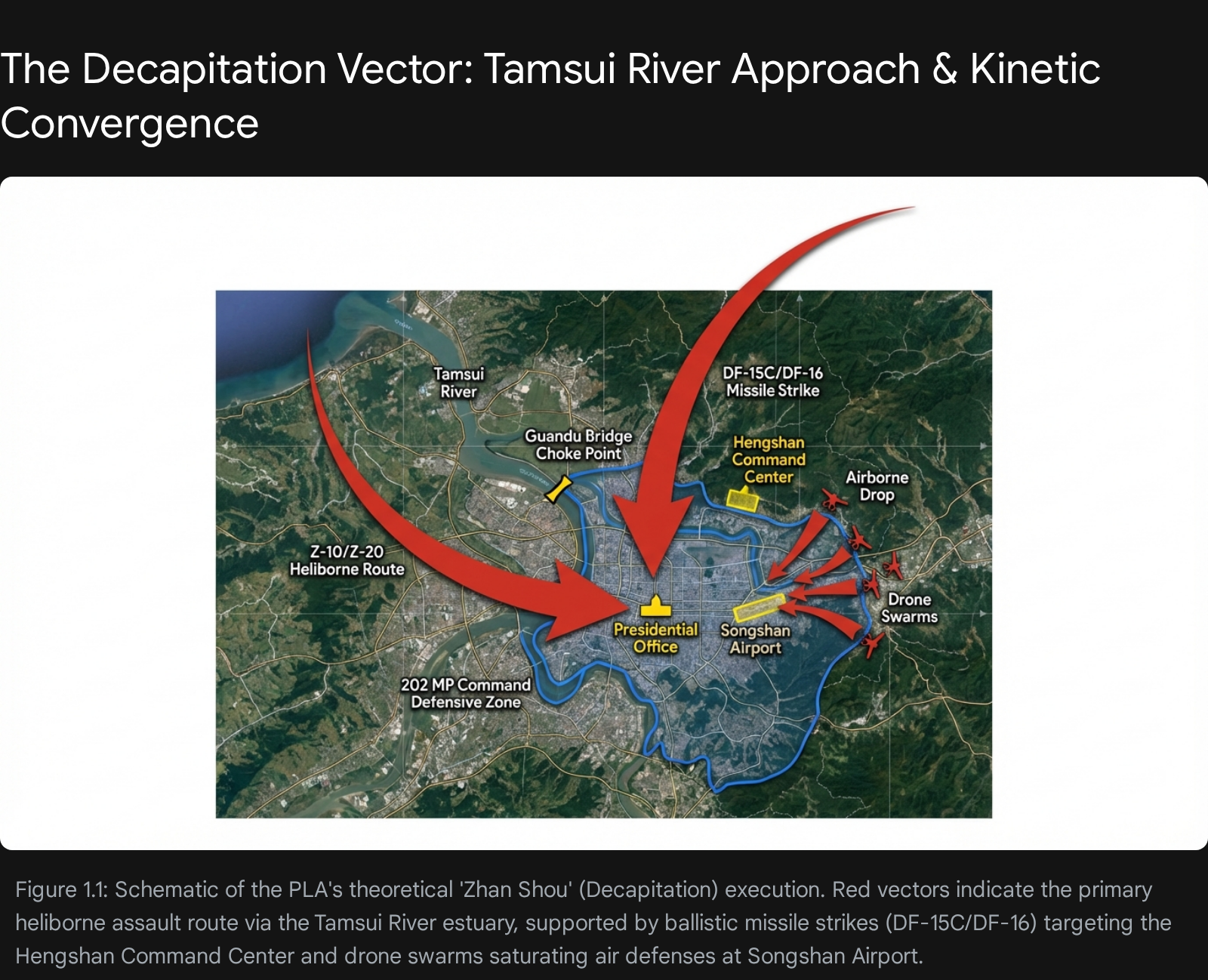
Defense planners in Taipei are acutely aware of this “Trojan Horse” route. The 6th Army Corps, responsible for the defense of northern Taiwan, has integrated the 202 Military Police Command into a layered defense around the river mouth and the capital.11 Defensive measures include the deployment of the M3 Amphibious Rig—normally used for bridging—to act as a floating blockade, deploying chains of explosive oil drums across the river to deny passage to hovercraft and assault boats. Additionally, the proliferation of Stinger MANPADS (Man-Portable Air-Defense Systems) among MP battalions creates a “kill box” for any aircraft attempting to navigate the narrow river channel.11
3.2 The Drone Swarm Saturation Strategy
A key evolution in PLA tactics, observed in the “Joint Sword” series, is the integration of drone swarms to conduct Suppression of Enemy Air Defenses (SEAD).10 Taiwan relies on a dense network of high-end air defense systems, primarily the US-made Patriot PAC-3 and the indigenous Tien Kung III (Sky Bow).25 While these systems are formidable against traditional aircraft and ballistic missiles, they are economically and logistically ill-suited to counter massed swarms of cheap, expendable drones.
The PLA’s strategy is one of cost-imposition and magazine depletion. By launching hundreds of converted civilian drones or loitering munitions, the PLA aims to force Taiwan’s defenders to expend their limited stock of multi-million dollar interceptors on targets worth a few thousand dollars.24 Once the batteries are depleted or reloading, the “kill window” opens for the higher-value assets—the Z-10 helicopters and J-16 fighters—to strike the unprotected C2 nodes. The “Zhan Shou” doctrine relies on this saturation to ensure the survival of the decapitation force during its transit across the Strait and into the Taipei Basin.
3.3 The Hardened Target: Hengshan and C2 Resilience
The ultimate target of a kinetic decapitation strike is the command and control infrastructure that allows the Taiwanese government to coordinate a defense. The Hengshan Military Command Center, buried deep beneath a mountain in the Dazhi district of Taipei, serves as the nerve center for the President and the General Staff.27 This facility is hardened against conventional strikes, nuclear blasts, and High-Altitude Electromagnetic Pulse (HEMP) attacks, featuring six-sided double-layer zinc-plated steel shielding.27
However, the effectiveness of Hengshan relies on the leadership reaching it. The PLA’s “Zhan Shou” doctrine focuses on the “transit vulnerability”—striking the leadership at their residences, in transit, or at less hardened interim facilities before they can secure themselves in the complex. Furthermore, the PLA’s development of the aforementioned DF-15C earth-penetrating missiles poses a theoretical threat even to hardened facilities, necessitating a shift in Taiwan’s doctrine from “static defense” to “mobile continuity,” utilizing distributed command nodes rather than relying on a single, stationary bunker.1
4. STRATEGIC ASSESSMENT: THE COGNITIVE & CYBER DOMAINS
4.1 The “Red” Mind War: ISF and Deepfakes
The NSA Directorate identifies the cognitive domain as the battlespace where the PLA intends to win the war before the first boot hits the ground. The newly formed Information Support Force (ISF) has operationalized the concept of “Cognitive Warfare” (CW) to a degree not seen in previous conflicts.17 The objective is to hack the OODA loop (Observe-Orient-Decide-Act) of the Taiwanese leadership and public.
The most potent weapon in this arsenal is the weaponization of Deepfake technology. Intelligence indicates that the PLA has likely prepared high-fidelity, AI-generated video and audio content depicting President Lai Ching-te and other key leaders surrendering, fleeing, or issuing orders to stand down.18 In a “Zhan Shou” scenario, these deepfakes would be broadcast simultaneously with a kinetic attack on Taiwan’s legitimate media infrastructure. If the PLA can hijack the emergency broadcast system or flood social media with these fabrications while severing Taiwan’s connection to the outside world, they can create a “reality gap” where the defenders believe the war is lost while it is still winnable.18
4.2 Cyber-Siege: Undersea Cables and the “Digital Blockade”
To ensure the effectiveness of the cognitive campaign, the PLA must isolate Taiwan from the global internet. Taiwan’s digital connectivity relies heavily on a network of roughly 14 undersea cables.31 The NSA Directorate highlights the vulnerability of these cables to sabotage by the PLA’s “Maritime Militia”—fishing fleets equipped with cable-cutting gear—or specialized deep-sea sabotage vessels like those developed by the China Ship Scientific Research Centre.32
Recent incidents, such as the severing of cables to the Matsu Islands in 2023 by Chinese vessels, serve as a rehearsal for a total “Digital Blockade”.31 In a full-scale decapitation scenario, the PLA would likely cut the majority of international fiber-optic links while simultaneously employing heavy electronic jamming against satellite uplinks (including Starlink) to create an information vacuum.34 This isolation prevents the Taiwanese government from communicating its “Proof of Life” to the populace and from coordinating with allies like the US and Japan.
4.3 Lawfare: The “Police Action” Narrative
The INTEL Directorate emphasizes the critical role of “Lawfare” in the PLA’s strategy. By framing the conflict as a “Non-War Military Operation” (NWMO), Beijing aims to bypass the legal triggers for foreign intervention.8 The PLA will likely cite the “Anti-Secession Law” to label the operation as a domestic law enforcement action against “separatist criminals,” mimicking the language used by the US in its indictment of Maduro.5
This narrative is specifically designed to exploit the ambiguity in the US-Japan Security Treaty. If the conflict is framed as a “police action” rather than an “armed attack” or invasion, it complicates the political decision-making in Tokyo regarding whether the situation constitutes a “survival-threatening situation” that permits the mobilization of the Japan Self-Defense Forces (JSDF).35 This legal hesitation is a weapon; every hour of delay in allied decision-making is an hour the PLA gains to complete the decapitation.
5. WAR ROOM DEBATE TRANSCRIPT: JOINT STRATEGIC COUNCIL
LOG ID: JSC-EMERGENCY-013126
ATTENDEES:
- NSA: Director of Cyber Command & Signals Intelligence
- INTEL: Director of Strategic Intelligence & Analysis
- WAR: Commander of Joint Operations & Kinetic Defense
SUBJECT: Assessment of Imminent PLA ‘Zhan Shou’ Indicators and Counter-Strategy Formulation.
NSA: “Gentlemen, we need to strip away the assumptions of the last decade. The reorganization of the SSF into the Information Support Force wasn’t administrative shuffling. It was a declaration of intent. They are preparing to blind us. My teams are seeing Starlink jamming simulations running 24/7 in their wargames. They aren’t just planning to cut the cables; they’re planning to put a digital dome over the island. If we can’t authenticate the President’s voice within five minutes of the first blackout, the war is lost in the cognitive domain before WAR even loads a magazine.”
WAR: “Respectfully, NSA, your algorithms won’t stop a Z-10 attack helicopter. The 202 Military Police Battalion is digging in at the Tamsui River, but let’s be realistic—they are light infantry. If the PLA commits to a saturation attack with drone swarms to drain our Patriot batteries, followed by a heavy heliborne lift, we have a simple physics problem: we run out of interceptors before they run out of drones. We need to talk about decentralization. We need ‘shoot and scoot’ authority for platoon-level commanders now, not when the comms go dead. The chain of command is too rigid. If the head is cut off, the body must know how to fight independently.”
INTEL: “You’re both focusing on the how, but missing the why and the when. The PLA doesn’t want a Stalingrad in Taipei. They want a Crimea. They want a quick fait accompli. My concern is the ‘Maduro’ narrative. They are building a legal case, not just a military one. Look at the ‘Joint Sword’ exercises. They practiced the blockade, yes, but they also practiced the police action—Coast Guard vessels operating alongside Navy ships. They are normalizing the idea that this is a law enforcement operation. If they launch a decapitation strike, they will frame it as an arrest warrant execution. Will Japan intervene for an ‘arrest’? Will the US? That hesitation is their weapon.”
NSA: “That’s exactly why the counter-strategy must be cognitive first. We need to ‘pre-bunk’ the deepfakes. We need a cryptographic ‘Proof of Life’ system for the leadership that doesn’t rely on the public internet. And we need to make sure the Japanese know that a ‘police action’ that involves ballistic missiles is an Article 5 trigger, regardless of what Beijing calls it.”
WAR: “Agreed on the Japanese coordination. But ‘pre-bunking’ doesn’t stop a bunker buster. I need the 6th Army Corps to move its command nodes now. The Hengshan Center is hardened, sure, but it’s a known coordinate. We need mobile command posts. We need to turn Taipei into a porcupine that swallows the snake. If they enter the Tamsui, they shouldn’t find a clear river; they should find a river of fire. We need to mine the estuary.”
INTEL: “There’s an internal dimension too. Xi has purged the PLA Rocket Force leadership. There is deep distrust within their ranks. If we can sow doubt in the loyalty of the invasion force commanders—make them fear a trap, or fear being purged if they fail—we can induce hesitation. The ‘Empty Fort’ strategy. We make them think we want them to come into Taipei because it’s a trap. We play on their paranoia.”
JSC CONSENSUS: The threat is imminent and multi-dimensional. The response must be an integrated Cognitive-Kinetic counter-offensive. We cannot just defend; we must make the attempt politically fatal for the CCP.
6. SCENARIO SIMULATION: “OPERATION RED ECLIPSE”
TIMELINE: SUMMER 2026
This scenario is constructed based on the convergence of PLA doctrine, recent exercises, and the assessed capabilities of both forces.
PHASE 1: THE BLINDFOLD (T-Minus 4 Hours)
- Cyber & Space: The PLA Information Support Force (ISF) initiates a massive DDoS and malware attack targeting Taiwan’s power grid (Taipower) and telecommunications infrastructure.
- Physical Sabotage: “Fishing vessels” (Maritime Militia) operating near Matsu and the Taiwan Strait “accidentally” sever the TPE and TPKM-3 undersea cables using deep-sea cutters.
- Effect: Taiwan experiences a partial communications blackout. Confusion reigns as internet connectivity drops to near zero.
PHASE 2: THE COGNITIVE SHOCK (T-Minus 1 Hour)
- Deepfake Injection: PLA cyber units hijack emergency broadcast frequencies. A realistic AI-generated video of President Lai Ching-te airs, stating that he is “negotiating a peace transfer” to avoid bloodshed and ordering the armed forces to stand down.
- Lawfare Declaration: Beijing announces a “Special Law Enforcement Operation” to detain “secessionist criminals,” warning foreign powers that interference constitutes an act of war against Chinese sovereignty.
PHASE 3: THE KINETIC BREACH (H-Hour)
- The Drone Wave: Thousands of converted civilian drones launch from the mainland and ships in the Strait. Their target is saturation—forcing Taiwan’s Patriot and Tien Kung radars to light up and expend missiles.
- The Missile Strike: Once air defense batteries are overwhelmed, PLARF launches DF-16 and DF-15C precision missiles. Targets are specific C2 nodes: Hengshan Command Center inputs, radar stations, and air base runways.
PHASE 4: THE DECAPITATION (H+1 to H+4 Hours)
- The Tamsui Vector: Under the cover of the missile barrage, low-flying Z-10 and Z-20 helicopter squadrons enter the Tamsui River estuary. They fly below radar, navigating the river valley toward the Presidential Office.
- SOF Insertion: PLA Special Operations Forces fast-rope onto government buildings. Their mission is to locate, capture, or kill the leadership core before they can reach the hardened bunkers.
- Fifth Column: Sleeper agents and compromised local actors attempt to sabotage logistical routes and create chaos in Taipei streets to impede 202 MP reinforcement.
PHASE 5: THE CHECKMATE OR THE QUAGMIRE (H+12 Hours)
- Success Scenario (PLA View): Leadership is captured. The “Surrender” is ratified. The world is presented with a fait accompli.
- Failure Scenario (JSC View): The President is evacuated to a mobile command post. The 202 MP Battalion detonates the Tamsui bridges and mines the river. The “Deepfake” is exposed via secure channels. The war becomes a grinding urban conflict.
7. THE 7-PHASE EXECUTION MATRIX (COUNTER-STRATEGY)
To counter “Operation Red Eclipse,” the Joint Strategic Council authorizes the following 7-Phase Asymmetric Defense Strategy. This matrix integrates the Cognitive and Kinetic domains to ensure regime survival.
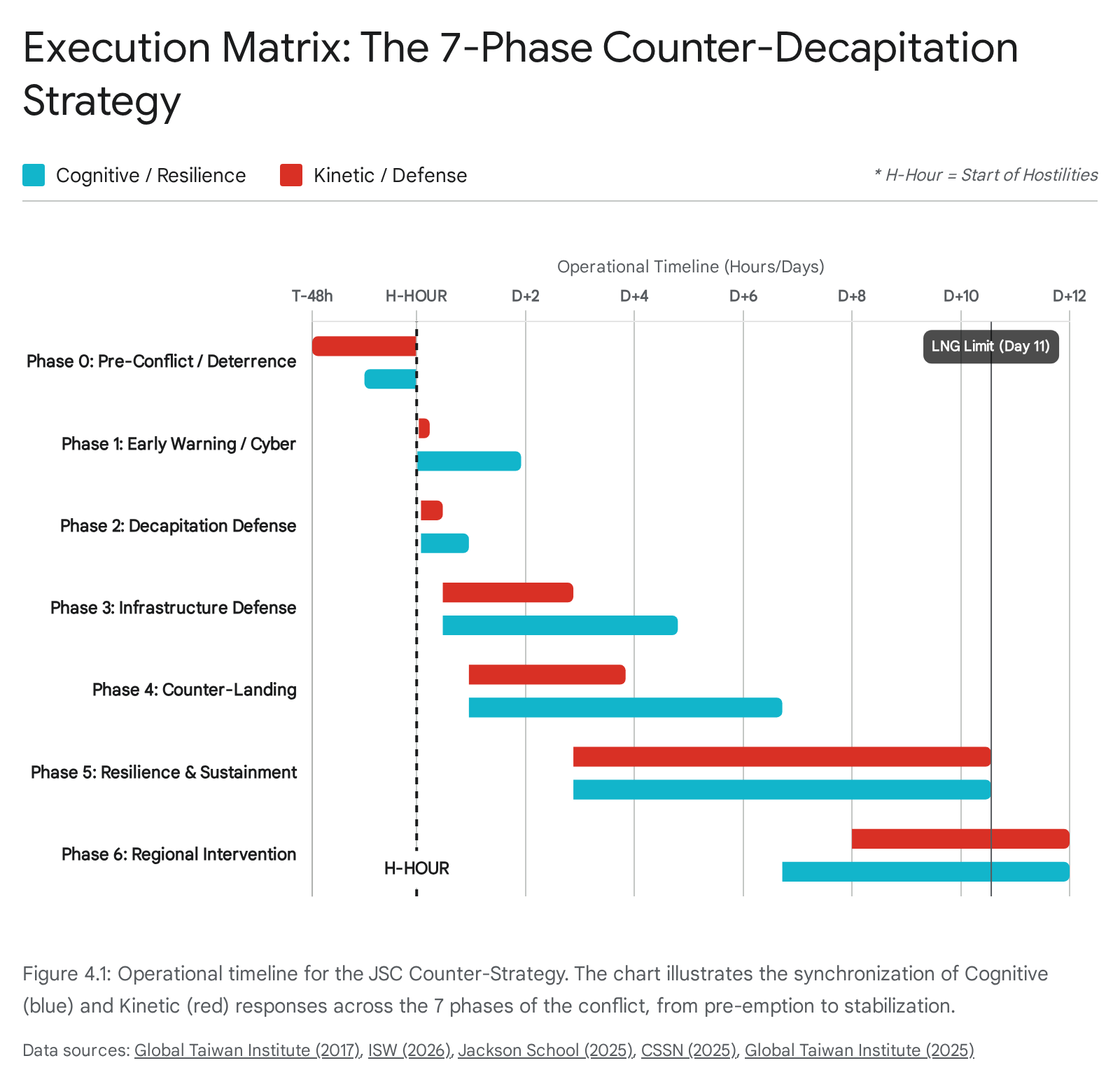
Table 7.1: Detailed Phase Breakdown
| Phase | Operational Code | Domain Focus | Strategic Objective | Key Actions (Cognitive & Kinetic) |
| 0 | PRE-EMPTION | Cognitive / Intel | Vaccinate & Expose | Cog: “Pre-bunking” campaign releasing verified “Proof of Life” protocols. Public education on deepfakes. Kin: Deployment of acoustic sensors and sea mines in Tamsui estuary. Pre-deployment of MANPADS to 202 MP. |
| 1 | DETECTION | Cyber / Space | Pierce the Fog | Cog: Activate redundant LEO satellite links (Starlink/OneWeb) to bypass cable cuts.37 Kin: Real-time satellite tracking of PLA “Training” fleets turning into assault formations. |
| 2 | ABSORPTION | Defensive | Survive the Volley | Cog: Maintain radio silence on key nodes to deny SIGINT. Kin: “Turtle Strategy” for air defense—hold fire on cheap drones, engage only high-value aircraft. Disperse leadership to mobile, nondescript command vehicles. |
| 3 | DENIAL | A2/AD | Close the Gates | Kin: Detonate Tamsui river blocks (explosive barges). Activate “Volcano” mine systems on beaches. Launch “Hsiung Feng” anti-ship missiles at amphibious transport ships. |
| 4 | RESILIENCE | Infrastructure | Keep the Lights On | Kin: Ration LNG immediately to military-only grids. Activate emergency coal reserves.38 Repair teams prioritize military fiber optics. |
| 5 | COUNTER-PUNCH | Asymmetric | Strike the Archers | Kin: Use mass-produced suicide drones (Taiwan’s “Altius” equivalent) to strike PLA staging ports across the strait. Target the launchers, not the missiles. |
| 6 | SIGNALING | Geopolitical | Trigger the Alliance | Cog: Broadcast evidence of missile strikes to Tokyo to trigger the “Survival-Threatening Situation” clause.35 Formally declare the event an “Armed Attack.” |
| 7 | STABILIZATION | Continuity | The Long War | Cog: President addresses the nation from a secure, verifiable location. Mobilize reserves. Kin: Transition from anti-decapitation to anti-invasion urban guerrilla warfare. |
8. DEEP DIVE: CRITICAL INFRASTRUCTURE AND RESILIENCE
8.1 The Energy Cliff: LNG Vulnerability
The Council identifies energy security as the single greatest non-kinetic threat to Taiwan’s defense sustainability. Taiwan imports approximately 97% of its energy needs.38 The most critical bottleneck is Liquefied Natural Gas (LNG). Unlike coal or oil, which can be stockpiled for months, LNG requires constant resupply and specialized cryogenic storage, which Taiwan lacks in sufficient volume.
Current estimates place Taiwan’s LNG reserves at approximately 11 days of supply.39 In a blockade scenario, even without direct kinetic strikes on the receiving terminals at Yung-An and Taichung, the power grid would face collapse within two weeks. This “Energy Cliff” creates a hard time limit on Taiwan’s ability to resist before societal collapse begins.
While coal reserves are more robust (approx. 40 days) and oil reserves are mandated at 90 days, the reliance on gas for peak load generation means that the loss of LNG would force immediate, draconian rationing.40 The Council recommends the immediate preparation of a “War Economy Grid” plan, which would cut civilian consumption by up to 70% to preserve power for military radars, hospitals, and command centers.
8.2 The Silicon Shield: Deterrent or Magnet?
The strategic debate regarding Taiwan Semiconductor Manufacturing Company (TSMC)—the producer of over 90% of the world’s advanced chips—is central to the conflict calculus. The “Silicon Shield” theory suggests that the global economic indispensability of TSMC protects Taiwan. However, the Council assesses that in a “Decapitation” scenario, this shield may degrade into a “Silicon Magnet” or a “Scorched Earth” liability.
Some strategic analysis suggests that if China believes it cannot capture TSMC intact, or if the US believes China is about to capture it, the facilities might be targeted for destruction to prevent the transfer of capabilities.41 The destruction of these fabs would trigger a global economic depression estimated at $10 trillion, far exceeding the impact of the 2008 financial crisis or the COVID-19 pandemic.42 This “Mutually Assured Economic Destruction” is the true deterrent, but it relies on rational actors. In an ideological conflict driven by nationalism, rationality is not guaranteed.
9. SUN TZU CHECKMATE: ASYMMETRIC RESPONSES
Strategic Insight: Turning Strength into Weakness
Sun Tzu teaches: “Appear weak when you are strong, and strong when you are weak.” The PLA’s strength is its overwhelming mass and firepower. Its weakness is its political fragility and the absolute necessity of a quick, clean victory to maintain CCP legitimacy.
The Strategy: “The Poisoned Chalice”
The Council proposes a strategy that makes the successful capture of Taiwan more dangerous to the CCP than failure.
- The Silicon Kill Switch: Taiwan must credibly signal that it has the capability and will to remotely disable or destroy the critical EUV (Extreme Ultraviolet Lithography) machinery at TSMC fabs in the event of an invasion. This removes the economic prize of the conquest and ensures that China inherits a “silicon graveyard” rather than a technological crown jewel.41
- The “Empty Fort” Urban Trap: Instead of a static defense at the coastline, which can be overwhelmed, Taiwan should transform the “Bo’ai Special Zone” (Presidential district) into a pre-surveyed artillery kill zone. If SOF units land, they should not be met with static guards who can be eliminated, but with pre-sighted artillery and drone strikes from the surrounding mountains. We invite the “decapitation” force in, only to trap it in a lethal urban quagmire.
- The “Deep Truth” Counter-Offensive: If the PLA attempts a deepfake surrender, Taiwan must counter with a “Deep Truth” campaign—flooding the Chinese mainland intranet (breaching the Great Firewall) with high-definition footage of PLA casualties and destroyed equipment. The goal is to pierce the domestic information bubble in China, turning nationalist fervor into fear of a “Vietnam-style” quagmire, thereby destabilizing the CCP regime from within.
10. CONCLUSION
The “Venezuela Model,” while failed in its original context, has been successfully weaponized and industrialized by the People’s Liberation Army. The threat of a decapitation strike against Taiwan is not a theoretical exercise but a present operational capability, rehearsed in “Joint Sword” exercises and enabled by the new Information Support Force.
The survival of the Republic of China depends on shedding the illusion of safety provided by the Taiwan Strait. The defense must be Cognitively Hardened to resist the fake surrender, Kinetically Distributed to fight without a centralized head, and Strategically Asymmetric to convince Beijing that the cost of pulling the trigger is the regime’s own survival.
End of Simulation
If you find this post useful, please share the link on Facebook, with your friends, etc. Your support is much appreciated and if you have any feedback, please email me at in**@*********ps.com. Please note that for links to other websites, we are only paid if there is an affiliate program such as Avantlink, Impact, Amazon and eBay and only if you purchase something. If you’d like to directly contribute towards our continued reporting, please visit our funding page.
Sources Used
- Are U.S. Operations in Venezuela a Blueprint for China for Taiwan? – CSIS, accessed January 31, 2026, https://www.csis.org/analysis/are-us-operations-venezuela-blueprint-china-taiwan
- Operation Gideon (2020) – Wikipedia, accessed January 31, 2026, https://en.wikipedia.org/wiki/Operation_Gideon_(2020)
- Untangling Operation Gideon – Venezuelanalysis, accessed January 31, 2026, https://venezuelanalysis.com/analysis/14888/
- ‘His head wasn’t in the world of reality’: how the plot to invade Venezuela fell apart, accessed January 31, 2026, https://www.theguardian.com/world/2020/may/08/his-head-wasnt-in-the-world-of-reality-how-the-plot-to-invade-venezuela-fell-apart
- All Elements in Place for a US Strike on Venezuela – Venezuelanalysis, accessed January 31, 2026, https://venezuelanalysis.com/opinion/all-elements-in-place-for-a-us-decapitation-strike-on-venezuela/
- Democracy, drugs or oil? Why Trump is gunning for Venezuela’s Maduro – explained, accessed January 31, 2026, https://timesofindia.indiatimes.com/world/us/democracy-drugs-or-oil-why-trump-is-gunning-for-venezuelas-maduro-explained/articleshow/125722026.cms
- The Official Position of the Republic of China (Taiwan) on the People’s Republic of China’s Anti-Secession (Anti-Separation) Law, accessed January 31, 2026, https://www.mac.gov.tw/en/News_Content.aspx?n=8A319E37A32E01EA&sms=2413CFE1BCE87E0E&s=D1B0D66D5788F2DE
- China’s Taiwan-related legal initiatives: actors and strategic implications, accessed January 31, 2026, https://www.iiss.org/online-analysis/charting-china/2025/01/chinas-taiwan-related-legal-initiatives-actors-and-strategic-implications/
- Military Operations Other Than War in China’s Foreign Policy – Stimson Center, accessed January 31, 2026, https://www.stimson.org/2022/military-operations-other-than-war-and-chinas-foreign-policy/
- PLA Special Operations Threat to Taiwan, accessed January 31, 2026, https://globaltaiwan.org/2017/11/pla-special-operations-threat-to-taiwan/
- China & Taiwan Update, January 23, 2026 | ISW, accessed January 31, 2026, https://understandingwar.org/research/china-taiwan/china-taiwan-update-january-23-2026/
- Understanding the People’s Liberation Army Rocket Force, accessed January 31, 2026, https://www.armyupress.army.mil/Portals/7/military-review/Archives/English/JA-21/Mihal-PLA-Rocket-Force-v1.pdf
- Cratering Effects: Chinese Missile Threats to US Air Bases in the Indo-Pacific, accessed January 31, 2026, https://www.stimson.org/2024/cratering-effects-chinese-missile-threats-to-us-air-bases-in-the-indo-pacific/
- Annual Report to Congress: Military and Security Developments Involving the People’s Republic of China 2025 – DoD, accessed January 31, 2026, https://media.defense.gov/2025/Dec/23/2003849070/-1/-1/1/ANNUAL-REPORT-TO-CONGRESS-MILITARY-AND-SECURITY-DEVELOPMENTS-INVOLVING-THE-PEOPLES-REPUBLIC-OF-CHINA-2025.PDF
- Special Report: Surprise PRC Military Exercise Around Taiwan | ISW, accessed January 31, 2026, https://understandingwar.org/research/china-taiwan/china-taiwan-special-report-december-31-2025/
- People’s Liberation Army Strategic Support Force – Wikipedia, accessed January 31, 2026, https://en.wikipedia.org/wiki/People%27s_Liberation_Army_Strategic_Support_Force
- A New Step in China’s Military Reform – NDU Press, accessed January 31, 2026, https://ndupress.ndu.edu/Media/News/News-Article-View/Article/4157257/a-new-step-in-chinas-military-reform/
- China Seeks to Shape the Cross-Strait Battlefield Through Cognitive Warfare, accessed January 31, 2026, https://dominotheory.com/china-seeks-to-shape-the-cross-strait-battlefield-through-cognitive-warfare/
- The Malicious Exploitation of Deepfake Technology: Political Manipulation, Disinformation, and Privacy Violations in Taiwan, accessed January 31, 2026, https://globaltaiwan.org/2025/05/the-malicious-exploitation-of-deepfake-technology/
- Military conducts defense drills in New Taipei amid Chinese exercises – Focus Taiwan, accessed January 31, 2026, https://focustaiwan.tw/politics/202512300020
- China Maritime Report No. 19: The PLA Airborne Corps in a Joint Island Landing Campaign, accessed January 31, 2026, https://digital-commons.usnwc.edu/cgi/viewcontent.cgi?article=1018&context=cmsi-maritime-reports
- Report outlines possible PLA attacks – Taipei Times, accessed January 31, 2026, https://www.taipeitimes.com/News/front/archives/2015/09/01/2003626656
- China Rehearsing Possible Taiwan Decapitation Operation – T2COM G2, accessed January 31, 2026, https://oe.t2com.army.mil/product/china-rehearsing-possible-taiwan-decapitation-operation/
- Military eyeing defense against ‘drone swarm’ – Taipei Times, accessed January 31, 2026, https://www.taipeitimes.com/News/taiwan/archives/2020/07/27/2003740631
- An Assessment of Relative Costs and Operational BAir Defense Options for Taiwan – RAND, accessed January 31, 2026, https://www.rand.org/content/dam/rand/pubs/research_reports/RR1000/RR1051/RAND_RR1051.pdf
- Missile tests demonstrate fresh capabilities: expert – Taipei Times, accessed January 31, 2026, https://www.taipeitimes.com/News/front/archives/2025/11/23/2003847672
- Defense ministry confirms New Taipei Naval base hardened against nuclear electromagnetic pulse attack | Taiwan News | Oct. 30, 2023 18:26, accessed January 31, 2026, https://taiwannews.com.tw/news/5030076
- This Is How Taiwan’s Military Would Go To War With China – The War Zone, accessed January 31, 2026, https://www.twz.com/this-is-how-taiwans-military-would-go-to-war-with-china
- The Challenges Taiwan Faces in Cognitive Warfare and Its Impact on US–Taiwan Relations, accessed January 31, 2026, https://www.airuniversity.af.edu/JIPA/Display/Article/4171199/the-challenges-taiwan-faces-in-cognitive-warfare-and-its-impact-on-ustaiwan-rel/
- The Challenges Taiwan Faces in Cognitive Warfare and Its Impact on US–Taiwan Relations, accessed January 31, 2026, https://media.defense.gov/2025/May/01/2003702343/-1/-1/1/VIEW%20-%20CHEN%20DISCLAIMER.PDF
- China’s Undersea Cable Sabotage and Taiwan’s Digital Vulnerabilities, accessed January 31, 2026, https://globaltaiwan.org/2025/06/taiwans-digital-vulnerabilities/
- China Unveils Deep-Sea Cable Cutter, Sparking Global Security Fears – YouTube, accessed January 31, 2026, https://www.youtube.com/watch?v=EU2Dzx0U68E
- China’s New Deep-Sea Cable Cutter and its Security Implications, accessed January 31, 2026, https://bisi.org.uk/reports/chinas-new-deep-sea-cable-cutter-and-its-security-implications
- China Simulates Starlink Jamming over Taiwan with Balloons and UAVs – Militarnyi, accessed January 31, 2026, https://militarnyi.com/en/news/china-simulates-starlink-jamming-over-taiwan-with-balloons-and-uavs/
- Japan’s Dangerous Statements Pose Regional Security Risks, accessed January 31, 2026, http://its.taiwan.cssn.cn/cgzs/zyhd_148669/202512/t20251212_5955512.shtml
- Enhancing U.S.-Japan Coordination for a Taiwan Conflict – Council on Foreign Relations, accessed January 31, 2026, https://cdn.cfr.org/sites/default/files/report_pdf/Enhancing%20U.S.-Japan%20Coordination%20for%20a%20Taiwan%20Conflict_DP_1.pdf
- Building Resilience in Taiwan’s Internet Infrastructure from Geopolitical Threats, accessed January 31, 2026, https://jsis.washington.edu/news/building-resilience-in-taiwans-internet-infrastructure-from-geopolitical-threats/
- Losing the Buffer: What a Less Diverse Energy Mix Means for Taiwan’s Security, accessed January 31, 2026, https://globaltaiwan.org/2025/11/less-diverse-energy-mix-taiwans-security/
- Renewable Energy Strategy – TCAN 台灣氣候行動網絡, accessed January 31, 2026, https://tcan2050.org.tw/en/project/renewable-energy-strategy-en/
- How Long Taiwan Can Keep Its Lights On – Chung-Hua Institution for Economic Research, accessed January 31, 2026, https://www.cier.edu.tw/en/institution-en/29418/
- TSMC Risk – Stratechery by Ben Thompson, accessed January 31, 2026, https://stratechery.com/2026/tsmc-risk/
- The World’s Growing Reliance on Taiwan’s Semiconductor Industry – Vision of Humanity, accessed January 31, 2026, https://www.visionofhumanity.org/the-worlds-dependency-on-taiwans-semiconductor-industry-is-increasing/
- Losing Taiwan’s Semiconductors Would Devastate the US Economy | Hudson Institute, accessed January 31, 2026, https://www.hudson.org/technology/losing-taiwan-semiconductor-would-devastate-us-economy-riley-walters