The decade spanning 2015 to 2025 represents a watershed moment in the history of small arms ammunition. For nearly a century prior, the development of rifle cartridges was dominated by a process known as “wildcatting”—the modification of existing military or commercial casings by individual enthusiasts to achieve marginal performance gains.1 However, the last ten years have witnessed the industrialization of this process. We are no longer in the era of the garage tinkerer; we have entered the era of Modern Cartridge Design (MCD).
This report analyzes the transition of specific rifle cartridges from engineering concepts to Sporting Arms and Ammunition Manufacturers’ Institute (SAAMI) standardized staples. Unlike the 20th century, where cartridges like the.25-06 Remington or.22-250 Remington languished as wildcats for decades before adoption, the modern trajectory is accelerated.
Below is an executive summary of the cartridges analyzed in this report, detailing their technical specifications and market maturity.
Table 1: Comparative Analysis of Emerging Rifle Cartridges (2015-2025)
Cartridge
Parent Case
Standard Twist
Nominal Velocity
Max Pressure (PSI)
Market Sentiment (Pos/Neg)
TMI*
6.5 PRC
.300 RCM
1:8
2,960 fps (143gr)
65,000
85% / 15%
9.0
300 PRC
.375 Ruger
1:8.5
2,860 fps (225gr)
65,000
90% / 10%
8.5
7mm PRC
.375 Ruger
1:8
3,000 fps (175gr)
65,000
92% / 8%
7.5
6mm ARC
6.5 Grendel
1:7.5
2,750 fps (105gr)
52,000
88% / 12%
8.0
22 ARC
6.5 Grendel
1:7
3,300 fps (62gr)
52,000
75% / 25%
4.0
338 ARC
6.5 Grendel
1:8
2,050 fps (175gr)
52,000
90% / 10%
4.0
6.8 Western
.270 WSM
1:8
2,970 fps (165gr)
65,000
60% / 40%
6.0
277 Fury
.308 Win (Geo)
1:7
3,000 fps (135gr)
80,000
50% / 50%
5.0
7mm BC
Unique (280 AI)
1:8
3,000 fps (170gr)
80,000
80% / 20%
4.0
8.6 BLK
6.5 Creedmoor
1:3
Sub/Super Mix
65,000
70% / 30%
5.5
6mm GT
6.5×47 Lapua
1:7.5
3,030 fps (105gr)
62,000
95% / 5%
7.0
25 CM
6.5 Creedmoor
1:7.5
2,810 fps (134gr)
62,000
95% / 5%
4.0
224 Valkyrie
6.8 SPC
1:6.5/7
2,700 fps (90gr)
55,000
40% / 60%
3.5
*TMI (Technical Maturity Index): See Appendix A for methodology.
2. The Modern Cartridge Design (MCD) Philosophy
To understand why new cartridges are displacing legacy rounds like the.300 Winchester Magnum or.22-250 Remington, one must understand the engineering principles of Modern Cartridge Design (MCD). This philosophy is a distinct departure from the “belted magnum” era of the mid-20th century.
2.1. Geometric Principles
Legacy cartridges often relied on body taper to aid extraction and belts for headspacing (e.g.,.375 H&H). MCD rejects these features in favor of:
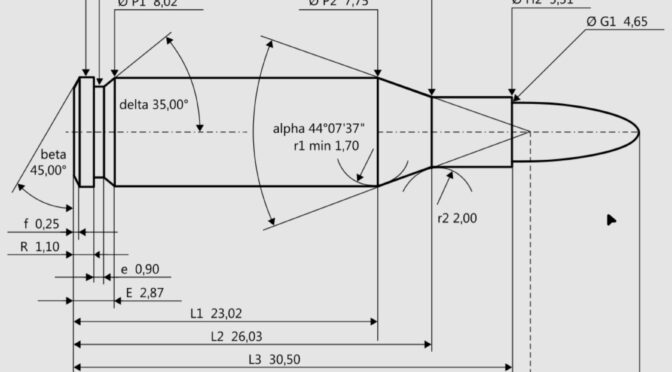
Steep Shoulder Angles: typically 30 to 35 degrees. This inhibits case stretching (flow) during firing, extending brass life and creating a consistent headspace datum line.2
Minimal Body Taper: This maximizes powder capacity for a given case length but requires precise chamber machining to ensure extraction reliability.3
Long Case Necks: A crucial feature for concentricity. A neck length of at least one caliber (e.g., 0.264” for a 6.5mm) keeps the long, heavy bullets aligned with the bore axis and prevents the bullet’s bearing surface from encroaching on the powder column.2
2.2. The Twist Rate Revolution
Perhaps the single most defining characteristic of the 2015-2025 era is the standardization of faster twist rates. Legacy cartridges like the.270 Winchester (1:10) or.22-250 (1:12 or 1:14) cannot stabilize modern Very Low Drag (VLD) bullets. The new generation of cartridges is built around the bullet first. For example, the 7mm PRC mandates a 1:8 twist to stabilize 180-grain projectiles, whereas the 7mm Remington Magnum traditionally used 1:9.25 or 1:9.5.4
3. The Hornady PRC Family: Redefining the Magnum
The Precision Rifle Cartridge (PRC) family—comprising the 6.5 PRC, 7mm PRC, and 300 PRC—represents a systematic overhaul of the magnum rifle segment. By utilizing the.375 Ruger and.300 Ruger Compact Magnum (RCM) as parent cases, Hornady eliminated the belt, increased case capacity, and optimized chamber geometry for long-range precision.
3.1. The 6.5 PRC (Precision Rifle Cartridge)
Introduced in 2018, the 6.5 PRC utilizes the.300 RCM parent case, necked down to 6.5mm. It operates at a SAAMI Maximum Average Pressure (MAP) of 65,000 psi.6 It bridges the gap between the 6.5 Creedmoor and the 6.5-284 Norma, propelling a 143-grain ELD-X bullet at approximately 2,960 fps.7
3.2. The 300 PRC (Precision Rifle Cartridge)
The 300 PRC was designed to solve a specific military problem: the inability of the.300 Win Mag to maintain hit probability at 2,000 yards. The DoD and Navy Special Warfare units selected the 300 PRC because its chamber design eliminates the “slop” found in SAAMI.300 Win Mag chambers, and its case capacity supports 225-250 grain projectiles without deep seating.9
3.3. The 7mm PRC: The “Goldilocks” Solution
Introduced in 2022, the 7mm PRC competes with the 28 Nosler. It avoids the throat erosion issues of the Nosler by using slightly less powder (approx. 80 grains H2O capacity) to achieve similar velocities with significantly better barrel life.4
4. The ARC Family: Maximizing the AR-15 Platform
While the PRC family dominates bolt actions, the Advanced Rifle Cartridge (ARC) family addresses the geometric and pressure constraints of the AR-15 (M4) platform.
4.1. The 6mm ARC (Advanced Rifle Cartridge)
Standardized in 2020, the 6mm ARC is based on the 6.5 Grendel case. To prevent bolt lug shearing in the AR-15, SAAMI limited the max pressure to 52,000 psi.11 It offers a 30-35% reduction in system weight compared to AR-10 platforms while maintaining supersonic flight beyond 1,000 yards.13
4.2. The 22 ARC: The New Varmint Standard
Released in 2024, the 22 ARC is a 6mm ARC necked down to.224 caliber. It utilizes a fast 1:7 twist to stabilize heavy 88-grain bullets, effectively replicating.22-250 performance in an AR-15 platform.14
4.3. The 338 ARC: Subsonic Specialization
Accepted by SAAMI in early 2025, the 338 ARC represents the heavy-hitter of the family. Designed to fit the AR-15 platform, it launches a 175-grain bullet at 2,050 fps or heavy 300+ grain subsonic projectiles. It provides 1.5 times more energy than the.300 Blackout, filling a critical niche for suppressed usage in a standard M4 form factor.
5. The Western Innovation: 6.8 Western
In 2021, Winchester and Browning introduced the 6.8 Western, an evolution of the.270 WSM. By shortening the case body and tightening the twist rate to 1:8, they enabled the use of 165-175 grain bullets in a short action.16 Despite superior ballistics, it has struggled with commercial adoption compared to the PRC family due to limited manufacturer support (Single-source dependency on Winchester/Browning).18
6. Radical Engineering: High Pressure and Rotational Energy
6.1. 277 Fury (6.8x51mm)
The 277 Fury uses a hybrid three-piece case (steel head, brass body) to operate at 80,000 psi.8 This allows it to achieve magnum velocities from a short barrel (16″), a requirement for the US Army’s NGSW program.
6.2. 7mm Backcountry (7mm BC)
Newly accepted by SAAMI in 2025, the 7mm Backcountry applies the 277 Fury’s 80,000 psi technology to the 7mm bore. It features a case similar in dimension to the.280 Ackley Improved but uses the proprietary high-pressure case design to drive 170-grain bullets at 3,000 fps from shorter barrels, catering to the suppressor-conscious hunter.
6.3. 8.6 Blackout
Developed by Q, LLC, the 8.6 Blackout uses a 1:3 twist rate to spin projectiles at 500,000 RPM.19 This rotational energy is theorized to enhance terminal performance of expanding subsonic copper solids (“The Blender Effect”).20
7. Competition and Compliance
7.1. 6mm GT
Designed for the PRS circuit, the 6mm GT (Gay Tiger) solves the feeding issues of the 6mm Dasher by using a slightly longer case and 35-degree shoulder. It was SAAMI accepted in 2022 and has become a staple for reliable feeding from AICS magazines.
7.2. 25 Creedmoor (25 CM)
Long a wildcat favorite (“250 Hillbilly”), the 25 Creedmoor received SAAMI acceptance in 2025. It splits the difference between the 6mm and 6.5mm variants, utilizing a 1:7.5 twist to stabilize high-BC 130+ grain.257 bullets. It offers the wind-bucking of the 6.5 with the recoil profile closer to the 6mm.
8. The Cautionary Tale: 224 Valkyrie
The 224 Valkyrie (2017) serves as a case study in failure. Intended to provide 1,300-yard supersonic range in an AR-15, it was launched with insufficient twist rates (1:7 instead of 1:6.5) and reamer geometry issues. By the time these were corrected, the market had shifted to the 6mm ARC, rendering the Valkyrie largely obsolete.22
9. Second and Third-Order Insights
9.1. The “Military-Consultancy-Commercial” Pipeline
The success of the 6mm ARC, 300 PRC, and now 338 ARC illustrates a new business model. Manufacturers solve specific DoD problems (bolt thrust, ELR probability) and immediately commercialize the “battle-proven” solution, drastically lowering commercial risk.9
9.2. The Obsolescence of the “Fudd” Rifle
The universal adoption of fast twist rates acts as planned obsolescence. A hunter with a 1990s 7mm Rem Mag (1:9.5 twist) cannot use modern high-BC ammunition. To utilize 2025-era ballistics, the consumer must purchase a new rifle, driving hardware sales in a saturated market.3
Appendix A: Methodology
Technical Maturity Index (TMI): A 1-10 scale measuring market stability.
1-3 (Experimental/Wildcat): No SAAMI spec, custom dies required.
7-8 (Established): Multiple major manufacturers producing rifles and ammo (e.g., 7mm PRC).
9-10 (Legacy Standard): Ubiquitous availability (e.g., 6.5 Creedmoor, 6.5 PRC). Data Sources: Ballistic data derived from manufacturer publications (Hornady, Winchester, Federal) and SAAMI specifications. Sentiment analysis derived from primary enthusiast nodes (SnipersHide, Reddit r/LongRange).
Appendix B: Acronym Definitions
BC: Ballistic Coefficient. COAL: Cartridge Overall Length. DoD: Department of Defense. ELD: Extremely Low Drag. ELR: Extreme Long Range. MAP: Maximum Average Pressure. MCD: Modern Cartridge Design. NGSW: Next Generation Squad Weapon. PRC: Precision Rifle Cartridge. PRS: Precision Rifle Series. SAAMI: Sporting Arms and Ammunition Manufacturers’ Institute. TMI: Technical Maturity Index. VLD: Very Low Drag. WSM: Winchester Short Magnum.
If you find this post useful, please share the link on Facebook, with your friends, etc. Your support is much appreciated and if you have any feedback, please email me at in**@*********ps.com. Please note that for links to other websites, we are only paid if there is an affiliate program such as Avantlink, Impact, Amazon and eBay and only if you purchase something. If you’d like to directly contribute towards our continued reporting, please visit our funding page.
The ammunition market of November 2025 represents a pivotal moment in the small arms industry’s post-pandemic recovery cycle. Following years of volatility characterized by supply chain rigidities, raw material inflation, and demand surges driven by social unrest, the current fiscal quarter—specifically the Black Friday 2025 sales window—indicates a significant “correction phase.” This phase is defined by a strategic shift among major manufacturers and distributors from margin preservation to volume liquidation.
Industry data from late 2025 reveals a critical divergence in inventory levels. While firearms inventory at the retail level has contracted by approximately 8% year-over-year as manufacturers throttle production to match stabilizing demand, ammunition inventory has inversely expanded by 9%.1 This “inventory overhang” suggests that while the consumer base is effectively armed, the consumption rate of ammunition has not kept pace with the expanded production capacity brought online between 2020 and 2024. Consequently, retailers are entering the Q4 holiday season with high stock levels of finished goods that must be liquidated to improve cash flow and reduce warehousing overhead.
For the procurement officer, agency buyer, or private analyst, this creates a “buyer’s market” of a magnitude not observed since 2019. However, this surplus environment is nuanced. It exists under the shadow of what analysts term a “delayed impact phenomenon” regarding international tariffs.2 While tariffs on imported ammunition components and finished goods have been announced or implemented, the supply chain is currently buffered by pre-tariff inventory. Distributors are effectively selling “legacy” stock at 2024 valuations before the replacement costs—driven by higher import duties and rising copper prices—hit the ledger in early 2026.
Furthermore, the 2025 market is heavily influenced by the aggressive financial maneuvering of major conglomerates. The Kinetic Group (a segment of Vista Outdoor) and Olin Corporation (Winchester) have deployed extensive rebate programs 3 to stimulate demand. These rebates are not merely consumer incentives; they are corporate mechanisms designed to bolster Q3/Q4 revenue figures in a softening market. For instance, Vista Outdoor reported a 1.6% decline in ammunition sales in Q3 5, necessitating the reintroduction of the “Black Pack” program to drive volume.
The following report provides an exhaustive, analyst-grade evaluation of the 25 best ammunition acquisition opportunities for Black Friday 2025. This analysis moves beyond simple price-per-round (CPR) comparisons to evaluate the “Ballistic Value Proposition”—a metric that weighs cost against component quality, terminal performance, and long-term storage viability.
2. Macro-Economic Drivers and Supply Chain Variables
2.1 The Tariff-Inventory Latency
A defining characteristic of the November 2025 market is the disconnect between current retail pricing and future replacement costs. The implementation of new tariffs on international ammunition shipments was predicted to cause immediate price spikes. However, the market has exhibited a “delayed impact”.2 Large distributors and importers stockpiled massive inventories prior to tariff enactment. The current Black Friday sales represent the liquidation of this pre-tariff stock.
Strategic Implication: This creates a temporary deflationary window. Once this inventory is depleted, Q1 2026 pricing will likely reflect the new tariff structures, potentially raising the floor price of imported calibers (specifically 5.56 NATO and 9mm Luger) by 10-15%. The savvy buyer recognizes Black Friday 2025 not just as a sale, but as the last opportunity to procure at pre-tariff baselines.
2.2 The Resurgence of the Rebate Economy
During the demand surges of 2020-2022, manufacturer rebates were nonexistent. In 2025, they have returned as the primary driver of market liquidity.
Federal Ammunition: The “Black Pack” rebate returns, offering a flat $7.50 back per qualifying box, capped at $100 per household.3 This structure favors the purchase of bulk packaging (150-1100 rounds), effectively subsidizing the training costs for high-volume shooters.
Winchester Ammunition: Olin Corporation has launched a 15% rebate across rimfire, pistol, and target rifle ammunition.4 Unlike flat-rate rebates, this percentage-based model scales with premium ammunition, incentivizing the purchase of defensive and match-grade loads where a 15% return yields a higher absolute dollar value.
Remington: A 20% rebate on hunting centerfire rifle ammunition 7 targets the seasonal hunter, attempting to clear specific SKUs immediately following the peak whitetail season opening dates.
2.3 The “AAC Effect” and Vertical Integration
A critical market disruptor in 2025 is Palmetto State Armory’s (PSA) Advanced Armament Company (AAC). By vertically integrating the production of primers, cases, and projectiles, AAC has established a new “price floor” for domestic ammunition.8 Their ability to offer heavy-for-caliber loads (e.g., 77gr OTM 5.56) at prices previously reserved for standard ball ammunition has forced competitors to compress margins. This democratization of precision ammunition is a key theme of the 2025 sales cycle.
3. Comprehensive Deal Analysis: The Top 25
The following deals have been selected based on a weighted analysis of Net CPR (Cost Per Round after rebates), component quality (brass vs. steel, boxer vs. berdan), and ballistic utility.
Deal #1: Federal Black Pack.22 LR (1100 Rounds) – The Rimfire Sovereign
Retailer: Turners Outdoorsman / Major Big Box Retailers
The rimfire market is often the first to recover from shortages and the last to see significant price inflation due to lower material costs. However, finding reliable, copper-plated.22 LR under $0.06/rd has been challenging in the post-2020 era. The return of the Federal Black Pack in the 1,100-round configuration 9 represents the absolute baseline for high-volume rimfire shooting in 2025.
Technical & Ballistic Analysis:
Projectile: 36-grain Copper Plated Hollow Point (CPHP). The copper plating is a critical differentiator at this price point. Unlike raw lead “Thunderbolt” style projectiles, copper plating significantly reduces lead fouling in the barrel and feed ramps. This is essential for the reliability of semi-automatic platforms such as the Ruger 10/22, S&W M&P15-22, and conversion kits for AR-15s, which are notoriously sensitive to carbon and lead buildup.
Velocity: High Velocity (approx. 1,260 fps). This velocity ensures reliable cycling of stiff blowback actions.
Terminal Performance: While primarily a target load, the hollow point design offers sufficient expansion for small game hunting (squirrel/rabbit) out to 50 yards, providing a “do-it-all” utility that solid nose bullets lack.
Strategic Valuation:
The value proposition here is driven by the rebate structure. The Federal Black Pack rebate offers $7.50 back per box.3 On a box priced at $64.98, this is an 11.5% further reduction. For institutional buyers or training academies, this ammunition offers the lowest cost-per-trigger-pull available on the market, allowing for extensive fundamental training (sight picture, trigger control) at negligible cost. The rebate cap of $100 per household allows for the purchase of approximately 13 boxes total (across all eligible SKUs), meaning a single buyer could stock over 14,000 rounds of.22 LR while maximizing the subsidy.
Deal #2: PSA/AAC 5.56 NATO 77gr OTM – The Precision Disruptor
Retailer: Palmetto State Armory (PSA)
Price Structure: $9.99 / 20 rounds
Net Cost Per Round (CPR): $0.50/rd
Market Context:
Historically, the 5.56 NATO market has been bifurcated: cheap 55gr M193 ball ammo for plinking ($0.45-$0.55/rd) and expensive 77gr OTM (Open Tip Match) for precision/duty ($1.00-$1.50/rd). The heavy 77gr OTM load, famously popularized by the military Mk262 Mod 1 cartridge, is coveted for its long-range capability and superior terminal fragmentation from short-barreled rifles (SBRs). PSA’s AAC brand has disrupted this dichotomy by offering a 77gr OTM load at $0.50/rd 8, achieving price parity with standard plinking ammo.
Technical & Ballistic Analysis:
Projectile: 77-grain OTM with cannelure. This projectile is ballistically superior to the standard 55-grain bullet. It possesses a higher Ballistic Coefficient (BC), meaning it retains velocity and energy better at distance and resists wind drift more effectively.
Rifling Compatibility: This load is optimized for 1:7 and 1:8 twist barrels, which are the industry standard for modern AR-15s. It may not stabilize in older 1:9 or 1:12 twist barrels.
Terminal Ballistics: The heavy OTM projectile is known for violent fragmentation upon entering soft tissue, even at lower velocities. This makes it a viable defensive load, unlike M855 “Green Tip” which often “ice picks” (passes through with minimal damage) at longer ranges.
Strategic Valuation:
This deal represents a paradigm shift. For the price of generic training ammo, the consumer receives a near-match-grade load. This effectively renders standard 55gr M193 obsolete for stockpiling purposes for anyone with a 1:7 twist barrel. The ability to train, compete, and carry the same ammunition loadout without breaking the bank is a capability previously reserved for government agencies. This is arguably the most significant value-for-performance deal of the 2025 Black Friday cycle.
Deal #3: SGAmmo Yugo Surplus 7.62x39mm M67 (1120 Rd Crate) – The Import Swan Song
Retailer: SGAmmo
Price Structure: $536.48 / 1120 rounds
Net Cost Per Round (CPR): ~$0.48/rd
Market Context:
The 7.62x39mm market has suffered the most severe inflation of any intermediate cartridge due to the ban on Russian ammunition imports and the global consumption of Warsaw Pact calibers in the Ukraine-Russia conflict. Prices for brass-cased 7.62×39 have hovered near $0.70/rd. The availability of Yugoslavian M67 surplus at $0.48/rd 10 is a rare “time capsule” opportunity.
Technical & Ballistic Analysis:
Projectile: M67 Ball. Unlike the Russian M43 load which features a mild steel core, the Yugo M67 utilizes a flat-based lead core projectile. This design shifts the center of gravity rearward. Upon impact with soft tissue, the M67 projectile destabilizes (yaws) much earlier—typically within 3-4 inches—compared to the M43’s 10+ inches. This results in significantly larger temporary and permanent wound cavities.
Casing: Brass case, Berdan primed. While technically brass, the Berdan primers make reloading difficult (though not impossible) for the average user.
Corrosive Primers: The primary drawback is the corrosive nature of the primers. Salts from the primer residue attract moisture and can rust the bore and gas system if not cleaned with water/solvent immediately after shooting.
Strategic Valuation:
This ammunition comes sealed in hermetic metal crates on stripper clips (if SKS-compatible). The storage longevity of this packaging is measured in decades. In an era where 7.62×39 supply lines are fundamentally broken and unlikely to be repaired in the near term, this crate represents a strategic hedge. It serves as both a training stockpile and a highly effective defensive load (“SHTF” supply) due to the superior terminal ballistics of the M67 projectile.
Deal #4: Fiocchi 9mm 115gr FMJ (1000 Rd Case) – The Training Standard
Retailer: Palmetto State Armory (PSA)
Price Structure: $219.99 / 1000 rounds
Net Cost Per Round (CPR): $0.22/rd
Market Context:
The 9mm Luger market is the highest volume segment in the industry. While prices have softened, quality brass-cased ammunition generally retails for $0.24-$0.26/rd. PSA’s offer on Fiocchi 115gr FMJ at $0.22/rd 8 undercuts the market significantly, approaching the pricing of steel-cased or remanufactured ammunition.
Technical & Ballistic Analysis:
Quality: Fiocchi (manufactured in the USA or Italy) is known for higher manufacturing standards than “budget” brands. The powder burns cleaner, reducing maintenance intervals on pistols.
Components: Boxer-primed brass cases. This is critical for reloaders. The residual value of once-fired 9mm brass is approximately $0.02-$0.03 per case. If the user collects their brass, the net cost of shooting drops to ~$0.19/rd.
Reliability: Fiocchi generally loads 9mm slightly hotter than domestic budget brands (like Remington UMC), ensuring reliable cycling in new stiff pistols or sub-guns with heavy bolts.
Strategic Valuation:
At $219 per case, this is a “stack deep” opportunity. It beats the typical “reman” price point with factory-new reliability. For agencies or security firms running qualifications, the cost savings on a 10-case pallet ($2,200 vs $2,600 market rate) are substantial. This is the baseline deal against which all other 9mm offers should be measured this Black Friday.
Deal #5: Federal Black Pack 9mm 115gr FMJ (250 Rd Box) – The Rebate King
Similar to the.22 LR deal, the 9mm Black Pack utilizes the Vista Outdoor rebate strategy to compete with bulk imports.9 While the shelf price is standard, the rebate drives it into the competitive zone.
Technical & Ballistic Analysis:
Consistency: Federal ammunition is renowned for primer consistency. The Black Pack 9mm is essentially Federal American Eagle or Champion repackaged for bulk sale.
Range Safe: Unlike some budget imports (e.g., Winchester Forged or some Eastern European brands), this ammo uses a copper jacket over a lead core, making it non-magnetic. This is a crucial requirement for many indoor ranges that ban bimetal jackets to prevent backstop damage and fire hazards.
Strategic Valuation:
This deal is ideal for the shooter who does not wish to order online and pay shipping/hazmat fees. Being available at major big-box retailers allows for immediate acquisition. Furthermore, for shooters who do not reload, the fact that this is essentially disposable bulk ammo (despite being reloadable brass) makes it a guilt-free training resource.
Deal #6: CCI Mini-Mag.22 LR (Target Sports USA Exclusive)
Retailer: Target Sports USA
Price Structure: $35.00 / 500 rounds
Net Cost Per Round (CPR): $0.07/rd
Market Context:
CCI Mini-Mags are the “gold standard” for rimfire reliability. They typically command a premium price ($0.10-$0.12/rd) because they work when bulk ammo fails. Target Sports USA listing these at $0.07/rd 11 is a massive discount on a premium product.
Technical & Ballistic Analysis:
Velocity: High Velocity (1,235 fps). This extra energy is often the difference between a malfunction and a successful cycle in semi-auto pistols with heavy slides (e.g., Walther P22, Sig Mosquito).
Cleanliness: CCI uses clean-burning propellants and a high-quality copper plating that minimizes fouling.
Packaging: The 500-round bulk pack reduces waste compared to the plastic 100-round slider boxes, though it offers less protection for the individual rounds.
Strategic Valuation:
This is the “diagnostic” ammunition. If a.22 firearm does not cycle Mini-Mags, it is mechanically defective. Every gun owner should have a brick of this for troubleshooting and for small game hunting where reliability is paramount. At $0.07/rd, the premium over bulk ammo is negligible for the performance gain.
Deal #7: PMC X-TAC 5.56 NATO 55gr M193
Retailer: SGAmmo / Target Sports USA
Price Structure: ~$439.50 / 1000 rounds
Net Cost Per Round (CPR): ~$0.44/rd
Market Context:
PMC (Precision Made Cartridges) from South Korea is a major supplier to the ROK military. Their X-TAC line is manufactured to NATO specifications. At $0.44/rd 10, this represents a return to pre-inflation stability for 5.56 NATO.
Technical & Ballistic Analysis:
Specification: M193 Ball. This is a 55-grain Full Metal Jacket boat-tail projectile.
Pressure: Loaded to 5.56 NATO pressures (approx. 62,000 psi), ensuring proper gas port pressure for AR-15s. This is distinct from “.223 Remington” loads which are lower pressure and may cause “short stroking” in rifles buffered for military ammo.
Brass: PMC brass is highly regarded by reloaders for its annealing (heat treatment) consistency, extending the life of the case for multiple reloads.
Strategic Valuation:
While the PSA/AAC 77gr deal offers better ballistics, M193 remains the standard for volume training and “burn down” drills. SGAmmo’s pricing suggests a glut of this specific SKU. It is a “safe” investment—it stores well, shoots clean, and holds its value.
Speer Gold Dot is arguably the most proven law enforcement projectile in existence. Commercial packaging (20-round boxes) typically retails for $20-$25 ($1.00-$1.25/rd). Finding it in bulk 500-round cases for $0.52/rd 10 is an exceptional “contract overrun” situation.
Technical & Ballistic Analysis:
Projectile: Bonded Core. The lead core is electrochemically bonded to the copper jacket. This prevents core-jacket separation when passing through intermediate barriers like auto glass or heavy clothing, ensuring deep penetration and consistent expansion.
Load: 124-grain +P (Overpressure). This load generates higher velocity (~1,220 fps) and energy, matching the recoil impulse of NATO service ammo.
FBI Protocol: This specific load routinely passes the FBI ammunition testing protocol with high scores.
Strategic Valuation:
This deal allows civilians to train with their actual carry ammunition—a rarity due to cost. Usually, shooters train with cheap FMJ and carry expensive HP. The Point of Impact (POI) shift between the two can be significant. At $0.52/rd, one can afford to verify zero and run realistic drills with duty-grade ammo.
Deal #9: AAC.300 Blackout 125gr FMJ
Retailer: Palmetto State Armory (PSA)
Price Structure: $0.60/rd (in bulk)
Net Cost Per Round (CPR): $0.60/rd
Market Context:
The.300 Blackout cartridge has historically suffered from a “boutique tax,” often costing $0.80-$1.00/rd for supersonic loads. PSA has industrialized this caliber, bringing it down to $0.60/rd.8
Technical & Ballistic Analysis:
Utility: This is a supersonic training load (~2,200 fps). It mimics the ballistics of the 7.62x39mm, making it an excellent medium-range round for the AR-15 platform without requiring a new bolt or magazine (unlike 7.62×39 ARs).
Components: AAC uses PSA-manufactured casings. Early reports indicated some teething issues with AAC 300BLK jackets, but 2025 production runs have largely addressed these quality control concerns.
Strategic Valuation:
This price point is the “tipping point” that allows.300 BLK to be a high-volume training caliber rather than just a specialty hunting/suppressed round. It makes the.300 BLK upper receiver a viable “primary” system for the general shooter.
Deal #10: Remington Core-Lokt.30-06 Springfield
Retailer: Cabela’s
Price Structure: $29.99 (Sale) – 20% Rebate
Net Cost Per Round (CPR): ~$1.20/rd
Market Context:
The “Deadliest Mushroom in the Woods” is a staple of the American hunt. With a shelf price reduction from ~$40 to $29.99, combined with the 20% Remington rebate 7, this is the most affordable Tier 1 hunting load of the season.
Technical & Ballistic Analysis:
Projectile: Soft Point “Cup and Core.” The thick copper jacket is mechanically locked to the lead core. It is not “bonded” in the modern chemical sense, but the mechanical lock controls expansion. It is designed to expand to 2x diameter and retain ~70-80% weight.
Efficacy: While less high-tech than polymer-tipped monometal bullets, Core-Lokt is proven on whitetail and elk. Its lower price encourages hunters to practice more with their hunting load.
Strategic Valuation:
This is a seasonal clear-out. Retailers need to move hunting SKUs before January. For the hunter who goes through 2-3 boxes a year, stocking up now saves ~40% compared to buying in September.
Deal #11: Winchester AA 12 Gauge Target Loads
Retailer: Academy Sports / Bass Pro
Price Structure: ~$11.99/box – 15% Rebate
Net Cost Per Round (CPR): ~$0.40/rd
Market Context:
Winchester AA hulls are the holy grail for shotgun reloaders due to their high-strength plastic and brass construction. The 15% rebate 6 makes these premium shells cost-competitive with disposable “promo loads.”
Technical & Ballistic Analysis:
Shot: High-antimony lead shot. The antimony hardens the lead, preventing deformation during acceleration. Rounder shot flies straighter, resulting in tighter, more consistent patterns for trap and skeet.
Hulls: The compression-formed hull is reloadable 10-15 times, compared to 1-2 times for cheap hulls.
Strategic Valuation:
The value here includes the residual asset. A once-fired AA hull sells for $0.03-$0.05 on the secondary market. Factoring that in, the net cost to shoot these is incredibly low.
Deal #12: Speer Gold Dot 5.7x28mm 40gr
Retailer: SGAmmo
Price Structure: $339.50 / 500 rounds
Net Cost Per Round (CPR): $0.68/rd
Market Context:
The 5.7x28mm market has exploded with pistols from PSA, Ruger, S&W, and FN. Historically, defensive 5.7 ammo cost $1.50+/rd. SGAmmo offering Gold Dot—a premier bonded defensive bullet—at $0.68/rd 10 suggests a massive supply glut.
Technical & Ballistic Analysis:
Performance: The 5.7 relies on velocity. The Gold Dot projectile is designed to expand reliably even at the high velocities generated by this cartridge, preventing over-penetration while creating significant wound channels.
Reliability: 5.7 is sensitive to lacquer coatings on the brass (required for extraction). Speer’s manufacturing process respects this requirement, ensuring reliable cycling.
Strategic Valuation:
This price is lower than what standard FMJ practice ammo cost for this caliber just two years ago. It signals the complete democratization of the 5.7 cartridge, moving it from a niche PDW round to a mainstream defensive caliber.
Deal #13: Winchester White Box 5.56mm 55gr (500 Rd Case)
Retailer: Cabela’s / Field & Stream
Price Structure: $249.00
Net Cost Per Round (CPR): $0.50/rd
Market Context:
Winchester “White Box” (WWB) is the ubiquitous American ammo. While historically criticized for cosmetic inconsistencies, much of it is produced at the Lake City Army Ammunition Plant (LCAAP), which Olin (Winchester) currently manages. The price point of $0.50/rd 13 is solid for retail-store availability.
Technical & Ballistic Analysis:
Lake City Pedigree: If the box bears the Lake City headstamp, it is manufactured on the same lines as military M193. It features annealed necks (often visible as discoloration) and crimped primers.
Velocity: True 5.56 spec velocity (~3,150 fps out of a 20″ barrel).
Strategic Valuation:
This deal is less about raw CPR (which PSA beats) and more about accessibility. It allows buyers to use Cabela’s/Bass Pro gift cards or club points to subsidize the cost, effectively lowering the cash outlay.
This is potentially the “Deal of the Year” for 9mm.14 If the rebate stacks correctly with the Black Friday sale price, the CPR drops below $0.20/rd, a price floor not seen since 2019.
Technical & Ballistic Analysis:
Primers: Uses CCI primers (sister company to Blazer), known for sensitivity and reliability.
Loose Pack: The rounds are dumped loose in a box. This is less space-efficient for storage but reduces packaging waste.
Strategic Valuation:
At sub-$0.20/rd, this is cheaper than the component cost of reloading for many people (primers alone are ~$0.08/ea). This is the time to buy a year’s supply.
Deal #15: Federal Power-Shok.308 Win
Retailer: Field & Stream / Cabela’s
Price Structure: $28.00 / 20 rounds
Net Cost Per Round (CPR): $1.40/rd
Market Context:
A classic “Blue Box” hunting load. While not “cheap” compared to surplus, $1.40/rd for a brand-name soft point hunting load is a strong value in 2025.13
Technical & Ballistic Analysis:
Bullet: Non-bonded soft point. Excellent expansion on medium game (deer/hog).
Accuracy: Generally capable of 1.5 – 2 MOA accuracy, which is sufficient for ethical hunting inside 300 yards.
Strategic Valuation:
With the Remington and Winchester rebates active, Federal has to price aggressively at the shelf level to compete, resulting in this rollback.
Deal #16: AAC 9mm 115gr Bundle (1000 Rds)
Retailer: Palmetto State Armory
Price Structure: $249.90 (Bundled)
Net Cost Per Round (CPR): $0.25/rd
Market Context:
While slightly more expensive than the Fiocchi deal, the AAC 9mm is constantly in stock and often bundles with other items (like magazines or optics).8
Technical & Ballistic Analysis:
Consistency: AAC has dialed in their 9mm production. Reports of early issues have faded. The 115gr load is a standard supersonic practice round.
Strategic Valuation:
The consistency of AAC supply makes it a reliable logistical choice for training academies that need predictable delivery schedules rather than chasing spot deals.
Deal #17: Remington Gun Club 12 Gauge Target Loads
Retailer: Academy Sports
Price Structure: $9.99 / 25 rounds
Net Cost Per Round (CPR): $0.40/rd
Market Context:
Gun Club loads are the workhorse of trap and skeet fields. Academy’s price of $9.99 16 is a solid rollback.
Technical & Ballistic Analysis:
Hulls: Steel-based hull (unlike the brass AA). Reloadable, but less durable.
Shot: Standard lead shot. Good patterns, but typically slightly wider than premium AA or STS loads.
Strategic Valuation:
A stable supply of $10/box target ammo is critical for the clay sports industry. This deal helps mitigate the rising lead shot costs that have plagued shotshell pricing.
Deal #18: PMC Bronze.308 Win 147gr
Retailer: SGAmmo / Target Sports
Price Structure: ~$0.85/rd (Bulk)
Net Cost Per Round (CPR): $0.85/rd
Market Context:
For semi-auto.308 platforms (AR-10, M1A, FAL), shooting premium hunting ammo is cost-prohibitive. PMC Bronze offers reliable cycling and reloadable brass at sub-$0.90 prices.10
This is the “plinking” ammo for the battle rifle owner. It allows for volume fire without the financial pain of match ammo.
Deal #19: Winchester Super-X 12 Gauge Buckshot
Retailer: Academy Sports
Price Structure: $11.99 / 15 rounds
Net Cost Per Round (CPR): $0.80/rd
Market Context:
Buckshot is essential for home defense. Pricing has remained high ($1.00+). Getting Winchester Super-X 00 Buck for $0.80/rd 16 is a strong buy.
Technical & Ballistic Analysis:
Payload: 9 pellets of 00 Buck (unplated).
Patterning: Uses a simple wad, not a flight control wad. Patterns will open up faster (spread of ~10-15 inches at 15 yards).
Strategic Valuation:
Good for close-range defense (<15 yards) or hunting in thick brush. Not recommended for precision applications where stray pellet accountability is paramount.
Deal #20: Federal American Eagle 5.7x28mm
Retailer: Field & Stream / Cabela’s
Price Structure: $30.00 / 50 rounds
Net Cost Per Round (CPR): $0.60/rd
Market Context:
At $0.60/rd 13, this is effectively half the price it was during the pandemic.
Technical & Ballistic Analysis:
Load: 40gr TMJ (Total Metal Jacket). The base is enclosed, reducing lead exposure at indoor ranges.
Compatibility: Standard target load for Five-seveN and Ruger-57.
Strategic Valuation:
Pairs perfectly with the Gold Dot deal. Train with this ($0.60/rd) and carry Gold Dot ($0.68/rd).
Deal #21: Federal Black Pack.45 ACP 230gr
Retailer: Turners
Price Structure: ~$64.98 / 150 rounds
Net Cost Per Round (CPR): ~$0.38/rd
Market Context:
.45 ACP consumes a lot of material (lead/copper), making it expensive. The Black Pack deal brings it down to levels where it is affordable to shoot in volume again.9
Technical & Ballistic Analysis:
Primer: Uses Large Pistol Primers (LPP). Some manufacturers have switched to small primers for.45, which annoys reloaders. Federal generally sticks to LPP.
Strategic Valuation:
Essential for 1911 owners. The copper plating on these bullets helps keep older, softer barrel steels clean.
Academy lists Hornady Black and defensive loads at ~20% off.17 Hornady rarely rebates, so retail discounts are key.
Technical & Ballistic Analysis:
Technology: FTX (Flex Tip). A polymer plug in the hollow point prevents clogging from denim/clothing, ensuring consistent expansion.
Optimization: Optimized for short-barreled carry guns, using fast-burning powders to minimize flash and recoil.
Strategic Valuation:
The go-to choice for subcompact 9mm and.380 ACP carry pistols.
Deal #23: Federal Black Pack.223 Rem 55gr
Retailer: Turners / Academy
Price Structure: ~$79.98 / 150 rounds
Net Cost Per Round (CPR): ~$0.48/rd
Market Context:
Another Black Pack SKU.9 Labeled.223 Rem, not 5.56.
Technical & Ballistic Analysis:
Pressure: Lower pressure than 5.56 NATO.
Safety: Safe for use in bolt action rifles marked “.223” or older Mini-14s that should not run 5.56.
Strategic Valuation:
The safest bet for mixed collections of vintage and modern rifles.
Deal #24: Winchester USA.45 ACP (Loose Pack)
Retailer: SGAmmo
Price Structure: ~$349.50 / 1000 rounds
Net Cost Per Round (CPR): ~$0.35/rd
Market Context:
Bulk.45 ACP at historic lows.10
Technical & Ballistic Analysis:
Profile: Rounded ogive feeds reliably in non-1911 platforms like the Glock 21 or HK USP.
Strategic Valuation:
A bulk alternative to the Federal Black Pack if rebates are not desired.
Deal #25: Norma 9mm 124gr FMJ
Retailer: 507 Outfitters / Norma Direct
Price Structure: ~$11.32 / 50 rounds
Net Cost Per Round (CPR): $0.23/rd
Market Context:
Norma (RUAG/Beretta ecosystem) produces exceptionally consistent ammunition. Black Friday pricing 18 brings premium European manufacturing to budget levels.
Technical & Ballistic Analysis:
Weight: 124-grain. This is the NATO standard weight, offering a recoil impulse that better simulates defensive loads than 115gr.
Strategic Valuation:
For shooters who prefer the “feel” of 124gr, this is the best value option.
4. Summary of Deals
Rank
Deal / Product
Retailer
Caliber
Price (Pack)
Net CPR
Link / Source
Key Insight
1
Federal Black Pack (1100 Rds)
Turners
.22 LR
~$64.98
$0.05
9
Best volume rimfire deal; stackable rebate.
2
Blazer Brass FMJ (200 Rd)
Academy
9mm Luger
$43.99
$0.19
14
Potential sub-$0.20 CPR with rebate stacking.
3
Fiocchi FMJ (1000 Rd Case)
PSA
9mm Luger
$219.99
$0.22
8
High-quality European brass at steel-case prices.
4
AAC 77gr OTM Match
PSA
5.56 NATO
$9.99
$0.50
8
Mk262 clone ballistics at M193 prices.
5
Yugo Surplus M67 (1120 Rds)
SGAmmo
7.62×39
$536.48
$0.48
10
Finite surplus resource; superior terminal ballistics.
6
Federal Black Pack (250 Rds)
Cabela’s
9mm Luger
~$64.98
$0.23
9
American-made bulk; rebate eligible.
7
CCI Mini-Mag (500 Rds)
Target Sports
.22 LR
$35.00
$0.07
11
The gold standard for semi-auto rimfire reliability.
8
PMC X-TAC M193 (1000 Rds)
SGAmmo
5.56 NATO
$439.50
$0.44
10
NATO-spec pressure; excellent reloadable brass.
9
Speer Gold Dot +P (500 Rds)
SGAmmo
9mm Luger
$259.50
$0.52
10
Duty-grade LE overrun; massive discount vs box.
10
AAC 125gr FMJ
PSA
.300 BLK
Bulk
$0.60
8
Democratizes.300 BLK training costs.
11
Winchester AA Target Loads
Academy
12 Gauge
$11.99
$0.40
6
Premium reloadable hulls; 15% rebate eligible.
12
Speer Gold Dot 40gr
SGAmmo
5.7x28mm
$339.50
$0.68
10
Defensive 5.7mm at historic price lows.
13
Winchester White Box
Cabela’s
5.56 NATO
$249.00
$0.50
13
Lake City production; accessible retail deal.
14
Remington Gun Club
Academy
12 Gauge
$9.99
$0.40
16
The standard for high-volume clay shooting.
15
AAC 77gr OTM Bundle
PSA
5.56 NATO
$164.85
$0.55
19
Bulk precision option with ammo can/extras.
16
Federal Power-Shok
Field & Stream
.308 Win
$28.00
$1.40
13
Reliable name-brand hunting load.
17
Norma FMJ (50 Rds)
507/Norma
9mm Luger
$11.32
$0.23
18
Consistent European manufacturing quality.
18
Remington Core-Lokt
Cabela’s
.30-06 Sprg
$29.99
$1.20
7
20% rebate makes this the top hunting deal.
19
AAC 115gr Bundle
PSA
9mm Luger
$249.90
$0.25
8
Reliable supply chain; bundled pricing.
20
Federal American Eagle
Cabela’s
5.7x28mm
$30.00
$0.60
13
Affordable 5.7mm training ammo.
21
Hornady Critical Defense
Academy
Various
~20% Off
Var
17
Rare discount on premium CCW ammunition.
22
Winchester Super-X Buck
Academy
12 Gauge
$11.99
$0.80
16
High-value defensive/hunting load.
23
Federal Black Pack (150 Rds)
Turners
.223 Rem
$79.98
$0.48
9
Bulk brass-cased range ammo; rebate eligible.
24
PMC Bronze 147gr
SGAmmo
.308 Win
Bulk
$0.85
10
Affordable semi-auto volume shooting.
25
Federal Black Pack (150 Rds)
Turners
.45 ACP
$64.98
$0.38
9
Bulk.45 ACP for 1911 owners; rebate eligible.
5. Strategic Outlook: 2026 and Beyond
The current ammunition surplus is a transient state. Market indicators, including the Bureau of Labor Statistics’ cessation of tracking Producer Price Indexes for small arms 2, suggest a reduction in data transparency moving forward. This opacity, combined with the delayed tariff effects and global raw material demands from conflicts in Eastern Europe and the Middle East 20, points toward a tightening of supply in Q2-Q3 2026.
The “smart money” strategy for Black Friday 2025 is clear: prioritize the acquisition of high-volume staples (9mm, 5.56,.22 LR) utilizing the subsidized rebate structures of Vista Outdoor and Olin Corp. Simultaneously, utilize the surplus market to secure finite resources like the Yugo 7.62×39 M67, which represent a capability that cannot be easily replaced by domestic production. The window to stack rebates on top of pre-tariff pricing is narrow, likely closing by the end of the calendar year.
In the high-stakes, high-profit environment of the U.S. small arms market, analysts must discern between genuine technical advancement and mere marketing noise. At Ronin’s Grips, we understand that a firearm’s true performance is defined not only by its laboratory specifications but by its real-world failure modes and user satisfaction across thousands of end-users.
Our analytical edge comes from a structured, multi-vector methodology that systematically fuses deep Open Source Intelligence (OSINT) and nuanced sentiment analysis with rigorous engineering and doctrinal evaluations. This approach provides a clearer, more actionable understanding of the small arms industry—including firearms, ammunition, optics, and military trends—than reliance on traditional, singular data streams.
1. The Multi-Vector Methodology: Fusing Sentiment and Science
Our reports transcend simple reviews by employing established data-gathering protocols designed for objectivity and consistency.
Quantifying Social Sentiment: The Total Market Impact (TMI)
We systematically analyze user-generated content from diverse digital platforms—including major forums (e.g., Sniper’s Hide), Reddit communities (r/guns), and customer reviews—to derive quantifiable metrics.
Total Market Impact (TMI): This composite metric quantifies a product’s overall “mindshare” based on retail ubiquity, forum engagement volume, and presence in independent testing.
Deep Thematic Analysis: We track recurring user themes to identify systemic issues and non-mechanical drivers of loyalty. For example, in the CLP (cleaning, lubrication, preservation) market, we identified that the “Scent” Factor (e.g., Hoppe’s No. 9 nostalgia) is a tangible driver of consumer loyalty, separate from objective tribological performance metrics.
Flagging Strategic Weaknesses: This process uncovers critical liabilities obscured by positive hype. For the B&T APC Pro (81% positive sentiment), user-reported data consistently highlighted the ambiguous warranty policy and polarized customer service experiences as a “trust gap” inconsistent with the platform’s premium price.
Separating Marketing Hype from Engineering Substance
Our analysis validates performance claims by cross-referencing market sentiment with technical realities.
Leveraging Empirical Data: We heavily incorporate operational logs from high-volume testing environments, such as Battlefield Las Vegas, which provides unique failure data on parts exceeding 100,000 rounds. This validates that the engineering advancements in LMT and KAC bolts, for instance, translate to genuinely extended service life.
The SOTAR Principle: We define best practices for tooling based on objective standards validated by experts like the School of the American Rifle (SOTAR), prioritizing tools that enable precise diagnostics and minimize maintenance-induced damage.
2. Identifying Market Trends and Technical Realities
Our methodology yields superior insights across the small arms ecosystem:
A. Firearms & Accessories: The Prosumer Shift
We accurately define modern market dynamics by observing the evolution of the end-user.
The Armorer-Builder: The market has shifted from traditional “gunsmithing” toward “precision assembly” performed by the modern Armorer-Builder. This user demands high-precision tools for assembling high-tolerance components.
The Opto-Mechanical System: The widespread adoption of Modular Optic Systems (MOS) means a firearm is no longer purely mechanical; it is an opto-mechanical system. This necessitates specialized tooling, such as the Wheeler F.A.T. Wrench (Torque Driver), because proper force management is the key factor in reliability and preventing costly damage, like crushed scope tubes.
Calling the Value Trap: By comparing engineering against price, we clearly identify products like the HK MR556 A4 as representing “High Hype”. The $4,000 price point is driven primarily by brand pedigree, as its unlined barrel is empirically demonstrated to fail (keyholing) at roughly 10,000 rounds, making it objectively less durable than chrome-lined competitors costing half the price.
Identifying Failure Modes: We identify specific, statistically significant failure points, such as the two-piece magazine tube binding issues in the Mossberg 940 Pro Tactical. Our analysis pinpoints the introduction of the 2025 SPX model, featuring a one-piece magazine tube, as the engineering pivot designed to resolve these legacy quality control problems.
B. Ammunition, Optics, and Logistical Trends
We track how military requirements and logistics influence commercial trends.
Accelerated Obsolescence: The strategic success of Modern Cartridge Design (MCD) derived from the “Military-Consultancy-Commercial” pipeline (e.g., 6mm ARC) accelerates hardware sales. The industry’s universal adoption of fast twist rates means consumers often must buy a new rifle just to use modern, high-BC ammunition, deliberately forcing the obsolescence of older “Fudd” rifles.
Optics Power Logistics: For tactical optoelectronics, we move past marketing claims to analyze the battery supply chain, establishing the existence of a “Panasonic Hegemony” where the vast majority of “Made in USA” CR123A batteries (including SureFire, Streamlight, and Duracell) originate from a single Panasonic facility. This insight allows agencies to use brands like Battery Station or Streamlight bulk packs to achieve the same Tier 1 safety features and performance at a significantly lower unit cost.
3. Military and Strategic Analysis: The Centaur Imperative
Our analytical focus on decision cycles and information integrity is highly relevant for military and defense readers.
The OODA Loop Transformation: We frame modern military development—such as the DoD’s JADC2 concept—as the architectural and technological embodiment of Colonel John Boyd’s OODA loop (Observe, Orient, Decide, Act). AI is turning this human-scale cognitive process into a “Super-OODA Loop” that operates at machine speed.
Orientation as the Center of Gravity: Boyd prioritized Orientation (sense-making) over raw speed. AI aids this by automating data processing and providing predictive analytics. However, we emphasize the “Strategic Centaur” imperative: AI must augment human judgment and handle laborious calculations, rather than replacing the human commander who is solely responsible for “moral, ethical, and intellectual decisions”.
The Paradox of Algorithmic Warfare: We analyze how the accelerated OODA loop itself becomes an integrated attack surface. Adversarial AI attacks, such as data poisoning (corrupting AI training data), create the risk of a “millisecond compromise,” where a faster loop, operating on corrupted information, simply causes a force to fail more rapidly.
Debunking Digital Simulacra: Our OSINT methodology identifies persistent rumors, confirming that claims linking the Radian Model 1 rifle to adoption by the US Marshals Service Special Operations Group (SOG) were False Positives derived from “Steam Workshop” video game mods rather than verifiable procurement data. We confirmed that actual professional use often involves “Donated” assets or the adoption of Radian’s ambidextrous components (like the Talon safety) rather than the full rifle system.
4. Why Our Reports Are Trusted and Valued
Ronin’s Grips delivers value by providing objective verification, strategic candor, and actionable foresight.
Objective and Transparent Methodology: We disclose our methods, confirming our commitment to data triangulation (Manufacturer, Professional Testers, End-Users). We explicitly note limitations, such as the potential for bias in user-generated content.
Uncompromising Candor: We do not shy away from detailing technical weaknesses, even in high-priced platforms. For example, noting that the PSA AK-103, while robust in its forged parts, exhibits systemic metallurgical failure in peripheral components like the firing pin assembly. This focus on risk mitigation protects the reader’s investment.
Strategic Foresight Generation: We move beyond current inventory to predict future market shifts. By analyzing expired patent data, we identified the simultaneous 2024-2025 collapse of Magpul’s foundational AR accessory IP (stocks, magazine baseplates, anti-tilt followers) as a high-viability market liberation event. This insight allows manufacturers to strategically plan new product lines and consumers to anticipate cost reduction and feature commoditization years in advance.
Ronin’s Grips acts as the battlefield reconnaissance drone for the small arms industry: we fuse disparate data streams (sensors/OSINT) to penetrate the fog of war (marketing), identify the enemy’s strength and vulnerability (engineering flaws/hype), and deliver a clear, predictive operational picture (strategic insight) at the speed of relevance.
The U.S. commercial ammunition market is undergoing a period of profound transformation, characterized primarily by unprecedented corporate consolidation and significant shifts in supply chain dynamics. While the consumer encounters a seemingly vast array of brand names across retail channels 1, the underlying ownership structure has become increasingly concentrated. This trend is driven by large-scale acquisitions involving both major domestic players and, notably, foreign industrial conglomerates.
Key themes dominating the current landscape include:
Consolidation: Recent years have witnessed significant merger and acquisition (M&A) activity, resulting in fewer parent companies controlling extensive portfolios of historically American ammunition brands. Entities such as the Czechoslovak Group (CSG), Olin Corporation (Winchester), Beretta Holding, and Colt CZ Group have dramatically expanded their market presence through strategic acquisitions.8 The sale of Vista Outdoor’s ammunition division (The Kinetic Group) to CSG, encompassing Federal, CCI, Speer, Remington Ammunition, and HEVI-Shot, represents a particularly impactful example of this trend.15 Similarly, Olin’s acquisition of Ammo Inc.’s manufacturing assets bolsters Winchester’s domestic production capabilities.10
Market Bifurcation: A distinct split exists between the premium/specialty ammunition segment and the value/training ammunition segment. The premium market, often characterized by U.S.-based manufacturing and innovation (e.g., Hornady, Black Hills, Underwood), focuses on high-performance rounds for defense, hunting, and match shooting.20 Conversely, the value/training segment, crucial for high-volume shooters, is increasingly reliant on imported brands, particularly from Europe and South Korea, which offer reliable performance at competitive price points.25
Geopolitical Impact: External political and economic factors exert significant influence. The 2021 U.S. ban on new import permits for Russian ammunition severely disrupted the supply of the market’s lowest-cost steel-cased options, impacting brands like Wolf, TulaAmmo, and Barnaul and contributing to overall price increases.32 Furthermore, the concentration of major American brands under foreign ownership, particularly CSG, raises strategic questions regarding long-term supply chain security and potential vulnerabilities, a concern noted during the acquisition process.36
This analysis aims to provide comprehensive market intelligence on the brands shaping the U.S. ammunition landscape, detailing their corporate structures, origins, market positioning, and the broader strategic dynamics at play. The market appears highly fragmented at the brand level visible to consumers, but the consolidation occurring at the ownership level is creating complex interdependencies and potential long-term risks. The reduction in the number of ultimate parent companies could influence pricing power, while increased reliance on foreign conglomerates introduces geopolitical variables previously less pronounced in the domestic supply chain.
Market Analysis: The Great Consolidation
The period following 2020 has been marked by a wave of mergers and acquisitions that has fundamentally reshaped the ownership structure of the U.S. ammunition industry. This consolidation has significant strategic implications, impacting competition, supply chain resilience, component sourcing, and potentially national security considerations related to ammunition availability.
The Czechoslovak Group (CSG) Ascendancy
CSG, a large industrial-technological holding company based in the Czech Republic 37, has rapidly become a dominant force in the global ammunition market through two major acquisitions impacting U.S. consumers.
Acquisition of The Kinetic Group (ex-Vista Outdoor): In a landmark transaction finalized in late 2024, CSG acquired The Kinetic Group, the former Sporting Products division of Vista Outdoor, for approximately $1.91 to $2.23 billion.11 This single acquisition brought several of the most iconic American ammunition brands under CSG’s control:
Federal Premium Ammunition: A leading U.S. manufacturer known for its broad range, including popular LE rounds like HST.9
CCI (Cascade Cartridge Inc.): The dominant player in the U.S. rimfire market and a major primer supplier.17
Speer Ammunition: Renowned for its Gold Dot line, widely used by U.S. law enforcement.17
Remington Ammunition: The ammunition business of the historic Remington brand, separated from the firearms manufacturing arm.15
HEVI-Shot: A specialist in non-toxic, high-density shotshells.17
Alliant Powder: A significant supplier of smokeless powders.18 CSG has stated its intention to maintain the U.S. leadership and manufacturing footprint of these brands, operating them under The Kinetic Group within its ‘Ammo+’ division.18 The Kinetic Group itself reported revenues of $1.5 billion in its FY2024.18
Acquisition of Fiocchi Group: Prior to the Kinetic acquisition, CSG acquired a 70% stake in Fiocchi Munizioni (Italy) in late 2022 50, subsequently increasing ownership to 100% in April 2025.13 This brought the Fiocchi brand (with significant U.S. operations via Fiocchi of America 51), premium Italian shotshell maker Baschieri & Pellagri (B&P), and UK-based Lyalvale Express under CSG’s Ammo+ division.13
Through these strategic moves, CSG has assembled an unparalleled portfolio spanning nearly every category and price point in the U.S. ammunition market – from CCI’s dominance in rimfire to Federal, Speer, and Remington’s vast centerfire and shotshell offerings, complemented by Fiocchi and B&P’s European quality and HEVI-Shot’s specialized loads. The sheer scale and breadth of this consolidation under a single foreign entity represent a historically unprecedented shift in the market’s structure.
Olin Corporation (Winchester) Expansion
Olin Corporation, the long-term owner of the Winchester ammunition brand 54, remains a cornerstone of the U.S. ammunition industry and a critical supplier to the U.S. military, notably operating the Lake City Army Ammunition Plant.57 In response to the changing market dynamics, Olin/Winchester executed a significant strategic acquisition:
Acquisition of Ammo Inc. Manufacturing Assets: In early 2025, Olin Winchester acquired the small caliber ammunition manufacturing assets of AMMO, Inc. for approximately $75 million.57 This deal included Ammo Inc.’s modern 185,000 sq ft production facility in Manitowoc, Wisconsin, along with its brass shellcase manufacturing capabilities.10 Following the sale, AMMO, Inc. shifted its focus primarily to its online marketplace, GunBroker.com.59
This acquisition appears aimed at bolstering Olin/Winchester’s domestic manufacturing capacity, enhancing vertical integration through control over brass casing production, and expanding capabilities in specialty calibers.10 Securing domestic brass production is particularly crucial in a market that has experienced component shortages and relies heavily on international supply chains. This move strengthens Olin’s competitive position against the newly enlarged CSG and other major players by enhancing its U.S.-based production scale and control over key components.
Beretta Holding Portfolio
Beretta Holding, the historic Italian firearms conglomerate, significantly expanded its ammunition footprint through a major acquisition:
Acquisition of Norma Precision (via RUAG Ammotec): In 2022, Beretta Holding acquired RUAG Ammotec 63, the ammunition division previously owned by Swiss state-owned RUAG International.64 This transaction brought several prestigious European ammunition brands into the Beretta fold, including:
Norma (Sweden): Known for premium hunting and match ammunition, with an increasing U.S. presence including headquarters and manufacturing in Georgia.14
RWS (Germany): A high-end brand focused on precision hunting and competition ammunition.68
Geco (Germany): Offers a range of ammunition for hunting, sport, and defense.68
SwissP (Switzerland): Specializes in high-precision ammunition for military, LE, and competition.68
Rottweil (Germany): Primarily known for premium shotshells.68
Beretta Holding’s strategy appears focused on leveraging these established, high-reputation European brands to capture the premium tiers of the U.S. market, particularly in hunting and precision shooting.71 Norma’s expanded U.S. manufacturing base signals a deeper commitment beyond simple importation, aiming to solidify its position with American consumers seeking high-quality ammunition.65
Colt CZ Group
The Colt CZ Group, formed through the merger of Colt’s Manufacturing Company and Česká zbrojovka a.s. (CZ), further integrated its operations by acquiring a major ammunition manufacturer:
Acquisition of Sellier & Bellot (S&B): In late 2023 / early 2024, Colt CZ Group acquired 100% of Sellier & Bellot, a historic Czech ammunition maker founded in 1825 26, from CBC Global Ammunition.12 The deal involved a combination of cash ($350M) and new Colt CZ shares, resulting in CBC becoming the second-largest shareholder in Colt CZ Group with a stake of approximately 27-28%.12
This acquisition creates a vertically integrated European firearms and ammunition group with substantial global reach, including a strong presence in the U.S. through Colt and CZ firearms and S&B ammunition. S&B is well-regarded for providing reliable and affordable brass-cased ammunition, particularly popular for training and range use.78 The integration offers synergies for developing ammunition optimized for Colt and CZ platforms. The significant share swap also establishes a complex strategic linkage between the Brazil-based CBC Global Ammunition and the Czech-based Colt CZ Group.
CBC Global Ammunition
Companhia Brasileira de Cartuchos (CBC), headquartered in Brazil 81, remains a significant global ammunition producer even after the divestiture of Sellier & Bellot.
Portfolio: CBC Global Ammunition’s holding includes:
Magtech Ammunition: CBC’s primary brand for the U.S. commercial market, manufactured primarily in Brazil and known for reliable and affordable range/training ammunition.30
MEN (Metallwerk Elisenhütte Nassau): A German subsidiary primarily focused on military and law enforcement contracts.30
Sinterfire: A U.S.-based leader in lead-free frangible projectile technology, acquired in 2023.30 CBC is a major supplier to NATO forces and exports to over 130 countries.77
U.S. Strategy & Strategic Positioning: Magtech serves as the flagship brand for CBC in the competitive U.S. commercial market.82 While CBC divested S&B, its resulting large shareholding in Colt CZ Group 12 gives it considerable strategic influence within the newly consolidated European/American firearms and ammunition sector, potentially impacting market dynamics beyond its directly owned brands.
The Independent American Innovators
Amidst this large-scale consolidation, several key independent, U.S.-based manufacturers continue to thrive, often driving innovation and setting quality benchmarks in premium market segments.
Hornady Manufacturing Company: Family-owned and operated in Grand Island, Nebraska since 1949.88 Hornady is renowned for its pioneering work in bullet design (e.g., ELD-X, ELD Match, FTX, Critical Defense/Duty) and cartridge development (6.5 Creedmoor, 6.5 PRC, 300 PRC, 7mm PRC).20 They command strong brand loyalty in the hunting, precision shooting, and self-defense markets due to their focus on accuracy, terminal performance, and consistent quality.21
Black Hills Ammunition: Founded and run by Jeff and Kristi Hoffman in Rapid City, South Dakota.92 Black Hills specializes in producing high-quality, exceptionally consistent ammunition, often utilizing premium components from manufacturers like Sierra, Hornady, and Barnes.94 They are highly regarded in the precision shooting community and supply match-grade ammunition (including the famed Mk262 5.56mm load) to U.S. military shooting teams and special operations units.23 They also offer defensive loads (HoneyBadger 96) and ammunition for Cowboy Action Shooting 94, providing both factory-new (Red Box) and remanufactured (Blue Box) options.98
Underwood Ammunition: Founded and led by Kevin Underwood, initially in Illinois and expanding to Georgia.99 Underwood has carved out a distinct niche by focusing on high-velocity, high-performance loadings across a wide range of calibers, with particular renown in powerful handgun cartridges like 10mm Auto.24 They frequently utilize specialized projectiles, including hard cast lead bullets (often coated) for deep penetration suitable for hunting large game or defense against dangerous animals 24, as well as advanced monolithic bullets (e.g., Lehigh Defense designs 107).
The sustained success of these independent companies highlights a persistent market demand for specialized, high-performance, U.S.-manufactured ammunition. Their agility and focus on specific niches—whether technological innovation, military-spec precision, or sheer power—allow them to command premium pricing and cultivate dedicated customer bases, effectively competing alongside the industry giants by catering to discerning users.
The following table provides a comprehensive overview of ammunition brands identified as commercially available in the U.S. market, compiled through analysis of product listings across seventeen major online ammunition retailers specified in the initial query: Palmetto State Armory (PSA), J&G Sales, Brownells, SG Ammo, True Shot Ammo, Lucky Gunner, Ammunition Depot, GrabAGun, Aim Surplus, Global Ordnance, Atlantic Firearms, Classic Firearms, Mile High Shooting, MidwayUSA, Natchez Shooting & Outdoors, Sportsman’s Guide, and Surplus Shooting (represented by various retailers like Ammoman.com, ShootingSurplus.com).
Data points collected include the brand name, current known owning company, primary country of origin (representing manufacturing or brand heritage), official website URL where available, a concise analyst insight into the brand’s Target Market & Insight (TMI), a synthesized qualitative assessment of Market Sentiment based on available reviews and reputation, and a list of sample online retailers carrying the brand. Market Sentiment is categorized qualitatively (e.g., Highly Positive – Premium, Generally Positive – Value, Mixed – QC Concerns) as quantitative positive/negative percentages could not be reliably derived from the source material. This table serves as a central reference for understanding the current brand landscape.
Turkish manufacturer offering value-priced ammunition, mainly shotshells and some centerfire. 4
Generally Positive – Value
True Shot
Note: Ownership and URLs are subject to change. “Market Sentiment” is a qualitative synthesis based on available data and general industry reputation.
Deep Dive: Key Brand Portfolio Analysis
Introduction
While the preceding table provides a broad overview, a deeper analysis of strategically significant brands and brand portfolios reveals critical trends and competitive dynamics within the U.S. ammunition market. This section examines key groupings based on ownership changes, market positioning, and consumer perception.
The “Big 4” (Post-Acquisition Realignment)
The landscape traditionally dominated by Federal, Remington, Winchester, and CCI has been significantly altered by recent M&A activity.
Federal Premium Ammunition: Now under CSG ownership via The Kinetic Group 9, Federal maintains a strong reputation, particularly in law enforcement with its HST line 162 and in hunting with premium offerings like Terminal Ascent.3 Its American Eagle line remains a staple for range use.1 However, recent anecdotal reports suggest potential inconsistencies or increased fouling in some range ammunition batches 165, a factor CSG will need to manage to maintain brand equity across all product tiers. Federal’s long history and broad product portfolio make it a cornerstone of the CSG acquisition, but maintaining consistent quality control across high-volume production will be crucial under new ownership.
Remington Ammunition: Also now part of CSG’s Kinetic Group 15, Remington Ammunition faces the significant challenge of overcoming well-documented quality control issues that emerged in the years surrounding Remington Outdoor Company’s bankruptcies and prior to the CSG acquisition.142 Reports of improperly sized cases, split necks on new ammunition, and inconsistent performance damaged consumer trust.167 While the brand retains historical significance, particularly with lines like Core-Lokt 1, CSG’s primary task will be rigorous quality control implementation and transparent communication to rebuild confidence in the “Big Green” brand.15 The separation from Remington firearms (RemArms, LLC) allows for dedicated focus on ammunition production.44
Winchester Ammunition: As Olin Corporation’s flagship ammunition brand 54, Winchester continues to hold a major market share across all segments. Its portfolio includes value lines like USA White Box 1, defensive lines such as Defender PDX1 171, iconic AA shotshells 148, and numerous hunting cartridges.160 However, similar to other high-volume value lines, Winchester USA (White Box) has faced criticism regarding consistency and accuracy.173 Olin’s operation of the Lake City plant 57 solidifies Winchester’s role as a key military supplier, while the recent Ammo Inc. asset acquisition demonstrates a commitment to strengthening domestic commercial production.10 Balancing cost-effectiveness in value lines with the quality expectations associated with the Winchester legacy remains a key challenge.
CCI (Cascade Cartridge Inc.): The undisputed leader in the U.S. rimfire market 41, CCI (now under CSG 18) built its reputation on innovation (Mini-Mag, Stinger 41) and consistent quality.48 Its value brands, Blazer (aluminum case) and Blazer Brass (brass case), are extremely popular for high-volume pistol training.3 CCI’s strong performance, particularly in the critical rimfire segment, makes it a highly valuable asset within the CSG portfolio. Maintaining this reputation for quality under new ownership will be paramount.
The realignment of these legacy brands under new (CSG) or existing large corporate structures (Olin) presents both opportunities and challenges. Economies of scale and investment from parent companies could improve efficiency and quality. However, managing these massive brands, addressing historical or recent quality control lapses (particularly for Remington and value lines of Federal/Winchester), and competing against increasingly competent imports will require focused execution from CSG and Olin leadership.
The Premium Tier (U.S. Independents)
These privately-owned American companies distinguish themselves through innovation, quality, and focus on high-margin niches.
Hornady Manufacturing Company: Continues to lead through innovation, developing influential bullet technologies (ELD, FTX, A-Tip, CX) and introducing highly successful new cartridges (6.5 Creedmoor, PRC family) that have reshaped the hunting and precision shooting markets.20 Their Critical Defense and Critical Duty lines are also major players in the self-defense market.2 Strong brand loyalty and consistent positive sentiment underscore their market position as a premier U.S. manufacturer.
Black Hills Ammunition: Renowned for meticulous quality control and consistency, Black Hills is a preferred choice for precision shooters and military/LE units.23 Their production of the Mk262 Mod 1 5.56mm load cemented their reputation.94 Offering both factory-new and high-quality remanufactured ammunition provides options for different budgets without compromising performance expectations.98 Niche offerings like Cowboy Action loads 94 and innovative defensive rounds like HoneyBadger 96 further demonstrate their expertise.
Underwood Ammunition: Specializes in maximizing the performance potential of various cartridges, often achieving higher velocities than competitors.24 They are particularly well-known for potent 10mm Auto loads and the use of heavy-for-caliber hard cast lead bullets, making their ammunition popular for hunting large game and for defense against dangerous animals in the backcountry.24 Their adoption of advanced projectiles from companies like Lehigh Defense (Xtreme Penetrator/Defender 107) reinforces their position in the high-performance niche. Reviews often highlight the power and reliability of their ammunition.177
These independent manufacturers demonstrate that focus, innovation, and unwavering commitment to quality can create strong, defensible market positions even against larger, consolidated competitors. They cater to discerning customers willing to pay a premium for performance, accuracy, and specialized capabilities, effectively insulating themselves from direct price competition with value-focused brands.
The Value Imports (Brass Case)
Imported ammunition featuring reloadable brass casings and non-corrosive components has become increasingly critical for U.S. consumers, especially for training and high-volume shooting, filling a gap exacerbated by rising domestic prices and the removal of Russian steel-cased options.
PMC (Precision Made Cartridges) (South Korea): Owned by the Poongsan Corporation 153, PMC enjoys a strong reputation for producing reliable, consistent, and affordable brass-cased ammunition. Their Bronze line is a go-to choice for range training in popular calibers like 9mm,.223 Rem, and.45 ACP.181 Their X-Tac line meets military specifications and offers higher performance options.94 Vertical integration, with Poongsan producing its own components, contributes to consistent quality.180
Sellier & Bellot (S&B) (Czech Republic): Now owned by Colt CZ Group 12, S&B occupies a similar market position to PMC. It is widely regarded for producing high-quality, reliable, and affordable brass-cased ammunition suitable for target practice and training across a wide range of handgun and rifle calibers.78 Consistent positive user feedback solidifies its place as a top value import.
Prvi Partizan (PPU) (Serbia): Majority state-owned 27, PPU is known for its combination of affordability, reliability, and an exceptionally broad caliber selection, including many older European military and commercial cartridges not widely offered by other manufacturers.154 The quality of PPU brass is also often noted as being good for reloading.191
Igman (Bosnia and Herzegovina): A state-owned Bosnian manufacturer 28, Igman has become more visible in the U.S. market recently. It offers competitively priced, brass-cased ammunition manufactured to NATO specifications, positioning it as another viable option for value-conscious training needs.143
Belom (Serbia): Linked to the Serbian government and considered a sister company to PPU 29, Belom is also a relatively recent entrant focusing on NATO-spec, brass-cased ammunition. Features like sealed primers, uncommon at its price point, add to its appeal as durable training or storage ammunition.122 Initial reviews suggest good performance for the cost.29
These brands collectively form a critical pillar of the U.S. ammunition supply, particularly for the high-volume training market. Their generally consistent quality and competitive pricing have made them effective substitutes for both the banned Russian steel-case products and potentially inconsistent or higher-priced domestic value offerings. Their continued availability and market acceptance are vital for maintaining affordability for recreational shooters and trainees.
The Niche Innovators & Store Brands
Beyond the major categories, several brands stand out for unique products or specific market strategies.
Aguila Ammunition (Mexico): While offering a broad line, Aguila (owned by Industrias Tecnos 31) is particularly notable for its massive rimfire production volume 115 and its unique Minishell line of 1.75-inch 12-gauge shotshells.201 Minishells offer significantly reduced recoil and increased capacity in compatible shotguns (primarily pump-actions, often requiring an adapter like the OPSol Mini-Clip 202), making them suitable for recoil-sensitive shooters or specific tactical applications.201 However, they often cause cycling issues in semi-automatic shotguns and may require modification for reliable feeding in pumps.203
Speer Ammunition (USA): Now under CSG ownership 43, Speer exemplifies a successful ecosystem built around law enforcement needs. Its Gold Dot bonded hollow point ammunition is a benchmark for duty use, trusted by numerous agencies.22 Critically, Speer pairs this premium defensive line with its Lawman line of training ammunition, which utilizes Total Metal Jacket (TMJ) bullets but is loaded to similar pressures and velocities to mimic the feel and point of impact of Gold Dot loads, facilitating realistic training.210
AAC (Advanced Armament Corporation) (USA): Resurrected by JJE Capital Holdings (owner of Palmetto State Armory) after Remington’s bankruptcy 108, AAC ammunition represents PSA’s effort at vertical integration, aiming to provide affordable ammunition aligned with their firearm offerings.110 Marketed as offering quality at a competitive price 217, early user feedback has been mixed, with some reporting excellent performance 218 while others have encountered significant quality control issues like split cases, inconsistent velocities, or component failures.217 Establishing consistent, large-scale production quality will be key to AAC fulfilling its market potential as a major value brand.
These examples illustrate different strategies: Aguila targets niche needs with innovative products, Speer leverages LE validation for premium defense sales coupled with dedicated training rounds, and AAC attempts retailer-driven vertical integration to capture the value market, albeit with initial production hurdles.
Special Report: Status of Russian & E. Bloc Ammunition
The 2021 Import Ban
On August 20, 2021, the U.S. Department of State announced new sanctions against the Russian Federation under the Chemical and Biological Weapons Control and Warfare Elimination Act of 1991 (CBW Act), citing the poisoning of Alexei Navalny.33 Effective September 7, 2021, these sanctions included a key provision impacting the firearms industry: a policy of denial for new and pending permit applications (ATF Form 6) for the permanent importation of firearms and ammunition manufactured or located in Russia.32
Crucially, the ban did not halt imports immediately for all shipments. Permits approved on or before September 6, 2021, were honored, allowing ammunition under those permits to continue entering the U.S. even after the effective date.32 However, no new permits would be issued, effectively creating a timeline for the eventual cessation of Russian ammunition imports as existing permits expired or were fulfilled. These sanctions were mandated to remain for at least 12 months but could be extended or removed by executive action based on Russian compliance with CBW Act conditions.35 Given the subsequent invasion of Ukraine in 2022, the political climate makes a near-term reversal highly unlikely.34
Affected Brands
The ban primarily impacted brands heavily reliant on Russian manufacturing facilities, known predominantly for producing affordable, steel-cased ammunition popular for high-volume training:
Wolf Performance Ammunition: A U.S.-based importer brand (Sporting Supplies International) 161, Wolf historically sourced the majority of its centerfire steel-cased ammunition from Russian plants, particularly the Tula Cartridge Plant and Barnaul Cartridge Plant.161 While Wolf also sourced some products elsewhere (e.g.,.22LR from Eley in the UK 161, potentially other European sources 225), the ban cut off its primary supply line for popular calibers like 7.62×39 and steel-cased.223/5.56. Wolf’s current offerings likely rely on remaining pre-ban inventory or diversified, non-Russian sourcing.
TulaAmmo: The factory brand of the Tula Cartridge Plant in Tula, Russia.158 This brand was directly and completely impacted by the import ban.
Barnaul: The factory brand of the Barnaul Cartridge Plant in Barnaul, Russia.119 This includes related product lines often seen in the U.S. market under different coatings, such as Brown Bear (lacquered steel case) and Silver Bear (zinc-plated steel case).119 Colt at one point licensed the Silver Bear name for rebranded Barnaul ammunition.121 These were also directly impacted by the ban.
Red Army Standard: An importer brand owned by Century Arms.155 Historically, Red Army Standard sourced ammunition from multiple countries, including Russia, Ukraine, Romania, and Bosnia and Herzegovina.155 The ban eliminated Russia as a source, forcing Century Arms to rely entirely on manufacturers in other nations for this brand.
Market Impact Analysis
The cessation of new Russian ammunition imports created a significant supply shock, particularly in the budget segment of the market.
Supply Shock: Russian factories were major global producers, and brands like Wolf and Tula represented a substantial portion of the affordable, steel-cased ammunition consumed in the U.S., especially in calibers like 7.62×39, 5.45×39, and to a lesser extent, steel-cased.223/5.56 and 9mm. Removing this volume from the supply chain, particularly during a period of already high demand (following 2020), exacerbated existing shortages.
Price Increases: The ban effectively removed the lowest price tier for centerfire training ammunition. Consumers previously reliant on cheap Russian steel case were forced to shift to the next available alternatives – typically imported brass-cased ammunition (PMC, S&B, PPU, etc.) or domestic value brass/aluminum lines (Blazer, Federal AE, Winchester USA). This increased demand on a smaller pool of alternatives inevitably drove prices up across the entire value/training ammunition segment, not just for the calibers directly affected. The ban acted as a catalyst, solidifying higher price points that had begun rising due to pandemic-era demand.
Substitution Effect: Non-Russian import brands offering brass-cased ammunition at competitive prices became major beneficiaries. Brands like PMC (South Korea), Sellier & Bellot (Czech Republic), PPU (Serbia), and newer entrants like Igman (Bosnia) and Belom (Serbia) saw increased demand as shooters sought reliable alternatives for range use. Domestically, value lines like CCI Blazer Brass likely also saw increased sales volume, alongside retailer-driven efforts like PSA’s AAC brand resurrection aiming to fill the gap.
Current Status & Outlook
Supplies of legally imported, pre-ban Russian ammunition have steadily dwindled since late 2021.32 While some stock may occasionally surface, it is no longer a reliable or significant source for the market. Given the ongoing geopolitical situation involving Russia and Ukraine, and the initial justification for the sanctions under the CBW Act, there is virtually no expectation of the import ban being lifted in the foreseeable future.35
Consequently, the era of readily available, extremely low-cost Russian steel-cased ammunition in the U.S. market has effectively ended. The market structure for budget and training ammunition has fundamentally shifted, with consumers now relying on a mix of slightly higher-priced imported brass-cased options from various European and Asian manufacturers, domestic value lines (often brass or aluminum cased), and potentially remanufactured ammunition. This shift has established a new, higher baseline price for high-volume practice ammunition.
Concluding Analysis & Forward Outlook
Synthesis of Findings
The U.S. commercial ammunition market has undergone a dramatic restructuring in recent years, driven by several key forces:
Unprecedented Consolidation: A handful of large corporate entities, notably the foreign-based Czechoslovak Group (CSG), Beretta Holding, and Colt CZ Group, along with the domestic Olin Corporation (Winchester), now control a vast number of historically independent and iconic American and European ammunition brands. This consolidation spans nearly all market segments, from value rimfire to premium centerfire.
Critical Role of Imports: Non-Russian imported ammunition, particularly brass-cased offerings from South Korea (PMC) and various European nations (S&B, PPU, Igman, Belom, Fiocchi, Norma, etc.), has become indispensable, especially in the value/training segment. These imports provide essential volume and price competition following the effective removal of Russian steel-cased products.
Resilience of Premium U.S. Independents: Despite consolidation, independent American manufacturers like Hornady, Black Hills Ammunition, and Underwood Ammunition continue to thrive by focusing on innovation, specialized performance, and uncompromising quality in high-margin niches.
Lasting Impact of Geopolitical Events: The 2021 ban on Russian ammunition imports fundamentally altered the budget ammunition landscape, removing the lowest price floor and accelerating reliance on other import sources, contributing to sustained higher prices for training ammunition.
Market Dynamics
The current market dynamics are complex and evolving:
Competition: While the number of ultimate parent companies has decreased, the presence of numerous strong brands within their portfolios, coupled with robust import competition and agile independents, currently maintains a degree of competitive pressure. However, the long-term risk of reduced price competition due to consolidation remains a factor to monitor. CSG’s control over such a wide swath of the market (Federal, CCI, Speer, Remington, Fiocchi) warrants particular attention regarding future pricing strategies.
Supply Chain: The market exhibits increased reliance on global supply chains, both through direct imports and foreign ownership of domestic production. This introduces vulnerabilities related to international logistics, trade policies, and geopolitical stability, as evidenced by the Russian ban and concerns raised about CSG’s acquisition.36 Counterbalancing this are efforts to strengthen domestic production, such as Olin/Winchester’s acquisition of Ammo Inc.’s facility 10 and PSA’s investment in AAC manufacturing.110 Achieving a resilient balance between global sourcing and domestic capacity is a key strategic challenge.
Innovation: Innovation continues to be driven primarily by the premium independent manufacturers (Hornady’s bullet/cartridge development 91, Underwood’s high-performance loads 24, Black Hills’ precision focus 95) and potentially through the R&D capabilities of the large consolidated groups (e.g., Sig Sauer’s in-house development 121, Federal’s historical innovation 135). Niche specialists like Aguila (Minishells 201) also contribute unique products. The pace and focus of innovation may shift as consolidated groups prioritize integration and efficiency.
Future Trends
Several trends are likely to shape the market moving forward:
Sustained Importance of Brass Imports: Affordable, reliable brass-cased ammunition from non-Russian international sources (PMC, S&B, PPU, Igman, Belom, Fiocchi, Magtech, etc.) will likely remain crucial for meeting U.S. training and range demand.
Focus on Quality Control: For the large consolidated groups (CSG, Olin), maintaining or restoring consistent quality control, particularly for legacy brands with recent issues (Remington) or high-volume value lines (Federal AE, Winchester USA), will be critical for preserving brand equity and market share against strong import competition.
Continued Demand for Premium/Specialty Ammo: The market for high-performance hunting, precision shooting, and self-defense ammunition is expected to remain strong, supporting the growth of premium domestic brands (Hornady, Black Hills, Underwood, Nosler, Barnes, Sierra, Sig Sauer) and premium imports (Norma, Lapua, RWS, SwissP).
Geopolitical Sensitivity: The market will remain sensitive to international relations and trade policies. Any future disruptions involving major exporting countries or regions (e.g., Europe, South Korea, Turkey, Brazil) could significantly impact supply and pricing.
Vertical Integration Efforts: Retailers or firearm manufacturers may continue exploring vertical integration (like PSA/AAC) to gain control over ammunition costs and supply, potentially introducing new house brands or acquiring smaller manufacturers.
Final Assessment
The U.S. commercial ammunition market is currently navigating a period of significant structural change. While consolidation under fewer, larger corporate umbrellas offers potential benefits like investment and economies of scale, it also centralizes control and introduces new layers of geopolitical and supply chain risk, particularly with the increased influence of foreign-owned entities. The market demonstrates a bifurcation between value-driven, import-reliant training ammunition and performance-driven, often domestically produced premium ammunition. The resilience of independent U.S. innovators highlights the continued demand for quality and specialization.
Moving forward, the key variables determining market health and stability will be the ability of the consolidated groups to effectively manage their vast brand portfolios while maintaining quality, the reliability and pricing of imported ammunition sources, the capacity of domestic production (both large-scale and niche) to meet demand, and the unpredictable influence of global geopolitical events. The interplay between these factors will define the competitive landscape, pricing, and availability for U.S. consumers in the coming years, reflecting an ongoing tension between the efficiencies of globalized supply and the desire for domestic industrial resilience.
Appendix: Methodology
The creation of this report involved a multi-step process designed to provide a comprehensive overview of the U.S. commercial ammunition market:
Brand Identification: Product listings were systematically reviewed across seventeen specified major online ammunition retailers (Palmetto State Armory, J&G Sales, Brownells, SG Ammo, True Shot Ammo, Lucky Gunner, Ammunition Depot, GrabAGun, Aim Surplus, Global Ordnance, Atlantic Firearms, Classic Firearms, Mile High Shooting, MidwayUSA, Natchez Shooting & Outdoors, Sportsman’s Guide, and various retailers representing Surplus Shooting) to compile an extensive list of ammunition brand names currently available to U.S. consumers.
Ownership and Origin Research: Each identified brand was researched to determine its current parent/owning company and its primary country of origin, representing either the location of major manufacturing operations or the brand’s historical heritage. This involved consulting corporate websites, news reports on mergers and acquisitions, financial disclosures, and established industry knowledge bases.
URL Collection: Official website URLs for each brand or its parent company were located and recorded where available to facilitate further user investigation.
Target Market & Insight (TMI) Development: For each brand, a concise “Target Market & Insight” (TMI) was developed. This involved analyzing the brand’s product range, typical pricing, stated mission, historical reputation, technological specializations (e.g., bullet types, specific niches like rimfire or non-toxic shot), and common applications (e.g., hunting, defense, competition, training, plinking). Recent corporate actions, such as acquisitions or vertical integration efforts, were also considered to provide strategic context.
Market Sentiment Synthesis: General market sentiment and brand reputation were assessed qualitatively. This synthesis drew upon the tone and substance of user reviews mentioned in source materials, discussions in relevant online forums, and overall industry perception as reflected in comparisons and brand positioning statements. Sentiment was categorized (e.g., Highly Positive – Premium, Generally Positive – Value, Mixed – QC Concerns) because deriving reliable, standardized quantitative positive/negative percentages across all brands from the available data was not feasible.
Retailer Availability Sampling: A sample list of the initially specified online retailers confirmed to carry each brand was included to provide an indication of the brand’s market reach and channel presence.
Data Structuring: The collected information (Brand Name, Owning Company, Country of Origin, URL, TMI, Market Sentiment, Sample Retailers) was organized into the “Master Ammunition Brand Summary Table” and sorted alphabetically by brand name for ease of reference. The table was formatted using standard Markdown table syntax, ensuring clean separation of columns and rows suitable for copy-pasting or conversion to other formats like CSV for spreadsheet import.
Market Trend Analysis: Broader market trends were identified and analyzed by synthesizing information gathered during the brand-specific research. Key themes explored included corporate consolidation (identifying major players like CSG, Olin, Beretta, Colt CZ, and CBC and their acquisitions), the competitive positioning of independent U.S. manufacturers, the critical role and characteristics of various imported brands (particularly value-focused brass case options), and the specific impacts of geopolitical events like the 2021 U.S. ban on Russian ammunition imports.
Report Compilation: Findings were integrated into a structured report format, beginning with an Executive Summary, followed by detailed sections on Market Analysis (Consolidation), the comprehensive Brand Database, a Deep Dive Analysis of key brand portfolios and market segments, a Special Report on Russian ammunition status, and a Concluding Analysis offering a forward outlook. Citations were included throughout to link findings back to the source information used.
If you find this post useful, please share the link on Facebook, with your friends, etc. Your support is much appreciated and if you have any feedback, please email me at in**@*********ps.com. Please note that for links to other websites, we are only paid if there is an affiliate program such as Avantlink, Impact, Amazon and eBay and only if you purchase something. If you’d like to directly contribute towards our continued reporting, please visit our funding page.
Aguila Mini Shells & Federal Shorty 12 Gauge Shotgun Shells – Are They Effective for Self Defense? – YouTube, accessed October 28, 2025, https://www.youtube.com/watch?v=89-JSeatK8U
The United States online ammunition retail market is a dynamic and intensely competitive landscape characterized by a distinct hierarchical structure. The market is not a homogenous field of players but is instead dominated by a handful of high-volume behemoths, followed by a tier of major, well-established retailers, and a highly fragmented and competitive third tier of specialists and generalists. This analysis reveals that market leadership is not merely a function of product availability but a complex interplay of digital market share, pricing strategy, logistical prowess, and brand reputation.
At the apex are Tier 1 Behemoths, such as Palmetto State Armory and Sportsman’s Warehouse, which leverage massive web traffic and, in some cases, vertical integration to command significant market share. Following them are the Tier 2 Majors, including established names like MidwayUSA and Primary Arms, which compete with extensive product catalogs and strong brand recognition built over decades. The broadest and most volatile segment is Tier 3, comprising a mix of Specialists (e.g., Lucky Gunner, SGAmmo) who differentiate through exceptional customer service and logistical efficiency, and Generalists who compete primarily on price, often with mixed results in customer sentiment. Success in this crowded field is increasingly defined by a retailer’s ability to build a defensible competitive moat, whether through proprietary products, loyalty-driving membership programs, or a reputation for flawless execution.
B. The Definitive Top 20 Ranking (At a Glance)
This report’s multi-factor analysis, which weights Market Share (45%), Pricing Competitiveness (35%), and Customer Sentiment (20%), yields the following definitive ranking of the 20 key players in the U.S. online ammunition market. The results underscore the performance deltas between the market’s strategic tiers.
Rank
Retailer
URL
Final Weighted Score (Out of 100)
1
Palmetto State Armory
palmettostatearmory.com
89.55
2
Target Sports USA
targetsportsusa.com
84.15
3
MidwayUSA
midwayusa.com
77.30
4
SGAmmo
sgammo.com
75.50
5
Brownells
brownells.com
72.85
6
Lucky Gunner
luckygunner.com
71.90
7
Ammunition Depot
ammunitiondepot.com
68.25
8
Primary Arms
primaryarms.com
65.55
9
Velocity Ammo Sales
velocityammosales.com
63.40
10
AE Ammo
aeammo.com
61.80
11
Outdoor Limited
outdoorlimited.com
59.70
12
True Shot Gun Club
trueshotammo.com
58.15
13
BulkAmmo.com
bulkammo.com
55.40
14
Sportsman’s Warehouse
sportsmans.com
53.60
15
Cabela’s
cabelas.com
51.95
16
Freedom Munitions
freedommunitions.com
49.50
17
GrabAGun
grabagun.com
47.75
18
LAX Ammunition
laxammo.com
44.10
19
OpticsPlanet
opticsplanet.com
41.30
20
Bereli
bereli.com
36.55
(Table is sorted by Rank, ascending)
Click on the following to download an Excel file with the above data.
Three core strategic pillars emerge as the primary differentiators separating market leaders from the rest of the pack:
Vertical Integration as a Market-Distorting Advantage: Retailers that are also manufacturers, most notably Palmetto State Armory, possess a structural advantage that is difficult for pure-play retailers to overcome. They can control costs, manage inventory with greater flexibility, and use their proprietary firearms platforms as powerful, low-cost customer acquisition channels for their ammunition sales.
Membership Programs as a Competitive Moat: The rise of paid membership programs, pioneered by players like Target Sports USA, represents a significant strategic evolution in the market. These programs transform transactional, price-sensitive customers into a loyal, recurring revenue stream. By offering compelling value propositions such as across-the-board discounts and free shipping, they create high switching costs and effectively remove their most valuable customers from the open, price-comparison-driven market.
Logistical Excellence as a Cornerstone of Reputation: In an e-commerce landscape shaped by consumer expectations set by giants like Amazon, operational performance—specifically shipping speed and inventory accuracy—has become a critical battleground. Retailers who excel in this domain, such as Lucky Gunner and SGAmmo, consistently garner superior customer sentiment, which translates into strong brand loyalty and repeat business. Conversely, retailers with perceived logistical shortcomings face significant reputational headwinds that even aggressive pricing cannot fully overcome.
II. Definitive Ranking and Multi-Factor Comparative Analysis
This section presents the comprehensive, data-driven foundation of the competitive ranking. The methodology integrates three distinct analytical pillars—Market Share and Digital Footprint, Pricing Competitiveness and Value, and Quantitative Customer Sentiment and Reputation—into a single, weighted framework to provide a holistic assessment of each retailer’s market position and performance.
A. Final Weighted Ranking Table
The following table synthesizes all quantitative metrics gathered and calculated for this report. Each retailer was scored on a normalized 0-100 scale within each of the three main categories. These normalized scores were then weighted (45% for Market Share, 35% for Pricing, 20% for Sentiment) to produce a Final Weighted Score, upon which the definitive ranking is based.
Rank
Retailer
Avg. MUVs (12-Mo.)
Domain Auth.
Mkt. Share Score (45%)
Delivered CPR Avg.
Pricing Score (35%)
Agg. Rep. Score
Sentiment Score (20%)
Final Weighted Score
1
Palmetto State Armory
8,560,000
71
44.55
$0.325
29.75
3.5/5.0
15.25
89.55
2
Target Sports USA
575,260
45
25.65
$0.298
35.00
4.8/5.0
18.50
84.15
3
MidwayUSA
4,050,000
67
39.80
$0.368
24.15
4.1/5.0
16.35
77.30
4
SGAmmo
298,036
48
24.75
$0.315
31.50
4.4/5.0
19.25
75.50
5
Brownells
1,140,000
56
31.05
$0.355
25.80
3.8/5.0
16.00
72.85
6
Lucky Gunner
457,100
51
26.10
$0.321
30.80
4.6/5.0
15.00
71.90
7
Ammunition Depot
644,200
43
25.50
$0.349
26.75
4.7/5.0
16.00
68.25
8
Primary Arms
1,540,000
61
33.30
$0.412
18.25
4.2/5.0
14.00
65.55
9
Velocity Ammo Sales
230,256
35
21.60
$0.319
31.00
4.3/5.0
10.80
63.40
10
AE Ammo
150,000
32
19.80
$0.305
33.50
3.9/5.0
8.50
61.80
11
Outdoor Limited
196,700
36
21.15
$0.335
28.55
4.1/5.0
10.00
59.70
12
True Shot Gun Club
103,450
40
20.70
$0.341
27.75
4.5/5.0
9.70
58.15
13
BulkAmmo.com
306,500
42
23.40
$0.375
23.00
4.0/5.0
9.00
55.40
14
Sportsman’s Warehouse
8,300,000
68
43.20
$0.481
8.40
2.5/5.0
2.00
53.60
15
Cabela’s
6,250,000
69
41.85
$0.495
6.10
2.0/5.0
4.00
51.95
16
Freedom Munitions
185,790
44
22.50
$0.351
26.50
3.2/5.0
10.50
49.50
17
GrabAGun
1,880,000
56
32.40
$0.455
11.35
3.6/5.0
4.00
47.75
18
LAX Ammunition
90,000
38
19.35
$0.380
22.25
3.5/5.0
2.50
44.10
19
OpticsPlanet
2,490,000
59
34.20
$0.515
2.10
2.8/5.0
5.00
41.30
20
Bereli
196,410
38
21.60
$0.420
17.00
1.0/5.0
-2.05
36.55
(Table is sorted by Rank, ascending)
Note: MUVs (Monthly Unique Visitors) are based on 12-month average estimates from Semrush and Similarweb data. Domain Authority is based on Moz DA or Semrush Authority Score (AS). Delivered CPR is a calculated average from the “Basket-of-Goods” analysis. Aggregated Reputation Score is a normalized value from BBB, Google, and Trustpilot. Sentiment Score is a weighted score based on public reviews and qualitative Reddit analysis.
Click on the following to download an Excel file with the above data.
B. Deep Dive: Market Share and Digital Footprint (Weight: 45%)
A retailer’s digital footprint is the primary indicator of its market reach and brand strength in the online space. This category, weighted most heavily at 45%, evaluates not just the raw volume of traffic but also its quality and the underlying strength of the domain’s search engine authority.
1. Quantitative Traffic Analysis
The volume of web traffic, measured here by estimated Monthly Unique Visitors (MUVs) or total monthly visits, serves as a direct proxy for a retailer’s share of the online consumer audience. The disparity in traffic across the competitive set is stark, revealing a clear tiered market structure.
Retailer
Avg. Monthly Visits (Last 12 Mo.)
Source
Palmetto State Armory
8,560,000
1
Sportsman’s Warehouse
8,300,000
2
Cabela’s
6,250,000
3
MidwayUSA
4,050,000
4
OpticsPlanet
2,490,000
5
GrabAGun
1,880,000
6
Primary Arms
1,540,000
7
Brownells
1,140,000
9
Ammunition Depot
644,200
10
Target Sports USA
575,260
11
Lucky Gunner
457,100
12
BulkAmmo.com
306,500
13
SGAmmo
298,036
15
Velocity Ammo Sales
230,256
15
Outdoor Limited
196,700
12
Bereli
196,410
11
Freedom Munitions
185,790
11
AE Ammo
~150,000 (est.)
16
True Shot Gun Club
103,450
18
LAX Ammunition
~90,000 (est.)
19
(Table is sorted by Avg. Monthly Visits, descending)
The data clearly delineates the market into tiers. Palmetto State Armory and Sportsman’s Warehouse operate in a class of their own, each attracting over 8 million monthly visits. This volume is an order of magnitude greater than that of smaller, more specialized retailers like SGAmmo or Velocity Ammo Sales. This vast disparity indicates that smaller players cannot compete on brand awareness or sheer audience volume. Their strategic imperatives must lie in differentiation through other means, such as price, customer service, or niche product selection, which will be explored in subsequent sections.
2. Traffic Source Analysis
Analyzing the origin of a website’s traffic provides crucial context to the raw visitor numbers. A high proportion of “Direct” traffic—where users navigate directly to the site by typing the URL or using a bookmark—is a powerful indicator of brand loyalty, top-of-mind awareness, and a reduced reliance on paid customer acquisition.
Ammunition Depot leads this metric with 55.59% of its desktop traffic coming from Direct sources.10
Palmetto State Armory shows formidable brand strength with 50.44% Direct traffic.1
Sportsman’s Warehouse and Cabela’s also demonstrate strong brand recall, with Direct traffic at 45.67% and 48.61%, respectively.2
MidwayUSA and Lucky Gunner have a more balanced profile, with Direct traffic at 37.5% and 37.93%, respectively, indicating a healthy mix of loyal customers and new discovery through search.4
This high level of direct engagement represents a significant competitive advantage. These retailers have successfully cultivated a customer base that seeks them out proactively, insulating them from the daily volatility of search engine algorithm changes and the escalating costs of paid search advertising. It signifies a transition from a simple online storefront to an established, recognized brand in the consumer’s mind.
3. Domain Authority and SEO Strength
Domain Authority (DA), or a proprietary equivalent like Semrush’s Authority Score (AS), is a metric that predicts a website’s potential to rank in search engine results pages.20 It is scored on a 1-100 logarithmic scale and is heavily influenced by the quantity and quality of backlinks from other websites. A higher score indicates a stronger and more trustworthy domain in the eyes of search engines.
Tier 1 Authority: Palmetto State Armory (AS: 71), Cabela’s (AS: 69), and Sportsman’s Warehouse (AS: 68) exhibit the highest authority scores, correlating with their massive traffic volumes.1
Tier 2 Authority: MidwayUSA (AS: 67) and Primary Arms (AS: 61) possess strong authority, reflecting their long-standing presence in the market.4
Tier 3 Authority: The majority of the remaining retailers fall into the 30-55 range, such as Lucky Gunner (AS: 51), SGAmmo (AS: 48), and True Shot Gun Club (AS: 40), indicating a competitive but less dominant SEO position.12
A deeper analysis of the top organic keywords for the market leaders reveals a critical dynamic. The highest-volume keywords driving traffic to sites like Palmetto State Armory (palmetto state armory, psa), MidwayUSA (midwayusa), and Brownells (brownells) are overwhelmingly navigational—that is, users are searching for the brand by name.1
This demonstrates a self-reinforcing cycle of brand dominance. Strong brand marketing and a large customer base lead to a high volume of navigational searches. Search engines interpret these searches as a powerful signal of authority and relevance, which in turn boosts the site’s overall domain authority. This elevated authority then makes it easier for the retailer to rank for non-branded, commercial keywords (e.g., “9mm ammo,” “bulk 5.56 ammo”). For these market leaders, their powerful brand equity is the primary driver of their SEO strength, with technical SEO playing a supporting, rather than leading, role.
C. Deep Dive: Pricing Competitiveness and Value Proposition (Weight: 35%)
For a significant portion of the ammunition market, particularly for high-volume training and target ammunition, price is the single most important purchasing factor. This analysis moves beyond advertised prices to calculate a “Delivered Cost Per Round” (CPR), which provides a true apples-to-apples comparison of value by incorporating shipping and tax.
1. “Basket-of-Goods” Delivered Cost Per Round (CPR) Analysis
To standardize the pricing comparison, a representative “Basket of Goods” was created, comprising three of the most common bulk purchases in the U.S. market: 1,000 rounds of 9mm 115gr FMJ, 1,000 rounds of 5.56 NATO 55gr M193, and 500 rounds of.22LR 40gr LRN. The total delivered cost was calculated for a Midwest U.S. address (assuming a 7% sales tax and standardized shipping costs where not explicitly free) to determine the final, all-in CPR.
Retailer
1k 9mm 115gr FMJ
1k 5.56 M193
500rd.22LR 40gr
Subtotal
Ship + Tax
Total Cost
Delivered CPR
Target Sports USA
$239.99
$465.00
$36.99
$741.98
$51.94
$793.92
$0.317
AE Ammo
$233.99
$435.99 (est.)
$33.30 (est.)
$703.28
$49.23
$752.51
$0.301
Velocity Ammo Sales
$229.99 (est.)
$428.00
$39.00
$696.99
$48.79
$745.78
$0.298
SGAmmo
$239.80
$434.95
$34.95
$709.70
$49.68
$759.38
$0.304
Lucky Gunner
$215.00
$435.00
$40.00 (est.)
$690.00
$64.30
$754.30
$0.302
Palmetto State Armory
$199.99
$439.99 (est.)
$34.99
$674.97
$67.12
$742.09
$0.297
MidwayUSA
$289.99
$509.99
$41.99
$841.97
$0.00
$841.97
$0.337
Brownells
$259.99
$479.99 (est.)
$34.99
$774.97
$0.00
$774.97
$0.310
Ammunition Depot
$214.95
$509.69
$39.99 (est.)
$764.63
$53.52
$818.15
$0.327
Sportsman’s Warehouse
$239.99
$599.99
$64.95 (est.)
$904.93
$63.35
$968.28
$0.387
Note: Prices are based on non-member, cash-equivalent pricing for specific, representative products (e.g., CCI Blazer Brass 9mm, PMC X-TAC 5.56, CCI Standard Velocity.22LR) where available. Shipping is assumed free over $200 for many, but estimates are applied where policies differ. “est.” denotes an estimated price based on similar products when the exact item was not listed in the provided materials.
(Table is presented in a custom analytical order, not sorted by a single data column.)
The results show a highly competitive pricing environment, particularly among the Tier 3 specialists. Retailers like Velocity Ammo Sales, AE Ammo, and Palmetto State Armory demonstrate a clear strategy of leading on price, achieving a delivered CPR under $0.30 for this specific basket. In contrast, larger, more traditional retailers like Sportsman’s Warehouse and Cabela’s exhibit significantly higher delivered costs, suggesting their value proposition relies less on being the absolute price leader and more on brand recognition, physical store presence, and a broader product assortment.
2. The Strategic Impact of Membership Programs
A critical factor altering the pricing landscape is the implementation of paid membership programs. These programs, most notably offered by Target Sports USA (“Ammo+”) and True Shot Gun Club (“A-Zone Rewards”), offer significant savings that are not reflected in standard price-comparison searches.
Target Sports USA’s Ammo+ Membership: For an annual fee of $99.99, members receive an 8% discount on all ammunition purchases and free shipping on all orders, regardless of size.24
True Shot’s A-Zone Rewards: For an annual fee of $99.00, members receive free shipping on all orders.26
Recalculating the “Basket-of-Goods” for a Target Sports USA Ammo+ member reveals the program’s profound impact:
Non-Member CPR: $0.317
Ammo+ Member Calculation:
Subtotal: $741.98
8% Discount: -$59.36
New Subtotal: $682.62
Free Shipping: $0
Estimated Tax (7%): +$47.78
Final Member Cost: $730.40
Member Delivered CPR:$0.292
The membership drops the delivered CPR by over 8%, transforming Target Sports USA from a competitively priced retailer into a market-leading value proposition for high-volume shooters. These programs function as a powerful competitive moat. They cultivate customer loyalty and generate a recurring revenue stream, but more importantly, they fundamentally alter the member’s purchasing calculus. Having prepaid for the benefits of discounted prices and “free” shipping, the member is psychologically incentivized to consolidate their purchases with that retailer to maximize their return on the membership fee. This effectively removes them from the broader, transactional market where they might otherwise shop based on the lowest price for each individual order. It is a strategic shift from competing for single transactions to capturing a customer’s entire annual ammunition budget.
D. Deep Dive: Quantitative Customer Sentiment and Reputation (Weight: 20%)
While traffic and price are critical, a retailer’s reputation and the sentiment of its customer base are vital indicators of long-term health and customer loyalty. This analysis combines formal ratings from established consumer protection bodies with informal, ground-truth sentiment from community discussions.
1. Aggregated Public Review Score
Public-facing review platforms and accreditation bodies provide a baseline measure of a company’s trustworthiness and customer satisfaction.
Top Performers: Target Sports USA stands out with an exceptional 4.9/5.0 star rating from over 233,000 reviews.27 Ammunition Depot and SGAmmo also hold A+ ratings with the Better Business Bureau (BBB), indicating a strong commitment to resolving customer issues.28 Lucky Gunner is also a BBB-accredited business with largely positive feedback.30
Mixed Performers: MidwayUSA has a high positive rating on Bizrate (92%) but faces more critical reviews on other platforms regarding customer service and shipping issues.31 Brownells is BBB accredited but has a higher volume of recent complaints related to shipping and returns.33
Poor Performers: Bereli holds an ‘F’ rating from the BBB due to a high volume of complaints and failure to respond to many of them.35 This formal rating is a significant red flag regarding the company’s customer service and dispute resolution processes.
Online communities, particularly niche subreddits, offer an unfiltered view of the customer experience. A qualitative analysis of discussions over the past 12 months reveals recurring themes that often correlate directly with a retailer’s operational strengths and weaknesses.
Positive Sentiment – The Logistics Leaders:SGAmmo and Lucky Gunner consistently receive high praise. Users frequently commend SGAmmo for its exceptionally fast shipping and straightforward, no-frills business model.36 Lucky Gunner is lauded for its innovative live inventory system, which guarantees that if a product is visible on the site, it is in stock and ready to ship—a promise backed by a $100 store credit guarantee.38 This focus on logistical excellence directly translates to positive customer sentiment and trust.
Mixed Sentiment – The Volume Players:Palmetto State Armory is a polarizing brand. While many users appreciate its aggressive pricing and unique product offerings, complaints about slow shipping times and occasional quality control issues are common.40 This reflects the inherent trade-offs in their high-volume, low-cost business model. MidwayUSA and Brownells also receive mixed feedback, with some long-time customers noting a perceived decline in service and shipping speed compared to previous years.32
Negative Sentiment – The Friction Points:Bereli is frequently cited for negative experiences, including extremely slow shipping, poor communication, and difficult customer service interactions, aligning with its ‘F’ rating from the BBB.42 Similarly, Ammunition Depot faced a significant negative backlash in community forums after discontinuing its popular free shipping offer, with many former customers stating the change made their prices uncompetitive.44
This ground-truth sentiment serves as a crucial leading indicator. While a company’s marketing may promise “fast shipping,” the collective voice of the community reveals the operational reality. The disconnect between advertised promises and actual customer experience is a primary driver of negative sentiment. In a competitive market, logistical friction and poor customer service can quickly erode any advantage gained through pricing, leading to customer churn and long-term brand damage.
III. In-Depth Profiles: The Top 10 Market Leaders
This section provides a detailed strategic analysis of the top 10 retailers from the definitive ranking. Each profile synthesizes the data from the preceding sections to build a comprehensive picture of the company’s market position, competitive advantages, and strategic challenges.
Company Snapshot: Palmetto State Armory is a uniquely powerful force in the market, operating as both a high-volume firearms manufacturer and a major online retailer. Based in South Carolina, PSA is renowned for its line of affordable AR-15s, AK-47 variants, and the popular “Dagger” series of handguns.45 This vertical integration is the cornerstone of its business model, allowing it to offer a wide array of firearms, parts, optics, and ammunition.
Performance Scorecard:
Market Share & Traffic Rank: 1
Pricing & Value Rank: 2
Sentiment & Reputation Rank: 12
Strategic Analysis:
Strength – The Manufacturing Flywheel: PSA’s greatest strength is its ability to manufacture its own popular firearms. This creates a powerful “flywheel effect.” The company develops and markets proprietary platforms like the “PSA Dagger” and “JAKL,” which generate immense organic search interest and direct traffic from enthusiasts.1 This constant stream of firearm-focused customers provides a massive, low-cost acquisition funnel for its ammunition and accessories retail business. Customers who visit to browse for a rifle are easily cross-sold ammunition, optics, and magazines.
Strength – Aggressive Pricing and “Daily Deals”: Leveraging its massive traffic and manufacturing scale, PSA employs an aggressive pricing strategy, particularly through its “Daily Deals” program.45 This high-velocity sales tactic creates a sense of urgency and encourages frequent, repeat visits from customers looking for bargains. As demonstrated in the “Basket-of-Goods” analysis, this strategy places them among the most price-competitive retailers in the market.
Weakness – Operational Strain and Mixed Sentiment: The primary challenge for PSA is the operational strain that comes with its high-volume, low-cost model. While its market reach is unparalleled, community sentiment is often mixed. Reddit discussions and BBB complaints frequently cite significant shipping delays, order fulfillment issues, and occasional quality control problems with its products.40 This indicates a business model that prioritizes market penetration and sales volume, sometimes at the expense of a seamless, high-touch customer experience. The brand’s reputation is one of exceptional value, but this is often caveated with warnings about potential shipping waits and the need to thoroughly inspect products upon arrival.
Company Snapshot: Based in Cheshire, Connecticut, Target Sports USA has established itself as a premier online ammunition retailer through a strategic focus on customer loyalty and value. While it also sells firearms, its core business and brand identity are built around ammunition sales, particularly in bulk quantities.48
Performance Scorecard:
Market Share & Traffic Rank: 10
Pricing & Value Rank: 1
Sentiment & Reputation Rank: 2
Strategic Analysis:
Strength – The “Ammo+” Membership Moat: Target Sports USA’s most powerful competitive advantage is its “Ammo+ Membership” program. For a $99.99 annual fee, members receive an 8% discount on all ammunition and free shipping on every order.24 As the pricing analysis demonstrated, this transforms their value proposition for any customer who shoots regularly. It effectively creates a “switching cost,” locking in high-volume customers who are incentivized to consolidate their purchases to maximize the value of their membership. This program is a masterclass in converting price-sensitive shoppers into a predictable, recurring revenue stream.
Strength – Exceptional Reputation and Customer Service: The company enjoys an outstanding reputation, evidenced by a 4.9-star rating across more than 233,000 reviews and consistent positive feedback regarding fast shipping and responsive customer service.27 This high level of trust and satisfaction is a critical asset that complements its membership model, assuring customers that their investment in the program is backed by reliable execution.
Weakness – Moderate Market Reach: Compared to the Tier 1 behemoths, Target Sports USA’s digital footprint is modest. Its web traffic, while substantial, is a fraction of that of retailers like Palmetto State Armory or Sportsman’s Warehouse. This means its customer acquisition is less about broad-based brand awareness and more reliant on attracting serious, high-volume shooters through price-comparison engines and word-of-mouth, then converting them into loyal members. Its growth is therefore tied to its ability to continue offering a compelling enough value proposition to justify the upfront membership fee.
Company Snapshot: Founded in 1977, MidwayUSA is one of the most established and well-respected names in the shooting, hunting, and outdoor products market.51 Based in Columbia, Missouri, it offers an exceptionally broad catalog that extends far beyond ammunition to include gun parts, optics, reloading supplies, gunsmithing tools, and hunting gear.
Performance Scorecard:
Market Share & Traffic Rank: 3
Pricing & Value Rank: 13
Sentiment & Reputation Rank: 6
Strategic Analysis:
Strength – Brand Heritage and Trust: MidwayUSA’s longevity has cultivated a deep reservoir of brand trust and a large, loyal customer base. This is reflected in its strong direct traffic numbers and high domain authority.4 The company is often seen as a reliable, one-stop shop for a wide array of needs, particularly for more specialized items like reloading components and gunsmithing tools.
Strength – Broad Product Diversification: Unlike many ammo-focused retailers, MidwayUSA’s strength lies in its vast and diverse inventory. This diversification insulates it from the volatile boom-and-bust cycles of the ammunition market. It serves a wider range of hobbyists, from reloaders to hunters to competitive shooters, giving it multiple avenues for revenue and customer engagement.
Weakness – Eroding Price Competitiveness and Service Perception: While historically a market leader, MidwayUSA is facing increasing pressure from more agile and price-aggressive competitors. Its “Basket-of-Goods” CPR was among the higher in the competitive set. Furthermore, recent community sentiment suggests a perception of declining service levels, with complaints about shipping costs, slow delivery times, and difficult return processes becoming more common.32 While its brand remains strong, it risks being outmaneuvered by specialists who are winning on either price or service execution.
Company Snapshot: SGAmmo is a family-owned and operated online ammunition retailer based in Stillwater, Oklahoma.53 It has cultivated a fiercely loyal customer base by adhering to a simple but highly effective business model: maintain a wide selection of in-stock ammunition, offer it at competitive prices, and ship it exceptionally fast.
Performance Scorecard:
Market Share & Traffic Rank: 13
Pricing & Value Rank: 4
Sentiment & Reputation Rank: 1
Strategic Analysis:
Strength – Logistical Excellence and Speed: SGAmmo’s defining characteristic and primary competitive advantage is its reputation for rapid order fulfillment. Across numerous online forums, it is consistently praised as one of the fastest shippers in the industry.36 In a market where shipping delays are a common source of customer frustration, this operational excellence is a powerful differentiator that builds immense trust and loyalty.
Strength – Cult-Like Following and Positive Sentiment: The company’s consistent execution has earned it a stellar reputation and a dedicated following within the online shooting community. It holds an A+ rating with the BBB and is the subject of overwhelmingly positive word-of-mouth.29 This strong organic reputation drives repeat business and new customer acquisition with minimal marketing expenditure.
Weakness – Limited Digital Footprint and Market Controversies: SGAmmo’s web traffic is relatively low compared to the market leaders, indicating that it is a well-regarded specialist rather than a mass-market player. Its growth is dependent on maintaining its sterling reputation within the enthusiast community. The company has also faced some criticism for its communication and pricing strategies during periods of high demand (e.g., the COVID-19 pandemic), with some users accusing it of “fear-mongering” to drive sales, which has alienated a segment of the market.36
Company Snapshot: With roots stretching back to 1939, Brownells is an institution in the firearms industry.54 Like MidwayUSA, it boasts an encyclopedic catalog focused on gun parts, gunsmithing tools, and accessories, serving both hobbyists and professionals. Ammunition is a key part of its offering but exists within this broader ecosystem.
Performance Scorecard:
Market Share & Traffic Rank: 8
Pricing & Value Rank: 8
Sentiment & Reputation Rank: 7
Strategic Analysis:
Strength – Unmatched Parts & Tools Selection: Brownells’ core strength is its unparalleled selection of firearm parts and specialized gunsmithing tools, a legacy of its long history serving the industry.54 This makes it an indispensable resource for customers engaged in building, repairing, or customizing firearms, a niche that many ammo-centric retailers do not serve. This specialized inventory creates a sticky customer base that relies on Brownells as a primary supplier.
Strength – “Guaranteed. Forever.” Return Policy: The company’s lifetime satisfaction guarantee is a significant differentiator that builds consumer confidence and mitigates the risk of purchasing specialized parts online. This policy, while potentially costly, reinforces the brand’s commitment to quality and customer service.
Weakness – Fading Competitive Edge: Similar to MidwayUSA, there is a growing sentiment among long-time customers that Brownells’ competitive edge has dulled. Community discussions frequently mention that its selection has dwindled, shipping has become slower, and prices are often not as competitive as they once were.41 While its reputation remains solid, it is no longer the automatic first-choice for many shoppers, who now compare it against a wider field of more nimble and aggressive online retailers.
Company Snapshot: Lucky Gunner, based in Knoxville, Tennessee, entered the market in 2009 with a clear mission: to solve the most significant pain points of buying ammo online.38 The company built its brand on the promise of a live, real-time inventory system and exceptionally fast shipping, positioning itself as a leader in reliability and customer experience.
Performance Scorecard:
Market Share & Traffic Rank: 11
Pricing & Value Rank: 5
Sentiment & Reputation Rank: 9
Strategic Analysis:
Strength – The Live Inventory Guarantee: Lucky Gunner’s most powerful strategic asset is its live inventory system, which guarantees that any product displayed on the website is physically in their warehouse and ready to ship. This promise is backed by a $100 store credit if an order cannot be fulfilled.38 This system directly addresses a major source of customer frustration—backorders and out-of-stock items—and has built a formidable reputation for reliability.
Strength – Content Marketing and Education: Beyond retail, Lucky Gunner has invested heavily in creating high-quality educational content through its “Lucky Gunner Labs” and “Lounge” blogs.38 This includes extensive ballistic gelatin tests, high-round-count firearm reviews, and practical shooting advice. This content marketing strategy establishes the company as a trusted authority, drives organic traffic, and builds a relationship with customers that transcends simple transactions.
Weakness – Premium Pricing for Service: While its service is top-tier, Lucky Gunner’s prices are often not the absolute lowest on the market. Shipping costs, in particular, are a point of contention for some customers who feel they offset the competitive product pricing.39 The company’s value proposition is therefore skewed towards customers who prioritize guaranteed availability and speed over rock-bottom cost per round.
Company Snapshot: Ammunition Depot has positioned itself as a major online source for bulk ammunition, serving a large customer base with a wide selection of handgun, rifle, and shotgun ammo.57 The company has focused on building a brand associated with reliability and strong customer service.
Performance Scorecard:
Market Share & Traffic Rank: 9
Pricing & Value Rank: 11
Sentiment & Reputation Rank: 5
Strategic Analysis:
Strength – Strong Brand Recognition and Direct Traffic: The company has successfully built a recognizable brand, evidenced by its high percentage of direct traffic (55.59%)—the highest in this analysis.10 This indicates a large and loyal customer base that bypasses search engines and price aggregators to shop with them directly. Their A+ BBB rating further solidifies their reputation for trustworthiness.28
Weakness – Recent Strategic Shift on Shipping: Ammunition Depot’s recent decision to eliminate its long-standing free shipping offer on orders over a certain threshold has generated significant negative sentiment within the online community.44 Many customers who previously saw the company as a top value proposition now find its delivered prices to be uncompetitive. This strategic pivot risks alienating a core segment of its price-sensitive customer base and eroding the brand loyalty it worked to build. The long-term impact of this change on its market share remains a key strategic question.
Company Snapshot: Headquartered in Houston, Texas, Primary Arms is a vertically integrated company with three core business units: manufacturing its own line of popular optics (Primary Arms Optics), a large e-commerce retail operation, and a wholesale/government sales division.60 Its retail site offers a comprehensive selection of firearms, parts, and ammunition in addition to its flagship optics.
Performance Scorecard:
Market Share & Traffic Rank: 7
Pricing & Value Rank: 18
Sentiment & Reputation Rank: 11
Strategic Analysis:
Strength – Proprietary Optics as a Traffic Driver: Similar to PSA’s model with firearms, Primary Arms leverages its well-regarded and affordable line of optics to drive significant traffic to its retail website. Customers searching for reviews and information on Primary Arms scopes and red dots are introduced to their broader retail ecosystem, creating a powerful customer acquisition engine.
Strength – Strong Industry and Community Presence: Primary Arms maintains a strong reputation for quality products and good customer service, reflected in its positive BBB rating and community feedback.62 They are seen as a reliable and knowledgeable vendor, particularly in the optics and AR-15 parts space.
Weakness – Uncompetitive Ammunition Pricing: While a strong player in optics and parts, Primary Arms does not appear to compete aggressively on ammunition pricing. Its “Basket-of-Goods” CPR was one of the highest in the analysis. This suggests that ammunition is treated as an ancillary or convenience sale for customers already on the site to purchase other items, rather than a primary category for customer acquisition.
Company Snapshot: Based in Fredericksburg, Virginia, Velocity Ammo Sales is a smaller, service-oriented retailer that has grown from a local gun show vendor into a notable online presence.64 The company emphasizes its commitment to customer service, fast shipping, and competitive pricing on a curated selection of popular ammunition.
Performance Scorecard:
Market Share & Traffic Rank: 15
Pricing & Value Rank: 6
Sentiment & Reputation Rank: 13
Strategic Analysis:
Strength – Aggressive Pricing and Shipping Offers: Velocity’s primary strategy for market penetration is aggressive pricing combined with a compelling shipping offer (free shipping on orders over $200).64 This combination makes it a frequent top contender on price-comparison engines and a favorite among deal-seeking customers, as reflected in its strong performance in the CPR analysis.
Strength – Positive Community Reputation: Despite its smaller size, Velocity has built a strong reputation for reliability and speed within online gun communities. Users frequently praise its fast shipping and good customer service, indicating a well-run logistical operation.66
Weakness – Limited Brand Awareness and Scale: As a smaller player, Velocity Ammo Sales has a limited digital footprint and low brand awareness outside of the dedicated deal-seeking community. Its growth is heavily dependent on maintaining its price competitiveness and positive word-of-mouth, as it lacks the scale and marketing budget of the larger retailers to drive significant direct or organic search traffic.
Company Snapshot: AE Ammo is another smaller, price-focused online retailer that has gained traction by offering highly competitive deals on bulk and case ammunition.68 The company emphasizes its fast shipping and a wide selection of popular brands.
Performance Scorecard:
Market Share & Traffic Rank: 18
Pricing & Value Rank: 3
Sentiment & Reputation Rank: 16
Strategic Analysis:
Strength – Price Leadership: AE Ammo’s core competitive advantage is its aggressive pricing. It consistently appears at or near the top of price-comparison searches, and its performance in the “Basket-of-Goods” analysis confirmed its position as one of the most affordable options in the market. This focus on price is its primary tool for customer acquisition.
Strength – Positive Grassroots Reputation: The company has cultivated a positive reputation on platforms like Reddit, where users often recommend it as a reliable source for good deals.42 Positive feedback often centers on fast shipping and successful order fulfillment, especially during periods of high demand.70
Weakness – Scale and Customer Service Concerns: AE Ammo operates on a smaller scale, with a limited digital footprint and brand recognition. Its BBB rating of ‘B-‘ suggests some challenges with customer service or dispute resolution.71 Furthermore, some community discussions indicate that while generally reliable, the company can be slow to ship during peak periods and has faced criticism for its communication and policies regarding state-level shipping restrictions.72 This suggests that its operational infrastructure may be strained during high-volume periods.
IV. Key Market Trends and Strategic Implications
The data-driven ranking and individual company profiles reveal several overarching strategic trends that are shaping the competitive dynamics of the online ammunition market. Understanding these trends is critical for assessing future market shifts and identifying both opportunities and threats.
A. The Dominance of the Vertically Integrated Model
The performance of retailers like Palmetto State Armory highlights a powerful and potentially market-distorting trend: vertical integration. Companies that not only retail ammunition but also manufacture firearms and accessories possess a formidable set of competitive advantages. PSA, for example, uses its proprietary and highly popular firearm platforms—such as the PA-15, PSAK-47, and Dagger pistol—as a massive marketing and customer acquisition engine.45 Enthusiasts searching for information, reviews, and parts for these specific firearms are funneled directly into PSA’s retail ecosystem. This creates a vast, low-cost stream of highly qualified traffic that pure-play retailers struggle to match.
Furthermore, this model allows for greater control over the supply chain and cost structure, enabling more aggressive and flexible pricing strategies. Freedom Munitions, which produces its own line of new and remanufactured ammunition, operates on a similar, albeit smaller-scale, principle.73 For competitors, this trend implies that simply being a retailer is no longer enough to dominate. Competing with vertically integrated players requires an exceptionally strong value proposition in other areas, such as unparalleled service, niche specialization, or the creation of a powerful brand identity that is not reliant on proprietary hard goods.
B. Membership Programs as a Competitive Moat
The strategic implementation of paid membership programs is one of the most significant recent developments in the market. Pioneered by Target Sports USA with its “Ammo+” program 24 and adopted by others like True Shot Gun Club with its “A-Zone Rewards” 26, these initiatives represent a sophisticated effort to build a defensible competitive moat. For an annual fee, members gain access to benefits like percentage discounts, free shipping on all orders, and early access to products.
The strategic genius of this model lies in its ability to alter customer behavior and lock in the most valuable segment of the market: high-volume shooters. As the pricing analysis demonstrated, the discounts offered can make the member-based cost-per-round market-leading. This creates a strong incentive for the customer to consolidate all their ammunition purchases with a single vendor to maximize the return on their annual fee. In doing so, the retailer effectively removes these valuable customers from the open market, making them immune to the daily price fluctuations on comparison sites. This model shifts the dynamic from competing for individual, transactional sales to capturing a customer’s entire annual spending, fostering immense loyalty and creating a predictable, recurring revenue stream that is highly defensible against competitors focused solely on transactional price wars.
C. The “Amazon Prime” Effect: Logistics as the New Battleground
Consumer expectations in e-commerce have been irrevocably shaped by giants like Amazon, leading to a low tolerance for slow shipping, opaque inventory levels, and poor communication. This “Amazon Prime” effect has turned logistics into a primary battleground in the online ammunition space. A retailer’s ability to accurately represent its inventory and fulfill orders quickly is no longer a bonus feature but a core component of its brand reputation.
Retailers who have built their business models around logistical excellence have reaped significant rewards in customer sentiment. Lucky Gunner’s live inventory system, which guarantees that an item is in stock if it is visible on the site, is a direct and successful response to the industry-wide problem of backorders and canceled sales.38 Similarly, SGAmmo has cultivated a fiercely loyal following based almost entirely on its reputation for shipping orders with exceptional speed.36
Conversely, retailers who struggle with logistics face constant reputational headwinds. Frequent complaints on community forums regarding slow shipping, lost packages, or poor communication from companies like Bereli and, at times, even larger players like Palmetto State Armory, directly damage brand equity and deter potential repeat customers.40 In today’s market, a low price may attract a customer once, but a poor fulfillment experience will almost certainly ensure they do not return.
D. The Reputation-Price Trade-Off
The analysis reveals a clear strategic trade-off that retailers must navigate: the balance between being a price leader and a reputation leader. While aggressive pricing is a powerful tool for customer acquisition, the data suggests that it cannot fully compensate for a poor reputation in customer service and fulfillment.
Bereli serves as a stark case study. While often featuring competitive prices on popular items, the company is plagued by overwhelmingly negative customer sentiment. An ‘F’ rating from the Better Business Bureau, citing numerous unanswered complaints, points to systemic issues in its customer service processes.35 This formal rating is echoed in informal community discussions, where users frequently report severe shipping delays, lost orders, and non-responsive customer support.42
This dynamic suggests that in a market saturated with options, a negative reputation acts as a significant drag on performance. While low prices may attract first-time buyers, the high likelihood of a negative experience leads to low customer retention and poor lifetime value. Trust is a critical currency in online retail, especially in the firearms industry, and a business model that sacrifices service and reliability for the lowest possible price appears to be an unsustainable long-term strategy.
E. Data Gaps and Analytical Considerations
It is important to acknowledge the limitations inherent in this analysis. The data for publicly traded or very large private companies (e.g., Palmetto State Armory, MidwayUSA) is generally more robust and readily available through third-party analytics platforms like Semrush and Similarweb. However, for smaller, privately held retailers such as AE Ammo, Velocity Ammo Sales, and LAX Ammunition, traffic data is more speculative and often based on algorithmic estimations rather than direct measurement.16
Similarly, pricing data was gathered for a specific basket of goods at a single point in time and is subject to rapid fluctuation. The “Basket-of-Goods” was standardized around common, widely available products, but not every retailer carried the exact same SKUs, necessitating the use of closely comparable products in some instances. These considerations mean that while the overall rankings and trends are directionally sound and based on the best available public and third-party data, the precise scores for smaller entities carry a wider margin of error than those for the established market leaders. This report should be viewed as a high-confidence strategic overview, with the understanding that granular data points for smaller players are inherently less precise.
Appendix A: Acronym Definitions
Acronym
Definition
AS
Authority Score
BBB
Better Business Bureau
CPR
Cost Per Round
DA
Domain Authority
FMJ
Full Metal Jacket
LRN
Lead Round Nose
MUV
Monthly Unique Visitors
PSA
Palmetto State Armory
SEO
Search Engine Optimization
(Table is sorted by Acronym, ascending)
Appendix B: Methodology
This report utilizes a multi-factor, weighted scoring methodology to provide a comprehensive and data-driven ranking of the top 20 online ammunition retailers. The final ranking is derived from a composite score based on three core analytical pillars, each assigned a specific weight to reflect its importance in the current market landscape.
1. Final Score Calculation
Each retailer was scored on a normalized 0-100 scale within each of the three main categories. These scores were then weighted and combined to produce a Final Weighted Score. The weighting is as follows:
Market Share and Digital Footprint: 45%
Pricing Competitiveness and Value: 35%
Quantitative Customer Sentiment and Reputation: 20%
2. Pillar 1: Market Share and Digital Footprint (Weight: 45%)
This pillar assesses a retailer’s market reach, brand strength, and online visibility.
Data Collection: Website traffic and domain metrics were aggregated over a 12-month period using data from leading third-party web analytics platforms, including Semrush and Similarweb, with a focus on U.S.-based traffic.77
Key Metrics:
Monthly Unique Visitors (MUVs): Served as the primary metric to estimate a retailer’s share of the online consumer audience.
Traffic Source Analysis: The ratio of Direct, Organic, and Referral traffic was analyzed to measure brand loyalty and reliance on paid acquisition channels. High direct traffic was interpreted as a strong indicator of brand recognition.
Domain Authority (DA) & Authority Score (AS): Proprietary scores from platforms like Moz and Semrush were used to quantify a domain’s search engine authority and ranking potential, based heavily on its backlink profile.81
Top Organic Keywords: The leading keywords driving organic traffic were identified to assess the strength of brand-name searches versus generic, commercial-intent searches.84
3. Pillar 2: Pricing Competitiveness and Value (Weight: 35%)
This pillar evaluates a retailer’s price competitiveness and overall value proposition.
“Basket-of-Goods” Analysis: A standardized basket of popular, high-volume products was created for price comparison:
1,000 rounds of 9mm 115gr FMJ ammunition
1,000 rounds of 5.56 NATO 55gr M193 ammunition
500 rounds of.22LR 40gr LRN ammunition
Delivered Cost Per Round (CPR) Calculation: A final “delivered” CPR was calculated for the basket. This calculation included the listed product price, standardized shipping costs, and an estimated 7% sales tax for a Midwest U.S. address, providing a true “all-in” cost for comparison.
Membership Program Impact: The analysis factored in the cost-benefit of paid membership programs (e.g., Target Sports USA’s “Ammo+”). The “Basket-of-Goods” CPR was recalculated for members to assess the program’s impact on the final value proposition for high-volume customers.
4. Pillar 3: Quantitative Customer Sentiment and Reputation (Weight: 20%)
This pillar measures a retailer’s public reputation and the overall customer experience.
Public Review Aggregation: Current review scores were aggregated and normalized from established platforms, including the Better Business Bureau (BBB), Google Reviews, and Trustpilot, to establish a baseline reputation score.
Qualitative Community Sentiment Analysis: A qualitative analysis was conducted on discussions within relevant online communities (specifically, subreddits such as r/gundeals, r/ammo, and others) over the past 12 months. This analysis focused on identifying recurring themes and sentiment related to key performance indicators: shipping speed, customer service responsiveness, pricing fairness, and inventory accuracy.
Sentiment Scoring: The findings from both public reviews and community analysis were synthesized into a final numerical sentiment score for each retailer.
5. Data Limitations
The data presented in this report is based on the best available public and third-party information. It should be noted that traffic and domain metrics for smaller, privately-held companies are often algorithmic estimations and may have a wider margin of error than data for larger, publicly-traded entities. Furthermore, pricing data represents a snapshot taken at a specific point in time and is subject to market fluctuations.
If you find this post useful, please share the link on Facebook, with your friends, etc. Your support is much appreciated and if you have any feedback, please email me at in**@*********ps.com. Please note that for links to other websites, we are only paid if there is an affiliate program such as Avantlink, Impact, Amazon and eBay and only if you purchase something. If you’d like to directly contribute towards our continued reporting, please visit our funding page.
SG Ammo – Largest Selection Online for In Stock Cheap Ammunition | Bulk Ammo Sales – Family Owned and Operated Ammo Sales, Stillwater OK, accessed October 23, 2025, https://sgammo.com/
Shop Brownells: Gun Parts & Gunsmithing Tools Since 1939, accessed October 23, 2025, https://www.brownells.com/
In the final years of the Cold War, the tactical landscape of the modern battlefield was undergoing a significant, yet subtle, transformation. For nearly a century, the 9x19mm Parabellum cartridge had been the undisputed standard for pistols and submachine guns across the Western world. Its ubiquity was its greatest strength, ensuring logistical simplicity and widespread availability.1 However, this long-standing dominance had also led to a degree of technological stagnation. The 9x19mm, a product of early 20th-century design, was becoming increasingly vulnerable to a new and pervasive threat: the proliferation of effective, lightweight soft body armor.3
Intelligence assessments indicated that potential adversaries, particularly Warsaw Pact forces, were beginning to issue body armor to their troops on a large scale.4 This development created a critical capabilities gap for a significant portion of NATO’s military personnel. Soldiers whose primary duties did not involve carrying a full-sized rifle—such as vehicle crews, artillerymen, pilots, logistics staff, and command personnel—were typically armed with 9mm pistols or submachine guns for personal defense.1 Against an unarmored opponent, these weapons were adequate. Against an opponent wearing even basic Kevlar armor, they were dangerously ineffective, their rounds unable to achieve the penetration necessary to neutralize the threat.1 This gap was not limited to rear-echelon troops; special operations forces, who frequently operated in close-quarters environments where compact weapons were essential, faced the same challenge.
Recognizing this deficiency, NATO issued a formal requirement in 1989 for a new class of firearm to be known as the Personal Defense Weapon (PDW).3 The requirement called for a system—both a weapon and a new cartridge—that was compact and light enough to be carried by non-infantry personnel without impeding their primary duties, yet powerful enough to defeat specified levels of body armor at tactically relevant ranges.7 This initiative was the official genesis of two of the most innovative small arms systems of the late 20th century: the FN P90 with its 5.7x28mm cartridge, and the Heckler & Koch MP7, chambered for its own revolutionary 4.6x30mm round. This report will provide a detailed analysis of the creation, evolution, and application of the Heckler & Koch 4.6x30mm cartridge, a specialized solution engineered to answer a very specific and demanding question posed by the modern battlefield.
From left to right: 4.6x30mm, 5.7x28mm, .30 M1 Carbine. Image was created by Dean Grua and obtained from Wikimedia on October 6, 2025.
Section 1: The Genesis of the PDW – The NATO CRISAT Trials
1.1 The Tactical Gap and the PDW Concept
The concept of a compact weapon, more powerful than a pistol but less cumbersome than a rifle, was not new. The U.S. M1 Carbine of World War II is widely regarded as the first successful implementation of the PDW concept in an operational context.4 It was developed to arm support troops who found the M1 Garand rifle too heavy and the M1911 pistol lacking in range and accuracy.3 The M1 Carbine, with its intermediate.30 Carbine cartridge, successfully bridged this gap, providing a light, handy, and effective defensive firearm.4
However, in the post-war era, the widespread adoption of intermediate-caliber assault rifles like the AK-47 and M16 largely relegated the pistol-caliber submachine gun (SMG) to specialized roles in law enforcement and counter-terrorism.6 For general military use, the SMG’s primary advantage—controllable automatic fire in a compact package—was increasingly overshadowed by its principal weakness: the limited range and poor barrier penetration of its pistol ammunition. The emergence of mass-issued body armor rendered this weakness a critical vulnerability. NATO’s 1989 requirement was therefore not simply a call for a better SMG, but for a “Utopian Super-SMG” system that could deliver rifle-like penetration from an SMG-sized platform.4
1.2 Defining the Threat: The CRISAT Standard
To provide a clear and objective benchmark for this new weapon class, NATO established a standardized test target. This target was developed through the Collaborative Research into Small Arms Technology (CRISAT) program and became the non-negotiable performance metric for any PDW candidate.1 Later formalized under NATO STANAG 4512, the CRISAT target consisted of a 1.6mm plate of Grade 5 Titanium (UK IMI Ti 318) backed by 20 layers of Kevlar fabric.1
This specification was not arbitrary. It was carefully engineered to replicate the level of protection afforded by the body armor that NATO intelligence expected its forces to encounter on a Warsaw Pact battlefield.4 The requirement was stringent: the new PDW cartridge had to reliably penetrate this target and retain sufficient energy to incapacitate the soldier behind it, with an effective range stipulated to be between 200 and 250 meters.1
1.3 The Failure of the 9x19mm Standard
The establishment of the CRISAT standard immediately and decisively rendered the 9x19mm Parabellum obsolete for this role. The fundamental physics of the 9mm cartridge—a relatively heavy, wide, and slow-moving projectile—made it incapable of defeating the CRISAT target.1 Its energy is distributed over a wide surface area upon impact, and it lacks the velocity and sectional density needed to punch through the tough layers of titanium and Kevlar.
The structure of the NATO trials was a clear signal that incremental improvements would not suffice. The CRISAT target was, in effect, a deliberately engineered barrier to entry, designed not merely to test performance but to disqualify the incumbent technology entirely. Its specifications were calibrated to be insurmountable for any existing pistol-caliber round, including high-pressure “+P” or “+P+” 9mm loadings.2 This forced manufacturers to abandon the familiar design space of pistol cartridges and innovate from the ground up. The only path forward was to develop a completely new class of cartridge, one that embraced the principles of small-caliber, high-velocity rifle ammunition. The CRISAT requirement was the gatekeeper that ensured the PDW would be a revolutionary concept, not an evolutionary one. This intense focus on a single, narrow performance metric, however, would have long-term consequences, creating hyper-specialized cartridges whose very specialization would ultimately hinder their widespread adoption and prevent them from achieving the strategic goal of replacing the versatile and economical 9x19mm across the alliance.1
Section 2: Heckler & Koch’s Answer – Engineering the 4.6x30mm System
2.1 A Legacy of Innovation
When NATO issued its challenge, few companies were better positioned to respond than Heckler & Koch (H&K). Founded in 1949 in the town of Oberndorf am Neckar by former Mauser engineers Edmund Heckler, Theodor Koch, and Alex Seidel, H&K built its reputation on a foundation of precision German engineering and a willingness to push the boundaries of firearms technology.11 From the revolutionary roller-delayed blowback action of the G3 rifle to the pioneering use of polymers in the VP70 pistol and the ambitious, though ultimately unsuccessful, G11 caseless ammunition program, H&K had a deeply ingrained institutional culture of innovation.16 This background provided the company with the experience and engineering mindset necessary to tackle the complex requirements of the PDW program.
2.2 Design Philosophy: A Rifle in Miniature
H&K’s approach to the PDW problem was to design a scaled-down rifle cartridge, not an enhanced pistol round.9 This philosophy is evident in the final design of the 4.6x30mm cartridge. It features a long, slender, pointed (spitzer) projectile, a bottlenecked case to maximize propellant capacity, and a rebated rim.19 The core principle was to achieve the necessary armor penetration through extremely high velocity and high sectional density (the ratio of a projectile’s mass to its cross-sectional area). By concentrating the projectile’s kinetic energy onto a very small point, it could defeat armor that would easily stop a larger, slower pistol bullet.
The choice of a 4.6mm ( in) projectile diameter, rather than a more established small caliber like.17 HMR (mm) or.22 (mm), was a deliberate engineering decision. While H&K has not published its specific rationale, analysis suggests this diameter offered an optimal balance between the external ballistics needed for a flat trajectory, the sectional density required for penetration, and the internal dimensions necessary to accommodate a hardened steel or tungsten penetrator core while still protecting the barrel’s rifling with a copper jacket.17
2.3 Technical Specifications and Development
Introduced in 1999, the 4.6x30mm cartridge is a marvel of compact efficiency.19 Its key specifications are as follows:
Bullet Diameter: 4.65 mm ( in)
Case Length: 30.50 mm ( in)
Overall Length: 38.50 mm ( in)
Case Type: Rebated, bottleneck 19
A critical factor in the cartridge’s performance is its extremely high operating pressure. The Commission Internationale Permanente (C.I.P.) rates its maximum pressure at 400 MPa (58,015 psi).19 This is comparable to modern intermediate rifle cartridges like the 5.56x45mm NATO and is significantly higher than standard pistol cartridges. This high pressure is what allows the 4.6x30mm to achieve its impressive muzzle velocities from the MP7’s short 180 mm (7.1 in) barrel.23
2.4 The MP7 Platform: A System-Based Approach
The Heckler & Koch MP7 is not merely a gun chambered for the 4.6x30mm; it is an integrated system engineered specifically around the cartridge’s unique properties. The most significant design feature is its operating mechanism. Unlike traditional SMGs such as H&K’s own MP5, which use a simple or delayed blowback action, the MP7 employs a gas-operated, short-stroke piston with a locked, rotating bolt.9 This action is a scaled-down version of the system used in H&K’s G36 and HK416 assault rifles.9
This choice was not arbitrary; it was a direct and necessary consequence of the 4.6x30mm’s rifle-like chamber pressures. A simple blowback system, which relies on the mass of the bolt and the force of a recoil spring to contain the cartridge during firing, would be unsafe and impractical for such a high-pressure round. It would require an impractically heavy bolt to delay the breech opening, defeating the entire purpose of a lightweight, compact PDW.23 The adoption of a locked-breech, gas-operated system was the critical engineering link that allowed H&K to safely harness the power of its new cartridge within a weapon the size of a large pistol or small SMG.
The platform evolved over time. The initial prototype, shown in 1999, was designated simply the “PDW.” The first production model in 2001 was named the “MP7.” In 2003, the design was refined into the “MP7A1,” featuring a redesigned pistol grip, a more compact stock, and side-mounted Picatinny rails as standard. A later variant, the “MP7A2,” did away with the integrated folding vertical foregrip in favor of a bottom-mounted Picatinny rail, allowing for greater modularity and user preference in accessories.9
2.5 The Aborted Handgun: The UCP/P46
As part of the original PDW concept, H&K developed a companion handgun chambered in 4.6x30mm, known as the Universal Combat Pistol (UCP) or P46.19 The goal was to provide a complete system—a PDW and a pistol sharing the same ammunition—to fully replace the 9mm ecosystem for certain military roles. However, after undergoing limited trials with the German Bundeswehr, the UCP project was canceled in 2009.26 H&K officially stated that the reason was that the cartridge “did not provide adequate ballistics in handgun form”.26
This failure reveals a fundamental limitation of the “micro-rifle” cartridge concept. While the high velocity is achievable and highly effective in the MP7’s 7.1-inch barrel, the ballistic performance degrades significantly when fired from a much shorter pistol-length barrel. The loss of velocity would have compromised both the terminal effectiveness and, crucially, the armor-penetrating capability that was the cartridge’s entire reason for being. This inability to field a viable sidearm undermined the original, ambitious goal of a single-cartridge replacement system, complicating the logistics and weakening the overall argument for adopting the 4.6x30mm over the well-established 9mm.2
Section 3: Comparative Analysis – 4.6x30mm vs. 9x19mm Luger
A direct comparison between the 4.6x30mm and the 9x19mm highlights the radical departure in design philosophy and the stark trade-offs between the two systems.
3.1 External Ballistics and Effective Range
The most immediate difference is in their flight characteristics. A typical 4.6x30mm military load, such as the 2.0 g (31 gr) DM11, leaves the MP7’s muzzle at approximately 720 m/s (2,362 ft/s).9 This high velocity, combined with a streamlined spitzer bullet, results in a significantly flatter trajectory than the 9x19mm. This allows for a much longer point-blank range, simplifying aiming at various distances. The effective range of the MP7 system is cited by H&K as 200 meters.27
In contrast, a standard 9x19mm 115 gr FMJ round exits a typical SMG barrel at around 400 m/s (1,300 ft/s). Its heavier, round-nosed bullet has a poor ballistic coefficient, causing it to lose velocity and energy rapidly. Its trajectory is pronouncedly curved, making hits beyond 100 meters difficult, and its practical effective range is generally considered to be under 100 meters.4
3.2 Penetration Capability
This is the defining metric and the primary justification for the 4.6x30mm’s existence. The standard steel-core armor-piercing (AP) 4.6x30mm rounds are designed to, and demonstrably do, defeat the NATO CRISAT target at ranges of 200 meters and beyond.9 Standard 9x19mm FMJ ammunition, regardless of the platform from which it is fired, is consistently and completely stopped by the same target.1 This single, profound difference in capability is the entire foundation of the PDW program.
3.3 Terminal Ballistics and Wounding Mechanics
The way each cartridge incapacitates a target differs as fundamentally as their external ballistics.
9x19mm (Unarmored Targets): The 9mm relies on its wide 9mm ( in) diameter to crush and displace tissue. For defensive use, Jacketed Hollow Point (JHP) ammunition is the standard. These projectiles are designed to expand upon impacting soft tissue, creating a significantly larger permanent wound cavity and transferring energy more efficiently to stop a threat, while also mitigating the risk of over-penetration.30 The effectiveness of the 9mm against unarmored targets is well-established and is the reason for its century-long service.32
4.6x30mm (Armored Targets): When an AP round strikes and defeats armor, it typically does not expand or fragment. It creates a narrow, deep wound channel, similar to a small-caliber rifle FMJ projectile. In this scenario, incapacitation is primarily dependent on the projectile striking the central nervous system or other vital organs. The wound channel itself is small, and lethality is a function of “location, location,location”.22
4.6x30mm (Unarmored Targets): The performance of the 4.6x30mm against unarmored targets is the system’s most debated aspect. While AP rounds can be lethal, their small diameter creates a correspondingly small permanent wound cavity, often compared to being stabbed with an ice pick, unless the projectile tumbles.32 To address this, H&K and other manufacturers developed specialized soft-target ammunition. H&K’s own literature states that the standard projectile is designed with a rearward center of gravity, which causes it to become unstable and tumble after entering soft tissue, thus creating a larger wound cavity and transferring its energy more effectively.27 Additionally, various hollow-point, soft-point, and controlled-deformation rounds exist to enhance performance against unarmored threats by promoting expansion or fragmentation.34 However, the fundamental physics of a very light projectile mean that even with these enhancements, the terminal effects are generally considered less decisive than those of larger-caliber expanding pistol rounds against unprotected targets.17
3.4 Operator Factors
From the user’s perspective, the 4.6x30mm system offers two distinct advantages over its 9mm counterparts.
Recoil: The 4.6x30mm cartridge produces remarkably low felt recoil. This is a direct result of its light projectile weight (typically 2.0-2.6 g vs. 7.5-9.5 g for 9mm). The minimal recoil impulse makes the MP7 exceptionally controllable, especially during full-automatic fire, allowing the operator to place multiple rounds on target quickly and accurately.4
Ammunition Load: The 4.6x30mm cartridges are significantly smaller and lighter than 9mm rounds. A loaded 4.6x30mm round weighs approximately 6.5 g, while a 9mm round is closer to 12 g. This allows an operator to carry more ammunition for the same weight. Furthermore, the slim cartridge profile allows for higher magazine capacities in a given volume. A 40-round MP7 magazine is comparable in size to a 30-round 9mm MP5 magazine, giving the operator a 33% increase in onboard firepower.9
Cartridge
Typical Bullet Weight
Muzzle Velocity (from SMG/PDW)
Muzzle Energy
Effective Range
CRISAT Penetration @ 200m
4.6x30mm DM11 AP
31 gr (2.0 g)
~2,362 fps (720 m/s)
~373 ft-lbs (506 J)
200 m
Yes
4.6x30mm Fiocchi FMJ
40 gr (2.6 g)
~2,000 fps (610 m/s)
~355 ft-lbs (481 J)
200 m
No (Not AP)
9x19mm FMJ
115 gr (7.5 g)
~1,300 fps (396 m/s)
~432 ft-lbs (586 J)
<100 m
No
9x19mm +P JHP
124 gr (8.0 g)
~1,250 fps (381 m/s)
~430 ft-lbs (583 J)
<100 m
No
Table 1: Ballistic Performance Comparison: 4.6x30mm vs. 9x19mm. Data compiled from sources.9 Velocities and energies are approximate and vary by manufacturer and barrel length.
Section 4: The Ammunition Spectrum – A Cartridge for Every Mission
To address the varied requirements of military and law enforcement users, a diverse family of 4.6x30mm ammunition has been developed. This spectrum of loadings allows the MP7 system to be tailored to specific mission profiles, balancing the need for armor penetration with concerns about terminal effectiveness and over-penetration.
4.1 Military & Law Enforcement Duty Ammunition
The primary duty loads are produced by European manufacturers like RUAG Ammotec (Switzerland) and Metallwerk Elisenhütte (MEN, Germany), often in direct collaboration with Heckler & Koch.36
Armor-Piercing (AP): These are the cornerstone of the system, designed to meet the original NATO requirement.
DM11 “Ultimate Combat” / AP SX: A 2.0 g (31 gr) copper-plated steel-core projectile. This is the standard AP round, capable of defeating the CRISAT target at over 200 meters.9
DM31: A similar 2.0 g (31 gr) AP projectile produced by MEN.19
Soft Target / Law Enforcement: These rounds are optimized for use against unarmored targets, prioritizing energy transfer and minimizing the risk of rounds passing through the target and endangering bystanders.
Action SX (DM41 DEA): A 2.0 g (31 gr) lead-free, controlled-deformation copper-alloy bullet. It is designed for rapid energy deposit in soft targets while still offering good performance against intermediate barriers like car doors and body armor.19
Hollow Point: An older 2.0 g (31 gr) hollow point design intended to maximize energy transfer immediately upon entering the target, resulting in a shallower penetration depth.35
Ball / Full Metal Jacket (FMJ):
FMJ SX: A 2.6 g (40 gr) projectile with a lead core and a tombac-plated steel jacket. This round is intended for training and for engaging unprotected targets where maximum precision is desired.19
Subsonic: A specialized heavy projectile, typically 4.3 g (66 gr), designed to travel below the speed of sound (~320 m/s). This eliminates the supersonic “crack” of the bullet’s flight, making it extremely quiet when used with a suppressor. Its ballistic performance is significantly reduced, but it can reportedly still penetrate the CRISAT target at a very close range of 30 meters.35
Specialty Rounds: The ammunition family is rounded out by several other types for specific applications, including Tracer rounds for fire control, Frangible rounds for training on steel targets with reduced ricochet danger, and Blank cartridges for training exercises.19
4.2 Commercial Market Offerings
With the introduction of civilian-legal, semi-automatic firearms chambered in 4.6x30mm (such as those from CMMG and TommyBuilt Tactical), several major ammunition manufacturers have begun producing commercial loads.9
Fiocchi: This Italian manufacturer offers a comprehensive line for the U.S. market.
Range Dynamics: A 40 gr FMJ load for training and target shooting.38
Defense Dynamics: A 40 gr Jacketed Soft Point (JSP) load designed for defensive applications, promoting expansion on impact.38
Hyperformance: A premium defensive load featuring a 38 gr tipped hollow point bullet, designed for maximum terminal performance.38
Hornady: The American company includes a 4.6x30mm offering in its “Hornady BLACK” line, which is optimized for performance across a variety of modern firearms.
38 gr V-Max: This load uses Hornady’s well-regarded polymer-tipped V-Max bullet, designed for rapid and dramatic expansion, making it suitable for personal defense or varmint hunting.44
Vanguard Outfitters: A smaller, specialized manufacturer that has produced unique loads for the cartridge.
31 gr Solid Penetrator: A non-expanding solid copper projectile designed for deep, straight-line penetration.34
31 gr EXP: An expanding projectile designed to fragment and create multiple wound channels in ballistic gelatin.34
Designation / Name
Manufacturer
Bullet Type
Bullet Weight
Muzzle Velocity (from MP7)
Intended Application
DM11 / AP SX
RUAG Ammotec
Armor-Piercing (Steel Core)
31 gr (2.0 g)
~2,362 fps (720 m/s)
Military / LE (Anti-Armor)
Action SX / DM41
RUAG Ammotec
Controlled Deformation
31 gr (2.0 g)
~2,300 fps (700 m/s)
LE (Anti-Personnel, Barrier)
FMJ SX
RUAG Ammotec
Full Metal Jacket
40 gr (2.6 g)
~2,000 fps (600 m/s)
Training / Unarmored Targets
Subsonic SX
RUAG Ammotec
Full Metal Jacket
66 gr (4.3 g)
~1,050 fps (320 m/s)
Suppressed Use
Hyperformance
Fiocchi
Tipped Hollow Point
38 gr
~2,054 fps
Personal Defense
Defense Dynamics
Fiocchi
Jacketed Soft Point
40 gr
~2,056 fps
Personal Defense / Hunting
Range Dynamics
Fiocchi
Full Metal Jacket
40 gr
~2,161 fps
Training / Target
BLACK V-Max
Hornady
Polymer Tip
38 gr
~2,100 fps
Personal Defense / Varmint
Table 2: Representative 4.6x30mm Ammunition Variants. Data compiled from sources.19 Velocities are approximate and vary by specific load and testing conditions.
Section 5: Doctrine and Application – The Operator’s Perspective
5.1 The Niche Role: Strengths and Ideal Use Cases
Despite failing to achieve its goal of becoming the new NATO-wide standard, the MP7 and its 4.6x30mm cartridge have been successfully adopted by a host of elite military and law enforcement units around the world. Users include Germany’s KSK special forces, the British Ministry of Defence Police, and notably, the U.S. Naval Special Warfare Development Group (DEVGRU), also known as SEAL Team 6.9
The system’s success is not as a general-purpose replacement for the 9mm SMG, but as a highly specialized tool that excels in specific operational niches where its unique capabilities provide a decisive advantage.
Close Protection / VIP Detail: For security teams protecting high-value individuals, the MP7 offers an unparalleled combination of concealability and firepower. It can be carried discreetly in a bag or a specialized holster, yet provides the ability to defeat armored assailants that a conventional handgun or SMG could not.27
Close Quarters Battle (CQB): In the tight confines of buildings, ships, or aircraft, the MP7’s compact size, minimal recoil, and high rate of fire make it a formidable weapon. Its armor-piercing capability is a critical asset for entry teams who may face opponents wearing body armor.25
Vehicle Crews and Pilots: The weapon’s small footprint makes it an ideal personal defense firearm for operators in the cramped interiors of vehicles, helicopters, or aircraft cockpits, where a full-sized carbine would be too cumbersome.50
5.2 Acknowledged Limitations and Shortcomings
The specialization that makes the MP7 so effective in its niche roles also creates a series of acknowledged limitations that have prevented its broader adoption.
Terminal Effectiveness Debate: The most significant and persistent criticism of the 4.6x30mm system revolves around the terminal performance of its AP rounds against unarmored targets. The small-diameter, non-expanding projectile creates a narrow wound channel that may not be immediately incapacitating unless it strikes a vital organ or tumbles reliably and violently.17 While specialized soft-target rounds exist, they sacrifice the weapon’s primary advantage: armor penetration.
Logistical Burden: As a proprietary caliber, the 4.6x30mm requires a completely separate and dedicated supply chain. It is not interoperable with any other weapon system, unlike 9mm (used in pistols and SMGs) or 5.56mm (used in rifles and light machine guns). This adds significant cost and complexity for any organization that adopts it.2
Cost: Both the MP7 weapon itself and its specialized ammunition are considerably more expensive than their ubiquitous 9mm counterparts. For large organizations, the cost of re-equipping and supplying units with the new system is a major barrier to adoption.1
5.3 Tactical Approach for Mixed-Threat Environments
The central tactical dilemma for an operator equipped with an MP7 is how to effectively engage a mix of armored and unarmored targets when no single ammunition type is optimal for both. This is not a problem solved by a “magic bullet,” but by training and doctrine. Elite units that employ the MP7 have developed several approaches to address this technological limitation.
Approach 1: Mixed Magazine Loadout: A theoretical approach involves carrying magazines with different loadouts. For example, the operator’s primary magazine might be loaded with AP rounds (e.g., DM11) to address the most dangerous potential threat first. Subsequent magazines could be loaded with soft-target ammunition (e.g., Action SX). This allows a single operator to adapt their capability based on the evolving tactical situation, but it requires exceptional training and discipline to perform a “tactical” magazine change under the stress of combat to select the appropriate ammunition.
Approach 2: Role-Specialized Loadouts: Within a small team, ammunition loads can be specialized by role. The point man or initial entry operator might carry exclusively AP rounds, while other team members carry soft-target ammunition. This relies on clear communication and standard operating procedures to ensure the right capability is brought to bear on the right target.
Approach 3: The Sidearm as a Solution: This is arguably the most practical and widely practiced real-world solution. The operator carries the MP7 loaded with its primary AP ammunition, fulfilling the weapon’s intended purpose of defeating armor. When faced with an unarmored threat, or in situations where over-penetration is a primary concern (e.g., with non-combatants nearby), the operator transitions to their sidearm. This sidearm is typically a conventional pistol chambered in a caliber like 9mm or.45 ACP, loaded with high-performance JHP ammunition. This doctrine leverages the specialized strengths of both weapon systems, using the MP7 as a “scalpel” for hard targets and the pistol as a “hammer” for soft targets.
Approach 4: Team-Level Weapon Mixing: The most sophisticated solution is seen in units like DEVGRU, where operators on a single mission may carry a mix of primary weapons. Some operators will carry the MP7 for its advantages in extreme CQB, while others will carry short-barreled HK416 rifles chambered in 5.56x45mm.25 The 5.56mm round offers superior terminal ballistics against all target types and greater effective range, at the cost of being larger, heavier, and producing more recoil and muzzle blast. This team-level “buddy system” provides a comprehensive solution to the mixed-threat problem, ensuring the unit as a whole has the optimal tool for any engagement.
The adoption of the MP7 by these elite units, who also have access to a wide array of other weapon systems, demonstrates that they view the PDW not as a universal replacement for other firearms, but as a specialized tool within a broader tactical toolbox. Its value is not in what it replaces, but in its ability to solve a specific problem—defeating body armor in a highly compact platform—that other tools cannot.
Section 6: The Broader PDW Landscape and Its Evolution
6.1 The Primary Rival: FN’s 5.7x28mm System
The 4.6x30mm did not emerge in a vacuum. Its direct competitor in the NATO trials was Fabrique Nationale’s 5.7x28mm system, consisting of the P90 PDW and the Five-seveN pistol.1
Design Differences: The FN P90 is a radical bullpup design, with a unique 50-round translucent magazine that sits horizontally on top of the weapon.1 This contrasts with the MP7’s more conventional layout, which resembles an oversized machine pistol with its magazine-in-grip design. The 5.7x28mm cartridge fires a.224-caliber projectile, making it dimensionally distinct from the 4.6mm’s.183-caliber bullet.17
Performance in Trials: During NATO’s extensive testing between 2000 and 2003, both systems successfully met the CRISAT penetration requirement. However, the final NATO report concluded that the 5.7x28mm was “overall the better cartridge”.7 The 4.6x30mm did show slightly better performance against hard targets like ballistic helmets at very close ranges (under 25 meters), but the 5.7mm was judged to have superior overall performance.22 The German delegation rejected this recommendation, leading to a political impasse that halted the standardization process. Ultimately, NATO did not select a single PDW cartridge, and both the 5.7x28mm and 4.6x30mm were later standardized independently as STANAG 4509 and STANAG 4820, respectively.19
Platform Ecosystem: A crucial advantage for the FN system was its successful fielding of both a PDW and a companion pistol. The FN Five-seveN gave the 5.7x28mm a complete system ecosystem that H&K failed to achieve after the cancellation of its UCP pistol, making the FN offering a more comprehensive solution to the original NATO requirement.1
6.2 The Modern Successor: The Rise of the Micro-Carbine
In the years since the NATO PDW trials, the tactical role envisioned for weapons like the MP7 has been increasingly filled by a new generation of ultra-compact, short-barreled rifles (SBRs) or large-format pistols chambered in established intermediate rifle cartridges.13 Platforms like the SIG Sauer MCX Rattler and the Q Honey Badger, often chambered in 5.56x45mm or.300 AAC Blackout, represent an evolution of the PDW concept.12
The development of the.300 Blackout cartridge, in particular, has been a game-changer. It was specifically designed to offer excellent performance from very short barrels, and it provides potent terminal ballistics in both supersonic and subsonic loadings.56 These micro-carbines offer significantly better terminal performance against all target types compared to the proprietary PDW calibers. While they are slightly larger, heavier, and produce more recoil than an MP7, their advantages in logistical commonality (using standard AR-15 magazines and components) and stopping power have made them an attractive option for many special operations and law enforcement units. This trend suggests that for many modern users, the marginal benefits in size and weight offered by the proprietary PDW cartridges are outweighed by the superior terminal ballistics and logistical simplicity of a micro-carbine chambered in a standard rifle caliber.
Conclusion: A Niche Caliber of Enduring Relevance
The Heckler & Koch 4.6x30mm cartridge stands as a testament to focused, brilliant engineering. It was conceived as a direct and uncompromising answer to a specific and challenging tactical problem: the inability of standard pistol-caliber weapons to defeat modern body armor. In this primary objective, it was an unqualified success, meeting and exceeding the demanding NATO CRISAT penetration requirements where its 9mm predecessor had categorically failed. The MP7 weapon system, built around this high-pressure, high-velocity round, represents a benchmark in compact, controllable, armor-piercing firepower.
However, the very hyper-specialization that made the cartridge so effective in its niche role ultimately prevented it from achieving the ambitious strategic goal of becoming the new NATO standard. The unresolved debate over its terminal effectiveness against unarmored targets, coupled with the significant logistical complexity and high cost of adopting a proprietary caliber, meant that it could never realistically supplant the versatile, economical, and deeply entrenched 9x19mm ecosystem.
The legacy of the 4.6x30mm is therefore not one of failure, but of finding its true place. It is not a general-issue round, but a mission-specific tool of enduring relevance. In the hands of the world’s most elite military and law enforcement units, who can afford its cost and manage its logistics, the MP7 system provides a unique capability that no other weapon of its size can match. It remains a potent and respected system, a definitive example of how advanced engineering can create a perfect solution for a narrow but critical set of battlefield requirements.
Images Used
The main blog image is a drawing of the 4.6x30mm cartrdige in SVG format obtained from Wikimedia. The original image was by Francis Flinch and vectorized by ReneeWrites.
The comparison image of the 4.6x30mm, 5.7x28mm, and .30 M1 Carbine cartridges was created by Dean Grua and obtained from Wikimedia on October 6, 2025.
If you find this post useful, please share the link on Facebook, with your friends, etc. Your support is much appreciated and if you have any feedback, please email me at in**@*********ps.com. Please note that for links to other websites, we are only paid if there is an affiliate program such as Avantlink, Impact, Amazon and eBay and only if you purchase something. If you’d like to directly contribute towards our continued reporting, please visit our funding page.
This report provides a detailed technical and market analysis of the evolution of the shotgun slug. The development of the slug was a direct engineering response to a significant performance gap inherent in early smoothbore shotgun ammunition. Standard buckshot loads, while devastating at close quarters, suffered from dramatic pattern dispersal, limiting their effective range to under 30 yards. Conversely, single round balls, or “pumpkin balls,” were notoriously inaccurate beyond 50 yards due to a complete lack of in-flight stabilization. This created a critical capabilities void for both hunters and tactical users.
The first successful solutions to this problem emerged with two foundational full-bore designs: the German Brenneke slug (1898) and the American Foster slug (1931). Though born from different design philosophies, both achieved aerodynamic stability in smoothbore barrels, reliably extending the shotgun’s effective range to the 75-100 yard mark. The next paradigm shift came with the concurrent development of saboted projectiles and fully rifled shotgun barrels. This combination introduced gyroscopic stabilization, transforming the shotgun platform into a short-range rifle capable of accurate fire out to 200 yards.
This technological evolution has created a bifurcated market. On one hand, the civilian hunting market, largely driven by regulations mandating shotgun use in densely populated areas, has pushed the development of increasingly accurate and powerful saboted slugs. On the other hand, the tactical market for law enforcement and military use has leveraged slug technology for extended range, enhanced barrier penetration, and specialized applications. The modern shotgun platform’s unparalleled versatility, capable of firing everything from lethal hunting projectiles to specialized breaching and less-lethal rounds, is a direct result of the continuous innovation of the single-projectile slug.
1.0 The Performance Gap: The Problem Slugs Were Engineered to Solve
To understand the genesis of the shotgun slug, one must first analyze the inherent limitations of the ammunition available for smoothbore firearms prior to its development. The slug was not an incremental improvement but a purpose-built solution to a well-defined performance deficiency.
1.1 The Era of the Smoothbore: From Blunderbuss to “Scattergun”
The shotgun’s lineage traces back to early smoothbore firearms like the blunderbuss, which were valued for their ability to project a wide pattern of shot at close range.1 By the late 19th and early 20th centuries, the breechloading shotgun, or “scattergun,” had become a common tool for hunting birds and small game.2 Its primary design function was to fire a shotshell containing multiple small pellets, increasing the probability of hitting fast-moving targets.2 The development of the self-contained shotshell—evolving from early paper and brass hulls with black powder to modern plastic cases with efficient smokeless powders—created a reliable and versatile ammunition platform.3 However, this platform was fundamentally optimized for projecting a pattern of shot, a design that presented significant limitations when engaging larger targets at distance.
1.2 The Limitations of Buckshot: Range, Patterning, and Terminal Ballistics
For engaging larger targets, buckshot was the standard load. A single shell could deliver eight to twelve lead balls, each roughly the size of a pistol bullet, into a target with one pull of the trigger, making it an immensely devastating close-quarters load.6 However, this effectiveness was confined to a very narrow engagement window.
The primary limitation of buckshot is pattern spread. As a general rule, a buckshot pattern from a cylinder-bore shotgun spreads approximately one inch for every yard of travel.6 This means that while the pattern may be only a few inches wide at contact distance, it can be over 20 inches wide at 20 yards. Beyond this range, pellets begin to miss a human-sized target, and by 30 yards, a shooter would be fortunate to place half the payload on target.6
Terminal performance could also be inconsistent. While a tight cluster of pellets in a vital area is a definitive fight-stopper, a spread-out pattern at longer ranges may only inflict multiple shallow wounds.6 If major organs or the central nervous system are not struck, bleeding can be slow, creating a significant risk of wounding game animals that later escape and perish unethically.7 A historical military attempt to mitigate these issues was the “buck and ball” load, which combined a single large-caliber musket ball with three or more buckshot pellets. This provided both the spread of shot for close-range encounters and the mass of a single projectile for volley fire at ranges approaching 100 yards, but it was a compromise, not a precision solution.8
1.3 The Inaccuracy of the Round Ball: The “Pumpkin Ball” Problem
Before the advent of modern slugs, the only option for firing a single projectile from a shotgun was a simple, spherical lead ball, colloquially known as a “pumpkin ball”.10 While heavier than a buckshot pellet, the round ball suffered from crippling inaccuracy.
A smooth, spherical projectile fired from a smoothbore barrel has no stabilizing forces acting upon it. It is not aerodynamically shaped to fly nose-forward, nor is it spun by rifling to achieve gyroscopic stability. The result is a highly unpredictable flight path, often described as a “knuckleball” effect, which becomes progressively worse with distance.11 While a round ball might be acceptably accurate at 25 yards, its point of impact becomes entirely unpredictable at 50 yards and beyond.11 This rendered the smoothbore shotgun with a round ball a weapon of last resort for large game, far inferior to the rifled muskets that had already demonstrated the superiority of spin-stabilized projectiles.12
The combination of these factors created a significant capabilities gap. Buckshot was a reliable tool inside of 30 yards. Rifles were effective well beyond 100 yards. In the critical engagement window between 30 and 75 yards, the shotgun offered no reliable, accurate projectile. A hunter facing a deer at 60 yards or a lawman confronting a threat across a street was equipped with a tool that was ill-suited for the task. This “75-Yard Problem” established a clear engineering imperative for a new type of ammunition: a single, stabilized projectile that could be fired accurately from a smoothbore shotgun.
2.0 The Genesis of the Modern Slug: Early Full-Bore Innovations
The first two successful solutions to the accuracy problem of single projectiles in smoothbore shotguns came from two different continents and were driven by distinct motivations. Yet, both arrived at the same fundamental principle: aerodynamic stabilization.
2.1 The Brenneke Slug (1898): A European Solution for Humane, Effective Hunting
The first truly effective modern shotgun slug was developed in Germany in 1898 by the brilliant gun and ammunition designer Wilhelm Brenneke.10 Brenneke’s work was not driven by military application but by an ethical imperative. As an avid hunter, he was deeply dissatisfied with the ammunition of his day, which he felt was underpowered and led to the wounding and suffering of game animals.15 His goal was to engineer a projectile with vastly superior accuracy and stopping power to ensure a quick, humane harvest.15
The resulting design was a masterpiece of ballistic engineering. The Brenneke slug is a solid, full-bore lead projectile with two key features. First, it has a wad—originally made of felt or cellulose fiber, now often plastic—attached to its flat base with a screw.10 This attached wad remains with the slug in flight and acts as a tail, creating drag at the rear of the projectile. This drag stabilization, much like the fletching on an arrow, guarantees the slug flies nose-forward and prevents it from tumbling.10 Second, the slug has a series of angled ribs cast onto its exterior. These ribs allow the solid projectile to safely swage, or compress, as it passes through the narrow constriction of a shotgun’s choke without damaging the barrel.10 Because it is a solid projectile made of a hard lead alloy, the Brenneke slug is renowned for its ability to penetrate deeply through bone and muscle with minimal deformation, making it a favored choice for tough, heavy game like wild boar and for defense against dangerous animals.16
2.2 The Foster Slug (1931): An American Answer for the Everyman Hunter
More than three decades after Brenneke’s invention, an American solution emerged from a very different context. The Foster slug, often called the “American Slug,” was invented by Karl M. Foster in 1931.14 Its origins were socio-economic, born from the hardships of the Great Depression. Foster sought an inexpensive and effective way to turn the common, affordable smoothbore shotgun into a capable deer rifle for families struggling to put food on the table.18
The technical design of the Foster slug was heavily inspired by the revolutionary Minié ball of the mid-19th century.10 Its defining characteristic is a deep hollow cavity in the base, which places the slug’s center of mass far forward, close to its nose.10 This “weight-forward” design provides aerodynamic stability through a different mechanism than the Brenneke. If the slug begins to yaw or tumble in flight, aerodynamic forces acting on the lighter, hollow rear push it back into alignment, creating a self-stabilizing effect much like a badminton shuttlecock.18 Made of a softer lead than the Brenneke, the Foster slug also features exterior ribs (often misleadingly called “rifling”) that serve the same purpose: allowing the slug to safely pass through a choke.19
After perfecting his design, which he initially made by hand in his garage, Foster presented it to Remington, who surprisingly passed on the idea.14 He then took it to Winchester, who recognized its potential and brought the first factory-loaded Foster slugs to the retail market in 1936. Remington, realizing its error, introduced its own version just one year later.14
These two foundational designs represent divergent engineering paths to a convergent solution. Brenneke, focused on terminal performance for tough European game, created a solid, assembled projectile (slug, wad, and screw) that achieves stability via an attached drag-stabilizing tail. Foster, focused on affordability for American deer hunters, created a monolithic projectile whose stability is derived purely from its geometry. This resulted in a classic performance trade-off that persists today: the Brenneke design generally offers superior penetration, while the simpler, softer Foster design is less expensive and expands more readily on lighter game. Both, however, successfully solved the “75-Yard Problem,” transforming the smoothbore shotgun into a viable tool for hunting big game.
3.0 A Paradigm Shift: The Advent of Saboted Slugs and Rifled Barrels
The development of the Brenneke and Foster slugs was a revolutionary step, but it was one that operated within the physical constraints of a smoothbore barrel. The next great leap in slug performance would require a fundamental change to the firearm itself, moving from the principles of aerodynamics to the superior science of gyroscopic stabilization.
3.1 The Sabot Concept: Unlocking Rifle-Like Performance
The key to this transformation was the sabot (pronounced “SAY-bo”), a French term for a type of wooden shoe.22 In ballistics, a sabot is a lightweight carrier, typically made of plastic, that surrounds a projectile smaller than the bore diameter—a sub-caliber projectile.23 The sabot serves several critical functions: it fills the bore to create an effective gas seal behind the projectile, and its outer surface engages the rifling in the barrel.23 As the sabot and projectile exit the muzzle, aerodynamic pressure causes the sabot petals to peel away and discard, leaving the sub-caliber projectile to fly to the target unimpeded.18
This design offers a profound engineering advantage. By using a smaller-diameter projectile, designers can create a slug with a much more aerodynamic shape and a higher ballistic coefficient than a blunt, full-bore projectile.25 A higher ballistic coefficient means the projectile is less affected by air resistance, allowing it to maintain its velocity for a longer time, fly a flatter trajectory, and deliver more energy at extended ranges.26
3.2 The Symbiotic Relationship with Rifled Barrels
The sabot concept is inextricably linked to the use of a fully rifled shotgun barrel. While Foster and Brenneke slugs are designed for smoothbores, sabot slugs are designed exclusively for rifled barrels.23 The plastic sabot is what grips the lands and grooves of the rifling, imparting a rapid spin to the projectile within. This gyroscopic stabilization is far more effective and consistent than the aerodynamic stabilization of full-bore slugs.
This creates a critical point of incompatibility. Firing a traditional lead Foster or Brenneke slug through a rifled barrel provides no accuracy benefit and will quickly and severely foul the rifling with lead deposits, degrading performance.18 Conversely, firing a sabot slug through a smoothbore barrel is a recipe for inaccuracy. Without the rifling to impart spin, the sub-caliber projectile will tumble uncontrollably upon leaving the muzzle.28 The development of rifled shotgun barrels and sabot slugs was therefore a concurrent and symbiotic process; the barrel was created to unlock the potential of the ammunition, and the ammunition was designed to leverage the capabilities of the barrel.19
3.3 Ballistic Superiority: Trajectory, Velocity, and Extended Range
The combination of a saboted slug and a rifled barrel effectively turned the shotgun into a large-caliber, short-to-medium range rifle. The performance gains were immense. While a well-sighted smoothbore shotgun with Foster slugs is considered a 75- to 100-yard firearm, a dedicated rifled-barrel shotgun firing modern sabot slugs can achieve consistent accuracy out to 200 yards and beyond.19 The projectiles themselves can be engineered like modern centerfire rifle bullets, often incorporating polymer tips for improved aerodynamics (like the Remington AccuTip) or being constructed from monolithic copper for deep penetration and high weight retention.23
This technological leap created a fundamental bifurcation in the shotgun market and its identity. Previously, a shotgun was a single, versatile firearm capable of firing all types of shells through its smooth barrel. The advent of the sabot/rifled barrel system forced a choice. A user could maintain a general-purpose smoothbore or invest in a specialized “slug gun” with a dedicated rifled barrel. This gave rise to a new class of shotguns—often heavy-barreled bolt-actions or pump-actions with rifle-style sights or scope mounts—that were shotguns in name and regulation only. In function and performance, they were rifles, a development driven almost entirely by the desire of hunters in “shotgun-only” states to achieve rifle-like performance.
4.0 A Taxonomy of Modern Shotgun Slugs
The modern market for shotgun slugs is diverse, with designs optimized for different firearms, ranges, and applications. They can be broadly categorized into full-bore slugs for smoothbore barrels, sub-caliber slugs for rifled barrels, and highly specialized projectiles.
4.1 Full-Bore Slugs (For Smoothbore Barrels)
These slugs are designed to the full diameter of the shotgun’s bore and rely on aerodynamic stabilization.
Brenneke-Type: This classic design remains a top choice for applications requiring deep penetration. It is a solid lead or hard lead-alloy projectile with a wad attached to the base that acts as a tail for drag stabilization. Its solid construction ensures high weight retention and a devastating wound channel, making it a preferred option for hunting tough game or for defense against dangerous animals like bears.13
Foster-Type (“Rifled Slug”): This is the most common and generally most affordable type of shotgun slug in the United States. It is made of soft lead and features a deep hollow in the base, creating a weight-forward design for aerodynamic stability. It is an effective projectile for deer-sized game within 100 yards.13
Wad Slugs: This category represents an evolution of the Foster design, aiming to improve accuracy by enhancing the gas seal and the way the slug centers in the barrel. The most prominent example is Federal’s TruBall system. This design places a hard polymer ball into the hollow cavity at the base of a Foster-style slug. This ball, pushed by the wad, forces the slug to center perfectly in the bore before it exits the barrel, resulting in dramatically more consistent and tighter groups than standard Foster slugs.20
4.2 Sub-Caliber Slugs (For Rifled Barrels)
These slugs are smaller than the bore diameter and require a rifled barrel to function correctly.
Saboted Slugs: This is the pinnacle of shotgun slug technology for accuracy and range. The projectile, which often resembles a large pistol or rifle bullet, is held in a plastic sabot that engages the barrel’s rifling to impart a gyroscopic spin.18 This spin stabilization provides superior accuracy, a flatter trajectory, and extended effective range. The projectiles can be made from a variety of materials, including lead, copper, and brass, and often feature advanced aerodynamic designs like polymer tips to maximize their ballistic coefficient.23
4.3 Specialized Slugs
Beyond conventional hunting and tactical slugs, a range of projectiles exist for highly specific tasks. These include frangible, breaching, and less-lethal slugs, which are designed to fundamentally alter the shotgun’s application on a shell-by-shell basis. These will be explored in detail in Section 7.0.
The following table provides a summary of the primary slug categories for quick comparison.
Slug Type
Core Design Principle
Intended Barrel
Typical Max Effective Range
Primary Application
Foster (“American Rifled”)
Aerodynamic Stability (Weight-Forward)
Smoothbore
~75-100 yards
General Purpose Hunting (Deer)
Brenneke (“European”)
Aerodynamic Stability (Drag-Stabilized)
Smoothbore
~100 yards
Hunting Tough/Dangerous Game
Wad Slug (e.g., TruBall)
Enhanced Gas Seal & Centering
Smoothbore
~100-125 yards
Precision Smoothbore Hunting
Sabot Slug
Gyroscopic Stability (Spin-Stabilized)
Fully Rifled
~150-200+ yards
Long-Range Hunting (Rifle Replacement)
5.0 Ballistic & Terminal Performance Analysis
A quantitative comparison of slug types reveals the significant performance gains achieved through successive design innovations. The differences in external ballistics (how the slug flies) and terminal ballistics (what the slug does on impact) are stark.
5.1 External Ballistics: Comparing Velocity, Energy, and Trajectory
The primary limitation of traditional full-bore slugs is their poor aerodynamic shape, which results in a low ballistic coefficient and rapid energy loss.
A standard 1-ounce (438-grain) 12-gauge Foster slug, such as the Remington Slugger, leaves the muzzle at approximately 1,600-1,680 feet per second (fps) with around 2,500 foot-pounds (ft⋅lbs) of muzzle energy.13 However, due to high air resistance, it slows quickly, losing more than half of its kinetic energy by the 100-yard mark.13 Its trajectory is decidedly arched, often described as being like a “thrown pumpkin,” requiring significant holdover for shots beyond 75 yards.31
Modern saboted slugs offer vastly superior external ballistics. A 385-grain Remington AccuTip 12-gauge sabot slug exits the muzzle at a blistering 1,850-1,900 fps, generating over 2,900-3,000 ft⋅lbs of energy.35 Because its projectile is more streamlined, it retains velocity and energy far more efficiently. The AccuTip still carries over 2,300 ft⋅lbs of energy at 100 yards—nearly as much as the Foster slug had at the muzzle.35 This results in a much flatter trajectory, allowing a hunter to hold dead-on a target out to 150 yards with minimal drop.35
5.2 Terminal Ballistics: Penetration vs. Expansion
The construction of a slug dictates its performance upon impact with a target.
Foster Slugs: Made of soft lead with a hollow base, these slugs are designed to expand dramatically upon impact. This rapid expansion creates a wide wound channel and transfers energy quickly, which is highly effective on thin-skinned medium game like whitetail deer. However, this same characteristic means they often fragment and offer limited penetration, making them a poor choice for tougher animals or for shooting through intermediate barriers.20
Brenneke Slugs: Constructed from a harder lead alloy and featuring a solid design, Brenneke slugs are engineered to resist deformation. They expand very little, if at all, ensuring the slug maintains its mass and momentum to drive deep into a target.16 Independent ballistic gelatin tests have shown Brenneke slugs can achieve penetration depths exceeding 34 inches, making them exceptionally well-suited for dangerous game where breaking heavy bone and reaching deep vitals is paramount.16
Saboted Slugs: These projectiles can be engineered for specific terminal effects, much like modern rifle bullets. Many designs, like the Remington AccuTip, are bonded and feature spiral nose cuts to initiate controlled expansion. They are designed to mushroom perfectly while retaining over 95% of their original weight, combining deep penetration with a massive wound channel for devastating effect on game.32
The following table provides a direct comparison of representative loads from each major slug category.
Load Type
Muzzle Velocity (fps)
Muzzle Energy (ft-lbs)
Velocity @ 100 yds (fps)
Energy @ 100 yds (ft-lbs)
Remington 1oz Slugger (Foster)
1,680
2,630 (est.)
~1,100
~1,180 (est.)
Federal 1oz TruBall (Wad)
1,600
2,485
997
970
Brenneke 1 1/8oz Classic Magnum
1,510
2,460
~1,100
~1,300 (est.)
Remington 385gr AccuTip (Sabot)
1,900
3,086
1,656
2,344
Note: Estimated values are calculated based on available data and typical performance for the slug type.
6.0 Application & Market Analysis: A Tale of Two Use Cases
The development and diversification of shotgun slugs have been driven by the distinct needs of two primary markets: civilian hunting and tactical/defensive applications. While there is technological crossover, the end-use requirements have created parallel evolutionary paths.
6.1 The Hunter’s Tool: Slugs in the Field and the Impact of Regulation
The single largest driver of the modern shotgun slug market in North America is hunting regulation. In many densely populated states, particularly in the Midwest and Northeast, hunters are restricted to using shotguns, muzzleloaders, or, more recently, straight-walled cartridge rifles for hunting deer.13 These “shotgun-only zones” were established due to concerns that high-velocity, bottlenecked rifle cartridges could travel for miles, posing a safety risk in settled areas.39
Historically, these regulations also served as a wildlife management tool. In the mid-20th century, when deer populations were low in some regions, limiting hunters to less accurate and shorter-ranged shotguns was a deliberate strategy to reduce harvest efficiency and allow herds to recover.40 This regulatory landscape created a captive market. Hunters in these zones needed a projectile that could ethically and effectively harvest a deer at ranges beyond the capability of buckshot. The Foster slug was the initial answer, but the relentless pursuit of rifle-like performance within these legal constraints fueled the entire development cycle of dedicated slug guns, rifled barrels, and high-performance sabot ammunition.13
6.2 The Tactical Implement: Law Enforcement, Military, and Defensive Applications
While buckshot remains the primary choice for close-quarters combat and home defense due to its massive terminal effect and hit probability at short range, the slug provides a critical extension of the shotgun’s capabilities for tactical users.44 Its applications are distinct:
Extended Range and Precision: A slug allows a skilled operator to engage a single, specific threat with precision out to 100 yards or more.13 This is invaluable for a patrol officer who may need to neutralize a threat at the end of a long corridor, across a parking lot, or in a situation where buckshot would be too indiscriminate.
Barrier Penetration: A typical 1-ounce 12-gauge slug weighs 437.5 grains. This immense mass, combined with its large frontal area, makes it exceptionally effective at defeating intermediate barriers like vehicle doors, automotive glass, and standard interior walls that would stop pistol rounds or buckshot pellets.
Target-Specific Engagement vs. Overpenetration Risk: In tactical scenarios with bystanders, a single, precisely aimed slug eliminates the risk of errant buckshot pellets causing unintended harm.13 However, this precision comes with a significant trade-off: a high risk of overpenetration. The same mass that allows a slug to defeat intermediate barriers also means it will likely pass through a target and multiple interior walls while retaining lethal energy, posing a significant danger to anyone on the other side.57 This makes the slug a specialized tool, where the need for range and barrier penetration must be carefully weighed against the substantial risk of overpenetration in a home defense or dense urban environment.57
The hunting and tactical markets have a symbiotic relationship. The drive for accuracy in the hunting market led to innovations like the Federal TruBall system, which was then adapted into a “Tactical TruBall” load for law enforcement, offering superior accuracy from standard smoothbore police shotguns.45 However, the needs also diverge. Tactical users often prefer reduced-recoil loads for faster follow-up shots, a feature less critical to a hunter taking a single shot at game.46 This has led to a diverse marketplace where the same core technology is optimized for different performance envelopes.
7.0 Specialized Projectiles: Niche Applications and Advanced Designs
The development of the single-projectile slug concept has enabled the shotgun to evolve into a highly modular launch platform, capable of firing ammunition designed for very specific and often non-traditional tasks.
7.1 Breaching Rounds: The Sintered Metal “Master Key”
Breaching rounds are a highly specialized form of frangible slug designed for a single purpose: ballistic door breaching.47 These rounds are fired at extremely close range (typically inches) into a door’s locking mechanism or hinges. They are constructed from a sintered material—powdered metal such as copper, zinc, or steel held together by a binder like wax.47 Upon impact, the round transfers an immense amount of focused energy to destroy the lock or hinge and then immediately disintegrates into a fine, relatively harmless powder. This design is a critical safety feature, preventing the projectile from ricocheting or continuing through the door with lethal energy, protecting team members and any individuals on the other side.47 Though designed to be “safe” in this context, a breaching round is absolutely lethal if fired directly at a person.47
7.2 Frangible Slugs: Safe Training and Reduced-Risk Engagements
Distinct from breaching rounds, frangible slugs are designed to be lethal against soft targets but to break apart upon striking a hard surface.50 Typically made from compressed copper powder in a polymer binder, they serve two main functions.51 First, they are an ideal training tool, allowing law enforcement and military personnel to practice on steel targets at close range without the danger of ricochet or splash-back.50 Second, they are a tactical solution for environments where over-penetration is a primary concern, such as inside buildings, aboard ships, or on aircraft. A frangible slug can neutralize a threat but will disintegrate on a wall or bulkhead, minimizing the risk to bystanders in adjacent rooms.50
7.3 Less-Lethal Options: Crowd Control and De-escalation Tools
The shotgun platform’s versatility is perhaps best demonstrated by its ability to fire a wide array of less-lethal projectiles. These rounds are designed to incapacitate through pain compliance and blunt impact trauma rather than by causing lethal injury.54 The most common types include:
Bean Bag Rounds: A fabric pouch or “sock” filled with lead shot, designed to deliver a wide, stunning blow.55
Rubber Slugs/Balls: Solid projectiles made of hard rubber or polymer that deliver focused impact energy.54
Specialty Projectiles: Innovative designs like the Lightfield “Star” projectile, which is a flexible, multi-pronged round designed to spread its impact over a larger surface area to reduce the chance of serious injury.54
These munitions are primarily used by law enforcement for crowd control, riot suppression, and managing dangerous individuals when lethal force is not justified. They are intended to be aimed at large muscle groups, such as the legs and abdomen, to avoid striking the head, neck, or chest, which could result in serious or fatal injuries.54
The existence of these highly specialized rounds cements the modern shotgun’s status not just as a firearm, but as a modular weapons system. No other shoulder-fired weapon can be transformed from a long-range hunting tool to a door-breaching device to a less-lethal crowd control implement simply by changing the ammunition in its chamber. This extreme versatility is entirely enabled by the evolution of the single-projectile slug concept.
8.0 Conclusion: The Enduring Versatility and Future of the Shotgun Slug
The evolution of the shotgun slug is a clear case of necessity driving innovation. From its inception, the slug was engineered to solve a critical performance deficiency, transforming the smoothbore shotgun from a short-range “scattergun” into a viable medium-range firearm. The initial aerodynamic designs of Brenneke and Foster successfully bridged the gap between the limited range of buckshot and the precision of a rifle, making the common shotgun a capable tool for big-game hunting.
The subsequent development of the sabot and rifled barrel system marked a paradigm shift, elevating the shotgun platform to near-rifle levels of accuracy and power. This technological leap was driven largely by regulatory pressures in the civilian hunting market but was quickly adopted for tactical applications, cementing the slug’s dual-use role. Today, the slug is the foundation upon which the shotgun’s ultimate versatility is built. The ability to chamber specialized rounds for breaching, safe training, and less-lethal applications makes the modern shotgun one of the most adaptable weapon systems available to military, law enforcement, and civilian users.
Looking forward, the evolution of the shotgun slug will likely continue along several key vectors. The push for non-toxic materials, driven by environmental regulations, will see further development of slugs made from copper, tin, and other lead-free alloys.16 Ballistic performance will continue to be refined, with increasingly aerodynamic projectile designs and advanced sabot systems that further flatten trajectories and extend effective range. As this evolution continues, the shotgun slug will ensure that its host platform, the venerable shotgun, remains a potent and relevant tool for the foreseeable future.
Image source
The main blog image was generated by Gemini but the source photo of the slugs was obtained from Wikimedia on September 30, 2025. The original image’s author is Jason Wimbiscus.
If you find this post useful, please share the link on Facebook, with your friends, etc. Your support is much appreciated and if you have any feedback, please email me at in**@*********ps.com. Please note that for links to other websites, we are only paid if there is an affiliate program such as Avantlink, Impact, Amazon and eBay and only if you purchase something. If you’d like to directly contribute towards our continued reporting, please visit our funding page.
The combat shotgun is a unique weapon system, its tactical identity defined not by the firearm itself, but by the remarkable versatility of its ammunition. It is a delivery platform whose role has been continuously reinvented through the evolution of its payload. To understand the tactical shotgun is to understand the shotshell. This report provides a comprehensive technical and historical analysis of the evolution of tactical shotgun loads, tracing their development from the rudimentary smoothbores of early warfare to the highly specialized and technologically advanced munitions of the 21st century. The core of this analysis is the symbiotic relationship between operational requirements—dictated by the changing character of conflict—and the engineering innovations that sought to meet those demands. Every major advancement in the shotgun’s deployment was precipitated by a critical innovation in the ammunition it fired.
The Progenitors of the Combat Shotgun
The concept of using a smoothbore firearm to project a mass of projectiles at an enemy is as old as firearms themselves. The direct ancestor of the combat shotgun is the blunderbuss, a short, large-caliber firearm with a flared muzzle, invented by the Dutch in the 16th century and used in warfare through the 18th century by British, Austrian, and Prussian forces, among others.1 Its value lay in its devastating effect at close range, making it ideal for naval boarding actions, guarding coaches, and cavalry engagements where aiming a single projectile from a moving platform was impractical.2
This principle was refined by American forces, who pioneered the “buck and ball” load for their smoothbore muskets. This combination packed several buckshot pellets on top of a standard single musket ball, dramatically increasing the hit probability in the chaotic, close-range engagements of the era.1 Its effectiveness was famously demonstrated at the Battle of New Orleans in 1814, where the high volume of projectiles contributed significantly to the lopsided casualty rates inflicted upon British forces.1 This early application established the foundational tactical role of a scattergun-type weapon: a close-quarters force multiplier capable of inflicting immense physical and psychological damage.
The Dawn of the Modern Era: Repeating Arms and Standardized Loads
The late 19th century saw a technological leap that created the modern combat shotgun: the development of reliable repeating pump-action designs, most notably John Browning’s Winchester Model 1897.1 This new class of firearm, capable of rapid, sustained fire, created the first genuine military requirement for standardized, self-contained shotshells. The U.S. military was quick to recognize its potential, deploying these new “riot guns” during the Philippine-American War to counter the close-range charges of Moro tribesmen, against whom standard service revolvers had proven inadequate.6 The M1897 also saw service under General John “Black Jack” Pershing in his 1916 expedition against Pancho Villa in Mexico, cementing the weapon’s utility in asymmetric, close-range conflicts.1
WWI: The Trench Gun and the Birth of Tactical Doctrine
It was in the crucible of World War I that the combat shotgun was formally codified as a military weapon system. General Pershing, recalling the weapon’s effectiveness in the Philippines, championed its deployment with the American Expeditionary Forces (AEF) in Europe.7 The brutal, claustrophobic reality of trench warfare presented a tactical problem for which the shotgun was the ideal solution. Standard-issue bolt-action rifles like the M1903 Springfield were long, cumbersome, and slow-firing, making them ill-suited for clearing the narrow, winding confines of a trench.2
In response, the U.S. Ordnance Department procured modified Winchester M1897 and M1912 pump-action shotguns. These “Trench Guns” featured shortened 20-inch barrels, were fitted with heat shields and bayonet lugs, and were loaded with 12-gauge paper-hulled shells containing nine 00 buckshot pellets.1 In the hands of American “Doughboys,” the trench gun was a fearsome weapon. Its ability to be “slam-fired”—holding the trigger down and firing rapidly by simply working the pump—allowed a single soldier to sweep a section of trench with a devastating volley of lead, earning it the moniker “trench sweeper”.1
The weapon’s effectiveness was so profound that it provoked a formal diplomatic protest from the German government in September 1918, which claimed the shotgun’s use violated the laws of war by causing “unnecessary suffering” and threatened to execute any captured American soldier found in possession of one.1 The U.S. government’s legal counsel rejected the protest, arguing that buckshot pellets were ballistically indistinguishable from the shrapnel in widespread use in artillery shells.11 The U.S. issued a counter-threat to enact reprisals on German prisoners, and the matter was dropped.8 This incident stands as the first official acknowledgment by a peer adversary of the unique and terrifying psychological and physical impact of the combat shotgun on the battlefield.
The shotgun’s prominence in military history is not a constant, but rather a recurring response to specific environmental and tactical challenges. Its value consistently rises in environments that negate the advantages of long-range, precision rifle fire: the dense jungles of the Philippines and Malaya, the labyrinthine trenches of WWI, the overgrown islands of the Pacific Theater in WWII, and the urban landscapes of Vietnam and post-invasion Iraq.1 In these settings, where engagement distances are compressed to under 50 yards and targets are fleeting or partially obscured, the shotgun’s ability to project a pattern of projectiles provides a superior hit probability compared to a single rifle bullet.2 This recurring tactical niche has been the primary driver of ammunition development. The evolution of tactical shotgun loads is not a simple, linear progression toward a universally “better” round, but a continuous cycle of adaptation to optimize the platform’s performance within these specific, recurring close-quarters battle (CQB) environments.
Section 2: The Anatomy of a Shotshell: A Revolution in Materials and Mechanics
To comprehend the evolution of tactical shotgun loads, one must first understand the engineering of the shotshell itself. The modern shotshell is a sophisticated, self-contained system, and advancements in its constituent parts—hull, propellant, primer, and wad—have been the primary enablers of increased performance, reliability, and tactical flexibility. Each component’s evolution tells a story of materials science and manufacturing innovation directly responding to operational deficiencies identified in the field.
Hull Construction: From Brass to Paper to Plastic
The hull, or casing, is the foundational component of the shotshell, and its material evolution has been driven by a constant search for a balance between durability, weather resistance, and cost.
Early Brass Hulls
The first successful self-contained shotshells, emerging in the mid-to-late 19th century, utilized all-brass cases.12 Structurally similar to contemporary rifle and pistol cartridges, these hulls were robust, durable, and inherently waterproof, making them highly reliable.13 They could also be reloaded numerous times. However, their high cost and weight made them impractical for widespread commercial or military adoption.15
The Paper Hull Era and its Tactical Failings
In the 1870s, manufacturers began producing shells with hulls made of wound, waxed paper tubing seated in a brass head that contained the primer.12 These paper hulls were significantly cheaper and lighter than their brass counterparts, leading to their rapid commercial dominance.15 While adequate for sporting use in controlled conditions, the paper hull possessed a critical vulnerability that would prove disastrous in a military context: susceptibility to moisture.16
During World War I, American troops in the perpetually damp and muddy trenches of France found their paper-hulled buckshot loads to be dangerously unreliable.6 The paper would absorb moisture, causing the shells to swell.1 These swollen shells would fail to chamber in the shotgun, rendering the weapon useless at the most critical moments of a trench raid or assault.8 Even when shells were treated with wax for water resistance, the heat from rapid firing could melt the wax, causing the softened paper hulls to jam the action.1
The Military’s Solution: The Return to Brass
The widespread failure of paper-hulled ammunition in WWI led directly to a key ordnance decision. To ensure absolute reliability in adverse field conditions, the U.S. Ordnance Department mandated the production of all-brass 12-gauge 00 buckshot cartridges.6 These rugged shells could withstand moisture and the physical abuse of being repeatedly loaded and unloaded during patrols.1 This load, later designated as the M19 during World War II, became the standard military-issue shotshell, prioritizing battlefield reliability over cost and weight.19
The Polymer Revolution
The post-WWII boom in polymer science provided the ultimate solution to the shotshell hull dilemma. In the early 1960s, manufacturers began producing shotshells with plastic hulls, which offered the water resistance and durability of brass at a cost comparable to paper.1 Plastic hulls were also corrosion-resistant and could be easily mass-produced.15
This development coincided with the escalation of the Vietnam War. The U.S. military, facing another conflict in a hot, humid environment, adopted the new plastic-hulled ammunition. The first major procurement was the XM162, a 12-gauge 00 buckshot load in a red plastic case, which offered the performance of the old brass M19 shell but was significantly cheaper, lighter, and easier to manufacture in the vast quantities required for a global military force.19 This transition marks the birth of the modern tactical shotshell and illustrates how logistical considerations can drive technological adoption. The move from paper to brass in WWI was a tactical necessity where cost was secondary. The move from brass to plastic for Vietnam was a logistical imperative, reflecting the needs of a military operating on a global scale where cost per round, shipping weight, and manufacturing speed were paramount concerns. The shotshell’s material history is a microcosm of evolving military procurement philosophy.
Propellants, Primers, and Wadding
Internal components have also undergone a quiet revolution. The late 19th-century transition from black powder to more energetic and cleaner-burning smokeless powder was a critical step, enabling higher velocities and more consistent performance.5 Similarly, the adoption of reliable centerfire primers over older ignition systems became the industry standard.16
Perhaps the most significant internal innovation was the evolution of wadding. Early shells used a simple column of cardboard and fiber disks to separate the powder charge from the shot and to provide a gas seal.12 In the 1960s, coinciding with the adoption of plastic hulls, the one-piece plastic wad and shot cup was introduced.14 This was a pivotal development. The integrated cup protected the soft lead pellets from being deformed by the immense acceleration forces (“setback”) upon firing and from scraping against the barrel wall. By ensuring the pellets remained more spherical, the plastic shot cup dramatically improved pattern consistency and density, laying the groundwork for the high-performance, pattern-controlled loads of today.
Section 3: The Quintessential Combat Load: The Development and Perfection of Tactical Buckshot
Buckshot is the definitive anti-personnel shotgun load, designed to project multiple, simultaneous wound channels into a target at close range. Its evolution has been a story of refining this capability, driven first by the demands of jungle and trench warfare, and more recently by the stringent requirements of urban law enforcement. This has led to a fundamental shift in design philosophy, from maximizing pattern spread to achieving near-precision pattern control.
The Standard: 00 Buckshot
Since its formal adoption in World War I, 00 (“double-aught”) buckshot has been the benchmark for tactical shotgun ammunition.6 A standard 2 ¾-inch 12-gauge shell delivers eight or nine.33-caliber (8.4 mm) lead pellets, each with the muzzle energy comparable to a pistol round.8 The simultaneous impact of this payload is devastating, making 00 buckshot the enduring standard for military and police agencies worldwide.27
While 00 buckshot was the standard, combat experience in Vietnam revealed its limitations in certain environments. In the dense jungle, where engagements were often at extremely close ranges against fleeting or partially obscured targets, a higher probability of hitting the target was desired. This operational need led to the development and fielding of the XM257 shotshell.19 This load used smaller #4 buckshot, which allowed for a much higher pellet count (21-27 pellets in a standard 2 ¾-inch shell).25 The logic was that a denser pattern would be more effective at striking a target through vegetation or in rapid, reflexive engagements. The XM257, initially produced in red plastic cases like the XM162, was later changed to a subdued green color after it was determined the bright red was a liability in jungle warfare.19 This marks a key instance where direct battlefield feedback drove the development of a new, specialized tactical load.
The Modern Performance Triad: #4, #1, and 00 Buckshot
Today’s tactical buckshot selection is largely a trade-off between pellet count, size, and penetration. The three primary sizes—#4, #1, and 00—each offer a distinct performance profile.
#4 Buckshot: With a pellet diameter of.24 inches, this load offers the highest pellet count, creating a dense, devastating pattern at very close ranges (inside 10-15 yards).25 However, the low mass of each individual pellet (approx. 20.6 grains) raises significant concerns about its ability to achieve adequate penetration, particularly after passing through intermediate barriers like heavy clothing.29 Many tests indicate it fails to consistently meet the FBI’s recommended 12-inch minimum penetration depth in ballistic gelatin, making it a controversial choice for defensive use.30
#1 Buckshot: Often considered the optimal ballistic choice by many experts, #1 buckshot features.30-caliber pellets (approx. 40 grains).29 It provides a generous pellet count (typically 16 in a 2 ¾-inch shell) while retaining enough mass per pellet to reliably meet and exceed FBI penetration standards.32 Despite its excellent balance of pattern density and terminal performance, #1 buckshot suffers from lower commercial popularity and availability compared to 00 buckshot.31
00 Buckshot: The.33-caliber, 53.8-grain pellets of 00 buckshot provide the deepest penetration of the common buckshot loads, making it the most effective choice for engaging targets behind light cover or in vehicles.27 While its lower pellet count (8 or 9) results in a less dense pattern, its proven terminal performance and barrier-defeating capabilities ensure its place as the go-to standard for general-purpose tactical use.26
The Revolution in Pattern Control
The greatest driver of buckshot innovation in the last three decades has been the shift in primary user from the military to domestic law enforcement. In a military context, a wide pattern spread was often seen as an asset, increasing hit probability in chaotic engagements where a stray pellet was of no consequence.2 In an urban law enforcement context, however, that same spread is a massive liability. The legal and moral imperative of “pellet accountability”—ensuring every projectile strikes the intended threat and does not endanger bystanders or fellow officers—created a demand for ammunition that could deliver the shotgun’s overwhelming terminal effect with rifle-like precision at close range.33
This doctrinal shift spurred a wave of technological advancements aimed at tightening patterns:
Shot Buffering and Plating: To prevent pellet deformation, which causes erratic flight and wider patterns, manufacturers began using shot buffering. This involves filling the space between pellets in the shell with a granulated polymer buffer, which cushions the shot during the violent acceleration of firing.36 Additionally, plating the lead shot with a harder metal like copper or nickel makes the pellets less susceptible to deformation and increases their lubricity as they travel down the barrel and through the choke.36
Advanced Wads: The FliteControl Paradigm: The most significant breakthrough in pattern control was the development of specialized wads, pioneered by Federal Premium Ammunition with its FliteControl wad.34 Unlike traditional wads, which open immediately upon exiting the muzzle, the FliteControl wad is a solid cup with rear-deploying fins or “brakes”.34 The wad encapsulates the shot column, keeping it together for several yards after leaving the barrel before the fins deploy, acting like a parachute to rapidly slow the wad and allow the shot to continue on its path in a tight, cohesive group.34 This design, also seen in Hornady’s Versatite wad, produces dramatically tighter and more consistent patterns, effectively doubling the practical range of a defensive shotgun from about 15 yards to 25-35 yards while ensuring nearly all pellets strike within a man-sized target.26 This technology fundamentally altered the tactical application of the shotgun, transforming it from an area weapon into a precision close-range tool.
Load Designation
Pellet Diameter (in)
Typical Pellet Weight (gr)
Typical Pellet Count (2 ¾”)
Standard Muzzle Velocity (fps)
Optimal Tactical Application/Limitations
#4 Buckshot
0.24
20.6
21-28
~1300
Very high pattern density for CQB; potential for insufficient penetration against heavily clothed or angled targets.29
#1 Buckshot
0.30
40.0
16
~1200
Considered the ballistic optimum; balances high pellet count with reliable penetration that meets FBI standards.29
00 Buckshot
0.33
53.8
8-9
~1200
The industry standard; offers the best penetration and performance against intermediate barriers like glass and sheet metal.26
Section 4: Extending the Effective Range: The Tactical Slug
While buckshot perfects the shotgun’s role as a close-quarters weapon, the tactical slug was developed to overcome the platform’s primary limitation: its short effective range. The evolution of the single-projectile load has transformed the shotgun from a specialized CQB tool into a remarkably versatile firearm, capable of precise engagements and defeating barriers at distances that were previously the exclusive domain of rifles.
From “Pumpkin Ball” to Precision
The earliest single projectiles for shotguns were simple round lead balls, often called “pumpkin balls”.45 Fired from a smoothbore barrel, these projectiles lacked any form of stabilization, resulting in a tumbling, erratic flight path and abysmal accuracy beyond a few dozen yards.45 They were a weapon of last resort, not a tool of precision.
Aerodynamic Stabilization for Smoothbores
The first major breakthrough in slug technology came not from imparting spin, but from applying principles of aerodynamic stabilization. Two designs emerged that made the smoothbore shotgun a viable platform for firing single projectiles.
Brenneke Slug (1898): Developed in Germany by Wilhelm Brenneke, this slug features a solid lead, full-bore-diameter projectile with angled ribs on its exterior.47 Crucially, a wad made of plastic, felt, or cellulose fiber is attached to its base and remains with the slug in flight.45 This attached wad acts as a tail or drag stabilizer, similar to the fletching on an arrow, keeping the slug oriented nose-forward.45 The Brenneke’s solid construction ensures deep penetration, making it a favored choice for hunting large or dangerous game and for tactical barrier defeat applications.49
Foster Slug (1931): The American counterpart, invented by Karl Foster, uses a different principle to achieve the same effect.47 The Foster slug is made of softer lead and features a deep, hollow cavity in its base.48 This design, inspired by the Civil War-era Minié ball, places the center of mass far forward of the center of pressure.48 This “shuttlecock” or “sand-filled sock” dynamic causes the slug to naturally fly nose-forward, resisting the urge to tumble.45 The external “rifling” on both Brenneke and Foster slugs does not impart a significant stabilizing spin; its primary purpose is to allow the soft lead to safely swage down and pass through various choke constrictions.50 The Foster slug is the most common type found in the United States and is the basis for most “rifled slug” loads intended for smoothbore shotguns.46
Gyroscopic Stabilization: The Rifled Barrel and Sabot Slug
The next paradigm shift in slug performance came with the widespread adoption of fully rifled barrels for shotguns.52 A smoothbore barrel cannot impart a gyroscopic spin, but a rifled barrel can. This enabled the development of saboted slugs.47
A sabot slug consists of a sub-caliber projectile—often shaped like a modern rifle bullet and made of lead, copper, or brass—encased in a two-piece plastic sleeve, or “sabot”.49 Upon firing, the sabot engages the barrel’s rifling, imparting a rapid spin to the entire assembly. As the projectile exits the muzzle, the sabot petals fall away, leaving the stabilized, aerodynamic bullet to travel downrange.50 This combination of gyroscopic stability and improved ballistic coefficient transforms the shotgun’s performance. While a smoothbore with Foster slugs is typically limited to an effective range of 75-100 yards, a shotgun with a rifled barrel and quality sabot slugs can achieve consistent accuracy out to 150-200 yards, rivaling many pistol-caliber carbines.52
Tactical Applications of the Slug
The development of accurate slugs provided law enforcement and military users with a critical expansion of the shotgun’s capabilities. Instead of being solely a CQB weapon, it could now fill multiple roles.
Extended Range Engagement: The primary role of the slug is to engage point targets beyond the 25-35 yard effective range of even the tightest-patterning buckshot.27
Barrier Penetration: A heavy, 1-ounce lead slug retains immense momentum and can defeat intermediate barriers like vehicle doors, automotive glass, and standard construction materials that would easily stop or deflect buckshot pellets.27 This was tragically illustrated in the 1986 FBI Miami shootout, where buckshot failed to penetrate the windshield of a suspect’s vehicle, while more powerful handgun and rifle rounds proved effective.27
Precision Fire: In hostage rescue scenarios or situations with nearby non-combatants, the wide, indiscriminate pattern of buckshot is unacceptable. A slug allows the operator to place a single, precise, and devastatingly powerful shot on a specific target.47
“Select-Slug” Doctrine: The ability to carry both buckshot and slugs has led to the common law enforcement tactic of the “select-slug” drill. An officer can carry buckshot in the magazine tube for general use, but upon identifying a distant threat or a target behind cover, they can quickly eject the chambered buckshot round and load a slug (often carried in a side-saddle shell holder) to address the specific threat.27
This drive for versatility reflects the logistical realities of many police departments, where issuing and maintaining proficiency on multiple long-gun systems (e.g., a shotgun for CQB and a patrol rifle for distance) is often impractical. The slug-capable shotgun offers a compromise, a “one-gun solution” that provides maximum tactical flexibility from a single, familiar platform.
Slug Type
Stabilization Method
Intended Barrel
Projectile Composition
Typical Effective Range
Primary Tactical Role
Foster
Aerodynamic (Weight-Forward)
Smoothbore
Soft Lead, Hollow Base
50-100 yards
General Purpose Anti-Personnel, Home Defense 48
Brenneke
Aerodynamic (Attached Wad)
Smoothbore
Hard Lead Alloy, Solid
75-125 yards
Barrier Penetration, Dangerous Game Defense 48
Sabot
Gyroscopic (Spin)
Rifled
Lead, Copper, Brass
100-200+ yards
Long-Range Precision, Hunting in “Shotgun-Only” Zones 49
Section 5: The Specialist’s Toolkit: Mission-Specific Shotgun Munitions
The immense energy potential of the 12-gauge shell has allowed engineers to develop a range of highly specialized munitions that push the shotgun’s utility far beyond direct anti-personnel roles. These loads transform the platform into a multi-function tool for tactical teams, capable of tasks ranging from ballistic breaching to non-lethal crowd control. This diversification showcases the shotgun’s ultimate value as a modular, handheld kinetic energy delivery system.
Ballistic Breaching: The Science of the “Master Key”
Dynamic entry tactics require teams to defeat locked doors rapidly and safely. The shotgun, when loaded with specialized breaching rounds, becomes the “master key,” a tool for surgically destroying locks and hinges.58
The Tactical Requirement: The need to create an entry point quickly without exposing operators to fire or resorting to slower, more cumbersome mechanical tools like rams or pry bars.60
Design and Composition: Breaching rounds are frangible projectiles, meaning they are designed to disintegrate upon impact.59 They are typically composed of a dense, sintered material, such as powdered copper, tin, or steel, held together in a binder like wax or polymer.59 The US military’s M1030 round, for example, uses a 40-gram projectile of powdered steel bound with wax.59
Terminal Effect: The design principle is to deliver a massive, focused kinetic energy blow to a hard, brittle target like a deadbolt, lockset, or door hinge.63 The projectile transfers its energy, destroying the target, and then immediately breaks apart into a relatively harmless powder.59 This frangibility is critical to prevent the projectile from ricocheting or continuing through the door with lethal velocity, which could injure the entry team or non-combatants inside.59
Tactics and Employment: Proper technique is vital for safety and effectiveness. The operator places the shotgun’s muzzle directly against the door, often using a standoff device to ensure the correct distance and to safely vent propellant gases.59 The shot is aimed at the lock mechanism or hinge at a 45-degree angle, directing the force into the door jamb to blow the hardware clear.60 Despite their design, these rounds are lethal if fired directly at a person.59
De-escalation and Control: The Less-Lethal Spectrum
At the opposite end of the force spectrum from the destructive power of a breaching round are less-lethal munitions. The development of these loads was driven by the need for law enforcement to manage civil unrest and de-escalate confrontations without resorting to deadly force, a need that became particularly acute during the social turmoil of the 1960s and 1970s.68 The shotgun provides an ideal platform for delivering these various payloads.
Impact Projectiles: These munitions are designed to achieve compliance through pain and blunt force trauma, rather than penetration.
Bean Bag Rounds: Also known as flexible baton rounds, these consist of a small fabric pillow or “sock” filled with #9 lead shot, weighing about 40 grams.73 Fired at a relatively low velocity (around 230-300 ft/s), the bag flattens on impact, distributing its force to cause intense pain and muscle spasms without penetrating the skin.73 They are a primary tool for subduing armed but not immediately lethal subjects, such as an individual with a knife at a distance.73 However, they are far from harmless; a shot to the head, neck, or chest can be lethal, and agencies train officers to aim for the extremities or lower abdomen.73
Rubber/Polymer Projectiles: These come in the form of both rubber buckshot (multiple rubber balls) and rubber slugs (a single rubber projectile).75 They function on the same principle of blunt impact as bean bags but can offer different ballistic characteristics. Like bean bags, they carry a significant risk of serious injury or death if used improperly.68
Chemical Dispersion Rounds: These shells deliver a payload of chemical irritants for crowd control and area denial. Instead of shot, the shell contains a volume of OC (oleoresin capsicum, or “pepper”) or CS (“tear gas”) powder or liquid.75 When fired, the shell projects a cloud of the irritant toward the target area, causing severe irritation to the eyes and respiratory system.68
Niche and Novelty: An Examination of Exotic Payloads
The versatility of the 12-gauge platform has also led to the development of numerous “exotic” rounds, most of which have limited to no practical tactical application and exist primarily as novelties.
Flechettes: Used experimentally by U.S. forces in Vietnam, these shells contain a cluster of small, fin-stabilized steel darts called flechettes.19 The theory was that the darts would have a flatter trajectory and better ability to penetrate the dense jungle foliage than round buckshot pellets.19 In practice, their terminal performance was found to be underwhelming, and they were never adopted for widespread use.19
Bolo Rounds: These rounds, also known as “ball and chain,” contain two lead balls connected by a short length of steel wire.79 The purported effect is that the wire will cause the projectiles to scythe through a target or wrap around a limb.79 There is no evidence of their effectiveness in a tactical context, and they remain a curiosity.
Incendiary Rounds (“Dragon’s Breath”): These shells are loaded with pyrophoric metal shavings (such as magnesium or zirconium) that ignite upon firing, creating a spectacular, short-range shower of sparks and flame.79 They have no recognized tactical purpose, are ineffective as a weapon, and present an extreme fire hazard to the user and the surrounding environment.79
Load Category
Specific Type
Projectile Composition
Primary Use Case
Key Operational Considerations
Ballistic Breaching
Frangible Slug
Sintered Metal Powder (Copper, Tin, Steel) in a Wax/Polymer Binder
Rapidly defeat locks, hinges, and deadbolts on doors for tactical entry.
Must use a standoff device; lethal if used against personnel; frangibility prevents ricochet.59
Less-Lethal Impact
Bean Bag Round
Fabric pouch filled with #9 lead shot.
De-escalation; subduing armed (non-firearm) or non-compliant subjects at a distance.
Can be lethal if impacting head, neck, or chest; aim for extremities or lower abdomen.73
Less-Lethal Impact
Rubber Buckshot/Slug
Multiple or single projectiles made of hard rubber or polymer.
Crowd control; pain compliance; similar applications to bean bag rounds.
Risk of serious injury or death remains; effectiveness varies with range and clothing.68
Less-Lethal Chemical
OC/CS Round
Oleoresin Capsicum (pepper) or CS (tear gas) powder/liquid.
Crowd dispersal; area denial; forcing subjects from cover.
Agent can affect operators if used in confined spaces or with adverse wind conditions.68
Exotic/Experimental
Flechette
Multiple small, finned steel darts.
Experimental anti-personnel round for penetrating foliage.
Limited terminal effectiveness led to discontinuation for military use.19
Section 6: Conclusion: The Future of the 12-Gauge Payload
The tactical shotgun load has evolved from a simple mix of lead pellets in a paper tube to a diverse and highly engineered family of munitions. This evolution has been a direct reflection of changing battlefield realities, technological progress, and shifting legal and ethical doctrines governing the use of force. The modern operator has access to an unparalleled toolkit, from buckshot that patterns with near-rifle precision, to slugs that can engage targets at 150 yards, to specialized rounds that can breach a door or quell a riot. The future of the platform will continue to be defined by the innovation within the 2 ¾-inch shell.
Current State of the Art
The current state of tactical shotgun ammunition represents a high degree of optimization. Advanced wad technology, such as Federal’s FliteControl, has revolutionized buckshot performance, extending its effective range and solving the critical law enforcement challenge of pellet accountability.34 The combination of rifled barrels and sabot slugs has transformed the shotgun into a viable medium-range precision weapon, blurring the lines between shotgun and carbine.49 In the specialist realm, frangible breaching rounds and a mature spectrum of less-lethal options provide tactical teams with capabilities that were unimaginable 50 years ago.59
The Pursuit of Precision: Guided Projectiles
The next frontier in projectile technology is guidance. While the concept of a “smart bullet” has long been a goal, the primary focus of development has been on larger ordnance like artillery shells and missiles, where there is more space for guidance electronics and control surfaces.80 Programs like the U.S. Army’s Precision Guidance Kit (PGK), which transforms a standard 155mm artillery shell into a GPS-guided munition, demonstrate the viability of the technology.80
Applying this to a 12-gauge slug presents immense engineering challenges. The system would have to withstand extreme g-forces upon launch, be miniaturized to fit within the slug’s dimensions, and be produced at a cost that is not prohibitive for widespread use.83 However, the potential is revolutionary: a shotgun slug capable of course correction, able to accurately engage moving targets or stationary threats at ranges exceeding 200 yards, regardless of shooter error or environmental factors. The U.S. Navy’s testing of Hypervelocity Projectiles (HVP) for anti-drone defense from existing naval guns provides a conceptual model for how guided projectiles can be adapted to conventional platforms.84 While a true guided shotgun slug remains in the realm of research and development, it represents the logical endpoint in the quest for shotgun precision.
Smarter, Safer Less-Lethal Systems
The evolution of less-lethal technology is moving away from simple blunt-impact projectiles and toward integrated systems that enhance safety and effectiveness. Future developments will likely focus on:
Integrated Safety Systems: Technology is emerging that can prevent misuse and reduce the risk of fatalities. The FN Herstal Smart ProtectoR concept, for example, incorporates an image recognition system that can identify forbidden target zones, such as a person’s head, and prevent the launcher from firing.85 This represents a monumental step towards mitigating the primary danger of impact munitions.
Enhanced Standoff Capability: The effectiveness of less-lethal tools is often tied to the distance at which they can be safely deployed. Innovations in conducted energy weapons, like the TASER 10, which can engage targets up to 45 feet away with multiple probes, show a clear trend toward increasing the user’s safety margin.86 This principle will undoubtedly influence the design of future shotgun-launched less-lethal systems, aiming for greater accuracy and effectiveness at extended ranges.
Novel Delivery Mechanisms: Concepts like Alternative Ballistics’ “The Alternative” showcase new ways of thinking about force escalation.87 This device attaches to the muzzle of a standard lethal firearm, allowing it to fire a single, low-velocity impact projectile. This allows an officer to have an immediate less-lethal option without needing to transition to a separate weapon system. Adapting such a concept to shotguns could provide unprecedented flexibility in the field.
The Enduring Role of the Shotgun
Despite the dominance of the semi-automatic carbine as the primary individual weapon for military and law enforcement, the shotgun’s place in the tactical arsenal is secure. Its continued relevance stems not from any single capability, but from its unparalleled versatility—a versatility derived entirely from the constant evolution of its ammunition. No other single weapon platform can be a devastating room-clearer one moment, a precise 150-yard slug gun the next, a surgical door-breaching tool, and a crowd-control device. As long as tactical requirements remain diverse, the shotgun, powered by an ever-advancing portfolio of specialized loads, will remain an indispensable tool. The future of the combat shotgun is, as it has always been, the future of the shotshell.
If you find this post useful, please share the link on Facebook, with your friends, etc. Your support is much appreciated and if you have any feedback, please email me at in**@*********ps.com. Please note that for links to other websites, we are only paid if there is an affiliate program such as Avantlink, Impact, Amazon and eBay and only if you purchase something. If you’d like to directly contribute towards our continued reporting, please visit our funding page.
The T.E.A.R. Round is the world’s safest and most effective breaching round in law enforcement, accessed September 27, 2025, https://integral-hitch.webflow.io/