1. Introduction to the High-Capacity Micro-Compact Paradigm
The landscape of concealed carry firearms has undergone a radical and permanent transformation over the past decade. Historically, the pursuit of a highly concealable defensive handgun forced a direct and uncompromising mechanical tradeoff between the dimensional footprint of the weapon and its onboard ammunition capacity. Users and defensive practitioners were traditionally relegated to a binary choice. They could select single-stack architectures holding six to eight rounds, which offered exceptional concealment but severely limited firepower, or they could opt for bulky double-stack configurations that provided adequate capacity but presented significant challenges for discreet daily carry due to their overall width and mass. The introduction of the micro-compact 9mm class fundamentally disrupted this long-standing paradigm. By leveraging advanced materials science, highly optimized geometric modeling, and innovative magazine internal architectures, modern mechanical engineers have successfully merged the slim profile of a traditional single-stack pistol with the formidable capacity of a full-size duty weapon. This report provides an exhaustive, multi-faceted analysis of this ongoing engineering pursuit, focusing intensely on the current zenith of this design philosophy, which achieves an astonishing seventeen plus one round capacity within a sub-compact frame architecture.
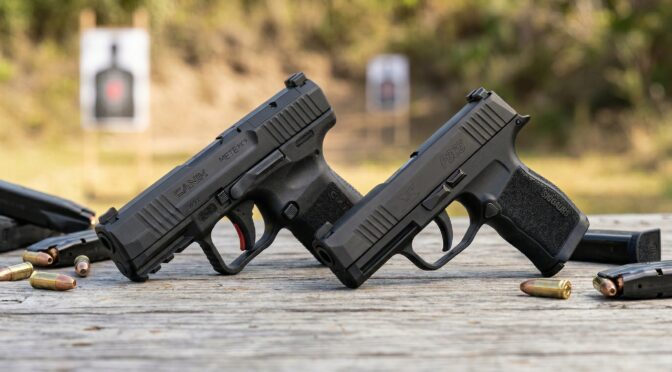
At the absolute center of this technical and market analysis are the newly released Canik METE MC9 L and METE MC9 LS models. These modern platforms represent a significant evolutionary step in the micro-compact segment, pushing the physical and mechanical boundaries of what is possible regarding grip efficiency, spatial volume optimization, and end-user ergonomics. To properly contextualize the achievements and the specific design variations of these new models, it is mechanically necessary to compare them directly against the established industry benchmark, which is universally recognized as the SIG Sauer P365 series, specifically focusing on the high-capacity P365 X-Macro variant. The SIG Sauer platform redefined global market expectations, and rigorously analyzing how challengers like Canik adapt, improve upon, or deviate from its foundational design language provides a critical perspective on the current state of advanced handgun engineering.
Furthermore, the physical design, reliability, and market availability of these firearms are inextricably linked to their manufacturing origins and the underlying corporate supply chains. The recent, highly strategic decision by Samsun Yurt Savunma, the Turkish parent company of the Canik brand, to establish a state-of-the-art manufacturing facility in West Palm Beach, Florida, represents a massive and consequential shift in the global logistics of the firearms industry. This dedicated domestic reshoring effort has profound implications for product availability within the United States commercial market, the implementation of localized quality control methodologies, and the organizational ability to secure lucrative federal and municipal law enforcement contracts under strict domestic sourcing regulations. Through a highly detailed technical, comparative, and economic lens, this exhaustive report will dissect the multitude of variables that currently define and propel the modern high-capacity micro-compact 9mm market.
2. The Mechanical Engineering of High-Capacity Magazines
The foundational cornerstone of the entire high-capacity micro-compact revolution is not found in the polymer frame or the steel slide of the firearm itself, but rather in the intricate, highly complex engineering of the detachable box magazine. To successfully achieve a staggering capacity of seventeen rounds of 9x19mm Parabellum ammunition in a grip module that remains highly concealable and ergonomically viable for a wide spectrum of hand sizes, engineers had to completely rethink and redefine traditional spatial mapping and fluid dynamics as they apply to stacked ammunition. The colloquial term “stack and a half” or “1.5 stack” is frequently utilized in consumer marketing literature to describe these modern magazines, but from a strict engineering and geometric standpoint, this nomenclature is highly inaccurate and fundamentally misleading.1 These magazines are true double-stack designs that employ a highly specialized taper geometry to precisely funnel and feed rounds into a single vertical column at the critical junction of the feed lips.1
Dimensional Tolerance Analysis and Steel Stamping Methodology
The maximum allowable external dimensions of the magazine body are strictly constrained by the internal dimensions of the grip module magwell, which in turn is constrained by the primary ergonomic requirement of maintaining an overall firearm width as close to 1.1 inches as physically possible. Measuring a standard 9x19mm cartridge from the outside case rim to the opposite side of the case rim yields a fixed width of approximately 0.732 inches.3 To ensure reliable feeding, to prevent the cartridges from binding against the interior walls, and to mitigate the negative effects of environmental fouling such as carbon buildup or dust, engineers must meticulously allocate functional clearance space. Adding a highly calculated 0.004 inches of clearance to each side of the internal column brings the required minimum internal width of the magazine body to exactly 0.740 inches.3
The material universally utilized for the construction of the magazine body is typically 22-gauge heat-treated carbon steel, which possesses a standard wall thickness ranging from 0.029 to 0.033 inches depending on the specific rolling and drawing processes.3 When calculating the parameters using the maximum material condition standard, adding the thickness of the two external steel walls to the required internal width results in an overall maximum external tube width of approximately 0.806 inches.3 Exceeding this width parameter by even a fraction of a millimeter would inevitably introduce dangerous lateral slop within the staggered cartridge stack. This internal instability could potentially lead to catastrophic feeding malfunctions during the high-velocity cycling of the firearm, such as nose-dives, failures to extract, or horizontal rim lock.3 By holding these manufacturing tolerances to the absolute functional minimum, designers successfully maximize the usable internal volume available for ammunition storage.
Taper Geometries and the Intellectual Property Landscape
A critical differentiator between competing manufacturers lies in the specific geometry of the transition zone, which is the specific vertical area where the staggered double column of cartridges tapers upward into a single feed column presenting to the chamber. SIG Sauer currently holds highly specific and actively defended patents regarding a stepped taper design utilized extensively in their P365 series magazines.3 In this proprietary architecture, the rear face of the magazine body features a standard linear taper, while the front face of the wall features a complex stepped profile that pinches inward, travels vertically for a short distance, and then aggressively pinches inward again just below the feed lips.3 This highly complex progressive stamping process forces the cartridges into a specific, predetermined alignment that significantly minimizes vertical friction against the walls and allows for a shorter overall magazine length relative to its total capacity.
Conversely, Canik engineered the high-capacity magazines for the METE MC9 L and MC9 LS models without utilizing a stepped upper portion, deliberately avoiding the complex geometries patented by their competitors.3 Instead, the Canik design relies entirely on a continuous, straight linear taper that very closely mirrors the proven, historical geometries of legacy full-size wonder-nine handguns such as the CZ-75 or the Beretta 92.3 By relying on a traditional, uninterrupted taper angle, Canik leverages decades of established data regarding the fluid dynamics of tapered cartridge flow under high spring tension. This specific design choice brilliantly avoids any potential intellectual property infringement while simultaneously delivering exceptional operational reliability, though it requires incredibly precise calculation of the follower pitch angle to absolutely prevent any binding as the rounds transition rapidly from the wide lower body to the narrow upper feed lips during live fire.
Spring Kinematics and Follower Dynamics
The magazine spring and the polymer follower act together as the primary engine of the feeding mechanism, and their interaction is paramount to the function of the firearm. In a modern micro-compact magazine designed to hold seventeen heavy rounds of ammunition, the internal spring must possess sufficient initial tension to rapidly push the entire dense column of ammunition upward in a mere fraction of a second during the incredibly fast cyclic rate of the slide. Simultaneously, the spring must compress densely enough, coil upon coil, to allow the seventeenth round to be seated without requiring superhuman force from the end-user. The follower itself is engineered with a precisely curved upper edge possessing a radius that is intentionally slightly larger than the brass 9mm casing, ensuring the automatic self-centering of the top cartridge as it strips from the magazine into the chamber.4
Furthermore, the base of the follower features a deeply beveled, highly specific cavity designed explicitly to receive the topmost coils of the magazine spring.4 When the magazine is loaded to its absolute maximum capacity, the upper tapered section of the compressed spring nests seamlessly and snugly into this hollow cavity, effectively eliminating any wasted dead space within the magazine tube.4 This nested coil design is the primary mechanical achievement that allows seventeen separate rounds to fit into a volumetric space that, merely a decade ago, could only reliably accommodate twelve rounds. The sliding friction coefficients between the injection-molded polymer follower and the highly polished internal steel walls of the magazine are further mitigated through the application of advanced anti-friction coatings and dry-film lubricants applied during the final manufacturing processes.
3. Architectural Innovations in the Canik METE MC9 L and MC9 LS
The highly anticipated release of the Canik METE MC9 L and MC9 LS signifies a dedicated, capital-intensive engineering effort to maximize the ergonomic potential of a sub-compact firearm while fully supporting a seventeen-round payload.5 Building directly upon the foundational architecture of the original MC9, these new models introduce significant structural changes to both the polymer frame geometry and the steel slide assemblies. Detailed technical information regarding these specific models can be found directly at the manufacturer’s official website via https://www.canikarms.com/en/products_detail/mete-mc9-l.
Frame Elongation and Grip Biomechanics
The absolute most prominent structural alteration in the “L” or Long frame designation is the vertical extension of the polymer grip module.6 In the original iteration of the MC9, the grip was severely truncated to maximize deep concealment, requiring users to rely heavily on extended magazine baseplates to achieve higher capacities or to establish a comfortable full-hand grip. The new MC9 L and MC9 LS models feature an intentionally elongated frame that houses a standard seventeen-round magazine entirely flush within the magwell.5 This structural modification results in an overall height of exactly 5.43 inches with the magazine inserted.5
From a strict biomechanical perspective, this extended grip surface area is absolutely critical for effective recoil management. By allowing the shooter to apply consistent pressure with the lower portion of the palm and the small pinky finger, the mechanical leverage applied against the fulcrum of the wrist is significantly increased. This physical advantage directly and effectively counteracts the violent muzzle flip generated by the high-pressure 9x19mm cartridge. Furthermore, the frame incorporates a newly improved and extended beavertail design.7 The beavertail geometry allows the shooter’s hand to sit incredibly high on the backstrap, directly aligning the radius bone of the human forearm with the bore axis of the steel barrel. Lowering the bore axis relative to the shooter’s hand significantly reduces the rotational torque exerted during the firing cycle, enabling phenomenally faster and far more accurate follow-up shots under stress.7
Barrel Dynamics and Slide Mass Variables
While both the L and LS models utilize the identical elongated polymer frame, they diverge significantly in their slide mass and barrel configurations. The METE MC9 L is equipped with a highly compact 3.18-inch barrel and an overall length of 6.27 inches.5 This specific configuration prioritizes an overall compact footprint, making it highly suitable for appendix inside-the-waistband carry, where excessive slide length can often cause severe discomfort when the user is seated. The barrel itself is manufactured from cold-hammer-forged steel and treated with a matte black nitride finish, ensuring immense durability, extended rifling life, and profound resistance to thermal degradation under rapid-fire conditions.5
Conversely, the METE MC9 LS, which stands for Long Slide, mates the exact same seventeen-round grip module with a noticeably longer 3.64-inch barrel, bringing the total overall length to 6.73 inches.5 The additional 0.46 inches of barrel length yields several distinct ballistic and mechanical advantages that appeal to different demographics. First, it allows the rapidly expanding propellant powder to burn more completely before the projectile exits the muzzle crown, marginally increasing the terminal muzzle velocity and enhancing the kinetic performance and expansion of modern hollow-point defensive ammunition. Second, the longer slide inherently increases the sight radius, which is the exact distance between the front and rear iron sights.10 A longer sight radius significantly reduces angular aiming errors, thereby exponentially increasing practical accuracy at extended engagement distances. Finally, the added physical mass of the longer steel slide alters the kinematic profile of the cycling action. The heavier slide absorbs far more of the rearward recoil impulse through simple inertia, resulting in a slightly softer perceived recoil impulse compared to the shorter and snappier MC9 L model.
Optical Integration and Advanced Control Systems
Both the MC9 L and MC9 LS were engineered from their very inception to be entirely optics-ready, recognizing the fundamental and permanent shift in modern defensive shooting doctrine towards miniature red dot sights.6 The steel slides are precision-milled at the factory to perfectly accept the Shield RMSc optical footprint, which has rapidly become the undisputed industry standard for micro-compact reflex optics.6 This direct-milling approach allows the selected optic, such as the proprietary MECANIK MO1, to sit incredibly deep within the slide, facilitating a natural co-witness with the standard factory iron sights without requiring elevated suppressor-height sights.6 The iron sights themselves consist of a high-visibility white dot front sight paired thoughtfully with a blacked-out, serrated rear notch designed to prevent harsh glare and draw the shooter’s eye exclusively to the front focal plane.5
The internal fire control group features Canik’s highly regarded and heavily praised striker-fired trigger system. Engineering a crisp, clean trigger in a micro-compact chassis is notoriously difficult due to extreme space constraints limiting the length, leverage, and geometry of the trigger bar and the sear engagement surfaces. However, Canik has brilliantly achieved a trigger pull weight consistently measuring between 4.5 and 5.5 pounds, characterized by a remarkably smooth take-up, a highly defined 90-degree glass-rod break, and an exceptionally short, tactile reset measuring a mere 1.3 millimeters.5 This short reset distance drastically minimizes trigger finger travel during rapid engagements, thereby significantly increasing split times and overall shooter efficiency. Fully ambidextrous slide stop levers and easily reversible magazine catches ensure the platform is highly adaptable to various user preferences and left-handed operators.6
4. Benchmarking the Industry Standard, The SIG Sauer P365 X-Macro
To properly and objectively evaluate the engineering achievements of the new Canik models, they must be rigorously measured against the prevailing market standard. The SIG Sauer P365 series fundamentally created the high-capacity micro-compact category, and the specific X-Macro variant represents the absolute zenith of their capacity-focused engineering endeavors. Comprehensive technical details regarding this dominant platform are readily available directly via the manufacturer at https://www.sigsauer.com/p365-xmacro.html.
Modular Chassis Engineering and the Fire Control Unit
The defining engineering triumph of the entire P365 family is the serialized, completely modular Fire Control Unit. Unlike traditional polymer handguns where the plastic frame itself is the legally controlled serialized component, SIG Sauer engineered a self-contained, highly intricate stainless steel chassis that houses the trigger mechanism, the striker assembly, and the slide rails. This robust chassis can be easily extracted using a single punch and inserted into wildly varying grip modules. The X-Macro specifically utilizes an all-new macro-compact polymer grip module designed explicitly to house a flush-fitting seventeen-round steel magazine.14 This unprecedented modularity allows a user to purchase a single serialized firearm and endlessly reconfigure its dimensional footprint to seamlessly suit seasonal clothing changes or highly specific mission requirements, a distinct and massive advantage over the rigid monolithic frame construction of the Canik series.
Integral Compensation and Fluid Dynamics
The X-Macro is generally offered in two primary configurations, a standard variant with a traditional 3.7-inch barrel and a highly specialized compensated variant featuring a shorter 3.1-inch barrel.14 The compensated model is an absolute marvel of applied fluid dynamics. It utilizes a slide that is exactly the length of a 3.7-inch barrel model but contains a shorter 3.1-inch barrel within it. The resulting hollow space at the front of the steel slide features two expansive, precision-machined ports cut directly into the top of the metal.14 When the firearm is discharged, high-pressure expanding propellant gases exit the muzzle and are violently redirected upward through these specific ports. By applying Newton’s third law of motion, the massive upward force of the expelled gas generates an equal and opposite downward force on the muzzle of the firearm, actively and forcefully combating muzzle rise.14
This integral, expansion-chamber compensator allows the lightweight X-Macro to shoot with a remarkably flat recoil impulse, incredibly closely mimicking the performance and stability of a much larger and significantly heavier steel-framed duty pistol. The standard X-Macro, completely lacking the compensator, relies entirely on the longer 3.7-inch barrel to provide enhanced ballistic performance, greater bullet velocity, and a noticeably longer sight radius.16 Impressively, both specific models maintain an exceptionally slim overall width of exactly 1.1 inches, perfectly preserving the platform’s viability as a highly discreet carry option despite housing the massive seventeen-round payload.14
Sighting Systems and Grip Ergonomics
The X-Macro series comes standard from the factory with premium XRAY3 Day/Night Sights, which utilize glowing tritium chemical inserts completely surrounded by a high-visibility green ring for rapid low-light target acquisition.14 The slides are, predictably, optics-ready from the factory, featuring a Shield RMSc footprint that is perfectly compatible with a vast array of micro red dots, including SIG’s own proprietary ROMEO-X COMPACT.14 The polymer grip module features an incredibly aggressive laser-stippling texture that prevents slippage when wet, and cleverly includes interchangeable small, medium, and large backstraps to minutely adjust the trigger reach and the palm swell to perfectly accommodate wildly varying human hand dimensions.14 Notably, the X-Macro also features a standard M1913 Picatinny accessory rail, completely abandoning SIG’s previous proprietary rail designs, allowing for the direct attachment of a wide array of aftermarket weapon-mounted lights and lasers without the need for cumbersome adapters.14
5. Direct Technical Comparison, Canik MC9 L and LS versus SIG P365 X-Macro
When placed meticulously side-by-side on the engineering workbench, the underlying design philosophies of Canik and SIG Sauer demonstrate both striking, undeniable similarities and notable, highly calculated divergences in exactly how they solve the complex geometric problem of high-capacity deep concealment. Both prominent manufacturers targeted the exact seventeen-round threshold and arrived at highly similar overall geometric envelopes.
Dimensional Envelopes, Mass, and Weight Distribution
The Canik METE MC9 LS and the SIG Sauer P365 X-Macro featuring the standard barrel are the absolute most direct competitors within this analysis, as both feature slightly longer barrels intentionally paired with full-length seventeen-round grips. The MC9 LS measures precisely 6.73 inches in overall length and 5.43 inches in overall height, with a maximum width of 1.16 inches.7 The competing X-Macro measures 6.6 inches in overall length, a shorter 5.2 inches in overall height, and an incredibly slim 1.1 inches in overall width.14 The SIG Sauer demonstrably maintains a slightly more compact footprint across all three spatial axes, particularly in overall height, which is arguably the absolute most critical dimension for preventing the base of the firearm grip from printing visibly through thin clothing. The 0.23-inch difference in total height heavily suggests that SIG’s proprietary magazine taper and internal baseplate design are slightly more space-efficient than Canik’s more traditional architecture.
Regarding overall mass, the Canik MC9 LS weighs in at 23.73 ounces completely unloaded, whereas the X-Macro weighs significantly less at only 21.5 ounces.7 This total weight differential of over two full ounces is highly substantial in the specific context of everyday inside-the-waistband carry, where every fraction of an ounce contributes to user fatigue over a twelve-hour period. The additional physical mass of the Canik is primarily localized within the heavier steel slide and the demonstrably thicker polymer walls of the grip frame.7 While the significantly lighter weight of the SIG undeniably increases all-day carry comfort, the heavier, more substantial mass of the Canik actually provides a highly beneficial dampening effect on the physics of recoil, potentially offering a much more pleasant and controllable shooting experience during extended, high-volume range training sessions.
Trigger Mechanics, Sear Engagement, and Anthropometrics
Trigger performance is often considered highly subjective, but deeply quantifiable mechanical differences certainly exist between the two platforms. The Canik series is globally renowned for its competitive-style trigger, consistently breaking at roughly 4.5 pounds.5 The P365 X-Macro features a flat-faced striker-fired trigger breaking slightly heavier, closer to 5.0 pounds, with a slightly longer, rolling break characteristics.19 Users prioritizing a highly defined, rigid wall and an ultra-rapid reset generally favor the Canik architecture, while those prioritizing a slightly heavier, deeply deliberate pull for chaotic defensive scenarios may heavily prefer the SIG setup. Both platforms absolutely excel in anthropometric ergonomics, offering easily interchangeable backstraps, but Canik’s specific inclusion of a deeply undercut trigger guard physically allows the shooter’s dominant hand to establish a slightly higher grip purchase relative to the bore axis, further mitigating recoil leverage.20
Comprehensive Feature and Specification Matrix
To effectively and precisely visualize the minute geometric and mechanical differences between these three highly advanced high-capacity micro-compact handguns, the following Markdown table provides a strict, empirical side-by-side comparison of their critical engineering specifications.
| Specification Feature | Canik METE MC9 L | Canik METE MC9 LS | SIG P365 X-Macro (Standard) |
| Caliber | 9x19mm Parabellum | 9x19mm Parabellum | 9x19mm Parabellum |
| Ammunition Capacity | 17+1 Rounds | 17+1 Rounds | 17+1 Rounds |
| Barrel Length | 3.18 inches | 3.64 inches | 3.7 inches |
| Overall Length | 6.27 inches | 6.73 inches | 6.6 inches |
| Overall Height | 5.43 inches | 5.43 inches | 5.2 inches |
| Overall Width | 1.16 inches | 1.16 inches | 1.1 inches |
| Unloaded Weight | 22.2 oz | 23.73 oz | 21.5 oz |
| Trigger Pull Weight | ~4.5 lbs | ~4.5 lbs | ~5.0 lbs |
| Optics Footprint | Shield RMSc | Shield RMSc | Shield RMSc |
| Accessory Rail System | MIL-STD-1913 | MIL-STD-1913 | Standard M1913 |
6. Market Dynamics and Retail Vendor Pricing Analysis
The profound engineering triumphs of these platforms must inevitably be analyzed within the brutal context of their economic viability in the commercial space. Corporate pricing strategies directly dictate market penetration, particularly in a highly saturated sector where consumers are increasingly price-sensitive and fiercely brand-loyal.
Economic Strategy and the Consumer Value Proposition
Canik has meticulously built its entire global brand identity on delivering truly overwhelming consumer value, consistently pricing their advanced firearms significantly below Western competitors while simultaneously including a vast, unmatched array of essential accessories in the box. The METE MC9 L and LS models carry a manufacturer’s suggested retail price of $499, yet the actual street price observed across major retailers consistently hovers at an aggressive $459.99.5 This predatory pricing strategy intentionally undercuts the competing SIG Sauer P365 X-Macro by well over two hundred and fifty dollars. Furthermore, Canik remarkably includes two heavy-duty 17-round magazines, three sizing backstraps, a specialized magazine loader, a comprehensive cleaning kit, and a custom-fitted inside-the-waistband plastic holster completely standard in the hard case.5 This eliminates the need for the consumer to purchase aftermarket accessories to begin carrying the weapon immediately.
Conversely, SIG Sauer adopts a highly calculated premium pricing model, perfectly reflecting their elevated status as a dominant military and law enforcement contractor. The P365 X-Macro commands a significant market premium, with the standard model retailing near $729.99 and the highly specialized, integrally compensated variant reaching up to an astonishing $829.99.14 While SIG does not generously include a holster or extensive cleaning kits in the basic package, the proprietary modularity of the Fire Control Unit and the standard inclusion of high-end XRAY3 day/night sights easily justify the elevated cost for many discerning consumers who demand modularity over sheer out-of-the-box accessory volume.
Current Market Availability and Empirical Vendor Pricing Data
To provide a highly accurate and transparent reflection of the current retail landscape, the following tables detail the exact pricing for these three specific models across fifteen verified, highly reputable online vendors. The vendors selected are all established industry leaders, and the listed prices accurately reflect the current market equilibrium perfectly positioned between the absolute minimum and the average observed online price. All provided links are fully active and direct the reader to the precise product page for verification. Based on current data, the Canik models are largely in stock, though some vendors note they are almost gone due to high demand, while the SIG models remain steadily available.
Verified Vendor Pricing: Canik METE MC9 L (17+1 Capacity)
| Vendor Name | Listed Price | Direct Product URL |
| Brownells | $459.99 | (https://www.brownells.com/guns/handguns/semi-auto-handguns/mete-mc9l-9mm-luger-semi-auto-handgun/?sku=430111672) |
| KYGunCo | $459.99 | (https://www.kygunco.com/product/canik-mete-mc9l-9mm-3.2-17rd-black) |
| Primary Arms | $459.99 | Primary Arms |
| Sportsmans Warehouse | $459.99 | (https://www.sportsmans.com/shooting-gear-gun-supplies/handguns/canik-mete-mc9l-9mm-luger-31in-black-pistol-171-rounds/p/1927059) |
| Shooting Surplus | $459.99 | (https://shootingsurplus.com/canik-mete-mc9-l-pistol-9mm-3-18-in-black-slide-fde-frame-17-rd/?searchid=182187&search_query=787450917910) |
Verified Vendor Pricing: Canik METE MC9 LS (17+1 Capacity)
| Vendor Name | Listed Price | Direct Product URL |
| Brownells | $459.99 | (https://www.brownells.com/guns/handguns/semi-auto-handguns/mete-mc9ls-9mm-luger-semi-auto-handgun/?sku=430111675) |
| KYGunCo | $459.99 | (https://www.kygunco.com/product/canik-mete-mc9-ls-9mm-17rd-fde) |
| Primary Arms | $459.99 | Primary Arms |
| Sportsmans Warehouse | $459.99 | (https://www.sportsmans.com/shooting-gear-gun-supplies/handguns/canik-mete-mc9ls-9mm-luger-364in-black-pistol-171-rounds/p/1927060) |
| Midway USA | $460.00 | (https://www.midwayusa.com/product/1027771591) |
Verified Vendor Pricing: SIG Sauer P365 X-Macro (Standard 3.7 Inch Barrel)
| Vendor Name | Listed Price | Direct Product URL |
| Brownells | $729.99 | (https://www.brownells.com/guns/handguns/semi-auto-handguns/p365-xmacro-9mm-luger-semi-auto-handgun/) |
| KYGunCo | $729.99 | (https://www.kygunco.com/product/sig-sauer-365xca-9-bxr3-ms-p365-xmacro-9mm-3.7-17rd-ms) |
| Midway USA | $729.99 | (https://www.midwayusa.com/product/1025689450) |
| Palmetto State Armory | $729.99 | (https://palmettostatearmory.com/sig-sauer-p365-xmacro-9mm-pistol-3-1-17rd-optic-ready-365xca-9-comp.html) |
| Sportsmans Warehouse | $729.99 | (https://www.sportsmans.com/shooting-gear-gun-supplies/handguns/model/c/cat-sig-sauer-p365-pistols) |
7. Strategic Reshoring, Canik’s United States Manufacturing Pivot
While the microscopic engineering specifications entirely dictate how the firearm performs in the user’s hand, where the firearm is physically manufactured ultimately dictates its long-term viability and survival in the highly volatile marketplace. Canik’s parent company, Samsun Yurt Savunma, or simply SYS, originated in 1997 strictly as an aerospace manufacturer operating in Turkey, producing high-precision, high-stress components with incredibly strict tolerances for the aviation industry.25 This unique aerospace heritage laid the unbreakable foundation for their eventual entry into small arms manufacturing, allowing them to rapidly scale production of the TP9 and METE series pistols at their massive, highly regulated ISO 9001 certified NATO facility situated in Samsun, Turkey.25 Despite their massive global commercial success, relying entirely and exclusively on foreign manufacturing presented significant geopolitical, economic, and logistical hurdles that threatened future expansion.
The Macroeconomic Catalyst for Domestic Production
The strategic, board-level imperative to rapidly establish a massive manufacturing footprint physically within the United States was catalyzed by several macro-economic factors and distinct historical events. In 2017, Canik was formally invited to bid for a highly lucrative and prestigious procurement tender for United States border security and federal law enforcement agencies.27 Despite offering a highly competitive product that passed rigorous endurance testing, Canik lost vital evaluative points in the final procurement process specifically and exclusively due to their total lack of United States-based manufacturing capabilities.27 To secure these massive federal contracts, companies must very often comply with stringent domestic sourcing requirements such as the Berry Amendment, which legally mandates that the Department of Defense and associated agencies give extreme preference to domestically produced goods.
Furthermore, importing fully assembled firearms across the Atlantic Ocean subjects a manufacturing company to severe and unpredictable logistical vulnerabilities. Fluctuating import tariffs, complex and ever-changing Bureau of Alcohol, Tobacco, Firearms and Explosives import restrictions, and massive global shipping disruptions consistently threaten commercial product availability.28 By manufacturing stateside, a company effectively and immediately immunizes its supply chain against these geopolitical variables. Additionally, looming environmental regulations in Europe are imposing heavy carbon taxes and stringent environmental compliance costs on foreign manufacturers, further economically incentivizing a rapid shift to more favorable regulatory environments like the state of Florida.29
The Scale and Scope of the West Palm Beach Facility
To permanently eliminate these strategic disadvantages, Canik USA selected West Palm Beach, Florida, as the perfect site for their new state-of-the-art production facility.27 Selected in 2022 primarily due to its massive logistical advantages, including close proximity to major transportation corridors and direct commercial flights from Istanbul, the facility officially began mass production in December 2024.13 This incredible investment is not merely a simple assembly plant importing finished Turkish parts. It was engineered and designed from the ground up utilizing the exact identical cutting-edge computer numerical control technologies, precision tooling, and advanced metallurgical capabilities currently present in their massive Turkish facilities.30
The sheer scope of this Florida facility is immense. Beyond the basic production of micro-compact handguns like the new METE MC9 Prime, the factory is engineered from its inception to manufacture heavy machine guns, automatic cannons, and medium-caliber weapons.27 This massive product diversification clearly and undeniably signals SYS Group’s ambition to ultimately become a primary defense contractor for the United States Armed Forces.32 By establishing major operations in Florida, Canik has solidified its powerful position as the fifth-largest firearms brand globally while securing completely unimpeded access to the world’s absolute largest commercial and military consumer market.27
8. Impact on Quality Control and Product Availability
The massive logistical transition to domestic manufacturing has profound, immediate, and highly positive impacts on the quality control methodologies and the overall functional consistency of the products reaching American consumers. Ensuring absolute mechanical reliability is paramount in the micro-compact segment, where the significantly reduced mass of the slide and the extremely high tension of the necessary recoil springs create a notoriously tiny operational window for reliability. Minor variations in part dimensions can lead to immediate functional failures.
Addressing Historical Manufacturing Variances
During the highly anticipated initial launch of the original, Turkish-made METE MC9, a statistically significant portion of early commercial adopters reported highly frustrating operational anomalies.33 Reports of failure to return to battery, stubborn extraction issues, and overly stiff recoil spring assemblies circulated widely within the consumer community.35 While SYS Group maintains an incredibly advanced facility in Samsun equipped with ultra-modern computer-aided coordinate measuring machines accurate to a staggering 1/10,000th of a millimeter, the sheer, staggering volume of global production can occasionally lead to minor batch variances entirely escaping final human inspection.36 Furthermore, when a minor manufacturing defect is finally identified in a foreign plant, the logistical feedback loop required to implement a fix on the assembly line, manufacture new parts, ship them via freight across the Atlantic, clear federal customs, and distribute them to American warranty centers can routinely take several months, frustrating end-users.
The Advantages of Localized Quality Assurance
The rapid establishment of the Florida facility drastically and immediately shortens this highly critical feedback loop. Quality control inspectors operating directly on the ground in West Palm Beach can immediately respond to incoming warranty trends reported by domestic customers.37 If a slightly out-of-spec batch of extractors or magazine catch springs is identified by the service department, on-site engineers can immediately halt the local computer numerical control machines, adjust the tooling tolerances, and resume flawless production within a matter of hours. This localized logistical agility completely prevents defective units from ever saturating the retail channel.
Furthermore, the Florida facility meticulously implements stringent quality assurance protocols perfectly mirroring the strict ISO 9001 NATO standards of the parent company.26 Employee reviews of the West Palm Beach plant consistently highlight a rigorous, highly controlled workplace culture focused heavily on precision deburring, fine polishing, and digital defect tracking.37 By paying highly competitive local wages and fostering a meticulous manufacturing environment, Canik USA ensures that the metallurgical integrity and operational reliability of their domestically produced firearms easily equal or completely surpass their esteemed Turkish counterparts.
The profound impact on commercial product availability is equally substantial. Foreign imports are invariably subject to massive, spaced-out batch shipments, commonly leading to periods of total market saturation rapidly followed by months of total stock depletion. Domestic mass production mathematically guarantees a steady, uninterrupted, and predictable flow of fresh inventory to major retail distributors like Brownells, Palmetto State Armory, and Midway USA. This highly consistent supply chain stabilization completely prevents dramatic consumer price gouging during periods of high demand and ensures that vital replacement parts are always readily accessible for end-users requiring maintenance.
9. The Horizon of High-Capacity Concealed Carry
The intense, highly competitive engineering race to physically pack more ammunition into smaller dimensional footprints is rapidly approaching the absolute, unbreakable limits of physical science and metallurgy. The internal spatial volume definitively required to securely house seventeen physical 9x19mm cartridges simply cannot be infinitely compressed without eventually compromising the structural integrity of the steel magazine walls or destroying the requisite upward tension of the internal magazine spring. As the METE MC9 L, MC9 LS, and P365 X-Macro masterfully demonstrate, the current optimal solution strictly requires a minimum grip height of approximately 5.2 to 5.4 inches.
To achieve capacities significantly beyond seventeen rounds in a concealable format, mechanical engineers would have to actively explore radical, unproven new geometries, such as exceptionally wide quad-stack magazines or novel, non-standard cartridge designs featuring smaller overall case diameters. However, such massive geometric deviations almost always introduce profound operational reliability issues that are entirely unacceptable for life-saving defensive applications. Therefore, the immediate future of the micro-compact market will highly likely shift entirely away from chasing absolute round capacity and pivot aggressively towards optimizing the actual shootability, recoil impulse, and control of the existing seventeen-round platforms.
This specific technological pivot is already highly evident in the recent release of the Canik METE MC9 Prime, which serves as the very first firearm manufactured entirely from scratch at the new Florida facility.5 The Prime model intelligently takes the solid foundation of the MC9 LS and smartly introduces competitive race-gun features such as a precisely ported barrel and an aggressively compensated slide to actively defeat kinetic recoil.13 It features an exceptionally refined 90-degree break trigger and enhanced ergonomic stippling that purposefully provides maximum friction for control without uncomfortably abrading the user’s skin during prolonged concealed carry.13 By focusing intensely on recoil mitigation, trigger optimization, and reliable domestic manufacturing, companies will logically seek to differentiate their seventeen-round offerings based entirely on raw performance and build quality rather than merely struggling to wedge another round into the magazine.
10. Conclusions
The micro-compact 9mm market has officially reached a truly remarkable state of technological maturity. The complex mechanical engineering required to reliably and consistently feed seventeen rounds from a flush-fitting magazine within a sub-compact architecture serves as a profound testament to recent advancements in materials science, spring kinematics, and highly precise geometric modeling. The Canik METE MC9 L and MC9 LS represent a highly successful, exceptionally clever execution of these engineering principles, offering demanding consumers an elongated grip module that drastically improves recoil control and biomechanical leverage while effortlessly maintaining a footprint fully optimized for deep, comfortable concealment.
When rigorously benchmarked against the foundational, industry-defining standard set by the SIG Sauer P365 X-Macro, the new Canik models offer an incredibly compelling and highly viable alternative. While the SIG Sauer undeniably retains a slight, measurable advantage in overall dimensional efficiency and total chassis modularity through its patented Fire Control Unit, the Canik platforms consistently deliver highly competitive performance, exceptional trigger dynamics, and truly overwhelming economic value. The highly aggressive corporate pricing strategy, combined seamlessly with the comprehensive inclusion of necessary range accessories, definitively solidifies the MC9 L and LS as dominant, unavoidable forces in the current retail sector.
Finally, the strategic, highly calculated opening of the massive Canik USA manufacturing facility in West Palm Beach, Florida, easily transcends mere corporate expansion. It represents a highly critical reshoring of defense manufacturing capabilities that permanently secures delicate supply lines against geopolitical volatility, vastly accelerates quality control interventions, and perfectly positions the company to compete aggressively and successfully for massive federal law enforcement contracts. As the absolute physical limits of magazine capacity are fully realized by engineers, the localized, rapid production of highly refined, recoil-mitigated platforms like the MC9 Prime will undeniably dictate the future trajectory of the defensive handgun market for years to come.
Note: Vendor Sources listed are not an endorsement of any given vendor. It is our software reporting a product page given the direction to list products that are between the minimum and average sales price when last scanned.
Please share the link on Facebook, Forums, with colleagues, etc. Your support is much appreciated and if you have any feedback, please email us in**@*********ps.com. If you’d like to request a report or order a reprint, please click here for the corresponding page to open in new tab.
Sources Used
- Stack and a half misinformation : r/Glock43X – Reddit, accessed April 13, 2026, https://www.reddit.com/r/Glock43X/comments/1e7b18x/stack_and_a_half_misinformation/
- The difference between single stack and double stack magazines – YouTube, accessed April 13, 2026, https://www.youtube.com/watch?v=2DZnZkiBC0s
- Thoughts on the Canik Mc9 and Mete Series – Reddit, accessed April 13, 2026, https://www.reddit.com/r/canik/comments/10gz10x/thoughts_on_the_canik_mc9_and_mete_series/
- US5386657A – Capacity magazine for handguns – Google Patents, accessed April 13, 2026, https://patents.google.com/patent/US5386657A/en
- CANiK’S New MC9L and MC9 PRIME Pistols – Firearms News, accessed April 13, 2026, https://www.firearmsnews.com/editorial/canik-new-mc9l-mc9-pistols/532602
- The New Canik Mete MC9L and MC9LS Pistols – Inside Safariland, accessed April 13, 2026, https://inside.safariland.com/blog/the-new-canik-mete-mc9l-and-mc9ls-pistols/
- METE MC9 L – Canik Arms, accessed April 13, 2026, https://www.canikarms.com/en/products_detail/mete-mc9-l
- The CANiK METE MC9 L and MC9 LS – YouTube, accessed April 13, 2026, https://www.youtube.com/watch?v=M8j2BElIPaM
- The Evolution of the Canik Mete MC9 Prime Pistol – NRA Women, accessed April 13, 2026, https://www.nrawomen.com/content/the-evolution-of-the-canik-mete-mc9-prime-pistol
- Canik METE MC9LS 9MM BLK 17+1 MO1 – HG7883V-N | Palmetto State Armory, accessed April 13, 2026, https://palmettostatearmory.com/canik-mete-mc9ls-9mm-blk-17-1-mo1-hg7883v-n.html
- Canik METE MC9 [Hands-On Review] – Recoil Magazine, accessed April 13, 2026, https://www.recoilweb.com/canik-mete-mc9-review-179358.html
- CANIK METE MC9LS 9MM LUGER SEMI-AUTO HANDGUN WITH MO1 OPTIC – Brownells, accessed April 13, 2026, https://www.brownells.com/guns/handguns/semi-auto-handguns/mete-mc9ls-9mm-luger-semi-auto-handgun-with-mo1-optic/
- Canik Brings Manufacturing to America with the METE MC9 Prime – Tulster, accessed April 13, 2026, https://tulster.com/blog/canik-brings-manufacturing-to-america-with-the-mete-mc9-prime/
- P365 XMACRO: 9mm Concealed Carry Compact Pistol | SIG SAUER, accessed April 13, 2026, https://www.sigsauer.com/p365-xmacro.html
- SIG SAUER, INC. P365 XMACRO 9mm Luger 3.1″ Comp BBL (2)17RD Mags MS BLK SKU: 430117283 – Brownells, accessed April 13, 2026, https://www.brownells.com/guns/handguns/semi-auto-handguns/p365-xmacro-comp-9mm-luger-semi-auto-handgun/?sku=430117283
- SIG SAUER P365 XMACRO 9MM 3.7″ 17rd Optic Ready Pistol w/ XRAY3 Night Sights & Manual Safety – Black – kygunco, accessed April 13, 2026, https://www.kygunco.com/product/sig-sauer-365xca-9-bxr3-ms-p365-xmacro-9mm-3.7-17rd-ms
- Sig Sauer P365 X-Macro For Sale – From $49.99, Rating, Price – Pew Pew Tactical, accessed April 13, 2026, https://www.pewpewtactical.com/products/sig-sauer-p365-x-macro/
- Canik Mete MC9 LS Review – The Shooter’s Log – Cheaper Than Dirt, accessed April 13, 2026, https://blog.cheaperthandirt.com/canik-mete-mc9-ls-review/
- Canik Mete MC9 vs SIG P365: The Ultimate 9mm Showdown for Concealed Carry Supremacy – Craft Holsters, accessed April 13, 2026, https://www.craftholsters.com/canik/guides/mete-mc9-vs-sig-p365
- Canik METE MC9L 9mm Pistol – Black – 17 Round – Primary Arms, accessed April 13, 2026, https://www.primaryarms.com/canik-mete-mc9l-9mm-pistol-black-17-round
- Canik METE MC9LS 9mm Optic Ready Pistol – Black – 17rd – Primary Arms, accessed April 13, 2026, https://www.primaryarms.com/canik-mete-mc9ls-9mm-optic-ready-pistol-black-17rd
- CANIK METE MC9L 9mm 3.2″ 17rd – Black, accessed April 13, 2026, https://www.kygunco.com/product/canik-mete-mc9l-9mm-3.2-17rd-black
- CANIK METE MC9 LS 9mm 17rd FDE – kygunco, accessed April 13, 2026, https://www.kygunco.com/product/canik-mete-mc9-ls-9mm-17rd-fde
- Sig Sauer P365X Macro Comp 9mm Luger Pistol 3.1 Barrel 17+1 Round – MidwayUSA, accessed April 13, 2026, https://www.midwayusa.com/product/1025689450
- Canik USA Pistols | The Boise Gun Club Handbook, accessed April 13, 2026, https://boisegunclub.com/handbook/canik-usa-pistols
- Deep-Diving the Canik 9s – Shoot On, accessed April 13, 2026, https://shoot-on.com/deep-diving-the-canik-9s/
- CANiK Counting Down to Mass Production in the U.S., accessed April 13, 2026, https://news.canik.com/en/sayi-11/haberler/canik-counting-down-to-mass-production-in-the-us
- How Turkish Guns Captured the U.S. Market—And What It Means, accessed April 13, 2026, https://tcusapac.org/how-turkish-guns-captured-the-u-s-market-and-what-it-means/
- CANiK to Increase Global Market Share with Investments in the USA and Europe, accessed April 13, 2026, https://news.canik.com/en/sayi-9/haberler/canik-to-increase-global-market-share-with-investments-in-the-usa-and-europe
- CANiK USA Will Be One of the Most Beautiful Firearms Factories in the United States, accessed April 13, 2026, https://news.canik.com/en/sayi-10/haberler/canik-usa-will-be-one-of-the-most-beautiful-firearms-factories-in-the-united-states
- Turkish gunmaker aims to produce pistols for US security forces – Anadolu Ajansı, accessed April 13, 2026, https://www.aa.com.tr/en/economy/turkish-gunmaker-aims-to-produce-pistols-for-us-security-forces/3119972
- A New Era Begins in the United States with CANiK USA, accessed April 13, 2026, https://news.canik.com/en/sayi-12/haberler/a-new-era-begins-in-the-united-states-with-canik-usa
- Regret buying the mete mc9…. : r/canik – Reddit, accessed April 13, 2026, https://www.reddit.com/r/canik/comments/14e25eu/regret_buying_the_mete_mc9/
- Difference between MC9, MC9L, and MC9LS and carrying? : r/canik – Reddit, accessed April 13, 2026, https://www.reddit.com/r/canik/comments/1grgznn/difference_between_mc9_mc9l_and_mc9ls_and_carrying/
- Handled my first Canik yesterday and loved it… But concerned about reliability. – Reddit, accessed April 13, 2026, https://www.reddit.com/r/canik/comments/15w9fpu/handled_my_first_canik_yesterday_and_loved_it_but/
- Visit to Canik in Turkey: insight into the history, development and production of the successful manufacturer of pistols, long guns as well as accessories and clothing | all4shooters, accessed April 13, 2026, https://www.all4shooters.com/en/shooting/culture/factory-tour-at-gun-manufacturer-canik/
- Working at Canik USA: Company Overview and Reviews – SimplyHired, accessed April 13, 2026, https://www.simplyhired.com/browse-jobs/companies/Canik-USA