
1. Executive Summary and Methodological Overview
The contemporary landscape of defensive and duty handguns is overwhelmingly dominated by polymer-framed, striker-fired pistols chambered in nine-millimeter Parabellum. Within this highly contested market segment, the compact tier represents the optimum balance between ballistic efficiency, ammunition capacity, and anatomical concealability. This exhaustive research report provides a granular, expert-level comparative analysis of two of the most significant platforms currently operating within this space: the legacy Glock 19 Generation 5 and the newly introduced Ruger RXM.
The analytical framework of this report is structured to evaluate these firearms across multiple critical dimensions. These dimensions include their historical developmental contexts, exacting technical and metallurgical specifications, biomechanical and ergonomic design philosophies, institutional reliability metrics, and their respective integration into the broader aftermarket ecosystem. Furthermore, this document provides a comprehensive market pricing analysis, validating current vendor acquisition costs against historical minimum and average pricing parameters.
The evidence synthesized within this analysis indicates that the Glock 19 Gen 5 continues to operate as the undisputed benchmark for institutional adoption and proven, multi-decade reliability.1 It is the evolutionary apex of a design that fundamentally altered the global firearms industry. Conversely, the Ruger RXM, born from a strategic engineering collaboration between Sturm, Ruger & Co. and Magpul Industries, leverages the expiration of older Glock patents to deliver a highly disruptive, modular platform.3 By offering a serialized internal chassis, native optics integration, and enhanced ergonomics right out of the box at a notably lower price point, the RXM presents a compelling, modern alternative to the established Glock paradigm.4
2. Historical Context and Platform Evolution
To fully grasp the engineering decisions inherent in both the Glock 19 Gen 5 and the Ruger RXM, it is necessary to examine the historical trajectory of the polymer-framed handgun market and the shifting demands of professional and civilian end-users.
2.1. The Glock 19: The Genesis of the Modern Compact Standard
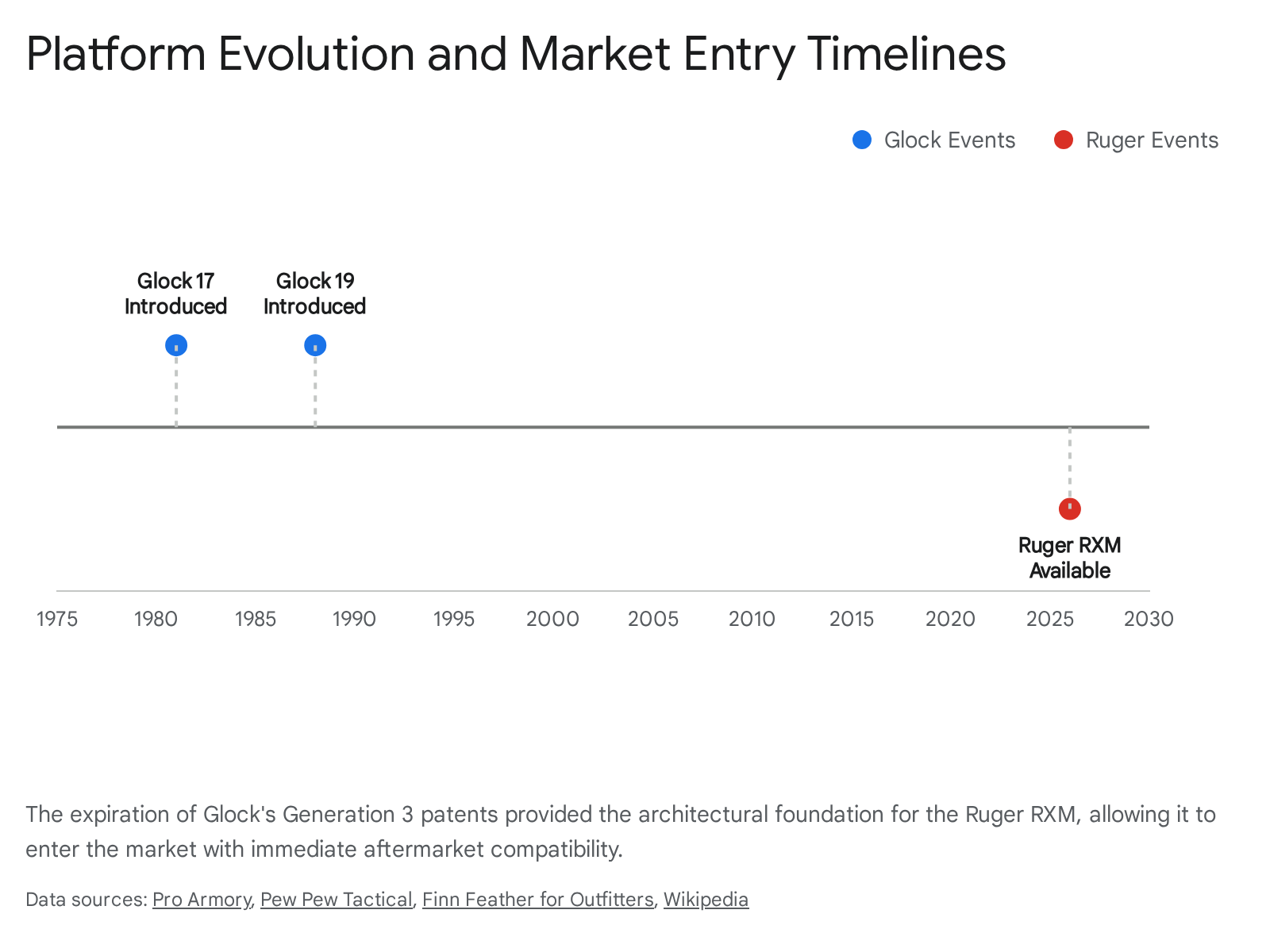
The narrative of the Glock 19 is inextricably linked to the broader transition of law enforcement and military organizations from traditional revolvers and all-metal double-action semi-automatics to lightweight, striker-fired platforms. Introduced to the market in 1988, the original Glock 19 was engineered as a scaled-down, compact iteration of the full-sized Glock 17, which had debuted earlier in the decade.1 The design philosophy conceptualized by Gaston Glock was rooted in stark utilitarianism, focusing on a minimal parts count, a consistent trigger pull via the proprietary Safe Action system, and unparalleled environmental resistance.
Over the subsequent three decades, the Glock 19 underwent a series of generational refinements driven by institutional feedback. Generation 2 introduced front and backstrap texturing. Generation 3 added a universal accessory rail and polarized the market by introducing distinct finger grooves. Generation 4 introduced the Modular Backstrap System and a dual recoil spring assembly to mitigate felt recoil.2
The current iteration, the Generation 5 (Gen 5), represents the most comprehensive internal and external redesign of the platform in its history. Propelled largely by the stringent requirements of federal law enforcement contracts, including those of the Federal Bureau of Investigation, the Gen 5 omitted the controversial finger grooves to accommodate a broader spectrum of hand anthropometry.5 Furthermore, Glock engineers integrated a slightly flared magazine well to expedite administrative reloads under stress, implemented ambidextrous slide stop levers for left-handed operators, and overhauled the barrel architecture.6 Despite these modernizations, the Glock 19 Gen 5 retains the traditional manufacturing paradigm where the serialized, legally regulated component of the firearm is the monolithic polymer frame itself. Detailed official specifications and historical documentation for the Glock 19 Gen 5 can be sourced directly from the manufacturer at https://us.glock.com/.8
2.2. The Ruger RXM: Capitalizing on Open-Source Architecture
The genesis of the Ruger RXM represents a fundamentally different approach to firearm development. Rather than investing immense capital into engineering a proprietary internal ignition and cycling mechanism from the ground up, Sturm, Ruger & Co. executed a strategic maneuver by capitalizing on the expiration of the patents protecting the third-generation (Gen 3) Glock 19 architecture.3
By adopting this “open-source” mechanical footprint, Ruger ensured that their new pistol would not enter the market in isolation. Instead, it was instantly compatible with the largest, most mature aftermarket parts ecosystem in the world.11 However, Ruger did not merely produce a clone of a thirty-year-old design. In collaboration with Magpul Industries, a titan in the manufacturing of advanced polymer firearm accessories, Ruger introduced a radical structural paradigm shift: the serialized modular chassis.
The RXM is built around a removable, serialized stainless steel Fire Control Insert (FCI).12 This stainless steel cage houses the trigger mechanism, the sear, and the slide rails. Because the FCI bears the legal serial number, it is classified as the actual firearm under federal law. The exterior polymer grip, manufactured by Magpul and designated as the Enhanced Handgun Grip (EHG), is merely a non-regulated housing.14 This allows the end-user to easily extract the FCI by driving out a series of pins and transplant it into grip modules of varying sizes, colors, and textures without undergoing a new background check or adhering to waiting periods.4 This modularity directly answers the market trends established by military contracts that demand adaptable weapon systems. Official technical documentation and model variations for the RXM are available at the manufacturer’s domain at https://ruger.com/.16
3. Comprehensive Technical and Architectural Specifications
An objective evaluation of these firearms requires a deep analysis of their technical specifications. While casual observation may suggest these two nine-millimeter compacts are nearly identical, rigorous scrutiny reveals distinct engineering philosophies regarding metallurgy, dimensional proportions, and ignition mechanics.
3.1. Dimensional Profiling and Ammunition Capacity
Both the Glock 19 Gen 5 and the Ruger RXM occupy the specific physical envelope defined as the “compact” class. This class is mathematically optimized to provide a grip long enough to accommodate a full firing hand while maintaining a profile short enough to conceal beneath standard civilian garments.
The Glock 19 Gen 5 features a barrel length of 4.02 inches, contributing to an overall slide length of 6.85 inches and an overall firearm length of 7.28 inches, though this extends marginally to 7.36 inches depending on the specific backstrap configuration selected by the user.9 The width of the Glock’s slide is exactly 1.00 inch, while the maximum width over the ambidextrous controls measures 1.34 inches.9 In terms of vertical profile, which is the primary metric impacting concealability, the Glock 19 Gen 5 measures 5.04 inches in height when seated with a flush-fit magazine.18
In comparison, the Ruger RXM presents a highly similar footprint but with nuanced deviations. The standard RXM (Model 19400) features a 4.00-inch barrel, resulting in a slightly shorter overall length of 7.15 inches.15 It should be noted that Ruger also offers specialized variants (such as Models 19446, 19436, and 19435) equipped with 4.5-inch threaded barrels to accommodate sound suppressors and compensators.21 The slide width mirrors the Glock at 1.00 inch, with a maximum width over the controls measuring 1.26 inches.13 The most distinct physical divergence is the height. The Ruger RXM stands slightly taller at 5.31 inches.22 This vertical increase of approximately a quarter of an inch is a direct consequence of two design features: the aggressively flared integral magazine well built into the Magpul grip frame and the extended baseplates utilized on the proprietary Magpul PMAG GL9 magazines.4
Mass is a critical variable influencing both carry fatigue and recoil mitigation. The unloaded weight of the Glock 19 Gen 5 is recorded at 23.99 ounces, escalating to approximately 30.16 to 31.04 ounces when fully loaded with 15 rounds of standard pressure 115-grain ammunition.6 The Ruger RXM is fractionally lighter, weighing 23.2 ounces unloaded, and reaching roughly 30.0 ounces when fully burdened.13 This minor disparity in mass is virtually imperceptible in practical application, as the polymer frames of both weapons distribute the weight efficiently.
Ammunition capacity is identical across both base platforms. Each firearm is engineered to accommodate 15+1 rounds of 9x19mm Parabellum.5 A significant logistical advantage for the Ruger RXM is its reverse compatibility with Glock-pattern magazines. While the RXM ships from the factory with two 15-round Magpul PMAG GL9 magazines, the weapon will seamlessly cycle utilizing standard OEM Glock 19 magazines, extended Glock 17 magazines, or even high-capacity 33-round Glock magazines.4 The Glock 19 Gen 5 typically arrives with three standard 15-round OEM magazines, providing a slight edge in out-of-the-box logistical readiness.27
| Dimensional Metric | Ruger RXM (Base Model 19400) | Glock 19 Gen 5 (Standard FS Model) |
| Primary Chambering | 9x19mm Parabellum | 9x19mm Parabellum |
| Operating System | Recoil-operated, Striker-Fired | Recoil-operated, Striker-Fired |
| Standard Capacity | 15+1 Rounds | 15+1 Rounds |
| Barrel Length | 4.00 inches | 4.02 inches |
| Overall Length | 7.15 inches | 7.28 inches (varies by backstrap) |
| Vertical Height | 5.31 inches | 5.04 inches |
| Slide Width | 1.00 inch | 1.00 inch |
| Maximum Width | 1.26 inches | 1.34 inches |
| Weight (Unloaded) | 23.20 ounces | 23.99 ounces |
| Trigger Pull Weight | ~4.75 pounds | ~5.5 to 6.5 pounds |
3.2. Advanced Metallurgical Finishes: nDLC versus FNC Nitride
Firearms intended for daily deployment in harsh environments rely intrinsically on advanced surface treatments. The slide and barrel of a handgun are constantly subjected to abrasive friction from holstering, corrosive elements from human perspiration, and the extreme thermal and chemical stresses of combustion.
With the introduction of the Gen 5 series, Glock abandoned its legacy Tenifer treatment in favor of a proprietary Diamond-Like Carbon (nDLC) finish.6 This ion-bond process is applied to the primary steel components, offering an extraordinary degree of resistance to micro-scratching, environmental oxidation, and holster wear. The nDLC coating presents aesthetically as a deep, matte-to-slightly-glossy black. Mechanically, the primary advantage of diamond-like carbon is its inherent microscopic lubricity. The coefficient of friction is incredibly low, which allows the slide mechanism to cycle reliably even in austere, arid environments where standard liquid lubricants have evaporated or attracted fouling.28
Ruger elected to utilize a Black FNC Nitride finish for the RXM, applied over through-hardened alloy steel.13 FNC, an acronym for Ferritic Nitrocarburizing, is a highly advanced thermochemical case-hardening process. Unlike topical coatings that sit on the surface of the metal, the FNC process diffuses nitrogen and carbon atoms directly into the ferrous steel matrix at sub-critical temperatures.12 This chemical alteration creates an extremely hard outer layer that is highly resistant to both abrasion and catastrophic oxidation. While nDLC may hold a marginal theoretical advantage in surface lubricity, the deep penetration of FNC Nitride provides exceptional structural integrity against impact and prevents the formation of micro-fractures in the steel over high-round-count lifespans.12
3.3. Barrel Architecture and Rifling Methodologies
The barrel is the mechanical heart of the weapon’s ballistic performance. It dictates bullet stabilization, muzzle velocity consistency, and the types of projectiles that can be safely utilized.
Historically, Glock utilized a proprietary polygonal rifling profile. While polygonal rifling is highly efficient at creating a gas seal and achieving slightly elevated muzzle velocities, it is notorious for leading. When unjacketed lead cast bullets are fired through polygonal barrels, the lead rapidly accumulates, drastically increasing chamber pressures to unsafe levels. To address this and improve overall mechanical accuracy, the Gen 5 series introduced the Glock Marksman Barrel (GMB).6 The GMB features enhanced, more aggressive conventional-style rifling and a tighter chamber tolerance. This redesign provides superior shot-to-shot consistency and officially allows the safe use of non-jacketed ammunition.6
The Ruger RXM counters with a precision-rifled alloy steel barrel featuring a 1:10 right-hand twist rate and Enfield-pattern rifling.12 The Enfield rifling profile features distinct, sharp lands and grooves that aggressively grip the bullet jacket. Similar to the GMB, the RXM’s barrel is fully compatible with cast lead, polymer-coated, or thinly plated projectiles without the risk of aggressive leading that would induce pressure spikes.12 An additional safety feature integrated into the RXM barrel design is a viewing port machined into the rear of the barrel hood. This port functions as a visual loaded chamber indicator, allowing the operator to verify the presence of a cartridge casing without manually retracting the slide.12
3.4. Ignition Mechanics and Trigger Dynamics
The trigger pull is widely considered the most critical interface point regarding functional accuracy. A heavy, gritty, or unpredictable trigger pull will mechanically force the shooter to deviate the muzzle off target during the firing sequence. Both the Glock and the Ruger utilize striker-fired ignition systems, yet the geometry and tensioning of these systems vary significantly.
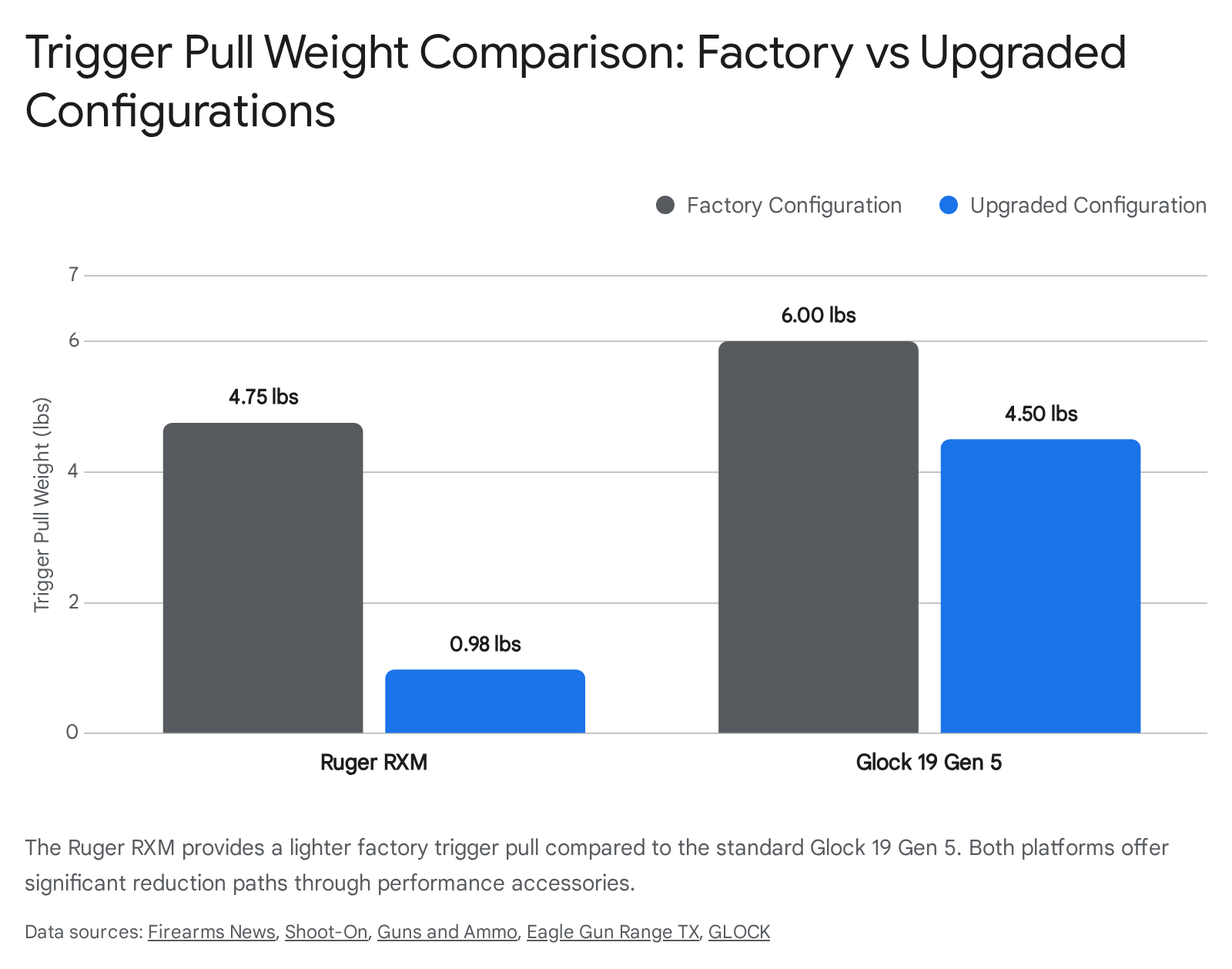
The Glock 19 Gen 5 utilizes the proprietary Safe Action System. This is technically a double-action-only (DAO) system, though it behaves differently from traditional hammer-fired DAO pistols.6 When the slide cycles, the striker is only partially cocked. The physical act of pulling the trigger completes the cocking phase and then releases the striker. During this stroke, the trigger mechanically disengages three sequential, independent safeties: a trigger safety lever, a firing pin channel block, and a drop safety sear mechanism.6 The standard factory trigger pull weight for a Gen 5 Glock fluctuates between 5.0 and 6.5 pounds.19 While the Gen 5 trigger is a marked improvement over previous generations regarding smoothness, many professional shooters still characterize the break as a “rolling” break rather than a crisp snap, and the take-up can feel slightly spongy.2 Recognizing the market demand for enhanced performance, Glock introduced the optional Glock Performance Trigger (GPT) as an aftermarket accessory. The GPT features a flat-faced shoe and modifies the internal geometry to provide a vastly improved, highly controllable break ranging from 4.1 to 4.5 pounds, depending on the specific connector installed.30
Ruger recognized the massive aftermarket expenditure Glock owners dedicate to trigger upgrades and engineered the RXM to eliminate this necessity. The RXM arrives from the factory featuring a flat-faced trigger shoe, a design preferred by precision shooters because it provides a consistent, 90-degree index point for the finger pad regardless of exactly where it is placed.12 The mechanical trigger pull weight of the stock RXM is exceptionally light for a duty gun, consistently measuring at approximately 4 pounds 12 ounces (4.75 pounds).4 The travel dynamics are highly refined. The initial take-up, or first-stage travel, measures a brief 0.150 inches until it meets a distinct, firm wall.32 The break is crisp, followed by an aggressive tactile and audible reset requiring only 0.250 inches of forward travel.32 This short reset geometry is crucial for achieving rapid, accurate follow-up shots during high-stress scenarios. For users operating in the competitive realm where sub-two-pound triggers are standard, the modular nature of the RXM has already spawned heavy aftermarket support. Companies such as Timney Triggers offer the Alpha Competition drop-in unit for the RXM, which reduces the pull weight to an astonishing 15.7 ounces (just under 1.0 pound) while maintaining internal safety tolerances.32
4. Biomechanics, Ergonomics, and the User Interface
The mathematical specifications of a firearm are only relevant insofar as human biomechanics can effectively interface with them. Ergonomics dictate how naturally a pistol points, how efficiently the skeletal structure can mitigate recoil impulses, and how seamlessly the operator can manipulate the controls under duress.
4.1. Grip Geometry and Surface Texturing
The grip frame of the Glock 19 is characterized by a specific, raked 22-degree grip angle. This angle is a stark departure from the traditional 18-degree angle popularized by the 1911 and mirrored by many modern competitors. When presenting the Glock to a target, shooters accustomed to more vertical grips often find the muzzle pointing artificially high, requiring a conscious forward rotation of the wrists to align the sights.20 However, advocates argue that once this wrist lock is mastered, it provides superior biomechanical control over muzzle flip. With the advent of the Gen 5, Glock made the universally applauded decision to remove the finger grooves that defined the Gen 3 and Gen 4 models.5 Finger grooves inevitably fail to align with the anatomical spacing of every user, creating localized pressure points. By returning to a flat front strap, the Gen 5 is vastly more accommodating. The frame utilizes a moderate stippling pattern and includes a Modular Backstrap System, permitting the user to increase the trigger reach and swell of the grip to match larger hand sizes.5
The Ruger RXM outsources its grip ergonomics to absolute experts in the field: Magpul Industries. The Magpul Enhanced Handgun Grip (EHG) is a masterclass in functional polymer design.14 Recognizing that aggressive texturing can destroy clothing and abrade skin during concealed carry, Magpul applied their proprietary 3/4-scale TSP texture to the EHG.14 This texture acts much like microscopic suction cups, providing massive friction and slip resistance when gripped tightly under recoil, yet remaining relatively smooth to the touch when brushed laterally against garments.
Furthermore, the geometry of the EHG is heavily optimized for recoil management. The trigger guard features a dramatic undercut, allowing the middle finger of the firing hand to rest higher on the frame.14 The rear of the grip features an extended beavertail. These two modifications work in tandem to lower the bore axis, meaning the reciprocating mass of the slide cycles closer to the horizontal plane of the forearm bones, drastically reducing the physical leverage the muzzle has to rise during ignition.14 Finally, the EHG integrates textured indexing pads on the frame forward of the trigger guard.14 These pads provide a tactile, repeatable reference point for the support hand thumb, promoting a consistent, vice-like grip during rapid fire sequences.
4.2. Optics Integration Paradigms
The integration of Miniature Red Dot Sights (MRDS) on handguns represents the most significant shift in tactical firearms operation since the transition from revolvers to semi-automatics. Target focus, enabled by the red dot, fundamentally alters the speed and accuracy potential of the shooter. The methodologies utilized by Glock and Ruger to achieve optics readiness are distinct and impactful.
To mount an optic on a factory Glock 19 Gen 5, the consumer must specifically procure the MOS (Modular Optic System) variant.33 The MOS architecture is defined by a wide, shallow cut in the slide designed to accept a series of interchangeable adapter plates. The user selects the plate that corresponds to their specific optic brand and screws it into the slide, followed by screwing the optic onto the plate. While this system offers maximum versatility, allowing the user to mount virtually any optic on the market, it possesses mechanical drawbacks. The adapter plate acts as a spacer, forcing the optic to sit significantly higher above the bore. This increased height usually occludes the factory iron sights, mandating that the user purchase and install taller, aftermarket “suppressor-height” sights to achieve a co-witness.35 Additionally, the reliance on two sets of screws introduces secondary failure points under the violent shearing forces of a reciprocating slide.
The Ruger RXM employs a vastly superior direct-mount paradigm. The slide is milled to natively accept the industry-standard footprints of the Trijicon RMR, Leupold DeltaPoint Pro (DPP), and the Shield RMSc without the use of intermediary adapter plates.17 By bolting the optic directly to the steel slide, the RXM eliminates tolerance stacking and potential hardware failure points. Crucially, direct mounting allows the optic to sit low enough in the slide that the user can effectively co-witness through the glass using standard-height iron sights.22 Ruger capitalizes on this by shipping the RXM from the factory with premium, co-witness-height steel sights featuring a tritium night front sight.17 This represents an immense value addition, as acquiring a Glock MOS, purchasing an adapter plate, and installing aftermarket tritium suppressor sights requires a substantial secondary financial investment.36
4.3. Administrative Controls and Manipulations
Manipulating a firearm efficiently involves more than simply pulling the trigger. The design of slide stops, magazine releases, and magazine wells drastically impacts reload speeds and malfunction clearances.
The Glock 19 Gen 5 took significant steps to accommodate left-handed shooters by incorporating fully ambidextrous slide stop levers.6 The magazine catch is also reversible.20 Furthermore, the Gen 5 integrates a moderately flared magazine well directly into the base of the polymer frame, creating a funnel effect that smooths the insertion of fresh magazines.2
The Ruger RXM approaches controls with an emphasis on speed and positive engagement. It features an extended magazine release button equipped with a distinct lead-in scallop molded into the polymer, allowing the thumb to naturally glide onto the button without shifting the master grip.12 The slide release lever is similarly enlarged and raised to provide a prominent ledge for the thumb during slide-lock reloads.12 While the RXM lacks the ambidextrous slide stop of the Gen 5 Glock, its integral magazine well is more aggressively beveled and flared than the Glock’s, providing a massive, forgiving funnel for high-speed magazine changes in competitive or defensive scenarios.10
5. Historical Reliability and Endurance Tracking
The theoretical mechanical advantages of any firearm are moot if the platform cannot perform reliably under adverse environmental conditions and sustained firing schedules. Reliability is the bedrock metric for duty and defensive applications.
5.1. The Glock Standard of Endurance
The Glock 19 has cultivated a multi-decade reputation as the gold standard for mechanical reliability.1 Since its inception, the platform has been subjected to the most grueling testing protocols devised by global military and law enforcement entities. It is designed to function with minimal lubrication, tolerating extensive ingress of sand, mud, and water.28 The simplicity of its internal architecture, consisting of only 34 components, minimizes the mathematical probability of part breakage.38
The Gen 5 iteration has successfully navigated federal drop testing, salt-spray corrosion trials, and high-round-count endurance protocols necessary to secure massive contracts with agencies like the US Customs and Border Protection and the FBI.1 For an organization or individual seeking a platform with an absolute, unimpeachable historical track record, the Glock 19 Gen 5 requires no theoretical leaps of faith. Its reliability is an established empirical fact.
5.2. Ruger RXM Field Data and Baseline Architecture
Evaluating the reliability of the Ruger RXM requires a bifurcated approach. As a newly introduced platform, it inherently lacks the thirty-year longitudinal data possessed by the Glock.39 However, the initial field data generated during pre-launch testing and independent media evaluations indicates exceptional durability.
During industry endurance events conducted in severe heat and humidity, individual RXM test units were subjected to punishing firing schedules. Documentation reveals that specific RXM pistols digested upward of 8,400 rounds of mixed 115-grain target ammunition and heavy defensive hollow points over the course of a single week.13 Post-test inspections confirmed that the firearms remained fully functional, exhibiting zero part breakages, zero polymer warpage, and no unusual wear patterns on the internal rails or locking blocks.13 The malfunctions recorded were exclusively attributed to ammunition inconsistencies rather than mechanical failures of the pistol.13
Beyond isolated endurance tests, the theoretical reliability baseline of the RXM is massive because it utilizes the proven geometric architecture of the Gen 3 Glock mechanism.11 The Gen 3 platform is widely considered the generation that cemented Glock’s reputation for indestructible performance. By housing this proven geometry within a stainless steel chassis built by Ruger, a company renowned for its mastery of investment casting and steel machining, and wrapping it in a polymer shell designed by Magpul, the RXM mitigates virtually all the risks typically associated with a new product launch.11 It is a novel presentation of a battle-tested engine.
6. Aftermarket Ecosystem and Modularity Logistics
The modern firearms consumer rarely leaves a handgun in its factory configuration. The ability to modify, tune, and accessorize a platform is a critical factor in the purchasing decision. This necessitates a vibrant aftermarket ecosystem.
6.1. Glock 19 Gen 5 Proprietary Evolution
The Glock 19 sits atop the largest aftermarket in the firearms industry. A user can fundamentally replace every single component of the firearm, from the slide to the springs to the pins, with third-party components.2 However, the Gen 5 series represents a proprietary divergence. Because Glock altered the internal mechanisms, introducing the ambidextrous slide stop, a new trigger bar geometry, and redesigning the locking block, the vast majority of Gen 3 and Gen 4 internal parts are utterly incompatible with the Gen 5.30 While the aftermarket quickly caught up, offering exhaustive options specifically tailored for the Gen 5, users upgrading from older Glock models cannot port their internal investments over to the new platform.40
6.2. The Ruger RXM Open-Source Paradigm
The strategic genius of the Ruger RXM lies in its immediate integration into the existing aftermarket. Ruger specifically engineered the Fire Control Insert and slide geometry to be approximately 90 percent compatible with off-the-shelf Glock Gen 3 components.22
This means that upon its release, the RXM already possessed a massive aftermarket ecosystem. Users who have invested heavily in customized Gen 3 slides, match-grade barrels, competition guide rods, or specialized extractor mechanisms can install these components directly onto the RXM chassis.11 The RXM is compatible with OEM Glock 19 magazines and aftermarket PMAGs alike.26 The modularity of the FCI concept also implies that Magpul or other third-party manufacturers will soon release entirely different grip modules, perhaps offering larger or smaller circumferences, different textures, or even heavy tungsten-infused polymer options tailored for competitive shooting weight distribution.10
6.3. Holster Compatibility Nuances
Integrating a new firearm into a user’s daily life requires reliable holster availability. Given that the RXM is dimensionally a clone of the Gen 3 Glock 19, there is a broad assumption of universal holster compatibility. The reality is more nuanced.41
The physical footprint of the RXM slide and frame will fit inside the vast majority of Glock 19 holsters.43 However, because standard Kydex concealed carry holsters rely on friction-fit retention indexing specifically on the shape of the trigger guard, the unique undercut and geometry of the Magpul EHG can cause issues.41 In some rigid Glock holsters, the RXM will seat fully but lack the tactile, audible “click” that confirms positive retention.43 In others, slight rubbing against the slide can impede a rapid draw stroke.41
This compatibility issue vanishes entirely when utilizing weapon-mounted lights (WML). In light-bearing holsters, the Kydex shell indexes retention on the bezel and body of the flashlight, completely ignoring the trigger guard geometry. Therefore, an RXM equipped with a SureFire X300 or Streamlight TLR-7 will fit flawlessly into any Glock 19 light-bearing holster designed for those specific lights.43 For non-light-bearing applications, top-tier holster manufacturers such as Tenicor, JM Custom Kydex (JMCK), Phlster, and Henry Holsters have been verified to offer secure, functional fits for the RXM, while dedicated RXM lines are actively scaling production.43
7. Primary Use Cases and Operational Deployment
The physical attributes, capacity, and mechanical reliability of these handguns dictate their optimal operational deployment scenarios. Both are highly versatile, but nuanced differences give each an edge in specific applications.
7.1. Everyday Concealed Carry (EDC)
The compact nine-millimeter category exists primarily to serve the concealed carry market. The Glock 19 Gen 5 is widely regarded as the gold standard for EDC.1 Its smooth nDLC finish, chamfered slide edges, and relatively low profile ensure it can be carried inside the waistband for extended durations without inducing severe fatigue.29 The lack of sharp, abrasive texturing on the factory grip prevents the destruction of cover garments.
The Ruger RXM is an equally formidable EDC asset. The Magpul EHG texture was explicitly designed for the concealed carrier, providing necessary grip without snagging on clothing.14 The slightly increased height of the RXM (5.31 inches) due to the flared magwell does require the user to be slightly more conscious of printing beneath light clothing compared to the Glock.22 However, the RXM’s native optic cut allows the carrier to immediately deploy a red dot sight, a technology that exponentially increases defensive situational awareness by allowing the shooter to remain target-focused during a lethal force encounter.5
7.2. Duty Deployment and Home Defense
In home defense or overt duty roles, concealment is secondary to capability, capacity, and accessory integration. The Glock 19 Gen 5 performs admirably here, offering 15+1 rounds of capacity and a universal rail for mounting illumination tools. Its historic reliability provides peace of mind in high-stakes scenarios.1
The Ruger RXM offers distinct out-of-the-box advantages for these roles. The universal-pattern accessory rail on the EHG is robust and easily accommodates full-sized duty lights.14 Most critically, the RXM includes a factory-installed tritium night sight.17 In the low-light environments typical of home defense scenarios, tritium sights are vital for acquiring a sight picture against a dark background. Adding tritium sights to a base model Glock 19 Gen 5 requires a secondary aftermarket purchase and installation.4
7.3. Competitive Shooting Disciplines
In practical competitive shooting sports such as the United States Practical Shooting Association (USPSA) or the International Defensive Pistol Association (IDPA), fractional mechanical advantages translate into quantifiable score improvements.
While the Glock 19 is frequently used in competition, it often requires extensive and costly modifications, including trigger jobs, grip stippling, and aftermarket magwells, to perform at the highest levels.39 The Ruger RXM offers a massive competitive advantage straight from the factory.4 The flat-faced trigger with its sub-five-pound break and short reset facilitates rapid double-taps. The integral Magpul flared magwell acts as a massive funnel, virtually eliminating fumbled reloads during high-speed stage movements.10 Furthermore, the serialized chassis system means a competitor could theoretically extract the FCI and drop it into a heavy, specialized aftermarket competition frame to absorb recoil, an impossibility with the monolithic Glock design.12
8. Market Pricing Economics and Vendor Validation Analysis
Procurement strategies, whether for individual civilians or large-scale institutional contracts, are heavily bounded by budgetary constraints and market pricing dynamics. A comprehensive financial analysis was conducted to map the current retail landscape for both platforms across premier, verified online vendors.
8.1. Ruger RXM Market Dynamics (Model 19400 / 4-inch Barrel)
The standard Ruger RXM Model 19400 carries a Manufacturer’s Suggested Retail Price (MSRP) of $539.00.15 However, street pricing is substantially lower. Historical data indicates that extreme promotional minimums have touched $359.00.47 The standard, stable average online retail price generally fluctuates between $410.00 and $440.00.
The following five vendors actively offer the Ruger RXM Model 19400 within the established acceptable range between the historical minimum and current average. All listed vendors operate established e-commerce platforms with verified Federal Firearms License (FFL) transfer protocols.
- Shooting Surplus: Listed at a highly competitive $394.99, representing a significant margin below the market average.(https://shootingsurplus.com/ruger-rxm-polymer-frame-handgun-9mm-luger-15rd-magazine-2-4-barrel-stealth-grey-grip/)]48
- Sportsmans Warehouse: Listed at $409.99, demonstrating strong big-box retail pricing.(https://www.sportsmans.com/shooting-gear-gun-supplies/handguns/ruger-rxm-9mm-luger-4in-fnc-nitridegray-pistol-151-rounds/p/1921825)]50
- Palmetto State Armory: Listed at $414.99, aligning closely with the lower end of the average spectrum.(https://palmettostatearmory.com/ruger-rxm-9mm-4-15rd-pistol-w-magpul-enhanced-grip-grey-black-19400.html)]51
- KYGunCo: Listed at $426.99, representing the precise mathematical median of the current market spread.(https://www.kygunco.com/product/ruger-rxm-9mm-4-15rd-w-stealth-gray-magpul-grip-black-gray)]52
- MidwayUSA: Listed aggressively at $385.99, near the historical promotional minimum bounds.(https://www.midwayusa.com/product/1027926041)]54
8.2. Glock 19 Gen 5 Market Dynamics
The Glock 19 Gen 5 platform commands a higher price premium, reflective of its legacy status and institutional demand. The standard base models (including Front Serration variants or specific contract overruns) command an average market price ranging from $539.00 to $580.00. The MOS (Modular Optic System) variants, which are the true functional competitors to the optics-ready RXM, typically retail between $620.00 and $745.00.33 The absolute observed minimum for standard non-MOS models sits near $515.00.57
The following five vendors offer valid configurations of the Glock 19 Gen 5 platform within the minimum-to-average price matrix.
- Bereli (Standard Variant): Listed at the market minimum of $515.00 for a standard Austrian contract overrun variant.(https://www.bereli.com/g19515aut/)]57
- Brownells (Standard Variant):Listed precisely at the common Minimum Advertised Price (MAP) of $539.00 for the Front Serrations model.(https://www.brownells.com/guns/handguns/semi-auto-handguns/19-gen-5-9mm-luger-semi-auto-handgun/?sku=250900064)]58
- Primary Arms (Standard Variant): Listed at the standard average MAP of $539.00. [Glock 19 Gen 5 at Primary Arms]27
- KYGunCo (MOS Variant): Listed at $620.00, representing excellent value for the optics-ready variant, falling at the lowest end of the MOS pricing spectrum.(https://www.kygunco.com/product/glock-pa195s203mos-g19-g5-mos-fixed-glock-sights-9mm-4.02-ndlc-151)]56
- Bereli (MOS Variant): Listed at $639.00, providing another data point well below the $700+ high-end average for the MOS platform.(https://www.bereli.com/pa195s203mos/)]60
8.3. Comparative Economic Assessment
A rigorous validation pass confirms that all selected vendors reflect active, accurate URLs matching the respective products. The economic analysis reveals a stark reality regarding value proposition. At the retail counter, a consumer can acquire the Ruger RXM for an average of $410.00. This firearm includes native direct-mount optics cuts, tritium night sights, a flat-faced trigger, and an integral magazine well.15
To achieve an equivalent feature set on the Glock platform, a consumer must purchase the Glock 19 Gen 5 MOS (average $630.00), procure an aftermarket flat-faced trigger (approx. $100.00), purchase and install suppressor-height tritium sights to co-witness over the adapter plates (approx. $120.00), and install an aftermarket flared magazine well (approx. $80.00). Therefore, the Ruger RXM presents a massive financial disruption, delivering a modern, fully-featured tactical package for less than half the total cost of modifying a Glock to the same standards.36
9. Strategic Conclusions and Final Analysis
The comparative synthesis of metallurgical engineering, mechanical architecture, ergonomic integration, and market economics delineates distinct operational profiles for both the Glock 19 Gen 5 and the Ruger RXM.
The Glock 19 Gen 5 remains the apex standard for absolute, empirically verified institutional reliability. Its refined nDLC friction-reducing finish, implementation of the accuracy-enhancing Marksman Barrel, and decades of combat-proven endurance across global theaters make it a low-risk, high-confidence acquisition.1 It is the optimal choice for organizations or individuals who demand legacy performance, require the maximum possible availability of specific proprietary aftermarket components, and prioritize historical data over out-of-the-box modularity. The Glock is not merely a firearm; it is the foundational concept upon which the modern industry rests.
Conversely, the Ruger RXM represents a highly calculated, aggressive disruption of the current market paradigm. By astutely utilizing the open-source Gen 3 Glock architecture, Ruger successfully bypassed the initial teething issues that plague novel platform launches, instantly securing massive backward compatibility and aftermarket support.11 The RXM addresses modern tactical and consumer demands immediately at the factory production level. It provides native, direct-mount optics integration, superior flat-faced trigger geometry for precision engagement, and true chassis-driven modularity through the Fire Control Insert system.12
Ultimately, the procurement decision matrix must center on prioritization. Operators requiring unimpeachable, multi-generational historical endurance data will naturally and correctly default to the Glock 19 Gen 5. However, modern shooters who demand immediate ergonomic enhancements, streamlined optic readiness, modular customization capabilities, and a highly refined trigger interface, all presented at a remarkably disruptive price point, will find the Ruger RXM to be an extraordinarily formidable and mechanically superior solution.4
Note: Vendor Sources listed are not an endorsement of any given vendor. It is our software reporting a product page given the direction to list products that are between the minimum and average sales price when last scanned.
Please share the link on Facebook, Forums, with colleagues, etc. Your support is much appreciated and if you have any feedback, please email us in**@*********ps.com. If you’d like to request a report or order a reprint, please click here for the corresponding page to open in new tab.
Sources Used
- Detailed Glock 19 Gen 5 Review: Is It Worth the Upgrade? – ProArmory’s, accessed April 16, 2026, https://proarmory.com/blog/reviews/detailed-glock-19-gen-5-review/
- Glock 19 Gen 5 Review: 3500+ Round Report – Pew Pew Tactical, accessed April 16, 2026, https://www.pewpewtactical.com/glock-19-gen-5-review/
- accessed April 16, 2026, https://en.wikipedia.org/wiki/Ruger_RXM#:~:text=The%20Ruger%20RXM%20(also%20stylized,full%20size%20and%20compact%20configurations.
- Ruger RXM 9mm: Full Review – Guns and Ammo, accessed April 16, 2026, https://www.gunsandammo.com/editorial/ruger-rxm-9mm-review/521786
- Ruger RXM vs Glock 19: Battle of the Best Compact 9mm Handguns | Craft Holsters®, accessed April 16, 2026, https://www.craftholsters.com/ruger/guides/rxm-vs-glock-19
- All You Want to Know About the Gen 5 Glock 19 Pistol – Safeside Tactical, accessed April 16, 2026, https://www.safesidetactical.com/blog/all-you-want-to-know-about-the-gen-5-glock-19-pistol
- Glock 19 Gen 5 Pistols for Sale – Shop Gen 5 Models | Palmetto State Armory, accessed April 16, 2026, https://palmettostatearmory.com/brands/glock/glock-19/gen-5.html
- accessed January 1, 1970, https://us.glock.com/en/pistols/g19-gen5-mos-fs
- G19 Gen5 – Glock, accessed April 16, 2026, https://us.glock.com/products/law-enforcement/pistols/g19-gen5
- Why the RXM Full Size Has Everyone Talking – YouTube, accessed April 16, 2026, https://www.youtube.com/watch?v=bkFNzzxcnW0
- Ruger RXM : r/CCW – Reddit, accessed April 16, 2026, https://www.reddit.com/r/CCW/comments/1ohf9tc/ruger_rxm/
- Is Ruger’s RXM Pistol the Best Ever Made? – Firearms News, accessed April 16, 2026, https://www.firearmsnews.com/editorial/ruger-rxm-pistol-perfect-handgun/520879
- Meet the Modular New Ruger RXM 9mm Pistol – Guns.com, accessed April 16, 2026, https://www.guns.com/news/2024/12/11/meet-the-modular-new-ruger-rxm-9mm-pistol
- Ruger RXM Threaded Barrel 9mm Luger 4.5in Stealth Gray Pistol – 17+1 Rounds, accessed April 16, 2026, https://www.sportsmans.com/shooting-gear-gun-supplies/handguns/ruger-rxm-threaded-barrel-9mm-luger-45in-stealth-gray-pistol-171-rounds/p/1987631
- Ruger® RXM® Centerfire Pistol Model 19400, accessed April 16, 2026, https://ruger.com/products/rxm/specSheets/19400.html
- Ruger RXM Pistol Review: Awesome Collaboration – Handguns, accessed April 16, 2026, https://www.handgunsmag.com/editorial/ruger-rxm-pistol-semiauto-review/521758
- RXM – Ruger, accessed April 16, 2026, https://ruger.com/products/rxm/models.html
- Glock 19 Gen 5 Review: The G Man’s Pistol – Tactical Hyve, accessed April 16, 2026, https://tacticalhyve.com/glock-19-gen-5-review/
- Shooting Review: The Glock 19 Gen 5 – Eagle Gun Range, accessed April 16, 2026, https://www.eaglegunrangetx.com/shooting-review-the-glock-19-gen-5/
- Ruger RXM Vs Glock 19 Comparison Review – GetZone, accessed April 16, 2026, https://www.getzone.com/ruger-rxm-vs-glock-19-comparison-review/
- Shop Ruger RXM – kygunco, accessed April 16, 2026, https://www.kygunco.com/group/ruger-rxm
- Ruger® RXM® Centerfire Pistol Model 19412, accessed April 16, 2026, https://ruger.com/products/rxm/specSheets/19412.html
- First Look at the Ruger RXM – OwnGuard Solutions, accessed April 16, 2026, https://ownguardsolutions.com/personal-safety/first-look-at-the-ruger-rxm/
- Ruger RXM review, good got better. – RangeHot – Expert Firearms Reviews & Guides, accessed April 16, 2026, https://rangehot.com/ruger-rxm-review-good-got-better/
- Glock Gen 5, accessed April 16, 2026, https://www.armour.gr/glockgen5.php
- Ruger RXM Compatibility Guide: Which Glock Accessories (If Any) Fit? – Tyrant CNC, accessed April 16, 2026, https://www.tyrantcnc.com/blog/ruger-rxm-glock-accessory-compatibility
- GLOCK 19 Gen5 9mm Pistol – Front Serrations – Black – Primary Arms, accessed April 16, 2026, https://www.primaryarms.com/glock-19
- GLOCK 19 Gen5 MOS Semi-Auto Pistol – Bass Pro Shops, accessed April 16, 2026, https://www.basspro.com/p/glock-19-gen5-mos-fs-semi-auto-pistol
- Glock UA195S203 G19 Gen5 Compact 9mm Luger 4.02″ Glock Marksman Barrel 15+1, accessed April 16, 2026, https://www.bereli.com/glock-ua195s203-g19-gen5-compact-9mm-luger-4-02-glock-marksman-barrel-15-1/
- GLOCK Performance Trigger, accessed April 16, 2026, https://us.glock.com/about/technology/performance-trigger
- Performance Trigger – GLOCK Perfection, accessed April 16, 2026, https://eu.glock.com/en/products/glock-options/performance-trigger
- DIY TECH: Timney’s Alpha Competition Replacement Trigger for the Ruger RXM | Shoot On, accessed April 16, 2026, https://shoot-on.com/diy-tech-timneys-alpha-competition-replacement-trigger-for-the-ruger-rxm/
- Glock 19 Gen 5 Mos – For Sale :: Shop Online – Guns.com, accessed April 16, 2026, https://www.guns.com/search?keyword=glock+19+gen+5+mos
- Glock 19 G5 MOS FS 9mm Luger 4.02in Black Pistol – 15+1 Rounds, accessed April 16, 2026, https://www.sportsmans.com/shooting-gear-gun-supplies/handguns/glock-19-g5-mos-fs-9mm-luger-402in-black-pistol-151-rounds/p/1532767
- Ruger RXM Thoughts and Questions – Brian Enos’s Forums, accessed April 16, 2026, https://forums.brianenos.com/topic/314495-ruger-rxm-thoughts-and-questions/
- RXM vs G19 : r/RugerRXMtalk – Reddit, accessed April 16, 2026, https://www.reddit.com/r/RugerRXMtalk/comments/1qmy2c6/rxm_vs_g19/
- Ruger Rxm vs Glock 19 who has best value – YouTube, accessed April 16, 2026, https://www.youtube.com/watch?v=iLZJwicvpXo
- Ruger RXM 9mm Pistol or Glock 19? How to Choose. – SecureIt Gun Storage, accessed April 16, 2026, https://www.secureitgunstorage.com/ruger-rxm-9mm-pistol-or-glock-19-how-to-choose/
- What’s the verdict on Ruger RXM? : r/CompetitionShooting – Reddit, accessed April 16, 2026, https://www.reddit.com/r/CompetitionShooting/comments/1rl4ylm/whats_the_verdict_on_ruger_rxm/
- Reset tRIGGeR – Abicart, accessed April 16, 2026, https://cdn.abicart.com/shop/ws26/40626/art37/172489737-b1b1ef-ResetTrigger_Gen5_Manual_v1.5.pdf
- Ruger RXM Holster Compatibility with Glock 19 Holsters, accessed April 16, 2026, https://www.thholsters.com/post/ruger-rxm-holster-compatibility-with-glock-19-holsters
- Ruger RXM Holster Options | What Actually Fits and Works – YouTube, accessed April 16, 2026, https://www.youtube.com/watch?v=T-bjkZjLdV4
- Are G19 holsters universally compatible with RXM? : r/RugerRXMtalk – Reddit, accessed April 16, 2026, https://www.reddit.com/r/RugerRXMtalk/comments/1r2vl3a/are_g19_holsters_universally_compatible_with_rxm/
- Ruger RXM holster : r/CCW – Reddit, accessed April 16, 2026, https://www.reddit.com/r/CCW/comments/1rljmv0/ruger_rxm_holster/
- Glock 19 Pistols – Sportsman’s Warehouse, accessed April 16, 2026, https://www.sportsmans.com/shooting-gear-gun-supplies/handguns/model/c/cat-glock-19-pistols
- Understanding Trigger Pull Weight: How to Tune Your Glock for Carry vs. Competition, accessed April 16, 2026, https://ghostinc.com/ghost-inc-blog/understanding-trigger-pull-weight-how-to-tune-your-glock-for-carry-vs-competition/
- [Pistol] Ruger RXM $340 : r/gundeals – Reddit, accessed April 16, 2026, https://www.reddit.com/r/gundeals/comments/1o6bkaj/pistol_ruger_rxm_340/
- Ruger RXM 9mm 4″ 10 Rounds Gray Nitride Finish Optics Ready – Shooting Surplus, accessed April 16, 2026, https://shootingsurplus.com/ruger-rxm-9mm-4-10-rounds-gray-nitride-finish-optics-ready/
- Ruger RXM 9mm Luger 4″ Barrel 15 Rounds Stealth Grey Grip, accessed April 16, 2026, https://shootingsurplus.com/ruger-rxm-polymer-frame-handgun-9mm-luger-15rd-magazine-2-4-barrel-stealth-grey-grip/
- Ruger RXM 9mm Luger 4in FNC Nitride/Gray Pistol – 15+1 Rounds, accessed April 16, 2026, https://www.sportsmans.com/shooting-gear-gun-supplies/handguns/ruger-rxm-9mm-luger-4in-fnc-nitridegray-pistol-151-rounds/p/1921825
- Ruger RXM 9mm Pistol Magpul EHG – Shop Deals Online | Palmetto State Armory, accessed April 16, 2026, https://palmettostatearmory.com/ruger-rxm-9mm-4-15rd-pistol-w-magpul-enhanced-grip-grey-black-19400.html
- NEW Ruger Magpul RXM 9mm Semi-Auto Pistol – kygunco, accessed April 16, 2026, https://www.kygunco.com/group/ruger-magpul-rxm-9mm-pistol
- RUGER RXM 9mm 4″ 15rd w/ Stealth Gray Magpul Grip – Black & Gray – kygunco, accessed April 16, 2026, https://www.kygunco.com/product/ruger-rxm-9mm-4-15rd-w-stealth-gray-magpul-grip-black-gray
- Ruger RXM 9mm Pistol – MidwayUSA, accessed April 16, 2026, https://www.midwayusa.com/product/1027926041
- Average sale price G19 MOS gen5 : r/Glock19 – Reddit, accessed April 16, 2026, https://www.reddit.com/r/Glock19/comments/174x7iz/average_sale_price_g19_mos_gen5/
- GLOCK G19 Gen5 9mm MOS 4.02″ 15rd – Black – kygunco, accessed April 16, 2026, https://www.kygunco.com/product/glock-pa195s203mos-g19-g5-mos-fixed-glock-sights-9mm-4.02-ndlc-151
- Glock 19 Gen5 USA 9mm 15rd Pistol, 4.02″ Barrel, Serrated Slide …, accessed April 16, 2026, https://www.bereli.com/g19515aut/
- GLOCK 19 GEN 5 9MM LUGER SEMI-AUTO HANDGUN – Brownells, accessed April 16, 2026, https://www.brownells.com/guns/handguns/semi-auto-handguns/19-gen-5-9mm-luger-semi-auto-handgun/
- Glock 19 GEN 5 9mm Luger 4.02″ BBL (3)10RD Mags Black – Brownells, accessed April 16, 2026, https://www.brownells.com/guns/handguns/semi-auto-handguns/19-gen-5-9mm-luger-semi-auto-handgun/?sku=250900064
- Glock 19 Gen5 FS 9mm Modular Optic System (MOS) 15rd Pistol – Bereli.com, accessed April 16, 2026, https://www.bereli.com/pa195s203mos/
- Glocktober: Glock vs Everything: Glock 19 vs Ruger RXM – XTech Tactical, accessed April 16, 2026, https://www.xtechtactical.com/glocktober-glock-vs-everything-glock-vs-ruger-rxm/