
| This is a time-sensitive special report and is based on information available as of January 6, 2026. Due to the situation being very dynamic the following report should be used to obtain a perspective but not viewed as an absolute. |
The execution of Operation Absolute Resolve on January 3, 2026, marks a definitive inflection point in United States foreign policy, military doctrine, and intelligence tradecraft within the Western Hemisphere. The operation, culminating in the extrajudicial capture of Venezuelan President Nicolás Maduro Moros and First Lady Cilia Flores, transcends the traditional boundaries of a law enforcement action or a limited military strike. Instead, it represents the kinetic validation of a re-engineered Monroe Doctrine, adapted for the era of Great Power Competition, where the boundaries between counternarcotics operations, counterterrorism, and conventional state-on-state warfare have been deliberately blurred.1
This report provides an exhaustive, multi-dimensional analysis of the operation, dissecting the intelligence architecture that enabled it, the kinetic execution that ensured its success, and the geopolitical shockwaves that continue to reverberate through Caracas, Havana, Moscow, and Beijing. The extraction of a sitting head of state from a heavily fortified urban center—protected by an Integrated Air Defense System (IADS) of Russian origin and a counterintelligence apparatus managed by Cuban state security—demonstrated a level of joint-force synchronization and intelligence penetration rarely witnessed since the initial phases of Operation Iraqi Freedom.3
Strategically, the operation serves a dual purpose. Primordially, it aimed to decapitate the Bolivarian regime, which Washington has long classified as a nexus of narco-terrorism destabilizing the region. Secondarily, but perhaps more significantly, the deployment of over 150 advanced airframes—including F-22 Raptors, B-1B Lancers, and fifth-generation F-35s—functioned as a high-visibility signal of deterrence. It demonstrated to near-peer adversaries that the United States retains the capability to dismantle sophisticated anti-access/area-denial (A2/AD) bubbles and project power with impunity in its “near abroad”.2
The intelligence community’s role in this operation was paramount, shifting from passive observation to active shaping of the battlefield. The fusion of Human Intelligence (HUMINT) derived from high-level regime defections with persistent, stealthy Signals Intelligence (SIGINT) created an inescapable “Pattern of Life” matrix around the target. This report will elucidate how U.S. intelligence agencies, including the CIA, NSA, and NGA, systematically dismantled the protective layers surrounding Maduro, exploited the failures of his foreign security guarantors, and are now managing the volatile transition under Interim President Delcy Rodríguez.
2. Phase I: Intelligence Preparation of the Operational Environment (IPOE)
The kinetic success of January 3 was the terminal phase of an Intelligence Preparation of the Operational Environment (IPOE) that spanned approximately five months, intensifying significantly from August 2025.3 This preparatory phase was characterized by a profound shift in collection posture, moving from strategic monitoring to actionable targeting.
2.1 The “Pattern of Life” Matrix and HUMINT Penetration
Since 2019, Venezuelan President Nicolás Maduro had adopted extreme operational security (OPSEC) measures to evade assassination or capture. These included the cessation of announced public appearances, the use of decoys, and a rotation schedule involving six to eight different safe houses for sleeping.3 Breaking this security protocol required a granular reconstruction of his daily existence, a process General Dan Caine, Chairman of the Joint Chiefs of Staff, described as mapping the target’s “pattern of life” down to his dietary habits and the location of his pets.3
The breakthrough in this targeting effort was achieved through a synthesis of technical collection and a high-risk HUMINT placement.
- The Insider Threat: Agency insiders have confirmed the successful recruitment of a human source within the upper echelons of the Venezuelan government.3 This placement, described as “bold” and fraught with risk, provided the critical “last mile” verification needed to authorize the strike. In an environment where Cuban counterintelligence (G2) aggressively monitored the loyalty of the Venezuelan officer corps, maintaining such a source represents a significant failure of the regime’s internal security apparatus.
- Fusion of Data Streams: This human reporting was cross-referenced with technical data. The intelligence community likely exploited the inevitable electronic signatures generated by a head of state’s security detail—encrypted communications bursts, convoy movements tracked by overhead assets, and logistical supply chains—to narrow the probability circles of his location to the Fuerte Tiuna military complex on the night of the operation.7
2.2 The Maritime Intelligence Node: MV Ocean Trader
A critical, often overlooked component of the intelligence architecture was the deployment of the MV Ocean Trader. A Special Warfare Support Vessel operated by the Military Sealift Command, the Ocean Trader (formerly the Cragside) functioned as a clandestine, mobile forward operating base.6
Deploying to the Caribbean theater in late December 2025 alongside the USS Iwo Jima Amphibious Ready Group, the vessel provided a unique set of capabilities tailored for this specific mission profile:
- Mobile SIGINT Platform: Unlike land-based stations which are static and known to the adversary, the Ocean Trader could position itself in international waters to optimize the interception of Venezuelan military communications (COMINT) and radar emissions (ELINT) without violating airspace prior to hostilities.6
- Special Operations Command and Control (C2): The vessel is configured to support Naval Special Warfare and Joint Special Operations Command (JSOC) elements. It likely served as the tactical staging ground for the rotary-wing assault force or as the primary relay node for the data pouring in from drone assets, ensuring that the assault team had real-time situational awareness during the ingress.6
- Ambiguity and Deception: Its presence, while noted by open-source intelligence observers, offered operational ambiguity. Ostensibly a support ship, its lethal capabilities and role as a “mothership” for stealth assets allowed the U.S. to build up a strike force under the guise of routine naval patrols or counternarcotics operations.9
2.3 Aerial Surveillance and the RQ-170 Sentinel
To maintain persistent eyes on the target without triggering the Venezuelan IADS, the U.S. deployed the RQ-170 Sentinel.5 This stealth, flying-wing unmanned aerial system (UAS) is designed specifically for operation in denied or contested airspace.
The deployment of the Sentinel was necessitated by the sophistication of Venezuela’s air defenses. Conventional drones like the MQ-9 Reaper would have been vulnerable to detection and engagement by S-300VM batteries. The RQ-170, however, could loiter undetected over Caracas, streaming high-fidelity Full Motion Video (FMV) and thermal imagery. This capability allowed planners to monitor the security perimeter of the Fuerte Tiuna compound in real-time, identifying the specific building housing Maduro and tracking the disposition of his Cuban security detail.5
2.4 Cyber and Electronic Shaping Operations
In the hours preceding the kinetic breach, U.S. Cyber Command and the NSA executed a series of shaping operations designed to blind the adversary and sever their command links. The most visible manifestation of this was the targeted blackout of the Caracas power grid.5
This cyber-kinetic attack served multiple tactical functions:
- IADS Degradation: While military radar systems often have backup generators, the sudden loss of the civilian grid introduces chaos and forces a switch-over process that can expose gaps in coverage. Furthermore, the reliance on backup power limits the operational endurance of radar sites.
- C2 Decapitation: The blackout disrupted the civilian telecommunications infrastructure—cellular towers and internet nodes—upon which much of the Venezuelan state’s routine communication relies. This forced military commanders to switch to radio frequencies, which were then subjected to intense jamming by U.S. electronic warfare assets.6
- Psychological Dislocation: The plunging of the capital into darkness magnified the confusion among regime loyalists, hindering the mobilization of the “Colectivos” (armed pro-government paramilitary groups) and delaying any coordinated counter-attack.5
2.5 The “Project Portero” Doctrine
While focused on the Venezuelan theater, the intelligence methodology employed in Operation Absolute Resolve draws heavily from “Project Portero,” a DEA-led initiative targeting Mexican cartel “gatekeepers”.10 Although Portero is distinct in geography, the operational doctrine—leveraging deep intelligence penetration to conduct “snatch and grab” operations against high-value targets protected by quasi-military forces—served as the template. The “substantial knowledge of cartel networks” and the fusion of law enforcement authorities with military capabilities developed under Portero established the “enabling conditions” that emboldened policymakers to authorize a similar, albeit larger-scale, decapitation strike in Caracas.10
3. Phase II: The Kinetic Execution
The execution phase, authorized by President Donald Trump at 10:46 PM ET on January 2, 2026, was a masterclass in joint-force synchronization.4 The operation, lasting less than three hours, utilized a force package designed for “overmatch”—ensuring that any resistance would be instantaneously neutralized.
3.1 The Air Dominance Package
The Pentagon confirmed the participation of over 150 aircraft, a force size typically reserved for major theater wars.4 This armada included:
- Strategic Bombers (B-1B Lancer): Likely utilized for their large payload of standoff munitions (JASSM) to strike fixed air defense sites and command bunkers from outside the engagement envelope.5
- Air Dominance (F-22 Raptor, F-35 Lightning II): The F-22s provided air superiority cover to negate the Venezuelan Air Force’s Su-30MK2 Flankers, while the F-35s conducted “Day One” stealth strikes against S-300VM and Buk-M2 missile batteries.5
- Electronic Attack (EA-18G Growler): These platforms conducted the SEAD (Suppression of Enemy Air Defenses) campaign, using AGM-88 HARM missiles and high-powered jamming pods to blind enemy radar.6
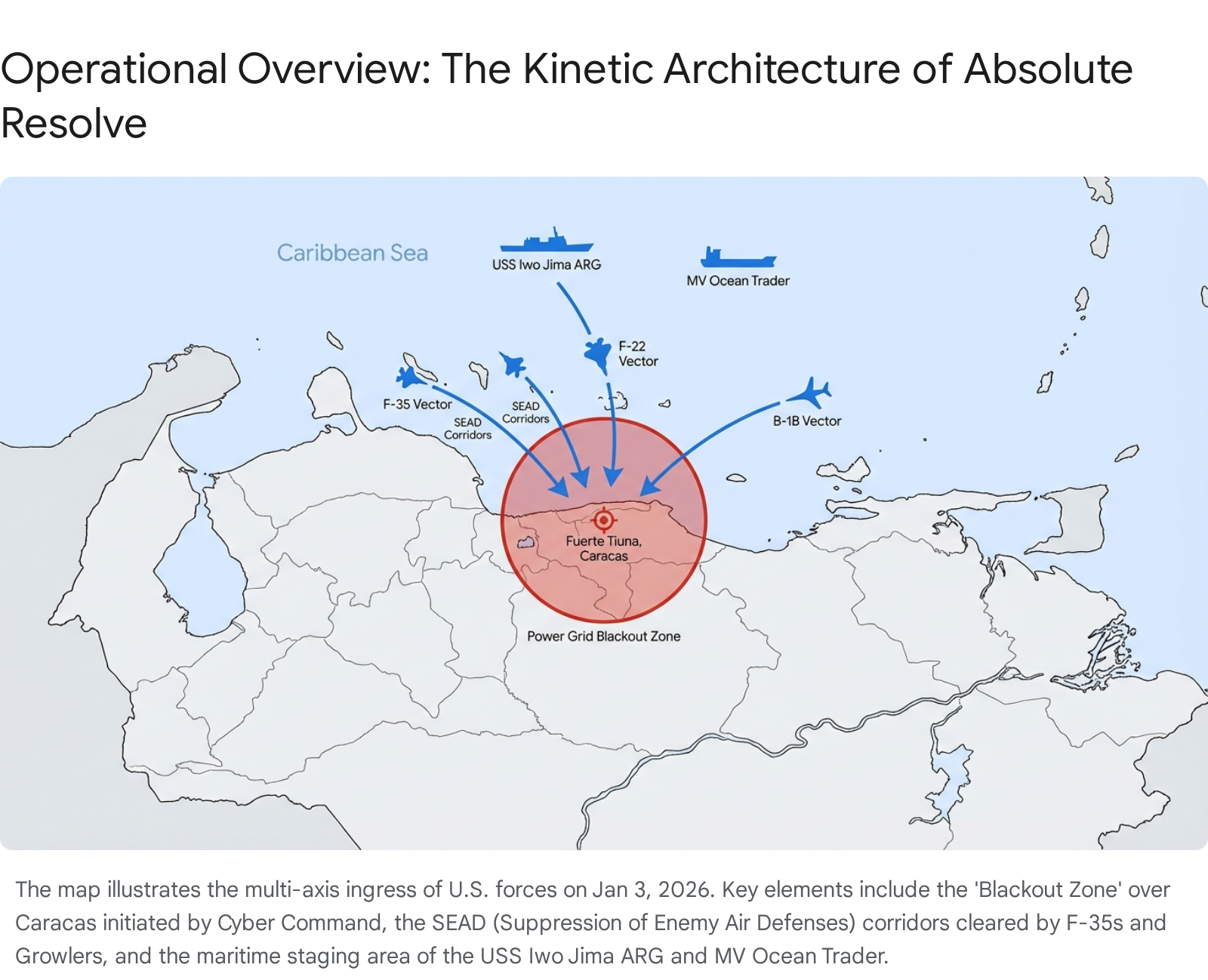
3.2 The Force Package Breakdown
To understand the sheer scale of the operation, it is necessary to analyze the composition of the deployed assets. The force structure was heavily weighted towards suppression and electronic dominance to ensure the survival of the relatively vulnerable rotary-wing assault force.
| Operational Role | Asset Platforms | Strategic Function & Capability |
| Air Dominance | F-22 Raptor, F-15C Eagle | Established a “sanitized” airspace box over Caracas, deterring Venezuelan Su-30MK2s and F-16s from engaging. |
| SEAD / Strike | F-35 Lightning II, B-1B Lancer | Utilized stealth and standoff munitions to physically destroy radar sites (S-300VM) and command bunkers. |
| Electronic Warfare | EA-18G Growler, EC-130H Compass Call | Jammed communications and blinded acquisition radars, creating the “electronic fog” for the raid. |
| ISR & C2 | E-2D Hawkeye, RQ-170 Sentinel, MV Ocean Trader | Provided Airborne Early Warning (AEW), persistent video surveillance, and real-time command relay. |
| Assault / Extraction | MH-60 Black Hawk, MH-47 Chinook (160th SOAR) | Conducted the low-level ingress (100ft altitude) to insert Delta Force operators and extract the targets. |
Table 1: Operational breakdown of U.S. assets deployed during Operation Absolute Resolve.4
3.3 The Assault on Fuerte Tiuna
The capture itself was spearheaded by the U.S. Army’s 160th Special Operations Aviation Regiment (SOAR), known as the “Night Stalkers,” and Delta Force (1st Special Forces Operational Detachment-Delta).1
The assault force utilized MH-60 Black Hawks and likely MH-47 Chinooks, ingressing at an altitude of 100 feet above the water to stay below the radar horizon.5 Upon reaching the Fuerte Tiuna compound—described by President Trump as a “fortress”—the operators breached the facility.8
The resistance was significant but localized. Venezuelan military personnel and a contingent of Cuban security advisors engaged the U.S. forces. The firefight resulted in 56 enemy killed in action (24 Venezuelan, 32 Cuban).11 Remarkably, the operation resulted in zero U.S. casualties and no loss of equipment, a testament to the overwhelming efficacy of the pre-assault SEAD and cyber campaigns.10
4. Adversary Counter-Intelligence Failure Analysis
A critical insight from Operation Absolute Resolve is the catastrophic failure of foreign counterintelligence and defensive umbrellas within Venezuela, specifically those of Cuba and Russia. This failure has strategic implications that extend far beyond the immediate loss of the Venezuelan client state.
4.1 The Collapse of the Cuban Security Shield
For decades, the Cuban G2 (intelligence service) has been the guarantor of the Bolivarian regime’s security, managing the President’s personal detail and counterintelligence protocols.3 The operation exposed a “hollow shield” and a degradation of capability that analysts have termed a “major blow to Cuba’s proud intelligence agencies”.12
- Operational Blindness: Despite deep penetration into the Venezuelan military—where Cuban advisors are embedded at the battalion level—Cuban intelligence failed to detect the specific timing or target of the U.S. strike. The “Pattern of Life” analysis conducted by the CIA went undetected, indicating a failure in Cuban countersurveillance tradecraft.
- Tactical Overmatch: The confirmed death of 32 Cuban agents during the raid suggests that Cuban personnel were positioned as the last line of defense for Maduro.11 Their inability to hold off the Delta Force assault, or even to successfully evacuate the principal target, shattered the myth of Cuban invincibility.
- Strategic Repercussions: The Wall Street Journal notes this event serves as a stark warning to other regimes relying on Cuban security assistance. Furthermore, the loss of Venezuelan oil subsidies—often traded for these security services—threatens to accelerate internal economic instability within Cuba itself.13
4.2 Russian Hardware and Doctrine Failure
Venezuela possesses one of the densest air defense networks in Latin America, built primarily on Russian S-300VM (Antey-2500) and Buk-M2 systems.14 The successful ingress of non-stealth assets (helicopters) and fourth-generation fighters (F/A-18s) into the heart of Caracas indicates a total failure of this IADS.
- Electronic Warfare Dominance: The U.S. SEAD campaign likely utilized advanced jamming frequencies and cyber-enabled payloads that the export versions of Russian hardware could not counter.6 This suggests that U.S. electronic warfare capabilities have outpaced the defensive algorithms of legacy Russian systems.
- Systemic Vulnerabilities: By targeting the power grid, U.S. forces exploited a physical vulnerability in the Russian-built system infrastructure. The reliance on the civilian grid and the failure of backup power generation rendered sophisticated radar systems inert, blinding the defenders at the critical moment of ingress.5
- Diplomatic Paralysis: The Russian response was notably muted. President Putin’s “stunning silence” and the Foreign Ministry’s limitation to travel warnings and verbal condemnation highlight Moscow’s inability to project power in the Caribbean theater or to effectively protect its allies when the United States commits to decisive action.4
5. The “Internal Front”: The Delcy Rodríguez Transition & Intelligence Maneuvering
The immediate aftermath of the capture saw the swearing-in of Vice President Delcy Rodríguez as Interim President.11 While public rhetoric from Rodríguez condemned the “kidnapping” and asserted loyalty to Maduro, intelligence indicators suggest a more complex, transactional reality involving high-level backchannel negotiations.
5.1 The Qatar Backchannel
Intelligence reporting indicates that months prior to the operation, secret negotiations were conducted between U.S. officials and Delcy Rodríguez, mediated by the State of Qatar.17 Qatar, which has previously facilitated talks between Washington and adversaries like the Taliban and Iran, served as the neutral conduit for these sensitive discussions.
- The “Soft Landing” Proposal: These talks reportedly explored scenarios where Maduro would be removed or marginalized, allowing Rodríguez to assume power. The objective was to secure a transition that would preserve the core of the Chavista state structure while acquiescing to U.S. demands for energy access and regional stability.19
- The “Betrayal” Narrative: Analysts, including former Colombian officials, suggest that Rodríguez may have “sold out” Maduro to secure her own position.19 Her rapid pivot to offering a “balanced and respectful” relationship with the U.S. shortly after the raid—and President Trump’s comment that she was “willing to do what is necessary”—corroborates the theory of a pre-arranged understanding.16
5.2 The “Brest-Litovsk” Strategy
To manage the internal base of the Partido Socialista Unido de Venezuela (PSUV) and the military, regime loyalists have framed Rodríguez’s cooperation with the U.S. not as surrender, but as a “Brest-Litovsk” moment.21 Drawing a parallel to Lenin’s 1918 treaty with Germany, the narrative posits that the regime must make painful concessions—including the loss of Maduro and the opening of oil fields to U.S. companies—to save the “revolution” from total annihilation by a superior military force.
This narrative allows the military high command (Padrino López, Diosdado Cabello) to retain their positions and avoid a fratricidal conflict, presenting their acquiescence to the new reality as a strategic retreat rather than a capitulation. Rodríguez’s public demand for Maduro’s release is thus interpreted as necessary political theater to maintain the cohesion of the Bolivarian movement while the realpolitik of the transition is negotiated behind closed doors.21
6. Geopolitical & Strategic Fallout
6.1 The Monroe Doctrine Redux
Operation Absolute Resolve serves as the kinetic validation of a revived and militarized Monroe Doctrine. President Trump’s justification of the operation—citing “narco-terrorism” and the need to secure natural resources—signals a return to a sphere-of-influence policy where external powers (China, Russia, Iran) are forcibly excluded from the Western Hemisphere.1 The operation demonstrates that the U.S. is willing to use unilateral force to enforce this doctrine, disregarding international norms of sovereignty when vital interests (or perceived threats) are at stake.
6.2 China: Displaced Aggression and Legal Warfare
The response from the People’s Republic of China has been characterized by a mix of diplomatic condemnation and displaced military signaling.
- Diplomatic Condemnation: Beijing denounced the operation as a “gross violation of international law” and the UN Charter, framing the U.S. as a “hegemonic bully”.22 This rhetoric aims to rally the Global South against U.S. interventionism.
- Military Signaling: Crucially, China’s military response was not in the Caribbean, where it lacks projection capability, but in East Asia. Following the operation, China conducted “Justice Mission-2025” drills around Taiwan, launching rockets into the island’s contiguous zone.4 This suggests China is unwilling to escalate directly with the U.S. over Venezuela but will use the event to justify its own aggressive postures in its near abroad, interpreting the U.S. action as a precedent that legitimizes unilateral action against “separatist” or “criminal” regimes.
6.3 Regional Realignments
The operation has fractured the Latin American geopolitical landscape.
- The Leftist Bloc: Leaders in Colombia (Petro), Brazil (Lula), and Mexico (Sheinbaum) have condemned the action as an illegal violation of sovereignty.24 However, their inability to prevent or effectively respond to the operation highlights the power asymmetry in the region.
- The Stability Seekers: Conversely, some sectors in the region view the removal of Maduro as a necessary step to resolve the migration crisis that has displaced 8 million Venezuelans.1 The exhaustion with the Venezuelan crisis may lead to a tacit acceptance of the new status quo, provided that stability is restored and migration flows are curbed.
7. Economic Intelligence: The Energy Sector Rehabilitation
A central, if under-articulated, objective of the operation appears to be the rehabilitation of the Venezuelan oil sector under U.S. stewardship. President Trump explicitly stated that U.S. oil companies would “run” Venezuela’s oil infrastructure to rebuild the country.26
7.1 Corporate Hesitancy vs. Market Opportunity
While the stock prices of major U.S. oil companies like Chevron (CVX), ExxonMobil (XOM), and ConocoPhillips (COP) spiked following the raid, the corporate reality is more nuanced.27
- Infrastructure Decay: Years of mismanagement and sanctions have left PDVSA’s infrastructure in ruin. Rebuilding production to pre-Chavez levels is estimated to require $80-90 billion in investment over nearly a decade.29
- Legal Uncertainty: Executives have expressed caution, noting that they require a stable legal and fiscal framework before committing capital. The “Delcy Transition” offers a tenuous partner; U.S. firms are wary of investing billions in a jurisdiction where the rule of law is maintained by a fragilized interim government.30
- Resource Denial: Strategically, the operation aims to deny China continued privileged access to Venezuelan oil and strategic minerals like coltan. By reorienting these resources to the U.S. supply chain, Washington aims to decouple the Venezuelan economy from Beijing’s orbit.31
8. Legal and Doctrinal Implications
8.1 The “Narco-Terrorism” Warfare Model
The legal framework for the operation relies on the indictment of Nicolás Maduro for “narco-terrorism” by the Southern District of New York (SDNY).32 This represents a significant evolution in legal warfare (lawfare).
- Domestic Law as Casus Belli: The U.S. has effectively established a precedent where the domestic indictment of a foreign head of state for criminal activity provides the casus belli for military intervention. This bypasses the traditional requirement for a declaration of war or a UN Security Council resolution, framing the military invasion as a “law enforcement support operation”.10
- The Indictment: Maduro faces charges of conspiring with the FARC and Venezuelan officials (Diosdado Cabello, Hugo Carvajal) to flood the U.S. with cocaine. The indictment alleges he led the “Cartel of the Suns,” using state resources to facilitate drug trafficking as a weapon against the United States.32
8.2 Maduro’s Defense Strategy
In his initial arraignment before the SDNY, Maduro adopted a defense strategy focused on his status as a head of state. He declared, “I am President of the Republic of Venezuela… I am here kidnapped,” and claimed status as a “Prisoner of War” (POW).32 His defense team, including high-profile attorneys, is likely to challenge the jurisdiction of the U.S. court, arguing sovereign immunity and the illegality of his capture under international law.35 This legal battle will likely become a protracted spectacle, testing the boundaries of U.S. extraterritorial jurisdiction.
9. Future Outlook and Threat Assessment
Operation Absolute Resolve stands as a watershed moment in 21st-century warfare and U.S. foreign policy. By seamlessly integrating high-end military capabilities with deep-penetration intelligence, the United States achieved a strategic objective that had eluded it for a decade.
However, the tactical brilliance of the raid masks the volatility of the peace. The U.S. now effectively owns the Venezuelan crisis. The administration faces the monumental task of stabilizing a collapsed state, managing a potentially duplicitous interim government under Delcy Rodríguez, and countering the inevitable asymmetric responses from humiliated global adversaries.
The intelligence community must now pivot from targeting to stabilization. Key collection priorities will include monitoring the loyalty of the Venezuelan military to the new interim government, detecting any “stay-behind” insurgent networks activated by hardcore Chavistas or Cuban operatives, and securing the critical energy infrastructure against sabotage. The capture of Maduro is not the end of the Venezuelan crisis, but the beginning of a new, potentially more dangerous phase of direct American management in Latin America.
If you find this post useful, please share the link on Facebook, with your friends, etc. Your support is much appreciated and if you have any feedback, please email me at in**@*********ps.com. Please note that for links to other websites, we are only paid if there is an affiliate program such as Avantlink, Impact, Amazon and eBay and only if you purchase something. If you’d like to directly contribute towards our continued reporting, please visit our funding page.
Sources Used
- What Will ‘Operation Absolute Resolve’ Mean for Venezuela and …, accessed January 6, 2026, https://www.stimson.org/2026/what-will-operation-absolute-resolve-mean-for-venezuela-and-latin-america/
- What US aircraft were used in Operation Absolute Resolve? – Army Technology, accessed January 6, 2026, https://www.army-technology.com/features/what-us-aircraft-were-used-in-operation-absolute-resolve/
- Months in planning, over in two and a half hours: how the US snatched Maduro, accessed January 6, 2026, https://www.theguardian.com/world/2026/jan/04/tactical-surprise-and-air-dominance-how-the-us-snatched-maduro-in-two-and-a-half-hours
- ‘Over 150 aircraft’: From Trump’s go-ahead to handcuffed Maduro …, accessed January 6, 2026, https://timesofindia.indiatimes.com/world/us/over-150-aircraft-from-trumps-go-ahead-to-handcuffed-maduro-how-us-carried-out-operation-absolute-resolve-in-under-five-hours/articleshow/126325775.cms
- US Airpower Paved Way for Special Ops to Capture Venezuela’s …, accessed January 6, 2026, https://www.airandspaceforces.com/us-airpower-paved-the-way-for-delta-force-to-capture-venezuelas-maduro/
- Operation Absolute Resolve: Anatomy of a Modern Decapitation Strike, accessed January 6, 2026, https://sofsupport.org/operation-absolute-resolve-anatomy-of-a-modern-decapitation-strike/
- Inside ‘Op Absolute Resolve’: From CIA team to drone fleet – the …, accessed January 6, 2026, https://timesofindia.indiatimes.com/world/us/inside-op-absolute-resolve-from-cia-team-to-drone-fleet-the-planning-before-flawless-arrest-of-venezuela-president-nicolas-maduro/articleshow/126334353.cms
- Destruction Seen At Caracas Base That Was A Focus Of The U.S. Military Operation, accessed January 6, 2026, https://www.twz.com/news-features/major-damage-seen-in-caracas-after-u-s-op-to-capture-maduro
- US Special Forces ghost ship spotted near Venezuela — is a secret mission underway?, accessed January 6, 2026, https://m.economictimes.com/news/international/us/us-special-forces-ghost-ship-spotted-near-venezuela-is-a-secret-mission-underway/articleshow/124274227.cms
- Operation Absolute Resolve: A Rendition Revival? | Small Wars …, accessed January 6, 2026, https://smallwarsjournal.com/2026/01/06/operation-absolute-resolve-a-rendition-revival/
- 2026 United States strikes in Venezuela – Wikipedia, accessed January 6, 2026, https://en.wikipedia.org/wiki/2026_United_States_strikes_in_Venezuela
- Cuba’s Intelligence Agencies Humiliated in Maduro Arrest, accessed January 6, 2026, https://www.chosun.com/english/world-en/2026/01/06/4GX5VN74XFCI5CYPWQGAYV3MLI/
- “From Caracas to Havana: U.S. Strategic Options for Dismantling Cuban Authoritarian Rule”, accessed January 6, 2026, https://lansinginstitute.org/2026/01/03/from-caracas-to-havana-u-s-strategic-options-for-dismantling-cuban-authoritarian-rule/
- The Maduro Raid: A Military Victory with No Viable Endgame, accessed January 6, 2026, https://www.csis.org/analysis/maduro-raid-military-victory-no-viable-endgame
- Russia Warns Citizens Against Travel to Venezuela After U.S. Ousts …, accessed January 6, 2026, https://www.themoscowtimes.com/2026/01/05/russia-warns-citizens-against-travel-to-venezuela-after-us-ousts-maduro-a91609
- Delcy Rodríguez strikes conciliatory tone with US after Trump warning, accessed January 6, 2026, https://www.theguardian.com/world/2026/jan/05/venezuela-delcy-rodriguez-trump
- Venezuela: Did Delcy Rodriguez Sell Out Maduro to Trump and the US ?, accessed January 6, 2026, https://colombiaone.com/2026/01/04/delcy-rodriguez-maduro-trump/
- The Secret Negotiations Between the USA and Delcy Rodriguez – Havana Times, accessed January 6, 2026, https://havanatimes.org/features/the-secret-negotiations-between-the-usa-and-delcy-rodriguez/
- Was Maduro betrayed claims point to Delcy Godriguez US talks?, accessed January 6, 2026, https://en.yenisafak.com/world/was-maduro-betrayed-claims-point-to-delcy-godriguez-us-talks-3712824
- Trump Announces U.S. Military’s Capture of Maduro, accessed January 6, 2026, https://www.war.gov/News/News-Stories/Article/Article/4370431/trump-announces-us-militarys-capture-of-maduro/
- Venezuela’s Revolution still stands: debunking Trump’s psyop …, accessed January 6, 2026, https://peoplesdispatch.org/2026/01/05/venezuelas-revolution-still-stands-debunking-trumps-psyop/
- China imposes sanctions on five US companies as countermeasures against arms sales to Taiwan island – Global Times, accessed January 6, 2026, https://www.globaltimes.cn/page/202401/1304907.shtml
- Trump, Big Oil and China – Three Articles – Portside.org, accessed January 6, 2026, https://portside.org/2026-01-04/trump-big-oil-and-china-three-articles
- The Shoe Drops in Venezuela, accessed January 6, 2026, https://jstribune.com/sanders-the-shoe-drops-in-venezuela/
- U.S. Ouster of Maduro Divides World Powers, accessed January 6, 2026, https://www.chosun.com/english/world-en/2026/01/05/DSLECTVKRVBBXJENFBGXQKSA4Q/
- Trump says U.S. is “in charge” of Venezuela, Maduro jailed in New York after U.S. military operation, accessed January 6, 2026, https://www.cbsnews.com/live-updates/venezuela-us-military-strikes-maduro-trump/
- Chevron and Exxon stocks jump. Here’s what analysts are saying about big oil companies after Maduro’s capture., accessed January 6, 2026, https://www.morningstar.com/news/marketwatch/20260105205/chevron-and-exxon-stocks-jump-heres-what-analysts-are-saying-about-big-oil-companies-after-maduros-capture
- Chevron, Oil Stocks Soar as Trump Promises Revival of Venezuelan Oil Industry, accessed January 6, 2026, https://www.investopedia.com/chevron-oil-stocks-soar-as-trump-promises-revival-of-venezuelan-oil-industry-11878967
- Trump says US companies will invest billions in Venezuelan oil production. Experts aren’t so sure, accessed January 6, 2026, https://www.theguardian.com/us-news/2026/jan/06/trump-oil-companies-venezuela
- Venezuela oil industry too shaky for U.S. companies to rush to re-enter, experts say, accessed January 6, 2026, https://www.cbsnews.com/news/venezuela-oil-maduro-chevron-exxon-mobil-conocophiillips/
- Operation Absolute Resolve: Why the US Captured Maduro, the …, accessed January 6, 2026, https://researchcentre.trtworld.com/publications/podcast/operation-absolute-resolve-why-the-us-captured-maduro-the-delta-force-raid-and-the-battle-for-oil-reserves/
- ‘Me Considero Prisionero de Guerra’: Maduro Arraigned in Federal …, accessed January 6, 2026, https://www.lawfaremedia.org/article/me-considero-prisionero-de-guerra—maduro-arraigned-in-federal-court
- Beyond the Doctrine: How Operation Absolute Resolve Rewrote the Rules of American Foreign Policy in 2026, accessed January 6, 2026, https://debuglies.com/2026/01/04/beyond-the-doctrine-how-operation-absolute-resolve-rewrote-the-rules-of-american-foreign-policy-in-2026/
- United States of America v. Nicolás Maduro – Wikipedia, accessed January 6, 2026, https://en.wikipedia.org/wiki/United_States_of_America_v._Nicol%C3%A1s_Maduro
- Nicolás Maduro Hires Assange Lawyer for Criminal Defense (2), accessed January 6, 2026, https://news.bloomberglaw.com/us-law-week/nicolas-maduro-hires-julian-assange-lawyer-for-criminal-defense