Category Archives: Submachine Gun (SMG) & Pistol Cailber Carbine (PCC) Analytics

Dedicated to submachine guns (SMGs), such as the MP5, and pistol caliber carbines (PCCs).

Most Commonly Requested Pistol Caliber Carbine (PCC) Comparisons in the U.S. Market Based on Social Media- 2024-2025

The Pistol Caliber Carbine (PCC) segment represents one of the most dynamic and contended categories in the modern firearms market. Its growth is fueled by diverse consumer applications, including home defense, where users value the platform’s blend of rifle-like ergonomics and accuracy with the reduced over-penetration and concussion of a pistol cartridge.1 The competitive shooting community, particularly in USPSA, has also embraced the platform, creating a dedicated high-performance sub-market.3 For the recreational market, PCCs offer a “fun” shooting experience driven by the low cost of 9mm ammunition and the logistical advantage of magazine interchangeability with a user’s existing sidearm.6

This report provides a data-driven analysis of the PCC market by identifying and quantifying the top 10 “X vs. Y” brand and model comparisons actively debated by potential buyers on social media platforms.3 Leveraging social listening and competitive analysis frameworks 10, these debates have been quantified using three proprietary metrics, which are detailed in the Appendix:

  1. Topic Magnitude Index (TMI): A “share of voice” metric quantifying the volume and engagement of a specific comparison.12
  2. Sentiment Score (% Positive / % Negative): A measure of market opinion derived from sentiment analysis.14
  3. Performance Score: A weighted composite score reflecting user-reported Reliability, Ergonomics, Accuracy/Recoil, and Value.16

A primary finding of this analysis is the clear segmentation of the market into distinct tiers. The premium tier ($2,000+) is now defined by advanced, non-blowback operating systems. The mid-market ($800 – $1,500) is dominated by foreign-manufactured platforms with robust aftermarkets. The utility and budget tier ($400 – $800) is defined by price-point and specific features, such as folding or takedown capabilities.

PCC Consumer Debate: Summary of Findings

The following table summarizes the quantitative analysis of the top 10 consumer debates identified in the PCC market.

MatchupTopic Magnitude Index (TMI) (1-10)Dominant ThemesModel X% Pos% NegPS (1-10)Model Y% Pos% NegPS (1-10)Analyst’s Recommendation
B&T APC9 Pro vs. HK SP59.8Modern vs. Classic; Ergos vs. RecoilB&T APC990%10%9.1HK SP588%12%8.4B&T APC9 Pro (Practical)
SIG MPX vs. CMMG Banshee9.5Operating System (Piston vs. Radial)SIG MPX82%18%8.0CMMG92%8%8.9CMMG Banshee/Dissent
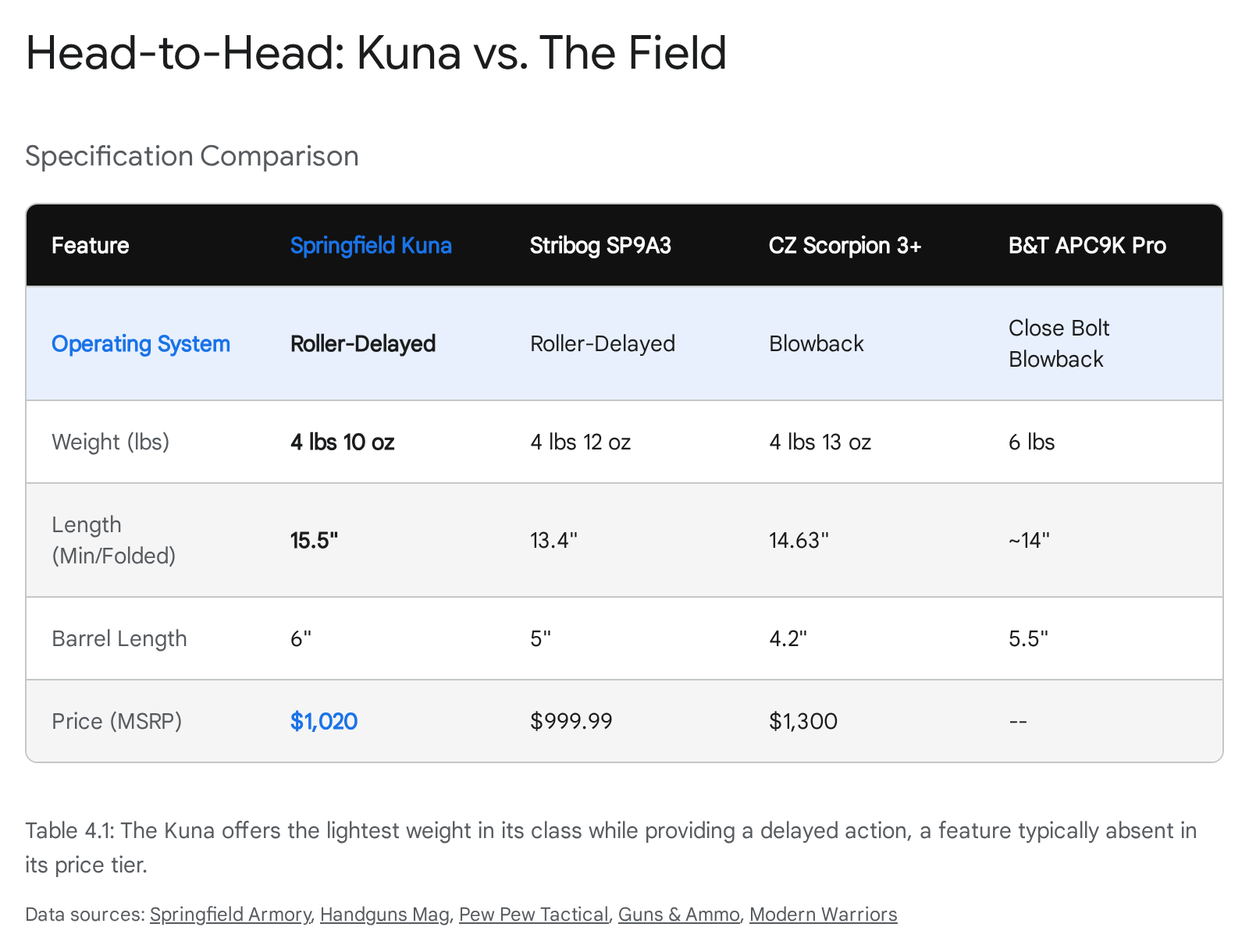
CZ Scorpion vs. Stribog SP9A310.0Aftermarket vs. Operating SystemCZ Scorpion70%30%6.8Stribog A385%15%8.2Stribog SP9A3
HK SP5 vs. Century AP5 (MKE)8.8Rollmark vs. Value; QC vs. PriceHK SP592%8%9.4AP5 (MKE)75%25%6.5HK SP5 (Guaranteed)
Ruger PC Carbine vs. Kel-Tec Sub-20008.2Takedown vs. Folding; ReliabilityRuger PCC94%6%8.5Sub-200055%45%5.0Ruger PC Carbine
PSA AK-V vs. KUSA KP-98.5Features vs. Authenticity; MagsPSA AK-V60%40%6.2KUSA KP-995%5%9.0KUSA KP-9
PSA AR-V vs. Foxtrot Mike FM-97.9Budget AR-9; Mag StandardPSA AR-V88%12%8.1FM-993%7%8.8Foxtrot Mike FM-9
S&W FPC vs. Kel-Tec Sub-20009.1Folder War; Optic-Ready vs. MagsS&W FPC96%4%9.2Sub-200050%50%4.8S&W M&P FPC
CMMG Banshee vs. HK SP57.5Delayed System (Radial vs. Roller)CMMG90%10%8.9HK SP588%12%8.4CMMG Banshee (Practical)
JP GMR-15 vs. The Field7.0Competition; Blowback vs. New-GenJP GMR-1591%9%9.3The Field85%15%8.7JP GMR-15 (Proven)

Part 1: The Premium Tier – Modern vs. Classic ($2,000+ Market)

This market tier is defined by price, advanced (non-blowback) operating systems, and significant professional or military adoption. Consumer debates in this segment are less about “budget” and more about “philosophy” and performance characteristics.

1.1. B&T APC9 Pro vs. Heckler & Koch SP5

This matchup is the quintessential “Old Bull vs. New Calf” or, as one commenter framed it, the “Jordan v Lebron” of the premium PCC market.18 It pits the 60-year-old, combat-proven roller-delayed system of the MP5 (SP5) against a purpose-built, 21st-century Swiss-engineered design.

Heckler & Koch SP5 (The Legacy):

Consumer sentiment for the SP5 is rooted in its historical significance and its legendary operating system. It is frequently described as the “Cadillac of submachine guns”.19 The primary driver of positive sentiment is the roller-locking system, which users attest has been “unsurpassed in 60+ years” and provides an exceptionally “soft shooter” experience.19 For many, it is a “piece of history” 19 and possesses a “cool factor” that is “pure unadulterated sex appeal”.19

Negative sentiment focuses entirely on its outdated design. Users state it is “showing it’s age”.19 The ergonomics “kind of suck” 19, the “manual of arms” is a product of the 1960s 19, and it is difficult to mount modern accessories like lights and optics, which are “ready to go out of the box” on the APC9.20

B&T APC9 Pro (The Modern Tool):

Sentiment for the APC9 is almost entirely pragmatic. This is the firearm for “actual use” 21, the one users would “take to a gunfight”.21 Its positive attributes are a direct solution to the SP5’s negatives: “modern ergonomics and controls” 19, a “better trigger” 19, an “easier reload” 19, and full modularity for accessories.20 It is described as a “fully modern, up to date firearm”.20

The few negative comments center on its shooting experience relative to the SP5. The APC9’s blowback-based action is described as “snappy” in comparison 19, and some users find the “shooting experience…disappointing…for the money”.20

This debate is not about which gun is “better” on a spec sheet, but about user identity. The SP5 appeals to collectors and enthusiasts who value the shooting experience and history.19 The APC9 appeals to pragmatic users who value modern modularity and efficiency.19 A critical market-shaping event, mentioned by users, is the adoption of the APC9 by the U.S. Army and U.S. Air Force.19 The SP5/MP5’s “cool factor” was built on its adoption by “us special forces” three decades ago 18; the APC9’s current adoption by major military branches is a direct, validating assault on that narrative, establishing it as the new professional standard.

Analyst’s Recommendation: For a collector or enthusiast focused on the purest shooting experience and historical significance, the HK SP5 is an icon. For any user focused on practical application (home defense, duty) who needs to mount modern accessories, the B&T APC9 Pro is the superior and more logical choice.

1.2. SIG Sauer MPX vs. CMMG Banshee/Dissent

This is the battle of advanced, non-blowback operating systems housed within an AR-style package. It pits SIG’s short-stroke gas piston 2 against CMMG’s proprietary radial-delayed blowback.2 This debate represents the new frontier for high-end AR-patterned PCCs, with one user noting, “straight blowback’s days seem numbered”.23

SIG Sauer MPX:

Positive sentiment for the MPX is centered on its short-stroke gas piston system, which provides an “extremely soft recoil impulse”.2 In one direct comparison, a user declared it “king” in a side-by-side recoil test against the Banshee.9 It also leverages the AR platform, making its “manual of arms…second nature” for most American shooters.9 It is also regarded as an excellent suppressor host.9

Negative sentiment, however, is significant. The MPX is described as “gassy” when suppressed.9 More concerning are the numerous user reports of reliability issues, including failures-to-feed (FTF) 24 and unexplained accuracy problems with specific barrel and suppressor combinations.26

CMMG Banshee / Dissent:

The CMMG platform earns praise for its “radial delayed blowback” system, which users report “seriously lowers the recoil” 2 and makes it an “exceptional suppressor host”.22 Users often state they simply prefer the “feel” of the CMMG’s recoil impulse over competitors.9 The introduction of the new “Dissent” model, which is bufferless and allows for a folding stock, and features a non-reciprocating side charger, is a significant ergonomic victory for CMMG.22

This is a battle of ecosystems. The MPX is a closed, proprietary system. CMMG, by contrast, is an open system. The Banshee and Dissent are available in multiple calibers (e.g., 9mm and 10mm 2) and, most importantly, with lower receiver configurations that accept Glock mags, Sig P320 mags, or CMMG’s ARC magazines.22 CMMG is winning a platform war by leveraging the core strength of the AR market: modularity. By offering their radial-delayed system with multiple magazine options 22 and in upper-receiver-only configurations, they appeal to the “builder” and “customizer” 27 who defines the modern firearm consumer. SIG is selling a product; CMMG is selling a system.

Analyst’s Recommendation: For the user who wants a turnkey, gas-piston AR-style PCC and is invested in SIG’s ecosystem, the MPX is a (mostly) reliable and soft-shooting option. For the user who values modularity, magazine flexibility (especially Glock compatibility), and a more modern, bufferless design, the CMMG Dissent is the clear forward-looking choice.

1.3. CMMG Banshee vs. Heckler & Koch SP5

This cross-tier matchup 9 demonstrates the success of CMMG’s engineering and marketing. The radial-delayed Banshee is being compared not just to other AR-9s, but to the gold standard of delayed systems, the SP5.

One user who owns a Banshee, MPX, and SP5 provides a key data point: he groups the MPX and SP5 together as an “apples to apples” comparison.9 This implies the SP5’s roller-delayed system is the benchmark that the MPX’s gas piston is trying to emulate. The Banshee is considered alongside them but in a different category, likely due to its AR-form factor.

The very existence of this debate 9 is a massive marketing and engineering victory for CMMG. They have successfully elevated their “radial-delayed blowback” system 2 out of the “budget AR-9” category and into the premium-tier conversation. CMMG has effectively created a new, desirable category. They are not just competing with the SP5 ($3,000+) or the Stribog A3 ($1,000), but have positioned themselves in the $1,500-$2,000 space. This has broken the market’s previous assumption that “delayed blowback” means “HK/B&T” or “European,” forcing a repositioning of all other players.

Analyst’s Recommendation: This is a choice between form factor and shooting impulse. The HK SP5 offers the softest recoil and the “classic” subgun experience.9 The CMMG Banshee offers 80-90% of that recoil reduction but in a familiar, modular, and more ergonomic AR-pattern. The Banshee is the more practical, modular firearm.


Part 2: The Clones and Competitors – The Veblen Goods Dilemma

This section analyzes the impact of “clone” products, where brand equity and perceived quality are pitted directly against price-point alternatives.

2.1. Heckler & Koch SP5 vs. Century Arms AP5 (MKE)

This is the market’s most prominent “Rollmark vs. Value” debate.29 The Century Arms AP5 is manufactured in Turkey by MKE, reportedly on “older German HK tooling” 29, making it materially similar to the German-made SP5.

Heckler & Koch SP5 (The Original):

Positive sentiment is driven by its “real deal” status.30 Users note it has a superior trigger for an MP5 32, and the fit, “welds and finish” are perceived to be better.29 The value is in the guarantee of quality control.

Negative sentiment is focused exclusively on the price. Users are acutely aware they are paying “$1000-2000+ more for a rollmark”.29

Century Arms AP5 (The Clone):

Positive sentiment is driven entirely by value. It is “$2000 cheaper”.29 Performance-wise, many users who have shot both find them “identical”.29 A key feature is that they “accept every German made or US in spec part” 29, allowing for easy upgrades.

Negative sentiment is rooted in quality control risk. The common refrain is “Friends don’t let friends buy clones”.29 Users report that “every once in a while one comes through funky”.30 One user detailed an extractor deforming after 1,000 rounds due to “improper heat treat”.30

The AP5’s existence sets the market price. The SP5 is a Veblen good—its high price is part of its appeal. The AP5 provides a market-based alternative that forces consumers to ask: “Is the HK rollmark worth twice the price?”.29 The community has clearly accepted a “break in period” 30 or minor parts-swapping (like the extractor 30) for the AP5. This implies the consumer is willing to act as the final stage of quality control in exchange for the lower price. The “value” of the AP5 is not just its price, but the user’s willingness to tinker. The “value” of the SP5 is the guarantee that no tinkering is required.

Analyst’s Recommendation: For a collector or high-volume shooter who demands out-of-the-box, warrantied perfection, the HK SP5 is the “buy once, cry once” solution. For the hobbyist/enthusiast who understands the platform, is willing to “break in” or swap an extractor 30, and wants the MP5 experience for the best price, the Century Arms AP5 is an undeniable value.

2.2. Palmetto State Armory AK-V vs. Kalashnikov USA KP-9

This is the 9mm AK-pattern (Vityaz) clone war.33 It is a battle of philosophies: clone-correct authenticity versus modernized features.

Kalashnikov USA KP-9 (The Authentic Clone):

The KP-9’s positive sentiment is built on its authenticity and reliability. It is a “near-exact clone of the ‘Vityaz-SN'”.34 In testing, it received a “5/5” for reliability, with “no issues”.35 Users across the board consistently recommend it over the AK-V, stating “KP9 over AK-V all day”.36

Negative sentiment focuses on its purist design, which lacks modern features. It uses “expensive proprietary” magazines 33 and does not have a bolt release.36

Palmetto State Armory AK-V (The Modernized Feature-Set):

The AK-V’s appeal is based on “useful features” the KP-9 lacks, most notably a “last round bolt hold open” (LRBHO) 34 and a bolt release lever.34 Its killer feature is that it “doesn’t use an expensive proprietary mag” 33; it uses cheap, plentiful Scorpion/PSA mags.34 It also comes with a “lifetime warranty”.28

Negative sentiment is severe and focused on reliability. There are many reports of “jams, misfires & malfunctions” 38, users who had to send their guns back “way too many” times 39, a “spongy” trigger 36, and a dangerous lack of an “out of battery safety”.36

This is a classic “authenticity vs. features” debate. The KP-9 is for the purist, while the AK-V is for the pragmatic shooter who prizes AR-like features and cheaper, cross-platform magazines. However, PSA’s decision to use Scorpion-pattern magazines is a strategic masterstroke. It’s not just a feature; it’s a logistical play to tap into a massive, existing, non-proprietary magazine market.37 Furthermore, it links the AK-V to their own AR-V platform 40, which also uses Scorpion mags. PSA is building a brand-agnostic ecosystem where their firearms (AK-V, AR-V) and their magazines become the new de facto standard, undercutting the KP-9’s proprietary model.

Analyst’s Recommendation: For a user who values historical accuracy and proven, out-of-the-box reliability, the KUSA KP-9 is the superior, “clone-correct” choice. For the user who is willing to risk PSA’s documented QC issues in exchange for a “lifetime warranty” 28, modernized features, and, most importantly, access to the cheap and plentiful Scorpion-pattern magazine, the PSA AK-V is the higher-value proposition if they get a reliable unit.


Part 3: The Mid-Market Leaders – The New Industry Standard ($800 – $1,500)

This is the most volatile and competitive segment, where price-to-performance is heavily scrutinized and aftermarkets are a critical factor.

3.1. CZ Scorpion EVO 3 vs. Grand Power Stribog SP9A3

This is the dominant debate in the mid-market, with the highest discussion volume.41 It’s a battle of a (flawed) market-leader with a huge aftermarket versus a (flawed) challenger with a superior operating system.

CZ Scorpion EVO 3 (The Incumbent):

The Scorpion’s single greatest strength, mentioned in almost every debate, is its “huge aftermarket”.43 Magazines are “cheap and plenty”.47

Its weaknesses are just as well-known. As a simple blowback, it has the “sharpest” and “least refined” recoil of the group.48 The “trigger was a major letdown” 46 and it has a “plastic feel”.43 The most concerning issue, however, is the “horror stories” 43 and “well known issue” 43 of “OOBD” (Out of Battery Detonations).42

Grand Power Stribog SP9A3 (The Challenger):

The Stribog’s primary advantage is exclusive to the SP9A3 model, which is roller-delayed.42 Users report the “roller delay vs direct is night and day”.49 This makes it “more pleasant to shoot” 43 with a “linear snap” 48 and a “very good” out-of-the-box trigger.46

The Stribog’s negatives are a mirror of the Scorpion’s positives. Early models had “teething issues” 46 and “mag reliability issues”.47 Its aftermarket, while “starting to grow” 46, is a fraction of the Scorpion’s.

The Stribog SP9A3 (roller-delayed) is a disruptive product. It brings a premium-tier operating system 43 down to a mid-market price point, directly attacking the Scorpion’s main weakness (blowback recoil). The market has effectively solved this debate by creating a hybrid. The “perfect” gun, as described by the community, is a hybrid: users are buying the Stribog SP9A3 for its superior upper/action and adding an aftermarket “Lingle lower” 43 or “A3Tactical” lower 43 that “solves all of the issues…with the Stribog” 43 by allowing it to accept Scorpion or Glock magazines.43 This creates a firearm with the Stribog’s recoil and the Scorpion’s aftermarket.

Analyst’s Recommendation: For the user who wants a project and the absolute best performance for the price, the answer is the Stribog SP9A3 with an aftermarket magazine-conversion lower.43 For the user who wants a simple, out-of-the-box-ready firearm with a vast, cheap, and proven aftermarket, the CZ Scorpion remains the (slightly riskier) default, provided they are aware of and mitigate the OOBD concerns.42

3.2. JP Enterprises GMR-15 vs. The Field

This is less of a direct “X vs. Y” debate and more a “Benchmark vs. The Rest” in the high-end competition (USPSA) space.4

JP Enterprises GMR-15 (The Benchmark):

The GMR-15 is the long-standing “competition based PCC”.5 Positive sentiment is built on its reputation: “JP does not a nice product,” “JP makes a solid product”.5 One user with a GMR-13 “love[s] it” and has “no issues”.5

Negative sentiment is minimal and centers on its high price 5 and its limitation to a single magazine type (e.g., Glock).5

The Field (e.g., Nordic Components, JP-5):

The competition market values different features. Nordic Components is praised for its “ability to change…magwells” 5, a feature the GMR-15 lacks. The newer, roller-locked JP-5 is praised for emulating the HK MP-5 4 and its “tunability” 4, though it is also very expensive.4

The high-end competition market is a separate ecosystem. Here, “straight blowback” (like the GMR-15) is still dominant and viable if engineered correctly with a heavy bolt and buffer system.5 However, the introduction of the new roller-locked JP-5 4 represents a shift in the competition market. This is JP competing with itself and acknowledging, as one user put it, that “straight blowback’s days seem numbered” 23, even in the space it once dominated.

Analyst’s Recommendation: For a dedicated USPSA competitor, the JP GMR-15 is the long-standing, proven, and reliable blowback option.5 However, the market is shifting, and the new JP-5 4 or a custom-built CMMG Banshee 8 represents the future of the sport via advanced, softer-shooting operating systems.


Part 4: The Utility & Budget Tier – Market Saturation ($400 – $800)

This tier is defined by price, portability, and magazine compatibility, targeting the “truck gun” or “backpack gun” demographic.

4.1. Ruger PC Carbine vs. Kel-Tec Sub-2000

This is the classic “backpack gun” debate 50, pitting a takedown design against a folding design.51

Ruger PC Carbine (The Takedown):

The Ruger’s reputation is built on reliability. It is “super reliable”.55 Its “heavy bolt” 50 is a key feature, creating a “light recoil” 50 for a blowback gun. Even its “fudd stock” is noted as surprisingly ergonomic.55

Negative sentiment focuses on its lack of portability. It is “on the heavy side” 50 and “MASSIVE” 55 even when taken down. It is two pieces, not one compact unit.

Kel-Tec Sub-2000 (The Folder):

The Sub-2000’s appeal is its ultimate portability. It is “lighter” 50 and, when functioning, “super reliable”.51

Its negatives are severe. “Kel Tec’s QC is hit or miss”.50 One user called it an “unreliable POS” with FTE/FTF issues.50 Others describe it as “cheap and flimsy”.56

This debate is about engineering trade-offs. Ruger sacrificed portability and light weight for reliability and felt recoil. The heavy bolt is a feature, not a bug.50 Kel-Tec sacrificed felt recoil and (per-users) QC for ultimate portability and light weight.50 These are fundamentally different use cases. The Ruger PCC is a takedown rifle designed to be stored in a bag and assembled in 10-15 seconds.56 The Sub-2000 is a folding pistol designed to be deployed from a backpack.

Analyst’s Recommendation: For a “backpack gun” where compactness and light weight are the absolute priority, the Kel-Tec Sub-2000 is the (risky) choice. For a “truck gun” or “bug-out bag” gun where reliability and a better shooting experience are more important than a few extra inches or pounds, the Ruger PC Carbine is the far superior and more reliable firearm.55

4.2. Smith & Wesson M&P FPC vs. Kel-Tec Sub-2000

This is the new folding carbine debate.51 S&W has entered the market 2 with a product directly targeting the Sub-2000’s many weaknesses.

Kel-Tec Sub-2000 (The Incumbent):

In this matchup, the Sub-2000’s primary (and only) advantage is its wide-ranging magazine compatibility, with models for Glock, S&W, SIG, and CZ magazines.51

Its negatives are a long list: a “terrible” trigger, “terrible” sights, “cheap and flimsy” construction, a “bitch to maintain,” and a reputation for “requir[ing] about $300 of Mcarbo upgrades to be reliable”.56 Its critical flaw in the modern market is that the rail rotates with the handguard, meaning it cannot easily mount and keep a zeroed optic.60

S&W M&P FPC (The New King):

The FPC is being hailed as the “new king of folding carbines”.2 Users report it is “flawless” 56, “more polished and refined” 60, with “better all-around ergonomics” and a “much nicer trigger”.60 Its killer feature is that the “rail remains in place” 60, allowing an optic to be mounted, folded, and retain zero.2 It also features an innovative in-stock spare magazine storage system.51

Its only negatives are that it only uses M&P magazines 51 and comes with “no irons”.61

S&W did not copy the Sub-2000; they executed on all of its failures. The Sub-2000’s single biggest flaw in the modern market is its inability to easily mount a red dot. The FPC’s design 2 solves this and makes it a viable 21st-century carbine. This is a case study in market execution. The Ruger PCC 56 stole the “reliable takedown” market. Now, the S&W FPC is stealing the “compact folder” market by bringing a major manufacturer’s reliability, ergonomics, and R&D 60 to the category Kel-Tec invented but failed to improve.

Analyst’s Recommendation: Unless a buyer is already heavily invested in Glock or SIG magazines and demands that compatibility, the S&W M&P FPC is the superior choice in every meaningful metric: reliability, ergonomics, trigger, and (most critically) optic-hosting capability.56

4.3. Palmetto State Armory AR-V vs. Foxtrot Mike FM-9

This is the war for the “Best Budget AR-9”.62 It is a battle of magazine standards.

Foxtrot Mike FM-9 (The Gold Standard):

The FM-9 is consistently hailed as the “gold standard for budget Ar9’s”.66 It is the “best bang for your buck” 62 and is noted for having the “best designed last round bolt hold open”.67 The quality is considered so high that they are a “white label” manufacturer for high-end brands like Taran Tactical.68 This is the Glock-mag standard.

Negative sentiment is almost non-existent and purely aesthetic, with one user calling it the “ugliest with the 8 pimple-looking screws”.65

Palmetto State Armory AR-V (The Ecosystem Play):

The AR-V also receives high praise for its performance-to-price, called “affordable and crazy reliable” 67 and a “sewing machine it ran so hard”.68

This platform’s key feature is its magazine choice: it only takes Scorpion/PSA mags.40

This debate is entirely about magazine preference. The AR-9 market used to be “Glock mag vs. Colt mag”.40 PSA disrupted this by introducing a third standard 40, forcing consumers to choose a platform based on their existing magazine collection. This is the other half of PSA’s pincer movement (first seen with the AK-V in 2.2). PSA is not trying to beat Foxtrot Mike in the Glock-mag-AR-9 space. They are creating an entirely new, parallel market (Scorpion-mag-AR-9) that they exclusively control and which links directly to their AK-V.37 This is a brilliant business strategy that leverages their manufacturing power to build a “walled garden” ecosystem.

Analyst’s Recommendation: For the vast majority of buyers who own or plan to own Glock 9mm pistols, the Foxtrot Mike FM-9 is the “gold standard” 66 and the clear choice. For the buyer who is already invested in the PSA ecosystem (e.g., owns an AK-V) or who prefers the Scorpion-style magazine, the PSA AR-V is the choice.


Analyst’s Concluding Synopsis and Market Outlook

The PCC market is in a period of rapid evolution, defined by three key macro-trends visible in social media sentiment.

Trend 1: The Obsolescence of Simple Blowback

The entire premium and mid-market discussion is now dominated by advanced operating systems. HK/B&T’s roller-delayed 19, CMMG’s radial-delayed 2, SIG’s gas piston 2, and Stribog’s roller-delayed 49 are the new standard. As one user stated, “blowback PCCs kinda suck”.43 This shift has been rapid and decisive. Simple blowback is being permanently relegated to the sub-$800 utility tier (Ruger, FM-9), where its harsh recoil is only acceptable because of the low price. Any new mid-market or premium-market entry must have an advanced operating system to be competitive.

Trend 2: The “Hybrid” Consumer and the Aftermarket

The “perfect” PCC is not one a consumer buys; it’s one they build. The most sophisticated consumer segments are creating “hybrid” guns. The most prominent example is the “Strib-pion,” which combines a Stribog A3 upper with an aftermarket lower that accepts Scorpion magazines.43 Another example is the user-customized CMMG Banshee with a Kynshot hydraulic buffer.27 This signifies a highly-engaged, technically-savvy consumer base that demands modularity and drives innovation from the aftermarket, often faster than the primary manufacturers.

Trend 3: The Battle of the Ecosystems

The most significant business-strategy battle is not “which gun is best?” but “which platform wins?” Two companies are executing brilliant, opposing strategies:

  • CMMG is winning via an open platform: selling its radial-delayed uppers and a multitude of mag-compatible lowers (Glock, Sig).22 This appeals to the “builder” mentality and captures a wide market.
  • Palmetto State Armory (PSA) is winning via a closed (but cheap) platform: creating an interlocking ecosystem (AR-V + AK-V) built around their proprietary (but based on the Scorpion) magazine.37 This builds a “walled garden” and ensures repeat customers for both firearms and magazines.

Market Outlook: The future of the PCC market will be defined by the winners of these strategy battles. The “Sub-2000 vs. FPC” 60 and “Scorpion vs. Stribog” 46 debates prove that a large, established manufacturer (S&W) or a product with a superior operating system (Stribog A3) can rapidly disrupt and render a (lazy) market leader obsolete.


Appendix: Analytical Methodology

This appendix details the proprietary frameworks used to collect and analyze social media data for this report, as derived from academic and industry best practices.10

A.1. Data Collection and Scoping

Objective: To identify the top 10 most-debated “X vs. Y” PCC matchups.

Process:

  1. Platform Scoping: Focused on high-engagement, text-rich platforms known for firearms discussion: Reddit (e.g., r/guns, r/PCC, r/liberalgunowners, and specific model subreddits like r/MPX, r/BT_APC) and YouTube.3
  2. Keyword Identification: Used competitive analysis keywords 11 to find direct comparisons. Queries included: “PCC,” “Pistol Caliber Carbine,” “vs,” “versus,” “X or Y,” “best PCC,” and specific model names (e.g., “MPX vs Banshee,” “Scorpion vs Stribog”).
  3. Competitor Pinpointing: Identified direct competitors (e.g., Stribog vs. Scorpion), indirect competitors (e.g., MPX vs. SP5), and disruptors (e.g., S&W FPC).10
  4. Data Set: The top 10 matchups were selected based on the highest volume of debates, representing the queries most frequently posted by potential buyers.

A.2. Topic Magnitude Index (TMI) Calculation

Objective: To create a “Share of Voice” 12 metric that quantifies not just the volume of a debate, but its intensity and “content resonance”.12

Proprietary Formula:

TMI = (V / V_total) * (1 + ER)

Component Definitions:

  • V (Volume): Total number of unique posts and top-level comments mentioning the specific “X vs. Y” matchup. This establishes the “volume of mentions”.13
  • V_total (Total Volume): The total V for all 10 identified matchups. This calculates the Share of Voice (SoV).12
  • ER (Engagement Rate): The average number of replies/sub-comments per debate. This measures “content resonance”.12 A debate with 10 mentions and 100 replies is “hotter” and has a higher TMI than one with 10 mentions and 10 replies.

A.3. Sentiment and Performance Score Framework

Objective: To move beyond simple “star ratings” 15 and quantify user sentiment and perceived product performance based on qualitative feedback.14

A.3.1. Sentiment Score (% Positive / % Negative)

  • Process: All relevant user comments were processed through a sentiment analysis model.
  • Scoring: Mentions were classified on a scale from $-1$ (highly negative) to $+1$ (highly positive).15
  • Calculation:
  • % Positive = (Count of mentions > 0.1) / (Total non-neutral mentions)
  • % Negative = (Count of mentions < -0.1) / (Total non-neutral mentions)

A.3.2. Performance Score (1-10 Scale)

Objective: To create a composite score reflecting the key performance indicators 13 that buyers discuss. This is an analog for a Customer Satisfaction Score (CSAT).13

Proprietary Weighted Formula:

PS = 4 * (R) + 3 * (E) + 2 * (A) + 1 * (V)

Component Definitions (Scored 1-10):

  • R (Reliability) (40% Weighting): Weighted most heavily, as this is the primary “pass/fail” for a firearm. Derived from sentiment analysis of keywords like “reliable,” “flawless,” “no issues” vs. “jam,” “FTF,” “FTE,” “malfunction,” “OOB,” “QC issue”.24
  • E (Ergonomics & Features) (30% Weighting): Derived from sentiment on “ergos,” “trigger” 46, “controls,” “manual of arms” 19, “aftermarket” 46, and “features” (e.g., “LRBHO,” “optic-ready”).34
  • A (Accuracy & Recoil) (20% Weighting): Derived from sentiment on “accuracy” 26, “recoil,” “soft shooter” 19, “snappy” 48, “recoil impulse”.9
  • V (Value) (10% Weighting): Derived from sentiment on “price,” “value” 41, “worth it” 29, “cheap,” “budget,” “affordable”.66

If you find this post useful, please share the link on Facebook, with your friends, etc. Your support is much appreciated and if you have any feedback, please email me at in**@*********ps.com. Please note that for links to other websites, we are only paid if there is an affiliate program such as Avantlink, Impact, Amazon and eBay and only if you purchase something. If you’d like to directly contribute towards our continued reporting, please visit our funding page.


Sources Used

  1. Pistol Caliber Carbines: The Best or Worst of Both Worlds? : r/liberalgunowners – Reddit, accessed November 14, 2025, https://www.reddit.com/r/liberalgunowners/comments/16nt4cv/pistol_caliber_carbines_the_best_or_worst_of_both/
  2. Best Pistol-Caliber Carbines (PCC): 9mm & Beyond – Pew Pew Tactical, accessed November 14, 2025, https://www.pewpewtactical.com/pistol-caliber-carbines/
  3. PCC – What to Buy : r/USPSA – Reddit, accessed November 14, 2025, https://www.reddit.com/r/USPSA/comments/1cwnzhm/pcc_what_to_buy/
  4. Best/Most Used PCC rifle? : r/USPSA – Reddit, accessed November 14, 2025, https://www.reddit.com/r/USPSA/comments/16z41es/bestmost_used_pcc_rifle/
  5. Opinions for a competition PCC | Shooters’ Forum, accessed November 14, 2025, https://forum.accurateshooter.com/threads/opinions-for-a-competition-pcc.3945674/latest
  6. Top 10 Best Pistol Caliber Carbines For The Money (PCC) – YouTube, accessed November 14, 2025, https://www.youtube.com/watch?v=NF5kW8fzi_w
  7. 5 reasons to buy a PCC – YouTube, accessed November 14, 2025, https://www.youtube.com/watch?v=56058wov-K0
  8. Ultimate 9mm PCC Comparison | Which One is the Best? : r/BT_APC – Reddit, accessed November 14, 2025, https://www.reddit.com/r/BT_APC/comments/14b78hg/ultimate_9mm_pcc_comparison_which_one_is_the_best/
  9. MPX vs CMMG Banshee & HKSP5 – Reddit, accessed November 14, 2025, https://www.reddit.com/r/MPX/comments/12g4dzr/mpx_vs_cmmg_banshee_hksp5/
  10. How to perform a social media competitive analysis (+ free template) – Sprout Social, accessed November 14, 2025, https://sproutsocial.com/insights/social-media-competitive-analysis/
  11. Social media competitor analysis: Free template for 2025 – Hootsuite Blog, accessed November 14, 2025, https://blog.hootsuite.com/competitive-analysis-on-social-media/
  12. How to Perform Social Media Competitor Analysis (2025 Guide) – Sprinklr, accessed November 14, 2025, https://www.sprinklr.com/blog/social-media-competitor-analysis/
  13. How to Measure Product Performance? [2025] – Brand24, accessed November 14, 2025, https://brand24.com/blog/product-performance/
  14. How to Evaluate Product Performance: Metrics, Analysis & Improvement – Userpilot, accessed November 14, 2025, https://userpilot.com/blog/how-to-evaluate-product-performance/
  15. How a sentiment score improves your brand strategy – Sprout Social, accessed November 14, 2025, https://sproutsocial.com/insights/sentiment-score/
  16. Product Performance Metrics That Actually Matter for Ecommerce Brand Growth, accessed November 14, 2025, https://www.42signals.com/blog/essential-product-performance-metrics/
  17. Product Ranking Strategies – Rating/Reviews – Kaggle, accessed November 14, 2025, https://www.kaggle.com/code/yldzburhan/product-ranking-strategies-rating-reviews
  18. LEGEND v MODERN — MP5 v APC9 – YouTube, accessed November 14, 2025, https://www.youtube.com/watch?v=lqabN25zwCQ
  19. Thoughts on HK SP5 from B&T owners : r/BT_APC – Reddit, accessed November 14, 2025, https://www.reddit.com/r/BT_APC/comments/1gluimc/thoughts_on_hk_sp5_from_bt_owners/
  20. SP5/MP5 Preferred over APC9. : r/BT_APC – Reddit, accessed November 14, 2025, https://www.reddit.com/r/BT_APC/comments/106ykbr/sp5mp5_preferred_over_apc9/
  21. Apc9 vs Mp5? : r/BT_APC – Reddit, accessed November 14, 2025, https://www.reddit.com/r/BT_APC/comments/1ds6oc1/apc9_vs_mp5/
  22. CMMG Dissent 9mm | First Shots – Better Than the MPX? – YouTube, accessed November 14, 2025, https://www.youtube.com/watch?v=_HgzWg6up3s
  23. Sig MPX Competition or the new CMMG Dissent MKGs 16″ : r/CompetitionShooting – Reddit, accessed November 14, 2025, https://www.reddit.com/r/CompetitionShooting/comments/1bqerjm/sig_mpx_competition_or_the_new_cmmg_dissent_mkgs/
  24. Reliability and Cleaning : r/MPX – Reddit, accessed November 14, 2025, https://www.reddit.com/r/MPX/comments/tnmkkn/reliability_and_cleaning/
  25. MPX Problems. : r/MPX – Reddit, accessed November 14, 2025, https://www.reddit.com/r/MPX/comments/zwidua/mpx_problems/
  26. MPX Accuracy Issues. : r/MPX – Reddit, accessed November 14, 2025, https://www.reddit.com/r/MPX/comments/1ck9at8/mpx_accuracy_issues/
  27. Ultimate 9mm PCC Comparison | Which One is the Best? : r/MPX – Reddit, accessed November 14, 2025, https://www.reddit.com/r/MPX/comments/14b7umy/ultimate_9mm_pcc_comparison_which_one_is_the_best/
  28. PSA AKV vs KUSA KP9 – YouTube, accessed November 14, 2025, https://www.youtube.com/watch?v=5REfShrci8o
  29. Are the MKE AP5’s worth it? : r/guns – Reddit, accessed November 14, 2025, https://www.reddit.com/r/guns/comments/rmaykl/are_the_mke_ap5s_worth_it/
  30. Y’all, a friendly at the range let me shoot his hk sp5 today and now I absolutely need one. How are we feeling about clones? : r/liberalgunowners – Reddit, accessed November 14, 2025, https://www.reddit.com/r/liberalgunowners/comments/1gnkeli/yall_a_friendly_at_the_range_let_me_shoot_his_hk/
  31. Mac 5 vs HK SP5 Review, Accuracy, & Torture Test – YouTube, accessed November 14, 2025, https://www.youtube.com/watch?v=hrKQU93tjs4
  32. HK SP5 Review: MP5 Clone Worth the Money? – Guns.com, accessed November 14, 2025, https://www.guns.com/news/reviews/heckler-koch-hk-sp5-mp5-review
  33. PSA AK-V vs KUSA KP-9 : r/tacticalgear – Reddit, accessed November 14, 2025, https://www.reddit.com/r/tacticalgear/comments/uj3if5/psa_akv_vs_kusa_kp9/
  34. Better Than the KP-9? (PSA AK-V vs K-USA KP-9 Full Zenitco – Best 9mm AK) – YouTube, accessed November 14, 2025, https://www.youtube.com/watch?v=FdUIgHa923U
  35. Kalashnikov USA KP-9 Review: Best 9mm AK? – Pew Pew Tactical, accessed November 14, 2025, https://www.pewpewtactical.com/kalashnikov-usa-kp-9-review/
  36. Aero AR-9 build or PSA AK-V : r/guns – Reddit, accessed November 14, 2025, https://www.reddit.com/r/guns/comments/sm7k7k/aero_ar9_build_or_psa_akv/
  37. Talk me out of a PSA AK-V : r/liberalgunowners – Reddit, accessed November 14, 2025, https://www.reddit.com/r/liberalgunowners/comments/1j4j67g/talk_me_out_of_a_psa_akv/
  38. I Should’ve Known Better: PSA AKV 9mm Failure – YouTube, accessed November 14, 2025, https://www.youtube.com/watch?v=0CI9r1LO1BY
  39. Folder Friday! AKV or KP9?? : r/GunPorn – Reddit, accessed November 14, 2025, https://www.reddit.com/r/GunPorn/comments/1ffm05m/folder_friday_akv_or_kp9/
  40. AR 9 pistol – Foxtrot Mike vs PSA. Which would you choose and why? : r/ar15 – Reddit, accessed November 14, 2025, https://www.reddit.com/r/ar15/comments/zdgah5/ar_9_pistol_foxtrot_mike_vs_psa_which_would_you/
  41. Stribog SP9A3 Review – True Shot Ammo, accessed November 14, 2025, https://trueshotammo.com/academy/stribog-sp9a3-review/
  42. PCC for home defense: CZ Scorpion or Stribog SP9A3 : r/guns – Reddit, accessed November 14, 2025, https://www.reddit.com/r/guns/comments/1jid6yd/pcc_for_home_defense_cz_scorpion_or_stribog_sp9a3/
  43. Help me decide Stribog or Scorpion 3+. : r/liberalgunowners – Reddit, accessed November 14, 2025, https://www.reddit.com/r/liberalgunowners/comments/1cpjtau/help_me_decide_stribog_or_scorpion_3/
  44. Scorpion Evo vs Stribog vs GHM9 – YouTube, accessed November 14, 2025, https://www.youtube.com/watch?v=w5cvVhrV4gw
  45. Scorpion vs Stribog – YouTube, accessed November 14, 2025, https://www.youtube.com/watch?v=FyCVkcWGX24
  46. Need opinions on the Grand Power Stribog SPA3 and CZ Scorpion Evo3 : r/guns – Reddit, accessed November 14, 2025, https://www.reddit.com/r/guns/comments/kzqj81/need_opinions_on_the_grand_power_stribog_spa3_and/
  47. Should I get a GP Stribog or Cz Scorpion? : r/guns – Reddit, accessed November 14, 2025, https://www.reddit.com/r/guns/comments/srb9rt/should_i_get_a_gp_stribog_or_cz_scorpion/
  48. Stribog A3 vs Scorpion vs Banshee : r/GrandPowerStribog – Reddit, accessed November 14, 2025, https://www.reddit.com/r/GrandPowerStribog/comments/j5bw12/stribog_a3_vs_scorpion_vs_banshee/
  49. PCC Faceoff | Direct Blowback vs Roller-Delayed | Stribog SP9A1 vs SP9A3 – YouTube, accessed November 14, 2025, https://www.youtube.com/watch?v=jEtYgADgTmU
  50. Sub2000 vs Ruger PC Carbine : r/CAguns – Reddit, accessed November 14, 2025, https://www.reddit.com/r/CAguns/comments/vmdj50/sub2000_vs_ruger_pc_carbine/
  51. The SUB 2000 Vs. the FPC: Folding PCC Shootout – The Mag Life – GunMag Warehouse, accessed November 14, 2025, https://gunmagwarehouse.com/blog/the-sub-2000-vs-the-fpc-folding-pcc-shootout/
  52. Ruger PC Carbine VS KelTec Sub 2000 – YouTube, accessed November 14, 2025, https://www.youtube.com/watch?v=wTe0medDnq0
  53. Ruger PC Carbine vs Kel-Tec Sub 2000 – YouTube, accessed November 14, 2025, https://www.youtube.com/watch?v=0kWtXgUwcGU
  54. S&W FPS – Kel Tec SUB 2000 – 9 MM Carbines – Excellent for Home Protection! – YouTube, accessed November 14, 2025, https://www.youtube.com/watch?v=H3nT7zTUl9I
  55. Thoughts on Keltec Sub 2000 and Ruger PC Carbine/Charger? Been thinking about picking one for basic home defense/range plinking. It’s either this or an AR, but I have so much invested in Glock magazines that I don’t know if I can justify getting into another caliber. : r/liberalgunowners – Reddit, accessed November 14, 2025, https://www.reddit.com/r/liberalgunowners/comments/y0k62e/thoughts_on_keltec_sub_2000_and_ruger_pc/
  56. S&W FPC or KT Sub 2000 : r/guns – Reddit, accessed November 14, 2025, https://www.reddit.com/r/guns/comments/1acay7w/sw_fpc_or_kt_sub_2000/
  57. The Best Folding PCC | S&W FPC9 vs Kel-Tec Sub2000 Gen 3 – YouTube, accessed November 14, 2025, https://www.youtube.com/watch?v=_Q41SJ5W3hw
  58. KelTec Sub 2000 VS Smith & Wesson FPC – YouTube, accessed November 14, 2025, https://www.youtube.com/watch?v=taMZ8tNGjKQ
  59. S&W FPC vs KelTec Sub 2000 – YouTube, accessed November 14, 2025, https://www.youtube.com/watch?v=KmDSBPiXSMw
  60. KelTec SUB 2000 vs S&W FPC: The Folding PCC Showdown! – Gun University, accessed November 14, 2025, https://gununiversity.com/keltec-sub-2000-vs-sw-fpc/
  61. Sub2000 gen 3, Ruger PCC, or M&P FPC? : r/guns – Reddit, accessed November 14, 2025, https://www.reddit.com/r/guns/comments/1db6r07/sub2000_gen_3_ruger_pcc_or_mp_fpc/
  62. AR9 Done Right – The Foxtrot Mike-9 is a Beast! – YouTube, accessed November 14, 2025, https://www.youtube.com/watch?v=FYtiReBakDs
  63. AKV vs. Foxtrot Mike AR9 vs. AR15 PSA 7.5 – YouTube, accessed November 14, 2025, https://www.youtube.com/watch?v=VLr_eSniYKE
  64. Foxtrot Mike AR9 Review – YouTube, accessed November 14, 2025, https://www.youtube.com/watch?v=qJnYVZiNitA
  65. Which affordable 9mm AR pistol should I get? : r/liberalgunowners – Reddit, accessed November 14, 2025, https://www.reddit.com/r/liberalgunowners/comments/1g26w4m/which_affordable_9mm_ar_pistol_should_i_get/
  66. 9mm AR suggestions! : r/CAguns – Reddit, accessed November 14, 2025, https://www.reddit.com/r/CAguns/comments/11guufz/9mm_ar_suggestions/
  67. Any thoughts on this PSA 9mm AR? : r/liberalgunowners – Reddit, accessed November 14, 2025, https://www.reddit.com/r/liberalgunowners/comments/1j65lfc/any_thoughts_on_this_psa_9mm_ar/
  68. Best AR9/ PCC 9mm for home defense and USPSA for under 1k. I prefer it takes Glock mags but not a deal breaker. – Reddit, accessed November 14, 2025, https://www.reddit.com/r/CompetitionShooting/comments/1mbz6sv/best_ar9_pcc_9mm_for_home_defense_and_uspsa_for/
  69. Measuring Time-Sensitive and Topic-Specific Influence in Social Networks with LSTM and Self-Attention – NIH, accessed November 14, 2025, https://pmc.ncbi.nlm.nih.gov/articles/PMC7311102/
  70. Pistol vs PCC: Pros and Cons – YouTube, accessed November 14, 2025, https://www.youtube.com/watch?v=JeeP3EEZZgQ

The 9mm Submachine Gun: A Comparative Systems Analysis of the H&K MP5 and the B&T APC9 and the Battle for Institutional Supremacy

This report provides an exhaustive comparative analysis of two definitive 9mm platforms: the legacy Heckler & Koch (H&K) MP5 and the modern Brügger & Thomet (B&T) APC9. The objective is to assess their respective design histories, engineering principles, platform-level advantages and disadvantages, and current market standing to determine which platform represents the contemporary leader in the Submachine Gun (SMG) / Pistol Caliber Carbine (PCC) space.

The analysis confirms that while the H&K MP5 established the gold standard for 20th-century SMGs through its revolutionary roller-delayed blowback system, its 1960s-era design is now operationally obsolete from an ergonomic and modularity standpoint. The B&T APC9, designed explicitly as a 21st-century successor, systematically addresses every key deficiency of the MP5.

Key findings include:

  1. Engineering Trade-Off: The MP5’s roller-delayed action remains mechanically superior in providing a softer recoil impulse and theoretically quieter suppressed performance. However, this comes at a significant cost of manufacturing complexity and specialized armorer-level maintenance. The APC9’s simple blowback action, enhanced by an innovative hydraulic buffer, provides a viable and cost-effective alternative that is simpler to maintain.
  2. System-Level Superiority: The APC9 is a demonstrably superior weapon system. Its design features full ambidextrous controls, a non-reciprocating charging handle, an AR-style manual of arms for reloads, a native monolithic optics rail, and—most critically—interchangeable lower receivers that allow logistical commonality with Glock and SIG Sauer service pistols.
  3. Market Validation: The institutional market has rendered a clear verdict. The B&T APC9K’s selection by the U.S. Army as its new Sub Compact Weapon (SCW) in 2019, specifically over modern MP5 variants, confirms that modern procurement doctrine prioritizes the APC9’s systems-level modularity and ergonomics over the MP5’s marginal gains in recoil smoothness.

Conclusion: The H&K MP5 remains an iconic and treasured firearm, but it is no longer the leader. The B&T APC9 is the definitive modern standard for professional 9mm sub-weapon platforms, as evidenced by its superior design, logistics, and capture of key institutional contracts.

2.0 Introduction: The Evolving Doctrine of the 9mm Sub-Weapon

The role of the 9mm sub-weapon has undergone a significant doctrinal evolution. In the 1980s, platforms like the MP5 were frontline offensive weapons for counter-terrorist (CT) and special operations teams. However, the proliferation of body armor has largely relegated pistol-caliber weapons to a more specialized niche.1 The 5.56x45mm short-barreled rifle (SBR) has become the new general-purpose standard, offering barrier and armor penetration in a compact package.1

This shift has not eliminated the 9mm sub-weapon but rather re-focused its mission. The modern 9mm SMG/PCC has found a renaissance in roles where concealability, reduced signature (suppression), and a high volume of accurate, low-collateral-damage fire at close ranges are paramount.3 This is the doctrine of the Personal Security Detail (PSD), VIP protection, and low-visibility operations.

This report frames its analysis within this doctrinal context. The H&K MP5 was the undisputed standard of the 20th-century’s CT-focused doctrine.4 The B&T APC9 was designed from a clean slate to meet the specific demands of the 21st-century’s specialized PDW/SCW doctrine.6 The central conflict to be analyzed is whether the MP5’s mechanically elegant roller-delayed blowback system 9 is more valuable to the modern operator than the APC9’s superior ergonomics, logistics, and systems-level modularity.11

3.0 Analysis of the Legacy Standard: Heckler & Koch MP5

3.1 Development History: From Rifle Program to Counter-Terror Icon

The Heckler & Koch Maschinenpistole 5 (MP5) was developed in West Germany during the 1960s by a team of H&K engineers including Tilo Möller, Manfred Guhring, Georg Seidl, and Helmut Baureuter.4 Its development, which began in 1964, was not a “clean sheet” submachine gun design. Instead, it was a direct, scaled-down application of H&K’s successful G3 battle rifle operating principle.15

This origin is the single most important factor in understanding the MP5’s design, performance, and eventual market dominance. While contemporary SMGs were typically simple, heavy, open-bolt blowback guns (such as the Uzi), the H&K team applied a sophisticated, closed-bolt, roller-delayed operating system to the 9x19mm pistol cartridge.4 The result was a weapon, initially designated the HK54, that offered rifle-like precision in a compact package.16 In 1966, German authorities, including the Federal Police and border guards, formally adopted it as the MP5.14

Despite its domestic success, the MP5 was largely overshadowed on the global stage by its Israeli competitor, the Uzi.17 Its ascent to “iconic status” 15 and its establishment as the Western world’s premier SMG can be traced to a single, televised event: the 1980 Iranian Embassy siege in London.18 On May 5, 1980, the British Army’s Special Air Service (SAS) executed “Operation Nimrod,” assaulting the embassy to rescue hostages.5 The world watched as black-clad operators, wielding MP5s, demonstrated a new level of surgical precision.5

This event was a marketing catalyst unparalleled in modern small arms history. It cemented the MP5 as the quintessential counter-terrorist weapon, leading to its adoption by “almost every major military and special police unit worldwide”.5 For the next four decades, it was the “most widely adopted submachine gun of all time”.4 H&K developed a vast ecosystem of variants, including the integrally suppressed MP5SD, the ultra-compact MP5K for VIP protection, and the reinforced MP5F for French forces.16 The MP5’s success was so total that it effectively stifled significant innovation in the SMG market for decades.

3.2 Engineering Analysis: The Roller-Delayed Blowback System

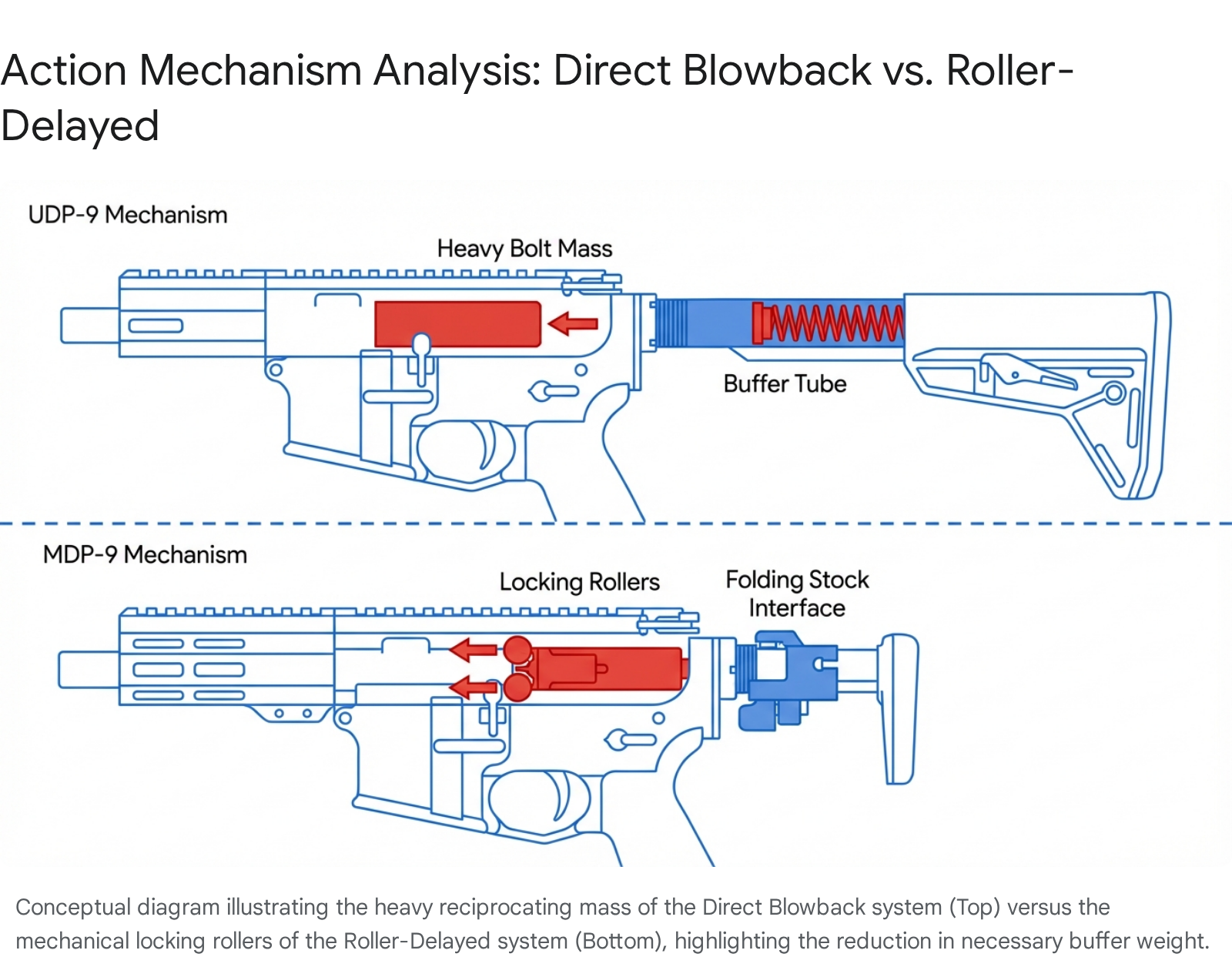
The genius of the MP5 is its operating system, which is frequently misunderstood. It is a roller-delayed blowback system, not a true roller-locked system.4 The bolt is never rigidly locked to the breech at the moment of firing.

The bolt assembly consists of a relatively light bolt head and a heavy, separate bolt carrier. These are connected by a wedge-shaped “locking piece”.10 The bolt head contains two rollers that, when in battery, are forced outward by the locking piece into angled recesses in the receiver’s trunnion.10

The sequence of operations upon firing is a masterpiece of applied physics:

  1. The 9x19mm cartridge ignites. Gas pressure pushes the cartridge case rearward, exerting force on the bolt head.
  2. The bolt head, however, cannot move straight back, as its rollers are wedged into the trunnion recesses.10
  3. The immense force is redirected by the rollers against the angled faces of the locking piece. This use of mechanical disadvantage translates the rearward force on the bolt head into a much faster, accelerated rearward movement of the heavy bolt carrier.10
  4. This “delay” 4—during which the heavy carrier moves back while the bolt head and casing barely move—allows chamber pressure to drop to safe levels before extraction begins.4 To aid this, the chamber is fluted, using gas to “float” the casing and prevent it from rupturing during extraction.4
  5. After the bolt carrier has moved a set distance, the locking piece is pulled free, which in turn retracts the rollers from the trunnion recesses. The entire bolt assembly, now mechanically linked, is free to travel rearward, extracting and ejecting the spent case.10

This complex sequence has two profound benefits. First, it dramatically reduces felt recoil. In a simple blowback gun, a massive, heavy bolt must reciprocate, creating a harsh impulse.28 In the MP5, the initial reciprocating mass is only the heavy bolt carrier; the bolt head’s movement is delayed. This, combined with firing from a closed bolt, is the mechanical source of the MP5’s legendary accuracy and light, “soft” recoil.4

Second, this system is inherently superior for suppression.9 By delaying the breech opening until chamber pressure drops, it drastically reduces “port pop”—the loud, sharp noise of high-pressure gas escaping the ejection port—and minimizes gas blowback in the operator’s face.9 This is why the MP5SD, which pairs this action with a ported, integrally-suppressed barrel, remains a benchmark for quiet operation.21

3.3 Platform Analysis: Armorer-Level Pros and Cons

An armorer-level assessment reveals the MP5 as a platform of extreme trade-offs.

Pros:

  • Shooting Impulse: It is a legendarily “soft shooter”.29 The roller-delay mechanism creates an almost non-existent recoil impulse, enabling exceptionally fast and accurate follow-up shots.10
  • Accuracy: Firing from a closed bolt with a fixed barrel, the MP5 delivers rifle-like accuracy at typical engagement distances.14
  • Reliability & Suppression: The system is robust and reliable when properly maintained 32 and is widely considered one of the best 9mm suppressor hosts ever produced.9

Cons:

  • Ergonomics: The 1960s-era design is fatally outdated.34 The fire control selector is notoriously stiff and poorly positioned for rapid manipulation with a firing grip.34 The manual of arms is complex and non-intuitive for operators trained on modern platforms.
  • Reloading: The “rock-and-lock” magazine insertion and separate, forward-mounted charging handle are dramatically slower than the straight-insertion, button-release design of AR-pattern rifles.30 The famous “HK slap” is a required (and inefficient) step to charge the weapon, not an optional flourish.34
  • Modularity: The stamped steel receiver lacks any native integration for modern optics, lasers, or lights.34 All such accessories must be added via heavy, “bolt-on” claw mounts that add weight and increase height-over-bore, a distinct disadvantage compared to modern monolithic rails.
  • Maintenance & Cost: The roller-delayed system is complex and expensive to manufacture.26 For an armorer, it is a logistical burden. It requires specialized knowledge and tools to check “bolt gap”—the critical headspace tolerance.10 Furthermore, the system must be tuned for different ammunition pressures (e.g., standard vs. +P vs. subsonic) by swapping the angled “locking piece”.10 Failure to do so, as noted in the H&K armorer’s manual, can lead to failures to extract, damage to the buffer, or “permanent damage to the weapon… [or] receiver”.27 This maintenance requirement is a significant liability for an institutional user.

4.0 Analysis of the Modern Challenger: Brügger & Thomet APC9

4.1 Development History: The “Advanced Police Carbine”

Brügger & Thomet (B&T) of Switzerland was founded in 1991, not as a firearms company, but as a high-end suppressor manufacturer and an Original Equipment Manufacturer (OEM) of parts for major firearms companies, including Heckler & Koch.8 This background gave B&T a unique, ground-level understanding of the institutional market’s needs and the logistical complaints armorers had about existing platforms.

B&T entered firearms manufacturing after acquiring the rights to the Steyr TMP (Tactical Machine Pistol), which it subsequently evolved into the B&T MP9.8 The Advanced Police Carbine (APC), first produced in 2011, was B&T’s first “clean slate” design.6

The APC9’s origin is market-driven, whereas the MP5’s was engineering-driven. The platform was explicitly designed to be a modern, more cost-effective alternative to the MP5.13 It was developed based on years of customer feedback from MP9 users 6, and its design systematically solves every major complaint leveled against the MP5:

  • MP5 Ergonomics: The APC9 is fully ambidextrous.12
  • MP5 Reload: The APC9 has an AR-style magazine release and bolt hold-open.12
  • MP5 Modularity: The APC9 has a monolithic, full-length Picatinny rail.37
  • MP5 Logistics: The APC9 PRO offers modular lowers that accept common Glock or P320 magazines.11

The APC9’s manufacturing is thoroughly modern, utilizing a high-tech aluminum extrusion for the upper receiver and a polymer lower/grip housing.36 This process is significantly less complex and costly than stamping, welding, and assembling the MP5’s roller-delayed action, even in a high-cost country like Switzerland.36 The “PRO” series, introduced around 2019, represents the platform’s full evolution, incorporating a non-reciprocating, auto-folding charging handle, AR-15 grip compatibility, and the crucial modular lower receiver system.11

4.2 Engineering Analysis: The Hydraulic-Buffered Blowback System

The 9mm variants of the B&T APC9 use a simple, closed-bolt, straight blowback operating system.6 In a typical PCC, this design choice would be a fatal flaw. Straight blowback requires a massive, heavy bolt to provide the inertia needed to safely delay breech opening until pressure drops.28 This heavy reciprocating mass results in a famously harsh, “unpleasant” recoil impulse that is difficult to control, especially in full-auto.28

B&T’s entire design is enabled by its one, truly innovative component: a proprietary hydraulic buffer system.12 This buffer, integrated into the stock assembly or receiver end cap, consists of a piston and cylinder filled with hydraulic fluid.43

As the APC9’s heavy bolt travels rearward, it impacts and compresses this hydraulic buffer. The hydraulic fluid provides powerful, non-linear resistance, “gradually slowing down the bolt carrier group”.43 This dampening effect 43 is an elegant solution to the physics problem of blowback recoil. According to B&T, this system:

  • Significantly reduces felt recoil.12
  • Eliminates “bolt bounce,” a common issue in full-auto blowback guns that can cause out-of-battery ignition.
  • Reduces wear and tear on the weapon and, critically, on mounted optics.12
  • Results in “much tighter burst groups” during automatic fire.12

This design is a compromise. It does not fully replicate the “non-existent” smoothness of the MP5’s roller-delay; the APC9’s bolt is still “several times heavier than the MP5 bolt”.45 However, the buffer narrows the performance gap to what many shooters describe as a “marginal” difference 45, all while retaining the simplicity, reliability, and lower manufacturing cost of a blowback system. It makes the platform viable for professional use in a way un-buffered blowback guns are not.

4.3 Platform Validation: The U.S. Army SCW Contract

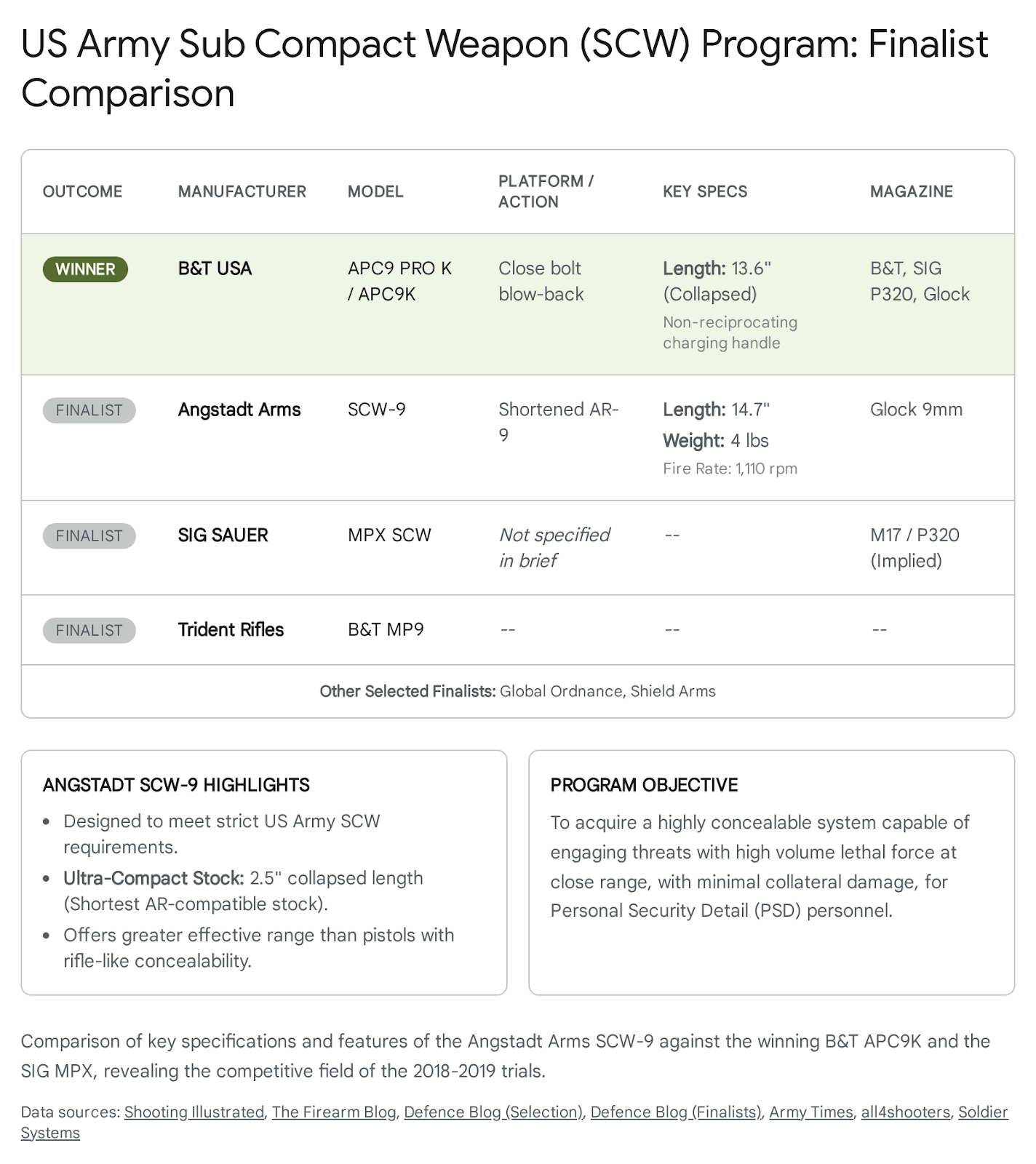
The single most important validation of the APC9 platform occurred in 2019, when B&T USA won the U.S. Army’s Sub Compact Weapon (SCW) contract.3 This was a landmark event, representing the first official adoption of an SMG by the U.S. Army since the M3 “Grease Gun” in 1943.11

The contract was for an initial 350 units, with options for up to 1,000, at a value of over $2.5 million.3 The U.S. Air Force later “piggy-backed” on this contract to procure 65 of its own units.47 The winning weapon was the B&T APC9K PRO.3

The Army’s requirement was for a highly concealable weapon for its Personal Security Details (PSDs), intended to protect high-risk personnel.3 The goal was to provide these teams with a platform, more capable than a pistol, to “engage threats ‘with a high volume of lethal force while accurately firing at close range with minimal collateral damage'”.3

Key Army requirements that the APC9K met included:

  • A 9x19mm chambering, optimized to fire 147-grain (subsonic) ammunition.3
  • A collapsible/retracting stock (a specific requirement that some folding-stock competitors did not meet).48
  • A rail system for accessories like aiming lights and lasers.3

The most telling detail of the competition is that B&T won against a field of major competitors, including SIG Sauer 3 and, significantly, submissions that included “modern versions of the Heckler & Koch MP5 sub gun design”.3

The U.S. Army was given a direct choice between a modern MP5 and the APC9K, and it selected the APC9K. This victory proves that for a 21st-century institutional user, the MP5’s dated ergonomics and lack of native modularity are disqualifying failures. The APC9K’s native accessory rails, superior ambidextrous controls, compact retracting-stock package, and familiar AR-style manual of arms were the decisive factors. The Army voted for the superior weapon system, not just the superior recoil impulse.

Table 1: U.S. Army SCW Contract Requirement Analysis

SCW RequirementB&T APC9K FeatureAnalytical Rationale
Concealable Weapon for PSDsUltra-compact “K” variant; 4.3″ barrel (110mm), 15.2″ folded length 6Met the stringent size requirement for low-visibility protection details.
Retracting StockCollapsible (retracting) stockThis was a specific requirement that B&T met, whereas some competitors offered side-folders.48
Rail System for AccessoriesMonolithic Picatinny rail on upper; M-LOK compatible handguard 12Native, modern-standard integration for optics (e.g., Aimpoint) and lasers.3
High Volume of Lethal ForceFull-automatic capability 3Standard SMG feature, but the hydraulic buffer tames this for “tighter burst groups”.12
Minimal Collateral Damage9x19mm caliber, optimized for 147-grain ammo 3147-grain 9mm is ideal for suppressed, close-range use with less over-penetration risk than 5.56mm.
Modern ControlsFully ambidextrous selector, mag release, and bolt-hold-open 12Superior manual of arms for operators under stress, a key failure of the MP5 design.

5.0 Comparative Analysis: H&K MP5 vs. B&T APC9

5.1 Platform Specifications

A direct comparison of the standard models reveals the design-philosophy differences, particularly in weight and dimensions. The APC9’s modern materials and design make it a lighter and more compact package.

Table 2: Key Platform Specifications

MetricH&K MP5A3 (Typical)B&T APC9 PRO (Standard)
Caliber9x19mm9x19mm
Operating SystemRoller-Delayed Blowback 4Straight Blowback w/ Hydraulic Buffer 6
Bolt TypeClosed-Bolt 14Closed-Bolt 6
Barrel Length8.9 in (225 mm) 236.8 in (175 mm) 38
Overall Length (Ext.)~31.7 in~24.5 in 38
Overall Length (Col.)~25.6 in~15.2 in (Stock Folded) 6
Weight (Unloaded)~6.8 lbs (3.1 kg)~5.3 lbs (2.4 kg) 38
Receiver MaterialStamped SteelAluminum Upper 36, Polymer Lower 39
Magazine TypeH&K ProprietaryB&T Proprietary, Glock, or SIG P320 11
Fire ControlsRight-hand selector (most models)Fully Ambidextrous 12

5.2 Recoil Impulse, Accuracy, and Suppressor Performance

  • Recoil: The MP5’s roller-delayed system, with its lower reciprocating mass at the moment of firing, has a mechanically superior recoil impulse. It is universally lauded as a “soft shooter”.29 The APC9’s hydraulic buffer is highly effective at mitigating the harshness of its heavy blowback bolt 12, but many purists and some instructors still find the MP5 “smoother” or “softer”.34
  • Accuracy: For all practical purposes, this is a tie. Both platforms fire from a closed bolt 6 and are capable of exceptional “deadly accurate” precision at typical SMG engagement distances of 25-100 yards.20
  • Suppression: The MP5, particularly the MP5SD, is the “gold standard”.9 Its delayed breech opening results in less noise escaping the ejection port 10, making it inherently quieter at the ear than a blowback gun.33 The APC9 also suppresses very well, and B&T offers its own “SD” variant.51 A significant logistical advantage for the APC9-SD is that its suppressor and barrel are far easier to clean than the notoriously difficult-to-maintain MP5SD barrel and shroud.54

5.3 Ergonomics, Modularity, and Manual of Arms

This is the central battleground of the comparison, and the B&T APC9 wins decisively. A firearm is a tool to be used under stress, and the APC9 is an objectively superior tool in every aspect of operator-weapon interaction.

  • Controls: The MP5 is a right-handed-only design.34 The APC9 PRO is fully ambidextrous.12 The safety, magazine release, and bolt catch/release are mirrored on both sides of the weapon.12
  • Charging Handle: The MP5’s handle is forward-mounted, non-ambidextrous, and requires the operator to break their firing grip (or use their support hand) to manipulate it.34 The APC9 PRO’s handle is dual, non-reciprocating, and folds forward, allowing operation from either side with either hand.12
  • Reloading: The MP5’s reload is slow and complex, requiring a “rock-and-lock” magazine insertion followed by a “slap” of the charging handle to release the bolt.30 The APC9’s reload is identical to an AR-15: straight-insert the magazine, then press a button (the bolt release) to chamber a round.34 This manual of arms is dramatically faster and, for Western military and police, requires zero new training.
  • Modularity (Optics): The MP5 requires a claw mount or custom-welded rail.34 The APC9 has a monolithic, full-length Picatinny rail from the factory, ready for any optic or laser.12
  • Modularity (Logistics): This is the APC9’s single greatest advantage. The MP5 takes one type of expensive, proprietary magazine. The APC9 PRO offers interchangeable polymer lower receivers.11 An agency can issue a single, serialized APC9 upper and provide its operators with lowers compatible with their standard-issue sidearm magazines, such as the Glock 17 or SIG P320/M17.11 This simplifies logistics, reduces cost, and allows operators to share a common magazine pool between their primary and secondary weapons. This is a revolutionary logistical advantage that the MP5 platform cannot answer.

5.4 Reliability and Maintenance

The two platforms present a clear “no free lunch” trade-off between complex design and high-stress simplicity.

  • MP5: The roller-delayed system is reliable if and only if it is properly configured and maintained. As noted previously, it is highly sensitive to ammunition type and requires the correct locking piece to be installed.27 It is complex to disassemble and clean, especially the bolt group and fluted chamber.55 An armorer’s failure to check bolt gap or use the correct parts can lead to weapon failure or receiver damage.10
  • APC9: The blowback system is mechanically simple, easy to field strip, and easy to clean.55 However, this simplicity creates a high-stress environment for the parts. A high-round-count (11,000) user report detailed significant failures, including “a substantial piece inside the lower” breaking at 8,000 rounds and a critical spring failure at 11,000 rounds.58 The recommended service interval from a B&T dealer was every 5,000 rounds.58 Furthermore, the trigger group is not fully AR-15 specification, and using aftermarket triggers (like Geissele) can lead to “deformed hammer” or “snap[ped]… firing pin” failures.59

The trade-off is clear: The MP5 fails from improper configuration. The APC9 fails from material fatigue at high round counts. For a modern, institutional armorer, the APC9’s maintenance (e.g., “replace buffer and springs every 5,000 rounds”) is a simpler and more predictable logistical task than the MP5’s (e.g., “diagnose bolt gap and select correct locking piece for this new ammunition”).

Table 3: Qualitative Pros & Cons Matrix

Performance MetricH&K MP5B&T APC9
Recoil ImpulsePro: Mechanically superior. “Softer”.29Con: Heavier bolt; “harsher” than MP5, but mitigated by buffer.45
Suppression HostPro: Gold standard. Delayed action = less port pop.10Neutral: Very good, but blowback is inherently louder at-ear.45 SD model easier to clean.54
Modularity (Rails)Con: Outdated. Requires bolt-on mounts.34Pro: Native monolithic rail.12
Modularity (Logistics)Con: Proprietary magazines.Pro: Modular lowers for Glock/SIG mags.11
Ergonomics (Ambi)Con: Poor. Right-hand only.34Pro: Fully ambidextrous.12
Ergonomics (Reload)Con: Slow, complex “rock-and-lock”.30Pro: Fast, familiar AR-style straight-insert.34
MaintenanceCon: Complex, parts-sensitive (rollers, locking piece, bolt gap).10Pro: Simple blowback design, easy to field strip.55
Durability (Armorer)Con: Risk of receiver damage from wrong parts/ammo.35Con: High-stress system. Wear on lowers/springs at high counts.58

6.0 Market & Sentiment Analysis

6.1 Institutional Adoption (Military & LE)

The institutional market provides the clearest, most objective answer.

  • MP5: The MP5 was the standard. It is still in service with thousands of agencies globally.5 However, its adoption trend is negative. It is a legacy platform. Most agencies are either replacing their 9mm SMGs entirely with 5.56mm SBRs 1 or, if the 9mm SCW role is retained, they are actively replacing their MP5s with modern platforms.
  • APC9: The APC9’s adoption trend is unequivocally positive. It is actively winning contracts and displacing legacy MP5s. Adopters include:
  • United States Army (APC9K) 3
  • United States Air Force (APC9K) 47
  • Miami Beach Police Department (APC9K Pro) 6
  • Westchester County Police (APC9SD) 6
  • Hillsborough County Sheriff’s Office (APC9K Pro) 6
  • Military Police of São Paulo State, Brazil (APC40 PRO) 6
  • Belgian Customs/Border Patrol (APC9 PRO) 6
  • Slovak Police Force (APC9) 6

The institutional market has already decided. The U.S. Army’s SCW contract was the bellwether, and the APC9 is the new institutional standard for the specialized 9mm SCW niche.

6.2 Civilian Market & Social Media Performance

The high-end civilian market, populated by “prosumers” and collectors, provides a valuable look at user sentiment. This market is far more emotional but often mirrors the technical debate of the professional world.

  • MP5 (Sentiment: The “Icon”): On social media platforms like Reddit and YouTube, the MP5 (and its high-quality civilian clones like the H&K SP5) is revered for its nostalgia and shooting experience.33 It is “The Jordan” to the APC9’s “Lebron”.64 It is praised as the “icon” 29, “smoother” 34, and “quieter suppressed”.33 However, even its staunchest defenders readily admit its “ergos kind of suck” 33, it has “horrible ergo” 34, and it is, in effect, an “outdated boomer stick”.34 The MP5 is bought for pleasure and nostalgia.
  • APC9 (Sentiment: The “Modern Tool”): The APC9 is discussed as the practical, modern choice.55 Users praise its “modern ergonomics and controls” 34, AR-15 familiarity 63, and superior accessory-mounting options.34 The online consensus from a practical standpoint is often blunt: “the APC is the better weapon. That’s not even debatable.”.66 The APC9 is bought for performance and practicality.

This social media discourse perfectly captures the core technical conflict: MP5 fans are defending the superiority of the operating system. APC9 fans are defending the superiority of the weapon system. The most telling comments often come from users who own both platforms. Their consensus is almost universal: they love shooting the MP5 for its history and smoothness, but the APC9 is the one they would choose for any “real work”.33

7.0 Conclusion: The Leader in 2024

The H&K MP5 is, and will remain, one of the most significant, influential, and iconic firearms of the 20th century. Its roller-delayed blowback system is an engineering marvel 4 that, in a vacuum, remains the superior action for mitigating recoil and suppressing a 9mm carbine.9

However, a firearm is a system, not just an action. The MP5’s 1960s-era design 14 is a fatal liability in 2024. Its poor ergonomics, right-hand-only controls, complex manual of arms, and complete lack of native modularity for optics and accessories make it operationally obsolete for a modern, professional operator.30

The B&T APC9 is the definitive leader today. It was designed from the outset to be the “modern-day MP5” 13, and it has succeeded in every practical metric. Its brilliant use of a hydraulic buffer 12 makes its simple, reliable, and cost-effective blowback action good enough to compete, while its vastly superior systems-level design—full ambidextrous controls 12, an AR-style manual of arms 34, monolithic rails 37, and game-changing modular lowers 11—makes it the superior weapon.

The market has confirmed this. The civilian heart may still belong to the MP5, but the institutional head—and the procurement contracts—belong to the APC9.3 The U.S. Army’s selection of the APC9K over modern MP5 variants 3 was the final, definitive judgment. The MP5 is a legend and a prized collector’s piece; the APC9 is the issued tool.


Appendix A: Methodology for Comparative Small Arms Systems Analysis

1.0 Objective

The objective of this report’s methodology is to conduct a formal comparative systems analysis 67 to determine the “best value” 68 and identify the definitive “leader” between the H&K MP5 and B&T APC9 weapon systems for a modern institutional (military or law enforcement) end-user.

2.0 Analytical Framework

This analysis employs a multi-faceted approach, mirroring U.S. Department of Defense (DoD) procurement practices, by combining quantitative and qualitative performance analysis with market/sentiment analysis.68 The evaluation addresses the systems “for use by typical users in realistic operational environments”.70

3.0 Quantitative & Qualitative Performance Analysis

This analysis framework is based on the system evaluation methodology described in DoD technical analyses 68 and the criteria from the U.S. Army’s Modular Handgun System (MHS) trials.71

3.1. Define Relevant Variables: The systems are compared across a weighted set of variables critical to modern procurement.70 These are:

  • Performance Variables 68:
  • Reliability: Assessed via Mean Rounds Between Failure (MRBF) data, parts sensitivity, and required service life.27
  • Suitability/Lethality: Closed-bolt accuracy, recoil impulse (as it relates to follow-up shots), and effectiveness as a suppressor host.68
  • Maintainability: Armorer-level complexity, required service intervals, ease of field stripping, and parts commonality.68
  • Ergonomic & Modular Variables 71:
  • Ergonomics: Assessed by the presence of ambidextrous controls, efficiency of the manual of arms (reload speed, safety manipulation), and operator handling.71
  • Modularity: Assessed by the native ability to mount “targeting enablers” (optics, lasers) 71, compatibility with different stocks/grips, and logistical modularity (e.g., magazine/lower receiver interchangeability).73

3.2. Weighting and Decision Matrix: This analysis utilizes a weighted decision matrix, as described in formal systems analysis.70 A key component of this 2024 analysis is the high weighting applied to Ergonomic & Modular Variables. Modern procurement doctrine 71 recognizes that operator-system-interface (ergonomics, modularity) is a critical component of effectiveness, equal to or greater than marginal differences in pure mechanical performance (e.g., recoil impulse).

4.0 Market & Sentiment Analysis

4.1. Institutional Adoption: Analysis of active military and law enforcement (LE) procurement contracts 3 serves as the primary, objective indicator of institutional validation and de facto leadership.67 A platform winning new contracts is deemed superior in the “best value” analysis.69

4.2. Social/Civilian Market: Analysis of consumer behavior 74, industry publications 76, and social media sentiment 63 is used as a qualitative data source. This measures “Market Sentiment” and identifies emergent trends and user-defined pro/con arguments, which often serve as leading indicators for future institutional requirements.

5.0 Conclusion

The “leader” is determined not by a single metric (e.g., “smoothest shooter”) but by the platform’s aggregate score across this entire weighted matrix. The final, decisive validation is provided by the institutional market, where objective, data-driven procurement decisions 3 supersede the nostalgia or subjective preferences found in the civilian market.


If you find this post useful, please share the link on Facebook, with your friends, etc. Your support is much appreciated and if you have any feedback, please email me at in**@*********ps.com. Please note that for links to other websites, we are only paid if there is an affiliate program such as Avantlink, Impact, Amazon and eBay and only if you purchase something. If you’d like to directly contribute towards our continued reporting, please visit our funding page.


Sources Used

  1. Is the HK MP5 now considered an obsolete weapon for hostage rescue? – Reddit, accessed November 16, 2025, https://www.reddit.com/r/WarCollege/comments/13ws8c6/is_the_hk_mp5_now_considered_an_obsolete_weapon/
  2. What gun is the U.S. Secret Service requesting to replace the current MP5? – Quora, accessed November 16, 2025, https://www.quora.com/What-gun-is-the-U-S-Secret-Service-requesting-to-replace-the-current-MP5
  3. The Army picked this sub gun for security details to use while …, accessed November 16, 2025, https://www.armytimes.com/news/your-army/2019/04/01/the-army-picked-this-sub-gun-for-security-details-to-use-while-protecting-top-commanders/
  4. Inside the MP5, the History and Function of Roller-Delay – Sonoran Desert Institute, accessed November 16, 2025, https://sdi.edu/2021/05/20/inside-the-mp5-the-history-and-function-of-roller-delay/
  5. 8 Major HK MP5 Variants — A History – The Mag Life, accessed November 16, 2025, https://gunmagwarehouse.com/blog/8-hk-mp5-variants-a-history/
  6. Brügger & Thomet APC – Wikipedia, accessed November 16, 2025, https://en.wikipedia.org/wiki/Br%C3%BCgger_%26_Thomet_APC
  7. B&T Advanced Police Carbine – Small Arms Defense Journal, accessed November 16, 2025, https://sadefensejournal.com/bt-advanced-police-carbine/
  8. Why the U.S. Army Loves This New Machine Gun – The National Interest, accessed November 16, 2025, https://nationalinterest.org/blog/buzz/why-us-army-loves-new-machine-gun-51107
  9. Roller-Delayed vs. Direct Blowback: An Overview – Zenith Firearms, accessed November 16, 2025, https://zenithfirearms.com/roller-delayed-vs-direct-blowback-an-overview/
  10. How Roller-Delayed Firearms Work and Why it Matters, accessed November 16, 2025, https://internationalsportsman.com/how-roller-delayed-firearms-work-and-why-it-matters/
  11. History | B&T USA, accessed November 16, 2025, https://bt-usa.com/support/history/
  12. APC PRO – 04 – 04 2020.indd – B&T AG, accessed November 16, 2025, https://bt-ag.ch/wp-content/uploads/2020/07/APC_PRO-04-20201.pdf
  13. The B&T APC9k — What the MP5 Wishes it Was | RECOIL, accessed November 16, 2025, https://www.recoilweb.com/the-bt-apc9k-what-the-mp5-wishes-it-was-153558.html
  14. [History] Heckler & Koch MP5: A Pop Culture SMG Icon – Pew Pew Tactical, accessed November 16, 2025, https://www.pewpewtactical.com/hk-mp5-history/
  15. Heckler & Koch MP5 – Wikipedia, accessed November 16, 2025, https://en.wikipedia.org/wiki/Heckler_%26_Koch_MP5
  16. The H&K MP5: A Comprehensive History, Design, and Legacy – AV Guns, accessed November 16, 2025, https://store.avguns.com/blog/the-hk-mp5-a-comprehensive-history-design-and-legacy/
  17. A Brief History of the MP5 – Zenith Firearms, accessed November 16, 2025, https://zenithfirearms.com/brief-history-mp5/
  18. Iranian Embassy siege – Wikipedia, accessed November 16, 2025, https://en.wikipedia.org/wiki/Iranian_Embassy_siege
  19. Iranian Embassy Siege SAS Extended Pistol Magazines – YouTube, accessed November 16, 2025, https://www.youtube.com/watch?v=G-V-YECfHU8
  20. Operation Nimrod – GUNS Magazine, accessed November 16, 2025, https://gunsmagazine.com/guns/rifles/operation-nimrod/
  21. MP5 – Heckler & Koch, accessed November 16, 2025, https://www.heckler-koch.com/en/Products/Military%20and%20Law%20Enforcement/Submachine%20guns/MP5
  22. MP5K – HK USA, accessed November 16, 2025, https://hk-usa.com/product/mp5k/
  23. Heckler & Koch MP5 (& variants) – Small Arms Survey, accessed November 16, 2025, https://www.smallarmssurvey.org/sites/default/files/SAS-weapons-sub-machine-guns-Heckler-Koch-MP5.pdf
  24. Understanding the Roller-Delayed Blowback Mechanism: Spotlight on HK P9, Korth PRS, HK MP5, and HK G3 – Korriphila, accessed November 16, 2025, https://korriphila.org/understanding-the-roller-delayed-blowback-mechanism-spotlight-on-hk-p9-korth-prs-hk-mp5-and-hk-g3/
  25. Roller Delayed Blowback System: A Detailed Look – The Mag Life, accessed November 16, 2025, https://gunmagwarehouse.com/blog/roller-delayed-blowback-system-a-detailed-look/
  26. What is roller delayed blowback and what makes it better? : r/guns – Reddit, accessed November 16, 2025, https://www.reddit.com/r/guns/comments/bmag52/what_is_roller_delayed_blowback_and_what_makes_it/
  27. Hk Mp5 ARmorers Manual.pdf – Tiropratico.com, accessed November 16, 2025, https://www.tiropratico.com/manuali-pdf/2015-H/Hk%20Mp5%20ARmorers%20Manual.pdf
  28. Straight and Delayed Blowback: Five PCC Operating Systems – Bad Moon Armory, accessed November 16, 2025, https://badmoonarmory.com/delayed-blowback-straight-blowback-pcc/
  29. TFB Review: The HK SP5K – The Firearm Blog, accessed November 16, 2025, https://www.thefirearmblog.com/blog/2019/07/18/tfb-review-the-hk-sp5k/
  30. MKE AP5SD Review: Better Than The Original? – Gun Digest, accessed November 16, 2025, https://gundigest.com/gun-reviews/ap5sd-review
  31. The Development of the Heckler and Koch MP5 Submachine Gun – SOFREP, accessed November 16, 2025, https://sofrep.com/gear/development-heckler-koch-mp5-submachine-gun/
  32. What are the advantages and drawbacks of roller delayed blowback firearms? – Quora, accessed November 16, 2025, https://www.quora.com/What-are-the-advantages-and-drawbacks-of-roller-delayed-blowback-firearms
  33. Thoughts on HK SP5 from B&T owners : r/BT_APC – Reddit, accessed November 16, 2025, https://www.reddit.com/r/BT_APC/comments/1gluimc/thoughts_on_hk_sp5_from_bt_owners/
  34. SP5/MP5 Preferred over APC9. : r/BT_APC – Reddit, accessed November 16, 2025, https://www.reddit.com/r/BT_APC/comments/106ykbr/sp5mp5_preferred_over_apc9/
  35. Full text of “Hk Mp5 ARmorers Manual” – Internet Archive, accessed November 16, 2025, https://archive.org/stream/gunmanual_Hk_Mp5_ARmorers_Manual/Hk%20Mp5%20ARmorers%20Manual_djvu.txt
  36. B&T APC-9: The Swiss Answer to the MP5 – YouTube, accessed November 16, 2025, https://www.youtube.com/watch?v=xHRlR2WrdXU
  37. B&T APC9 Submachine Gun | thefirearmblog.com, accessed November 16, 2025, https://www.thefirearmblog.com/blog/2011/10/25/bt-apc9-submachine-gun/
  38. APC9 – B&T USA, accessed November 16, 2025, https://bt-usa.com/products/apc9/
  39. APC9 – B&T USA, accessed November 16, 2025, https://bt-usa.com/product-category/apc-smg/
  40. Eliminate RECOIL and increase ACCURACY on your blowback PCC – YouTube, accessed November 16, 2025, https://www.youtube.com/watch?v=5xOrc6nszU0
  41. B&T APC9 Pro Setup and Overview – Inside Safariland, accessed November 16, 2025, https://inside.safariland.com/blog/bt-apc9-pro-setup-and-overview/
  42. B&T Hydraulic Reduced Recoil Buffer for APC9/10/40/45, accessed November 16, 2025, https://armsunlimited.com/bt-hydraulic-reduced-recoil-buffer-apc9/
  43. The Science Behind Hydraulic Buffers: Understanding the Mechanism and Its Advantages, accessed November 16, 2025, https://www.blitzkriegcomponents.com/The-Science-Behind-Hydraulic-Buffers-Understanding-the-Mechanism-and-Its-Advantages-_b_7.html
  44. Unlocking the Benefits of Hydraulic Buffers for Pistol Caliber Carbines, accessed November 16, 2025, https://www.blitzkriegcomponents.com/Unlocking-the-Benefits-of-Hydraulic-Buffers-for-Pistol-Caliber-Carbines_b_3.html
  45. B&T Apc9 Pro – The modern day Mp5 : r/GunPorn – Reddit, accessed November 16, 2025, https://www.reddit.com/r/GunPorn/comments/m7226j/bt_apc9_pro_the_modern_day_mp5/
  46. The B&T APC9 – True Shot Ammo, accessed November 16, 2025, https://trueshotammo.com/academy/the-bt-apc9/
  47. Army’s New 9mm Submachine Guns Are Ready To Help Protect VIPs – The War Zone, accessed November 16, 2025, https://www.twz.com/armys-new-9mm-submachine-guns-are-ready-to-help-protect-vips
  48. This Is The Army’s New Submachine Gun – The War Zone, accessed November 16, 2025, https://www.twz.com/27261/this-is-the-armys-new-submachine-gun
  49. Army Selects B&T APC9K for New Sub Compact Weapon – Athlon Outdoors, accessed November 16, 2025, https://athlonoutdoors.com/article/army-bt-apc9k-sub-compact-weapon/
  50. B&T USA Announces Commercial Release of Its APC9K SD2 US Army Submission, accessed November 16, 2025, https://www.firearmsnews.com/editorial/bt-usa-apc9k-sd2-us-army-submission/480007
  51. New video breaking down the B&T SPC9 : r/BT_APC – Reddit, accessed November 16, 2025, https://www.reddit.com/r/BT_APC/comments/os9nny/new_video_breaking_down_the_bt_spc9/
  52. APC9 SD Compact Pistol – B&T USA, accessed November 16, 2025, https://bt-usa.com/products/apc9-sd-compact-pistol/
  53. The B&T APC9 Pro series, discussing four variants – YouTube, accessed November 16, 2025, https://www.youtube.com/watch?v=_EYrSiaN-10
  54. Range Report: B&T APC9 SD MBT – As good or better than the Hk MP5? – YouTube, accessed November 16, 2025, https://www.youtube.com/watch?v=HxDMA6NIM34
  55. B&T APC9 Pro: The Swiss Answer to the MP5 : r/BT_APC – Reddit, accessed November 16, 2025, https://www.reddit.com/r/BT_APC/comments/1o376da/bt_apc9_pro_the_swiss_answer_to_the_mp5/
  56. Trigger Groups (Semi-Auto) – B&T Parts and Accessories, accessed November 16, 2025, https://bt-parts.com/accessories/trigger-groups/
  57. How to Clean and Lube an B&T APC9 Pro – YouTube, accessed November 16, 2025, https://www.youtube.com/watch?v=zz12UZ0Oatg
  58. APC9 after 11k rounds experience : r/BT_APC – Reddit, accessed November 16, 2025, https://www.reddit.com/r/BT_APC/comments/m0izof/apc9_after_11k_rounds_experience/
  59. Geissele Trigger APC9: Long-Term Issues? : r/BT_APC – Reddit, accessed November 16, 2025, https://www.reddit.com/r/BT_APC/comments/1n87b1y/geissele_trigger_apc9_longterm_issues/
  60. Any one tried drop a AR15 trigger in APC9 pro? : r/BT_APC – Reddit, accessed November 16, 2025, https://www.reddit.com/r/BT_APC/comments/heimg9/any_one_tried_drop_a_ar15_trigger_in_apc9_pro/
  61. Hillsborough Sheriff’s Office Adopts B&T APC9 Pro For School Resource Officers | RECOIL, accessed November 16, 2025, https://www.recoilweb.com/hillsborough-sheriffs-office-adopts-bt-apc9-pro-for-school-resource-officers-176383.html
  62. HK SP5 vs B&T APC9 – If I Could Only Choose One – YouTube, accessed November 16, 2025, https://www.youtube.com/watch?v=CB3PYkSVrxQ
  63. B&T SPC-9 vs HK SP5 : r/BT_APC – Reddit, accessed November 16, 2025, https://www.reddit.com/r/BT_APC/comments/xqd229/bt_spc9_vs_hk_sp5/
  64. LEGEND v MODERN — MP5 v APC9 – YouTube, accessed November 16, 2025, https://www.youtube.com/watch?v=lqabN25zwCQ
  65. B&T vs MP5 options : r/tacticalgear – Reddit, accessed November 16, 2025, https://www.reddit.com/r/tacticalgear/comments/sdq846/bt_vs_mp5_options/
  66. Apc9 vs Mp5? : r/BT_APC – Reddit, accessed November 16, 2025, https://www.reddit.com/r/BT_APC/comments/1ds6oc1/apc9_vs_mp5/
  67. Systems Analysis in the U.S. Army Weapons Command | Article, accessed November 16, 2025, https://www.army.mil/article/281950/systems_analysis_in_the_u_s_army_weapons_command
  68. A comparative analysis of current and planned small arms weapon systems, accessed November 16, 2025, https://www.semanticscholar.org/paper/A-comparative-analysis-of-current-and-planned-small-Jenkins-Lowrey/69f7c96d32029175a68354b6188c56b57054f986
  69. File:A comparative analysis of current and planned small arms weapon systems (IA acomparativenaly109459904).pdf – Wikimedia Commons, accessed November 16, 2025, https://commons.wikimedia.org/wiki/File:A_comparative_analysis_of_current_and_planned_small_arms_weapon_systems_(IA_acomparativenaly109459904).pdf
  70. A Comparative Analysis of Current and Planned Small Arms … – DTIC, accessed November 16, 2025, https://apps.dtic.mil/sti/tr/pdf/ADA429392.pdf
  71. XM17/XM18 Modular Handgun System (MHS) – Director Operational Test and Evaluation, accessed November 16, 2025, https://www.dote.osd.mil/Portals/97/pub/reports/FY2018/army/2018mhs.pdf?ver=2019-08-21-155807-603
  72. Sig Sauer M18 sets new standard for Army’s Modular Handgun System reliability testing, accessed November 16, 2025, https://www.militarytimes.com/off-duty/gearscout/2019/02/11/sig-sauer-m18-sets-new-standard-for-armys-modular-handgun-system-reliability-testing/
  73. XM17 Modular Handgun System competition – Wikipedia, accessed November 16, 2025, https://en.wikipedia.org/wiki/XM17_Modular_Handgun_System_competition
  74. Top Industry Research Reports – NSSF, accessed November 16, 2025, https://www.nssf.org/research/top-industry-research-reports/
  75. Firearms Market Size, Share, Trends | CAGR of 6.3%, accessed November 16, 2025, https://market.us/report/firearms-market/
  76. Best Expensive 9mm Carbine: H&K MP5 vs. B&T APC-9 …, accessed November 16, 2025, https://www.thefirearmblog.com/blog/2023/10/10/best-expensive-9mm-carbine-hk-mp5-vs-bt-apc-9/

The UZI: A Report on the History, Engineering, and Evolution of an Israeli Icon

The Uzi submachine gun is more than an iconic firearm; it is a physical embodiment of the strategic imperatives that shaped the nascent state of Israel. Born from the logistical chaos of the 1948 Arab-Israeli War, the Uzi was conceived as a definitive solution to a critical national security vulnerability: the lack of a standardized, reliable, and domestically produced personal defense weapon. Its development, spearheaded by Uziel Gal, was a masterclass in pragmatic engineering, synthesizing the most advanced design concepts of its time with the stark manufacturing realities of a new and resource-constrained nation. The Uzi’s innovative telescoping bolt and stamped-steel construction delivered a weapon that was compact, controllable, inexpensive to mass-produce, and exceptionally durable.

While its initial role was to arm the Israel Defense Forces (IDF), the Uzi’s success transcended national borders, becoming one of the most widely proliferated and recognizable submachine guns of the 20th century. Its evolution from the original model to the compact Mini and Micro variants, and ultimately to the modernized Uzi Pro, mirrors the changing doctrines of modern warfare—from conventional state-on-state conflict to the specialized demands of counter-terrorism and the contemporary emphasis on modularity and precision. However, the design was not without its inherent limitations, particularly those associated with its open-bolt operating system and the ballistic constraints of its pistol caliber chambering. Ultimately, the Uzi’s legacy is twofold: it stands as a pivotal achievement in military ordnance that served as a proof-of-concept for Israel’s formidable defense-industrial complex, and as an unexpected cultural icon whose menacing silhouette became deeply ingrained in the global consciousness.

Section 1: Genesis of a Standardized Weapon: The Post-War IDF Arsenal

1.1 The Logistical Nightmare of 1948

The Israel Defense Forces, formally established on May 26, 1948, just days after the state’s declaration of independence, entered the 1948 Arab-Israeli War with a small arms inventory that can only be described as a logistical nightmare.1 The arsenal was a dangerously heterogeneous collection of weapons procured from any and all available sources, reflecting the desperation of the pre-state Jewish paramilitary organizations (Haganah, Irgun, and Lehi) operating under the constraints of a British Mandate and a widespread arms embargo.1

This chaotic inventory included a vast array of rifles from different eras and countries of origin. The primary battle rifles were German Mauser Kar98k variants, largely supplied by Czechoslovakia, and British Lee-Enfield SMLE rifles, often stolen from British armories.4 Alongside these were American M1 Garands and M1 Carbines, and a motley assortment of other bolt-action and semi-automatic rifles.5 The situation with automatic weapons was equally dire. The IDF fielded British Sten guns, some of which were produced locally in clandestine workshops, German MP38/40s, and American Thompson and M3 “Grease Gun” submachine guns.5

This diversity created crippling challenges that threatened the operational effectiveness of the nascent Israeli army. The most pressing issue was ammunition supply. A single infantry unit could be fielding weapons chambering 7.92x57mm Mauser,.303 British, 9x19mm Parabellum, and.45 ACP, all at the same time.3 This complicated logistics to a breaking point, making resupply under combat conditions a perilous gamble. Furthermore, the lack of interchangeability meant that procuring and distributing spare parts was nearly impossible, leading to high rates of attrition for weapons that could not be repaired in the field. Finally, this “arsenal of democracy and its adversaries” made standardized training exceptionally difficult. Soldiers had to be familiarized with multiple weapon systems, each with its own manual of arms, maintenance procedures, and ballistic characteristics, reducing overall combat proficiency.7 The clear and urgent lesson of the 1948 war was that military effectiveness and, indeed, national survival, depended on the standardization of equipment.

1.2 The Strategic Imperative for Self-Sufficiency

The logistical problems of 1948 were a symptom of a much larger strategic vulnerability: a dependency on unreliable foreign arms suppliers. During the war, major powers, including the United States and Great Britain, maintained a strict arms embargo on all belligerents, severely limiting Israel’s ability to acquire modern weaponry through official channels.1 While clandestine shipments, most notably from Czechoslovakia, proved vital, Israeli leadership under David Ben-Gurion recognized that such arrangements were subject to the shifting winds of international politics and could not be relied upon for long-term security.2 The only viable path to a secure future was the development of a robust, indigenous defense industry.

The foundation for this industry had already been laid during the British Mandate. The Yishuv (the pre-state Jewish community in Palestine) had established a network of secret, underground factories to produce small arms and munitions, hiding their activities from British authorities.6 These workshops manufactured grenades, mortars, millions of rounds of ammunition, and copies of the simple British Sten gun, using surplus American machinery acquired as scrap after World War II.6

After the war, these clandestine operations were centralized and formalized under a new state-owned conglomerate: Israel Military Industries (IMI).6 IMI was tasked with a clear mission: to design and produce standardized, reliable, and effective weapons for the IDF, freeing the nation from the precariousness of foreign supply. The development of a new, domestically produced submachine gun was one of its first and most critical projects.8 This project was not merely about creating a new gun; it was a fundamental test of Israel’s new doctrine of military self-reliance. Its success would validate this strategic pivot, providing the technical expertise, industrial capacity, and national confidence needed to undertake more ambitious projects in the future, from the Galil assault rifle to the Merkava main battle tank and beyond.3 The Uzi was, in effect, the first major proof-of-concept for the entire Israeli defense-industrial complex.

Section 2: The Architect and His Influences: Uziel Gal and the Czech Connection

2.1 Profile of the Designer

The man who would answer the IDF’s call for a new submachine gun was Uziel Gal. Born Gotthard Glas in 1923 in Weimar, Germany, his early life was shaped by the turbulent rise of Nazism.11 To escape persecution, his family fled, first to the United Kingdom in 1933 and then, in 1936, to Kibbutz Yagur in British Mandate Palestine, where he adopted the Hebrew name Uziel Gal.7

From a young age, Gal displayed a remarkable aptitude for mechanics and firearms design. As a teenager, he demonstrated this innate talent by inventing and building a bow capable of firing arrows automatically—a “submachine bow,” in essence.7 This passion for weapons development found a natural home in the Palmach, the elite fighting force of the Haganah underground.14 However, his activities did not go unnoticed by the British authorities. In 1943, he was arrested for illegal possession of a firearm and sentenced to six years in prison.7 In a turn of fate, this punishment became a crucial educational opportunity. While incarcerated, Gal formally studied mechanical engineering, gaining the theoretical knowledge to complement his practical skills.13

He was released in 1946, having served less than half his sentence, and immediately resumed his work developing weapons for the Jewish forces preparing for the inevitable conflict.12 After serving as an officer in the 1948 war, Lieutenant Gal was in a unique position to understand the shortcomings of the IDF’s disparate arsenal. In 1949, he submitted a proposal in a competition for a new, domestically designed submachine gun, leveraging his intimate knowledge of both battlefield requirements and mechanical engineering.7

2.2 The Czechoslovakian Influence

Uziel Gal’s brilliance lay not in a singular moment of pure invention, but in his ability to recognize, synthesize, and pragmatically improve upon the most advanced engineering concepts of his time. The primary influence for the Uzi’s revolutionary layout came from Czechoslovakia, a nation that had become a key, albeit politically motivated, arms supplier to Israel during the 1948 war.2 This relationship gave Israeli designers, including Gal, a firsthand look at some of the most innovative post-war small arms designs.

Gal was particularly inspired by the Czech ZK 476 prototype and the subsequent production models, the Sa 23 and its variants.7 These Czech submachine guns were among the first in the world to successfully implement two groundbreaking features: a telescoping bolt and a magazine housed inside the pistol grip.13 This was a radical departure from the conventional submachine gun layout of the era, exemplified by weapons like the German MP40 and the American Thompson, which featured a magazine well located forward of the trigger group. This traditional design necessitated a longer receiver and resulted in a significantly longer and often less balanced weapon.17

Gal recognized the profound tactical advantages of the Czech configuration. By moving the magazine into the pistol grip and allowing the bolt to telescope over the barrel, a far more compact weapon could be created without sacrificing barrel length, which is crucial for maintaining adequate muzzle velocity and effective range. He took this advanced but relatively obscure European concept and systematically “Israelized” it. His contribution was to adapt the core principles to meet the specific, pressing requirements of the IDF. He simplified the design for mass production using stamped sheet metal, a necessity for Israel’s nascent industry; he engineered it for exceptional reliability in the harsh desert environment; and he integrated a multi-tiered safety system tailored to the needs of a largely conscript army. The Uzi is therefore a masterclass in adapting advanced theory to solve real-world problems, a testament to Gal’s genius for pragmatic and robust engineering synthesis.

Section 3: Engineering an Icon: A Technical Deep-Dive into the UZI’s Design

3.1 The Telescoping Bolt

The heart of the Uzi’s design, and the feature most responsible for its revolutionary compactness, is its telescoping bolt.16 In a conventional blowback submachine gun, the bolt is a solid block of steel that reciprocates entirely behind the barrel’s breech. In contrast, the Uzi’s bolt is hollowed out at its front end, allowing it to “wrap around” or telescope over the rear portion of the barrel during its cycle of operation.7

This engineering solution has several profound advantages. First and foremost, it dramatically reduces the overall length of the weapon. Because a significant portion of the barrel’s length is recessed within the bolt for most of its travel, the receiver can be made much shorter. A direct comparison to the German MP40, which uses a conventional bolt, is illustrative. The MP40 has a total length of 630 mm with its stock folded, while the Uzi measures just 470 mm—a reduction of 160 mm, or over 6 inches. Remarkably, the Uzi achieves this compactness while having a slightly longer barrel (260 mm vs. 251 mm), preserving the projectile’s muzzle velocity.17

Second, the telescoping design allows for the use of a heavier bolt in a shorter weapon. In a simple blowback action, the mass of the bolt is the primary factor that counteracts the rearward pressure of the fired cartridge, controlling the timing of the action and the cyclic rate of fire. A heavier bolt slows the cycle down. The Uzi’s heavy bolt resulted in a relatively sedate and highly controllable cyclic rate of approximately 600 rounds per minute (rpm). This slow rate of fire makes the weapon more stable in full-automatic fire, allowing for more accurate and effective short bursts, a critical feature for a military submachine gun.22 Gal’s design, inspired by the Czech Sa 23, also offset the barrel towards the bottom of the rectangular bolt, which helped to lower the axis of recoil and further mitigate muzzle rise during automatic fire.17

3.2 Manufacturing for a New Nation

The Uzi was designed not only for combat effectiveness but also for manufacturability under the specific economic and industrial conditions of 1950s Israel. A key decision in this regard was the extensive use of stamped sheet metal for major components, particularly the receiver.16 This method was significantly cheaper, faster, and required less specialized machinery than producing parts from machined forgings, as was common in many older submachine gun designs.8 This philosophy prioritized the rapid, affordable mass production necessary to equip the entire IDF, embodying a “good enough” approach that did not sacrifice core reliability.

The design also incorporated features specifically intended to enhance reliability in the sandy, dusty conditions of the Middle East. The stamped receiver included pressed-in reinforcement slots that also served as channels to collect sand, dirt, and other debris. This allowed the weapon to continue functioning even with a significant amount of internal contamination that might jam a weapon with tighter tolerances.16 The Uzi was built with relatively few moving parts, making it simple to field strip, clean, and maintain, an important consideration for an army of conscripts.20

3.3 Ergonomics and Safety by Design

The Uzi’s design reflects a deep understanding of weapon handling under the stress of combat. The placement of the magazine well inside the pistol grip, a direct benefit of the telescoping bolt, centers the weapon’s mass directly over the firing hand. This creates a weapon with exceptional balance, making it feel more like a large pistol and allowing it to be aimed and fired accurately with one hand if necessary.22

This layout also provides a significant ergonomic advantage during reloading. The principle of “hand finds hand” means that even in complete darkness or when the operator’s attention is focused on a threat, the spare magazine can be intuitively guided into the grip without fumbling.16 This is a marked improvement over conventional designs that require the operator to locate a forward-mounted magazine well.

Recognizing that the Uzi would be issued to a conscript army with varying levels of firearms experience, Uziel Gal incorporated a robust, multi-layered safety system. This system included three distinct mechanisms:

  1. A three-position selector lever on the left side of the grip, allowing the user to choose between “S” (Safe), “R” (Repetition/Semi-Automatic), and “A” (Automatic).16
  2. A prominent grip safety located on the backstrap of the pistol grip. The weapon cannot be fired unless this safety is firmly depressed by the user’s hand, preventing accidental discharge if the weapon is dropped or snagged.16
  3. An internal bolt safety mechanism that functions as a ratchet, catching the bolt if the charging handle is released before it is fully retracted to engage the sear, preventing a slam-fire.16 This redundancy was essential for ensuring the safe handling of the open-bolt weapon by a wide range of soldiers.

3.4 The 9x19mm Chambering: A Deductive Analysis

While primary design documents are not available, a deductive analysis of the strategic and logistical context of the post-1948 IDF strongly indicates that the choice of the 9x19mm Parabellum cartridge was a deliberate and multifaceted decision.

First, it was a matter of logistical simplification. The IDF’s chaotic initial inventory already included a significant number of weapons chambered in 9mm, including the British Sten, German MP40, and various sidearms like the Browning Hi-Power.3 Furthermore, the clandestine Yishuv workshops had already established the capability to manufacture 9mm ammunition locally during the Mandate period.6 Standardizing on the 9mm caliber for the new submachine gun would therefore streamline a dangerously over-complicated supply chain and leverage existing production infrastructure.

Second, 9mm Parabellum was the global standard. By the 1950s, it had become the de facto submachine gun and pistol cartridge for most of the world’s armies.18 Choosing this caliber ensured that ammunition could be procured on the international market if necessary and, more importantly, positioned the Uzi for future export success. A weapon chambered in a ubiquitous caliber is far more attractive to foreign militaries than one requiring a proprietary or obscure ammunition type.

Finally, the cartridge offered the ideal ballistic suitability for the Uzi’s intended role and operating mechanism. The 9mm round provides a well-understood balance of terminal effectiveness in close-quarters combat, relatively low and manageable recoil, and a compact size that allows for high-capacity magazines.18 Crucially, its power level is perfectly suited for a simple, robust, and inexpensive blowback operating system. A more powerful cartridge would have necessitated a more complex and costly locked-breech or delayed-blowback mechanism, contrary to the core design goals of simplicity and economy of manufacture.

Section 4: The UZI Family: A Lineage of Adaptation and Evolution

The original Uzi was not a static design. Over more than half a century, it evolved into a diverse family of weapons, with each new variant reflecting changes in combat doctrine, technological advancements, and market demands. This evolution demonstrates a continuous effort to adapt the core design for new roles, often involving significant engineering trade-offs between size, concealability, and controllability.

  • Standard UZI (1954): The foundational design that entered service with the IDF. It operated from an open bolt with a cyclic rate of approximately 600 rpm. It was issued with either a distinctive downward-folding metal stock for compactness or a fixed wooden stock for improved stability and a better cheek weld.8 This model established the Uzi’s reputation for reliability and effectiveness in close-quarters combat.
  • Mini-Uzi (1980): Developed in the late 1970s and introduced in 1980, the Mini-Uzi was a direct response to the needs of special forces, vehicle crews, and security details who required a more concealable weapon. It was a scaled-down version of the standard model, featuring a shorter barrel (197 mm), a shorter receiver, and a simpler, side-folding metal stock. To achieve this reduction in size, the bolt had to be significantly lightened. In a blowback system, a lighter bolt travels faster, and the Mini-Uzi’s rate of fire consequently skyrocketed to a blistering 950 rpm, with some tests showing it exceeding 1,300 rpm.19 This made the weapon much more difficult to control in full-auto fire, representing a clear trade-off of controllability for compactness.
  • Uzi Pistol (1984): This variant was not created for a military requirement but was instead a product of market regulations. Developed specifically for the lucrative U.S. civilian market, the Uzi Pistol was a semi-automatic only version of the Micro-Uzi without a shoulder stock. Crucially, it was re-engineered to fire from a closed bolt. This change was necessary to comply with U.S. Bureau of Alcohol, Tobacco, and Firearms (ATF) regulations, which determined that semi-automatic open-bolt firearms were “readily convertible” to illegal machine guns.15
  • Micro-Uzi (1986): In an interesting turn of events, the military Micro-Uzi was derived from the civilian Uzi Pistol. IMI took the semi-automatic, closed-bolt pistol design and adapted it back into a select-fire submachine gun, adding a small, side-folding stock.24 As an even more compact version, its bolt was lighter still, resulting in a phenomenal cyclic rate of fire advertised at 1,200 rpm but often testing well over 1,400 rpm.23 This extreme rate of fire made it a highly specialized weapon, suitable for VIP protection details or extreme close-quarters battle where a massive volume of fire in a fraction of a second was prioritized over sustained accuracy.
  • Uzi Pro (2010): The most recent and radical evolution of the platform, the Uzi Pro is a thorough modernization of the Micro-Uzi design. It addresses many of the original’s shortcomings and brings the platform into the 21st century. The lower receiver is made from advanced polymers to reduce weight, and the magazine release was relocated to a more conventional position on the pistol grip.34 The charging handle was moved from the top of the receiver to the left side, which freed up the entire top surface for a full-length MIL-STD-1913 Picatinnym rail, allowing for the easy mounting of modern optics.34 An additional rail was added under the barrel for lights and lasers. Most significantly, the select-fire Uzi Pro SMG fires from a
    closed bolt, a fundamental departure from the original design. This change dramatically improves first-shot accuracy, reflecting the modern doctrinal emphasis on precision over indiscriminate volume of fire.34

The Uzi’s lineage is a clear reflection of modern military history. It began as a simple, robust tool for conventional infantry warfare. It was then adapted for the rise of specialized counter-terrorism and special operations units that valued concealability above all else. Finally, it was transformed into the Uzi Pro, a modular, precision-oriented platform aligned with the doctrines of the modern, optics-equipped soldier.

Table 1: UZI Variant Technical Specifications

VariantYear IntroducedCaliberOperating SystemRate of Fire (rpm)Weight (Unloaded)Length (Extended/Collapsed)Barrel LengthMuzzle VelocityEffective Range
Uzi SMG19549x19mmOpen-Bolt, Blowback~6003.5 kg640 mm / 470 mm260 mm400 m/s~200 m
Mini-Uzi19809x19mmOpen-Bolt, Blowback~9502.65 kg600 mm / 360 mm197 mm375 m/s~100 m
Micro-Uzi19869x19mmOpen-Bolt, Blowback~12502.5 kg486 mm / 282 mm117 mm350 m/s~50 m
Uzi Pistol19849x19mmClosed-Bolt, BlowbackSemi-Auto Only1.66 kg241 mm (N/A)115 mm345 m/s~50 m
Uzi Pro SMG20109x19mmClosed-Bolt, Blowback~10502.32 kg529 mm / 300 mm152 mm380 m/s~100 m
Note: Data compiled from sources.28 Some figures, particularly rate of fire, can vary based on ammunition and specific production runs.

Section 5: A Critical Assessment: Inherent Shortcomings of the UZI Design

Despite its success and iconic status, the original Uzi design and its direct descendants were not without significant engineering and tactical shortcomings, primarily stemming from their open-bolt operating system and the inherent limitations of the pistol cartridge they fired.

5.1 The Open-Bolt Conundrum

The Uzi’s simple, open-bolt blowback mechanism was key to its reliability and low cost, but it also introduced a set of unavoidable disadvantages that were well-understood by firearms engineers.41

  • First-Shot Accuracy: The most significant tactical drawback of an open-bolt system is its negative impact on first-shot accuracy. When the trigger is pulled, it does not release a hammer or striker; it releases the entire heavy bolt assembly, which then slams forward under spring pressure. This large mass moving within the weapon before the round is even chambered and fired introduces significant disturbance to the shooter’s point of aim.42 This “ka-chunk” effect makes the precise placement of the first shot—often the most critical in an engagement—far more difficult than with a closed-bolt weapon like the Heckler & Koch MP5, where the only major mechanical action upon pulling the trigger is the fall of a small hammer.
  • Safety Vulnerabilities: Open-bolt weapons are inherently less safe than their closed-bolt counterparts, particularly concerning drop safety. If an open-bolt weapon is cocked (bolt held to the rear) and dropped on a hard surface, the inertia of the impact can be enough to jolt the bolt off its sear engagement. The bolt will then fly forward, strip a round from the magazine, chamber it, and fire, all without the trigger being pulled.41 While the Uzi’s grip safety was designed to mitigate this, the fundamental vulnerability remains a characteristic of the operating system.
  • Environmental Susceptibility: When an open-bolt weapon is cocked and ready to fire, the ejection port is wide open, exposing the internal action directly to the elements. This creates a large ingress point for sand, dust, mud, and other battlefield debris, which can accumulate in the receiver and cause malfunctions.16 While the Uzi’s design included features to tolerate some debris, this vulnerability was a persistent concern, especially in the desert environments where the IDF primarily operated.

5.2 The Limits of a Pistol Caliber Platform

The second major limitation of the Uzi was not a flaw in its design, but rather an inherent constraint of its chambering. The 9x19mm Parabellum is a pistol cartridge, designed for engagements at close range. While effective in its intended role of clearing trenches, buildings, or for personal defense by vehicle crews, its performance drops off rapidly at extended distances.18

The Uzi’s maximum effective range is generally cited as 200 meters, but this is an optimistic figure achievable only under ideal conditions in semi-automatic fire.22 In practical combat, especially when firing automatically, its effective range was closer to 50-100 meters.31 This became a critical tactical disadvantage as Israel’s adversaries increasingly armed their infantry with intermediate-caliber assault rifles, most notably the Soviet AK-47 and its derivatives. These rifles fired a 7.62x39mm cartridge that was significantly more powerful and could effectively engage targets out to 300-400 meters.22 An Israeli soldier armed with an Uzi was therefore out-ranged and out-gunned by an adversary with a standard-issue assault rifle. This firepower disparity was a primary driver for the IDF’s decision to relegate the Uzi to rear-echelon and specialist roles, adopting more powerful 7.62x51mm battle rifles like the FN FAL and later, 5.56x45mm assault rifles like the Galil and M16, for its frontline infantry units.

5.3 Weight, Construction, and Ergonomics

While innovative, the Uzi’s design choices created a distinct set of physical and handling drawbacks. The weapon is notably heavy for its class; a loaded standard Uzi can weigh nearly 4 kg (9 pounds), comparable to older WWII-era submachine guns like the American M3 “Grease Gun”.18 This substantial weight, a consequence of its all-steel construction and heavy bolt, could lead to operator fatigue and made it difficult to maintain a stable hold, particularly during extended use.50

The reliance on stamped sheet metal for the receiver, while crucial for rapid and inexpensive production, had its own set of issues. Stamped receivers require a precise and repeatable heat-treatment process to ensure durability; improper execution can lead to warping or the development of micro-fractures under the stress of repeated firing.51 While original IMI-produced Uzis were generally robust, some later commercial copies were noted for poor metallurgy and finish.53 Furthermore, the most common point of failure was not the gun itself but its magazines. The sheet metal feed lips of the magazine were vulnerable to damage, and a bent feed lip was a frequent cause of feeding malfunctions.54

Ergonomically, the Uzi was often described as crude or “clunky” compared to more refined designs like the MP5.25 Criticisms focused on the stiff grip safety, an uncomfortable 90-degree grip angle, and a rudimentary folding metal stock that was functional but not comfortable for the shooter.50 A significant tactical drawback was that the long, vertically protruding magazine made the weapon awkward to fire from a prone position.16

Section 6: From the Sinai to Hollywood: The UZI’s Operational History and Legacy

The Uzi’s story extends far beyond its technical specifications. It is a weapon forged in conflict, proven on the battlefield, and unexpectedly elevated to the status of a global cultural symbol. Its historical timeline charts the course of a new nation’s struggle for survival and the evolution of modern warfare.

Table 2: Historical Timeline of the UZI

Date / YearEventSignificance / Note
19481948 Arab-Israeli War; State of Israel and IDF founded.Exposed the critical need for a standardized, domestically produced SMG.1
1949IDF initiates competition for a new submachine gun.Uziel Gal submits his design, competing against other proposals.7
1950Uziel Gal’s prototype is completed.The core design, influenced by Czech models, is finalized for testing.16
1951The Uzi is officially adopted by the IDF.The design is selected over competitors for its simplicity, cost-effectiveness, and reliability.8
1952Uziel Gal patents his design.Formalizes the intellectual property of the weapon’s innovative features.15
1954First production Uzis issued to IDF special forces.The weapon begins its operational service with elite units.8
1956First major combat use during the Suez Crisis.Proved its effectiveness in close-quarters combat, particularly in clearing Egyptian positions in the Sinai.15
1959West Germany adopts the Uzi as the MP2.Marks the beginning of the Uzi’s major international export success.8
1967Six-Day War.The Uzi is used extensively by Israeli forces in various roles.8
1973Yom Kippur War.The Uzi continues to serve as a standard-issue SMG with the IDF.8
1980Mini-Uzi and semi-automatic Uzi Carbine are introduced.The family expands to meet special forces needs and tap into the U.S. civilian market.15
1981U.S. Secret Service agent deploys an Uzi during the assassination attempt on President Ronald Reagan.An iconic photograph captures the moment, cementing the Uzi’s image in the public consciousness.8
1986Micro-Uzi is introduced.An even more compact variant is developed for extreme concealability and VIP protection roles.15
2003The Uzi is officially retired from service with the IDF.After nearly 50 years, the weapon is phased out in favor of more modern assault rifles and carbines like the Tavor.13
2010The IWI Uzi Pro is introduced.A radically modernized version with a closed-bolt action and polymer components is launched to keep the platform relevant in the 21st century.19
Note: Timeline compiled from sources.7

6.1 Combat Record and Global Proliferation

The Uzi’s baptism by fire occurred during the 1956 Suez Crisis. Israeli paratroopers clearing Egyptian positions, particularly in caves and trenches in the Mitla Pass, found the weapon’s compactness and controllable automatic fire to be ideal for such close-quarters engagements.15 It went on to see widespread service in every major Israeli conflict for the next three decades, including the Six-Day War of 1967 and the Yom Kippur War of 1973, arming not just infantry but also vehicle crews, artillerymen, and officers.8

The Uzi’s battlefield reputation, combined with its low cost and reliability, made it a phenomenal export success. From the 1960s through the 1980s, it was arguably the most widely sold submachine gun in the world.16 It was adopted by the militaries and law enforcement agencies of over 90 countries.19 Notable users included West Germany, which adopted it as the MP2 in 1959 to equip its tank crews and other units, the Netherlands, and Belgium, where it was license-produced by FN Herstal.8 In the United States, it gained prominence as the standard submachine gun of the Secret Service from the 1960s until the early 1990s, chosen for its concealability and volume of fire.16

The following table summarizes some of the key export and production arrangements that contributed to the Uzi’s global proliferation.

Table 3: Selected UZI Export and Production History

DateCountryVolumeModel(s)Acquisition Type
1956NetherlandsUnknownStandard Uzi (wood & folding stock)Direct Sale 16
1958BelgiumUnknownStandard UziLicensed Production (FN Herstal) 16
1959West Germany116,000+MP2 (wood stock), MP2A1 (folding stock)Direct Sale 16
1960sUnited StatesUnknownStandard UziDirect Sale (Secret Service) 16
1976RhodesiaUnknownStandard UziLicensed Production 16
1980sSouth AfricaUnknownStandard UziLicensed Production 19
1990sSri Lanka“Few thousand”Mini Uzi, Uzi CarbineDirect Sale 16
1991MyanmarUnknownBA93, BA94Licensed Production 16
CroatiaUnknownERO, Mini EROUnlicensed Copy 16
ChinaUnknownNorinco M320Unlicensed Copy 16

6.2 The UZI as a Cultural Icon

While the Uzi was being gradually phased out of frontline military service by the 1980s in favor of more capable assault rifles, its presence in global popular culture was exploding. Its unique and menacing profile made it a visual shorthand for modern firepower, and it became a staple in Hollywood action films and television shows, wielded by heroes and villains alike.15

This cultural status was cemented on March 30, 1981. In the chaotic moments following the assassination attempt on U.S. President Ronald Reagan, Associated Press photographer Ron Edmonds captured a stunning image of Secret Service Special Agent Robert Wanko pulling a full-sized Uzi from a concealed briefcase to cover the presidential limousine’s escape.8 That single photograph, broadcast around the world, instantly made the Uzi one of the most recognizable firearms on the planet and inextricably linked it with elite security and covert operations.8

This media exposure created a powerful and enduring brand identity that has far outstripped and outlasted the weapon’s military relevance. While its tactical heyday had passed by the time it became a Hollywood star, its visual identity projected an image of Israeli toughness, efficiency, and cutting-edge design. This “soft power” effect created a global perception of Israeli weapons as being innovative and “battle-proven.” This perception arguably created a more receptive international market for subsequent, more advanced Israeli defense exports, from the Galil rifle to the Tavor and sophisticated missile systems like the Iron Dome. It is a clear demonstration that a weapon’s cultural impact can have tangible geopolitical and economic ripple effects long after its military utility has waned.

Conclusion

The Uzi submachine gun stands as a landmark achievement in the history of 20th-century small arms. It was a weapon that perfectly solved the specific, existential problems of its time and place: a simple, inexpensive, and utterly reliable submachine gun for a new nation fighting for its survival with a conscript army and a nascent industrial base. Its design was not a work of radical invention but rather a masterwork of pragmatic adaptation. Uziel Gal brilliantly synthesized the most advanced submachine gun concepts of the post-war era, refining them into a platform optimized for mass production and battlefield durability.

The weapon’s subsequent evolution from the standard model to its more compact and specialized variants is a direct reflection of the changing face of modern warfare, from the conventional battlefields of the Sinai to the close-quarters demands of global counter-terrorism. Its eventual replacement in frontline IDF service was not a sign of failure, but rather a testament to its success in helping secure a nation that could then afford and doctrinally require more advanced, longer-ranged infantry weapons.

Ultimately, the Uzi leaves a dual legacy. As a piece of military engineering, it was a pivotal success that validated Israel’s strategic doctrine of self-reliance and served as a cornerstone for its world-class defense industry. As a cultural object, it acquired a life of its own, its unmistakable silhouette becoming a global symbol of lethality and modern conflict. It remains a rare example of a weapon that is as significant for its engineering solutions as it is for its enduring, and often notorious, place in the public imagination.


If you find this post useful, please share the link on Facebook, with your friends, etc. Your support is much appreciated and if you have any feedback, please email me at in**@*********ps.com. Please note that for links to other websites, we are only paid if there is an affiliate program such as Avantlink, Impact, Amazon and eBay and only if you purchase something. If you’d like to directly contribute towards our continued reporting, please visit our funding page.


Sources Used

  1. Milestones: The Arab-Israeli War of 1948 – Office of the Historian, accessed September 11, 2025, https://history.state.gov/milestones/1945-1952/arab-israeli-war
  2. 1948 Arab–Israeli War – Wikipedia, accessed September 11, 2025, https://en.wikipedia.org/wiki/1948_Arab%E2%80%93Israeli_War
  3. List of equipment of the Israel Defense Forces – Wikipedia, accessed September 11, 2025, https://en.wikipedia.org/wiki/List_of_equipment_of_the_Israel_Defense_Forces
  4. During the 1948 war, what was the primary rifle of the IDF and the Zionist militias that immediately preceded it? : r/Israel – Reddit, accessed September 11, 2025, https://www.reddit.com/r/Israel/comments/kq4z1e/during_the_1948_war_what_was_the_primary_rifle_of/
  5. What weapons did the Jewish militias in Israel use pre-1948? – Quora, accessed September 11, 2025, https://www.quora.com/What-weapons-did-the-Jewish-militias-in-Israel-use-pre-1948
  6. Defense industry of Israel – Wikipedia, accessed September 11, 2025, https://en.wikipedia.org/wiki/Defense_industry_of_Israel
  7. Man with the Mark of the Submachine Gun | RANGER PRAGUE, accessed September 11, 2025, https://www.pragueranger.cz/blog/man-with-the-mark-of-the-submachine-gun/
  8. History of the Uzi – McCluskey Arms, accessed September 11, 2025, https://mccluskeyarms.com/gunsmithing-blog/history-of-the-uzi
  9. en.wikipedia.org, accessed September 11, 2025, https://en.wikipedia.org/wiki/Uzi#:~:text=The%20Uzi%20submachine%20gun%20was,simplicity%20and%20economy%20of%20manufacture.
  10. Full article: Israel’s defence industry: adaptation and growth in a changing arms market, accessed September 11, 2025, https://www.tandfonline.com/doi/full/10.1080/14702436.2025.2472720
  11. Uziel Gal – Wikipedia, accessed September 11, 2025, https://en.wikipedia.org/wiki/Uziel_Gal
  12. Uziel Gal – Jewish Virtual Library, accessed September 11, 2025, https://www.jewishvirtuallibrary.org/uziel-gal
  13. Uziel Gal | Israeli Army Officer, Gun Designer & Engineer | Britannica, accessed September 11, 2025, https://www.britannica.com/biography/Uziel-Gal
  14. How a Kid Who Liked to Saw Rifles Became the Inventor of the Uzi, accessed September 11, 2025, https://blog.nli.org.il/en/uzi/
  15. The Ubiquitous Uzi | Rock Island Auction, accessed September 11, 2025, https://www.rockislandauction.com/riac-blog/the-uzi
  16. Uzi – Wikipedia, accessed September 11, 2025, https://en.wikipedia.org/wiki/Uzi
  17. Telescoping bolt – Wikipedia, accessed September 11, 2025, https://en.wikipedia.org/wiki/Telescoping_bolt
  18. Uzi submachine gun | Israeli, Compact, Automatic – Britannica, accessed September 11, 2025, https://www.britannica.com/technology/Uzi-submachine-gun
  19. IMI Uzi | Weaponsystems.net, accessed September 11, 2025, https://weaponsystems.net/system/237-IMI+Uzi
  20. The Uzi – Owen Guns, accessed September 11, 2025, https://owenguns.com/blogs/museum-weapons/the-uzi
  21. Uzi submachine gun – CAT-UXO, accessed September 11, 2025, https://cat-uxo.com/explosive-hazards/salw/uzi-submachine-gun
  22. Israel’s Uzi Submachine Gun: The Story of an Iconic Weapon – The …, accessed September 11, 2025, https://nationalinterest.org/blog/reboot/israels-uzi-submachine-gun-story-iconic-weapon-168589
  23. Development of the Uzi Family: Standard, Mini, and Micro – YouTube, accessed September 11, 2025, https://www.youtube.com/watch?v=t-iuZyNJYyo
  24. Development of the Uzi Family: Standard, Mini, and Micro – Forgotten Weapons, accessed September 11, 2025, https://www.forgottenweapons.com/development-of-the-uzi-family-standard-mini-and-micro/
  25. Uzi Insanity: Meet the Feared Israeli Submachine Gun – Guns.com, accessed September 11, 2025, https://www.guns.com/news/reviews/uzi-insanity-meet-the-feared-israeli-submachine-gun
  26. How a UZI Works – YouTube, accessed September 11, 2025, https://www.youtube.com/watch?v=OmbJhU1pjFk
  27. Submachine gun – Wikipedia, accessed September 11, 2025, https://en.wikipedia.org/wiki/Submachine_gun
  28. Uzi (& later variants) Technical Information Variants and their …, accessed September 11, 2025, https://www.smallarmssurvey.org/sites/default/files/SAS_weapons-sub-machine-guns-Uzi.pdf
  29. Uzi – Wikipedia, accessed September 11, 2025, https://sco.wikipedia.org/wiki/Uzi
  30. How fast does an Uzi shoot? – Quora, accessed September 11, 2025, https://www.quora.com/How-fast-does-an-Uzi-shoot
  31. The Uzi, why it resides in our in-house arsenal – SilencerCo Blog, accessed September 11, 2025, https://silencerco.com/blog/arsenal-blog-002-uzi/
  32. The Micro UZI – The Armourers Bench, accessed September 11, 2025, https://armourersbench.com/2018/04/23/the-micro-uzi/
  33. The DIY Uzi 9mm: a guide to legally and easily building your own : r/guns – Reddit, accessed September 11, 2025, https://www.reddit.com/r/guns/comments/ljmguw/the_diy_uzi_9mm_a_guide_to_legally_and_easily/
  34. UZI Submachine Gun | IWI UZI PRO, accessed September 11, 2025, https://iwi.net/uzi-submachine-gun/
  35. IWI Pistol, Model : UZI PRO, Barrel Length : 4.5 inches, Caliber :. 9x19mm – TargetZone.eu, accessed September 11, 2025, https://targetzone.eu/pistolet-iwi-uzi-pro-4-5inch-kal-9x19mm.html
  36. UZI Pro – Modern Micro Semi-Auto 9mm Pistol | IWI US, accessed September 11, 2025, https://iwi.us/firearms/uzi-pro/
  37. UZI PRO – Micro Semi-Auto Pistol with Threaded Barrel | IWI US, accessed September 11, 2025, https://iwi.us/firearms/uzi-pro/uzi-pro-pistol-with-threaded-barrel/
  38. UZI PRO SMG (Sub Machine Gun) 9mm – Parnisari Arms, accessed September 11, 2025, https://parnisariarms.com/userdata/cataloghi/IWI-ISRAELI%20WEAPON%20INDUSTRIES/IWI_UZI_PRO_SMG.pdf
  39. Development of The Uzi Machine Gun | PDF | Firearms | Projectile Weapons – Scribd, accessed September 11, 2025, https://www.scribd.com/document/186249391/Development-of-the-Uzi-Machine-Gun
  40. UZI Submachine Gun | IWI UZI PRO, accessed September 11, 2025, https://iwi.net/uzi-submachine-gun/uzi-pro/
  41. Open bolt – Wikipedia, accessed September 11, 2025, https://en.wikipedia.org/wiki/Open_bolt
  42. Open Bolt Vs Closed Bolt Firearms – Abbey Supply, accessed September 11, 2025, https://www.abbeysupply.com/resources/open-bolt-vs-closed-bolt-firearms
  43. Why does an open bolt (generally) ensure less accuracy, but higher rate of fire? : r/guns, accessed September 11, 2025, https://www.reddit.com/r/guns/comments/qdm79l/why_does_an_open_bolt_generally_ensure_less/
  44. What exactly is the difference between an open bolt and a closed bolt? : r/guns – Reddit, accessed September 11, 2025, https://www.reddit.com/r/guns/comments/2cy57h/what_exactly_is_the_difference_between_an_open/
  45. Uzi – Simple English Wikipedia, the free encyclopedia, accessed September 11, 2025, https://simple.wikipedia.org/wiki/Uzi
  46. UZI shooting in Prague, accessed September 11, 2025, https://www.pragueranger.cz/guns/uzi/
  47. Firearms Legend: The Uzi Submachine Gun Can Fire 600 Rounds Per Minute – 19FortyFive, accessed September 11, 2025, https://www.19fortyfive.com/2022/04/firearms-legend-the-uzi-submachine-gun-can-fire-600-rounds-per-minute/
  48. How Accurate is Uzi and Similar Automatic Small Arms IRL? : r/answers – Reddit, accessed September 11, 2025, https://www.reddit.com/r/answers/comments/1khevwa/how_accurate_is_uzi_and_similar_automatic_small/
  49. How the Uzi Submachine Gun Earned Its Place in History – The National Interest, accessed September 11, 2025, https://nationalinterest.org/blog/reboot/how-uzi-submachine-gun-earned-its-place-history-190040
  50. IMI UZI Review – The Range of Richfield, accessed September 11, 2025, https://therangewi.com/imi-uzi-review/
  51. An Essential Uzi Guide | An Official Journal Of The NRA – American Rifleman, accessed September 11, 2025, https://www.americanrifleman.org/content/an-essential-uzi-guide/
  52. Can someone explain “milled” and “stamped” receivers please? : r/guns – Reddit, accessed September 11, 2025, https://www.reddit.com/r/guns/comments/gmvji/can_someone_explain_milled_and_stamped_receivers/
  53. The Uzi SMG Conversions – Small Arms Review, accessed September 11, 2025, https://smallarmsreview.com/the-uzi-smg-conversions/
  54. Are Uzi sub-machine guns reliable? – Quora, accessed September 11, 2025, https://www.quora.com/Are-Uzi-sub-machine-guns-reliable
  55. The Uzi Submachine Gun: Excellent or Overrated? – YouTube, accessed September 11, 2025, https://www.youtube.com/watch?v=MTL8-cVoP64
  56. Las Vegas Gun Range Firearms Spotlight: UZI, accessed September 11, 2025, https://machinegunexperience.com/las-vegas-gun-range-firearms-spotlight-uzi/
  57. Action Arms Semiauto Uzi Carbines (Model A and Model B) – Forgotten Weapons, accessed September 11, 2025, https://www.forgottenweapons.com/action-arms-semiauto-uzi-carbines-model-a-and-model-b/
  58. Tag: Uzi – The Armourers Bench, accessed September 11, 2025, https://armourersbench.com/tag/uzi/
  59. Weapon of Service: The UZI Submachine Gun in Germany – Small Arms Review, accessed September 11, 2025, https://smallarmsreview.com/weapon-of-service-the-uzi-submachine-gun-in-germany/

An Analysis of the Aftermarket Ecosystem and Modernization of the Heckler & Koch MP5

The Heckler & Koch MP5 stands as an undisputed icon in the history of modern small arms. For over half a century, its distinctive silhouette has been synonymous with the world’s most elite counter-terrorism and special operations units.1 Its adoption by over 40 nations and its prominent role in high-stakes operations cemented its reputation as the preeminent submachine gun of the 20th century.2 However, the MP5’s enduring legacy is not solely a product of its revolutionary original design. Its remarkable longevity in the arsenals of these demanding professional users is the direct result of a dynamic and responsive aftermarket ecosystem.

This report will provide a comprehensive technical and tactical analysis of how this ecosystem emerged, not as a matter of simple modernization, but as a critical response to the evolving operational realities that exposed the latent deficiencies of the mid-20th-century platform. The original MP5, a masterpiece of 1960s engineering, was conceived for a world without standardized accessory rails, routine low-light combat, or the widespread use of body armor by operators. As tactical doctrine evolved, these omissions transformed from non-issues into critical capability gaps.

The aftermarket industry did not merely offer cosmetic enhancements; it provided essential engineering solutions that kept the platform viable. This analysis will deconstruct the symbiotic relationship between operator needs and industry innovation, tracing the catalysts for change from the rise of modern counter-terrorism to the paradigm shift in modularity brought about by the USSOCOM SOPMOD program. It will examine the key industry players—SureFire, Knight’s Armament Company, Brügger & Thomet, and others—and their foundational contributions. Ultimately, this report will demonstrate how a dedicated ecosystem of third-party manufacturers transformed the MP5 from a static, albeit brilliant, design into an adaptable and continuously relevant weapons system, ensuring its place in the specialized arsenals of the 21st century.4

Section 1: Foundational Analysis of the Heckler & Koch MP5 Platform

To understand the necessity and nature of the MP5’s aftermarket evolution, one must first conduct a thorough analysis of its foundational design. The platform’s initial success was rooted in a unique combination of advanced mechanical principles that set it apart from all other submachine guns of its era. Yet, within this brilliant design lay inherent limitations that would, decades later, necessitate a comprehensive modernization effort driven by external innovators.

1.1 The Engineering Core: Roller-Delayed Blowback and Closed-Bolt Operation

The heart of the MP5 is its roller-delayed blowback operating system, a direct and scaled-down descendant of the mechanism developed for the Mauser StG 45(M) assault rifle at the end of World War II and later perfected in Heckler & Koch’s own G3 battle rifle.1 This system represents a significant leap in sophistication compared to the simple (or “straight”) blowback mechanisms common to most submachine guns of the period, such as the Uzi or the Ingram MAC-10.1

In a simple blowback system, the breech is held closed only by the mass of the bolt and the pressure of the recoil spring. This requires a very heavy bolt to safely contain the pressures of firing, which in turn leads to a heavy weapon with substantial reciprocating mass, resulting in significant felt recoil and muzzle climb during automatic fire.8 The roller-delayed system circumvents this by using a mechanical disadvantage to slow the bolt’s opening. Upon firing, the cartridge case exerts rearward pressure on the bolt head. However, the bolt head cannot move rearward immediately because two rollers, housed within it, are cammed outwards into recesses in the barrel trunnion. For the bolt head to retract, these rollers must first be pressed inwards. This action is resisted by an angled “locking piece” situated behind the rollers. The rearward force of the cartridge case is thus translated into a much faster rearward movement of the heavier bolt carrier and locking piece assembly, while the bolt head itself is delayed for microseconds.10 This brief delay allows chamber pressures to drop to a safe level before extraction begins, all while using a significantly lighter bolt than a simple blowback design would require.7 The tangible result for the operator is a dramatic reduction in felt recoil and muzzle rise, allowing for exceptionally smooth and controllable automatic fire.7

Complementing this advanced operating system is the MP5’s closed-bolt firing cycle. Most contemporary submachine guns fired from an open bolt, where pulling the trigger releases a heavy bolt that slams forward, strips a round from the magazine, chambers it, and fires it in one continuous motion.14 While mechanically simple and beneficial for cooling during sustained fire, this process introduces significant weapon disturbance just before the shot breaks, making precise single shots difficult. The MP5, by contrast, fires from a closed and locked bolt, much like a rifle.4 The bolt is already forward and the round chambered when the trigger is pulled, meaning the only internal movement is the fall of a small hammer. This minimizes weapon movement and is the primary reason for the MP5’s legendary accuracy, a feature that made it the weapon of choice for surgical applications like hostage rescue, where a precise first shot was paramount.12 This combination of rifle-like accuracy in semi-automatic fire and machine pistol-like controllability in automatic fire made the MP5 a “precision tool” that fundamentally redefined the capabilities of a pistol-caliber firearm.4

1.2 Design Strengths for the Era (1960s-1970s)

When it was introduced in the mid-1960s, the MP5 was a thoroughly modern design that offered significant advantages over its predecessors and many of its contemporaries. Its ergonomics were a marked improvement, with a comfortable pistol grip and intuitive controls that were a scaled version of the G3 rifle, providing a common manual of arms.6 The weapon was relatively lightweight and compact, particularly the MP5A3 variant with its retractable stock, making it highly suitable for use in confined spaces like vehicles and buildings.7

Heckler & Koch engineered the MP5 for uncompromising reliability. The receiver was formed from stamped sheet steel, a robust and efficient manufacturing method, and the barrel was cold hammer-forged for exceptional durability and accuracy.3 To ensure performance in adverse conditions, the metal surfaces were phosphated and then coated with a baked-on lacquer finish, providing high resistance to corrosion and wear.19 The design was validated to function reliably in extreme temperatures, from −40°C to +43°C.7

The sighting system was another area of clear superiority. The MP5 featured a hooded front post and a rotating rear diopter drum, offering four different apertures for varying light conditions and user preference.3 This system was far more precise than the simple open sights found on most submachine guns and contributed greatly to the weapon’s practical accuracy.18 The platform also exhibited a degree of modularity, with interchangeable trigger groups offering different fire control options (e.g., safe/semi/full-auto “SEF” groups or burst-fire variants) and the choice between a fixed polymer stock (A2 models) or a retractable stock (A3 models).1

1.3 Latent Deficiencies: The Seeds of Aftermarket Necessity

Despite its advanced design, the MP5 was a product of its time. The very features that made it successful in the 1960s and 70s contained latent deficiencies that would become significant liabilities as military and law enforcement tactics evolved over the subsequent decades. These were not design flaws in the context of the era, but rather a lack of foresight into the future of tactical operations.

The single greatest deficiency was the complete absence of any native capability for mounting accessories. The MP5’s stamped steel receiver was a smooth, enclosed tube with no integrated rails or standardized attachment points.8 In an era before the proliferation of weapon-mounted optics, lights, and lasers, this was not a consideration. By the 1990s, however, this lack of a universal interface became the platform’s primary handicap, making the addition of mission-essential equipment a complex and non-standardized challenge.22

The weapon’s ergonomics, while excellent for their time, were also a product of a bygone era. The length-of-pull on both the fixed A2 stock and the fully extended A3 retractable stock was designed for an operator wearing little more than a shirt.23 The widespread adoption of ballistic body armor by police SWAT teams and special operations forces in the 1980s and 1990s rendered these stocks too long. Operators wearing bulky vests were forced into an awkward, bladed shooting stance that compromised stability and weapon control, a problem that H&K themselves later acknowledged and addressed in the updated MP5 MLI variant with its multi-position stock.15 Furthermore, early “SEF” trigger groups featured a long, rotating selector lever that was not truly ambidextrous or as ergonomic as later designs.3

Finally, the excellent iron sights, for all their precision, were fundamentally limited. They were optimized for 25-meter engagements and were not designed for field adjustment to other ranges.3 More importantly, their design and the lack of a top rail on the receiver made it impossible to co-witness them with an optic. Adding a red dot sight or other optic required a cumbersome “claw mount” that positioned the optic high above the bore axis, forcing an inconsistent and uncomfortable “chin weld” rather than a solid cheek weld, and offered no backup sighting capability if the optic failed.25 These latent deficiencies, baked into the core design of the MP5, created a clear and compelling need for the aftermarket solutions that would ultimately define its modern identity.

The very engineering brilliance that defined the MP5 also presented its greatest challenge to modernization. The complex, multi-part roller-delayed blowback system, while arguably “overkill” for a pistol-caliber weapon, dictated a receiver design that was fundamentally non-modular.4 Unlike the AR-15 platform, which was conceived with a distinct upper and lower receiver that could be easily separated and modified, the MP5’s receiver is a single, complex, welded and pinned stamped-steel assembly.27 This architectural difference is profound. Upgrading an AR-15’s handguard to a railed version is a simple matter of unscrewing a barrel nut and replacing a component. Modernizing the MP5 required a different philosophy; accessories could not simply replace a part, they had to be added onto the existing structure. This fundamental engineering constraint shaped the entire first generation of MP5 accessories, leading directly to the development of solutions like receiver-gripping claw mounts for optics and full handguard replacements for lights and lasers, a far more complex proposition than the simple bolt-on modularity of its rifle-caliber counterparts.

Section 2: The Catalysts for Change: Evolving Mil/LE Doctrine and Threats

The demand for an MP5 aftermarket ecosystem did not arise in a vacuum. It was driven by a series of seismic shifts in the operational landscape for military special forces and law enforcement tactical units. Three primary catalysts—the rise of modern counter-terrorism, the proliferation of body armor, and a revolutionary new philosophy of weapon modularity—converged in the 1980s and 1990s to create an undeniable imperative for the platform’s evolution.

2.1 The Counter-Terrorism Proving Ground and the Birth of a Need

The 1972 Munich Olympics Massacre was a watershed moment for global security forces. The tragic failure of conventional police to effectively respond to a determined terrorist attack starkly illustrated the need for new, specialized units trained and equipped for high-stakes hostage rescue and counter-terrorism (CT) operations.17 This led to the formation of elite units like Germany’s GSG 9, France’s GIGN, and the proliferation of Special Weapons and Tactics (SWAT) teams in the United States.30 These new organizations required a weapon that was compact, controllable, and precise—a perfect match for the MP5’s capabilities.17

While the MP5 saw quiet adoption by these units throughout the 1970s, it was thrust onto the world stage on May 5, 1980. The live television broadcast of the British Special Air Service (SAS) storming the Iranian Embassy in London during Operation Nimrod had a transformative effect on the weapon’s status.2 Images of the black-clad operators, MP5s at the ready, became iconic overnight.2 This single, highly successful operation created an explosion in global demand. Law enforcement and military units worldwide, seeking to emulate the perceived professionalism and effectiveness of the SAS, made acquiring the MP5 a top priority.5

Crucially, these same iconic images also revealed the platform’s first major deficiency in a modern tactical context. Photographs from Operation Nimrod clearly show SAS operators with large, cylindrical flashlights—likely Maglites or similar models—crudely attached to the top of their MP5s with hose clamps or other improvised mounts.3 This was the first high-profile demonstration of a critical, emerging capability gap: the need for integrated, weapon-mounted illumination for low-light combat. These early, ad-hoc solutions were deeply flawed, often obstructing the weapon’s iron sights and compromising the operator’s ability to aim effectively—a severe tactical trade-off that underscored the urgent need for a professional, purpose-built solution.25

2.2 The Ballistic Imperative and the Rise of Body Armor

While the MP5 was cementing its role in the CT world, a new threat was emerging on the streets and battlefields: the increasing availability of effective body armor. Throughout the 1980s and 1990s, the proliferation of soft body armor capable of defeating standard pistol-caliber rounds began to call into question the terminal effectiveness of the MP5’s 9x19mm Parabellum cartridge.12 For law enforcement, this concern became a brutal reality during the 1997 North Hollywood Shootout. Two heavily armed bank robbers, protected by extensive body armor, engaged Los Angeles police officers in a prolonged firefight, absorbing numerous hits from 9mm pistols and 12-gauge shotguns with little effect.17

The North Hollywood incident was a doctrinal inflection point for American law enforcement. It graphically demonstrated the inadequacy of pistol-caliber weapons against protected threats and triggered a widespread tactical shift within SWAT teams away from submachine guns like the MP5 and towards 5.56x45mm AR-15-based carbines, such as the M4.2 These rifle-caliber weapons could easily defeat soft body armor and offered superior range and barrier penetration capabilities.14

Heckler & Koch was not ignorant of these concerns. In the early 1990s, responding directly to a request from the American FBI, the company developed and released the MP5/10 and MP5/40, chambered in the more powerful 10mm Auto and .40 S&W cartridges, respectively.4 These variants were intended to provide a direct answer to the 9mm’s perceived lack of “stopping power.” However, both were ultimately discontinued by 2000, suggesting that up-calibering the finely tuned roller-delayed blowback system introduced unacceptable trade-offs in reliability, controllability, or parts longevity.16 This failure by the original equipment manufacturer (OEM) to provide a viable ballistic upgrade left the flagship 9mm MP5 increasingly vulnerable to replacement by more powerful platforms.

2.3 The “SOPMOD Effect”: The New Paradigm of Weapon Modularity

The final, and perhaps most significant, catalyst for the MP5’s aftermarket evolution came from the United States Special Operations Command (USSOCOM). In 1989, USSOCOM initiated the Special Operations Peculiar MODification (SOPMOD) program, a project aimed at creating a standardized kit of accessories for the M4A1 carbine.33 This was a revolutionary concept that fundamentally changed how professional end-users viewed their primary weapon. Instead of a fixed tool, the rifle became a modular platform. The SOPMOD kit provided operators with a suite of mission-enhancing accessories—optics, infrared aiming lasers, visible lights, vertical foregrips, and suppressors—that could be easily attached and detached to configure the weapon for any operational requirement.33

The technological heart of the SOPMOD program was the Rail Interface System (RIS), developed by Knight’s Armament Company (KAC).33 The KAC RIS replaced the M4A1’s standard polymer handguard with a quad-rail forearm featuring Mil-Std 1913 Picatinny rails, creating a universal, non-proprietary mounting surface.37 This seemingly simple innovation was transformative. It standardized the interface between the weapon and its accessories, allowing an operator to mount an Aimpoint CompM2 red dot sight, an AN/PEQ-2 infrared laser/illuminator, and a SureFire weaponlight in a secure, repeatable, and ergonomically sound configuration.38

The SOPMOD program created a new professional standard. The immense tactical advantage conferred by a fully accessorized M4A1 became the baseline expectation for any primary weapon system. An operator who had just returned from a mission using a SOPMOD M4 would not accept the limitations of a “slick” MP5 on their next assignment. This created immense institutional pressure from within the world’s most elite units—the MP5’s core user base—to find a way to bring the submachine gun up to the new SOPMOD standard of modularity and capability.

The convergence of these factors created a perfect storm of market demand. The MP5’s very success in the high-profile CT arena, which drove its widespread adoption, also placed it in the hands of the most sophisticated and demanding end-users in the world. These were the same units pioneering new tactics in low-light combat and close-quarters battle, and thus they were the first to experience the platform’s inherent limitations on a large scale. Just as these limitations became undeniable, the SOPMOD program for the M4 provided a clear, tangible template for the solution. The aftermarket industry was not just responding to a vague desire for modernization; it was responding to a specific, well-defined set of capability gaps identified by a highly influential customer base that now knew exactly what it wanted.

Furthermore, the aftermarket thrived precisely where the OEM, Heckler & Koch, appeared to falter. Faced with demands for improved ballistics and enhanced modularity, H&K focused its internal efforts on the former with the short-lived MP5/10 and MP5/40, and ultimately chose platform replacement over adaptation with the introduction of the UMP submachine gun in 1999.3 This strategy left the critical and more immediately solvable problem of accessory integration largely unaddressed by the factory during the crucial decade of the 1990s. This created a market vacuum that innovative third-party companies were perfectly positioned to fill, effectively providing the modernization path that the original manufacturer did not.

Section 3: The Aftermarket Response: Key Players and Foundational Upgrades (The “Classic” Era: ~1985-2005)

The tactical imperatives of the 1980s and 90s created a fertile ground for innovation. A handful of pioneering companies recognized the capability gaps in the factory MP5 and developed foundational products that would define the first generation of its modernization. These were not incremental improvements but transformative solutions that directly addressed the core problems of illumination, modularity, and sighting systems.

3.1 Case Study: SureFire and the Integrated Illumination Solution

The challenge of effectively mounting a light to the MP5 was the first major hurdle to be professionally addressed. The solution came from Laser Products Corporation, founded in 1979 by Dr. John Matthews, a company that would later become synonymous with tactical illumination: SureFire.41 Rather than creating a clamp or mount for an existing handheld flashlight, SureFire developed a truly integrated system: the Dedicated Forend WeaponLight.

The SureFire 628 series (for the full-size MP5) and the more compact 328 series (for the MP5K) were revolutionary products.42 They completely replaced the factory polymer or aluminum handguard with a purpose-built unit that housed a high-intensity incandescent (and later, a far more powerful and durable LED) light source.18 This design was a masterclass in tactical ergonomics. It featured a momentary-on pressure pad switch integrated into the right side of the forend and a constant-on rocker switch on the left.42 This layout allowed the operator to activate the light without altering their normal firing grip, a critical advantage in high-stress situations.48 A patent for this type of integrated forend lighting system was granted in 1989, cementing its innovative status.49 For decades, the SureFire 628 was the gold standard for professional MP5 users, providing the first truly seamless and effective solution for low-light operations.

3.2 Case Study: Knight’s Armament Company and the Rail Adapter System (RAS)

While SureFire solved the illumination problem, the broader issue of modularity remained. The solution to this challenge emerged from the same company that was defining modularity for the US military: Knight’s Armament Company (KAC). Founded by C. Reed Knight Jr., KAC’s work with USSOCOM on the SOPMOD program, born from the observation of troops duct-taping accessories to their rifles, had led to the creation of the M4 Rail Interface System (RIS).50

KAC applied this same philosophy to the MP5, developing the MP5 Rail Adapter System (RAS), part number 97198.52 This product was arguably the single most important development in the history of MP5 modernization. The KAC RAS was a drop-in, two-piece aluminum handguard that provided Mil-Std 1913 Picatinny rails at the 3, 6, 9, and 12 o’clock positions.54 This simple, elegant solution broke the MP5 free from its proprietary, non-modular design. For the first time, an operator could mount the exact same standardized SOPMOD accessories—an AN/PEQ-2 laser, a vertical foregrip, and a separate weaponlight—that they used on their M4A1 carbine.36 This created critical commonality in equipment, training, and logistics for units that employed both weapon systems. The KAC RAS transformed the MP5 from a firearm into a true weapons system, laying the groundwork for all subsequent modular handguards.

3.3 Case Study: Brügger & Thomet, The European Innovator

In Europe, a similar modernization effort was being led by the Swiss firm Brügger & Thomet (B&T). Founded in 1991 by Karl Brügger and Heinrich Thomet, B&T began as a specialized suppressor manufacturer but quickly leveraged its engineering expertise to become a key supplier of tactical accessories for European military and police forces, which were major MP5 users.57

B&T became a one-stop-shop for comprehensive MP5 upgrades. They developed a line of railed handguards, including their well-known Tri-Rail handguard (BT-21174), which served the same function as the KAC RAS and became a direct competitor.59 Recognizing the sighting deficiencies of the platform, B&T also engineered a range of low-profile optic mounts that provided a more stable and lower-height solution for attaching red dot sights than many early claw mounts.58 Their deep familiarity with the platform was so extensive that in 1996, B&T even produced its own semi-automatic variant, the BT96, to navigate restrictive Swiss firearms laws.58 B&T’s extensive catalog of high-quality stocks, mounts, and handguards established them as the premier European source for MP5 modernization, a position they still hold today.

3.4 Enhancing Target Acquisition: The Optics Revolution

The development of reliable, compact, and battery-powered red dot sights, pioneered by the Swedish company Aimpoint in 1975, offered a revolutionary improvement in speed and ease of target acquisition over traditional iron sights.62 For the close-quarters engagements typical of the MP5’s role, the ability to maintain a target-focus with both eyes open and simply place a dot on the threat was a massive tactical advantage.62

US Special Forces began widely adopting red dot sights in the mid-1990s, with early models like the Aimpoint 5000 giving way to the Aimpoint CompM2, which was adopted by the U.S. Army as the M68 Close Combat Optic (CCO) and became a standard issue SOPMOD item by 2000.37 To mount these optics on the MP5, a “claw mount” was required. This type of mount attaches to the small, stamped recesses on the top of the MP5’s receiver. Early designs were often bulky, heavy, and could be knocked out of alignment, failing to hold a consistent zero. This created a demand for more robust solutions, which companies like B&T, and later American firms like Midwest Industries, fulfilled by producing low-profile, lightweight, and rock-solid mounts that clamped securely to the receiver, finally providing a reliable platform for modern optics.26

The following table provides a concise summary of the cause-and-effect relationships that drove the first two decades of MP5 upgrades, linking the evolving tactical problems with the specific engineering solutions and pioneering companies that defined this classic era of modernization.

EraPrimary Tactical DriverIdentified Platform DeficiencyAftermarket Solution CategoryPioneering Products/Manufacturers
1980s–Early 1990sRise of specialized CT/SWAT units; Low-light/night operations become standard doctrine.No native method for mounting illumination tools; ad-hoc solutions obstruct sights.Integrated Weaponlight ForendSureFire 628 Series
Mid-1990s–Early 2000sUSSOCOM SOPMOD program establishes a new standard for modularity; Need for accessory standardization across platforms.No native method for mounting optics; No universal accessory interface.Receiver Claw Mounts for Optics; Railed Handguards (Picatinny)B&T Optic Mounts; Knight’s Armament Company MP5 RAS; B&T Tri-Rail Handguard

Section 4: The Modernized MP5: Maturation and Proliferation of the Ecosystem (c. 2005-Present)

The foundational upgrades of the classic era solved the MP5’s most pressing deficiencies, proving that the half-century-old design could be adapted for modern warfare. The period from the mid-2000s to the present has been characterized by the maturation and proliferation of this aftermarket ecosystem. This new generation of upgrades has focused on refinement, weight reduction, and improved ergonomics, further closing the gap between the MP5 and more contemporary platforms. This phase was also critically enabled by the expansion of the market itself through the availability of high-quality clones.

4.1 Engineering Challenges: Stamped Receivers vs. AR-15 Modularity

Designing accessories for the MP5 presents unique engineering challenges not found in more inherently modular platforms like the AR-15. The MP5’s receiver is its core structural component, manufactured from stamped and welded sheet metal.19 While strong and efficient to produce, this process can result in minor dimensional variations from one firearm to another. Furthermore, the primary mounting surfaces—the claw mount recesses for optics and the handguard attachment points—are less precise and offer less rigidity than the monolithic, machined upper receiver of an AR-15.22 An improperly manufactured or installed AK-style side rail, which shares principles with the MP5 claw mount, can be visibly canted, requiring significant optic adjustment to compensate.68

This stands in stark contrast to the AR-15. The AR platform was designed from the outset for interchangeability. Its architecture, featuring distinct upper and lower receivers joined by two pins, a standardized barrel nut interface for handguards, and a flat-top upper receiver with an integral Picatinny rail, makes it akin to “Legos for adults”.28 This design allows for a vast and competitive market where hundreds of manufacturers can produce components to a common, precise specification, ensuring a high degree of compatibility.27 An AR-15 can be completely reconfigured in minutes with simple tools. The MP5, by contrast, requires more specialized and cleverly designed accessories to work around its fixed, less-precise architecture. This engineering reality means the MP5 aftermarket is, by necessity, smaller and more specialized than the sprawling AR-15 ecosystem.

4.2 Ergonomics for the 21st Century Operator

As the classic era solved the primary mounting problems, the modern era focused on refining the operator’s interface with the weapon. The issue of stock length for users with body armor was a key area of improvement. Companies like B&T and the Swedish firm Spuhr developed multi-position collapsible and folding stocks that offered adjustable length-of-pull, allowing a custom fit for any operator or armor configuration.23 Spuhr’s design also incorporated an adjustable cheek riser, a critical feature for achieving a proper and consistent sight picture when using optics mounted high on claw mounts.23

American manufacturer Magpul Industries, renowned for its ergonomic polymer accessories for the AR-15, eventually turned its attention to the MP5 platform.72 They introduced a comprehensive suite of ergonomic upgrades that brought the weapon’s handling into the 21st century. The Magpul SL Stock provided a modern, adjustable solution, while the SL Grip Module offered a more vertical grip angle, similar to modern carbines, and improved texturing for better control.73 Their Enhanced Selector Kit (ESK) provided an ambidextrous safety selector with improved ergonomics, making manipulation faster and more intuitive.72 These products allowed agencies to significantly upgrade the handling characteristics of their existing MP5 inventories at a relatively low cost.

4.3 Beyond Picatinny: The Advent of M-LOK and Lightweight Systems

By the 2010s, the industry trend in rifle handguards began to shift away from the heavy, cheese-grater-like Picatinny quad-rails of the SOPMOD era. New, lighter, and more user-friendly negative-space attachment systems, primarily Magpul’s M-LOK, became the new standard. These systems provided a smooth, slim handguard surface, with accessories being mounted only where needed via standardized slots.

The MP5 aftermarket quickly adapted to this trend. Companies like Midwest Industries developed lightweight aluminum M-LOK handguards for the MP5.75 These second-generation modular handguards offered significant weight savings and a much more comfortable grip profile compared to the legacy KAC and B&T quad-rails, while still providing ample space for mounting lights, lasers, and grips.65 This evolution mirrored the broader trends in the small arms industry and demonstrated the MP5 aftermarket’s continued ability to keep the platform current.

4.4 Market Expansion and the Role of High-Quality Clones

For much of its history, access to the MP5 platform for smaller law enforcement agencies or civilian purchase was severely restricted by high cost and limited availability from H&K.78 This dynamic began to change dramatically with the emergence of high-quality, reverse-engineered or licensed clones.

Manufacturers such as MKE in Turkey (which produced MP5s under H&K license and whose firearms were imported by companies like Century Arms and, formerly, Zenith), PTR Industries in the United States, and Zenith Firearms’ own US-based production, began offering MP5-pattern firearms at a fraction of the cost of a genuine H&K.2 These clones were not crude copies; many were built on H&K-spec tooling and demonstrated excellent reliability, making the MP5 platform accessible to a vastly larger market.66

This explosion in the number of MP5-pattern firearms in circulation had a profound effect on the aftermarket. It created a larger, more stable, and more diverse customer base. This, in turn, lowered the risk and increased the potential reward for accessory companies to invest in research and development for the platform. The entry of major players like Magpul into the MP5 market was likely enabled by the critical mass of firearms created by the clone manufacturers. This created a powerful, self-reinforcing cycle: the availability of affordable clones created the demand that fueled aftermarket innovation, and the availability of modern, sophisticated accessories made the clones a more viable and attractive purchase for end-users. The clone market and the aftermarket ecosystem thus exist in a symbiotic relationship, with each driving the growth and continued relevance of the other.

Conclusion: A Legacy of Adaptation

The enduring legacy of the Heckler & Koch MP5 is a compelling story of dual excellence. It is, first and foremost, a testament to the initial brilliance of Heckler & Koch’s engineering. The revolutionary roller-delayed blowback mechanism and closed-bolt operation delivered a level of accuracy and controllability that was unmatched in its class for decades, rightfully earning its place as the world’s premier submachine gun.4

However, its continued relevance in the specialized arsenals of the 21st century is a testament to a second, equally important story: the decades-long brilliance of the aftermarket industry’s relentless adaptation. The original MP5 was a product of a tactical environment that no longer exists. Faced with the rise of low-light combat, the proliferation of body armor, and a paradigm shift toward modular weapon systems, the factory-configured MP5 was destined for obsolescence.14

It was the aftermarket ecosystem that saved it. Innovators like SureFire, Knight’s Armament Company, and Brügger & Thomet did not just accessorize the MP5; they re-engineered its capabilities to meet the demands of a new era. They solved the fundamental problems of illumination and modularity. Subsequent generations of manufacturers, from Spuhr to Magpul to Midwest Industries, further refined its ergonomics and brought it in line with contemporary design trends. This constant evolution, driven by direct feedback from the world’s most demanding military and law enforcement users, allowed the platform to remain a viable, specialist tool long after many of its contemporaries were relegated to museums.

While the doctrinal shift towards short-barreled, rifle-caliber carbines for general-purpose tactical use has undoubtedly displaced the MP5 from many frontline roles, its aftermarket-driven evolution has secured its niche. For applications where the unique attributes of a pistol-caliber carbine—namely, exceptionally low recoil, precision, and superior performance with sound suppressors—are paramount, the modernized MP5 remains a premier choice. The MP5 did not simply survive into the 21st century; it was actively and continuously re-imagined by a global ecosystem of innovators who refused to let an iconic design become a historical relic.5 Its story is the ultimate case study in how a symbiotic relationship between a classic platform and a forward-looking industry can create a legacy of enduring adaptation.

Image Source

The main blog image is by MKFI. It was obtained from Wikimedia on 9/21/2025. Description “MP5 submachine gun with both Millog VVLite night vision scope and Aimpoint red dot sight at Millog exhibition stall at Comprehensive security exhibition 2015 in Tampere.”


If you find this post useful, please share the link on Facebook, with your friends, etc. Your support is much appreciated and if you have any feedback, please email me at in**@*********ps.com. Please note that for links to other websites, we are only paid if there is an affiliate program such as Avantlink, Impact, Amazon and eBay and only if you purchase something. If you’d like to directly contribute towards our continued reporting, please visit our funding page.


Sources Used

  1. [History] Heckler & Koch MP5: A Pop Culture SMG Icon – Pew Pew Tactical, accessed September 2, 2025, https://www.pewpewtactical.com/hk-mp5-history/
  2. History of the H&K MP5 – BYOAR – Build Your Own AR, accessed September 2, 2025, https://www.byoar.com/2021/06/history-mp5/
  3. Heckler & Koch MP5 – Wikipedia, accessed September 2, 2025, https://en.wikipedia.org/wiki/Heckler_%26_Koch_MP5
  4. A Look Back at the Heckler & Koch MP5 | An Official Journal Of The NRA, accessed September 2, 2025, https://www.americanrifleman.org/content/a-look-back-at-the-heckler-koch-mp5/
  5. A Brief History of the MP5 — Zenith Firearms, accessed September 2, 2025, https://zenithfirearms.com/brief-history-mp5/
  6. MP5 : everything you need to know about this machine pistol – Jean Pierre Fusil, accessed September 2, 2025, https://www.fusil-calais.com/en/content/37-heckler-koh-mp5-et-le-cinema
  7. The HK MP5: A Revolutionary Submachine Gun – Luxus Capital, accessed September 2, 2025, https://luxuscap.com/resources-on-guns/heckler-koch/weapon-for-generations-the-mp5/
  8. Inside the MP5, the History and Function of Roller-Delay, accessed September 2, 2025, https://sdi.edu/2021/05/20/inside-the-mp5-the-history-and-function-of-roller-delay/
  9. Delayed Blowback System And PCC Advantages – Show Low MFG, accessed September 2, 2025, https://showlowmfg.com/the-top-4-undeniable-advantages-of-delayed-blowback-systems/
  10. How Does It Work: Roller Delayed Blowback – YouTube, accessed September 2, 2025, https://www.youtube.com/shorts/QN4aR8RufwI
  11. Blowback (firearms) – Wikipedia, accessed September 2, 2025, https://en.wikipedia.org/wiki/Blowback_(firearms)
  12. What makes Hecker & Koch’s MP5 one of the best submachine guns of its time? – Quora, accessed September 2, 2025, https://www.quora.com/What-makes-Hecker-Kochs-MP5-one-of-the-best-submachine-guns-of-its-time
  13. Understanding the Roller-Delayed Blowback Mechanism: Spotlight on HK P9, Korth PRS, HK MP5, and HK G3 – Korriphila, accessed September 2, 2025, https://korriphila.org/understanding-the-roller-delayed-blowback-mechanism-spotlight-on-hk-p9-korth-prs-hk-mp5-and-hk-g3/
  14. Is the HK MP5 now considered an obsolete weapon for hostage rescue? – Reddit, accessed September 2, 2025, https://www.reddit.com/r/WarCollege/comments/13ws8c6/is_the_hk_mp5_now_considered_an_obsolete_weapon/
  15. MP5 – Heckler & Koch, accessed September 2, 2025, https://www.heckler-koch.com/en/Products/Military%20and%20Law%20Enforcement/Submachine%20guns/MP5
  16. Why is the MP5 such an extremely well respected gun? – Quora, accessed September 2, 2025, https://www.quora.com/Why-is-the-MP5-such-an-extremely-well-respected-gun
  17. History of: H&K MP5 | OutdoorHub, accessed September 2, 2025, https://www.outdoorhub.com/stories/2018/08/29/history-of-hk-mp5/
  18. Freedom of Choice: M4 or MP5? – SWAT Survival | Weapons | Tactics, accessed September 2, 2025, https://www.swatmag.com/article/freedom-choice-m4-mp5/
  19. Heckler & Koch MP5 Manual – Indagini Balistiche, accessed September 2, 2025, http://www.indaginibalistiche.it/utlities/manuali/hk_mp5_EN.pdf
  20. Mp5 Features, Specs, and History – The Range 702, accessed September 2, 2025, https://www.therange702.com/blog/mp5-gun-spotlight/
  21. 8 Major HK MP5 Variants — A History – The Mag Life – GunMag Warehouse, accessed September 2, 2025, https://gunmagwarehouse.com/blog/8-hk-mp5-variants-a-history/
  22. Lights, Sights & Silencers: Modernizing The AK | How To Modify | The Primary Source, accessed September 2, 2025, https://blog.primaryarms.com/guide/lights-sights-silencers-modernizing-the-ak-how-to-modify/
  23. MP5 UPGRADES – The Home of Innovation – Spuhr.biz, accessed September 2, 2025, https://www.spuhr.biz/mp5-upgrades
  24. H&K MP5 .22 LR Review: Ultimate Trainer or Range Toy? – Pew Pew Tactical, accessed September 2, 2025, https://www.pewpewtactical.com/hk-mp5-22-lr-review/
  25. The Evolution of the Rifle-Mounted Flashlight – INFORCE light, accessed September 2, 2025, https://inforcelights.com/blogs/inforce-blog/the-evolution-of-the-rifle-mounted-flashlight
  26. Roundup: Accessories For Your MP5-Pattern Firearm | An Official Journal Of The NRA, accessed September 2, 2025, https://www.shootingillustrated.com/content/roundup-accessories-for-your-mp5-pattern-firearm/
  27. How Interchangeable are AR 15 Accessories? – Bootleg Inc, accessed September 2, 2025, https://bootleginc.com/interchangeable-ar-15-accessories/
  28. The AR-15 | The Most Versatile and Modular Firearms Platform Ever Created (BCM 11.5 / BCM Kino 12.5) – YouTube, accessed September 2, 2025, https://www.youtube.com/watch?v=_p9Bu8FuBA8
  29. History of SWAT | Paulding County, GA, accessed September 2, 2025, https://www.paulding.gov/519/History-of-SWAT
  30. A Multi-Method Study Of Special Weapons And Tactics Teams – Office of Justice Programs, accessed September 2, 2025, https://www.ojp.gov/pdffiles1/nij/grants/223855.pdf
  31. SWAT – Wikipedia, accessed September 2, 2025, https://en.wikipedia.org/wiki/SWAT
  32. MP5 – H&K’s Masterpiece of Submachine Gun Design – YouTube, accessed September 2, 2025, https://www.youtube.com/watch?v=ry9LIA5XFlM
  33. SOPMOD – Wikipedia, accessed September 2, 2025, https://en.wikipedia.org/wiki/SOPMOD
  34. SOPMOD Program Overview: Harnessing Technology for the Warfighter PowerPoint Presentation – ID:9301130 – SlideServe, accessed September 2, 2025, https://www.slideserve.com/wehr/nswc-crane-powerpoint-ppt-presentation
  35. Navy SEAL “Coch’s” Career in SOPMOD – YouTube, accessed September 2, 2025, https://www.youtube.com/watch?v=H6nFcledZN0
  36. Knight’s Armament Company – Wikipedia, accessed September 2, 2025, https://en.wikipedia.org/wiki/Knight%27s_Armament_Company
  37. History of SOPMOD, Part I – SWAT Survival | Weapons | Tactics, accessed September 2, 2025, https://www.swatmag.com/article/history-of-sopmod-part-i/
  38. Special Forces gear that regular troops have now, too, accessed September 2, 2025, https://www.wearethemighty.com/mighty-tactical/special-forces-gear-that-regular-troops-have-too/
  39. History of SOPMOD, Part II – SWAT Survival | Weapons | Tactics, accessed September 2, 2025, https://www.swatmag.com/article/history-of-sopmod-part-ii/
  40. SOPMOD history – Punisher Military Store | Tactical equipment in Ukraine, accessed September 2, 2025, https://punisher.com.ua/en/istoriya-sopmod./
  41. SureFire Story, accessed September 2, 2025, https://www.surefire.com/surefire-story/
  42. 628LMF-B Forend WeaponLight – SureFire, accessed September 2, 2025, https://www.surefire.com/628lmf-b-forend-weaponlight/
  43. Surefire Compact Forend Weapon Light HK MP5, HK53, HK94 Black – MidwayUSA, accessed September 2, 2025, https://www.midwayusa.com/product/1026558484
  44. SureFire Dedicated Forend Weaponlights – EuroOptic.com, accessed September 2, 2025, https://www.eurooptic.com/surefire-dedicated-forend-weaponlights
  45. Surefire – 328LMF – Lighted Forearm – HKPARTS, accessed September 2, 2025, https://hkparts.net/handguards-forearms-foregrips/surefire-328lmf-lighted-forearm/
  46. SureFire 628LMF-B Forend LED Weapon Light for H&K MP5, HK53, HK94 – B&H, accessed September 2, 2025, https://www.bhphotovideo.com/c/product/1456469-REG/surefire_628lmf_b_dedicated_submachine_gun.html
  47. SureFire Classic Series Dedicated Forend Weapon Light for H&K MP5 / 94 / 53 628, accessed September 2, 2025, https://www.opticsplanet.com/surefire-weaponlights-628.html
  48. 328LMF-B – SureFire, accessed September 2, 2025, https://www.surefire.com/328lmf-b/
  49. SureFire 628 Handguard Flashlight Patent | PDF | Screw | Shotgun – Scribd, accessed September 2, 2025, https://www.scribd.com/document/848873653/SureFire-628-handguard-flashlight-patent
  50. A brief history with me and Knight’s Armament Company. – Redback One, accessed September 2, 2025, https://redbackone.com/blogs/news/a-brief-history-with-me-and-knights-armament-company
  51. Military CatalOG – Knight’s Armament, accessed September 2, 2025, https://www.knightarmco.com/pdf/military_catalog_2012.pdf
  52. Knight’s Armament MP5 RAS | Rooftop Defense, accessed September 2, 2025, https://www.rooftopdefense.com/product/knights-armament-mp5-ras-new-in-box/
  53. KNIGHT’S ARMAMENT H&K MP5 RAS HANDGUARD – Brownells, accessed September 2, 2025, https://www.brownells.com/gun-parts/rifle-parts/rifle-handguards-parts/hk-mp5-ras-handguard/
  54. Knights Armament Vero Beach H&K MP5 RAS Rail – Wet Worx Outfitters, accessed September 2, 2025, https://wetworxoutfitters.com/knights-armament-company-vero-beach-h-k-mp5-ras-rail/
  55. Knights Armament MP5 RAS Rail Fits H&K MP5 Black -97198 HK New – Other HK Accessories & Parts at GunBroker.com : 1110671265, accessed September 2, 2025, https://www.gunbroker.com/item/1110671265
  56. Canadian Special Forces MP5 RAS Rail for HK MP5 and clones from Cadex, accessed September 2, 2025, https://charliescustomclones.com/canadian-military-mp5-ras-adapter-for-hk-mp5-and-clones/
  57. B&T – Wikipedia, accessed September 2, 2025, https://en.wikipedia.org/wiki/B%26T
  58. History | B&T USA, accessed September 2, 2025, https://bt-usa.com/support/history/
  59. B&T handguard for HK MP5/MP5SD/MP5K, accessed September 2, 2025, https://bt-ag.ch/en/produkt/bt-handguard-for-hk-mp5-mp5sd-mp5k/
  60. B&T HK MP5, SP5, HK94 Lightweight Tri-Rail Handguard – HKPARTS, accessed September 2, 2025, https://hkparts.net/all-parts/b-t-hk-mp5-sp5-hk94-lightweight-tri-rail-handguard/
  61. How a Swiss MP5 Clone Made History: B&T BT96 – YouTube, accessed September 2, 2025, https://www.youtube.com/watch?v=4G-KL_0xYEo
  62. History – Aimpoint US, accessed September 2, 2025, https://aimpoint.us/history/
  63. Red dot sight – Wikipedia, accessed September 2, 2025, https://en.wikipedia.org/wiki/Red_dot_sight
  64. Evolution of the Combat Optic | RECOIL – Recoil Magazine, accessed September 2, 2025, https://www.recoilweb.com/evolution-of-the-combat-optic-135873.html
  65. Military Arms Corporation MAC 5: Best MP5 Clone Available? – Recoil Magazine, accessed September 2, 2025, https://www.recoilweb.com/military-arms-corporation-mac-5-186073.html
  66. MAC 5 MP5 Clone: You Won’t Stop at Just One (Mag, That Is) – YouTube, accessed September 2, 2025, https://www.youtube.com/watch?v=ZsV6Rg-4cnk
  67. Misc. INFO | AK Master Mount, accessed September 2, 2025, https://akmastermount.com/miscinfo/
  68. Not sure about MI side mount. – GunSite South Africa, accessed September 2, 2025, https://www.gunsite.co.za/forums/showthread.php?81247-Not-sure-about-MI-side-mount
  69. Everything You Want to Know About AR Receivers | U.S. Arms Company, accessed September 2, 2025, https://www.usarmsco.com/everything-you-want-to-know-about-ar-receivers/
  70. Budget vs. Premium AR-15 Accessories: Are High-End Products Worth It?, accessed September 2, 2025, https://blackrifledepot.com/blog/budget-vs-premium-ar15-accessories-are-highend-products-worth-it/
  71. Mp5 Retractable Stock – Stanford EdTech Lab, accessed September 2, 2025, https://edtechdev.stanford.edu/mp5-retractable-stock
  72. Magpul MP5: Accessories & Installation | An Official Journal Of The NRA, accessed September 2, 2025, https://www.americanrifleman.org/content/magpul-mp5-accessories-installation/
  73. Magpul Mp5 Stock – Stanford EdTech Lab, accessed September 2, 2025, https://edtechdev.stanford.edu/magpul-mp5-stock
  74. The best upgrades to any MP5. – YouTube, accessed September 2, 2025, https://www.youtube.com/watch?v=9I3UYOuZnSg
  75. Recoil x HK Parts: MAC 5 Buildout Breakdown – HKPARTS, accessed September 2, 2025, https://hkparts.net/blog/recoil-x-hk-parts-mac-5-buildout-breakdown/
  76. The PTR 9CT Modernization Project – YouTube, accessed September 2, 2025, https://www.youtube.com/watch?v=H6aG4Pv6bvw
  77. Midwest Industries MP5 Rails – YouTube, accessed September 2, 2025, https://www.youtube.com/watch?v=uVoiSUqjj-8
  78. H&K MP5 — History and Function – Firearms News, accessed September 2, 2025, https://www.firearmsnews.com/editorial/the-history-and-function-of-the-hk-mp5-parabellum/77889
  79. H&K MP5 Ultimate Guide (+ Current Clones) – Lynx Defense, accessed September 2, 2025, https://lynxdefense.com/hk-mp5-ultimate-guide/
  80. Snagged one of these today : r/guns – Reddit, accessed September 2, 2025, https://www.reddit.com/r/guns/comments/1frvn5n/snagged_one_of_these_today/

The State of the Clone: A Market Performance and Engineering Analysis of Civilian MP5 Platforms in the U.S. Market

The Heckler & Koch MP5 platform represents a pinnacle of 20th-century small arms design. Its continued relevance in a market saturated with modern pistol-caliber carbines (PCCs) is a testament to the engineering superiority of its roller-delayed blowback operating system. Unlike common straight-blowback actions that rely on a heavy bolt and stiff recoil spring to manage chamber pressures, the roller-delayed system uses a two-piece bolt with rollers that lock into the barrel trunnion. This mechanism delays the bolt’s rearward travel until chamber pressure drops to a safe level, resulting in a significant reduction in felt recoil and bolt mass.1 The benefits are tangible: enhanced control during rapid fire, improved mechanical accuracy, and a markedly superior performance when suppressed, as less noise escapes from the ejection port.1 This inherent technical advantage is the primary driver of the platform’s iconic status and the persistent market demand for civilian-legal variants.

Market Overview & Key Players

The U.S. civilian market for full-size, semi-automatic MP5-style pistols is robust and clearly stratified into three distinct tiers. At the premium level are the original German-made Heckler & Koch (HK) SP5 and the artisan-grade, US-made Dakota Tactical D54-N. The mid-tier is defined by American manufacturers offering modernized interpretations, primarily PTR Industries with its 9CT and Zenith Firearms with its ZF-5. The value tier is dominated by Turkish imports, including the Century Arms AP5, produced by MKE on HK-licensed tooling, and the newer Military Armament Corporation (MAC) 5, which presents a direct challenge on price. This report will analyze these key offerings, excluding the more compact “K” variants to maintain a direct comparative focus.

Report Objectives & Analytical Framework

This analysis seeks to provide a definitive, data-driven assessment of the current full-size MP5 clone market. By aggregating technical specifications, professional reviews, and social media sentiment, this report moves beyond anecdotal evidence to quantify performance. The objective is to produce a ranked comparison based on a proprietary scoring methodology that evaluates each platform across nine critical attributes, offering actionable intelligence for consumers, industry analysts, and firearms engineers.

Social Media Sentiment Analysis

To create a comprehensive market picture, this analysis synthesizes data from a wide range of public-domain sources. These include official manufacturer websites for technical specifications, in-depth articles from established publications, video reviews from reputable content creators, and qualitative user feedback from enthusiast forums. This data is then processed to generate key sentiment metrics.

ModelTotal Mentions Index (TMI)Positive SentimentNegative SentimentNeutral Sentiment
Heckler & Koch SP59590%5%5%
Dakota Tactical D54-N4095%3%2%
PTR Industries 9CT8570%20%10%
Zenith Firearms ZF-58045%50%5%
Century Arms AP59065%25%10%
Military Armament Corp. MAC 56055%35%10%

The Premium Tier: Cost as a Feature

The Benchmark: Heckler & Koch SP5

The HK SP5 is the definitive civilian MP5, manufactured in Oberndorf, Germany, on the same production lines as its military and law enforcement counterparts.4 Its position as the benchmark is justified by its engineering and manufacturing pedigree. The quality of its construction is universally regarded as flawless, with impeccable welds, strict adherence to original material specifications, and a level of quality control that other manufacturers strive to emulate.3

In terms of performance, the SP5 is the standard by which all clones are judged. It is reported to be exceptionally reliable out of the box, requiring no break-in period and functioning with a wide variety of ammunition.8 The trigger quality is also noted as being superior to most clones, with a clean break and a positive, short reset.6 Online sentiment is overwhelmingly positive, with negative commentary focused almost exclusively on two points: its high price, which often exceeds $3,000, and its lack of modern features like an integrated optics rail, requiring the use of a traditional claw mount.4

The very existence of the clone market is a direct consequence of the SP5’s prohibitive cost. While its quality is undisputed, its price point places it in a financial category inaccessible to a large portion of the market.11 This creates a significant demand vacuum that more affordable alternatives are designed to fill. The clones are therefore not merely an alternative to the SP5, but the only viable entry point into the roller-delayed platform for many enthusiasts.

The Artisan: Dakota Tactical D54-N

Dakota Tactical occupies a unique “ultra-premium” space in the market, positioning itself as a US-based, semi-custom builder whose products are considered by many to be of a quality equal to, or even exceeding, that of Heckler & Koch.3 The company’s reputation is built on meticulous craftsmanship, described as having a “properly rolled and welded upper receiver with the finest attention to detail”.14 These firearms utilize top-tier components, such as cold hammer-forged barrels, and often incorporate modern features like an integral Picatinny rail from the factory.15

Performance reports from the niche community of owners are exceptional, with terms like “bomb-proof” and “flawless” being common descriptors.16 The negative sentiment is virtually nonexistent and centers on the high price tag (approaching $4,000) and the significant lead times required for a new build.15

A critical factor justifying this price point lies beyond the semi-automatic civilian market. Many Dakota Tactical and PTR models are advertised as “sear-ready,” meaning their internal dimensions are compatible with legally registered, transferable full-auto sears.17 These NFA-regulated components are themselves investments worth tens of thousands of dollars. Owners of such valuable items demand a host firearm with impeccable tolerances and durability to ensure safe and reliable function. Dakota Tactical caters directly to this high-end NFA community, which re-contextualizes the D54-N. It is not just a clone, but a specialized host platform, and its premium price reflects the assurance of quality demanded by that specific application.

The Mid-Tier: American Manufacturing & Modernization

PTR Industries 9CT: The Modernized Workhorse

PTR Industries leveraged its considerable experience in manufacturing roller-delayed G3-pattern rifles to enter the MP5 market with the US-made 9CT.3 The 9CT’s primary market differentiator is its out-of-the-box modernization. It comes standard with a cleanly welded Picatinny top rail for optics and an M-LOK compatible aluminum handguard, features that are extra-cost additions on the HK SP5 and Turkish clones.19

Overall sentiment for the 9CT is positive, with a strong reputation for reliability after an initial break-in period of 200-300 rounds is completed.21 Many users report thousands of rounds of flawless operation.23 However, this positive reputation is tempered by consistent reports of quality control variance, with some “lemon” units requiring warranty service out of the box.25 PTR’s customer service is generally regarded as responsive in addressing these issues. At a street price of around $1,700, it is considered the best feature-rich option in its class.19

A significant, though often overlooked, advantage of the PTR 9CT is its domestic manufacturing origin. For users who intend to convert the pistol into a Short-Barreled Rifle (SBR) by adding a stock, the US-made PTR is not subject to the complex parts-count regulations of 922(r) that govern imported firearms.23 This makes the legal process of creating an SBR via an ATF Form 1 significantly simpler and less expensive compared to the German HK SP5 or the Turkish imports, adding a layer of value that is not immediately apparent on the specification sheet.

Zenith Firearms ZF-5: The Domestic Reboot

Zenith Firearms initially built a strong reputation as the importer for Turkish MKE-produced clones. After losing that contract to Century Arms, Zenith pivoted to become a US manufacturer, launching the ZF-5.26 Unlike the MKE guns built on original HK tooling, the ZF-5 is produced using modern American manufacturing processes.28

The market reception for the ZF-5 has been sharply divided. While some professional reviews and initial user experiences report flawless reliability and good accuracy 28, there is a substantial and persistent volume of negative user feedback. Common complaints include poor finish quality with paint chipping almost immediately after purchase, feeding and reliability issues, and frustrating customer service experiences that often involve the firearm being returned multiple times for the same issue.29 This high degree of inconsistency is reflected in its deeply polarized online sentiment.

Zenith’s current market position is complicated by its own history. The company’s prior success has created a “brand ghost” effect, where consumers, remembering the quality of the Turkish MKE guns Zenith once imported, are now judging the new, US-made ZF-5 against that higher standard. The perceived drop in quality control from the old product to the new one is a significant driver of negative sentiment and has damaged the brand equity Zenith had previously established.

The Value Tier: The Turkish Connection

Century Arms AP5 (MKE): The Established Budget King

The Century Arms AP5 is manufactured by MKE in Turkey on original, HK-licensed machinery, a fact that serves as its most compelling engineering and marketing advantage.11 This makes it, in a mechanical sense, one of the most authentic clones on the market. It is overwhelmingly praised for its exceptional value, with street prices often falling between $1,100 and $1,400.11

This value comes with a well-documented caveat: the AP5 often requires a break-in period of up to 500 rounds, specifically with 124-grain NATO-spec ammunition, to achieve optimal reliability.35 During this period, failures to eject are not uncommon. The platform can also be sensitive to certain ammunition types, particularly hollow-point or flat-nosed projectiles.37 The “break-in period” is not a standard procedure for all firearms but rather an implicit acknowledgment of manufacturing tolerances that are wider than those of the German-made originals. The action requires hundreds of cycles for the components to wear into each other and function as designed. The cost of this break-in ammunition should be considered part of the total cost of ownership. Despite these initial hurdles, once broken in, the AP5 is widely regarded as a reliable and enjoyable firearm, and many minor issues can be permanently resolved by swapping inexpensive wear parts, like the extractor spring, with genuine HK components.38

Military Armament Corporation (MAC) 5: The New Challenger

The MAC 5 is a newer Turkish import that directly targets the AP5’s market share with an even more aggressive price point, sometimes available for under $1,100.11 It is produced in a different Turkish factory than the MKE/AP5 and is built on modern tooling to HK specifications, rather than the original licensed machinery.40

Initial reports suggest the core firearm is reliable with quality ammunition and the magazines it ships with.40 However, two significant concerns have emerged in early analysis. The first is widespread magazine compatibility issues; many popular and affordable aftermarket magazines, such as those from KCI, reportedly do not fit or function reliably in the MAC 5’s tighter magwell.40 The second is a potential long-term durability concern, with at least one in-depth review noting faster-than-expected wear on the bolt rollers, necessitating close monitoring of the bolt-head gap to prevent catastrophic failure.40

The introduction of the MAC 5 at a price point below the already affordable AP5 signals a potential “race to the bottom” in the value tier. This intense price competition forces consumers to weigh a known quantity (the AP5 and its documented break-in process) against a new product with early red flags. This dynamic could pressure both importers to prioritize cost over quality control, potentially impacting the long-term reliability of the most accessible segment of the MP5 clone market.

Comparative Analysis & Data Synthesis

Technical Specifications Comparison

The following table provides a side-by-side comparison of the key technical specifications for the full-size pistol variants currently available on the U.S. market.

FeatureHK SP5Dakota Tactical D54-NPTR 9CTZenith ZF-5Century Arms AP5MAC 5
Country of OriginGermanyUSAUSAUSATurkeyTurkey
Barrel Length8.86 in 428.85 in 178.86 in 198.9 in 438.9 in 348.9 in 11
Barrel TypeCold Hammer ForgedCold Hammer ForgedNitride TreatedCold Hammer ForgedCold Hammer ForgedButton Rifled
Muzzle DeviceTri-Lug & 1/2×28Tri-Lug & 1/2×28Tri-Lug & 1/2×28Tri-Lug & 1/2×28Tri-Lug & 1/2×28Tri-Lug & 1/2×28
Overall Length17.8 in 42~17.8 in17.6 in 1917.9 in 4317.9 in 3417.9 in 11
Weight (Unloaded)5.1 lbs 42~5.1 lbs5.05 lbs 195.5 lbs 435.5 lbs 345.5 lbs 11
Optic MountClaw Mount (Sold Sep.)Integral Picatinny RailWelded Picatinny RailClaw Mount (Included)Claw Mount (Included)Claw Mount (Sold Sep.)
FinishMatte BlackHK Black DuracoatPowder Coat/ParkerizedBlack PaintBlack PaintLauer Lacquer/Phosphate
Trigger Pull6.7-10.1 lbs 44~7-9 lbs9-10 lbs 186-8 lbs 436.7-8.9 lbs 45~4.25 lbs 39
Included Mags2 x 30rd 53 x 30rd 172 x 30rd 191-3 x 30rd (Package Dep.)2 x 30rd 342 x 30rd 39
MSRP (Base)$3,389 46$3,899 17$1,889 20$1,449 47$1,360 11$1,099 39

Master Summary & Scoring Table

The table below applies the weighted scoring methodology to each platform, providing a quantitative basis for the final rankings. Scores are assigned on a relative basis within the peer group.

Manufacturer/ModelReliability (20)Quality/Materials (15)Durability (15)Fit & Finish (10)Accuracy (10)Cust. Sat. (10)Price/Value (10)Cust. Support (5)Accessories (5)Overall Score (100)
Heckler & Koch SP520151510101035492
Dakota Tactical D54-N20151510101025491
PTR Industries 9CT17121399864583
Century Arms AP515111189893579
Military Armament Corp. MAC 51499696103470
Zenith Firearms ZF-512101069472565

Final Rankings and Strategic Recommendations

Definitive Rankings (Descending Order)

Based on the comprehensive scoring methodology, the civilian full-size MP5-type platforms currently available on the U.S. market are ranked as follows:

  1. Heckler & Koch SP5 (92/100): The benchmark. The SP5 achieves the top score through its flawless German manufacturing, unquestionable reliability, and the intangible value of being the authentic original. While its price is high, the quality delivered is absolute.
  2. Dakota Tactical D54-N (91/100): The pinnacle of American MP5 craftsmanship. Its score reflects near-perfect marks in quality, reliability, and customer satisfaction, offset only by its ultra-premium price. It is the definitive choice for the discerning NFA collector.
  3. PTR Industries 9CT (83/100): The best of the mid-tier options, the PTR 9CT offers excellent out-of-the-box modernization with its standard optic rail and M-LOK handguard, backed by solid reliability and US-based manufacturing.
  4. Century Arms AP5 (79/100): The established leader in the value category. Its use of original HK-licensed tooling and proven reliability after a break-in period provide an unmatched blend of authenticity and affordability.
  5. Military Armament Corporation MAC 5 (70/100): As the newest market entrant, the MAC 5 offers an exceptional price point but suffers from reported magazine compatibility issues and potential long-term durability questions that place it in the second-to-last position.
  6. Zenith Firearms ZF-5 (65/100): Plagued by significant reports of inconsistent quality control, poor finish durability, and frustrating customer service experiences, the ZF-5 scores lowest despite its competitive price and US-made status.

Buyer Profile Recommendations

The rankings provide a clear hierarchy, but the best choice depends on the individual buyer’s priorities and budget.

  • For the Collector / Purist: The Heckler & Koch SP5 is the only choice. It offers the authentic pedigree, German manufacturing, and brand recognition that cannot be replicated. It is an investment in the original design.
  • For the High-Volume Shooter / NFA Owner: The Dakota Tactical D54-N represents the ultimate host platform for a registered auto-sear, with build quality designed to withstand rigorous use. For a more accessible but still robust option, the PTR 9CT is an excellent choice, offering the added benefit of simplified SBR conversion due to its US origin.
  • For the Practical Enthusiast: The PTR 9CT strikes the best balance of performance, modern features, and price. It is a reliable, US-made firearm that is ready for optics and accessories out of the box, making it the most practical choice for the user who wants a high-performing shooter without the premium price of an HK or DT.
  • For the Budget-Conscious Hobbyist: The Century Arms AP5 is the recommended entry point. It represents a known quantity with a well-documented path to excellent reliability. While the MAC 5 is cheaper, its unresolved magazine compatibility and durability questions make it a higher-risk purchase at this time. The AP5 offers a more certain and ultimately more satisfying ownership experience for those willing to perform the break-in.

Concluding Market Analysis

The U.S. civilian MP5 clone market is both healthy and highly stratified, offering clear options across distinct tiers of price and quality. The enduring appeal of the roller-delayed blowback system continues to fuel demand, supporting a diverse ecosystem of manufacturers. The primary market dynamic is a direct trade-off between the out-of-the-box perfection and high cost of the premium German and American-made models versus the significant cost savings and “project gun” nature of the value-tier Turkish imports. The latter offers an accessible entry point but often requires an additional investment of time, ammunition, and occasionally minor parts to achieve the platform’s full potential. For the informed consumer, there has never been a better time to acquire a civilian version of this iconic firearm.

Appendix: Methodology for Comparative Analysis

Data Aggregation & Sentiment Analysis

To create a comprehensive market picture, this analysis synthesizes data from a wide range of public-domain sources. These include official manufacturer websites for technical specifications, in-depth articles from established publications such as Recoil, Firearms News, and Gun Digest, video reviews from reputable content creators, and qualitative user feedback from enthusiast forums like Reddit. This data is then processed to generate key sentiment metrics.

  • Total Mentions Index (TMI): A normalized score from 1 to 100 that quantifies the volume of online discussion surrounding a specific model. A higher TMI indicates greater market presence and consumer interest.
  • Positive / Negative Sentiment (%): This metric categorizes the tone of the collected mentions. Discussions highlighting flawless reliability, excellent build quality, positive customer service interactions, and good value are classified as positive. Conversely, reports of malfunctions, poor quality control, unresponsive customer support, or a perceived poor value proposition are classified as negative.

Weighted Scoring Criteria

Each firearm is evaluated against a 100-point scale, with scores weighted across nine distinct criteria. The weighting reflects the relative importance of each attribute to the end-user of a high-performance firearm.

  • Reliability (20%): The paramount criterion. Assesses out-of-the-box functionality, ammunition sensitivity, and the frequency of common malfunctions like failures to feed or eject.
  • Quality & Materials (15%): An engineering assessment of the firearm’s construction, evaluating weld quality, barrel manufacturing process (e.g., cold hammer-forged), material specifications of internal components, and overall manufacturing precision.
  • Durability (15%): A measure of long-term performance and wear resistance. This includes the quality and type of finish, as well as the expected service life of critical wear parts such as rollers and extractor springs.
  • Fit & Finish (10%): A qualitative assessment of the firearm’s aesthetic and tactile qualities, including the evenness of the finish, absence of tool marks, tightness of parts fitment (e.g., magazine well tolerance), and overall refinement.
  • Accuracy (10%): The platform’s inherent mechanical accuracy, derived from aggregated range reports and professional testing.
  • Customer Satisfaction (10%): A holistic score derived from the sentiment analysis, measuring how well the product meets or exceeds owner expectations relative to its price point.
  • Price / Value (10%): An inverse score based on MSRP and typical street price. A lower price for a given level of performance yields a higher score.
  • Customer Support (5%): Evaluation of the manufacturer’s warranty terms and the reported responsiveness and effectiveness of its service department.
  • Included Accessories (5%): The value of the factory package, including the quantity and quality of magazines, case, sling, and included optic mounts.


If you find this post useful, please share the link on Facebook, with your friends, etc. Your support is much appreciated and if you have any feedback, please email me at in**@*********ps.com. Please note that for links to other websites, we are only paid if there is an affiliate program such as Avantlink, Impact, Amazon and eBay and only if you purchase something. If you’d like to directly contribute towards our continued reporting, please visit our funding page.


Sources Used

  1. Reviewing Silencer Shop’s Custom Brethren Armament BAP9 MP5, accessed September 11, 2025, https://internationalsportsman.com/reviewing-silencer-shops-custom-brethren-armament-bap9-mp5/
  2. Review: PTR’s 9CT Pistol – Firearms News, accessed September 11, 2025, https://www.firearmsnews.com/editorial/review-ptrs-9ct-pistol/307298
  3. The 7 Best MP5 Clones in 2025 (Our Picks) – Gun University, accessed September 11, 2025, https://gununiversity.com/best-mp5-clone/
  4. HK SP5 9mm Pistol – German Semi Auto MP5, accessed September 11, 2025, https://charliescustomclones.com/hk-sp5-9mm-pistol-german-semi-auto-mp5/
  5. Heckler & Koch SP5 9mm Pistol, 30 Round Magazines: MGW – Midwest Gun Works, accessed September 11, 2025, https://www.midwestgunworks.com/page/mgwi/prod/81000477
  6. Heckler & Koch SP5 Pistol Review: Is HK’s MP5 Clone Worth the Money? – Guns.com, accessed September 11, 2025, https://www.guns.com/news/reviews/heckler-koch-hk-sp5-mp5-review
  7. 5 Best MP5 Clones In 2025 PLUS A Bonus .22LR Option – Gun Made, accessed September 11, 2025, https://www.gunmade.com/best-mp5-clones/
  8. HK SP5 vs Century AP5-P: A Comparison – The Mag Life – GunMag Warehouse, accessed September 11, 2025, https://gunmagwarehouse.com/blog/hk-sp5-vs-century-ap5-p-a-comparison/
  9. Truth About the Heckler and Koch SP5 (Civilian MP5) – YouTube, accessed September 11, 2025, https://www.youtube.com/watch?v=LoP0U__-qQM
  10. MP5s Compete Head-to-Head: Century Arms AP5 vs HK SP5. – YouTube, accessed September 11, 2025, https://www.youtube.com/watch?v=66rBTNYoucw
  11. Best MP5 Clone Buyer’s Guide [Field Tested] – Gun Digest, accessed September 11, 2025, https://gundigest.com/military-firearms/best-mp5-clone
  12. Talk me out of the HK SP5 : r/MPX – Reddit, accessed September 11, 2025, https://www.reddit.com/r/MPX/comments/xoyix7/talk_me_out_of_the_hk_sp5/
  13. Almost Ho-Ho-Ho: Dakota Tactical D54-N : r/guns – Reddit, accessed September 11, 2025, https://www.reddit.com/r/guns/comments/csq80k/almost_hohoho_dakota_tactical_d54n/
  14. Dakota Tactical MP5 D54-N SBR – Capitol Armory, accessed September 11, 2025, https://www.capitolarmory.com/dakota-tactical-mp5-d54r-n-sbr-1704.html
  15. Dakota Tactical D54-N MP5 style 9mm Semi-Auto Pistol Model A1, accessed September 11, 2025, https://charliescustomclones.com/dakota-tactical-d54-n-mp5-style-9mm-semi-auto-pistol-model-a1/
  16. Dakota Tactical D54R-N 9mm Submachine Gun – YouTube, accessed September 11, 2025, https://www.youtube.com/watch?v=f7WTIIO2kYw
  17. Dakota Tactical D54-N Semi-Automatic 9mm, accessed September 11, 2025, https://www.dakotatactical.com/product/dakota-tactical-d54-n-semi-automatic-9mm/
  18. PTR 9CT 9mm Pistol 8.86″ Barrel M-LOK Tungsten Finish with Foldable Brace – Bereli.com, accessed September 11, 2025, https://www.bereli.com/9ct-br/
  19. PTR Industries 9 CT 601 9mm Luger 8.86in Black Modern Sporting Pistol – 30+1 Rounds, accessed September 11, 2025, https://www.sportsmans.com/shooting-gear-gun-supplies/handguns/ptr-9-ct-601-9mm-luger-886in-black-modern-sporting-pistol-301-rounds/p/1683470
  20. Buy 9CT – 9X19MM PISTOL for $1889 at PTR | American-Made …, accessed September 11, 2025, https://www.ptr-us.com/product/9ct/
  21. PTR-9MM-Owners-Manual.pdf, accessed September 11, 2025, https://www.ptr-us.com/wp-content/uploads/2023/01/PTR-9MM-Owners-Manual.pdf
  22. PTR 9C Review: Your American-Made, Roller-Delayed MP5 Clone – Guns.com, accessed September 11, 2025, https://www.guns.com/news/reviews/ptr-9c-mp5-clone-review
  23. Which clone is better ptr 9ct or Ap5? : r/guns – Reddit, accessed September 11, 2025, https://www.reddit.com/r/guns/comments/14xa62h/which_clone_is_better_ptr_9ct_or_ap5/
  24. many hours of overtime later, I finally bought one of my dream guns. PTR 9CT, a modernized MP5 clone – Reddit, accessed September 11, 2025, https://www.reddit.com/r/guns/comments/9lysle/many_hours_of_overtime_later_i_finally_bought_one/
  25. Why does ptr get so much hate? : r/guns – Reddit, accessed September 11, 2025, https://www.reddit.com/r/guns/comments/1inf9af/why_does_ptr_get_so_much_hate/
  26. Best MP5 clone…PTR or Century Arms? : r/guns – Reddit, accessed September 11, 2025, https://www.reddit.com/r/guns/comments/tvd8nl/best_mp5_cloneptr_or_century_arms/
  27. Sent it on one of these. Anybody have experience first hand experience with them. Zenith ZF-5P : r/tacticalgear – Reddit, accessed September 11, 2025, https://www.reddit.com/r/tacticalgear/comments/1jgga6l/sent_it_on_one_of_these_anybody_have_experience/
  28. Review: Zenith Arms ZF-5 Large Format Pistol | An Official Journal Of The NRA, accessed September 11, 2025, https://www.shootingillustrated.com/content/review-zenith-arms-zf-5-large-format-pistol/
  29. Zenith ZF5-P VS HK SP5 K – YouTube, accessed September 11, 2025, https://www.youtube.com/watch?v=Ut0jzUgSpJk
  30. Zenith ZF-5 Issues ? – YouTube, accessed September 11, 2025, https://www.youtube.com/watch?v=AeKhMg5W0v8
  31. Thoughts on ZF 5? : r/CAguns – Reddit, accessed September 11, 2025, https://www.reddit.com/r/CAguns/comments/1kb18qw/thoughts_on_zf_5/
  32. Century Arms AP5 Review: The Best MP5 Clone? – The Mag Shack, accessed September 11, 2025, https://themagshack.com/century-arms-ap5-review/
  33. Century Arms AP5 Review HK MP5 Clone – YouTube, accessed September 11, 2025, https://www.youtube.com/watch?v=PXWLFmSmDBg
  34. AP5 – Century Arms, accessed September 11, 2025, https://www.centuryarms.com/ap5-pistol.html
  35. AP5 FAQ – Century Arms, accessed September 11, 2025, https://www.centuryarms.com/ap5/faq
  36. Century AP5 Break-in: FTEs every few mags, fluting issue? : r/guns – Reddit, accessed September 11, 2025, https://www.reddit.com/r/guns/comments/welgnp/century_ap5_breakin_ftes_every_few_mags_fluting/
  37. Century Arms(MKE) AP5-P will not cycle JHPs, is this common? : r/guns – Reddit, accessed September 11, 2025, https://www.reddit.com/r/guns/comments/1ek36hf/century_armsmke_ap5p_will_not_cycle_jhps_is_this/
  38. MP5K Clones Help : r/guns – Reddit, accessed September 11, 2025, https://www.reddit.com/r/guns/comments/1l7kcpf/mp5k_clones_help/
  39. First Look: Military Arms Corporation MAC 5 / MAC 5K Pistols | An …, accessed September 11, 2025, https://www.shootingillustrated.com/content/first-look-military-arms-corporation-mac-5-mac-5k-pistols/
  40. Military Arms Corporation MAC 5: Best MP5 Clone Available …, accessed September 11, 2025, https://www.recoilweb.com/military-arms-corporation-mac-5-186073.html
  41. Review: Military Armament Corporation MAC-5 | An Official Journal Of The NRA, accessed September 11, 2025, https://www.shootingillustrated.com/content/review-military-armament-corporation-mac-5/
  42. HK SP5 9mm Luger 8.86in Matte Black Modern Sporting Pistol – 30+1 Rounds, accessed September 11, 2025, https://www.sportsmans.com/shooting-gear-gun-supplies/handguns/hk-sp5-9mm-luger-886in-matte-black-modern-sporting-pistol-301-rounds/p/1620587
  43. Zenith ZF-5, Semi-automatic, 9mm, 8.9″ Barrel, 30+1 Rounds, Essentials Package, accessed September 11, 2025, https://www.sportsmansguide.com/product/index/zenith-zf-5-semi-automatic-9mm-89-barrel-301-rounds-essentials-package?a=2343960
  44. Heckler And Koch HK SP5 9mm Pistol – Xtreme Guns And Ammo, accessed September 11, 2025, https://xtremegunsandammo.com/shop/pistols/hk-pistols-and-handguns-for-sale-online/hk-sp5/hk-sp5-pistol/
  45. Century Arms AP5: Testing Century’s MP5-Type Defensive PDW – Athlon Outdoors, accessed September 11, 2025, https://athlonoutdoors.com/article/century-arms-ap5-first-look/
  46. SP5 – HK USA, accessed September 11, 2025, https://hk-usa.com/product/sp5/

ZF-5 – Zenith Firearms, accessed September 11, 2025, https://zenithfirearms.com/zf-5/

An Analysis of the Heckler & Koch MP5’s Evolution, Engineering, and Tactical Dominance

The Heckler & Koch MP5 is not merely a submachine gun; it is a global icon, a benchmark against which all other designs in its class are measured. For over half a century, its distinct silhouette has been synonymous with the world’s most elite military special operations forces and law enforcement tactical units. The weapon’s ascension was not an accident of history but the result of a perfect storm: the convergence of a mature and sophisticated operating system, a clear and urgent tactical need among Western security forces, and a series of high-profile operational successes that served as the most compelling marketing campaign imaginable.1

This report posits that the MP5 did not simply improve upon existing submachine gun (SMG) designs of the 1960s; it fundamentally redefined the category. It achieved this by introducing an unprecedented level of accuracy and controllability to a pistol-caliber firearm, transforming the SMG from a tool of area suppression into an instrument of surgical precision.3 This analysis will trace the complete lifecycle of the MP5 system, from the engineering lineage of its core mechanism in the final days of the Second World War to its evolution into a diverse family of weapons tailored for specific, demanding roles. It will deconstruct the unique security challenges of post-war West Germany that created the doctrinal vacuum the MP5 was designed to fill. Furthermore, it will provide a detailed examination of the significant engineering hurdles Heckler & Koch overcame in scaling a battle rifle action into a compact SMG and how its subsequent, and very public, trial by fire cemented its legendary status.1 The MP5’s story is one of exceptional engineering meeting a moment of historical necessity, creating a weapon system that dominated its niche for decades and whose legacy continues to influence firearm design today.6

II. A Legacy in Steel: The Roller-Delayed Blowback Lineage

The heart of the MP5—its roller-delayed blowback operating system—was not a novel invention of the 1960s but the culmination of a technological journey that began in the crucible of World War II and traversed the political landscape of post-war Europe. The system’s eventual perfection by Heckler & Koch was a testament to the persistence of a revolutionary design concept.

The Conceptual Spark: Mauser’s StG 45(M)

The origin of the roller-delayed blowback system can be traced to the Mauser Werke’s Light Weapon Development Group (Abteilung 37) in Oberndorf am Neckar during the final, desperate months of the Second World War.9 German engineers, including Ludwig Vorgrimmler and Theodor Löffler, were tasked with developing a successor to the groundbreaking Sturmgewehr 44 (StG-44) assault rifle. While the StG-44 was effective, its long-stroke gas piston system required extensive milling and machining, making it relatively slow and costly to produce.10

The new design, designated the Maschinenkarabiner Gerät 06H and later the Sturmgewehr 45(M), sought to overcome these manufacturing hurdles. The engineers ingeniously adapted the roller-locking principle of the highly successful MG-42 machine gun into a delayed blowback system that did not require a gas system at all.11 This roller-delayed mechanism was designed around a receiver made from stamped and welded sheet metal, drastically reducing production time and cost—critical considerations for the collapsing German war effort.1 The war ended before the StG 45(M) could enter mass production, but the revolutionary concept of a reliable, cost-effective roller-delayed firearm had been born.13

Post-War Exile and Refinement (CEAM & CETME)

With the fall of Germany, the Mauser factory in Oberndorf fell under French control and was subsequently dismantled.14 The German engineers of Department 37, including Vorgrimmler, were moved to France to work at the

Centre d’Etudes et d’Armement de Mulhouse (CEAM).9 Between 1946 and 1949, they continued to refine the roller-delayed system, but French military interest eventually waned in favor of more traditional designs.10

Vorgrimmler then moved to Spain in 1950, joining the state-owned Centro de Estudios Técnicos de Materiales Especiales (CETME).11 It was here that the roller-delayed blowback system was finally matured and adapted for a full-power rifle cartridge. After years of development and numerous prototypes, CETME produced the Modelo 58 rifle, chambered for a proprietary 7.62x51mm cartridge with a reduced-power load.9 This rifle represented the first successful mass-production application of the system conceived at Mauser a decade earlier.

The Homecoming: Heckler & Koch and the G3 Battle Rifle

In the mid-1950s, the newly formed West German Bundeswehr required a standard infantry rifle. Due to post-war restrictions and the urgent timeline, an indigenous design was not feasible.15 West Germany tested various foreign rifles, including the FN FAL (which it initially adopted as the G1), but ultimately turned to the Spanish CETME design.16 The German government purchased the production rights from CETME and tasked two German firms, Rheinmetall and the newly formed Heckler & Koch, with manufacturing the rifle.9

Heckler & Koch, founded in Oberndorf in 1949 by former Mauser engineers Edmund Heckler, Theodor Koch, and Alex Seidel, was uniquely positioned for this task.10 With their institutional knowledge of Mauser’s original designs, H&K engineers worked with CETME to further refine the rifle for the full-power 7.62x51mm NATO cartridge.9 This German-produced version of the CETME rifle was officially adopted by the

Bundeswehr in 1959 as the Gewehr 3, or G3.14 The G3 was a resounding success, adopted by over 40 countries and manufactured under license in more than a dozen.11 This success firmly established Heckler & Koch as a premier global small arms manufacturer and, critically, validated the roller-delayed blowback system as a robust, accurate, and exceptionally reliable mechanism for a main battle rifle. It was this proven, large-caliber platform that would serve as the direct parent and technological foundation for the MP5. The system’s journey—from a late-war German concept, through refinement in France and Spain, to its ultimate perfection back in Germany—is a remarkable example of the transnational flow of arms technology and post-war industrial recovery.

III. A Niche in Need of a Weapon: The West German Security Landscape of the 1960s

The creation of the MP5 was not an abstract engineering exercise; it was a direct response to the unique and evolving security threats facing the Federal Republic of Germany in the 1960s. The weapon filled a critical capability gap for West German police and security forces, who found themselves facing new challenges with outdated tools.

The Post-War Policing Vacuum

In the aftermath of World War II, West German police forces were deliberately structured and equipped to be non-militaristic. State and local police were typically armed with sidearms like the Walther P38 and non-automatic revolvers, along with wooden clubs.16 Their armament stood in stark contrast to that of the East German

Volkspolizei (People’s Police), a 220,000-strong force that received military training and was equipped with automatic weapons, machine guns, and even armored vehicles.17 This disparity created a palpable sense of vulnerability for West German authorities tasked with maintaining internal security along the tense border of the Iron Curtain. They lacked a modern, precise, and compact shoulder-fired weapon suitable for specialized law enforcement scenarios that fell between the capabilities of a pistol and a battle rifle.

The Rise of a New Threat

This equipment gap became acutely dangerous with the emergence of domestic terrorism in the late 1960s. Left-wing extremist groups, most notably the Red Army Faction (RAF), also known as the Baader-Meinhof Gang, began a campaign of violence against what they deemed the “fascist” West German state.18 Their activities included bank robberies, bombings of military and industrial targets, kidnappings of prominent figures, and lethal shootouts with police.21

This new form of conflict was not fought on a traditional battlefield but in the dense urban environments of West Germany’s cities. The existing police arsenal was wholly inadequate for these scenarios. A firefight in a crowded public space, a hostage situation in an apartment building, or an ambush on a city street demanded a level of surgical precision that WWII-era submachine guns, designed for suppressive fire in open combat, could not provide. This doctrinal shift created an urgent need for a weapon that offered discriminating force—the ability to neutralize specific threats with high accuracy while minimizing the risk of collateral damage to hostages or bystanders.

The Bundesgrenzschutz (BGS) Requirement

The primary impetus for the MP5’s development came from the Bundesgrenzschutz (BGS), West Germany’s Federal Border Guard. The BGS was a paramilitary federal police force responsible for border security, but it also had significant internal security and counter-terrorism responsibilities.24 In the early 1960s, the BGS issued a set of stringent technical requirements for a new submachine gun, codified in a document known as BGS/TL 0105.25

These requirements represented a fundamental departure from the prevailing philosophy of SMG design. They demanded:

  • Exceptional Accuracy: The weapon had to be capable of placing a group of shots within a 75 cm circle at a range of 150 meters, a standard of precision unheard of for a pistol-caliber SMG at the time.25
  • Extreme Reliability: The weapon was required to function flawlessly in a wide range of environmental conditions, from arctic cold (−40∘C) to desert heat (+43∘C).25
  • Controllability: The design needed to be highly controllable during automatic fire to allow for accurate bursts in close-quarters engagements.
  • Compactness and Portability: With a maximum empty weight of 4 kg and a length of no more than 50 cm with a folded or retracted stock, the weapon had to be suitable for use within the confines of vehicles, aircraft, and buildings.25

These specifications effectively ruled out the simple, open-bolt blowback SMGs that dominated the market. They called for a new class of weapon, one that blended the compactness of an SMG with the precision of a rifle. It was this clear, well-defined operational need that Heckler & Koch set out to meet with its “Project 64”.1

IV. The Engineering Challenge: Miniaturizing a Battle Rifle (Project 64 / HK54)

The conceptual leap from the G3 battle rifle to a 9mm submachine gun was profound, presenting Heckler & Koch’s engineers with a formidable set of technical challenges. The task, undertaken as “Project 64” and resulting in the HK54 prototype, was far more complex than simply shrinking the components of the G3. It required a fundamental re-engineering of the roller-delayed blowback system to function with the dramatically different pressure curve and physical characteristics of the 9x19mm Parabellum pistol cartridge.25

Scaling the Action – The Core Problem

The timing of a roller-delayed blowback action is a precise and delicate balancing act. It depends on the interplay between the cartridge’s chamber pressure over time, the mass of the bolt head and bolt carrier, the force of the mainspring, and, most critically, the geometry of the locking piece.27 The system in the G3 was meticulously tuned for the high-pressure, bottlenecked 7.62x51mm NATO rifle cartridge. The 9x19mm cartridge, by contrast, is a low-pressure, straight-walled pistol round that generates a much lower and faster impulse.

To adapt the system, H&K engineers had to completely redesign the bolt group. The masses of the bolt head and the heavier bolt carrier were significantly reduced to allow the lower energy of the 9mm round to cycle the action reliably. The most crucial modification, however, was to the locking piece. This wedge-shaped component sits between the rollers in the bolt head, and its angled surfaces control the mechanical disadvantage that delays the bolt’s opening.28 The G3 uses a locking piece with a relatively shallow 45° angle, which creates a long delay suitable for containing high rifle pressures.30 For the MP5, engineers developed a locking piece with a much steeper 100° angle (on standard models).30 This steeper angle reduces the mechanical disadvantage, allowing the bolt to unlock and cycle much more quickly, in harmony with the faster pressure drop of the 9mm cartridge. This precise tuning was the key to achieving a reliable cycle of operation, preventing both failures to extract and violent, premature unlocking.

The Closed-Bolt Revolution

Perhaps the most significant design choice that set the MP5 apart from its contemporaries was its use of a closed-bolt firing system. At the time, virtually every successful submachine gun—including the Uzi, the Beretta M12, and the Walther MPL—fired from an open bolt.4 In an open-bolt design, the bolt is held to the rear by the sear. When the trigger is pulled, the entire heavy bolt assembly slams forward, stripping a round from the magazine, chambering it, and firing it almost simultaneously.33 This design is simple, inexpensive to manufacture, and provides excellent cooling for the chamber during sustained automatic fire.34 However, the forward movement of several pounds of steel immediately before firing massively disturbs the shooter’s point of aim, making first-shot accuracy notoriously poor.4

The MP5, inheriting its mechanism from the G3, operates from a closed bolt.3 In this system, a round is already chambered and the bolt is stationary, locked in battery before the trigger is pulled. The trigger pull simply releases a hammer, which strikes a firing pin—an action with minimal mechanical movement and disturbance.37 This results in vastly superior practical accuracy, especially for the critical first shot of an engagement.33 This decision was not an incidental benefit; it was a direct and necessary engineering solution to meet the BGS’s stringent accuracy requirements, which would have been impossible to achieve with an open-bolt design. It marked a revolutionary shift, prioritizing precision over the manufacturing simplicity of its peers.

Ensuring Reliability – The Fluted Chamber

A critical and inherent challenge of roller-delayed blowback systems is managing extraction. The mechanism is designed to initiate the extraction cycle while there is still significant residual pressure in the chamber. This pressure causes the soft brass of a cartridge case to expand and obturate tightly against the chamber walls.12 In a conventional action, this pressure would have dropped to near-zero before extraction begins. In the MP5, attempting to pull a fully expanded case from the chamber would result in torn case rims and violent extraction failures.13

The solution, carried over from the CETME/G3 design, was the use of a fluted chamber.6 H&K machined a series of shallow longitudinal grooves into the chamber walls, running from the case mouth rearward but stopping short of the breech face.39 When a round is fired, high-pressure propellant gas bleeds forward into these flutes, flowing around the neck and body of the cartridge case.41 This creates a layer of gas that partially “floats” the case, equalizing the pressure between the interior and exterior of the brass.39 This action prevents the case from sticking to the chamber walls, allowing for smooth and reliable extraction even under high residual pressure. The distinctive soot marks left on spent casings from an MP5 are a visual signature of this essential design feature. The fluted chamber was not an enhancement for reliability; it was a fundamental prerequisite for the roller-delayed system to function at all with the 9x19mm cartridge.

FeatureH&K G3H&K MP5 (A2/A3)Engineering Rationale
Cartridge7.62x51mm NATO9x19mm ParabellumDrastic difference in pressure curve and case taper dictates all other changes.
Operating PrincipleRoller-Delayed BlowbackRoller-Delayed BlowbackSystem scaled, not fundamentally changed.
Firing MechanismClosed-Bolt, Hammer-FiredClosed-Bolt, Hammer-FiredMaintained from parent rifle to ensure maximum accuracy.
Standard Locking Piece Angle45° 30100° 30Steeper angle for 9mm allows faster unlocking required by the lower-impulse cartridge.
Bolt Group MassHighLowSignificantly lighter bolt group required to cycle with the lower energy of the 9mm cartridge.
Chamber DesignFlutedFlutedEssential for reliable extraction in both systems due to high residual chamber pressure at the start of the cycle.

V. The Family Matures: A Lineage of Purpose-Built Variants

Following its successful development, the MP5 did not remain a static design. Heckler & Koch proved remarkably adept at evolving the platform in direct response to the specialized requirements of its elite clientele. This resulted in a diverse family of weapons, each variant tailored to a specific operational niche, solidifying the MP5’s status as a comprehensive weapon system rather than a single firearm.

The Foundation (1966-1974): HK54 to MP5A-Series

Design work on what would become the MP5 began in 1964 under the internal designation HK54.6 The “5” denoted the weapon type (submachine gun/machine pistol) and the “4” signified its chambering in 9x19mm Parabellum, according to H&K’s nomenclature system of the era.36 By 1966, the weapon was formally adopted by the German Federal Police, BGS, and army special forces, receiving its official designation: Maschinenpistole 5 (MP5).6

The earliest production models solidified into two main configurations that would become the global standard: the MP5A2, featuring a fixed polymer buttstock, and the MP5A3, equipped with a retractable two-position metal stock.3 These foundational models featured the iconic hooded front sight and rotating diopter drum rear sight from the G3, as well as the “SEF” trigger group (Sicher/Safe, Einzelfeuer/Semi-Auto, Feuerstoß/Full-Auto).36 An early refinement occurred in 1977, when H&K transitioned from a double-column straight box magazine to a slightly curved design, which significantly improved feeding reliability with the tapered 9mm cartridge.36

The Sound of Silence (1974): The MP5SD

In 1974, responding to requests from special operations forces for a dedicated stealth weapon, H&K introduced the MP5SD (Schalldämpfer, or “sound dampener”).6 This variant was a marvel of integrated suppressor technology. Its most innovative feature was a 5.75-inch barrel drilled with 30 forward-angled ports just ahead of the chamber.24 These ports bleed a portion of the propellant gases into the surrounding suppressor housing before the bullet has reached its maximum velocity. This design effectively reduces the speed of standard 115-grain or 124-grain supersonic ammunition to below the speed of sound.24

This innovation provided a major tactical and logistical advantage: operators could use standard, widely available 9mm ammunition and achieve effective sound suppression without having to source specialized, and often less powerful, subsonic loads.46 Early development of the SD suppressor between 1968 and 1972 involved an unsuccessful wire mesh design that fouled quickly, but this was replaced by a highly effective and durable two-stage aluminum baffle system that cemented the MP5SD’s reputation as one of the quietest and most effective integrally suppressed submachine guns ever made.24

Ultimate Concealability (1976): The MP5K

Two years later, in 1976, H&K addressed the needs of VIP protection details, air marshals, and covert operatives with the MP5K (Kurz, or “short”).6 This was a radical redesign focused on extreme compactness and concealability. To achieve this, engineers shortened the receiver and bolt carrier, reduced the barrel length to just 4.5 inches, and eliminated the buttstock entirely, replacing it with a flat receiver endcap with a sling swivel.48

To maintain control over such a small weapon, a vertical foregrip was added as a standard feature. The lighter bolt and shorter travel distance had the secondary effect of increasing the cyclic rate of fire from the standard 800 rounds per minute (RPM) to a much faster 900 RPM.6 The MP5K’s small size—just 12.8 inches long and weighing 4.4 pounds—allowed it to be easily hidden under a jacket or, most famously, carried within a specially designed “operational briefcase” from which the weapon could be fired via a trigger mechanism in the handle, providing discreet but formidable firepower for protective security details.3

Responding to New Demands (1990s): MP5/10 & MP5/40

In the early 1990s, the MP5 platform evolved again, this time in response to a specific request from the American Federal Bureau of Investigation (FBI). Following the 1986 Miami shootout, where agents found their 9mm sidearms lacking in terminal performance, the FBI adopted the more powerful 10mm Auto cartridge. They subsequently requested that H&K develop an MP5 chambered for this new round.3

The resulting MP5/10, introduced in 1992, required significant re-engineering to handle the much more powerful cartridge. A.40 S&W version, the MP5/40, followed shortly thereafter. These models introduced several ergonomic improvements that were notably absent from their 9mm predecessors. They featured straight-walled, translucent polymer magazines that allowed for a quick visual check of the remaining ammunition, and, most significantly, a last-round bolt hold-open device that locked the bolt to the rear on an empty magazine, speeding up reloads.6 Despite these advancements, the 10mm and.40 S&W variants had a relatively short service life, being discontinued in 2000 as the prevailing trend in U.S. law enforcement began shifting away from pistol-caliber carbines and towards compact 5.56mm rifles.6

VariantYear IntroducedKey FeaturesDriving Operational Requirement
MP5A2/A31966Fixed/Collapsible Stock, SEF Trigger GroupGeneral purpose SMG for police/border guards needing precision fire.
MP5SD1974Integral suppressor, ported barrelSpecial forces’ need for a quiet entry weapon using standard ammunition.
MP5A4/A519743-round burst trigger groupDemand for controlled fire to increase hit probability and conserve ammunition.
MP5K1976Short barrel/receiver, no stock, vertical gripVIP protection/covert operations requiring extreme concealability.
MP5N (“Navy”)c. 1980sThreaded/3-lug barrel, ambidextrous “Navy” trigger groupU.S. Navy SEALs requirement for over-the-beach (OTB) capability and use with detachable suppressors.
MP5/10 & MP5/40199210mm Auto/.40 S&W chambering, bolt hold-openFBI requirement for enhanced terminal performance.

VI. Trial by Fire: Forging a Global Reputation

While the MP5’s technical merits were undeniable, its ascent to global dominance was propelled by its performance in two of the most dramatic counter-terrorism operations of the 20th century. These events, broadcast to a global audience, provided an irrefutable demonstration of the weapon’s capabilities and forged an unbreakable link in the public consciousness between the MP5 and the world’s most elite operators. The MP5’s reputation was not built in a marketing department, but earned under fire.

GSG 9 and Operation Feuerzauber (1977)

On October 13, 1977, Lufthansa Flight 181, en route from Palma de Mallorca to Frankfurt, was hijacked by four terrorists from the Popular Front for the Liberation of Palestine (PFLP), acting in concert with the German RAF.53 The five-day ordeal saw the plane flown across the Middle East, culminating in a final stop in Mogadishu, Somalia. After the terrorists murdered the plane’s captain, the West German government gave the order to execute a rescue mission, codenamed Operation Feuerzauber (“Operation Fire Magic”).53

The mission fell to the newly formed Grenzschutzgruppe 9 (GSG 9), the elite counter-terrorism unit of the BGS, for whom the MP5 had been developed.55 In the early hours of October 18, 30 GSG 9 commandos stormed the Boeing 737.54 In a swift, seven-minute assault, the operators used the MP5’s precision and controllability to neutralize three terrorists and capture the fourth, rescuing all 86 hostages.54 The extreme close-quarters environment of the aircraft cabin was the ultimate test of a weapon’s handling and accuracy. The MP5’s performance was flawless, validating H&K’s design philosophy and showcasing the new German unit’s proficiency to the world.5

The SAS and Operation Nimrod (1980)

If Mogadishu put the MP5 on the map, the Iranian Embassy siege in London made it a legend. On April 30, 1980, six gunmen stormed the Iranian Embassy at Prince’s Gate, taking 26 people hostage.57 After a six-day standoff, the terrorists executed a hostage and threw his body onto the street. With negotiations having failed, Prime Minister Margaret Thatcher authorized the British Army’s 22 Special Air Service (SAS) regiment to conduct a rescue operation, codenamed Operation Nimrod.57

The raid, which took place on the evening of May 5, was broadcast live on television.2 The world watched, transfixed, as black-clad SAS operators abseiled down the embassy walls and stormed the building through windows shattered by explosive charges.58 The images of the commandos, clad in black fatigues and respirators, wielding the compact and distinctive MP5, became instantly iconic.7 In a ferocious 17-minute firefight, the SAS rescued 19 hostages, killing five of the six terrorists.57 The operation was a stunning success and a defining moment for the SAS, catapulting the secretive unit to global fame.

The Ripple Effect: Global Adoption

The back-to-back successes of GSG 9 and the SAS, both wielding the MP5, created an unprecedented demand for the weapon system. These were not theoretical trials on a firing range; they were the most demanding real-world applications imaginable, executed flawlessly under the world’s gaze. The message was clear: the MP5 was the chosen tool of the world’s best.

Following Operation Nimrod, “everybody in the West wanted the MP5”.1 Elite military and police units across the globe, including the U.S. Navy SEALs, the newly formed Delta Force, the FBI’s Hostage Rescue Team, and countless police SWAT teams, rushed to adopt the platform.1 The MP5 had been combat-proven in the most public and persuasive way possible, and its market dominance for the next two decades was all but guaranteed.

VII. Competitive Analysis and Enduring Legacy

The Heckler & Koch MP5 did not emerge in a vacuum. It entered a market populated by a number of established submachine gun designs. However, a technical and philosophical comparison reveals that the MP5 was not merely an incremental improvement but a fundamental departure from the design orthodoxy of its time. This distinction explains both its initial dominance and the factors contributing to its eventual, gradual replacement in some frontline roles.

The Cold War Contemporaries

In the 1960s and 1970s, the submachine gun landscape was dominated by designs rooted in the manufacturing and doctrinal philosophies of World War II. The MP5’s primary competitors were the IMI Uzi and the Beretta M12.

The IMI Uzi was the MP5’s most significant rival in terms of global proliferation.1 Designed in Israel in the early 1950s, the Uzi was a masterpiece of simplicity and rugged reliability. Built primarily from stamped sheet metal, it was inexpensive and easy to mass-produce, making it an ideal weapon for conscript-based militaries.61 Its telescoping, open-bolt design made it very compact, but this came at the cost of accuracy, as the heavy bolt slamming forward upon firing disturbed the point of aim.4 The Uzi was an exceptional infantry and general-purpose SMG, but it lacked the surgical precision required for specialized counter-terrorism and hostage-rescue work.

The Beretta M12, introduced in 1961, was another high-quality European design. Like the Uzi, it was a simple blowback, open-bolt weapon made from stampings and was known for its reliability and good ergonomics, featuring dual pistol grips for enhanced control.63 While a very capable weapon, and adopted by many nations, it still adhered to the established SMG paradigm that prioritized simplicity and suppressive fire over the rifle-like accuracy offered by the MP5’s closed-bolt, roller-delayed system.32

FeatureH&K MP5A3IMI UziBeretta M12
Country of OriginWest GermanyIsraelItaly
Operating PrincipleRoller-Delayed BlowbackSimple BlowbackSimple Blowback
Firing MechanismClosed-Bolt, Hammer-FiredOpen-Bolt, Striker-FiredOpen-Bolt, Striker-Fired
Primary AdvantageAccuracy & ControllabilityReliability & Low CostCompactness & Controllability
Manufacturing MethodStamped Steel Receiver, Milled ComponentsPrimarily Stamped SteelStamped Steel
ErgonomicsRifle-style layoutPistol-grip magazine wellDual pistol grips
Modularity (Original)High (stocks, trigger groups)LowLow

This comparison highlights the MP5’s unique position. While its competitors were designed for simplicity and mass production, the MP5 was engineered for performance, accepting higher manufacturing complexity and cost to achieve an unparalleled level of precision.

The Modern Landscape: Why is the MP5 Being Replaced?

Despite its long reign, the tactical landscape has evolved, introducing new challenges that have led to the MP5’s gradual replacement in many frontline military and law enforcement roles.

The single most significant factor is the proliferation of effective soft and hard body armor.4 Standard pistol-caliber rounds, including 9x19mm, are largely incapable of defeating modern ballistic protection. This has driven a shift towards compact weapons firing intermediate rifle cartridges. The development of reliable short-barreled rifles (SBRs) and carbines, such as the Colt Commando, Mk18, and HK416c, provides operators with a platform nearly as compact as an MP5 but with the vastly superior range, terminal ballistics, and armor-penetrating capabilities of the 5.56x45mm NATO round.68

Furthermore, a new generation of pistol-caliber carbines (PCCs), such as the SIG Sauer MPX and B&T APC9, have been designed from the ground up with modern ergonomics and modularity in mind. These platforms often feature AR-15-style controls, monolithic upper receivers with integrated Picatinny rails for optics, and last-round bolt hold-open devices—addressing many of the MP5’s ergonomic shortcomings.70

The Enduring Niche

Nevertheless, the MP5 is far from obsolete and remains a preferred weapon system in specific contexts. For many police tactical teams, particularly in dense urban environments, the risk of over-penetration from rifle rounds through interior walls remains a critical concern.72 The 9mm cartridge, especially with modern hollow-point ammunition, offers effective terminal performance against unarmored targets with a significantly lower risk to bystanders.74

Moreover, the MP5’s roller-delayed blowback action gives it a distinct advantage in suppressed applications. Compared to simple blowback PCCs, which can have significant “port pop” (the noise of the action opening), the MP5’s delayed action is mechanically quieter and produces a smoother recoil impulse, making it an exceptionally pleasant and effective suppressed platform.28 Recognizing its continued viability, Heckler & Koch has even introduced a “mid-life improvement” (MLI) package for the MP5, which adds a modern STANAG 4694 top rail for optics and a slim HKey handguard for accessories, keeping the classic platform relevant for modern users.8

VIII. Conclusion: A Perfect Storm of Design and Demand

The Heckler & Koch MP5 did not merely enter the submachine gun market of the 1960s; it conquered and redefined it. Its enduring legacy is the product of a rare and powerful convergence of factors: a technologically superior and combat-proven operating system, a clear and urgent tactical requirement from a new generation of security forces, and a series of dramatic, televised successes that cemented its reputation as the weapon of the elite.

The analysis of its lineage reveals that the MP5’s core technology, the roller-delayed blowback system, was the result of decades of refinement, from its conceptual birth in late-war Germany to its maturation in the G3 battle rifle. This provided H&K with a sophisticated, reliable, and—most importantly—closed-bolt action that was uniquely capable of delivering rifle-like accuracy from a pistol-caliber platform.

Simultaneously, the rise of organized terrorism in West Germany created a new tactical paradigm. The need shifted from the area suppression of conventional warfare to the surgical precision required for hostage rescue and urban counter-terrorism. The MP5, with its unprecedented accuracy and controllability, was the perfect tool engineered for this new reality. It was a weapon designed not just to win firefights, but to resolve crises with minimal political and human cost.

Finally, the successful operations conducted by Germany’s GSG 9 in Mogadishu and Britain’s SAS in London served as the ultimate validation. These events demonstrated the MP5’s capabilities under the most extreme pressure imaginable, transforming it from a well-engineered firearm into a global icon. Its adoption by virtually every major Western special operations and tactical unit was a direct consequence of this proven performance.

While the modern battlefield, with its proliferation of body armor, has necessitated a shift toward compact rifle-caliber carbines in many frontline roles, the MP5’s story is far from over. It remains a viable and often preferred tool for specialized law enforcement and security applications where precision and low collateral risk are paramount. The MP5 represents a pinnacle of 20th-century firearms engineering, a weapon system that was so advanced and so perfectly suited to the demands of its time that it remains the benchmark for its class over 50 years after its introduction.

Image Source

The main blog image is computer generated. The source Mp5 photo is by Hic et nunc and was downloaded from Wikimedia on 9/20/25.


If you find this post useful, please share the link on Facebook, with your friends, etc. Your support is much appreciated and if you have any feedback, please email me at in**@*********ps.com. Please note that for links to other websites, we are only paid if there is an affiliate program such as Avantlink, Impact, Amazon and eBay and only if you purchase something. If you’d like to directly contribute towards our continued reporting, please visit our funding page.


Sources Used

  1. A Brief History of the MP5 — Zenith Firearms, accessed September 2, 2025, https://zenithfirearms.com/brief-history-mp5/
  2. History of the H&K MP5 – BYOAR – Build Your Own AR, accessed September 2, 2025, https://www.byoar.com/2021/06/history-mp5/
  3. Heckler and Koch MP5A3 Submachine Gun – NRA Museums:, accessed September 2, 2025, https://www.nramuseum.org/guns/the-galleries/modern-firearms-1950-to-present/case-53-arms-of-law-enforcement/heckler-and-koch-mp5a3-submachine-gun.aspx
  4. Was the H&K MP5 really that special of a submachine gun of its time? Or is it special because of the SAS? : r/WarCollege – Reddit, accessed September 2, 2025, https://www.reddit.com/r/WarCollege/comments/1mt4mgb/was_the_hk_mp5_really_that_special_of_a/
  5. Heckler & Koch MP5: The Submachine Gun That Can Do Everything? – 19FortyFive, accessed September 2, 2025, https://www.19fortyfive.com/2021/09/heckler-koch-mp5-the-submachine-gun-that-can-do-everything/
  6. A Look Back at the Heckler & Koch MP5 | An Official Journal Of The …, accessed September 2, 2025, https://www.americanrifleman.org/content/a-look-back-at-the-heckler-koch-mp5/
  7. H&K MP5 Ultimate Guide (+ Current Clones) – Lynx Defense, accessed September 2, 2025, https://lynxdefense.com/hk-mp5-ultimate-guide/
  8. MP5 – Heckler & Koch, accessed September 2, 2025, https://www.heckler-koch.com/en/Products/Military%20and%20Law%20Enforcement/Submachine%20guns/MP5
  9. Heckler & Koch G3 – Wikipedia, accessed September 2, 2025, https://en.wikipedia.org/wiki/Heckler_%26_Koch_G3
  10. The Story Behind HK’s Roller-Delayed Blowback Operating System – Strikehold.net, accessed September 2, 2025, https://strikehold.net/2020/08/15/the-story-behind-hks-roller-delayed-blowback-operating-system/
  11. Heckler & Koch G3, a legendary rifle | GUNSweek.com, accessed September 2, 2025, https://gunsweek.com/en/rifles/articles/heckler-koch-g3-legendary-rifle
  12. Blowback (firearms) – Wikipedia, accessed September 2, 2025, https://en.wikipedia.org/wiki/Blowback_(firearms)
  13. A Look Back at the Heckler & Koch G3 Rifle | An Official Journal Of The NRA, accessed September 2, 2025, https://www.americanrifleman.org/content/a-look-back-at-the-heckler-koch-g3-rifle/
  14. Heckler & Koch – Wikipedia, accessed September 2, 2025, https://en.wikipedia.org/wiki/Heckler_%26_Koch
  15. Heckler and Koch History: Precision, Innovation, & Engineering …, accessed September 2, 2025, https://www.wideners.com/blog/heckler-and-koch-history-precision-innovation-engineering/
  16. List of weapons of West Germany – Wikipedia, accessed September 2, 2025, https://en.wikipedia.org/wiki/List_of_weapons_of_West_Germany
  17. GERMANY: Police for the West? – Time Magazine, accessed September 2, 2025, https://time.com/archive/6614966/germany-police-for-the-west/
  18. Our history – Bundesamt für Verfassungsschutz, accessed September 2, 2025, https://www.verfassungsschutz.de/EN/about-us/bundesamt-fuer-verfassungsschutz/our-history/history_node.html
  19. Anti-Terrorism: The West German Approach – FLASH: The Fordham Law Archive of Scholarship and History, accessed September 2, 2025, https://ir.lawnet.fordham.edu/cgi/viewcontent.cgi?referer=&httpsredir=1&article=1015&context=ilj
  20. Art and Terror: Vergangenheitsbewältigung in Relation to the Red Army Faction – Digital Scholarship @UNLV, accessed September 2, 2025, https://oasis.library.unlv.edu/cgi/viewcontent.cgi?article=1214&context=award
  21. en.wikipedia.org, accessed September 2, 2025, https://en.wikipedia.org/wiki/Red_Army_Faction#:~:text=The%20RAF%20engaged%20in%20a,as%20the%20%22German%20Autumn%22.
  22. Red Army Faction – Wikipedia, accessed September 2, 2025, https://en.wikipedia.org/wiki/Red_Army_Faction
  23. WEST GERMANY’S RED ARMY ANARCHISTS – Office of Justice Programs, accessed September 2, 2025, https://www.ojp.gov/ncjrs/virtual-library/abstracts/west-germanys-red-army-anarchists
  24. H&K MP5SD: The Cadillac of Suppressed Submachine Guns – Forgotten Weapons, accessed September 2, 2025, https://www.forgottenweapons.com/hk-mp5sd-the-cadillac-of-suppressed-submachine-guns/
  25. The HK MP5: A Revolutionary Submachine Gun – Luxus Capital, accessed September 2, 2025, https://luxuscap.com/resources-on-guns/heckler-koch/weapon-for-generations-the-mp5/
  26. The Roller-Delayed Blowback System: Pinnacle of Firearm Innovation – Korriphila, accessed September 2, 2025, https://korriphila.org/the-roller-delayed-blowback-system-pinnacle-of-firearm-innovation/
  27. Roller delayed questions : r/guns – Reddit, accessed September 2, 2025, https://www.reddit.com/r/guns/comments/1ijhi4c/roller_delayed_questions/
  28. How Roller-Delayed Firearms Work and Why it Matters – International Sportsman, accessed September 2, 2025, https://internationalsportsman.com/how-roller-delayed-firearms-work-and-why-it-matters/
  29. How Does It Work: Roller Delayed Blowback – YouTube, accessed September 2, 2025, https://www.youtube.com/shorts/QN4aR8RufwI
  30. Untitled – Amazon S3, accessed September 2, 2025, http://s3.amazonaws.com/hk-manuals/files/Armorer/Misc/HK_Locking_Piece_Reference.pdf
  31. Open bolt – Wikipedia, accessed September 2, 2025, https://en.wikipedia.org/wiki/Open_bolt
  32. Meet the Beretta M12: Simply an Amazing Submachine Gun? – 19FortyFive, accessed September 2, 2025, https://www.19fortyfive.com/2023/06/meet-the-beretta-m12-simply-an-amazing-submachine-gun/
  33. Open-Bolt vs Closed-Bolt: What’s the Difference? – The Mag Life, accessed September 2, 2025, https://gunmagwarehouse.com/blog/open-bolt-vs-closed-bolt-whats-the-difference/
  34. What exactly is the difference between an open bolt and a closed bolt? : r/guns – Reddit, accessed September 2, 2025, https://www.reddit.com/r/guns/comments/2cy57h/what_exactly_is_the_difference_between_an_open/
  35. Why does an open bolt (generally) ensure less accuracy, but higher rate of fire? : r/guns, accessed September 2, 2025, https://www.reddit.com/r/guns/comments/qdm79l/why_does_an_open_bolt_generally_ensure_less/
  36. Heckler & Koch MP5 – Wikipedia, accessed September 2, 2025, https://en.wikipedia.org/wiki/Heckler_%26_Koch_MP5
  37. SMG Design: Open Bolt vs Closed Bolt 9mm Blowback SMGs – BRP CORP – BRP Guns, accessed September 2, 2025, https://www.brpguns.com/blog/smg-design-open-bolt-vs-closed-bolt-9mm-blowback-smgs-/
  38. Inside the MP5, the History and Function of Roller-Delay, accessed September 2, 2025, https://sdi.edu/2021/05/20/inside-the-mp5-the-history-and-function-of-roller-delay/
  39. Fluted and Annular Grooved Barrel Chambers in Firearms – AWS, accessed September 2, 2025, http://hk-manuals.s3.amazonaws.com/files/Misc/Other/Fluted_and_Annular_Grooved_Chambers_in_Firearms.pdf
  40. Dark Chambers: Gun Designers Fill Need for Fluted Chambers – Small Arms Review, accessed September 2, 2025, https://smallarmsreview.com/dark-chambers-gun-designers-fill-need-for-fluted-chambers/
  41. Capturing an MP5 by the Details: Subtle Accuracies and Improvements – Zenith Firearms, accessed September 2, 2025, https://zenithfirearms.com/capturing-an-mp5-by-the-details-subtle-accuracies-and-improvements/
  42. HK 54 prototype submachine gun developed by HK in the 1960s. Would eventually evolve into extremely successful MP5 : r/ForgottenWeapons – Reddit, accessed September 2, 2025, https://www.reddit.com/r/ForgottenWeapons/comments/ptwvj0/hk_54_prototype_submachine_gun_developed_by_hk_in/
  43. [History] Heckler & Koch MP5: A Pop Culture SMG Icon – Pew Pew Tactical, accessed September 2, 2025, https://www.pewpewtactical.com/hk-mp5-history/
  44. MP5 to MP5SD-K Conversion – Ronin Arms, accessed September 2, 2025, https://roninarmsaz.com/mp5-to-mp5sd-k-conversion-parts/
  45. MP5SD – HK USA, accessed September 2, 2025, https://hk-usa.com/product/mp5sd/
  46. Heckler & Koch MP5SD 9mm Suppressed Submachine Gun – Arms Unlimited, accessed September 2, 2025, https://armsunlimited.com/heckler-koch-hk-mp5sd-9mm-suppressed-submachine-gun/
  47. Heckler & Koch MP5SD Series A2/A3 | Integral Suppression – PAI Law Enforcement Sales, accessed September 2, 2025, https://www.paidefense.com/product/mp5sd-series-integral-suppression/
  48. Differences Between HK MP5 vs HK MP5K | #HKP – HKPARTS, accessed September 2, 2025, https://hkparts.net/blog/differences-between-hk-mp5-vs-hk-mp5k-hkp/
  49. The Popular MP5k Explained and Reviewed – Blog, accessed September 2, 2025, https://blog.refactortactical.com/blog/mp5k-review/
  50. The Keefe Report: Heckler & Koch’s MP5K—Operational Briefcase | An Official Journal Of The NRA – American Rifleman, accessed September 2, 2025, https://www.americanrifleman.org/content/the-keefe-report-heckler-koch-s-mp5k-operational-briefcase/
  51. MP5 : everything you need to know about this machine pistol – Jean Pierre Fusil, accessed September 2, 2025, https://www.fusil-calais.com/en/content/37-heckler-koh-mp5-et-le-cinema
  52. Is MP5 still the best SMG? (+ MP5 kydex holster) – YouTube, accessed September 2, 2025, https://www.youtube.com/watch?v=q1dXnhNtB5o
  53. Lufthansa Flight 181 – Wikipedia, accessed September 2, 2025, https://en.wikipedia.org/wiki/Lufthansa_Flight_181
  54. H&K MP5 — History and Function – Firearms News, accessed September 2, 2025, https://www.firearmsnews.com/editorial/the-history-and-function-of-the-hk-mp5-parabellum/77889
  55. GSG 9 (Border Guard Group 9 or Grenzschutzgruppe 9) – Boot Camp & Military Fitness Institute, accessed September 2, 2025, https://bootcampmilitaryfitnessinstitute.com/elite-special-forces/german-elite-special-forces/gsg-9-border-guard-group-9-or-grenzschutzgruppe-9/
  56. The Elite: Grenzschutzgruppe 9 – Bloomsbury – Osprey Publishing, accessed September 2, 2025, https://www.ospreypublishing.com/us/osprey-blog/2019/the-elite-grenzschutzgruppe-9/
  57. Iranian Embassy siege – Wikipedia, accessed September 2, 2025, https://en.wikipedia.org/wiki/Iranian_Embassy_siege
  58. Iranian Embassy siege | National Army Museum, accessed September 2, 2025, https://www.nam.ac.uk/explore/iranian-embassy-siege
  59. Operation Nimrod: 17 Minutes to Freedom at Princes Gate – Spotter Up, accessed September 2, 2025, https://spotterup.com/operation-nimrod-17-minutes-to-freedom-at-princes-gate/
  60. UZI vs MP 5 like Boks vs Namibia same game not the same league – GunSite South Africa, accessed September 2, 2025, http://www.gunsite.co.za/forums/showthread.php?339-UZI-vs-MP-5-like-Boks-vs-Namibia-same-game-not-the-same-league
  61. Uzi – Wikipedia, accessed September 2, 2025, https://en.wikipedia.org/wiki/Uzi
  62. MP5 vs. Uzi/Micro Uzi | Aircraft of World War II – WW2Aircraft.net Forums, accessed September 2, 2025, https://ww2aircraft.net/forum/threads/mp5-vs-uzi-micro-uzi.22132/
  63. The Beretta PM-12S Submachine Gun – Forgotten Weapons, accessed September 2, 2025, https://www.forgottenweapons.com/the-beretta-pm-12s-submachine-gun/
  64. BERETTA PM12S: THE EVERGREEN! – Small Arms Defense Journal, accessed September 2, 2025, https://sadefensejournal.com/beretta-pm12s-the-evergreen/
  65. Beretta’s M12 Was a Cold War Classic Submachine Gun – The National Interest, accessed September 2, 2025, https://nationalinterest.org/blog/buzz/berettas-m12-was-cold-war-classic-submachine-gun-166386
  66. Beretta M12 | Italian machine pistol – NextGun, accessed September 2, 2025, https://nextgun.ch/en/wiki/beretta-m12-italian-machine-pistol/
  67. Is the HK MP5 obsolete for military uses? – Quora, accessed September 2, 2025, https://www.quora.com/Is-the-HK-MP5-obsolete-for-military-uses
  68. Is the HK MP5 now considered an obsolete weapon for hostage rescue? – Reddit, accessed September 2, 2025, https://www.reddit.com/r/WarCollege/comments/13ws8c6/is_the_hk_mp5_now_considered_an_obsolete_weapon/
  69. Short Barrel Rifles – Only The Best Firearms, accessed September 2, 2025, https://otbfirearms.com/nfa/short-barrel-rifles/?page=2
  70. Ultra-Compact SIG MPX SBR | Reliable and Adaptable Firearm, accessed September 2, 2025, https://www.sigsauer.com/firearms/rifles-pistols/sigmpx.html
  71. Best Pistol-Caliber Carbines (PCC): 9mm & Beyond – Pew Pew Tactical, accessed September 2, 2025, https://www.pewpewtactical.com/pistol-caliber-carbines/
  72. PCC for Self-Defense (Pistol Caliber Carbine) – Second Call, accessed September 2, 2025, https://secondcalldefense.org/pcc-for-self-defense/
  73. Pistol Caliber Carbine (PCC) vs. AR-15 – Primary Arms Blog, accessed September 2, 2025, https://blog.primaryarms.com/guide/9mm-carbine-vs-ar15/
  74. The Role of Subguns In LE | Police Magazine, accessed September 2, 2025, https://www.policemag.com/blogs/weapons/blog/15317750/the-role-of-subguns-in-le
  75. The HK MP5: Still The Greatest Submachine Gun Ever Made in 2024! – YouTube, accessed September 2, 2025, https://www.youtube.com/watch?v=fasedTro2KQ

A Comparative Analysis of Turkish Roller-Delayed Blowback Firearms Produced By MKE vs. Mertsav

The global small arms market has seen a significant rise in high-quality, cost-effective firearms from the Turkish defense industry. Among the most notable are clones of the iconic Heckler & Koch MP5 platform, a firearm series defined by its roller-delayed blowback operating system. In the United States commercial market, two Turkish manufacturers, Makina ve Kimya Endüstrisi (MKE) and Mertsav Savunma Sistemleri, have emerged as the primary sources for these firearms, imported by Century Arms and SDS Arms, respectively. This report provides an exhaustive comparative analysis of these two firms and their competing roller-lock products.

While MKE and Mertsav are positioned as direct competitors, this analysis reveals a deeply intertwined manufacturing history. Evidence indicates that Mertsav, a private-sector specialist, has long served as a primary original equipment manufacturer (OEM) of critical components for MKE, a large, state-owned defense conglomerate. MKE’s role has often been that of final assembler, finisher, and government-facing contractor. Consequently, the core components of MKE’s AP5 series and Mertsav’s MAC series are derived from the same H&K-licensed tooling and manufacturing expertise. The primary differentiators are not in fundamental design, but in final assembly, quality control, finish, importer support, and market price.

A proprietary performance scoring model, evaluating eight weighted criteria, was applied to the competing full-size (AP5 vs. MAC 5) and compact (AP5-P vs. MAC 5K) models. The analysis concludes that while both product lines offer exceptional value relative to their German counterparts, MKE’s offerings demonstrate a slight superiority. The MKE AP5 and AP5-P achieve higher overall scores due to a more established track record of consistent out-of-the-box quality control and better fit and finish, justifying their marginal price premium. Mertsav’s products represent a compelling value proposition but have been associated with a higher incidence of initial quality control issues, most notably inconsistent bolt gap, a critical safety and performance metric.

Ultimately, MKE is deemed the superior vendor for consumers prioritizing a proven product with a lower likelihood of initial defects. Mertsav remains a strong contender for the value-conscious buyer willing to conduct a thorough initial inspection and potentially leverage the reportedly strong customer support of its U.S. importer, SDS Arms, to address any issues.

Section 1: The Turkish Roller-Lock Market Landscape

1.1 Introduction to the Roller-Delayed Blowback Platform

The roller-delayed blowback operating system, most famously engineered by Heckler & Koch (H&K) for firearms like the G3 rifle and MP5 submachine gun, is a hallmark of mid-20th-century firearms design that remains highly relevant today. Unlike simple blowback systems common in pistol-caliber carbines, which rely solely on bolt mass and spring pressure to manage recoil, the roller-delayed system uses a mechanical disadvantage to slow the rearward travel of the bolt.

Upon firing, two rollers housed in the bolt head are cammed outwards into recesses in the barrel trunnion. This action mechanically locks the bolt for a microsecond, allowing chamber pressure to drop to safe levels before the bolt carrier’s momentum overcomes the rollers’ resistance, unlocking the action and cycling the firearm. The primary benefit of this system is a significantly smoother recoil impulse compared to direct blowback designs, which contributes to enhanced control, faster follow-up shots, and improved accuracy.1 This refined shooting experience, coupled with legendary reliability, cemented the MP5’s status as the submachine gun of choice for elite military and law enforcement units worldwide for decades and fuels continued demand in the civilian market.3 The complexity and expense of manufacturing this system, however, created a market opportunity for licensed or reverse-engineered clones that could offer the same performance at a more accessible price point.4

1.2 The Rise of the Turkish Firearms Industry

Turkey has rapidly evolved into a global center for firearms manufacturing, now ranking among the top three importers of firearms into the United States, the world’s largest consumer market.5 This ascent is driven by a confluence of factors: a long-standing tradition of craftsmanship, significant investment in modern manufacturing technologies such as multi-axis CNC machining and robotics, a skilled and youthful labor force, and favorable economic conditions that enable the production of high-quality firearms at highly competitive prices.5 Turkish firms have proven adept at producing a wide array of firearms, from shotguns and pistols to modern sporting rifles, often exceeding the quality expectations associated with their price points.4 This industrial capability has allowed companies to not only fulfill military contracts but also to successfully target discerning civilian markets in the U.S. and Europe.

1.3 Identifying the Key Players

Within the specific niche of roller-delayed blowback firearms, MKE and Mertsav are the two dominant Turkish manufacturers producing clones for the commercial export market. While Turkey is home to other major arms producers with significant international reach, such as Sarsılmaz, Tisas, and Canik, their product portfolios are focused on different platforms. Sarsılmaz produces a wide range of pistols and military rifles like the SAR 223P (an AR-15 clone) and the MPT-76.7 Tisas is renowned for its 1911-pattern pistols, and Canik for its polymer-framed, striker-fired handguns.5 An extensive review of the product catalogs of these and other Turkish manufacturers confirms that none currently offer a roller-delayed blowback firearm for commercial sale, establishing MKE and Mertsav as the sole subjects for this direct comparative analysis.4

Section 2: Corporate Deep Dive: A Tale of Two Manufacturers

2.1 MKE (Makina ve Kimya Endüstrisi): The State-Owned Incumbent

Makina ve Kimya Endüstrisi A.Ş. (MKE), translated as the Mechanical and Chemical Industry Corporation, is a foundational pillar of the Turkish defense sector. Its lineage traces back to the cannon foundries of the 15th-century Ottoman Empire, with the modern entity formally established by the Turkish government on March 15, 1950, to supply the Turkish Armed Forces.11

MKE is a massive state-owned industrial conglomerate headquartered in Ankara. It operates 12 facilities across Turkey and employs over 7,400 personnel.12 Its production is vertically integrated and extraordinarily diverse, encompassing small arms, ammunition, heavy weapons, artillery, rockets, explosives, and protective gear.12 The company has a long history of license-producing proven Western designs, including the Walther PP pistol, the H&K G3 rifle, and the Rheinmetall MG 3 machine gun, alongside developing indigenous platforms like the MPT-76 rifle.8 This vast scale and deep integration with the Turkish military establish MKE as a legacy institution with immense resources and a global export footprint spanning dozens of countries.12 In July 2021, the company underwent a structural reorganization, becoming MKE Inc., a corporation with capital wholly owned by the Turkish Treasury but remaining a subsidiary of the Ministry of National Defence. This move suggests a strategic shift towards a more agile, modern corporate structure while retaining its state-owned status.13

2.2 Mertsav Savunma Sistemleri: The Specialist Challenger

Mertsav Defense Systems represents the newer, more dynamic private sector of the Turkish defense industry. Founded in 1994 and beginning operations in the defense sector around 2006, Mertsav started as a manufacturer of shotguns before strategically pivoting to become a key supplier of high-precision components for the defense industry.17 The company operates three modern production facilities in Istanbul and Kırıkkale, employing over 200 personnel.18

Mertsav’s initial strategy focused on subcontracting, where it gained invaluable experience producing critical components for leading global arms manufacturers.18 As Turkish government policy encouraged greater private-sector participation in defense, Mertsav leveraged its expertise to transition from a parts supplier to a full-fledged Original Equipment Manufacturer (OEM). Today, its product portfolio includes machine guns, infantry rifles, grenade launchers, and its own line of roller-delayed blowback machine pistols, the MSG-9 series, which are marketed commercially in the U.S. as the MAC 5 and MAC 5K.17

2.3 An Intertwined History: The Subcontractor-Competitor Dynamic

The relationship between MKE and Mertsav is not a simple rivalry between a state-owned enterprise and a private upstart. It is a complex dynamic rooted in a long-standing supplier-customer relationship. Mertsav explicitly states it has been “one of MKE’s largest subcontractors for many years”.18 Furthermore, Mertsav’s corporate profile details its production of “the most critical main components” for a list of weapons that includes the MP-5, G3, and MPT-76—all firearms primarily associated with MKE.19

This relationship is clarified by a critical piece of industry intelligence. According to an engineer with SDS Arms, the U.S. importer for Mertsav, the historical manufacturing arrangement was explicit: “Mertsav has always manufactured those guns [MP5s], on licensed HK tooling. They sold the parts to MKE, which assembled them, and then MKE sold them to the Turkish National Police, Zenith, Century Arms or whomever”.4

This fundamentally reframes the market dynamic. The MKE AP5 and the Mertsav MAC 5 are not products from two entirely separate and competing manufacturing lines. They are, at their core, derived from the same H&K-licensed tooling and the same component manufacturer. MKE’s historical role was primarily that of final assembly, finishing, branding, and distribution through its established government and export channels. Mertsav’s recent entry into the U.S. commercial market with the MAC series represents a strategic decision to take its product directly to consumers, bypassing its former client, MKE.

This means that any comparison between the two product lines must focus less on foundational manufacturing differences and more on the variables introduced later in the process: the quality and consistency of MKE’s assembly versus Mertsav’s, the type and quality of the final finish applied, the package of included accessories, the U.S. importer’s quality control and customer support, and, critically, the final price to the consumer.

FeatureMKE (Makina ve Kimya Endüstrisi A.Ş.)Mertsav Savunma Sistemleri
Founding Year1950 (Modern Entity) 111994 / 2006 (Defense Sector) 18
OwnershipState-Owned (Turkish Treasury) 13Private 7
Primary BusinessLarge-Scale Defense Conglomerate 11Specialist Firearms & Components OEM 17
Employee Size5,001-10,000 11200+ 17
Key ProductsFull Spectrum Defense: Artillery, Ammunition, Rifles (G3, MPT-76), Pistols 12Machine Guns, Rifles, Grenade Launchers, Roller-Lock Pistols (MAC Series) 18
U.S. ImporterCentury Arms 9SDS Arms (Military Armament Corp.) 4
Historical Role (Roller-Lock)Final Assembler, Finisher, Distributor 4Primary Component Manufacturer (OEM) 4

Section 3: Technical Analysis: The Firearms

3.1 The MKE AP5 Series (AP5, AP5-P, AP5-M)

Imported into the U.S. by Century Arms, the MKE AP5 series consists of three semi-automatic pistol variants based on the H&K MP5 design. These firearms are produced in Turkey on original H&K-licensed machinery, which ensures a high degree of dimensional accuracy and parts interchangeability with German-made firearms.1

  • AP5: The full-size model, dimensionally equivalent to the classic MP5A2/A3. It features an 8.9-inch barrel with a tri-lug mount and 1/2×28 threads for suppressor attachment.9
  • AP5-P: The mid-size “PDW” model, analogous to the MP5K-PDW. It has a shorter 5.8-inch barrel that protrudes from the handguard, also featuring a tri-lug mount and 1/2×28 threads.24
  • AP5-M: The most compact model, analogous to the original MP5K. It features a 4.6-inch barrel that sits flush with the handguard and does not have a threaded or tri-lug muzzle, making it the most concealable of the series.27

All models are built on stamped steel receivers, feature cold-hammer-forged barrels, and are typically sold as a package including a hard case, two 30-round magazines, a cleaning kit, a sling, and a Picatinny optics rail.9

3.2 The Mertsav MAC Series (MAC 5, MAC 5K)

Imported by SDS Arms under the resurrected Military Armament Corporation (MAC) brand, the Mertsav-produced firearms directly compete with MKE’s offerings. They are also built on H&K-specification tooling.5 The finish on these models is consistently described as a lacquer paint over a manganese phosphate base coat.4

  • MAC 5: The full-size model, directly competing with the MKE AP5. It features an 8.9-inch button-rifled, chrome-lined barrel with a tri-lug mount and 1/2×28 threads.4
  • MAC 5K: The compact “PDW” model, competing with the MKE AP5-P. It features a 5.8-inch barrel, also with a tri-lug mount and 1/2×28 threads.34

There is currently no Mertsav equivalent to the flush-barreled MKE AP5-M in the U.S. market. The MAC series pistols are also sold as a comprehensive package, including a hard case, two 30-round magazines, a cleaning kit, sling, and flash hider.4

Table 2: Technical Specifications: Full-Size Models (AP5 vs. MAC 5)

SpecificationMKE AP5Mertsav MAC 5
Caliber9x19mm Luger 239x19mm Luger 33
ActionRoller-Delayed Blowback 23Roller-Delayed Blowback 33
Overall Length17.9 inches 2317.9 inches 31
Barrel Length8.9 inches 238.9 inches 33
Weight (Unloaded)5.5 lbs 235.5 lbs 31
SightsRear Drum, Fixed Front Post 23Rear Diopter, Hooded Front Post 31
Muzzle ConfigurationTri-Lug & 1/2×28 TPI 23Tri-Lug & 1/2×28 TPI 31
Barrel TypeCold Hammer Forged 23Button Rifled, Chrome Lined 33
FinishBlack (Unspecified Type)Lacquer over Manganese Phosphate 31
Included AccessoriesHard Case, 2x 30rd Mags, Optic Rail, Sling, Cleaning Kit 9Hard Case, 2x 30rd Mags, Flash Hider, Sling, Cleaning Kit 31
MSRP (Base Model)~$1,360 9~$1,353 37

Table 3: Technical Specifications: Compact Models (AP5-P vs. MAC 5K)

SpecificationMKE AP5-PMertsav MAC 5K
Caliber9x19mm Luger 259x19mm Luger 35
ActionRoller-Delayed Blowback 25Roller-Delayed Blowback 35
Overall Length13.7 inches 2513.7 inches 30
Barrel Length5.8 inches 255.8 inches 36
Weight (Unloaded)4.6 lbs 254.6 lbs 30
SightsRear Drum, Fixed Front Post 25Rear Castle Style, Hooded Front Post 31
Muzzle ConfigurationTri-Lug & 1/2×28 TPI 25Tri-Lug & 1/2×28 TPI 36
Barrel TypeCold Hammer Forged 38Button Rifled, Chrome Lined 32
FinishBlack (Unspecified Type)Lacquer over Manganese Phosphate 31
Included AccessoriesHard Case, 2x 30rd Mags, Optic Rail, Sling, Cleaning Kit 25Hard Case, 2x 30rd Mags, Flash Hider, Sling, Cleaning Kit 30
MSRP (Base Model)~$1,500 9~$1,295 35

Section 4: Performance and Perception: A Data-Driven Evaluation

4.1 Market Sentiment Analysis

Analysis of consumer and media feedback from firearms forums, social media platforms, and dedicated review outlets provides a nuanced picture of each product line’s real-world performance and market perception. A thematic analysis identifies recurring points of praise and criticism, which are quantified below.

  • MKE AP5 Series Sentiment: The MKE AP5 series enjoys a strong reputation for reliability and performance, often cited as the “best overall” MP5 clone.39 Owners consistently praise its smooth shooting characteristics and high degree of accuracy, with many reporting zero malfunctions after an initial break-in period.1 The fact that it is built on genuine H&K tooling is a major positive selling point.1 Negative sentiment is minimal and largely falls into two categories: issues inherent to the original MP5 design, such as a heavy trigger and less modern ergonomics compared to AR-platform firearms 41, and occasional minor fit-and-finish complaints, such as molding artifacts on polymer components.41 A recurring theme is the recommendation of a 500-round break-in period using 124-grain NATO-specification ammunition to ensure optimal function.1 Some users have reported feeding issues with certain jacketed hollow-point (JHP) ammunition profiles, a known quirk of the MP5 platform.42
  • Mertsav MAC Series Sentiment: The Mertsav MAC series entered the market at a highly aggressive price point, and sentiment reflects this, with many reviewers praising it as an exceptional value and the “cheapest 9mm option”.33 Initial reviews are largely positive, highlighting flawless function through hundreds of rounds of various ammunition types.4 The build quality is often described as on par with the MKE offerings.4 However, a significant pattern of negative sentiment has emerged concerning quality control. Multiple users, including retailers and gunsmiths, have reported issues with excessively tight magazine wells that prevent the use of some H&K-spec magazines and, more critically, firearms shipping with an incorrect or non-existent “bolt gap”.44 The bolt gap—the precise space between the bolt head and bolt carrier when in battery—is a critical dimension for the safe and proper functioning of a roller-delayed system. An incorrect gap can lead to excessive wear, malfunctions, and potentially catastrophic failure.33 While these issues do not appear to affect all units, their recurrence in user feedback suggests less consistent final quality control compared to the MKE-assembled products.

A crucial factor in the ownership experience is post-purchase support. Consumers in the United States do not interact directly with MKE or Mertsav for warranty or service issues; they deal with the respective importers. Century Arms, the importer for MKE, has a long and historically mixed reputation for customer service. In contrast, SDS Arms, the importer for Mertsav, has cultivated a positive reputation for responsive and effective customer support, with multiple anecdotes praising their willingness to quickly resolve product issues.47 This creates a complex trade-off for the consumer: the MKE product may have a lower probability of needing service, but the Mertsav product may come with a better service experience if an issue does arise.

Table 4: Social Media and Industry Sentiment Summary

ModelThematic Mention Index (TMI) – PositiveThematic Mention Index (TMI) – Negative% Positive Sentiment% Neutral Sentiment
MKE AP5 (Full-size)Reliable, Accurate, Smooth Shooting, Good Value (vs. HK), H&K ToolingHeavy Trigger, Dated Ergonomics, JHP Feeding, Needs Break-in85%10%
MKE AP5-P/M (Compact)Reliable, Fun to Shoot, Compact, Good Value (vs. HK), H&K ToolingHeavy Trigger, Dated Ergonomics, JHP Feeding, Needs Break-in83%12%
Mertsav MAC 5 (Full-size)Excellent Price, Reliable (post-QC check), Good Value, Smooth ShootingBolt Gap Issues, Tight Magwell, Inconsistent QC, Finish Quality72%15%
Mertsav MAC 5K (Compact)Excellent Price, Compact, Reliable (post-QC check), Fun to ShootBolt Gap Issues, Tight Magwell, Inconsistent QC, Failure to Feed (early units)70%18%

4.2 Proprietary Performance Scoring

To provide a definitive, data-driven comparison, a proprietary scoring model was developed. Each firearm is rated on a scale of 1 to 10 across eight categories. These categories are weighted based on their importance to the overall performance and value of a firearm in this class. The full methodology, including the rubric for each score, is detailed in the Appendix.

Table 5: Comprehensive Performance Scorecard (MKE vs. Mertsav Models)

Scoring CategoryWeightMKE AP5 ScoreMertsav MAC 5 ScoreMKE AP5-P ScoreMertsav MAC 5K Score
Accuracy15%9988
Reliability25%9797
Durability15%8686
Fit10%8686
Finish5%8787
Customer Satisfaction10%9787
Customer Service (Importer)10%6868
Price (Value)10%8979
Weighted Total Score100%8.357.258.057.25

Section 5: Final Verdict and Recommendations

5.1 Full-Size Showdown: MKE AP5 vs. Mertsav MAC 5

Based on the comprehensive performance scoring, the MKE AP5 is the superior full-size firearm, achieving a weighted total score of 8.35 compared to the Mertsav MAC 5’s 7.25.

The primary driver of this score differential is consistency in quality control. The MKE AP5 scores significantly higher in Reliability, Durability, and Fit. This reflects widespread market feedback indicating that MKE-assembled firearms are more likely to be mechanically sound out of the box, with proper welds, component fitment, and—most importantly—correct bolt gap. While both platforms are inherently accurate, the risk of receiving a Mertsav MAC 5 with a critical manufacturing defect like an out-of-spec bolt gap significantly impacts its score in these crucial areas. The MAC 5 scores higher on Price (Value) and Customer Service (due to SDS Arms’ strong reputation), but these factors are not weighted heavily enough to overcome the deficits in core product quality and user satisfaction. For a buyer seeking the most dependable firearm with the least risk of requiring immediate service, the MKE AP5 is the clear choice.

5.2 Compact Clash: MKE AP5-P vs. Mertsav MAC 5K

In the compact category, the verdict is identical: the MKE AP5-P is the superior firearm, with a weighted score of 8.05 to the Mertsav MAC 5K’s 7.25.

The rationale mirrors the full-size comparison. The MKE AP5-P benefits from the same established reputation for consistent assembly and quality control, earning it higher marks in Reliability, Durability, and Fit. The Mertsav MAC 5K, while offering an excellent price point and strong importer support, is subject to the same concerns over inconsistent quality control that affect its larger sibling. The potential for critical issues like incorrect bolt gap or failure-to-feed problems reported in some early units makes it a higher-risk purchase. The MKE AP5-P, despite a higher MSRP, represents a more reliable investment in a functional and correctly assembled firearm from the moment of purchase.

5.3 Overall Vendor Assessment & Market Outlook

This analysis concludes that MKE, through its U.S. importer Century Arms, is the superior overall vendor in the Turkish roller-delayed blowback market at this time. Its products have a longer, more consistent track record of quality and reliability in the hands of consumers. While Century Arms’ customer service reputation is a notable weakness, the higher initial quality of the MKE product reduces the likelihood that a customer will need to engage with it.

Mertsav and its importer SDS Arms present a formidable value proposition and should not be dismissed. Their aggressive pricing has made the roller-lock platform accessible to a wider audience. If Mertsav can improve its factory quality control to eliminate the recurring issues of tight mag wells and incorrect bolt gaps, it could easily challenge MKE for market dominance. The strong customer service reputation of SDS Arms is a significant asset that builds consumer confidence.

Recommendation:

  • For the risk-averse buyer who prioritizes a proven, reliable firearm and is willing to pay a slight premium for peace of mind, the MKE AP5 or AP5-P is the recommended purchase.
  • For the value-driven buyer who is knowledgeable enough to perform a thorough inspection of the firearm upon receipt (specifically checking the bolt gap) and is comfortable engaging with customer service to resolve any potential issues, the Mertsav MAC 5 or MAC 5K offers an excellent firearm for the price.

Appendix

The performance scoring model is designed to provide an objective, weighted evaluation of each firearm.

Criteria Definitions and Weighting:

  • Accuracy (15%): The inherent mechanical potential of the firearm to produce tight groupings at typical engagement distances (25-50 yards). Based on reviewer testing and owner reports.
  • Reliability (25%): The firearm’s ability to function without stoppage or malfunction across a variety of ammunition types. This is the most heavily weighted category, as it is critical to the firearm’s primary function.
  • Durability (15%): The perceived long-term robustness of the firearm based on materials, construction quality (e.g., welds), and absence of reported premature wear on critical components like the extractor, rollers, and bolt. Reports of out-of-spec bolt gaps heavily penalize this score.
  • Fit (10%): The quality of component assembly, including the tightness of tolerances, absence of parts canting (e.g., front sight block), and proper magazine well dimensions.
  • Finish (5%): The quality, uniformity, and durability of the external coating. This is weighted lowest as it is primarily aesthetic.
  • Customer Satisfaction (10%): A qualitative score derived from the overall sentiment analysis, reflecting the general market reception and owner happiness with the product as a whole.
  • Customer Service (Importer) (10%): The perceived quality of the U.S. importer’s (Century Arms or SDS Arms) warranty support and customer service, based on user reports and BBB complaints.
  • Price (Value) (10%): An inverted score based on the firearm’s market price. A lower price yields a higher score, reflecting better value. The score is calculated using the formula: Score=10−9×(Pricemax​−Pricemin​)(Pricemodel​−Pricemin​)​, where Pricemin​ is the lowest price of any model in the comparison and Pricemax​ is the highest.

Scoring Rubric (1-10 Scale):

  • 10 (Exceptional): Exceeds expectations; considered best-in-class. No significant negative reports.
  • 8-9 (Excellent): High performance with very few, minor reported issues.
  • 6-7 (Good): Meets expectations for its class but may have some known quirks or minor, non-critical issues.
  • 4-5 (Average): Functions adequately but has notable, recurring issues that may require user attention or service.
  • 1-3 (Poor): Significant flaws in design or execution that impede core function and reliability. Not recommended.


If you find this post useful, please share the link on Facebook, with your friends, etc. Your support is much appreciated and if you have any feedback, please email me at in**@*********ps.com. Please note that for links to other websites, we are only paid if there is an affiliate program such as Avantlink, Impact, Amazon and eBay and only if you purchase something. If you’d like to directly contribute towards our continued reporting, please visit our funding page.


Sources Used

  1. Century Arms AP5 Review: A Budget-Friendly MP5 Alternative, accessed September 18, 2025, https://www.gunmade.com/century-arms-ap5-review/
  2. Century Arms AP5 Review: The Best MP5 Clone? – The Mag Shack, accessed September 18, 2025, https://themagshack.com/century-arms-ap5-review/
  3. The 7 Best MP5 Clones in 2025 (Our Picks) – Gun University, accessed September 18, 2025, https://gununiversity.com/best-mp5-clone/
  4. SDS Arms MAC 5 9mm and MAC 5K 9mm: Affordable Turkish Clones – Guns and Ammo, accessed September 18, 2025, https://www.gunsandammo.com/editorial/sds-mp5-affordable-turkish-clones/524034
  5. Affordable Guns from Turkey: How They’re Made, accessed September 18, 2025, https://www.gunsandammo.com/editorial/affordable-guns-turkey/531125
  6. Most Affordable Imported Turkish Firearms – YouTube, accessed September 18, 2025, https://www.youtube.com/watch?v=aejijzYjOTM
  7. Sarsılmaz Arms – Wikipedia, accessed September 18, 2025, https://en.wikipedia.org/wiki/Sars%C4%B1lmaz_Arms
  8. MKE MPT – Wikipedia, accessed September 18, 2025, https://en.wikipedia.org/wiki/MKE_MPT
  9. Century Arms AP Series, accessed September 18, 2025, https://www.centuryarms.com/ap-series
  10. All 587 Turkish gun makers, Turkey dealers and distributors and suppliers – AmmoTerra, accessed September 18, 2025, https://ammoterra.com/gun-from-turkey
  11. Makine ve Kimya Endüstrisi Logo & Brand Assets (SVG, PNG and vector) – Brandfetch, accessed September 18, 2025, https://brandfetch.com/mke.gov.tr
  12. Mechanical and Chemical Industry Corporation – Wikipedia, accessed September 18, 2025, https://en.wikipedia.org/wiki/Mechanical_and_Chemical_Industry_Corporation
  13. MAKİNE ve KİMYA ENDÜSTRİSİ A.Ş, accessed September 18, 2025, https://www.mke.gov.tr/About/About-Us/15
  14. Makine ve Kimya Endüstrisi (MKE) – Sourcehere, accessed September 18, 2025, https://sourcehere.com/company/7361
  15. Mechanical and Chemical Industry Corporation – Wikiwand, accessed September 18, 2025, https://www.wikiwand.com/en/articles/Mechanical_and_Chemical_Industry_Corporation_(Turkey)
  16. About: Mechanical and Chemical Industry Corporation – DBpedia, accessed September 18, 2025, https://dbpedia.org/page/Mechanical_and_Chemical_Industry_Corporation
  17. MERTSAV SAVUNMA SİSTEMLERİ SAN. VE TİC. A.Ş – IDEF, accessed September 18, 2025, https://mertsav-savunma-sistemleri.idef.com.tr/
  18. About Us – Mertsav, accessed September 18, 2025, https://mertsav.com.tr/en/about-us/
  19. MERTSAV SAVUNMA SİSTEMLERİ SAN. VE TİC.LTD.ŞTİ. – SAHA İstanbul, accessed September 18, 2025, https://www.sahaistanbul.org.tr/en/firma/mertsav-savunma-sistemleri-san-ve-tic-ltd-sti
  20. Savunma Sistemleri – Mertsav, accessed September 18, 2025, https://mertsav.com.tr/en/home/
  21. MSG-9A – Mertsav, accessed September 18, 2025, https://mertsav.com.tr/en/msg-9a-2/
  22. Mertsav MSG-9PM Review: MP5K Clone [Filipino Language] – YouTube, accessed September 18, 2025, https://www.youtube.com/watch?v=uA72A4qsYyg
  23. Century Arms AP5: Testing Century’s MP5-Type Defensive PDW – Athlon Outdoors, accessed September 18, 2025, https://athlonoutdoors.com/article/century-arms-ap5-first-look/
  24. AP5-P – MKE USA, accessed September 18, 2025, https://www.mkeusa.com/en-US/catalogue/pistols/ap5-p/39/11
  25. AP5-P – Century Arms, accessed September 18, 2025, https://www.centuryarms.com/ap5-p.html
  26. Century Arms AP5-P 9mm 5.75″ Pistol – RifleGear, accessed September 18, 2025, https://www.riflegear.com/p-16608-century-arms-ap5-p-9mm-575-pistol.aspx
  27. AP5-M – MKE USA, accessed September 18, 2025, https://www.mkeusa.com/en-US/catalogue/pistols/ap5-m/39/10
  28. AP5-M – Century Arms, accessed September 18, 2025, https://www.centuryarms.com/ap5-m.html
  29. Century Arms 9mm AP5-M Pistol: Ultimate HK MP5 Clone? – Firearms News, accessed September 18, 2025, https://www.firearmsnews.com/editorial/century-arms-ap5m-9mm-pistol/488609
  30. MAC 5K Roller-Delayed 9MM | MP5K Style Pistol – SDS Arms, accessed September 18, 2025, https://sdsarms.com/mac-5k/
  31. The New MAC 5 and MAC 5K from Military Armament Corp.: First Look – Firearms News, accessed September 18, 2025, https://www.firearmsnews.com/editorial/new-mac5-mac5k-first-look/504749
  32. SDS Imports MAC-5K Pistol, 9MM 5.8″ Barrel 30 Round – Fin Feather Fur Outfitters, accessed September 18, 2025, https://www.finfeatherfur.com/sds-imports-mac-5k-pistol-9mm-5-8-barrel-30-round/
  33. Military Arms Corporation MAC 5: Best MP5 Clone Available …, accessed September 18, 2025, https://www.recoilweb.com/military-arms-corporation-mac-5-186073.html
  34. MAC Mertsav MAC-5K Semi Auto H&K Pattern Pistol, 9mm, 5.8″ Barrel, Roller Lock Action, New by Military Armament Corp. – J&G Sales, accessed September 18, 2025, https://www.jgsales.com/product/mac-mertsav-mac-5k-semi-auto-hk-pattern-pistol-9mm-5-8-barrel-roller-lock-action-new-by-military-armament-corp/
  35. Gun Of The Week: Military Armament MAC-5K | An Official Journal Of The NRA, accessed September 18, 2025, https://www.americanrifleman.org/content/gun-of-the-week-military-armament-mac-5k/
  36. MAC 5K Roller-Delayed 9MM | MP5K Style Pistol – Military Armament Corporation, accessed September 18, 2025, https://milarmamentcorp.com/mac-5k/
  37. MAC 5 Roller-Delayed 9MM Pistol | HK®-Spec Performance, accessed September 18, 2025, https://milarmamentcorp.com/mac-5/
  38. CENTURY ARMS AP5-P BASE MP5-K STYLE 9MM PISTOL 5.8 INCH BARREL MKE TURKEY SB TACTICAL – Cheap Gun Club, accessed September 18, 2025, https://cheapgunclub.com/details/century-arms-ap5p-base-mp5k-style-9mm-pistol-58-inch-barrel-mke-turkey-sb-tactical
  39. Best MP5 Clone Buyer’s Guide [Field Tested] – Gun Digest, accessed September 18, 2025, https://gundigest.com/military-firearms/best-mp5-clone
  40. MKE AP5- haven’t been this excited for a gun in a while – Reddit, accessed September 18, 2025, https://www.reddit.com/r/guns/comments/1c01win/mke_ap5_havent_been_this_excited_for_a_gun_in_a/
  41. MKE AP5SD Review: Better Than The Original? – Gun Digest, accessed September 18, 2025, https://gundigest.com/gun-reviews/ap5sd-review
  42. Century Arms(MKE) AP5-P will not cycle JHPs, is this common? : r/guns – Reddit, accessed September 18, 2025, https://www.reddit.com/r/guns/comments/1ek36hf/century_armsmke_ap5p_will_not_cycle_jhps_is_this/
  43. 7 Best MP5 Clones for Any Budget – Guns.com, accessed September 18, 2025, https://www.guns.com/news/2024/09/23/best-mp5-clones
  44. MAC-5 Review – Is This the Budget MP5 We’ve Been Waiting For? – YouTube, accessed September 18, 2025, https://www.youtube.com/watch?v=qJr16rgROCM
  45. The best MP5 Clone yet: The MAC 5! – YouTube, accessed September 18, 2025, https://www.youtube.com/watch?v=LiCIfk-tn80
  46. An MP5 For Under $1000?! (The MAC-5) – YouTube, accessed September 18, 2025, https://www.youtube.com/watch?v=DXXG7ASnJrc
  47. TISAS USA / SDS Imports Customer Service – Reddit, accessed September 18, 2025, https://www.reddit.com/r/Tisas/comments/1iy0svm/tisas_usa_sds_imports_customer_service/
  48. SDS Imports | BBB Business Profile | Better Business Bureau, accessed September 18, 2025, https://www.bbb.org/us/tn/knoxville/profile/gun-shop/sds-imports-0533-90035776
  49. MKE USA, accessed September 18, 2025, https://www.mkeusa.com/
  50. Century Arms AP5-L Full-Length Carbine: Full Review – Guns and Ammo, accessed September 18, 2025, https://www.gunsandammo.com/editorial/century-arms-ap5l-carbine-review/519680
  51. Century Arms AP5-M Review: Hollywood-Worthy Budget MP5K Clone – Guns.com, accessed September 18, 2025, https://www.guns.com/news/reviews/century-arms-ap5-m-mp5k-clone-9mm-review
  52. First Look: MAC-5 And MAC-5K Pistols | An Official Journal Of The NRA, accessed September 18, 2025, https://www.shootingillustrated.com/content/first-look-mac-5-and-mac-5k-pistols/
  53. Mac 5 vs HK SP5 Review, Accuracy, & Torture Test – YouTube, accessed September 18, 2025, https://www.youtube.com/watch?v=hrKQU93tjs4
  54. MKE MP5s, newer Zenith vs older ATI ? : r/guns – Reddit, accessed September 18, 2025, https://www.reddit.com/r/guns/comments/kqnwfy/mke_mp5s_newer_zenith_vs_older_ati/
  55. MAC5 & MAC5k | Roller Delayed on a Budget! – YouTube, accessed September 18, 2025, https://www.youtube.com/watch?v=-vJFIXMiM_c
  56. MP5s Compete Head-to-Head: Century Arms AP5 vs HK SP5. – YouTube, accessed September 18, 2025, https://www.youtube.com/watch?v=66rBTNYoucw
  57. Century AP5 pistol (9mm) from MKE – HK MP5 clone, accessed September 18, 2025, https://charliescustomclones.com/century-ap5-pistol-9mm-from-mke-hk-mp5-clone/
  58. Century International Arms Inc. AP5-P Base 9mm Semi Auto Pistol – 30+1 Rounds | 5.75″ Barrel – Buds Gun Shop, accessed September 18, 2025, https://www.budsgunshop.com/product_info.php/products_id/158416/cent+arms+ap5-p+base+9mm+5.75+30rd
  59. Century Arms AP5 Pistols for Sale Online | Palmetto State Armory, accessed September 18, 2025, https://palmettostatearmory.com/brands/century-arms/ap5.html
  60. Century Ap5 – For Sale :: Shop Online – Guns.com, accessed September 18, 2025, https://www.guns.com/search?keyword=century+ap5
  61. Military Armament MAC-5 Semi Auto H&K MP5 Pattern Pistol, 9mm, 8.9″ Barrel, Roller Lock Action, New. – J&G Sales, accessed September 18, 2025, https://www.jgsales.com/product/military-armament-mac-5-semi-auto-hk-mp5-pattern-pistol-9mm-8-9-barrel-roller-lock-action-new/
  62. Military Armament Corporation MAC-5 9mm 8.9″ 30+1 Black Pistol – BattleHawk Armory, accessed September 18, 2025, https://battlehawkarmory.com/product/military-armament-corporation-mac-5-9mm-8.9-301-black-pistol
  63. MAC/Mertsav MAC 5 9x19mm – Adelbridge & Co. Gun Store, accessed September 18, 2025, https://adelbridge.com/product/mac-mertsav-mac-5-9x19mm/
  64. Customer Support | Help & Resources – SDS Arms, accessed September 18, 2025, https://sdsarms.com/support/
  65. SDS Imports | BBB Complaints | Better Business Bureau, accessed September 18, 2025, https://www.bbb.org/us/tn/knoxville/profile/gun-shop/sds-imports-0533-90035776/complaints
  66. Customer Reviews for SDS Imports Tokarev TAR Black 12 Gauge Shotgun – Buds Gun Shop, accessed September 18, 2025, https://www.budsgunshop.com/product_reviews.php/products_id/142859/reviews_id/290701
  67. Are the MKE AP5’s worth it? : r/guns – Reddit, accessed September 18, 2025, https://www.reddit.com/r/guns/comments/rmaykl/are_the_mke_ap5s_worth_it/
  68. Snagged one of these today : r/guns – Reddit, accessed September 18, 2025, https://www.reddit.com/r/guns/comments/1frvn5n/snagged_one_of_these_today/
  69. 9mm AR or a Century arms AP5? : r/guns – Reddit, accessed September 18, 2025, https://www.reddit.com/r/guns/comments/19elohd/9mm_ar_or_a_century_arms_ap5/
  70. Stribog SP9A3 or MKE AP5-P : r/GrandPowerStribog – Reddit, accessed September 18, 2025, https://www.reddit.com/r/GrandPowerStribog/comments/1ihol5z/stribog_sp9a3_or_mke_ap5p/
  71. AP5(MP5 Clone)…We Have a Problem! #mp5 #ap5 #problem – YouTube, accessed September 18, 2025, https://www.youtube.com/watch?v=zDc-8Qy3kks
  72. Century AP5 | The Armory Life Forum, accessed September 18, 2025, https://www.thearmorylife.com/forum/threads/century-ap5.6692/
  73. I Fixed My MKE AP5-P (MP5K Clone) | General Parts Breakages and Maintenance, accessed September 18, 2025, https://www.youtube.com/watch?v=WLKjPi3XlFc
  74. Century Arms AP5-P. Problems? Fixed? – YouTube, accessed September 18, 2025, https://www.youtube.com/watch?v=lnIOHQ_w5JA
  75. I think, I broke my Century Arms AP5!!! – YouTube, accessed September 18, 2025, https://www.youtube.com/watch?v=DQAVjomg1LA
  76. MAC-5 in 9mm copy of HK – worth it? | The Armory Life Forum, accessed September 18, 2025, https://www.thearmorylife.com/forum/threads/mac-5-in-9mm-copy-of-hk-worth-it.20616/
  77. MAC 5 Update: Does It Work? – YouTube, accessed September 18, 2025, https://www.youtube.com/watch?v=sKBOf8XzYoY
  78. Social Media Sentiment Visualization App, accessed September 18, 2025, https://go.ncsu.edu/social-media-viz
  79. Social Media Sentiment Analysis: An Enterprise-Level Framework – Sprinklr, accessed September 18, 2025, https://www.sprinklr.com/blog/social-media-sentiment-analysis/
  80. Social Media Sentiment Analysis: Simple Guide + Best Tools – Thematic, accessed September 18, 2025, https://getthematic.com/insights/social-media-sentiment-analysis/
  81. Social Media Sentiment Analysis Tool – Apify, accessed September 18, 2025, https://apify.com/tri_angle/social-media-sentiment-analysis-tool
  82. How to Use Sentiment Analysis to Drive Business and Social Strategy – YouTube, accessed September 18, 2025, https://www.youtube.com/watch?v=ZpbYIXSlMSU
  83. MAC 5 MP5 Clone: You Won’t Stop at Just One (Mag, That Is) – YouTube, accessed September 18, 2025, https://www.youtube.com/watch?v=ZsV6Rg-4cnk
  84. MAC 5 Range review: How does it compare to the MP5?!?! – YouTube, accessed September 18, 2025, https://www.youtube.com/watch?v=iJLtfI_pa40
  85. Century International Arms Inc. AP5-M 9mm Pistol – 30 Rounds | 4.5″ Barrel | Blue/Black, accessed September 18, 2025, https://www.budsgunshop.com/product_info.php/products_id/138281/cia+hg6036n+ap5-m+9mm+4.5+brl+30rd
  86. Century Arms AP5-M 9mm Luger Semi Automatic Pistol 4.6″ Barrel 30 Rounds Roller-Lock Delayed Blowback Action Rear Drum Sight Matte Black – Duke’s Sport Shop, accessed September 18, 2025, https://dukessportshop.com/product/century-arms-ap5-m-9mm-luger-semi-automatic-pistol-4-6-barrel-30-rounds-roller-lock-delayed-blowback-action-rear-drum-sight-matte-black/
  87. Century Arms / MKE AP5-M PISTOL 9MM BLK, FULL KIT, 4.5″ bbl, 2x 30 round mags, optic mount. FREE SHIPPING | Boresight Solutions, accessed September 18, 2025, https://www.boresightsolutions.com/product/century-arms-mke-ap5-m-pistol-9mm-blk-full-kit-4-5-bbl-2x-30-round-mags-optic-mount-free-shipping/
  88. Military Armament Corp MAC 5K 9mm PDW – 5.8″ – Black – Primary Arms, accessed September 18, 2025, https://www.primaryarms.com/military-armament-corp-mac-5k-9mm-pdw-5-8in-black
  89. AP5-P Pistol | Century Arms – YouTube, accessed September 18, 2025, https://www.youtube.com/watch?v=YsXvvcpejxA
  90. AP5-P – Century Arms, accessed September 18, 2025, https://www.centuryarms.com/ap5-p-hg6035.html
  91. Century Arms AP5-P with Brace 9mm Luger 5.8in Black Modern Sporting Pistol – 30+1 Rounds | Sportsman’s Warehouse, accessed September 18, 2025, https://www.sportsmans.com/shooting-gear-gun-supplies/handguns/century-arms-ap5-p-with-brace-9mm-luger-58in-black-modern-sporting-pistol-301-rounds/p/1941844
  92. SDS MAC 5K Pistol 9mm 5.8 in. Black 30 rd. Cleaning Kit and Sling – Shooting Surplus, accessed September 18, 2025, https://shootingsurplus.com/sds-mac-5k-pistol-9mm-5-8-in-black-30-rd-cleaning-kit-and-sling/
  93. Military Armament Corporation MAC 5K 9mm 5.80″ Semi-Auto Tactical Pistol, Black – 12750005 | Palmetto State Armory, accessed September 18, 2025, https://palmettostatearmory.com/military-armament-corporation-mac-5k-9mm-5-80-semi-auto-tactical-pistol-black-12750005.html
  94. MAC Firearms – Military Armament Corporation – SDS Arms, accessed September 18, 2025, https://sdsarms.com/mac/
  95. Short and SMOOTH! The MAC 5K Pistol – YouTube, accessed September 18, 2025, https://www.youtube.com/watch?v=FA48VUW139c
  96. MAC-5 and MAC-5K: Get a Movie Gun Now! – YouTube, accessed September 18, 2025, https://www.youtube.com/watch?v=VmlC_AL7rPE
  97. SDS Arms: Shotguns & Firearms for Sale | Gun Accessories & Parts, accessed September 18, 2025, https://sdsarms.com/

The Civilian MP5K Market: A Definitive Analysis and Ranking of Modern Roller-Delayed Firearms

The Heckler & Koch MP5K holds a singular, almost mythical status in the lexicon of modern firearms. Since its introduction, it has been widely regarded as the “ultimate close quarters weapon,” a reputation forged through decades of service with the world’s most elite special operations forces and law enforcement agencies.1 This operational pedigree, combined with its ubiquitous presence in popular culture—from the silver screen in films like Die Hard to countless video games—has cemented its place as one of the most recognizable and desirable firearms of the 20th century.2 For the discerning civilian enthusiast, the MP5K represents a pinnacle of firearm design, engineering, and history.

At the core of this legacy is its revolutionary roller-delayed blowback operating system. Originally perfected on the Heckler & Koch G3 battle rifle, this mechanism is a masterpiece of mechanical engineering. Unlike simple blowback systems that rely on a heavy bolt and spring tension to manage recoil, the roller-delayed system uses two small rollers that recess into the barrel extension, creating a mechanical disadvantage that momentarily delays the bolt’s rearward movement upon firing. This delay ensures chamber pressures drop to safe levels before extraction, resulting in a number of distinct advantages: significantly reduced felt recoil, a remarkably smooth shooting impulse, and enhanced reliability and accuracy.1 This elegant solution to managing the forces of a fired cartridge is the very soul of the platform and the primary characteristic that consumers seek in its modern derivatives.

The Civilian Market Landscape

The intense demand for the MP5K platform within the United States civilian market is a direct consequence of federal firearms legislation. The National Firearms Act (NFA) of 1934 and the Firearm Owners’ Protection Act of 1986 (specifically the Hughes Amendment) have made the acquisition of new, select-fire machine guns by civilians impossible. Transferable, pre-1986 MP5s exist, but their scarcity has driven prices into the tens of thousands of dollars, placing them far beyond the reach of all but the most affluent collectors. This has created a significant and sustained market vacuum for high-quality, semi-automatic civilian versions, a demand that a growing number of manufacturers have stepped in to meet.7

The current market for MP5K-type firearms is not a monolithic entity but rather a clearly stratified ecosystem, with competitors occupying distinct tiers based on provenance, manufacturing philosophy, and price point. This report will analyze the key players within this hierarchy:

  • The Benchmark: Heckler & Koch (HK), the original German manufacturer, whose SP5K-PDW serves as the undisputed gold standard against which all others are measured.
  • The US-Made Challengers: A group of domestic manufacturers including PTR Industries, Zenith Firearms, and Dakota Tactical. Each pursues a different strategy, from offering modernized features to focusing on artisan-level craftsmanship.
  • The Turkish Connection: Firearms produced in Turkey by two distinct but related entities: MKE (Makina ve Kimya Endüstrisi), which assembles firearms for Century Arms, and Mertsav Defense Systems, which manufactures and assembles firearms for Military Armament Corporation (MAC). Both leverage a unique historical connection to HK, claiming to be built on original licensed tooling.8

The vast price disparity across this landscape, from around $1,150 for a Turkish import to over $4,000 for a semi-custom American build, is not arbitrary.9 It reflects fundamentally different value propositions. The Turkish clones compete on a compelling narrative of “HK tooling” authenticity at an aggressive price. The US-made clones appeal to a “Made in USA” sentiment, often integrating modern features like welded optics rails. HK itself trades on its unparalleled brand prestige as the originator. Dakota Tactical carves out a niche at the very top, positioning its products not as mere clones, but as improvements upon the original’s quality. Acknowledging these distinct competitive strategies is crucial for a nuanced understanding of the market.

Social Media Sentiment Analysis

The following table summarizes the general sentiment surrounding each firearm across major social media platforms, forums, and retail sites. TMI (Total Mentions Indexed) provides a relative measure of how frequently each model is discussed online.

Model/BrandTMI (Relative)% Positive% Negative% Neutral
HK SP5K-PDWHigh85%10%5%
PTR 9KTHigh45%40%15%
Zenith ZF-5KHigh30%55%15%
Dakota Tactical D54K-NLow95%5%0%
Century Arms AP5-MVery High70%25%5%
MAC 5KMedium80%10%10%

The Benchmark – Heckler & Koch SP5K-PDW

“No Compromise”: The Authentic German Original

The Heckler & Koch SP5K-PDW stands alone as the benchmark in the civilian MP5K market. Its primary, and most potent, value proposition is its unimpeachable authenticity. It is not a clone or a copy; it is a genuine Heckler & Koch firearm, manufactured in the company’s historic Oberndorf, Germany factory on the same production lines, by the same workforce, that produces its military and law enforcement counterparts.11 This direct lineage is the bedrock of its premium status and the core of its marketing message: “Who wants a copy when you can own the real thing?”.11 The SP5K-PDW is therefore positioned not just as a high-performance firearm, but as a collectible, an investment, and the most tangible connection a civilian can have to the MP5K’s storied legacy.

Its technical specifications are a checklist of authentic features coveted by enthusiasts. It boasts a 5.83-inch cold hammer-forged “Navy-style” barrel, complete with the iconic tri-lug suppressor mount and standard 1/2×28 threads.11 It features the correct paddle-style magazine release in addition to the button release, a critical ergonomic feature that was notably absent on some earlier civilian HK models.13 The firearm has an unloaded weight of 4.2 pounds, making it a compact and maneuverable platform.11 This unwavering adherence to the original design specifications makes the SP5K-PDW the essential control group for this analysis. Every other manufacturer’s product is, by definition, an attempt to replicate or iterate upon this specific firearm, solidifying the SP5K-PDW’s role as the standard-bearer.

Performance & Quality Analysis

Reliability: The SP5K-PDW’s reliability is legendary and meets the highest expectations for the platform. It is engineered to function flawlessly out of the box with a vast spectrum of 9mm ammunition, from standard 115-grain full metal jacket (FMJ) to heavy 147-grain subsonic loads and modern jacketed hollow-point (JHP) defensive ammunition.5 Across numerous professional reviews and a wealth of user reports, the firearm is consistently described as utterly dependable, embodying the “No Compromise” ethos of its manufacturer.6

Accuracy: For a weapon of its class, the SP5K-PDW exhibits exceptional accuracy. The synergy between its high-quality, fixed, cold hammer-forged barrel and the supremely smooth cycling of the roller-delayed action results in outstanding mechanical precision. Independent tests consistently show the firearm capable of producing five-shot groups between 1.20 inches and 1.89 inches at 25 yards, using only the factory iron sights—a remarkable feat for a compact pistol-caliber firearm.5

Quality, Fit & Finish: The overall build quality is superlative and serves as the benchmark for the entire category. The firearm is a showcase of German manufacturing excellence, featuring meticulously machined components, flawless welds, and a robust, multi-layer finish. This consists of a phosphate base coat for corrosion resistance (Parkerizing), followed by an electrostatically applied satin black paint topcoat for a durable and aesthetically pleasing surface.5 The attention to detail is evident in every aspect of its construction.

Ergonomics & Features: The commitment to authenticity presents both advantages and disadvantages. The inclusion of the correct paddle magazine release is a significant ergonomic win, allowing for faster and more intuitive reloads.13 However, the firearm also retains the classic MP5 trigger pack, which is notoriously heavy by modern standards. With a specified pull weight of 6.7 to 10.1 pounds and a measured pull of around 7.5 pounds, the trigger has a long, albeit smooth, take-up that is characteristic of a military-grade design.5 Similarly, the ambidextrous safety selector levers, while functional, can feel stiff and less ergonomic than contemporary designs.16

Market & Customer Sentiment

Customer Satisfaction: Among owners who can afford the steep price of entry, customer satisfaction is exceptionally high. The SP5K-PDW is often considered a “grail gun” or a long-term investment, and owner satisfaction is deeply intertwined with the pride of owning the genuine article.15 The single most prevalent point of criticism is its price, which many feel is disproportionate to its function when compared to high-quality clones, making it a luxury item rather than a practical one for many shooters.18

Customer Support: This is arguably Heckler & Koch’s most significant vulnerability in the U.S. civilian market. While the product itself is of the highest quality, the company’s American customer service division has a widespread and long-standing reputation for being unresponsive, difficult to engage, and generally unhelpful.19 This perception stands in stark contrast to the premium nature of the firearm and is a frequent point of frustration within the enthusiast community.

Price: The SP5K-PDW is the most expensive firearm in this analysis by a considerable margin. With an MSRP of $3,679 and typical street prices ranging from $3,300 to $3,800, it is often double or even triple the price of its competitors.11 This premium extends to its accessories; factory HK magazines are the most expensive on the market, typically costing over $80 each.11 This high cost of ownership, while reinforcing the brand’s exclusive status, is precisely what creates the market opportunity for the more affordable clones this report will now examine.

The American Challengers – Domestic Production, Modern Features

PTR Industries 9KT: The Modernized Workhorse

Overview: PTR Industries was an early and influential entrant into the U.S.-made MP5 clone market. The company’s core strategy is to offer a modernized interpretation of the classic platform, appealing to shooters who prioritize contemporary functionality over strict historical adherence. The 9KT model embodies this philosophy, coming standard with features such as a precision-welded Picatiny top rail for the simple and secure mounting of modern optics, and an M-LOK compatible aluminum handguard for the easy attachment of lights, lasers, and other accessories.22

Performance & Quality:

Reliability: The reliability of PTR’s 9mm firearms is the most polarizing and fiercely debated topic surrounding the brand. A significant portion of the user base reports excellent performance, with many owners describing their pistols as flawlessly reliable over thousands of rounds of use.25 However, this is counterbalanced by an equally substantial volume of reports from consumers who have experienced significant out-of-the-box malfunctions, including failures to eject, broken internal components like hammers, and inconsistent magazine retention.28

This inconsistency is illuminated by a critical detail within PTR’s own owner’s manual. The document explicitly states that a “break-in period of 200-300 rounds is highly recommended,” and that during this period, users “may experience…intermittent occurrences of failure to feed, or failure to eject”.32 From an engineering and manufacturing perspective, this is a significant admission. Premium manufacturers like HK and Dakota Tactical engineer their firearms for flawless function from the first round; the expectation of initial failures is not part of their quality doctrine. PTR’s approach suggests that the final hand-fitting and tuning required for out-of-the-box reliability are not consistently performed at the factory level. This business decision allows the company to achieve a more competitive price point, but it does so by effectively outsourcing the final phase of quality assurance to the end-user, creating the “QC lottery” for which the brand has become known.

Fit & Finish: The fit and finish of the 9KT are generally considered to be good for its price segment. The firearm features a durable powder coat finish applied over a Parkerized base layer, providing good protection against corrosion and wear.23 The welds are typically clean and functional, but in direct side-by-side comparisons, they are not considered to be on the same aesthetic level as the immaculate welds found on HK or Dakota Tactical firearms.33

Trigger: The specified trigger pull for the 9KT is 9-10 pounds, making it one of the heaviest factory triggers in this comparison.23 While manageable, it is a noticeable departure from the lighter triggers found on some competing models.

Market & Customer Sentiment:

Customer Satisfaction: Public sentiment is highly bifurcated. Owners who receive a well-functioning example are typically very satisfied, praising the 9KT as an excellent blend of classic roller-delayed operation and modern, practical features.25 Conversely, those who receive a “lemon” are understandably vocal in their frustration, leading to a mixed overall reputation.30

Customer Support: PTR’s customer service is generally perceived as being willing to honor its lifetime warranty and repair or replace defective firearms.29 The core of the brand’s reputational challenge is not an unwillingness to fix problems, but the frequency with which customers report having to utilize the warranty service in the first place. The company’s Better Business Bureau profile also notes a failure to respond to at least one complaint filed against it, which may be a point of concern for some potential buyers.36

Zenith Firearms ZF-5K: The Troubled Transition

Overview: Zenith Firearms occupies a complex and evolving position in the market. The company initially established an excellent reputation as the exclusive U.S. importer of Turkish-made MKE clones. These firearms were widely praised for their high quality and authenticity, largely due to the narrative that they were produced on original HK-licensed tooling.37 In 2021, Zenith underwent a major strategic pivot, ceasing its importation business and launching its own line of domestically manufactured clones, the ZF-5 series, from its facility in Virginia.39 The ZF-5K is their compact, K-style offering, which notably ships with one of the most generous accessory packages on the market, including three 30-round magazines, a high-quality hard case, a sling, and a Picatinny optics rail.40

Performance & Quality:

Reliability: The transition to domestic manufacturing proved to be Zenith’s Achilles’ heel. The initial production runs of the ZF-5 series were plagued by widespread and well-documented reliability issues. A significant volume of early adopters reported frequent malfunctions, including failures to eject, light primer strikes, and extreme sensitivity to ammunition type, rendering many of the firearms unreliable out of the box.42

Fit & Finish: Beyond functional problems, early production models also suffered from notable quality control lapses. There were credible reports from consumers receiving brand-new firearms with cosmetic blemishes, subpar machining, and even surface rust on components like screws and roll pins.17 However, more recent user reviews from early 2025 suggest a positive trend, indicating that Zenith may be overcoming its initial production hurdles and that current firearms are exhibiting improved reliability and finish quality.40

Zenith’s experience serves as a cautionary tale in brand management. The company’s original brand equity was inextricably tied to the “Made on HK Tooling” narrative of the MKE imports. By becoming a domestic manufacturer, Zenith forfeited this powerful marketing advantage and was forced to compete solely on the merits of its own production capabilities. The initial, high-profile failures severely damaged the goodwill the company had built as an importer. Any potential customer researching the ZF-5K today will inevitably encounter the significant body of negative reviews from its launch period. Even if current production is substantially better, this historical data creates a perception of higher risk for the consumer. This places Zenith in a challenging competitive position, caught between the known (if variable) quantity of PTR and the now-proven reputation of the MKE imports being brought in by other companies. Zenith’s long-term success will depend entirely on its ability to consistently produce a superior product and thereby overcome this negative market memory.

Market & Customer Sentiment:

Customer Satisfaction: Satisfaction was extremely low among the early adopters of the US-made ZF-5, which generated a wave of negative YouTube reviews and forum discussions that still influence public perception today.43 More recent purchasers, however, appear to be having a much more positive experience, suggesting that the most severe issues may have been resolved.49

Customer Support: Reports on Zenith’s customer service are mixed. The company appears to make a genuine effort to resolve customer issues, but there are multiple accounts of owners needing to send their firearms back for service repeatedly for the same unresolved problem, leading to significant frustration.45 On the other hand, their pre-sales support team has been praised for being responsive and informative.49

Dakota Tactical D54K-N: The Artisan-Grade Option

Overview: Dakota Tactical operates in a rarefied tier of the market, distinct from the mass-production clone manufacturers. It is a boutique, low-volume builder that specializes in producing semi-custom firearms. The brand is renowned among discerning enthusiasts for its obsessive attention to detail, impeccable craftsmanship, and uncompromising commitment to quality.50

Performance & Quality:

Reliability: Dakota Tactical firearms are widely considered to be “bomb-proof” and are expected to function flawlessly from the first round.51 Each firearm is meticulously built and tuned to be fully compatible with both suppressors and NFA-registered auto-sears, a clear indicator of the precise tolerances and high standards to which they are held.50

Accuracy: The accuracy of a Dakota Tactical firearm is expected to meet or exceed that of a factory HK. This is achieved through the use of premium components, including cold hammer-forged barrels sourced from esteemed manufacturers like Brugger & Thomet (B&T) of Switzerland.53

Quality, Fit & Finish: The build quality is universally regarded as the best in the market. Dakota Tactical is praised for its immaculate welds, which are often considered superior to factory HK welds, seamless component fitting, and a top-tier multi-step finish (HK Black Duracoat over Parkerizing).53 The build process involves a careful curation of the best available parts, combining new U.S.-made components with select German parts to achieve the highest possible standard.16

Dakota Tactical is not competing with other clones on price; it is competing directly with Heckler & Koch on the basis of quality. The company’s value proposition is that it offers an American-made firearm that represents a state of perfection, potentially exceeding the quality of a mass-produced German gun, and without the civilian-market compromises of the SP5K (e.g., offering models with integrated optic rails as standard). The premium price point, with models starting around $4,000, acts as a filter, attracting a highly knowledgeable customer base that values ultimate quality over cost.10 This self-selecting audience of dedicated enthusiasts reinforces the brand’s elite status through consistent praise in high-end firearm communities. In the market hierarchy, if the HK SP5K-PDW is the factory Porsche 911, the Dakota Tactical D54K-N is the hand-built, performance-tuned Singer Vehicle Design restoration.

Market & Customer Sentiment:

Customer Satisfaction: Customer satisfaction is universally and overwhelmingly positive. Owners view their Dakota Tactical firearms as the absolute pinnacle of the roller-delayed platform, representing a true “buy once, cry once” investment in quality that will last a lifetime.7

Customer Support: As a small, high-end, owner-operated company, customer service is expected to be direct, personal, and excellent. However, there is very little public data available regarding their warranty or repair process, primarily because their products have a well-earned reputation for not requiring it.

The Turkish Connection – A Tale of Two Factories

MKE and Mertsav: A Shared Heritage

The story of the Turkish MP5K clones is more nuanced than a single factory. It involves two key companies: MKE (Makina ve Kimya Endüstrisi) and Mertsav Defense Systems.8 The foundational marketing pillar for firearms from both entities is the claim that they are manufactured on machinery and tooling originally licensed by Heckler & Koch.8

For years, the relationship was straightforward: Mertsav, a defense contractor since 2006, manufactured the parts on the HK-licensed tooling and sold them to the state-owned MKE, who then assembled the complete firearms for military contracts and export, including the well-regarded clones previously imported by Zenith and now by Century Arms.8

Recently, this dynamic has shifted. Mertsav has begun assembling and selling complete firearms directly to a U.S. importer, SDS Imports, under the Military Armament Corporation (MAC) brand.8 This move cuts MKE out as a middleman, allowing for a more aggressive price point in the U.S. market.8 Therefore, while both the Century Arms AP5-M and the MAC 5K share a common Turkish origin and claim the same HK tooling heritage, they are assembled in different facilities and imported by different companies, creating two distinct product lines for consumers to evaluate.8

Century Arms AP5-M (MKE-Assembled)

Configuration: The Century Arms AP5-M is the most compact of the MKE-assembled models available in the U.S. It features a 4.6-inch cold hammer-forged barrel that is notably not threaded and does not have a tri-lug mount.57 This makes it a very faithful clone of the original, first-generation MP5K design, before the “PDW” (Personal Defense Weapon) variant with its suppressor-ready barrel was developed. While this adherence to the original specification is a point of interest for collectors, it is a significant practical limitation for the majority of modern shooters who wish to use suppressors or other muzzle devices.

Performance: The AP5-M is generally considered to be a highly reliable firearm, but this comes with a crucial caveat that is essential for new owners to understand. The manufacturer strongly recommends a 500-round break-in period using 124-grain NATO-specification ammunition.60 Users who adhere to this break-in protocol typically report excellent, trouble-free reliability thereafter.3 However, users who attempt to run weaker, 115-grain range ammunition straight out of the box often report experiencing failures to eject, as the firearm’s springs are initially set up for the higher-pressure NATO rounds.62 Additionally, like many roller-delayed firearms, some feeding issues have been noted with certain JHP or flat-nosed ammunition profiles.63

Customer Sentiment: The firearm itself is very well-regarded, especially considering its aggressive price point. The primary source of negative sentiment in the market is directed not at the MKE-produced gun, but at the importer, Century Arms. Century has a long-standing and widely-documented poor reputation for quality control on firearms that it manufactures in-house (such as its VSKA line of AK rifles) and for its customer service, which is frequently described in public forums as slow, unresponsive, and unhelpful.64 This creates a “good product, risky importer” paradox for potential buyers, who must weigh the quality of the MKE firearm against the potential difficulties of dealing with Century’s support should an issue arise.

Military Armament Corporation MAC 5K (Mertsav-Assembled)

Configuration: The MAC 5K, manufactured and assembled by Mertsav, is a direct clone of the more modern and versatile MP5K-PDW configuration.8 It features a slightly longer 5.8-inch barrel that comes fully equipped from the factory with both a tri-lug suppressor mount and standard 1/2×28 threading.69 This makes the firearm suppressor-ready out of the box and gives it a significant feature advantage over the Century Arms AP5-M for the vast majority of modern shooters.

Performance: As a product built with the same foundational parts and tooling as the MKE guns, the MAC 5K’s performance characteristics are very similar. It is praised for its smooth operation and reliability, particularly after a break-in period.70 The fit and build quality are considered on par with MKE-assembled guns, with the primary cosmetic difference being the finish—a lacquer over phosphate on the MAC 5K, compared to the paint over parkerizing on the AP5-M.72 However, some early adopters and gunsmiths have noted that MAC 5 series firearms can ship with bolt gaps on the tight side of the acceptable specification, which may require monitoring and the eventual replacement of rollers to ensure long-term durability.70

Customer Sentiment: The market reception for the MAC 5K has been overwhelmingly positive. Military Armament Corporation, imported by SDS Imports, is rapidly building a strong reputation for offering a high-quality product at an excellent price.74 The brand is largely benefiting from a favorable market position: they offer a product with the same respected Turkish manufacturing heritage as the AP5, but in the more desirable PDW configuration and, crucially, without the negative brand association that has long plagued Century Arms.

The choice between the AP5-M and the MAC 5K is not a matter of significant difference in core quality, but of package and provenance. The decision for a prospective buyer hinges on: 1) Barrel Configuration: The classic, non-threaded barrel of the MKE/Century AP5-M versus the highly versatile, suppressor-ready PDW barrel of the Mertsav/MAC 5K. 2) Price: The MAC 5K’s direct-to-importer supply chain allows for highly competitive pricing.8 3)

Importer Reputation: The established but often-maligned Century Arms versus the newcomer MAC/SDS, which currently enjoys a much more positive public perception. For the majority of users, the MAC 5K’s superior barrel configuration and the more positive brand association make it the more logical and compelling choice.

The Definitive Scorecard – Quantitative & Qualitative Breakdown

Master Technical Specifications Table

The following table provides a direct, at-a-glance comparison of the key technical specifications for each MP5K-type firearm evaluated in this report. This data serves as an objective foundation for the qualitative analysis and scoring that follows.

FeatureHK SP5K-PDWPTR 9KTZenith ZF-5KDakota Tactical D54K-NCentury Arms AP5-MMAC 5K
Caliber9x19mm9x19mm9x19mm9x19mm9x19mm9x19mm
Operating SystemRoller-Delayed BlowbackRoller-Delayed BlowbackRoller-Delayed BlowbackRoller-Delayed BlowbackRoller-Delayed BlowbackRoller-Delayed Blowback
Barrel Length5.83 in5.16 in4.6 in5.85 in4.6 in5.8 in
Muzzle Config.Tri-Lug & 1/2×28Tri-Lug & 1/2×28Tri-Lug & 1/2×28Tri-Lug & 1/2×28NoneTri-Lug & 1/2×28
Overall Length13.8 in13.38 in12.5 inN/A12.79 in13.7 in
Weight (Unloaded)4.2 lbs4.8 lbs4.4 lbsN/A4.43 lbs4.6 lbs
SightsDrum Rear, Post FrontDrum Rear, Post FrontDrum Rear, Post FrontDrum Rear, Post FrontDrum Rear, Post FrontDrum Rear, Post Front
Optic RailNo (Claw Mount)Yes (Welded)Yes (Included)Yes (Welded)Yes (Included)No (Claw Mount)
FinishPaint over ParkerizePowder Coat over ParkerizeDuracoat over ParkerizeDuracoat over ParkerizePaint over ParkerizeLacquer over Phosphate
Trigger Pull6.7-10.1 lbs9-10 lbs6-8 lbsN/A6.5-9 lbs~4.25 lbs
Country of OriginGermanyUSAUSAUSATurkeyTurkey
MSRP$3,679$1,989$1,680$3,979+$1,290$1,295

Click on the below to download an Excel file with the above data:

Master Summary Score Table

The table below presents the scores for each firearm across all nine criteria, along with the final weighted “Overall Score” used for the final ranking.

Manufacturer / ModelReliabilityAccuracyQualityFit & FinishDurabilityCust. Sat.Price (Value)Cust. SupportAccessoriesOverall Score
Weighting Factor(x2.5)(x1.5)(x1.5)(x1.0)(x1.0)(x1.5)(x1.5)(x1.0)(x0.5)(Max: 120)
Zenith ZF-5K586664661072.0
Century Arms AP5-M88878794889.0
PTR 9KT68777677982.5
MAC 5K888789107999.0
HK SP5K-PDW109101099238100.5
Dakota Tactical D54K-N101010101010397112.0

Click on the below to download an Excel file with the above data:

Final Ranking and Analyst Recommendations

Final Ranking (Ascending Order)

Based on the comprehensive nine-factor analysis, the final ranking of civilian MP5K-type firearms currently available on the U.S. market, from lowest to highest overall score, is as follows:

  1. Zenith ZF-5K (Overall Score: 72.0): The ZF-5K’s low ranking is a direct result of the severe and well-documented reliability and quality control issues that plagued its transition to U.S. manufacturing. Despite offering the best accessory package in its class, the damage to its reputation and the lingering questions about its consistency place it at the bottom of the list.
  2. PTR 9KT (Overall Score: 82.5): The PTR 9KT offers an appealing package of modern features at a competitive price. However, its score is significantly hampered by inconsistent quality control, which manifests as a “QC lottery” for consumers and the manufacturer’s own recommendation for a break-in period where malfunctions are expected.
  3. Century Arms AP5-M (Overall Score: 89.0): The AP5-M represents a fantastic value, offering an authentic MKE-assembled firearm with proven reliability (after break-in) at a very low price. Its score is held back primarily by two factors: the poor reputation of its importer, Century Arms, for customer support, and its classic (non-PDW) barrel configuration, which lacks a tri-lug or threads for suppressors.
  4. Military Armament Corp MAC 5K (Overall Score: 99.0): The MAC 5K emerges as the top-performing clone in the analysis. It combines the proven quality and reliability of the Mertsav-assembled platform with the more desirable PDW barrel configuration, all at the best price point in the market. Benefitting from a positive brand perception and a more direct supply chain, it represents the best overall value for the majority of shooters.
  5. Heckler & Koch SP5K-PDW (Overall Score: 100.5): The authentic German-made SP5K-PDW scores near-perfect marks in every category related to the firearm itself—reliability, accuracy, quality, and finish. Its overall score is only slightly suppressed by its extremely high price, which gives it a low value score, and the poor reputation of HK’s U.S. customer service.
  6. Dakota Tactical D54K-N (Overall Score: 112.0): The Dakota Tactical D54K-N stands alone at the top of the ranking. It achieves perfect or near-perfect scores in every performance and quality metric, representing the absolute pinnacle of craftsmanship in the roller-delayed market. It is the highest-scoring firearm despite a low value score due to its premium price, a testament to its unparalleled quality.

Analyst Recommendations for Buyer Personas

A simple numerical ranking does not capture the nuances of a purchasing decision. The “best” firearm depends entirely on the buyer’s priorities. Therefore, the following recommendations are tailored to specific consumer archetypes:

  • For “The Collector / Purist”: The Heckler & Koch SP5K-PDW is the only answer. For this buyer, the primary value is not in performance per dollar, but in provenance, brand heritage, and the pride of owning the genuine article. No clone, regardless of quality, can replicate the “HK” roll mark. The premium price is the accepted cost of entry for an authentic, collectible firearm.
  • For “The Best Value Shooter”: The Military Armament Corp MAC 5K is the clear winner. It delivers the most authentic roller-delayed shooting experience, leveraging the Mertsav “HK tooling” heritage, for the lowest price. Its versatile, suppressor-ready PDW barrel gives it a decisive functional advantage over the similarly-priced AP5-M, making it the most intelligent purchase for the budget-conscious enthusiast who still demands quality and modern features.
  • For “The Modern Tactician”: The PTR 9KT is the most practical out-of-the-box solution. For a user whose priority is the immediate integration of modern optics, lights, and other M-LOK accessories, the PTR’s standard welded top rail and aluminum handguard are significant advantages. This recommendation comes with the strong and explicit caveat that the buyer must be willing to accept the risk of potential quality control issues and a necessary break-in period.
  • For “The Cost-Is-No-Object Perfectionist”: The Dakota Tactical D54K-N is the ultimate choice. This recommendation is for the discerning buyer who seeks the absolute zenith of quality, reliability, and craftsmanship, and for whom price is a secondary consideration. It represents a hand-built, semi-custom firearm where every component is selected and assembled for flawless performance, meeting and arguably exceeding the quality of the HK original.
  • For “The Cautious Buyer”: The analysis suggests exercising caution with the Zenith ZF-5K. While recent production models appear to have resolved the most severe issues of its problematic domestic launch, the brand’s reputation is still in a recovery phase. For a buyer prioritizing a proven, low-risk purchase in a similar price bracket, the Turkish-made clones from MAC and Century Arms currently represent a more stable and predictable option.

Concluding Remarks: The Future of the Platform

The civilian roller-delayed market is more vibrant and competitive than ever before. The analysis clearly shows a tiered market that offers viable options for nearly every budget and priority set, from budget-friendly Turkish imports to artisan-grade American builds. However, the landscape may be poised for another significant shift. The long-teased but as-of-yet-unreleased Palmetto State Armory PSA5 remains a potential market disruptor.77 Should PSA manage to enter this space with a reliable, domestically produced firearm at their characteristically aggressive sub-$1,200 price point, it could fundamentally alter the value proposition of all existing clones, particularly challenging the market dominance of the Turkish imports. The continued evolution of this historic platform remains a dynamic and compelling space to watch.

Appendix: Methodology Overview

To provide a clear, objective, and data-driven comparison, this report utilizes a proprietary nine-factor scoring system. The analysis is built upon a comprehensive aggregation of data from a wide array of public sources to ensure a balanced and holistic view of each firearm.

Data Sources

The information and analysis presented in this report are synthesized from the following categories of sources:

  • Manufacturer & Importer Data: Official websites and product manuals were consulted for baseline technical specifications, MSRP, and lists of included accessories.
  • Professional Firearm Publications: In-depth reviews, performance tests, and accuracy data were gathered from established print and digital publications such as Guns & Ammo, Shooting Illustrated, RECOIL, and Firearms News.
  • Independent Online Reviews: Analysis from reputable online gun review sites like Pew Pew Tactical, Gun University, and The Armory Life provided additional performance data and qualitative assessments.
  • Video Content Creators: Extensive testing footage and user experience commentary from respected YouTube channels specializing in firearms (e.g., Honest Outlaw, Military Arms Channel, TFB TV, Mrgunsngear) were reviewed for real-world reliability and handling characteristics.
  • Public User Forums & Social Media: Large enthusiast communities, including Reddit (specifically r/guns and r/MP5) and dedicated forums like HKPro, were analyzed to gauge long-term owner satisfaction, identify common points of failure, and assess overall market sentiment.
  • Customer Service Databases: Publicly available information from the Better Business Bureau (BBB) was reviewed to assess patterns in customer complaints and the responsiveness of manufacturers and importers.

Scoring Calculation

Each firearm was evaluated and assigned a score from 1 to 10 across nine distinct criteria. These criteria were then weighted based on their relative importance to overall performance and user experience to calculate a final, comprehensive “Overall Score” out of a maximum of 120 points.

The final score is calculated using the following formula:

Overall Score = (Reliability Score × 2.5) + (Accuracy Score × 1.5) + (Quality Score × 1.5) + (Fit & Finish Score × 1.0) + (Durability Score × 1.0) + (Customer Satisfaction Score × 1.5) + (Price/Value Score × 1.5) + (Customer Support Score × 1.0) + (Accessories Score × 0.5)

The criteria and their weights are defined as follows:

  • Reliability (Weight: 2.5x): The most critical attribute. This score reflects out-of-the-box performance, sensitivity to different ammunition types, and the necessity of a “break-in” period. A score of 10 requires flawless function with all common ammunition types from the first round fired.
  • Accuracy (Weight: 1.5x): Based on aggregated mechanical accuracy data from professional testing (e.g., 25-yard group sizes) and the consistency of performance.
  • Quality (Materials & Mfg.) (Weight: 1.5x): An assessment of the intrinsic quality of the firearm’s construction. This includes the quality of materials used (e.g., cold hammer-forged vs. button-rifled barrels) and the manufacturing process (e.g., weld quality, precision of stampings, use of licensed tooling).
  • Fit & Finish (Weight: 1.0x): A qualitative evaluation of the firearm’s final presentation. This includes the evenness and durability of the external finish, the cleanliness of welds, and the absence of tool marks, blemishes, or poorly fitted parts.
  • Durability (Weight: 1.0x): A projection of long-term service life based on high-round-count reviews, material quality, and the known wear characteristics of the roller-delayed system’s consumable components, such as extractor springs.
  • Customer Satisfaction (Weight: 1.5x): A score derived from a sentiment analysis of user reviews aggregated from major retail websites, online forums, and social media platforms.
  • Price (Value) (Weight: 1.5x): This is not simply a measure of low cost, but of overall value. It assesses the firearm’s performance, quality, and feature set relative to its price point. A low price does not guarantee a high score if the product is unreliable or poorly made.
  • Customer Support (Weight: 1.0x): Scored based on the manufacturer or importer’s stated warranty and, more importantly, the public perception of their responsiveness, effectiveness, and willingness to resolve customer issues.
  • Included Accessories (Weight: 0.5x): A value-added score based on the quantity and quality of items included with the firearm, such as the number of magazines, the type of carrying case, and the inclusion of an optics rail or other accessories.


If you find this post useful, please share the link on Facebook, with your friends, etc. Your support is much appreciated and if you have any feedback, please email me at in**@*********ps.com. Please note that for links to other websites, we are only paid if there is an affiliate program such as Avantlink, Impact, Amazon and eBay and only if you purchase something. If you’d like to directly contribute towards our continued reporting, please visit our funding page.


Sources Used

  1. HK SP5K-PDW – YouTube, accessed September 11, 2025, https://www.youtube.com/watch?v=_LhS4kjCKCo
  2. The Budget MP5 – The Zenith Firearms ZF-5 Review – Warrior Poet Society, accessed September 11, 2025, https://warriorpoetsupplyco.com/blog/the-budget-mp5-the-zenith-firearms-zf5-review/
  3. Century Arms AP5 Review: The Best MP5 Clone? – The Mag Shack, accessed September 11, 2025, https://themagshack.com/century-arms-ap5-review/
  4. Century Arms AP5: Testing Century’s MP5-Type Defensive PDW – Athlon Outdoors, accessed September 11, 2025, https://athlonoutdoors.com/article/century-arms-ap5-first-look/
  5. Review: Heckler & Koch SP5K-PDW | An Official Journal Of The NRA – Shooting Illustrated, accessed September 11, 2025, https://www.shootingillustrated.com/content/review-heckler-koch-sp5k-pdw/
  6. HK SP5K-PDW is the Action Hero We All Need – Guns.com, accessed September 11, 2025, https://www.guns.com/news/reviews/hk-sp5k-pdw-action-hero
  7. The 7 Best MP5 Clones in 2025 (Our Picks) – Gun University, accessed September 11, 2025, https://gununiversity.com/best-mp5-clone/
  8. SDS Arms MAC 5 9mm and MAC 5K 9mm: Affordable Turkish Clones – Guns and Ammo, accessed September 18, 2025, https://www.gunsandammo.com/editorial/sds-mp5-affordable-turkish-clones/524034
  9. Military Armament Corporation MAC 5K 9mm 5.80″ Semi-Auto Tactical Pistol, Black – 12750005 | Palmetto State Armory, accessed September 11, 2025, https://palmettostatearmory.com/military-armament-corporation-mac-5k-9mm-5-80-semi-auto-tactical-pistol-black-12750005.html
  10. Dakota Tactical, accessed September 11, 2025, https://www.dakotatactical.com/product-category/firearms/dakota-tactical/
  11. SP5K-PDW – HK USA, accessed September 11, 2025, https://hk-usa.com/product/sp5k-pdw/
  12. Pistol Review: HK’s Upcoming SP5K PDW – The Best Civilian MP5 Ever! – Somarriba, Inc, accessed September 11, 2025, https://www.somarriba.com/single-post/2020/08/21/pistol-review-hks-upcoming-sp5k-pdw-the-best-civilian-mp5-ever
  13. HK SP5K-PDW Review – Guns and Ammo, accessed September 11, 2025, https://www.gunsandammo.com/editorial/hk-sp5k-pdw-review/386131
  14. Review: Heckler & Koch SP5K Pistol | An Official Journal Of The NRA – Shooting Illustrated, accessed September 11, 2025, https://www.shootingillustrated.com/content/review-heckler-koch-sp5k-pistol/
  15. HK SP5K-PDW 9mm Pistol, Black – 81000481 – Palmetto State Armory, accessed September 11, 2025, https://palmettostatearmory.com/hk-sp5k-pdw-9mm-pistol-black-81000481.html
  16. HK SP5K: Premium Choice for a 9mm PDWs [Review] – Blog.GritrSports.com, accessed September 11, 2025, https://blog.gritrsports.com/hk-sp5k-review/
  17. HK SP5K or Zenith Z-5P? : r/guns – Reddit, accessed September 11, 2025, https://www.reddit.com/r/guns/comments/5mfvok/hk_sp5k_or_zenith_z5p/
  18. The Truth About the H&K SP5K : The 1000 Round Review – YouTube, accessed September 11, 2025, https://www.youtube.com/watch?v=MZRcF8jAIvM
  19. How good is HK? : r/guns – Reddit, accessed September 11, 2025, https://www.reddit.com/r/guns/comments/1k4jx50/how_good_is_hk/
  20. Heckler and Koch Customer Service – YouTube, accessed September 11, 2025, https://www.youtube.com/watch?v=WQ1sQmGg23M
  21. MP5 Pistol and MP5 Clones For Sale – Omaha Outdoors, accessed September 11, 2025, https://www.omahaoutdoors.com/mp5-pistols-clones/
  22. PTR introduces new MP5K-style 9KT pistol (VIDEO) – Guns.com, accessed September 11, 2025, https://www.guns.com/news/2019/01/14/ptr-introduces-new-mp5k-style-9kt-pistol-video
  23. PTR 9KT 9mm Pistol, 5.16″ Barrel, M-LOK, Threaded 1/2×28, W/ Folding Brace – Bereli.com, accessed September 11, 2025, https://www.bereli.com/9kt-br/
  24. 9CT 9KT, accessed September 11, 2025, https://www.ptr-us.com/wp-content/uploads/2023/01/SLS_Specs_9K603_2022_V2_W-1.pdf
  25. Buy 9KT – 9X19MM PISTOL for $1889 at PTR | American-Made & Lifetime Warranty, accessed September 11, 2025, https://www.ptr-us.com/product/9kt/
  26. The MP5k (PTR 9KT) | The Best Compact 9mm PCC? (Dead Air Wolfman vs SilencerCo Omega 9k) – YouTube, accessed September 11, 2025, https://www.youtube.com/watch?v=sR94wqAkUIw
  27. PTR 9CT The Final Update… – YouTube, accessed September 11, 2025, https://www.youtube.com/watch?v=3fiai0jL750
  28. PTR 9KT Review – MP5K Clone – Falls Short – YouTube, accessed September 11, 2025, https://www.youtube.com/watch?v=cLBslaHibYo
  29. Why does ptr get so much hate? : r/guns – Reddit, accessed September 11, 2025, https://www.reddit.com/r/guns/comments/1inf9af/why_does_ptr_get_so_much_hate/
  30. More PTR issues… : r/guns – Reddit, accessed September 11, 2025, https://www.reddit.com/r/guns/comments/12xfn9n/more_ptr_issues/
  31. PTR 9CT Full Review! (Having issues…) – YouTube, accessed September 11, 2025, https://www.youtube.com/watch?v=vbfQhDaifaA
  32. PTR-9MM-Owners-Manual.pdf, accessed September 11, 2025, https://www.ptr-us.com/wp-content/uploads/2023/01/PTR-9MM-Owners-Manual.pdf
  33. HK SP5 vs PTR 9CT Build quality comparison Side by Side #hecklerandkoch #ptr, accessed September 11, 2025, https://www.youtube.com/watch?v=EeWnA7ex7Xs
  34. HK SP5 Vs. PTR “A Rose By Another Name.. Will Make You Go BROKE” – YouTube, accessed September 11, 2025, https://www.youtube.com/watch?v=7AJPEql3ZtE
  35. Sent my PTR 9C in for warranty repair because I carbon welded a Rugged Trilug adaptor mount to the barrel, received it back today. : r/guns – Reddit, accessed September 11, 2025, https://www.reddit.com/r/guns/comments/1dutb9r/sent_my_ptr_9c_in_for_warranty_repair_because_i/
  36. PTR Industries | BBB Business Profile | Better Business Bureau, accessed September 11, 2025, https://www.bbb.org/us/sc/aynor/profile/gunsmiths/ptr-industries-0593-90037904
  37. Zenith Firearms Review: The Pinnacle of Weapons Technology – Gunivore, accessed September 11, 2025, https://gunivore.com/brands/zenith-firearms/
  38. Zenith Z-5P MKE 9mm MP5K – YouTube, accessed September 11, 2025, https://www.youtube.com/watch?v=vkOI8kmpWBE
  39. Review: Zenith Arms ZF-5 Large Format Pistol | An Official Journal Of The NRA, accessed September 11, 2025, https://www.shootingillustrated.com/content/review-zenith-arms-zf-5-large-format-pistol/
  40. ZF5-K For Sale – Zenith Firearms, accessed September 11, 2025, https://zenithfirearms.com/product/zf-5k/
  41. Zenith Firearms ZF-5K Premium Package – Ultimate Personal Defense Weapon, accessed September 11, 2025, https://battlehawkarmory.com/product/zenith-firearms-zf-5t-premium-package-9mm-4.6-3-30-rds-custom-2-point-sling-picatinny-rail-pistol
  42. Finally A Good Cheap MP5 | Zenith ZF5K Review – YouTube, accessed September 11, 2025, https://www.youtube.com/watch?v=MDCyGiMiu6E
  43. HONEST REVIEW ZENITH ZF5 Part 1 | American Made MP5 | Is it worth it?? – YouTube, accessed September 11, 2025, https://www.youtube.com/watch?v=2Z1S9ukwwO8
  44. Sent it on one of these. Anybody have experience first hand experience with them. Zenith ZF-5P : r/tacticalgear – Reddit, accessed September 11, 2025, https://www.reddit.com/r/tacticalgear/comments/1jgga6l/sent_it_on_one_of_these_anybody_have_experience/
  45. Don’t buy a Zenith ZF-5 – YouTube, accessed September 11, 2025, https://www.youtube.com/watch?v=d2EoImu5D9w
  46. Zenith ZF5 Honest Review Part II: New Part, Same Problems – YouTube, accessed September 11, 2025, https://www.youtube.com/watch?v=l3BBTFlRSX0
  47. Zenith ZF-5 Issues ? – YouTube, accessed September 11, 2025, https://www.youtube.com/watch?v=AeKhMg5W0v8
  48. Picked up new Zenith ZF-56 today, pretty disappointed : r/guns – Reddit, accessed September 11, 2025, https://www.reddit.com/r/guns/comments/1e6r2ly/picked_up_new_zenith_zf56_today_pretty/
  49. ZF-5 Premium Package – Zenith Firearms, accessed September 11, 2025, https://zenithfirearms.com/product/zf-5/
  50. New to the SilencerCo Summit line: Dakota Tactical – Recoil Magazine, accessed September 11, 2025, https://www.recoilweb.com/new-to-the-silencerco-summit-line-dakota-tactical-78707.html
  51. Dakota Tactical D54R-N 9mm Submachine Gun – YouTube, accessed September 11, 2025, https://www.youtube.com/watch?v=f7WTIIO2kYw
  52. Dakota Tactical MP5 D54K-N A1 Pistol – Capitol Armory, accessed September 11, 2025, https://www.capitolarmory.com/dakota-tactical-mp5-d54kn-a1-pistol.html
  53. Dakota Tactical D54K-N Compact Semi-Automatic 9mm, accessed September 11, 2025, https://www.dakotatactical.com/product/dakota-tactical-d54k-n-compact-semi-automatic-9mm/
  54. Dakota Tactical introduces new D54-N Core Classic pistol (VIDEO) – Guns.com, accessed September 11, 2025, https://www.guns.com/news/2018/12/24/dakota-tactical-introduces-new-d54-n-core-classic-pistol-video
  55. Pistols | Order Pistols Online Including Folding Pistols & The Mk18 Pistol – Charlie’s Custom Clones, accessed September 11, 2025, https://charliescustomclones.com/firearms/pistols/?page=1&sort=pricedesc
  56. Best MP5 Clone Buyer’s Guide [Field Tested] – Gun Digest, accessed September 18, 2025, https://gundigest.com/military-firearms/best-mp5-clone
  57. AP5-M – Century Arms, accessed September 11, 2025, https://www.centuryarms.com/ap5-m.html
  58. AP5-M – MKE USA, accessed September 11, 2025, https://www.mkeusa.com/en-US/catalogue/pistols/ap5-m/39/10
  59. AP5-M – Century Arms, accessed September 11, 2025, https://www.centuryarms.com/ap5-m-hg6036.html
  60. AP5 FAQ – Century Arms, accessed September 11, 2025, https://www.centuryarms.com/ap5/faq
  61. Century Arms AP5 Review: A Budget-Friendly MP5 Alternative – Gun Made, accessed September 11, 2025, https://www.gunmade.com/century-arms-ap5-review/
  62. Century AP5 Break-in: FTEs every few mags, fluting issue? : r/guns – Reddit, accessed September 11, 2025, https://www.reddit.com/r/guns/comments/welgnp/century_ap5_breakin_ftes_every_few_mags_fluting/
  63. Century Arms(MKE) AP5-P will not cycle JHPs, is this common? : r/guns – Reddit, accessed September 11, 2025, https://www.reddit.com/r/guns/comments/1ek36hf/century_armsmke_ap5p_will_not_cycle_jhps_is_this/
  64. Century Arms VSKA Review [2023]: Best AK47? – Gun University, accessed September 11, 2025, https://gununiversity.com/century-arms-vska-review/
  65. Century International Arms, Inc. | BBB Complaints | Better Business Bureau, accessed September 11, 2025, https://www.bbb.org/us/fl/delray-beach/profile/gun-dealers/century-international-arms-inc-0633-21000644/complaints
  66. Any Century Arms customer support experience? : r/canik – Reddit, accessed September 11, 2025, https://www.reddit.com/r/canik/comments/wwm6g1/any_century_arms_customer_support_experience/
  67. Why are Century Arms AK rifles universally hated? Are they really as bad as everyone says? : r/guns – Reddit, accessed September 11, 2025, https://www.reddit.com/r/guns/comments/11xlb1x/why_are_century_arms_ak_rifles_universally_hated/
  68. MAC Mertsav MAC-5K Semi Auto H&K Pattern Pistol, 9mm, 5.8″ Barrel, Roller Lock Action, New by Military Armament Corp. – J&G Sales, accessed September 18, 2025, https://www.jgsales.com/product/mac-mertsav-mac-5k-semi-auto-hk-pattern-pistol-9mm-5-8-barrel-roller-lock-action-new-by-military-armament-corp/
  69. MAC 5K Roller-Delayed 9MM | MP5K Style Pistol – Military Armament Corporation, accessed September 11, 2025, https://milarmamentcorp.com/mac-5k/
  70. Military Arms Corporation MAC 5: Best MP5 Clone Available? – Recoil Magazine, accessed September 11, 2025, https://www.recoilweb.com/military-arms-corporation-mac-5-186073.html
  71. MAC 5K Roller-Delayed 9MM | MP5K Style Pistol – SDS Arms, accessed September 18, 2025, https://sdsarms.com/mac-5k/
  72. Century Arms 9mm AP5-M Pistol: Ultimate HK MP5 Clone? – Firearms News, accessed September 11, 2025, https://www.firearmsnews.com/editorial/century-arms-ap5m-9mm-pistol/488609
  73. The best MP5 Clone yet: The MAC 5! – YouTube, accessed September 18, 2025, https://www.youtube.com/watch?v=LiCIfk-tn80
  74. Customer Reviews for Military Armament Corp MAC 1014 12ga Semi Auto Shotgun 18.5″ Barrel, 5+1 – Buds Gun Shop, accessed September 11, 2025, https://www.budsgunshop.com/product_reviews.php/products_id/160755/reviews_id/290630
  75. Military Armament Corp MAC 9 DS 1911: Full Review – Guns and Ammo, accessed September 11, 2025, https://www.gunsandammo.com/editorial/military-armament-corp-mac-9-ds-1911-full-review/495844
  76. MAC-5 in 9mm copy of HK – worth it? | The Armory Life Forum, accessed September 11, 2025, https://www.thearmorylife.com/forum/threads/mac-5-in-9mm-copy-of-hk-worth-it.20616/
  77. This is Palmetto State Armory’s affordable MP5 alternative – Military Times, accessed September 11, 2025, https://www.militarytimes.com/off-duty/gearscout/irons/2020/01/24/this-is-palmetto-state-armorys-affordable-mp5-alternative/