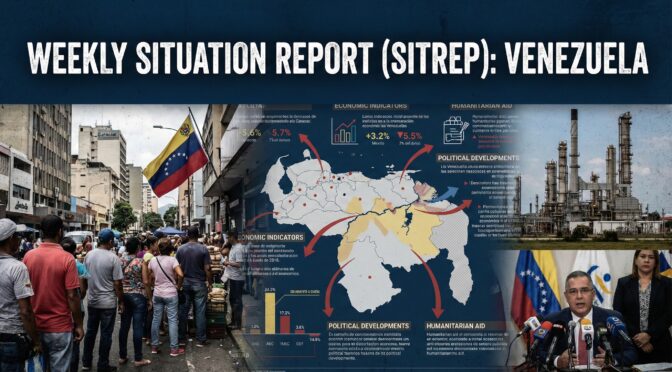
REPORTING PERIOD: JANUARY 17 – JANUARY 24, 2026
1. EXECUTIVE SUMMARY
Bottom Line Up Front (BLUF):
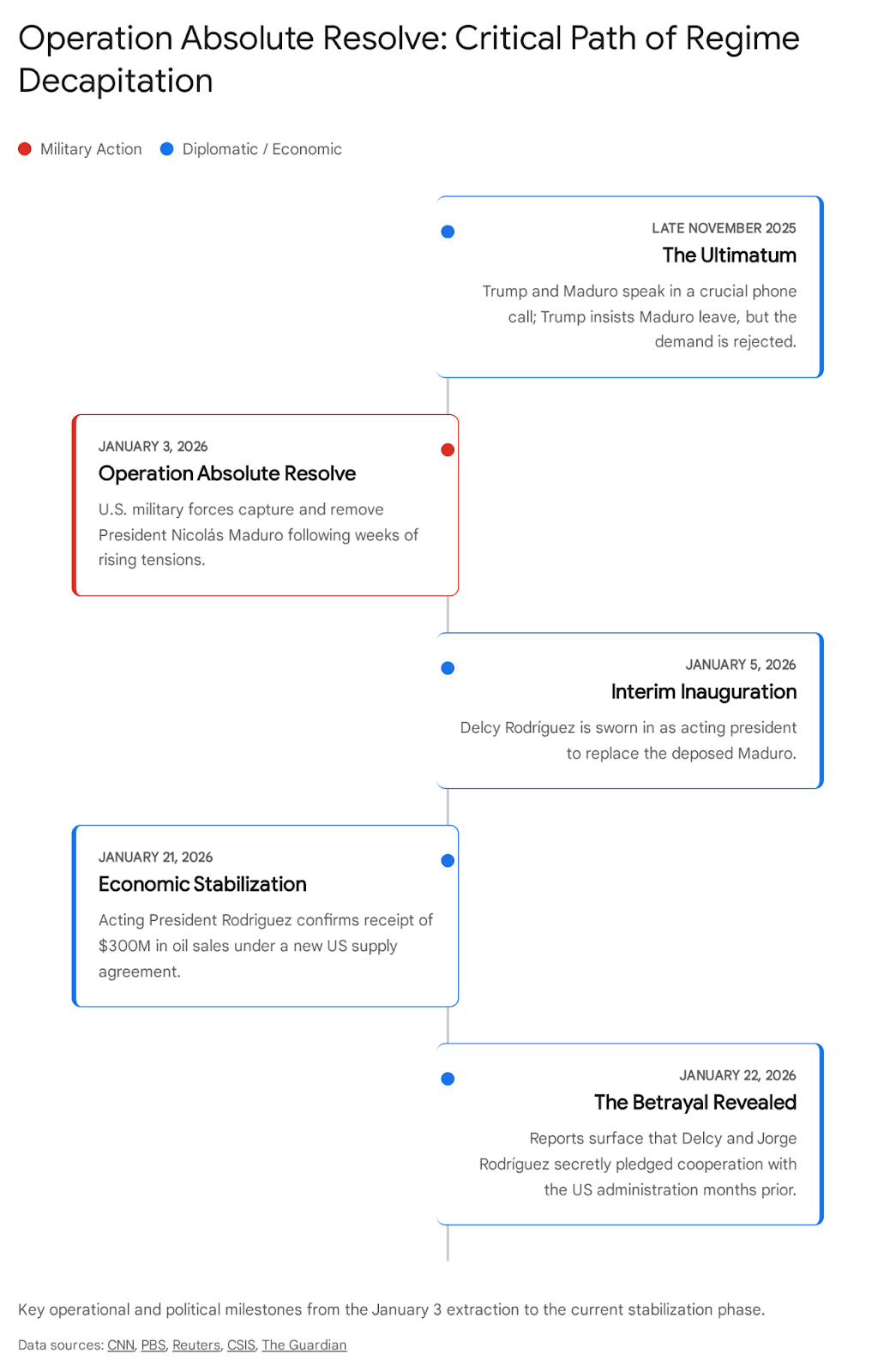
The operational week ending January 24, 2026, marks the crystallization of a new, albeit fragile, status quo in Venezuela following the January 3 United States military intervention (“Operation Absolute Resolve”) that resulted in the capture and extraction of former President Nicolás Maduro. Contrary to initial open-source forecasts of regime collapse or protracted civil war, the week has been defined by a “forced normality” orchestrated through a tacit, pragmatism-driven troika: the interim administration of Delcy Rodríguez, the United States executive branch, and major global energy stakeholders. This alignment has effectively sidelined the traditional opposition while securing critical energy flows to the United States.
The most significant intelligence development of the reporting period is the confirmation of high-level pre-operational collusion between the Rodríguez faction and U.S. interlocutors via Qatari intermediaries.1 This “palace coup by proxy” explains the rapidity of the stabilization measures observed this week, including the January 20 receipt of $300 million in oil revenue 2 and the systematic political marginalization of opposition leader María Corina Machado, despite her status as a Nobel Laureate.3 The operational environment has shifted from high-intensity kinetic risk to a phase of consolidated authoritarian stabilization, where the interim government leverages U.S. economic inducements to pacify the populace while maintaining a robust internal security apparatus.
Security indicators remain elevated but stable. The Bolivarian National Armed Forces (FANB) have largely adhered to the new interim command structure, prioritizing institutional preservation over ideological loyalty to the deposed Maduro. However, the internal security apparatus has pivoted to reliance on irregular paramilitary groups (colectivos) to enforce social order in urban centers 4, creating a high-friction environment for the civilian populace. Externally, the geopolitical shockwaves continue to fracture Latin American unity, with Colombia’s President Gustavo Petro escalating military readiness on the western border 5, while Brazil adopts a posture of diplomatic condemnation without escalation.7
Economically, the immediate infusion of liquidity and the promise of U.S.-sanctioned oil exports have triggered a speculative stabilization of the Bolivar and a cooling of hyperinflationary pressures.8 However, critical infrastructure remains degraded, with the cyber-kinetic effects of the January 3 operation leaving persistent vulnerabilities in the national power grid.9 This report provides an exhaustive analysis of these dynamics, assessing the durability of the Rodríguez-US pact, the strategic obsolescence of Russian and Chinese security guarantees, and the long-term implications for regional energy security.
2. OPERATIONAL INTELLIGENCE: THE POST-DECAPITATION SECURITY LANDSCAPE
2.1. Analysis of Operation Absolute Resolve and the Kinetic Aftermath
The strategic silence surrounding the tactical details of the January 3 operation has begun to lift, allowing for a comprehensive battle damage assessment (BDA) that has profound implications for future regional deterrence and military readiness. The operation, characterized by its brevity and precision, fundamentally altered the perception of U.S. power projection capabilities in the Southern Hemisphere, while simultaneously exposing the fragility of the “Fortress Venezuela” doctrine cultivated by the Maduro regime over the past decade.
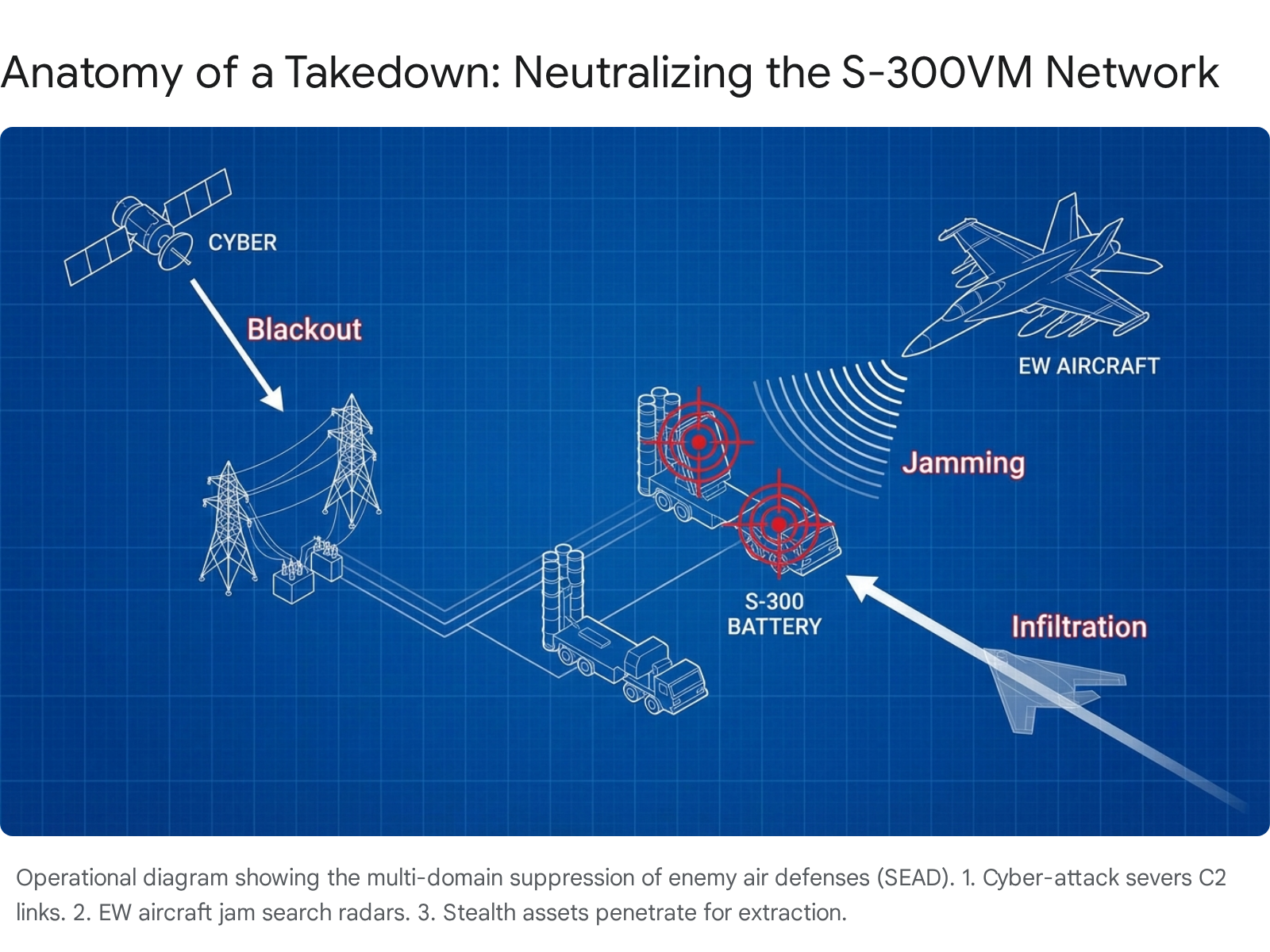
Cyber-Kinetic Convergence and the “Hybrid Decapitation” Intelligence analysis confirms that the operation was not a brute-force entry but a sophisticated “hybrid decapitation.” The widespread blackout reported in Caracas was not merely collateral damage but the result of a coordinated cyber-attack targeting the Industrial Control Systems (ICS) of the national grid, specifically designed to disable the Integrated Air Defense System (IADS) radar network.9 This effectively blinded the Venezuelan military’s Russian-made S-300VM and Buk-M2E batteries, which failed to engage incoming U.S. assets. The psychological impact of this technological overmatch on the FANB officer corps cannot be overstated; the failure of their “invincible” Russian hardware has precipitated a crisis of confidence in Moscow’s material support.11
The cyber-offensive targeted the digital brains responsible for regulating the Guri Dam’s turbines and routing power through the national transmission network. By manipulating these controllers, U.S. Cyber Command was able to create a “split reality” for the grid operators, masking the intrusion while simultaneously triggering protective relays that shut down the grid.9 This synchronized blackout served a dual purpose: it degraded the command-and-control capabilities of the Venezuelan security forces by severing fiber-optic links and forcing reliance on insecure radio channels, and it plunged the capital into darkness, providing cover for the insertion of special operations forces. The use of such advanced cyber weaponry, previously theorized but rarely seen in such a definitive application, signals a new chapter in hybrid warfare where critical infrastructure is a primary battlespace.9
Casualties and Force Protection Assessment The operation resulted in significant but highly localized casualties, reflecting a Rules of Engagement (ROE) protocol strictly tailored to minimize civilian harm and preserve the institutional structure of the FANB for post-Maduro stability. Confirmed figures indicate between 24 and 47 FANB personnel were killed during the raid.12 These casualties were largely concentrated among units directly tasked with presidential security, specifically the Presidential Guard and counter-intelligence elements. More notably, 32 Cuban security advisors and military personnel were killed.12 This disproportionately high casualty rate among Cuban personnel suggests they formed the inner ring of Maduro’s personal security detail, while regular FANB units largely stood down or were bypassed, a critical indicator of the pre-operational fracturing of loyalty within the regime’s security apparatus.
Civilian casualties were remarkably low, with only two confirmed deaths directly attributed to the kinetic phase of the operation.12 This low collateral damage has been pivotal for the interim administration of Delcy Rodríguez, allowing them to manage public outrage by framing the event as a violation of sovereignty rather than a massacre. However, U.S. forces did not escape unscathed; seven U.S. service members were injured, sustaining gunshot wounds and shrapnel injuries during the extraction phase.13 Five have returned to duty, while two remain in recovery, indicating intense close-quarters combat within the target compound despite the overwhelming air and cyber superiority.
Naval Posture and Caribbean Security The U.S. naval presence in the Caribbean remains elevated. The operation was supported by a significant naval deployment that had been building since September 2025 under the guise of counter-narcotics operations. Intelligence reports that in the months leading up to the raid, U.S. forces conducted 32 attacks on vessels in the Caribbean and Eastern Pacific, resulting in 115 extrajudicial executions of suspected traffickers.14 This “shaping of the battlefield” effectively cleared the maritime approaches to Venezuela and degraded the regime’s illicit revenue streams prior to the decapitation strike. The continued presence of these naval assets serves as a deterrent against any counter-moves by the Venezuelan Navy or its remaining allies, ensuring that the sea lines of communication remain open for the anticipated resumption of oil exports.
2.2. Internal Security: The “Forced Normality”
In the week ending January 24, the internal security dynamic has shifted from high-intensity alert to a repressive stabilization. The interim government of Delcy Rodríguez has deployed a strategy of “forced normality,” utilizing state media to project calm while unleashing irregular forces to suppress dissent. This strategy relies on a bifurcation of security responsibilities: the formal military (FANB) is tasked with securing strategic infrastructure and borders, while the “dirty work” of population control is outsourced to paramilitaries.
Paramilitary Hegemony and Urban Control With the FANB largely confined to barracks or strategic sites to prevent potential mutinies or uncoordinated actions, the colectivos (armed pro-government gangs) have assumed primary responsibility for street-level control in Caracas.4 Reports from the working-class neighborhoods of Catia and 23 de Enero indicate that these groups are operating with total impunity. They have established checkpoints, are conducting warrantless searches of mobile devices, and are detaining individuals suspected of celebrating Maduro’s capture or criticizing the interim administration.4 This reliance on paramilitaries serves a strategic function for the Rodríguez administration: it creates a layer of deniability for the formal government regarding human rights abuses, and it keeps the FANB leadership insulated from the daily friction of repression, preserving their dignity and theoretical loyalty to the constitution.16
The “External Commotion” Decree and Digital Persecution The legal framework for this repression is the “State of External Commotion” decree, implemented by Rodríguez immediately following the raid.15 This decree effectively suspends constitutional guarantees, legalizing the persecution of any manifestation of support for the U.S. operation. The repression has evolved into a sophisticated digital surveillance dragnet. The VenApp platform—originally designed for citizens to report failures in public services like water and electricity—has been repurposed as a tool for “Operation Tun Tun” (Knock Knock).15 The application now facilitates anonymous denunciations of “traitors,” allowing neighbors to report on each other for perceived disloyalty. This digital authoritarianism has created a climate of fear and silence in the streets, as citizens self-censor to avoid becoming targets of the colectivos or the intelligence services (SEBIN).15
2.3. Border Security Dynamics: The Western Front
Colombia: The western border remains the most volatile flashpoint in the region. Colombian President Gustavo Petro, positioning himself as the primary antagonist to the U.S. intervention, has deployed 30,000 troops to the border regions.17 While Bogotá frames this as a defensive measure to contain spillover violence and refugees, intelligence suggests it is also a political signal to Washington and his own domestic base. The deployment is concentrated in the Catatumbo region, an area already rife with conflict between the ELN (National Liberation Army) and splinter factions of the FARC.
Despite the bellicose rhetoric, the border crossings remain open, maintaining the critical “pendular” migration flows that sustain the border economies. Data indicates approximately 73,000 daily movements across the frontier, with a balanced flow of entries and exits.19 This suggests that neither side wishes to precipitate a humanitarian crisis that would destabilize the border regions. However, the presence of returning guerrilla leaders who had previously found safe haven in Venezuela adds a layer of complexity; fearing they could be bargaining chips in the Rodríguez-US rapprochement, many irregulars are retreating back into Colombian territory, potentially intensifying violence within Colombia itself.17
Guyana: Tensions on the eastern border regarding the Essequibo region have paradoxically de-escalated. The removal of Maduro has temporarily defanged the aggressive nationalist rhetoric that characterized late 2025. While the Guyana Defence Force (GDF) remains on high alert and has intensified monitoring 5, the immediate threat of Venezuelan military incursions has subsided as the Caracas establishment focuses on internal consolidation. Prime Minister Mark Phillips of Guyana has maintained a posture of vigilance but notes no unusual troop movements.5 The interim government in Caracas appears to have shelved the Essequibo annexation plans to focus on securing its own survival and normalizing relations with Western oil majors, notably ExxonMobil, which operates in the disputed waters.
3. POLITICAL INTELLIGENCE: THE TRANSITION THAT WASN’T
3.1. The Rodríguez-Washington Axis
The most critical insight of the reporting period is the stabilization of the “Rodríguez-Washington Axis.” The revelation that Delcy Rodríguez and her brother, National Assembly President Jorge Rodríguez, engaged in backchannel communications with U.S. officials via Qatar prior to the raid 1 fundamentally reframes the nature of the transition. This was not a hostile takeover but a negotiated decapitation.
The “Betrayal” Narrative and Strategic Calculus: This pre-arrangement suggests that the U.S. objective was not “regime change” in the traditional sense (i.e., dismantling Chavismo and installing a democratic government), but “leadership decapitation” to remove the specific toxic asset (Maduro) impeding energy flows and regional stability. Delcy Rodríguez’s subsequent assumption of the presidency, therefore, is not an act of defiance against the U.S. but the fulfillment of this secret pact. Her administration’s rhetoric—condemning the “kidnapping” while simultaneously accepting U.S. oil deals—is a sophisticated piece of political theater designed to appease the radical Chavista base while cooperating with U.S. strategic interests.1
The U.S. calculation appears to be that a disciplined, authoritarian Chavismo under Rodríguez is preferable to the unpredictable anarchy that might follow a total collapse of the state. Rodríguez offers institutional continuity, control over the security apparatus, and a willingness to pragmatically engage with U.S. energy demands—qualities that the fractured opposition could not guarantee.3 This “authoritarian stability” model mirrors past U.S. foreign policy approaches in other regions, prioritizing order and resource access over democratic ideals.
3.2. The Marginalization of the Opposition
The biggest loser in this geopolitical realignment is the traditional democratic opposition, specifically María Corina Machado (MCM). despite her overwhelming popularity, demonstrated by her 2024 election performance and her receipt of the 2025 Nobel Peace Prize 3, MCM has been effectively sidelined by the new power dynamics.
The Trump-MCM Disconnect: President Trump’s dismissal of MCM—stating she “lacked sufficient domestic support to stabilize the country” 3—signals a return to extreme transactionalism in U.S. foreign policy. The meeting between Trump and MCM on January 9 was largely ceremonial; her offer to share her Nobel Prize with him was a desperate, symbolic attempt to curry favor that ultimately failed to alter the administration’s realpolitik calculus.20 The U.S. administration views MCM’s radical democratic agenda, which includes dismantling the criminal structures of the state, as a potential liability that could trigger a civil war or loss of control over the oil fields. In contrast, Rodríguez offers a turnkey solution for stability and immediate production.
Opposition Paralysis: The opposition is currently fractured and directionless. Activists who spent years fighting for democracy now find themselves in a surreal scenario where the dictator is gone, but the dictatorship remains, seemingly with U.S. blessing.16 The release of a small number of high-profile political prisoners (approx. 154 out of 800+) 12 serves as a pressure release valve, allowing the regime to claim progress on human rights without dismantling the machinery of repression. The opposition’s “Triangular Exclusion” is evident: The U.S. provides legitimacy and markets; the Rodríguez regime provides oil and order; and Chevron provides the technical means. The democratic opposition is left outside this triangle, relegated to the role of observers in their own country’s fate.
3.3. Internal Regime Dynamics
The PSUV remains outwardly united, but fissures are likely developing beneath the surface. The ascension of the Rodríguez siblings creates a power imbalance with other key factions, such as the military wing led by Vladimir Padrino López or the hardline ideologues associated with Diosdado Cabello. While the immediate shock of the U.S. intervention has forced a “rally around the flag” effect, the distribution of the new oil revenues will be the critical test of regime cohesion. If the Rodríguez faction monopolizes the incoming U.S. dollars, it could trigger a counter-coup from excluded elements of the Chavista elite. For now, however, the survival instinct prevails, and the “forced normality” holds.
4. ECONOMIC INTELLIGENCE: THE OIL-STABILITY NEXUS
4.1. The Petroleum Pivot and Revenue Inflows
The economic rationale behind the U.S. intervention is now transparent and rapidly being operationalized. The swift announcement of a 50-million-barrel supply agreement 2 and the immediate receipt of $300 million by the Rodríguez administration on January 20 2 indicate that the mechanism for oil monetization was pre-planned. This infusion of cash is a lifeline for the regime, allowing it to pay key loyalists and stabilize the currency.
Chevron’s Strategic Role: Chevron remains the linchpin of this strategy. With approximately 3,000 personnel in country and current production at roughly 240,000 barrels per day (bpd) 21, Chevron is the only entity with the technical capacity to scale production in the near term. The U.S. plan relies on Chevron ramping up production to approximately 360,000 bpd within two years. While some optimistic forecasts suggest a return to 1.6 million bpd, industry experts caution that a full recovery to historical levels (3 million bpd) would require over $183 billion and a decade of sustained investment.21 Therefore, the U.S. interest is likely focused on securing a steady, moderate flow of heavy crude for Gulf Coast refineries to offset global supply volatility, rather than transforming Venezuela back into a global energy superpower immediately.
OPEC Implications: This bilateral U.S.-Venezuela arrangement poses a direct threat to OPEC’s market control. By effectively capturing a portion of Venezuelan output and removing it from OPEC quota discipline, the U.S. gains a new lever to influence global oil prices.22 This “energy dominance” strategy allows Washington to buffer against price shocks orchestrated by Saudi Arabia or Russia, using Venezuelan crude as a strategic reserve that is politically accessible.
4.2. Macroeconomic Stabilization and “Dollarization”
The “Interim” administration has leveraged the political shock to implement orthodox economic measures that would have been ideologically difficult for Maduro. The influx of U.S. dollars and the expectation of normalized trade have led to a rapid cooling of the parallel exchange rate and a speculative stabilization of the Bolivar.8
Table 1: Economic Indicators Snapshot (January 2026)
| Indicator | Status | Trend | Drivers |
| Inflation | Decelerating | Positive | Exchange rate stability; dollar liquidity injection. |
| Exchange Rate | Stabilizing | Positive | Perception of U.S. backing; $300M revenue inflow. |
| Oil Revenue | Increasing | Positive | 50M barrel U.S. deal; resumption of formal exports. |
| Purchasing Power | Stagnant | Negative | Wages remain low ($0.37/mo min wage); prices dollarized. |
| Fiscal Deficit | Narrowing | Positive | Increased oil tax revenue; reduced social spending. |
Data Sources: 2
The Fedecamaras business association has publicly welcomed these measures, noting that the fresh flow of hard currency is essential for imports.2 However, this stabilization comes at a social cost. The economy is now effectively dualized: a dollarized private sector for those with access to foreign currency, and a destitute public sector reliant on worthless Bolivars. While inflation—which hit 172% in April 2025 23—is projected to decelerate, the structural poverty affecting over 90% of the population 24 remains unaddressed by these macro-level fixes.
4.3. Infrastructure: The Critical Vulnerability
Despite the macroeconomic optimism, the physical reality of Venezuela remains dire. The cyber-attacks on January 3 exacerbated an already fragile power grid. While power has been largely restored, the underlying damage to the Guri Dam’s control systems and the national transmission network creates a high risk of recurring blackouts.25 The lack of spare parts, the flight of skilled engineers, and the corruption within the electricity sector mean that the grid is operating on a razor’s edge. The U.S. administration has signaled intent to assist in rebuilding this infrastructure, but this is a long-term project that requires billions in capital—money that the current $300 million tranche cannot cover. Without reliable power, the projected increases in oil production will be physically impossible to sustain.
5. GEOPOLITICAL INTELLIGENCE: THE COLLAPSE OF THE MULTI-POLAR ILLUSION
5.1. The Russian Paper Tiger
The most damaging outcome for global anti-Western alliances is the exposure of Russia as a “fair-weather friend.” The complete failure of Russian air defense systems to protect Maduro, coupled with Moscow’s tepid diplomatic response, has shattered the perception of Russia as a security guarantor in the Western Hemisphere.11
Strategic Decoupling: Intelligence indicates that the Kremlin has deprioritized Venezuela to focus resources on the war in Ukraine. The loss of Venezuela as a strategic outpost for docking warships and projecting power is a significant blow to Russian global reach.11 Moscow’s narrative has shifted to “condemning violations of international law” rather than threatening counter-escalation, a clear sign of weakness that is being closely watched by other Russian client states like Cuba, Nicaragua, and Syria.27 The inability of the S-300VM systems to detect or engage U.S. aircraft has also inflicted severe reputational damage on the Russian arms industry, likely leading to order cancellations from other clients who rely on these systems for their own defense.
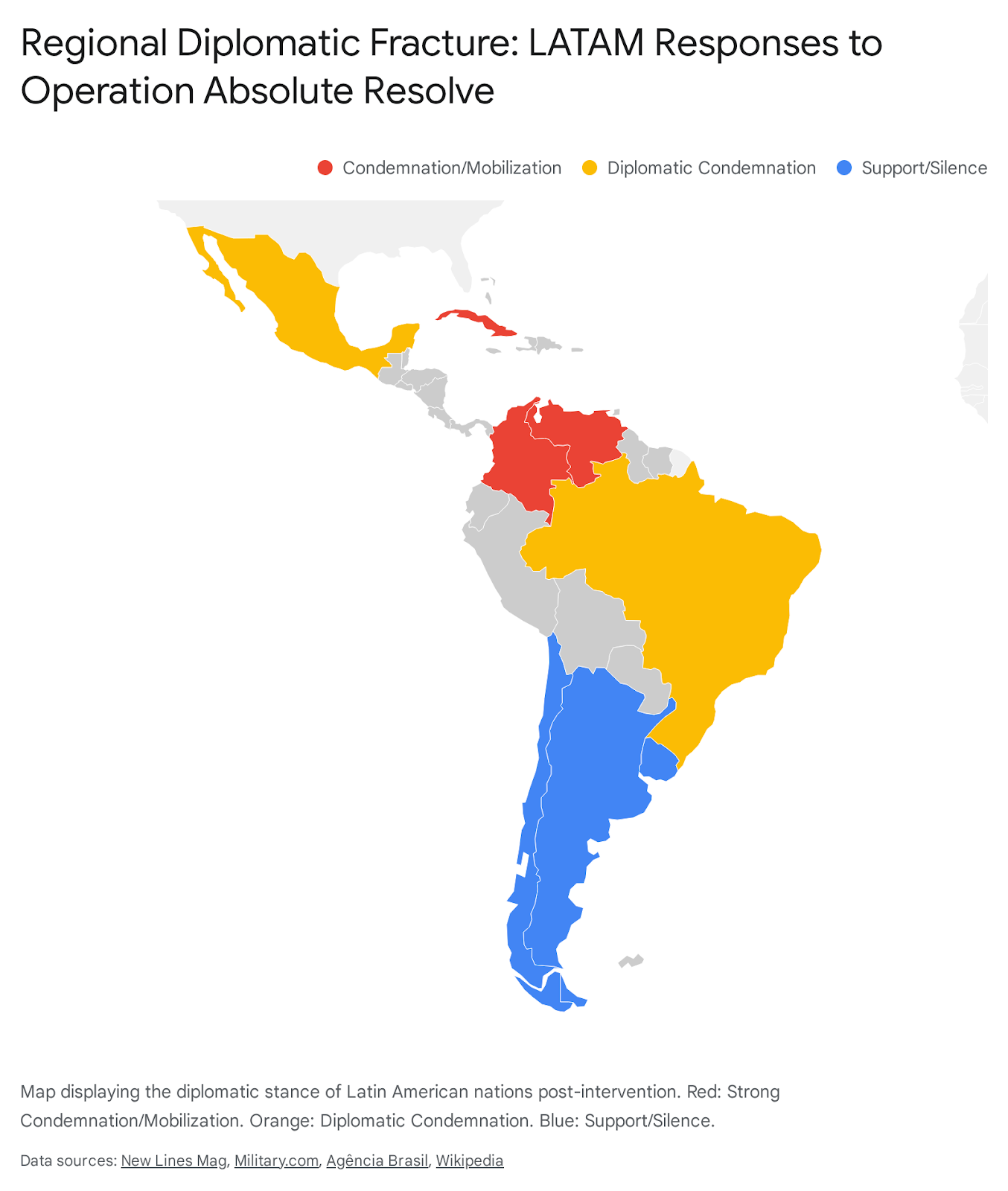
5.2. The Latin American Fracture
The intervention has driven a wedge through the Latin American left, fracturing the “Pink Tide” 2.0. The region is no longer united by ideology but divided by national interest and proximity to the crisis.
The Pragmatists vs. The Ideologues:
- Brazil (The Pragmatist): President Lula’s response has been carefully calibrated. While he condemned the “unacceptable” violation of sovereignty and the “dangerous precedent” set by the U.S. action 7, he has not severed ties with the U.S. or mobilized troops. His focus is on maintaining Brazil’s status as a regional leader and avoiding direct confrontation with Washington while placating his domestic base with strong rhetoric.
- Colombia (The Ideologue): President Petro has taken the most aggressive stance, comparing the U.S. action to Nazi bombing campaigns (Guernica) and mobilizing troops to the border.28 This visceral reaction is driven by domestic political necessity—appeasing his leftist base—and genuine fear that he could be next on the U.S. “regime change” list. His administration sees the normalization of military interventionism as an existential threat to his own governance project.
- The Center-Right: Leaders in Argentina, Uruguay, and elsewhere have largely remained silent or offered tacit support, viewing the removal of Maduro as a net positive for regional stability, regardless of the method.29 This silence effectively isolates Petro and prevents a unified regional bloc from opposing the U.S. strategy.
5.3. China’s Strategic Patience
China’s reaction has been notably muted compared to Russia. While Beijing has used evasion methods to import sanctioned Venezuelan oil 30, its diplomatic response has been confined to standard calls for respecting sovereignty. China appears to be adopting a “wait and see” approach, prioritizing the security of its loans and investments over the political survival of Maduro. The fact that Chinese radar systems also failed to provide effective detection during the raid 30 has likely embarrassed Beijing, but their long-term interest remains securing resource access. If the Rodríguez administration guarantees oil shipments to repay debts, China is unlikely to challenge the new status quo aggressively.
6. HUMANITARIAN INTELLIGENCE AND SOCIAL DYNAMICS
6.1. Migration Trends: The “Re-Regionalization”
Contrary to initial fears of a mass exodus towards the U.S. southern border, the migration picture remains static but complex. The “wait and see” attitude prevails among the populace, who are assessing the stability of the new interim government. The closure of the U.S. border to asylum seekers and the Trump administration’s strict deportation policies serve as strong deterrents.31
However, the “re-regionalization” of migration continues. Flows are redirecting South toward Brazil and Colombia rather than North. The northbound movement has dropped by 93% in U.S. border encounters, while southbound movements within South America have increased.31 This shift places a sustained burden on regional host countries, particularly Colombia, which already hosts 2.8 million Venezuelans.32 The perception of stability in Venezuela, driven by the dollarization and “forced normality,” may encourage some reverse migration, but the lack of public services and civil liberties remains a powerful push factor.
6.2. Human Rights and Political Prisoners
The release of 154 political prisoners, including high-profile journalists like Roland Carreño and Biagio Pillieri 33, is a welcome development but represents less than 20% of the estimated 780+ arbitrary detainees held by the regime. This move is assessed as a transactional gesture by the Rodríguez administration to buy international goodwill and secure oil sanctions relief, rather than a genuine commitment to justice.
Simultaneously, the regime continues its “Revolving Door” policy—releasing some high-profile figures to generate positive headlines while arresting others via the VenApp dragnet.15 The detention of teenagers for “celebrating” the intervention and the continued imprisonment of activists indicate that the apparatus of repression remains fully operational. NGOs like Foro Penal continue to document these abuses, but their operational space is shrinking under the “External Commotion” decree.
7. STRATEGIC OUTLOOK: SCENARIOS FOR Q1 2026
Scenario A: The “Authoritarian Stability” (Most Likely – 60%)
The Rodríguez-US pact holds. Oil revenues increase, stabilizing the economy and allowing the regime to buy loyalty from the military and key constituencies. The opposition, starved of resources and international backing, withers into irrelevance. The international community, prioritizing energy security and stability, accepts the fait accompli. Venezuela becomes a reliable energy supplier to the U.S. but remains an autocracy.
- Indicators: Continued monthly oil payments, decline in protests, normalization of relations with EU/Brazil, marginalization of MCM.
Scenario B: The “Palace Fracture” (Moderate Probability – 25%)
Hardline Chavista elements (Diosdado Cabello faction) or mid-ranking military officers, feeling betrayed by the Rodríguez clique’s deal with the “Empire” and exclusion from the new revenue streams, launch a counter-coup. This leads to internal conflict, potentially escalating into a civil war between rival military factions and paramilitary groups.
- Indicators: Assassination attempts on Rodríguez, military mutinies, breakdown of the colectivo command structure, sudden halt in oil exports.
Scenario C: The “Democratic Breakthrough” (Low Probability – 15%)
Economic stabilization fails to trickle down to the masses, sparking massive spontaneous protests that the opposition (MCM) manages to harness. The U.S., facing bad PR and domestic pressure from the Venezuelan diaspora, is forced to pivot back to supporting a democratic transition.
- Indicators: Hyperinflation returns, massive street mobilization despite repression, U.S. Congress blocks oil deals, high-level defections from the Rodríguez administration.
8. DEEP DIVE: THE INTELLIGENCE FAILURE OF THE RUSSIAN IADS
The ease with which U.S. forces penetrated Venezuelan airspace has triggered a global reassessment of Russian anti-access/area denial (A2/AD) capabilities. Venezuela possessed the densest air defense network in the Western Hemisphere, anchored by the S-300VM (Antey-2500) and Buk-M2E systems. The failure of these systems to down a single U.S. aircraft is a catastrophic intelligence and technical failure for Moscow.
Technical Analysis of the Failure:
- Electronic Warfare (EW) Dominance: The U.S. employed advanced EW suites that effectively jammed the engagement radars of the S-300s, rendering them unable to lock onto targets.11 This highlights a critical vulnerability in Russian radar technology against modern Western countermeasures.
- Cyber-Infiltration: The cyber-attack on the power grid likely severed the fiber-optic data links between command posts and radar batteries. Without these links, the IADS could not form a coherent picture of the airspace, forcing individual batteries into autonomous mode, where they are significantly less effective and more vulnerable to anti-radiation missiles.9
- Operator Incompetence/Complicity: There is a strong possibility that FANB operators, demoralized by the suddenness of the attack or perhaps instructed by compromised leadership to stand down, simply chose not to engage. The lack of any missile launches suggests a “soft kill” of the system rather than kinetic destruction of all launchers.
This failure has immediate commercial implications for Russia’s arms industry, which will likely see cancellations of orders from other clients (e.g., India, Algeria) who now doubt the system’s efficacy against Western air power. It reinforces the U.S. narrative of technological supremacy and degrades the deterrence value of Russian weaponry globally.
ANALYST NOTE:
The rapid normalization of the post-Maduro order suggests that the international community is fatigued by the Venezuelan crisis. The “Venezuelan Fatigue” has allowed realpolitik to triumph over democratic principles. The coming weeks will determine if this stability is a lasting equilibrium or a temporary pause before the next eruption of violence. Watch the Colombian border and the internal cohesion of the FANB as the primary indicators of risk.
END OF REPORT
If you find this post useful, please share the link on Facebook, with your friends, etc. Your support is much appreciated and if you have any feedback, please email me at in**@*********ps.com. Please note that for links to other websites, we are only paid if there is an affiliate program such as Avantlink, Impact, Amazon and eBay and only if you purchase something. If you’d like to directly contribute towards our continued reporting, please visit our funding page.
Sources Used
- Venezuela’s Delcy Rodríguez assured US of cooperation before Maduro’s capture, accessed January 24, 2026, https://www.theguardian.com/world/2026/jan/22/delcy-rodriguez-capture-maduro-venezuela
- Venezuela private sector says fresh flow of dollars could stabilize exchange market, prices, accessed January 24, 2026, https://www.investing.com/news/economic-indicators/venezuela-private-sector-says-fresh-flow-of-dollars-could-stabilize-exchange-market-prices-4457895
- The US attack on Venezuela and the collapse of international law …, accessed January 24, 2026, https://www.aljazeera.com/opinions/2026/1/21/the-us-attack-on-venezuela-and-the-collapse-of-international-law
- Armed militias deployed in Venezuela as regime attempts to impose authority – The Guardian, accessed January 24, 2026, https://www.theguardian.com/world/2026/jan/07/caracas-venezuela-paramilitary-groups
- PM Phillips says Guyana remains vigilant, secure following developments in Venezuela, accessed January 24, 2026, https://dpi.gov.gy/pm-phillips-says-guyana-remains-vigilant-secure-following-developments-in-venezuela/
- Colombia calls for emergency UN, OAS meetings after US air strikes in Venezuela, accessed January 24, 2026, https://colombiareports.com/colombia-calls-for-emergency-un-oas-meetings-after-air-strikes-in-venezuela/
- Lula condemns attacks on Venezuela, Brazilian diplomats discuss crisis, accessed January 24, 2026, https://agenciabrasil.ebc.com.br/en/internacional/noticia/2026-01/lula-condemns-attacks-venezuela-brazilian-diplomats-discuss-crisis
- US military intervention boosts Venezuela’s economic forecasts | Economy and Business, accessed January 24, 2026, https://english.elpais.com/economy-and-business/2026-01-22/us-military-intervention-boosts-venezuelas-economic-forecasts.html
- Digital Sabotage: Turning Infrastructure into Weapons, accessed January 24, 2026, https://www.miragenews.com/digital-sabotage-turning-infrastructure-into-1606248/
- New Reports Reinforce Cyberattack’s Role in Maduro Capture Blackout – SecurityWeek, accessed January 24, 2026, https://www.securityweek.com/new-reports-reinforce-cyberattacks-role-in-maduro-capture-blackout/
- The Geopolitics of Maduro’s Capture: What Does Operation … – CSIS, accessed January 24, 2026, https://www.csis.org/analysis/geopolitics-maduros-capture-what-does-operation-absolute-resolve-mean-russia
- 2026 United States intervention in Venezuela – Wikipedia, accessed January 24, 2026, https://en.wikipedia.org/wiki/2026_United_States_intervention_in_Venezuela
- At least 24 Venezuelan security officers killed in Maduro capture, its military says – AP News, accessed January 24, 2026, https://apnews.com/live/us-venezuela-trump-maduro-updates-01-06-2026
- Joint statement – situation in Venezuela – WOLA, accessed January 24, 2026, https://www.wola.org/2026/01/joint-statement-situation-in-venezuela/
- Forbidden to Celebrate: Silence in the Streets of Venezuela, accessed January 24, 2026, https://havanatimes.org/features/forbidden-to-celebrate-silence-in-the-streets-of-venezuela/
- Dictator ousted but regime intact – what next for Venezuela’s opposition?, accessed January 24, 2026, https://www.theguardian.com/world/2026/jan/18/venezuela-opposition-what-next
- What next for the humanitarian crisis and response in Venezuela?, accessed January 24, 2026, https://www.thenewhumanitarian.org/analysis/2026/01/14/humanitarian-crisis-response-venezuela-analysis-post-maduro
- Colombia sends 30,000 troops to Venezuela border following US strikes | The National, accessed January 24, 2026, https://www.thenationalnews.com/news/us/2026/01/05/cuba-colombia-us-intervention/
- Colombia Reports Normal Border Operations With Venezuela – Latina Republic, accessed January 24, 2026, https://latinarepublic.com/2026/01/05/colombia-reports-normal-operations-at-border-crossings-with-venezuela/
- Nobel Institute rejects María Corina Machado’s offer to share peace prize with Trump, accessed January 24, 2026, https://www.theguardian.com/world/2026/jan/11/nobel-institute-rejects-maria-corina-machados-offer-to-share-peace-prize-with-trump
- US Oil Companies in Venezuela – January 2026 – Lodi 411, accessed January 24, 2026, https://lodi411.com/lodi-eye/us-oil-companies-in-venezuela-january-2026
- A US Capture of Venezuelan Oil Could Come at OPEC’s Expense, accessed January 24, 2026, https://arabcenterdc.org/resource/a-us-capture-of-venezuelan-oil-could-come-at-opecs-expense/
- Venezuela Inflation Rate – Trading Economics, accessed January 24, 2026, https://tradingeconomics.com/venezuela/inflation-cpi
- What’s Happening With the U.S. and Venezuela, Explained | TIME, accessed January 24, 2026, https://time.com/7344628/us-venezuela-trump-maduro-oil-drugs-war-explainer-questions-answered/
- Venezuela Restores Power After Outage, Government Points to Sabotage – Orinoco Tribune, accessed January 24, 2026, https://orinocotribune.com/venezuela-restores-power-after-outage-government-points-to-sabotage/
- 2024 Venezuelan blackouts – Wikipedia, accessed January 24, 2026, https://en.wikipedia.org/wiki/2024_Venezuelan_blackouts
- Russia tries to revive its relevance with support for Iran after failure to fight US moves in Venezuela, accessed January 24, 2026, https://www.washingtonexaminer.com/news/world/4421841/russia-revive-relevance-support-for-iran-after-failure-fight-us-moves-venezuela/
- President Petro’s Clash With Trump Over Venezuela Backs Colombia Into a Corner, accessed January 24, 2026, https://www.military.com/daily-news/2026/01/07/president-petros-clash-trump-over-venezuela-backs-colombia-corner.html
- Latin America’s Mixed Reactions to Trump’s Venezuela Intervention – New Lines Magazine, accessed January 24, 2026, https://newlinesmag.com/argument/latin-americas-mixed-reactions-to-trumps-venezuela-intervention/
- China-Venezuela Fact Sheet: A Short Primer on the Relationship, accessed January 24, 2026, https://www.uscc.gov/research/china-venezuela-fact-sheet-short-primer-relationship
- Venezuela (RMRP) – Humanitarian Action, accessed January 24, 2026, https://humanitarianaction.info/plan/1525/article/venezuela-rmrp-3
- Venezuela crisis: Facts, FAQs, and how to help | World Vision, accessed January 24, 2026, https://www.worldvision.org/disaster-relief-news-stories/venezuela-crisis-facts
- VENEZUELA: All Arbitrary Detainees Must Be Released, accessed January 24, 2026, https://www.amnesty.org/en/documents/amr53/0635/2026/en/