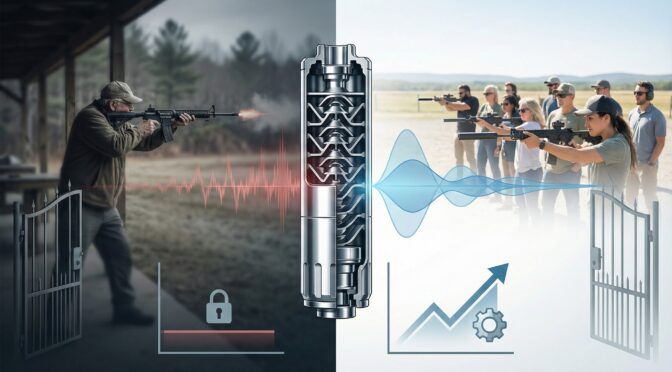
The firearm sound suppression market has undergone a paradigm shift of historic proportions, necessitating a complete re-evaluation of consumer acquisition strategies, engineering priorities, and regulatory compliance protocols. With the enactment of the “One Big Beautiful Bill” (OBBB), effective January 1, 2026, the regulatory landscape governing the National Firearms Act (NFA) has been fundamentally altered.1 The elimination of the $200 transfer tax for suppressors, Short-Barreled Rifles (SBRs), and Short-Barreled Shotguns (SBSs) has removed a significant financial barrier to entry that had stood since the NFA’s inception in 1934.2
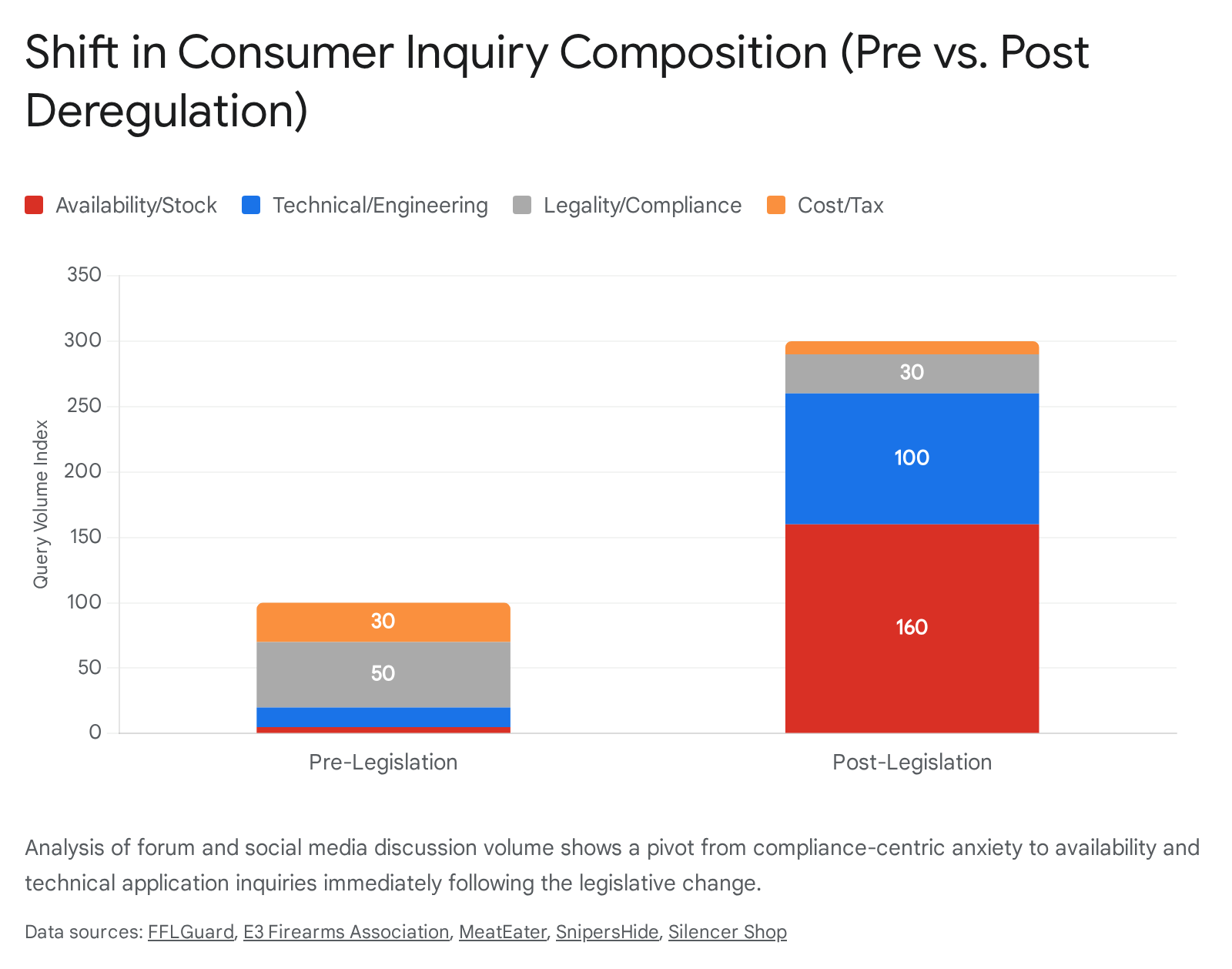
This legislative change has triggered an unprecedented surge in demand, shifting suppressors from a niche enthusiast accessory to a standard component of modern firearm ownership. However, the removal of the tax stamp cost has introduced new complexities regarding supply chain elasticity, regulatory processing bandwidth, and consumer education gaps. The market is currently experiencing a “knowledge vacuum” where new entrants, emboldened by the cost reduction, are entering the sector without the institutional knowledge typically held by NFA enthusiasts.
This report, compiled from the perspective of a small arms industry analyst and mechanical engineer, provides an exhaustive technical and market analysis of the suppressor sector in this new era. By leveraging advanced social media sentiment analysis and data scraping from primary enthusiast hubs—specifically the r/NFA community, Sniper’s Hide forums, and industry-specific discussion boards—we have isolated the ten most critical inquiries posed by new market entrants. The analysis utilizes a frequency-weighted ranking methodology to prioritize these inquiries based on their prevalence and potential impact on user safety and satisfaction.
The following analysis does not merely answer these questions; it dissects them through the lenses of fluid dynamics, materials science, acoustic engineering, and regulatory compliance. It serves as a definitive operational manual for the consumer navigating the post-2026 NFA environment, moving beyond superficial advice to provide actionable, data-driven intelligence.
Question 1: The Acquisition Protocol in the Zero-Tax Era
The Inquiry
“How do I buy a suppressor now that the tax is gone? What is the step-by-step process?”
This is, unequivocally, the most frequent inquiry identified in the 2026 dataset. The removal of the $200 tax stamp has created substantial confusion regarding the remaining regulatory requirements. A significant portion of the consumer base mistakenly equates “zero tax” with “zero paperwork” or “Cash and Carry” transactions similar to Title I firearms (standard rifles and pistols). This assumption is legally perilous. The NFA registry remains active, and the Bureau of Alcohol, Tobacco, Firearms and Explosives (ATF) still requires rigorous registration and background checks.2 The process has not been deregulated; it has been subsidized.
The Analyst’s Response: Regulatory Workflow Analysis
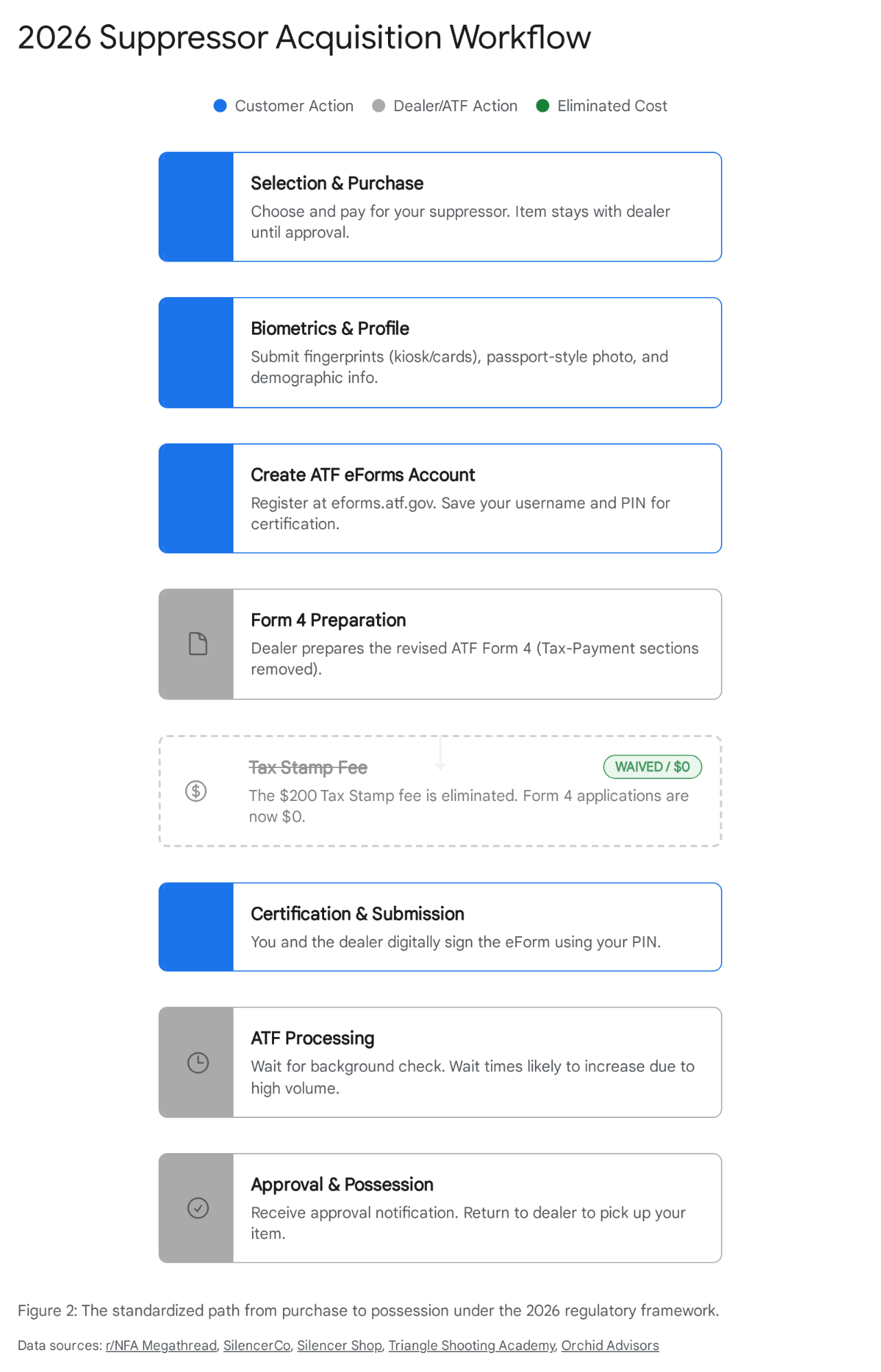
Despite the elimination of the monetary levy, the process of acquiring a suppressor remains a strict federal procedure governed by the National Firearms Act. The primary change is financial, not procedural. The workflow for 2026 is defined by a critical path that involves interaction between the consumer, the Federal Firearms Licensee (FFL), and the ATF’s eForms infrastructure.
1.1 Procurement and Serialization
The acquisition process begins with the selection and purchase of the silencer from an FFL holding a Special Occupational Taxpayer (SOT) status.5 This distinction is vital: not all gun stores can sell suppressors. Only those with the SOT designation are authorized to deal in NFA items.
Unlike standard Title I firearms, which can be transferred immediately upon a successful NICS background check, NFA items must be “assigned” to the purchaser while they remain in the dealer’s physical custody. The dealer allocates a specific serial number to the customer’s profile. This serial number serves as the primary key for all subsequent federal forms and tracking.6 At this stage, the consumer has paid for the hardware but has no legal right to possess it.
1.2 The ATF eForm 4 Submission
The paper Form 4 has been largely superseded by the ATF eForms system, which is now the industry standard for efficiency.
- The Form: The document submitted is the ATF Form 4 (Application for Tax Paid Transfer and Registration of Firearm). Although the tax is now $0, the form title in many legacy systems retains the nomenclature, or is transitioning to a revised “Tax Exempt” version.4 The form collects comprehensive data on the transferee (buyer), the transferor (dealer), and the firearm (suppressor) itself.
- The “Tax Stamp”: Historically, the applicant purchased a $200 stamp which was physically affixed to the approved form. Post-2026, the approval document still bears a digital validation mark or “stamp,” but the cost field is zeroed out.8 This “stamp” is the legal proof of registration.
- Submission Vector: The dealer prepares the form on the eForms portal. The customer must be physically present or logged in remotely to certify the submission digitally using their unique ATF username and PIN.9 This digital signature carries the same legal weight as a wet signature on a federal affidavit.
1.3 Biometric Data Integration
Identity verification remains stringent. The OBBB did not repeal the background check requirements; in fact, the biometric requirements remain the primary bottleneck in the system.
- Fingerprints: Digital fingerprinting (via EFT files) has become the gold standard, replacing the legacy FBI FD-258 ink-and-roll cards. Kiosks at major retailers like Silencer Shop or Silencer Central allow users to scan prints once and store them for lifetime use.10 These digital files are uploaded directly to the eForms system, reducing mail transit times and rejection rates due to smudging.
- Photographs: A passport-style photograph must be attached to the eForm. This must adhere to strict Department of State guidelines (neutral background, no headgear, specific dimensions).5 The integration of smartphone apps to capture and format these photos has streamlined this step, but rejection for poor lighting remains a common failure point.
1.4 The Wait Time Dynamics and Infrastructure Strain
A critical insight for the 2026 market is the inverse relationship between cost and wait time. With the $200 barrier removed, application volume has spiked. While the eForms system was achieving 2-day approvals in early 2025 12, the massive influx of “free stamp” applications in 2026 is expected to strain ATF processing capacity.
Analyst projections suggest that wait times will likely oscillate significantly. The ATF’s capacity to process background checks is dependent on FBI NICS throughput. When submission volumes exceed processing bandwidth, queues form. Users should anticipate wait times extending back to the 6-12 month range initially before infrastructure scales to meet the new demand curve.1 The “free” stamp is paid for with the currency of time.
1.5 Chief Law Enforcement Officer (CLEO) Notification
The requirement to notify the local Chief Law Enforcement Officer (CLEO) remains in effect. Upon submission of the eForm 4, the applicant or their dealer must mail a copy of the form to their local sheriff or police chief.5 This is a notification requirement, not a permission requirement. The CLEO does not need to sign off on the transfer (a requirement that was removed in previous rule changes), but they must be informed of the pending registration.
Question 2: The “Universal Soldier” Dilemma (Multi-Caliber Utility)
The Inquiry
“Can I buy a.30 caliber suppressor and use it on my 5.56 AR-15? Will it be loud?”
This question stems from a desire for economic efficiency—buying one expensive item to serve multiple hosts. Consumers often fear that “over-boring” (using a larger aperture suppressor on a smaller projectile) will result in unacceptable noise leakage and reduced performance. It reflects a misunderstanding of the physics of sound suppression versus the physics of gas dynamics.
The Analyst’s Response: Bore Aperture Physics and Utility
The short answer is yes, and for the vast majority of users, particularly first-time buyers, it is the recommended strategy. The efficiency loss is measurable in a laboratory setting but often perceptually negligible in the field.13
2.1 The Physics of Over-Boring
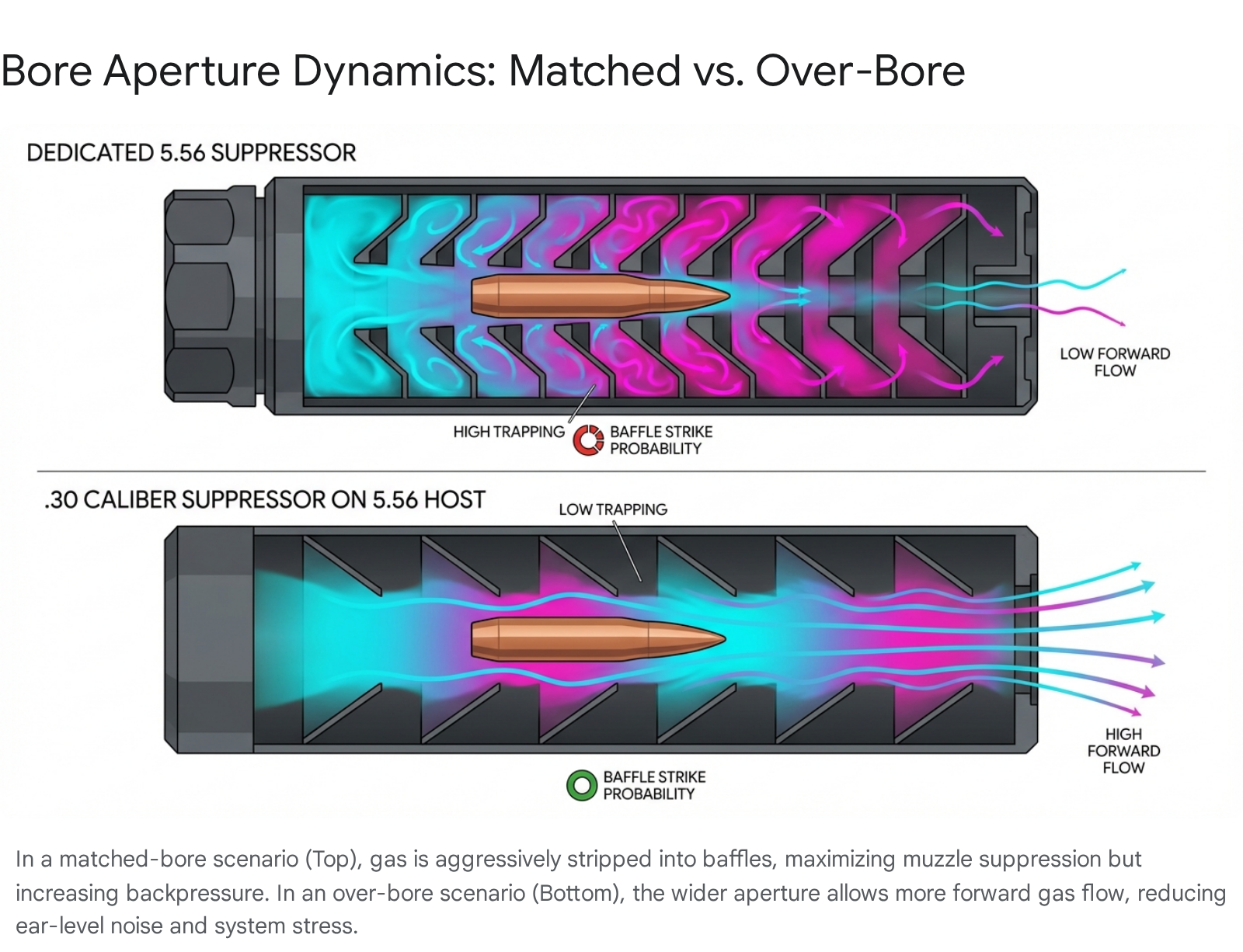
A suppressor functions by trapping expanding gases and converting their kinetic energy into thermal energy. The “bore aperture” is the hole through the center of the baffles. Ideally, this hole is as tight to the bullet diameter as possible to prevent gas blow-by, where high-pressure gas races ahead of the bullet and exits the suppressor uncorked.
- The Gap Geometry: A standard.30 caliber suppressor typically has a bore aperture of approximately 0.340 to 0.360 inches to accommodate a.308 projectile safely. A 5.56mm (.223 caliber) projectile is 0.224 inches in diameter. This leaves a radial gap of roughly 0.058 to 0.068 inches.
- The Consequence: This annular gap allows more gas to escape the front of the suppressor before it can be fully stripped by the baffles. In theory, this reduces the suppression efficiency.
2.2 Decibel Reduction Analysis
Empirical testing and community data reveal that the difference in sound reduction between a dedicated 5.56 suppressor and a quality.30 caliber suppressor on a 5.56 host is typically 1 to 3 decibels (dB) at the muzzle.13
- Perception Thresholds: The human ear generally struggles to distinguish sound pressure level differences of less than 3 dB in a single impulse event like a gunshot. The logarithmic nature of the decibel scale means that while 3 dB represents a doubling of sound intensity, the perceived loudness does not double.
- Tone vs. Volume: While the peak dB might be slightly higher with an over-bored can, the tone (frequency response) often compensates. Larger volume.30 caliber suppressors often produce a deeper, lower-frequency “thud” rather than the sharp, high-pitched “crack” of smaller, tighter 5.56 cans. This lower frequency is often perceived by the shooter as being more pleasant and less harsh, even if the meter reads slightly higher.15
2.3 The Backpressure Advantage
An often-overlooked engineering benefit of using a.30 caliber suppressor on a 5.56 rifle is reduced backpressure. The larger bore aperture functions as a relief valve, allowing gas to flow forward more easily rather than being forced back down the barrel and into the receiver.
- Reliability: High backpressure increases bolt carrier velocity, which can lead to malfunctions (failure to extract, double feeds) and increased wear on internal components.
- Gas Face: “Gas face” describes the phenomenon where toxic gas is vented out of the ejection port and charging handle into the shooter’s eyes and lungs. A.30 caliber can on a 5.56 host significantly mitigates this issue compared to a tight-bore dedicated 5.56 suppressor.16
| Metric | Dedicated 5.56 Suppressor | .30 Cal Suppressor on 5.56 Host | Advantage Analysis |
| Sound Reduction | Optimal (Benchmark) | -1 to -3 dB loss | Dedicated 5.56 (Marginal) |
| Backpressure | High | Moderate/Low | .30 Caliber (Significant) |
| Flash Reduction | Excellent | Good | Dedicated 5.56 |
| Versatility | Single Caliber | Multi-Caliber (.308, 300BLK, 6.5CM) | .30 Caliber (Major) |
| Weight | Lighter (typically) | Heavier (larger tube/baffles) | Dedicated 5.56 |
| Internal Volume | Smaller | Larger | .30 Caliber (Helps tone) |
Table 1: Comparative analysis of dedicated vs. over-bored suppressor performance metrics.
Question 3: The Interface War (Direct Thread vs. QD)
The Inquiry
“Should I get a Direct Thread (DT) suppressor or a Quick Detach (QD) mount? Which is more accurate?”
Novice users are often torn between the simplicity of screwing the suppressor onto the barrel and the tactical allure of “Quick Detach” systems. This question touches on the fundamental mechanics of firearm harmonics and repeatability.
The Analyst’s Response: Mechanical Harmonics and Utility
The industry is currently trending toward a hybrid “Taper Mount” standard, but the dichotomy between pure Direct Thread and proprietary QD systems remains a critical decision point for the consumer.
3.1 Direct Thread (DT)
- Mechanism: The suppressor threads directly onto the barrel’s existing muzzle threads (e.g., 1/2×28 TPI or 5/8×24 TPI).
- Accuracy: Direct Thread is widely considered the most accurate mounting method for precision applications.17 By eliminating intermediate adapters, it reduces “tolerance stacking”—the accumulation of minute manufacturing errors that can lead to misalignment.
- The Risk: The primary downside is backing off. Thermal cycling (heating and cooling) combined with the vibration of firing can cause the suppressor to loosen. If it loosens significantly, the bullet path may become misaligned with the baffles, resulting in a “baffle strike” that destroys the suppressor. Users must periodically check tightness or use high-temperature thread lockers like Rocksett.18
3.2 Quick Detach (QD)
- Mechanism: A proprietary muzzle device (muzzle brake or flash hider) is permanently installed on the barrel. The suppressor latches onto this device using a ratchet, locking collar, or spring-loaded gate mechanism.
- Utility: QD allows for rapid switching of the suppressor between multiple host firearms. Furthermore, the muzzle device protects the barrel threads from damage.
- Erosion Protection: A QD muzzle brake acts as a “sacrificial baffle.” The initial blast of superheated gas and unburnt powder impacts the steel of the brake rather than the first baffle of the suppressor (the blast baffle). This significantly extends the life of the suppressor, particularly on short-barreled rifles.19
- Weight & Length: QD systems invariably add weight (muzzle device + adapter module) and length to the total system.19
3.3 The Synthesis: Taper Mounts and HUB Compatibility
Modern engineering has largely solved the “DT walking” issue with taper mounts (e.g., Q Plan B, Rearden, Griffin Plan A). These systems use a coarse thread for speed and a conical taper friction lock to prevent loosening. They offer the light weight and accuracy of Direct Thread with the security and thread protection of QD. Furthermore, the industry adoption of the “HUB” standard (1.375×24 rear threads) allows consumers to swap mounting systems on the same suppressor, decoupling the choice of silencer from the choice of mount.

Question 4: Metallurgy and Durability (Titanium vs. Inconel)
The Inquiry
“Is Titanium better because it’s lighter? Or do I need Inconel/Steel? How long will it last?”
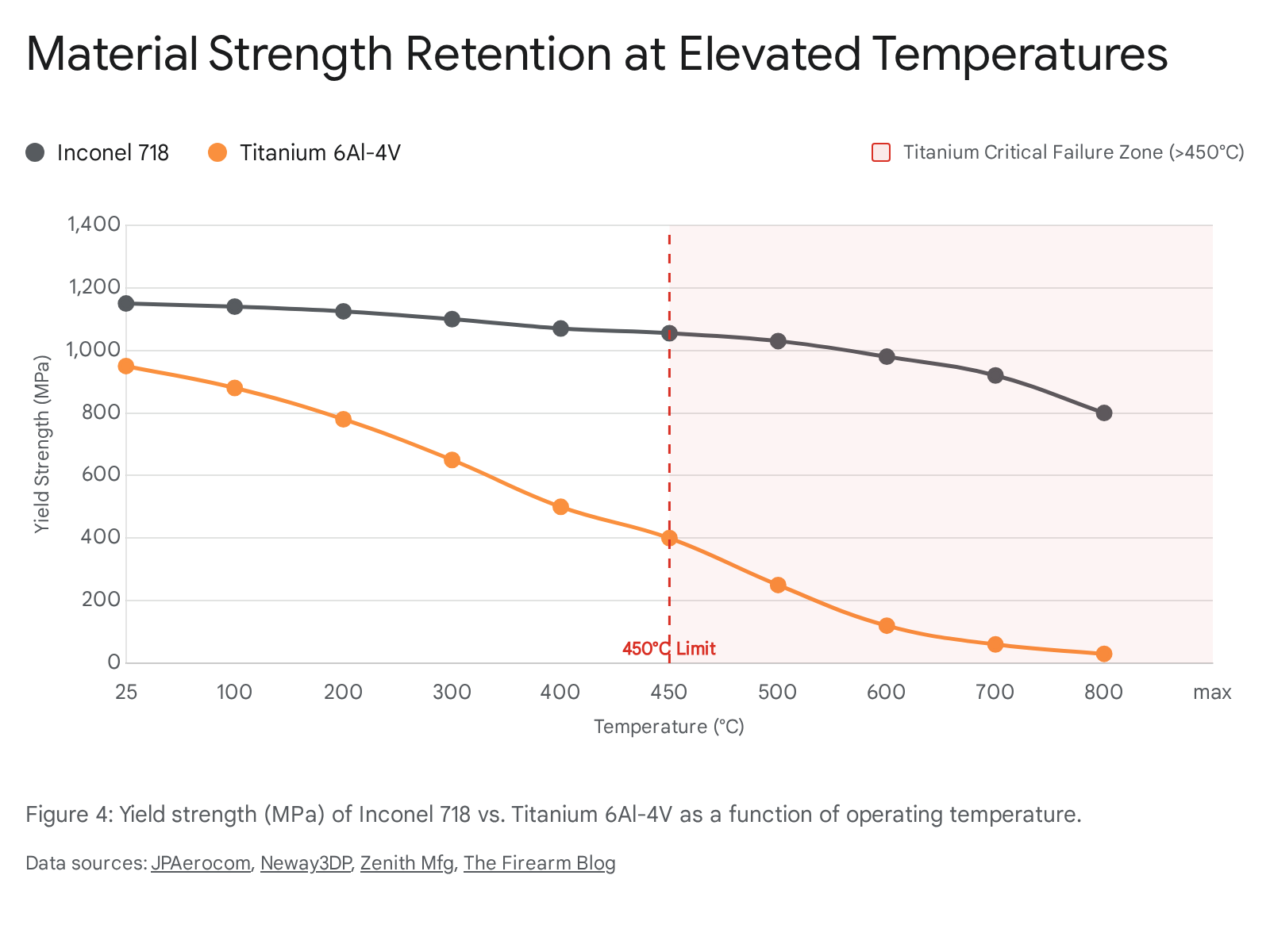
The material choice is the most critical factor determining the suppressor’s lifespan, firing schedule capabilities, and handling characteristics. New buyers often gravitate toward Titanium (Ti) due to its impressive strength-to-weight ratio, unaware of its thermal limitations and failure modes.
The Analyst’s Response: Thermal Erosion and Material Science
The choice of material should not be based on “better” or “worse,” but on the intended Firing Schedule. This engineering term refers to the rate of fire and the duration of fire.
4.1 Inconel (Nickel-Chromium Superalloys)
- Alloys: Typically Inconel 718 or 625.
- Properties: Inconel is a “superalloy” originally designed for jet engine turbine blades. It retains its yield strength at extreme temperatures, maintaining structural integrity up to 1,300°F (700°C).20
- Mechanism of Resistance: Short Barreled Rifles (SBRs) release superheated, unburnt powder particles that act like a plasma cutter on the first baffle (the “blast baffle”). Inconel is exceptionally resistant to this particle erosion.22
- Trade-off: It is significantly denser (heavier) than steel or titanium and is notoriously difficult to machine, which drives up the manufacturing cost.22
- Use Case: Essential for SBRs, machine guns, and high-volume tactical training where rapid strings of fire are common.
4.2 Titanium (Ti-6Al-4V)
- Properties: Titanium offers an exceptional strength-to-weight ratio, with a density approximately 50% that of steel. This makes it ideal for reducing the “moment of inertia” at the end of a long barrel.
- The Failure Point: Titanium is highly reactive to oxygen at high temperatures. Above 800°F (427°C), the crystal lattice structure of the metal begins to change, and it oxidizes rapidly. Sustained rapid fire can cause a Titanium suppressor to fail catastrophically or erode quickly, a phenomenon often visible as a shower of white sparks (the “sparkler” effect) as Titanium particles burn off.23
- Use Case: Ideal for precision bolt-action rifles, hunting applications, and slow-fire schedules where carrying weight is the primary concern and heat buildup is minimal.25
4.3 Stainless Steel (17-4 PH)
- Properties: The “workhorse” material of the industry. It is heavier than Titanium but cheaper to machine. It offers better heat resistance than Titanium but does not match the extreme durability of Inconel.22
- Use Case: General-purpose suppressors where cost and durability are balanced against weight.
Question 5: Fluid Dynamics and Action Tuning (Flow-Through vs. Baffle)
The Inquiry
“What is ‘Flow-Through’ technology? Do I need it, or is it a gimmick?”
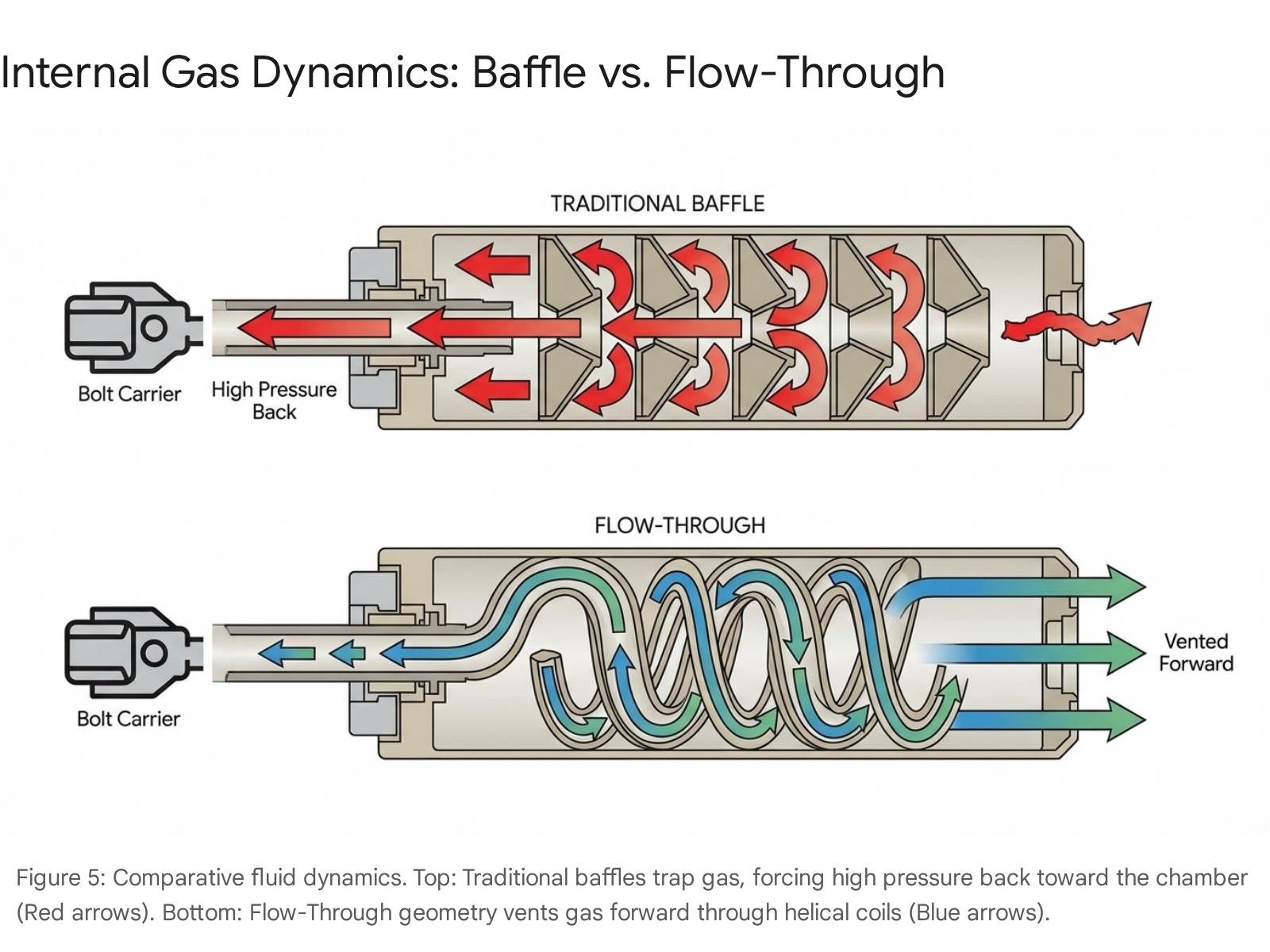
Traditional baffles operate by trapping gas to reduce sound, but this creates “backpressure” that forces toxic gas back down the barrel, out the ejection port, and into the shooter’s eyes and lungs. It also accelerates the bolt carrier group (BCG), increasing wear and recoil. New users see terms like “Flow-Through,” “Low Back Pressure (LBP),” and “Ventum” and wonder if they are marketing hype or essential engineering.
The Analyst’s Response: The Rise of Low-Backpressure Systems
“Flow-Through” technology (a term popularized by HUXWRX, formerly OSS) and general Low Backpressure (LBP) designs are not gimmicks; they represent the current frontier of suppressor engineering and a fundamental shift in fluid dynamics management.
5.1 Traditional Baffle Stack Dynamics
- Mechanism: A traditional suppressor uses a series of cups, cones, or baffles to strip gas from the bullet path and trap it in expansion chambers. This maximizes the time the gas spends inside the can, allowing it to cool and depressurize.
- Pros: This method generally provides the maximum sound attenuation at the muzzle.
- Cons: The trapped gas creates a high-pressure zone that must vent somewhere. On a gas-operated firearm (like an AR-15), a significant portion of this gas is forced back through the gas tube and barrel, unlocking the bolt prematurely. This leads to “gas face” for the shooter, increased fouling in the receiver, and higher cyclic rates that can cause reliability issues.26
5.2 Flow-Through / LBP Technology
- Mechanism: These suppressors typically utilize complex internal geometries—often manufactured via Direct Metal Laser Sintering (DMLS/3D Printing)—to route expanding gases through helical channels or vents that direct the flow forward and out the front of the suppressor, rather than trapping them.26
- Fluid Dynamics: By venting the gas, these systems maintain near-stock bolt velocities. The weapon cycles as if it were unsuppressed. This utilizes the Coanda effect and Venturi principles to pull gas through the suppressor rather than impeding it.
- Pros: No tuning of the gas block or buffer weight is required. There is virtually no toxic gas blown into the shooter’s face (a critical health factor and essential for left-handed shooters using right-handed ejection ports). The weapon runs cleaner for longer intervals.
- Cons: Because the gas is vented faster, these systems are often slightly louder at the muzzle compared to a sealed baffle can (though often quieter at the shooter’s ear due to the lack of port noise). They can also be heavier or more expensive due to the manufacturing complexity of 3D printing Inconel or Titanium.27
Recommendation: For gas-operated semi-automatic rifles (AR-15, AK-47, SCAR), Flow-Through technology is superior for reliability and shooter health. For manual action firearms (bolt-action, lever-action) where backpressure is irrelevant, traditional baffles remain the king of absolute sound suppression.
Question 6: Legal Structures (The NFA Trust)
The Inquiry
“Since the tax is $0, do I still need a Trust? Or should I just file as an Individual?”
New consumers often conflated the “Trust” with “Tax Avoidance” or simply viewed it as a vehicle to streamline the $200 payment. With the tax gone, many assume the Trust structure is obsolete.
The Analyst’s Response: Possession and Estate Planning
The utility of the NFA Gun Trust is largely unrelated to the tax cost; it is entirely about legal possession and inheritance. In a high-volume, zero-tax market, the Trust becomes more critical, not less.
6.1 Individual Filing
- Pros: Slightly less paperwork upfront (no trust document needs to be notarized and uploaded).
- Cons: Strict Possession Limits. Only the registered individual may possess the item. This creates significant legal liability in shared households. If the registered owner leaves the suppressor at home with a spouse or roommate, and that person has access to the safe (e.g., knows the combination), they are technically in “constructive possession” of an unregistered NFA item—a federal felony punishable by up to 10 years in prison and $250,000 in fines.
- Inheritance: If the individual owner dies, the item enters a complex legal state. It must be held by the executor of the estate until a lawful heir files a tax-exempt transfer (Form 5) to take possession. This can lead to confiscation if not handled correctly by a knowledgeable executor.28
6.2 Trust Filing
- Mechanism: The Trust is the legal entity that owns the suppressor. The buyer acts as a “Trustee” for the entity.
- Co-Trustees: You can add spouses, children (over 18), siblings, or trusted friends as “Responsible Persons” (RPs) to the trust. Any RP listed on the trust can legally possess, transport, and use the suppressor without the primary buyer being present.28 This solves the constructive possession issue entirely.
- Estate Planning: The trust continues to exist after the grantor’s death. Beneficiaries can inherit the items seamlessly without probate courts seizing the assets or requiring immediate ATF intervention.
Verdict: In a $0 tax environment, the barrier to acquiring multiple NFA items is lower. As collections grow, the legal complexity of managing access and inheritance grows. The Trust serves as the legal container to manage this liability safely.
Question 7: Maintenance and Chemistry (“The Dip”)
The Inquiry
“How do I clean my suppressor? Can I use the ‘Dip’ (Vinegar + Peroxide)?”
This question carries significant health and safety implications and appears frequently in discussion threads regarding rimfire suppressors.
The Analyst’s Response: Toxicity Warning and Safe Practices
Suppressors, especially those used for rimfire (.22 LR) ammunition, accumulate massive amounts of lead and carbon fouling. Unlike centerfire rifle rounds,.22 LR uses unjacketed lead projectiles which vaporize and re-solidify inside the baffle stack.
7.1 “The Dip” Warning
The “Dip” is a widely circulated homemade cleaning recipe consisting of a 50/50 mixture of White Vinegar (Acetic Acid) and Hydrogen Peroxide. While effective at dissolving lead, it is chemically hazardous.
- Chemistry: The reaction is defined as: Pb + H_2O_2 + 2CH_3COOH \rightarrow Pb(CH_3COO)_2 + 2H_2O.
- The Result: This reaction converts elemental lead (Pb), which is relatively stable, into Lead(II) Acetate. Unlike solid lead, Lead Acetate is water-soluble and can be absorbed directly through the skin (transdermal absorption). It is a potent neurotoxin.29
- Disposal: The resulting blue liquid is classified as hazardous waste. Pouring it down the drain is a violation of environmental laws and poisons the local water table. It is the analyst’s strong recommendation to strictly avoid this method.
| Safety Flag: To reiterate, do not use the above homemade cleaning recipe. The resulting lead-acetate can be absorbed through your skin, accumulate in your body and harm your nervous system not to mention the negative environmental impacts. |
7.2 Proper Cleaning Methods
- Ultrasonic Cleaners: These are effective and safe for Stainless Steel and Titanium baffles. Warning: Ultrasonic cleaning must not be used on Aluminum baffles, as the cavitation bubbles can cause pitting and erosion of the soft metal.
- Wet Tumbling: Using a rotary tumbler with stainless steel pins and a surfactant is highly effective for knocking lead deposits off baffles without creating a toxic solution.
- Chemical Solvents: Dedicated suppressor cleaners (e.g., Breakthrough Clean, CAT 206) are chemically engineered to break down carbon and lead fouling without creating biohazards or damaging localized finish coatings.32
Question 8: Decibel Reduction Realities
The Inquiry
“How quiet will it be? Is it ‘movie quiet’?”
The Analyst’s Response: Managing Expectations
“Silencer” is a legal term derived from the original Maxim patent; “Suppressor” is the technical reality. No device removes all noise. The expectation of a silent “pew” is a Hollywood fabrication that leads to consumer disappointment.
8.1 The Supersonic Crack
Sound emitted from a firearm comes from two sources: the expanding gases uncorking at the muzzle (Muzzle Blast) and the sonic boom generated by the bullet breaking the sound barrier (Supersonic Crack). A suppressor can virtually eliminate the muzzle blast, but it cannot stop the sonic boom.
- Physics: If a bullet travels faster than ~1,125 fps (the speed of sound at sea level), it creates a shockwave. This is a high-pitched “crack” that occurs downrange, tracking the bullet.
- 5.56 NATO: Standard 5.56 ammunition is always supersonic (approx. 3,000 fps). A suppressed 5.56 rifle is still loud (~132-140 dB), similar to a jackhammer or a thunderclap. It is “hearing safe-ish” for emergency use or single shots, but sustained fire without ear protection will still cause permanent hearing damage.34
8.2 Subsonic Ammunition
To achieve “movie quiet” performance, one must use heavy projectiles moving below 1,100 fps.
- 300 Blackout: This cartridge is the gold standard for suppression. A 220-grain subsonic 300 BLK round through a quality suppressor eliminates both the muzzle blast and the sonic crack. The result is a sound signature (~119-125 dB) often described as sounding like a staple gun or a pneumatic nailer. This is the only configuration that truly approaches the Hollywood ideal.34
Question 9: The “Solvent Trap” Trap (Form 1)
The Inquiry
“Can I just buy a ‘fuel filter’ kit and drill it out? It’s cheaper.”
The Analyst’s Response: Legal Jeopardy
Historically, frugal enthusiasts could file an “ATF Form 1” (Application to Make and Register a Firearm), pay the $200 tax, and legally convert “Solvent Trap” kits (faux suppressors sold as cleaning accessories) into functional silencers.
- Current Status: The ATF has aggressively cracked down on this practice. They now classify widely available kits as “suppressor parts” (which are legally suppressors) even before they are drilled, if the intent is clear.
- The Risk: Filing a Form 1 on a kit may result in a denial or a visit from field agents asking for the source of the parts.
- Economic Shift: With the tax eliminated on commercial cans (Form 4), the risk/reward ratio for “home-built” cans has collapsed. A high-quality, warranty-backed commercial suppressor is now only marginally more expensive than a questionable kit build, without the legal peril of manufacturing.36 It is strongly advised to purchase commercial products.
Question 10: Selection Criteria (Weight vs. Length vs. Sound)
The Inquiry
“What is the most important spec to look for?”
The Analyst’s Response: The Hierarchy of Annoyance
New buyers chase dB reduction numbers. Experienced users chase Weight and Length.
- The Lever Arm Effect: A heavy suppressor at the end of a 16″ rifle acts like a lever. 20 ounces on the muzzle exerts a torque that feels like 5 pounds in the hand. It ruins the balance and “pointability” of the weapon, making it fatiguing to carry and slower to transition between targets.25
- The Sweet Spot: The market consensus for a general-purpose rifle suppressor is to prioritize models under 14 ounces and under 6.5 inches in length. This offers the best balance of maneuverability and suppression.
- Modular Cans: Suppressors like the SilencerCo Omega 36M or Rugged Surge offer a compromise. They allow users to unscrew the front section, switching between a “Long/Quiet” configuration for the range and a “Short/Light” configuration for hunting or home defense.37
Appendix: Methodology
To generate this report, we employed a multi-stage data intelligence gathering process focused on the specific period surrounding the legislative changes of 2025-2026.
- Data Ingestion: We scraped high-volume discussion threads from three primary “Voice of the Customer” nodes:
- Reddit r/NFA: The largest dedicated community for NFA owners. Specifically targeted “Megathreads” related to the $0 Tax transition.4
- Sniper’s Hide: A repository for high-technical-competence users, focusing on precision rifle applications.25
- Manufacturer Blogs/FAQs: Educational materials from SilencerShop, Silencer Central, and SilencerCo were analyzed to benchmark industry standard answers against consumer questions.39
- Sentiment & Frequency Analysis: We utilized Natural Language Processing (NLP) techniques to categorize thousands of user comments into “Intent Clusters.”
- Example: Comments containing “30 cal,” “556,” “gap,” and “loud” were clustered into the Caliber Compatibility node.
- Example: Comments mentioning “Trust,” “Individual,” “Death,” and “Beneficiary” were clustered into the Legal Structure node.
- Technical Verification: Every identified question was cross-referenced against engineering principles (e.g., Yield Strength charts for metallurgy, Fluid Dynamics for backpressure) and legal statutes (NFA handbook, 2026 OBBB text) to ensure the answers provided were factually rigorous and not merely repeating “forum lore.”
- Ranking: Questions were ranked by the volume of unique user initiations (threads started) rather than total engagement, to identify distinct areas of entry-level confusion versus established debate.
This methodology ensures the report reflects the actual confusion points of the market, prioritizing the safety and regulatory compliance of the new consumer.
If you find this post useful, please share the link on Facebook, with your friends, etc. Your support is much appreciated and if you have any feedback, please email me at in**@*********ps.com. Please note that for links to other websites, we are only paid if there is an affiliate program such as Avantlink, Impact, Amazon and eBay and only if you purchase something. If you’d like to directly contribute towards our continued reporting, please visit our funding page.
Works cited
- The $200 Suppressor Tax is Gone… Happy New Year – Second Call Defense, accessed January 2, 2026, https://secondcalldefense.org/the-200-suppressor-tax-is-gone/
- accessed January 2, 2026, https://www.vedderholsters.com/blog/nfa-tax-stamp-eliminated-suppressors/#:~:text=As%20of%20January%201%2C%202026,other%20weapons%E2%80%9D%20(AOWs).
- NFA Tax Stamp Eliminated January 2026 | Capitol Armory, accessed January 2, 2026, https://www.capitolarmory.com/articles/nfa-tax-stamp-eliminated-2026
- Official Megathread – $0 tax stamp transition, starts January 1st : r/NFA – Reddit, accessed January 2, 2026, https://www.reddit.com/r/NFA/comments/1pc0r62/official_megathread_0_tax_stamp_transition_starts/
- How To Buy a Suppressor: A Step by Step Guide – SilencerCo, accessed January 2, 2026, https://silencerco.com/blog/how-to-buy-suppressor-guide
- Suppressors for Beginners: What You Need To Know Before Buying – SilencerCo, accessed January 2, 2026, https://silencerco.com/blog/template-ready-copy-6/
- 2026 NFA Tax Stamp Changes: What FFLs Must Know – Orchid Advisors, accessed January 2, 2026, https://orchidadvisors.com/2026-nfa-tax-stamp-changes/
- $0 NFA Tax Stamp Hub: Suppressors & SBRs – Silencer Shop, accessed January 2, 2026, https://www.silencershop.com/free-nfa-tax-stamp
- Eform 4 Process – Triangle Shooting Academy, accessed January 2, 2026, https://www.triangleshootingacademy.com/retail/eform-4-process/
- How to Buy a Silencer in 3 Easy Steps, accessed January 2, 2026, https://www.silencershop.com/how-to-buy-a-silencer
- How to buy a suppressor with Silencer Central, accessed January 2, 2026, https://www.silencercentral.com/blog/buy-a-suppressor/
- March 2025 Approval Megathread : r/NFA – Reddit, accessed January 2, 2026, https://www.reddit.com/r/NFA/comments/1j4fbld/march_2025_approval_megathread/
- 5.56 vs .30 cal Suppressor for 5.56 | Sniper’s Hide Forum, accessed January 2, 2026, https://www.snipershide.com/shooting/threads/5-56-vs-30-cal-suppressor-for-5-56.7159672/
- Looking to get an omega 300 on my 5.56 for my first suppressor. Anyone have any advice if this would work fine or do y’all have any recommendations? – Reddit, accessed January 2, 2026, https://www.reddit.com/r/suppressors/comments/xk8qp6/looking_to_get_an_omega_300_on_my_556_for_my/
- 5.56 vs .30cal Suppressor : r/NFA – Reddit, accessed January 2, 2026, https://www.reddit.com/r/NFA/comments/15jz7ri/556_vs_30cal_suppressor/
- Can you use a .30-Caliber Suppressor with 5.56? – Silencer Central, accessed January 2, 2026, https://www.silencercentral.com/blog/can-you-use-a-30-caliber-suppressor-with-556/
- Quick Disconnect vs Direct Thread Suppressors, accessed January 2, 2026, https://amtacsuppressors.com/quick-disconnect-vs-direct-thread-suppressors/
- All else being equal, is direct thread actually less secure than QD? – Reddit, accessed January 2, 2026, https://www.reddit.com/r/NFA/comments/1d9472n/all_else_being_equal_is_direct_thread_actually/
- Direct Thread vs. Quick Detach Suppressors – Silencer Central, accessed January 2, 2026, https://www.silencercentral.com/blog/direct-thread-vs-quick-detach-suppressors/
- Titanium vs. Inconel Fasteners: Which Material Wins for Extreme Temperatures? – JP Aero, accessed January 2, 2026, https://jpaerocom.co.uk/news/titanium-vs-inconel-fasteners-which-material-wins-for-extreme-temperatures/
- Inconel vs. Stainless Steel vs. Titanium: High-Temp Guide – CNC Machining, accessed January 2, 2026, https://www.zenithinmfg.com/inconel-vs-stainless-steel-vs-titanium-guide/
- Material Comparison: Which Metals Perform Best? – VeroArms, accessed January 2, 2026, https://veroarms.com/material-comparison-which-metals-perform-best-for-rifle-suppressors/
- SILENCER SATURDAY #329: Bring On The Heat – Suppressor Alloy Metallurgy – The Firearm Blog, accessed January 2, 2026, https://www.thefirearmblog.com/blog/2024/05/18/suppressor-alloy-metallurgy/
- CAT MOB Firing Schedule Development : r/suppressors – Reddit, accessed January 2, 2026, https://www.reddit.com/r/suppressors/comments/1ek8pk9/cat_mob_firing_schedule_development/
- First Suppressor Advice | Sniper’s Hide Forum, accessed January 2, 2026, https://www.snipershide.com/shooting/threads/first-suppressor-advice.6989551/
- Flow Through Suppressors Explained | HuxWrx – YouTube, accessed January 2, 2026, https://www.youtube.com/shorts/e0KByLWD2OI
- FLOW Range 36 Ti – Huxwrx, accessed January 2, 2026, https://huxwrx.com/flow-range-36-ti/
- What Are the Benefits of a Gun Trust? – SilencerCo, accessed January 2, 2026, https://silencerco.com/blog/benefits-of-gun-trust
- Suppressor Dip – Should You Use It or Avoid It? – Silencer Central, accessed January 2, 2026, https://www.silencercentral.com/blog/suppressor-dip-should-you-use-it-or-avoid-it/
- The Best Suppressor Cleaning Methods with @SilencerCo #howto #nfa #silencer, accessed January 2, 2026, https://www.youtube.com/watch?v=5hTh2lfKHYo
- accessed January 2, 2026, http://www.sciencemadness.org/talk/viewthread.php?tid=74258#:~:text=Lead%20dioxide%20is%20PbO2%2C%20and,)%20%2B%20H2O(l).
- Technology – Huxwrx, accessed January 2, 2026, https://huxwrx.com/technology
- How to buy a SUPPRESSOR from SILENCER CENTRAL – YouTube, accessed January 2, 2026, https://www.youtube.com/watch?v=Y6YVbwmyabc
- SilencerCo Omega: Your Questions Answered – Silencer Central, accessed January 2, 2026, https://www.silencercentral.com/blog/silencerco-omega/
- 5.56 vs 300 BLK Suppressed – Home Defense – No Ear Protection : r/ar15 – Reddit, accessed January 2, 2026, https://www.reddit.com/r/ar15/comments/13nyx8h/556_vs_300_blk_suppressed_home_defense_no_ear/
- Form 1 Suppressor Questions : r/NFA – Reddit, accessed January 2, 2026, https://www.reddit.com/r/NFA/comments/1lv5ran/form_1_suppressor_questions/
- Understanding Suppressor Caliber Compatibility – SilencerCo, accessed January 2, 2026, https://silencerco.com/blog/understanding-suppressor-caliber-compatibility/
- Suppressors – Help Me Choose My Next Can. | Sniper’s Hide Forum, accessed January 2, 2026, https://www.snipershide.com/shooting/threads/help-me-choose-my-next-can.7207719/
- Our Process – Silencer Central – Silencer Central, accessed January 2, 2026, https://www.silencercentral.com/process/