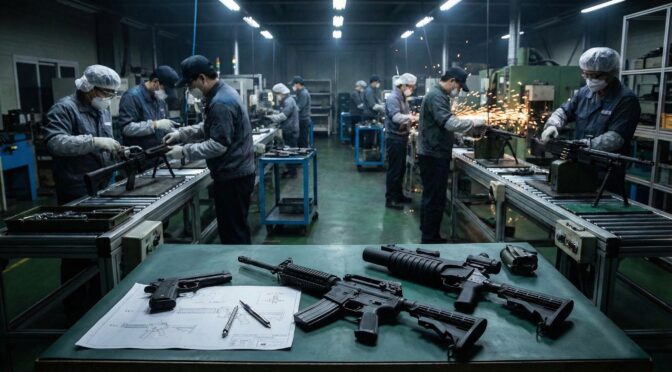
SNT Motiv Co., Ltd., formerly known as Daewoo Precision Industries, stands as the foundational pillar of the Republic of Korea’s (ROK) indigenous small arms capability. Established in the geopolitical crucible of the late 1970s and early 1980s, the company was born from the strategic imperative of the Park Chung-hee administration to achieve “Self-Reliant National Defense” (Jaju Gukbang). Over four decades, SNT Motiv has evolved from a licensed manufacturer of United States military weaponry into a sophisticated design house capable of producing a comprehensive spectrum of infantry systems, ranging from pistols to heavy machine guns and complex air-burst munitions.
The company’s corporate trajectory mirrors the turbulent industrial history of South Korea itself. Beginning as a subsidiary of the massive Daewoo conglomerate, it weathered the Asian Financial Crisis of 1997, the subsequent bankruptcy of its parent group, and a period of corporate orphanhood before its acquisition by the S&T Group (now SNT Group). Today, SNT Motiv operates as a hybrid industrial entity. It balances a high-volume, precision automotive components division—supplying motors and powertrain parts to global giants like Hyundai, Kia, and General Motors—with a specialized defense division that equips the ROK Armed Forces. This dual-structure provides a unique financial resilience, allowing automotive revenues to subsidize defense research and development (R&D) during inter-contract lulls.
In the domestic market, SNT Motiv recently faced the most significant challenge in its history: the end of its monopsonistic relationship with the South Korean government. The 2016 designation of Dasan Machineries as a second supplier of small arms introduced fierce competition, culminating in a procurement war for the ROK Army’s next-generation service rifle. However, SNT Motiv has successfully navigated this threat, leveraging its institutional maturity and recent competitor scandals to secure the adoption of its STC-16 platform as the K13 Special Operations Submachine Gun. This victory signals a critical technological pivot for the company, moving away from the legacy K1/K2 architecture toward modern, modular, short-stroke gas piston systems influenced by the AR-15 platform.
Internationally, SNT Motiv is aggressively pursuing export diversification. While it has established footholds in Indonesia, the Philippines, and the Middle East, the United States remains the “white whale” of its strategic roadmap. The company’s history in the US civilian market is fragmented, characterized by a series of shifting importers and regulatory hurdles—from the pre-ban “Max” series to the post-ban “DR” rifles and the recent Lionheart Industries partnership. Current indicators suggest a strategic shift toward establishing US-based manufacturing capabilities (SNT Defense) to bypass import restrictions and directly access the world’s largest civilian firearms market.
This report provides an exhaustive, forensic analysis of SNT Motiv. It details the technical lineage of its “K-Series” weapons, dissects the geopolitical and legal complexities of its US import history, and offers a comprehensive assessment of its competitive standing against domestic and international rivals.
1. Corporate Genealogy and Industrial Evolution
The history of SNT Motiv is not merely a corporate chronicle; it is a case study in state-sponsored industrialization and the resilience of South Korea’s defense sector. The company’s evolution can be segmented into four distinct eras: the foundational Daewoo era, the restructuring crisis, the S&T acquisition, and the modern SNT rebranding.
1.1 The Foundation: Daewoo Precision Industries (1981–1999)
The origins of SNT Motiv lie in the Nixon Doctrine of the early 1970s, which signaled a reduction of US ground forces in Korea and compelled Seoul to develop an independent arms industry. In 1971, the ROK government mandated the construction of a dedicated arsenal for small arms production.1
The M16 License and the Busan Arsenal:
Before the formal incorporation of Daewoo Precision, the manufacturing infrastructure was established to produce the Colt M16A1 rifle under license. This program was critical for two reasons. First, it standardized the ROK Army on the 5.56×45mm NATO cartridge. Second, and more importantly, the technology transfer from Colt provided South Korean engineers with advanced expertise in aluminum forging, barrel chroming, and quality control protocols that did not previously exist in the domestic industrial base. This facility, known initially as the Arsenal of National Defense, laid the groundwork for all future developments.2
Incorporation and Indigenous Design:
In December 1981, Daewoo Precision Industries Co., Ltd. was officially established as a subsidiary of the Daewoo Group, one of the nation’s largest chaebols (family-owned conglomerates). The company was tasked with a clear mandate: replace foreign designs with indigenous weapons optimized for the Korean peninsula’s mountainous terrain and conscript army profile.
- The K1 (1981): The first fruit of this labor was the K1 submachine gun (later reclassified as a carbine). Developed to replace the M3 Grease Gun for special forces and vehicle crews, the K1 utilized a direct gas impingement system similar to the AR-15 but featured a unique telescoping wire stock and receiver architecture.2
- The K2 (1984): The K2 assault rifle followed, representing a “best of both worlds” synthesis. It combined the M16’s lower receiver ergonomics and rotating bolt with an AK-47-style long-stroke gas piston system. This hybrid design addressed the reliability issues of the M16A1 in Korea’s extreme seasonal temperature variations.3
Diversification:
Recognizing the cyclical nature of defense procurement, Daewoo Precision diversified early. In July 1986, the company constructed an automotive parts plant. This strategic decision to manufacture shock absorbers, motors, and transmission components created a dual-revenue stream that would prove vital for the company’s survival during future defense spending cuts.1
1.2 The Crisis Era: Bankruptcy and Restructuring (1999–2006)
The Asian Financial Crisis of 1997 devastated the highly leveraged Daewoo Group. By 1999, the parent conglomerate collapsed under nearly $80 billion in debt, triggering the largest corporate bankruptcy in South Korean history. This catastrophic event thrust Daewoo Precision Industries into a period of extreme uncertainty.1
Merger with Daewoo Telecom:
In an effort to salvage viable assets, the creditors and government regulators merged Daewoo Precision Industries into Daewoo Telecom Co., Ltd. in June 1999. For three years, the defense manufacturer operated as a division within this telecommunications entity, a mismatch of industrial cultures that served primarily as a financial holding action.1
The Spin-Off (2002):
In February 2002, the company was spun off once again as an independent entity, reclaiming the name Daewoo Precision Industries Co., Ltd. This period was characterized by aggressive internal restructuring. The management implemented Enterprise Resource Planning (ERP) systems in 2003 and reorganized the workforce to improve efficiency, positioning the company for sale to a new owner.1 Despite the corporate turmoil, the defense division continued to deliver K-series weapons, maintaining the continuity of national defense supply chains.
1.3 The S&T Acquisition and Stabilization (2006–2020)
In June 2006, S&T Holdings (Science and Technology Holdings) acquired a majority stake in Daewoo Precision Industries, ending years of creditor management. S&T was an emerging mid-sized conglomerate with interests in heavy machinery and dynamics.1
Rebranding to S&T Daewoo (2006):
In September 2006, the company was renamed S&T Daewoo Co., Ltd. The retention of the “Daewoo” name was a calculated decision to leverage the brand’s global recognition in automotive and firearms markets, despite the parent group’s failure. Under S&T ownership, the company accelerated its globalization, establishing subsidiaries in Poland (S&T Polska) and India to support its automotive clients.1
Rebranding to S&T Motiv (2012):
In March 2012, the company initiated a significant rebranding, changing its name to S&T Motiv Co., Ltd. The removal of “Daewoo” signaled a desire to distance the firm from the legacy of the failed chaebol and assert a new, independent corporate identity. The name “Motiv” was chosen to symbolize “motor” (its core automotive product) and “motivation,” reflecting its drive for technological innovation in defense and mobility.1
1.4 The Modern Era: SNT Motiv (2021–Present)
The most recent evolution occurred in February 2021, when the parent group underwent a comprehensive restructuring. S&T Holdings became SNT Holdings, and consequently, S&T Motiv was renamed SNT Motiv Co., Ltd..1
Strategic Pivot:
This modern era is defined by the end of SNT Motiv’s monopoly. The ROK government’s decision to open the defense market to competition forced SNT Motiv to abandon its complacent reliance on 1980s-era designs. The company has since engaged in a rapid R&D cycle, developing modular weapon systems (STC-16, K15, K16) to compete with rival Dasan Machineries and international vendors.
- ESG and Globalization: The SNT era has also seen a focus on Environmental, Social, and Governance (ESG) criteria and a push for localized manufacturing in the United States (SNT Defense) to bypass protectionist barriers.1
2. Comprehensive Small Arms Product Portfolio
SNT Motiv’s product line represents a complete ecosystem of infantry weapons. Unlike many manufacturers that specialize in specific categories, SNT Motiv produces everything from sidearms to heavy crew-served weapons. The “K” designation stands for “Korea,” and the numbering sequence generally reflects the chronological order of development or adoption.
2.1 Assault Rifles and Carbines
The K2 and K2C1 Assault Rifle (5.56×45mm NATO)
The K2 is the flagship product of SNT Motiv and the standard service rifle of the ROK Armed Forces.
- Design Philosophy: The K2 was designed to merge the best features of the M16A1 (which the ROK was already producing) with the AK-47. The goal was to create a weapon that retained the accuracy and ergonomics of the AR platform but possessed the reliability of the Kalashnikov system, particularly for winter operations where direct impingement systems were perceived to be vulnerable to freezing.3
- Operating Mechanism: The K2 utilizes a long-stroke gas piston system. The piston is rigidly attached to the bolt carrier group, moving as a single unit. This provides significant mass to power through fouling and ice. The locking mechanism is a rotating bolt with multiple lugs, similar to the M16.
- Barrel and Rifling: The K2 features a 1-in-7.3 inch twist rate, optimized for the NATO SS109 (M855) 62-grain projectile, ensuring stability and range.
- Evolution:
- K2 (1984): The original model featured a fixed folding polymer stock (allowing for compact transport in APCs) and a smooth polymer handguard.
- K2C (2012): A carbine variant with a shorter barrel and Picatinny rails, primarily exported to nations like Iraq and Malawi. It was tested by ROK Special Forces but not widely adopted domestically.2
- K2C1 (2016): The current standard modernization. It retains the core K2 mechanism but adds a flat-top upper receiver with a full-length Picatinny rail for optics, a new adjustable telescoping stock (still foldable), and a railed handguard. This update addressed the lack of modularity in the original design.3
The K1/K1A Carbine (5.56mm)
Often incorrectly classified as a submachine gun due to its ROK Army designation, the K1A is a carbine chambered in 5.56mm.
- Design Distinction: Crucially, the K1A does not use the K2’s piston system. Instead, it uses a direct gas impingement system very similar to the AR-15/M4. This choice was made to reduce weight and receiver height for vehicle crews and special forces.2
- Features: It features a sliding wire stock (similar to the M3 Grease Gun) and a very short 10.4-inch barrel. Early models (K1) had flash suppression issues, leading to the K1A upgrade with a specifically designed flash hider to mitigate the massive muzzle blast of 5.56mm from a short barrel.2
- Status: The K1A is currently being phased out in favor of the K13 (STC-16) for elite units, though it remains in widespread service.
The K13 (STC-16) Special Operations Submachine Gun
The K13 represents a generational leap for SNT Motiv, abandoning the legacy K-series architecture for a modern AR-15 derivative.
- Development: Known commercially as the STC-16 (SNT Technological Carbine), this weapon was developed to compete with the HK416 and Dasan Machineries’ DSAR-15.
- Mechanism: It utilizes a short-stroke gas piston system, distinct from the K1A’s direct impingement and the K2’s long-stroke piston. This system keeps the receiver clean while reducing the recoil impulse compared to a long-stroke system.
- Adoption: In 2023, the STC-16 was officially designated the K13 after winning the “Special Operations Submachine Gun Type II” competition. It features fully ambidextrous controls (safety, mag release, bolt catch), a monolithic upper rail, and M-LOK handguards, making it compatible with the vast ecosystem of AR-15 accessories.5
2.2 Machine Guns
K3 and K15 Light Machine Gun (5.56×45mm NATO)
- The Legacy K3: Adopted in 1989, the K3 was visually and mechanically similar to the FN Minimi (M249). However, it suffered from a reputation for unreliability, particularly with feed tray issues and bracket fatigue. It served as the squad automatic weapon for decades.
- The K15 Replacement: The K15 was developed to rectify the K3’s shortcomings. While it retains the general layout, every component was re-engineered.
- Improvements: The K15 features a reinforced receiver, improved feed pawl geometry to prevent jamming, a customized adjustable stock, and integrated rails for the PAS-18K thermal sight.
- Status: The K15 entered mass production in 2020 and began fielding in 2022, systematically replacing the K3 in infantry squads.7
K16 General Purpose Machine Gun (7.62×51mm NATO)
- Strategic Gap: For years, the ROK military relied on aging US-supplied M60D machine guns for vehicle and helicopter mounts. SNT Motiv developed the K16 (originally K12) to replace these worn-out systems.
- Modular Design: The K16 is a modular system with three primary variants:
- K16 (Infantry): Features a bipod and buttstock for dismounted operations.
- K16D (mounted): Equipped with spade grips for use on helicopters (Surion) and vehicles.
- K16E (Coaxial): A solenoid-fired version for integration into the K1A2 and K2 Black Panther tanks.
- Performance: The K16 significantly reduces weight compared to the M60 while improving reliability and barrel change speed. It was officially fielded in December 2021.9
2.3 Handguns
K5 / LH9 (9×19mm)
- The “Triple Action”: The K5 is unique in the world of handguns for its “Fast Action” (Double Action Plus) trigger mechanism. This allows the hammer to be cocked (single action mode) and then physically pushed forward into a “down” position while the mainspring remains compressed. The first trigger pull is long but extremely light (as it only needs to spring the hammer back), combining the safety of a double-action carry with the accuracy of a single-action pull.11
- Lionheart Variants: In the US, this pistol was marketed as the Lionheart LH9, featuring Cerakote finishes and Novaks sights.
The Next Generation: Partnership with CZ
Recognizing that the metal-framed K5 is outdated compared to modern polymer striker-fired pistols, SNT Motiv has partnered with Colt CZ Group (formerly CZUB). The company is pitching a localized version of the CZ P-10 series (often referred to as the STP-9 in prototypes) for the ROK Army’s next service pistol contract. This strategic alliance allows SNT Motiv to offer a world-class polymer handgun without incurring the massive R&D cost of developing one from scratch.6
2.4 Specialized and Support Weapons
- K4 Automatic Grenade Launcher (40×53mm): A blowback-operated grenade machine gun similar to the US Mk 19. It is a staple of ROK heavy weapons companies. The recently unveiled K4-II uses advanced alloys to reduce weight by nearly 8kg, addressing the primary complaint of the legacy system.12
- K7 Silenced Submachine Gun (9mm): Based on the K1A, the K7 features an integral suppressor. It was developed for Naval Special Warfare brigades and is notable for its extremely quiet operation due to the use of heavy subsonic ammunition and a ported barrel.4
- K14 Sniper Rifle (7.62×51mm): A dedicated bolt-action sniper rifle with a chassis system, developed to replace M40s and other foreign sniper rifles in the ROK inventory.4
- K11 (Cancelled): An ambitious dual-barrel air-burst weapon (20mm airburst + 5.56mm carbine) similar to the US XM29 OICW. Despite limited fielding, the project was plagued by fire control system failures and battery issues, leading to its eventual cancellation—a rare but significant failure in SNT Motiv’s history.4
3. Domestic Market Dynamics: The End of Monopoly
For nearly four decades, SNT Motiv operated as the sole source for ROK small arms. This monopoly ensured stability but fostered technological complacency. The seismic shift occurred in 2016, when the ROK government, seeking cost efficiency and innovation, designated Dasan Machineries as a second authorized defense supplier.15
3.1 The Rise of Dasan Machineries
Dasan Machineries was originally a subcontractor producing parts (barrels, magazines) for foreign companies. Leveraging this manufacturing base, Dasan entered the domestic market with a strategy of “fast innovation” based on the AR-15 platform. They secured a license to produce the Caracal CAR 816 (designed by Robert Hirt and Chris Sirois, key figures in the HK416 development) and developed their own DSAR-15 series.16
3.2 The Procurement War: Type I vs Type II
The rivalry culminated in the competition to replace the aging K1A carbine. The procurement was split into two tracks:
- Type I (General Army): A massive contract to replace the standard service carbine.
- Type II (Special Operations): An urgent requirement for elite units.
In 2020, Dasan Machineries shocked the industry by winning the Type I competition with its DSAR-15PC, beating SNT Motiv’s initial offerings. It appeared that SNT Motiv was on the verge of losing its primary revenue stream.18
3.3 The Scandal and SNT Motiv’s Resurgence
In 2020-2021, the situation reversed dramatically. An investigation by military prosecutors revealed that Dasan Machineries executives had illicitly obtained classified technical documents from the Agency for Defense Development (ADD). These documents reportedly contained SNT Motiv’s proprietary design data and future military requirements.
- The Fallout: The scandal led to the arrest of former ADD and Dasan officials. Consequently, Dasan’s selection as the preferred bidder for the Type I program was suspended and eventually cancelled.
- SNT’s Counterstroke: SNT Motiv capitalized on the chaos. They refined their STC-16 design and aggressively marketed it. In 2023, the STC-16 was officially selected for the Type II program (designated K13), solidifying SNT Motiv’s reputation as the “safe” and reliable choice. With Dasan legally encumbered, SNT Motiv is now the frontrunner to recapture the re-initiated Type I program.6
4. The US Civilian Market: A Forensic History of Importation
For American analysts and collectors, SNT Motiv is defined by the erratic availability of its products. The company’s US market history is a complex tapestry of legislative bans, shifting importers, and rebranding efforts.
4.1 The Pre-Ban “Golden Age” (1980s–1989)
Prior to the 1989 import ban, Daewoo Precision Industries exported civilian semi-automatic versions of their military rifles. These firearms are now highly collectible “Pre-Ban” artifacts.
- Importers: The primary importers were Stoeger Industries (South Hackensack, NJ) and later B-West (Tucson, AZ).
- Models:
- Max I (K1A1): The civilian version of the K1A. It retained the wire stock and 1:12 twist barrel (optimized for M193 55gr ammo).
- Max II (K2): The civilian version of the K2. It featured the original side-folding polymer stock and 1:7.3 twist barrel.
- Market Impact: These rifles were praised for offering FNC/AK reliability with AR-15 ergonomics at a price point lower than the Colt AR-15.
4.2 The “Thumbhole” Era (1990–1994)
Following the 1989 Executive Order by President George H.W. Bush, which banned the importation of “non-sporting” rifles, Daewoo modified their designs to comply.
- Importers: Kimber (Clackamas, OR) and B-West took over importation duties.
- The DR-200 (Daewoo Rifle 200): This was a neutered K2. The folding stock was replaced with a fixed “thumbhole” stock (to eliminate the pistol grip). The flash hider was removed or replaced with a non-slotted muzzle brake, and the bayonet lug was shaved off. Despite the cosmetic butchery, the core mechanism remained the robust K2 gas piston system.
- The DR-300: A rare variant chambered in 7.62×39mm. It was designed to capitalize on the cheap surplus AK ammo flooding the US market in the early 1990s. However, the DR-300 suffered from durability issues with its bolt extractor, as the K2 bolt face was opened up too much to accommodate the larger Russian cartridge rim.19
4.3 The Lionheart Partnership and “Made in USA”
After a long hiatus in the 2000s, SNT Motiv returned to the US market in 2011 through a partnership with Lionheart Industries (originally based in Redmond, WA).
- Phase 1 (Importation): Lionheart imported the K5 pistol components from SNT Motiv in Korea. These were assembled, finished with Cerakote, and fitted with premium sights in the US, marketed as the LH9. This allowed them to bypass some import restrictions while leveraging Korean manufacturing costs.11
- Phase 2 (Domestic Production): In a significant strategic shift around 2020, Lionheart Industries relocated to Winder, Georgia, and launched the Regulus and later the Vulcan 9. Crucially, the company claims these new models are manufactured in the USA, signaling a decoupling from the direct importation model. This move protects the supply chain from executive orders regarding firearm imports and allows for tighter quality control.21
5. Global Export Strategy and Geopolitics
SNT Motiv is a key player in South Korea’s “K-Defense” export strategy, which aims to position the nation as a premier global arms supplier.
5.1 Southeast Asia
The company has found its most consistent success in Southeast Asia.
- Indonesia: A major operator of Daewoo weapons. The Indonesian military uses the K7 silenced SMG and has license-produced variants of South Korean designs. Recent defense pacts involving the KF-21 fighter jet often include offsets or parallel deals for small arms and ammunition.2
- Philippines: The Philippine National Police and Armed Forces have procured thousands of K2C1s and K13-type carbines. The similarities in terrain and requirements between Korea and the Philippines make SNT products a natural fit.
5.2 The Polish Gateway
The massive defense deals signed between Poland and South Korea in 2022-2024 (involving K2 tanks, K9 howitzers, and FA-50 jets) have created a “highway” for SNT Motiv products.
- Strategic Logic: While Poland has a robust small arms industry (FB Radom, maker of the Grot), gaps exist in crew-served weapons. SNT Motiv is positioning the K4 AGL and K16 GPMG as complementary systems for the Polish military’s new vehicle fleets. The K16E is already integrated into the K2 Black Panther tanks Poland has purchased, creating an automatic logistics footprint for the weapon.24
6. Financial and Operational Analysis
SNT Motiv’s financial structure is its hidden strength. Unlike pure-play defense firms (like Colt or FN Herstal), SNT Motiv is an automotive powerhouse.
- Revenue Split: Approximately 70-80% of revenue is derived from the automotive division. The company is a Tier 1 supplier of precision motors, oil pumps, and suspension parts to Hyundai, Kia, and GM.
- The EV Pivot: SNT Motiv is heavily invested in the electrification transition, manufacturing traction motors for electric vehicles (EVs) and hybrid starter generators.
- Cross-Pollination: This industrial base provides two advantages. First, the automotive revenue buffers the defense division against the “feast or famine” nature of government contracts. Second, expertise in high-precision motor manufacturing (for EVs) translates directly to defense applications, such as the solenoid firing mechanisms in the K16 coaxial machine gun and actuator systems for future weapon stations.
- 2024 Performance: In 2024, the company reported revenues of approximately 969 billion KRW. While this represented a slight year-over-year contraction due to automotive sector adjustments, the defense order book remains robust with the K15/K16 full-rate production and K13 initial deliveries.26
7. Strategic Timeline
| Year | Event Category | Description |
| 1973 | Origins | Construction of the “Arsenal of National Defense” for licensed M16A1 production begins. |
| 1981 Dec | Corporate | Daewoo Precision Industries Co., Ltd. is formally incorporated. |
| 1981 | Product | K1 Submachine Gun (Carbine) is adopted by the ROK Army. |
| 1984 | Product | K2 Assault Rifle enters service, replacing the M16A1. |
| 1989 | Product/US | K5 Pistol adopted. US Import Ban halts sales of “Max I/II” rifles. |
| 1990 | US Market | Introduction of DR-200 post-ban rifles via Kimber and B-West. |
| 1999 Jun | Crisis | Daewoo Group collapses; Company merged into Daewoo Telecom. |
| 2002 Feb | Restructuring | Spun off as independent Daewoo Precision Industries. |
| 2006 Sep | Acquisition | Acquired by S&T Holdings; renamed S&T Daewoo. |
| 2011 | US Market | Lionheart Industries founded to import K5/LH9 variants. |
| 2012 Mar | Rebranding | Company renamed S&T Motiv Co., Ltd. |
| 2016 | Competition | Dasan Machineries authorized as 2nd defense supplier; Monopoly ends. |
| 2020 | Product | K15 LMG enters mass production to replace the K3. |
| 2020 Jun | Conflict | Dasan wins “Type I” rifle competition; later nullified due to data leak scandal. |
| 2021 Feb | Rebranding | Company renamed SNT Motiv Co., Ltd. |
| 2021 Dec | Product | K16 GPMG officially fielded to ROK units. |
| 2023 Oct | Victory | STC-16 officially selected as the K13 Special Operations Submachine Gun. |
| 2024 | Expansion | Mass fielding of K13; Establishment of SNT Defense (USA) manufacturing initiatives. |
| 2025 | Innovation | Unveiling of K4-II lightweight AGL and K13A1 variants at ADEX. |
8. Conclusion
SNT Motiv stands at a pivotal juncture in its history. Having survived the collapse of its parent conglomerate and a direct assault on its domestic market dominance by Dasan Machineries, the company has emerged as a resilient and technologically modernized entity. The successful fielding of the K15, K16, and K13 platforms demonstrates that SNT Motiv has successfully pivoted from maintaining 1980s legacy designs to producing competitive, modular, 21st-century weapon systems.
The company’s strategic future relies on three pillars: maintaining its recaptured dominance in the ROK domestic market, leveraging the “K-Defense” export wave to penetrate European and Middle Eastern markets, and finally solving the puzzle of the US civilian market through localized manufacturing. With its unique hybrid structure of high-tech automotive manufacturing and deep institutional defense expertise, SNT Motiv is well-positioned to remain a tier-one player in the global small arms industry for the foreseeable future.
If you find this post useful, please share the link on Facebook, with your friends, etc. Your support is much appreciated and if you have any feedback, please email me at in**@*********ps.com. Please note that for links to other websites, we are only paid if there is an affiliate program such as Avantlink, Impact, Amazon and eBay and only if you purchase something. If you’d like to directly contribute towards our continued reporting, please visit our funding page.
Sources Used
- SNT Motiv – Grokipedia, accessed December 6, 2025, https://grokipedia.com/page/SNT_Motiv
- Daewoo Precision Industries K1 – Wikiwand, accessed December 6, 2025, https://www.wikiwand.com/en/articles/Daewoo_Precision_Industries_K1
- Daewoo Precision Industries K2 – Wikipedia, accessed December 6, 2025, https://en.wikipedia.org/wiki/Daewoo_Precision_Industries_K2
- SNT Motiv – Wikipedia, accessed December 6, 2025, https://en.wikipedia.org/wiki/SNT_Motiv
- ADEX 2025 – SNT Motiv K13A1, South Korea’s next-generation assault rifle redefines battlefield versatility – EDR Magazine, accessed December 6, 2025, https://www.edrmagazine.eu/adex-2025-snt-motiv-k13a1-south-koreas-next-generation-assault-rifle-redefines-battlefield-versatility
- Show Report: ADEX 2023 – Small Arms Defense Journal, accessed December 6, 2025, https://sadefensejournal.com/show-report-adex-2023/
- South Korea received its first batch of SNT Motiv K15 light machine guns recently. K15 is paired with Hanwha Systems PAS-18K thermal sight. [2048 x 1204] – Reddit, accessed December 6, 2025, https://www.reddit.com/r/MilitaryPorn/comments/zqsgrl/south_korea_received_its_first_batch_of_snt_motiv/
- S&T Motiv K15 – Gun Wiki – Fandom, accessed December 6, 2025, https://guns.fandom.com/wiki/S%26T_Motiv_K15
- S&T Motiv K16 – Wikipedia, accessed December 6, 2025, https://en.wikipedia.org/wiki/S%26T_Motiv_K16
- S&T Motiv K16 – Grokipedia, accessed December 6, 2025, https://grokipedia.com/page/S&T_Motiv_K16
- Lionheart Industries 9mm Concealed Carry Guns, accessed December 6, 2025, https://carry9mm.com/lionheart-industries
- Daewoo Precision Industries K4 – Grokipedia, accessed December 6, 2025, https://grokipedia.com/page/Daewoo_Precision_Industries_K4
- ADEX 2025 – SNT Motiv unveils the K4-II, South Korea’s next-generation automatic grenade launcher – EDR Magazine, accessed December 6, 2025, https://www.edrmagazine.eu/adex-2025-snt-motiv-unveils-the-k4-ii-south-koreas-next-generation-automatic-grenade-launcher
- SNT Motiv | Gun Wiki – Fandom, accessed December 6, 2025, https://guns.fandom.com/wiki/SNT_Motiv
- Monopoly on rifles for the Army turns into duopoly – Korea JoongAng Daily, accessed December 6, 2025, https://koreajoongangdaily.joins.com/2016/08/23/economy/Monopoly-on-rifles-for-the-Army-turns-into-duopoly/3022984.html
- Out with the Old, in with the New: The SnT Motiv STC-16 – Small Arms Review, accessed December 6, 2025, https://smallarmsreview.com/out-with-the-old-in-with-the-new-the-snt-motiv-stc-16/
- CAR 816 – Wikipedia, accessed December 6, 2025, https://en.wikipedia.org/wiki/CAR_816
- Dasan Machineries DSAR-15 – Wikiwand, accessed December 6, 2025, https://www.wikiwand.com/en/articles/Dasan_Machineries_DSAR-15
- To the Roofs! A Look at the Dazzling Daewoo – Guns.com, accessed December 6, 2025, https://www.guns.com/news/2020/12/09/to-the-roofs-a-look-at-the-dazzling-daewoo
- Lionheart Industries LH9C | thefirearmblog.com, accessed December 6, 2025, https://www.thefirearmblog.com/blog/2013/05/16/lionheart-industries-lh9c/
- Lionheart Pistols for Sale | BattleHawk Armory, accessed December 6, 2025, https://battlehawkarmory.com/product-manufacturer/lionheart-industries
- Company – Lionheart Industries, accessed December 6, 2025, https://lionheartindustries.com/company/
- A RECORD-SETTING DEFENSE EXPORT AGREEMENT BETWEEN TÜRKİYE AND INDONESIA: THE DEAL COVERS THE SALE OF 48 UNITS OF THE NATIONAL COMBAT AIRCRAFT KAAN, DEVELOPED INDIGENOUSLY BY TURKISH AEROSPACE INDUSTRIES (TUSAŞ) – Defence Turkey Magazine, accessed December 6, 2025, https://www.defenceturkey.com/en/content/a-record-setting-defense-export-agreement-between-turkiye-and-indonesia-the-deal-covers-the-sale-of-48-units-of-the-national-combat-aircraft-kaan-developed-indigenously-by-turkish-aerospace-industries-tusas-6293
- South Korea set to sign $6 billion K2 battle tank deal with Poland this month, accessed December 6, 2025, https://defence-industry.eu/south-korea-set-to-sign-6-billion-k2-battle-tank-deal-with-poland-this-month/
- Poland’s Air Defense Investment in 2024 – Norsk luftvern, accessed December 6, 2025, https://norskluftvern.com/2024/06/22/polands-air-defense-investment-in-2024/
- SNT Motiv (KOSE:A064960) – Stock Analysis – Simply Wall St, accessed December 6, 2025, https://simplywall.st/stocks/kr/automobiles/kose-a064960/snt-motiv-shares
- SNT Motiv (KRX:064960) Revenue – Stock Analysis, accessed December 6, 2025, https://stockanalysis.com/quote/krx/064960/revenue/