
Sako Ltd. (Suojeluskuntain Ase- ja Konepaja Osakeyhtiö) represents a unique case study in the global defense and firearms industry, embodying the transition from a nationalistic logistical necessity to a premier global luxury brand, and subsequently back to a strategic geopolitical asset. Founded in 1921 to service the heterogeneous arsenal of the Finnish Civil Guard, the company has navigated a century of existential threats, corporate consolidations, and shifting market paradigms to emerge as a dominant force in both the high-precision sporting rifle market and the modern military small arms sector.
This report provides an exhaustive analysis of Sako’s operational history, industrial philosophy, and future trajectory. The analysis indicates that Sako’s longevity is not merely a result of product quality but of strategic adaptability. The company successfully pivoted from wartime production to consumer goods in the 1940s, leveraged American import networks in the 1950s to achieve global scale, and survived the “conglomerate era” of Nokia and Valmet ownership in the late 20th century. The pivotal acquisition by Beretta Holding in 2000 is identified as the catalyst that unlocked Sako’s modern potential, marrying Finnish engineering rigor with Italian capital and global distribution channels.
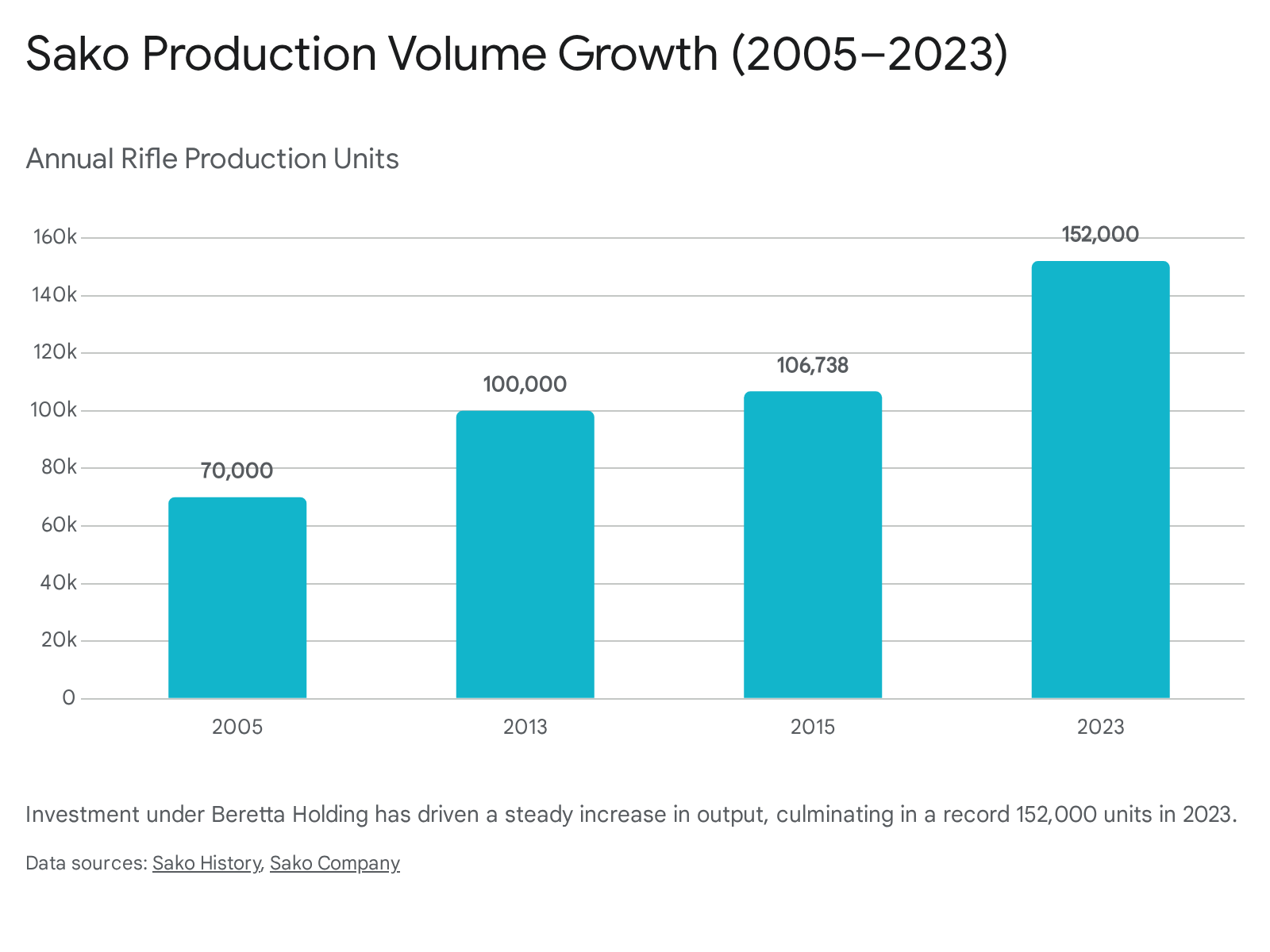
Current industrial output at the Riihimäki facility has reached historic highs, surpassing 152,000 rifles annually as of 2023. This growth is driven by a dual-brand strategy: Tikka dominates the high-volume, mid-tier market with the T3x platform, while Sako retains the premium segment with the new 90 and 100 series. Simultaneously, the geopolitical realignment of the Nordics following the Russian invasion of Ukraine has catalyzed a renaissance in Sako’s defense division. The joint procurement of the Sako M23 and Arctic Rifle Generation (ARG) systems by Finland and Sweden marks a definitive shift away from Soviet-legacy weaponry toward NATO interoperability, securing Sako’s order book through the mid-21st century.
1. Strategic Origins: The Civil Guard and National Defense (1919–1944)
The genesis of Sako is inextricably linked to the turbulent formation of the independent Finnish state. The strategic imperative that drove its founding—the need for domestic self-sufficiency in small arms—remains a core tenet of its corporate identity today.
1.1 The Supreme Staff Gun Works: Necessity as the Mother of Invention
Following the Finnish Civil War of 1918, the newly independent nation faced a critical logistical crisis. The White Guard (Civil Guard), a voluntary militia that formed the backbone of national defense, possessed a vast but dilapidated arsenal of Russian Mosin-Nagant Model 1891 rifles captured during the conflict. These weapons, while robust, varied wildly in tolerance and condition. The young nation lacked the industrial base to manufacture new rifles from scratch, necessitating a strategy of refurbishment and standardization.
In 1919, the Civil Guard General Staff established a dedicated repair workshop in the granite casemates of the former Russian naval fortress in Helsinki.1 This facility was not initially a factory in the modern sense but an armory focused on repair and re-barreling. The operation was formalized as a separate financial entity on April 1, 1921, marking the company’s official founding date. The name Suojeluskuntain Ase- ja Konepaja Osakeyhtiö (Civil Guard Gun and Machining Works Ltd) was quickly abbreviated to the acronym Sako, a brand that would eventually outlive the organization that spawned it.2
The early industrial philosophy was defined by hybridization. Sako’s engineers, led by the legendary Oskar Päärnä, realized that while the Russian Mosin receiver was sound, the barrels and sights were inadequate for Finnish marksmanship standards. Sako began importing high-quality barrel blanks from Switzerland (SIG) and Germany, machining them to tighter tolerances, and mating them to the Russian actions. This process birthed the M/28-30 “Pystykorva” (Spitz), a rifle that achieved mythical status in Finnish military history.1 The M/28-30 was not merely a refurbished weapon; it was a re-engineered system featuring a heavier barrel, improved sights, and a tuned two-stage trigger. It was with a Sako M/28-30 that Simo Häyhä, the world’s deadliest sniper, recorded over 500 confirmed kills during the Winter War, cementing the brand’s reputation for extreme accuracy under arctic conditions.
1.2 Relocation to Riihimäki: Strategic Industrial Zoning
By the late 1920s, the strategic vulnerability of a munitions factory located in the capital city became apparent. In a move driven by defense logistics, the company relocated in 1927 to Riihimäki, a railway hub in southern Finland.4 This location offered excellent logistical connections to the rest of the country while being sufficiently removed from the immediate coast to offer some strategic depth. The Riihimäki facility remains Sako’s global headquarters and primary manufacturing site to this day, a testament to the foresight of that early decision.
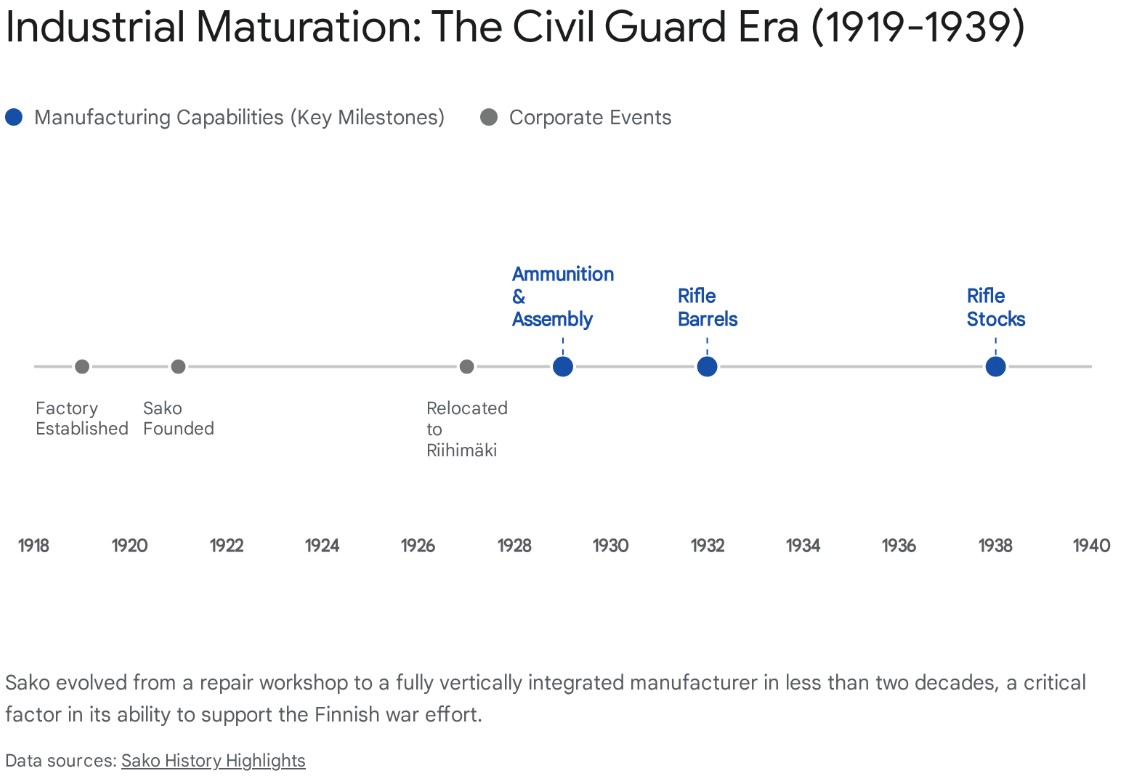
The move to Riihimäki catalyzed vertical integration. The company ceased to be merely an assembly shop.
- 1929: Ammunition manufacturing commenced. This was a critical development, as it allowed Sako to control the entire accuracy equation—rifle and cartridge—simultaneously.4
- 1932: The manufacturing of rifle barrels began in-house, reducing reliance on foreign suppliers like SIG.4
- 1938: Stock manufacturing capabilities were added, making Sako a fully independent firearms manufacturer.4
1.3 The Crucible of War (1939–1945)
During the Winter War (1939–1940) and the Continuation War (1941–1944), Sako operated at maximum capacity. The factory produced over 275 million machine gun cartridges and vast quantities of refurbished rifles for the Finnish Defence Forces.4 This period forged the company’s internal culture: a necessity-driven focus on absolute functional reliability. For Sako’s workforce, quality control was not an abstract concept; the end-users were their fathers, brothers, and sons on the Karelian Isthmus. This “survivalist quality” ethos persists in the company’s marketing and engineering narratives today.
2. The Post-War Pivot: Survival, Innovation, and the American Frontier (1945–1960)
The conclusion of World War II posed an existential threat to Sako. The Paris Peace Treaties demanded the disbandment of the Civil Guard, Sako’s owner and primary customer. Furthermore, the Soviet Union imposed heavy war reparations on Finland, threatening the seizure of industrial assets.
2.1 The Red Cross Anomaly and Emergency Production
In a brilliant maneuver of corporate obfuscation, ownership of Sako was transferred to the Finnish Red Cross in 1945.2 This transfer was designed to shield the company from Soviet appropriation—seizing the assets of a humanitarian organization would have been a diplomatic faux pas even for the USSR. Under Red Cross ownership, Sako entered a “survival mode.” With weapons production strictly curtailed, the factory utilized its precision metalworking machinery to produce consumer goods needed for national reconstruction: lipstick cases, weaving looms, and cigarette lighters.2 This period demonstrated the company’s industrial flexibility, a trait that would later allow it to adapt to shifting market trends.
2.2 The L46 and the “Mini-Mauser” Niche
While manufacturing lipstick cases kept the lights on, Sako’s engineers, led by Eino Mäkinen, were secretly developing the company’s future. They recognized that post-war Europe and America would see a boom in sport hunting. However, most sporting rifles of the era were sporterized military surplus (heavy, long actions) or expensive custom builds.
Sako identified a “Blue Ocean” strategy: a miniature bolt action scaled specifically for small cartridges. The result was the L46 (Luodikko 1946).5
- Engineering Nuance: Unlike competitors who utilized a standard.30-06 length action for smaller rounds (resulting in unnecessary weight and bolt travel), the L46 was dimensionally scaled to the 7x33mm Sako cartridge.5 This cartridge itself was an innovation, developed from 9x19mm Parabellum brass to bypass restrictions on military calibers while providing a suitable round for Capercaillie and Black Grouse hunting—critical food sources in rationing-era Finland.
- Market Impact: The L46 was petite, lightweight, and exquisitely finished. It didn’t just fill a gap; it created a new category of “Varmint” rifles.
2.3 The American Breakthrough: Firearms International and Garcia
The 1950s marked the era of globalization for Sako. The company secured distribution in the United States, initially through Firearms International and later the Garcia Corporation.6 The timing was fortuitous; the U.S. economy was booming, and a culture of “wildcatting” and precision varmint hunting was taking hold.
- The Vixen (L461): Introduced in 1961, this refined small action became the gold standard for the.222 Remington and.223 Remington cartridges.5 Its “mythical status” among American shooters was driven by its adjustable trigger and integral scope mounting rails—features that were often expensive aftermarket additions on American domestic rifles.
- The Forester (L579): Launched in 1957, this medium action catered to the burgeoning.308 Winchester and.243 Winchester market.5
- The Finnbear (L61R): The 1961 introduction of the long-action Finnbear allowed Sako to compete in the heavy game sector with calibers like.30-06 and.375 H&H.5
By 1953, sales in the United States exceeded domestic sales in Finland.6 This was a pivotal moment: Sako had successfully transformed from a national arsenal into an export-driven commercial entity. The success in the U.S. insulated Sako from the limited size of the Nordic market and provided the capital necessary for continued R&D.
3. The Era of Conglomerates: Nokia, Tikkakoski, and Valmet (1960–1999)
The mid-20th century saw a wave of industrial consolidation in Finland. Sako ceased to be an independent entity and became a division within larger, multi-industry conglomerates. This era was characterized by a tension between financial stability and a lack of strategic focus from ownership.
3.1 The Nokia Ownership (1967–1999)
In 1962, Suojeluskuntain Ase- ja Konepaja Osakeyhtiö was acquired by Suomen Kaapelitehdas (Finnish Cable Works). When Cable Works merged with Finnish Rubber Works and Nokia Ab to form the Nokia Corporation in 1967, Sako became a division of the new industrial giant.1
Under Nokia, Sako experienced periods of benign neglect interspersed with strategic confusion. The 1960s were profitable due to Finnish Defence Force orders for assault rifles, but the 1970s brought financial strain as military contracts waned and the U.S. dollar fluctuated. Nokia, whose leadership was increasingly focused on electronics and telecommunications, viewed Sako as a non-core asset. Jorma Ollila, Nokia’s transformative CEO in the 1990s, famously described Sako as a “sideline” that distracted from the mobile phone mission.8
3.2 The Tikkakoski Merger (1983): Consolidating the Domestic Base
A definitive moment in Finnish firearms history occurred in 1983 when Nokia acquired Tikkakoski Oy, Sako’s primary domestic rival.4 Tikkakoski, famous for its sewing machines and the “Tikka” brand of firearms, was historically the “Ford” to Sako’s “BMW.”
- Strategic Rationalization: The merger, finalized as Oy Sako-Tikka Ab, allowed for massive industrial rationalization. In 1989, production at the Tikkakoski factory was terminated, and all machinery and personnel were moved to Sako’s Riihimäki plant.4
- Brand Stratification: This merger birthed the modern dual-brand strategy. Sako positioned the Tikka brand as a value-oriented, entry-level premium option. By utilizing simpler manufacturing techniques (like a polymer trigger guard and a non-integral recoil lug) for Tikka, Sako could capture the high-volume market without diluting the prestige of the main Sako line. This strategy would eventually result in the Tikka T3, one of the best-selling rifles in history.
3.3 The Valmet Merger and State Consolidation
In 1986, the Finnish state-owned Valmet (VKT) merged its firearms division with Sako, creating Sako-Valmet Oy, owned 50/50 by Nokia and Valmet.3 This was a “shotgun wedding” orchestrated to save the Finnish small arms industry. Valmet brought with it the production of the Rk 62 (the Finnish AK-47 variant), consolidating all domestic military production under one roof.
However, the marriage was short-lived. By 1999, Nokia divested its shares to focus entirely on mobile technology. Valmet (later Metso) briefly held 100% ownership but had no long-term interest in the firearms business.4 At the turn of the millennium, Sako was a profitable, high-quality manufacturer essentially “orphaned” by its corporate parents.
4. The Beretta Acquisition: Globalization and Modernization (2000–2010)
The year 2000 marked the most significant structural change in Sako’s recent history. Metso Oyj sold 100% of Sako shares to Beretta Holding B.V., the Italian dynasty that traces its firearms manufacturing lineage back to 1526.1
4.1 Strategic Synergy: Capital Meets Craft
Unlike Nokia or Metso, Beretta was a dedicated firearms company. The acquisition was highly synergistic:
- Portfolio Complementarity: Beretta was a global leader in shotguns and handguns (Beretta 92, 686 Series) but lacked a world-class bolt-action rifle brand. Sako filled this gap perfectly.
- Global Distribution: Sako gained immediate access to Beretta’s massive global distribution network, particularly the powerful Beretta USA subsidiary. This removed the need for third-party importers (like Garcia or Stoeger), allowing Sako to capture more margin and control its brand narrative in North America.8
- Capital Injection: Beretta invested heavily in the Riihimäki facility. In 2001, a 2,000 m² expansion was initiated, followed by a multi-year investment program (2006–2010) to automate production using advanced CNC machinery.4 This investment transformed Sako from a large workshop into a modern industrial plant capable of high-volume precision manufacturing.
4.2 The “Single Factory” Advantage
Under Beretta, Sako’s unique operational model was preserved. Sako remains one of the only major manufacturers in the world to produce both rifles and ammunition in the same facility.2 This allows for a closed-loop quality control system. Rifle barrels are batch-tested using Sako ammunition, and new cartridge loads (like the Sako Hammerhead) are developed using Sako barrels. This synergy is a key marketing differentiator, allowing Sako to guarantee accuracy (typically 5-shot MOA) when using their own systems.
5. Modern Commercial Dominance: The Rifle Portfolio (2011–Present)
Sako’s current commercial strategy relies on a sophisticated segmentation of the market. The portfolio is divided into the high-volume/utility segment (Tikka) and the luxury/innovation segment (Sako).
5.1 Tikka: The Democratization of Precision
The Tikka T3 (2002) and its successor the T3x (2016) are arguably the most commercially important products in Sako’s history.10 The T3 broke the “quality costs money” paradigm. By designing the receiver for ease of manufacture (broached rather than milled, with a separate steel recoil lug), Sako could sell a rifle that shot sub-MOA out of the box for under $800.
The T3x addressed the few complaints of the original T3 (plastic bolt shroud, recoil lug deformation) and has become a dominant force in the U.S. market. It also serves as the base for the Tikka T1x rimfire, allowing Sako to dominate the growing NRL22 (precision.22LR competition) market.11 The selection of the Tikka T3 as the C19 Ranger Rifle for the Canadian Rangers further validated the platform’s reliability in extreme conditions.10
5.2 The Evolution of the Sako Flagship: 75, 85, and 90
While Tikka pays the bills, the Sako brand carries the prestige. The lineage of the flagship Sako bolt action demonstrates a consistent philosophy of refinement:
- Sako 75 (1996): The first “modern” Sako, featuring a 3-lug bolt (allowing a short 60-degree throw) and a detachable magazine. This model saved the company during the difficult 1990s.4
- Sako 85 (2006): Refined the 75 with “Controlled Round Feeding” (CRF) features and the “Total Control Latch” magazine system to prevent accidental loss. It became the benchmark for premium production rifles.4
- Sako 90 (2023): The current flagship. It represents an engineering evolution focused on receiver rigidity and customization. The Sako 90 utilizes a broached receiver (improving torsional strength) and offers specialized carbon-fiber variants (Sako 90 Peak, Quest). It simplified the magazine latch system and introduced distinct action sizes for every caliber group—a manufacturing complexity most competitors avoid to save costs.12
5.3 The Sako 100: A Centennial Statement
To commemorate its 100th anniversary, Sako launched the Sako 100 in 2022/2023.13 This rifle targets the ultra-premium European market, competing directly with the Blaser R8.
- Technical Innovation: The Sako 100 features a switch-caliber design where the optic mounts to the barrel, not the receiver. This allows a hunter to swap a.243 Win barrel for a.375 H&H barrel in minutes without losing zero.14 It is a statement product, showcasing that Sako can compete at the highest tier of gunsmithing.
5.4 The S20: The Hybrid Concept
In 2020, Sako released the S20, a “hybrid” rifle designed to bridge the gap between traditional hunting stocks and modern tactical chassis systems. It features an internal aluminum chassis covered by interchangeable polymer “skins” (Hunter or Precision).16 This design acknowledges the changing demographics of hunters, many of whom are now coming from a precision shooting background and demand ergonomic adjustability (vertical grips, adjustable cheek risers) previously absent on hunting rifles.
6. The Defense Renaissance: NATO and the Arctic (2020–Future)
While Sako is renowned for hunting rifles, its defense sector has seen a massive resurgence in the 2020s. This shift is driven by the Russian invasion of Ukraine, Finland’s accession to NATO, and the need to replace aging Cold War-era weaponry.
6.1 The TRG Sniper Lineage
The TRG series has long been the standard-bearer for Sako’s military capability.
- TRG-22/42 (1999): These rifles became the standard sniper systems for nations ranging from Italy to Switzerland. Unlike modified hunting rifles (e.g., Remington 700), the TRG was designed from the ground up as a military tool, featuring a monolithic chassis and extreme durability.18
- TRG M10 (2011): A response to the US SOCOM PSR solicitation, the M10 is a modular, multi-caliber system capable of switching between.308 Win,.300 Win Mag, and.338 Lapua Mag. It represents the pinnacle of Sako’s sniper technology.18
6.2 The M23 and ARG: A Geopolitical Pivot
The most significant recent development is the joint procurement agreement between the Finnish Defence Forces (FDF) and the Swedish Armed Forces. For decades, Finland relied on the Rk 62/95 (an AK-47 derivative) due to the availability of captured ammunition and the system’s reliability. However, NATO membership necessitates a shift to standard NATO calibers (5.56 and 7.62).
- Sako M23: Adopted in 2022, this is a designated marksman rifle (DMR) based on the AR-10 platform (7.62 NATO). It replaces the aging Dragunov SVD and bolt-action Tkiv 85 in Finnish service.19 The choice of an AR-10 platform signals a definitive break from the “Eastern” doctrine of the past century.
- Arctic Rifle Generation (ARG): Launched in August 2025, the ARG is the future of Nordic infantry small arms. It is an AR-15 based platform (5.56 NATO) designed to replace the Swedish Ak 5 and potentially the Finnish Rk 62.
- The “Arctic” Differentiator: Standard AR-15s can struggle in extreme cold (gas tubes freezing, tight tolerances seizing). The ARG is engineered with specific metallurgy and gas system tuning (available in both Short Stroke Piston and Direct Impingement) to pass NATO D14 arctic standards.21
- Strategic Significance: The joint framework agreement allows both Sweden and Finland to procure these weapons under a single contract through 2053.23 This creates a massive, long-term revenue stream for Sako that is independent of consumer market fluctuations.
7. Industrial & Financial Analysis
Sako’s transformation into an industrial powerhouse is quantified by its output and operational efficiency.
7.1 Production Metrics
From a modest output of 70,000 rifles in 2005, Sako has more than doubled its capacity, producing 152,000 rifles in 2023.24 This growth has been achieved without sacrificing the “Sako Standard.” The factory runs 24/7 in three shifts to meet global demand, particularly from the U.S. civilian market and the new military contracts. The workforce has grown to 435 specialized employees, making it a major employer in the Kanta-Häme region.24
7.2 Sustainability and “Green” Ammunition
As part of Beretta Holding, Sako is aggressive in its sustainability targets. A critical initiative is the transition to lead-free ammunition. The Sako Powerhead Blade (introduced 2020) is a monolithic copper bullet designed to perform like lead without the environmental toxicity.25 With the European Union tightening regulations on lead in wetlands and hunting, Sako’s early pivot to premium copper ammunition positions it ahead of competitors who are reacting slowly to the regulatory landscape. The Riihimäki factory itself is undergoing upgrades to reduce CO2 emissions, aligning with Beretta’s “BePlanet” sustainability roadmap.26
7.3 Financial Health
While Beretta Holding does not break out Sako’s individual profits in public reports, the conglomerate reported €1.4 billion in revenue in 2022, with Sako being a “key pillar” of this success.27 The integration of RUAG Ammotec (acquired by Beretta in 2022) provides further synergies, as Sako can now leverage a wider European supply chain for primer and powder components, insulating it from supply shocks.27
8. Future Outlook: 2025 and Beyond
The future for Sako appears exceptionally robust, anchored by three pillars:
- The U.S. Commercial Market: The launch of the Sako 90 Finnlight in 2025 targets the lucrative North American backcountry hunting market. Sako is aggressively positioning itself against high-end semi-custom makers (like Christensen Arms or Proof Research) by offering factory rifles with similar performance at a lower price point and higher reliability.28
- Long-Term Defense Contracts: The framework agreement with Sweden and Finland provides a guaranteed baseline of production for the next 30 years. The potential for the ARG platform to be adopted by other NATO allies operating in cold climates (e.g., Norway, Canada, Estonia) represents a significant growth vector.
- Technological Innovation: Sako continues to push the boundaries of materials science with carbon fiber stocks (Sako 90 Quest) and advanced metallurgy. The “digitalization” of the hunting experience—integrating rifles with ballistic apps and smart optics (via the Beretta alliance with Steiner)—is a likely future frontier.
9. Comprehensive Milestone Table
The following table summarizes the century-long evolution of Sako, highlighting the convergence of corporate strategy, product innovation, and geopolitical necessity.
| Year | Event | Significance |
| 1919 | Civil Guard Workshop established | Precursor to Sako; repair of Mosin-Nagants. |
| 1921 | Sako Founded (April 1) | Independent financial entity established in Helsinki. |
| 1927 | Relocation to Riihimäki | Establishment of the current headquarters and main factory. |
| 1929 | Ammunition & “Pystykorva” assembly | Beginning of rifle assembly and cartridge production. |
| 1932 | Barrel Manufacturing Begins | Vertical integration step; independence from foreign steel. |
| 1939 | Wartime Production | Critical supplier for Finnish forces during Winter War. |
| 1945 | Ownership to Red Cross | Post-war survival strategy; shift to civilian goods. |
| 1946 | L46 Rifle Launched | First civilian Sako rifle; entry into sporting market. |
| 1950s | Entry into U.S. Market | Exports exceed domestic sales; brand globalizes. |
| 1962 | Acquired by Cable Works | Beginning of corporate consolidation. |
| 1967 | Acquired by Nokia | Sako becomes part of the Nokia industrial group. |
| 1983 | Merger with Tikkakoski | Acquisition of the “Tikka” brand; consolidation of domestic rivals. |
| 1987 | Merger with Valmet | Formation of Sako-Valmet; integration of RK assault rifle tech. |
| 1989 | Tikka Production Moves | Riihimäki becomes the sole manufacturing hub. |
| 1996 | Sako 75 Launched | First modern, ground-up Sako design; major success. |
| 1999 | Nokia divestment | Nokia sells shares; Valmet (Metso) takes temporary ownership. |
| 2000 | Acquired by Beretta Holding | Strategic sale to Italian firearms giant; access to global capital. |
| 2002 | Tikka T3 Launched | Revolutionized the budget-performance rifle market. |
| 2006 | Sako 85 Launched | Successor to the 75; solidified premium market position. |
| 2011 | TRG M10 Launched | Modular multi-caliber sniper system for special forces. |
| 2020 | Sako S20 Launched | First “Hybrid” rifle (chassis/stock modularity). |
| 2022 | Finland/Sweden Joint Procurement | Framework agreement for Sako M23 and ARG military systems. |
| 2023 | Sako 90 & 100 Launched | New flagship hunting rifles; Sako 100 features switch-barrel tech. |
| 2025 | ARG Launch | “Arctic Rifle Generation” enters service; Sako 90 Finnlight released. |
If you find this post useful, please share the link on Facebook, with your friends, etc. Your support is much appreciated and if you have any feedback, please email me at in**@*********ps.com. Please note that for links to other websites, we are only paid if there is an affiliate program such as Avantlink, Impact, Amazon and eBay and only if you purchase something. If you’d like to directly contribute towards our continued reporting, please visit our funding page.
Works cited
- Sako Ltd’s History highlights by Decade, accessed December 21, 2025, https://www.sako.global/article/sako-history-highlights-by-decade
- Traditional Finnish firearms manufacturer Sako turns 100 – PR Newswire, accessed December 21, 2025, https://www.prnewswire.com/news-releases/traditional-finnish-firearms-manufacturer-sako-turns-100-301258456.html
- SAKO – Wikipedia, accessed December 21, 2025, https://en.wikipedia.org/wiki/SAKO
- Sako’s History highlights by Year, accessed December 21, 2025, https://www.sako.global/article/sako-history-highlights-by-year
- Sako Serial Number by Year and Chambering List – The Hunter’s Life Forums, accessed December 21, 2025, https://forum.thehunterslife.com/index.php?topic=14777.0
- Finnish Firearms Manufacturer Sako Turns 100 – Petersen’s Hunting, accessed December 21, 2025, https://www.petersenshunting.com/editorial/finnish-firearms-manufacturer-sako-turns-100-anniversary-/390372
- One hundred years of Sako rifles – All4Shooters.com, accessed December 21, 2025, https://www.all4shooters.com/en/shooting/culture/one-hundred-years-of-sako-rifles/
- Sako Importer History – Sako Collectors Club Discussion Forum, accessed December 21, 2025, https://sakocollectors.com/forum/threads/sako-importer-history.4115/
- Tikkakoski legacy – Sako Ltd company story, accessed December 21, 2025, https://www.sako.global/article/tikkakoski-legacy-company-story
- Tikkakoski (Tikka) History highlights by Year – Sako, accessed December 21, 2025, https://www.sako.global/article/tikkakoski-history-highlights-by-year
- Sako « Daily Bulletin, accessed December 21, 2025, https://bulletin.accurateshooter.com/tag/sako/
- Sako launches the new Sako 90 hunting rifle series, accessed December 21, 2025, https://www.sako.global/article/new-sako-90-hunting-rifle-series
- Sako 100, accessed December 21, 2025, https://www.sako.global/series/sako-100
- Sako 100 Explorer, accessed December 21, 2025, https://www.sako.global/rifle/sako-100-explorer
- Sako Model 100 Unboxing Review – YouTube, accessed December 21, 2025, https://www.youtube.com/watch?v=t3GLw3lud14
- Sako S20 – Wikipedia, accessed December 21, 2025, https://en.wikipedia.org/wiki/Sako_S20
- Review: Sako’s Modular S20 | An Official Journal Of The NRA – American Rifleman, accessed December 21, 2025, https://www.americanrifleman.org/content/review-sako-s-modular-s20/
- Sako TRG – Wikipedia, accessed December 21, 2025, https://en.wikipedia.org/wiki/Sako_TRG
- Defence Forces to procure new rifle systems and intensify cooperation with Sweden, accessed December 21, 2025, https://defmin.fi/en/-/defence-forces-to-procure-new-rifle-systems-and-intensify-cooperation-with-sweden
- Sako M23 – Wikipedia, accessed December 21, 2025, https://en.wikipedia.org/wiki/Sako_M23
- Sako ARG: Arctic Rifle Generation assault rifles based on the AR-15 platform for use in arctic conditions | all4shooters, accessed December 21, 2025, https://www.all4shooters.com/en/shooting/pro-zone/sako-arg-40-gp-arg-40-di-and-arg-50-gp-new-assault-rifle-details-backgrounds/
- SAKO Launches Arctic Rifle Generation (ARG): A New Era in Military Rifle Systems, accessed December 21, 2025, https://soldiersystems.net/2025/08/25/sako-launches-arctic-rifle-generation-arg-a-new-era-in-military-rifle-systems/
- Finnish and Swedish Defence Forces to acquire a joint range of firearms from Sako Ltd, accessed December 21, 2025, https://www.sako.global/article/finnish-and-swedish-defence-forces-to-acquire-a-joint-range-of-firearms
- Sako Company, accessed December 21, 2025, https://www.sako.global/company
- Information About Saudi Green Initiative, accessed December 21, 2025, https://www.sgi.gov.sa/about-sgi/
- Environmental Sustainability at Beretta | BePlanet Project, accessed December 21, 2025, https://www.beretta.com/en/company/sustainability/environment
- Beretta Holding: Strategic Investments Boost Financial Results, accessed December 21, 2025, https://berettaholding.com/beretta-holding-strategic-investments-boost-impressive-financial-results/
- We Review the New Sako Finnlight 90 – North American Outdoorsman, accessed December 21, 2025, https://northamerican-outdoorsman.com/sako-finnlight-90/