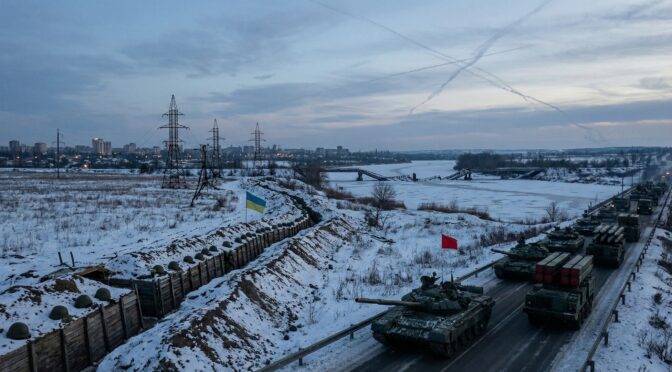
DATES: January 17 – 24th, 2026
1. STRATEGIC OVERVIEW
The reporting period ending January 24, 2026, marks a pivotal and highly volatile juncture in the nearly four-year Russia-Ukraine conflict. The strategic landscape is currently defined by a “fight-and-talk” dynamic, where intensified kinetic operations are being leveraged to shape the parameters of nascent, high-stakes diplomatic engagements. This week witnessed the convergence of three critical vectors: the commencement of unprecedented trilateral peace negotiations in Abu Dhabi, a massive Russian escalation in the strategic air campaign targeting Ukraine’s crumbling energy infrastructure, and a grinding intensification of positional warfare in the Donbas.
For the first time since the onset of full-scale hostilities in February 2022, senior representatives from the United States, Russia, and Ukraine convened simultaneously, signaling a potential shift from indirect signaling to direct, albeit contentious, dialogue.1 However, the synchronization of these talks with Russia’s largest missile barrage of the year against Kyiv and Kharkiv underscores a Kremlin strategy of “coercive diplomacy”—utilizing terror and infrastructure degradation to force capitulation on territorial demands before any ceasefire can be formalized.3
Strategically, the conflict has moved beyond a stalemate into a phase of acute attritional pressure. Russia is exploiting its material advantages to push for maximalist aims encapsulated in the “Anchorage Formula,” demanding the cession of the entire Donbas region.5 Conversely, Ukraine, fortified by a renewed US diplomatic push under the “20-Point Peace Plan,” remains steadfast in its refusal to trade sovereignty for a pause in fighting, even as its energy generation capacity plummets to critical levels.6 The operational tempo has not slackened; rather, it has adapted, with both sides institutionalizing drone warfare and electronic contestation to a degree that fundamentally alters the doctrine of modern combat.
The following report provides an exhaustive analysis of these developments, integrating intelligence on diplomatic maneuvering, kinetic operations, force generation, and economic warfare to provide a holistic assessment of the conflict’s trajectory.
2. DIPLOMATIC DYNAMICS: THE ABU DHABI PROCESS & COMPETING FRAMEWORKS
The diplomatic domain this week was characterized by a flurry of high-level activity moving from the World Economic Forum in Davos to bilateral meetings in Moscow, culminating in the trilateral summit in Abu Dhabi. This sequence of events represents the most significant diplomatic intervention by the United States since the war’s inception, driven by the Trump administration’s accelerated timeline for conflict resolution.
2.1 The Trilateral Engagement in Abu Dhabi
On January 23 and 24, 2026, delegations from the United States, Russia, and Ukraine met in the United Arab Emirates. The choice of venue—Abu Dhabi—highlights the rising prominence of Gulf states as mediators capable of maintaining dialogue with all belligerents.1
Delegation Composition and Strategic Signaling
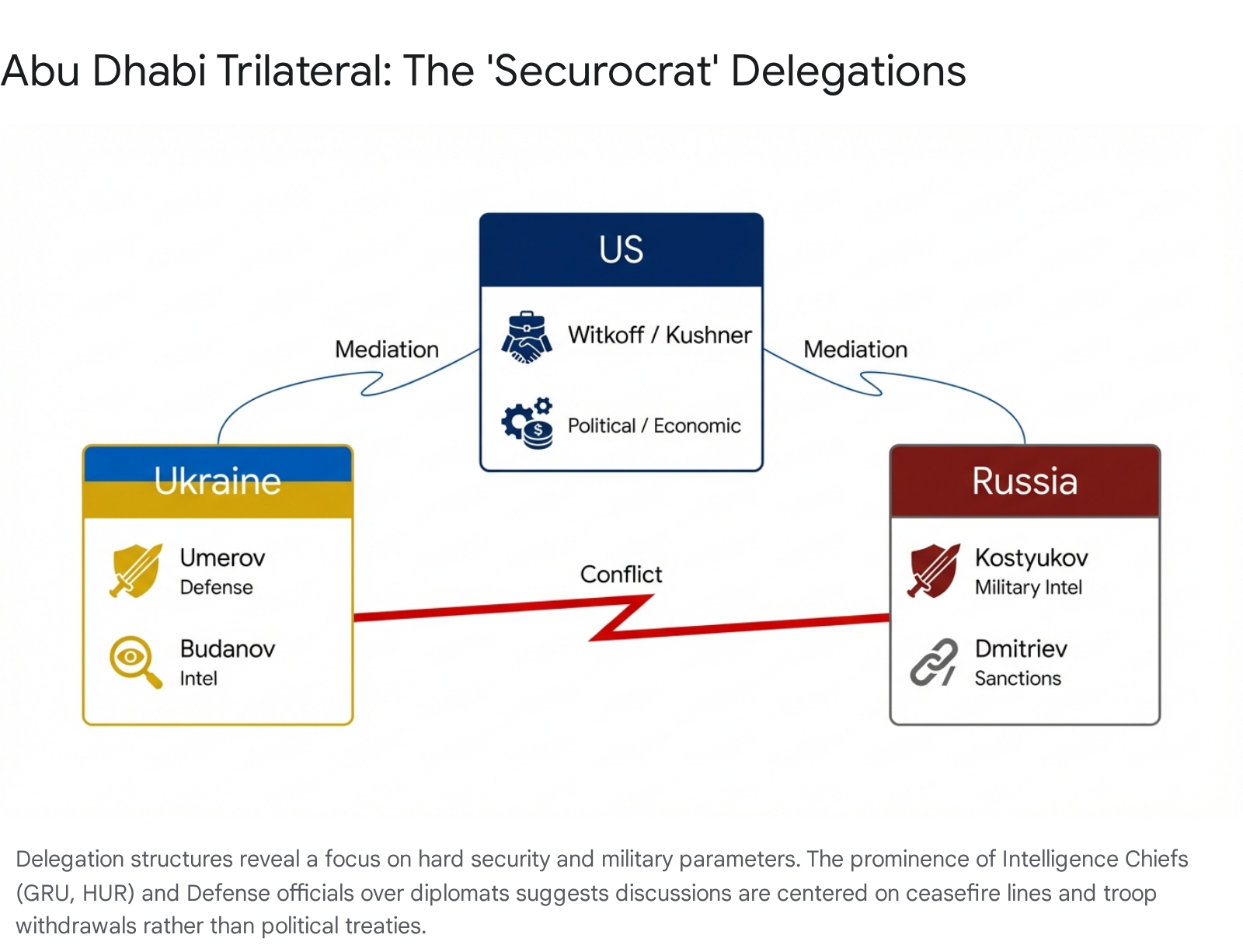
The composition of the respective delegations offers deep insight into the substantive focus of the negotiations. Unlike traditional diplomatic summits led by Foreign Ministers, this engagement was dominated by security, intelligence, and “special envoy” figures, indicating a focus on “hard” security parameters—ceasefire lines, demilitarized zones, and enforcement mechanisms—rather than broad political normalization.
- United States Delegation: The US team was led by Special Envoy to the Middle East Steve Witkoff and former Senior Advisor Jared Kushner, accompanied by Josh Gruenbaum, a senior advisor to the newly formed “Board of Peace”.7 The reliance on Kushner and Witkoff, rather than career diplomats from the State Department, underscores the personalized nature of the Trump administration’s foreign policy and a desire to bypass traditional bureaucratic channels to achieve a rapid deal. Their presence signals that Washington views this not merely as a regional security issue but as a component of a broader geopolitical realignment.9
- Russian Delegation: Moscow dispatched a highly militarized delegation led by Admiral Igor Kostyukov, head of the Main Directorate of the General Staff (GRU).2 The decision to send the GRU chief—responsible for military intelligence and special operations—rather than a diplomat like Sergey Lavrov represents a clear signal: Russia views these talks through a strictly military-strategic lens. The presence of Kirill Dmitriev, CEO of the Russian Direct Investment Fund (RDIF), indicates that sanctions relief and the unfreezing of assets are Russia’s primary non-military objectives.9
- Ukrainian Delegation: Kyiv matched the securitized nature of the talks. The delegation was headed by Defense Minister Rustem Umerov and included Intelligence Chief Kyrylo Budanov (HUR), Chief of the General Staff Major General Andriy Hnatov, and SBU First Deputy Head Oleksandr Poklad.7 This lineup confirms that Ukraine is prioritizing the immediate survival of its state and armed forces, focusing discussions on security guarantees and the mechanics of any potential armistice.
Outcomes and Assessments While US officials characterized the initial rounds as “productive,” no concrete breakthrough was achieved regarding the core territorial disputes.11 The talks extended into a second day on January 24, even as Russian missiles struck Kyiv, a dichotomy that Ukrainian officials labeled as cynical sabotage.1 The primary friction point remains Russia’s demand for total control over the Donbas, a condition Kyiv views as existential capitulation.
2.2 The “Anchorage Formula” vs. The “20-Point Plan”
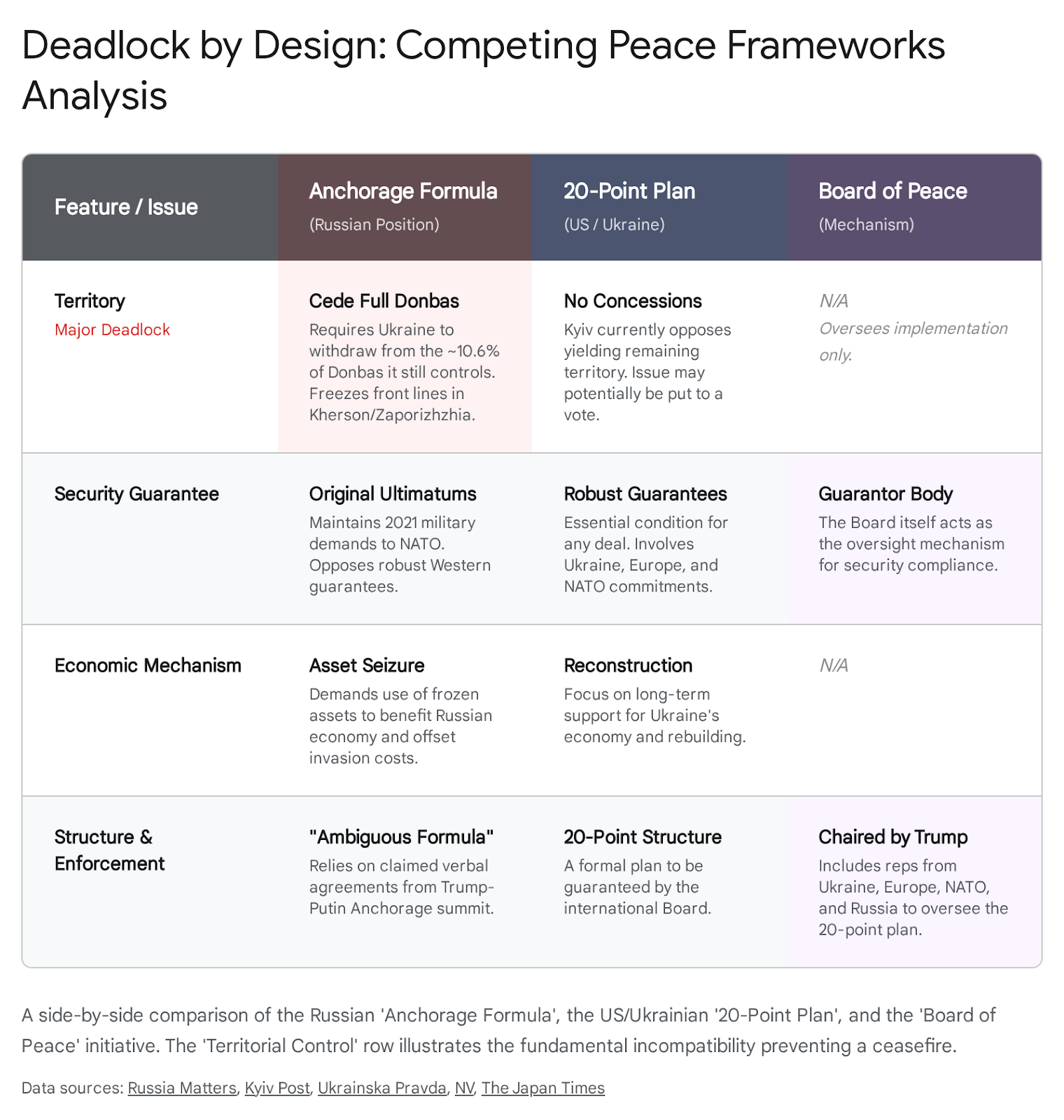
The negotiations are currently deadlocked between two competing frameworks. Understanding the nuance of these frameworks is critical to assessing the probability of a ceasefire.
The Russian “Anchorage Formula” Throughout the week, Kremlin aides Yuri Ushakov and Dmitry Peskov repeatedly referenced the “Anchorage Formula,” a set of demands allegedly derived from a summit between Donald Trump and Vladimir Putin in Alaska in August 2025.5
- Core Demand: The surrender of the entirety of the Donbas (Donetsk and Luhansk oblasts) to Russia.
- Territorial Implications: This would require Ukrainian forces to voluntarily withdraw from key industrial strongholds they currently hold, including Kramatorsk, Slovyansk, and Pokrovsk. These areas represent approximately 10.6% of the Donbas (roughly 2,187 square miles or 5,000 sq km) that Russia has failed to capture militarily after four years of high-intensity warfare.5
- Strategic Rationale: Moscow frames this as a prerequisite for “demilitarization” and establishing a defensible line of control. By labeling it the “Anchorage Formula,” the Kremlin is attempting a psychological operation to lock the US administration into a perceived prior agreement, effectively pressuring Washington to force Kyiv’s compliance or risk collapsing the peace process.12
- Assessment: This is a maximalist demand. Surrendering the industrial heart of the unoccupied Donbas without a fight would be politically fatal for the Zelenskyy administration and would strip Ukraine of its most fortified defensive belts, opening the path to Dnipro.5
The “20-Point Peace Plan” (US/Ukraine) In contrast, the “20-point plan,” an evolution of a previous 28-point draft, represents the framework supported by Ukraine and the US administration.12
- Status: President Zelenskyy described the plan as “90% ready” during his appearance at Davos.14
- Key Elements:
- Territorial Freeze: The plan likely proposes freezing the lines in situ (along the current Line of Contact) rather than demanding Ukrainian withdrawals, creating a de facto partition similar to the Korean scenario.15
- Security Guarantees: Discussion has centered on a 15-year security guarantee from the United States, which would require ratification by the US Congress, providing a binding commitment short of full NATO Article 5 membership.16
- Demilitarized Zones (DMZ): The creation of buffer zones monitored by international peacekeepers. However, Russia has preemptively rejected the presence of European NATO troops.17
- Economic Incentives: The plan includes provisions for a “tariff-free zone” for Ukraine to boost its post-war economic recovery.18
- Implementation Body: Oversight would be managed by a “Board of Peace,” a controversial new international mechanism.14
2.3 The “Board of Peace” Initiative: Structure and Controversy
The “Board of Peace,” championed by the Trump administration, has emerged as a controversial mechanism intended to oversee the implementation of peace deals, not just in Ukraine but globally (including Gaza).
- Structure: The Board is chaired by Donald Trump (designated as a “member for life”), with an Executive Board that includes high-profile figures such as Jared Kushner, Steve Witkoff, former UK Prime Minister Tony Blair, Apollo Global Management CEO Marc Rowan, and World Bank President Ajay Banga.19
- Membership Model: Reports indicate a transactional “pay-to-play” model where permanent seats on the board require a $1 billion contribution, ostensibly to fund reconstruction efforts.21
- Global Reaction: The initiative has received a polarized reception. European allies, notably France and Norway, have rejected joining, viewing the Board as a parallel structure designed to undermine the United Nations Security Council and G7.22 Conversely, over 20 nations, including Israel, Egypt, and Hungary, have reportedly agreed to join.22
- Russian Manipulation: President Putin has expressed interest in Russia joining the Board, cynically proposing to pay the $1 billion fee using frozen Russian assets currently held in the United States.18 This maneuver presents a strategic trap: accepting this payment would implicitly legitimize the use of frozen assets for Russian-directed projects (potentially rebuilding Russian-occupied Donbas) rather than Ukrainian reparations, effectively releasing the funds back into the Russian economic sphere.18
3. OPERATIONAL ASSESSMENT: KINETIC ACTIVITY
While diplomats convened in air-conditioned suites in Abu Dhabi, the operational reality on the ground and in the air over Ukraine degraded significantly. The reporting period saw a marked escalation in Russia’s strategic air campaign and a grinding, relentless pressure on the eastern front.
3.1 Strategic Air Campaign: The “Negotiation” Strikes
The air domain has seen an escalation directly linked to the diplomatic timeline. Russia is executing a campaign of “maximum pressure” on Ukraine’s energy grid to erode civilian morale and leverage negotiating power.
The January 24 Combined Strike Coinciding with the second day of the Abu Dhabi talks, Russia launched one of its most complex strike packages of the year targeting Kyiv and Kharkiv.1
- Scale and Composition: The attack involved approximately 396 aerial targets, a mix of missiles and drones designed to overwhelm air defenses.24 This included a high volume of Shahed-136/131 loitering munitions, Kh-22 anti-ship missiles (launched from Tu-22M3 bombers and known for their devastating inaccuracy against ground targets), and at least two 3M22 Zircon hypersonic cruise missiles.4
- Tactical Significance of Zircon Usage: The deployment of the Zircon, Russia’s premier conventional hypersonic weapon, against Kyiv signifies a high-priority effort to penetrate the Patriot and SAMP-T shields protecting the capital. These missiles are scarce and expensive; their use suggests an intent to guarantee destruction of high-value hardened targets or to send an uninterceptable message to the negotiators.4
- Targeting and Impact: The primary targets were critical energy generation nodes, specifically CHP-5 and CHP-6 (Combined Heat and Power plants) in Kyiv, and the Darnytsia CHP.4 The strikes resulted in one fatality and 18 injuries in Kyiv.1 More critically, they severed power to 800,000 consumers and cut heating to 6,000 apartment blocks in temperatures plummeting to -13°C.4
- Strategic Signal: This “diplomacy by fire” demonstrates that the Kremlin feels no pressure to de-escalate during negotiations. By targeting heating infrastructure in the dead of winter, Moscow is attempting to create a humanitarian catastrophe that forces the Ukrainian government to accept the “Anchorage” terms to save its population.
3.2 Ground Domain: Eastern Theater (Donbas)
The Donbas remains the primary theater of operations, where Russia is employing an “optimized positional warfare” doctrine. This involves the use of small, dispersed infantry groups supported by massive artillery and drone superiority to achieve incremental gains.
Pokrovsk and Kurakhove Sectors The Pokrovsk axis remains the focal point of the Russian offensive. Russian forces are utilizing “infiltration tactics,” sending small teams disguised in captured uniforms or civilian vehicles to bypass Ukrainian strongpoints before larger assault waves follow.26 This sector has seen the highest intensity of combat engagements, with Russian forces advancing near Shevchenko (northwest of Pokrovsk).18
Velyka Novosilka and the Capture of Vremivka A significant tactical shift occurred on January 17 with the Russian capture of Vremivka.27
- Operational Context: Vremivka is located on the southern flank of Velyka Novosilka, a key logistics hub for Ukrainian forces in the southern Donetsk region.
- Implication: The seizure of this village allows Russian forces to threaten the envelopment of Velyka Novosilka from the south, potentially forcing a Ukrainian withdrawal without the need for a costly frontal assault. This aligns with the broader Russian objective of securing the administrative borders of Donetsk Oblast to fulfill the “Anchorage” criteria militarily if diplomacy fails.
3.3 Northern & Southern Fronts
Northeastern Front (Kharkiv/Sumy)
Russia continues to conduct shaping operations along the northern border to pin Ukrainian reserves and stretch air defenses.
- Kupyansk: The battle for Kupyansk has intensified, with Russian sources claiming to be engaged in street fighting in Kupyansk-Vuzhlovyi.29 However, Ukrainian reports indicate that while infiltration attempts are frequent, the city remains under Ukrainian control, though it is being systematically leveled by glide bombs.26
- Sumy Border Incursions: The Russian Ministry of Defense claimed the capture of border villages Hrabovske and Komarivka in Sumy Oblast.30 Intelligence assessment suggests these are likely temporary incursions by Reconnaissance-Sabotage Groups (DRGs) rather than a consolidated occupation. The primary goal is psychological—to create the perception of a widening front and force Ukraine to divert critical units from the Donbas to defend the extensive Sumy border region.29
The Kursk Salient
The Ukrainian incursion into Russia’s Kursk Oblast remains a strategic thorn in the Kremlin’s side.
- Status: Ukraine continues to hold an estimated 600-800 square kilometers of Russian territory.
- Foreign Fighter Involvement: North Korean troops have been heavily committed to the counter-offensive in this sector. Reports estimate 4,000 DPRK casualties in Kursk, indicating distinct command-and-control issues and a reliance on “human wave” tactics to clear entrenched Ukrainian positions.27
- Strategic Value: Kyiv intends to hold this territory as a bargaining chip for the ongoing negotiations—offering to withdraw from Kursk only in exchange for reciprocal Russian withdrawals from occupied Ukrainian lands.
Southern Axis (Kherson) In Kherson, the Dnipro River remains the line of contact. Russia has escalated its terror tactics against the civilian population in Ukrainian-controlled Kherson city. Known as “human safari” tactics, Russian FPV drone operators are actively hunting individual civilians and private vehicles, aiming to depopulate the near-rear areas and disrupt logistics through sheer terror.7
4. FORCE GENERATION AND TECHNOLOGICAL ADAPTATION
Both belligerents are racing to adapt their force structures to the realities of a “transparent battlefield,” where persistent drone surveillance makes massed formations suicidal.
4.1 Ukrainian Defense Reforms and Drone Doctrine
Ministry of Defense Leadership Purge On January 22, Ukrainian Defense Minister Mykhailo Fedorov executed a significant leadership overhaul, dismissing five deputy defense ministers, including Anatoliy Klochko and Oleksandr Kozenko.18
- Analysis: Fedorov, widely recognized for his background in digital transformation, is clearing the “old guard” to streamline procurement and accelerate innovation. The explicit goal stated by the ministry is to strengthen “asymmetric and cyber strikes” capabilities.33 This signals a decisive shift away from Soviet-legacy heavy mechanized warfare doctrine toward a more agile, technology-centric approach that prioritizes unmanned systems and precision strikes.
Institutionalizing Drone Warfare Ukraine has formally established specialized Unmanned Systems Brigades, upgrading units like the 20th Separate Drone Brigade and “Madyar’s Birds” from battalion to brigade status.34
- Doctrine: These units are no longer merely support elements but are now primary maneuver forces. They are capable of denying terrain, halting armored advances, and conducting deep strikes at a fraction of the cost of traditional artillery. The 20th Brigade alone reportedly neutralized over 350 enemy personnel in January using the latest K-2 drone systems.35
4.2 Russian Force Adaptation and Manpower
Light Mobility Tactics Intelligence indicates a shift in Russian tactical mobility. The Russian command is prioritizing the procurement of light motorized vehicles (buggies, ATVs, motorcycles) over heavy Infantry Fighting Vehicles (IFVs) for transporting infantry to the front.18
- Tactical Logic: In a drone-saturated environment, heavy armor is easily spotted and destroyed. Small, fast, dispersed teams on motorcycles have a higher survival rate when closing the “last mile” to Ukrainian trenches. This “Mad Max” style of logistics and assault is a direct adaptation to Ukrainian FPV dominance.
AI and Situational Awareness Reports suggest the Russian military is deploying an AI-enabled “tactical situational awareness system” to the front.18
- Purpose: This system is designed to compensate for the severe degradation in the quality of junior officers (lieutenants and captains). High casualties have decimated the professional officer corps; AI decision-support tools are being introduced to help inexperienced replacements manage complex battlefield geometry and coordinate fire support, attempting to bridge the “competence gap” with technology.
Drone Networking Russian forces are increasingly equipping their drones (specifically Shaheds and FPVs) with Chinese-manufactured mesh networking modules.36 This technology allows swarms of drones to communicate and relay signals to one another, effectively extending their range and allowing them to overcome Ukrainian Electronic Warfare (EW) jamming bubbles by maintaining a signal link through the swarm network rather than a direct line to the operator.
5. ECONOMIC AND MARITIME DOMAINS
The economic war has opened a new front in the Mediterranean, highlighting the West’s belated but escalating enforcement of energy sanctions.
5.1 The Shadow Fleet and Maritime Sanctions
Seizure of the Grinch On January 22, the French Navy intercepted and seized the Russian tanker Grinch in the Mediterranean Sea.37
- Precedent: This operation marks a major escalation in sanctions enforcement. Previously, Western naval powers monitored but rarely physically interdicted “shadow fleet” vessels—aging, uninsured tankers used by Russia to bypass the G7 oil price cap.
- Legal Basis: The seizure was predicated on the vessel flying a “false flag” (claiming Comoros registration improperly) and violating safety regulations.37 This provides a legal veneer for what is effectively a blockade action.
- Strategic Impact: The interception was supported by US and UK intelligence, signaling a coordinated NATO effort to crack down on Russia’s primary revenue stream. If this becomes a pattern, it could significantly raise insurance premiums for Russian cargoes and deter “grey market” shipping operators from carrying Russian oil, constricting the financial lifeline of the war effort.
5.2 Energy Infrastructure and Economic Resilience
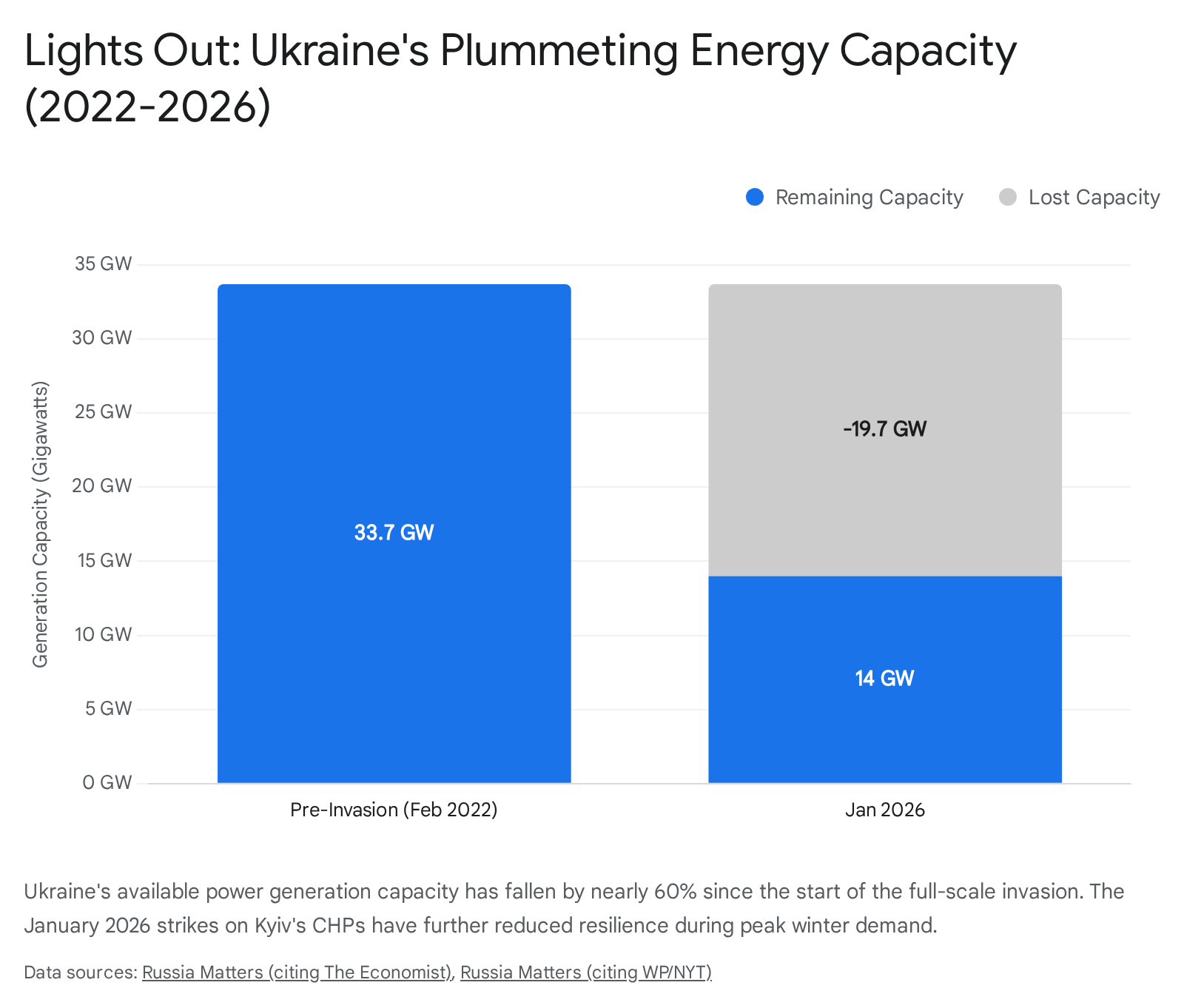
Grid Capacity Crisis The cumulative effect of Russian strikes has been devastating. As of late January 2026, Ukraine’s available power generation capacity has plummeted to approximately 14 GW, down from a pre-war capacity of 33.7 GW.6
- Human Impact: The destruction of substations and distribution nodes has made the grid extremely fragile. The targeting of CHPs (heating) rather than just electricity is a calculated move to make major cities uninhabitable.
- Economic Impact: With capacity halved, industrial output is severely curtailed. The “20-point plan” proposal for a tariff-free zone is an attempt to provide an economic lifeline, but without reliable power, industrial production and reconstruction efforts remain theoretical.
6. GEOPOLITICAL RAMIFICATIONS
6.1 The Axis of Evasion: Russia-Iran-North Korea
Russia continues to deepen its alliances with rogue states to sustain its war machine, though limits are emerging.
- Iran: A “Comprehensive Strategic Partnership” was signed between Vladimir Putin and Iranian President Masoud Pezeshkian on January 17.28 Crucially, intelligence analysis reveals that the agreement lacks a mutual defense clause. This indicates that while military-technical cooperation (drone supply, missile technology transfer) will continue, Tehran is wary of a formal defense pact that could drag it into a direct war with NATO, and Russia currently lacks the bandwidth to guarantee Iran’s security.39
- North Korea: Pyongyang remains Russia’s most reliable source of external manpower. However, the cost is high. With an estimated 4,000 casualties among North Korean troops in the Kursk sector alone, the sustainability of this force is questionable.27 A new deployment of DPRK personnel is expected by mid-March 2026 to backfill these losses and maintain the tempo of infantry assaults.27
6.2 Western Unity and Divergence
The “Board of Peace” initiative has exposed fissures within the Western alliance. While the US administration pushes for this new mechanism, traditional European powers like France and Norway have refused to join, citing its potential to undermine the UN system.22 This divergence complicates the formation of a unified front in negotiations, as Russia can exploit these cracks to drive wedges between Washington and Brussels. The seizure of the Grinch by France, however, demonstrates that on the operational level—sanctions enforcement and military support—European resolve remains hardened.
7. STRATEGIC FORECAST AND INTELLIGENCE OUTLOOK
Near-Term Outlook (1-2 Weeks):
- Diplomatic Stagnation: The Abu Dhabi talks are unlikely to yield a comprehensive ceasefire agreement in the immediate term. The gap between the “Anchorage Formula” (territorial cession) and Ukraine’s sovereignty is currently too wide to bridge. We anticipate a joint statement may be issued focusing on humanitarian corridors or POW exchanges as a “face-saving” measure, but the core conflict will continue unabated.
- Military Intensification: Russia will likely intensify its offensive in the Donbas (Pokrovsk/Velyka Novosilka) to maximize territorial control before the spring thaw (Rasputitsa) hampers mobility. The capture of Vremivka suggests a dangerous enveloping maneuver is developing in the south that could destabilize the Ukrainian defense in Donetsk.
- Strategic Air War: We assess a high probability of follow-on strikes against the Ukrainian energy grid. Russia aims to cause a systemic collapse of the grid during the peak winter freeze (late January/early February) to force the Zelenskyy administration to reconsider the “Anchorage” terms under duress.
Strategic Warning:
The combination of the energy crisis in Ukraine, the “fight-and-talk” diplomatic pressure, and the shifting US political landscape creates a window of extreme vulnerability for Kyiv. The coming weeks will likely determine whether the conflict enters a frozen state along the current line of contact—leaving millions of Ukrainians under occupation—or escalates into a potentially decisive and even more destructive spring campaign.
End of Report
If you find this post useful, please share the link on Facebook, with your friends, etc. Your support is much appreciated and if you have any feedback, please email me at in**@*********ps.com. Please note that for links to other websites, we are only paid if there is an affiliate program such as Avantlink, Impact, Amazon and eBay and only if you purchase something. If you’d like to directly contribute towards our continued reporting, please visit our funding page.
Sources Used
- Russian attacks on Ukraine kill 1 and wound 18 ahead of second day of peace talks, accessed January 24, 2026, https://www.wboc.com/news/international/russian-attacks-on-ukraine-kill-1-and-wound-18-ahead-of-second-day-of-peace/article_ee4092b6-8365-53a8-ad42-a23f73a5181e.html
- Russia keeps up demand for Ukrainian land as three-way talks begin in UAE – The Guardian, accessed January 24, 2026, https://www.theguardian.com/world/2026/jan/23/us-ukraine-russia-abu-dhabi-talks-putin-witkoff-kushner
- Russia-Ukraine war live: Kyiv, Kharkiv come under attack amid peace talks, accessed January 24, 2026, https://www.aljazeera.com/news/liveblog/2026/1/24/live-kyiv-kharkiv-come-under-attack-amid-russia-ukraine-peace-talks
- 88,000 Homes in Kyiv Cut Off as Russia Launches Massive Strikes …, accessed January 24, 2026, https://www.kyivpost.com/post/68693
- Russia in Review, Jan. 16–23, 2026, accessed January 24, 2026, https://www.russiamatters.org/news/russia-review/russia-review-jan-16-23-2026
- The Russia-Ukraine War Report Card, Jan. 21, 2026, accessed January 24, 2026, https://www.russiamatters.org/news/russia-ukraine-war-report-card/russia-ukraine-war-report-card-jan-21-2026
- Russian Offensive Campaign Assessment, January 23, 2026 | ISW, accessed January 24, 2026, https://understandingwar.org/research/russia-ukraine/russian-offensive-campaign-assessment-january-23-2026/
- Putin meets US envoys in Moscow ahead of trilateral talks on Ukraine peace plan, accessed January 24, 2026, https://www.indiatoday.in/world/story/putin-holds-talks-with-trump-envoys-witkoff-kushner-possible-ukraine-peace-plan-2856453-2026-01-23
- Russian Offensive Campaign Assessment, January 21, 2026, accessed January 24, 2026, https://www.criticalthreats.org/analysis/russian-offensive-campaign-assessment-january-21-2026
- Ahead of Russia-Ukraine-US talks: Kremlin lays down ‘very important condition’ — what is it, accessed January 24, 2026, https://timesofindia.indiatimes.com/world/europe/ahead-of-russia-ukraine-us-talks-kremlin-lays-down-very-important-condition-what-is-it-donbas/articleshow/127270861.cms
- Rare US-backed Ukraine-Russia talks open amid deep territorial rifts, accessed January 24, 2026, https://www.indiatoday.in/world/story/ukraine-russia-us-talks-open-in-abu-dhabi-territory-still-a-hurdle-2857040-2026-01-24
- Kremlin uses Alaska summit to pressure Trump on Ukraine – ISW, accessed January 24, 2026, https://english.nv.ua/nation/isw-russia-pressures-trump-to-abandon-ukraine-peace-talks-50578172.html
- No deal on territory as Ukraine–Russia peace talks begin in Abu Dhabi, accessed January 24, 2026, https://english.nv.ua/nation/peregovori-v-oae-23-sichnya-zakinchilisya-bez-kompromisu-shchodo-donbasu-50578176.html
- Trump team considers creating Board of Peace for Ukraine modelled on Gaza – FT, accessed January 24, 2026, https://www.pravda.com.ua/eng/news/2026/01/17/8016596/
- Behind the contact line, accessed January 24, 2026, https://meduza.io/en/feature/2026/01/09/behind-the-contact-line
- U.S. offers Ukraine 15-year security guarantee as part of peace plan, Zelenskyy says, accessed January 24, 2026, https://www.pbs.org/newshour/politics/u-s-offers-ukraine-15-year-security-guarantee-as-part-of-peace-plan-zelenskyy-says
- Putin cannot accept any peace deal that secures Ukrainian statehood, accessed January 24, 2026, https://www.atlanticcouncil.org/blogs/ukrainealert/putin-cannot-accept-any-peace-deal-that-secures-ukrainian-statehood/
- Russian Offensive Campaign Assessment, January 22, 2026 – Institute for the Study of War, accessed January 24, 2026, https://understandingwar.org/research/russia-ukraine/russian-offensive-campaign-assessment-january-22-2026/
- Board of Peace – Wikipedia, accessed January 24, 2026, https://en.wikipedia.org/wiki/Board_of_Peace
- Statement on President Trump’s Comprehensive Plan to End the Gaza Conflict – The White House, accessed January 24, 2026, https://www.whitehouse.gov/briefings-statements/2026/01/statement-on-president-trumps-comprehensive-plan-to-end-the-gaza-conflict/
- ‘Imperial’ agenda: What’s Trump’s Gaza development plan, unveiled in Davos?, accessed January 24, 2026, https://www.aljazeera.com/news/2026/1/23/imperial-agenda-whats-trumps-gaza-development-plan-unveiled-in-davos
- Trump Overrides Israeli Objections to Advance Gaza Peace Plan, accessed January 24, 2026, https://thesoufancenter.org/intelbrief-2026-january-22/
- What to know about Trump’s “Board of Peace” as world leaders sign founding charter in Davos – CBS News, accessed January 24, 2026, https://www.cbsnews.com/news/trump-board-of-peace-what-to-know/
- Russia Launches Large-Scale Ballistic Missile and Drone Attack on Kyiv as Peace Talks Take Place in the UAE, accessed January 24, 2026, https://united24media.com/latest-news/russia-launches-large-scale-ballistic-missile-and-drone-attack-on-kyiv-as-peace-talks-take-place-in-the-uae-15297
- ‘Massive’ Russian strikes on Ukraine hit negotiation table as well as people, Kyiv says – Europe live – The Guardian, accessed January 24, 2026, https://www.theguardian.com/world/live/2026/jan/24/ukraine-russia-war-us-talks-uae-europe-live-latest-news-updates
- Ukrainian battlefield success denies Russia a key city as a bargaining chip, accessed January 24, 2026, https://www.washingtonpost.com/world/2026/01/19/ukraine-kupyansk-russia-war-drones/
- Russia in Review, Jan. 17-24, 2025, accessed January 24, 2026, https://www.russiamatters.org/news/russia-review/russia-review-jan-17-24-2025
- Russian Offensive Campaign Assessment, January 17, 2025 | ISW, accessed January 24, 2026, https://understandingwar.org/research/russia-ukraine/russian-offensive-campaign-assessment-january-17-2025/
- Russian Offensive Campaign Assessment, January 15, 2026 – Critical Threats, accessed January 24, 2026, https://www.criticalthreats.org/analysis/russian-offensive-campaign-assessment-january-15-2026
- Russia Reports Control of New Village in Northeast Ukraine, Shoots Down 356 Drones, accessed January 24, 2026, https://qna.org.qa/en/News-Area/News/2026-1/5/russia-reports-control-of-new-village-in-northeast-ukraine-shoots-down-356-drones
- Russia claims to have captured another settlement in eastern Ukraine – Anadolu Ajansı, accessed January 24, 2026, https://www.aa.com.tr/en/russia-ukraine-war/russia-claims-to-have-captured-another-settlement-in-eastern-ukraine/3798995
- Ukraine dismisses five deputy defense ministers – Xinhua, accessed January 24, 2026, https://english.news.cn/europe/20260123/e2c0b68f188645c0872cb35ca9335c4e/c.html
- Government dismisses 5 dpty ministers of defense – Fedorov, accessed January 24, 2026, https://interfax.com.ua/news/general/1138576-amp.html
- Russia’s War in Ukraine: Drone-Centric Warfare – International Centre for Defence and Security, accessed January 24, 2026, https://icds.ee/en/russias-war-in-ukraine-drone-centric-warfare/
- Ginko Supports Strategic Defense as Drones Halt Russian Attack on Key Frontline – weareiowa.com, accessed January 24, 2026, https://www.weareiowa.com/article/news/local/plea-agreement-reached-in-des-moines-murder-trial/524-3069d9d4-6f9b-4039-b884-1d2146bd744f?y-news-28238163-2026-01-16-ginko-supports-strategic-defense-drones-halt-russian-attack
- Russian Offensive Campaign Assessment, January 17, 2026 | Critical Threats, accessed January 24, 2026, https://www.criticalthreats.org/analysis/russian-offensive-campaign-assessment-january-17-2026
- French navy intercepts suspected Russian ‘shadow fleet’ tanker in Mediterranean, accessed January 24, 2026, https://www.theguardian.com/world/2026/jan/22/french-navy-intercepts-suspected-russian-shadow-fleet-tanker-mediterranean
- French Navy Seizes Russian Shadow Fleet Tanker in Western Mediterranean – Naval News, accessed January 24, 2026, https://www.navalnews.com/naval-news/2026/01/french-navy-seizes-russian-shadow-fleet-tanker-in-western-mediterranean/
- Russian Offensive Campaign Assessment, January 17, 2025 | Critical Threats, accessed January 24, 2026, https://www.criticalthreats.org/analysis/russian-offensive-campaign-assessment-january-17-2025-678b0d4c6edca