As the Russian Federation navigates the mid-2020s, the regime of Vladimir Putin has defied initial Western prognostications of imminent collapse. Through a combination of institutional re-engineering, economic adaptation, and intensified repression, the Kremlin has successfully transitioned the state from a hybrid authoritarian model into a fully consolidated personalist dictatorship, specifically calibrated for the demands of a “long war.” This report provides an exhaustive foreign affairs analysis of the machinery of this survival. It argues that Putin’s grip on power is maintained not by a single pillar, but by a complex, interlocking system of “Military Keynesianism,” elite management through predation (“deprivatization”), the construction of a hermetic “sovereign information space,” and the forging of a new, grim social contract with the periphery based on the monetization of war.
The analysis draws upon extensive data from 2024 and 2025 to illustrate that while the regime faces severe long-term structural entropy—manifesting in demographic collapse, economic overheating, and technological degradation—its short-to-medium-term stability is secured. The 2020 constitutional amendments provided the legal scaffolding for an indefinite presidency; the 2024–2025 purges of the Ministry of Defense disciplined the coercive apparatus; and the pivot to a war economy has paradoxically raised living standards for the regime’s core base in the poorer regions. However, this stability is brittle, reliant on the continuous cannibalization of the civilian future to feed the military present.
I. The Institutional Architecture of the “Long State”
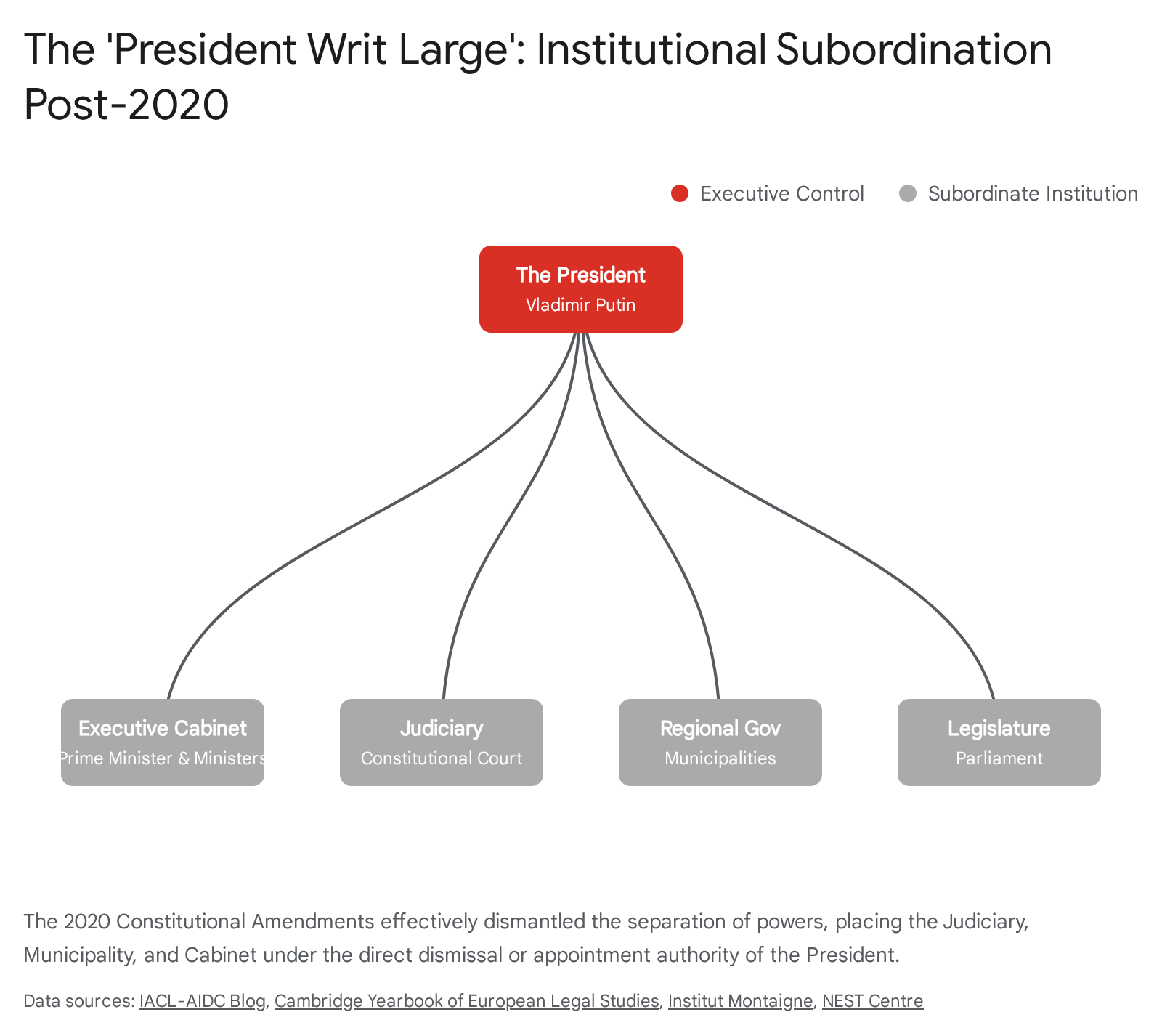
The longevity of Vladimir Putin’s tenure is not merely a result of ad-hoc political maneuvering but has been systematically codified into the supreme law of the Russian Federation. The transition to the current configuration of power, often referred to by Kremlin ideologues as the “Long State,” began with the 2020 Constitutional Amendments. These reforms were not cosmetic; they fundamentally dismantled the remaining checks and balances of the post-Soviet system and formalized the “President Writ Large” system, creating a legal bedrock that allows for the indefinite perpetuation of the current leadership.1
1.1 The Nullification of Time: The “Zeroing” Mechanism
The cornerstone of Putin’s current legitimacy is the “zeroing out” (obnuleniye) of his presidential terms, a legal maneuver executed during the 2020 constitutional reform. While Article 81 of the 1993 Constitution previously limited the presidency to two consecutive terms, the amendment championed by Valentina Tereshkova reset the clock, allowing Putin to contest the 2024 and 2030 elections, theoretically remaining in power until 2036.2
This legalistic sleight of hand served a dual strategic purpose essential for regime stability. First, it resolved the “2024 problem”—the risk of Putin becoming a lame duck as his term approached its end. In authoritarian systems, a known end-date for a leader creates a horizon of uncertainty that encourages elites to look for successors, fostering instability and factionalism. By creating the legal possibility of an indefinite presidency, the Kremlin forced the elite to abandon succession planning and refocus their loyalty entirely on the incumbent.3 Second, it signaled to the bureaucracy and the broader population that the current course was not a temporary deviation but a permanent state of affairs. The reforms were immediately followed by a crackdown on the opposition, most notably the Alexei Navalny affair, which signaled that the era of “systemic” tolerance was definitively over.2
The implications of this move extend beyond the person of the president. It effectively suspended the operation of political time in Russia, replacing the cyclical nature of electoral politics with a linear trajectory of “stability” defined solely by the physical longevity of the ruler. This “forever regime” logic now permeates all levels of governance, where long-term planning is substituted by immediate regime preservation.
1.2 The “President Writ Large”: The Destruction of Separation of Powers
The 2020 amendments did more than extend Putin’s tenure; they fundamentally restructured the executive branch to concentrate management power directly in the hands of the President, effectively creating a “super-presidency.” The reforms constitutionalized the President’s dominance over the government, granting him the unilateral authority to remove the Prime Minister and any other ministers.5 This clause is critical: historically, the Prime Minister could act as a potential alternative center of gravity or a designated successor. By making the Premier firing-proof only to the Parliament but instantly dismissible by the President, the constitution reduced the head of government to a high-level administrator.
Furthermore, the reform marginalized the legislative and judicial branches to a degree unseen since the Soviet era. The Constitutional Court, previously a theoretically independent arbiter capable of striking down laws, was reformed to reduce its autonomy. The number of judges was reduced, and the President gained the power to initiate their dismissal, effectively ending judicial independence.6
Perhaps most significantly for the internal structure of the Russian Federation, the concept of a “United System of Public Power” was introduced. This provision effectively abolished the autonomy of local self-government—a right previously guaranteed by the constitution—and integrated municipal authorities directly into the vertical of federal power.6 This centralization ensured that no alternative center of power—regional, municipal, or institutional—could emerge to challenge the Kremlin from below. The mayors of major cities, historically potential independent political figures, were transformed into lower-tier appointees within the presidential vertical.
1.3 The State Council: A Parallel Structure of Control
Another innovation of the constitutional reform was the elevation of the State Council (Gossovet) to a constitutional body.2 Initially, observers speculated this might be a retirement vehicle for Putin, allowing him to rule “from behind the scenes” like Kazakhstan’s Nursultan Nazarbayev. However, with the “zeroing” option exercised, the State Council has instead evolved into a mechanism for enforcing the federal will upon regional governors.
The State Council, which includes regional governors and top federal officials, serves as a forum where collective responsibility is enforced. By implicating all regional leaders in federal decision-making, the Kremlin ensures that blame for unpopular policies can be dispersed, while credit for stability is concentrated at the top. It serves as a mechanism of “mutual hostage-taking,” where regional elites are bound to the federal center not just by budget transfers, but by direct constitutional subordination in decision-making processes regarding “unified public power.” This structure is pivotal in managing the 85+ regions of Russia, preventing the centrifugal forces that tore apart the Soviet Union from re-emerging during the stress of the current war.
II. The Praetorian Guard and the Management of Violence
If the Constitution provides the legal framework, the Siloviki—the “people of force”—provide the tangible muscle that keeps the regime intact. The Russian Federation has evolved into a “hard” authoritarian system shading toward a “soft” dictatorship, where the security services dominate all branches of power.7 However, maintaining control over the men with guns requires a delicate balance of empowerment and repression to prevent any single faction from becoming a threat—a lesson painfully learned during the Prigozhin mutiny of 2023. The events of 2024 and 2025 demonstrate a sophisticated strategy of “purging the loyal” to ensure “super-loyalty.”
2.1 The Ascendancy of the Security State and the FSB
The Siloviki network, comprising alumni of the KGB and its successors (FSB, SVR, FSO), controls virtually all key positions in the Russian government and economy.8 This group, historically led by figures like Nikolai Patrushev, dominates the President’s agenda, fueling anxieties about Western threats and justifying internal repression.9 The Federal Security Service (FSB) has effectively become a “state within a state,” responsible for monitoring the elite as much as the opposition.
Since the beginning of the full-scale invasion of Ukraine, the influence of the Siloviki has expanded into every crevice of Russian life. The FSB has adopted an “all-hands-on-deck” approach, shifting resources from counter-terrorism to counter-intelligence and regime security.10 This shift has transformed the agency into the primary arbiter of political reliability. The FSB’s Second Service (Service for the Protection of the Constitutional System and the Fight against Terrorism) has been instrumental in crushing domestic dissent, while its economic security departments oversee the redistribution of assets, ensuring that the “new nobility” remains dependent on the chekists for their wealth.
By mid-2025, the intensity of this repression was quantifiable: treason prosecutions soared to 760 verdicts, and the national “List of Terrorists and Extremists” surged to over 18,000 names, including more than 150 children. This statistical explosion reflects a system where “national security” laws are weaponized to criminalize any form of dissent, effectively creating a dragnet that ensnares not just activists but ordinary citizens.
Furthermore, the creation of the National Guard (Rosgvardia), a praetorian force answerable directly to Putin, has insulated the President from potential disloyalty within the regular military or police. By taking over functions previously held by the Ministry of Internal Affairs (MVD), Rosgvardia serves as the ultimate guarantee against a palace coup or mass unrest.11 This diversification of the coercive apparatus—balancing the FSB against the MVD, and the Army against Rosgvardia—is a classic autocratic survival strategy to prevent any single security chief from becoming a “kingmaker.”
2.2 The 2024–2025 Ministry of Defense Purge: Disciplinary Terror
A critical mechanism of Putin’s control is the periodic rotation and purging of the elite to prevent the accumulation of independent power bases. This was most visible in the dramatic restructuring of the Ministry of Defense (MoD) starting in April 2024 and continuing into 2025.
Following the dismissal of long-time Defense Minister Sergei Shoigu, the Kremlin launched a sweeping anti-corruption purge against the MoD’s top brass. This was not merely a reaction to the failures in Ukraine, but a calculated political decapitation. High-ranking officials, including Deputy Defense Minister Pavel Popov and others associated with the “Shoigu clan,” were arrested on fraud charges.1 The purge extended deep into the ministry, with six of Shoigu’s deputies fired and three taken into custody.1
This move served multiple strategic ends:
- Disruption of Patronage Networks: By dismantling the “Shoigu clan,” Putin prevented the military leadership from becoming an autonomous political force. The legacy of the Prigozhin mutiny was the realization that a charismatic or autonomous military leader poses an existential threat.13 The purge effectively atomized the military elite, reminding them that their positions are revocable at any moment.
- Efficiency for the “Long War”: The appointment of Andrei Belousov, an economist and statist technocrat, as Defense Minister signaled a paradigm shift toward “Military Keynesianism” (discussed in Section III). The Kremlin recognized that the rampant corruption of the Shoigu era, while useful for buying loyalty in peace, was a liability in a protracted war of attrition. Belousov’s mandate was to optimize the war economy, ensuring that the trillions of rubles poured into defense actually resulted in hardware rather than yachts.12
- Elite Discipline: The arrests shattered the unspoken rule of the Putin era that high-ranking federal ministers were “untouchable” as long as they remained loyal. By targeting the very top of the military hierarchy, the Kremlin sent a chilling message to all elite groups: loyalty alone is no longer sufficient protection; absolute competence and subservience are required. No one is safe, and every official is potentially “on the hook” for past transgressions.1
2.3 Post-Prigozhin Fragmentation of Violence
The aftermath of the Wagner Group rebellion in 2023 necessitated a fundamental restructuring of Russia’s irregular forces. The Kremlin moved to ensure that no private army could ever again challenge the state’s monopoly on violence. The Wagner Group’s assets were fragmented and absorbed by loyalist structures: the National Guard (Rosgvardia), the GRU (military intelligence), and the “Akhmat” special forces loyal to Ramzan Kadyrov.14
This fragmentation ensures that while the state retains the capabilities of irregular warfare—crucial for operations in the “Grey Zone” in Africa or the Sahel—the command and control are firmly reintegrated into the state hierarchy. The “Africa Corps,” formed to replace Wagner in the Sahel, operates under the direct supervision of the Ministry of Defense.15 The GRU, despite suffering significant setbacks and expulsions of spies in Europe, has reasserted control over these foreign operations, replacing the charismatic but dangerous leadership of Prigozhin with faceless bureaucratic oversight.10
This restructuring highlights the regime’s adaptability. It identified a systemic vulnerability—the autonomy of proxy forces—and ruthlessly eliminated it, even at the cost of some operational effectiveness. The priority remains regime security over military efficiency; a loyal, fragmented military is preferable to a highly effective but autonomous one.
III. The Political Economy of Total War: “Military Keynesianism”
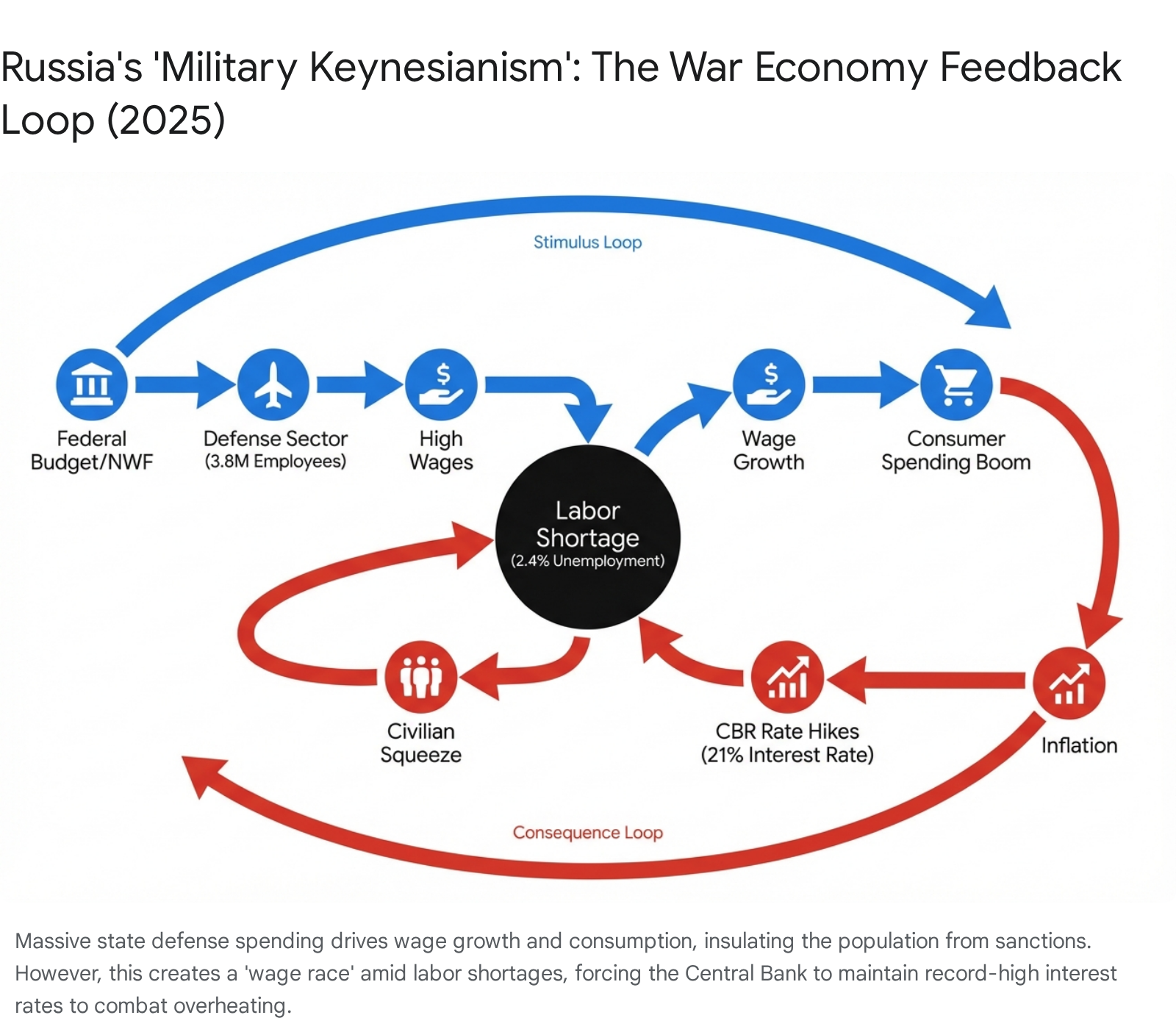
Perhaps the most surprising factor in Putin’s survival has been the resilience of the Russian economy. Despite unprecedented Western sanctions, the regime has maintained stability through a specific economic model that analysts have termed “Military Keynesianism.” By flooding the economy with defense spending, the Kremlin has generated artificial growth, reduced unemployment to record lows, and bought social peace, albeit at the cost of long-term overheating and structural imbalance.
3.1 The Stimulus of War
The Russian economy in 2025 is characterized by a massive, government-led wartime spending spree. Government demand, driven by the existential need to produce tanks, shells, drones, and equipment, has pushed economic activity to an unsustainable rate.16 This spending has had a massive multiplier effect across the entire economy:
- Defense Sector Boom: The defense industry has become the engine of the economy, now employing approximately 3.8 million people. Between 2023 and mid-2024 alone, the sector absorbed 600,000 workers, sucking talent and labor from the civilian economy.16
- The “Wage Race”: To attract workers to 24/7 defense plants, salaries in the sector have spiked by 20–60%. This has forced civilian sectors—retail, construction, logistics—to drastically raise wages to compete for the dwindling pool of workers. This “wage race” has increased the nominal disposable income of the population, effectively shielding many Russians from the inflation caused by sanctions.17 For the average worker, the war has paradoxically led to a period of financial abundance, creating a “war bonus” that secures their support for the regime.
- Regional Redistribution: The war has acted as a mechanism for redistributing wealth from the center (Moscow/St. Petersburg) to the poorer industrial periphery. Regions with heavy military-industrial facilities, such as the Urals and the Volga region, have seen explosive growth in retail turnover and investment.16
3.2 The Costs of Overheating: Inflation and Labor Shortages
This economic model faces severe, perhaps terminal, constraints. The economy is “overheating,” meaning demand vastly outstrips the capacity to produce. The primary bottleneck is labor. With an unemployment rate near a record low of 2.4%, Russia faces a “perfect storm” of worker deficits caused by demographic decline (the small generation of the 1990s entering the workforce), the mobilization of hundreds of thousands of men, and the emigration of skilled professionals.16
To combat the resulting inflation (which reached 9% by late 2024 and remains high in 2025), the Central Bank of Russia (CBR), led by the technocratic Elvira Nabiullina, was forced to raise interest rates to a punishing 21% in 2025.16 This creates a classic “guns vs. butter” tension: the high interest rates crush the civilian economy and private business, which cannot afford to borrow at such rates, while the defense sector, subsidized by the state budget and preferential loans, continues to consume resources. The regime is effectively cannibalizing its future civil economy—investment, innovation, small business—to feed the current war effort.16
3.3 Dependence on China and the “Renminbi-zation”
Western sanctions, while failing to collapse the Russian economy, have fundamentally altered its geopolitical orientation. By 2025, sanctions have driven Russia out of the dollar-dominated financial system and into the arms of Beijing. China has become Russia’s largest trading partner and economic lifeline. The two nations now settle the vast majority of their trade in renminbi.16
This relationship is structurally asymmetrical: Russia provides discounted energy and raw materials to China, while China supplies the machinery, electronics, semiconductors, and vehicles necessary to keep the Russian economy running. Chinese brands now hold over 60% of the Russian auto market, replacing Western manufacturers.16 This dependence secures the regime against Western economic strangulation but subordinates Russia’s long-term economic sovereignty to Chinese interests. Russia is becoming a resource appendage of the Chinese economy, but for Putin, this is an acceptable price for survival. The “Pivot to the East” has provided the necessary inputs to keep the factories running and the shops stocked, preventing the shortages that could trigger social unrest.16
3.4 The Digital Leash: The Digital Ruble
To further cement control over the economy and its citizens, the Kremlin is preparing the full government rollout of the Digital Ruble in 2026. Unlike standard currency, this central bank digital currency (CBDC) introduces the concept of “programmable” money. State employees and welfare recipients will receive payments in digital rubles that can be tracked in real-time. This system grants the state unprecedented surveillance capabilities and the power to restrict spending based on “behavioral loyalty,” potentially blocking accounts without a court order if a citizen is deemed “unreliable”. This transition represents a shift from a purely economic survival strategy to a tool of totalitarian social control.
IV. The Redefinition of the Social Contract: “Deathonomics” and Regional Buying Power
The regime’s stability relies not just on the elite, but on the acquiescence of the broader population. The war has reshaped the social contract, particularly for Russia’s poorer regions, transforming the conflict from a burden into a perverse economic opportunity.
4.1 “Deathonomics”: The Monetization of Casualties
In the poorest and most remote regions of Russia, such as the Republic of Tyva and Buryatia, the war has become a primary economic driver. The combination of high federal and regional sign-on bonuses (often exceeding 1 million rubles in some regions) and massive insurance payouts for injuries or death (“KIA payouts”) has led to an explosion in household bank deposits and consumption.16
This phenomenon, grimly termed “Deathonomics,” creates a perverse incentive structure where the war effectively mitigates deep-seated poverty. In Tyva, despite having the highest war death rate per capita in the entire country, the region has experienced a 190% growth in fixed investment and a 74% growth in retail turnover.16 Families of the fallen receive sums equivalent to decades of peacetime earnings, allowing them to buy apartments, cars, and pay off debts.
By monetizing the bodies of its citizens, the Kremlin has transformed the war from a tragedy into an economic lifeline for the most marginalized segments of society. This secures their loyalty—or at least their silence—through financial dependency. The “coffin money” circulating in these regions acts as a potent stimulus, buying complicity from the very populations that are suffering the highest losses. This strategy cynically exploits the economic desperation of the periphery to fuel the imperial ambitions of the center.
4.2 Federal Debt Relief as a Subsidization of War
To sustain this regional spending, the federal government implemented a program in late 2024 allowing lower-income regional governments to write off up to two-thirds of their debt. In exchange, regions must direct the freed-up funds toward social expenditures and “national projects”—which in practice often means funding the war effort, including recruitment bonuses and social support for veterans.16
This creates a fiscal mechanism where Moscow effectively subsidizes the regions’ participation in the war without directly bearing the entire upfront cost on the federal balance sheet. It allows governors to offer competitive bonuses to volunteers without bankrupting their regional budgets immediately. It creates a unified financial front where every level of government is fiscally invested in the continuation of the war.
4.3 The “New Elite”: Veterans and the “Time of Heroes” Program
Putin has explicitly declared the participants of the “Special Military Operation” (SVO) to be the country’s “new elite,” stating they should replace the “so-called elites” of the 1990s whom he views as insufficiently patriotic.20 To operationalize this, the Kremlin launched the “Time of Heroes” program, designed to train and insert war veterans into positions of power within the public administration.21
However, the implementation of this program reveals the limits of Putin’s social engineering. While the rhetoric is soaring, the actual number of veterans appointed to high office remains relatively low compared to the scale of the war—only about 60 had been appointed to federal or regional positions by late 2025, and only 168 were admitted to the program out of 65,000 applicants.21 Most appointees are placed in symbolic roles or middle-management positions where they can serve as “political commissars” rather than effective administrators.
Nevertheless, the political symbolism is potent. United Russia nominated over 1,600 war participants in regional elections, integrating the “war party” directly into the political fabric.23 This militarization of the civil service aims to create a cadre of officials whose primary loyalty is forged in blood and shared complicity in the war, acting as a buffer against the more liberal or technocratic elements of the bureaucracy. It signals to the ambitious youth that the path to upward mobility now runs through the trenches of Ukraine, further militarizing Russian society.
V. The Predatory State: Asset Redistribution and Elite Discipline
To maintain power, an autocrat must constantly reward loyalty and punish dissent. In 2024–2025, Putin fundamentally altered the unwritten social contract with the Russian elite, moving from a model of “enrichment through stability” to “enrichment through predation and redistribution.”
5.1 “Deprivatization”: The Nationalization of Assets
A major trend in 2025 has been the “deprivatization” or nationalization of private assets. The state has actively seized private companies, citing “privatization violations” from the 1990s, corruption, or “ties to unfriendly countries”.24 In 2025 alone, the value of assets transferred to state ownership exceeded 3 trillion rubles, a 4.5-fold increase from the previous year.24
Targeted assets include strategic enterprises in ports, fishing, and mining. Specific cases include the seizure of Metafrax, Russia’s largest methanol producer, from Forbes listee Seyfeddin Rustamov, under the pretext that the original privatization was illegal and the owner had foreign ties.26 Other targets have included major pasta producers (Makfa), automotive dealerships (Rolf), and ferroalloy plants.26
Crucially, these assets rarely remain in state hands. They are quickly resold or transferred to “investors loyal to the Kremlin,” effectively redistributing wealth from the old oligarchs (or those who tried to remain neutral) to a new class of state-aligned cronies and “state-preneurs”.24 This process serves as a powerful disciplinary tool: any asset can be seized if the owner wavers in their support for the war, and immense wealth awaits those who serve the regime’s new priorities. The “statute of limitations” on privatization deals has been effectively abolished by the Constitutional Court, meaning no property right is secure.24
5.2 The End of the Oligarchic Pact
This redistribution marks the end of the post-Soviet oligarchic pact, where wealth was tolerated as long as it did not interfere in politics. Now, wealth is conditional on active participation in the war effort. Oligarchs are forced to walk a “wartime tightrope”: they must contribute to the war effort (through taxes, “voluntary” contributions, or direct support) to avoid nationalization at home, while trying to avoid Western sanctions abroad—a nearly impossible task that traps them in Russia.27 The result is the consolidation of a nationalized elite that has no exit strategy and is therefore inextricably tied to the regime’s survival.
VI. The Cognitive Fortress: Information Sovereignty and Ideology
Control over the information space has shifted from “management” to “isolation” and “indoctrination.” The Kremlin is actively building a “Sovereign Internet” and a new state ideology to immunize the population against Western narratives and create a hermetically sealed cognitive environment.
6.1 The Sovereign Internet and TSPU
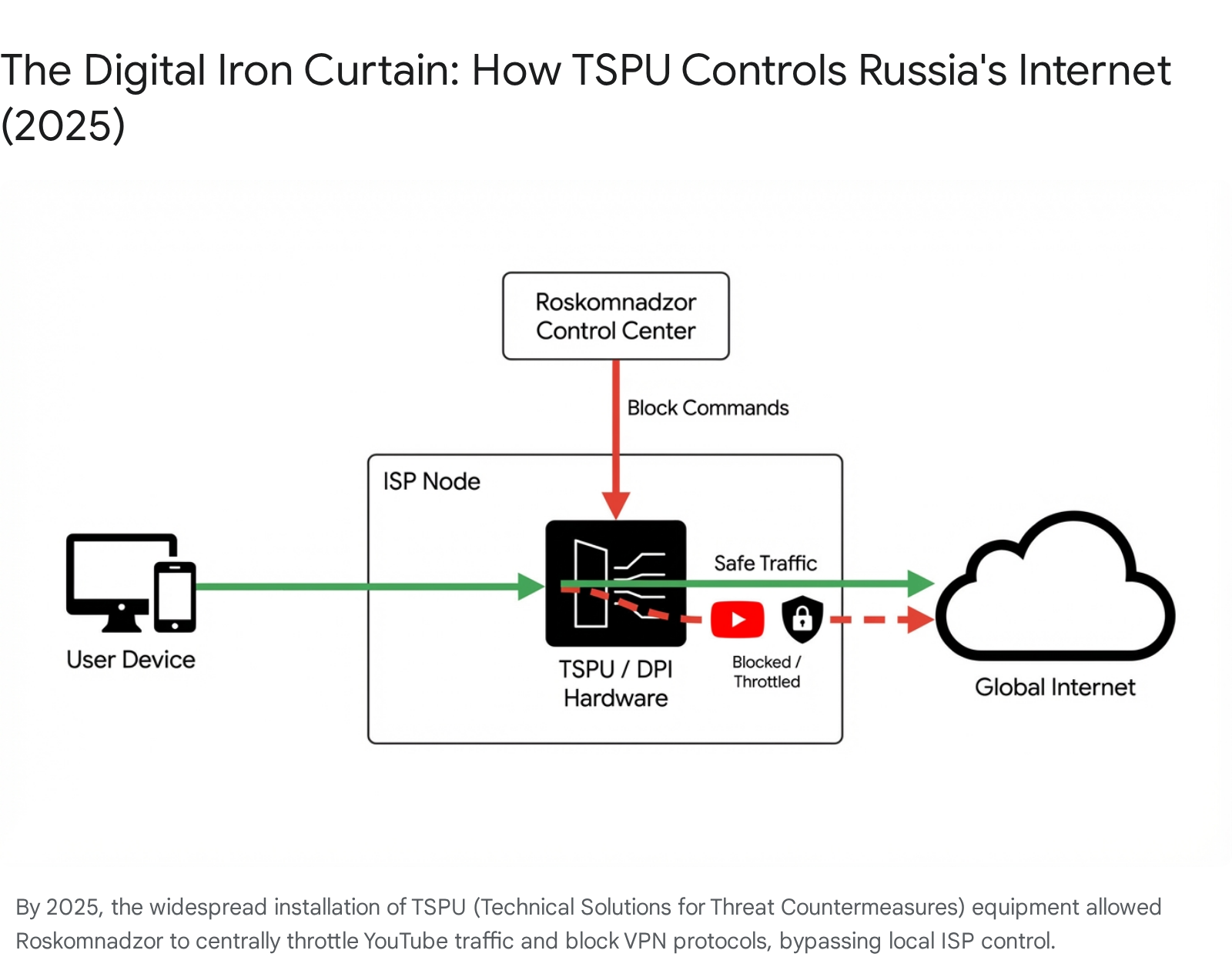
Russia is moving toward full digital isolation, building what analysts call a “Digital Iron Curtain.” The legal and technical framework for this is the “Sovereign Internet” law, implemented via “Technical Solutions for Threat Countermeasures” (TSPU)—Deep Packet Inspection (DPI) equipment installed directly on the networks of all telecom operators.28
Key developments in 2024–2025 include:
- Throttling and Blocking: The TSPU infrastructure allows Roskomnadzor (the federal censor) to throttle or block traffic centrally, bypassing local providers. This capability was demonstrated in July 2024 when the state artificially degraded YouTube speeds to near-unusable levels to push users toward domestic alternatives like VK Video and Rutube.28
- VPN War: The state has engaged in a game of “whack-a-mole” with VPN services, blocking protocols (like OpenVPN and WireGuard) to prevent citizens from accessing independent information. By 2025, users faced increasing difficulties with encrypted calls on WhatsApp and Telegram, signaling a move toward controlling even private communications.29
- Cost of Access: The requirements to install data storage (Yarovaya Law) and surveillance equipment have driven up the cost of internet access, further centralizing control in the hands of a few compliant state-linked operators.19
6.2 The “Pentabase” and Engineered Ideology
The regime has moved beyond non-ideological pragmatism to construct a “scientific conservatism” designed to indoctrinate the next generation. This effort is spearheaded by Sergei Kiriyenko, the First Deputy Chief of Staff of the Presidential Administration. The new ideological framework, often referred to as the “Pentabase,” is taught in universities through the mandatory “Fundamentals of Russian Statehood” course.31
The ideology is defined by:
- Civilizational Distinctness: Russia is framed not as a nation-state but as a unique “State-Civilization” distinct from, superior to, and historically hostile to the “decaying” West.32 This concept allows the regime to reject universal human rights as Western constructs inapplicable to Russia.
- The DNA of Russia: A project overseen by Kremlin political technologists produces content to reinforce these themes. The “Pentabase” of values consists of: Patriotism, Trust (in the state), Tradition, Solidarity, and Creativity.34 These values are presented as the “genetic code” of Russian society, with the implicit message that opposition to the state is a violation of one’s own nature.
- Narrative Control: The “DNA of Russia” project has produced over 79 videos framing the war as a defensive struggle against a “satanic” or “corrupt” West.33
This ideological conditioning is not limited to classrooms. The “Movement of the First,” a state-run youth organization, has begun integrating Russian youth into the geopolitical bloc of autocracies. In a grim signal of this alignment, the movement facilitated exchanges with North Korea in 2024–2025, sending Russian schoolchildren to the Songdowon camp to serve as “ambassadors” of the new order. This project aims to create a “new intelligentsia” loyal to the regime, replacing the liberal-leaning educated class that has largely emigrated or been silenced.35
VII. The Rituals of Legitimacy: Elections and the Systemic Opposition
While Russia is a personalist dictatorship, it retains the external rituals of democracy to generate legitimacy and demonstrate the “unity” of the nation. However, the function of these institutions has changed from contestation to acclamation.
7.1 The Neutering of Systemic Opposition
The traditional “systemic opposition”—the Communist Party (CPRF) and the Liberal Democratic Party (LDPR)—has been completely co-opted and neutralized. In the 2024 presidential elections and subsequent 2025 regional votes, these parties offered no real challenge to Putin or United Russia.36
The death of LDPR founder Vladimir Zhirinovsky in 2022 removed a key charismatic figure who, while loyal, could occasionally channel populist anger. His successor, Leonid Slutsky, is a grey functionary who lacks any independent base. Similarly, the CPRF, under the aging Gennady Zyuganov, has been forced to fully endorse the war, stripping it of its traditional role as a venue for protest votes. The crackdown on any deviation from the “patriotic consensus” has turned these parties into mere appendages of the Kremlin, useful only for channeling harmless grievances and signaling a veneer of pluralism.37
Looking ahead to the 2026 State Duma elections, the Kremlin is already tightening electoral legislation to ensure no systemic shocks occur, treating the upcoming vote as a logistical stress test for the regime’s administrative machine rather than a political contest. The authorities are preparing for a scenario where lack of competition is absolute, even at the lowest levels.
7.2 Elections as Administrative Stress Tests
Elections in 2024 and 2025 served not as contests for power but as administrative stress tests for the regional bureaucracy. The “referendum-style” voting confirms the ability of the regional governors to deliver the required numbers and turnout.
United Russia’s dominance in the 2025 regional elections, securing 81% of seats in regional capitals and creating “monoparliaments” in cities like Magadan, demonstrates the total mobilization of administrative resources.38 The extensive use of Remote Electronic Voting (DEG) has made the falsification of results easier and harder to detect, allowing the Kremlin to dial in the exact margins of victory it desires. These “elections” serve to demonstrate the futility of resistance to the population and the efficacy of the administrative machine to the Kremlin.
VIII. Strategic Horizons and Structural Entropy
As of 2026, Vladimir Putin remains in power not through inertia, but through a highly active, multi-layered strategy of regime preservation. He has constructed a “Fortress Russia” designed to withstand a long war. However, this stability is purchased at the cost of the country’s future.
8.1 The Paradox of Stability
The analysis indicates that the immediate threats to Putin’s power—elite coup, popular uprising, or economic collapse—have been effectively neutralized for the near term.
- Legally, he is secure until 2036.
- Militarily, the “Siloviki” are disciplined and fragmented.
- Economically, “Military Keynesianism” has bought social peace.
- Socially, the “long war” has been normalized.
8.2 Structural Fragilities
However, the system faces deep structural entropy that threatens its medium-to-long-term viability:
- Economic Exhaustion: The “overheating” of the economy cannot be sustained indefinitely. The depletion of the National Welfare Fund (NWF) and the cannibalization of the civilian sector will eventually lead to stagflation or a collapse in living standards once the war spending inevitably slows.16
- Demographic Collapse: The war has accelerated Russia’s demographic decline, removing hundreds of thousands of young men from the workforce and discouraging family formation. This creates a labor shortage that no amount of Chinese technology can fix.16
- Elite Fatigue: While currently repressed, the elite is acutely aware that their wealth and safety are contingent on the whim of one man. The “deprivatization” campaign has destroyed property rights, creating a latent demand for the rule of law that may resurface during a transition crisis.
In conclusion, Putin remains in power by transforming Russia into a machine solely dedicated to regime preservation and total war. The system is stable only as long as the war continues to justify the repression and fuel the economy; it has likely lost the ability to function in peacetime. Thus, the “long war” is not just a foreign policy goal but a domestic necessity for the regime’s survival. The Kremlin has burned the bridges back to the pre-2022 world, leaving it with only one direction: forward, into a deepening authoritarianism and reliance on the conflict to sustain its legitimacy.
Statistical Appendix: Key Indicators of Regime Stability (2025)
| Indicator | Value/Status | Implication | Source |
| Presidential Term Limit | Reset to Zero | Putin eligible until 2036 | 2 |
| Key Interest Rate | 16.5% – 21% | Combatting high inflation/overheating | 16 |
| Unemployment Rate | ~2.4% | Severe labor shortage; full employment | 16 |
| Defense Sector Employment | 3.8 Million | High dependency on war spending | 16 |
| Asset Seizures (2025) | >3 Trillion Rubles | Redistribution to loyalists | 24 |
| Treason Prosecutions | 760 Verdicts | Intense repression of dissent | |
| Terrorist List Size | 18,000+ Names | Broad criminalization of opposition | |
| United Russia Regional Share | 81% of seats | Total political monopoly | 38 |
| Internet Status | YouTube throttled, VPNs blocked | “Sovereign Internet” operational | 30 |
If you find this post useful, please share the link on Facebook, with your friends, etc. Your support is much appreciated and if you have any feedback, please email me at in**@*********ps.com. Please note that for links to other websites, we are only paid if there is an affiliate program such as Avantlink, Impact, Amazon and eBay and only if you purchase something. If you’d like to directly contribute towards our continued reporting, please visit our funding page.
Sources Used
- Power and Society in Russia: The Political Transformation Index …, accessed January 10, 2026, https://nestcentre.org/power-and-society-in-russia-2025/
- Putin’s Grip on Power: The Beginning of the End? – Institut Montaigne, accessed January 10, 2026, https://www.institutmontaigne.org/en/expressions/putins-grip-power-beginning-end
- Constitutional change in Russia – European Parliament, accessed January 10, 2026, https://www.europarl.europa.eu/RegData/etudes/BRIE/2020/651935/EPRS_BRI(2020)651935_EN.pdf
- Analysis: How Vladimir Putin was able to change Russia’s constitution and become president for life | UCL News – UCL – University College London, accessed January 10, 2026, https://www.ucl.ac.uk/news/2025/jan/analysis-how-vladimir-putin-was-able-change-russias-constitution-and-become-president-life
- RUSSIA’S 2020 CONSTITUTIONAL AMENDMENTS: A COMPARATIVE ANALYSIS | Cambridge Yearbook of European Legal Studies, accessed January 10, 2026, https://www.cambridge.org/core/journals/cambridge-yearbook-of-european-legal-studies/article/russias-2020-constitutional-amendments-a-comparative-analysis/4A8B84877258789A56CF0B47625386CD
- The Content of the 2020 Constitutional Amendments in Russia – IACL-AIDC Blog, accessed January 10, 2026, https://blog-iacl-aidc.org/2021-posts/2021/04/01-constitutional-amendments-in-russia-content-lhnf7
- Reading Russia: The Siloviki in Charge | Journal of Democracy, accessed January 10, 2026, https://www.journalofdemocracy.org/articles/reading-russia-the-siloviki-in-charge/
- Russia: Siloviki Take The Reins In Post-Oligarchy Era – Radio Free Europe, accessed January 10, 2026, https://www.rferl.org/a/1078686.html
- Putin’s security men: the elite group who ‘fuel his anxieties’ | Russia – The Guardian, accessed January 10, 2026, https://www.theguardian.com/world/2022/feb/04/putin-security-elite-siloviki-russia
- What impact has the war on Ukraine had on Russian security and intelligence? | Feature from King’s College London, accessed January 10, 2026, https://www.kcl.ac.uk/what-impact-has-the-war-on-ukraine-had-on-russian-security-and-intelligence
- National Guard of Russia – Wikipedia, accessed January 10, 2026, https://en.wikipedia.org/wiki/National_Guard_of_Russia
- Putin’s purging of defence ministry suggests he is preparing for a long war | Chatham House, accessed January 10, 2026, https://www.chathamhouse.org/2024/09/putins-purging-defence-ministry-suggests-he-preparing-long-war
- Unprecedented Defense Ministry Purge Sparks Concern in Russian Elite, accessed January 10, 2026, https://carnegieendowment.org/russia-eurasia/politika/2025/01/shoigu-clan-repressions?lang=en
- Wartime Russian Civil-Military Relations – CNA.org., accessed January 10, 2026, https://www.cna.org/reports/2025/02/Wartime-Russian-Civil-Military-Relations.pdf
- Russia’s End State: Assessing Prigozhin’s Legacy, accessed January 10, 2026, https://www.marshallcenter.org/en/publications/clock-tower-series/strategic-competition-seminar-series-fy25/russias-end-state-assessing-prigozhins-legacy
- The Russian economy in 2025: Between stagnation and …, accessed January 10, 2026, https://www.atlanticcouncil.org/in-depth-research-reports/report/the-russian-economy-in-2025-between-stagnation-and-militarization/
- Down But Not Out: The Russian Economy Under Western Sanctions – CSIS, accessed January 10, 2026, https://www.csis.org/analysis/down-not-out-russian-economy-under-western-sanctions
- The Economic Impact of Russia Sanctions – Congress.gov, accessed January 10, 2026, https://www.congress.gov/crs-product/IF12092
- Russia: Freedom on the Net 2024 Country Report, accessed January 10, 2026, https://freedomhouse.org/country/russia/freedom-net/2024
- The Kremlin’s Balancing Act: The War’s Impact On Regional Power Dynamics, accessed January 10, 2026, https://www.fpri.org/article/2025/02/the-kremlins-balancing-act-the-wars-impact-on-regional-power-dynamics/
- From Front Line to Fault Line: Russia’s Challenge Managing Veteran Reintegration, accessed January 10, 2026, https://www.fpri.org/article/2025/12/from-front-line-to-fault-line-russias-challenge-managing-veteran-reintegration/
- ‘Time of Heroes’ Program: How the Kremlin is Going to Re-Adapt War Veterans to Civilian Life – Russia.Post, accessed January 10, 2026, https://russiapost.info/politics/time_of_heroes
- 1.6K Ukraine War Veterans Nominated for Russia’s 2025 Regional Elections, accessed January 10, 2026, https://www.themoscowtimes.com/2025/08/13/16k-ukraine-war-veterans-nominated-for-russias-2025-regional-elections-a90189
- Nationalization of Assets in russia Is Gaining Momentum – Служба зовнішньої розвідки України, accessed January 10, 2026, https://szru.gov.ua/en/news-media/news/nationalization-of-assets-in-russia-is-gaining-momentum
- Foreign Intelligence Service: Asset nationalization in Russia is gaining momentum, accessed January 10, 2026, https://odessa-journal.com/foreign-intelligence-service-asset-nationalization-in-russia-is-gaining-momentum
- Military Redistribution: Nationalisation of the elite, new rules of loyalty and the chaebolisation of Russia – Re: Russia, accessed January 10, 2026, https://re-russia.net/en/analytics/0267/
- Russia’s Oligarchs Must Walk a Wartime Tightrope to Keep Their Fortunes, accessed January 10, 2026, https://carnegieendowment.org/russia-eurasia/politika/2025/11/russia-elites-money-saving?lang=en
- Disrupted, Throttled, and Blocked: State Censorship, Control, and Increasing Isolation of Internet Users in Russia – Human Rights Watch, accessed January 10, 2026, https://www.hrw.org/report/2025/07/30/disrupted-throttled-and-blocked/state-censorship-control-and-increasing-isolation
- Russia’s next step in the “sovereign internet” – towards full isolation? – New Eastern Europe, accessed January 10, 2026, https://neweasterneurope.eu/2025/12/29/russias-next-step-in-the-sovereign-internet-towards-full-isolation/
- Blocking of YouTube in Russia – Wikipedia, accessed January 10, 2026, https://en.wikipedia.org/wiki/Blocking_of_YouTube_in_Russia
- ‘I Did Not Agree to These Demands and, Of Course, I Did Not Intend to Follow Them’ – Russia.Post, accessed January 10, 2026, https://russiapost.info/society/fundamentals_of_russian_statehood
- Foundations of Russian Statehood – HSE University Course Catalogue, accessed January 10, 2026, https://www.hse.ru/en/edu/courses/975845385
- ‘The DNA of Russia’: Ideology and Patriotic Education in Wartime Russia, accessed January 10, 2026, https://russiapost.info/politics/dna_of_russia
- From Uvarov’s ‘Triad’ to Kiriyenko’s ‘Pentabasis’: Conservative ideology in Russia, accessed January 10, 2026, https://russiapost.info/politics/conservative_ideology
- An ‘experienced strategist’ The man behind Russia’s new ideological course for university students – Meduza, accessed January 10, 2026, https://meduza.io/en/feature/2023/06/10/an-experienced-strategist
- Presidential Elections Will Consolidate Russian Autocracy – BIPR, accessed January 10, 2026, https://bipr.jhu.edu/BlogArticles/articleprofile/30-Presidential-Elections-Will-Consolidate-Russian-Autocracy.cfm
- Liberal Democratic Party of Russia – Wikipedia, accessed January 10, 2026, https://en.wikipedia.org/wiki/Liberal_Democratic_Party_of_Russia
- Election update XIV – REM – Russian Election Monitor, accessed January 10, 2026, https://www.russian-election-monitor.org/election-update-xiv.html