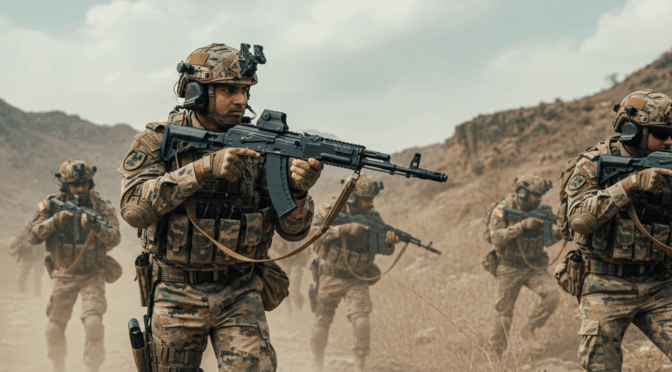
The Indian Armed Forces are currently navigating an unprecedented phase of modernization in their small arms inventory, a transition prompted by the evolving threats along the Line of Control (LoC) with Pakistan and the Line of Actual Control (LAC) with China. Traditionally reliant on a mixture of Soviet-era platforms and the indigenous but troubled Indian Small Arms System (INSAS), the Indian military has shifted toward a multi-caliber, “lethality-first” doctrine. This transformation is underpinned by the “Aatmanirbhar Bharat” initiative, which seeks to balance the immediate need for high-end imports—such as the American SIG Sauer SIG 716i—with long-term domestic manufacturing projects like the AK-203 joint venture and the massive 2025 carbine contracts. The Army, Navy, and Air Force have each refined their specialized requirements, with elite units like the Para SF, MARCOS, and Garud commandos adopting modular Western and Israeli systems, while the regular infantry prepares for a wholesale replacement of legacy systems with modern 7.62mm and 5.56mm platforms. As of late 2025, the defense industrial landscape has been redefined by the entry of private players such as Bharat Forge and SSS Defence, who are now winning significant contracts previously held by state monopolies. This report provides a detailed technical and strategic analysis of the small arms across all three branches, the logistics of their multi-caliber inventory, and the geopolitical implications of India’s pivot toward indigenous sovereignty in infantry weaponry.
The Evolution of Small Arms Doctrine in the Indian Subcontinent
To understand the current state of India’s small arms inventory, one must first analyze the historical and strategic pressures that led to the present modernization drive. For much of the late 20th century, the Indian military operated on a doctrine influenced by British colonial heritage and Soviet strategic alignment. The transition from the.303 Lee-Enfield to the 7.62×51mm L1A1 Self-Loading Rifle (SLR) in the 1960s marked the first major step toward semi-automatic capability.1 However, the 1980s saw a global shift toward the 5.56×45mm NATO caliber, which was thought to be superior due to its lighter weight, allowing soldiers to carry more ammunition, and its tendency to wound rather than kill, thereby straining the enemy’s logistical and medical infrastructure.3
This philosophy led to the development of the INSAS (Indian Small Arms System), which was intended to be a family of weapons including a rifle, a carbine, and a light machine gun (LMG). While the INSAS rifle became the mainstay of the infantry for nearly three decades, it was plagued by design flaws that became painfully evident during high-altitude combat, most notably during the 1999 Kargil War.4 Soldiers reported magazines cracking in sub-zero temperatures, oil splashing into the operator’s eyes during firing, and a lack of consistency in the three-round burst mode.3 These failures catalyzed an emergency procurement of AK-47 variants from Eastern Europe, marking the beginning of a “search for lethality” that would eventually lead to the abandonment of the wounding-centered 5.56mm doctrine for frontline infantry.3
In the contemporary landscape of 2025, the Indian Army has largely returned to the 7.62mm caliber for its primary combat roles. The reasoning is twofold: first, the increasing prevalence of body armor among adversaries renders the 5.56mm round less effective at range; and second, the terrain of the LoC and LAC requires high stopping power and effective engagement ranges beyond 500 meters, where the 7.62×51mm caliber excels.3 Consequently, the current inventory is a sophisticated mix of imported battle rifles for frontline troops and locally produced assault rifles for the wider force, creating a complex but lethal logistical ecosystem.6
Summary Table: Historical Transition of Primary Service Rifles
| Era | Primary Rifle | Caliber | Origin | Status |
| 1950s – 1960s | SMLE Mk III* | .303 British | United Kingdom / India | Retired |
| 1960s – 1990s | L1A1 SLR (1A1) | 7.62×51mm | UK (Licensed) / India | Limited Police / Reserve Use |
| 1990s – 2020s | 1B1 INSAS | 5.56×45mm | India (OFB) | Being phased out 8 |
| 2020 – 2025+ | SIG Sauer SIG 716i | 7.62×51mm | USA / India (Nibe) | Standard Frontline 9 |
| 2023 – 2025+ | AK-203 | 7.62×39mm | Russia / India (IRRPL) | Standard Infantry 8 |
Indian Army Small Arms Inventory: The Push for Lethality
The Indian Army, with its massive personnel count and diverse operational theaters, is the primary driver of small arms demand in the country. The current strategy involves a clear demarcation between the “frontline infantry,” who require high-performance battle rifles, and the “general infantry” and specialized units engaged in counter-insurgency (CI) and counter-terrorism (CT) operations.3
Primary Assault and Battle Rifles
The centerpiece of the Army’s modernization is the SIG Sauer SIG 716i “Patrol” rifle. Procured under a Fast Track Procedure (FTP) in 2019 and followed by a second major order in 2024, the SIG 716i is chambered in 7.62×51mm NATO.6 This weapon was selected specifically for its range and stopping power, with an effective “kill” range of 500 meters, making it ideal for the long-range engagements typical of the Himalayan borders.6 As of late 2025, the Indian Army has integrated approximately 145,400 SIG rifles into its frontline battalions.6 While initial reports indicated some minor issues with recoil and the need for local modifications like additional grips and bipods to improve stability, the platform is widely regarded by soldiers as a significant upgrade over the INSAS in terms of reliability and terminal ballistics.6
For the broader force, the Army has standardized the AK-203, a modernized variant of the ubiquitous Kalashnikov series. Manufactured in Korwa, Uttar Pradesh, through the Indo-Russia Rifles Private Limited (IRRPL) joint venture, the AK-203 fires the 7.62×39mm round.10 It offers the ruggedness of the classic AK system with modern enhancements, including a folding adjustable stock, ergonomic pistol grips, and Picatinny rails for mounting optics and tactical accessories.10 The AK-203 is intended to replace the INSAS across nearly all infantry units not deployed on the high-altitude borders.8
Carbines and Close-Quarter Battle Weapons
A significant gap in the Army’s arsenal for over a decade was the lack of a modern Close Quarter Battle (CQB) carbine. The legacy 9mm Sterling submachine gun (SAF 1A1) was long considered obsolete for modern urban warfare.13 This requirement was finally addressed in late 2025 with the signing of contracts for 425,000 5.56×45mm carbines.13 The selection of the DRDO-developed CQB carbine (manufactured by Bharat Forge/KSSL) and the Adani-IWI “Jeet” (a Galil ACE variant) represents a major milestone for indigenous manufacturing.8 These carbines utilize a short-stroke gas piston system and are designed for high-intensity urban combat, where compactness and a high rate of fire are paramount.13
Summary Table: Indian Army Primary Small Arms (2025)
| Category | Weapon Model | Caliber | Origin | Notes |
| Battle Rifle | SIG Sauer SIG 716i | 7.62×51mm | USA / India | Frontline border units 9 |
| Assault Rifle | AK-203 | 7.62×39mm | India / Russia | Standard general issue 8 |
| Assault Rifle | IWI Tavor TAR-21 | 5.56×45mm | Israel | Special Forces (Para SF) 8 |
| Assault Rifle | AKM (Various) | 7.62×39mm | E. Europe / India | Counter-insurgency standard 2 |
| Carbine | DRDO CQB Carbine | 5.56×45mm | India | 255,128 on order (2025) 13 |
| Carbine | Adani Jeet (ACE) | 5.56×45mm | India / Israel | 170,085 on order (2025) 13 |
| Submachine Gun | ASMI Machine Pistol | 9×19mm | India | 550 units for Para SF 8 |
| Submachine Gun | H&K MP5 | 9×19mm | Germany | Special Forces use 8 |
| Pistol | 9mm Pistol 1A | 9×19mm | India | Being replaced by new RFI 14 |
| Pistol | Glock 17/19 | 9×19mm | Austria | Special Forces standard 8 |
The Specialized Arsenal of the Para (Special Forces)
The Para (Special Forces) units maintain a highly distinct and modular arsenal compared to the regular infantry. Their primary weapon for several years has been the Israeli IWI Tavor TAR-21 and its more compact variant, the X95.8 The bullpup configuration of the Tavor is highly valued for airborne operations and vehicle-borne insertions, as it provides a full-length barrel in a compact package.1 For direct action and urban raids, the Para SF also utilizes the Colt M4A1 carbine, which is often heavily customized with SOPMOD accessories, including advanced optics, suppressors, and laser aiming modules.2
The Para SF has also been the primary recipient of newer indigenous innovations, such as the ASMI machine pistol. Developed in collaboration between the DRDO and Lokesh Machines, the ASMI is a 9mm submachine gun with a high rate of fire and 3D-printed components, intended for personal defense and room clearing.14 This unit’s adoption of the ASMI indicates a growing confidence in high-end indigenous designs for elite roles.
Indian Navy: Maritime Special Operations and Fleet Security
The Indian Navy’s small arms requirements are specialized around the unique challenges of the maritime environment, where corrosion resistance and compactness for shipborne operations are critical. The force is divided into the general sailor population responsible for ship security and the elite Marine Commando (MARCOS) unit.18
MARCOS: The “Crocodiles” of the Indian Ocean
The MARCOS are trained for a diverse array of missions, including amphibious raids, maritime counter-terrorism (MCT), and clandestine diving operations.15 Their weaponry reflects this versatility. The standard assault rifle for MARCOS is the AK-103, a 7.62×39mm modernized Kalashnikov that offers superior stopping power compared to 5.56mm rifles when engaging targets on vessels.2 For specialized maritime tasks, the MARCOS employ the APS underwater assault rifle, which fires 5.66mm steel bolts capable of penetrating thick neoprene and diving gear at depth—a capability shared by only a few elite units globally.15
For close-range ship intervention and boarding, search, and seizure (VBSS) missions, MARCOS heavily rely on the Heckler & Koch MP5 and the IWI Tavor X95.15 The MP5, despite its age, remains a favorite for its low recoil and “point-ability” in the tight confines of a ship’s engine room or corridor.16
Fleet and Shore Security
The general security of naval installations and warships is transitioning toward more modern systems. While the 9mm 1A pistol and INSAS rifle have been the standard, the Navy has received an allocation of approximately 2,000 SIG 716i battle rifles to provide a heavier punch for pier sentries and magazine security watches.3 This is particularly relevant given the increasing threat of asymmetrical attacks by maritime militia or non-state actors in the Indian Ocean Region.21
Summary Table: Indian Navy Small Arms Inventory (2025)
| Branch | Weapon Model | Caliber | Role | Status |
| MARCOS | AK-103 | 7.62×39mm | Primary Assault Rifle | Standard Issue 15 |
| MARCOS | APS Amphibious Rifle | 5.66×120mm | Underwater Combat | Specialized 15 |
| MARCOS | IWI Tavor X95 | 5.56×45mm | Close-Quarter Battle | Standard Issue 15 |
| MARCOS | H&K MP5 | 9×19mm | VBSS / Intervention | Special Operations 15 |
| MARCOS | IWI Negev NG-7 | 7.62×51mm | Light Machine Gun | Support Weapon 15 |
| General Navy | SIG Sauer SIG 716i | 7.62×51mm | Ship/Base Security | 2,000 units in service 9 |
| General Navy | 9mm Pistol 1A | 9×19mm | Sidearm | Standard issue 8 |
| General Navy | INSAS Rifle | 5.56×45mm | Sentry Duty | Being phased out 8 |
Indian Air Force: Protecting the High Ground
The Indian Air Force (IAF) manages its small arms inventory through its Air Force Police and the elite Garud Commando Force. The primary focus for the IAF is base defense and the recovery of downed pilots behind enemy lines.23
Garud Commando Force
Raised in the aftermath of terrorist attacks on Indian airbases, the Garuds are specialized in airfield seizure and combat search and rescue (CSAR).24 Like other special forces, they have standardized on the IWI Tavor TAR-21 for its compactness.26 However, the IAF has recently pushed for greater indigenization, issuing a request for pistols and submachine guns with at least 60% indigenous content.26 This is a strategic move to ensure that even its elite units are not entirely dependent on foreign supply lines for ammunition and spare parts.
The Garuds also operate approximately 4,000 SIG 716i battle rifles, providing them with the range necessary to protect large airbase perimeters from stand-off attacks.9 Their sniper capabilities have been bolstered with the Beretta Scorpio TGT and the Finnish Sako TRG-42, ensuring they can neutralize threats before they reach critical assets like fighter jets or radar installations.16
Summary Table: Indian Air Force Small Arms (2025)
| Unit | Weapon Model | Caliber | Origin | Use Case |
| Garud Commando | IWI Tavor TAR-21 | 5.56×45mm | Israel | Primary Service Rifle 26 |
| Garud Commando | SIG Sauer SIG 716i | 7.62×51mm | USA | Perimeter Security 9 |
| Garud Commando | Glock 17 | 9×19mm | Austria | Standard Sidearm 26 |
| Garud Commando | H&K MP5 | 9×19mm | Germany | CSAR / Base Recovery 25 |
| AF Police / DSC | AKM / Variants | 7.62×39mm | Various | Standard Base Defense 2 |
| AF Police / DSC | INSAS Rifle | 5.56×45mm | India | Routine Guard Duty 8 |
Support and Heavy Weapons: Sustaining Infantry Firepower
Beyond the individual soldier’s rifle, the effectiveness of the Indian infantry depends on its light and medium support weapons. This category has seen a massive shift toward 7.62×51mm belt-fed systems to provide superior suppressive fire compared to the magazine-fed 5.56mm INSAS LMG.3
Light and General-Purpose Machine Guns
The Indian Army has aggressively inducted the IWI Negev NG-7, a 7.62×51mm light machine gun that allows for sustained fire with high accuracy.16 Unlike the older INSAS LMG, the Negev NG-7 is battle-proven and can be fired in both semi-automatic and fully automatic modes, offering flexibility in both offensive and defensive postures.16 For the medium machine gun role, the Army continues to rely on the indigenous MG 2A1, a licensed copy of the FN MAG 58. This general-purpose machine gun (GPMG) is often mounted on vehicles or used by infantry sections to provide heavy suppressive fire up to 1,200 meters.15
Heavy Machine Guns and Anti-Material Capabilities
For anti-material roles and long-range suppression, the NSV and DShK heavy machine guns (12.7×108mm) are standardized across the military.28 These weapons are critical for disabling light-skinned vehicles and low-flying aerial threats. The Vidhwansak, an indigenous anti-material rifle available in 14.5mm and 20mm calibers, provides a bolt-action solution for precise strikes on hardened targets such as bunkers and communication arrays.28
Summary Table: Support and Heavy Weapons (2025)
| Weapon Model | Type | Caliber | Status | Role |
| IWI Negev NG-7 | LMG | 7.62×51mm | Induction (40,000+) | Section Support 14 |
| MG 2A1 (FN MAG) | GPMG | 7.62×51mm | Standard Issue | Medium Support 15 |
| PKM | GPMG | 7.62×54mmR | In Service (RR/SF) | Rugged CI Support 2 |
| NSV / Bhishma | HMG | 12.7×108mm | Vehicle/Sentry | Heavy Suppression 28 |
| Vidhwansak | AMR | 14.5 / 20mm | Standard Issue | Hard Target Interdiction 28 |
| AGS-30 | AGL | 30mm | Standard Issue | Area Denial 15 |
Precision Marksmanship: The New Sniper Doctrine
India’s sniper doctrine has undergone a renaissance, moving from a secondary infantry role to a dedicated professional trade. The reliance on the aging Dragunov SVD (7.62×54mmR) is being mitigated by the induction of Western .338 Lapua Magnum and .50 BMG systems, which offer significantly greater reach and precision.3
Long-Range Interdiction
The Beretta Scorpio TGT and Sako TRG-42 are now the primary long-range rifles for infantry snipers.3 Chambered in .338 Lapua Magnum, these rifles allow snipers to engage targets effectively at ranges exceeding 1,500 meters.16 This is a critical capability in the high-altitude theaters of Ladakh and Sikkim, where visibility is high and the ability to interdict enemy movements from a distance is a significant force multiplier.
The Rise of Indigenous Sniping Solutions
SSS Defence has disrupted the sniper market with its Saber and Viper rifles.31 The Saber, chambered in.338 Lapua Magnum, has demonstrated sub-MOA accuracy and has been exported to countries like Armenia, showcasing that Indian private sector firms can compete with established European and American brands.17 The Viper (7.62×51mm) is being positioned as a replacement for the Dragunov SVD in the designated marksman role, offering better ergonomics and the ability to mount modern thermals and ballistics computers.31
Summary Table: Sniper and Marksman Rifles (2025)
| Weapon Model | Caliber | Origin | Effective Range | Status |
| Sako TRG-42 | .338 Lapua Mag | Finland | 1,500m | SF Standard 16 |
| Beretta Scorpio TGT | .338 Lapua Mag | Italy | 1,500m | Infantry Standard 3 |
| SSS Defence Saber | .338 Lapua Mag | India | 1,500m | Trial/Export 31 |
| Dragunov SVD | 7.62×54mmR | Russia | 800m | Legacy/Updated 28 |
| Barrett M95 | .50 BMG | USA | 1,800m+ | Special Forces 25 |
| OSV-96 | 12.7×108mm | Russia | 1,800m | Naval/Special Forces 28 |
The Industrial Ecosystem: Corporatization and the Private Pivot
The structural shift from the state-monopoly Ordnance Factory Board (OFB) to the corporatized Advanced Weapons and Equipment India Limited (AWEIL) and other DPSUs has fundamentally changed how the Indian military procures small arms.35 This change was necessary to address the historic inefficiencies and quality control issues that plagued the INSAS program.3
AWEIL and the Joint Venture Model
AWEIL now operates as a corporate entity focusing on high-volume production of systems like the AK-203 and the JVPC (Joint Venture Protective Carbine).37 The AK-203 project at Korwa is a flagship of the Indo-Russian partnership, aiming to produce over 600,000 rifles with full technology transfer.8 This project ensures that even as India diversifies its imports, its core infantry weapon is secured through a domestic supply chain.
The Private Sector: Catalysts of Innovation
The emergence of private OEMs like SSS Defence, Bharat Forge (KSSL), and PLR Systems has introduced competitive pressure that was previously absent. The 2025 carbine contract is a prime example: the DRDO-developed CQB carbine, which had languished in testing for years, was successfully optimized and brought to production by Bharat Forge.8 Similarly, SSS Defence has focused on high-end niche products like precision sniper rifles and modular assault rifles (the P-72 family), which are now being adopted by state police forces and considered for central paramilitary units.31
PLR Systems, a joint venture between Adani and Israel Weapon Industries (IWI), has localized the production of the Tavor, X95, and Negev series in India.8 This ensures that the specialized weapons used by elite units like MARCOS and Para SF can be serviced and supported domestically, reducing the risk of being cutoff from spares during a conflict.
Strategic and Logistical Implications of the 2025 Inventory
For a foreign intelligence analyst, the Indian small arms landscape in 2025 presents a paradoxical mixture of extreme diversity and a strong push for standardization.
The Logistics of the Multi-Caliber Force
Maintaining an inventory that includes 7.62×51mm, 7.62×39mm, 5.56×45mm, and 7.62×54mmR (for legacy snipers) creates a complex logistical tail.7 The Indian Army’s strategy to manage this complexity is geographic and role-based segregation. SIG 716i rifles (7.62×51mm) are concentrated in frontline battalions where their range is a tactical necessity, while AK-203s (7.62×39mm) are slated for the bulk of the force engaged in varied operations.3
The massive induction of 100,000 indigenous 9mm pistols in late 2025 is a further attempt to standardize sidearms across the force, moving away from the aging Browning Hi-Power clones to a modular system that can accept modern lights, lasers, and suppressors—essential for urban counter-terrorism.14
Geopolitical Diversification as a Defense Strategy
India’s pivot toward the United States (SIG Sauer) and Israel (IWI) while maintaining ties with Russia (Kalashnikov) is a calculated move to avoid strategic over-dependence.41 The “Make in India” requirement attached to these deals ensures that even if diplomatic relations sour, the manufacturing capability remains on Indian soil.41 The tensions with the US over tariffs and oil imports in 2025 have only reinforced New Delhi’s belief that absolute self-reliance in infantry weapons is the only way to ensure national security.42
Terminal Ballistics and Modern Body Armor
The shift back to the 7.62mm caliber is a direct response to the proliferation of modern Type III and IV ballistic plates. Intelligence suggests that both Chinese and Pakistani forces have significantly improved their individual protection systems. The 7.62×51mm NATO round, with its superior kinetic energy and barrier penetration, ensures that Indian soldiers can defeat these protections at engagement ranges that would leave a 5.56mm user vulnerable.3
Future Outlook: Technology and Global Export Ambitions
As India looks toward 2030 and beyond, the small arms sector is no longer viewed merely as a tool for internal security, but as a potential engine for economic growth through exports.
The Next Generation of Infantry Weapons
The DRDO and private firms are already working on “smart” rifles that integrate augmented reality (AR) sights and network-centric systems.47 The goal is to create a soldier who is linked to the broader battlefield management system (BMS), with their weapon serving as a data point for situational awareness.49 The 2025 trials of robotic mules and logistical drones indicate that the future infantryman will be supported by autonomous systems that can carry heavy weapon loads and ammunition through difficult terrain.51
India as a Global Small Arms Hub
With defense exports reaching an all-time high of Rs 23,622 crore in FY 2024-25, India is increasingly being viewed as a reliable supplier to the Global South.43 The success of the Saber sniper rifle and the BrahMos missile has paved the way for smaller infantry systems to find markets in Africa, Southeast Asia, and Eastern Europe.33 By leveraging lower production costs and a maturing R&D ecosystem, India aims to become a top-five global defense exporter by 2047.47
Conclusion
The Indian Armed Forces in 2025 have successfully navigated the “post-INSAS” crisis by adopting a pragmatic and lethal mix of international and indigenous systems. The Army’s two-rifle doctrine provides both the precision needed for border defense and the reliability required for counter-insurgency. The Navy and Air Force have specialized their elite units with world-class Israeli and Western platforms, while simultaneously investing in indigenous backups. The corporatization of the DPSUs and the rise of private sector OEMs have created a vibrant industrial base that is now capable of meeting domestic needs and competing on the global stage. While logistical hurdles remain due to the diversity of calibers, the move toward “Aatmanirbharta” ensures that India is building the strategic resilience necessary to face a two-front threat in the 21st century. The 2025 modernization drive is more than a simple equipment upgrade; it is a fundamental reimagining of the Indian soldier as a high-tech, lethal, and self-reliant component of a burgeoning global power.
If you find this post useful, please share the link on Facebook, with your friends, etc. Your support is much appreciated and if you have any feedback, please email me at in**@*********ps.com. Please note that for links to other websites, we are only paid if there is an affiliate program such as Avantlink, Impact, Amazon and eBay and only if you purchase something. If you’d like to directly contribute towards our continued reporting, please visit our funding page.
Sources Used
- Service Rifles of Indian Army: 1947-Present – DefenceXP, accessed February 1, 2026, https://www.defencexp.com/service-rifles-of-indian-army-1947-present/
- Indian Armed Forces/Central Armed Police Force Weapons – Far East Tactical, accessed February 1, 2026, https://fareastmilsim.com/indian-armed-forcespolice-weapons
- Surgical Changes in the Small Arms Inventory of Indian Armed Forces – Bharatshakti, accessed February 1, 2026, https://bharatshakti.in/surgical-changes-in-the-small-arms-inventory-of-indian-armed-forces/
- India’s soldiers still have to fight with clunky, outdated and unreliable rifles – Quartz, accessed February 1, 2026, https://qz.com/india/443678/indias-soldiers-still-have-to-fight-with-clunky-outdated-and-unreliable-rifles
- Multiple Misfires: India’s Elusive Quest For a Quality Rifle – Raksha Anirveda, accessed February 1, 2026, https://raksha-anirveda.com/multiple-misfires-indias-elusive-quest-for-a-quality-rifle/
- India Orders 73,000 SiG-716 Rifles, Deliveries by 2025 – Raksha Anirveda, accessed February 1, 2026, https://raksha-anirveda.com/india-orders-73000-sig-716-rifles-deliveries-by-2025/
- The raw truth about the procurement of small arms – The Tribune, accessed February 1, 2026, https://www.tribuneindia.com/news/comment/the-raw-truth-about-the-procurement-of-small-arms/
- List of infantry equipment of the Indian Army – Wikipedia, accessed February 1, 2026, https://en.wikipedia.org/wiki/List_of_infantry_equipment_of_the_Indian_Army
- SIG Sauer SIG516 – Wikipedia, accessed February 1, 2026, https://en.wikipedia.org/wiki/SIG_Sauer_SIG516
- Top 10 Assault Rifles Used by Indian Armed Forces in 2025, accessed February 1, 2026, https://shop.ssbcrack.com/blogs/blog/top-10-assault-rifles-deployed-by-indian-armed-forces-in-2025
- India’s Assault Rifle Induction Woes Continue With Delays in Indigenous Ak-203 Production, accessed February 1, 2026, https://thewire.in/security/indias-assault-rifle-induction-woes-continue-with-delays-in-indigenous-ak-203-production
- Indian Army Orders Additional SIG716 Rifles | An Official Journal Of The NRA, accessed February 1, 2026, https://www.shootingillustrated.com/content/indian-army-orders-additional-sig716-rifles/
- Indian Army Orders More Than 400,000 Carbines | thefirearmblog.com, accessed February 1, 2026, https://www.thefirearmblog.com/blog/indian-army-orders-more-than-400-000-carbines-44825311
- Indian Army Advances Small-Arms Modernisation with Induction of One Lakh Indigenous 9-mm Pistols – Shop SSBCrack, accessed February 1, 2026, https://shop.ssbcrack.com/blogs/blog/indian-army-advances-small-arms-modernisation-with-induction-of-one-lakh-indigenous-9-mm-pistols
- MARCOS – Wikipedia, accessed February 1, 2026, https://en.wikipedia.org/wiki/MARCOS
- 7 Weapons used by Indian Special Forces in 2024 – Dehradun Defence College, accessed February 1, 2026, https://www.dehradundefencecollege.com/7-weapons-used-by-indian-special-forces/
- indigenous guns shown in International police expo 2025, New Delhi, India. – Reddit, accessed February 1, 2026, https://www.reddit.com/r/ForgottenWeapons/comments/1mfl6zl/indigenous_guns_shown_in_international_police/
- SEALs vs MARCOS – Which Naval Special Forces Unit Is More Powerful? – Shop SSBCrack, accessed February 1, 2026, https://shop.ssbcrack.com/blogs/blog/seals-vs-marcos-which-naval-special-forces-unit-is-more-powerful
- Indian Navy Marine Commandos (MARCOS) – Boot Camp & Military Fitness Institute, accessed February 1, 2026, https://bootcampmilitaryfitnessinstitute.com/elite-special-forces/indian-elite-special-forces/indian-navy-marine-commandos-marcos/
- SIG 716 Assault Rifle: Game changer for Indian Army? – Afa Aspirants – WordPress.com, accessed February 1, 2026, https://afaaspirants.wordpress.com/2020/03/26/sig-716-assault-rifle-game-changer-for-indian-army/
- India’s Strategic Leverage in the Philippines-China Confrontation at Second Thomas Shoal (2023–2025) – CeSCube, accessed February 1, 2026, https://www.cescube.com/vp-india-s-strategic-leverage-in-the-philippines-china-confrontation-at-second-thomas-shoal-2023-2025
- The Indian Navy After 2025: Taking Stock And Setting Course For 2026 – Analysis, accessed February 1, 2026, https://www.eurasiareview.com/05012026-the-indian-navy-after-2025-taking-stock-and-setting-course-for-2026-analysis/
- Special forces of India – Wikipedia, accessed February 1, 2026, https://en.wikipedia.org/wiki/Special_forces_of_India
- Garud Commando Force – Wikipedia, accessed February 1, 2026, https://en.wikipedia.org/wiki/Garud_Commando_Force
- Indian Special Forces: Details, Differences and Similarities – DefenceXP, accessed February 1, 2026, https://www.defencexp.com/indian-special-forces-details-differences-and-similarities/
- IAF Garud commandos look for guns with high indigenous content but no prospects in local market – The Tribune, accessed February 1, 2026, https://www.tribuneindia.com/news/uncategorized/iaf-garud-commandos-look-for-guns-with-high-indigenous-content-but-no-prospects-in-local-market-450568/
- Evaluating the Toughness of India’s Elite Special Forces: Para SF, MARCOS, and Garud, accessed February 1, 2026, https://shop.ssbcrack.com/blogs/blog/evaluating-the-toughness-of-indias-elite-special-forces-para-sf-marcos-and-garud
- Indian Army Weapons 2023: Complete List of New & Future Weapons – Testbook, accessed February 1, 2026, https://testbook.com/defence/indian-army-weapons
- SMALL ARMS, accessed February 1, 2026, https://media.defense.gov/2014/Feb/21/2002655449/-1/-1/1/140221-N-ZZ182-5358.pdf
- Indian Army Weapons: Tech and Tactics in 2025 – Indian Defence Institute, accessed February 1, 2026, https://indiandefenceinstitute.com/indian-army-weapons/
- SSS Defence – Wikipedia, accessed February 1, 2026, https://en.wikipedia.org/wiki/SSS_Defence
- SSS Defence: India’s Indigenous Small Arms Pioneer …, accessed February 1, 2026, https://alphadefense.in/index.php/2026/01/17/sss-defence-indias-indigenous-small-arms-pioneer/
- Forging a New Frontier: India’s Emergence as a Global Leader in Ammunition, Artillery, and Small Arms Manufacturing – Council for Strategic and Defense Research, accessed February 1, 2026, https://csdronline.com/wp-content/uploads/2025/03/Forging-a-New-Frontier-Indias-Emergence-as-a-Global-Leader-in-Ammunition-Artillery-and-Small-Arms-Manufacturing-2.pdf
- Indian Military Platform Modernisation: Uncertainties, Challenges, and Progress, accessed February 1, 2026, https://www.orfonline.org/research/indian-military-platform-modernisation-uncertainties-challenges-and-progress
- Our Organisations | DDPMoD – Department of Defence Production, accessed February 1, 2026, https://www.ddpmod.gov.in/ministry/our-organisations
- Indian Armed Forces – Wikipedia, accessed February 1, 2026, https://en.wikipedia.org/wiki/Indian_Armed_Forces
- ministry of defence; year end review – 2025 – PIB, accessed February 1, 2026, https://www.pib.gov.in/PressReleseDetailm.aspx?PRID=2210154®=3&lang=1
- Joint Venture Protective Carbine – Wikipedia, accessed February 1, 2026, https://en.wikipedia.org/wiki/Joint_Venture_Protective_Carbine
- Top Gun Companies in India (2025): Legal Gun Facts – Geam Guns, accessed February 1, 2026, https://geamguns.com/top-gun-companies-in-india/
- Indian Army 9mm Pistol Induction: One Lakh Indigenous Sidearms Set to Redefine Urban Warfare and Counter-Terror Operations – https://indianmasterminds.com, accessed February 1, 2026, https://indianmasterminds.com/news/defence/indian-army-induct-one-lakh-indigenous-9mm-pistols-170257/
- India’s strategic shift: new alliances beyond Russia | The Jerusalem Post, accessed February 1, 2026, https://www.jpost.com/defense-and-tech/article-866706
- Implications of Russia-India-China Trilateral Cooperation – Recorded Future, accessed February 1, 2026, https://www.recordedfuture.com/research/implications-of-russia-india-china-trilateral-cooperation
- ministry of defence; year end review – 2025 – PIB, accessed February 1, 2026, https://www.pib.gov.in/PressReleasePage.aspx?PRID=2210154®=3&lang=2
- Atmanirbhar Bharat: indigenous defence manufacturing powers India’s rise as global exporter | DD News, accessed February 1, 2026, https://ddnews.gov.in/en/atmanirbhar-bharat-indigenous-defence-manufacturing-powers-indias-rise-as-global-exporter/
- Why geopolitics, not just trade, finally sealed the EU–India deal – European Policy Centre, accessed February 1, 2026, https://www.epc.eu/publication/why-geopolitics-not-just-trade-finally-sealed-the-euindia-deal/
- Assault Rifles and Their Ammunition | PDF – Scribd, accessed February 1, 2026, https://www.scribd.com/doc/222354633/Assault-Rifles-and-Their-Ammunition
- How Bharat is defending the republic with indigenous weapons – Organiser, accessed February 1, 2026, https://organiser.org/2026/01/26/336818/bharat/how-bharat-is-defending-the-republic-with-indigenous-weapons/
- The Gold Standard for Small Arms – SP’s Land Forces, accessed February 1, 2026, https://www.spslandforces.com/story/?id=609&h=The-Gold-Standard-for-Small-Arms
- Yearender Special: India’s Defence Build-Up Accelerated in 2025 – Raksha Anirveda, accessed February 1, 2026, https://raksha-anirveda.com/indias-defence-build-up-accelerated-in-2025/
- Indian Army Hits Key Modernisation Milestones In 2025: Precision Long-Range Strikes And Fresh Battlefield Formations, accessed February 1, 2026, https://www.indiandefensenews.in/2026/01/indian-army-hits-key-modernisation.html
- How Indian Army’s Bold Logistics Strategy Safeguards Borders at LAC – YouTube, accessed February 1, 2026, https://www.youtube.com/watch?v=5YMaizIFrBs
- INDIA’S EXPORT OF CONVENTIONAL WEAPONS TO CONFLICT ZONES: ETHICAL AND STRATEGIC IMPLICATIONS – International Journal of Social Sciences Bulletin Volume 1, Issue, accessed February 1, 2026, https://pjssrjournal.com/index.php/Journal/article/download/305/310
- Guns, tech and trust: EU’s defence reset is India’s big moment – The Economic Times, accessed February 1, 2026, https://m.economictimes.com/news/defence/india-eu-trade-deal-eu-india-strategic-defence-ties-guns-tech-and-trust-eus-defence-reset-is-indias-big-moment/articleshow/127261431.cms