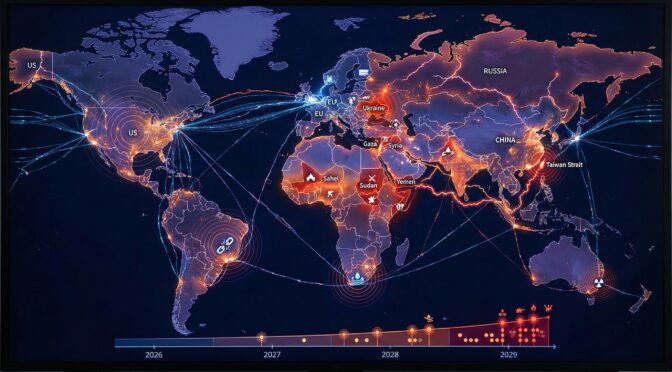
Date Authored: January 25, 2026
Executive Summary
The international security environment in January 2026 is defined by a convergence of high-intensity state-on-state warfare, the collapse of central authority in critical regional anchors, and a resurgence of aggressive unilateral interventionism that challenges the post-Cold War normative framework. This assessment, synthesized by the joint foreign affairs and intelligence desk, evaluates the current operational status of major global conflicts and projects high-risk contingencies for the 2026–2029 window. The global system is currently under extreme stress, characterized by the normalization of industrial-scale attrition in Eurasia, the fracturing of the Middle East following the “12-Day War” of 2025, and a decisive shift in United States foreign policy toward kinetic interventionism in the Western Hemisphere.
The defining geopolitical shock of early 2026 remains the United States’ direct military intervention in Venezuela. The January 3rd execution of Operation Absolute Resolve, which resulted in the capture of Nicolás Maduro and the decapitation of his regime, has fundamentally altered the calculus of sovereignty and intervention in the Americas.1 While the operation successfully dismantled the immediate leadership structure of the Bolivarian government, it has precipitated a severe diplomatic crisis with Latin American neighbors and raised the specter of a prolonged, fragmented insurgency despite the installation of a transitional government led by Delcy Rodríguez.1 This return to hard power by Washington is paralleled by an intensifying economic blockade, fundamentally reshaping global energy markets and regional stability dynamics.3
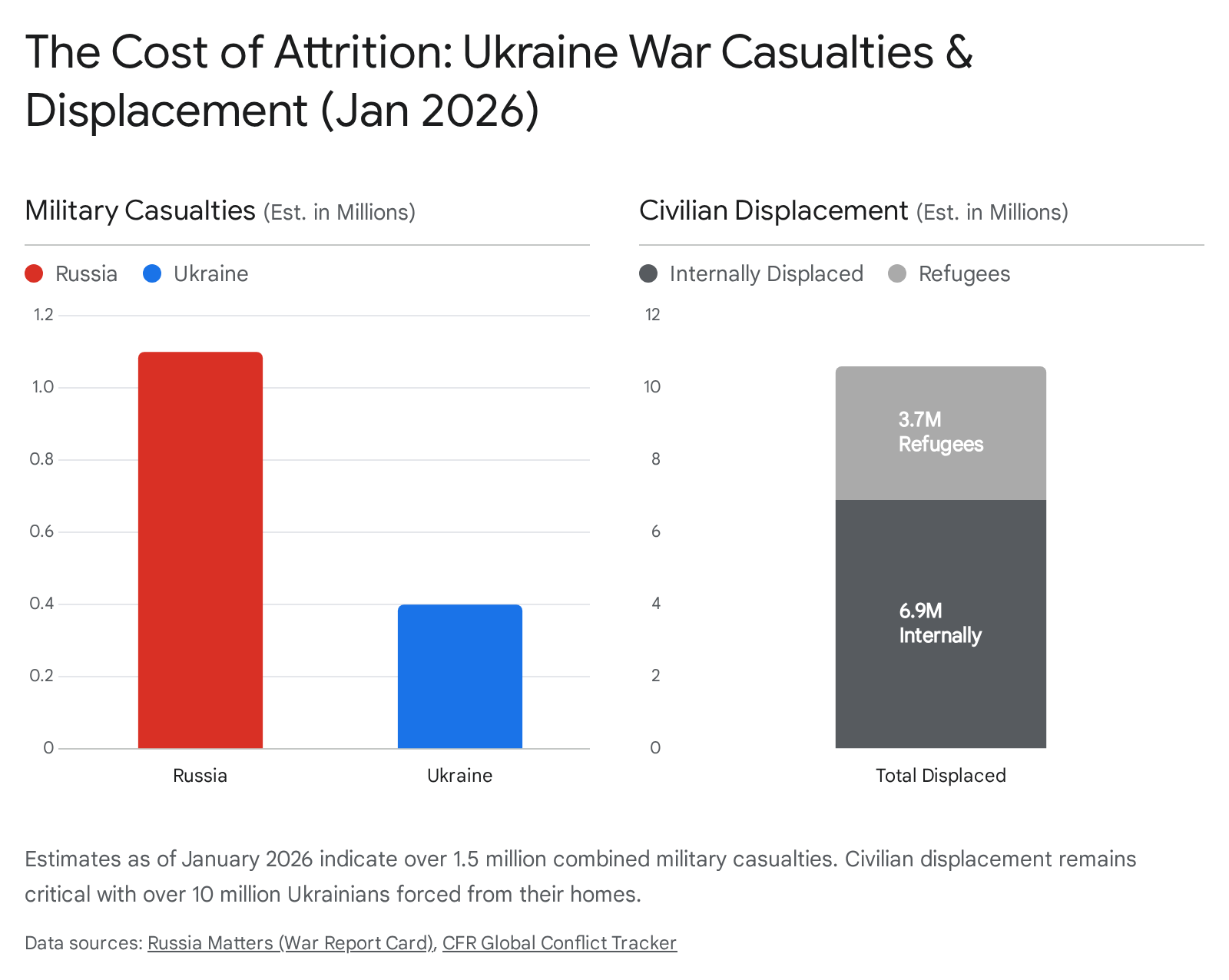
Simultaneously, the war in Ukraine has entered a brutal phase of positional attrition, devoid of the maneuver warfare that characterized earlier phases. With Russian casualties now estimated at a staggering 1.1 million and Ukrainian casualties at 400,000 4, the conflict has devolved into a grinding industrial war of exhaustion. The frontline remains largely frozen, yet civilian infrastructure is under intensifying bombardment, driving civilian casualties to their highest levels since the invasion began.5 The inability of either side to achieve a decisive breakthrough suggests a prolonged stalemate that will continue to drain global munition stocks and energy resources throughout 2026, with Ukraine facing immense pressure to cede territory in the Donbas to preserve its remaining state viability.6
In the Middle East, the region remains on a knife-edge following the major escalation of June 2025. While a fragile truce holds between Israel and Iran, the conflict in Gaza has not ceased but rather evolved into a permanent, high-intensity counter-insurgency operation inflicting catastrophic human costs, with fatalities exceeding 73,000.7 The proliferation of non-state actors—from the Houthis in Yemen to resurgent jihadist elements in the Sahel—continues to destabilize trade routes and regional governance, creating a belt of instability that stretches from the Levant to the Gulf of Guinea.
Looking toward the 2026–2029 strategic horizon, the primary risk is the potential for a kinetic conflict in the Indo-Pacific. The “2027 Window” regarding China’s military modernization and potential action against Taiwan remains the central planning assumption for global defense ministries.8 Furthermore, the rapid weaponization of new domains—specifically the “Anti-Satellite (ASAT) Age” and the race for deep-sea critical minerals—threatens to expand conflict envelopes into the exosphere and the ocean floor, areas previously managed through international cooperation but now arenas of zero-sum competition.10
This report details these conflicts, analyzes the drivers of escalation, and provides a strategic forecast for high-risk zones over the next three years. It argues that the “guardrails” that prevented direct Great Power conflict have eroded, necessitating a new analytical framework that accounts for the weaponization of migration, finance, and critical infrastructure.
Section 1: The Global Conflict Monitor (January 2026 Status)
1.1 The Eurasian Front: The Ukraine-Russia War of Attrition
Status: High-Intensity Industrial Warfare (Positional)
Location: Ukraine (Donbas, Southern Front, Deep Rear Areas)
Scale: Systemic / Approx. 1.5 Million Total Casualties
As of January 2026, the war in Ukraine has solidified into a high-lethality positional conflict that defies rapid resolution. Despite tactical innovations in drone warfare and electronic countermeasures, the strategic reality is defined by a lack of maneuver capability for either side. The Institute for the Study of War (ISW) assesses that Russian forces have optimized their force structure for positional warfare, effectively constraining any advances to a “foot pace” while maximizing the defensive utility of dense minefields and fortification lines.12 This shift represents a transition from a war of territorial conquest to a war of systemic exhaustion, where the primary objective is the degradation of the enemy’s capacity to sustain organized resistance.
The Human and Material Toll
The human cost of this strategic stalemate has reached proportions unseen in Europe since the Second World War. Intelligence estimates released in early 2026 place Russian casualties (killed and wounded) at approximately 1.1 million.4 This figure reflects the Russian command’s reliance on mass-infantry assaults to fix Ukrainian defenders, absorbing catastrophic losses to achieve incremental gains. On the Ukrainian side, casualties are estimated at 400,000 4, a toll that has severely strained the nation’s mobilization potential and social cohesion.
Material losses are equally severe, fundamentally altering the military balance in Eurasia. Russia has lost nearly 14,000 tanks and armored vehicles since the invasion began, along with 361 aircraft and 29 naval vessels.13 Ukraine, heavily reliant on Western aid, has lost over 11,000 pieces of heavy equipment, including 5,500 tanks and armored vehicles.13 This rate of attrition has outpaced the industrial production capacity of both the Russian defense industrial base and Western backers, leading to a global scarcity of artillery shells and armored platforms.
Civilian Impact and Demographic Crisis
The nature of the war has shifted toward the systemic degradation of Ukraine’s viability as a functional state. The year 2025 saw the highest civilian casualty rates since the war’s onset, with over 2,514 civilians killed.5 This surge is attributed to the “expanded frontline fighting” and, crucially, the “heightened use of long-range weapons” by Russian forces targeting energy grids, heating infrastructure, and population centers far from the contact line.5 The intent is clear: to make life in Ukrainian cities untenable during the winter months, thereby forcing a capitulation through humanitarian pressure.
Displacement remains a critical, perhaps permanent, crisis. There are currently 6.9 million internally displaced persons (IDPs) within Ukraine and 3.7 million refugees residing abroad.13 This represents the displacement of nearly 24% of Ukraine’s pre-invasion population. The demographic long-term impact is severe, as a significant portion of the refugee population—primarily women and children—establishes roots in host countries, reducing the likelihood of return and threatening Ukraine’s post-war economic recovery.
Strategic Outlook: The “Exhausted Ukraine” Scenario
The conflict is currently characterized by an “exhausted Ukraine” facing immense military and diplomatic pressure to cede the Donbas region.6 While the Ukrainian defense remains resilient, the cumulative effect of manpower shortages and intermittent aid delays has shifted the strategic initiative. The forecast for 2026 suggests a continued freezing of the conflict lines, with Russia attempting to consolidate its administrative control over occupied territories while conducting deep strikes to erode Ukrainian morale. The prospect of a negotiated settlement remains distant, as the maximalist goals of the Kremlin—demilitarization and political subordination of Kyiv—remain incompatible with Ukraine’s existential requirement for sovereignty and security guarantees.
1.2 The Middle East Fracture: Post-War Instability
Status: Active Insurgency / Fragile Truce
Location: Israel, Gaza, West Bank, Lebanon, Yemen
Scale: Regional High-Intensity / >73,000 Fatalities (Gaza)
The Middle East remains in a state of violent flux following the “12-Day War” of June 2025 between Israel and an Iranian-led coalition involving Hezbollah and the Houthis. While that specific kinetic exchange ended in a shaky truce—having damaged Iran’s nuclear program but left the regime intact—the underlying drivers of conflict have only intensified.14 The region has not returned to a status quo ante; rather, it has settled into a new, more volatile equilibrium where the threshold for resumption of major hostilities is dangerously low.
Gaza and West Bank: The Permanent Insurgency
The war in Gaza has ceased to be a conventional military operation and has evolved into a permanent, high-intensity counter-insurgency campaign. As of January 2026, the death toll in Gaza has surpassed 73,600, including significant numbers of women and children.7 The humanitarian situation is catastrophic, with the vast majority of the enclave’s infrastructure destroyed. Despite the declaration of “operational control” by Israeli forces in various sectors, Hamas and other militant groups retain the capacity to launch attacks, necessitating constant kinetic activity by the IDF.
Concurrently, the West Bank is experiencing an explosion of violence that threatens the stability of the Palestinian Authority. Escalating conflict between Israeli security forces, settlers, and Palestinian militant groups over settlement construction and political rights has created a second active front.15 The risk of a “Third Intifada” is no longer a theoretical risk but an operational reality in cities like Jenin and Nablus, further stretching Israeli security resources.
The Iranian Axis and the “Second Strike” Risk
Despite the setbacks of 2025, Iran’s proxy network remains operationally capable and strategically aggressive. The “lull” following the June 2025 war gave all sides a measure of satisfaction—Israel degraded Iranian nuclear capabilities, while the Iranian regime survived—but this equilibrium is unstable.14 Israel retains the capability and intent to strike again if it detects Iranian efforts to reconstitute the nuclear program, a scenario rated as a “moderate likelihood but high impact” risk for 2026.15
The Houthi front in Yemen continues to be a major disruptor of global trade. The group’s ability to threaten Red Sea shipping has necessitated a permanent US and allied naval presence, transforming the southern Red Sea into a zone of low-intensity naval warfare. This has broader economic implications, increasing insurance rates and disrupting supply chains between Europe and Asia.
Syria: The Sectarian Resurgence
Syria has re-entered the global risk matrix as a critical flashpoint. Following a period of relative dormancy, sectarian violence has surged in 2025 and early 2026, threatening the fragile stability of the Assad regime.6 This resurgence is driven by the vacuum left by distracted patrons (Russia and Iran) and the economic collapse of the Syrian state. The renewed violence draws in Turkish interests in the north and threatens to reignite the civil war on a scale not seen since 2017, potentially allowing groups like ISIS to re-establish territorial control in the Badia desert.16
1.3 Crisis in the Americas: Intervention and State Failure
Status: Direct Foreign Intervention / State Failure
Location: Venezuela, Haiti, Caribbean Basin
Scale: High (Geopolitical Shock / Regime Change)
The Western Hemisphere has become a primary theater of conflict in 2026, driven by a decisive shift in U.S. policy toward direct interventionism and the collapse of governance in key Caribbean states.
Venezuela: Operation Absolute Resolve
The capture of Nicolás Maduro by U.S. forces on January 3, 2026, during Operation Absolute Resolve, marks the most significant use of U.S. military force in Latin America in decades.1 This operation was the culmination of a steady military buildup in the Caribbean throughout late 2025, originally framed as a counter-narcoterrorism mission under the banner of Operation Southern Spear.17
The intervention has created a complex and perilous reality on the ground:
- Political Vacuum: While a transitional government led by former Vice President Delcy Rodríguez has been installed and attempts to maintain order, its legitimacy is contested by various internal factions and the international community.1
- Economic Strangulation: The country remains under a “total and complete blockade” of sanctioned oil tankers enforced by the U.S. Navy.3 This has strangled the country’s primary revenue source, exacerbating an already dire humanitarian crisis and creating incentives for illicit smuggling networks.
- Regional Fallout: The operation has alienated key Latin American partners and drawn condemnation from human rights organizations, who view the unilateral action as a violation of international law.18 The risk of an insurgency led by loyalist colectivos remains high, potentially dragging the U.S. into a prolonged stabilization mission.
Haiti: Governance by Gangs
Haiti has transitioned from a state of crisis to a state of war. Armed gangs, specifically the G9 and G-Pep alliances, now control approximately 90% of Port-au-Prince.19 This is not merely criminal activity; it is de facto governance by violent non-state actors who control territory, infrastructure, and the distribution of resources.
The violence is characterized by systematic brutality, including sexual violence used as a weapon of war and the recruitment of child soldiers.20 The UN-backed multinational mission led by Kenya has largely failed to break the gangs’ stranglehold, leaving the population in a state of acute vulnerability. With over 6.4 million people in need of humanitarian aid, Haiti represents a collapsed state within the U.S. near-abroad, fueling migration pressures and allowing transnational criminal organizations to operate with impunity.19
1.4 African State Collapse: The Belt of Instability
Status: Civil War / Jihadist Insurgency
Location: Sudan, Sahel (Mali, Burkina Faso, Niger), DRC
Scale: Continental / >15 Million Displaced
Sub-Saharan Africa is experiencing a cascade of state failures, linking the Red Sea to the Atlantic Ocean in a continuous belt of conflict.
Sudan: The Forgotten Catastrophe
Approaching its 1,000th day, the civil war in Sudan has resulted in the world’s largest displacement crisis. The conflict between the Sudanese Armed Forces (SAF) and the Rapid Support Forces (RSF) has effectively partitioned the country. Fighting has expanded into Kordofan, solidifying an east-west divide that threatens to become a permanent fracture of the Sudanese state.6
- Humanitarian Abyss: The scale of suffering is immense. Over 13.6 million people have been displaced, with nearly 9.3 million internally and 4.3 million seeking refuge in neighboring states like Chad, South Sudan, and Egypt.21 This massive influx of refugees is destabilizing the entire region, particularly Chad, which hosts nearly a million new arrivals.22
- Proxy Dimensions: The war is fueled by external actors, with powers such as the UAE and Egypt providing material support to opposing factions.14 This internationalization of the conflict ensures that neither side can achieve decisive victory, prolonging the attrition and increasing the likelihood of total state collapse and famine.
The Sahel: The Jihadist Proto-States
In the Sahel, the withdrawal of Western security forces and the failure of military juntas to provide security have ceded vast territories to jihadist groups. Affiliates of Al-Qaeda (JNIM) and the Islamic State (IS-Sahel) now effectively govern large swathes of Mali, Burkina Faso, and Niger.23 These groups collect taxes, administer justice, and use these territories as logistical hubs to launch attacks into the coastal states of West Africa, such as Benin and Togo. The region has become the global epicenter of terrorism deaths, accounting for over 50% of the worldwide total.23
Democratic Republic of the Congo (DRC): The Endless War
In the eastern DRC, the conflict involving the M23 rebel group remains a potent destabilizer. Despite the recent withdrawal of M23 forces from the city of Uvira in January 2026, the situation remains highly volatile.24 The underlying tensions between the DRC and Rwanda, which backs the M23, have not been resolved. The vacuum left by M23’s tactical withdrawal has often been filled by abusive “Wazalendo” militias, leaving civilians at grave risk of predation.24 The conflict continues to displace millions and hamper the exploitation of the region’s critical mineral wealth, which is vital for the global energy transition.
1.5 Asian Instability: Fragmentation and Insurgency
Status: Civil War / Border Conflict
Location: Myanmar, Afghanistan-Pakistan Border
Scale: Medium-High / Regional Spillover
Myanmar: The Junta’s Slow Collapse
The civil war in Myanmar has reached a critical inflection point in early 2026. The military junta (State Administration Council) is losing territory rapidly to a coalition of Ethnic Armed Organizations (EAOs) and People’s Defense Forces (PDF). Resistance forces have pushed the military out of vast swathes of the country, particularly in the border regions, with the Arakan Army now controlling almost all of Rakhine State.25
Facing defeat on the battlefield, the Junta has resorted to “scorched earth” tactics, relying on air power to bomb civilian centers and infrastructure.26 Politically, they are attempting to stage managed elections to fracture the opposition and garner international legitimacy, capitalizing on foreign support from China and Russia.6 The conflict has displaced over 3.6 million civilians 25, with significant spillover effects into Thailand and India.
Pakistan-Afghanistan: The Pashtun Belt Crisis
The border between Pakistan and Afghanistan has become a zone of active warfare. The resurgent Tehrik-e-Taliban Pakistan (TTP), utilizing safe havens in Taliban-controlled Afghanistan, has launched a relentless campaign of attacks inside Pakistan.27 This violence has strained relations between Islamabad and Kabul to the breaking point, leading to frequent border skirmishes and the threat of a broader interstate conflict. Pakistan faces a dual crisis of political legitimacy and internal security, battling rising militancy that risks spreading beyond the frontier regions.6
Summary Table 1: Current Major Conflicts (January 2026)
| Conflict Area | Primary Belligerents | Type | Intensity / Scale | Key Impact/Status (Jan 2026) |
| Ukraine | Russia vs. Ukraine (NATO support) | Interstate War | Extreme (1.5M+ casualties) | Positional warfare; “industrial attrition”; high civilian toll; stalemate. |
| Israel-Levant | Israel vs. Hamas/Hezbollah/Iran | Regional War | High (>73k dead in Gaza) | Ongoing Gaza insurgency; tenuous Israel-Iran truce; West Bank destabilization. |
| Sudan | SAF vs. RSF | Civil War | High (State Collapse) | 1,000 days of war; 13.6M displaced; de facto partition; famine risk. |
| Venezuela | US vs. Maduro Regime / Internal Factions | Intervention | High (Political Shock) | Maduro captured Jan 3; US Blockade; Transitional govt in fragile control. |
| Myanmar | Junta vs. PDF/EAOs | Civil War | Medium-High | Junta losing territory; widespread airstrikes; 3.6M displaced. |
| Sahel | Juntas vs. JNIM/IS-Sahel | Insurgency | Medium-High | Terror groups controlling vast territory in Mali/Burkina Faso/Niger. |
| DRC (East) | DRC Govt/Wazalendo vs. M23 (Rwanda backed) | Regional Proxy | Medium | M23 tactical withdrawal (Jan 2026); fragile ceasefire; high civilian risk. |
| Haiti | Govt/UN vs. G9/G-Pep Gangs | Gang Warfare | Medium (State Failure) | Gangs control 90% of capital; acute humanitarian emergency. |
Section 2: Strategic Horizon: The 2026-2029 Risk Matrix
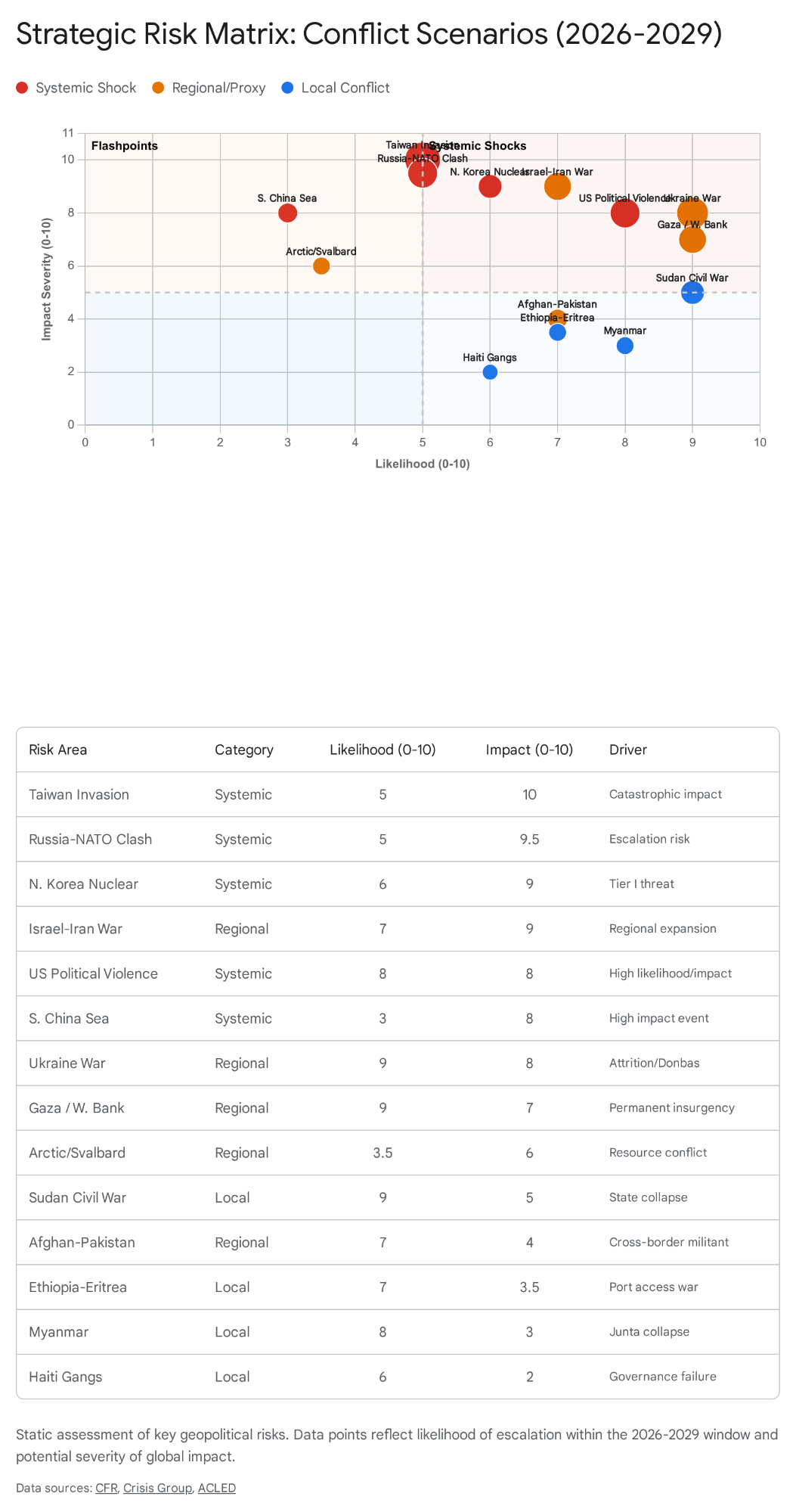
The following analysis identifies areas where conflict is likely to erupt or significantly escalate over the next three years. These assessments are based on current trend lines, intelligence signaling, and structural geopolitical shifts.
2.1 The Indo-Pacific: The Taiwan Singularity
Risk Level: Critical
Timeframe: 2026-2027
Primary Actors: China, Taiwan, United States, Regional Allies
The most dangerous flashpoint for global security remains the Taiwan Strait. Intelligence assessments point to 2027—the centennial of the People’s Liberation Army (PLA)—as a key milestone for Beijing’s readiness to undertake a forceful unification.9
- Triggers and Indicators: The primary triggers for conflict include a formal declaration of independence by Taiwan, a collapse of cross-strait dialogue, or a domestic crisis in China that necessitates a nationalist distraction. The “gray zone” pressure—military exercises, airspace violations, and economic coercion—is expected to ramp up significantly in 2026.28 The PLA’s “Justice Mission 2025” exercises in late 2025 signaled a growing capability to encircle the island.28
- Global Economic Impact: A conflict over Taiwan would likely result in a global economic depression. Estimates suggest a blockade or invasion could disrupt over $2.5 trillion in annual trade and sever the supply of advanced semiconductors, costing the global economy trillions and paralyzing industries ranging from automotive to consumer electronics.29
- The “Davison Window”: Former US Indo-Pacific Command Admiral Philip Davidson’s warning of a 2027 window remains the central planning assumption. While some analysts argue China may not be fully ready, the political imperative for Xi Jinping to deliver on reunification goals makes this period uniquely dangerous.28
2.2 The Polar Front: Arctic Militarization
Risk Level: High
Timeframe: 2026-2028
Primary Actors: United States, Russia, China, Denmark (Greenland)
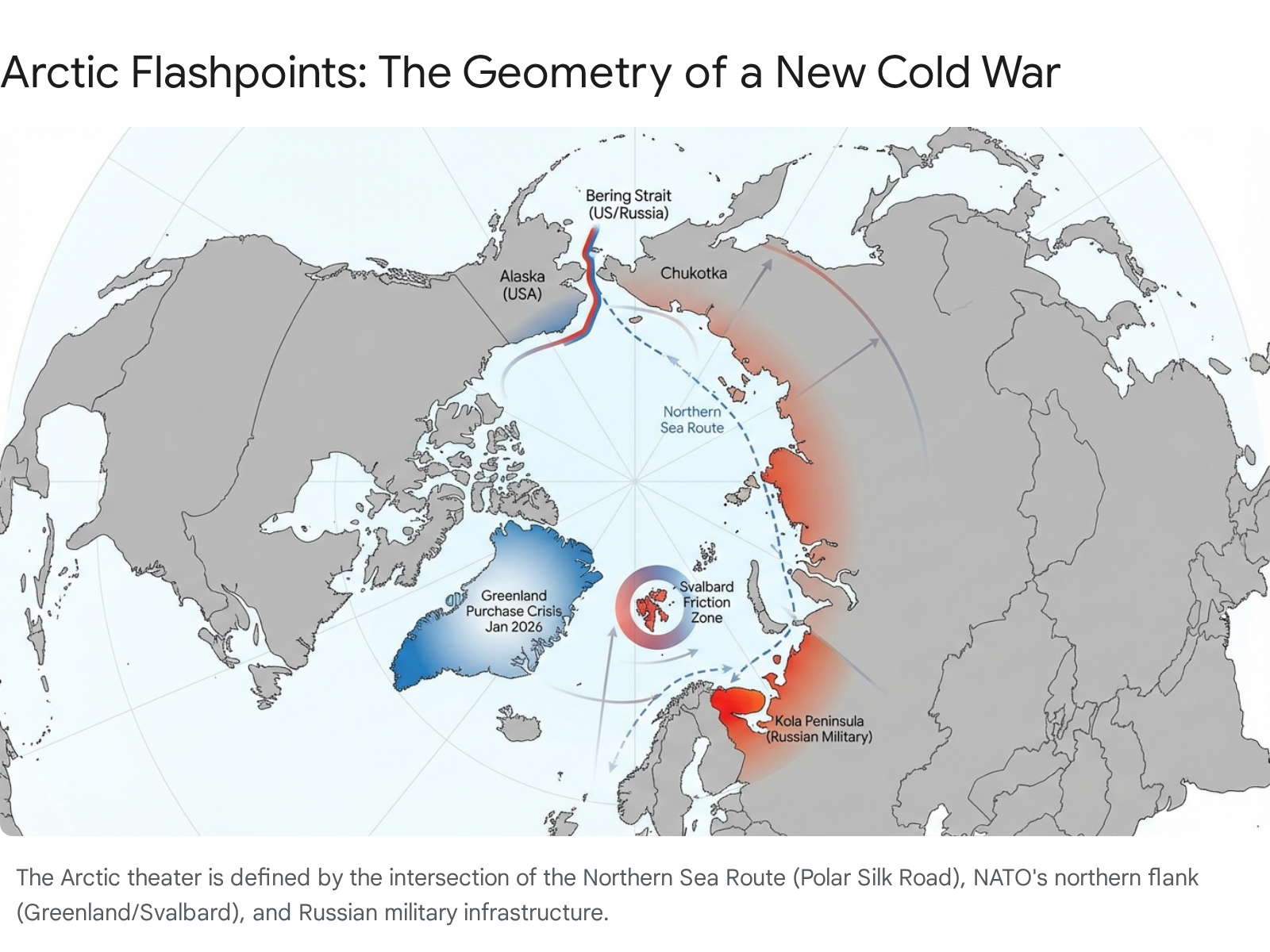
The “Greenland Crisis” of January 2026 serves as a bellwether for Arctic tensions. President Trump’s renewed push to purchase or annex Greenland, accompanied by tariff threats against European allies, nearly fractured the NATO alliance.31 While a “framework deal” reached in Davos on January 21, 2026, has temporarily de-escalated the immediate diplomatic standoff 33, the underlying driver—competition for Arctic resources and strategic positioning—remains unresolved.
- Militarization: Russia and China are expanding their icebreaker fleets and military infrastructure in the High North to secure the Northern Sea Route (Polar Silk Road). The U.S. determination to secure Greenland as a strategic asset reflects a return to 19th-century style territorial acquisition logic, driven by the desire to deny adversaries access to North American approaches.
- Flashpoints: Svalbard and the Bering Strait are emerging as friction points where NATO and Russian/Chinese assets operate in close proximity. The unique demilitarized status of Svalbard makes it a potential target for “gray zone” operations by Russia to test NATO resolve.34
2.3 New Domains: Space and the Seabed
Risk Level: High (Asymmetric/Systemic)
Timeframe: 2026-2029
Primary Actors: United States, China, Russia
Conflict is expanding into domains that were previously governed by international cooperation or were technologically inaccessible.
Space Warfare: The “Anti-Satellite” (ASAT) Age
Space is no longer a sanctuary; it is a warfighting domain. The deployment of ASAT capabilities by Russia and China, and the U.S. response, has created a “security dilemma” in orbit.10 The destruction of satellites is now a tangible risk. A kinetic conflict in space would create debris fields (Kessler Syndrome) that could render Low Earth Orbit (LEO) unusable, crippling the global digital economy. The space economy, valued at nearly $630 billion today and projected to reach $1.8 trillion by 2035, is entirely dependent on the security of this infrastructure.35 Any escalation in Taiwan or Ukraine could see a “blinding” attack on U.S. reconnaissance satellites, triggering a cascade of retaliation that would sever global communications and GPS services.36
Deep Sea Mining: The Race for the Abyss
The transition to green energy and the digitization of warfare require vast amounts of lithium, cobalt, and rare earth elements. With the International Seabed Authority (ISA) delaying regulations, the U.S. is moving toward unilateral exploitation of seabed resources under the Deep Seabed Hard Mineral Resources Act.11 This sets the stage for naval standoffs in the Pacific, particularly in the Clarion-Clipperton Zone, where U.S. and Chinese mining claims may overlap. The Executive Order of January 15, 2026, on “Adjusting Imports of Processed Critical Minerals,” signals a more aggressive U.S. posture to decouple from Chinese supply chains, which could lead to physical confrontations over mining sites.37
2.4 The Evolution of Terror: Decentralized Jihad
Risk Level: High
Timeframe: 2026-2029
Primary Actors: ISIS Affiliates, Al-Qaeda (JNIM), Lone Actors
Terrorism has evolved from a centralized threat (Al-Qaeda core) to a diffuse, localized insurgency model. The “New Orleans Attack” on January 1, 2026, which killed 14 people, demonstrated the enduring reach of ISIS-inspired lone actors striking soft targets in the homeland.38
Globally, the threat is concentrated in “ungoverned spaces.” In the Sahel, groups like JNIM and IS-Sahel effectively govern large territories, using them as bases to destabilize coastal West African states.39 In South Asia, the TTP’s resurgence in Pakistan highlights the danger of state sponsorship or tolerance of militant groups, as the Afghan Taliban’s shelter of the TTP drives the region toward a major interstate conflict.27 The risk for 2026-2029 is the “export” of this violence from local insurgencies to transnational attacks, facilitated by the loss of intelligence visibility in denied areas like Afghanistan.
2.5 Resource Wars: Critical Minerals
The scramble for critical minerals (Lithium, Cobalt, Copper) is driving conflict in Africa and South America. The U.S. shift to secure supply chains 37 puts resource-rich nations in the crosshairs. In the DRC and Zambia, competition for mining rights is intensifying local conflicts. In South America, the “Lithium Triangle” is becoming a zone of geopolitical competition, with the U.S. intervention in Venezuela viewed by some analysts as a precursor to securing energy and mineral resources in the wider region to deny them to adversaries like China.40
Summary Table 2: High-Risk Areas (Forecast 2026-2029)
| Risk Area | Primary Actors | Driver of Conflict | Risk Level | Projected Trigger/Scenario |
| Taiwan Strait | China vs. Taiwan/US | Reunification / Geopolitics | Critical | PLA blockade or invasion attempt (2027 window). |
| Arctic / Greenland | US vs. Russia/China | Resource Control / Strategy | High | US annexation attempts; Disputes over Svalbard/Northern Sea Route. |
| Space (LEO) | US vs. China/Russia | ASAT / Sat-Destruction | High | “Blinding” attack on reconnaissance sats during Earth conflict. |
| Ethiopia-Eritrea | Ethiopia vs. Eritrea | Red Sea Access | High | Ethiopia military push for port access (Assab). |
| Pakistan | Govt vs. TTP/Baloch Seps | Insurgency / Pol. Crisis | High | State failure or major cross-border war with Afghanistan. |
| Deep Sea Beds | US vs. China | Resource Extraction (Nodule) | Medium | Naval standoff over mining claims in the Clarion-Clipperton Zone. |
| Guyana | Venezuela vs. Guyana | Territorial Claim (Essequibo) | Medium | Venezuela renewed push for Essequibo (post-transition). |
| Balkans | Serbia vs. Kosovo | Ethnic / Territorial | Medium | Republika Srpska secession or N. Kosovo annexation attempt. |
Conclusion
The outlook for 2026–2029 is one of escalating volatility. The “guardrails” that prevented direct Great Power conflict during the post-Cold War era have eroded. The international system is suffering from “overload,” with the U.S. capability to manage multiple theater wars stretched to the breaking point.42 The “Two-War Construct”—the ability to fight two major wars simultaneously—is now a “Multi-Front Reality.”
Nations must prepare for a period where conflict is not an anomaly, but a permanent feature of the international landscape. This era will be defined by the weaponization of everything: from the physical blockade of energy (Venezuela) to the destruction of orbital infrastructure (Space) and the instrumentalization of migration flows (Sudan/Europe). The distinction between “war” and “peace” is vanishing, replaced by a continuum of competition that requires constant, agile adaptation by state and commercial actors alike.
If you find this post useful, please share the link on Facebook, with your friends, etc. Your support is much appreciated and if you have any feedback, please email me at in**@*********ps.com. Please note that for links to other websites, we are only paid if there is an affiliate program such as Avantlink, Impact, Amazon and eBay and only if you purchase something. If you’d like to directly contribute towards our continued reporting, please visit our funding page.
Sources Used
- 2026 United States intervention in Venezuela – Wikipedia, accessed January 25, 2026, https://en.wikipedia.org/wiki/2026_United_States_intervention_in_Venezuela
- The 5 Largest US Air Force Bases In The Caribbean & Their Strategic Roles, accessed January 25, 2026, https://simpleflying.com/5-largest-us-air-force-bases-caribbean-strategic-roles/
- Trump orders blockade of sanctioned oil tankers entering and leaving Venezuela, accessed January 25, 2026, https://www.theguardian.com/us-news/2025/dec/16/trump-orders-blockade-oil-tankers-venezuela
- The Russia-Ukraine War Report Card, Jan. 14, 2026, accessed January 25, 2026, https://www.russiamatters.org/news/russia-ukraine-war-report-card/russia-ukraine-war-report-card-jan-14-2026
- War in Ukraine | Global Conflict Tracker – Council on Foreign Relations, accessed January 25, 2026, https://www.cfr.org/global-conflict-tracker/conflict/conflict-ukraine
- Conflict Watchlist 2026 – ACLED, accessed January 25, 2026, https://acleddata.com/series/conflict-watchlist-2026
- Casualties of the Gaza war – Wikipedia, accessed January 25, 2026, https://en.wikipedia.org/wiki/Casualties_of_the_Gaza_war
- The Dragon and the Clock—2027 as the Turning Point Year Between China and Taiwan, accessed January 25, 2026, https://www.inss.org.il/publication/china-taiwan-2027/
- Xi Jinping’s Taiwan Dashboard, accessed January 25, 2026, https://media.defense.gov/2025/Apr/29/2003700710/-1/-1/1/FEATURE%20-%20MOORE%20DISCLAIMER.PDF
- From the Space Age to the Anti-Satellite Age – CSIS, accessed January 25, 2026, https://www.csis.org/analysis/space-age-anti-satellite-age
- The Risks of U.S. Deep-Sea Mining – CSIS, accessed January 25, 2026, https://www.csis.org/analysis/risks-us-deep-sea-mining
- Russian Offensive Campaign Assessment, January 22, 2026, accessed January 25, 2026, https://understandingwar.org/research/russia-ukraine/russian-offensive-campaign-assessment-january-22-2026/
- The Russia-Ukraine War Report Card, Jan. 21, 2026, accessed January 25, 2026, https://www.russiamatters.org/news/russia-ukraine-war-report-card/russia-ukraine-war-report-card-jan-21-2026
- Ten Conflicts to Watch in 2026 | International Crisis Group, accessed January 25, 2026, https://www.crisisgroup.org/visual-explainers/ten-conflicts-2026/
- Conflicts to Watch in 2026 | Council on Foreign Relations, accessed January 25, 2026, https://www.cfr.org/reports/conflicts-watch-2026
- Middle East Overview: January 2026 – ACLED, accessed January 25, 2026, https://acleddata.com/update/middle-east-overview-january-2026
- United States military buildup in the Caribbean during Operation Southern Spear – Wikipedia, accessed January 25, 2026, https://en.wikipedia.org/wiki/United_States_military_buildup_in_the_Caribbean_during_Operation_Southern_Spear
- Joint statement – situation in Venezuela – WOLA, accessed January 25, 2026, https://www.wola.org/2026/01/joint-statement-situation-in-venezuela/
- Haiti’s gang violence crisis: What to know and how to help | The IRC, accessed January 25, 2026, https://www.rescue.org/article/haitis-gang-violence-crisis-what-know-and-how-help
- Undoing Haiti’s Deadly Gang Alliance – International Crisis Group, accessed January 25, 2026, https://www.crisisgroup.org/sites/default/files/2025-12/110-haiti-deadly-gang-alliance%20%281%29.pdf
- Sudan war leaves millions hungry and displaced as health system nears collapse, accessed January 25, 2026, https://news.un.org/en/story/2026/01/1166738
- Situation Sudan situation – Operational Data Portal – UNHCR, accessed January 25, 2026, https://data.unhcr.org/en/situations/sudansituation
- Shifting Sands in Security: Foreign Counterterrorism Influences in the Sahel, accessed January 25, 2026, https://www.visionofhumanity.org/shifting-sands-in-security-foreign-counterterrorism-influences-in-the-sahel/
- DR Congo: Civilians in South Kivu City at Serious Risk | Human Rights Watch, accessed January 25, 2026, https://www.hrw.org/news/2026/01/20/dr-congo-civilians-in-south-kivu-city-at-serious-risk
- Myanmar Crisis Situation Analysis: 22/12/25 – 28/12/25, accessed January 25, 2026, https://reliefweb.int/report/myanmar/myanmar-crisis-situation-analysis-221225-281225
- World Report 2025: Myanmar | Human Rights Watch, accessed January 25, 2026, https://www.hrw.org/world-report/2025/country-chapters/myanmar
- 10 Conflicts to Watch in 2026 | International Crisis Group, accessed January 25, 2026, https://www.crisisgroup.org/cmt/global/10-conflicts-watch-2026
- PLA could ramp up aggression ahead of 2027: think tank – Taipei Times, accessed January 25, 2026, https://www.taipeitimes.com/News/taiwan/archives/2026/01/23/2003851108
- Disruptions to Trade in the Taiwan Strait Would Severely Impact China’s Economy – CSIS, accessed January 25, 2026, https://www.csis.org/analysis/disruptions-trade-taiwan-strait-would-severely-impact-chinas-economy
- Would Anyone “Win” a Taiwan Conflict? – Stimson Center, accessed January 25, 2026, https://www.stimson.org/2024/us-china-taiwan-conflict-global-economy/
- President Trump and Greenland: Frequently asked questions – House of Commons Library, accessed January 25, 2026, https://commonslibrary.parliament.uk/research-briefings/cbp-10472/
- Greenland crisis – Wikipedia, accessed January 25, 2026, https://en.wikipedia.org/wiki/Greenland_crisis
- By taking a win on Greenland, Trump set US and allied security in the Arctic on a better path, accessed January 25, 2026, https://www.atlanticcouncil.org/dispatches/by-taking-a-win-on-greenland-trump-set-us-and-allied-security-in-the-arctic-on-a-better-path/
- Arctic Geopolitics: The Svalbard Archipelago – CSIS, accessed January 25, 2026, https://www.csis.org/analysis/arctic-geopolitics-svalbard-archipelago
- Space: The $1.8 Trillion Opportunity for Global Economic Growth, accessed January 25, 2026, https://www3.weforum.org/docs/WEF_Space_2024.pdf
- The Business Of Cosmic Conflict: The Economic Stakes Of War In Space | Forbes Luxembourg, accessed January 25, 2026, https://www.forbes.lu/the-business-of-cosmic-conflict-the-economic-stakes-of-war-in-space/
- New Executive Order Ties U.S. Critical Minerals Security to Global Partnerships – CSIS, accessed January 25, 2026, https://www.csis.org/analysis/new-executive-order-ties-us-critical-minerals-security-global-partnerships
- Jihadist Terrorism in the United States – CSIS, accessed January 25, 2026, https://www.csis.org/analysis/jihadist-terrorism-united-states
- Assessment of the Global Terrorism Threat Landscape in Mid-2025 – The Soufan Center, accessed January 25, 2026, https://thesoufancenter.org/intelbrief-2025-july-11/
- Explainer: the Venezuela and Guyana oil dispute – Offshore Technology, accessed January 25, 2026, https://www.offshore-technology.com/features/explainer-the-venezuela-and-guyana-oil-dispute/
- The U.S.-Venezuela-Guyana Oil Triangle – Drilled Media, accessed January 25, 2026, https://drilled.media/news/guyana-venezuela
- The World’s Next Crisis May Begin in 2027, Are We Ready? – YouTube, accessed January 25, 2026, https://www.youtube.com/watch?v=eQF5vOKvD5o