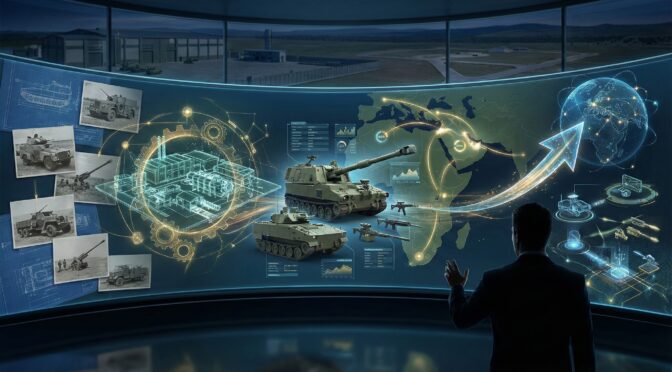
Denel Land Systems (DLS), a division of the state-owned conglomerate Denel SOC Ltd, represents the industrial nucleus of South Africa’s sovereign landward defence capability. Born from the strategic exigencies of the apartheid era—specifically the United Nations arms embargoes of 1963 and 1977—DLS evolved from a licensed manufacturer of foreign designs into a globally recognized innovator in long-range artillery and robust infantry systems. The company’s history is bifurcated into two distinct epochs: the “Embargo Era” of Lyttelton Engineering Works (LIW), characterized by the clandestine acquisition of technology and rapid indigenous adaptation to support the South African Border War; and the “Commercial Era” of Denel, marked by attempts to penetrate global markets, the devastating impact of state capture corruption, and a subsequent struggle for financial solvency.
As of late 2025, Denel Land Systems is navigating a critical turnaround phase following a period of technical insolvency that threatened its existence between 2019 and 2023. The division remains the Original Equipment Manufacturer (OEM) for the South African National Defence Force’s (SANDF) primary infantry and artillery platforms, including the R-series assault rifles, SS-77 machine guns, and the G5/G6 artillery family. The latter, developed in the late 1970s, revolutionized global artillery doctrine by utilizing Extended Range Full Bore (ERFB) technology to achieve ranges previously unattainable by NATO or Warsaw Pact standards.
In the small arms sector, DLS (under its historical Vektor brand) produced the standard-issue firearms for the SANDF but failed to sustain a foothold in the lucrative United States civilian market. This failure was precipitated by a catastrophic safety recall of the Vektor CP1 pistol in 2000, which destroyed the brand’s commercial viability in North America and led to the closure of Vektor USA. Today, DLS’s presence in the US is limited to the secondary market and the importation of demilitarized parts kits by niche suppliers.
This report provides an exhaustive industry analysis of Denel Land Systems. It dissects the company’s transition from the Armscor-controlled Lyttelton Engineering Works to a commercial entity, evaluates its diverse product portfolio ranging from 9mm pistols to 155mm howitzers, and scrutinizes its financial health and operational outlook as it attempts to deliver on the delayed Project Hoefyster combat vehicle program. The analysis suggests that while DLS retains pockets of world-class engineering capability, its future as a manufacturing entity hinges on the successful execution of its 2024/2025 restructuring plan and the retention of critical intellectual property against aggressive foreign acquisition.
1. Corporate History and Evolution
The trajectory of Denel Land Systems is inextricably linked to the geopolitical history of South Africa. The company did not emerge from organic commercial market forces but was forged as a strategic instrument of the state to ensure military self-sufficiency in the face of growing international isolation.
1.1 The Embargo Era: Lyttelton Engineering Works (LIW)
The origins of DLS trace back to Lyttelton Engineering Works (Lyttelton Ingenieurswerke – LIW), located in Centurion, south of Pretoria.1 In the early 1960s, the South African government recognized the vulnerability of its defence supply chains. The adoption of United Nations Security Council Resolution 181 in 1963, calling for a voluntary arms embargo, served as the initial warning. This was solidified by Resolution 418 in 1977, which imposed a mandatory arms embargo, effectively cutting off the South African Defence Force (SADF) from its traditional suppliers in the United Kingdom and Belgium.2
LIW was the manufacturing arm of Armscor (Armaments Corporation of South Africa), the state entity tasked with circumvention and indigenization. During this period, LIW’s mandate was clear: reverse-engineer essential foreign systems or secure production licenses before sanctions tightened completely. This era of “innovation from isolation” defined the engineering culture of the company. It prioritized robustness, simplicity, and lethality—requirements driven by the operational realities of the South African Border War in Angola and Namibia.4
The most significant crisis for the SADF—and the catalyst for LIW’s rise—occurred during Operation Savannah in 1975. South African artillery units, equipped with World War II-era 5.5-inch guns and 25-pounders, found themselves consistently outranged by Soviet-supplied BM-21 Grads and 130mm M-46 field guns operated by Cuban and Angolan forces (FAPLA).4 The inability to conduct effective counter-battery fire posed a severe tactical disadvantage.
In response, LIW, under Armscor’s direction, engaged in one of the Cold War’s most complex technology transfers. Through a clandestine partnership with the Space Research Corporation (SRC) and Canadian engineer Gerald Bull, South Africa acquired the plans and ballistic technology for the GC-45 howitzer.6 LIW engineers did not merely copy the design; they hardened it for the African bush, creating the G5 howitzer. This success transformed LIW from a licensed manufacturer into a design authority capable of producing world-leading ballistics technology.7
1.2 The Formation of Denel and Commercialization (1992)
With the end of the Cold War and the dismantling of apartheid in the early 1990s, the South African defence industry faced a new existential threat: the vanishing of the massive state defence budget. In preparation for the transition to democracy, the government restructured the industry to separate the procurement function from the manufacturing base.
On April 1, 1992, Denel (Pty) Ltd was established as a state-owned industrial company under the Ministry of Public Enterprises.8 It inherited the manufacturing subsidiaries of Armscor, including LIW, Atlas Aircraft Corporation, and Kentron (missiles).1
- Denel Land Systems (DLS): LIW was rebranded and integrated into the Land Systems division. It transitioned from a strategic arsenal to a profit-seeking entity, tasked with exporting its combat-proven hardware to the world.
- Vektor: The small arms division of LIW was branded as “Vektor” to market pistols and rifles to international military and civilian customers. This brand would become the face of South African small arms in the US and Europe throughout the 1990s.10
The immediate post-1994 era was characterized by significant export successes, particularly in the Middle East. The sale of G6 self-propelled howitzers to the United Arab Emirates (UAE) and Oman validated DLS’s technology on the global stage, proving that South African systems could compete with established Western OEMs like BAE Systems and General Dynamics.11
1.3 The “State Capture” Crisis (2010–2023)
The promising start of the commercial era eventually gave way to a period of severe institutional decay known in South Africa as “State Capture.” From approximately 2010 to 2018, Denel, like many South African State-Owned Enterprises (SOEs), became a target for political corruption and mismanagement.13
This period had a devastating impact on Denel Land Systems:
- Hollowing Out of Expertise: As financial mismanagement led to liquidity crises, DLS struggled to pay salaries. This triggered a massive “brain drain,” where senior engineers and technical staff left the company. Many were recruited by defence conglomerates in the UAE (such as EDGE Group) and Saudi Arabia, effectively transferring South African institutional knowledge to foreign competitors.13
- Loss of IP: Allegations surfaced regarding the unauthorized sharing of sensitive intellectual property with foreign entities to secure short-term funding or personal kickbacks for executives. The integrity of DLS’s proprietary technology—specifically in missiles and artillery—was compromised.13
- Technical Insolvency: By the 2021/2022 financial year, Denel was technically insolvent. The company could not service its debt or buy raw materials to fulfill orders. Operations at the Lyttelton campus frequently ground to a halt, and the company became reliant on government bailouts (totaling billions of Rands) to avoid liquidation.14
- Audit Failures: For several consecutive years, Denel received disclaimer audit opinions from the Auditor-General, indicating a complete breakdown in financial controls and record-keeping.16
1.4 Restructuring and “Green Shoots” (2024–2025)
In late 2023 and continuing through 2025, Denel embarked on a rigorous turnaround strategy overseen by a new board and the Department of Defence. The focus shifted to “right-sizing” the organization—cutting overheads, selling non-core assets, and renegotiating onerous contracts.16
By November 2025, Denel reported “encouraging results” from this restructuring. The company claimed to be stabilizing its core business, settling outstanding salaries, and slowly rebuilding its order book.16 However, the DLS division remains in a precarious position. It is heavily dependent on the successful execution of the delayed Project Hoefyster (Badger Infantry Combat Vehicle) and the maintenance of legacy systems. The strategic intent is to reposition DLS as a systems integrator, partnering with international firms where necessary, while retaining sovereign control over key technologies like artillery ballistics and secure communications.17
2. Small Arms Product Portfolio
Denel Land Systems’ small arms portfolio, historically marketed under the Vektor brand, is defined by ruggedness. The design philosophy emphasizes reliability in dusty, hot environments and ease of maintenance by conscript soldiers. While DLS has ceased mass production for the civilian market, it continues to manufacture military arms for the SANDF and select export clients.
2.1 The R-Series Assault Rifles
The R4 Assault Rifle is the foundational weapon of the South African infantry. Its adoption in 1980/1982 marked the transition from the 7.62x51mm battle rifle (R1/FN FAL) to the intermediate 5.56x45mm cartridge.2
Development and Adaptation:
The R4 is a licensed and heavily modified variant of the Israeli Galil ARM. While the Galil itself is a derivative of the Finnish Valmet (and by extension the Kalashnikov AK-47), the South African adaptation involved significant re-engineering by LIW to suit local requirements.19
- Polymer Construction: One of the most critical modifications was the replacement of the Galil’s metal stock and handguard with a high-impact, fiber-reinforced polymer. The metal stocks of the Galil became searingly hot in the African sun, making the weapon difficult to handle. The polymer solution also reduced the overall weight of the weapon.20
- Ergonomics: The stock length was increased. South African soldiers were, on average, physically larger than their Israeli counterparts, necessitating a longer length of pull for effective ergonomics.20
- Gas System: The R4 retains the AK-47’s long-stroke gas piston system, renowned for reliability. However, LIW improved the gas tube lock to prevent it from vibrating loose during sustained automatic fire, a known issue in early Galils.19
- Manufacturing Independence: Crucially, LIW established the capability to manufacture every component of the R4 domestically, including the cold-hammer-forged barrels and milled receivers, ensuring immunity from external sanctions.20
Variants:
- R4: The standard service rifle with an 18-inch barrel and bipod. It features a gas cut-off valve for launching rifle grenades, a tactic heavily utilized by the SADF for bunker clearing.19
- R5: A carbine variant introduced for the South African Police Service (SAPS), Special Forces, and the South African Air Force. It features a shorter 13-inch barrel and lacks the bipod. It is functionally equivalent to the Galil SAR.2
- R6: A sub-compact Personal Defence Weapon (PDW) with an 11-inch barrel, designed for vehicle crews and paratroopers who require maximum compactness.20
Operational Use:
The R4 family saw extensive combat during the Border War, the internal unrest of the 1990s, and peacekeeping deployments in the Democratic Republic of Congo (DRC) and the Central African Republic (Battle of Bangui). It remains the standard issue for the SANDF as of 2025, despite its age, due to its durability and the cost of replacement.19
2.2 Machine Guns
DLS possesses a robust machine gun manufacturing capability, centered on the SS-77 family.
Vektor SS-77 (7.62mm):
Developed in 1977 by Colonels Richard Joseph Smith and Lazlo Soregi (hence “SS-77”), this General Purpose Machine Gun (GPMG) was designed to replace the FN MAG when Belgian supplies were cut off.21
- Design Hybridity: The SS-77 is a mechanical hybrid, utilizing a tipping bolt locking mechanism similar to the Soviet Goryunov SG-43 and a feed mechanism derived from the PKM, while retaining the barrel change and general layout of the FN MAG.22
- Teething Issues: Initial production models suffered from reliability issues, including extractor failures and gas piston breakage. These were rectified in the “Mk 1” update, and the weapon is now considered highly reliable.22
- Mini-SS: In the early 1990s, DLS introduced a 5.56mm Light Machine Gun (LMG) version called the Mini-SS to compete with the FN Minimi/M249. It features a factory conversion or kit to switch calibers.21
Denel DMG-5 (Next Generation):
In 2016, DLS unveiled the DMG-5 (Denel Machine Gun – 5), a modernized evolution of the SS-77 designed by a team of young engineers at the Lyttelton campus.23
- Weight Reduction: The primary innovation of the DMG-5 is a 20% weight reduction (down to 8.4kg) compared to the SS-77. This was achieved through the use of modern alloys, a fluted barrel, and a redesigned receiver.23
- Integration: The DMG-5 is “future-proofed” with Picatinny rails for optics and accessories. It is also designed with a solenoid firing mechanism, allowing it to be easily integrated into remote weapon stations (RWS) on vehicles like the Badger ICV.23
2.3 Handguns: Innovation and Failure
DLS’s handgun history is marked by the competent Z88/SP1 service pistols and the disastrous commercial failure of the CP1.
Z88 and SP1/SP2:
- Z88: A clone of the Beretta 92F, manufactured locally when Italy adhered to the arms embargo.
- Vektor SP1: An indigenous improvement on the Z88 design. The SP1 (Service Pistol 1) features a closed slide design (unlike the open-top Beretta slide), which increases structural rigidity and reliability preventing debris ingress.25 It serves as the standard sidearm of the SANDF.
- SP2: A.40 S&W variant developed for police and export markets.
Vektor CP1 (Compact Pistol):
The CP1 was DLS’s ambitious attempt to disrupt the civilian concealed carry market in the late 1990s.
- Design: It featured a futuristic, streamlined polymer frame with “gas-delayed blowback” operation (similar to the H&K P7) to reduce recoil and allow for a fixed barrel, theoretically improving accuracy.26
- The Defect: The CP1 had a fatal flaw in its drop safety mechanism. If dropped on the rear of the slide, the internal striker could overcome the spring tension and fire the weapon without the trigger being pulled. This defect led to a massive recall in 2000 that essentially ended DLS’s civilian manufacturing ambitions.27
2.4 Heavy Infantry Weapons
DLS produces specialized heavy weapons for asymmetric and conventional warfare.
- NTW-20 Anti-Materiel Rifle: This massive bolt-action rifle is designed to engage high-value targets such as radar stations, parked aircraft, and command nodes. It features a recoil-buffering system that allows a single infantryman to fire 20mm cannon shells. It can be configured with a 20x82mm barrel or a 14.5x114mm barrel.28
- Y3 AGL: A 40mm Automatic Grenade Launcher designed for tripod or vehicle mounting, providing area suppression out to 2,000 meters.10
3. United States Market Analysis: Importation and Availability
The history of Denel/Vektor in the United States is a case study in market entry failure. While there was significant initial interest in South African firearms due to their “battle-proven” mystique, the brand effectively exited the US primary market over two decades ago.
3.1 Vektor USA and the CP1 Recall
In the mid-1990s, Denel established a US subsidiary, Vektor USA, based in Norfolk, Virginia, to import its handguns directly.25 The company marketed the SP1/SP2 service pistols (including a “Target” sporting model) and the CP1 compact pistol.
The venture collapsed due to the CP1 safety recall issued in October 2000.
- Liability Nightmare: The drop-fire defect affected thousands of imported units. DLS determined that retrofitting the pistols in the US was logistically unfeasible or too costly.
- Buy-Back Program: Vektor USA instituted a mandatory buy-back program, offering owners $500 to return their CP1 pistols for destruction. This financial hit, combined with the reputational damage and the looming threat of class-action lawsuits, forced Denel to shut down Vektor USA in 2001.26
- Failed Partnerships: A concurrent negotiation with Colt’s Manufacturing Company to brand Vektor pistols for the US market (potentially as the “Colt Z40”) also collapsed amidst the recall scandal.26
3.2 Current Import Status (2025)
As of 2025, there is no official importer of new Denel/Vektor firearms in the United States. The Vektor brand is defunct in the civilian space.
- Confusion with Kriss Vector: It is crucial for analysts to distinguish between “Vektor” (the South African brand) and the “Kriss Vector” (a US-manufactured submachine gun). These are unrelated entities. Several US firearms distributors (e.g., Palmetto State Armory) list “Vector” products, but these refer to Kriss USA, not Denel.30
3.3 The Secondary Market and Parts Kits
Despite the lack of new imports, there is a thriving secondary market for South African small arms, driven by collectors and enthusiasts of Cold War military history.
- Parts Kit Importers: Due to US import restrictions (specifically 18 USC 922(r) and the 1989/1994 import bans on “non-sporting” rifles), original R4 and R5 rifles cannot be imported intact. Instead, they are imported as demilitarized “parts kits” (with the receiver torch-cut).
- Frontier Armory LLC: This entity has emerged as a key niche supplier in the US market. They import genuine South African surplus parts—such as polymer handguards, gas tubes, and stock mechanisms—for the R4/R5 (LM4/LM5) series. These parts are purchased by builders who reconstruct the rifles using US-made receivers (often branded as “Galil” receivers) to comply with US law.31
- Collectors: Pre-ban imports of the Galil (which the R4 mimics) and the few surviving Vektor pistols command high prices on auction sites like GunBroker. The Vektor CP1, in particular, is a rare collector’s item, though owning one carries the safety risks associated with the recall.33
Table 1: US Import Status by Product Line
| Product | Historical Importer (1996-2001) | Current Status (2025) | Availability |
| Vektor CP1 | Vektor USA (Norfolk, VA) | Banned/Recalled | Extremely Rare (Unsafe to fire) |
| Vektor SP1/SP2 | Vektor USA | No Importer | Secondary Market (Auctions) |
| Vektor Z88 | Century Arms (Surplus batches) | No Importer | Secondary Market |
| R4/R5 Rifle | None (Ban Restricted) | Frontier Armory (Parts) | Parts Kits Only (Build required) |
| SS-77 / DMG-5 | None | No Importer | Non-existent in civilian market |
4. Artillery and Heavy Systems: The Core Competence
While small arms provide brand recognition, DLS’s strategic value and revenue are driven by its heavy artillery systems. These products established South Africa as a ballistic superpower in the 1980s and continue to be the division’s flagship offerings.
4.1 The G5 Towed Howitzer (155mm)
The G5 is the weapon that defined DLS.
- Ballistic Revolution: Before the G5, standard NATO 155mm howitzers (like the M198) used 39-caliber barrels and had ranges of approximately 24-30km. The G5, utilizing Gerald Bull’s theories, introduced a 45-caliber barrel and Extended Range Full Bore (ERFB) ammunition with “nubbies” that fit into the rifling to reduce gas blow-by and drag.4
- Base Bleed: By adding a base bleed unit (a slow-burning pyrotechnic at the base of the shell), the G5 reduced base drag, extending range to 39km at sea level and further at the high altitudes of the Angolan plateau.5
- Mobility: The G5 features a built-in Auxiliary Power Unit (APU) and a driver’s station, allowing the gun to move itself around the battlefield at speeds of up to 16 km/h. This “shoot-and-scoot” capability was essential for avoiding counter-battery fire in the bush war.4
4.2 The G6 “Rhino” Self-Propelled Howitzer
The G6 mounts the G5 ordnance onto a massive, mine-protected 6×6 wheeled chassis.
- Wheels vs. Tracks: Unlike the US M109 or British AS-90 (which are tracked), the G6 is wheeled. This design choice reflects the South African requirement for strategic mobility across vast distances of savanna where tank transporters were scarce. The wheeled chassis offers lower maintenance and higher road speeds (85 km/h).11
- Combat Record: The G6 saw combat in the final stages of the Border War (Battle of Cuito Cuanavale, 1987) where it decimated FAPLA logistics columns. More recently, the UAE deployed G6 howitzers in the Yemeni Civil War (2015), using them to provide fire support against Houthi rebels.11
4.3 Modernization: T5 and G6-52
DLS has continued to iterate on these designs to stay competitive against modern systems like the French CAESAR.
- G6-52: A modernized G6 with a 52-caliber barrel (matching NATO’s new JBMOU standard) and a fully automated ammunition handling system. This reduces the crew size and allows for MRSI (Multiple Round Simultaneous Impact) fire missions.11
- T5-52: A truck-mounted artillery system (similar to the CAESAR) that mounts the G5-2000 ordnance on a Tatra 8×8 truck. This system targets export customers who cannot afford the heavy G6 chassis but need the range of the G5.6
4.4 Project Hoefyster and the Badger ICV
Project Hoefyster (Horseshoe) represents DLS’s pivot toward turret systems. It is a program to replace the SANDF’s Ratel fleet with the Badger Infantry Combat Vehicle.
- Turret Technology: DLS is responsible for the “Modular Combat Turret” (MCT). This innovative design allows the same basic turret structure to be fitted with different weapons (30mm CamGun, Mortar, or Ingwe Missiles) by swapping internal modules.
- Program Failure: Despite being initiated in 2007, the project has failed to reach full-rate production as of 2025. Technical challenges with the software integration of the turret, combined with Denel’s financial collapse, have stalled delivery. This delay has forced the SA Army to invest in life-extension programs for the obsolete Ratel, significantly degrading its mechanized capability.15
Table 2: Key Artillery and Vehicle Systems
| System | Role | Caliber | Range (Max) | Key Tech | Status |
| G5-45 | Towed Howitzer | 155mm L/45 | 39 km | APU, ERFB Ammo | Legacy / Upgrade |
| G6 Rhino | SPH (Wheeled) | 155mm L/45 | 39 km | Mine Protected | Operational (SA, UAE, Oman) |
| G6-52 | SPH (Wheeled) | 155mm L/52 | 50+ km | Auto-loader, MRSI | Export / Prototype |
| T5-52 | Truck SPH | 155mm L/52 | 50+ km | Tatra 8×8 Chassis | Export Market |
| Badger | ICV | 30mm / Missiles | Direct Fire | Modular Turret | Delayed/Stalled |
5. Financial Analysis and Operational Outlook
5.1 Financial Health
Denel Land Systems is currently emerging from a “survival phase.” The financial mismanagement of the 2010s left the company with a massive debt burden and a decimated balance sheet.
- Solvency: While the 2025 reports indicate “encouraging results,” DLS is still navigating liquidity challenges. The inability to secure bank guarantees (due to its credit rating) prevents it from unlocking advance payments on new contracts, creating a “catch-22” where it has orders but no cash to buy materials.18
- Order Book: The claimed order pipeline of R45 billion is promising but contingent on DLS proving it can deliver. The cancellation or reduction of Project Hoefyster remains the single biggest risk to DLS’s revenue capabilities.18
5.2 Strategic Value vs. Commercial Viability
DLS is a strategic asset for the South African state. The government cannot afford to let it fail completely, as this would mean losing sovereign support for the SANDF’s primary weapons. However, its commercial viability is questionable. Without high-volume export contracts (like the G6 sales to UAE in the 90s), DLS cannot sustain its large manufacturing footprint.
- Turnaround Plan: The current strategy focuses on partnerships. By working with Rheinmetall (on munitions) and potentially engaging foreign partners for the Hoefyster turret, DLS hopes to survive as a specialized integrator rather than a vertically integrated manufacturer.17
6. Timeline of Key Events
| Date | Event | Significance |
| 1963 | Voluntary UN Arms Embargo | Initiates the strategic need for indigenous arms production. |
| 1977 | Mandatory UN Arms Embargo | Cuts off SADF from foreign suppliers; LIW begins full-scale reverse engineering. |
| 1977 | SS-77 Machine Gun Design | Development begins on the indigenous GPMG to replace the FN MAG. |
| 1979 | G5 Prototype Revealed | South Africa shocks the defence world with its long-range artillery capability. |
| 1980 | R4 Assault Rifle Adoption | The R4 (Galil derivative) officially replaces the R1 (FN FAL) in SADF service. |
| 1982 | G5 Production Begins | LIW starts mass production of the G5 howitzer. |
| 1987 | G6 Combat Debut | Pre-production G6s deployed to Angola (Op Hooper) and devastate FAPLA forces. |
| 1990 | UAE G6 Export Deal | Major contract for 78 G6 howitzers, marking the start of commercial exports. |
| 1992 | Denel Established | LIW becomes Denel Land Systems; Vektor brand created for small arms. |
| 1996 | Vektor USA Founded | Subsidiary established in Norfolk, VA to import pistols to the US. |
| 2000 | CP1 Safety Recall | Catastrophic recall of Vektor CP1 pistols due to drop-fire defect. |
| 2001 | Vektor USA Closure | DLS exits the US civilian market following the recall and financial losses. |
| 2007 | Project Hoefyster Signed | Contract for 264 Badger ICVs intended to secure DLS’s future for decades. |
| 2016 | DMG-5 Unveiled | Launch of the modernized, lightweight machine gun. |
| 2019 | Liquidity Crisis | Denel admits inability to pay full salaries; major brain drain begins. |
| 2021 | Technical Insolvency | Denel relies on state bailouts; Hoefyster project effectively frozen. |
| 2024 | Restructuring Implementation | New board implements rigorous turnaround strategy. |
| 2025 | Restructuring Results | Denel reports “encouraging” signs of stabilization; Hoefyster contract renegotiation ongoing. |
7. Conclusions
Denel Land Systems stands as a testament to the dual power of necessity and mismanagement. Its history demonstrates how geopolitical isolation can drive world-class engineering innovation, as seen in the G5/G6 and R4 programs. The company successfully created a sovereign industrial base capable of sustaining a major conventional war without external support—a rare feat for a nation of South Africa’s size.
However, the post-apartheid era exposed the fragility of this model. Without the guaranteed procurement of a war-footing state, DLS struggled to transition to a commercial entity. The Vektor CP1 disaster in the US market was a microcosm of this struggle—innovative design undermined by quality control failures and a lack of liability management.
In the 2020s, the “State Capture” era nearly destroyed the company, hollowing out its engineering talent and financial reserves. The 2025 turnaround strategy offers a narrow path to survival, but DLS is likely to emerge as a smaller, more focused entity. It will remain the arsenal of the South African state, maintaining the R4s and G6s, but its days as a mass-producer of global export weaponry may be over, replaced by a role as a niche technology partner in the global supply chain. For the US market, Denel serves not as a supplier, but as a historical curiosity, its products living on only through the dedication of collectors and parts kit builders.
If you find this post useful, please share the link on Facebook, with your friends, etc. Your support is much appreciated and if you have any feedback, please email me at in**@*********ps.com. Please note that for links to other websites, we are only paid if there is an affiliate program such as Avantlink, Impact, Amazon and eBay and only if you purchase something. If you’d like to directly contribute towards our continued reporting, please visit our funding page.
Sources Used
- Denel Land Systems – Wikipedia, accessed December 6, 2025, https://en.wikipedia.org/wiki/Denel_Land_Systems
- R4 assault rifle – Military Wiki – Fandom, accessed December 6, 2025, https://military-history.fandom.com/wiki/R4_assault_rifle
- Vektor Rifle R4 Assault Rifle / Assault Carbine – Military Factory, accessed December 6, 2025, https://www.militaryfactory.com/smallarms/detail.php?smallarms_id=612
- G5 – 61 Mechanised Battalion Group Veterans Association, accessed December 6, 2025, https://www.61mech.org.za/index.php/equipment/g5
- THE 155 MM G5 SOUTH AFRICAN TOWED GUN-HOWITZER (SINCE 1986), accessed December 6, 2025, https://ditsong.org.za/en/the-155-mm-g5-south-african-towed-gun-howitzer-since-1986/
- G5 howitzer – Wikipedia, accessed December 6, 2025, https://en.wikipedia.org/wiki/G5_howitzer
- Denel GV5 Luiperd (G5 Leopard) Towed 155mm Heavy Field Howitzer – Military Factory, accessed December 6, 2025, https://www.militaryfactory.com/armor/detail.php?armor_id=410
- Denel Aviation – Vertipedia!, accessed December 6, 2025, https://vertipedia-legacy.vtol.org/organization.cfm?organizationID=71
- Denel, accessed December 6, 2025, https://www.denel.co.za/
- Vektor – Wikipedia, accessed December 6, 2025, https://en.wikipedia.org/wiki/Vektor
- G6 howitzer – Wikipedia, accessed December 6, 2025, https://en.wikipedia.org/wiki/G6_howitzer
- G6 (Self-propelled howitzer) – Army Guide, accessed December 6, 2025, http://www.army-guide.com/eng/product2680.html
- Well-known South African state-owned company collapsing in front of everyone’s eyes, accessed December 6, 2025, https://dailyinvestor.com/south-africa/112519/well-known-south-african-state-owned-company-collapsing-in-front-of-everyones-eyes/
- One state-owned company went from a R111 million profit to a R1.9 billion loss, accessed December 6, 2025, https://mybroadband.co.za/news/government/617827-one-state-owned-company-went-from-a-r111-million-profit-to-a-r1-9-billion-loss.html
- Denel’s Hoefyster Project Near Cancellation | TURDEF, accessed December 6, 2025, https://turdef.com/article/denel-s-hoefyster-project-near-cancellation
- RESTRUCTURING OF DENEL SHOWING ENCOURAGING RESULTS | Denel SOC Ltd, accessed December 6, 2025, https://www.denel.co.za/press-article/-RESTRUCTURING-OF-DENEL-SHOWING-ENCOURAGING-RESULTS/256
- denel land systems, dls – Army Guide, accessed December 6, 2025, http://www.army-guide.com/eng/firm4105.html
- Denel turnaround strategy & support to SANDF; with Ministry | PMG, accessed December 6, 2025, https://pmg.org.za/committee-meeting/41040/
- Vektor R4 – Wikipedia, accessed December 6, 2025, https://en.wikipedia.org/wiki/Vektor_R4
- The R4 Rising: South Africa’s Galil Evolution – Soldier of Fortune Magazine, accessed December 6, 2025, https://sofmag.com/r4-south-africas-galil/
- Vektor SS-77 – Wikipedia, accessed December 6, 2025, https://en.wikipedia.org/wiki/Vektor_SS-77
- Innovation from Isolation: The SS-77 Machine Gun – The Firearm Blog, accessed December 6, 2025, https://www.thefirearmblog.com/blog/innovation-from-isolation-the-ss-77-machine-gun-44817868
- Denel DMG-5 – Wikipedia, accessed December 6, 2025, https://en.wikipedia.org/wiki/Denel_DMG-5
- Young Denel Engineers Produce Breakthrough Weapon, accessed December 6, 2025, https://www.denellandsystems.co.za/press-article/Young-Denel-Engineers-Produce-Breakthrough-Weapon/138
- Vektor SP1 – Wikipedia, accessed December 6, 2025, https://en.wikipedia.org/wiki/Vektor_SP1
- Vektor CP1 – Wikipedia, accessed December 6, 2025, https://en.wikipedia.org/wiki/Vektor_CP1
- Vektor CP1 – Grokipedia, accessed December 6, 2025, https://grokipedia.com/page/Vektor_CP1
- Products & Services | Denel SOC Ltd, accessed December 6, 2025, https://www.denel.co.za/our-business/products–services
- Defence industry of South Africa – Wikipedia, accessed December 6, 2025, https://en.wikipedia.org/wiki/Defence_industry_of_South_Africa
- Kriss Vector Firearms – Shop Now | Palmetto State Armory, accessed December 6, 2025, https://palmettostatearmory.com/brands/kriss/firearms.html
- VEKTOR/ GALIL | Frontier Armory LLC 2/4, accessed December 6, 2025, https://www.frontier-armory.com/vektor-denel-parts?page=2
- VEKTOR/ GALIL – Frontier Armory LLC, accessed December 6, 2025, https://www.frontier-armory.com/vektor-denel-parts
- Vektor Firearms for Sale | Buy Online at GunBroker, accessed December 6, 2025, https://www.gunbroker.com/vektor/search?keywords=vektor&s=f
- Denel concluding Hoefyster development but fewer vehicles to be manufactured, accessed December 6, 2025, https://metalworkingnews.info/denel-concluding-hoefyster-development-but-fewer-vehicles-to-be-manufactured/