PERIOD: JANUARY 17 – JANUARY 24, 2026
1. EXECUTIVE SUMMARY: THE STRATEGIC BIFURCATION
The assessment period ending January 24, 2026, reveals a People’s Republic of China (PRC) operating under a strategy of extreme bifurcation. The leadership in Beijing is attempting to manage two contradictory trajectories simultaneously: a diplomatic “charm offensive” aimed at fracturing the cohesion of the US-led alliance system, and a ruthless internal consolidation of the security apparatus that betrays deep systemic anxieties. This week marked a potential inflection point in the Xi Jinping era, characterized by the simultaneous purge of the military’s highest-ranking uniformed officer and the achievement of a major diplomatic breakthrough with a G7 nation.
At the core of this volatility is the confirmed investigation into General Zhang Youxia, Vice Chairman of the Central Military Commission (CMC), and General Liu Zhenli, Chief of the Joint Staff Department. The removal of Zhang, a “princeling” with hereditary ties to the Xi family and the architect of the People’s Liberation Army’s (PLA) modernization, signals a fracture within the regime’s “iron triangle” of Party, Army, and Leader. This purge, occurring amidst the backdrop of “Justice Mission 2025” fallout, suggests that the political leadership has lost confidence in the military’s combat readiness or its loyalty, necessitating a destabilizing decapitation of the command structure just one year before the 2027 centennial benchmark.1
Externally, Beijing exploited the geopolitical vacuum created by American political transitions and tariff threats. Vice Premier He Lifeng’s address at the World Economic Forum (WEF) in Davos positioned China as the “anchor” of global stability, a narrative that facilitated immediate tactical victories. The most significant of these was the rapprochement with Canada under Prime Minister Mark Carney. By securing a rollback of electric vehicle (EV) tariffs and signing a new energy framework, Beijing successfully drove a wedge between Ottawa and Washington, demonstrating the efficacy of its economic statecraft when applied to allies fearful of “America First” protectionism.4 Simultaneously, the UK’s approval of a controversial Chinese embassy in London indicates a pragmatic, if reluctant, prioritization of trade over security concerns by the Labour government.7
Domestically, the regime is executing a forced march toward “hard tech” sovereignty. The State Grid Corporation’s announcement of a RMB 4 trillion investment plan is a direct response to the energy intensity of artificial intelligence (AI) development. This “AI Power” doctrine acknowledges that while China may face headwinds in acquiring advanced lithography, it intends to out-scale the West in the energy infrastructure required to train large models, effectively subsidizing the computational cost of AI through state-directed utility capital.4 This pivot is occurring against a backdrop of rising social fragility, evidenced by a spike in pre-Lunar New Year labor strikes and a violent altercation between regulators and PDD Holdings staff, symbolizing the chaotic friction between market discipline and state control.11
The following table summarizes the stark contrast between Beijing’s external diplomatic posture and its internal security reality during this reporting period, illustrating the “Bifurcation” strategy in action.
Table 1.1: Operational Dichotomy: Diplomatic Engagement vs. Security Assertiveness (Jan 17-24, 2026)
| Domain | Action / Event | Strategic Intent / Implication | Source |
| Diplomatic (Openness) | Davos Address (He Lifeng) | Projected China as the defender of “true multilateralism” and globalization to contrast with US protectionism. | 13 |
| Diplomatic (Openness) | Canada Rapprochement | Secured EV tariff reduction and energy pacts; exploited US-Canada trade tensions. | 5 |
| Diplomatic (Openness) | UK Embassy Approval | Overcame security objections to secure a new diplomatic fortress in London; signaled thaw with UK. | 7 |
| Security (Coercion) | PLA Decapitation Purge | Investigation of Gen. Zhang Youxia/Liu Zhenli; asserted absolute Party control over the “gun” despite readiness risks. | 1 |
| Security (Coercion) | Taiwan Airspace Breach | First confirmed WZ-7 drone flight into Pratas territorial airspace; escalated from ADIZ harassment to sovereignty violation. | 17 |
| Security (Coercion) | SCS Collision | PLA Navy/CCG “blue-on-white” collision while harassing Philippine vessels; signaled aggressive saturation tactics. | 18 |
2. STRATEGIC SECURITY & MILITARY DYNAMICS
The security landscape for the week was defined by an unprecedented decapitation of the PLA’s top leadership structure, simultaneous with high-tempo operations in the Taiwan Strait and South China Sea. These events suggest a military apparatus that is aggressively projecting power externally while undergoing a traumatic internal restructuring.
2.1 The PLA Purge: Fracturing the “Iron Triangle”
The confirmation that General Zhang Youxia and General Liu Zhenli are under investigation for “serious violations of discipline and law” represents the most significant personnel upheaval in the PLA since the arrest of Guo Boxiong and Xu Caihou over a decade ago. This is not a routine anti-corruption sweep; it is a surgical strike against the apex of the military command.
Target Profile and Strategic Significance: General Zhang Youxia, 75, held a unique position within the Chinese political-military hierarchy. As the ranking Vice Chairman of the CMC, he was the senior-most uniformed officer in China. More importantly, he was a “princeling” with deep, multi-generational ties to Xi Jinping. Their fathers, Xi Zhongxun and Zhang Zongxun, served together in the First Field Army during the Civil War. Zhang was widely considered untouchable, retained on the Politburo past the customary retirement age specifically to ensure the PLA’s absolute loyalty and combat readiness during Xi’s third term. His removal shatters the assumption that personal history or factional proximity to the core leader offers immunity.1
General Liu Zhenli, 61, served as the Chief of the Joint Staff Department, a critical operational role responsible for war planning, command and control, and joint force integration. His implication alongside Zhang suggests the investigation targets the operational brain of the PLA, not just its political commissars or logistics officers.3
Intelligence Analysis of Causality:
The timing and scale of this purge support several concurrent hypotheses regarding the internal state of the PLA:
- Operational Failures in “Justice Mission 2025”: The large-scale blockade rehearsals conducted in late 2025 likely exposed critical deficiencies in joint command capabilities, logistics, or missile reliability. Xi Jinping’s intolerance for “peace disease” and performative incompetence may have triggered a purge of the leadership responsible for these shortcomings as the 2027 modernization goal looms.2
- Metastasis of the Rocket Force Corruption: The 2023-2024 purge of the PLA Rocket Force (PLARF) and the Equipment Development Department (EDD)—which Zhang previously headed—revealed widespread graft in procurement. It is highly probable that the investigation trail inevitably led upward to Zhang, the patron of the procurement network. The implication is that the corruption was not limited to a single branch but was systemic within the equipment acquisition process Zhang oversaw for years.2
- Preemptive Coup-proofing: The removal of a figure as powerful as Zhang may also reflect Xi’s paranoia regarding alternative power centers. By eliminating the one military figure with enough prestige and patronage to potentially challenge his authority, Xi is engaging in classic “coup-proofing,” prioritizing political safety over military continuity.
Impact on Readiness:
The immediate effect of this decapitation will be a paralysis of decision-making within the CMC and the Joint Staff Department. The officer corps, witnessing the fall of the PLA’s “godfather,” will likely retreat into risk-averse behavior, prioritizing political signaling over realistic training. However, the long-term intent is clear: Xi is attempting to forge a military that is not only loyal but arguably terrified into competence, removing any obstacle to his war-making authority.
2.2 Taiwan Strait Operations: Crossing the Sovereignty Threshold
Despite the internal turmoil, the PLA maintained a high-tempo pressure campaign against Taiwan, crossing a significant operational threshold with the first confirmed military drone incursion into territorial airspace. This activity is part of a broader strategy to normalize presence within the “contiguous zone” and erode Taiwan’s definitions of sovereign space.
The Pratas (Dongsha) Incursion: On January 17, a PLA WZ-7 “Soaring Dragon” surveillance drone violated the airspace of Pratas Island (Dongsha). Unlike the frequent gray-zone harassment in the Air Defense Identification Zone (ADIZ), which is international airspace, this was a direct violation of Taiwan’s territorial airspace. The WZ-7 is a high-altitude, long-endurance intelligence, surveillance, and reconnaissance (ISR) platform, often referred to as China’s answer to the Global Hawk. Its deployment in this manner suggests the PLA is building a comprehensive targeting picture of Taiwan’s outlying garrisons and, crucially, testing the specific Rules of Engagement (ROE) of the Taiwanese defenders. The Taiwanese Ministry of National Defense (MND) raised alert levels but refrained from kinetic engagement, likely to avoid providing Beijing with a pretext for escalation—a restraint that Beijing exploits to normalize such incursions.17
Sortie Analysis and Blockade Rehearsals: Data collected from the Taiwan MND indicates a sustained operational tempo throughout the week. The PLA shifted from simple encirclement to complex blockade rehearsals. Notably, large formations of PRC fishing vessels, acting as the maritime militia, were observed mobilizing in the East China Sea between January 9 and 12. This “civil-military” fusion allows the PLA to practice the logistical and spatial requirements of a blockade without fully committing naval combatants, complicating the targeting picture for adversary forces.17
Table 2.1: PLA Operational Tempo: Taiwan Strait Activity & Key Incursions (Jan 17-24, 2026)
| Date | Aircraft Sorties (Total) | Median Line Crossings | Naval Vessels | Key Events / Observations | Source |
| Jan 17 | 26 | 18 | 6 | WZ-7 Drone violates Pratas airspace; high operational tempo. | 17 |
| Jan 18 | 11 | 9 | 5 | Continued ADIZ incursions in North/Southwest sectors. | 17 |
| Jan 19 | 19 | 11 | 5 | Incursion into Southwest ADIZ; 3 official ships detected. | 22 |
| Jan 20 | 27 | 27 | 9 | Surge in activity; 100% of sorties crossed median line. | 24 |
| Jan 21 | 6 | 4 | 8 | Reduced air tempo; sustained naval presence. | 25 |
| Jan 22 | 2 | 0 | 5 | 5 PRC balloons detected; atmospheric surveillance. | 21 |
| Jan 23 | 11 | 9 | 5 | Resumption of median line crossings. | 21 |
Decapitation Threat and Countermeasures: Intelligence reports indicate that the PLA has been practicing “decapitation strikes” aimed at Taiwan’s political leadership. In response, Taiwan’s 202nd Military Police Command, responsible for protecting the Presidential Office, established a new battalion specialized in air defense missions on January 18. This unit is tasked with countering PLA helicopter-borne special operations forces. Additionally, the MND is procuring 21 Stinger MANPADS specifically for this unit and equipping forces with the domestically produced T112 rifle to enhance close-quarters firepower. These specific defensive adjustments confirm that Taipei views the threat to leadership survival not as a theoretical risk, but as an imminent operational contingency.17
2.3 South China Sea: The “Blue-on-White” Collision and Humanitarian Warfare
A significant maritime incident occurred near Scarborough Shoal (Bajo de Masinloc), highlighting the operational risks inherent in China’s aggressive saturation tactics. The incident also provided a case study in Beijing’s use of “humanitarian warfare” to complicate the diplomatic narrative.
The “Blue-on-White” Incident:
During a harassment operation against the Philippine Coast Guard vessel BRP Suluan, a People’s Liberation Army Navy (PLAN) warship collided with a China Coast Guard (CCG) cutter (Hull 3104). The collision occurred when the CCG vessel executed a high-speed blocking maneuver across the bow of the Philippine ship, failing to account for the proximity of its own naval support vessel. This “friendly fire” incident resulted in significant structural damage to the CCG vessel’s forecastle.
- Operational Failure: This incident validates longstanding intelligence assessments that the rapid expansion of the CCG fleet has outpaced its seamanship training and coordination protocols with the PLAN. The inability to safely coordinate complex blocking maneuvers suggests vulnerabilities in the “joint” command structure at the tactical level.18
- Strategic Reaction: Despite the embarrassment, Beijing refused to de-escalate. The Chinese Foreign Ministry blamed the Philippines for “intruding” and maintained a heavy blockade presence around the shoal. The presence of the 12,000-ton CCG cutter “5901” (the “Monster Ship”) continues to serve as a floating forward operating base, anchoring the blockade.29
Humanitarian Narrative Warfare: In a separate but temporally adjacent event, the CCG reported rescuing 17 Filipino crew members from the capsized MV Devon Bay in the waters northwest of Scarborough Shoal. Beijing aggressively publicized this rescue to project an image of “benevolent sovereignty,” contrasting its life-saving role with its enforcement role. This narrative is designed to undermine Philippine claims of Chinese aggression and portray the CCG as a legitimate provider of public goods in the disputed waters. However, the death of two rescued crew members complicates this narrative.30
2.4 China-Russia-BRICS: “Will for Peace 2026”
China continued to deepen its security integration with Russia and the broader BRICS bloc through the “Will for Peace 2026” joint maritime exercises held off the coast of South Africa (January 9-16).
- Exercise Composition: The drills featured the Chinese guided-missile destroyer Tangshan, the Russian corvette Stoikiy, and assets from South Africa and Iran. While ostensibly focused on “shipping lane safety,” the inclusion of live-fire maritime strike operations signals a shift toward combat interoperability.
- Strategic Messaging: These exercises, conducted in the Atlantic-Indian Ocean gateway, serve as a potent signal to the West. By leading a coalition that includes Russia and Iran, Beijing is demonstrating its ability to project power far beyond the First Island Chain and to assemble a “coalition of the willing” that challenges Western maritime dominance. The timing, coinciding with high tensions in the Red Sea and Taiwan Strait, underscores the global nature of China’s security ambitions.32
3. FOREIGN POLICY & GEOSTRATEGIC DIPLOMACY
Beijing’s diplomatic apparatus executed a sophisticated “wedge strategy” this week, targeting US allies with economic inducements while attempting to neutralize the Trump administration’s unilateral initiatives.
3.1 The “Davos Pivot” and the Board of Peace
Vice Premier He Lifeng’s appearance at the World Economic Forum in Davos was the centerpiece of a strategic messaging campaign designed to isolate the United States as the source of global instability.
He Lifeng’s Message: He Lifeng’s speech was a careful reiteration of President Xi’s 2017 defense of globalization. By invoking the “giant ship” metaphor—that all nations share a common destiny and cannot navigate “190 small boats” alone—He Lifeng sought to contrast China’s “predictability” with the erratic protectionism of the “America First” agenda. He explicitly called for “firm support for free trade” and warned that “confrontation and antagonism will only lead to damage,” a thinly veiled critique of US tariff policies. This rhetoric was tailored to appeal to European and Global South leaders anxious about the economic fallout of US-China decoupling.13
Reaction to the “Board of Peace”:
Beijing’s response to President Trump’s “Board of Peace” initiative—a proposed body to oversee the Gaza ceasefire and potentially supersede the UN Security Council—was a masterclass in diplomatic ambiguity.
- The Invitation: The Trump administration invited China to join the Board, alongside nations like Russia, Egypt, and Turkey. The Board requires a $1 billion membership fee and implies a circumvention of the UN system.36
- The Response: China acknowledged the invitation but publicly deferred to the “UN-centered international system.” Foreign Ministry spokesman Guo Jiakun stated that “China firmly upholds the UN-centered international system… no matter how the international situation changes.” This allows Beijing to appear cooperative while refusing to legitimize a US-led body that would dilute its veto power at the UNSC. By framing the UN as the only legitimate forum, Beijing successfully positioned itself as the defender of international law against US revisionism, rallying support from the Global South.36
3.2 The Canada “Turnaround”
The visit by Canadian Prime Minister Mark Carney to Beijing represents the most significant breach in the US-led alliance structure regarding China policy in years.
The Deal:
- Tariff Rollback: In a major reversal, Canada agreed to ease its 100% tariff on Chinese electric vehicles, replacing it with a quota system that allows the entry of 49,000 units annually at a reduced 6.1% duty. This effectively re-opens the North American market back door to Chinese automakers like BYD, undermining the unified North American tariff wall the US has attempted to construct.
- Agriculture and Energy: In exchange, China removed punitive anti-dumping measures on Canadian canola (a $4 billion market), peas, and pork. Furthermore, both nations signed a new energy framework covering uranium, oil, and gas development.
- Strategic Driver: Carney’s pivot is likely driven by the need to hedge against President Trump’s aggressive tariff threats against Canada (his “eat them up” comments). Beijing exploited this rift flawlessly, offering economic relief to Ottawa in exchange for a crack in the US containment strategy. This is a textbook application of “using barbarians to control barbarians,” leveraging US belligerence to court alienated allies.4
3.3 European Engagement: UK & Finland
- UK Embassy Approval: The British government’s approval of the new Chinese embassy at the Royal Mint Court in Tower Hamlets—Europe’s largest proposed diplomatic mission—removes a major irritant ahead of Prime Minister Keir Starmer’s planned visit. The approval came despite severe security concerns regarding the site’s proximity to strategic data cables and the Tower of London. This decision suggests that London, facing economic stagnation, is prioritizing trade stabilization over the objections of its security establishment.7
- Finland’s Visit: Finnish Prime Minister Petteri Orpo’s upcoming visit (Jan 25-28) continues the trend of European leaders seeking direct channels to Beijing. While Finland is a new NATO member with a security-focused stance on Russia, its economic reliance on China for green tech transitions necessitates engagement. Beijing views this as another opportunity to weaken the EU’s “de-risking” consensus by offering bilateral incentives.42
3.4 Reaction to Venezuela Operation
The PRC responded cautiously to the US military operation in Venezuela that resulted in the capture of Nicolas Maduro. While condemning the action as a violation of sovereignty and international norms, Beijing’s response was notably restrained.
- Rhetoric vs. Action: Foreign Ministry statements emphasized “peace” and “dialogue” but avoided threatening concrete retaliation. This aligns with Beijing’s pattern of prioritizing its economic interests (oil repayment) over ideological solidarity with failing regimes. Beijing likely assesses that Maduro’s fall was inevitable and is now positioning itself to protect its creditor status with any successor government, rather than expending capital to save a lost cause.45
4. ECONOMIC INTELLIGENCE: THE INFRASTRUCTURE WAR
While the diplomatic track focused on trade, the domestic economic engine was re-tasked to support a “war footing” in technology, specifically regarding AI and power generation.
4.1 The 4 Trillion Yuan Power Play: The “AI Power” Doctrine
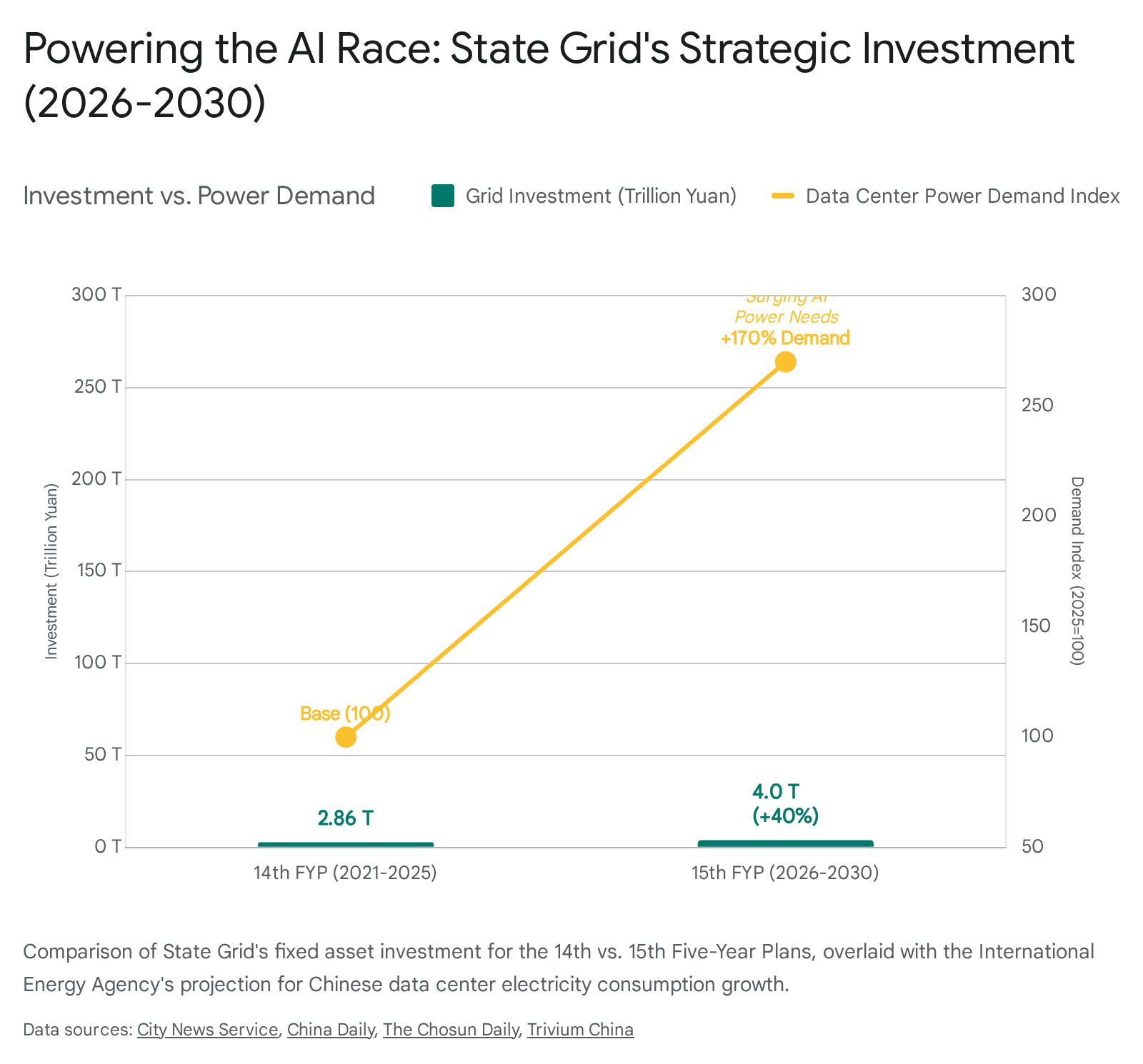
The State Grid Corporation of China (SGCC) unveiled a massive RMB 4 trillion (US$574 billion) investment plan for the 2026-2030 period. This capital injection is not merely a utility upgrade; it is a strategic counter-measure to US technology controls, designed to weaponize energy infrastructure in the global AI race.
Strategic Rationale:
The primary driver cited for this investment is the surging demand from AI data centers. The International Energy Agency estimates that China’s data center power consumption will increase by 170% over the next five years.
- The “Energy Sovereignty” Thesis: Beijing recognizes that while it currently lags the US in advanced semiconductor lithography (due to export controls), it possesses a distinct advantage in infrastructure mobilization. The US and Europe face severe grid bottlenecks, permitting delays, and capacity shortages that threaten to stall AI deployment. By centrally directing massive capital into the grid (a 40% increase over the previous 5-year plan), Beijing aims to offer cheap, abundant, and green power as a comparative advantage for AI companies.
- Execution: The plan targets adding 200GW of new renewable capacity annually and significantly expanding Ultra-High-Voltage (UHV) transmission lines to move power from the resource-rich west to the data-hungry east. This creates an environment where AI companies can operate less efficient chips (like Huawei’s Ascend series) at a lower total cost of ownership due to subsidized energy.4
4.2 The “Gate Two” Chip Control Mechanism
New intelligence on US-China technology flows reveals a sophisticated Chinese counter-move to US export controls, described by analysts as the “Gate Two” strategy.
- US Action (“Gate One”): On January 15, the US Bureau of Industry and Security (BIS) released rules easing some controls on Nvidia H200 chips but imposing a 25% tariff and a rigorous “checking” requirement to prevent military diversion.
- China’s Counter (“Gate Two”): Instead of rushing to acquire these chips, Beijing initiated “window guidance” on January 7, instructing tech firms to pause orders. On January 14, Chinese customs authorities began blocking H200 shipments at the border.
- The Bundling Mandate: Reports indicate an emerging domestic policy requiring Chinese tech firms to bundle every purchase of Nvidia hardware with a corresponding purchase of 30-50% Huawei Ascend chips.
- Assessment: This is a coerced import substitution strategy. By controlling the entry of US chips, Beijing forces domestic tech giants (Alibaba, Tencent, ByteDance) to subsidize the development of the domestic Huawei ecosystem. It transforms a US denial strategy into a Chinese “controlled decoupling” strategy, ensuring that US companies cannot dominate the market even if they are legally allowed to sell.47
4.3 Market Volatility & Regulatory Violence
- National Team Outflows: The “National Team” (state-backed funds) triggered record outflows from ETFs, totaling approximately RMB 101 billion. This appears to be a calculated move to cool down a speculative rally and lock in profits to fund other state priorities (likely the grid investment or deficit plugs). It demonstrates that the stock market remains a policy tool for the state, not a market mechanism for price discovery.49
- PDD “Fistfight”: The physical altercation between PDD Holdings (parent company of Temu) staff and State Administration for Market Regulation (SAMR) officials in Shanghai is highly symbolic of the current business climate. The clash occurred during a fraud investigation, resulting in the detention of executives. This event reflects the extreme pressure on private tech firms, which are being squeezed between aggressive growth targets (to survive deflation) and an increasingly predatory regulatory state looking for fines and compliance. The subsequent firing of PDD staff and the stock drop highlights the fragility of investor confidence in the face of arbitrary state power.11
5. DOMESTIC STABILITY: THE PRE-HOLIDAY PRESSURE COOKER
As the Lunar New Year (Year of the Snake) approaches, the traditional period of “social harmony” is being fractured by economic distress. The “social contract”—economic prosperity in exchange for political acquiescence—remains under severe strain as the slowdown bites into the working class.
5.1 Labor Unrest Surge
Intelligence tracking indicates a sharp rise in collective action incidents, particularly in the manufacturing and construction sectors. This wave of unrest is driven by the “sudden collapse” of factories due to weak demand and the looming threat of US tariffs.
Key Incidents:
- Crocs and New Balance Strike: A massive strike involving over 6,000 workers occurred at a contract manufacturing facility supplying Crocs and New Balance. The workers were protesting drastically reduced wages and the cancellation of bonuses. The scale of the strike required the deployment of significant security forces to disperse the crowds, indicating the state’s fear of contagion.12
- Construction Wage Arrears: Multiple protests have broken out at construction sites, including at the Jinjiang Alumina project in Indonesia (a Belt and Road Initiative project) and various domestic locations. Workers are demanding unpaid wages before the holiday migration. The export of labor unrest to BRI projects is a new vector of reputational risk for Beijing.54
State Response:
The response has been characterized by repression rather than mediation. Security forces were deployed to break the Crocs strike, and digital censorship has been ramped up to prevent videos of the protests from spreading on Douyin and Weibo. This indicates a “zero tolerance” approach to unrest ahead of the holidays, prioritizing order over grievance resolution.
5.2 Rural & Property Protests
- Property Crisis: Despite the 5% GDP growth figure officially reported, the property sector remains a significant drag on stability. Homeowner protests continue over unfinished projects, with many citizens having lost their life savings in pre-sold apartments that will never be built.
- Rural Dissent: Data from Freedom House indicates a 70% increase in rural protests. This suggests that the economic slowdown is now biting deep into the countryside, where the social safety net is weakest. The “return of the migrants” (millions heading home for LNY, potentially without full pay) risks exporting urban discontent back to rural areas, creating a volatile mix of unemployed youth and aggrieved farmers.56
5.3 Lunar New Year Migration
The Ministry of Transport expects record travel numbers for the upcoming Lunar New Year, with 9 billion interprovincial trips projected. However, this migration is occurring under a cloud of economic gloom. Many factories have closed early, forcing workers to return home weeks ahead of schedule, often without their full year-end pay. This “forced holiday” masks the true extent of unemployment and underemployment in the manufacturing sector.58
6. OUTLOOK & FORECAST (NEXT 7 DAYS)
Immediate Watchlist:
- The Purge Fallout: Monitor the PLA Daily and official channels for the formal announcement regarding General Zhang Youxia. A swift, publicly detailed announcement suggests Xi feels secure in his authority; a prolonged silence or vague statement suggests ongoing factional bargaining and instability within the CMC. Watch for further detentions in the Equipment Development Department (EDD) to see how deep the rot goes.
- Finland Visit (Jan 25-28): Assess if PM Orpo signs any substantial agreements or if the visit is purely ceremonial. Any deviation from the “de-risking” EU line would be a win for Beijing and a further blow to transatlantic unity.
- SCS Reprisals: Expect the CCG to maintain a blockade stance at Scarborough Shoal to “punish” the Philippines for the collision narrative. A second incident is highly probable given the density of vessels and the aggressive ROE currently in place.
- Taiwan Airspace: Will the PLA repeat the Pratas drone incursion? If they do so over Kinmen or Matsu, or even closer to the main island, it would signal a calculated escalation ladder designed to test the “First Strike” definition of the Lai administration.
Strategic Horizon:
The dichotomy between Beijing’s external “peace” narrative and internal “war preparation” (purges, grid investment, blockade drills) is unsustainable in the long term. The leadership is racing to harden the country’s infrastructure—energy, chips, and military discipline—before the full weight of the Trump 2.0 administration’s economic containment hits. The “Canada Deal” buys them time and a loophole, but the fundamental trajectory remains one of deepening confrontation. The purge of General Zhang Youxia is the clearest signal yet that Xi Jinping is willing to break the system to fix it, prioritizing absolute control and war readiness above all else.
END OF REPORT
JISAT // JAN 2026
Works cited
- China’s top general under investigation in latest military purge, accessed January 24, 2026, https://www.ksat.com/news/world/2026/01/24/chinas-top-general-under-investigation-in-latest-military-purge/
- ‘Unprecedented purge’: China’s No. 1 general under investigation – why it matters, accessed January 24, 2026, https://timesofindia.indiatimes.com/world/china/unprecedented-purge-chinas-no-1-general-under-investigation-xi-jinping-zhang-youxia-why-it-matters/articleshow/127381318.cms
- China’s top general under investigation in latest military purge – ClickOnDetroit, accessed January 24, 2026, https://www.clickondetroit.com/news/world/2026/01/24/chinas-top-general-under-investigation-in-latest-military-purge/
- Weekend Buzz: 17-18 January 2026, accessed January 24, 2026, https://www.citynewsservice.cn/articles/china-biz-buzz/daily-buzz/weekend-buzz-17-18-january-2026-rkl58r7n
- Prime Minister Carney forges new strategic partnership with the People’s Republic of China focused on energy, agri-food, and trade, accessed January 24, 2026, https://www.pm.gc.ca/en/news/news-releases/2026/01/16/prime-minister-carney-forges-new-strategic-partnership-peoples
- A new era in Canada-China trade: Key tariff changes and industry impacts, accessed January 24, 2026, https://www.mltaikins.com/insights/a-new-era-in-canada-china-trade-key-tariff-changes-and-industry-impacts/
- Britain approves plans for China’s new London embassy – Xinhua, accessed January 24, 2026, https://english.news.cn/20260120/554da0fc15c54179899a15e3221da002/c.html
- News | Government backs China’s huge London Embassy, accessed January 24, 2026, https://www.costar.com/article/1991464038/government-backs-chinas-huge-london-embassy
- State Grid plans massive investments for 15th Five-Year Plan, accessed January 24, 2026, https://www.chinadaily.com.cn/a/202601/16/WS6969b2aea310d6866eb34243.html
- State Grid targets whopping RMB 4 trillion in infrastructure investment over next five years, accessed January 24, 2026, https://triviumchina.com/2026/01/16/state-grid-targets-whopping-rmb-4-trillion-in-infrastructure-investment-over-next-five-years/
- Fistfights erupt between China officials, PDD staff during audit – Jing Daily, accessed January 24, 2026, https://jingdaily.com/posts/fistfights-erupt-between-china-officials-pdd-staff-during-audit
- 6000 Chinese workers strike over drastically reduced wages at a Crocs and New Balance factory – China Labor Watch, accessed January 24, 2026, https://chinalaborwatch.org/6000-chinese-workers-strike-over-drastically-reduced-wages-at-a-crocs-and-new-balance-factory/
- Foreign Ministry Spokesperson Guo Jiakun’s Regular Press Conference on January 23, 2026, accessed January 24, 2026, https://bb.china-embassy.gov.cn/eng/fyrth/202601/t20260123_11844474.htm
- Davos 2026: Special Address by He Lifeng, Vice-Premier of the People’s Republic of China, accessed January 24, 2026, https://www.weforum.org/stories/2026/01/davos-2026-special-address-he-lifeng/
- Why cheap Chinese EVs may cost Canada more in the long run, accessed January 24, 2026, https://policyoptions.irpp.org/2026/01/carney-china-evs/
- UK approves China’s mega-embassy in London despite spying fears, accessed January 24, 2026, https://www.courthousenews.com/uk-approves-chinas-mega-embassy-in-london-despite-spying-fears/
- China & Taiwan Update, January 23, 2026 | ISW, accessed January 24, 2026, https://understandingwar.org/research/china-taiwan/china-taiwan-update-january-23-2026/
- Chinese Coast Guard Sustained Devastating DAMAGED | Blamed Philippines for Collision, accessed January 24, 2026, https://www.youtube.com/watch?v=3ja2nYHFIFc
- 2025 China Coast Guard and People’s Liberation Army Navy ship collision incident, accessed January 24, 2026, https://en.wikipedia.org/wiki/2025_China_Coast_Guard_and_People%27s_Liberation_Army_Navy_ship_collision_incident
- Taiwan records 26 PLA aircraft sorties, 6 PLAN vessels around its territory – Mid-day, accessed January 24, 2026, https://www.mid-day.com/news/world-news/article/taiwan-records-26-pla-aircraft-sorties-6-plan-vessels-around-its-territory-23613471
- Taiwan detects 11 PLA aircraft sorties, 5 PLAN vessels around its territory, accessed January 24, 2026, https://www.tribuneindia.com/news/world/taiwan-detects-11-pla-aircraft-sorties-5-plan-vessels-around-its-territory/
- Taiwan reports Chinese military activity near its territory – The Economic Times, accessed January 24, 2026, https://m.economictimes.com/news/defence/taiwan-reports-chinese-military-activity-near-its-territory/articleshow/118696496.cms
- China & Taiwan Update, January 2, 2026, accessed January 24, 2026, https://understandingwar.org/research/china-taiwan/china-taiwan-update-january-2-2026/
- Taiwan detects 20 sorties of Chinese aircraft in its territory – The Economic Times, accessed January 24, 2026, https://m.economictimes.com/news/defence/taiwan-detects-20-sorties-of-chinese-aircraft-in-its-territory/articleshow/120750267.cms
- Taiwan reports Chinese military activity with 8 PLAN vessels, 6 PLA aircraft sorties near its territory – The Economic Times, accessed January 24, 2026, https://m.economictimes.com/news/defence/taiwan-reports-chinese-military-activity-with-8-plan-vessels-6-pla-aircraft-sorties-near-its-territory/articleshow/125027927.cms
- Taiwan tracks 5 Chinese naval ships, 2 military aircraft | Taiwan News | Jan. 22, 2026 13:31, accessed January 24, 2026, https://www.taiwannews.com.tw/en/news/6287585
- Philippines claims Chinese Coast Guard injured fishers, damaged vessels with high-pressure hoses | SeafoodSource, accessed January 24, 2026, https://www.seafoodsource.com/news/supply-trade/philippines-claims-chinese-coast-guard-injured-fishers-damaged-vessels-with-high-pressure-hoses
- PH Maritime Council expects China to twist facts on latest collision in West PH Sea | ANC, accessed January 24, 2026, https://www.youtube.com/watch?v=FV51uZo3FVg
- Philippines Challenge ‘Monster’ China Coast Guard Cutter, U.S. Carrier Vinson Drills with Philippine Forces in South China Sea – USNI News – U.S. Naval Institute, accessed January 24, 2026, https://news.usni.org/2025/01/20/philippines-challenges-monster-china-coast-guard-cutter-u-s-carrier-vinson-drills-with-philippine-forces-in-south-china-sea
- HEADLINES: Philippines-China sea row heats up | Jan. 24, 2026 …, accessed January 24, 2026, https://www.manilatimes.net/2026/01/24/podcasts/headlines-philippines-china-sea-row-heats-up-jan-24-2026/2264447
- China, Philippines escalate rhetoric in South China Sea collision row – Al Jazeera, accessed January 24, 2026, https://www.aljazeera.com/news/2023/10/23/china-philippines-escalate-rhetoric-in-south-china-sea-collision-row
- BRICS joint maritime exercise codenamed “Will for Peace 2026”, accessed January 24, 2026, https://www.myanmaritv.com/news/brics-joint-maritime-exercise-codenamed-%E2%80%9Cwill-peace-2026%E2%80%9D
- BRICS wargames: Why they matter, why India opted out | Explainer News | Al Jazeera, accessed January 24, 2026, https://www.aljazeera.com/news/2026/1/11/brics-wargames-why-they-matter-why-india-opted-out
- The navies of China, Russia, and Iran concluded the Multinational Exercise Will for Peace 2026 in South Africa – Zona Militar, accessed January 24, 2026, https://www.zona-militar.com/en/2026/01/20/the-navies-of-china-russia-and-iran-concluded-the-multinational-exercise-will-for-peace-2026-in-south-africa/
- China firmly supports multilateralism, free trade: vice premier, accessed January 24, 2026, https://english.www.gov.cn/news/202601/21/content_WS69701dabc6d00ca5f9a08b11.html
- China extends support to UN-centered system over Trump’s ‘board of peace’, accessed January 24, 2026, https://www.aa.com.tr/en/americas/china-extends-support-to-un-centered-system-over-trump-s-board-of-peace-/3806340
- What to know about Trump’s “Board of Peace” as world leaders sign founding charter in Davos – CBS News, accessed January 24, 2026, https://www.cbsnews.com/news/trump-board-of-peace-what-to-know/
- Here are the countries joining Trump’s ‘Board of Peace’ so far, accessed January 24, 2026, https://www.cbc.ca/news/world/board-of-peace-gaza-trump-list-of-countries-9.7055866
- China pushes back on idea that Trump’s ‘board of peace’ might replace the UN – TRT World, accessed January 24, 2026, https://www.trtworld.com/article/2448791860cb
- China firmly upholds UN-centered intl system, says Chinese FM in response to Trump’s claim that ‘Board of Peace’ may replace UN – Global Times, accessed January 24, 2026, https://www.globaltimes.cn/page/202601/1353811.shtml
- ‘China will eat them up’: Trump slams Canada over pushback on ‘Golden Dome’ plan in Greenland, accessed January 24, 2026, https://timesofindia.indiatimes.com/world/us/china-will-eat-them-up-trump-takes-aim-at-canada-over-golden-dome-plan-in-greenland/articleshow/127352558.cms
- Prime Minister Orpo to meet with Chinese leadership in Beijing, accessed January 24, 2026, https://valtioneuvosto.fi/en/-/prime-minister-orpo-to-meet-with-chinese-leadership-in-beijing
- Foreign Ministry Spokesperson Guo Jiakun’s Regular Press Conference on January 22, 2026, accessed January 24, 2026, https://www.fmprc.gov.cn/eng/xw/fyrbt/202601/t20260122_11843590.html
- Finland’s leader set for 4-day China visit as Europe seeks to counter Trump pressure, accessed January 24, 2026, https://www.scmp.com/news/china/diplomacy/article/3341111/finlands-leader-set-4-day-china-visit-europe-seeks-counter-trump-pressure
- China & Taiwan Update, January 9, 2026 | ISW, accessed January 24, 2026, https://understandingwar.org/research/china-taiwan/china-taiwan-update-january-9-2025/
- Focus This Week: Sovereignty at Stake – January 9, 2026, accessed January 24, 2026, https://www.chinausfocus.com/s/focus-this-week/2026-01-09.html
- The Two-Gate Trap: $4.5 Trillion Positioned for a Market That No Longer Exists, accessed January 24, 2026, https://shanakaanslemperera.substack.com/p/the-two-gate-trap-45-trillion-positioned
- A Mixed Bag of Chips: Significant New Import and Export Changes for Advanced Semiconductors | Wilson Sonsini, accessed January 24, 2026, https://www.wsgr.com/en/insights/a-mixed-bag-of-chips-significant-new-import-and-export-changes-for-advanced-semiconductors.html
- CN ‘National Team’ ETF Outflows Set All-time High, accessed January 24, 2026, https://www.aastocks.com/en/stocks/news/aafn-news/NOW.1497017/2
- Global equity funds see record outflows as U.S., China withdrawals surge, TD Securities says By Reuters, accessed January 24, 2026, https://www.investing.com/news/stock-market-news/global-equity-funds-see-record-outflows-as-us-china-withdrawals-surge-td-securities-says-4462366
- Now is not the time to own bonds, says Bank of America. These are safer bets., accessed January 24, 2026, https://www.morningstar.com/news/marketwatch/20260123179/now-is-not-the-time-to-own-bonds-says-bank-of-america-these-are-safer-bets
- PDD Reportedly Facing Broader Probe in CN Following Physical Confrontation with Investigators Last Mth AASTOCKS Financial News, accessed January 24, 2026, https://www.aastocks.com/en/stocks/news/aafn-con/NOW.1497283/popular-news/AAFN
- Temu owner PDD fires dozens of workers after fistfight with China officials, accessed January 24, 2026, https://www.straitstimes.com/business/companies-markets/temu-owner-pdd-fires-dozens-of-workers-after-fistfight-with-china-officials
- Indonesia: ‘Hundreds’ of Chinese workers protest due to alleged wage theft at Jinjiang Alumina Integrated Industrial Park; incl. cos. non-responses – Business and Human Rights Centre, accessed January 24, 2026, https://www.business-humanrights.org/en/latest-news/indonesia-hundreds-of-chinese-workers-protest-due-to-alleged-wage-theft-at-jinjiang-alumina-integrated-industrial-park-incl-cos-non-responses/
- Chinese Construction Workers Strike Over Unpaid Wages at Nickel Smelting Project in Indonesia – China Labor Watch, accessed January 24, 2026, https://chinalaborwatch.org/chinese-construction-workers-strike-over-unpaid-wages-at-nickel-smelting-project-in-indonesia/
- Far more protests taking place in China than reported, trying to cover them invites frightening ordeal – Tibetan Review, accessed January 24, 2026, https://www.tibetanreview.net/far-more-protests-taking-place-in-china-than-reported-trying-to-cover-them-invites-frightening-ordeal/
- Dashed dreams and land grabs: The rise of rural protests in China – The Guardian, accessed January 24, 2026, https://www.theguardian.com/world/2025/dec/19/workers-rural-protests-china-land-grabs
- Millions in China head home for Lunar New Year in ‘record high’ migration – Al Jazeera, accessed January 24, 2026, https://www.aljazeera.com/gallery/2025/1/27/millions-in-china-head-home-for-lunar-new-year-in-record-high-migration
- China: Sudden layoffs & closures ahead of Lunar New Year leads to protests & migrant workers returning home early – Business and Human Rights Centre, accessed January 24, 2026, https://www.business-humanrights.org/en/latest-news/china-sudden-layoffs-closures-ahead-of-lunar-new-year-force-leads-to-protests-migrant-workers-returning-home-early-incl-cos-responses-non-responses/