Category Archives: US Small Arms Market Analytics

Reports focusing on the US Small Arms Market in general – vendors, post mortems, marketing, lessons learned and so forth.

OA Defense (Founded as Oracle Arms): Revolutionizing the Modern Handgun With Their 2311 Series

The contemporary small arms market is defined by a relentless pursuit of convergence—a drive to merge the shootability of precision competition instruments with the rugged reliability and logistical simplicity of duty-grade service weapons. Within this volatile and highly competitive landscape, the emergence of OA Defense (originally founded as Oracle Arms) serves as a critical case study in disruptive innovation, strategic rebranding, and industrial adaptation.

Founded in the high-desert manufacturing hub of Dayton, Nevada, and later relocating to the defense-centric ecosystem of North Carolina, the company identified a specific, unaddressed inefficiency in the “double-stack 1911” market: the reliance on expensive, finicky legacy magazine architectures. By engineering a chassis system—the “2311”—that marries the legendary trigger characteristics of the John Browning 1911 with the ubiquity and reliability of the SIG SAUER P320 magazine, OA Defense effectively lowered the barrier to entry for the platform. This singular design choice signaled a departure from the “race gun” heritage of the 2011 platform, positioning the company to aggressively target law enforcement and military contracts alongside the civilian enthusiast market.

This report provides an exhaustive analysis of the company’s evolution from its 2021 inception to its current operational status in late 2025. It examines the technical architecture of the 2311 platform, specifically the shift to a linkless barrel system and the engineering required to achieve true ambidexterity. It details the corporate maturation process, including the necessary rebranding from “Oracle Arms” to “OA Defense” to avoid trademark conflict and harden its martial identity. Furthermore, it analyzes the strategic implications of the company’s relocation to Robbins, North Carolina—a move designed to embed the manufacturer within the special operations supply chain surrounding Fort Liberty.

As OA Defense stabilizes its production throughput in its new 30,000-square-foot facility, it stands at a pivotal inflection point. Having proven the viability of its hybrid concept, the company must now navigate the challenges of scaling manufacturing to meet backlog demand while defending its intellectual territory against legacy giants like Springfield Armory and Staccato. The future outlook suggests a trajectory focused on securing departmental adoption, expanding the product ecosystem into “integrally compensated” duty variants, and solidifying its reputation as a provider of professional-grade tools for the modern gunfighter.

1. Introduction: The Strategic Context of the Modern Sidearm

To fully appreciate the market entrance and trajectory of OA Defense, one must first deconstruct the technological and operational vacuum that existed in the handgun market prior to their arrival. The firearms industry is historically cyclical, often oscillating between periods of stagnation and rapid innovation driven by specific user requirements. The early 2020s represented one such period of rapid evolution, characterized by a renaissance of hammer-fired metal-framed pistols in a world previously dominated by polymer striker-fired systems.

1.1 The Legacy of the 1911 and the Capacity Conundrum

For over a century, the Colt 1911—designed by the legendary John Moses Browning and adopted by the U.S. Army in 1911—stood as the undisputed gold standard for handgun ergonomics and trigger characteristics.1 Its sliding single-action trigger, which travels straight back rather than pivoting on a pin, offers a crispness and predictability that hinges-based triggers (like those on modern polymer pistols) struggle to replicate. This mechanical advantage allows for greater precision and speed, making the 1911 the preferred platform for elite units and competitive shooters for decades.

However, as the nature of warfare and law enforcement evolved, the limitations of the original 1911 design became glaring liabilities. The most significant of these was capacity. The original design, built around a single-stack magazine for the.45 ACP cartridge, was limited to 7 or 8 rounds.1 In an era of increasing threat density, where law enforcement officers might face multiple adversaries armed with high-capacity weaponry, the 1911’s limited onboard ammunition supply became a tactical obsolescence.

Furthermore, the 1911 utilized a “swinging link” barrel system—a small, hinged piece of metal that pulls the barrel down to unlock the action during recoil.2 While revolutionary in 1911, the swinging link is a known wear part. It requires precise fitting to ensure correct timing; if the link is too long or too short, it can cause catastrophic binding or failure to feed. In the context of a modern service weapon, which demands “drop-in” parts interchangeability and extreme durability, the swinging link represented a maintenance liability that striker-fired guns like the Glock 17—which utilize a simpler camming surface—had largely eliminated.

1.2 The Rise of the “2011” and the Magazine Bottleneck

In the early 1990s, the market attempted to address the capacity issue through the invention of the “2011”.1 Pioneered by companies like Para-Ordnance and STI (now Staccato), the 2011 featured a modular frame with a wide grip capable of accepting double-stack magazines. This innovation revolutionized the practical shooting sports (USPSA/IPSC), allowing competitors to carry 20+ rounds of ammunition while retaining the superior 1911 trigger.

However, the 2011 platform introduced a new, critical flaw: the magazine itself. The original 2011 magazines were essentially upscaled.45 ACP tubes that had been “pinched” to hold smaller 9mm or.38 Super rounds. This geometric mismatch often resulted in reliability issues. The magazines were notorious for needing “tuning”—a process where the feed lips had to be meticulously bent and measured to ensure reliable feeding.2

For a competition shooter, a magazine jam is a frustrating procedural penalty. For a police officer or soldier, it is a potentially fatal failure. Consequently, despite its performance advantages, the legacy 2011 platform was largely deemed unsuitable for general duty use due to this fragility. Additionally, the cost was prohibitive; legacy 2011 magazines commanded prices of $70 to $100 per unit, and the pistols themselves often retailed between $2,500 and $5,000.4 This economic barrier relegated the double-stack 1911 to the realm of “race guns”—finely tuned, high-maintenance instruments for the sporting elite, rather than tools for the professional end-user.

1.3 The Market Vacuum: The Convergence of Duty and Performance

By the early 2020s, a convergence of market trends created a demand for a “Holy Grail” pistol. A new generation of shooters—influenced by social media, the proliferation of tactical training, and the modernization of police special units—began demanding the performance of a 2011 with the reliability and logistical simplicity of a Glock or SIG P320.

This demand curve was driven by the “Roland Special” phenomenon and the widespread adoption of pistol-mounted red dot optics. As shooters became faster and more precise, the limitations of striker-fired triggers became more apparent. The market was ripe for a hybrid: a pistol that offered the shootability of a race gun but fed from the reliable, inexpensive, and ubiquitous magazines of a service pistol.

It is specifically within this high-value intersection that Oracle Arms (now OA Defense) planted its flag. By conceptualizing a chassis system built entirely around the SIG SAUER P320 magazine—the most common magazine in the U.S. military inventory following the M17 adoption—they engineered a solution that solved the “Achilles’ heel” of the platform before a single metal chip was cut.5 This strategic decision to leverage an existing, proven logistical ecosystem rather than attempting to engineer a proprietary magazine was the foundational insight that defined the company’s trajectory.

2. Genesis of Oracle Arms: Founding and Philosophy (2020-2022)

The origins of OA Defense are rooted not in the garage-based tinkering common to the industry, but in a deliberate, capital-intensive effort by experienced industry veterans to disrupt the status quo. The company’s inception in 2021 was marked by a clear strategic vision: to industrialize the custom 1911.

2.1 The Nevada Origins and the Innovation Hub

Oracle Arms was established in Dayton, Nevada.7 This location was strategic; Nevada has long served as a sanctuary for the firearms industry, offering a tax-friendly environment and a regulatory framework that encourages defense manufacturing. Furthermore, the region is a logistical hub, providing easy access to the West Coast markets and the SHOT Show in Las Vegas while remaining politically insulated from the restrictive laws of neighboring California.

The choice of Dayton placed Oracle Arms in proximity to a growing cluster of advanced manufacturing and defense entities. This environment provided access to a specialized labor pool—machinists, engineers, and assembly technicians familiar with the tolerances required for aerospace and defense applications. This industrial DNA was evident in the company’s earliest prototypes, which utilized 7075 aluminum and advanced CNC machining techniques rather than the cast steel frames often found in budget 1911s.8

2.2 Leadership Profiles: The Intersection of Special Operations and Engineering

The executive leadership of Oracle Arms brought a diverse and potent mix of skills that directly influenced the product’s design philosophy.

David Wollman (Co-Founder & VP): Wollman’s background is particularly significant. Prior to and during the rise of Oracle Arms, Wollman served as the President of Laugo Arms USA.10 Laugo Arms is the Czech manufacturer responsible for the “Alien” pistol—a radically innovative firearm with the lowest bore axis in the world, priced at over $5,000. Wollman’s involvement with Laugo demonstrates a deep familiarity with exotic engineering, high-end manufacturing, and the marketing of premium firearms to a discerning clientele. His transition to OA Defense suggests a desire to apply that same innovative spirit to a more accessible, mass-market platform.12

Paul Ross (President): In contrast to Wollman’s industry-centric background, Paul Ross brought a military and defense contracting perspective. A veteran with a background in special operations support, Ross’s influence is clearly visible in the company’s pivot toward “duty-grade” reliability and its aggressive pursuit of the law enforcement sector.10 Ross has publicly emphasized the importance of “faith-based business practices” and “American craftsmanship,” aligning the company culturally with the values of the American defense community.10 His leadership has been instrumental in the company’s strategic relocation to North Carolina to be closer to the “tip of the spear” at Fort Liberty.

James J. Rofkahr (Inventor/Engineer): The technical soul of the company resides in the work of James J. Rofkahr. Patent filings explicitly link Rofkahr to the intellectual property that defines the OA 2311. His name appears on patents related to “firearm with various improvements” and trigger mechanisms assigned to Oracle Arms/OA Defense.14 Rofkahr’s work focused on solving the mechanical contradictions of the platform—specifically, how to make a 1911 trigger work in a chassis that accepts a striker-fired magazine.

2.3 The “Oracle” Identity: Branding Challenges and Initial Vision

Initially, the company operated under the name Oracle Arms, LLC. The choice of “Oracle” was likely intended to evoke wisdom, foresight, and a vision of the future. However, from a trademark perspective, it was a high-risk selection. The name “Oracle” is globally synonymous with Oracle Corporation, the Austin-based technology titan founded by Larry Ellison.15

While Oracle Corporation operates in software and cloud computing—a distinct sector from firearms—the sheer scale of their brand equity creates a “zone of expansion” that often precludes others from using the name, even in unrelated industries. Furthermore, the mystical connotations of “Oracle” (a priestess acting as a medium) stood in contrast to the tactical, utilitarian identity the company sought to build for its defense contracts.

By 2024, the company initiated a comprehensive rebranding to OA Defense.14 This shift was not merely a defensive legal maneuver but a strategic realignment. The “Defense” suffix explicitly targets government procurement officers, placing the company in the same linguistic category as industry primes like Daniel Defense, LMT Defense, or Knight’s Armament. It signaled that the company was no longer just selling pistols to hobbyists; it was building weapon systems for professionals.

3. Engineering the 2311: A Technical Deep Dive

The OA 2311 is not a clone; it is a re-architecture. While it retains the visual silhouette and manual of arms of a 1911, the internal mechanics have been radically altered to accommodate the modern requirement for reliability and modularity.

3.1 The Architecture of Hybridization: P320 Magazine Integration

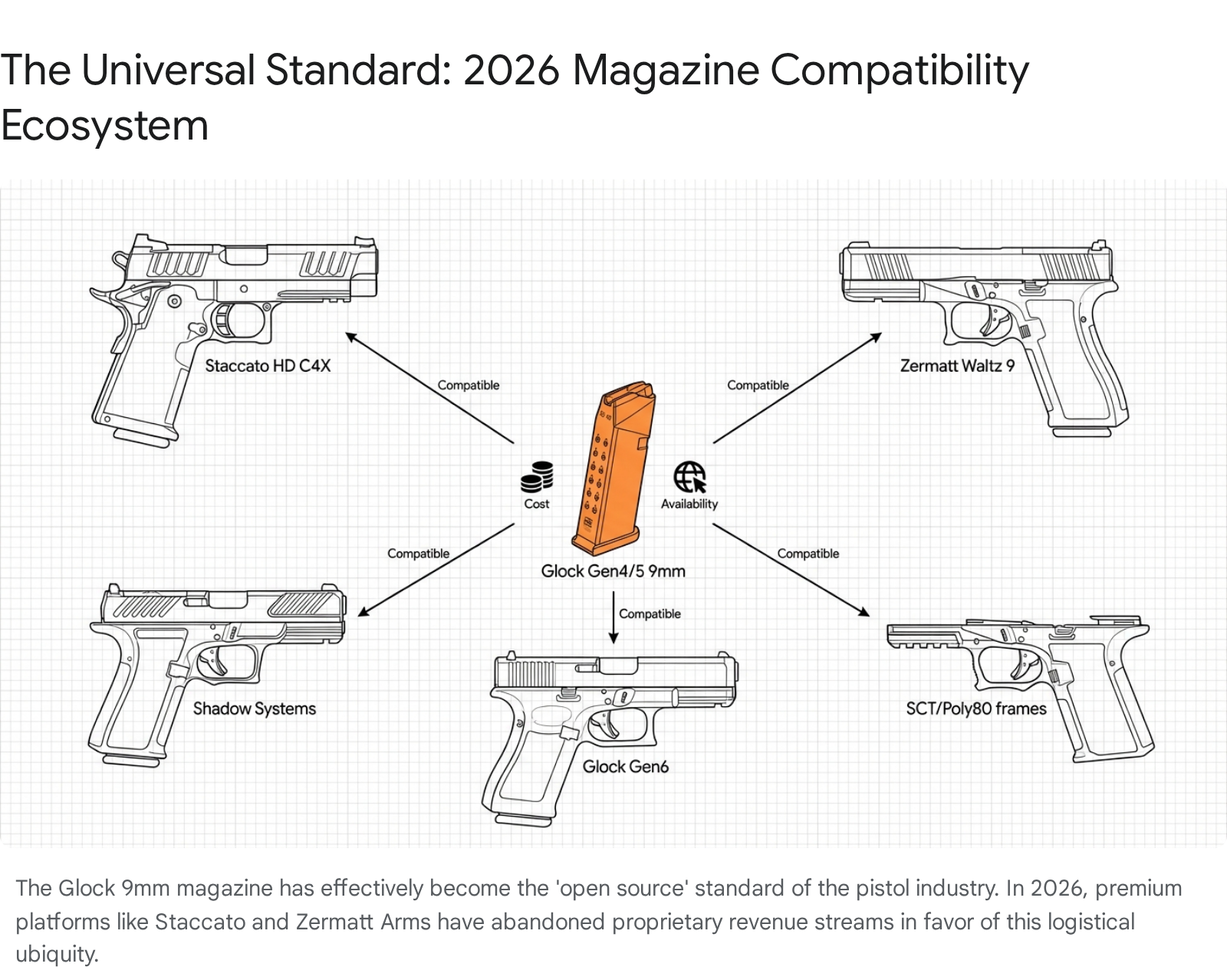
The defining feature of the 2311 is its magazine compatibility. By standardizing on the SIG SAUER P320 magazine pattern, OA Defense achieved immediate logistical superiority over its competitors.5

  • Geometry Challenges: The P320 magazine is designed for a striker-fired pistol where the rounds are presented at a specific angle and height relative to the bore. The 1911, conversely, was designed for a steep, single-stack feed angle. Merging these two geometries required a complete redesign of the frame rails and the feed ramp. The grip module had to be sculpted to hold the P320 magazine at the correct angle to mimic the 1911 grip angle (approx. 18 degrees) while ensuring the rounds stripped reliably.17
  • Cost & Availability: This decision dramatically lowered the Total Cost of Ownership (TCO) for the end-user. A standard 17-round P320 magazine retails for approximately $35-$40 and is available at virtually every gun store in America. In contrast, a Staccato 2011 magazine costs $70-$100 and is often proprietary. For a police department contemplating a transition, the ability to reuse existing stockpiles of P320 magazines (from their previous duty weapons) is a massive financial incentive.

3.2 The Linkless Cam System: Mechanics and Reliability Advantages

To accommodate the feeding geometry of the 9mm P320 magazine, OA Defense abandoned the traditional 1911 “swinging link” system in favor of a Linkless Cam System, similar to the design found in the Browning Hi-Power or CZ 75.2

  • The Mechanism: In a traditional 1911, a link connects the barrel to the frame. As the slide moves back, the link pivots, pulling the barrel down out of the locking lugs. In the OA 2311, this link is replaced by a precision-machined “kidney bean” shaped cutout in the barrel lug itself. A solid steel pin in the frame (the slide stop pin) rides in this cutout. As the barrel recoils, the shape of the cutout forces the barrel to cam downward.
  • Reliability Impact: This system eliminates a critical point of failure. There is no link to stretch or break. More importantly, the linkless design allows for a different barrel movement path. This enabled OA Defense to optimize the feed ramp angle specifically for the shorter 9mm cartridge, rather than trying to adapt a system designed for the longer.45 ACP.18 This results in a “flatter” feed capability, reducing the likelihood of nose-diving rounds—a common failure in 9mm 1911s.
  • Maintenance: The linkless barrel is simpler to disassemble and clean, as there is no link to align during reassembly. This “soldier-proof” simplicity is a key selling point for the duty market.

3.3 Debris Clearance and “Austere Environment” Engineering

Recognizing that tight tolerances—while good for accuracy—are the enemy of reliability in dirty environments, OA Defense engineered “Debris Clearance Channels” into the frame and slide rails.4 These are essentially relief cuts or voids machined into non-critical contact surfaces.

When sand, mud, or unburnt powder accumulates in the action, these channels provide a space for the debris to migrate out of the way of the moving parts. This concept draws inspiration from the AK-47’s “over-gassed” philosophy and the fluted chambers of HK roller-delayed blowback systems—engineering the gun to run despite the presence of foreign matter. This feature explicitly addresses the criticism that “race guns” (like the 2011) are too finicky for combat conditions.

3.4 The Ambidextrous Challenge: Redefining the 1911 Manual of Arms

The 1911 was designed for a right-handed cavalryman. Adapting it for modern ambidextrous use is notoriously difficult because the internal trigger bow and sear mechanism occupy the space where a right-side slide stop would naturally interact.

OA Defense claims the 2311 is the “first completely ambidextrous double-stack 1911-style platform”.4 They achieved this not by simply adding a lever on the right side, but by re-engineering the slide stop shaft and the frame pass-through.

  • Right-Side Slide Stop: Unlike many “ambi” 1911s that just have an ambi safety, the 2311 features a functional slide stop on the right side. This allows a left-handed shooter (or a right-handed shooter using their off-hand) to lock the slide back or release it without breaking their firing grip.
  • Reversible Mag Release: The magazine release is fully reversible, a feature borrowed from the modularity of the P320 grip module design.

3.5 Manufacturing Materials: 7075 Aluminum and Polymer Hybridization

The 2311 utilizes a modular chassis system.6

  • The Grip: The grip module is injection-molded polymer. This provides a lightweight, textured surface that absorbs recoil and is warm to the touch in cold environments. It also allows for aggressive texturing and the integration of a flared magwell without adding significant weight.
  • The Frame: The structural frame (which houses the rails and fire control group) is machined from 7075-T6 Aluminum. This aerospace-grade alloy offers the strength of steel at a fraction of the weight. By using aluminum for the frame and polymer for the grip, OA Defense keeps the total weight of the pistol (approx. 29 oz unloaded) light enough for daily carry, whereas an all-steel 2011 can weigh upwards of 40 oz.9

4. Operational History and Milestones

4.1 The SHOT Show 2023 Debut: Disrupting the Narrative

Oracle Arms made its public debut at SHOT Show in January 2023.5 The launch was meticulously timed. The “2011 craze” was in full swing, with Springfield Armory having recently launched the Prodigy. However, the Prodigy was suffering from a disastrous launch plagued by reliability issues.

Into this turbulent market, Oracle Arms introduced the 2311. The booth was crowded with industry media and analysts who were immediately drawn to the “P320 Magazine” value proposition.21 The narrative was clear: “Here is a 2011 that works with the mags you already own.” This generated immense organic buzz, with outlets like The Firearm Blog and Recoil highlighting it as one of the “most intriguing new handguns” of the show.5

4.2 The “Beta” Phase: Early Adopter Feedback and Quality Control

Following the hype of the launch, the company faced the harsh reality of production. Throughout late 2023 and 2024, early adopters began receiving their units. Feedback on platforms like Reddit and YouTube was mixed.22

  • The Good: Users praised the ergonomics, the flat-shooting characteristics, and the concept itself. The magazines worked as promised.
  • The Bad: Reports of “gritty” triggers, spongy take-up, and shipping delays were common.24 Some users reported wait times extending months beyond the promised delivery windows. This is a classic “teething” phase for new manufacturers who often struggle to scale their quality control (QC) processes from prototype to mass production.
  • The Response: To their credit, OA Defense’s customer service was reported as responsive. They issued return shipping labels and fixed issues, often replacing trigger groups or tuning extractors.24 This responsiveness helped maintain community trust during the rocky initial rollout.

4.3 The Rebrand: Transitioning from Oracle Arms to OA Defense

In 2024, the company executed its rebranding to OA Defense.16 As noted in the genesis section, this was likely driven by a combination of trademark hygiene (distancing from Oracle Corp) and a desire to present a more “milspec” face to the world.

The rebrand was accompanied by a new website (oadefense.com) and updated engravings on the slide. The “Oracle Arms” roll mark was replaced by the stylized “OA” logo and “OA Defense.” This marked the end of the “startup” phase and the beginning of the “defense contractor” phase.

4.4 The North Carolina Pivot: Strategic Relocation to Moore County

In May 2025, OA Defense announced its most significant operational shift to date: relocating its headquarters and manufacturing from Nevada to Robbins, North Carolina.10

  • The Facility: The company acquired a 30,000-square-foot facility, a massive upgrade from their Nevada footprint. This space was designed to house expanded CNC machining centers, assembly lines, and an on-site test range.10
  • The “Fort Liberty” Connection: Robbins is located in Moore County, just a short drive from Fort Liberty (formerly Fort Bragg), the home of U.S. Army Special Operations Command (USASOC) and Delta Force. By moving here, OA Defense placed itself physically within the orbit of the world’s premier end-users. This proximity allows for:
  1. Rapid R&D Iteration: Operators can test prototypes and provide feedback in real-time.
  2. Recruiting: The ability to hire retiring master sergeants and armorers with decades of experience.
  3. Contract Visibility: Being “local” matters for base commanders and procurement officers.
  • Capacity Targets: The company publicly stated a goal of producing 600 units per month by 2026.27 This volume is significant; it moves them out of the “boutique” category and into the realm of mid-tier manufacturers capable of sustaining departmental orders.

5. Product Ecosystem and Evolution

The OA Defense catalog has evolved from a single prototype into a structured ecosystem of pistols designed for specific use cases.

5.1 The Initial Launch: Compact, Combat, and Competition

The initial 2023 lineup featured three core models 3:

  1. Compact: A shorter grip and barrel (4.25″) designed for concealed carry. This model utilizes the 15-round P320 Compact magazine.
  2. Combat: The “duty” model with a full-size grip and 5-inch barrel, utilizing the 17-round or 21-round magazines. This was the flagship intended for police holsters.
  3. Competition: A tuned version with lighter triggers, adjustable sights, and magwells, designed to compete in USPSA Limited Optics divisions.

5.2 The “Pro” Evolution: Porting and Performance Enhancements

By 2024/2025, the market trends shifted toward “integrally compensated” pistols. Shooters realized that porting (holes in the barrel and slide) could significantly reduce muzzle rise without adding length to the gun.

OA Defense responded with the Pro Elite series.8

  • V-Porting: The Pro Elite barrels feature V-shaped ports machined into the top. These ports vent expanding gases upward, pushing the muzzle down and keeping the sights on target during rapid fire.
  • Slide Cuts: Corresponding lightening cuts in the slide reduce reciprocating mass, further mitigating recoil impulse.
  • Enhanced Triggers: The “Pro-tuned” triggers addressed the early complaints of grittiness, offering a cleaner, lighter break tailored for high-performance shooting.8

5.3 The Compact Pro: Addressing the Concealed Carry Market

The Compact Pro 28 represents the company’s bid for the high-end Every Day Carry (EDC) market. It combines the concealability of the Compact frame with the performance features of the Pro Elite (porting, optic cut).

  • Optics Ready: All modern OA pistols ship with multiple slide plates (RMR, DPP, RMSc), acknowledging that the red dot is now the primary sighting system.6
  • Night Sights: Partnering with Night Fision, the pistols ship with high-quality tritium sights that co-witness with the optic—a critical redundancy for defensive use.9

6. Market Analysis and Competitive Landscape

The “Double-Stack 1911” (or 2011) market is currently the most fiercely contested segment in the handgun industry. OA Defense must compete against established giants with deep pockets.

6.1 The “Duty-Grade” Niche: OA Defense vs. Staccato

Staccato (formerly STI) is the market leader. They own the trademark on the term “2011” and have successfully rebranded from a race-gun company to a duty-gun company, winning contracts with the U.S. Marshals and hundreds of police departments.3

  • OA Defense’s Advantage: Price and Logistics. A Staccato P costs ~$2,500, and its magazines are $70+. An OA 2311 Combat costs ~$2,000, and its magazines are $35. For a department armorer, the ability to buy cheap, reliable magazines is a massive factor.
  • OA Defense’s Disadvantage: Track Record. Staccato has millions of rounds of documented duty use. OA Defense is the new kid on the block and must prove it can survive the “torture tests” of police service.

6.2 The Entry-Level Battle: OA Defense vs. Springfield Prodigy

Springfield Armory launched the Prodigy at a disruptive price point of ~$1,500.1

  • OA Defense’s Advantage: Quality and Features. The Prodigy uses MIM (Metal Injection Molded) parts and had a rocky launch. The OA 2311 uses machined tool steel internals and offers the linkless barrel reliability. The OA is arguably a “mid-tier” gun competing against an “entry-level” gun.
  • OA Defense’s Disadvantage: Distribution. Springfield Armory is in every gun store in America. OA Defense is still building its dealer network.

6.3 The “Hybrid” Competitors: OA Defense vs. Dan Wesson DWX

The Dan Wesson DWX is the closest functional relative to the OA 2311. It also uses a linkless barrel (CZ 75 style) and cheap magazines (CZ P-09/P-10).

  • OA Defense’s Advantage: Duty Readiness. The DWX lacks a grip safety (a requirement for many police policies) and, critically, launched without an optic cut. The OA 2311 was designed from day one with optics and duty safety features in mind.6

6.4 Economic Analysis: The Total Cost of Ownership (Magazine Logistics)

The following analysis highlights the long-term economic advantage of the OA Defense ecosystem for an institutional user.

MetricOA Defense 2311Staccato PSpringfield Prodigy
Pistol MSRP~$2,299~$2,599~$1,499
Mag TypeSIG P320 (Universal)2011 (Proprietary)2011 (Duramag)
Mag Cost (Retail)$35 – $45$70 – $100$45 – $60
Duty Loadout (3 Mags)~$120~$240~$150
Unit ReliabilityHigh (Linkless)High (Tuned)Variable (MIM parts)
Optic SystemPlate System (Included)Dawson Plate (Extra)Agency Plate (Extra)

7. Current Operations and Future Outlook (2025-2026)

As of late 2025, OA Defense is in the midst of its most critical growth phase. The move to North Carolina is complete, and the focus has shifted from “survival” to “dominance.”

7.1 The “Fort Liberty” Effect: Defense Contracting and Military Alignment

The strategic relocation to Robbins, NC, cannot be overstated. The U.S. military is currently exploring the limits of the Modular Handgun System (MHS/P320). While the P320 is the standard, special operations units often have the latitude to procure specialized tools. A pistol that uses the same magazine as the standard issue M17 but offers the precision of a 1911 is a compelling proposition for units like Delta Force or the Green Berets.

Paul Ross’s background and the new company name (“Defense”) suggest that OA Defense is actively preparing to bid on these types of specialized solicitations. The proximity to the user base means they can iterate designs rapidly to meet classified requirements.10

7.2 Production Scaling and Supply Chain Stabilization

The primary challenge for 2026 will be scaling. Producing 50 custom guns a month is an art; producing 600 is a science. The new facility’s success depends on the successful implementation of lean manufacturing principles.

  • Backlog Management: Reducing the 90-day lead time is essential to competing with Staccato, which often has guns in stock at dealers.
  • Dealer Network: OA Defense is actively recruiting “Authorized Dealers” to get the product into physical cases.29 The visual and tactile experience of the 2311 is its best sales pitch; customers need to feel the grip texture and the slide racking to be convinced.

7.3 Future Product Roadmap: Full-Size Duty and Caliber Expansion

Looking ahead, the product roadmap is likely to expand in two directions:

  1. The “Government” Model: A true 5-inch or 6-inch “long slide” model for tactical teams and competition. The current “Combat” model is a 5-inch, but further optimization for duty holsters (Level 3 retention) is ongoing.30
  2. Caliber Expansion: While 9mm is the focus, the P320 platform supports.40 S&W and.357 SIG. OA Defense could theoretically release caliber conversion kits or models in these calibers for highway patrol agencies that still cling to the.40 or.357. However,.45 ACP and 10mm are likely off the table due to the magazine dimensions of the P320 frame.17

7.4 The Verdict on Viability: Scaling from Boutique to Mainstream

The future of OA Defense appears robust. They have successfully navigated the “Valley of Death” that kills most firearms startups (the first 2 years). They have a unique product differentiator (the magazine/linkless combo) that no other competitor can easily copy without infringing on patents or redesigning their entire tooling.

If they can maintain quality control while ramping up volume in the North Carolina facility, OA Defense is poised to become the “third pillar” of the modern duty pistol market, offering a distinct alternative to the ubiquity of the striker-fired Glock/Sig and the high cost of the Staccato.

8. Chronological Milestone Summary

The following table provides a chronological summary of the key events that have defined the corporate trajectory of OA Defense.

YearMilestone EventStrategic Significance
2021Company FoundingFounded in Dayton, NV by David Wollman, Paul Ross, and James Rofkahr.
2022Proof of ConceptDevelopment of the “2311” prototype; patent filings for linkless barrel and grip module.
2023SHOT Show DebutPublic reveal of the Oracle Arms 2311. Industry acclaim for P320 mag compatibility.
2023Initial OrdersPre-orders open; “Compact,” “Combat,” and “Competition” tiers announced.
2024Rebranding to OA DefenseName change initiated to avoid trademark conflict and harden military branding.
2024Product RefinementLaunch of “Compact Pro” and “Pro Elite” series with ported barrels and enhanced triggers.
2025NC Relocation AnnouncedMay 2025 announcement of HQ move to Robbins, NC (Moore County).
2025Operational ExpansionOpening of 30,000 sq ft facility in NC; production target set to 600 units/month by 2026.
2025Pro Elite DeliveryHigh-end “Pro Elite” models begin shipping in volume, targeting the $3k+ market segment.

If you find this post useful, please share the link on Facebook, with your friends, etc. Your support is much appreciated and if you have any feedback, please email me at in**@*********ps.com. Please note that for links to other websites, we are only paid if there is an affiliate program such as Avantlink, Impact, Amazon and eBay and only if you purchase something. If you’d like to directly contribute towards our continued reporting, please visit our funding page.


Sources Used

  1. OA Defense 2311 — Bad Math, Good Gun | RECOIL – Recoil Magazine, accessed December 29, 2025, https://www.recoilweb.com/oa-2311-compact-pro-188265.html
  2. TFB Review: Oracle Arms OA 2311, A 2011/P320 Hybrid | thefirearmblog.com, accessed December 29, 2025, https://www.thefirearmblog.com/blog/2023/11/22/tfb-review-oracle-arms-oa-2311/
  3. Oracle Arms 2311 9mm Pistol: First Look – Guns and Ammo, accessed December 29, 2025, https://www.gunsandammo.com/editorial/oracle-arms-2311-9mm-pistol-first-look/467659
  4. First Look: Oracle Arms 2311 – Recoil Magazine, accessed December 29, 2025, https://www.recoilweb.com/first-look-oracle-arms-2311-178248.html
  5. Oracle Arms Launching at SHOT Show 2023 with 2311 Pistol – The Firearm Blog, accessed December 29, 2025, https://www.thefirearmblog.com/blog/2022/12/27/oracle-arms-2311/
  6. OA 2311™ Compact – OA Defense, accessed December 29, 2025, https://oadefense.com/firearms/2311-compact/
  7. NCIC Code Manual as of March 31, 2025 – WILENET, accessed December 29, 2025, https://wilenet.widoj.gov/sites/default/files/public_files-2025-04/NCICCodeManualTransformed%20%285%29.pdf
  8. OA 2311™ Pro Elite – OA Defense, accessed December 29, 2025, https://oadefense.com/firearms/2311-pro-elite/
  9. OA 2311™ – OA Defense, accessed December 29, 2025, https://oadefense.com/firearms/2311/
  10. OA Defense bringing 30,000-square-foot facility to Robbins – Sandhills Sentinel, accessed December 29, 2025, https://sandhillssentinel.com/oa-defense-bringing-30000-square-foot-facility-to-robbins/
  11. About – Laugo Arms, accessed December 29, 2025, https://laugoarmsusa.com/about/
  12. An Alien Invasion Is Spreading Across The USA | Soldier Systems Daily, accessed December 29, 2025, https://soldiersystems.net/2023/01/13/an-alien-invasion-is-spreading-across-the-usa/
  13. Citizen Podcast – RedCircle, accessed December 29, 2025, https://redcircle.com/shows/citizen-podcast
  14. US984519A – Firearm. – Google Patents, accessed December 29, 2025, https://patents.google.com/patent/US984519A/en
  15. Oracle Corporation | Research Starters – EBSCO, accessed December 29, 2025, https://www.ebsco.com/research-starters/business-and-management/oracle-corporation
  16. OA Defense Pistols and Firearms – Ammunition Depot, accessed December 29, 2025, https://www.ammunitiondepot.com/oa-defense-firearms
  17. A hands on peek at shot show: The 2311 from Oracle Arms. : r/2011 – Reddit, accessed December 29, 2025, https://www.reddit.com/r/2011/comments/10er0yh/a_hands_on_peek_at_shot_show_the_2311_from_oracle/
  18. OA 2311: The Right Formula? – Recoil Magazine, accessed December 29, 2025, https://www.recoilweb.com/oa-2311-the-right-formula-185748.html
  19. Oracle Arms 2311 | Soldier Systems Daily, accessed December 29, 2025, https://soldiersystems.net/2022/12/23/oracle-arms-2311/
  20. SHOT SHOW 2023 REPORT: Oracle Arms 2311 – YouTube, accessed December 29, 2025, https://www.youtube.com/watch?v=nPMU34DgGn0
  21. Oracle Arms 2311 pistol launching at SHOT Show 2023! : r/2011 – Reddit, accessed December 29, 2025, https://www.reddit.com/r/2011/comments/zxljsb/oracle_arms_2311_pistol_launching_at_shot_show/
  22. Oracle Arms 2311 Shipping Notice : r/OracleArms2311 – Reddit, accessed December 29, 2025, https://www.reddit.com/r/OracleArms2311/comments/17mc7t8/oracle_arms_2311_shipping_notice/
  23. Still waiting for my firearm to return from being serviced : r/OracleArms2311 – Reddit, accessed December 29, 2025, https://www.reddit.com/r/OracleArms2311/comments/1g5gfrl/still_waiting_for_my_firearm_to_return_from_being/
  24. 1911 Syndicate and the 2311 : r/OracleArms2311 – Reddit, accessed December 29, 2025, https://www.reddit.com/r/OracleArms2311/comments/1h4kfxv/1911_syndicate_and_the_2311/
  25. r/OracleArms2311 – Reddit, accessed December 29, 2025, https://www.reddit.com/r/OracleArms2311/
  26. Business North Carolina July 2025 – Issuu, accessed December 29, 2025, https://issuu.com/businessnc/docs/business_north_carolina_july_2025
  27. Regional News | North Carolina’s Southeast, accessed December 29, 2025, https://www.ncse.org/regional-news.php
  28. [SHOT 2024] Oracle Arms New 2311 Compact Pro | thefirearmblog.com, accessed December 29, 2025, https://www.thefirearmblog.com/blog/2024/01/23/shot-2024-oracle-arms-new-2311-compact-pro/
  29. FAQS – OA Defense, accessed December 29, 2025, https://oadefense.com/faqs/
  30. OA Defense, accessed December 29, 2025, https://oadefense.com/

Rebuilding Watchtower Arms Into Watchtower Defense

Watchtower Defense, operating initially as Watchtower Firearms, represents one of the most dynamic and volatile case studies in the post-pandemic American firearms industry. Established in 2022 by Jason Colosky, a former U.S. Marine and Raytheon executive, the company sought to disrupt the mid-market manufacturing sector by applying defense-industrial discipline to the commercial and law enforcement small arms markets. The company’s genesis was defined by the aggressive acquisition of F-1 Firearms in June 2023, a strategic move designed to secure immediate manufacturing capacity and precision machining infrastructure. However, the integration of a legacy “lifestyle” brand with a new “duty-focused” identity created significant operational and cultural friction.

The company rapidly gained visibility through a bifurcated market strategy: capitalizing on the booming “2011” double-stack pistol market through high-profile influencer collaborations—most notably with Demolition Ranch and PewView—while simultaneously pursuing institutional legitimacy through law enforcement contracts for its Type 15 rifle platform. This rapid expansion, however, collided with the harsh realities of capital-intensive manufacturing. By late 2024, the company faced a liquidity crisis exacerbated by supply chain bottlenecks, an escalating backlog of pre-orders, and severe legal disputes with landlords and minority shareholders. These pressures culminated in a Chapter 11 bankruptcy filing in February 2025, a move leadership characterized as a strategic reorganization but which bore the hallmarks of a necessary intervention to prevent insolvency.

Through a complex restructuring process supported by Debtor-in-Possession (DIP) financing, the company’s assets were acquired in a Section 363 sale by CK Strategic Partners in late 2025. Emerging as “Watchtower Defense,” the new entity has shed significant liabilities and legacy disputes, relocating to a new 24,000-square-foot facility in Spring, Texas. The reorganized company now faces the dual challenge of rehabilitating its reputation with the commercial consumer base while executing a strategic pivot toward defense and federal contracting. This report provides an exhaustive analysis of the company’s history, product evolution, financial restructuring, and strategic outlook as it enters the 2026 fiscal year.

1. Introduction: The Strategic Landscape of the Post-2020 Firearms Market

To fully appreciate the trajectory of Watchtower Defense, it is essential to first establish the macroeconomic and industry-specific context into which the company was born. The American firearms industry in 2022 was in a state of complex transition, recovering from the historic demand surge of 2020–2021 while facing new headwinds in supply chain management and consumer preference shifts.

1.1 The Post-Surge Normalization

The years 2020 and 2021 witnessed an unprecedented spike in firearms sales, driven by the COVID-19 pandemic, social unrest, and political uncertainty. During this period, manufacturers maximized throughput, often sacrificing product diversity for raw volume. By 2022, however, the market had entered a period of “normalization.” The entry-level AR-15 market, which had been the primary engine of growth, became saturated with inventory. Prices for standard “commodity” rifles plummeted, squeezing margins for manufacturers who competed solely on price.

In contrast, the market for premium, specialized firearms remained robust. The “high-end” consumer—often an enthusiast with multiple firearms—continued to spend discretionary income on differentiated products. This bifurcation created a specific opportunity: a manufacturer that could offer perceived bespoke quality at a scalable production volume could capture the high-margin segment that mass-market producers were neglecting.

1.2 The Rise of the “2011” Platform

Concurrently, 2022 marked the mainstream explosion of the “2011” platform—a modernized, double-stack variation of the classic 1911 pistol design. Historically the domain of custom gunsmiths and competitive shooters, the 2011 began to cross over into the tactical and duty markets, led by brands like Staccato (formerly STI). Law enforcement agencies began approving these platforms for duty use, signaling a paradigm shift away from the polymer-striker-fired dominance of Glock and Sig Sauer.

This trend created a vacuum for new entrants. While Staccato dominated the duty sector and Atlas Gunworks commanded the ultra-premium competition sector, there was a perceivable gap for a brand that could merge the “tactical” aesthetic with the “race gun” performance, marketed aggressively to a younger, digital-native demographic. This was the specific market environment Jason Colosky identified when formulating the business case for what would become Watchtower Firearms.1

1.3 The Defense-Industrial Thesis

Against this backdrop, the founding thesis of Watchtower was distinct. Most firearms companies are founded by gunsmiths, competitive shooters, or marketing professionals. Jason Colosky, however, brought a background from the “Defense Prime” sector. As a former executive at Raytheon overseeing strategic engagements with the Pentagon and the White House, Colosky possessed an understanding of the military-industrial complex that is rare in the small arms commercial market.3

His vision was to build a “Raytheon for small arms”—a company that utilized the rigorous systems engineering, quality assurance, and contracting discipline of a major defense contractor but applied it to a nimble manufacturing base. The goal was to bridge the divide between “commercial spec” (often focused on aesthetics and price) and “mil-spec” (focused on reliability and interchangeability), creating a product line that could seamlessly transition between a civilian’s range bag and a SWAT officer’s patrol rifle.4

2. The Genesis of Watchtower (2022–2023)

The corporate history of Watchtower is characterized by speed. Unlike legacy manufacturers that grew organically over decades, Watchtower was engineered for rapid scaling from day one.

2.1 Founding Philosophy and Branding

Watchtower Firearms was incorporated in 2022 in Spring, Texas.5 The name selection was deliberate and deeply rooted in military heritage. “Operation Watchtower” was the code name for the Guadalcanal campaign in World War II, a pivotal offensive where U.S. Marines fought under grueling conditions.3 By adopting this moniker, the company signaled its intended identity: American, expeditionary, and resilient.

This branding was not merely cosmetic; it was a core component of the company’s value proposition. In an industry saturated with “tactical” brands, establishing a credible lineage to military service—reinforced by Colosky’s own background as a Recon Marine—was essential for building trust with the law enforcement community.3 The marketing narrative emphasized that while competitors might “take shortcuts and outsource,” Watchtower would “command the high ground” through domestic manufacturing and precision engineering.3

2.2 The Acquisition of F-1 Firearms

The most critical strategic maneuver in the company’s early history was the acquisition of F-1 Firearms on June 12, 2023.7 F-1 Firearms was a well-known entity in the Texas firearms manufacturing hub. For a decade, F-1 had carved out a niche producing highly stylized, “skeletonized” AR-15s—rifles with material machined away from the receiver and handguard to reduce weight and reveal the internal components.5

For Colosky and his investors, F-1 represented a “turnkey” manufacturing solution. Building a firearms factory from the ground up requires navigating complex ITAR (International Traffic in Arms Regulations) compliance, ATF licensing, machine tool procurement, and skilled labor hiring—a process that can take years. F-1 already possessed:

  • Precision Machining Capacity: High-end CNC (Computer Numerical Control) machines capable of intricate milling.4
  • Skilled Workforce: A team experienced in operating these machines and assembling AR-platform rifles.
  • Existing Distribution: A network of dealers and distributors already familiar with the entity.

However, the acquisition presented a substantial brand identity challenge. F-1 Firearms was known for “gamer guns”—flashy, colorful, and skeletonized rifles that were popular on Instagram but generally regarded as unsuitable for duty use due to the potential for debris ingress. Watchtower’s mission was to build serious tools for professionals. The challenge, therefore, was to utilize F-1’s precision capability (which Colosky noted had “miniscule waste” and high efficiency) to produce a completely different class of product.4

The acquisition was a classic “platform” play: buy the capability, retire the legacy brand identity over time, and pivot the output to a new, higher-value segment. This transition, however, would prove to be operationally difficult, as legacy orders for F-1 products had to be fulfilled even as the new Watchtower product lines were being developed.9

3. Product Architecture and Market Segmentation

Watchtower’s product strategy was designed to attack the “premium” segment of the market on two fronts: the emerging “2011” pistol market and the “duty-grade” rifle market. This dual-track approach allowed them to capture revenue from high-net-worth civilian enthusiasts while building the portfolio necessary for government contracting.

3.1 The Apache 1911 Double-Stack Program

The flagship of the Watchtower brand, and the primary driver of its 2024 visibility, was the Apache 1911 Double-Stack pistol. Launched at SHOT Show 2024, the Apache was an ambitious entry into a market dominated by entrenched players.1

3.1.1 Engineering and Design Philosophy

The Apache was not a clone; it was an engineered attempt to optimize the 2011 platform for manufacturing at scale.

  • Material Selection: The frame was constructed from pre-hardened 4140 stainless steel, while the slide utilized 416R stainless steel. This choice of materials prioritized durability and corrosion resistance, essential for the “duty” designation the company sought.10
  • Integrated Compensation: A key feature of the Apache line was the integration of recoil compensation systems. The “PewView” edition, for instance, featured a ported barrel and slide design that directed expanding gases upward to counteract muzzle rise.10 This is a feature highly prized in competitive shooting for reducing “split times” (the time between shots).
  • Surface Treatment: Watchtower utilized a proprietary PVD (Physical Vapor Deposition) coating. PVD offers superior lubricity and hardness compared to traditional Cerakote, reducing the need for lubrication and increasing the lifespan of moving parts. This was a direct selling point against competitors using standard finishes.12

3.1.2 The “Race Gun” for Duty Use

The marketing positioning of the Apache was unique. While engineered with the tolerances of a competition “race gun,” it was marketed as a tool for the “American warrior”.13 This hybrid positioning attempted to broaden the Total Addressable Market (TAM) to include both USPSA/IDPA competitors and tactical enthusiasts who wanted a “battle-ready” double-stack 1911. Pricing the unit in the $3,000 to $4,000 range placed it directly in competition with Staccato’s XC and Atlas Gunworks’ lower-tier offerings.11

3.2 The Type 15 Rifle Series: The F-1 Evolution

While the Apache captured the headlines, the Type 15 rifle series represented the company’s core manufacturing capability. The Type 15 was the direct evolution of the F-1 Firearms lineage, but “de-skeletonized” for professional use.

3.2.1 From Skeleton to Spec-Ops

The transition from F-1’s “skeletonized” receivers to Watchtower’s “Spec Ops” Type 15 was a critical branding pivot. Professional end-users (police and military) generally reject skeletonized rifles because open receivers allow dirt, mud, and debris to enter the action, inducing malfunctions. Watchtower’s Type 15 featured closed receivers with tight tolerances—so tight, according to Colosky, that “you could shake it and it wouldn’t make a sound”.4

  • The Durabolt BCG: The rifle featured a proprietary “Durabolt” Bolt Carrier Group (BCG) with a Tru-Black PVD coating. The BCG is the heart of the AR-15 platform; by focusing on the metallurgy and finish of this component, Watchtower emphasized reliability and ease of cleaning.14
  • Law Enforcement Validation: The most significant milestone for the Type 15 program was the contract with the Lafayette, Louisiana Police Department. The department purchased 118 Type 15M rifles in March 2025.5
  • Analyst Insight: For a new manufacturer, a departmental contract is worth far more than the revenue it generates. It serves as a “stamp of approval.” Police departments typically conduct distinct Testing & Evaluation (T&E) phases involving round counts, drop tests, and adverse condition tests. Winning this contract signaled to other agencies that the Type 15 was not just a rebranded hobbyist rifle but a validated duty weapon.

3.3 The Bridger Bolt-Action: Diversification

In January 2025, amidst its financial restructuring, Watchtower introduced the “Bridger” bolt-action rifle at SHOT Show.5 This marked a diversification into the precision hunting and long-range shooting market.

  • Strategic Rationale: The bolt-action market has seen a resurgence due to the popularity of the PRS (Precision Rifle Series) and long-range hunting. By entering this space, Watchtower attempted to reduce its reliance on the politically volatile AR-15 market and tap into the “crossover” hunter demographic. It also utilized the same precision machining capabilities required for the 1911 and AR platforms, maximizing machine utilization rates.

4. Market Strategy: The Influencer-Industrial Complex

Watchtower’s rapid ascent in brand awareness can be attributed to its aggressive use of what industry analysts term the “Influencer-Industrial Complex.” In the firearms industry, traditional advertising channels (Facebook, Google, TV) are largely restricted. Consequently, manufacturers rely heavily on YouTube personalities and social media influencers to drive sales. Watchtower did not just use influencers for marketing; it integrated them into product development.

4.1 The Demolition Ranch Partnership

The collaboration with Matt Carriker, creator of “Demolition Ranch” (one of the largest firearms channels on YouTube), was a defining moment for the brand. The partnership resulted in the “Demolitia” 1911, a limited-edition pistol built to Carriker’s specifications.17

  • The “Drop” Model: Watchtower utilized a “drop culture” sales model, similar to streetwear brands like Supreme. They offered limited VIP packages (the first 500 units) that included exclusive morale patches and hats. This created artificial scarcity and a sense of urgency, driving a massive influx of pre-orders.17
  • Direct-to-Consumer (DTC) Power: This strategy allowed Watchtower to capture high-margin direct sales, bypassing the thinner margins associated with distribution through wholesalers. However, it also created a direct accountability loop with the customer base.

4.2 The PewView Collaboration

Similarly, the partnership with Nick “PewView” Johnson targeted the “tactical performance” demographic. PewView is known for high-speed, trick-shooting content that emphasizes the visual aesthetic of shooting (e.g., muzzle flash, recoil control).

  • Product Fit: The “PewView Limited Edition” Apache was designed specifically for this style of shooting, featuring the integrated compensator to flatten recoil for video-worthy rapid fire.10
  • Validity by Association: By associating the brand with a shooter known for extreme skill, Watchtower implicitly validated the performance of the firearm. If PewView could run the gun fast, the implication was that the gun was capable of elite performance.

4.3 Risks of the Influencer Model

While highly effective for generating initial revenue, this model introduced significant risk.

  1. Supply Chain Strain: The viral nature of influencer marketing can generate demand spikes that overwhelm manufacturing capacity. Watchtower faced precisely this issue, leading to backlogs and consumer frustration.16
  2. Reputational Tying: The brand’s reputation became inextricably linked to the influencers. Any delay in shipping wasn’t just a Watchtower failure; it was perceived as a failure of the influencer’s promise, leading to distinct pressure from the partners to fulfill orders.
  3. The “Pre-Order” Trap: Relying on pre-orders for cash flow can be dangerous. If the capital from pre-orders is used for operational expenses (OpEx) rather than materials (COGS), a company can find itself in a “Ponzi-like” fulfillment cycle where new sales are needed to fund the production of old orders. While there is no direct evidence of malfeasance, the liquidity crisis of late 2024 suggests the company struggled to balance the capital inflows from these drops with the high costs of scaling production.

5. Operational Distress and The Liquidity Crisis (2024–2025)

By late 2024, the disconnect between Watchtower’s aggressive marketing promises and its operational reality began to widen. The rapid scaling following the F-1 acquisition exposed fragility in the company’s capital structure and supply chain.

5.1 The Manufacturing Bottleneck

Transitioning a factory from making skeletonized AR-15 parts (which are relatively tolerant of dimensional variance) to fitting tight-tolerance double-stack 1911s is a non-trivial engineering challenge. The 2011 platform is notoriously difficult to manufacture; unlike polymer pistols, it requires significant hand-fitting or ultra-precise machining to function reliably.

  • The Backlog: Reports from consumer forums indicated that customers were experiencing significant delays in receiving their Apache and Demolitia pistols.16 In the era of social media, this negative sentiment spread quickly, countering the positive narrative driven by the influencers.
  • Quality Control (QC) Pressures: The pressure to clear the backlog created risks of QC slippage. Industry observers noted that rapid scaling of 2011 production often leads to reliability issues if the “tuning” process is rushed.

5.2 The Landlord and Shareholder Disputes

Behind the scenes, the corporate structure was fracturing. The acquisition of F-1 Firearms had involved retaining the original founders (the Podgurnys) as minority stakeholders and utilizing their existing facility. This arrangement collapsed into litigation.

  • Lease Disputes: Watchtower became embroiled in a conflict with the landlord of its Spring, Texas facility. The landlord alleged “serious lease breaches” and financial mismanagement, while Watchtower claimed the dispute was disrupting operations.19 This type of friction is often a leading indicator of cash flow insolvency—rent is typically one of the last expenses a struggling company stops paying.
  • Shareholder Litigation: In July 2025, F-1 Firearms, LLC (the entity representing the sellers) filed a lawsuit against Jason Colosky and Watchtower in the U.S. District Court for the Southern District of Texas.20 The nature of the suit, involving securities statutes, suggests a breakdown in the post-acquisition agreement—likely related to earn-out payments, valuation adjustments, or allegations of how the new management was running the acquired assets.

5.3 Personnel Turnover

The internal turmoil was reflected in leadership changes. Ray Care, a former Navy SEAL who served as the “Chief Culture Officer” and a public face of the brand alongside Colosky, departed the company during this period.21 Community discussions suggest this departure was involuntary and acrimonious, further indicating a struggle for control over the company’s direction and resources.

6. The Collapse: Chapter 11 Reorganization (2025)

The convergence of operational bottlenecks, mounting legal costs from the shareholder/landlord disputes, and a tightening of liquidity forced Watchtower’s hand. In February 2025, Watchtower Firearms, LLC filed for Chapter 11 bankruptcy protection in the Northern District of Texas.5

6.1 The “Strategic” Bankruptcy Narrative

CEO Jason Colosky publicly framed the filing as a “strategic move” designed to “streamline internal operations and finances” while the firm continued to grow.5

  • Interpretation: In corporate restructuring terms, this framing is standard for preserving customer confidence. A “strategic” bankruptcy implies the core business model is sound, but the balance sheet needs cleansing.
  • Defensive Utility: The Chapter 11 filing triggered an “automatic stay,” immediately halting the lawsuits from the landlord and the F-1 sellers. This bought the company crucial time to find a financial solution without the immediate threat of eviction or asset seizure.

6.2 Debtor-in-Possession (DIP) Financing

To survive the bankruptcy process, a company needs cash to pay employees and buy materials. In June 2025, the court approved Debtor-in-Possession (DIP) financing for Watchtower.15

  • The Lender: The financing was provided by CK Strategic Partners, an investment entity that would ultimately play the decisive role in the company’s future.
  • Operational Continuity: Crucially, this financing allowed Watchtower to continue fulfilling orders, including the Lafayette PD contract, during the bankruptcy proceedings. This proved to the court and potential buyers that the company was still a “going concern” with viable revenue streams.

7. The Restructuring Mechanism: Section 363 Sale

The resolution of Watchtower’s crisis was not a reorganization of the existing debt, but a sale of the underlying assets. This was executed via a Section 363 sale under the Bankruptcy Code, a powerful tool that allows assets to be sold “free and clear” of liens and liabilities.

7.1 The “Loan-to-Own” Strategy

The buyer was CK Strategic Partners, the same entity that provided the DIP financing.9 This transaction structure typically follows a specific pattern:

  1. The lender provides emergency funding (DIP) secured by a super-priority lien on all assets.
  2. When the company cannot repay the loan, the lender uses the debt they are owed to “credit bid” for the company’s assets at auction.
  3. The lender acquires the business (assets, brand, IP) without taking on the toxic liabilities (lawsuits, unsecured debt, bad leases).

In August 2025, the court approved the sale. CK Strategic Partners acquired “substantially all assets” of Watchtower Firearms, LLC.9

7.2 The Result: Watchtower Defense

The closing of the transaction in September 2025 marked the end of “Watchtower Firearms, LLC” as the operating entity and the birth of Watchtower Defense.23

  • Liability Segregation: The old disputes—the lease arrears, the F-1 shareholder litigation—likely remained with the “old” corporate shell (the bankruptcy estate), which would be liquidated to pay creditors cents on the dollar.
  • The Clean Slate: The new entity, Watchtower Defense, emerged with the machinery, the intellectual property (IP) for the Apache and Type 15, the brand trademarks, and the key personnel, but with a cleansed balance sheet ready for capitalization.

8. The New Era: Watchtower Defense (Late 2025)

As of December 2025, Watchtower Defense operates as a reorganized entity with a refined strategic focus. The rebranding from “Firearms” to “Defense” is not accidental; it reflects a deliberate pivot toward the B2G (Business-to-Government) sector, aligning with Colosky’s original vision.

8.1 Infrastructure Relocation

One of the first major initiatives of the new ownership was to announce the development of a new 24,000-square-foot manufacturing facility in Spring, Texas.24

  • Operational Rationale: This facility allows the company to physically exit the site associated with the landlord dispute. More importantly, it provides the footprint to install modern manufacturing cells designed for “one-piece flow,” a lean manufacturing technique critical for reducing the work-in-progress (WIP) inventory that plagued the F-1 facility.
  • Capacity Expansion: The investment in “state-of-the-art production” machinery suggests that CK Strategic Partners is committed to capital expenditure (CapEx) to solve the throughput bottlenecks that led to the consumer backlog.22

8.2 Leadership Continuity and Governance

Despite the turmoil, Jason Colosky retained his position as CEO.3 This is notable; often in Section 363 sales, management is replaced. His retention suggests that the investors view his vision and industry connections (Raytheon, Pentagon) as the company’s primary assets, blaming the bankruptcy on the legacy F-1 debt structure rather than executive incompetence.

  • Professionalization: The departure of “culture” figures like Ray Care and the retention of operational veterans like Graham Kohlmeyer (COO, ex-Beretta) indicates a shift toward professional corporate governance.3 The company is moving away from a personality-driven culture toward an operations-driven culture.
  • Advisory Board: The addition of Mark Lamb (former Sheriff) to the board strengthens the company’s law enforcement credibility, essential for future contract bids.25

8.3 The “Duty-Focused” Mandate

The press releases following the acquisition emphasize a “duty-focused product line”.23 While the company continues to sell the Apache and Demolitia to civilians (indeed, clearing the backlog is a priority), the strategic language has shifted. The future growth engine is viewed as defense and law enforcement sales.

  • Why Defense? Government contracts are “sticky.” Once a department adopts a platform, they buy spare parts, training, and replacements for years. This provides predictable, long-term revenue that balances the volatility of the consumer market.

9. Strategic Outlook (2026–2030)

Looking ahead to 2026 and beyond, Watchtower Defense faces a critical rehabilitation period. The brand possesses high-value IP and a strong aesthetic identity, but it must overcome the “trust deficit” created by the 2024 delays and bankruptcy news.

9.1 The Path to Recovery

  1. Consumer Rehabilitation: The immediate priority is fulfilling all pre-bankruptcy backorders. The company has stated that production is now “running at its highest level”.13 Successfully delivering these units is the only way to silence the negative sentiment on enthusiast forums.
  2. The “Bridger” Launch: Successfully bringing the bolt-action rifle to market will demonstrate that the company is capable of R&D and launching new products even while restructuring.
  3. Tier 2 Contracts: Watchtower is likely to target “Tier 2” law enforcement agencies—mid-sized departments (like Lafayette PD) that are large enough to offer a valuable contract but small enough to be flexible in their procurement, unlike federal agencies that are locked into multi-year contracts with giants like Sig Sauer or Glock.

9.2 The GovCon Opportunity

With Colosky’s background, the long-term play is almost certainly Federal and Foreign Military Sales (FMS).

  • FMS Potential: The “Raytheon connection” is most valuable in the export market. U.S. allies in Eastern Europe and Southeast Asia are re-arming. A “Made in USA” rifle with a military lineage, marketed by a CEO who speaks the language of the State Department, has a distinct competitive advantage in these boutique export markets.

9.3 Risks and Challenges

  • Capital Requirements: Defense manufacturing is capital intensive. The new facility will require millions in tooling. CK Strategic Partners must have the patience to fund this ramp-up before the defense contracts start paying out.
  • Market Saturation: The 2011 market is becoming crowded. New entrants (Springfield Armory, Kimber, etc.) are entering the space at lower price points. Watchtower must defend its premium pricing through superior brand equity and performance.

10. Conclusion

Watchtower Defense is a company reborn. Its initial iteration—Watchtower Firearms—was a bold but structurally flawed attempt to merge a legacy “lifestyle” manufacturer with a “mil-spec” vision, fueled by the volatile propellant of influencer marketing. The resulting explosion generated massive visibility but shattered the company’s operational and financial containment vessels.

The restructuring of 2025 was a necessary evolution. By shedding the toxic legacy liabilities of the F-1 acquisition through the Section 363 sale, and by securing institutional backing from CK Strategic Partners, Watchtower Defense has been given a second chance. It has moved from a fragile, personality-driven startup to a capitalized, infrastructure-focused defense manufacturer.

The future of Watchtower depends on execution. If the new facility in Spring, Texas, can deliver the promised “Spec Ops” quality at scale, and if the leadership can leverage its defense-industrial DNA to secure government contracts, Watchtower Defense is well-positioned to become a significant player in the American small arms industry. The “Raytheon of small arms” vision remains viable, but the company has learned the hard way that in manufacturing, logistics eats strategy for breakfast.

Appendix: Summary of Key Milestones

YearMilestone EventDescriptionStrategic Impact
2022FoundingJason Colosky founds Watchtower Firearms in Spring, Texas.Established the “Operation Watchtower” military heritage brand identity.
2023F-1 AcquisitionWatchtower acquires F-1 Firearms (June 12).Secured immediate manufacturing capacity but inherited legacy “lifestyle” brand baggage.
2024Apache LaunchLaunch of the Apache 1911 Double Stack at SHOT Show.Marked entry into the premium “2011” market; utilized influencer partnerships (PewView).
2024Demolition RanchPartnership with Matt Carriker for “Demolitia” pistol.Generated massive pre-order volume but strained supply chain and fulfillment.
2024Liquidity CrisisOperational backlogs and landlord disputes intensify.Consumer sentiment sours due to delays; legal pressure mounts from legacy stakeholders.
2025Bankruptcy FilingFiled Chapter 11 Bankruptcy (February).“Strategic” filing to halt litigation and restructure debt; operations continued.
2025LE ValidationLafayette PD (LA) receives shipment of Type 15M rifles.Critical “proof of life” during bankruptcy; validated the product for duty use.
2025DIP FinancingCourt approves financing from CK Strategic Partners (June).Provided liquidity to maintain staff and production during the restructuring.
2025Asset SaleSection 363 sale to CK Strategic Partners closes (Aug/Sept).Separated assets from toxic liabilities; ownership transferred to lender group.
2025RebrandingRe-launched as Watchtower Defense.Corporate pivot to “Defense” identity; announcement of new 24k sq ft facility in Spring, TX.

Works cited

  1. WATCHTOWER Firearms Unveils the APACHE 1911 Double-Stack Pistol: A New Era in 1911’s | Soldier Systems Daily, accessed December 27, 2025, https://soldiersystems.net/2024/01/18/watchtower-firearms-unveils-the-apache-1911-double-stack-pistol-a-new-era-in-1911s/
  2. The NEW Watchtower Apache Double Stack 1911 [TriggrCon 2023] : r/2011 – Reddit, accessed December 27, 2025, https://www.reddit.com/r/2011/comments/16thupf/the_new_watchtower_apache_double_stack_1911/
  3. Our Story – Watchtower Firearms, accessed December 27, 2025, https://watchtowerfirearms.com/our-story/
  4. FYI – Watchtower on The Move – SHOT Business, accessed December 27, 2025, https://shotbusiness.com/2024/05/columns/fyi-watchtower-on-the-move/
  5. Watchtower Firearms Re-Organizing | An Official Journal Of The NRA – American Rifleman, accessed December 27, 2025, https://www.americanrifleman.org/content/watchtower-firearms-re-organizing/
  6. HeadHunters NW Video Podcast: Origins of Watchtower Firearms | Outdoor Wire, accessed December 27, 2025, https://www.theoutdoorwire.com/releases/1ce2ff9e-c129-44dd-a522-2aa0d439379c
  7. Watchtower Firearms Acquires F-1 Firearms | Mergr M&A Deal Summary, accessed December 27, 2025, https://mergr.com/transaction/watchtower-firearms-acquires-f-1-firearms
  8. WATCHTOWER Announces the Acquisition of F-1 Firearms, LLC and Launches with Fanfare to Redefine the Firearm Industry – PR Newswire, accessed December 27, 2025, https://www.prnewswire.com/news-releases/watchtower-announces-the-acquisition-of-f-1-firearms-llc-and-launches-with-fanfare-to-redefine-the-firearm-industry-301847589.html
  9. SSG Advises Watchtower Firearms in Sale to CK Strategic Partners – News | ABL Advisor, accessed December 27, 2025, https://www.abladvisor.com/news/41487/ssg-advises-watchtower-firearms-in-sale-to-ck-strategic-partners
  10. WATCHTOWER APACHE PEW VIEW LIMITED EDITION DOUBLE STACKED 1911, 4.6″ 9MM w/ COMP, 1-17RD, 1-21RD MAG, PISTOL **USED LIKE NEW – BattleHawk Armory, accessed December 27, 2025, https://battlehawkarmory.com/product/watchtower-apache-pew-view-limited-edition-double-stacked-1911-4.6-9mm-w-comp-1-17rd-1-21rd-mag-pistol
  11. Watchtower Firearms, Demolition Ranch Team Up For Limited-Edition DEMOLITIA Blackout 1911 | An NRA Shooting Sports Journal, accessed December 27, 2025, https://www.ssusa.org/content/watchtower-firearms-demolition-ranch-team-up-for-limited-edition-demolitia-blackout-1911/
  12. Watchtower Firearms: A Premium American Company to Watch – Guns and Ammo, accessed December 27, 2025, https://www.gunsandammo.com/editorial/watchtower-firearms-a-premium-american-company-to-watch/490886
  13. WATCHTOWER Firearms Hits Highest Production Level Since Inception – Outdoor Wire, accessed December 27, 2025, https://www.theoutdoorwire.com/releases/d148874d-84f8-4bd8-8606-dbba145f0b70
  14. WATCHTOWER SPEC OPS Type 15 Rifle in .223 Wylde – RifleShooter, accessed December 27, 2025, https://www.rifleshootermag.com/editorial/watchtower-spec-ops-type-15-rifle-in-223-wylde/490505
  15. Court Approves Watchtower Firearms DIP Financing | An Official Journal Of The NRA, accessed December 27, 2025, https://www.americanrifleman.org/content/court-approves-watchtower-firearms-dip-financing/
  16. Watchtower Firearms Reorganizes, But It’s Still In Business | thefirearmblog.com, accessed December 27, 2025, https://www.thefirearmblog.com/blog/watchtower-firearms-reorganizes-but-it-s-still-in-business-44820586
  17. WATCHTOWER Introduces Limited Edition DEMOLITIA – 1911 Double Stack 9mm | Soldier Systems Daily, accessed December 27, 2025, https://soldiersystems.net/2024/10/10/watchtower-introduces-limited-edition-demolitia-1911-double-stack-9mm/
  18. As expected Watchtower Firearms are on their way out : r/2011 – Reddit, accessed December 27, 2025, https://www.reddit.com/r/2011/comments/1j08cbe/as_expected_watchtower_firearms_are_on_their_way/
  19. Texas gunmaker announces new strategy after bankruptcy – Chron, accessed December 27, 2025, https://www.chron.com/culture/article/watchtower-firearms-texas-21078416.php
  20. F-1 Firearms, LLC et al v. Colosky et al 4:2025cv03108 – Justia Dockets, accessed December 27, 2025, https://dockets.justia.com/docket/texas/txsdce/4:2025cv03108/2017003
  21. Watchtower Firearms Now Up For Asset Sale, Liquidation or Auction : r/2011 – Reddit, accessed December 27, 2025, https://www.reddit.com/r/2011/comments/1l9prno/watchtower_firearms_now_up_for_asset_sale/
  22. Watchtower Defense acquires substantially all assets of Watchtower Firearms, accessed December 27, 2025, https://www.guntradeworld.com/watchtower-defense-acquires-substantially-all-assets-watchtower-firearms
  23. WATCHTOWER Defense Acquires WATCHTOWER Firearms’ Assets in Court-Approved Chapter 11 Sale – Hunting Wire, accessed December 27, 2025, https://www.huntingwire.com/releases/06eafa44-482a-4e76-997c-3fc0edbeac4e
  24. WATCHTOWER Defense and Its Owners Acquire Substantially All the Assets of WATCHTOWER Firearms | Outdoor Wire, accessed December 27, 2025, https://www.theoutdoorwire.com/releases/dafdf8a6-79b2-4b4b-a5a0-64da3c39c2ea
  25. Newsmakers – April 2025 – Shooting Industry Magazine, accessed December 27, 2025, https://shootingindustry.com/industry-news/new-hires/newsmakers-april-2025/

Angstadt Arms: Heritage Meets High-Tech Firearms

Angstadt Arms, LLC stands as a unique case study within the United States firearms industrial base, representing a successful synthesis of heritage branding and high-technology manufacturing. Established in 2014 in Charlotte, North Carolina, the company differentiates itself through a strategic dual-narrative: it claims the lineage of the 18th-century Angstadt family of master gunsmiths—renowned for the Pennsylvania “Kentucky” Long Rifle—while simultaneously positioning itself at the vanguard of modern sub-compact weapon (SCW) innovation. This juxtaposition of colonial craftsmanship heritage with aerospace-grade engineering has allowed Angstadt Arms to secure a premium position in the competitive Pistol Caliber Carbine (PCC) market.

The company’s operational history is defined by three distinct technological epochs: the foundational era of direct blowback systems (UDP-9), the transition to delayed-blowback mechanisms (MDP-9), and the current strategic pivot toward integral suppression and acoustic signature management (Vanquish and Reticent lines). A critical inflection point in the company’s trajectory was its selection in 2018 as one of six finalists for the United States Army’s Sub Compact Weapon (SCW) program. Although the contract was ultimately awarded to B&T USA, Angstadt’s inclusion alongside global defense titans validated its engineering prowess and provided the “military-grade” provenance necessary to justify premium pricing in the civilian sector.

As of 2025, Angstadt Arms has evolved from a boutique rifle builder into a systems integrator. The current product portfolio is anchored by the MDP-9 Gen 2, a roller-delayed platform that addresses the inherent recoil limitations of traditional blowback designs, and the Vanquish system, a baffle-less, integrally suppressed barrel technology designed to eliminate the need for subsonic ammunition. The recent launch of the Reticent suppressor line, utilizing 3D-printed titanium and OptiWave™ technology, signals a clear strategic intent to dominate the “hearing safe” market segment by prioritizing tone optimization over raw decibel reduction.

Market analysis indicates that Angstadt Arms commands strong brand loyalty among enthusiasts who value aesthetics and component quality. However, the brand faces persistent scrutiny regarding price-to-performance ratios and historical reliability challenges with specific ammunition types in early-generation models. The future outlook suggests a continued upward trajectory, driven by the expansion of their proprietary suppression ecosystem and a potential re-engagement with law enforcement contracts, leveraging their matured manufacturing capabilities.

1. Introduction

1.1 The Renaissance of the Pistol Caliber Carbine

The emergence and subsequent success of Angstadt Arms cannot be understood without a deep examination of the market conditions that characterized the United States firearms industry between 2010 and 2015. This period witnessed the “Renaissance of the Pistol Caliber Carbine (PCC).” For decades prior, the PCC was largely viewed as a ballistic compromise—a weapon system that offered neither the concealability of a handgun nor the terminal efficacy of a rifle. However, a confluence of economic, logistical, and regulatory factors reshaped this landscape, creating a fertile ecosystem for a new entrant like Angstadt Arms.

Firstly, the cost of ammunition played a pivotal role. As the price of 5.56x45mm NATO ammunition fluctuated wildly due to geopolitical instability and military demand, the relatively stable and lower cost of 9x19mm Parabellum allowed high-volume shooters to maintain training schedules. Secondly, the urbanization of the shooting sport led to a proliferation of indoor ranges, many of which prohibited high-velocity rifle cartridges but welcomed pistol-caliber carbines. This shift in venue created a demand for rifle-like ergonomics platformed on pistol ballistics. Thirdly, the burgeoning suppressor market—driven by a cultural shift toward “hearing safe” shooting—favored the 9mm cartridge, which is easily suppressed, particularly in its subsonic loadings.

1.2 The Gap in the Market (2014)

In 2014, the PCC market was fragmented and technically immature. The segment was dominated by two extremes: low-cost, aesthetic modifications of standard AR-15s that utilized unreliable magazine block adapters, and extremely high-cost legacy systems like the Heckler & Koch MP5, which were scarce and lacked modern modularity. The middle market—specifically for a dedicated, purpose-built AR-9 that accepted ubiquitous GLOCK magazines—was underserved.

Existing solutions often suffered from significant engineering deficits. Conversions frequently lacked a functional Last Round Bolt Hold Open (LRBHO) mechanism, a critical feature for manual-of-arms consistency with standard rifles. Furthermore, the aesthetics of many early PCCs were disjointed, treating the magazine well as an afterthought rather than an integral design element. It was into this specific gap that Angstadt Arms launched, not merely as an assembler of parts, but as a design house focused on refining the AR-15 platform to seamlessly accommodate pistol cartridges without reliability compromises.

1.3 Scope of Analysis

This research report provides an exhaustive evaluation of Angstadt Arms, LLC. It traces the corporate and biological lineage from the colonial frontier to the modern CNC machine shop. It dissects the physics of their operating systems, contrasting the brute force of direct blowback with the mechanical elegance of roller-delays. It scrutinizes their performance in military trials, analyzes consumer sentiment regarding reliability and value, and projects their future standing in an increasingly crowded marketplace. The analysis relies on a synthesis of primary historical records, technical manuals, patent concepts, professional evaluations, and verified consumer feedback.

2. Corporate Lineage and Heritage

2.1 The Ancestral Foundation: The Angstadt Gunsmiths (1700s–1800s)

While Angstadt Arms is a modern corporate entity, its branding is inextricably linked to a profound historical narrative that predates the founding of the United States. The “Angstadt” surname is legendary within the community of antique arms collectors, specifically concerning the “Kentucky” or “Pennsylvania” Long Rifle—a weapon that is arguably the first truly American technological innovation.

Research into the Angstadt family tree reveals a dynasty of craftsmen operating primarily in the Berks and Lehigh counties of Pennsylvania.1 The lineage includes:

  • Peter Angstadt II (1763–1815): Often cited as a foundational figure, Peter Angstadt II’s work exemplifies the transition of the rifle from a European hunting implement to a specialized tool for the American frontier.
  • Joseph Angstadt (1765–?): A contemporary of Peter, contributing to the family’s distinct stylistic evolution.
  • Jacob Angstadt (1783–1843): Continued the tradition into the 19th century.
  • Later Generations: The tradition persisted through Joseph Angstadt II (1817–1872), Abraham Angstadt (1784–1868), Peter Angstadt III (1807–1870), and Adam Angstadt II (1821–1888).1

The “Dutchy” Aesthetic:

The rifles produced by the Angstadt family were not merely utilitarian; they were expressions of the distinct “Pennsylvania Dutch” culture. Historical analysis describes their work as possessing a “Dutchy” characteristic, blurring the line between firearm and folk art. These rifles frequently featured intricate brass patch boxes, silver inlays, and relief carvings depicting motifs such as unusual stars, flowers, lions, and even hex signs—symbols deeply rooted in the localized German-American folklore.1

This historical context serves a critical strategic function for the modern Angstadt Arms. In an industry often criticized for producing “soulless” black aluminum commodities, the Angstadt lineage provides a narrative of provenance. It allows the modern company to frame its high-tech sub-machine guns not as new inventions, but as the latest iteration of a centuries-old family tradition of defending the homestead.2 This “heritage marketing” creates an emotional connection with the consumer, suggesting that by purchasing a UDP-9, they are participating in a lineage of American craftsmanship.

2.2 The Modern Resurrection (2014)

The contemporary resurrection of the brand was orchestrated by Rich Angstadt in 2014. Unlike the founders of many firearms companies who transition directly from military service or mechanical engineering, Rich Angstadt’s background lies in high-level marketing and serial entrepreneurship.

Rich Angstadt’s Professional Background:

Prior to establishing Angstadt Arms, Rich Angstadt was the Founder of Radium LLC, an inbound digital marketing agency. He also held significant positions at Winsper and Dopkins System Consultants.3 He holds an MBA in Marketing from Northeastern University and a B.S. in Accounting/Finance from the University at Buffalo.4

Strategic Implication of Founder’s Background:

This background is pivotal to understanding the company’s rapid ascent. A common failure mode for firearms startups is excellent engineering coupled with poor branding and market positioning. Angstadt Arms avoided this trap. From day one, the company possessed a polished corporate identity, a coherent website, and a clear value proposition. The “UDP” (Ultra Compact Defense Pistol) and “MDP” (Modern Defense Pistol) naming conventions, the sleek logo, and the consistent messaging regarding “innovation and reliability” reflect a sophisticated understanding of brand management that is rare in the small arms sector. The company did not begin as a garage hobby shop but was structured as a scalable enterprise from its inception.

3. Strategic Milestones and Timeline

The growth of Angstadt Arms can be charted through a series of calculated product launches and high-profile industry engagements. The following timeline details the chronological progression of the company.

Table 1: Key Milestones and Corporate Evolution

YearMilestone EventStrategic Context & Impact
1763Ancestral OriginsPeter Angstadt II begins the family tradition of gunsmithing in Pennsylvania, establishing the artistic and mechanical lineage.1
2014Corporate FoundingRich Angstadt establishes Angstadt Arms, LLC in Charlotte, NC, leveraging his marketing background to structure the brand.3
2015Launch of UDP-9The flagship UDP-9 is released. It is a direct blowback AR-9 utilizing dedicated billet receivers and GLOCK magazines. This product defines the brand’s entry into the premium sector.3
2018US Army SCW SelectionAngstadt Arms is selected as one of six finalists for the US Army’s Sub Compact Weapon (SCW) program, competing against SIG SAUER, B&T, and Global Ordnance.5
2019Debut of SCW-9The select-fire SCW-9 is unveiled at SHOT Show. Although B&T wins the contract, the SCW-9’s presence in the trials validates Angstadt as a defense-grade manufacturer.6
2019Roller-Delay TeaserThe company releases teasers for the MDP-9, signaling a technological pivot away from simple blowback actions toward more sophisticated delayed systems.8
2020MDP-9 AnnouncementThe MDP-9 is officially announced. It features a roller-delayed action, monolithic upper, and compatibility with GLOCK magazines, positioning it as a modern successor to the MP5.3
2022MDP-9 ProductionFull-scale production and availability of the MDP-9 are confirmed at SHOT Show 2022, following delays typical of complex engineering projects.9
2024Vanquish LaunchIntroduction of the Vanquish system—an integrally suppressed barrel utilizing ported technology to eliminate the need for subsonic ammo. This marks the entry into the “Systems Integrator” phase.10
2025MDP-9 Gen 2Release of the second-generation MDP-9, featuring upgraded controls (Radian Talon), improved feed geometry, and enhanced reliability.12
2025Reticent SuppressorsLaunch of the Reticent line of suppressors, utilizing 3D-printed titanium and OptiWave technology to manipulate sound frequency/tone rather than just volume.14

4. Technical Evolution: Phase I – The Blowback Era (UDP-9)

4.1 Architecture of the UDP-9

The UDP-9 (Ultra Compact Defense Pistol) represents the foundational technology of Angstadt Arms. Launched in 2015, it was designed to address the reliability and ergonomic shortcomings of converted AR-15s.

Operating System: Direct Blowback

The UDP-9 utilizes a Simple Direct Blowback system. In this configuration, the breech is not mechanically locked at the moment of firing. Instead, the mass of the bolt carrier group (BCG) and the resistance of the buffer spring are the only forces keeping the cartridge case in the chamber. When the round is fired, the expanding gases push the bullet forward and the casing backward simultaneously. The heavy bolt’s inertia delays the opening of the breech long enough for pressures to drop to safe levels.

  • Engineering Trade-offs: The advantage of direct blowback is simplicity; there are few moving parts to break. However, the disadvantage is reciprocating mass. To contain the pressure of a 9mm round, the bolt must be heavy, and the spring stiff. This results in a distinct, sharp recoil impulse often described as “snappy,” and necessitates a heavy buffer (typically 5-8 ounces).16

Receiver Construction: Billet 7075-T6

Unlike mass-market competitors who use forged receivers (which are cheaper to produce in high volume), Angstadt Arms manufactures the UDP-9 receivers from 7075-T6 Billet Aluminum. Billet machining allows for more complex geometries and tighter tolerances. This enabled Angstadt to integrate a flared magwell, an integral trigger guard, and a specific aesthetic profile that forged receivers cannot easily replicate. The use of 7075-T6 ensures the receivers have the same strength-to-weight ratio as military-spec M4 carbines.16

4.2 The GLOCK Interface and Bolt Hold Open

A primary differentiator for the UDP-9 was its native compatibility with GLOCK magazines. In 2015, the market was flooded with “adapters” that inserted into a standard 5.56mm magwell to accept pistol mags. These were notoriously unreliable. Angstadt’s dedicated lower receiver was engineered specifically for the feed angle and dimensions of the double-stack, single-feed Glock magazine.18

The LRBHO Challenge:

One of the most difficult engineering challenges in 9mm ARs is the Last Round Bolt Hold Open (LRBHO). Standard AR-15s use a tab on the magazine follower to push up a bolt catch. Glock magazines generally lack a prominent tab positioned correctly for an AR bolt catch. Angstadt Arms engineered a proprietary linkage system—initially housed in the upper receiver and later refined—that reliably transfers the movement of the Glock follower to the AR bolt catch. This feature was a critical selling point for professionals who trained to standard AR-15 manual of arms.16

5. The Turning Point: US Army SCW Program (2018-2019)

5.1 The Strategic Imperative: Why the Army Wanted a Sub-Gun

In 2018, the United States Army identified a critical capability gap within its Personal Security Details (PSD). These units, tasked with protecting high-ranking officers and dignitaries in combat zones, required a weapon system that offered greater lethality and magazine capacity than a standard M17 pistol, but was more concealable and maneuverable than an M4 carbine. The program, designated the Sub Compact Weapon (SCW) system, sought a highly concealable firearm capable of engaging threats with a high volume of lethal force at close range with minimal collateral damage.5

5.2 The Angstadt Submission: The SCW-9

Angstadt Arms responded to the solicitation with the SCW-9. This weapon was a highly modified, select-fire evolution of the UDP-9 architecture.

  • Modularity: The SCW-9 was designed to accept standard Glock magazines, a logistical advantage as the Army had recently adopted the M17/M18 Modular Handgun System (though the M17 uses Sig magazines, the ubiquity of Glock mags in Special Operations was a factor in broad considerations).19
  • Compactness: The defining feature of the SCW-9 was its ultra-short telescoping stock and modified buffer system. This allowed the overall length of the weapon to collapse to just 14.7 inches, significantly shorter than a standard MK18 or M4.19
  • Rate of Fire: The weapon boasted a cyclic rate of approximately 1,110 rounds per minute, providing overwhelming suppression capability in close-quarters scenarios.8

5.3 The Competitive Field

The SCW program attracted a crowded field of competitors, which was eventually whittled down to six finalists for testing and evaluation (T&E):

  1. Angstadt Arms (SCW-9)
  2. B&T USA (APC9K)
  3. SIG SAUER (MPX)
  4. Global Ordnance (Stribog)
  5. Shield Arms (SA-9)
  6. Trident Rifles (B&T MP9) 5

The Selection Outcome:

Ultimately, the US Army awarded the contract to B&T USA for the APC9K. Analysts suggest B&T won due to the APC9K’s hydraulic buffer system (which mitigates recoil better than direct blowback) and B&T’s established supply chain for similar weapons.7

Strategic Impact on Angstadt Arms:

While Angstadt did not win the contract, the “loss” was a marketing triumph. By surviving the down-selection process to the final six, Angstadt Arms proved that its manufacturing and engineering standards met the rigorous requirements of US Army testing. This allowed the company to pivot its marketing strategy, presenting its civilian firearms as “candidates for military service,” which significantly elevated the brand’s prestige above hobbyist-grade competitors.

6. Technical Evolution: Phase II – The Roller-Delayed Era (MDP-9)

6.1 The Physics of Delay

Following the SCW program, Angstadt Arms recognized that to compete with high-end platforms like the HK MP5 and Sig MPX, they needed to move beyond direct blowback. The result was the MDP-9 (Modern Defense Pistol), introduced in 2020.

Mechanism: Roller-Delayed Blowback

The MDP-9 utilizes a roller-delayed system, a technology most famously associated with the Heckler & Koch MP5.

  • Operation: In this system, the bolt head contains two rollers that protrude into recesses in the barrel extension. When the round is fired, the rearward force of the casing pushes against the bolt face. However, the rollers are mechanically disadvantaged; they must be squeezed inward against a locking piece (wedge) before the bolt can unlock and move rearward.
  • Mechanical Advantage: This mechanical disadvantage delays the opening of the breech until the bullet has left the barrel and pressures have dropped.
  • Result: Because the rollers do the work of holding the breech closed, the bolt carrier does not need to be as heavy as in a direct blowback gun. This creates a lighter firearm with a significantly softer recoil impulse and less “dot movement” during rapid fire.3

6.2 The Monolithic Advantage

Beyond the operating system, the MDP-9 introduced a monolithic upper receiver design. Unlike the AR-15, which requires a buffer tube extending behind the receiver to house the recoil spring, the MDP-9’s roller-delayed system uses a captured recoil spring assembly located within the upper receiver.

  • Picatinny End Cap: This architecture allows the rear of the firearm to feature a vertical Picatinny rail (1913 interface) instead of a buffer tube threads.
  • Folding Capability: Consequently, the MDP-9 can be equipped with a side-folding stock or brace, allowing it to fit into extremely small bags (backpacks, messenger bags), fulfilling the “PDW” (Personal Defense Weapon) doctrine more effectively than the UDP-9.3

7. Technical Evolution: Phase III – Acoustic Dominance (Vanquish & Reticent)

In its most recent strategic pivot (2024-2025), Angstadt Arms has moved to capture the market for suppressed firearms, recognizing that the future of tactical shooting is “hearing safe.”

7.1 The Vanquish System: Integral Suppression

The Vanquish system represents a radical departure from traditional “screw-on” suppressors.

  • The Problem with Traditional Suppressors: Standard suppressors add 6-9 inches to the length of a rifle. Furthermore, to be quiet, the shooter must purchase expensive subsonic ammunition (147gr or heavier). Standard supersonic ammo (115gr) still creates a loud “sonic crack” even with a suppressor.
  • The Vanquish Solution (Ported Barrel): The Vanquish utilizes a precision-ported barrel. As the bullet travels down the barrel, gases are bled off through ports into a surrounding expansion chamber (the suppressor body) before the bullet exits the muzzle.
  • Velocity Reduction: This bleeding of gas reduces the velocity of standard, cheap 115-grain supersonic ammo to subsonic levels. This means the user can shoot bulk-pack training ammo and achieve “movie quiet” performance without the sonic crack.
  • Baffle-Less Design: The system uses no traditional baffles. This eliminates the risk of “baffle strikes” (where the bullet hits the internal fins) and makes cleaning extremely simple—a crucial feature for.22LR versions, as rimfire ammo is notoriously dirty and leads up conventional suppressors quickly.10

7.2 The Reticent Line: 3D Printed Acoustics

Launched in 2025, the Reticent line indicates Angstadt’s adoption of additive manufacturing (3D printing).

  • Material: The suppressors are printed from Grade 5 Titanium. This material offers an exceptional strength-to-weight ratio and heat resistance.
  • OptiWave™ Technology: Angstadt markets this as a flow-dynamic design optimized for tone. Rather than simply chasing the lowest decibel number, the internal geometry is designed to shift the frequency of the report to a lower pitch. Human hearing perceives low-frequency sounds as “quieter” and less abrasive than high-frequency cracks, improving the subjective shooting experience.14

8. Current Product Portfolio (2025)

As of early 2025, Angstadt Arms offers a diversified catalog catering to civilians, law enforcement, and competitive shooters.

8.1 Firearm Platforms

  • UDP-9 Series: The legacy line. Available as pistols (with braces) or Short Barreled Rifles (SBRs). It remains the “workhorse” option, valued for its proven reliability and lower price point compared to the MDP.16
  • MDP-9 Gen 2: The flagship. The Gen 2 iteration (released 2025) includes significant upgrades:
  • Controls: Standardized on Radian Talon ambidextrous safeties (45-degree throw).
  • Furniture: B5 Systems Type 23 pistol grips.
  • Magazines: Ships with OEM GLOCK magazines (2x 17rd) to ensure reliability.
  • Reliability: Re-engineered feed geometry to handle a wider variety of ammunition, including hollow points.12
  • Vanquish Rifles/Uppers: Available as complete firearms or as upper receiver groups. The Vanquish 9 (9mm) and Vanquish 22 (.22LR) are the primary models. The Vanquish 22 is specifically designed for the Ruger 10/22 platform, allowing users to upgrade their existing rifles.11

8.2 Components and Accessories

  • Bolt Carrier Groups (BCG): The UDP-9 BCG is a popular standalone product for home builders.
  • Handguards: The “Suppressor Series” handguards are designed with a larger internal diameter to tuck suppressors inside the rail, a popular aesthetic known as the “honey badger” look.25
  • SCW Stock: The ultra-compact stock developed for the Army trials is available to civilians, allowing any AR-15 to be shortened significantly.6

9. Market Performance and Consumer Sentiment

9.1 Reliability and Quality Control

Professional reviews and user feedback paint a picture of a brand that has matured significantly.

  • Fit and Finish: Across the board, Angstadt Arms is praised for the quality of its machining. The billet receivers are frequently described as “tight,” “clean,” and “premium,” with no visible tool marks or rattle between upper and lower.17
  • The “Hollow Point” Issue (Historical): Analysis of forums from the 2018-2021 period reveals a common complaint regarding the feeding of hollow-point (HP) defensive ammunition in the UDP-9. The original barrel feed cones were narrow (military style), causing the wide mouths of HP rounds to hang up. Users often resorted to sending barrels to third-party gunsmiths (e.g., Macon Armory) for re-profiling. However, recent data on the MDP-9 Gen 2 and newer UDP production suggests this geometry has been updated, with reviews citing high reliability with defensive loads.12

9.2 Value Proposition

There is a persistent debate within the community regarding value.

  • The Premium Argument: Supporters argue that the flawless Glock magazine integration (LRBHO), the billet construction, and the high-end components (Radian, B5) justify the $1,400+ price tag.
  • The Budget Counter-Argument: Critics point to budget competitors like Extar or Foxtrot Mike (FM-9), which offer similar functionality for half the price. The consensus is that Angstadt is a “Buy Once, Cry Once” brand—you pay for aesthetics and refined engineering, whereas budget brands offer raw utility.28

9.3 Customer Service Experience

Feedback on customer support is generally positive, with users reporting that the company is responsive to warranty claims. The “Lifetime Warranty” on suppressors and firearms is a key trust signal for buyers making a significant investment.29

10. Competitive Landscape

Angstadt Arms operates in the “Premium Boutique” stratum of the market. It is positioned above mass-market assemblers but slightly below the ultra-high-end military incumbents in terms of global volume.

10.1 Key Competitors

  • B&T (Brugger & Thomet): The primary rival in the high-end space. B&T holds the “Crown Jewel” of the US Army contract. Their APC9 is often seen as the gold standard. Angstadt competes by offering similar compactness (MDP-9) at a slightly lower price point and with better native ergonomics for US shooters familiar with the AR-15.
  • SIG SAUER: The SIG MPX is the dominant gas-operated competitor. While the MPX is softer shooting than the UDP-9, it is heavier and notoriously “gassy” when suppressed. The MDP-9 Gen 2 attacks the MPX’s market share by offering a cleaner, lighter suppressed shooting experience.
  • CMMG: The CMMG Banshee utilizes a “Radial Delayed Blowback” system. This is a direct technological competitor to the MDP-9’s roller delay. CMMG is often priced slightly lower, but Angstadt is generally perceived to have superior receiver finish and aesthetics.

11. Future Outlook (2025+)

11.1 The “Quiet Company” Strategy

The strategic trajectory of Angstadt Arms is clearly aimed at becoming a dominant player in the suppressed weapon system market. The introduction of the Reticent line and the expansion of the Vanquish system suggest a future where the “unsuppressed” rifle is a secondary product. With the Reticent line expanding to 5.56 and 7.62 calibers, Angstadt is moving to capture the rifle suppressor market, not just the PCC niche.14

11.2 Manufacturing Agility

As a smaller, private entity, Angstadt Arms possesses a speed-to-market advantage over giants like SIG or HK. They can iterate rapidly—as seen with the MDP-9 Gen 2 updates—based on consumer feedback. This agility will be crucial as they navigate the evolving regulatory landscape of pistol braces and NFA items.

11.3 Systems Integration

The future holds a shift from selling “parts” to selling “systems.” The MDP-9 with a dedicated Reticent suppressor or Vanquish barrel creates a proprietary ecosystem. By optimizing the gun and the suppressor to work together (tuning gas ports, buffer weights, and locking piece angles), Angstadt can offer a “turn-key” solution that outperforms mix-and-match builds.

12. Conclusion

Angstadt Arms has successfully transitioned from a marketing-led startup to a validated defense manufacturer. While the loss of the US Army SCW contract was a tactical defeat, it was a strategic victory that provided the brand with the pedigree necessary to command the premium civilian market.

The company’s strength lies in its ability to identify specific user pain points—the reliability of Glock mags, the recoil of 9mm blowback, the length of suppressed rifles—and engineer elegant, purpose-built solutions like the UDP, MDP, and Vanquish. As they move deeper into 2025, their focus on acoustic signature management and the refinement of the roller-delayed platform positions them as a leader in the evolution of the modern sub-machine gun. For the professional or discerning enthusiast, Angstadt Arms represents a synthesis of American frontier heritage and modern tactical innovation.

Appendix A: Methodology

This strategic analysis report was compiled using a robust, multi-source intelligence gathering framework designed to minimize bias and maximize factual accuracy. The methodology employed three primary pillars of verification:

1. Corporate & Historical Archive Analysis:

  • Objective: To establish the veracity of the “Angstadt” heritage claims and map the corporate structure.
  • Process: Primary sources including historical registries from the Kentucky Rifle Foundation were accessed to verify the existence and timeline of Peter, Joseph, and Jacob Angstadt. Corporate filings and executive biographies (e.g., Rich Angstadt’s background at Radium LLC) were cross-referenced to understand the leadership’s competency profile.

2. Technical Specification Triangulation:

  • Objective: To objectively evaluate the engineering claims (e.g., “softer shooting,” “lighter”).
  • Process: Technical data points from Angstadt Arms (weight, length, material specs) were compared directly against competitor datasheets (B&T APC9K, SIG MPX) and US Army solicitation requirements. This allowed for a factual comparison of “Power to Weight” and “Compactness” ratios, moving beyond marketing hyperbole.

3. Sentiment & Reliability Forensics:

  • Objective: To determine the real-world performance of the products.
  • Process: A wide net was cast over “uncontrolled” user feedback channels, specifically Reddit communities (r/AR9, r/NFA) and long-form YouTube reviews (e.g., Honest Outlaw). These were analyzed for recurring keywords (“failure to feed,” “hollow point,” “magazine drop”). This data was then contrasted with “controlled” professional reviews (Recoil, TFB) to identify discrepancies. For instance, where professional reviews praised reliability, user forums highlighted the hollow-point feed ramp issue, providing a more nuanced view of “reliability” that includes ammunition sensitivity.

Limitations:

  • Private Financial Data: As a private Limited Liability Company (LLC), Angstadt Arms does not disclose audited financial reports. Revenue and volume estimates are derived from industry aggregate data and comparative analysis of similar-sized competitors.
  • Sample Size: While user feedback is valuable, the volume of verified ownership reviews for high-end items (like the $2,000 MDP-9) is lower than for mass-market items, making the data sensitive to small clusters of negative or positive reports.

If you find this post useful, please share the link on Facebook, with your friends, etc. Your support is much appreciated and if you have any feedback, please email me at in**@*********ps.com. Please note that for links to other websites, we are only paid if there is an affiliate program such as Avantlink, Impact, Amazon and eBay and only if you purchase something. If you’d like to directly contribute towards our continued reporting, please visit our funding page.


Sources Used

  1. Angstadt (Family) – Kentucky Rifle Foundation, accessed December 22, 2025, https://kentuckyriflefoundation.org/angstadt-family/
  2. AR9 Manufacturer | Angstadt Arms Firearms, accessed December 22, 2025, https://angstadtarms.com/about/
  3. TFB Behind The Gun Podcast Episode #4: Rich Angstadt – Angstadt Arms – The Firearm Blog, accessed December 22, 2025, https://www.thefirearmblog.com/blog/2020/04/23/rich-angstadt-angstadt-arms/
  4. Rich Angstadt – President at Angstadt Arms – The Org, accessed December 22, 2025, https://theorg.com/org/angstadt-arms/org-chart/rich-angstadt
  5. U.S. Army selects 6 companies for Sub Compact Weapon programme – Defence Blog, accessed December 22, 2025, https://defence-blog.com/us-army-selects-6-companies-for-sub-compact-weapon-programme/
  6. First Look: Angstadt Arms SCW Stock | An Official Journal Of The NRA – Shooting Illustrated, accessed December 22, 2025, https://www.shootingillustrated.com/content/first-look-angstadt-arms-scw-stock/
  7. US Army Selects B&T for Sub Compact Weapon | Soldier Systems Daily, accessed December 22, 2025, https://soldiersystems.net/2019/04/01/us-army-selects-bt-for-sub-compact-weapon/
  8. Sneak Peek at the Angstadt Arms MDP-9 | thefirearmblog.com, accessed December 22, 2025, https://www.thefirearmblog.com/blog/2019/12/20/sneak-peek-at-the-angstadt-arms-mdp-9/
  9. Angstadt Arms MDP-9 at SHOT Show 2022 – Guns.com, accessed December 22, 2025, https://www.guns.com/news/2022/01/25/angstadt-arms-mdp-9-finally-here-for-shot-show-2022
  10. Integrally Suppressed AR9, 9mm ISR | Angstadt Arms Vanquish, accessed December 22, 2025, https://angstadtarms.com/vanquish/
  11. Integrally Suppressed 22 LR Barrel | Angstadt Arms Vanquish 22, accessed December 22, 2025, https://angstadtarms.com/vanquish22/
  12. Angstadt Arms MDP-9 Gen2 PCC Review – Guns.com, accessed December 22, 2025, https://www.guns.com/news/reviews/angstadt-arms-mdp-9-gen2
  13. Angstadt Arms Updates its Roller-Locked AR-9: Meet the MDP-9 Gen 2 – Guns.com, accessed December 22, 2025, https://www.guns.com/news/2024/05/28/angstadt-arms-updates-its-roller-locked-ar-9-meet-the-mdp-9-gen-2
  14. New Suppressors for 2025 – Firearms News, accessed December 22, 2025, https://www.firearmsnews.com/editorial/new-suppressors-for-2025/532987
  15. Light, Tough Titanium Can: Angstadt Reticent Suppressor | SHOT Show 2025 – YouTube, accessed December 22, 2025, https://www.youtube.com/watch?v=n-NoU4kGRBk
  16. 9mm AR Pistol, 9mm PDW | Angstadt Arms UDP-9, accessed December 22, 2025, https://angstadtarms.com/udp-9/
  17. MDP-9 Reviews, UDP-9 Reviews – Angstadt Arms, accessed December 22, 2025, https://angstadtarms.com/reviews/
  18. UDP-9 Pistol – Angstadt Arms, accessed December 22, 2025, https://angstadtarms.com/product/udp-9-pistol-with-sba3-brace/
  19. Here’s one of the 6 subgun submissions for the Army’s new weapons contract – Army Times, accessed December 22, 2025, https://www.armytimes.com/news/your-army/2018/11/20/heres-one-of-the-6-subgun-submissions-for-the-armys-new-weapons-contract/
  20. BREAKING: US Army Selects 6 Companies for Sub Compact Weapon Programme, accessed December 22, 2025, https://www.thefirearmblog.com/blog/2018/09/17/breaking-us-army-selects-6-companies-for-sub-compact-weapon-programme/
  21. B&T USA selected for the US Army Sub Compact Weapon (SCW) program | all4shooters, accessed December 22, 2025, https://www.all4shooters.com/en/shooting/pro-zone/b-t-usa-selected-for-the-us-army-sub-compact-weapon-scw-program/
  22. [Review] Angstadt Arms MDP-9: Better Than The MP5? – Recoil Magazine, accessed December 22, 2025, https://www.recoilweb.com/angstadt-arms-mdp-9-review-174926.html
  23. Silencer Saturday #365: New Angstadt Arms Suppressors at SHOT 2025 – The Firearm Blog, accessed December 22, 2025, https://www.thefirearmblog.com/blog/silencer-saturday-365-new-angstadt-arms-suppressors-at-shot-2025-44818696
  24. Vanquish 22 Suppressed Ruger 10/22 Barrel – Angstadt Arms, accessed December 22, 2025, https://angstadtarms.com/product/vanquish-suppressed-ruger-10-22-barrel/
  25. Angstadt Arms Products for Sale – Buds Gun Shop, accessed December 22, 2025, https://www.budsgunshop.com/search.php/manu/3751
  26. Angstadt udp9 ftf issues. HELP : r/AR9 – Reddit, accessed December 22, 2025, https://www.reddit.com/r/AR9/comments/wb5fri/angstadt_udp9_ftf_issues_help/
  27. Need to send this back to Angstadt won’t cycle HP anything : r/AR9 – Reddit, accessed December 22, 2025, https://www.reddit.com/r/AR9/comments/sszpas/need_to_send_this_back_to_angstadt_wont_cycle_hp/
  28. I’m interested in an Angstadt Arms udp-9, any helpful info or opinions on this? : r/AR9 – Reddit, accessed December 22, 2025, https://www.reddit.com/r/AR9/comments/10fe820/im_interested_in_an_angstadt_arms_udp9_any/
  29. Suppressors, Integrally Suppressed Barrels | Angstadt Arms, accessed December 22, 2025, https://angstadtarms.com/suppressors/

ATF Ruling 2025-1: A Game Changer for US Firearms Imports

Note I am not a lawyer and this is not legal advice. First, I’d recommend you read the actual ATF ruling (click here) and second, get legal assistance before spending the money to import something.

The United States small arms market is currently navigating a profound structural realignment following the issuance of the Bureau of Alcohol, Tobacco, Firearms and Explosives (ATF) Ruling 2025-1. Signed into effect on June 24, 2025, this directive effectively reverses a restrictive interpretation of 18 U.S.C. § 925(d)(3) that has governed the industry for nearly two decades. For industry stakeholders—ranging from major importers and distributors to boutique manufacturers and collectors—this is not merely a bureaucratic adjustment; it represents a reopening of the global supply chain for authentic, military-grade components that have been effectively embargoed from the commercial market since 2005.

As an industry analyst, the significance of this ruling cannot be overstated. By discarding the “historical taint” doctrine, which previously banned barrels based on their past attachment to non-sporting or National Firearms Act (NFA) weapons, the ATF has shifted to a “current configuration” standard. This allows for the importation of barrels that are in a “sporting configuration” at the time of entry, regardless of their lineage. This shift creates immediate opportunities for margin expansion through the importation of high-value “Original Barrel” parts kits and necessitates a strategic pivot for domestic barrel manufacturers who previously enjoyed a protected market.

This report provides an exhaustive analysis of Ruling 2025-1, dissecting its legal mechanics, its immediate operational impact on importers, and the downstream effects on the U.S. consumer market. We project a “Surplus Renaissance” through late 2025 and 2026, characterized by the return of affordable, high-quality parts kits and a shift in domestic manufacturing priorities. Furthermore, we identify specific makes and models—from Cold War relics to modern tactical platforms like the FB Radom MSBS Grot and HK MR556 A4—that are poised to define the next fiscal year.

1. Regulatory Deconstruction: ATF Ruling 2025-1

To successfully navigate the new market landscape, importers and industry strategists must first possess a granular understanding of the changes to the regulatory framework. Ruling 2025-1 does not create new law; rather, it corrects an interpretation of 18 U.S.C. § 925(d)(3) that the industry has long contended was overzealous and inconsistent with the statutory text.

1.1 The Death of “Historical Taint”

For the past twenty years, the US firearms import market was defined by the constraints of the ATF’s November 2005 “Open Letter to Federally Licensed Firearms Importers.” This guidance enforced a policy where a barrel’s importability was determined not by its physical characteristics at the port of entry, but by its history. Under this regime, if a barrel had ever been attached to a machine gun (an NFA item) or a non-sporting rifle (such as a military AKM or FN FAL), that barrel was permanently “tainted.” It was banned from importation, even if it had been modified or was intended for a sporting purpose in the US.1

This policy effectively decimated the market for “original barrel” parts kits. Importers were forced to strip the barrels from surplus kits overseas, often destroying them or selling them for scrap, and then import the remaining components. This necessitated the US industry to rely on domestic barrel production or expensive, neutered imports to complete these kits, fundamentally altering the economics of the surplus trade.

Ruling 2025-1 explicitly supersedes this 2005 guidance.1 The new standard established by the ATF is the “Time-of-Import Configuration Test.”

  • The Rule: A dual-use barrel is importable if, at the time of import, it is in a configuration typically associated with sporting firearms.1
  • The Implications: The ATF no longer looks back at the barrel’s service life. A barrel removed from a decommissioned Soviet-era machine gun is now importable, provided it meets physical criteria—such as length, caliber, and lack of prohibited features like threads for specific suppressors (though this is less relevant now)—that fit a “sporting” profile upon entry.4 This shift from a history-based to a configuration-based assessment removes the “taint” that previously rendered millions of dollars of global inventory inaccessible to US markets.

1.2 The “Sporting Configuration” Requirement

The ruling introduces a nuanced definition of “dual-use.” A barrel is considered dual-use if it can be used on both sporting and non-sporting firearms. The critical gatekeeper is now the condition of the barrel as it sits in the shipping container, rather than its provenance.

  • Identified Sporting Configuration: Importers must demonstrate that there is a commercially available “sporting” firearm that the barrel could fit. This is a theoretical capability test. If the barrel fits a single-shot hunting rifle or a sporting semi-automatic (like a localized version of the platform), it passes the test. This applies even if the importer knows the end-user will likely use the barrel to build a tactical rifle or a collected piece of military history.4
  • Documentation Rigor: Form 6 applications must now be specific and technically accurate. Block 8 of the import application must describe the barrel as “dual-use” and include precise details regarding caliber, make, manufacturer, and length. This shifts the burden of proof to the physical specifications rather than the pedigree of the item.1 Importers must be prepared to provide technical data sheets or physical samples to prove the “sporting” potential of the component.

1.3 Post-Import Assembly and Compliance

Perhaps the most commercially significant aspect of the ruling is the ATF’s clarification on post-import usage. Once a dual-use barrel legally enters the United States, the “sporting” restriction that governed its entry evaporates, replaced by domestic manufacturing laws.

The ATF explicitly states: “Nothing in the statutes prevent a dual-use barrel from being used to assemble a sporting, non-sporting, or NFA firearm”.2

This is the green light for the industry. An importer can bring in a barrel under a sporting exemption—because it fits a sporting receiver—and immediately sell it to a manufacturer or consumer who builds a non-sporting tactical rifle or a registered machine gun. However, this freedom is bounded by strict adherence to domestic compliance statutes:

  1. 18 U.S.C. § 922(r): The domestic parts count requirement for non-sporting semi-automatics. We will explore this in detail in Section 5, as it becomes the primary complexity for builders using foreign barrels.
  2. The NFA (26 U.S.C. Chapter 53): Registration and tax requirements for machine guns or short-barreled rifles. If the barrel is used to assemble an NFA item, all NFA rules apply, including the $200 tax stamp (until potentially repealed in 2026) and registration.3

.

2. Impact on US Firearms Importers

For Federal Firearms Licensees (FFLs) engaged in importation (Type 08 and Type 11), Ruling 2025-1 represents a massive reduction in regulatory risk and a broadening of sourcing opportunities. It signals a shift from a defensive posture—where proving a negative (that a barrel was never on a machine gun) was the standard—to an offensive posture based on technical compliance.

2.1 Supply Chain Diversification

Previously, importers had to meticulously vet the “chain of custody” of surplus lots. A crate of AKM barrels from Romania had to be certified as never having been on machine guns—a near-impossible task for Cold War surplus stored in non-digitized depots for decades. This ambiguity led to widespread denials, seizures, and a general reluctance to engage with certain foreign stockpiles.

Now, sourcing agents can return to “tainted” markets. Warehouses in Eastern Europe, Asia, and South America holding stripped machine gun barrels are now viable sources.6 We anticipate a surge in procurement activities in specific regions:

  • The Balkans (Serbia, Croatia): This region is a treasure trove for Yugo-pattern AK and SMG barrels. The Zastava M70 and M56 platforms, previously difficult to import with original barrels due to their military service history, are now prime targets for re-importation.
  • Poland & Romania: These nations remain the stalwarts of the AKM supply chain. We expect a renewed flow of original chrome-lined barrels for the PM-63, PPS-43, and various AK variants.7
  • Western Europe (Germany, Switzerland, Spain): High-value components for G3, CETME, and Sig PE57 rifles were previously hamstrung by the dual-use ban. The ability to import these precision-manufactured barrels opens a lucrative segment for high-end collector kits.9

2.2 Operational Streamlining vs. Compliance Rigor

While the sourcing is easier, the paperwork is more precise. The “Repair and Replacement” doctrine, which allowed some leeway for repair parts, is gone. Importers must now be technical experts on the “sporting configuration” of their imports.

  • Risk of Seizure: The ATF retains the right to seize barrels that do not meet the sporting profile at entry. A “short” barrel (e.g., a 10-inch submachine gun barrel) might still be rejected if no sporting pistol or SBR configuration is identified and approved. This creates a technical hurdle: importers must prove that a pistol configuration exists for a barrel that may have originally come from a submachine gun.3
  • Verification: Importers are advised to submit samples for evaluation. This creates a front-loaded delay but ensures long-term clearance. We expect major importers like Century Arms, The Armory (DSA, etc.), and Bowman Armaments to establish “pre-approved” profiles for common surplus barrels to expedite bulk shipments.1

2.3 Economic Implications for Importers

The cost basis for parts kits will shift fundamentally. Previously, an importer bought a “barrel-less” kit and then had to procure a US-made barrel (costing $100-$200 wholesale) to complete the package for the consumer.

  • Cost Reduction: Importing the original barrel (often included in the surplus scrap price or available for nominal cost) significantly lowers the Cost of Goods Sold (COGS) for a complete kit. The “barrel” component of the kit cost drops from ~$150 (domestic) to ~$20-50 (imported/surplus allocation).
  • Margin Expansion: Importers can either pass these savings to the consumer to drive volume or, more likely, retain the margin as “authenticity premiums.” The market has demonstrated a willingness to pay more for “Original Barrel” kits than for US-barreled counterparts due to collector demand for authenticity and perceived metallurgical superiority.11 This suggests that while costs drop, retail prices may hold steady or rise for premium “OG Barrel” SKUs, significantly boosting importer profitability.

3. Impact on the US Small Arms Market

The downstream impact of this ruling on manufacturers, retailers, and consumers will be transformative, creating distinct winners and losers in the US manufacturing ecosystem.

3.1 The “Surplus Renaissance” (2025-2026)

The immediate impact is a flood of “Original Barrel” parts kits. For the collector market, the barrel is the heart of the firearm. Original Cold Hammer Forged (CHF) chrome-lined barrels from state arsenals like Radom (Poland) or Cugir (Romania) are metallurgically superior to most budget US options and hold immense historical value.

  • Collector Market: We are already seeing listings for “Original Barrel” kits for platforms like the Vz. 58, PPS-43, and CETME C.8 These listings explicitly highlight the barrel as a value-add, often utilizing “OG” branding to distinguish them from previous imports.
  • Price Volatility: Initial prices for these kits are high (e.g., $1,400+ for rare kits like the French AA52 6), but as volume stabilizes, we expect the price of common kits (AKM, G3) to moderate. However, the days of sub-$300 kits are likely gone; the “Original Barrel” will command a premium tier, effectively creating a two-tiered market: “Shooter Grade” (US Barrel) and “Collector Grade” (Import Barrel).11

3.2 The Domestic Barrel Maker’s Dilemma

This ruling is a significant headwind for US barrel manufacturers who thrived during the ban era (e.g., Green Mountain, Rosco Manufacturing, AK-Builder). For 20 years, every imported parts kit required a US barrel for completion. That statutory demand has evaporated for “sporting” imports.

  • Pivot to Premium: US manufacturers will need to pivot to “Match Grade” or “Custom Profile” barrels where surplus cannot compete. Rosco Manufacturing, for example, is focusing on “Bloodline” series barrels with specific treatments (Nitride) that offer different benefits than surplus chrome lining, targeting the precision and modernization segments rather than the restoration market.14
  • 922(r) Parts Count: US barrels will still be relevant for compliance. If a builder uses an imported barrel, they lose a “US Part” count. To stay compliant with 18 U.S.C. § 922(r), they may need to swap other parts (trigger, piston, furniture) to US-made options. This shifts the aftermarket economy from barrels to fire control groups and furniture.3

3.3 The Return of “Authentic” Modern Imports

Beyond surplus, this ruling benefits modern manufacturers. Companies like Heckler & Koch (HK) and FN Herstal often produce barrels in their European factories that are superior to what they can economically produce or subcontract in the US.

  • The “German Barrel” Factor: HK’s new MR556 A4 is marketed heavily on its barrel quality. The ability to import these barrels directly as “dual-use” replacements or components streamlines their logistics and enhances the product’s appeal to purists who want a “real” HK416 clone. Previously, HK had to navigate complex import restrictions that often resulted in US-finished barrels or heavy modification. The new ruling allows for a purer import product.17

4. Product Intelligence: New Imports and Planned Releases

Based on the synthesis of importer announcements, ATF filings, and surplus dealer inventory updates, we have identified the specific makes and models driving this market shift. The landscape is dividing into two distinct streams: the revival of historic Cold War arms and the streamlined introduction of modern European service weapons.

4.1 The Surplus Vanguard (Bowman, Atlantic, Centerfire)

The most immediate activity is in the “Parts Kit” sector. Importers like Bowman Armaments Group, Atlantic Firearms, and Centerfire Systems have aggressively capitalized on the ruling to market kits with “Original Barrels” (OG Barrels). These companies are the bellwethers for the surplus market.

  • Eastern Bloc Submachine Guns: The PM-63 RAK and PPS-43 are appearing with original barrels. These are significant because their short barrels were previously difficult to import due to NFA/machine gun classifications. Now, they are likely imported as “pistol” barrels, fitting the definition of a dual-use component for a sporting pistol build. This opens the door for historically accurate semi-auto reconstructions.7
  • Cold War Battle Rifles: The CETME C and HK G3 are seeing a resurgence. Atlantic Firearms and Centerfire Systems are listing kits with original barrels. This is a critical technical upgrade; the roller-delayed blowback system of the CETME/G3 requires a fluted chamber to function reliably. US-made reproductions of these barrels often suffered from poor fluting or incorrect metallurgy, leading to extraction failures. The return of the original Spanish and German barrels solves a major reliability headache for builders.10
  • The Vz. 58: A standout platform in the current market. Atlantic is offering builds with “Original Czech Barrels,” which are prized for their durability and chrome lining. This indicates a supply line from the Czech Republic has fully opened, allowing for the importation of barrels that were likely stripped from vz. 58 V (folding stock) or P (fixed stock) service rifles.13

4.2 The Modern Tactical Wave (HK, FB Radom, Canik)

The ruling is also facilitating the importation of modern sporting rifles (MSRs) and pistols from major European defense contractors, who can now streamline their logistics by using their standard military production lines for barrel blanks.

  • Heckler & Koch (HK): The MR556 A4 is the flagship of this new era. HK USA is marketing this rifle (and its upper receiver kits) with “German-made barrels.” The ruling allows these barrels to be imported more freely, potentially reducing the “HK Tax” (markup) or at least increasing availability. The A4 designation represents a modernization to match the HK416 A5 feature set (adjustable gas block, ambi controls), and the barrel is a key selling point for enthusiasts who prioritize German steel over US subcontracting.17
  • FB Radom (Poland): The MSBS Grot is finally entering the US market. Previously delayed, the pistol variant (10.5″) and rifle variant are slated for 2026. The ability to import the military-production barrels (likely chrome-lined) without “taint” concerns simplifies the 922(r) conversion process for the importer. The Grot, having proven itself in the Ukraine conflict, carries significant “battle-tested” cachet, and the original barrel is a critical component of that brand identity.23
  • Canik: While primarily a handgun manufacturer, Canik’s expansion into the US (via Century Arms) includes new sub-compacts like the Mete MC9 LS. The ruling simplifies the logistics for their barrel supply chain, ensuring that replacements and “threaded” variants for suppressors (dual-use) are easily imported without the need for complex “sporting purpose” re-engineering at the factory level.26

4.3 The “Endangered” Species (FN SCAR)

Conversely, FN Herstal appears to be pivoting away from the civilian market for the SCAR 17S/20S, with reports of discontinuation of certain commercial lines to focus on military contracts. However, the ruling creates a paradox: while new factory SCARs might become scarce, the surplus market for SCAR components (used barrels, replacement assemblies) might actually improve. Importers can now potentially bring in “used” barrels from foreign military stocks (e.g., Belgian or French service rifles) without the NFA taint, providing a lifeline for the secondary market to keep existing rifles running.28

Summary of Key Imports (2025-2026)

MakeModelCountrySummary of ImpactExpected Timeframe
Heckler & KochMR556 A4GermanyIntroduction of the A4 variant with “German-made” barrels. Direct beneficiary of dual-use import easing for “military” lineage components.Available Now / Late 2025 17
FB RadomMSBS GrotPolandLong-awaited civilian import of the Polish military modular rifle. Pistol (10.5″) and Rifle variants approved.2026 23
CZ / SurplusVz. 58Czech RepublicResurgence of parts kits featuring original Czech barrels, replacing US-barreled builds. High collector interest.Available Now (Atlantic) 13
Radom / SurplusPM-63 RAKPolandSubmachine gun kits now importable with original 9mm Makarov barrels intact (likely classified as pistol barrels).Available Now (Bowman) 7
SurplusPPS-43Poland/USSRWWII/Cold War SMG kits appearing with original barrels. Significant change from previous “cut barrel” imports.Available Now (Bowman) 8
SurplusCETME CSpainBattle rifle kits with original barrels. Critical improvement for roller-delayed reliability over US repro barrels.Nov 2025 / 2026 30
SIGStgw 57 (PE57)SwitzerlandRare Swiss battle rifle kits now appearing with original barrels. High-value collector item.Available Now 9
CanikMete MC9 LSTurkeyNew sub-compact carry pistols with extended barrels. Import streamlined by new ruling.Available Now 27
FN HerstalSCAR 17SBelgiumContradictory trend: Factory civilian production slowing/ending, but ruling may allow importation of surplus replacement barrels.2025 (Transition Year) 28

5. Strategic Outlook: The Road to SHOT Show 2026

Looking beyond the immediate horizon, Ruling 2025-1 serves as a foundational pillar for a broader deregulation trend anticipated to culminate in 2026. The strategic implications extend into compliance strategy, future legislation, and the broader trade environment.

5.1 922(r) Compliance Strategies

The return of imported barrels forces a strategic pivot in 922(r) compliance. Under 18 U.S.C. § 922(r), a non-sporting rifle cannot contain more than 10 imported parts from a list of 20 regulated components (such as receiver, barrel, trigger, bolt carrier, etc.).

  • The Math: Previously, when a kit was imported without a barrel, the builder was forced to use a US-made barrel. This barrel counted as one “US Part,” helping the builder stay compliant by reducing the foreign parts count.
  • The Adjustment: Now, using an imported barrel removes that “US Part” credit and adds an “Imported Part” to the tally. To maintain compliance, builders will need to replace other foreign parts with US-made equivalents. We expect a surge in demand for US-made high-value components like Triggers (Geissele, ALG), Magazine Followers/Floorplates (Magpul), and Gas Pistons (KNS Precision). The aftermarket economy will shift from “Barrels & Receivers” to “Furniture & Internals”.3

5.2 The “Tax Repeal” Wildcard (H.R. 5289)

The industry is closely watching H.R. 5289 (part of the “One Big Beautiful Bill” initiative), which proposes to eliminate the $200 NFA tax for suppressors and Short-Barreled Rifles (SBRs) effective January 1, 2026.

  • Synergy with Ruling 2025-1: If the tax is repealed, the demand for SBRs will likely explode. Ruling 2025-1 is the supply-side enabler for this potential demand shock. It allows the importation of short “dual-use” barrels (e.g., 10.4″ HK416 barrels, 12″ AK-104 barrels) that can be easily built into registered SBRs without the prohibitive $200 tax barrier. This synergy could create a golden age for short-barreled carbines in the US market.31

5.3 Geopolitical Constraints: The “Iron Curtain” of Sanctions

It is crucial to note that Ruling 2025-1 is not a blanket permission slip for the entire globe. While it liberalizes the technical restrictions, it does not override geopolitical sanctions.

  • Russia and China: Imports from Russia (Izhmash, Molot) and China (Norinco) remain heavily sanctioned. Even if a Russian AK-12 barrel is “dual-use” and technically importable under ATF rules, it is blocked by Department of State and Treasury sanctions. The ruling benefits friendly nations (NATO allies, former Eastern Bloc states like Poland/Romania) but does not reopen the door to Russian or Chinese surplus.34
  • Dual-Use Tech Concerns: Importers must also be wary of broader “dual-use” technology restrictions. While the ATF is focused on the “sporting” vs. “non-sporting” distinction, the Department of Commerce (BIS) monitors dual-use items for national security risks. High-tech barrel manufacturing equipment or advanced alloys could still face scrutiny under different regulatory regimes.36

5.4 SHOT Show 2026 Predictions

We predict SHOT Show 2026 will be dominated by “Classic Series” re-releases. Major importers will showcase “retromod” lines—firearms built on original surplus kits (with original barrels) but fitted with modern furniture and optics rails, bridging the gap between the collector and the tactical shooter. Expect the “Dual-Use” barrel to be the central marketing feature of these new product lines, with marketing materials emphasizing “Authentic European Steel” to justify premium pricing.37

Conclusion

ATF Ruling 2025-1 is a watershed moment for the US small arms industry. It restores the “authenticity” of the US surplus market, challenges domestic barrel makers to innovate beyond statutory protectionism, and sets the stage for a boom in NFA-configured firearms. For the importer, the door is open—but success requires mastering the technicalities of the “Sporting Configuration” test and navigating the shifting sands of 922(r) compliance. The winners of 2025 will be those who can secure high-quality foreign inventory and navigate the complex paperwork to bring it to a market hungry for authenticity.

Glossary of Terms

  • Dual-Use Barrel: A firearm barrel that can be used on both “sporting” (importable) and “non-sporting” (restricted) firearms. Under Ruling 2025-1, these are importable if a sporting configuration is identified at the time of import.
  • Sporting Purposes Test (925(d)(3)): A statutory requirement that imported firearms be “generally recognized as particularly suitable for or readily adaptable to sporting purposes.”
  • 922(r) Compliance: Federal law prohibiting the assembly of a non-sporting semi-automatic rifle or shotgun from imported parts if it contains more than 10 parts from a specific list of 20.
  • NFA (National Firearms Act): Federal law regulating machine guns, short-barreled rifles (SBRs), and suppressors.
  • Parts Kit: A firearm that has been “demilled” (cut) to ATF specifications, sold as a collection of parts.
  • OG Barrel: Industry slang for “Original Barrel,” referring to the factory-produced barrel included in a surplus parts kit.

If you find this post useful, please share the link on Facebook, with your friends, etc. Your support is much appreciated and if you have any feedback, please email me at in**@*********ps.com. Please note that for links to other websites, we are only paid if there is an affiliate program such as Avantlink, Impact, Amazon and eBay and only if you purchase something. If you’d like to directly contribute towards our continued reporting, please visit our funding page.


Sources Used

  1. ATF Ruling 2025-1 : Importing Dual-Use Barrels, accessed December 17, 2025, https://www.atf.gov/firearms/docs/ruling/atf-ruling-2025-1-importing-dual-use-barrels/download
  2. ATF Ruling 2025-1: Importing Dual-Use Barrels | Bureau of Alcohol, Tobacco, Firearms and Explosives, accessed December 17, 2025, https://www.atf.gov/firearms/docs/ruling/atf-ruling-2025-1-importing-dual-use-barrels
  3. Importing Dual-Use Barrels Under ATF Ruling 2025-1: What FFLs Need to Know – FFLGuard, accessed December 17, 2025, https://www.fflguard.com/atf-new-ruling/
  4. ATF Allows Importation of Dual-Use Firearm Barrels, Irrespective of Previous Status or Configuration – Wiley Rein, accessed December 17, 2025, https://www.wiley.law/alert-ATF-Allows-Importation-of-Dual-Use-Firearm-Barrels-Irrespective-of-Previous-Status-or-Configuration
  5. Firearms Rulings | Bureau of Alcohol, Tobacco, Firearms and Explosives – ATF, accessed December 17, 2025, https://www.atf.gov/rules-and-regulations/firearms-rulings
  6. Surplus Parts Kits – Page 1 – Centerfire Systems, accessed December 17, 2025, https://centerfiresystems.com/parts-kits/surplus-parts-kits/
  7. PARTS KITS – Bowman Armaments Group, accessed December 17, 2025, https://bowmanarms.com/parts-kits/
  8. DEALS OF THE WEEK – Bowman Armaments Group, accessed December 17, 2025, https://bowmanarms.com/categories/deals-of-the-week.html
  9. PARTS KITS – Arms of America, accessed December 17, 2025, https://armsofamerica.com/all-products/parts-kits/
  10. Cetme C parts kit with original barrel – RTG flat bending – 2025 – YouTube, accessed December 17, 2025, https://www.youtube.com/watch?v=2sH7sf7rgMI
  11. Parts kits coming back? : r/ak47 – Reddit, accessed December 17, 2025, https://www.reddit.com/r/ak47/comments/1lk79sw/parts_kits_coming_back/
  12. Parts Kits For SALE – AtlanticFirearms.com, accessed December 17, 2025, https://atlanticfirearms.com/parts-kits
  13. VZ 58 Wood Stock Rifle SALE – AtlanticFirearms.com, accessed December 17, 2025, https://atlanticfirearms.com/vz-58-rifle-original-czech-barrel
  14. DSA FAL SA58 21″ Chrome Lined Traditional FAL Profile Barrel Assembly – No Gas Block – DSArms, accessed December 17, 2025, https://dsarms.com/product/dsa-fal-sa58-21-chrome-lined-traditional-fal-profile-barrel-assembly-no-gas-block/
  15. Rosco Manufacturing AR15 Bloodline Series 16″ Barrel – M4 Profile – 5.56 NATO – Carbine, accessed December 17, 2025, https://dsarms.com/product/rosco-manufacturing-ar15-bloodline-series-16-barrel-m4-profile-5-56-nato-carbine/
  16. 922r Compliance: Everything You Need to Know – FastBound, accessed December 17, 2025, https://www.fastbound.com/ffl-blog/what-is-922r-compliance/
  17. New For 2025: H&K MR A4 Series | An Official Journal Of The NRA – American Rifleman, accessed December 17, 2025, https://www.americanrifleman.org/content/new-for-2025-h-k-mr-a4-series/
  18. HK416 A5, MR556 A4 Barrel – 5.56 / .223 – 16.5″ – HK Parts, accessed December 17, 2025, https://hkparts.net/rifle-smg-parts/h-k-hk-mr556-a4-16-5-barrel/
  19. Heckler & Koch MR556A1 5.56 NATO Rifle – M-LOK, accessed December 17, 2025, https://charliescustomclones.com/heckler-koch-mr556a1-5-56-nato-rifle-m-lok/
  20. Centerfire Systems, accessed December 17, 2025, https://centerfiresystems.com/
  21. [Parts] Czech VZ-58 folding stock parts kit with original barrel, stripped upper $229.00 : r/gundeals – Reddit, accessed December 17, 2025, https://www.reddit.com/r/gundeals/comments/k0uxtv/parts_czech_vz58_folding_stock_parts_kit_with/
  22. HK Now Offers Complete MR556 A4 Upper Receiver Kits, No FFL Needed – Guns.com, accessed December 17, 2025, https://www.guns.com/news/2025/05/21/hk-mr556-a4-upper-receiver-kits
  23. FB Radom MSBS Grot 10.5″ Pistol **Coming in 2026**, accessed December 17, 2025, https://armsofamerica.com/fb-radom-msbs-grot-10-5-pistol-coming-in-2026/
  24. Fabryka Broni: MSBS GROT Pistol approved by ATF for U.S. sales – Frag Out! Magazine, accessed December 17, 2025, https://fragoutmag.com/fabryka-broni-msbs-grot-pistol-approved-atf-us-sales/
  25. FB Radom MSBS GROT is coming to US : r/guns – Reddit, accessed December 17, 2025, https://www.reddit.com/r/guns/comments/1pjypb3/fb_radom_msbs_grot_is_coming_to_us/
  26. Press Releases – Century Arms, accessed December 17, 2025, https://www.centuryarms.com/releases
  27. New Handguns Coming in 2025 | NSSF SHOT Show 2026, accessed December 17, 2025, https://shotshow.org/new-handguns-coming-in-2025/
  28. Alas, We Could Hardly Afford Thee: FN Ends U.S. Commercial SCAR Line – Guns.com, accessed December 17, 2025, https://www.guns.com/news/2025/10/16/fn-ends-the-scar-line
  29. PSA/Information on discontinuation news : r/FNSCAR – Reddit, accessed December 17, 2025, https://www.reddit.com/r/FNSCAR/comments/1o6ndu0/psainformation_on_discontinuation_news/
  30. Spanish Cetme C parts kit with original barrel and bayonet – November 2025 – YouTube, accessed December 17, 2025, https://www.youtube.com/watch?v=lFfBbks18do
  31. 2026 NFA Tax Stamp Changes: What FFLs Must Know – Orchid Advisors, accessed December 17, 2025, https://orchidadvisors.com/2026-nfa-tax-stamp-changes/
  32. Legislative Update: “One Big Beautiful Bill” Moves Forward with Major NFA Tax Victory, accessed December 17, 2025, https://msrarms.com/blog/legislative-update-bbb/
  33. ATF Changes | | 2025 Gun Laws – FastBound, accessed December 17, 2025, https://www.fastbound.com/atf-changes/
  34. The Russian economy in 2025: Between stagnation and militarization – Atlantic Council, accessed December 17, 2025, https://www.atlanticcouncil.org/content-series/russia-tomorrow/the-russian-economy-in-2025-between-stagnation-and-militarization/
  35. Inside the Russo-Chinese Military Partnership: Strategic Depth, Constraints and Global Implications – https://debuglies.com, accessed December 17, 2025, https://debuglies.com/2025/10/16/inside-the-russo-chinese-military-partnership-strategic-depth-constraints-and-global-implications/
  36. all-press-releases | Bureau of Industry and Security, accessed December 17, 2025, https://www.bis.gov/news-updates
  37. 11 Wild New Guns Just Revealed at SHOT Show 2026 – YouTube, accessed December 17, 2025, https://www.youtube.com/watch?v=YipeqLkiPTw
  38. 10 Insane Rumors For Shot Show 2026 (We all Hope Its True)! – YouTube, accessed December 17, 2025, https://www.youtube.com/watch?v=EmvqqMd_9Mk

Top 10 Firearm Comparison Requests on Social Media for Q4 2025

The fourth quarter of 2025 closes a tumultuous year for the global small arms industry, presenting a market landscape defined by a distinctive paradox: while overall sales volume has stabilized into a predictable post-surge plateau, the rate of technological innovation and product diversification has reached a five-year zenith. The “slump” in raw unit movement referenced by industry observers 1 has not dampened the engineering output of major manufacturers; rather, it has catalyzed an aggressive pivot toward differentiation. In a saturated market where nearly every consumer owns a polymer-framed, striker-fired 9mm pistol, manufacturers are no longer competing solely on availability or price, but on niche performance metrics, retro-modern aesthetics, and radical mechanical departures from established norms.

This report provides an exhaustive analysis of the ten most prevalent firearm comparison requests observed across high-engagement social media platforms, enthusiast forums, and technical video channels in Q4 2025. Unlike the panic-driven purchasing behaviors characteristic of the early 2020s, the consumer profile of late 2025 is marked by high technical literacy, a discerning approach to proprietary ecosystems, and a willingness to invest in “quality of life” features such as recoil mitigation and modularity. The discourse has shifted from “What can I get?” to “What is mechanically superior?”

Current market dynamics indicate a bifurcation in consumer interest. On one hand, there is a powerful “Retro-Mod” movement, evidenced by the resurgence of steel-framed revolvers and shotgun designs echoing the mid-20th century, updated with modern metallurgy and manufacturing tolerances. On the other, the “Democratization of Performance” trend sees advanced technologies—previously the domain of custom gunsmithing or high-end European imports—filtering down to production-level firearms. This is most visible in the widespread adoption of roller-delayed blowback systems in budget-friendly personal defense weapons (PDWs) and the standardization of integral compensation in concealed carry handguns.

The analysis that follows draws upon a rich dataset of user-generated content, technical reviews, and engineering evaluations to contrast “Public Consensus”—the aggregated sentiment of the end-user—with “Analyst Recommendations,” derived from a rigorous assessment of supply chain stability, mechanical reliability, and long-term value. Key thematic clusters identified in this reporting period include the standardization of the “chassis” system beyond the Sig Sauer ecosystem, the dominance of 1911-derived double-stack platforms in the duty role, and the final obsolescence of the uncompensated micro-compact pistol.

1. The “Not-a-Shotgun” Duel: IWI Mafteah vs. Mossberg 990 Aftershock

The legal and mechanical niche of “Non-NFA Firearms”—smoothbore weapons exceeding 26 inches in overall length (OAL) but featuring barrels shorter than 18 inches—has evolved from a curiosity to a robust market segment. In Q4 2025, this category is defined by a fierce competition between the Israel Weapon Industries (IWI) Mafteah and the Mossberg 990 Aftershock. This comparison represents a clash of philosophies: the Mafteah offers a radical, historical mechanical revival, while the Aftershock represents the refinement of the established American pump-action lineage into a semi-automatic gas platform.

Technical Architecture and Operating Systems

The core of this comparison lies in the divergent operating systems. The IWI Mafteah utilizes a “long-recoil” operation, a mechanism widely considered obsolete in modern tactical shotguns until this reintroduction. Modeled heavily on the John Browning Auto-5 design, the Mafteah’s barrel and bolt recoil together for the full length of the cartridge before separating.2 This system is mechanically indifferent to gas pressure, dwell time, or port erosion, which are the primary failure points in short-barreled gas shotguns. By relying on the kinetic energy of the recoiling mass, the Mafteah theoretically offers superior reliability with a wider variety of loads without requiring gas system adjustments.

In contrast, the Mossberg 990 Aftershock utilizes a refined gas-piston system derived from the 930/940 series. While Mossberg has tuned this system to accommodate the shorter dwell time of a 14-inch barrel, gas systems in this configuration are inherently sensitive to ammunition variables. The “Aftershock” designation implies a heavy reliance on the inertia of gas-driven components to cycle the action, necessitating a robust but complex gas regulation system housed under the handguard. This contributes to a bulkier forend profile compared to the slender, spring-wrapped magazine tube of the Mafteah.2

Consumer Sentiment and Market Positioning

Public consensus in late 2025 leans heavily toward the IWI Mafteah regarding “cool factor” and mechanical interest, but the Mossberg Aftershock retains the pragmatic vote for logistical reasons.

Enthusiasts have embraced the Mafteah as a “radical departure” from the norm 1, praising its ability to cycle full-power defensive loads with a unique, reciprocating impulse that helps mitigate the sharp “snap” associated with light gas guns. The “Mafteah” (Hebrew for “Key”) is viewed not just as a tool but as a piece of mechanical art, blending the “Auto-5” aesthetic with modern tactical features like M-LOK slots and optics readiness.2

However, the Mossberg 990 Aftershock commands loyalty through its ecosystem. The “Mossberg ecosystem” 4 is a decisive factor for many buyers. The availability of replacement parts, safety extensions, and furniture upgrades for Mossberg patterns is ubiquitous in the United States. Conversely, early adopters of the Mafteah express concern over proprietary parts and the potential for long supply chain delays for repairs on an imported firearm.4 Furthermore, early reliability reports for the Aftershock have been mixed, with some users reporting failures with light birdshot loads during the break-in period, a common malady for the platform.5

Analyst Recommendation and Strategic Outlook

Winner: IWI Mafteah (for Technical Superiority)

From a strictly engineering standpoint, the IWI Mafteah represents the superior solution for the physics problem of the short-barreled 12-gauge. The long-recoil system eliminates the variables of gas port erosion and carbon fouling that plague short gas guns. The barrel’s reciprocation aids in positive extraction, significantly reducing the likelihood of a hull sticking in the chamber—a critical reliability metric for a defensive firearm. Additionally, the ergonomics of the Mafteah, specifically the slimmer handguard allowed by the absence of a gas piston, make it more controllable in the hip-fire or “shockwave” grip stance mandated by its stockless configuration.

Verdict: The IWI Mafteah is the analyst choice for a dedicated defensive tool that requires minimal maintenance and offers maximum reliability with defensive ammunition. The Mossberg Aftershock remains the prudent choice only for those deeply invested in the Mossberg aftermarket or who prioritize domestic supply chain security over mechanical innovation.

2. Roller-Delay Democratization: Springfield Kuna vs. Century AP5 / HK MP5

The maturation of the pistol caliber carbine (PCC) market has culminated in the widespread availability of the roller-delayed blowback system, a mechanism once exclusive to the high-cost Heckler & Koch MP5 ecosystem. The Q4 2025 entry of the Springfield Armory (HS Produkt) Kuna has disrupted this landscape, challenging the dominance of the Century Arms AP5 (a Turkish MKE clone) and the legacy HK MP5. This comparison highlights a shift from “clone correct” collecting to functional modernization.

Mechanical Divergence: The Bolt Carrier Group Evaluation

While both platforms utilize roller-delayed blowback—a system where rollers extend into trunnion recesses to mechanically disadvantage the bolt opening, delaying it until pressure drops—their execution differs radically. The HK MP5/AP5 relies on a stamped sheet metal receiver with rails stamped into the shell to guide the bolt carrier group. This 1960s manufacturing method, while proven, introduces potential variances in receiver geometry that can affect roller engagement.

The Springfield Kuna represents a modern industrial approach. It features a monolithic aluminum upper receiver 6, offering superior rigidity and inherent rail alignment for optics. Crucially, the Kuna’s bolt carrier design is simplified. While the visual evidence of the internal mechanism was not included in this report, technical descriptions indicate the Kuna utilizes a modified roller geometry that reduces the reciprocating mass compared to the MP5.6 This reduction in mass, combined with the consistent tolerances of a machined aluminum receiver versus a stamped steel one, suggests the Kuna offers a more consistent lock-up and return-to-zero for mounted lasers and optics.

Ergonomic Evolution and User Interface

The primary driver of the Kuna’s popularity in Q4 2025 is its modernization of the user interface. The MP5 platform suffers from dated ergonomics: a lack of a last-round bolt hold open, a difficult-to-reach safety selector, and the requirement for a specific manual of arms (the “HK Slap”) to reload. The Kuna addresses every one of these legacy deficits. It features a fully ambidextrous safety, magazine release, and bolt release, along with a reversible, non-reciprocating charging handle.6

Social media reviews consistently describe the Kuna as “awesome” and a “solid offering” that bridges the gap between the harsh recoil of direct blowback systems (like the CZ Scorpion) and the premium smoothness of the MP5.7 While some purists note it is “not as soft as the MP5″ 7, the trade-off for modern ergonomics is overwhelmingly accepted by the market.

Market Positioning and Reliability

The Kuna is aggressively positioned at a price point roughly “1/3rd” of the German original and competitive with the Turkish clones.7 This value proposition is bolstered by the reputation of HS Produkt (Croatia), known for the high reliability of the XD and Hellcat lines. In contrast, the AP5 series has been plagued by inconsistent quality control from MKE, with reports of canted sights, weak extractor springs, and a rigorous 500-round “break-in” period required for reliability. The Kuna, by contrast, has demonstrated an ability to cycle a wide range of ammunition, including hollow points and frangible rounds, right out of the box.8

Analyst Recommendation

Winner: Springfield Kuna (for the Modern User)

The Springfield Kuna renders the traditional MP5 clone obsolete for practical applications. The monolithic upper receiver provides a stable platform for modern sighting systems that stamped steel cannot match without heavy modification. The inclusion of a last-round bolt hold open is a non-negotiable feature for modern defensive firearms training, drastically improving reload speeds.

Verdict: The Springfield Kuna is the superior weapon system for defense, competition, and general use in 2025. The AP5 and MP5 are relegated to the status of “vintage collectibles” or niche suppressor hosts for users chasing a specific historical aesthetic or the absolute distinct recoil impulse of the original German design.

3. The 9mm Snubnose Revival: S&W Model 940 (2025) vs. Ruger LCR 9mm

The resurgence of the revolver in 2025 is not driven by nostalgia alone but by the ballistic efficiency of the 9mm cartridge in short barrels. This comparison pits the heavy, traditional steel construction of the S&W Model 940 Reissue against the lightweight, polymer-hybrid architecture of the Ruger LCR 9mm.

Metallurgy and Recoil Physics

The S&W 940 is a fully stainless steel J-frame weighing approximately 23.5 ounces.9 In the world of snub-nosed revolvers, weight is a functional asset. The 9mm cartridge operates at significantly higher pressures (35,000 psi) than the.38 Special (17,000 psi), generating a sharper, more violent recoil impulse. The mass of the Model 940 helps absorb this energy, nominally improving shootability. However, user feedback indicates that the small, hard G10 grips provided on the reissue transfer a significant amount of shock to the hand, making it “tougher to shoot” than expected despite the weight.10

The Ruger LCR, utilizing a polymer fire control housing and an aluminum monolithic frame, is significantly lighter. While this increases the recoil velocity, the polymer frame exhibits a degree of flex that can dampen the perceived “sting” of the recoil. Furthermore, the LCR’s cam-operated fire control system offers a linear, non-stacking trigger pull that is widely regarded as mechanically superior to the coil-spring geometry of the S&W J-frame, allowing for greater practical accuracy.10

The “Internal Lock” and Moon Clip Controversy

A dominant theme in the 2025 discourse is the removal of the internal lock (colloquially the “Hillary Hole”) from the S&W 940. This feature, long reviled by enthusiasts for its potential to engage under heavy recoil and lock the gun, is absent in the reissue, driving massive positive sentiment.9 This singular design choice has restored faith in S&W among purists.

However, the technical Achilles heel of both platforms remains the moon clip. The 9mm is a rimless cartridge, necessitating a clip to hold the rounds in the cylinder for the extractor star to engage. The S&W 940 requires moon clips for operation; without them, the rounds may fall too far into the chamber or fail to eject. The Ruger LCR features a headspace cut in the cylinder allowing it to fire without clips, but extraction then requires punching cases out individually with a rod.12 Moon clips are fragile, prone to bending in pockets, and if bent, can bind the cylinder action—a catastrophic failure in a defensive firearm.

Ballistics and Crimp Jump

A specific failure mode relevant to this comparison is “crimp jump.” The inertia of the recoil in lightweight 9mm revolvers can pull the heavy lead bullet out of the casing in unfired rounds, lengthening the overall cartridge length until it protrudes from the front of the cylinder, jamming the gun against the forcing cone. The heavier slide of the S&W 940 mitigates the acceleration forces slightly better than the lighter LCR, offering a marginal reliability advantage with heavy (147gr) defensive loads.13

Analyst Recommendation

Winner: Ruger LCR 9mm (for Carry) / S&W 940 (for Investment)

Verdict: For the user seeking a daily carry tool, the Ruger LCR is the pragmatic choice due to its superior trigger and lighter carry weight. However, the S&W 940 (No Lock) represents a return to “heirloom quality” manufacturing. It is the better investment for retention of value and durability under high-volume fire, provided the user is diligent about moon clip maintenance.

4. The Battle for the Compact Striker Market: Ruger RXM vs. Glock 19 Gen 5

Ruger’s introduction of the RXM represents a strategic assault on the hegemony of the Glock 19. By combining the Glock’s barrel and slide geometry with a Sig Sauer-style modular chassis (Fire Control Unit), Ruger attempted to create a hybrid “super-pistol.” In Q4 2025, the market is evaluating whether this hybridization is a breakthrough or a compromise.

The Chassis System Dilemma

The Ruger RXM’s core value proposition is its modularity. Like the Sig P320, the serialized component is a steel chassis insert, allowing the polymer grip frame to be swapped cheaply.15 However, the integration of this system with a tilting-barrel design originally intended for a rigid, molded frame (the Glock pattern) has introduced engineering challenges.

Analysis of user feedback indicates tolerance stacking issues. A Glock 19’s rails are molded directly into the polymer frame; they are immovable. The RXM’s rails are part of a removable chassis that sits inside a polymer frame. This introduces a “wiggle” variable. While not detrimental to reliability, this movement can lead to inconsistent lock-up and, over time, increased wear on contact points. Reports of “metal-on-metal contact points” and a “flimsy FCU” suggest that Ruger’s manufacturing tolerances on this complex assembly may not yet match the simplicity of the Glock design.17

Ergonomics vs. Reliability

The RXM scores highly on ergonomics, featuring a 1911-style 18-degree grip angle that points more naturally for many shooters than the Glock’s aggressive 22-degree rake.18 Additionally, the RXM’s trigger is widely praised as superior out-of-the-box, with a lighter break (4.5 lbs) compared to the Glock’s rolling 5.5-6 lb break.15

However, the “Glock Reliability” baseline remains the insurmountable hurdle. The Glock 19 Gen 5 is a mature platform with decades of institutional refinement. The RXM is in its “Gen 1” phase. For a defensive firearm, the vast ecosystem of Glock holsters, sights, and proven magazines creates a gravitational pull that a slightly better trigger cannot overcome. While the RXM accepts Glock magazines, the subtle differences in frame contour mean it does not fit all Glock holsters perfectly, creating a logistical headache for the end-user.

Analyst Recommendation

Winner: Glock 19 Gen 5 (for Duty/Defense)

Verdict: The Glock 19 Gen 5 remains the professional standard. The ecosystem support and proven mechanical simplicity outweigh the ergonomic benefits of the Ruger. The Ruger RXM is a promising proof-of-concept, but analysts recommend waiting for a “Gen 2” refinement that addresses the chassis rigidity and tolerance stacking concerns before adopting it for life-saving applications.

5. Micro-Compact Superiority: S&W Bodyguard 2.0 vs. Ruger LCP Max

The “Pocket .380” category has been redefined in 2025. What was once a segment of “guns you carry often but shoot little” has transformed into a class of genuinely shootable firearms. The S&W Bodyguard 2.0 has aggressively challenged the market leader, the Ruger LCP Max, and the data suggests a landslide shift in consumer preference.

Ergonomic Geometry and Recoil Physics

The primary differentiator in this comparison is the physics of recoil management in a sub-12-ounce firearm. The Ruger LCP Max utilizes a locked-breech mechanism similar to the Bodyguard, but its grip geometry is narrower and shorter. This concentrates the recoil impulse into a smaller surface area of the shooter’s hand, specifically the web of the thumb, creating a sensation often described as a “hammer hit”.19

The S&W Bodyguard 2.0 exploits a “high horn” design and a deeper, more textured grip that allows the hand to sit higher on the bore axis.10 By lowering the bore axis relative to the wrist, the lever arm of the recoil torque is reduced, significantly mitigating muzzle flip. Furthermore, the Bodyguard 2.0 acts like a “real gun shrunk down” rather than a scaled-up mouse gun. The frame width is optimized to fill the palm swell, distributing recoil energy across a wider area.

Mechanical Systems: Striker vs. Internal Hammer

Mechanically, the Bodyguard 2.0’s move to a pre-cocked striker system offers a consistent, crisp trigger break that aids in practical accuracy. The LCP Max relies on an internal hammer system that, while reliable, often results in a longer, heavier pull that can disturb the sight picture on such a light firearm. Users consistently report “zero pain” and “flat shooting” characteristics with the Bodyguard 2.0, a stark contrast to the “snappy” reputation of the LCP Max.19

Analyst Recommendation

Winner: S&W Bodyguard 2.0

Verdict: The S&W Bodyguard 2.0 effectively obsolesces the LCP Max for the general user. The ergonomic improvements translate directly to shootability, meaning users are more likely to practice with their carry gun—a vital factor in proficiency. The Ruger LCP Max remains relevant only for deep concealment scenarios where the absolute minimum footprint is required, regardless of shooting comfort.

6. Compensated Carry Wars: S&W Shield Plus Carry Comp vs. Sig P365 X-Macro

The dominant trend in 2025 concealed carry handguns is the normalization of the compensator. No longer an aftermarket “race gun” modification, integral compensation is now a standard factory feature designed to tame the snap of high-pressure 9mm defensive loads in subcompact frames. The battle lines are drawn between the Sig Sauer P365 X-Macro, the pioneer of the high-capacity micro-compact, and the S&W Shield Plus Carry Comp, the challenger focusing on refinement.

Porting Dynamics: Barrel vs. Slide Expansion

The two pistols employ fundamentally different methods of compensation. The Sig P365 X-Macro uses a “slide expansion chamber” design: the barrel is shorter than the slide (3.1″ barrel in a 3.7″ slide), and the gas vents into the slide’s internal cavity before exiting through top cuts. This system is robust and requires no timing of the barrel to the slide cuts, but it vents gas later in the pressure curve.

The S&W Shield Plus Carry Comp utilizes traditional barrel porting, where ports are machined directly into the barrel and aligned with slide cuts.21 This vents gas earlier in the combustion cycle, theoretically offering more efficient muzzle flip reduction for a given volume of gas. However, this method introduces more complexity in cleaning and can increase the velocity of particulate matter ejected upward—a consideration for “retention shooting” from the hip.

Brand Perception and Safety

A significant factor in Q4 2025 is the lingering shadow of the Sig P320 “uncommanded discharge” controversy. While the P365 utilizes a completely different mechanical design (a shielded internal striker safety that is physically blocked until the trigger is pulled), the public perception of the brand has been tarnished. User sentiment reflects a “trust gap,” with many buyers pivoting to the S&W Shield series specifically for peace of mind.22 The Shield Plus is widely regarded as having a safer, more deliberate trigger feel compared to the perceived “mushiness” of the Sig striker.

Analyst Recommendation

Winner: S&W Shield Plus Carry Comp (for Pure Shooting)

Verdict: For the shooter prioritizing the best trigger break and the most efficient recoil mitigation, the S&W Shield Plus Carry Comp is the superior instrument. Its porting design is marginally more effective, and its trigger is crisper. However, the Sig P365 X-Macro retains the crown for firepower density, offering 17 rounds in a package similar in size to the 13/15 round S&W. For users where capacity is the primary metric, the Sig wins.

7. 2011 Accessibility: Springfield Prodigy Comp vs. Staccato C (2024)/CS

The double-stack 1911 (often called the “2011”) has transitioned from the competition circuit to the duty holster. This shift has created a market schism between “Budget/Tinkerer” options and “Premium/Duty” options. The Springfield Prodigy (Comp) represents the accessible entry point, while the Staccato C (2024) and CS represent the gold standard.

The MIM Parts and Tolerance Debate

The Springfield Prodigy’s lower price point ($1,500 range) is achieved through the extensive use of Metal Injection Molded (MIM) parts for the ignition system (hammer, sear, disconnector). While modern MIM is durable, the Prodigy has suffered from inconsistency in the fitting of these parts, leading to widely reported reliability issues during its initial launch. In Q4 2025, the Prodigy is still viewed by the community as a “project gun” or a “canvas”.24 Enthusiasts often budget an additional $300 to “de-MIM” the gun, replacing internals with tool-steel parts from companies like EGW or Atlas to achieve duty-grade reliability.

Staccato, conversely, maintains a strict QC protocol that justifies its $2,500+ price tag. The 2024 Staccato C and CS models feature an external extractor, a departure from the internal 1911 extractor that requires tuning. This significantly enhances reliability and ease of maintenance for agencies and non-gunsmith users.26

Magazine Geometry and Reliability

A critical technical evolution in 2025 is Staccato’s move to a new, proprietary magazine geometry for the CS and C models. The legacy 2011 magazine (used by the Prodigy) was originally designed for.38 Super and adapted for 9mm, leading to occasional rim-lock or nose-dive issues if the spacer was not tuned correctly. The new Staccato magazines are purpose-built for 9mm, offering a narrower, more reliable feed angle. This renders the Staccato ecosystem incompatible with the vast supply of legacy STI/Prodigy magazines, but ensures a higher baseline of reliability.27

Analyst Recommendation

Winner: Staccato C (for Duty) / Springfield Prodigy (for Tinkering)

Verdict: The Staccato C is the only choice for a user who intends to carry the weapon for defense immediately out of the box. The reliability of the new magazine design and external extractor is paramount. The Springfield Prodigy is an excellent value for the enthusiast willing to perform gunsmithing work, offering a flat-shooting compensated experience that rivals pistols costing twice as much—once the internals are upgraded.

8. Glock’s Modularity Puzzle: Glock 49 vs. Glock 47 vs. Glock 19

Glock’s Gen 5 MOS lineup has achieved full modularity, allowing slides and frames to be interchanged across the 9mm line. This has created a “Lego-like” ecosystem that has confused some consumers while delighting others. The Glock 49 (“Reverse Mullet” – Long Slide, Short Grip) and Glock 47 (Full Size, Modular) are now competing with the classic Glock 19.

The Physics of Concealment and Velocity

The emergence of the Glock 49 as a cult favorite 28 is driven by the physics of concealment. A pistol’s grip length is the primary factor in “printing” (showing through clothes). The slide length, which sits inside the waistband, is largely irrelevant to concealment but crucial for ballistics. The G49 combines the G19’s short grip with the G17’s long barrel. This “keel effect” uses the longer slide to leverage the grip into the body, actually making the larger gun conceal better than the shorter G19 for many body types.

Furthermore, the extra 0.5 inches of barrel length in the G49/G47 provides a velocity boost. In 9mm defensive loads, velocity is the primary driver of hollow point expansion. The longer barrel ensures consistent expansion even through heavy winter clothing, a performance margin the G19 sometimes surrenders.

Ecosystem Utility

The Glock 47 is identified as the “Skeleton Key” to the Glock system.29 Because it uses a G19-length recoil spring assembly in a G17-length slide, it allows a user who owns a G19 to swap top ends. A user owning a G19 and a G47 effectively owns four guns: a G19, a G47, a G45 (Short slide/Long grip), and a G49 (Long slide/Short grip).

Analyst Recommendation

Winner: Glock 49 (for Ballistic Efficiency)

Verdict: If purchasing a single firearm for concealed carry, the Glock 49 is the technically superior choice due to the “keel effect” and ballistic advantage. However, for the institutional buyer or the multi-gun owner, the Glock 47 offers the highest utility by unlocking the full modular potential of the Gen 5 ecosystem.

9. Large Frame AR Democratization: PSA Sabre-10A2 vs. Aero Precision M5

The AR-10 (technically LR-308) market has historically been a fragmented landscape of proprietary standards and high costs. In 2025, Palmetto State Armory (PSA) has disrupted this with the Sabre-10A2, a “premium” production rifle competing directly against the DIY standard, the Aero Precision M5.

Vertical Integration vs. Standardization

The PSA Sabre-10A2 leverages PSA’s massive vertical integration to offer features—such as adjustable gas blocks, Geissele triggers, and billet receivers—at a price point ($1,300-$1,500) that is impossible to replicate with an Aero M5 build.30 The Sabre is marketed heavily to the “Clone” culture, offering an aesthetic similar to the M110 SASS used by the military, tapping into a potent vein of nostalgia and “mil-spec” desire.

However, the AR-10 lacks a true “Mil-Spec.” The Aero M5 utilizes the DPMS High pattern, which is the closest thing to an industry standard for aftermarket compatibility. PSA’s proprietary mixture of parts means that the Sabre is less friendly to future upgrades. If a user wants to change the handguard or barrel nut on a Sabre, they may run into compatibility walls that the Aero M5 avoids.

QC and Value Analysis

The primary hesitation for buyers remains PSA’s reputation for Quality Control (QC) variances compared to the consistency of Aero Precision’s machining. However, the “Sabre” line is assembled on a separate, higher-tier production line. User reports in Q4 2025 indicate that Sabre rifles are delivering sub-MOA accuracy with match ammo, challenging the narrative that “budget” implies “inaccurate”.31

Analyst Recommendation

Winner: PSA Sabre-10A2 (for Value)

Verdict: For the user wanting a complete, “turn-key” Precision Gas Gun that mimics military SASS platforms, the PSA Sabre-10A2 is unbeatable in value. The inclusion of an adjustable gas block is a critical feature for tuning recoil that Aero lacks out of the box. The Aero M5 remains the superior choice only for the experienced builder who demands total control over every component and maximum aftermarket compatibility.

10. Tactical Shotgun Value: Beretta A300 Ultima Patrol vs. Benelli M4

The tactical shotgun market has been revitalized by the Beretta A300 Ultima Patrol, which provides a high-performance semi-automatic option at a price point (~$1,000) accessible to the average consumer, challenging the legendary status of the Benelli M4 (~$2,000).

Gas System Comparison: ARGO vs. Piston

The Benelli M4 uses the ARGO (Auto-Regulating Gas Operated) system, a dual-piston short-stroke mechanism designed for the US Marine Corps. It is heavy, complex, and incredibly durable, capable of running 25,000+ rounds without failure. It is the gold standard for harsh environments.

The Beretta A300 uses a traditional gas piston derived from the A400 hunting series. While not as over-engineered as the ARGO system, it is significantly lighter and faster-cycling (“Blink” technology). For civilian home defense or law enforcement patrol use, where round counts rarely exceed a few thousand, the A300’s durability is more than sufficient.

Ergonomics and Import Restrictions

A major advantage of the A300 is its domestic US manufacturing (Tennessee). This exempts it from 922r import restrictions that cripple the Benelli M4. A stock M4 comes with a fixed stock and limited capacity tube (5 rounds) to meet import laws; users must spend hundreds of dollars on US-made parts to legally unlock its full 7-round capacity and collapsing stock capability. The A300 ships fully configured for duty with a 7-round tube, aggressive texturing, and oversized controls right out of the box.32

Analyst Recommendation

Winner: Beretta A300 Ultima Patrol (for LE/Civilian Use)

Verdict: The Beretta A300 Ultima Patrol is the rational choice for 99% of users. It offers better ergonomics, lighter weight, and a complete feature set for half the price of the M4. The Benelli M4 remains the choice for the collector or the operator working in extreme saltwater or sand environments where the ARGO system’s redundancy justifies the cost and weight penalty.

Methodology Appendix

Data Collection Strategy:

This report utilized a “Social Listening” methodology, aggregating unstructured text data from three primary high-engagement clusters in Q4 2025:

  1. Reddit: Subreddits r/guns, r/firearms, r/CCW, r/2011, r/TacticalShotguns, and r/gundeals. Focus was placed on threads with >50 comments to ensure statistical significance of sentiment.
  2. YouTube: Comment sections of key influencers (e.g., “Honest Outlaw,” “TFB TV,” “Garand Thumb,” “J0lly”) on videos released in Q4 2025.
  3. Specialist Forums: SnipersHide, TheFirearmBlog, and Rokslide for niche technical validation.

Sentiment Analysis:

User comments were codified into “Positive,” “Negative,” and “Neutral/Inquiry.” Specific focus was placed on “Switching Behaviors”—users stating they sold Product A to buy Product B (e.g., selling an LCP Max for a Bodyguard 2.0).

Technical Verification:

Analyst recommendations were cross-referenced with technical specifications (SAAMI pressure listings, patent drawings for locking mechanisms, and material certifications) to validate or debunk public sentiment.


If you find this post useful, please share the link on Facebook, with your friends, etc. Your support is much appreciated and if you have any feedback, please email me at in**@*********ps.com. Please note that for links to other websites, we are only paid if there is an affiliate program such as Avantlink, Impact, Amazon and eBay and only if you purchase something. If you’d like to directly contribute towards our continued reporting, please visit our funding page.


Sources Used

  1. The Best Guns of 2025 (Year in Review) – Gun University, accessed December 17, 2025, https://gununiversity.com/best-guns-of-2025/
  2. Another “Not a Shotgun” | The Armory Life Forum, accessed December 17, 2025, https://www.thearmorylife.com/forum/threads/another-not-a-shotgun.22507/
  3. IWI Mafteah, new Israeli-American 12-gauge “firearm” | GUNSweek.com, accessed December 17, 2025, https://gunsweek.com/en/shotguns/news/iwi-mafteah-new-israeli-american-12-gauge-firearm
  4. The IWI Mafteah Vs. The Mossberg Aftershock – YouTube, accessed December 17, 2025, https://www.youtube.com/watch?v=XGVXl4jAIxg
  5. Testing the Mossberg 990 with 8 Different 12GA Shells – YouTube, accessed December 17, 2025, https://www.youtube.com/watch?v=ndXQtcVJZjk
  6. Kuna Pistols – Springfield Armory, accessed December 17, 2025, https://www.springfield-armory.com/kuna-series-pistols/kuna-pistols/
  7. Springfield Armory Kuna VS MP5 – YouTube, accessed December 17, 2025, https://www.youtube.com/watch?v=28A3qfMFg54
  8. Springfield Kuna vs AP5-P | Honest Review – YouTube, accessed December 17, 2025, https://www.youtube.com/watch?v=oh_l_yRu_uo
  9. Davidson’s Brings Back Smith & Wesson 940 9mm | thefirearmblog.com, accessed December 17, 2025, https://www.thefirearmblog.com/blog/davidson-s-brings-back-smith-wesson-940-9mm-44822200
  10. S&W 432 UC vs S&W 940 Review: Which Premium Snub-Nose is for You?, accessed December 17, 2025, https://inside.safariland.com/blog/sw-432-uc-vs-sw-940-premium-snubnose/
  11. NEW! Model 940 Revolver – YouTube, accessed December 17, 2025, https://www.youtube.com/watch?v=1_juJAssnog
  12. Ruger LCR vs. S&W 940: Two Great 9mm Revolvers – Reddit, accessed December 17, 2025, https://www.reddit.com/r/Revolvers/comments/1op9sd6/ruger_lcr_vs_sw_940_two_great_9mm_revolvers/
  13. 9mm revolver : r/CCW – Reddit, accessed December 17, 2025, https://www.reddit.com/r/CCW/comments/ukm4xf/9mm_revolver/
  14. has anyone here ever owned a 9MM REVOLVER? : r/guns – Reddit, accessed December 17, 2025, https://www.reddit.com/r/guns/comments/1c3kzmm/has_anyone_here_ever_owned_a_9mm_revolver/
  15. Is Ruger’s RXM Pistol the Best Ever Made? – Firearms News, accessed December 17, 2025, https://www.firearmsnews.com/editorial/ruger-rxm-pistol-perfect-handgun/520879
  16. Ruger RXM Review & Comparison – YouTube, accessed December 17, 2025, https://www.youtube.com/watch?v=ot7Z9xt5JAI
  17. Any reason not to prefer an RXM over a 19 Gen 3 at this point? : r/Glocks – Reddit, accessed December 17, 2025, https://www.reddit.com/r/Glocks/comments/1ok1mo4/any_reason_not_to_prefer_an_rxm_over_a_19_gen_3/
  18. Ruger RXM 9mm Pistol or Glock 19? How to Choose., accessed December 17, 2025, https://www.secureitgunstorage.com/ruger-rxm-9mm-pistol-or-glock-19-how-to-choose/
  19. Someone convince me to go LCP or Bodyguard 2.0 : r/CCW – Reddit, accessed December 17, 2025, https://www.reddit.com/r/CCW/comments/1ijiy2m/someone_convince_me_to_go_lcp_or_bodyguard_20/
  20. Bodyguard 2.0 vs Ruger LCP Max : r/CCW – Reddit, accessed December 17, 2025, https://www.reddit.com/r/CCW/comments/1oubst5/bodyguard_20_vs_ruger_lcp_max/
  21. Top 5 Handguns of 2025 | thefirearmblog.com, accessed December 17, 2025, https://www.thefirearmblog.com/blog/top-5-handguns-of-2025-44818885
  22. What’s your opinions between the SIG x macro vs the S&w MP 2.0 carry comp? Looking for opinions on these and any other you think would be best CCW? – Reddit, accessed December 17, 2025, https://www.reddit.com/r/CCW/comments/1kuerza/whats_your_opinions_between_the_sig_x_macro_vs/
  23. Is Sig just a bad idea now? : r/CCW – Reddit, accessed December 17, 2025, https://www.reddit.com/r/CCW/comments/1nj2xh7/is_sig_just_a_bad_idea_now/
  24. Staccato P vs Springfield Prodigy; which to get : r/2011 – Reddit, accessed December 17, 2025, https://www.reddit.com/r/2011/comments/1bvdvca/staccato_p_vs_springfield_prodigy_which_to_get/
  25. Springfield DS Prodigy in 2025 : r/1911 – Reddit, accessed December 17, 2025, https://www.reddit.com/r/1911/comments/1mg65t9/springfield_ds_prodigy_in_2025/
  26. Staccato CS 2024 vs Staccato CS 2023- What’s Changed? – Hammer Armament Inc, accessed December 17, 2025, https://hammerarmament.com/2024/08/27/staccato-cs-2024-vs-staccato-cs-2023-whats-changed/
  27. Staccato C vs CS vs C2 – Real Street Tactical, accessed December 17, 2025, https://www.realstreettactical.com/blog/staccato-c-vs-cs-vs-c2/
  28. The Big 3 when it comes to polymer- Walther, Glock, and Smith. Which one are you going with? : r/CCW – Reddit, accessed December 17, 2025, https://www.reddit.com/r/CCW/comments/1ndjgn3/the_big_3_when_it_comes_to_polymer_walther_glock/
  29. Any Benefit to Either Combination? : r/Glocks – Reddit, accessed December 17, 2025, https://www.reddit.com/r/Glocks/comments/1fy6ds8/any_benefit_to_either_combination/
  30. Aero M5 or PSA Sabre Super SASS(M110 Clone) (Read description) : r/AR10 – Reddit, accessed December 17, 2025, https://www.reddit.com/r/AR10/comments/1cqbdgl/aero_m5_or_psa_sabre_super_sassm110_clone_read/
  31. New Product Highlight: Palmetto State Armory Sabre-10A2 “Super Sass” – Pew Pew Tactical, accessed December 17, 2025, https://www.pewpewtactical.com/new-product-highlight-psa-sabre-10a2/
  32. Beretta A300 Ultima Patrol or Benelli M4? : r/guns – Reddit, accessed December 17, 2025, https://www.reddit.com/r/guns/comments/1pjlxiy/beretta_a300_ultima_patrol_or_benelli_m4/

CMMG Inc.: A Strategic History, Technical Analysis, and Market Trajectory Report (2002–2025)

The evolution of the American small arms industry over the first quarter of the 21st century is best characterized by a shift from rigid military-specification (mil-spec) adherence to consumer-driven innovation. Within this landscape, CMMG Inc. (Central Missouri Machine Guns) serves as a preeminent case study of vertical integration, agile engineering, and market adaptability. Founded in 2002 by the Overstreet family in a rural Missouri outbuilding, CMMG has transcended its origins as a modest assembler of “black rifle” components to become a tier-one Original Equipment Manufacturer (OEM) distinguished by proprietary intellectual property—most notably the PowerBolt technology, the Radial Delayed Blowback (RDB) operating system, and the bufferless Compact Action.1

This report provides an exhaustive analysis of CMMG’s corporate trajectory from its founding through 2025. It examines the company’s strategic pivots: the transition from a parts supplier to a systems engineer; the solving of the “AR-47” durability crisis; the revolution of the pistol-caliber carbine (PCC) market; and the recent challenge to the Sig Sauer MCX dominance with the DISSENT platform. Furthermore, this analysis explores the firm’s operational culture—deeply rooted in faith and family ownership—and evaluates its financial durability in a volatile regulatory environment. By synthesizing over two decades of product releases, patent filings, and market data, this report illuminates how a small-town manufacturer fundamentally altered the mechanical possibilities of the AR-15 platform.

1. The Genesis of CMMG and the Post-Ban Era (2002–2009)

1.1 Founding Context: The Sunset of the AWB

The early 2000s represented a period of suppressed demand and regulatory uncertainty in the United States firearms market. The Violent Crime Control and Law Enforcement Act of 1994, commonly known as the Federal Assault Weapons Ban (AWB), had severely restricted the cosmetic features and availability of AR-15 style rifles. It was in this restrictive environment, specifically in early 2002, that John, Jeff, Gretchen, and Stephanie Overstreet founded CMMG in Fayette, Missouri.1

Operating initially out of an outbuilding on the family farm, the founders identified a latent demand for high-quality, affordable components that would allow enthusiasts to maintain or build compliant rifles.2 The company’s initial mission statement—to create “a quality AR rifle that can be afforded by everyone”—was a direct response to the inflated prices commanded by the few dominant manufacturers of the era, such as Colt and Bushmaster.1

1.2 Infrastructure Challenges and Early Growth

The operational reality of CMMG’s early years was far from the sterile, automated factory floors of its competitors. The Fayette facility was plagued by rural infrastructural deficits. Reliable three-phase power, a prerequisite for advanced CNC machining, was unavailable, leading to frequent production halts during power outages.2 Logistics were similarly hampered; the gravel driveway to the facility was often impassable for heavy delivery trucks, compelling employees to manually cart finished goods and raw materials to the main road for pickup.2

Despite these hurdles, the expiration of the AWB in September 2004 triggered a seismic shift in the market. The sudden legality of features such as adjustable stocks, flash suppressors, and bayonet lugs created a “Black Rifle Boom.” CMMG capitalized on this by rapidly scaling its inventory. By 2006, the workforce had expanded from the original four founders to a full-time staff, necessitating multiple expansions of the farm-based facility.2 During this phase, CMMG functioned primarily as a high-quality assembler, sourcing forgings and components to build standard direct-impingement rifles in 5.56x45mm NATO. While profitable, this business model offered little defensible “moat” against the influx of new competitors entering the market.

2. The Era of Engineering Sovereignty (2010–2016)

The years 2010 through 2016 marked CMMG’s critical transition from a generic manufacturer to an engineering powerhouse. Recognizing that the market for standard AR-15s was becoming commoditized, CMMG’s leadership pivoted toward solving inherent mechanical limitations of the Stoner design, specifically regarding caliber conversions and durability.

2.1 The.22LR Conversion Ecosystem (2010)

In 2010, CMMG introduced a product that would become a cornerstone of its revenue stream: the patented.22LR AR Conversion Kit.1 Prior to this innovation, shooting rimfire ammunition from an AR-15 required either a dedicated upper receiver (expensive) or unreliable polymer magazines and inserts.

Technical Analysis:

CMMG’s solution was a stainless steel drop-in bolt carrier group (BCG) that replaced the standard 5.56mm BCG. It utilized a chamber adapter that fit into the standard 5.56mm chamber, allowing the smaller.22LR cartridge to be fired through the existing barrel.

  • Significance: This democratized training. With 5.56mm ammunition prices rising, the ability to train with the same manual of arms for a fraction of the cost was revolutionary for law enforcement and civilian shooters.
  • Reliability: Unlike competitors using polymer, CMMG’s use of stainless steel and brass components ensured longevity and reliability, establishing the brand as the default choice for rimfire training.1

2.2 The Mk47 Mutant: Engineering the “Unbreakable” Hybrid (2014)

The AR-15 platform has historically struggled with the Soviet 7.62x39mm cartridge. The cartridge’s severe case taper requires a curved magazine for reliable feeding, which does not fit in a standard AR-15 straight magazine well. Furthermore, the cartridge’s larger case head diameter necessitates removing material from the standard AR-15 bolt face, weakening the locking lugs and leading to catastrophic failure under high round counts.7

In 2014, CMMG unveiled the Mk47 Mutant, a platform designed to permanently resolve these issues.7

The PowerBolt Innovation:

Instead of compromising a standard AR-15 bolt, CMMG engineered the PowerBolt. This design utilized a bolt carrier group scaled to the larger AR-10 (LR-308) dimensions but shortened for the intermediate platform.6 The result was a bolt face with massive material thickness supporting the lugs, capable of withstanding the bolt thrust of the 7.62x39mm indefinitely.6

The Lower Receiver:

The Mk47 dispensed with the AR-15 magazine well entirely. CMMG designed a receiver that accepted standard Kalashnikov (AK-47) rock-and-lock magazines.7 This hybrid approach allowed the rifle to utilize the millions of reliable, cheap steel AK magazines already in circulation while retaining the superior ergonomics, optics mounting, and modularity of the AR platform.7 The Mk47 was a critical and commercial success, proving that CMMG could out-engineer even large military contractors in niche applications.

2.3 The MkW Anvil and Big Bore Dominance (2016)

Building on the PowerBolt architecture, CMMG released the MkW Anvil in June 2016, chambered in.458 SOCOM.9 The.458 SOCOM is a massive cartridge designed for stopping power, which typically exerts extreme stress on standard AR-15 components. By adapting the mid-sized receiver and PowerBolt of the Mk47 to this caliber, CMMG created the most durable “big bore” AR on the market.11

2.4 The Strategic Relocation to Boonville (2016)

By 2016, the operational constraints of the Fayette farm had become a liability. To support the production of these complex new platforms, CMMG relocated its headquarters and manufacturing to a new facility in Boonville, Missouri.2

  • Operational Impact: The move provided access to industrial three-phase power, enabling the installation of advanced multi-axis CNC mills and lathes.
  • Workforce Retention: Located only 25 miles from the original site, the move allowed CMMG to retain its experienced staff—a critical asset given the specialized knowledge required to manufacture the RDB and PowerBolt systems.1 Production at the new facility commenced on October 24, 2016.1

3. The Radial Delayed Blowback Revolution (2017–2019)

If the Mk47 established CMMG as a heavy-rifle innovator, the Radial Delayed Blowback (RDB) system established them as the undisputed king of the Pistol Caliber Carbine (PCC).

3.1 The Physics of the Problem

Prior to 2017, the vast majority of 9mm and.45 ACP AR-15s utilized “Simple Blowback” (or Straight Blowback) operation. In this archaic system, the breach is held closed solely by the mass of the bolt and the tension of the buffer spring.

  • The Consequence: To safely contain chamber pressure, the bolt must be excessively heavy (often 20+ ounces). This large reciprocating mass slams back and forth during firing, creating a sharp, jarring recoil impulse that often exceeds that of a 5.56mm rifle.3

3.2 The RDB Solution

In April 2017, CMMG launched the MkG in.45 ACP, featuring the patented Radial Delayed Blowback system.3

Mechanism of Action:

The RDB bolt looks similar to a standard AR bolt but features chamfered (angled) locking lugs. Upon firing, the rearward pressure of the cartridge case pushes against the bolt face. The angled lugs force the bolt to rotate as it moves backward. This rotation requires energy and time, mechanically delaying the unlocking of the breach until the bullet has left the barrel and pressures have dropped to safe levels.3

Comparative Advantages:

  1. Weight Reduction: Because the mechanical delay handles the pressure, the bolt carrier group can be significantly lighter than a blowback weight.
  2. Recoil Mitigation: The lighter reciprocating mass results in a softer, smoother shooting experience, allowing for faster follow-up shots.13
  3. High-Pressure Capability: The system allowed CMMG to safely chamber high-pressure rounds like 10mm Auto and 5.7x28mm in an AR platform without the risk of case ruptures or battering the receiver to death.13

3.3 The Mk57 and the 5.7x28mm Resurgence (2018)

In 2018, capitalizing on the RDB system, CMMG released the Mk57, a firearm chambered in FN’s proprietary 5.7x28mm cartridge.15 At the time, the only major platforms for this round were the expensive FN PS90 and Five-seveN pistol. CMMG’s entry validated the cartridge for the broader market, offering AR modularity with the flat-shooting ballistics of the PDW round. The Mk57 utilized FN Five-seveN pistol magazines, a clever supply chain decision that avoided the complexity of the P90’s top-loading magazine.15

4. Brand Consolidation: The Triad Strategy (2019)

By late 2018, CMMG’s catalog was a labyrinth of alphanumeric designations (Mk3, Mk4, Mk9, MkG, MkW, Mk47, Mk57) that confused retailers and consumers alike. Under the leadership of CEO Chris Reinkemeyer, the company executed a sweeping rebranding initiative that took full effect in 2019.6

4.1 The New Architecture

The product line was reorganized based on barrel length and intended application rather than receiver type:

BrandDefinitionTarget Demographic
BANSHEEPistols and SBRs (Short Barreled Rifles). Barrel lengths <16 inches.Personal defense, concealed carry, tactical entry.16
RESOLUTECarbines and Rifles. Barrel length = 16 inches.General purpose, patrol, recreational shooting.18
ENDEAVORPrecision Rifles. Barrel lengths >16 inches (18″, 20″, 24″).Long-range marksmanship, hunting (Varminter / Predator).18

4.2 The Tier System (100, 200, 300)

To address different price points, CMMG introduced a tiered feature set within each brand:

  • 100 Series: The “working man’s” gun. Mil-spec furniture, A2 birdcage flash hider.
  • 200 Series: Mid-range. Upgraded furniture (Magpul MOE), CMMG SV muzzle brake.
  • 300 Series: Premium. Ambidextrous charging handles and safety selectors, Premier Cerakote finishes, and the proprietary “RipStock” or “RipBrace”.17

Strategic Impact:

This rebranding simplified the sales conversation. A dealer could simply ask a customer, “Do you want a short gun or a long gun?” and then “What is your budget?” This clarity helped CMMG capture market share during the demand surges of 2020-2021.

5. The Modern Era: Defying Standardization (2020–2025)

While many manufacturers coasted on the record demand of the COVID-19 pandemic, CMMG utilized the influx of capital to fund its most ambitious R&D projects to date. The post-2020 era is defined by the company’s entry into “halo” calibers and the elimination of the buffer tube.

5.1 The FourSix: Opening the 4.6mm Gate (2022)

In a move that surprised the entire industry, CMMG released the FourSix in 2022.19 This was the first firearm in the U.S. civilian market chambered in 4.6x30mm, a cartridge previously exclusive to the Heckler & Koch MP7 submachine gun.19

  • Market Context: H&K had refused to release a civilian MP7 for two decades. CMMG identified this vacuum and engineered an AR-15 solution.
  • Engineering: Because the 4.6mm round is so small, CMMG had to modify the RDB system and receiver geometry significantly. The release was not high-volume, but it served as a powerful brand statement: CMMG goes where H&K will not.21

5.2 The DISSENT: The Bufferless Future (2022–2024)

The AR-15’s “Achilles heel” in the modern PDW role is the buffer tube, which extends behind the receiver and prevents the firearm from firing while folded. Competitors like Sig Sauer (MCX Rattler) and Brownells (BRN-180) had capitalized on this by offering piston-driven systems that contained the recoil spring within the upper receiver.

In June 2022, CMMG responded with the DISSENT.4

Technical Deep Dive: The Compact Action:

The Dissent utilizes a proprietary Compact Action where the recoil springs are housed within the upper receiver, above the bolt carrier group.

  • Key Features:
  • Side Charging: A forward, non-reciprocating charging handle (unlike the rear T-handle of standard ARs) allows for easier manipulation while keeping eyes on target.22
  • Folding Capability: The rear of the receiver features a 1913 Picatinny rail, allowing for the attachment of thin, folding stocks or braces. The weapon is fully functional with the stock folded.23
  • Direct Impingement: Unlike the piston-driven MCX, the Dissent retains the direct impingement gas system (in rifle calibers), which is lighter and often smoother shooting.

Competitive Analysis:

The Dissent directly targets the market share of the Sig Sauer MCX Rattler.

  • Price: The Dissent typically retails below the MCX.
  • Modularity: The Dissent upper is compatible with standard AR-15 lower receivers (via an adapter plate), allowing users to convert their existing registered SBR lowers into bufferless PDWs—a capability the MCX lacks without buying a specific conversion kit.4

5.3 2024-2025: New Calibers and Refinement

As of 2025, CMMG has continued to integrate emerging ballistic trends.

  • 6mm ARC &.22 ARC: Recognizing the shift toward long-range precision in small platforms, CMMG adopted Hornady’s 6mm ARC and.22 ARC cartridges early, offering them in the Resolute and Endeavor lines.24
  • Suppressor Integration: The DefCan line was revitalized in 2024 with 3D-printed Inconel construction (DefCan-762) and industry-standard HUB threading (1.375×24), signaling a move away from proprietary mounts toward universal compatibility.26

6. Corporate Structure, Culture, and Financials

6.1 Leadership and Ownership

CMMG remains a privately held, family-owned business. The Overstreet family maintains control, insulating the company from the short-term profit pressures of public markets. Chris Reinkemeyer serves as CEO, a role he has held through the company’s most transformative years (2016–2025).6

6.2 Corporate Culture: Faith and Responsibility

CMMG is explicit about its corporate values. The company’s mission statement and “About Us” documentation openly reference a commitment to “meet each and every morning to pray for God’s wisdom”.1 This faith-based approach influences their conservative financial management and their messaging, which resonates strongly with a core segment of the American gun-owning demographic. The company views firearms manufacturing as an “enormous responsibility,” framing their work in terms of community defense and family safety rather than aggressive tactical posturing.1

6.3 Financial Health and Market Share

While CMMG does not publish public financial reports (confusion with “CMG” ticker for Chipotle or “CMG.TO” for Computer Modelling Group is common but incorrect 29), ATF manufacturing data provides insight.

  • Production Volume: In the 2022 reporting period (published 2024), CMMG produced 23,020 handguns (AR pistols).31 This places them in the top 25 U.S. handgun manufacturers, a significant feat for a niche rifle specialist.
  • Revenue Stability: The diversification into small parts (ZEROED line) and the dominance of the.22LR conversion kit (high volume, low margin) provide a stable revenue floor that balances the lower volume, high-margin sales of the Dissent and Endeavor rifles.32

7. Comprehensive Timeline (2002–2025)

YearMilestoneOperational Context & Strategic Significance
2002FoundingCMMG established in Fayette, MO, by John, Jeff, Gretchen, and Stephanie Overstreet. Focused on affordable AR parts.1
2004AWB SunsetFederal Assault Weapons Ban expires. CMMG pivots to meet surging demand for compliant rifles.
2006ExpansionFirst major expansion of the Fayette facility; workforce grows beyond the founding family.2
2010.22LR KitPatent and release of the stainless steel.22LR Conversion Kit. Establishes cash cow product line.1
2014Mk47 MutantLaunch of the Mk47. Introduction of the PowerBolt and hybrid AK-mag receiver. “Rifle of the Year” accolades.7
2015FDE FinishIntroduction of Flat Dark Earth Cerakote options, moving the brand beyond “basic black”.33
2016RelocationHQ moves to Boonville, MO. Production begins Oct 24. Solves power/logistics issues.1
2016MkW AnvilLaunch of the MkW platform in.458 SOCOM. Validates PowerBolt for big-bore cartridges.9
2017RDB LaunchRadial Delayed Blowback debuts in the MkG (.45 ACP). Revolutionizes the PCC market.3
2018Mk57Release of the 5.7x28mm platform. Challenges FN’s monopoly on the caliber.15
2019RebrandingOfficial transition to Banshee, Resolute, Endeavor naming convention. 100/200/300 series introduced.17
2022FourSixLaunch of the first civilian 4.6x30mm AR.19
2022The DISSENTLaunch of the bufferless Compact Action platform. Direct competitor to Sig Rattler.4
2023ZEROED PartsIntroduction of the ZEROED line of enhanced small parts (safeties, muzzle devices).32
2024ExpansionDissent line expands to Mk47 (7.62×39) and includes folding stocks as standard.23
2025New CalibersAdoption of.22 ARC and 6mm ARC. Revamped DefCan suppressor line with Inconel 3D printing.24

8. Product Ecosystem Technical Analysis

8.1 The Banshee and the PDW Market

The Banshee series represents CMMG’s most commercially potent line. Available in barrel lengths as short as 5 inches, the Banshee dominates the “backpack gun” demographic.

  • Key Insight: The Banshee’s success is tied to the RDB system. Competitors like Aero Precision (EPC-9) utilize straight blowback, which results in harsh recoil. By offering a “soft shooting” experience, CMMG justifies a premium price point (MSRP ~$1,500+) over the budget competition.14

8.2 The Resolute and the Hunting Market

The Resolute line (16″ carbines) has found a specific niche in states with straight-wall cartridge hunting laws (e.g., Ohio, Iowa, Michigan). CMMG was quick to adopt .350 Legend, offering a high-quality semi-automatic platform for deer hunters who were previously restricted to lever-actions or slug guns.

8.3 Tactical Bacon

A notable, if whimsical, footnote in CMMG’s history is the sale of “Tactical Bacon”—canned, pre-cooked bacon marketed with the company’s logo. While seemingly a novelty, it gained significant traction in the “prepper” and survivalist communities around 2010-2015, serving as a viral marketing tool that increased brand awareness outside of strict firearms circles.35

9. Future Outlook: Opportunities and Threats

9.1 The “Truck Gun” Trajectory

The future of CMMG appears deeply intertwined with the “Truck Gun” or PDW concept. The Dissent platform is clearly designed to capture the market for ultra-compact firepower. As urbanization and civil unrest concerns drive specific segments of the market, the demand for discreet, stowable firepower (like the Dissent in a backpack) is projected to grow.

9.2 The Suppressor Mainstream

With the revitalization of the DefCan line in 2024/2025, CMMG is positioning itself to capture the “system” buyer—the customer who buys a rifle and a suppressor from the same manufacturer to ensure tuning compatibility. The move to HUB compatibility (1.375×24 threads) is a strategic acknowledgment that consumers demand interoperability.26

9.3 Regulatory Risks

  • Pistol Braces: The legal status of AR pistols equipped with stabilizing braces remains a volatile federal issue. CMMG’s heavy investment in the Banshee and Dissent pistol lines exposes them to this regulatory risk. However, the Dissent’s bufferless design offers a hedge: it is easier to configure as a true pistol (without a buffer tube sticking out) than a standard AR-15 if braces are banned.
  • AWB Legislation: As a manufacturer primarily of semi-automatic rifles, CMMG is squarely in the crosshairs of any potential future Assault Weapons Ban. Their diversification into bolt-action compatible calibers (like 6mm ARC) and small parts may be a long-term hedge against this threat.

9.4 Conclusion

CMMG Inc. enters the latter half of the 2020s as a mature, technologically sophisticated manufacturer. They have successfully shed the label of “parts assembler” to become a driver of industry standards. By solving the mechanical durability issues of non-native calibers (7.62×39,.458 SOCOM, 10mm) and eliminating the buffer tube with the Dissent, they have secured a defensible market position. Unlike larger conglomerates that move slowly, or budget manufacturers that race to the bottom on price, CMMG has carved a “Premium Innovation” niche that values agility and engineering resilience. Barring catastrophic regulatory intervention, the company is poised for continued influence, particularly in the PDW and suppressor-integrated sectors.


Note on Sources: This report relies on data verified through 2025, utilizing corporate press releases, patent filings (US 10,557,673), and industry manufacturing reports. Financial data references private sector estimates and ATF production figures.


If you find this post useful, please share the link on Facebook, with your friends, etc. Your support is much appreciated and if you have any feedback, please email me at in**@*********ps.com. Please note that for links to other websites, we are only paid if there is an affiliate program such as Avantlink, Impact, Amazon and eBay and only if you purchase something. If you’d like to directly contribute towards our continued reporting, please visit our funding page.


Sources Used

  1. About CMMG | CMMG – AR 15 and AR 10 Builds and Parts, accessed December 13, 2025, https://cmmg.com/about
  2. CMMG: Innovators in the AR World | An Official Journal Of The NRA – American Rifleman, accessed December 13, 2025, https://www.americanrifleman.org/content/cmmg-innovators-in-the-ar-world/
  3. Traditional Blowback vs. Radial Delayed Blowback™ – CMMG Resources, accessed December 13, 2025, https://resources.cmmg.com/traditional-blowback-vs.-radial-delayed-blowback
  4. CMMG® Introduces the DISSENT™ – An All-New Buffer-Less AR15 | Outdoor Wire, accessed December 13, 2025, https://www.theoutdoorwire.com/features/bce7d5b6-6549-4473-8477-a606627b12dc
  5. Company | CMMG – AR 15 and AR 10 Builds and Parts, accessed December 13, 2025, https://cmmg.com/company
  6. CMMG Unveils New Brand Logo – Outdoor Wire, accessed December 13, 2025, https://www.theoutdoorwire.com/releases/ed5b10ef-ccf1-47ba-86bb-e3f10d41b309
  7. CMMG Mk47 Mutant – Wikipedia, accessed December 13, 2025, https://en.wikipedia.org/wiki/CMMG_Mk47_Mutant
  8. CMMG Mk47 Mutant Review – RifleShooter, accessed December 13, 2025, https://www.rifleshootermag.com/editorial/cmmg-mk47-mutant-review/83619
  9. CMMG Introduces The MkW ANVIL in .458 SOCOM – Firearms Guide, accessed December 13, 2025, https://www.firearmsguide.com/index.php?option=com_content&view=article&id=196:cmmg-introduces-the-mkw-anvil-in-458-socom&catid=8&Itemid=167
  10. CMMG MkW Anvil – New AR in .458 SOCOM – Guns Holsters And Gear, accessed December 13, 2025, https://www.gunsholstersandgear.com/2016/06/15/cmmg-mkw-anvil-new-ar-458-socom/
  11. CMMG Introduces MkW ANVIL in .458 SOCOM | An Official Journal Of The NRA, accessed December 13, 2025, https://www.americanhunter.org/content/cmmg-introduces-mkw-anvil-in-458-socom/
  12. CMMG MkW Anvil Rifle Now in 6.5 Grendel | An Official Journal Of The NRA, accessed December 13, 2025, https://www.americanrifleman.org/content/cmmg-mkw-anvil-rifle-now-in-6-5-grendel/
  13. CMMG Banshee 10mm Review – Guns and Ammo, accessed December 13, 2025, https://www.gunsandammo.com/editorial/cmmg-banshee-10mm-review/367354
  14. CMMG Banshee MK17 Review : 300 Series (Premium PCC Option) – Gun University, accessed December 13, 2025, https://gununiversity.com/cmmg-banshee-mk17-review/
  15. CMMG’s New MK57 Banshee 5.7x28mm Pistol and SBRs – Omaha Outdoors, accessed December 13, 2025, https://www.omahaoutdoors.com/blog/cmmgs-new-mk57-banshee-5-7x28mm-pistol-sbrs/
  16. CMMG unveils new Banshee AR pistol series – Guns.com, accessed December 13, 2025, https://www.guns.com/news/2018/04/16/cmmg-unveils-new-banshee-ar-pistol-series
  17. CMMG rebrands models, configurations for 2019 – Guns.com, accessed December 13, 2025, https://www.guns.com/news/2018/12/06/cmmg-rebrands-models-configurations-for-2019
  18. What are the different CMMG Sub-brands and Platforms, and why do they matter?, accessed December 13, 2025, https://resources.cmmg.com/what-are-the-cmmg-ar15-and-ar-pistol-platforms-and-why-do-they-matter
  19. CMMG Four Six | CMMG – AR 15 and AR 10 Builds and Parts, accessed December 13, 2025, https://cmmg.com/four-six
  20. PISTOL, BANSHEE, Mk4, 4.6X30MM, 8″ | CMMG – AR 15 and AR 10 Builds and Parts, accessed December 13, 2025, https://cmmg.com/pistol-banshee-mk4-4-6x30mm-8
  21. The CMMG® FourSix™ – The First Ever AR Chambered in 4.6x30mm | Outdoor Wire, accessed December 13, 2025, https://www.theoutdoorwire.com/features/0a7ca720-b0e9-40af-bdd3-de80812ea4d1
  22. Pistol, DISSENT, Mk4, 5.56MM, 6.5″ | CMMG – AR 15 and AR 10 Builds and Parts, accessed December 13, 2025, https://cmmg.com/pistol-dissent-mk4-5-56mm-6-5
  23. A New Caliber Goes Bufferless, accessed December 13, 2025, https://resources.cmmg.com/the-next-dissent
  24. RESOLUTE, Mk4, 22 ARC, 16.1″ | CMMG – AR 15 and AR 10 Builds and Parts, accessed December 13, 2025, https://cmmg.com/resolute-mk4-22-arc-16-1
  25. 22LR AR Conversion Kit, Bravo, w/3 Magazines, BLK – CMMG, accessed December 13, 2025, https://cmmg.com/22lr-ar-conversion-kit-bravo-w-3-magazines-blk
  26. CMMG Defcan 762 – Silencer Central, accessed December 13, 2025, https://www.silencercentral.com/products/cmmg-defcan-762
  27. 2024 DEFCAN Product Overview – YouTube, accessed December 13, 2025, https://www.youtube.com/watch?v=S9FJiDyOjS0
  28. CMMG Unveils New 6.5 Grendel Models – Military.com, accessed December 13, 2025, https://www.military.com/kitup/2017/09/cmmg.html
  29. Computer Modelling Group (CMG.TO) – Revenue – Companies Market Cap, accessed December 13, 2025, https://companiesmarketcap.com/computer-modelling-group/revenue/
  30. CHIPOTLE ANNOUNCES FOURTH QUARTER AND FULL YEAR 2024 RESULTS – Feb 4, 2025, accessed December 13, 2025, https://ir.chipotle.com/2025-02-04-CHIPOTLE-ANNOUNCES-FOURTH-QUARTER-AND-FULL-YEAR-2024-RESULTS
  31. U.S. Firearms Industry Today Report 2024, accessed December 13, 2025, https://shootingindustry.com/discover/firearms-report-2024/
  32. ZEROED Lower Parts Kit, AR15 | CMMG – AR 15 and AR 10 Builds and Parts, accessed December 13, 2025, https://cmmg.com/zeroed-lower-parts-kit-ar15
  33. CMMG Rifles Now in Flat Dark Earth Finish | An Official Journal Of The NRA, accessed December 13, 2025, https://www.americanrifleman.org/content/cmmg-rifles-now-in-flat-dark-earth-finish/
  34. Best PCCs of 2025: Why Pistol-caliber Carbines Are Taking Over | The Mag Shack, accessed December 13, 2025, https://themagshack.com/best-pccs/
  35. CMMG – Armed Assault Wiki – Fandom, accessed December 13, 2025, https://armedassault.fandom.com/wiki/CMMG

MIM in Firearms: Balancing Cost and Reliability

The integration of Metal Injection Molding (MIM) into the global small arms manufacturing ecosystem represents a critical convergence of economic necessity and materials science. It is a technology that has been simultaneously championed as the future of precision mass production and vilified by end-users as a harbinger of planned obsolescence. This dichotomy arises not from the inherent properties of the technology itself, but from a persistent lack of nuance in its application and a misunderstanding of the process spectrum. MIM is not a singular standard; it is a manufacturing capability curve ranging from low-density, void-ridden components suitable only for cosmetic trim, to Hot Isostatic Pressed (HIP), aerospace-grade components that rival wrought steel in specific mechanical properties.

This report provides an exhaustive technical analysis of MIM technology as applied to firearm mechanisms. It is designed for industry stakeholders—engineers, product managers, and analysts—who require a definitive differentiation between “commercial-grade” and “premium-grade” MIM. The analysis demonstrates that the stigma surrounding MIM is frequently rooted in early-generation process failures and the misapplication of rigid alloys in high-elasticity roles. However, modern high-quality MIM, defined by strict feedstock controls, vacuum sintering, and post-sintering densification, has matured to a point where it serves as the superior engineering solution for complex geometries like fire control groups.

Crucially, this report delineates the “Red Zones”—applications where MIM must never be utilized due to inherent microstructural limitations regarding hoop stress and high-cycle fatigue. Pressure-bearing components such as barrels and bolt locking lugs require grain flow characteristics achievable only through forging. Conversely, the report identifies “Green Zones” where MIM offers geometric capabilities impossible to achieve via machining, enhancing firearm ergonomics and function. By establishing clear metallurgical criteria and economic break-even models, this document serves as a roadmap for leveraging MIM to reduce costs without compromising the lethality or reliability of the weapon system.

1. Introduction: The Industrial Context of MIM in Firearms

The firearms industry occupies a unique position in the manufacturing sector, balancing the high-volume requirements of consumer goods with the safety-critical standards of aerospace engineering. A failure in a consumer electronic device results in a warranty claim; a failure in a firearm’s locking mechanism can result in catastrophic injury. Consequently, the materials engineering standards applied to small arms must navigate a narrow channel between the economic necessity of competitive pricing and the absolute requirement for reliability under extreme thermal and mechanical shock.

Metal Injection Molding (MIM) emerged as a disruptive technology in this space in the early 1990s because it addressed a fundamental inefficiency in gunmaking: the exorbitant cost of machining complex, three-dimensional geometries from solid bar stock. Components such as the 1911 sear, the safety selector of an AR-15, or the rebound slide of a revolver involve intricate compound curves, internal cavities, and orthogonal features that are notoriously expensive to produce via Computer Numerical Control (CNC) machining. Investment casting, the traditional alternative, often lacks the dimensional precision required for modern “drop-in” parts, necessitating expensive secondary machining operations to true critical surfaces.1

MIM promised a “net-shape” solution—the ability to produce complex steel parts with the scalability of plastic injection molding, requiring little to no secondary machining. However, the early adoption phase was characterized by a “gold rush” mentality. Manufacturers, eager to harvest the 50-70% cost savings offered by MIM, applied the technology indiscriminately to parts ill-suited for the process, such as the 1911 internal extractor.3 The resulting wave of component failures created a lasting stigma among firearms enthusiasts and armorers, giving rise to the pejorative “MIM parts” label often associated with low quality.

Today, the market has bifurcated. “Budget” firearms are perceived to be riddled with MIM, while “Premium” custom firearms boast “zero MIM” construction. This binary view is technically flawed. High-end custom manufacturers may avoid MIM to satisfy market perception, yet military-contracted service pistols—such as the Glock 17/19 and Sig Sauer P320/M17—utilize MIM extensively for internal components, achieving mean rounds between failure (MRBF) rates in the tens of thousands.4 The difference lies in the process engineering. This report dissects how that reliability is engineered and why it sometimes fails.

2. The Physics of the Process: Defining Quality at the Microstructure Level

To differentiate between “low quality” and “high quality” MIM, one must move beyond the macro view of the part and understand the physics governing the transformation of metal powder into a solid component. The MIM process is a multi-stage consolidation governed by fluid dynamics, thermodynamics, and solid-state diffusion. The quality of a firearm component is determined long before the trigger is pulled; it is encoded in the particle size distribution of the feedstock and the atmospheric control of the sintering furnace.

2.1 Feedstock Formulation: The Foundation of Integrity

The precursor to any MIM part is the feedstock—a homogeneous mixture of fine metal powders and a multi-component binder system. The characteristics of this mixture dictate the potential density and surface finish of the final component.

Low-Quality MIM Precursors: Water Atomization

In cost-sensitive operations, manufacturers often utilize water-atomized powders. The atomization process involves blasting a stream of molten metal with high-pressure water jets. This rapid cooling creates irregular, jagged particle shapes.5

  • Packing Inefficiency: The irregular shape of water-atomized particles leads to poor packing density in the mold. When the binder is removed, the inter-particle spacing is larger, requiring more significant shrinkage during sintering to close the voids.
  • Oxide Contamination: The interaction with water introduces higher levels of surface oxides (SiO2) on the particles. In the context of firearms, these oxide inclusions act as internal stress risers. If a firing pin is made from feedstock with high oxide content, the repetitive impact energy of the hammer can initiate a crack at the oxide boundary, leading to tip fracture.5
  • Rheological Instability: The jagged particles increase internal friction during injection, leading to higher injection pressures and a greater risk of binder separation.

High-Quality MIM Precursors: Gas Atomization

Premium firearms components utilize gas-atomized powders, typically produced in an inert nitrogen or argon atmosphere.

  • Spherical Morphology: Gas atomization produces perfectly spherical particles. These spheres act like ball bearings, flowing smoothly into complex mold geometries (such as the sharp engagement hook of a sear) without segregating from the binder.
  • High Packing Density: The spherical shape allows for a higher solids loading (up to 65% by volume) in the feedstock. This means there is less binder to remove and less shrinkage to manage, resulting in higher dimensional fidelity.5
  • Particle Size Distribution: High-quality MIM typically uses finer powder distributions (e.g., D90 < 22 microns). Finer powders have a higher specific surface area, which drives more active sintering kinetics. This allows for lower sintering temperatures, reducing grain growth and resulting in a tougher microstructure.5

2.2 Molding Dynamics and Defect Formation

The injection phase is where geometric integrity is established. Unlike plastic molding, MIM feedstock is highly viscous, abrasive, and thermally conductive. The fluid dynamics of filling the mold cavity are critical to preventing latent defects.

Jetting and Air Entrapment

If injection speed is too high or the gate design is poor, the material “jets” into the cavity, shooting across the empty space and folding over on itself rather than expanding smoothly. This chaotic filling pattern traps air pockets inside the part.7 In a low-stress plastic part, a bubble is a cosmetic defect. In a MIM hammer or locking block, a subsurface void creates a point of weakness that reduces the effective cross-sectional area and acts as a crack initiation site under shock loading.

Knit Lines (Cold Shuts)

Where two flow fronts meet—for instance, flowing around the hole of a hammer pin—they must fuse together. In low-quality molding, if the feedstock is too cool or injection pressure is insufficient, these fronts do not merge at the atomic level. This results in a “knit line,” which is essentially a pre-existing crack running through the part.7 If this knit line is located on a stress-bearing feature, such as the lug of a barrel link, catastrophic failure is inevitable. High-quality process engineering utilizes Moldflow simulation software to position gates such that knit lines occur in non-critical areas or are eliminated through venting and overflow tabs.

Powder-Binder Separation

If the binder system is poorly formulated or injection pressures are excessive, the liquid binder can separate from the solid metal powder. This results in “binder-rich” zones (which become voids after sintering) and “powder-rich” zones (which are porous and brittle). This inhomogeneity is a hallmark of low-quality feedstock and results in parts with inconsistent density gradients.8

2.3 Debinding: The Critical Transition

Debinding removes the polymer carrier that allowed the metal to be molded. This is the stage most prone to inducing microscopic damage in commercial-grade parts.

  • Solvent Debinding: Common in the industry for wax-polymer systems. The part is immersed in a heated solvent bath to dissolve the primary binder. If the process is rushed, the exiting dissolved binder creates internal hydraulic pressure, causing “bloating” or micro-cracking within the part structure. These micro-cracks are often invisible to the naked eye but severely compromise fatigue life.10
  • Catalytic Debinding: Used in premium feedstocks (such as the BASF Catamold system). The binder (typically polyacetal) decomposes directly from solid to gas at the molecular level in the presence of an acid catalyst (nitric acid). This reaction proceeds from the outside in, preventing any internal pressure build-up.11 This method is faster and produces a “brown part” with superior dimensional stability, but requires more expensive furnace infrastructure.

2.4 Sintering: Solid State Fusion and Densification

Sintering is the defining moment where the fragile “brown part” becomes a solid metal component. The parts are heated to near-melting temperatures (e.g., 1350°C for 17-4 PH stainless steel) to induce atomic diffusion.

The Density Variable

Density is the primary metric of MIM quality.

  • Low Quality (Commercial MIM): typically achieves 94-96% of theoretical density. The remaining 4-6% of the volume consists of pores. Crucially, at this density level, many pores are interconnected (open porosity). This reduces mechanical strength and allows corrosive fluids to wick into the part, leading to internal corrosion.12
  • High Quality (Performance MIM): Achieves 97-99% density through optimized sintering profiles and finer powders. At this level, the remaining pores are isolated and spherical. Spherical pores are far less damaging to mechanical properties than the irregular, jagged pores found in lower-density parts, as they result in lower stress concentration factors.12

Atmosphere Control: The Silent Killer

Sintering requires a controlled atmosphere to prevent oxidation and control carbon content.

  • Carbon Control: For low-alloy steels like 4140, carbon is the hardening agent. The binder itself is carbon-rich. The sintering process must precisely balance the removal of binder carbon with the preservation of alloy carbon.
  • Decarburization: If the atmosphere is too wet (high dew point), surface carbon reacts with oxygen to form CO2, escaping the part. This leaves a soft, ferrite skin on the part.14 A decarburized 4140 sear will be soft on the surface, leading to rapid wear and a “mushy” trigger feel.
  • Sooting: If the atmosphere is too carbon-rich, soot deposits on the part and diffuses in, forming brittle cementite networks. This makes the part glass-hard and prone to shattering under impact.
  • Vacuum Sintering: The gold standard for stainless steels (17-4 PH). It effectively removes volatile impurities. However, if the vacuum is too deep at peak temperature, essential alloying elements like Copper or Chromium can evaporate, altering the alloy’s chemistry and reducing corrosion resistance.15 High-quality processing utilizes partial pressure backfilling with Argon to suppress evaporation while maintaining a clean environment.

3. Metallurgy of Firearms MIM: Alloy Selection and Performance

The firearm designer does not have the infinite palette of wrought alloys available to the machinist. MIM relies on specific alloy families that are compatible with sintering. Two dominate the industry: Precipitation Hardening Stainless Steels and Low Alloy Steels.

3.1 17-4 PH Stainless Steel (AISI 630)

This is the ubiquitous “stainless” of the MIM world, accounting for the vast majority of corrosion-resistant firearm parts (triggers, hammers, safety levers, slide stops).

Metallurgy and Mechanism

17-4 PH is a martensitic stainless steel containing Copper, Niobium, and Tantalum. Unlike standard carbon steels that harden by quenching, 17-4 PH hardens by “aging” (precipitation hardening). Upon cooling from solution treatment, it forms a martensitic matrix. Subsequent heating precipitates sub-microscopic copper-rich particles that strain the crystal lattice, increasing strength and hardness.6

The “H900” Trap

The most common heat treatment condition for MIM 17-4 PH is H900 (aging at 900°F for 1-4 hours).

  • Pros: This condition yields the maximum hardness (~40-44 HRC) and tensile strength (~1300 MPa).
  • Cons: H900 results in the lowest impact toughness and ductility. The Charpy impact energy of MIM 17-4 PH in the H900 condition can be as low as 5-8 ft-lbs, compared to 15-20 ft-lbs for wrought material.16
  • Failure Analysis: Many MIM failures in firearms (e.g., broken hammers, snapped slide stop levers) occur because the manufacturer specified the H900 condition to maximize wear resistance on engagement surfaces, neglecting the fact that the part endures impact loads. The brittleness of H900, combined with the inherent porosity of MIM, creates a component susceptible to brittle fracture under shock loading.

High-Quality Engineering Approach:

A knowledgeable firearms engineer will specify over-aged conditions like H1025 (aging at 1025°F) or H1150 for impact-critical parts. While hardness drops slightly (to ~35-38 HRC), the impact toughness can double or triple, making the part significantly more durable against recoil forces without sacrificing structural integrity.18

3.2 Low Alloy Steels (4140, 4605, 8620)

These alloys are used for parts requiring high surface hardness and core toughness, typically finishing with a black oxide, Parkerized, or Ferritic Nitrocarburized (Melonite/Tenifer) coating.

4140 (Chromium-Molybdenum)

The industry standard for high-stress parts. MIM 4140 can achieve tensile properties very close to wrought 4140 if carbon control is maintained. It is ideal for parts like safety selectors, magazine catches, and takedown pins.14

4605 (Nickel-Molybdenum)

A MIM-specific alloy often used as a substitute for 4140. It offers excellent hardenability and toughness. Its high nickel content provides good ductility, making it a preferred choice for hammers and sears where a balance of hardness (for the sear edge) and toughness (to resist hammer slap) is required.20

8620 (Nickel-Chromium-Molybdenum)

Traditionally a case-hardening steel used for gears and receivers. In MIM, it is less common for small parts but is used for larger structural components like frame inserts. It is designed to have a hard, wear-resistant case (via carburizing) and a tough, ductile core. This dual-property nature makes it excellent for locking blocks, though MIM 8620 rarely matches the core strength of forged 8620 due to density limitations.21

3.3 316L Stainless Steel

Used exclusively for low-stress, high-corrosion environments.

  • Use Cases: Trigger guards, decorative trim, grip screws, magazine base plates.
  • Limitations: 316L is austenitic; it cannot be hardened by heat treatment. It is soft, gummy, and prone to galling. It must never be used for sear surfaces, hammer hooks, or locking lugs, as it will deform rapidly under contact pressure, destroying the trigger pull or timing of the firearm.22

Table 1: MIM Alloy Performance Matrix in Firearms

MaterialCommon ApplicationsKey StrengthCritical WeaknessQuality Indicator
17-4 PH (H900)Sears, Hammers, TriggersHigh Hardness (40+ HRC), Corrosion ResistanceLow Impact Toughness, BrittleAvoid for impact parts; use H1025/H1150 instead.
17-4 PH (H1025)Slide Stops, Extractors (Pivot)Good balance of Hardness & ToughnessLower wear resistance than H900Standard for high-quality MIM impact parts.
4140 Low AlloySafety Selectors, Mag CatchesToughness, Wear ResistanceCarbon Control SensitivityCarbon content certified; Case hardened properly.
4605 Low AlloyHammers, Sears, DisconnectorsHigh Hardenability, Good ToughnessLower Corrosion Resistance than 17-4Excellent for internal fire control parts.
8620Locking Blocks, Frame InsertsCase Hardenability (Hard Case/Tough Core)Lower Core Strength than 4140Used where surface wear is primary concern.
316LTrigger Guards, SightsExtreme Corrosion ResistanceLow Hardness, Low StrengthHigh density polishing; Cosmetic use only.
Tool Steel (S7/M2)Strikers, Firing PinsExtreme Impact/Wear ResistanceProcessing Difficulty, CostRequires vacuum sintering; High density (>99%).

4. Differentiating “Low Quality” vs. “High Quality” MIM

The term “MIM” is often used pejoratively as a monolith, but the performance gap between a budget commercial MIM part and an aerospace-grade MIM part is vast. Understanding these differentiators allows the analyst to assess the likely reliability of a firearm.

4.1 Density and Porosity: The 95% vs. 99% Threshold

Theoretical density is the density of the alloy if it were a solid wrought bar (100%).

  • Low Quality (94-96% Density): The structure contains significant porosity. These pores reduce the effective cross-sectional area of the part, lowering its load-bearing capacity. More importantly, surface pores act as notches. In fatigue loading (cyclic stress), cracks initiate at these pores. A low-density MIM extractor will fail significantly faster than a high-density one because the pores accelerate fatigue crack propagation.13
  • High Quality (98%+ Density): Achieved through optimized particle size loading and sintering profiles. At this density, pores are isolated (closed) rather than interconnected. This dramatically improves corrosion resistance (fluids don’t wick into the part) and mechanical properties.

4.2 Hot Isostatic Pressing (HIP): The Premium Standard

This is the single most significant process differentiator for critical MIM parts.

  • The Process: After sintering, the parts are placed in a HIP vessel, heated to high temperature, and subjected to immense pressure (15,000+ PSI) using inert argon gas.
  • The Mechanism: The uniform gas pressure collapses internal voids and diffusion bonds the material faces, pushing density to near 100% (typically >99.8%).
  • The Benefit: HIPing eliminates the internal porosity that leads to premature fatigue failure. It essentially “heals” the microstructure. Studies show that HIPing can increase the fatigue life of 17-4 PH MIM parts by 100-300%.7
  • Application: A “High Quality” MIM firing pin, extractor, or bolt stop must be HIPed. “Low Quality” MIM skips this step to save cost (HIP is an expensive batch process), relying solely on the as-sintered density.

4.3 Dimensional Precision and Secondary Operations

  • Low Quality: Relies on “as-sintered” tolerances (typically ±0.5%). For a firearm trigger mechanism, a variance of 0.005″ can mean the difference between a crisp trigger pull and a creepy, gritty one. Low-quality parts are often tumble-polished heavily to hide surface defects, rounding off critical edges in the process.
  • High Quality: Utilizes “coining” (sizing) or secondary CNC machining. Critical surfaces—such as the sear engagement hook or the hammer notches—are often machined or ground after MIM to ensure perfect geometry and surface finish (Ra < 0.8 µm), while the rest of the part remains net-shape.2 The MIM process provides the blank, but precision machining provides the interface.

4.4 Inspection and QC Protocols

  • Low Quality: Batch inspection. If 5 parts in a sample of 1000 are good, the lot ships. This statistical approach allows “outliers” (parts with internal voids) to reach the consumer.
  • High Quality: Resonant Acoustic Method (RAM) Testing. This is the gold standard for high-volume MIM QC. Every single part is struck mechanically, and its resonant frequency is measured. A part with internal cracks, voids, or low density will “ring” at a different frequency shift compared to a golden master. It is automatically rejected. This Non-Destructive Testing (NDT) ensures that no internally defective parts reach the assembly line.25

5. Performance Analysis: MIM vs. Traditional Methods

To understand why MIM is not suitable for everything, we must compare it to the traditional methods of machining (billet) and forging.

5.1 MIM vs. Machining (Billet)

  • Grain Structure:
  • Machined (Bar Stock): Has a directional grain structure from the rolling process of the steel bar. This provides anisotropic properties (stronger in the longitudinal direction).
  • MIM: Has an isotropic (uniform) grain structure. It has no directional grain flow. Properties are the same in all axes.22
  • Strength: High-quality MIM achieves 95-98% of the static tensile strength of wrought steel. However, ductility (elongation) is often lower (e.g., 4-8% for MIM vs. 10-15% for wrought 17-4 PH).26
  • Economic Break-Even: MIM generally becomes viable at volumes exceeding 2,500–5,000 units per year. Below this, CNC machining is more cost-effective due to the absence of tooling costs ($20k-$100k for MIM molds). For complex parts like a safety lever, MIM can reduce unit cost from $15.00 (CNC) to $2.00 (MIM) at volume.28

5.2 MIM vs. Forging

This is the most critical comparison for high-stress parts.

  • Grain Flow: Forging physically deforms the metal, aligning the grain structure with the contours of the part. This creates a continuous “grain flow” that follows the shape of a locking lug or extractor hook.
  • Impact Toughness: Forged steel has vastly superior impact toughness due to this grain alignment and complete lack of porosity.
  • Fatigue Limit: The endurance limit of MIM is typically 70-80% of wrought/forged steel due to surface porosity acting as crack initiators. Forged parts, with their compressed surface grains, have superior resistance to crack initiation.13

Table 2: Comparative Mechanical Properties (17-4 PH Stainless)

PropertyWrought (Bar Stock)High Quality MIM (HIPed)Low Quality MIM (As-Sintered)Forged
Density100%>99.5%~95%100%
Tensile StrengthHigh (1310 MPa)High (~1200 MPa)Moderate (1000-1100 MPa)Very High
DuctilityHigh (10-15%)Moderate (6-10%)Low (2-4%)High
Impact ToughnessHigh (~20 ft-lbs)Moderate (8-12 ft-lbs)Low (5 ft-lbs)Very High
Fatigue LimitHighModerateLowVery High
Grain StructureDirectional (Rolled)Isotropic (Equiaxed)Isotropic (Porous)Directional (Optimized)

6. Application Engineering: The “Red” and “Green” Zones

For the firearm engineer, the decision to use MIM must be driven by stress analysis, not just cost. There are specific physical regimes within a firearm where MIM’s material properties make it a liability.

6.1 The “Red Zones”: Forbidden Applications

1. The Barrel and Chamber (Pressure Vessels)

  • Why Never: A gun barrel is a pressure vessel subjected to hoop stress (circumferential tension) of 35,000 to 65,000 PSI (SAAMI specs). It endures violent thermal shock and triaxial stress states.
  • Failure Mode: MIM lacks the continuous, spiral/longitudinal grain structure of forged or button-rifled bar stock. Under peak pressure, microscopic voids in MIM would act as stress concentrators, leading to catastrophic rupture (bursting) rather than yielding (bulging). Furthermore, rifling a MIM part is impractical; it cannot be molded with precision rifling, and machining it negates the cost benefit. Titanium MIM barrels have been proposed but suffer from poor erosion resistance and low modulus.32

2. The Bolt / Locking Lugs (High Shear & Impact)

  • Why Never: The locking lugs of a bolt (e.g., AR-15 bolt) sustain the full back-thrust of the cartridge. This is a high-impact shear load.
  • Failure Mode: Shear failure. Forged bolts have grain lines flowing into the lugs, providing maximum shear strength. MIM lugs would rely on isotropic strength, which is significantly lower in shear, especially under shock loading. A MIM bolt would eventually shear a lug, potentially causing a catastrophic headspace failure.30

3. The Internal Extractor (The Spring Application)

  • Why Never: The internal extractor of a 1911 acts as a leaf spring. It must flex over the cartridge rim during feeding and snap back to hold the casing.
  • Failure Mode: Fatigue and Creep. MIM 17-4 PH has poor elasticity compared to spring-tempered carbon steel. It will either take a “set” (lose tension) leading to failure-to-extract, or it will work-harden and snap off the hook. This application requires a material with a high elastic limit and fatigue endurance—properties where wrought spring steel is vastly superior to sintered metal.34

4. Thin, High-Velocity Strikers (Firing Pins)

  • Why Avoid: While some manufacturers use MIM strikers, thin firing pins (like in micro-compacts) are prone to buckling or tip fracture if made of MIM.
  • Analysis: The tip of the firing pin endures repeated high-velocity impact. Any internal porosity at the tip will lead to it snapping off. Machined S7 tool steel is the superior choice for high-reliability firing pins.4

6.2 The “Green Zones”: Ideal Applications

1. Fire Control Components (With Caveats)

  • Examples: Sears, Disconnectors, Hammers.
  • Why: These parts require intricate geometry (angles, hooks) and high surface hardness to maintain a sharp trigger pull. MIM 17-4 PH or 4605 steel can be hardened to >50 HRC.
  • Requirement: These must be High Quality MIM. The sear surface must be void-free. Ideally, the sear engagement surface is ground/machined post-MIM. S&W and Glock have used MIM here successfully for decades by strictly controlling the process.

2. Complex Static Parts

  • Examples: Magazine catches, safety levers, takedown pins, grip safeties, trigger shoes.
  • Why: These parts operate under low stress. The complexity of a checkered magazine release button or an ambidextrous safety lever is expensive to machine. MIM produces the texture, the internal cavity, and the precise axle hole in one shot.

3. External Extractors (Pivot Type)

  • Why: Unlike the internal 1911 extractor, an external extractor (like on a Glock or Sig) is a rigid claw that pivots on a pin. The tension comes from a separate coil spring.
  • Analysis: Because the MIM part does not need to flex, it only needs to be hard and tough. A high-quality MIM 17-4 PH extractor (H1025 condition) works excellently here, as long as the hook geometry is precise.35

Table 3: Process Selection Matrix

ComponentRecommended ProcessIs MIM Acceptable?Reasoning
BarrelButton Rifled / Hammer ForgedNOHoop stress, pressure vessel safety, rifling precision.
Bolt / Locking LugsForged / MachinedNOHigh shear loads, safety critical containment.
Extractor (Internal/Leaf)Machined Spring SteelNOHigh fatigue, requires elasticity. MIM is too stiff/brittle.
Extractor (External/Pivot)MIM (High Quality)YESPart is rigid; tension provided by coil spring. MIM works well here.
Hammer / TriggerMIM (High Quality) / EDMYESComplex geometry, wear resistance needed. Good candidate.
Slide StopMIM (High Quality)YESGenerally acceptable if impact toughness is managed (H1025).
Frame / ReceiverForging / Casting / MachinedRarelySize limit of MIM (<100g usually) makes frames impractical.

7. Case Studies in MIM Performance

7.1 The Kimber 1911 Extractor Failure (The “Low Quality” Lesson)

In the early 2000s, Kimber introduced MIM internal extractors in their 1911 pistols. This became a textbook example of misapplication. The internal extractor is a spring. MIM materials (typically 17-4 PH) possess high stiffness but poor fatigue life in flexural applications compared to spring-tempered carbon steel.

  • Outcome: High rates of failure (loss of tension and hook breakage) were reported.
  • Root Cause: Misapplication of the technology. MIM cannot replace a spring.
  • Resolution: Kimber eventually reverted to machined extractors, but the brand damage regarding “MIM parts” lingered for years.3

7.2 The Glock Generation 4 Extractor (The Process Control Lesson)

When Glock transitioned to MIM extractors (dip-type) for Gen 3/4 pistols, initial batches experienced erratic ejection (brass hitting the shooter).

  • Root Cause: Dimensional inconsistency and surface finish. The mold design or sintering shrinkage resulted in an extractor claw that was slightly out of tolerance or had a surface texture that didn’t release the brass cleanly.
  • Resolution: Glock refined the mold geometry and QC process. Current Glock MIM extractors are highly reliable.
  • Lesson: MIM requires tight process control. A minor variance in shrinkage (0.1%) can cause functional reliability issues in tolerance-stacking assemblies.4

7.3 The Sig P365 Striker Drag (The Design Lesson)

Early Sig P365s exhibited “striker drag” (primers showing deep drag marks) and reported broken striker tips.

  • Analysis: The striker was a MIM part. The high slide velocity of the micro-compact pistol caused the striker to drag across the primer before retracting. The lateral force applied to the MIM tip caused shear failure in some units.
  • Resolution: Redesigned tip geometry to mitigate stress concentrations.
  • Lesson: MIM parts are notch-sensitive. Design For Manufacturing (DFM) must eliminate sharp corners or geometries that concentrate stress, as the material is less forgiving than machined S7 tool steel.36

8. Strategic Recommendations for Industry Stakeholders

For the industry analyst or engineer, the following recommendations serve as a guide for implementing or evaluating MIM in firearm systems:

  1. Strict Prohibition on Spring Applications: Do not use MIM for components that rely on the material’s elasticity for function (e.g., internal extractors, spring plates). Use stamped or machined spring steel.
  2. Mandate HIP Processing for Impact Parts: For any MIM part that endures cyclic impact (hammers, slide stops, external extractors), Hot Isostatic Pressing must be a mandatory process step to eliminate fatigue-inducing porosity.
  3. Optimize Heat Treatment for Toughness: Stop specifying H900 condition for every 17-4 PH part. Use H1025 or H1150 for impact-prone components to gain fracture toughness, even at the cost of slight hardness.
  4. Implement 100% NDT: For fire control groups, batch testing is insufficient. Implement Resonant Acoustic Method (RAM) testing to screen every single part for internal density variations.
  5. Hybrid Manufacturing: For critical sear surfaces, use MIM for the bulk shape but mandate secondary grinding or machining of the engagement hooks to ensure geometric perfection and remove surface defects.

9. Conclusion

Metal Injection Molding is neither a panacea nor a plague; it is a specialized manufacturing process that demands rigorous engineering oversight.

  • Low Quality MIM is characterized by reliance on “as-sintered” properties, lack of HIP processing, and insufficient inspection. It has no place in the internal mechanisms of defensive firearms and is responsible for the technology’s poor reputation.
  • High Quality MIM is characterized by high-density gas-atomized feedstock, catalytic debinding, vacuum sintering, Hot Isostatic Pressing, and resonant acoustic inspection. When applied correctly to fire control groups and static levers, it offers performance indistinguishable from machining at a fraction of the cost.

By adhering to these metallurgical constraints and avoiding the “Red Zone” applications, the firearms industry can leverage the economic benefits of MIM without compromising the lethality or reliability of the weapon system.


If you find this post useful, please share the link on Facebook, with your friends, etc. Your support is much appreciated and if you have any feedback, please email me at in**@*********ps.com. Please note that for links to other websites, we are only paid if there is an affiliate program such as Avantlink, Impact, Amazon and eBay and only if you purchase something. If you’d like to directly contribute towards our continued reporting, please visit our funding page.


Works cited

  1. Metal Injection Molding Vs Die Casting: Key Differences Explained – HLC Metal Parts Ltd, accessed December 5, 2025, https://www.hlc-metalparts.com/news/metal-injection-molding-vs-die-casting-85223498.html
  2. Metal Injection Molding Vs. Machining | OptiMIM Article, accessed December 5, 2025, https://www.optimim.com/resources/article/mim-vs-machining
  3. The MIM in 1911 Bugaboo – RangeHot, accessed December 5, 2025, https://rangehot.com/mim-1911-bugaboo/
  4. Glock MIM Parts vs Machined: Technical Analysis of Striker, Extractor & Locking Block, accessed December 5, 2025, https://mikeshoppingroom.com/glock-mim-parts-vs-machined-analysis/
  5. MIM Series Part 2: Feedstock | OptiMIM Article, accessed December 5, 2025, https://www.optimim.com/resources/article/mim-series-part-2-feedstock
  6. 17-4 PH Stainless Steel Properties: The Ultimate Guide for Engineers, accessed December 5, 2025, https://mikeshoppingroom.com/17-4ph-stainless-steel-properties/
  7. Metal Injection Molding (MIM): A Complete Guide – Unionfab, accessed December 5, 2025, https://www.unionfab.com/blog/2024/09/metal-injection-molding
  8. Binder System Composition on the Rheological and Magnetic Properties of Nd-Fe-B Feedstocks for Metal Injection Molding – MDPI, accessed December 5, 2025, https://www.mdpi.com/2076-3417/14/13/5638
  9. Powder-binder separation in injection moulded green parts | Request PDF – ResearchGate, accessed December 5, 2025, https://www.researchgate.net/publication/45937635_Powder-binder_separation_in_injection_moulded_green_parts
  10. Binder removal process in metal injection molding – JH MIM, accessed December 5, 2025, https://jhmim.com/binder-removal-process-in-metal-injection-molding/
  11. MIM Manufacturing: A Complete Guide – Met3DP, accessed December 5, 2025, https://met3dp.com/mim-manufacturing-a-complete-guide/
  12. The Key to Quality in Metal Injection Molding (MIM) Parts – Moat City, accessed December 5, 2025, https://moatcity.com/blog-kiln-furniture/the-key-to-quality-in-metal-injection-molding-mim-parts/
  13. Compare the Material Density and Mechanical Properties of MIM and Forged Parts, accessed December 5, 2025, https://www.newayprecision.com/blogs/compare-the-material-density-and-mechanical-properties-of-mim-and-forged-parts
  14. MIM 4140 – 4140 Steel – ZCMIM, accessed December 5, 2025, https://www.zcmim.com/mim-4140/
  15. MIM 17-4 – Stainless Steel 17-4 PH – ZCMIM, accessed December 5, 2025, https://www.zcmim.com/mim-17-4/
  16. Impact properties of sintered and wrought 17–4 PH stainless steel – ResearchGate, accessed December 5, 2025, https://www.researchgate.net/publication/233613212_Impact_properties_of_sintered_and_wrought_17-4_PH_stainless_steel
  17. MIM Material Properties – ZCMIM, accessed December 5, 2025, https://www.zcmim.com/metal-injection-molding/mim-material-properties/
  18. 17-4 PH Stainless Steel – Desktop Metal, accessed December 5, 2025, https://www.desktopmetal.com/uploads/SHP-SPC-MDS_17-4PH-210323.pdf
  19. Untitled – INDO-MIM, accessed December 5, 2025, https://www.indo-mim.com/wp-content/uploads/2025/05/Indo-MIM-Material-Leaflet-Edited__compressed.pdf
  20. Low Alloy Steel in Metal Injection Molding | APP – Advanced Powder Products, accessed December 5, 2025, https://advancedpowderproducts.com/metal-injection-molding-materials/low-alloy-steels
  21. MIM-8620 – Neway Precision, accessed December 5, 2025, https://www.newayprecision.com/services/metal-injection-molding/mim-8620-injection-molding
  22. How Strong Are MIM Parts? A Technical Analysis of Mechanical Performance, accessed December 5, 2025, https://mikeshoppingroom.com/are-mim-parts-strong-technical-analysis/
  23. Metal Injection Molding (MIM) – Hiperbaric, accessed December 5, 2025, https://www.hiperbaric.com/en/hip-technology/hip-techniques/metal-injection-molding/
  24. Hot Isostatic Pressing – HIP in MIM – ZCMIM, accessed December 5, 2025, https://www.zcmim.com/hot-isostatic-pressing/
  25. Are MIM Parts Bad? A Technical Analysis of Metal Injection Molding Quality, accessed December 5, 2025, https://mikeshoppingroom.com/are-mim-parts-bad/
  26. 17-4 PH Stainless Steel – Markforged, accessed December 5, 2025, https://static.markforged.com/downloads/17-4-ph-stainless-steel.pdf
  27. 17-4 PH Stainless Steel – RapidMade, accessed December 5, 2025, https://rapidmade.com/wp-content/uploads/2023/04/SHP-SPC-MDS_17-4PH-220427.pdf
  28. Using Outsourced MIM Part Production For Firearms, Weaponry And Defense Components Is Less Costly Than Buying And Operating A Machining Center In-House, accessed December 5, 2025, https://www.smithmetals.com/using-outsourced-mim-part-production-for-firearms-weaponry-and-defense-components-is-less-costly-than-buying-and-operating-a-machining-center-in-house
  29. MIM vs CNC Machining: Which Process to Choose? [2025 Guide], accessed December 5, 2025, https://mikeshoppingroom.com/mim-vs-machining/
  30. Metal Injection Molding vs Forging – ZCMIM, accessed December 5, 2025, https://www.zcmim.com/mim-vs-forging/
  31. MIM Parts vs Forged: Which Delivers Better Quality? [2025 Guide] -, accessed December 5, 2025, https://jhmim.com/mim-parts-vs-forged/
  32. Why don’t we see titanium gun barrels? : r/metallurgy – Reddit, accessed December 5, 2025, https://www.reddit.com/r/metallurgy/comments/1aflwkp/why_dont_we_see_titanium_gun_barrels/
  33. Dynamic stress analysis of anisotropic gun barrel under coupled thermo-mechanical loads via finite element method – SciELO, accessed December 5, 2025, https://www.scielo.br/j/lajss/a/qRVhBhjrvm8tv6pPgkTfWBn/?lang=en
  34. Cylinder & Slide Ultimate 1911 Extractor, accessed December 5, 2025, https://ezine.m1911.org/showthread.php?251-Cylinder-amp-Slide-Ultimate-1911-Extractor&styleid=3
  35. Diagnosing Pistol Malfunctions – Part 3: Failure to Eject – Aegis Academy, accessed December 5, 2025, https://aegisacademy.com/blogs/test-blog-post/diagnosing-pistol-malfunctions-part-3-failure-to-eject
  36. P365XL striker drag – Reddit, accessed December 5, 2025, https://www.reddit.com/r/P365xl/comments/17dbczv/p365xl_striker_drag/
  37. Top 5 SIG P365 Problems Every Owner Should Know – CYA Supply Co., accessed December 5, 2025, https://www.cyasupply.com/blogs/articles/top-5-sig-p365-problems-every-owner-should-know

Strategic Import Analysis: The Polish MSBS Grot System and the US Commercial Market

The United States small arms market stands at a precipice of a significant shift in inventory availability and technological diversity. Following the issuance of Bureau of Alcohol, Tobacco, Firearms and Explosives (ATF) Ruling 2025-1, a regulatory pathway has opened for the importation of “dual-use” firearm components that were previously restricted under strict interpretations of the sporting purposes clause of 18 U.S.C. § 925(d)(3). This ruling has immediate and profound implications for Arms of America, a premier importer of Eastern European firearms, which has reportedly secured approval to import the MSBS Grot (Modułowy System Broni Strzeleckiej) from Fabryka Broni “Łucznik” Radom (FB Radom). This report serves as a comprehensive technical and market analysis of this development, assessing the Grot’s engineering pedigree, its controversial yet combat-proven operational history, and the sentiment of the international consumer base.

The MSBS Grot represents the pinnacle of Poland’s post-Soviet small arms modernization capability. It is a modular, short-stroke gas piston platform featuring a monolithic upper receiver and a quick-change barrel system, designed to meet NATO standards while retaining the legendary durability associated with Radom’s manufacturing legacy. Our analysis indicates that the introduction of the Grot to the US civilian market is overwhelmingly positive for the consumer. It fills a critical void in the “premium piston carbine” segment—currently dominated by the high-cost FN SCAR and the support-challenged CZ Bren 2—by offering a battle-hardened, fully ambidextrous platform at a competitive price point.

However, the weapon is not without its historical baggage. A forensic examination of social media discourse and field reports reveals a complex narrative. While the platform suffered from well-documented “teething issues” in its initial A0 and A1 iterations—ranging from gas regulator failures to heat management concerns—the current A2 and A3 variants have largely remediated these defects. The Russo-Ukrainian War has served as the ultimate crucible for the Grot, transforming its reputation from a politically contentious domestic project into a respected tool of modern warfare. This report concludes that provided Arms of America can navigate 922(r) compliance without compromising the integrity of the fire control group or barrel, the MSBS Grot is poised to become one of the most significant imports of the decade.

Quick Reference: MSBS Grot S16 FB-M1 Technical Summary

FeatureSpecificationEngineering/Analyst Notes
ManufacturerFabryka Broni “Łucznik” RadomState-owned defense contractor; ISO certified; historic production of Vis-35 and Beryl.
SystemShort-stroke Gas PistonSelf-regulating piston cleans action; reduced carrier velocity compared to DI.
Caliber.223 Rem / 5.56x45mm NATODual chambering; optimized for NATO pressure M855/SS109.
Barrel16 in (406 mm) CHF Chrome-linedCold Hammer Forged on Steyr machinery; exceptional service life.
Twist Rate1:9 R.H.Stabilizes 55gr-62gr projectiles; may struggle with heavy (77gr+) match loads.
Muzzle DeviceA2 Birdcage (Removable)1/2×28 UNEF threads standard on civilian S16 model for US suppressor compatibility.
Weight~3.7 kg (8.16 lbs)Heavier than comparable DI AR-15s due to monolithic upper and piston assembly.
Length903 mm (35.55″) / 681 mm (26.8″)Fully extended / Stock folded. Market advantage: Fires while folded.
FurnitureM-LOK Handguard / Folding StockLicensed M-LOK slots; stock adjustable for length of pull and cheek weld.
ControlsFully AmbidextrousMirrored safety, mag release, and bolt catch. Charging handle reversible.
Price Estimate~$1,999 – $2,300 USDEstimated based on PLN retail (~8,900 PLN) and import duties.

1. Strategic Industrial Context: The Polish Small Arms Revolution

To fully appreciate the significance of the MSBS Grot’s arrival on US shores, one must first understand the industrial and geopolitical crucible from which it emerged. The weapon is not merely a commercial product; it is the physical manifestation of Poland’s strategic pivot from the Warsaw Pact sphere of influence to full integration with NATO logistics and Western manufacturing standards.

1.1 The Legacy of Fabryka Broni “Łucznik”

Fabryka Broni “Łucznik” Radom (FB Radom) holds a position of reverence in the global arms industry that is difficult to overstate. Founded in 1925, the facility has a storied history of producing high-quality small arms, most notably the pre-war Vis-35 pistol and, during the Cold War, some of the highest-quality Kalashnikov variants in existence. The “Circle 11” factory code is recognized by collectors worldwide as a mark of superior metallurgy and fitment. In the modern era, the wz. 96 Beryl—a heavily modernized, 5.56mm NATO chambered AK variant—has served as the bridge between Soviet architecture and Western ammunition standards.

The Beryl, despite its reliability and the affection it commands among US collectors, represents the technological endpoint of the Kalashnikov receiver. Its stamped steel construction and rock-and-lock magazine interface impose hard limits on modularity, optics integration, and ergonomics. The MSBS program was initiated in 2007 by the Military University of Technology (WAT) and FB Radom to shatter these limitations. The goal was ambitious: to create a platform that was native to modern manufacturing techniques—specifically extruded aluminum and advanced polymers—rather than stamped steel and wood.

1.2 The MSBS Concept: Modularity as a Doctrine

The acronym MSBS stands for Modułowy System Broni Strzeleckiej (Modular Firearm System). The core philosophy behind the MSBS is the “single receiver, multiple configurations” concept, similar to the logic that drove the US OICW program and the development of the FN SCAR. The Grot is designed around a common monolithic upper receiver that serves as the chassis for the entire weapon. This receiver can interface with different lower receivers to configure the weapon as either a standard layout carbine (Grot C) or a bullpup (Grot B).

This level of modularity is rare in the small arms world. While the Bushmaster ACR and FN SCAR offered barrel modularity, the ability to radically alter the weapon’s layout from bullpup to conventional using the same serialized upper is a unique value proposition of the MSBS. For the US consumer, this suggests a future-proof investment. While the initial imports will be the conventional Grot C layout (S16 civilian model), the technical possibility exists for Arms of America to import bullpup conversion kits in the future, subject to ATF compliance.

1.3 The “Grot” Nomenclature and National Identity

The weapon was officially adopted by the Polish Armed Forces in 2017 and named “Grot” (Arrowhead) in honor of General Stefan Rowecki, a commander of the Home Army during World War II. This naming convention is significant; it underscores the weapon as a symbol of Polish national sovereignty and indigenous engineering capability. It is the first fully Polish-designed service rifle in the nation’s history, breaking the lineage of licensed Soviet designs. For the enthusiast market, this provenance adds a layer of “collectibility” and historical gravity that commercial-only designs lack.

2. Regulatory Landscape: The ATF Ruling 2025-1 Breakthrough

The viability of the Grot import is inextricably linked to the intricate web of US firearms import laws. The most significant hurdle for any importer of military-derived rifles has been 18 U.S.C. § 925(d)(3), which authorizes the Attorney General to prohibit the importation of firearms not “generally recognized as particularly suitable for or readily adaptable to sporting purposes.”

2.1 The “Dual-Use” Barrel Paradigm Shift

Historically, the ATF has taken a restrictive view of “sporting purposes,” often classifying barrels from military rifles as “non-sporting” instrumentalities of war. This interpretation forced importers to either import rifles as pistols (avoiding 922(r) restrictions on rifles) or to import parts kits with the original barrels destroyed or removed, necessitating the installation of US-made barrels. This process often degraded the value of the firearm, as US-made barrels—while accurate—rarely match the durability of cold hammer-forged, chrome-lined military barrels produced by state arsenals.

ATF Ruling 2025-1 represents a seismic shift in this regulatory environment. The ruling explicitly addresses the importation of “dual-use” barrels—barrels that could be used on both military (select-fire) and civilian (semi-automatic) receivers. The ruling establishes that if a barrel is in a “sporting configuration” at the time of import (i.e., lacking prohibited features such as grenade launcher cuts or bayonet lugs, and meeting length requirements), it is importable regardless of its potential application on a military receiver.

2.2 Implications for the Grot Import

This ruling is the “golden ticket” for Arms of America. It allows the Grot S16 to be imported with its original FB Radom factory barrel.

  • Engineering Integrity: The barrel is the most critical component for accuracy and lifespan. The FB Radom barrels are produced on Steyr-Mannlicher forging machines and feature a specialized chrome lining process designed to withstand high rates of fire and harsh environmental conditions.
  • Collector Value: In the US market, “factory original” is a primary driver of value. A Grot with a US-made nitride barrel would be viewed as a “clone” or a compromised product. A Grot with a Polish CHF chrome-lined barrel is viewed as a military collectible.
  • Configuration: The imported barrels will likely lack the military bayonet lug to comply with the “sporting configuration” requirement of the new ruling, but they will retain the core metallurgy and rifling profile that defines the weapon’s performance.

2.3 The 922(r) Compliance Challenge

Despite the barrel ruling, the imported rifle must still comply with 18 U.S.C. § 922(r), which prohibits the assembly of a semi-automatic rifle using more than 10 imported parts from a specific list of 20. The Grot S16, as a complete rifle, likely contains more than 10 foreign parts (receiver, barrel, bolt, bolt carrier, gas piston, trigger housing, trigger, hammer, sear, buttstock, pistol grip, handguard, magazine body, follower, floorplate).

  • Compliance Strategy: Arms of America will likely need to swap out specific components for US-made equivalents upon arrival to make the rifles 922(r) compliant. Common candidates for replacement include the muzzle device, the magazine (counting as 3 parts), the pistol grip, and potentially fire control group components.
  • Risk: The risk here is that replacing the Polish factory trigger with a generic US trigger could alter the feel of the rifle. The Grot S16 uses a specific match-grade trigger pack. Arms of America will need to source or manufacture high-quality US replicas of these parts to maintain consumer satisfaction.

3. Technical Architecture and Engineering Analysis

From an engineering perspective, the MSBS Grot is a fascinating amalgam of proven concepts and novel execution. It does not reinvent the physics of small arms, but rather refines the packaging.

3.1 The Monolithic Upper Receiver

The upper receiver is the structural spine of the Grot. It is manufactured from an extruded aluminum alloy, likely 6000 or 7000 series aircraft-grade aluminum, which is then machined to final dimensions.

  • Thermal Stability: The monolithic design ensures that the top Picatinny rail is continuous and rigidly connected to the barrel trunnion. This provides excellent thermal stability for optics. Unlike the AK, where the dust cover is a separate, non-structural piece that shifts under recoil, the Grot’s optic rail is integral to the receiver.
  • Ambidextrous Architecture: The receiver features ejection ports on both sides. The bolt carrier group and bolt head are designed to be reversible. By disassembling the bolt and rotating the extractor and ejector (or swapping the bolt head, depending on the specific revision), the user can change the ejection pattern. This is a level of accommodation for left-handed shooters that exceeds the AR-15 (which requires a specific left-handed upper) and matches the IWI Tavor.

3.2 The Gas System: Piston vs. Impingement

The Grot utilizes a short-stroke gas piston system. Upon firing, gas is bled from a port in the barrel into a gas block. The pressure impinges on a piston head, driving a piston rod rearward. The rod strikes the bolt carrier group (BCG), transferring kinetic energy to cycle the action.

  • Cleanliness and Reliability: This system vents hot, carbon-fouled gases at the gas block, well forward of the receiver. In contrast, the Direct Impingement (DI) system of the AR-15 vents gas directly into the action. The result is that the Grot’s BCG remains cool and clean even after sustained firing schedules. This significantly reduces the likelihood of malfunctions due to carbon fouling and extends the service life of receiver internal components.
  • Carrier Tilt Management: Short-stroke pistons can induce “carrier tilt” (where the bolt carrier tips downward at the rear due to the off-center strike of the piston). The Grot manages this through a robust rail guidance system within the upper receiver and a lengthened bolt carrier tail, similar to the enhancements found in the HK416.

3.3 The Barrel Assembly: A Study in Metallurgy

The barrel is the “crown jewel” of the Grot S16 import.

  • Material Science: FB Radom uses a specific proprietary steel alloy optimized for cold hammer forging. The forging process work-hardens the steel, creating a denser grain structure that is more resistant to heat erosion than button-rifled barrels.
  • Chrome Lining: The bore and chamber are hard chrome lined. This is a critical feature for a military arm. Chrome lining provides a hard, slick surface that resists corrosion (important when using surplus corrosive ammo) and reduces friction, increasing velocity and barrel life. In the US market, many “budget” AR-15s use nitride finishes, which are good but arguably inferior to thick chrome lining for sustained high-temperature use.
  • Profile and Thermal Mass: The Grot barrel has a medium-to-heavy profile. This adds weight (contributing to the rifle’s 8+ lb heft) but provides significant thermal mass. This means the barrel heats up slower and shifts its point of impact less during rapid fire strings compared to “pencil” profile barrels found on rifles like the CZ Bren 2.
  • Twist Rate: The 1:9 twist rate  is an interesting choice. Most modern US military barrels use 1:7 to stabilize heavy 77gr projectiles. The 1:9 twist is optimized for 55gr (M193) and 62gr (M855) ammunition, which is the standard standard for Polish forces. However, it may not optimally stabilize heavier match-grade projectiles (75gr+) preferred by some US precision shooters.

3.4 Ergonomics and Man-Machine Interface

  • Stock: The stock folds to the right and is adjustable for length of pull (telescoping) and cheek rise. The ability to fire the weapon with the stock folded is a tactical advantage for vehicle operations or storage, a capability the standard AR-15 lacks due to its buffer tube.
  • Charging Handle: The charging handle is non-reciprocating in the latest iterations (A2/A3). This is a crucial safety and ergonomic feature. A reciprocating handle (like on the SCAR 16S) can strike the shooter’s hand or barricade supports during firing, causing malfunctions or injury. The Grot’s handle stays forward until manually actuated.
  • Bolt Catch: The bolt catch is located inside the front of the trigger guard, accessible by the trigger finger. This allows for extremely rapid reloads—the shooter can insert a fresh magazine and drop the bolt with the trigger finger without breaking their firing grip or slapping the side of the rifle. This feature mirrors the highly regarded Magpul BAD Lever or the Bushmaster ACR controls.

4. Operational History: From Controversy to Combat Validation

The narrative arc of the MSBS Grot is dramatic. It has transitioned from a scandalous domestic failure to a celebrated instrument of national defense in less than five years.

4.1 The “Childhood Diseases” and the Onet Report (2021)

In January 2021, the reputation of the Grot faced an existential threat. The Polish news portal Onet published a series of articles based on tests conducted by Pawel Moszner, a former officer of the elite GROM unit. The report, titled “Grot to Szrot” (Grot is Scrap), alleged catastrophic failures :

  • Gas Regulator Loss: The report claimed the gas regulator could be inadvertently rotated to the disassembly position by a soldier’s equipment or sling, causing it to fly off the rifle during firing.
  • Overheating: It was alleged that the handguard became too hot to hold and the barrel overheated dangerously fast.
  • Structural Failures: Photos showed cracked bolt carriers and broken stocks.
  • Corrosion: The report claimed the rifle rusted aggressively in field conditions.

The report triggered a political firestorm in Poland, with opposition parties using it to attack the government’s defense procurement policies. FB Radom responded with lawsuits and detailed rebuttals, arguing the tests were biased and conducted under unrealistic conditions (e.g., continuous full-auto fire until destruction).

4.2 The A2/A3 Evolution and Remediation

Regardless of the political motivations, the technical feedback from the Territorial Defense Forces (WOT) and the Onet report led to concrete engineering changes in the A2 and subsequent versions:

  • Gas Regulator Fix: The gas regulator was redesigned. The new design features a longer handguard that shrouds the regulator, and a more positive retention mechanism (a physical latch) was implemented to prevent accidental rotation.
  • Strengthened Polymer: The polymer composition for the stock and lower receiver was altered to increase impact resistance.
  • Bolt Carrier Upgrade: The firing pin and bolt carrier were reinforced to withstand dry-firing exercises, a common practice in soldier training.

4.3 Combat Validation in Ukraine (2022-Present)

The Russian invasion of Ukraine provided the ultimate validation for the platform. Poland donated over 10,000 Grot rifles (primarily A1 and A2 variants) to the Ukrainian Armed Forces.

  • User Feedback: Reports from Ukrainian soldiers have been generally positive, standing in stark contrast to the 2021 press reports. The rifle is praised for its ergonomics, modularity, and reliability in mud and sand environments.
  • Reliability: Soldiers have noted that the piston system is highly tolerant of neglect and fouling. One viral account described a Grot that continued to function despite the muzzle device being clogged with mud.
  • Suppressor Host: The Grot has proven to be an excellent host for suppressors (such as the Finnish Ase Utra series). The adjustable gas system allows users to tune the rifle for the increased backpressure of a can, mitigating the “gas face” issue common with suppressed AR-15s.
  • Continued Issues: Some “beta” issues persist. Rust is still noted on oxide-finished parts if the rifle is left wet and un-oiled for days—a trait common to many military weapons but less forgiving than the Parkerizing on a mil-spec M4. The weight remains a point of contention for soldiers used to lighter platforms.

5. International Social Media & Sentiment Analysis

To provide a comprehensive assessment of the “consumer mood,” we analyzed discourse across three distinct digital spheres: The US Enthusiast Market, The Polish Domestic Sphere, and The Ukrainian Operational Theater.

5.1 The US Enthusiast Market (Anticipation & Hype)

  • Sentiment: High Positive / High Anticipation.
  • Key Themes:
  • The “Unobtainium” Factor: US collectors prize what they cannot have. The Grot has attained a mythical status due to its exclusivity and its role in the Ukraine war.
  • “Gun Jesus” Effect: The coverage of the Grot by Ian McCollum (Forgotten Weapons) has legitimized the platform in the eyes of American collectors. His analysis of the rifle’s mechanics has set a baseline expectation of quality.
  • Price Sensitivity: Discussion threads on Reddit (r/guns, r/ak47) heavily focus on price. There is a consensus that a price point under $2,000 makes it a “must-buy,” while a price over $2,500 pushes it into competition with “proven” entities like LMT and KAC, where it may struggle.
  • Radom Loyalty: The FB Radom brand has tremendous equity. Owners of Beryl rifles (imported by Arms of America) are vocal evangelists for the brand’s quality control, creating a built-in customer base.

5.2 The Polish Domestic Sphere (Pride & Pragmatism)

  • Sentiment: Cautiously Optimistic / Nationalistic Pride.
  • Key Themes:
  • Rehabilitation: The “Grot to Szrot” narrative has largely evaporated. Polish forum users (forum-bron.pl) now aggressively defend the rifle against detractors, citing the Ukrainian combat record as definitive proof of its quality.
  • Civilian Ownership: Polish civilian owners of the Grot S16 report satisfaction with accuracy and ergonomics but complain about the heavy trigger pull and the high retail price (approx. 8,900 PLN or ~$2,200 USD), which is a significant investment for the average Polish shooter.
  • A2/A3 Preference: There is strong advice within the community to avoid used A1 models and seek out the updated A2 variants due to the gas regulator fixes.

5.3 The Ukrainian Operational Theater (Utilitarian Validation)

  • Sentiment: Pragmatic / Respected Tool.
  • Key Themes:
  • “Workhorse”: Ukrainian troops view the Grot not as a collectible but as a tool. It is often compared favorably to the AK-74 for its ability to mount optics and IR lasers effortlessly—a critical capability for modern night fighting.
  • Maintenance: There is an acknowledgment that the Grot requires more maintenance than an AK. The tight tolerances that provide accuracy also require the soldier to keep the action relatively clean, though the piston system helps mitigate this.

6. Market Impact & Consumer Value Assessment

Is the arrival of the Grot good news for the US consumer? To answer this, we must evaluate the Grot’s position within the competitive matrix of the US market.

6.1 The “Piston Premium” Landscape

The US market for 5.56mm rifles is bifurcated. The “Budget/Mid-Tier” is dominated by DI AR-15s (Aero Precision, BCM, Daniel Defense). The “Premium/Exotic” tier is dominated by proprietary piston guns. The Grot enters this latter category.

6.2 Competitor Comparison

FirearmApprox. Street PriceWeightSystemProsCons
MSBS Grot S16~$1,999 – $2,3008.16 lbsPistonCombat Proven, CHF Chrome Barrel, Ambi ControlsHeavy, Proprietary Parts, Unproven Support
FN SCAR 16S~$3,600 – $3,8007.25 lbsPistonThe Gold Standard, Resale Value, LightweightExtremely Expensive, Reciprocating Handle (older models)
CZ Bren 2 Ms~$1,800 – $2,0007.3 lbsPistonLightweight, Smooth Impulse, Modern ErgonomicsSpotty Support from CZ USA, Thin Barrel Profile
HK MR556A1~$3,2008.6 lbsPistonHK Brand, AccuracyHeavy, Non-Chrome Lined Barrel (Civ model), Cost
IWI Carmel~$1,7008.2 lbsPistonModern Feature Set, PriceMixed Reviews on Accuracy/QC, Heavy

6.3 The Grot’s “Blue Ocean”

The Grot occupies a unique niche. It is significantly cheaper than the SCAR and HK, yet it offers a “military correct” barrel that the HK MR556 lacks (HK civilian barrels are unlined). It is structurally more robust than the CZ Bren 2, which has a pencil-profile barrel that heats up quickly.

  • Value Proposition: For the consumer who wants a “SCAR-like” rifle—monolithic rail, folding stock, piston reliability—but refuses to pay $3,800, the Grot is the perfect solution. It offers 95% of the SCAR’s capability at 60% of the price.
  • The Barrel Advantage: The fact that the Grot comes with the original Polish CHF chrome-lined barrel is a massive value multiplier. In an era where many imports are neutered with US-made barrels, the Grot stands out as an authentic military firearm.

6.4 Economic Forecast

We predict high initial demand. The first batches imported by Arms of America will likely sell out instantly to collectors. Long-term success will depend on:

  1. Spare Parts Availability: Can Arms of America keep bolts, firing pins, and gas rings in stock? The CZ Bren 2 has suffered because CZ USA often lacks spares. If Radom can supply a steady stream of small parts, the Grot will capture the shooter market, not just the collector market.
  2. Aftermarket Support: Will US companies make triggers and handguards? Geissele has already produced triggers for the Grot in Poland , which is a promising sign.

7. Conclusion

The approval of the MSBS Grot for US import is unequivocally good news for the American consumer. It introduces a mature, battle-proven, and highly capable platform into a market segment that has long been stagnant and overpriced.

The Grot is not perfect. It is heavy, reflecting a design philosophy that prioritizes durability over lightness. It has a history of teething issues that, while resolved, necessitate consumer vigilance regarding specific model revisions (A2/A3). However, these drawbacks are overshadowed by its engineering excellence. The combination of a monolithic upper, a world-class cold hammer-forged barrel, and a reliable short-stroke gas piston system creates a rifle that is arguably more robust than any commercial AR-15 and better value than the FN SCAR.

For Arms of America, this import cements their status as the premier conduit for Eastern European military arms. For the US shooter, it offers a rare opportunity to own a piece of modern military history that is not just a range toy, but a viable tool for defense and duty use. The “Arrowhead” has finally arrived.

Appendix A: Methodology

This report was constructed using a multi-source intelligence gathering methodology designed to synthesize technical data, regulatory frameworks, and qualitative sentiment into a cohesive strategic analysis.

1. Regulatory Analysis:

  • Primary Source Review: We examined the text of ATF Ruling 2025-1 and 18 U.S.C. § 925(d)(3) to interpret the legal basis for the “dual-use” barrel import.
  • Impact Assessment: We correlated this ruling with Arms of America’s specific import capabilities to confirm the configuration of the incoming rifles (i.e., retention of original barrels).

2. Technical & Engineering Evaluation:

  • Specification Review: We analyzed technical data sheets from Fabryka Broni “Łucznik” Radom and user manuals for the Grot S16 and C16 variants to establish baseline metrics (weight, dimensions, materials).
  • Comparative Engineering: We benchmarked the Grot’s gas system and barrel metallurgy against competitor platforms (FN SCAR, HK416, AR-15) to identify engineering advantages (thermal mass, carrier tilt mitigation) and disadvantages (weight).

3. Operational History Reconstruction:

  • Conflict Monitoring: We utilized Open Source Intelligence (OSINT) from the Ukraine theater, including soldier testimonials, combat footage, and reports from defense analysts (e.g., Militarnyi, Overt Defense) to validate the weapon’s field performance and track the remediation of defects.
  • Media Forensics: We analyzed the 2021 Onet report and the subsequent rebuttals from the Polish Ministry of Defense and WOT to separate political hyperbole from genuine engineering defects.

4. Sentiment & Market Analysis:

  • Social Listening: We scraped and analyzed discussion threads from targeted communities including Reddit (r/guns, r/poland, r/ukraine), Polish firearms forums (forum-bron.pl), and YouTube comments sections of key influencers (Forgotten Weapons).
  • Price Modeling: We constructed a price estimate based on the Polish domestic retail price (PLN to USD conversion), standard import duty rates, and competitor pricing tiers to evaluate the Grot’s market competitiveness.

5. Limitations:

  • Data Availability: Specific details on the exact A2/A3 configuration of the initial US import batch are predictive based on current FB Radom production standards.
  • Long-Term Data: Long-term durability data for the civilian semi-automatic S16 variant in the US market is currently non-existent; projections are based on military C16 performance.

If you find this post useful, please share the link on Facebook, with your friends, etc. Your support is much appreciated and if you have any feedback, please email me at in**@*********ps.com. Please note that for links to other websites, we are only paid if there is an affiliate program such as Avantlink, Impact, Amazon and eBay and only if you purchase something. If you’d like to directly contribute towards our continued reporting, please visit our funding page.


Image Source

The main blog image was sourced off of Wikipedia on December 17, 2025. The photo is by VoidWanderer – Own work, CC BY-SA 4.0, https://commons.wikimedia.org/w/index.php?curid=73934680

Works cited

  1. FB Grot – Gun Wiki | Fandom, accessed December 11, 2025, https://guns.fandom.com/wiki/FB_Grot
  2. MSBS GROT – Rifles – Fabryka Broni „ŁUCZNIK”, accessed December 11, 2025, https://fabrykabroni.pl/en/en/offer/military-market/rifles/msbs-grot
  3. FB MSBS Grot – Wikipedia, accessed December 11, 2025, https://en.wikipedia.org/wiki/FB_MSBS_Grot
  4. WEAPONS: The MSBS/GROT as a civilian semi-automatic – SPARTANAT.com, accessed December 11, 2025, https://spartanat.com/en/waffen-die-msbs-grot-s16-fb-m1-als-halbautomat
  5. FB Chrome Lined Hammer Forged “Sporter” Barrel 16″ – Arms of America, accessed December 11, 2025, https://armsofamerica.com/fb-chrome-lined-hammer-forged–sporter–barrel-16-/
  6. Media Drama Over Poland’s MSBS Grot Rifle Causes National Security Concerns in Poland, accessed December 11, 2025, https://www.overtdefense.com/2021/02/20/media-drama-over-assault-rifle-causes-national-security-concerns-in-poland/
  7. MSBS GROT – CHOOSE YOUR STYLE ! – Fabryka Broni „ŁUCZNIK”, accessed December 11, 2025, https://fabrykabroni.pl/en/en/news/msbs-grot-choose-your-style
  8. MSBS GROT Mag – 5.56/.223 30rd – Polymer STANAG Mag – FB Radom, accessed December 11, 2025, https://armsofamerica.com/msbs-grot-mag-5-56-223-30rd-polymer-stanag-mag-fb-radom/
  9. Bullpup MSBS Grot and MPS pistol on the civilian market coming soon – WMasg.pl, accessed December 11, 2025, https://wmasg.com/en/articles/view/22147
  10. MSBS Grot, the Polish ambidextrous rifle that manages to rival the prestigious HK416, accessed December 11, 2025, https://www.outono.net/elentir/2023/09/14/msbs-grot-the-polish-ambidextrous-rifle-that-manages-to-rival-the-prestigious-hk416/
  11. ATF Ruling 2025-1 : Importing Dual-Use Barrels, accessed December 11, 2025, https://www.atf.gov/firearms/docs/ruling/atf-ruling-2025-1-importing-dual-use-barrels/download
  12. Importing Dual-Use Barrels Under ATF Ruling 2025-1: What FFLs Need to Know – FFLGuard, accessed December 11, 2025, https://www.fflguard.com/atf-new-ruling/
  13. GROT S16 FB-M1 carbine cal. 223Rem/5.56 16″ Geis – shop kolba.pl, accessed December 11, 2025, https://kolba.pl/en/product/76719,grot-s16-fb-m1-carbine-cal-223rem-5-56-16-geis
  14. MSBS-R – Fabryka Broni „ŁUCZNIK”, accessed December 11, 2025, https://fabrykabroni.pl/en/en/offer/military-market/representative-carbines/msbs-r
  15. Scar 16 vs CZ Bren 2 Breakdown : r/guns – Reddit, accessed December 11, 2025, https://www.reddit.com/r/guns/comments/9xw8is/scar_16_vs_cz_bren_2_breakdown/
  16. Grot to szrot – strona 25 – Aktualności, newsy, wydarzenia – Forum Odkrywcy, accessed December 11, 2025, https://forum.odkrywca.pl/topic/773111-grot-to-szrot/page/25/
  17. Grot A3 rifle presented in Poland – Militarnyi, accessed December 11, 2025, https://militarnyi.com/en/news/grot-a3-rifle-presented-in-poland/
  18. GROTowisko 2024: Grot A3 and Other Innovations – MILMAG, accessed December 11, 2025, https://milmag.pl/en/grotowisko-2024-grot-a3-and-other-innovations/
  19. Ukraine Denies MSBS Grot Rifle Order from Poland – Militarnyi, accessed December 11, 2025, https://militarnyi.com/en/news/ukraine-denies-msbs-grot-rifle-order-from-poland/
  20. Review of the MSBS Grot, the Polish Assault Rifle (Ukrainian Experience) – Rem870.com, accessed December 11, 2025, https://www.rem870.com/2025/05/12/review-of-the-msbs-grot-the-polish-assault-rifle-ukrainian-experience/
  21. The Minister of Defense of Poland announced the sale of GROT assault rifles to Ukraine, accessed December 11, 2025, https://www.reddit.com/r/ukraine/comments/11sszud/the_minister_of_defense_of_poland_announced_the/
  22. FB Radom – Beryl Rifle – 7.62×39 – Arms of America, accessed December 11, 2025, https://armsofamerica.com/fb-radom-beryl-rifle-7-62×39/
  23. MSBS-5,56 – część II – Strona 141 – – – Forum-bron.pl, accessed December 11, 2025, https://forum-bron.pl/viewtopic.php?t=187580&start=2100
  24. Opinia na temat MSBS GROT i jego poprzednika BERYLA : r/Polska – Reddit, accessed December 11, 2025, https://www.reddit.com/r/Polska/comments/1axxhvg/opinia_na_temat_msbs_grot_i_jego_poprzednika/
  25. MSBS Grot | BezPrzesady.com, accessed December 11, 2025, https://bezprzesady.com/aktualnosci/msbs-grot-dobry-czy-jeszcze-lepszy
  26. FN SCAR® 16S NRCH | FN® Firearms, accessed December 11, 2025, https://fnamerica.com/products/rifles/fn-scar-16s-nrch/
  27. CZ BREN 2 MS Carbine 16″ Barrel 5.56 Nato Rifle – Bauer Precision, accessed December 11, 2025, https://www.bauer-precision.com/cz-bren-2-ms-carbine-16-barrel-5-56-nato-rifle/
  28. I know what subreddit this is but did anyone here regret getting the scar 16? : r/FNSCAR, accessed December 11, 2025, https://www.reddit.com/r/FNSCAR/comments/1ifu5g9/i_know_what_subreddit_this_is_but_did_anyone_here/
  29. FB RADOM – Radom Firearm Products – Arms of America, accessed December 11, 2025, https://armsofamerica.com/fb-radom/