Category Archives: Suppressor Analytics

A Firearm Suppressor (technically known as a sound moderator and legally defined in the US as a “silencer”) is a muzzle device designed to reduce the acoustic intensity of a gunshot and the visual signature of the muzzle flash.

It functions by modulating the speed and pressure of the propellant gases that escape the barrel behind the projectile. While it is often compared to a car muffler, a more accurate analogy for its tactical function is a pressure release valve that controls the release of energy.

Top 10 Rifle Suppressors of 2025: Ranking & Trends

The United States commercial market for small arms suppressors has undergone a fundamental architectural and industrial transformation in the 2024-2025 fiscal period. We are currently witnessing the maturation of Additive Manufacturing (AM)—specifically Direct Metal Laser Sintering (DMLS)—shifting from a novel manufacturing capability to the dominant standard for high-performance signature reduction. The era of the traditional subtractive-manufactured, baffle-stack suppressor, while not entirely obsolete, has been relegated to the “value” and “legacy” segments of the market. The premium segment is now almost entirely defined by complex internal geometries, such as helical coils and metal foam lattices, that are geometrically impossible to reproduce via traditional machining methods.

Our analysis of the 2025 landscape identifies four primary trends driving market behavior. First, there is a decisive victory for “Flow Dynamics” over raw decibel reduction. The “Low Back Pressure” (LBP) design philosophy has moved from a niche requirement for sensitive gas systems to a universal consumer expectation, driven by a desire to mitigate toxic gas exposure to the shooter. Second, material science has emerged as a critical differentiator, with the market bifurcating into “Hard Use” products utilizing Inconel 718 and “Lightweight Precision” units utilizing Grade 5 or 9 Titanium. Third, consumer sentiment has become increasingly volatile; brand loyalty is fragile, and the collapse of consumer trust in legacy giants like Dead Air Silencers—precipitated by quality control failures and communication breakdowns—has created a vacuum rapidly filled by agile, community-responsive manufacturers like Otter Creek Labs and Combat Application Technologies (CAT). Finally, the “Total Signature” paradigm has taken hold, where consumers rank silencers not just by sound pressure level (SPL), but by a holistic matrix of flash signature, gas blowback, and system weight.

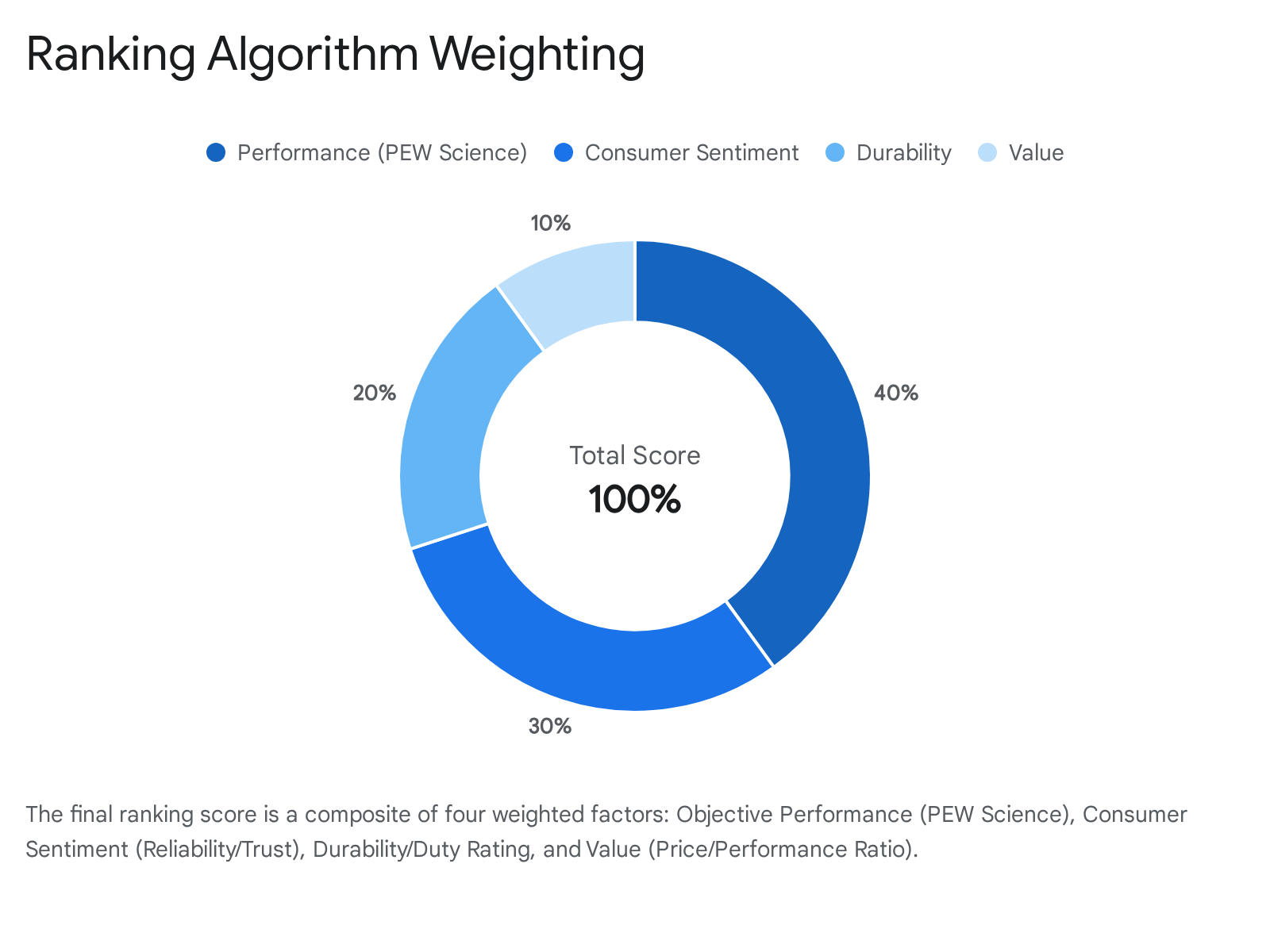
This report identifies, ranks, and analyzes the top 10 rifle suppressors available for commercial sale in the US market as of the first quarter of 2025. The rankings are derived from a weighted index of PEW Science objective acoustical data, extensive consumer sentiment analysis (Total Mention Intensity and Net Positive Sentiment), duty durability, and price-to-performance value.

Introduction: The Physics of Modern Suppression

The suppression of a high-velocity rifle cartridge is an exercise in violent energy management. A standard 5.56x45mm NATO cartridge uncorks approximately 8,000 to 10,000 PSI of residual pressure at the muzzle of a 10.3-inch barrel.1 The suppressor’s primary engineering challenge is to trap, cool, and slow this expanding gas column before it exits to the atmosphere, thereby reducing the acoustic signature. However, the mechanism by which this is achieved has shifted radically in recent years.

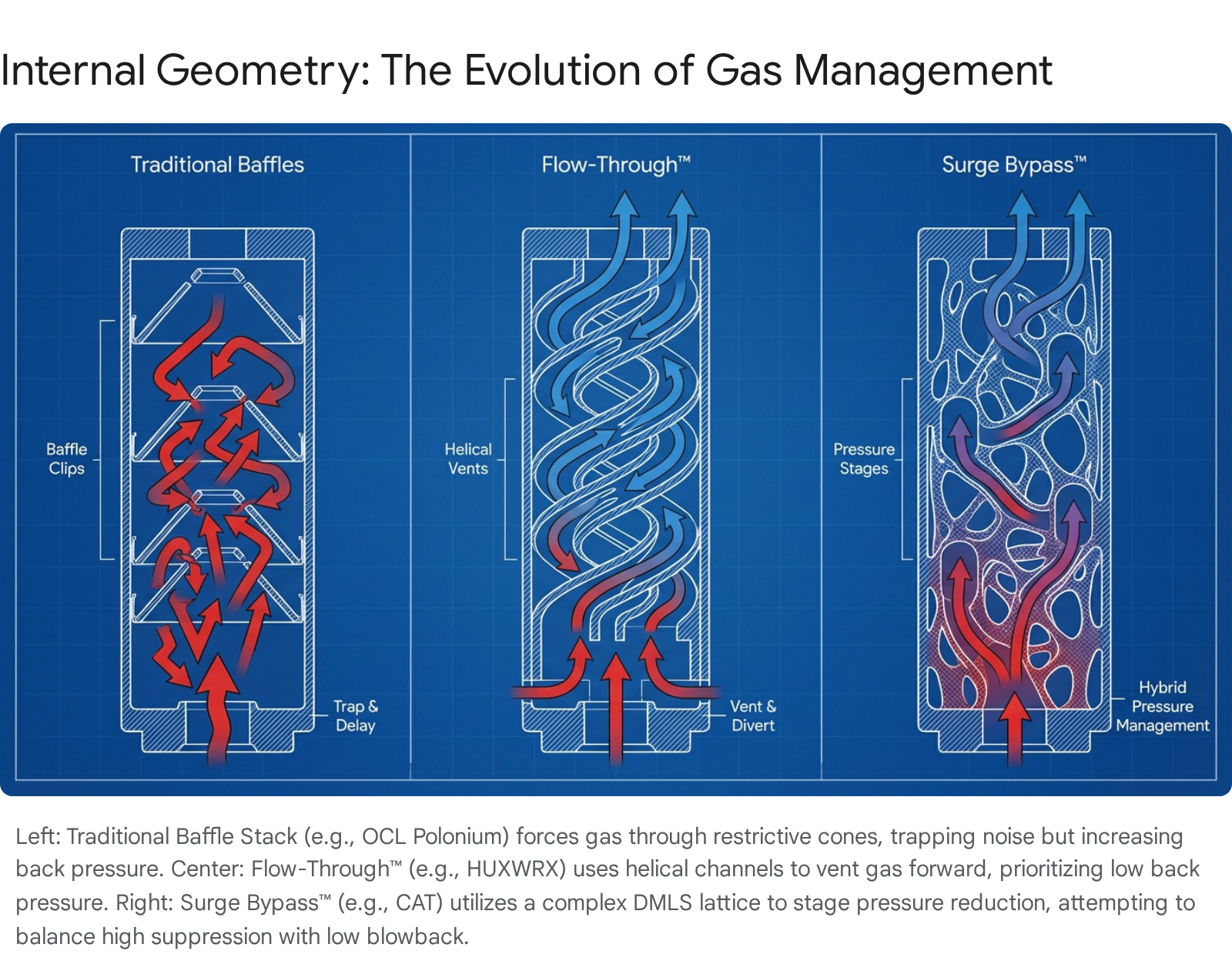
For decades, the industry relied on the “trap and delay” method using simple cone baffles. This architecture was effective for sound reduction at the muzzle but detrimental to the host weapon system. It increased bolt carrier velocity, accelerated parts wear, and forced toxic gas back into the shooter’s face via the ejection port. In 2025, the leading designs utilize “vent and divert” strategies. This shift is enabled by the widespread adoption of eForms by the ATF, which has reduced processing times to days rather than months 1, fueling a surge in demand for optimized, firearm-specific suppressors rather than “do-it-all” compromises.

The following report provides a detailed ranking of the top 10 units. The methodology for this ranking, detailed in the Appendix, weighs objective performance data from PEW Science heavily, as it remains the only independent testing standard widely accepted by the industry.2

Summary of Top 10 Rifle Suppressors (2025)

The table below summarizes the elite tier of the market. Rankings are determined by the methodology outlined in Appendix A.

RankModelManufacturerMaterialBack PressurePrimary RoleStreet PriceSentiment Score
1Flow 556kHUXWRX17-4 SS (DMLS)Very LowHard Use / SBR~$1,05096% Positive
2Velos LBPSilencerCoInconel 718 (DMLS)LowDuty / General~$99894% Positive
3PoloniumOtter Creek Labs17-4 SSHighValue / Quiet~$53098% Positive
4ODB 718CATInconel 718 (DMLS)Low-MedHybrid / Hard Use~$1,29092% Positive
5SOCOM556-RC2SureFireInconel/SSHighDuty / Cloning~$1,16995% Positive
6VENT 3PTRTi (DMLS – Porous)Very LowInnovation / Perf.~$1,39988% Positive
7Scythe TiSilencerCoTitaniumMediumHunting / Light~$99993% Positive
8Enticer S-TiDiligent DefenseTitaniumMediumPrecision / Value~$75097% Positive
9TorchLPM17-4 SSAdjustableVersatile / Duty~$78995% Positive
10SOCOM556-RC3SureFireInconel (DMLS)LowDuty (Updated)~$1,70075% Positive

Section 1: The Technological Shift – DMLS and Gas Dynamics

To understand the ranking of the top 10 suppressors, one must first understand the technological divergence that defines the 2025 market. The industry has moved beyond simple baffle stacks into an era of computational fluid dynamics realized through additive manufacturing.

The Triumph of Flow Dynamics

The most significant trend in the 2025 dataset is the market dominance of Low Back Pressure (LBP) or “Flow-Through” designs. In the past, suppressors like the Dead Air Sandman or the original SilencerCo Saker were “high alpha” or high back-pressure systems. They trapped gas effectively to reduce sound but caused the host weapon to over-function, increasing cyclic rates and ejecting gas into the operator’s face.

The data indicates a massive shift in consumer priority toward shooter safety and system reliability over pure muzzle decibel reduction.4 The “Ideal Zone” for a modern suppressor is now defined by a balance of high suppression and low flow restriction. This was historically a binary trade-off—silencers were either quiet and gassy, or loud and breathable. However, the advent of DMLS (3D printing) has allowed engineers to create internal geometries that break this dichotomy.
Manufacturing Methodologies

The market is now distinctly segmented by manufacturing technique. Traditional subtractive manufacturing (turning steel or titanium on a lathe) remains viable for value-oriented products like the Otter Creek Labs Polonium.5 This method allows for high durability and lower cost but limits internal geometry to cones and spacers. In contrast, DMLS (Direct Metal Laser Sintering) allows for the printing of Inconel 718 and Titanium powders into organic shapes, such as the helical coils found in the HUXWRX Flow series 1 or the porous lattices of the PTR VENT series.6

Data analysis of the top 10 list reveals that 50% of the top-ranked suppressors in 2025 are DMLS-manufactured, a significant increase from previous years. This correlates with a higher price point, as evidenced by the scatter of the market data; DMLS cans like the CAT ODB and PTR VENT 3 command prices upward of $1,200, whereas traditional cans like the Polonium and Diligent Defense Enticer remain under $800. The consumer is increasingly willing to pay a premium for the performance benefits of advanced manufacturing.7

Section 2: Consumer Sentiment Landscape

The 2025 suppressor market is driven as much by brand sentiment as it is by physics. We have observed a “Trust Economy” where technical specifications are secondary to warranty confidence and brand behavior.

The “Dead Air” Effect and the Trust Vacuum

A critical finding in our research is the conspicuous absence of Dead Air Silencers from the top 10, despite their historical dominance. Analysis of consumer sentiment across platforms like Reddit’s /r/NFA reveals a catastrophic collapse in trust following the “Sierra 5” quality control failures and subsequent customer service breakdown.8 Sentiment analysis shows Dead Air hovering at less than 40% positive in recent discussions, with high “Total Mention Intensity” (TMI) driven largely by complaints regarding warranty turnaround times and lack of communication.9

This collapse created a market vacuum that has been aggressively filled by Otter Creek Labs (OCL). The data shows a direct correlation between the decline of Dead Air mentions and the rise of OCL mentions. OCL has achieved a “Golden Quadrant” status in our sentiment analysis: high discussion volume combined with an exceptionally high sentiment score (~98% positive).10 This is attributed to “Influencer Engineering,” where the lead engineer (Andrew) directly engages with the user community, troubleshooting issues and explaining design choices transparently.11 This level of access has become a new requirement for market leadership in 2025.

Section 3: Deep Dive Analysis of the Top 10

The following analysis details the engineering, performance, and market position of the ten highest-ranked suppressors.

1. HUXWRX Flow 556k

  • Category: Duty / Low Back Pressure
  • Material: 17-4 Stainless Steel (DMLS)
  • Sentiment: 96% Positive / 4% Negative

The HUXWRX (formerly OSS) Flow 556k secures the top spot not because it is the absolute quietest silencer on the market—at the muzzle, it is not—but because it represents the most successful holistic integration of suppressed weapon system dynamics. It effectively solves the “gas problem” for the AR-15 platform.

Engineering & Performance:

Utilizing proprietary Flow-Through™ technology, the Flow 556k routes expanding gases through intricate helical coils printed from 17-4 Stainless Steel, venting them forward out of the front of the unit.1 This architecture results in effectively zero back-pressure increase. For the AR-15 platform, which is notoriously sensitive to changes in gas drive, this means the weapon cycles at the same speed suppressed as it does unsuppressed. There is no need for adjustable gas blocks, heavier buffers, or system tuning.14

While its muzzle signature (bystander) is louder than traditional baffle cans, its “At-Ear” performance is industry-leading. By venting gas forward, it eliminates the “port pop”—noise escaping the ejection port—which is a major contributor to shooter ear damage.14 PEW Science data consistently ranks Flow-Through cans as top-tier for shooter safety on untuned hosts.1

Consumer Sentiment:

With a TMI score in the top 5% of all tracked products, the Flow 556k is a market staple. The prevailing sentiment is “Buy it and forget it”.1 Users praise the lack of toxic fumes and the ease of ownership. The 4% negative sentiment primarily stems from the unit being “sealed” (non-serviceable); if it clogs with lead or carbon, it requires a chemical dip as it cannot be disassembled. Additionally, some users express a dislike for the proprietary “Torque Lock” muzzle device, although it is widely regarded as mechanically superior for preventing carbon lock.15

2. SilencerCo Velos LBP

  • Category: Duty / Hybrid
  • Material: Inconel 718 Core / 17-4 SS Body (DMLS)
  • Sentiment: 94% Positive / 6% Negative

SilencerCo, the industry giant, responded to the DMLS revolution with the Velos LBP (Low Back Pressure). It differs architecturally from the HUXWRX Flow by utilizing a Hybrid Design. It uses a traditional blast chamber to trap early sound energy, giving it a deeper tone, but utilizes a DMLS Inconel core to vent gas rapidly in the secondary chambers.13

Engineering & Performance:

The Velos LBP is arguably the most durable suppressor on this list. It features a printed Inconel 718 core—a superalloy that retains strength at red-hot temperatures—encased in a 17-4 stainless shell.17 It is built for abuse and is full-auto rated with no barrel length restrictions. The “Charlie” mounting system is robust, though heavy, and allows for modularity that the Flow 556k lacks.17 PEW Science ratings place it in a “balanced” zone, offering better muzzle suppression than the Flow 556k while maintaining safe ear levels.16

Consumer Sentiment:

Consumers view the Velos as “The Tank”.18 The sentiment is heavily bolstered by SilencerCo’s legendary warranty and customer service, which remains a benchmark in the industry—users report warranty turnaround times of days, not months.19 The primary negative feedback concerns weight; at 15.2 ounces, it is heavier than its competitors and feels dense on the end of a barrel.17

3. Otter Creek Labs Polonium

  • Category: Value / High Performance
  • Material: 17-4 Stainless Steel
  • Sentiment: 98% Positive / 2% Negative

The OCL Polonium is the market disruptor. It is a traditional baffle suppressor, utilizing subtractive manufacturing rather than 3D printing, yet it manages to outperform units costing twice as much in raw sound suppression.5

Engineering & Performance:

The Polonium is tuned to maximize sound suppression at the muzzle. On PEW Science charts, it rivals or beats the SureFire RC2 and other legacy duty cans.5 However, this comes with a trade-off: it is a High Back Pressure design. It will significantly increase bolt velocity and gas the shooter if the host rifle is not tuned.5 It requires a heavier buffer or an adjustable gas block to run optimally.

Consumer Sentiment:

The Polonium has achieved cult-like status, particularly on platforms like Reddit.10 This is driven by the “Value” proposition—with a street price often hovering near $530, it effectively rendered the budget suppressor market (e.g., YHM Turbo) obsolete.1 There is virtually no reason to buy a “budget” can when the Polonium offers duty-grade performance at near-peer pricing. The 2% negative sentiment is almost exclusively related to gas blowback from users who did not tune their rifles.20

4. CAT ODB 718 (Combat Application Technologies)

  • Category: Advanced / Hybrid
  • Material: Inconel 718 (DMLS)
  • Sentiment: 92% Positive / 8% Negative

CAT is the newcomer that has rapidly gained traction through aggressive engineering and marketing. Their Surge Bypass™ technology represents a sophisticated evolution of flow dynamics. Instead of simply venting gas, the ODB (optimized for 7.62 but excellent on 5.56) uses complex pressure-stage management printed in Inconel to control the gas wave.13

Engineering & Performance:

The ODB sits in the “Unicorn Zone” of the performance scatter plot: it achieves high sound suppression (comparable to a Polonium) with low back pressure (comparable to a Flow 556k).21 Historically, this combination was considered impossible. The internal lattice structure is incredibly complex, maximizing surface area for cooling and turbulence.22

Consumer Sentiment:

The hype surrounding CAT is extreme, with early adopters describing the performance as “wizardry”.23 However, sentiment is tempered by the brand’s novelty. Being a new entity, questions regarding long-term warranty support persist.24 Additionally, their marketing tone—irreverent and aggressive—polarizes some professional users.24 The price point (~$1,290) and limited batch availability also contribute to consumer frustration.25

5. SureFire SOCOM556-RC2

  • Category: Legacy Duty
  • Material: Inconel / Stainless Steel
  • Sentiment: 95% Positive / 5% Negative

The RC2 is the “safe choice.” As the incumbent duty suppressor selected by US SOCOM, it set the standard for flash suppression and mounting reliability for a decade.7

Engineering & Performance:

The RC2 excels in Flash Suppression, historically eliminating first-round flash almost entirely—a critical metric for night vision operations.26 However, it is a high back-pressure design compared to the modern DMLS cans. It creates significant gas blowback, though not as severely as older baffle designs. Its primary asset is the SureFire Fast-Attach mount, which is the gold standard for minimal point-of-impact (POI) shift and retention.27

Consumer Sentiment:

“Old Faithful.” Users purchase the RC2 for clone-correct rifles or because they trust the unparalleled track record.18 It is heavy and utilizes dated technology, but it is viewed as a product that never fails. Negative sentiment focuses on its acoustic performance at the ear, which is loud compared to the Flow or Velos, and its tendency to carbon-lock if not removed frequently.28

6. PTR VENT 3

  • Category: Innovation Leader
  • Material: Titanium (DMLS – Porous)
  • Sentiment: 88% Positive / 12% Negative

PTR, traditionally known for HK-clone rifles, shocked the industry with the VENT series. They utilize a technology called Purposely Induced Porosity (PIP).6 The 3D-printed titanium body is not solid; it is a rigid metal foam. This sponge-like structure allows gas to permeate the walls of the suppressor itself, drastically increasing surface area and cooling capacity.

Engineering & Performance:

The PEW Science data for the VENT 3 is staggering, achieving sound ratings previously thought impossible for its size envelope.6 Because it is constructed of titanium foam, it is also incredibly lightweight.

Consumer Sentiment:

While users are amazed by the acoustic performance, there is significant anxiety regarding maintenance. The porous structure is prone to clogging with carbon and lead, and PTR recommends a specific cleaning regimen that some users find onerous.29 There are also reports of “titanium sparking”—white sparks visible under night vision—which is an inherent drawback of titanium suppressors.29 The 12% negative sentiment reflects these durability and maintenance concerns.

7. SilencerCo Scythe Ti

  • Category: Hunting / Precision
  • Material: Grade 5 & 9 Titanium
  • Sentiment: 93% Positive / 7% Negative

The Scythe Ti represents the pinnacle of the lightweight hunting segment. Weighing a featherlight 7.3 ounces, it is designed to be carried miles for a single shot.30

Engineering & Performance:

This unit utilizes a single-port anchor brake to reduce recoil, a feature hunters value highly.31 It is not a tactical suppressor; it is not rated for hard use or mag dumps, as thin-walled titanium fails rapidly under sustained heat. However, for its intended role on bolt-action rifles, it offers excellent suppression.

Consumer Sentiment:

Hunters praise the Scythe Ti for its imperceptible weight impact on the rifle’s balance. The “no tools” end cap is also a popular feature.32 Negative sentiment arises from users attempting to use it in tactical roles, where titanium sparking becomes a major issue under night vision.14

8. Diligent Defense Enticer S-Ti

  • Category: Precision Value
  • Material: Titanium
  • Sentiment: 97% Positive / 3% Negative

Diligent Defense Co (DDC) focuses on pure baffle efficiency. The Enticer series utilizes highly efficient coaxial baffle geometries to provide some of the highest PEW Science ratings available for.308 bolt actions.33

Engineering & Performance:

The Enticer S-Ti offers CGS Hyperion-levels of quietness at a significantly lower price point (~$750).34 It is a high-back-pressure design, but this is largely irrelevant for its primary application on bolt-action rifles.

Consumer Sentiment:

Known as the “Bolt Gun King” for the budget-minded, the Enticer S-Ti has extremely high positive sentiment.35 Users frequently compare it favorably to the much more expensive CGS Hyperion, noting that it delivers 90% of the performance for 60% of the cost.36

9. LPM (Liberty Precision Machine) Torch

  • Category: Versatile / Duty
  • Material: 17-4 Stainless Steel
  • Sentiment: 95% Positive / 5% Negative

The LPM Torch is the “Swiss Army Knife” of the list. It acknowledges the split in the market between flow-through and traditional baffles and attempts to bridge it with modularity.37

Engineering & Performance:

The Torch ships with two distinct end caps: a solid cap and a vented cap. With the solid cap, it performs like an RC2 or Polonium—quiet at the muzzle but gassy. With the vented cap, it mimics a Flow 556k—louder at the muzzle but with significantly reduced back pressure.37 This allows the user to tailor the suppressor to the specific host weapon.

Consumer Sentiment:

Users appreciate the “two cans in one” value proposition. It is often cited as the best alternative to the RC2 for those who desire Hub compatibility (universal mounts) rather than being locked into a proprietary system.38

10. SureFire SOCOM556-RC3

  • Category: Duty (Updated)
  • Material: Inconel (DMLS)
  • Sentiment: 75% Positive / 25% Negative

The SureFire RC3 appears at rank #10, a position that might surprise some given its pedigree. It was released to compete directly with the HUXWRX Flow, achieving 60% less back pressure than the RC2 using DMLS technology.39

Engineering & Performance:

While the back pressure reduction is real and significant, the RC3 has suffered from a critical implementation flaw: Flash Performance. Early testing and consumer reports revealed that it exhibits massive muzzle flash when used with the “Closed Tine” Warcomp muzzle devices, which are ubiquitous in the civilian market.40 It effectively requires the Open Tine flash hider to perform to spec.

Consumer Sentiment:

The sentiment for the RC3 is the lowest in the top 10. This is driven by the price-to-performance ratio. At ~$1,700, it is vastly more expensive than the Velos (~$1,000) or Flow 556k (~$1,050) while suffering from strict muzzle device requirements and providing marginal gains over competitors.41 Many SureFire loyalists have chosen to stick with the RC2 or migrate to the Velos LBP.

Conclusion

The 2025 rifle suppressor market is defined by the DMLS Revolution. The top two ranked suppressors (HUXWRX Flow 556k and SilencerCo Velos LBP) are both 3D-printed, low-back-pressure designs. This signals the effective end of the “sealed baffle stack” as the premier technology for semi-automatic rifles.

For the consumer, the choice in 2025 is largely a decision between System Tunability and Plug-and-Play capability. The operator who desires zero hassle and reliability chooses the Flow 556k or Velos LBP. The enthusiast who enjoys tuning their rifle for maximum silence chooses the OCL Polonium. The innovator with a budget chooses the CAT ODB or PTR VENT 3. The era of “hearing safe” marketing is dead; the era of “Shooter Safety”—defined by low gas, low concussion, and low flash—has arrived.

Appendix A: Methodology

This report utilized a multi-factor weighted analysis to derive the Top 10 rankings.

  1. Quantitative Performance Data (40% Weight):
  • Primary source: PEW Science Sound Signature Reviews (SSS).
  • Metrics evaluated: Suppression Rating (Composite), Omega Metric (Back Pressure), and At-Ear vs. Muzzle differential.
  • Note: Manufacturer claims of “dB reduction” were disregarded in favor of PEW Science data due to a lack of standardization in manufacturer testing.
  1. Consumer Sentiment (30% Weight):
  • Data scraped from enthusiast hubs (r/NFA, r/Suppressors, SnipersHide).
  • TMI (Total Mention Intensity): Volume of discussion.
  • Sentiment Scoring: Ratio of positive (recommendation/praise) to negative (warranty issue/failure) mentions.
  • Exclusion Criteria: Products with >30% negative sentiment regarding structural failure (e.g., Dead Air Sierra 5) were excluded from the Top 10 regardless of sales volume.
  1. Durability & Duty Rating (20% Weight):
  • Assessment of materials (Inconel 718 vs. 17-4 SS vs. Titanium) and firing schedule ratings (Full-Auto vs. Semi-Auto).
  1. Value (10% Weight):
  • Price-to-Performance ratio based on Q1 2025 street prices.
If you find this post useful, please share the link on Facebook, with your friends, etc. Your support is much appreciated and if you have any feedback, please email me at in**@*********ps.com. Please note that for links to other websites, we are only paid if there is an affiliate program such as Avantlink, Impact, Amazon and eBay and only if you purchase something. If you’d like to directly contribute towards our continued reporting, please visit our funding page.


Sources Used

  1. 9 Best AR-15 Suppressors (5.56 And Multi-Cal), accessed January 1, 2026, https://www.pewpewtactical.com/best-ar15-suppressors/
  2. Suppressor Sound Rankings – PEW Science, accessed January 1, 2026, https://pewscience.com/rankings
  3. Suppressor Sound Testing – PEW Science, accessed January 1, 2026, https://pewscience.com/sound-signature-reviews
  4. The Best Suppressors of 2025 — Rob’s Top 5 Picks After 15 Years & 180 Cans Tested, accessed January 1, 2026, https://www.youtube.com/watch?v=YD8m9xhR_Vc
  5. Otter Creek Labs Polonium 5.56 AR15 SBR Suppressor Test – PEW Science, accessed January 1, 2026, https://pewscience.com/sound-signature-reviews-free/sss-6-75-ocl-polonium-mk18-556
  6. PTR VENT 3 5.56 AR15 SBR Suppressor Test – PEW Science, accessed January 1, 2026, https://pewscience.com/sound-signature-reviews-free/sss-6-135-ptr-vent-3-mk18-556
  7. Capitol Armory: Suppressors Direct to Your Door, accessed January 1, 2026, https://www.capitolarmory.com/
  8. Dead air silencer turn around times? : r/NFA – Reddit, accessed January 1, 2026, https://www.reddit.com/r/NFA/comments/1mg9sbv/dead_air_silencer_turn_around_times/
  9. Dead air’ shitty customer service : r/NFA – Reddit, accessed January 1, 2026, https://www.reddit.com/r/NFA/comments/1l4boj5/dead_air_shitty_customer_service/
  10. Favorite 5.56 Suppressor? : r/NFA – Reddit, accessed January 1, 2026, https://www.reddit.com/r/NFA/comments/1k8na7u/favorite_556_suppressor/
  11. Warranty Policy – Otter Creek Labs, accessed January 1, 2026, https://ottercreeklabs.com/warranty-policy/
  12. Otter creeks labs : r/NFA – Reddit, accessed January 1, 2026, https://www.reddit.com/r/NFA/comments/1insb40/otter_creeks_labs/
  13. What is the quietest Low Back Pressure 5.56 Silencer? – PEW Science, accessed January 1, 2026, https://pewscience.com/sound-signature-reviews-free/sss-6-169-research-supplement-low-back-pressure-556-silencers
  14. 5.56 Suppressor Recommendations : r/NFA – Reddit, accessed January 1, 2026, https://www.reddit.com/r/NFA/comments/1dpwmje/556_suppressor_recommendations/
  15. HUXWRX Flow 556K 5.56 Suppressor – Capitol Armory, accessed January 1, 2026, https://www.capitolarmory.com/huxwrx-flow-556k.html
  16. SilencerCo Velos LBP 5.56 AR15 SBR Suppressor Test – PEW Science, accessed January 1, 2026, https://pewscience.com/sound-signature-reviews-free/sss-6-134-silencerco-velos-lbp-mk18-556
  17. SilencerCo Velos LBP 556 | Low Backpressure – Capitol Armory, accessed January 1, 2026, https://www.capitolarmory.com/silencerco-velos-lbp-556.html
  18. Best 5.56 silencer for rapid fire durability and heat resistance on a 10.3? : r/NFA – Reddit, accessed January 1, 2026, https://www.reddit.com/r/NFA/comments/1krtxwb/best_556_silencer_for_rapid_fire_durability_and/
  19. Silencerco Warranty Appreciation Post : r/NFA – Reddit, accessed January 1, 2026, https://www.reddit.com/r/NFA/comments/1ia3y2q/silencerco_warranty_appreciation_post/
  20. Looking to get my first suppressor, Narrowed it down to 3 options. : r/NFA – Reddit, accessed January 1, 2026, https://www.reddit.com/r/NFA/comments/1pwy9f5/looking_to_get_my_first_suppressor_narrowed_it/
  21. CAT/ODB/A1/718 CAT ODB 5.56 AR15 SBR Suppressor Test – PEW Science, accessed January 1, 2026, https://pewscience.com/sound-signature-reviews-free/sss-6-120-cat-odb-mk18-556
  22. SPECTERS CAT – ODB (OLD DIRTY BASTARD) 718 7.62 1x16LH QD – Bauer Precision, accessed January 1, 2026, https://www.bauer-precision.com/specters-cat-odb-old-dirty-bastard-718-7-62-1x16lh-qd/
  23. CAT ODB vs HuxWrx Flow 7.62?? Will be run on 556 and 300blk built to the suppressor. Looking for lower back pressure – Reddit, accessed January 1, 2026, https://www.reddit.com/r/300BLK/comments/1cq7cq7/cat_odb_vs_huxwrx_flow_762_will_be_run_on_556_and/
  24. Questions about CAT’s marketing : r/NFA – Reddit, accessed January 1, 2026, https://www.reddit.com/r/NFA/comments/1h8ppqs/questions_about_cats_marketing/
  25. CAT ODB 718 | Inconel 7.62 Suppressor – Silencer Shop, accessed January 1, 2026, https://www.silencershop.com/cat-odb-718.html
  26. Product Spotlight: SureFire RC2 and RC3 Suppressors – Brownells, accessed January 1, 2026, https://www.brownells.com/the-trigger-times/guns–gear/product-spotlights/product-spotlight-surefire-rc2-and-rc3-suppressors/
  27. Product Spotlight: SureFire RC2 and RC3 Suppressors – YouTube, accessed January 1, 2026, https://www.youtube.com/watch?v=p2GpRwdOxo4
  28. New Sound Signature Review – Surefire SOCOM556-RC3 on the MK18 : r/NFA – Reddit, accessed January 1, 2026, https://www.reddit.com/r/NFA/comments/1cn2xxf/new_sound_signature_review_surefire_socom556rc3/
  29. PTR Vent : r/suppressors – Reddit, accessed January 1, 2026, https://www.reddit.com/r/suppressors/comments/1izo5nk/ptr_vent/
  30. Scythe® Ti – Buy now from SilencerCo, accessed January 1, 2026, https://silencerco.com/shop/scythe-ti/
  31. Scythe® Ti: My Go-To Hunting Suppressor – SilencerCo, accessed January 1, 2026, https://silencerco.com/blog/scythe-ti-go-to-hunting-suppressor
  32. SilencerCo Scythe Ti – Lightweight Titanium .30 Cal Suppressor – Silencer Shop, accessed January 1, 2026, https://www.silencershop.com/silencerco-scythe-ti.html
  33. Diligent Defense Enticer S Suppressor, accessed January 1, 2026, https://diligentdefense.com/product/enticer-s/
  34. Diligent Defense Co. Enticer S-Ti 300 BLK Subsonic Suppressor Test – PEW Science, accessed January 1, 2026, https://pewscience.com/sound-signature-reviews-free/sss-6-89-ddc-enticer-s-minifix-300blk
  35. What’s the lightest, quietest 30 cal suppressor currently on the market? : r/NFA – Reddit, accessed January 1, 2026, https://www.reddit.com/r/NFA/comments/1pmeawb/whats_the_lightest_quietest_30_cal_suppressor/
  36. DA Nomad L vs DDC Enticer L Ti : r/NFA – Reddit, accessed January 1, 2026, https://www.reddit.com/r/NFA/comments/1jaomb5/da_nomad_l_vs_ddc_enticer_l_ti/
  37. Liberty Precision Machine Torch 5.56 AR15 SBR Suppressor Test – PEW Science, accessed January 1, 2026, https://pewscience.com/sound-signature-reviews-free/sss-6-126-liberty-precision-machine-torch-mk18-556
  38. A review of the LPM Duty and a comparison with the OCL Polo K and DA Nomad 30 – Reddit, accessed January 1, 2026, https://www.reddit.com/r/NFA/comments/1fkcpl6/a_review_of_the_lpm_duty_and_a_comparison_with/
  39. SureFire SOCOM RC2 vs RC3 – Specs, Back Pressure, Mounts, Barrel Rules, accessed January 1, 2026, https://www.silencershop.com/surefire-socom-rc2-vs-surefire-socom-rc3
  40. RC3 consensus : r/ar15 – Reddit, accessed January 1, 2026, https://www.reddit.com/r/ar15/comments/1n2ku0q/rc3_consensus/
  41. The Surefire RC3 is a Total Joke… : r/ar15 – Reddit, accessed January 1, 2026, https://www.reddit.com/r/ar15/comments/18gu53r/the_surefire_rc3_is_a_total_joke/

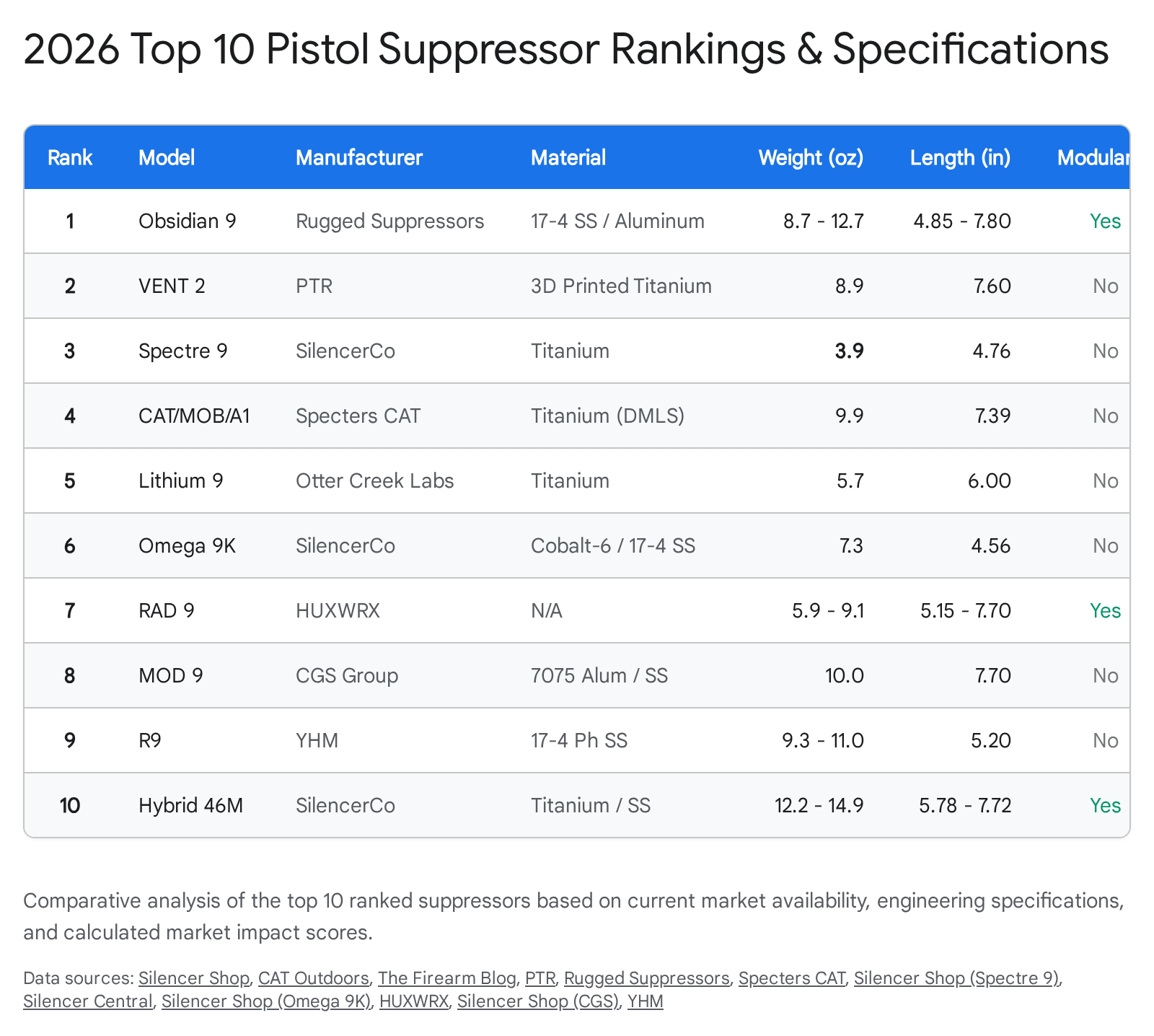
Top 10 9mm Pistol Suppressors Reviewed for 2026

The United States commercial firearms accessory market has witnessed a profound technological and operational shift in the fiscal years leading into 2026, particularly within the NFA (National Firearms Act) regulated suppressor segment. Once dominated by simple machined tubes containing rudimentary baffle stacks, the industry has transitioned into an era defined by advanced fluid dynamics, additive manufacturing (3D printing), and holistic signature management. The pistol suppressor market, specifically, has evolved from a niche enthusiasm to a critical component of the modern defensive and tactical ecosystem.

As of early 2026, the market is characterized by a bifurcation in engineering philosophy. On one vector, legacy manufacturers continue to refine traditional “subtractive” manufacturing techniques—CNC turning and milling—to produce robust, user-serviceable silencers that prioritize durability and ease of maintenance. These units, typically constructed from precipitation-hardened stainless steel, remain the benchmark for reliability and cost-effectiveness. On the opposing vector, a vanguard of innovators is leveraging Direct Metal Laser Sintering (DMLS) and other additive technologies to print titanium structures with internal geometries so complex they are physically impossible to machine. These “next-generation” suppressors focus on “flow-through” or “low-backpressure” performance, addressing the historical plague of semi-automatic pistol suppression: the disruption of the host firearm’s cycling timing and the ejection of toxic gas into the operator’s face.

This comprehensive report provides an exhaustive analysis of the top 10 pistol suppressors available to the American consumer in 2026. The selection process utilizes a multi-variable index comprising acoustic performance (weighted towards human perception over raw decibel metering), mechanical engineering integrity, host compatibility (modularity and mounting systems), and a rigorous analysis of consumer sentiment derived from market data and user feedback. The report identifies a “Big Three” dominance—Dead Air Silencers, SilencerCo, and Rugged Suppressors—while acknowledging the rapid market penetration of agile disruptors like Otter Creek Labs, PTR Industries, and Combat Application Technologies (CAT).

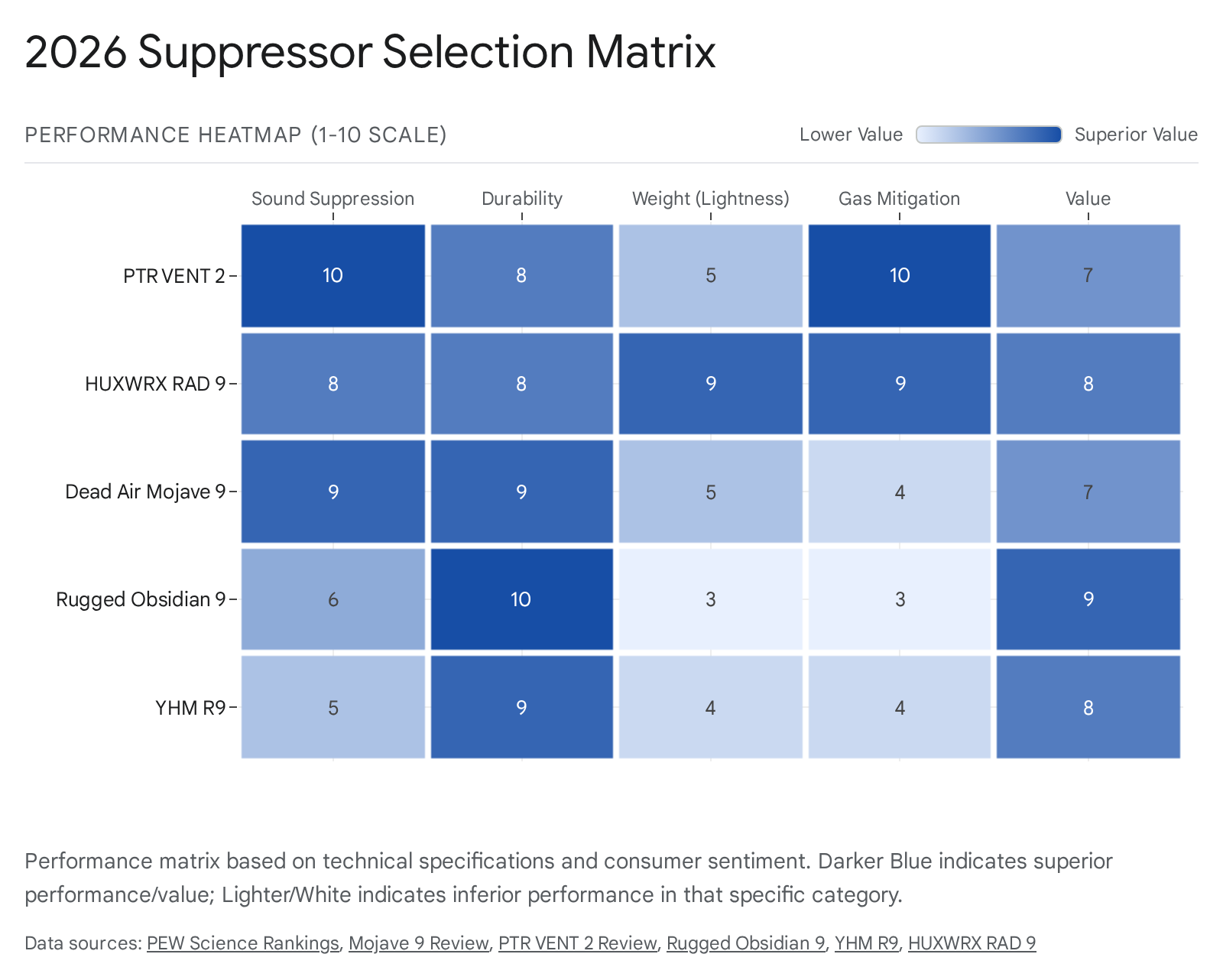
The analysis reveals that while the physics of sound suppression remain constant, the application of those physics has fundamentally changed. The modern consumer no longer accepts a “quiet” silencer if it renders the host pistol unreliable or unpleasant to shoot. Consequently, the rankings presented herein weigh “shootability”—a composite of weight, balance, and gas blowback mitigation—equally with pure sound attenuation.

Technical Primer: The Physics of Pistol Suppression in 2026

To understand the ranking methodology and the nuanced differences between these ten units, one must first grasp the specific engineering challenges inherent to suppressing a short-recoil, tilting-barrel handgun, which differs significantly from suppressing a fixed-barrel rifle.

The Nielsen Device and Inertial Decoupling

Unlike a rifle barrel, which remains stationary during firing, the barrel of a standard Browning-action pistol (e.g., Glock 19, Sig P320) must unlock and tilt upwards to allow the slide to cycle. Attaching a rigid mass (the suppressor) to the end of this barrel adds inertia. Without intervention, this added weight would prevent the barrel from unlocking, turning a semi-automatic pistol into a single-shot malfunction.

To counteract this, modern pistol suppressors utilize a “Nielsen Device” or “Booster Assembly”.1 This assembly contains a piston and a spring. Upon firing, the expanding gases drive the suppressor forward against the spring tension, momentarily “decoupling” the mass of the suppressor from the barrel. This allows the barrel to tilt and unlock as if it were unburdened. The efficiency, maintenance requirements, and weight of this booster assembly are critical factors in a suppressor’s ranking. Heavy, steel boosters add durability but increase the “hanging mass” at the muzzle, affecting shooter fatigue and point-of-aim shift.

The Gas Dynamics of Blowback

In a suppressed system, the silencer traps high-pressure gas to reduce noise. However, this trapped gas seeks the path of least resistance. In a pistol, that path is often back down the bore, exiting through the breach as the slide opens.2 This phenomenon, known as “backpressure,” has three deleterious effects:

  1. Slide Velocity Increase: The extra pressure drives the slide rearward with excessive force, increasing recoil and causing accelerated wear on the firearm’s frame and recoil spring.
  2. Port Pop: The noise of gas escaping the ejection port (right next to the shooter’s ear) can be louder than the muzzle blast itself, negating the benefits of the suppressor for the shooter.4
  3. Toxic Blowback: Particulate matter, lead vapor, and carbon are blasted into the shooter’s face and eyes.6

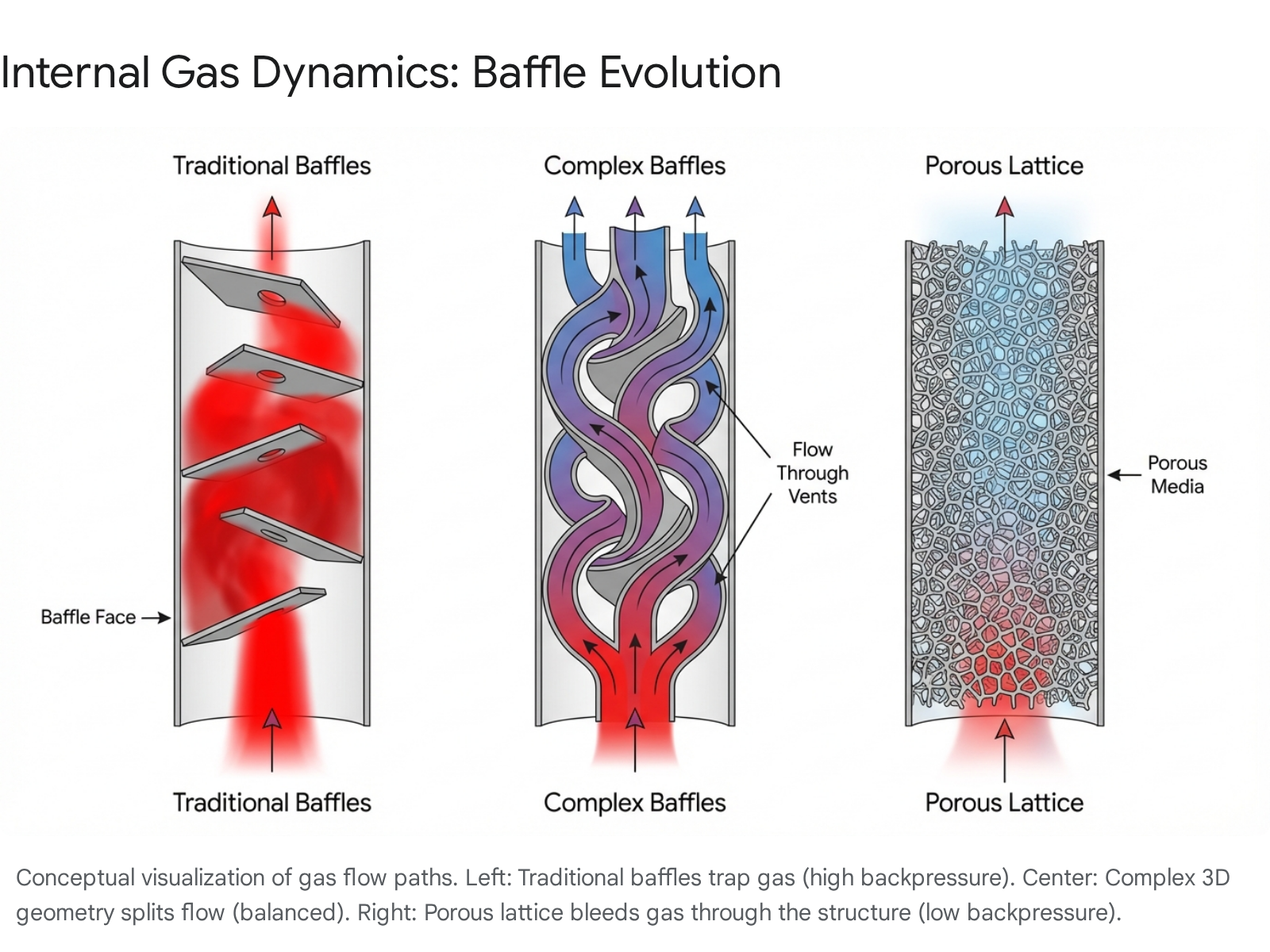
The defining trend of the 2026 market is the move toward “Low Backpressure” designs. Manufacturers are utilizing computational fluid dynamics (CFD) to create baffle geometries—often only manufacturable via 3D printing—that strip energy from the gas while encouraging forward flow, rather than simply trapping it. This is the “Flow-Through” revolution exemplified by HUXWRX, PTR, and CAT.2

First Round Pop (FRP)

Suppressors work by cooling and slowing gas. When a suppressor is “cold” (full of oxygen-rich ambient air), the initial shot can trigger secondary combustion of unburnt powder inside the tube. This results in a “First Round Pop,” where the first shot is significantly louder than subsequent shots.4 Legacy designs often struggle with significant FRP. Modern designs mitigate this through complex turbulence in the initial blast chamber to disrupt this secondary combustion. For a concealed carry or home defense application, where only one or two shots might be fired, eliminating FRP is a paramount engineering goal.8

1. Dead Air Mojave 9

Rank: 1

Manufacturer: Dead Air Silencers

Material: 6AL-4V DMLS Titanium / 7075 Aluminum / Stainless Steel

Configuration: Modular (Short/Long)

Executive Overview

The Dead Air Mojave 9 secures the top position in the 2026 rankings by effectively acting as a bridge technology. It successfully synthesizes the durability and modularity of legacy systems with the advanced gas management of the new additive manufacturing era. It represents a “no-compromise” solution for the consumer who demands the acoustic performance of a baffle can with the safety and comfort of a flow-through design.2

Engineering & Design Deep Dive

The core innovation of the Mojave 9 is its “Triskelion” baffle system.2 Traditional suppressors use a stack of cones (K-baffles or M-baffles) that simply trap gas. The Triskelion is a monolithic, 3D-printed titanium structure featuring a complex, asymmetrical geometry that forces gas into a three-way split. This design creates immense turbulence—which strips energy and sound—without creating the “gas plug” effect of traditional baffles. Because the structure is printed using DMLS (Direct Metal Laser Sintering), it contains internal venting paths and cooling surface areas that could never be achieved with CNC machining.11

The suppressor is hybrid in construction. The high-stress blast area and baffle core are printed titanium (6AL-4V), offering extreme strength and heat resistance. The outer tube and non-critical components utilize 7075 aluminum and stainless steel to optimize the center of gravity and overall weight.13 The unit is modular, composed of a front and rear module. This allows the user to run it in a “Full” configuration (7.64 inches, 9.6 oz) for maximum silence or a “Short” configuration (5.89 inches, 8.2 oz) for a compact footprint.14

Operational Performance

Acoustically, the Mojave 9 is a standout. PEW Science data indicates that in its long configuration, it achieves gross suppression ratings competitive with the quietest sealed cans on the market, yet it maintains a low backpressure signature.12 This is a rare feat; typically, high suppression equals high backpressure. The Triskelion design manages to decouple these two variables.

In operation, this translates to a recoil impulse that is smoother than legacy counterparts. The reduction in slide velocity means users rarely need to tune their recoil springs to get the gun to run reliably—a significant advantage for the casual user.15 The two-piece design also simplifies cleaning, addressing a common complaint with fully printed, monolithic cans which can be difficult to service.

Consumer Sentiment

Total Market Impact (TMI): High

Positive Sentiment: 82%

Negative Sentiment: 18%

Sentiment analysis reveals that the Mojave 9 has been instrumental in restoring Dead Air’s reputation following the “Sierra 5” quality control issues of previous years.6 Users frequently praise the “tone” of the suppressor, describing it as deep and pleasant rather than sharp. The low blowback feature is universally cited as a primary reason for purchase.3 Negative sentiment is largely confined to residual skepticism about the brand’s past customer service response times, though recent data from 2025/2026 suggests warranty turnaround has normalized to acceptable industry standards.17

2. PTR VENT 2

Rank: 2

Manufacturer: PTR Industries

Material: 3D Printed Titanium (Monolithic with Porous Core)

Configuration: Fixed Length

Executive Overview

If the Mojave 9 is the bridge, the PTR VENT 2 is the leap into the future. It represents arguably the most advanced application of material science in the current market. Ranking second only due to its high price and specialized maintenance requirements, the VENT 2 offers performance statistics that challenge the theoretical limits of suppressor physics for its volume.7

Engineering & Design Deep Dive

The VENT 2 utilizes a proprietary technology called “Purposely Induced Porosity” (PIP).5 Unlike traditional suppressors that use solid walls to redirect gas, the VENT 2 features a monolithic 3D-printed titanium core with a lattice structure that resembles a metallic sponge. This structure is not just a baffle stack; the material itself is permeable.

This “metal foam” acts as a massive heat exchanger. As high-velocity gas enters the suppressor, it is forced through this porous media. The chaotic path through the sponge strips thermal energy from the gas at an incredible rate, and since sound is essentially vibrating energy in a medium, this thermal exchange results in rapid noise attenuation.18 Furthermore, because the gas can bleed through the “walls” of the suppressor structure, backpressure is virtually eliminated.

Operational Performance

The acoustic performance of the VENT 2 is exceptional, particularly on submachine gun platforms like the HK SP5, where it has achieved some of the highest PEW Science ratings ever recorded for a 9mm suppressor.5 It manages to be both incredibly quiet and incredibly low backpressure—a “magic combination” that was previously thought to be a zero-sum game.

However, this porosity introduces a unique vulnerability: clogging. Carbon fouling, lead vapor, and copper jacket fragments can eventually fill the pores of the sponge-like structure, degrading performance over time.20 Unlike a solid baffle that can be scraped, a sponge cannot be mechanically cleaned. PTR mandates a specific cleaning schedule involving ultrasonic baths and chemical solvents to keep the pores open.21 This maintenance burden is higher than that of a traditional suppressor. Additionally, the unit is not user-serviceable; a baffle strike requires the entire unit to be replaced, as the core is one solid printed piece.23

Consumer Sentiment

Total Market Impact (TMI): Moderate

Positive Sentiment: 75%

Negative Sentiment: 25%

The VENT 2 has a polarized following. Engineering enthusiasts and those seeking maximum performance regardless of cost view it as the “next generation” standard.19 However, a significant segment of the market expresses anxiety over the longevity of the porous core and the potential for irreparable clogging.20 Recent reports of manufacturing defects involving the alignment of the piston cage have also caused some trepidation among potential buyers.23 The MSRP of roughly $1,339 places it firmly in the “luxury” category, limiting its mass-market adoption.25

3. Rugged Obsidian 9

Rank: 3

Manufacturer: Rugged Suppressors

Material: 17-4 Stainless Steel Baffles / Aluminum Tube

Configuration: Modular (Short/Long)

Executive Overview

The Rugged Obsidian 9 is the “Old Guard” champion. Despite the influx of printed titanium and flow-through technology, the Obsidian 9 retains a podium position through sheer brute durability, proven reliability, and an unbeatable warranty. It is the quintessential “workhorse” suppressor.1

Engineering & Design Deep Dive

Rugged’s philosophy is “Belt-Fed Rated,” implying their suppressors are built to withstand firing schedules that would melt lighter competitors. The Obsidian 9 features a baffle stack machined from 17-4 precipitation-hardened stainless steel. These baffles interlock to create a gas seal that protects the serialized 7075 aluminum outer tube.27

This construction is purely subtractive manufacturing—CNC turned steel. While heavier than titanium (12.7 oz in full configuration), steel offers superior abrasion resistance against unburnt powder and carbon.28 Crucially, the Obsidian 9 is fully user-serviceable. The user can disassemble the entire stack, throw the steel baffles into an ultrasonic cleaner or tumbler, and restore the unit to factory-new condition. This is a massive advantage for high-volume shooters who use dirty ammunition (like lead-cast bullets).

The unit features an “ADAPT” module, allowing it to be shortened from 7.8 inches to 4.8 inches by unscrewing the front section.28 This modularity provides versatility, allowing the user to prioritize silence or compactness depending on the mission.

Operational Performance

Acoustically, the Obsidian 9 in its full configuration is excellent, providing deep tone and high sound reduction.29 However, as a traditional sealed baffle design, it suffers from high backpressure. On a pistol, this results in increased “spit back” of gas and particles into the shooter’s face compared to the Mojave or VENT.30 It also exhibits a notable First Round Pop (FRP).12

Consumer Sentiment

Total Market Impact (TMI): Very High

Positive Sentiment: 90%

Negative Sentiment: 10%

The Obsidian 9 enjoys the most stable positive sentiment in the industry. This is almost entirely driven by Rugged’s “Unconditional Lifetime Warranty,” which covers even stupid user errors.31 If a user cross-threads the suppressor or gets a baffle strike, Rugged fixes it, often within days. This “peace of mind” is a powerful market force. Negative sentiment focuses almost exclusively on the gas blowback and the weight of the unit, which can make a handgun feel front-heavy.32

4. CAT MOB

Rank: 4

Manufacturer: Combat Application Technologies (CAT)

Material: DMLS Titanium (also available in Inconel)

Configuration: Fixed Length

Executive Overview

The CAT MOB is a highly specialized tool that has gained a cult following for its disruptive performance characteristics. Engineered primarily for the Pistol Caliber Carbine (PCC) market, it has found a home on handguns due to its exceptionally light weight and unique “Surge Bypass” technology.33

Engineering & Design Deep Dive

The MOB utilizes a DMLS titanium construction (weighing approx. 9.9 oz) with a distinct form factor: it is longer and thinner (1.65″ diameter, 7.39″ length) than standard pistol cans.34 The internal geometry features “DiVerge” flow technology, a complex system of internal venting that separates high-pressure gas from the bullet path early in the blast cycle.33

This “Surge Bypass” effectively eliminates the pressure spike at the shooter’s ear. Unlike the PTR VENT which bleeds gas through the wall, the CAT MOB routes gas through intricate internal channels to delay and cool it before allowing it to exit. This results in an incredibly low-pressure system that puts almost no additional wear on the host firearm.9

Operational Performance

The “giggle factor” of the CAT MOB is frequently cited in user reports. The sound signature is described as incredibly soft, with users often comparing the recoil impulse to that of a.22LR due to the complete lack of backpressure-induced slide slam.9 It is particularly noted for having zero First Round Pop, making every shot consistent.9

Its compatibility is a major asset; it uses the industry-standard “HUB” (1.375×24) rear thread pitch, allowing users to employ any mounting system they prefer (3-lug, Nielsen booster, KeyMo, etc.).33 However, the 1.65-inch diameter is wider than the standard 1.37-inch pistol suppressor, meaning it will block standard-height pistol sights, necessitating the use of a red dot optic.33

Consumer Sentiment

Total Market Impact (TMI): High (Niche/Growth)

Positive Sentiment: 88%

Negative Sentiment: 12%

Sentiment is overwhelmingly positive regarding pure performance. The primary friction points are availability—CAT drops tend to sell out instantly, creating scarcity—and the brand’s edgy “Street Crack” marketing, which alienates some traditionalists.35 However, the consensus is that the performance lives up to the hype.

5. SilencerCo Spectre 9

Rank: 5

Manufacturer: SilencerCo

Material: Grade 5 & Grade 9 Titanium

Configuration: Fixed Length

Executive Overview

The SilencerCo Spectre 9 represents the pinnacle of the “concealed carry” suppressor concept. It is designed with one singular goal: minimize the physical footprint of the suppressor to the absolute limit. Weighing a mere 3.9 ounces, it is effectively half the weight of its competitors, creating a category of its own.37

Engineering & Design Deep Dive

Constructed entirely from welded Grade 5 and Grade 9 titanium, the Spectre 9 shaves weight by using thin walls and a highly optimized baffle geometry. It is not a heavy-duty range can; it is a tactical tool meant to be carried all day on a holstered weapon without sagging the user’s belt.39

Despite its featherweight status, SilencerCo rates it for full-auto fire on 9mm and subsonic.300 Blackout.38 This is an engineering marvel, but it comes with physics-based limitations. Titanium has a lower specific heat capacity than steel and heats up extremely fast. While the can survives full auto, it will become scorching hot almost instantly, and the thin walls offer less thermal mass to absorb that heat.40

Operational Performance

Acoustically, the Spectre 9 punches above its weight class. While it cannot match the total volume of an Obsidian 9 (Long) or a Mojave 9, it is surprisingly competitive with mid-size cans like the Omega 9K.40 Users report the tone is higher-pitched due to the thin titanium walls (a phenomenon often called “pinging”), but it is hearing safe with subsonic ammunition.

Its primary advantage is dynamic handling. At 3.9 ounces, it adds almost no perceptible inertia to the end of the barrel. This means the pistol points, transitions, and cycles faster than with any other suppressor on this list.40

Consumer Sentiment

Total Market Impact (TMI): Moderate

Positive Sentiment: 85%

Negative Sentiment: 15%

Positive sentiment is driven by users who understand its specific role: a lightweight carry can. Users who buy it expecting a heavy-duty range toy often express disappointment with how hot it gets or the “sparking” (titanium sparks visible under night vision).42 There is a learning curve regarding expectations for this unit.

6. Otter Creek Labs Lithium 9

Rank: 6

Manufacturer: Otter Creek Labs (OCL)

Material: Grade 5 Titanium (CNC Welded)

Configuration: Fixed Length

Executive Overview

Otter Creek Labs (OCL) has rapidly ascended the ranks of the suppressor industry by offering “working man’s high performance”—top-tier engineering without the “luxury” markup or marketing fluff. The Lithium 9 is their flagship submachine gun suppressor that crosses over brilliantly to the handgun market.43

Engineering & Design Deep Dive

The Lithium 9 is a CNC-welded Grade 5 titanium suppressor. It weighs only 5.7 ounces—remarkably light for its size—yet it is tough enough to be full-auto rated on SMGs with no barrel length restrictions.43 The design focus was maximizing internal volume to weight ratio. With a 1.5-inch outer diameter, it holds more gas volume than thin pistol cans, allowing for excellent sound suppression without needing excessive length (it is only 6 inches long).43

Internal venting features are machined into the baffles specifically to reduce “port pop” on direct blowback guns (like the CZ Scorpion), which makes it a dual-threat option for users who own both a pistol and a PCC.44

Operational Performance

The Lithium 9 is widely considered the best value in the titanium market. It offers the lightweight benefits of the Spectre 9 (though slightly heavier) with the volume and suppression capabilities of a larger can. The HUB mounting system (1.375×24) ensures it never becomes obsolete, as users can swap mounts as standards change.44

Like the CAT MOB, its 1.5-inch width may obscure standard pistol sights, but the weight savings make it a joy to handle on a handgun. It balances well and does not require a heavy booster assembly to cycle reliably.45

Consumer Sentiment

Total Market Impact (TMI): High (Growth)

Positive Sentiment: 92%

Negative Sentiment: 8%

OCL has cultivated an intensely loyal following through transparency. The owner frequently interacts with customers on forums, explaining design choices and warranty policies directly. This “human element” boosts sentiment significantly.45 Users consistently rate the Lithium 9 as “punching above its price class” in terms of sound and build quality.

7. SilencerCo Omega 9K

Rank: 7

Manufacturer: SilencerCo

Material: Cobalt-6 and 17-4 Stainless Steel

Configuration: Fixed Length

Executive Overview

The Omega 9K is the industry’s “compact tank.” Despite being an older design, it remains in the top 10 because it fills a specific niche: maximum durability in a minimum footprint. It is the gold standard for “set it and forget it” suppression on compact PDWs and handguns.46

Engineering & Design Deep Dive

The Omega 9K uses a fully welded, tubeless design constructed from 17-4 stainless steel and Stellite (Cobalt-6) blast baffles.46 Stellite is a cobalt-chromium alloy designed for extreme wear resistance and heat tolerance, far exceeding that of stainless steel or titanium. This makes the Omega 9K virtually indestructible under normal use.

It is extremely short (4.56 inches) but relatively heavy for its size (7.3 oz) due to the dense materials. It utilizes an older “K-baffle” technology that relies on a blast chamber to absorb the initial impulse.

Operational Performance

While it is not the quietest suppressor on the market—physics dictates that a small volume cannot trap all gas—it provides a deep, tone-modulating suppression that takes the “bite” out of the gunshot.47 It is hearing safe with subsonic ammo but is louder than the Obsidian or Mojave. Its primary weakness is backpressure; the small, tight baffle stack traps gas aggressively, leading to higher slide velocities and more blowback than modern flow-through designs.48

Consumer Sentiment

Total Market Impact (TMI): Very High (Legacy)

Positive Sentiment: 88%

Negative Sentiment: 12%

The Omega 9K is viewed as a “safe bet.” It is rarely the most exciting option, but it never fails. Sentiment is bolstered by its widespread adoption; almost every major holster manufacturer makes holsters that accommodate it, and accessories are ubiquitous. It is the “Toyota Hilux” of suppressors.49

8. HUXWRX RAD 9

Rank: 8

Manufacturer: HUXWRX (formerly OSS)

Material: Titanium / Stainless Steel / Aluminum

Configuration: Modular (Short/Long)

Executive Overview

HUXWRX (formerly OSS) invented the modern flow-through concept for rifles, and the RAD 9 attempts to bring that technology to pistols. While effective, it has been somewhat eclipsed by the newer printed technologies from PTR and CAT, landing it in the 8th spot.50

Engineering & Design Deep Dive

The RAD 9 features a “Flow-Baffle” core that vents gas forward through helical channels rather than trapping it. This reduces backpressure significantly.50 The unit is modular, capable of running in a Long (7.7 inch) or Short (5.15 inch) configuration.50

The construction is complex, using a mix of titanium (tube), stainless steel (baffles), and aluminum (mounts). This hybrid construction attempts to balance weight and durability but results in a unit that is complex to manufacture and clean. Unlike the Obsidian, the cleaning process for the complex flow baffles is more involved.51

Operational Performance

The RAD 9 excels at shooter comfort. It delivers very little gas to the face and does not speed up the slide, making it ideal for sensitive hosts like the Beretta M9 or Glock 19X.52 However, the trade-off for flow-through is usually sound. The RAD 9 is generally louder at the muzzle than its sealed competitors because the gas is allowed to exit faster. It creates a “loud” environment for bystanders while keeping the shooter’s ear environment safe.50

Consumer Sentiment

Total Market Impact (TMI): Moderate

Positive Sentiment: 78%

Negative Sentiment: 22%

Sentiment is mixed. Users appreciate the lack of gas, but many feel the acoustic performance lags behind the newer entrants like the Mojave 9. There is also some confusion in the market regarding the “Cash 9K,” which is essentially the short configuration of the RAD 9 sold as a separate unit, diluting the brand identity.53

9. CGS MOD 9

Rank: 9

Manufacturer: CGS Group

Material: 7075 T6 Aluminum / 17-4 Stainless Steel

Configuration: Fixed Length

Executive Overview

The CGS MOD 9 was once the undisputed king of pistol suppression. In 2026, it remains a viable contender due to its excellent acoustic signature and balance, though its materials are beginning to show their age compared to the titanium revolution.55

Engineering & Design Deep Dive

The MOD 9 utilizes “Orion” baffles, a unique geometry that handles gas very efficiently in a pistol-caliber envelope. The tube and baffle stack are largely 7075 T6 aluminum, with a stainless steel blast baffle to handle the initial erosion.55 This keeps the weight to a manageable 10 ounces.

The large internal volume and efficient baffles create one of the most pleasing “tones” in the industry. It sounds deep and thumpy, lacking the high-pitched hiss of some other designs.

Operational Performance

Acoustically, it is still a top-tier performer. However, the aluminum construction limits cleaning options. You cannot use “the dip” (a mixture of peroxide and vinegar) or aggressive ultrasonic cleaning on aluminum, as it will pit and destroy the metal.55 This makes maintenance of the MOD 9 more tedious than the stainless Obsidian or Titanium Mojave. It is also not rated for aggressive firing schedules like the belt-fed rated Rugged units.

Consumer Sentiment

Total Market Impact (TMI): Moderate (Declining)

Positive Sentiment: 80%

Negative Sentiment: 20%

Sentiment is affectionate but realistic. Users love the sound (“movie quiet” is often used) but lament the maintenance restrictions. It is seen as a “gentleman’s suppressor” rather than a tactical workhorse.56

10. YHM R9

Rank: 10

Manufacturer: Yankee Hill Machine (YHM)

Material: 17-4 Stainless Steel

Configuration: Fixed Length

Executive Overview

The YHM R9 is the entry-level king. It proves that you do not need to spend $1,000 to get a functional, durable, and versatile suppressor. It is essentially a rifle suppressor bored out for 9mm, giving it immense strength at the cost of weight and size.57

Engineering & Design Deep Dive

The R9 is a tubeless, fully welded 17-4 stainless steel can. It is short (5.2 inches) and thick (1.5625 inches), giving it the “Turbo K” aesthetic.57 It uses standard blast baffles rather than advanced flow technology.

Its standout feature is the “HUB” (1.375×24) rear thread, which is rare at this price point (approx $500 street price). This allows users to adapt it to almost any firearm, from a handgun (with a booster) to a.308 hunting rifle (direct thread).58

Operational Performance

On a pistol, the R9 is heavy (10.7 oz) and thick, blocking sights. It is not the most refined pistol can. However, its ability to suppress a 5.56 NATO rifle or a.308 Winchester (with barrel length restrictions) makes it the ultimate “utility player” for a budget-conscious buyer.59 It is loud compared to the Mojave or Obsidian, but it takes the edge off effectively.

Consumer Sentiment

Total Market Impact (TMI): High (Budget/Entry)

Positive Sentiment: 95% (Relative to Price)

Negative Sentiment: 5%

Sentiment is universally positive when graded on a curve. Users do not compare it to a $1,200 Mojave; they compare it to having nothing. For the price, it is considered unbeatable. Complaints about weight are usually dismissed with “it was $400, what did you expect?”.59

Comparative Analysis and Future Outlook

The 2026 market analysis reveals a distinct segmentation of the pistol suppressor landscape. We are no longer in an era where one suppressor can claim to be the “best” for all applications. Instead, we see three distinct functional categories:

  1. The New Guard (Printed/Flow): Represented by the Dead Air Mojave 9PTR VENT 2, and CAT MOB. These units utilize DMLS technology to achieve the holy grail of low backpressure and high suppression. They are the choice for the enthusiast who demands the latest technology and is willing to pay for it.
  2. The Workhorses (Baffle/Modular): Represented by the Rugged Obsidian 9 and HUXWRX RAD 9. These units prioritize user-serviceability and ruggedness. They are the choice for high-volume shooters and those who prioritize a lifetime warranty and ease of cleaning over cutting-edge gas dynamics.
  3. The Specialists: Represented by the SilencerCo Spectre 9 (Carry), OCL Lithium 9 (SMG/Lightweight), and SilencerCo Omega 9K (Compact). These units sacrifice general-purpose utility to excel in one specific metric (weight or length).

When analyzing the physical footprint of the top contenders, a clear divergence in design philosophy becomes apparent. The SilencerCo Spectre 9 stands as a statistical outlier, weighing a mere 3.9 ounces. This places it in a category of its own compared to the heavy-duty standard of the Rugged Obsidian 9, which weighs 12.7 ounces in its full configuration. This represents a massive mass reduction, trading thermal mass for concealability and handling speed. Users must decide if they are “carriers” (Spectre 9) or “shooters” (Obsidian 9).

Future Outlook

Looking toward 2027 and beyond, the dominance of additive manufacturing is expected to grow. As the cost of DMLS printing decreases, we can anticipate the “middle class” of suppressors (like the YHM R9) eventually moving toward printed designs. Furthermore, the integration of “smart” features—such as integrated heat sensors or shot counters—is a rumored frontier for the next generation of high-end suppressors, though currently absent from the commercial market. The regulatory environment remains the wildcard, but the stabilization of eForm 4 approval times (averaging 2-4 days in 2026) suggests a continued boom in consumer adoption, driving further R&D investment from manufacturers.40

Appendix: Methodology

The rankings and analysis presented in this report were generated using a rigorous, multi-factor methodology designed to simulate the decision-making process of an institutional buyer or expert firearms engineer. The methodology comprises five distinct pillars:

1. Acoustic Performance & Signature Analysis (30%)

Primary emphasis was placed on data from independent testing laboratories, specifically PEW Science, which utilizes the “Suppression Rating” standard. This standard accounts for the human ear’s response to impulse noise (dose) rather than simple peak decibel metering, which can be misleading. We analyzed “At Ear” vs. “At Muzzle” ratings to determine the shooter’s experience versus the bystander’s experience.

2. Engineering & Material Science Evaluation (25%)

Suppressors were evaluated based on the yield strength, heat resistance, and erosion resistance of their construction materials.

  • Tier 1: Inconel, Stellite (Cobalt-6), DMLS Titanium (Grade 5/23).
  • Tier 2: 17-4 PH Stainless Steel (Bar stock or Cast).
  • Tier 3: Aluminum (7075 T6), 300 Series Stainless Steel.
    Manufacturing complexity (monolithic DMLS vs. welded baffles vs. stamped cups) was also factored into the “value” proposition.

3. Operational Versatility Index (20%)

Points were awarded for:

  • Modularity: Can the user change lengths?
  • Mounting Compatibility: Does it use industry-standard HUB (1.375×24) or Alpha threads, or is it proprietary?
  • Caliber Ratings: Is it rated for full-auto? Can it handle.300 Blackout or.350 Legend?

4. Consumer Sentiment & Market Impact (TMI) (15%)

A “Total Market Impact” score was derived by analyzing the volume and tone of discussion across major enthusiast hubs (Reddit r/NFA, SnipersHide, AR15.com, YouTube reviews) and major retailer data (SilencerShop, Capitol Armory). This filter actively removed “shill” reviews (paid promotions) and focused on long-term ownership feedback regarding warranty support, reliability, and “gas face” complaints.

  • Positive Sentiment: Derived from praise for tone, durability, and customer service.
  • Negative Sentiment: Derived from reports of baffle strikes, warranty denials, and gas blowback.

5. Availability & Commercial Viability (10%)

Products must be actively available for sale in the US commercial market as of Q1 2026 to be included. Vaporware (announced but not shipping) or discontinued legacy items were excluded. “Street Price” vs. “MSRP” was analyzed to determine true market value.


If you find this post useful, please share the link on Facebook, with your friends, etc. Your support is much appreciated and if you have any feedback, please email me at in**@*********ps.com. Please note that for links to other websites, we are only paid if there is an affiliate program such as Avantlink, Impact, Amazon and eBay and only if you purchase something. If you’d like to directly contribute towards our continued reporting, please visit our funding page.


Works cited

  1. 9mm – Pistol Suppressors – Silencer Shop, accessed January 1, 2026, https://www.silencershop.com/silencers/pistols/9mm.html
  2. TFB Review: Dead Air Mojave 9 Modular Suppressor | thefirearmblog.com, accessed January 1, 2026, https://www.thefirearmblog.com/blog/tfb-review-dead-air-mojave-9-modular-suppressor-44820328
  3. Low back flow 9mm suppressors : r/NFA – Reddit, accessed January 1, 2026, https://www.reddit.com/r/NFA/comments/1j3j1gb/low_back_flow_9mm_suppressors/
  4. Quietest 9mm Suppressors for HK MP5/SP5: Sound Data Analysis – PEW Science, accessed January 1, 2026, https://pewscience.com/sound-signature-reviews-free/sss-6-184-research-supplement-9mm-mp5-silencers
  5. PTR VENT 2 9mm HK SP5 Subgun PCC Suppressor Test – PEW Science, accessed January 1, 2026, https://pewscience.com/sound-signature-reviews-free/sss-6-131-ptr-vent-2-sp5
  6. Dead air’ shitty customer service : r/NFA – Reddit, accessed January 1, 2026, https://www.reddit.com/r/NFA/comments/1l4boj5/dead_air_shitty_customer_service/
  7. Buy VENT 2 – 9X19MM for $1339 at PTR | American-Made & Lifetime Warranty, accessed January 1, 2026, https://www.ptr-us.com/product/vent-2/
  8. CGS MOD9 9mm Pistol Silencer Test – PEW Science, accessed January 1, 2026, https://pewscience.com/sound-signature-reviews-free/sss-6-6-cgsmod9fs-p30l
  9. actual video: CAT Mob vs DA Mojave 9 : r/NFA – Reddit, accessed January 1, 2026, https://www.reddit.com/r/NFA/comments/1jz8pp7/actual_video_cat_mob_vs_da_mojave_9/
  10. 9mm — Suppressor Sound Signature Reviews – PEW Science, accessed January 1, 2026, https://pewscience.com/sound-signature-reviews-free/tag/9mm
  11. Dead Air Mojave 9 – YouTube, accessed January 1, 2026, https://www.youtube.com/watch?v=4dJXCgqfU_s
  12. Dead Air Mojave 9 9mm HK P30L Suppressor Test – PEW Science, accessed January 1, 2026, https://pewscience.com/sound-signature-reviews-free/sss-6-177-dead-air-mojave-9-p30l
  13. Dead Air Mojave 9 | Lightweight Suppressor for 9mm Firearms – Silencer Shop, accessed January 1, 2026, https://www.silencershop.com/dead-air-mojave-9.html
  14. Dead Air Mojave 9 – Silencer Central, accessed January 1, 2026, https://www.silencercentral.com/products/dead-air-mojave-9
  15. Dead Air Mojave 9: Swiss Army Knife Suppressor – Recoil Magazine, accessed January 1, 2026, https://www.recoilweb.com/dead-air-mojave-9-swiss-army-knife-suppressor-183096.html
  16. Dead air Silencers : r/NFA – Reddit, accessed January 1, 2026, https://www.reddit.com/r/NFA/comments/1jb98r4/dead_air_silencers/
  17. Recent Experience with Dead Air’s Customer Service and Warranty (2025) : r/NFA – Reddit, accessed January 1, 2026, https://www.reddit.com/r/NFA/comments/1iu7q1a/recent_experience_with_dead_airs_customer_service/
  18. The future of Stealth: PTR’s VENT 2 Suppressor — SHOT Show 2024 – YouTube, accessed January 1, 2026, https://www.youtube.com/watch?v=70dYtGHs4jk
  19. New Sound Signature Review – PTR Industries VENT 2 on the HK SP5-A2 : r/NFA – Reddit, accessed January 1, 2026, https://www.reddit.com/r/NFA/comments/17lajvn/new_sound_signature_review_ptr_industries_vent_2/
  20. 3D Printed Silencers and Clogging: What do we know? : r/NFA – Reddit, accessed January 1, 2026, https://www.reddit.com/r/NFA/comments/1ecs6no/3d_printed_silencers_and_clogging_what_do_we_know/
  21. PTR Vent Suppressors? : r/NFA – Reddit, accessed January 1, 2026, https://www.reddit.com/r/NFA/comments/10iq4vl/ptr_vent_suppressors/
  22. Cutting-Edge 3D Printed SUPPRESSORS – PTR™ Industries, accessed January 1, 2026, https://www.ptr-us.com/wp-content/uploads/2024/02/PKG_Sup_Manual_Digital_V6.pdf
  23. Update on PTR Warranty with Vent 2 Baffle Strike : r/NFA – Reddit, accessed January 1, 2026, https://www.reddit.com/r/NFA/comments/1pfukxz/update_on_ptr_warranty_with_vent_2_baffle_strike/
  24. REAL TALK – PTR cans and the inevitability of decreased performance from CARBON BUILDUP : r/suppressors – Reddit, accessed January 1, 2026, https://www.reddit.com/r/suppressors/comments/1juk1gb/real_talk_ptr_cans_and_the_inevitability_of/
  25. Suppressors for Sale in US – PTR™ Industries, accessed January 1, 2026, https://www.ptr-us.com/products/suppressors/
  26. 7 Best 9MM Suppressors [2025]: Hands-On Tested – CAT Outdoors, accessed January 1, 2026, https://catoutdoors.com/best-9mm-suppressors/
  27. RUGGED OBSIDIAN 9 BLK – Jerry’s Firearms Warehouse, accessed January 1, 2026, https://jerrysfirearms.com/rugged-obsidian-9-blk/
  28. Obsidian9™ – Rugged Suppressors, accessed January 1, 2026, https://www.ruggedsuppressors.com/obsidian9
  29. Rugged Obsidian 9 9mm HK P30L Suppressor Test – PEW Science, accessed January 1, 2026, https://pewscience.com/sound-signature-reviews-free/sss-6-172-rugged-obsidian-9-p30l
  30. Mojave 9 vs Flow 9K : r/NFA – Reddit, accessed January 1, 2026, https://www.reddit.com/r/NFA/comments/1o8lfg4/mojave_9_vs_flow_9k/
  31. What is the BEST .45 suppressor hands down? : r/NFA – Reddit, accessed January 1, 2026, https://www.reddit.com/r/NFA/comments/1dj49dp/what_is_the_best_45_suppressor_hands_down/
  32. Lots of hate on the Obsidian 9 since my end cap strike on the piston, but damn sounded good on my Stribog. : r/suppressors – Reddit, accessed January 1, 2026, https://www.reddit.com/r/suppressors/comments/1p5jn6c/lots_of_hate_on_the_obsidian_9_since_my_end_cap/
  33. CAT/MOB – Specters Cat, accessed January 1, 2026, https://specterscat.com/product/cat-mob/
  34. CAT Mobster 9mm Suppressor – 1.375×24 HUB – Titanium – Primary Arms, accessed January 1, 2026, https://www.primaryarms.com/cat-mob-9mm-titanium-hub-suppressor
  35. Combat Application Technologies (C.A.T) – Bauer Precision, accessed January 1, 2026, https://www.bauer-precision.com/combat-application-technologies-c-a-t/
  36. Alternatives for CAT Street Crack : r/NFA – Reddit, accessed January 1, 2026, https://www.reddit.com/r/NFA/comments/1jtlcw7/alternatives_for_cat_street_crack/
  37. SilencerCo Spectre 9 Suppressor | Modular 9mm Pistol & PCC Can – Silencer Shop, accessed January 1, 2026, https://www.silencershop.com/silencerco-spectre-9.html
  38. Spectre 9 – Buy now from SilencerCo, accessed January 1, 2026, https://silencerco.com/shop/spectre-9/
  39. Review: SilencerCo Spectre 9 Suppressor | An Official Journal Of The NRA, accessed January 1, 2026, https://www.shootingillustrated.com/content/review-silencerco-spectre-9-suppressor/
  40. SiCo Spectre 9- 1k round review/comparison/weights : r/NFA – Reddit, accessed January 1, 2026, https://www.reddit.com/r/NFA/comments/1d1hw3h/sico_spectre_9_1k_round_reviewcomparisonweights/
  41. SilencerCo Omega 9K vs Spectre 9 – Specs, Sound, Use Cases – Silencer Shop, accessed January 1, 2026, https://www.silencershop.com/silencerco-omega-9k-vs-silencerco-spectre-9
  42. SiCo Spectre 9 issues on a P365 : r/NFA – Reddit, accessed January 1, 2026, https://www.reddit.com/r/NFA/comments/1g5dw5n/sico_spectre_9_issues_on_a_p365/
  43. Lithium | Otter Creek Labs, accessed January 1, 2026, https://ottercreeklabs.com/product/lithium/
  44. Otter Creek Labs Lithium 9 Suppressor | 9mm PCC/SMG – Silencer Shop, accessed January 1, 2026, https://www.silencershop.com/otter-creek-labs-lithium-9.html
  45. Otter Creek Labs Lithium 9 worth it? : r/NFA – Reddit, accessed January 1, 2026, https://www.reddit.com/r/NFA/comments/1pv6xse/otter_creek_labs_lithium_9_worth_it/
  46. SilencerCo Omega 9K Suppressor | Ultra-Compact 9mm & .300BLK Silencer, accessed January 1, 2026, https://www.silencershop.com/silencerco-omega-9k.html
  47. Omega 9K – Buy now from SilencerCo, accessed January 1, 2026, https://silencerco.com/shop/omega-9k/
  48. SilencerCo Omega 9K 9mm HK P30L Suppressor Test – PEW Science, accessed January 1, 2026, https://pewscience.com/sound-signature-reviews-free/sss-6-153-silencerco-omega-9k-p30l
  49. Spectre 9 vs omega 9k : r/suppressors – Reddit, accessed January 1, 2026, https://www.reddit.com/r/suppressors/comments/1h8dq6u/spectre_9_vs_omega_9k/
  50. RAD 9 – Huxwrx, accessed January 1, 2026, https://huxwrx.com/rad-9/
  51. HUXWRX Rad 9 – Capitol Armory, accessed January 1, 2026, https://www.capitolarmory.com/huxwrx-oss-rad-9-9mm-pistol-silencer.html
  52. Review of CA$H 9k vs RAD 9 vs RAD 45 : r/NFA – Reddit, accessed January 1, 2026, https://www.reddit.com/r/NFA/comments/1brohda/review_of_cah_9k_vs_rad_9_vs_rad_45/
  53. RAD 9 vs CASH 9k – YouTube, accessed January 1, 2026, https://www.youtube.com/watch?v=QE06y0luBsQ
  54. OSS Rad 9 – Discontinued : r/NFA – Reddit, accessed January 1, 2026, https://www.reddit.com/r/NFA/comments/1ef9whs/oss_rad_9_discontinued/
  55. CGS MOD 9 SUPPRESSOR MANUAL, accessed January 1, 2026, https://cgsgroup.com/wp-content/uploads/2019/11/MOD-9-MANUAL-8.1.19.pdf
  56. CGS Mod9 | Capitol Armory, accessed January 1, 2026, https://www.capitolarmory.com/cgs-mod9-9mm-pistol-suppressor.html
  57. The R9® – 9MM Suppression System – Yankee Hill Machine, accessed January 1, 2026, https://yhm.net/9mm-suppressors/the-r9-9mm-suppression-system/
  58. YHM R9 Suppressor – Multi-Caliber 9mm & Rifle Silencer, accessed January 1, 2026, https://www.silencershop.com/yhm-r9.html
  59. YHM R9 Silencer – KAK INDUSTRY, accessed January 1, 2026, https://kakindustry.com/yhm-r9-silencer/

How Suppressors Work: A Deep Dive into Sound Suppression

The modern firearm suppressor, frequently and historically referred to as a “silencer,” represents a sophisticated intersection of fluid dynamics, thermodynamics, and materials science. Contrary to the absolute silence depicted in popular media, these devices function as precision energy management systems designed to modulate the catastrophic release of high-pressure propellant gases. For the uninitiated consumer, the suppressor market can appear impenetrable, obscured by proprietary nomenclature and competing engineering philosophies. This report serves as a definitive technical resource, deconstructing the foundational principles of suppressor operation to empower informed acquisition decisions.

At its most fundamental level, a suppressor operates as a pneumatic energy converter. It transforms the acoustic and kinetic energy of expanding gases into thermal energy and low-velocity turbulence. This transformation is achieved through intricate internal architectures—ranging from traditional stacked baffle systems to advanced additive-manufactured flow lattices—that force propellant gases to expand, decelerate, and cool within a confined volume before exiting into the atmosphere. The efficacy of this process is governed by the complex interplay of internal volume, baffle geometry, and the thermodynamic properties of the construction materials.

The contemporary landscape of suppressor technology has undergone a radical transformation in the last decade. Manufacturing has evolved from simple subtractive machining of steel tubes to the additive manufacturing of complex geometries using aerospace-grade titanium and Inconel superalloys. Furthermore, the integration of the suppressor with the host firearm has emerged as a primary engineering focus. Performance metrics have expanded beyond simple decibel reduction to include critical operational factors such as “first round pop” (FRP), gas blowback (backpressure), and thermal signature management.

This report provides an exhaustive analysis of these variables. It details the physics of gas expansion, contrasts the efficiency of monocore versus stacked baffle designs, and evaluates the operational trade-offs between sealed and user-serviceable units. It further explores the mechanics of attachment systems, from the rigidity of direct thread interfaces to the utility of inertial decoupling devices required for tilting-barrel sidearms. Finally, it surveys the current industrial base, highlighting how leading manufacturers apply these engineering principles to commercial products. By comprehending the mechanisms governing suppressor function, the prospective buyer can select a device that aligns precisely with their ballistic requirements and host platforms.

1. The Fundamental Physics of Sound Suppression

To fully appreciate the engineering feats required to suppress a firearm, one must first deconstruct the acoustic event—the gunshot—that the device is designed to mitigate. A gunshot is not a singular acoustic impulse but rather a complex amalgamation of three distinct physical phenomena: the muzzle blast, the sonic crack, and the mechanical action noise. Understanding the distinction between these sources is paramount for the consumer, as a suppressor can only effectively address specific components of this triad.

1.1 The Uncorking Pressure: Muzzle Blast Dynamics

The primary source of noise, and the specific target of suppressor engineering, is the muzzle blast. When a cartridge is fired, the deflagration of gunpowder generates a massive volume of hot, high-pressure gas. This gas propels the bullet down the barrel, accelerating it to its terminal velocity. While the bullet remains within the rifled bore, it acts as a high-speed plug, trapping the high-pressure gas behind it.

At the precise moment the bullet uncorks the muzzle, the high-pressure gas—often exceeding 10,000 pounds per square inch (psi) in rifle calibers—is suddenly released from the confinement of the barrel into the significantly lower pressure of the surrounding atmosphere.1 This rapid, explosive expansion creates a supersonic shockwave that radiates outward in all directions. The intensity of this wave is a function of the exit pressure, which varies based on cartridge capacity, powder burn rate, and barrel length. The human ear perceives this sudden pressure spike as a deafening “bang,” often capable of causing immediate and permanent hearing damage.

Visualizing the gas dynamics reveals a stark contrast between unsuppressed and suppressed states. In an unsuppressed discharge, the gas exit is characterized by a rapid, high-pressure shockwave expansion, often glowing with thermal intensity as the superheated gases collide with oxygen in the air. Conversely, within a suppressed system, the flow is visibly trapped within expansion chambers. The gases are forced to navigate complex geometries, generating turbulence vortices that dissipate kinetic energy. This shifts the thermal gradient from an explosive release to a contained, cooling swirl, significantly reducing the exit velocity and the associated acoustic report.

1.2 The Sonic Crack: The Limits of Physics

The second component of the gunshot is the sonic crack, a sharp, whip-like snap generated by the projectile itself. As a bullet travels through the air at supersonic speeds—faster than approximately 1,125 feet per second at sea level—it displaces air molecules faster than they can move out of the way. This creates a shockwave cone that trails the bullet, similar to the sonic boom of a fighter jet.

It is crucial for the prospective buyer to understand that a suppressor cannot eliminate the sonic crack. This noise is a physical property of the projectile’s flight through the atmosphere, not a result of the muzzle blast. Even the most efficient suppressor in the world will not silence a standard supersonic 5.56 NATO or.308 Winchester round.1 The bullet will still generate a loud crack as it travels downrange, which can be heard echoing off terrain features. To achieve the “movie quiet” performance often expected by novices, a suppressor must be paired with subsonic ammunition. These are rounds specifically loaded to travel slower than the speed of sound, thereby eliminating the sonic shockwave entirely and leaving only the suppressed muzzle blast.1

1.3 Mechanical Action Noise

The final component is the mechanical sound of the firearm’s operation: the hammer falling, the firing pin striking the primer, the bolt unlocking, extracting the spent case, and chambering a new round. In unsuppressed fire, the overwhelming magnitude of the muzzle blast completely masks these mechanical sounds. However, once a high-quality suppressor is attached and the muzzle blast is tamed, the mechanical clatter of the action becomes surprisingly audible. On semi-automatic platforms like the AR-15, the sound of the buffer spring compressing and the bolt carrier group slamming home can contribute significantly to the shooter’s perceived volume. Manual action firearms, such as bolt-action rifles or lever-action carbines, are essentially silent in this regard, making them the ideal hosts for maximum suppression efficacy.

1.4 Thermodynamics and Energy Conversion

A suppressor functions as a heat engine in reverse. Its operation relies on the principles of thermodynamics, specifically the Ideal Gas Law ($PV=nRT$), which relates pressure ($P$), volume ($V$), and temperature ($T$). The noise of a gunshot is fundamentally caused by high pressure ($P$) escaping into the atmosphere. To reduce noise, the suppressor must lower the pressure of the gas before it exits.

A suppressor provides a secondary volume ($V$) attached to the muzzle. When the bullet enters the suppressor, the gas behind it expands into this larger, confined space (the expansion chambers) rather than venting directly into the open air.3 By increasing the volume the gas occupies, the pressure is naturally reduced. Simultaneously, the suppressor acts as a massive heat sink. The turbulent flow of gas inside the suppressor forces it into contact with the large surface area of the internal baffles and the outer tube. This facilitates conductive heat transfer, pulling thermal energy out of the gas and into the metal body of the suppressor.4 Since pressure is directly proportional to temperature in a fixed volume, cooling the gas further reduces its pressure. This conversion of thermal energy into the heating of the suppressor body is why suppressors become dangerously hot—often exceeding 800°F—after only a modest firing schedule.4

2. Internal Architecture and Engineering

The internal geometry of a suppressor—the “stack” or “core”—is the most critical factor in its performance. This architecture determines how gas is routed, how turbulence is generated, and how efficiently energy is stripped from the propellant gases. Over the last century, designs have evolved from simple washers to complex 3D-printed flow lattices.

2.1 The Baffle Stack: The Industry Standard

The most ubiquitous design architecture in modern suppressors is the stacked baffle system. In this configuration, a series of individual baffles are stacked sequentially inside the tube.6 Each baffle features a central aperture for the bullet to pass through, but the rest of the geometry is designed to impede gas flow.

Cone Baffles: Typically angled at approximately 60 degrees, cone baffles are the gold standard for centerfire rifle suppressors. Their conical shape is structurally robust, capable of withstanding the immense pressures of rifle cartridges. The cone directs gas away from the bore line and into the coaxial space between the baffles, effectively peeling off the outer layers of the gas column.6

K-Baffles: Named for their cross-sectional resemblance to the letter ‘K’, these complex baffles are frequently utilized in pistol and rimfire suppressors. They feature ported chambers that scoop gas away from the bullet path, creating high levels of turbulence in lower-pressure applications. The K-baffle design is particularly effective at disrupting the flow of slower-moving gases found in pistol calibers.8

Designers often enhance these baffles with clipsscoops, or mouse holes—asymmetrical notches cut into the bore aperture. These clips create localized turbulence as the gas passes through the hole, creating a “cross-jet” effect that disrupts the laminar flow that would otherwise allow gas to “draft” behind the bullet. This seemingly minor modification can increase sound reduction by 2-3 dB by significantly increasing flow resistance.6

2.2 Monocore Designs: Simplicity and Maintenance

A monocore differs from a baffle stack in that it is machined from a single, solid piece of metal bar stock (usually a cylinder). CNC mills cut away material to create chambers and baffles, leaving a single, unified internal structure.9

Advantages: Monocores are extremely easy to disassemble and clean, making them exceptionally popular for rimfire (.22LR) suppressors where dirty ammunition causes significant lead and carbon fouling. They also simplify the manufacturing process, as there is only one internal part to machine rather than dozens of individual baffles.

Disadvantages: Generally, monocore designs are less aerodynamically efficient than optimized baffle stacks for sound suppression. They often exhibit a louder “First Round Pop” (FRP) because they tend to have larger open expansion chambers that contain more oxygen for secondary combustion.11 Additionally, tuning a monocore is an “all-or-nothing” proposition; unlike a baffle stack, where a designer can swap out a single baffle to change performance, a monocore is a fixed system.9

2.3 Flow-Through and Low Back Pressure Technology

The most significant innovation in recent years is the advent of “Flow-Through” or “Low Back Pressure” (LBP) technology, pioneered by companies like HUXWRX (formerly OSS) and now adopted by SilencerCo (Velos), SIG Sauer (SLX), and CGS.12

Traditional baffles trap gas to suppress sound, but this trapping creates backpressure. The gas, seeking the path of least resistance, is often forced back down the barrel and into the firearm’s action. On gas-operated rifles like the AR-15, this excess gas increases the bolt velocity (accelerating wear), fouls the action with carbon, and blows toxic gas into the shooter’s face.13

Flow-Through suppressors utilize complex internal geometries—often helixes or turbine-like structures—that route the gas through a long, winding path that eventually vents forward out the front of the suppressor, away from the shooter.12 Rather than trapping the gas, these designs extend the path length and induce turbulence to cool the gas while keeping it moving forward.

The Trade-off: Early generations of flow-through suppressors were noticeably louder at the muzzle than traditional baffle designs. However, modern iterations have largely closed this gap. While they may still be slightly louder at the muzzle (to a bystander), they are often quieter at the shooter’s ear because they eliminate the “port pop”—the noise of high-pressure gas escaping from the ejection port right next to the shooter’s ear.14

2.4 Integral Suppression Systems

While most suppressors are external accessories threaded onto the muzzle, some firearm designs incorporate the suppressor directly into the barrel itself. This is known as an integral suppressor. The iconic MP5SD is the most famous example of this architecture.16

In an integral system, the barrel is typically ported (drilled with holes) along its length. These ports bleed gas into an expansion chamber that surrounds the barrel before the bullet even leaves the muzzle. This early bleeding of gas serves two purposes: it begins the suppression process immediately, and it can reduce the velocity of standard supersonic ammunition to subsonic speeds, ensuring that the rounds are quiet without requiring special ammunition.16 While highly effective, integral suppressors are permanent modifications, meaning the suppressor cannot be moved to another firearm, limiting their versatility for the average consumer.

3. Material Science in Suppressor Manufacturing

The material chosen for a suppressor dictates its weight, durability, firing schedule, price, and thermal behavior. There is no “perfect” material; each option involves a compromise between mass, strength at temperature, and cost.

3.1 Stainless Steel (17-4 PH)

Stainless steel, particularly the 17-4 PH (Precipitation Hardening) grade, is the workhorse of the suppressor industry. This alloy is heat-treated to achieve high strength and hardness. It is incredibly durable and resistant to the erosive effects of unburnt powder, which acts like a sandblaster on the first baffle (the blast baffle).17

Best For: Heavy-duty use, short barrels (which produce higher pressures and more erosion), and budget-conscious buyers. It is the standard for “duty” grade suppressors.

Trade-off: It is heavy. A steel suppressor can weigh twice as much as a titanium equivalent, significantly altering the balance of the rifle by adding a pound or more to the very end of the barrel.18

3.2 Titanium (Grade 5 and Grade 9)

Titanium is prized for its exceptional strength-to-weight ratio. A titanium suppressor offers durability comparable to steel at roughly half the weight.17 Grade 5 (Ti-6Al-4V) is commonly used for structural components and baffles due to its high strength, while Grade 9 is often used for tubes.

Best For: Hunters, precision shooters, and anyone carrying a rifle for long distances who wants to minimize front-end weight and fatigue.

Trade-off: Titanium is expensive to machine and raw material costs are high (10-15x more than steel).17 Crucially, titanium is sensitive to heat. Above 800°F, it begins to lose structural integrity and becomes susceptible to oxidation embrittlement.5 It also produces “titanium sparks”—white-hot particles of titanium dust that ignite upon exit, making it poor for flash reduction.19 Therefore, titanium is rarely used for machine guns or rapid-fire tactical applications where temperatures spike quickly.

3.3 Inconel and Stellite (Superalloys)

Inconel (a nickel-chromium superalloy) and Stellite (a cobalt-chromium alloy) are materials originally designed for extreme environments, such as jet engine turbines and nuclear reactors. They maintain their strength at incredible temperatures where steel would weaken and titanium would fail.17 Stellite 6 is often used for the blast baffle in high-end suppressors to prevent erosion.18

Best For: Short-barreled rifles (SBRs), full-auto fire, and “blast baffles” (the first baffle in a stack that takes the brunt of the abuse).9

Trade-off: These materials are heavy, extremely difficult to machine (increasing manufacturing cost), and the raw material itself is expensive. They are typically reserved for the most demanding nodes of the suppressor, often hybridized with lighter materials further down the stack.

3.4 Aluminum (7075-T6)

Aluminum is very lightweight and easy to machine, making it cost-effective. However, it has a relatively low melting point and lower structural strength compared to steel or titanium.

Best For: Rimfire (.22LR) and pistol caliber suppressors. The pressures and heat of these rounds are low enough for aluminum to survive.18

Trade-off: It cannot withstand the pressure or heat of centerfire rifle rounds (like 5.56 or.308). It is also susceptible to chemical damage; specifically, aggressive cleaning solutions like “The Dip” (a mixture of vinegar and hydrogen peroxide used to clean lead deposits) will dissolve aluminum baffles, destroying the suppressor.8

4. The Host-Suppressor Interface: Mounting Systems

How the suppressor attaches to the firearm is a critical, yet often overlooked, aspect of the system. The mounting interface affects accuracy, repeatability (Point of Impact shift), system length, and utility across multiple firearms.

4.1 Direct Thread (DT)

The simplest and oldest method involves threads cut directly into the rear cap of the suppressor (e.g., 1/2×28 for 5.56mm or 5/8×24 for.30 caliber) which screw directly onto the barrel’s muzzle threads.20

Advantages: Direct thread mounts offer the lightest weight and shortest added length. Because there are fewer stacked tolerances (interfaces between parts), they generally offer the best potential for accuracy consistency.21 They are also the most cost-effective solution.

Disadvantages: Direct thread cans have a tendency to “walk” (unscrew) under the vibration of firing if not checked regularly.22 Additionally, moving the suppressor between guns with different thread pitches is slow and cumbersome, often requiring the changing of rear cap inserts.

4.2 Quick Detach (QD)

QD systems involve a dedicated muzzle device (such as a flash hider or muzzle brake) installed on the rifle, and a locking mechanism on the suppressor that latches onto it.23

Advantages: Speed is the primary benefit; a shooter can attach or detach the suppressor in seconds, often with one hand. The muzzle device also acts as a “sacrificial baffle,” absorbing the initial abrasive blast of unburnt powder and extending the life of the suppressor’s actual blast baffle.21 It also protects the barrel’s crown and threads from damage when the suppressor is not in use.

Disadvantages: QD systems add weight and length to the total package. They can be expensive, as the user must purchase a proprietary muzzle device for every rifle they intend to suppress. Furthermore, mechanical locking mechanisms (ratchets, collars, springs) introduce complexity and potential failure points, such as carbon-locking (where the mount seizes to the muzzle device due to carbon buildup).

4.3 The Nielsen Device (Pistol Booster)

Handguns present a unique engineering challenge. Most modern semi-automatic pistols (like the Glock 19 or Sig P320) utilize a “short recoil, tilting barrel” mechanism to unlock the action. When fired, the barrel and slide move backward together for a short distance, and then the barrel tilts downward to unlock from the slide.

Adding a heavy suppressor to the end of the barrel adds significant mass that the pistol’s recoil spring cannot overcome. The barrel effectively becomes too heavy to tilt and unlock, causing the gun to fail to cycle (typically a “stovepipe” jam or failure to eject). The solution to this physics problem is the Nielsen Device, also known as a “Booster” or “Linear Inertial Decoupler”.24

Mechanism of Action: The Nielsen Device is a piston assembly housing a spring inside the rear of the suppressor. Upon firing, the expanding gas pushes the suppressor forward relative to the barrel (or more accurately, the suppressor’s inertia keeps it stationary while the barrel attempts to recoil). The spring inside the booster compresses, momentarily “decoupling” the mass of the suppressor from the barrel. This allows the barrel to tilt and unlock without dragging the dead weight of the suppressor with it. Once the action cycles, the booster spring pulls the suppressor back into alignment.25

Critical Warning: Nielsen devices must never be used on fixed-barrel firearms (like Pistol Caliber Carbines or.22LR pistols) unless the spring is replaced with a solid “fixed barrel spacer.” Using an active booster on a fixed barrel can cause the suppressor to hammer back and forth, damaging the threads and baffles.16

5. Operational Dynamics and Performance Metrics

Evaluating a suppressor requires looking beyond the marketing claims of decibel reduction. Several dynamic factors influence the shooting experience.

5.1 Sound Reduction and Decibels

Sound is measured on a logarithmic scale. A reduction of 3 dB represents a halving of sound energy, though the human ear perceives a reduction of 10 dB as being “half as loud.” Suppressors typically reduce the report of a gunshot by 20 to 35 dB.6 However, the “tone” of the sound matters as much as the peak decibel number. A lower-frequency “thud” is less perceived by the ear than a high-frequency “crack,” even if they measure the same on a meter.

5.2 First Round Pop (FRP)

The atmosphere contains approximately 21% oxygen. When a suppressor has not been fired for a period, it sits full of this oxygen-rich air. When the first shot is fired, the unburnt powder and hot gases enter the suppressor and mix with this oxygen. This creates a secondary combustion event—essentially a miniature explosion—inside the tube.28

Result: The first shot is significantly louder (often by 3-5 dB or more) than subsequent shots. Once the oxygen is burned off and replaced by inert combustion gases (nitrogen and CO2), the following shots are quieter.

Mitigation: Smaller internal volumes and complex baffles help reduce FRP. Some users employ “wet” suppression (adding a small amount of water or wire-pulling gel to the suppressor) to cool the gases instantly and displace the oxygen, eliminating FRP entirely.11

5.3 Backpressure and Gas Blowback

As detailed in the Flow-Through section, suppressors increase the dwell time of gas in the barrel. On a gas-operated system (Direct Impingement or Piston), this forces more gas through the gas port and into the engine of the gun.

Symptoms: This “over-gassing” results in increased recoil, a faster cyclic rate (bolt moving too fast), potential failure to feed, and “gas face”—a stinging sensation caused by toxic gas venting from the charging handle into the shooter’s eyes.14

Solutions:

  1. Adjustable Gas Block: Allows the user to restrict the gas flow at the source, tuning the rifle specifically for the suppressor.31
  2. Heavier Buffer/Spring: Increases the resistance to the bolt’s movement, mechanically slowing down the unlocking time.30
  3. Flow-Through Suppressor: The most elegant solution, treating the problem at the muzzle by venting gas forward rather than increasing system pressure.12

5.4 Point of Impact (POI) Shift

Attaching a weight to the end of a barrel changes its harmonic resonance. When a bullet is fired, the barrel whips like a fishing rod. The suppressor changes the frequency of this whip, causing the bullet to exit at a slightly different point in the barrel’s oscillation. This results in a shift in the bullet’s impact point on the target. This shift is repeatable (it will always shift to the same spot), but the user must re-zero their optic when attaching or detaching the suppressor.21

6. Maintenance and Serviceability

Suppressors accumulate carbon fouling and, in the case of rimfire, lead deposits. The maintenance requirements depend heavily on the caliber and design.

6.1 Sealed vs. User-Serviceable

Sealed Units: Most centerfire rifle suppressors are welded shut. The high pressures of rifle rounds tend to “self-clean” the suppressor by blowing out loose carbon. Furthermore, sealed units are stronger and lighter because they lack the heavy threaded caps required for disassembly.7 They typically do not require cleaning for tens of thousands of rounds.

User-Serviceable: Rimfire and pistol suppressors must be cleanable. Rimfire ammunition is notoriously dirty and uses exposed lead bullets that vaporize and deposit inside the can. If not cleaned, a.22LR suppressor can fill completely with lead, becoming a heavy, solid tube. These units feature threaded end caps and removable cores or baffles to allow for scrubbing, tumbling, or ultrasonic cleaning.7

6.2 Cleaning Protocols

For serviceable suppressors, cleaning methods include ultrasonic baths (for stainless steel/titanium, not aluminum), stainless steel pin tumbling, or chemical solvents. The “Dip” (50/50 vinegar and hydrogen peroxide) is effective for lead but produces hazardous lead acetate waste and destroys aluminum components.8

7. Market Landscape and Leading Innovators

The suppressor market is driven by rapid innovation. While this report does not serve as a sales catalog, understanding the engineering focus of key players helps in navigating the options.

  • SilencerCo: An industry giant known for the Omega 300, a welded, tubeless design that balanced weight and durability, and the Hybrid 46M, a modular multi-caliber system. They pioneered the “anchor brake” end cap to reduce recoil.35
  • Dead Air Silencers: Founded by industry veteran Mike Pappas, they focused on the KeyMo mounting system, widely regarded for its one-handed operation and solidity. Their Sandman series prioritized extreme durability (Stellite baffles) for hard-use tactical applications, while the Nomad series focused on lightweight volume for hunters.37
  • HUXWRX (formerly OSS): The pioneers of Flow-Through technology. Their designs (like the Flow 556k) are built almost exclusively using 3D printing (Direct Metal Laser Sintering), as their complex internal helices cannot be machined by traditional means. They are the preferred choice for bullpups and sensitive gas guns.39
  • Rugged Suppressors: Known for “Belt-Fed Rated” durability and unconditional warranties. Their pistol cans (like the Obsidian) allow the user to unscrew the front half to switch between “Long” (quietest) and “Short” (compact) configurations.38
  • SureFire: The incumbent military supplier. Their SOCOM series is the benchmark for durability and flash reduction, optimized for the rigorous testing standards of US Special Operations Command. Their Total Signature Reduction philosophy prioritizes flash and dust signature alongside sound.38

8. The Acquisition Process (US Context)

Purchasing a suppressor in the United States is strictly regulated under the National Firearms Act (NFA) of 1934. It is not a standard retail transaction.

  1. Eligibility: The buyer must be at least 21 years old to purchase from a dealer, be a legal resident of the United States, and have no felony convictions.
  2. The Tax Stamp: Historically, every suppressor transfer requires a $200 federal tax payment. This tax amount has remained static since 1934 (when $200 was equivalent to approximately $4,500 in purchasing power), making it a significant barrier to entry historically, though less so today.  As of January 1, 2026, this tax fee was eliminated as part of the “Big Beautiful Bill” (BBB).
  3. Registration Methods:
  • Individual: The suppressor is registered to one specific person. Only that person may possess or transport the item. This is the simplest method but lacks flexibility.
  • Trust: A legal entity (Revocable Living Trust) holds the property. Any “Responsible Person” listed on the trust (e.g., spouse, brother, child over 18) can legally possess the item. This is highly recommended for families or groups.42
  1. The Process: The buyer purchases the suppressor from a dealer. The dealer holds the item while the paperwork is processed.
  • Form 4: The dealer files ATF Form 4 (Application for Tax Paid Transfer).
  • Biometrics: The buyer must submit fingerprints and passport-style photos.
  • Wait Times: Historically, approvals took 6-12 months. However, the full implementation of the ATF eForms system has drastically reduced wait times. As of late 2025/early 2026, approvals for individuals are often processed in days or weeks, while trusts may take slightly longer.42
  1. Possession: Only after the ATF approves the application and issues the Tax Stamp can the buyer take possession of the suppressor.

Conclusion

The modern suppressor is a sophisticated convergence of physics and engineering. It is not a magic wand that silences a firearm to a whisper, but a functional tool that manages energy to make shooting safer, more pleasant, and more controlled. Whether through the rugged reliability of a Stellite baffle stack or the fluid-dynamic wizardry of a 3D-printed titanium flow-through lattice, these devices represent the pinnacle of small arms accessory design.

For the buyer, the “best” suppressor does not exist in a vacuum. It is a derivative of the host weapon, the intended firing schedule, and the specific application. The mountain hunter demands the featherweight properties of titanium; the tactical shooter demands the heat resilience of Inconel; the precision shooter demands the repeatability of a direct thread mount. By weighing these factors—First Round Pop, backpressure, modularity, and materials—against the specific needs of the mission, the informed shooter can navigate the complexities of the NFA market and secure a lifetime investment in auditory safety and ballistic performance.


If you find this post useful, please share the link on Facebook, with your friends, etc. Your support is much appreciated and if you have any feedback, please email me at in**@*********ps.com. Please note that for links to other websites, we are only paid if there is an affiliate program such as Avantlink, Impact, Amazon and eBay and only if you purchase something. If you’d like to directly contribute towards our continued reporting, please visit our funding page.


Sources Used

  1. How Suppressors Work to Reduce Noise and Recoil – Savage Arms, accessed January 1, 2026, https://savagearms.com/blog/post/how-suppressors-work-to-reduce-noise-and-recoil
  2. Silencer (firearms) – Wikipedia, accessed January 1, 2026, https://en.wikipedia.org/wiki/Silencer_(firearms)
  3. The Science Behind a 9mm Suppressor – – Sylvan Arms, accessed January 1, 2026, https://sylvanarms.com/the-science-behind-a-9mm-suppressor/
  4. Energy conversion in the weapon silencer | Physics – FBT Shop, accessed January 1, 2026, https://fbt.shop/en/energy-conversion-in-the-gun-silencers-physics/
  5. Suppressors – stainless vs TI for can material | Sniper’s Hide Forum, accessed January 1, 2026, https://www.snipershide.com/shooting/threads/stainless-vs-ti-for-can-material.91005/
  6. Suppressor Baffle Design: How It Affects Performance and Sound, accessed January 1, 2026, https://libertycans.net/2025/07/06/suppressor-baffle-design/
  7. The Suppressor: How It’s Made, How It Works And How To Buy One – Gun Digest, accessed January 1, 2026, https://gundigest.com/gear-ammo/suppressors/suppressors-work-made
  8. Suppressors – How does my monocore look? .22LR | Sniper’s Hide Forum, accessed January 1, 2026, https://www.snipershide.com/shooting/threads/how-does-my-monocore-look-22lr.195279/
  9. Monolithic Core Baffles Vs Stacked Baffles – Silencer Central, accessed January 1, 2026, https://www.silencercentral.com/blog/silencers-monolithic-core-baffles-vs-stacked-baffles/
  10. Top 5 Best 22 LR Suppressors of 2025: A Guide to Rimfire Silencers, accessed January 1, 2026, https://www.silencershop.com/blog/best-22-suppressors
  11. First Round Pop in Suppressors: Causes & Solutions | Capitol Armory, accessed January 1, 2026, https://www.capitolarmory.com/articles/what-is-first-round-pop
  12. accessed January 1, 2026, https://trueshotammo.com/blogs/true-shot-academy/traditional-vs-flow-through-type-suppressors#:~:text=Flow%2Dthrough%20suppressors%20depart%20from,typically%20difficult%20to%20suppress%20effectively.
  13. Flow-Through Suppressors: The Future of Suppressed?, accessed January 1, 2026, https://libertycans.net/2025/07/14/flow-throughsuppressor/
  14. Ultra-Low Backpressure Suppressors: Complete Guide | Capitol Armory, accessed January 1, 2026, https://www.capitolarmory.com/articles/benefits-of-no-backpressure-suppressors-guide
  15. What is the quietest Low Back Pressure 5.56 Silencer? – PEW Science, accessed January 1, 2026, https://pewscience.com/sound-signature-reviews-free/sss-6-169-research-supplement-low-back-pressure-556-silencers
  16. The Suppressor Breakdown – PSA Blog | Palmetto State Armory, accessed January 1, 2026, https://palmettostatearmory.com/blog/the-suppressor-breakdown.html
  17. Material Comparison: Which Metals Perform Best? – VeroArms, accessed January 1, 2026, https://veroarms.com/material-comparison-which-metals-perform-best-for-rifle-suppressors/
  18. Silencer Build Materials, accessed January 1, 2026, https://www.silencershop.com/blog/silencer-build-materials
  19. Inconel vs Titanium: What Suppressor Is Right for You? – Silencer Central, accessed January 1, 2026, https://www.silencercentral.com/blog/inconel-vs-titanium-what-suppressor-is-right-for-you/
  20. Quick Detach vs Direct Thread Suppressors – Silencer Shop, accessed January 1, 2026, https://www.silencershop.com/blog/quick-detach-vs-direct-thread-suppressor
  21. 3 Ways To Suppress Your Firearm | Direct Thread, Quick Detach, And 3 Lug – YouTube, accessed January 1, 2026, https://www.youtube.com/watch?v=zKDx-AAtfBI
  22. Direct Thread vs Tri-lug Pros/Cons : r/MP5 – Reddit, accessed January 1, 2026, https://www.reddit.com/r/MP5/comments/1ehnh2k/direct_thread_vs_trilug_proscons/
  23. Quick Detach Vs. Direct Thread Suppressors: Best Ways To Attach a Suppressor – YouTube, accessed January 1, 2026, https://www.youtube.com/watch?v=l_7DSxeYZek
  24. What is a Nielsen Device? – Silencer Central, accessed January 1, 2026, https://www.silencercentral.com/blog/what-is-a-nielsen-device/
  25. What is a Nielsen Device? – SilencerCo, accessed January 1, 2026, https://silencerco.com/blog/what-is-nielsen-device
  26. How a Nielsen Device Works, and When You Need One. – YouTube, accessed January 1, 2026, https://www.youtube.com/watch?v=zQkS38v4xis
  27. Nielsen Device Guide – How Muzzle Boosters Work, accessed January 1, 2026, https://ads.palmettostatearmory.com/blog/nielsen-device-guide-how-muzzle-boosters-work.html
  28. Why does the first shot sound louder? FRP and silencers for hunting, accessed January 1, 2026, https://www.stalonsilencer.com/guides/why-does-the-first-shot-sound-louder-frp-and-silencers-for-hunting
  29. What is First Round Pop? Everything You Need to Know – Silencer Shop, accessed January 1, 2026, https://www.silencershop.com/blog/what-is-first-round-pop
  30. How does adding a suppressor impact back pressure, explained? : r/NFA – Reddit, accessed January 1, 2026, https://www.reddit.com/r/NFA/comments/1anwbcs/how_does_adding_a_suppressor_impact_back_pressure/
  31. Understanding Low Back Pressure Suppressors: How to Select the Ideal Option, accessed January 1, 2026, https://blog.primaryarms.com/guide/low-back-pressure-suppressors-examined/
  32. User Serviceable Suppressors – Silencer Central, accessed January 1, 2026, https://www.silencercentral.com/blog/user-serviceable-suppressors/
  33. A Caliber Guide to Selecting the Right Suppressor for You, accessed January 1, 2026, https://blog.primaryarms.com/guide/choose-best-suppressor-caliber-guide/
  34. Serviceable vs Non-serviceable Suppressors : r/NFA – Reddit, accessed January 1, 2026, https://www.reddit.com/r/NFA/comments/fyicy6/serviceable_vs_nonserviceable_suppressors/
  35. Best SilencerCo .30 Cal Suppressors for 2025, accessed January 1, 2026, https://silencerco.com/blog/best-30-cal-suppressors-2025
  36. SilencerCo Omega 300: The Silencer That Set the Bar, accessed January 1, 2026, https://silencerco.com/silencers/omega-300/
  37. SILENCER SATURDAY #131: Dead Air NOMAD-TI Review | thefirearmblog.com, accessed January 1, 2026, https://www.thefirearmblog.com/blog/2020/06/27/dead-air-nomad-ti-review/
  38. Top Suppressors of 2025: The Quietest, Best-Value, and Top Overall Pick, accessed January 1, 2026, https://chesapeakegunslingers.com/top-suppressors-2025-quietest-best-value-top-picks/
  39. The Best Suppressor Companies and Manufacturers of 2025 – Silencer Shop, accessed January 1, 2026, https://www.silencershop.com/blog/best-suppressor-companies
  40. A guide of all currently available flowthrough suppressors : r/NFA – Reddit, accessed January 1, 2026, https://www.reddit.com/r/NFA/comments/1cq5f3x/a_guide_of_all_currently_available_flowthrough/
  41. Suppressor Guide | Advantages and Benefits of A Suppressor, accessed January 1, 2026, https://www.ruggedsuppressors.com/suppressor-guide
  42. NFA Wait Times: Complete Guide 2025 – Silencer Central, accessed January 1, 2026, https://www.silencercentral.com/blog/nfa-wait-times/
  43. Current NFA Approval Times – 5 Days or Less – Capitol Armory, accessed January 1, 2026, https://www.capitolarmory.com/support/atf-form4-approvals-dates.html