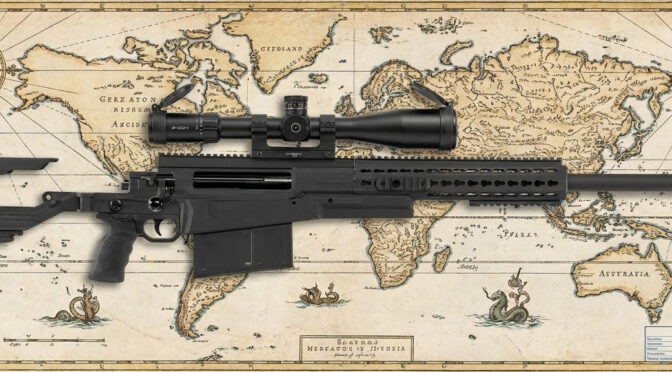
Accuracy International (AI) represents a singular entity in the defense industrial base, functioning as the progenitor of the modern tactical chassis system and the architect of the current sniper weapon system paradigm. Emerging from the United Kingdom’s competitive shooting community rather than its traditional military-industrial complex, the company fundamentally disrupted small arms design in the 1980s by decoupling the rifle action from the traditional stock, introducing the “Accuracy International Chassis System” (AICS). This innovation addressed the critical failure points of wooden-stocked legacy systems—environmental instability and lack of modularity—and established the Arctic Warfare (AW) series as the global benchmark for reliability in hostile environments.
Over four decades, AI has navigated a complex trajectory characterized by technical dominance, severe corporate instability, and strategic resurrection. The company’s history is bisected by a critical liquidation event in 2005, driven by ill-advised outsourcing strategies, which necessitated a management buyout (MBO) by the original founders. This restructuring returned the company to a vertically integrated manufacturing model, securing its quality control standards and enabling its survival. Today, AI operates a dual-hub strategy with manufacturing in Portsmouth, UK, and a significant subsidiary in Fredericksburg, Virginia, allowing it to navigate ITAR regulations and service the critical US market.
As of 2025, the company faces a rapidly evolving competitive landscape. While AI remains the incumbent choice for specialized tier-one units globally, it has faced significant setbacks in major procurement competitions, notably losing the US Special Operations Command (USSOCOM) Precision Sniper Rifle (PSR) and Advanced Sniper Rifle (ASR) contracts to Remington and Barrett, respectively. In response, AI has pivoted toward high-modularity platforms like the AXSR and the hybrid-use AT-XC, aiming to recapture market share by blending military ruggedness with the ergonomic demands of the burgeoning civilian Precision Rifle Series (PRS) market. The company’s immediate future hinges on the British Ministry of Defence’s “Project Shamer” and the continued integration of digital ballistics, as it defends its position as a premium provider against increasingly capable and lower-cost competitors.
1. Introduction: The Chassis Paradigm Shift
The history of the sniper rifle is divided into two distinct eras: the era of the “accurized” infantry rifle and the era of the purpose-built precision system. Prior to the 1980s, military doctrine largely relied on modifying standard service weapons or civilian hunting platforms for the sniping role. Rifles such as the US M40 or the British L42A1 were essentially wooden-stocked receivers, heavily reliant on traditional gunsmithing techniques like glass bedding to maintain accuracy. These platforms were susceptible to environmental shifts; moisture, temperature, and humidity caused wood to warp, exerting inconsistent pressure on the barrel and shifting the point of impact—a fatal flaw in precision engagement.1
Accuracy International was founded on the rejection of this legacy methodology. The company’s central innovation was the elimination of the stock as a structural component. Instead, AI introduced the chassis system: a rigid, machined metal backbone (initially aluminum) to which the steel action was bolted. This metal skeleton carried the mechanical loads, while the external “furniture”—the stock sides and grip—were merely polymer skins attached to the chassis. This design isolated the barrel and action from external torque and environmental stress, ensuring that the rifle retained its zero regardless of whether it was deployed in the humidity of a jungle or the freezing vacuum of the arctic.2 This engineering philosophy, born in a garden shed in West Sussex, would eventually force every major small arms manufacturer in the world to abandon traditional stocking methods in favor of the chassis capability that AI pioneered.
2. Genesis and Founding (1978–1985)
2.1 The “Three Men in a Shed”
The origins of Accuracy International are rooted in the discipline of International Sport Shooting Union (ISSU) competition rather than military logistics. The company was incorporated in 1978 by Malcolm Cooper, Dave Walls, and David Caig.1 This triad possessed a unique synergy of skills: Cooper was a world-renowned marksman, an Olympic legend who would secure back-to-back Gold Medals in the 50m Rifle 3 Positions event at the 1984 Los Angeles and 1988 Seoul Olympics.1 His partners, Walls and Caig, were expert toolmakers and fellow competitive shooters who operated out of a modest workshop—often mythologized as a garden shed—in West Sussex.2
The founders’ background in competitive shooting meant they approached rifle design with a focus on ergonomics and anatomical consistency that was absent in military hardware. In high-level competition, the interface between the shooter and the weapon is paramount. Walls and Caig began by creating replica pistols and modifying existing target rifles, but they quickly identified the limitations of converting commercial actions for high-precision work. Their dissatisfaction with existing bedding techniques led to the development of the prototype “Precision Marksman” (PM) system. This system utilized a flat-bottomed steel receiver bolted to a square-section aluminum alloy chassis, a radical departure from the cylindrical receivers and wood stocks of the era.2
2.2 The L96A1 Revolution and the 1985 Contract
In the early 1980s, the British Ministry of Defence (MoD) initiated a program to replace the L42A1, a sniper variant of the WWII-era Lee-Enfield No. 4. The L42A1 was chambered in 7.62x51mm NATO but was technologically obsolete, suffering from zero-shift due to its wooden furniture and lack of modern optical mounting solutions.6
The resulting competition was a David and Goliath scenario. The established favorite was Parker Hale, a historic British manufacturer offering the M85, a conventional, high-quality rifle that adhered to traditional design principles. Accuracy International submitted the PM. To military observers accustomed to wood and blued steel, the PM appeared alien; it featured a thumbhole stock made of green high-impact plastic, a massive boxy receiver, and a distinct lack of traditional aesthetics.3
However, the PM’s performance was undeniable. It achieved a first-round hit probability that vastly exceeded the M85. During the selection process, the MoD inspectors required a site visit to verify AI’s manufacturing capacity. Knowing their “shed” operation would disqualify them, the founders famously rented a larger workshop for a single day, populated it with all the prototype rifles they had built, and posed friends and family as staff. The ruse succeeded, demonstrating the necessary theoretical capacity.3 In 1985, AI won the contract, and the PM entered service as the L96A1.1
The L96A1 was the first “modern” sniper rifle. It featured a 60-degree bolt throw (allowing for faster cycling compared to the 90-degree Mauser standard), a 10-round detachable double-stack magazine (offering twice the capacity of most competitors), and a Schmidt & Bender 6×42 telescopic sight.4 This contract for over 1,000 rifles provided the capital and legitimacy that transformed AI from a boutique shop into a defense contractor.
3. The Arctic Warfare Era (1988–2000s)
3.1 The Swedish Contract and the Birth of “AW”
While the L96A1 was a domestic success, the company’s global reputation was forged in the frozen forests of Scandinavia. In the late 1980s, the Swedish Army sought a new sniper rifle capable of functioning in extreme cold. The L96A1, while rugged, was designed for the temperate climate of Central Europe; in deep freeze conditions, its grease could solidify, and tight clearances could bind with ice.1
AI responded by completely re-engineering the L96 platform to create the Arctic Warfare (AW). This development process introduced several critical engineering features that would define the brand:
- De-icing Bolt Design: The bolt body was milled with spiral grooves. These flutes acted as ice scrapers, shearing off frozen debris inside the receiver and providing a space for the ice to be displaced, ensuring the bolt could close and lock even when the rifle was frozen solid.1
- Enlarged Controls: The trigger guard and magazine release were significantly enlarged to allow operation by soldiers wearing thick arctic mittens.12
- Chassis Evolution: The aluminum chassis was refined for weight reduction and greater rigidity, and the polymer stock material was changed to a compound that retained durability at sub-zero temperatures.1
Sweden adopted the rifle as the PSG 90 in 1991.1 This success was quickly followed by the German Bundeswehr, which adopted the.300 Winchester Magnum variant as the G22 in 1995.10 By the late 1990s, the AW series had become the de facto standard for NATO sniper systems, purchased by over 60 nations.
3.2 The Magnum Revolution: AWM and.338 Lapua
During the mid-1990s, military ballistic requirements began to outstrip the capabilities of the standard 7.62x51mm NATO cartridge. The effective range of the 7.62mm is generally cited as 800 meters; beyond this, the bullet becomes subsonic and unpredictable. Armies needed a cartridge that bridged the gap between the antipersonnel 7.62mm and the anti-material.50 BMG (12.7mm).
The solution was the.338 Lapua Magnum, a cartridge developed (with AI’s involvement) specifically for long-range sniping. AI scaled up the AW action to handle the higher pressures and longer case length of this new round, creating the Arctic Warfare Magnum (AWM).1 The introduction of the AWM in.338 Lapua (designated L115A1 and later L115A3 in British service) fundamentally altered the tactical landscape. It extended the effective engagement range of the infantry sniper from 800 meters to over 1,500 meters.4
This capability was graphically demonstrated during the War in Afghanistan. In November 2009, British Corporal of Horse Craig Harrison, using an L115A3, engaged and neutralized two Taliban machine gunners at a confirmed distance of 2,475 meters (2,707 yards)—a world record at the time.15 This event validated the AI system not just as a rifle, but as a strategic asset capable of area denial at ranges previously reserved for artillery or air support. The data from field operations indicates that the.338 Lapua Magnum system offers nearly double the effective kinetic reach of the legacy 7.62mm platforms, a capability gap that drove the wholesale replacement of the L96A1 with the L115A3 in UK service by 2008.4
4. Corporate Turbulence: The 2005 Liquidation and Resurrection
Despite the operational ubiquity of its products, Accuracy International suffered a near-fatal corporate collapse in the mid-2000s. By 2005, the company had entered administration (liquidation).5 This paradox—a company with a full order book and a legendary product facing bankruptcy—was the result of specific strategic errors.
4.1 The Failure of Outsourcing
In the years leading up to 2005, the company’s management attempted to scale production and reduce overhead by outsourcing the machining of key components to third-party vendors. The rationale was to transform AI into an assembly and design house rather than a heavy manufacturer. This strategy failed catastrophically. The third-party vendors could not consistently maintain the micron-level tolerances required for the AI actions, leading to quality control rejections, supply chain bottlenecks, and a halt in deliveries.5 Simultaneously, the financial burden of managing these disparate supply chains, combined with rising interest expenses on corporate debt, drained the company’s liquidity.5
4.2 The Management Buyout (MBO)
The company was rescued by a consortium led by its own internal leadership. Tom Irwin (then Sales and Marketing Manager) partnered with original founder Dave Walls and Paul Bagshaw to execute a Management Buyout (MBO).5 This pivotal moment defined the modern character of the company.
Upon regaining control, the new owners immediately reversed the outsourcing strategy. They re-acquired machinery and centralized manufacturing back to the UK facility. This return to vertical integration was not merely a sentimental decision but a quality assurance necessity; it ensured that every critical dimension of the rifle was under the direct control of AI’s engineers.16 This restructuring prevented the acquisition of AI by large defense conglomerates, allowing it to remain an independent entity focused solely on precision dominance.
5. The North American Expansion: AINA
While the engineering heart of AI beats in Portsmouth, its commercial lungs are located in the United States. Recognizing the sheer scale of the US market—both civilian and government—AI established Accuracy International of North America (AINA) in 1997.18
In 2010, AINA significantly expanded its footprint by opening a facility in Fredericksburg, Virginia.19 This facility is strategically critical for two reasons. First, it allows AI to service US federal contracts that require domestic support capabilities. AINA holds active contracts with the US Secret Service, US Coast Guard, and Customs and Border Protection, ensuring these agencies have direct access to maintenance and logistical support.18 Second, the Fredericksburg facility enables compliance with various “Buy American” provisions and allows the company to navigate the complex International Traffic in Arms Regulations (ITAR) by having a localized entity that can handle sensitive technology transfers and final assembly for the US market.
6. The Modular Era (2010–2020)
Following the stabilization of the company post-2005, the technical demands of the market shifted. The Global War on Terror (GWOT) experience led US Special Operations Command (USSOCOM) to demand a new capability: modularity. Snipers required a single chassis that could be reconfigured in the field to fire different calibers (e.g., training with.308, operating with.338 Lapua) by simply swapping the barrel and bolt face.
6.1 The AX Series
In response to the US Precision Sniper Rifle (PSR) solicitation, AI developed the AX series in 2010.21 The AX represented a departure from the permanently bonded chassis of the AW.
- Multi-Caliber Architecture: The AXMC (Multi-Caliber) featured a quick-change barrel system released by a simple hex key, allowing caliber conversion in minutes.
- Modernized Interface: The smooth skins of the AW were replaced by an octagonal fore-end tube featuring the “KeySlot” mounting system (a precursor to the now-standard M-LOK), allowing for the integration of thermal optics, night vision clip-ons, and laser rangefinders.22
6.2 The AT Series
In 2014, AI consolidated its law enforcement and lower-tier lines into the AT (Accuracy Tactical). This rifle replaced the legacy AW and AE models. It retained the battle-proven 10-round double-stack magazine of the AW but incorporated the quick-change barrel technology of the AX. This effectively democratized the modular capability, allowing police agencies to train with cheaper.308 ammunition and deploy with specialized loads using the same platform.24
7. Competitive Analysis and Contract Loss
Despite the technical excellence of the AX series, the last decade has seen AI lose its monopoly on elite contracts. The company’s “over-engineered” philosophy—prioritizing absolute durability over weight and cost—has clashed with procurement trends favoring lighter, more affordable systems.
7.1 The USSOCOM Defeats
AI suffered two high-profile defeats in the US market.
- Precision Sniper Rifle (PSR): In 2013, the Remington MSR (Modular Sniper Rifle) beat the AI AX series for the PSR contract. Although the MSR later suffered from reliability and QC issues leading to its early retirement, the loss was a significant blow to AI’s prestige.26
- Advanced Sniper Rifle (ASR): Following the failure of the Remington MSR, USSOCOM launched the ASR program. AI submitted the AXSR, but in 2019, the contract was awarded to the Barrett MRAD Mk22.28 The Barrett platform offered a similar multi-caliber capability but benefited from Barrett’s massive domestic manufacturing capacity and a price point that was generally more aggressive than the imported AI alternative.
7.2 The French FPSA Contract
In Europe, AI faced stiff competition from Sako (Finland). The French Army’s FPSA (Fusil de Précision Semi-Automatique) program aimed to replace the FR-F2. While the semi-automatic portion was won by FN Herstal (SCAR-H PR), the bolt-action requirements in Europe have increasingly been filled by the Sako TRG M10, which directly rivals the AXSR in modularity and price.30 The Sako TRG M10 is widely perceived as a comparable system to the AI AXSR but often comes in at a lower cost, making it attractive to European ministries of defense facing budget constraints.
8. Current Activities and Product Portfolio (2024–2025)
As of 2025, Accuracy International has streamlined its product offerings to address the dichotomy between “Professional” (Mil/LE) and “Sporting” (Civilian Competition) users.
8.1 The AXSR: The Flagship
Despite the ASR loss, the AXSR remains the company’s premier offering. It is a dedicated long-action system capable of managing the potent.300 and.338 Norma Magnum cartridges, which are rapidly replacing the.338 Lapua in special operations use due to their superior ballistic coefficients. The AXSR features an integrated ARCA rail (a standard borrowed from the photography world) for tripod stability, reflecting the influence of civilian competition techniques on military hardware.32
8.2 The AT-XC: Bridging the Gap
In 2024, AI launched the AT-XC, a “cross-over” rifle designed to replace both the AT and the AX308.34
- Market Strategy: The AT-XC is explicitly designed to capitalize on the explosion of the Precision Rifle Series (PRS) in the United States. PRS competitions demand rifles that are heavy (to absorb recoil), perfectly balanced for barricade shooting, and capable of rapid fire.
- Technical Features: The AT-XC features a redesigned action with a lower bore axis and a more vertical grip angle, optimizing it for the positional shooting style dominant in modern competition. By offering a “Pro” version for civilians and a “Mil” version for agencies, AI is attempting to regain the “Sunday win, Monday sale” dynamic.35
8.3 The AX50 ELR
For the anti-material role, the AX50 ELR continues the lineage of the AW50. Updated to share the ergonomics and chassis modularity of the AXSR, it provides.50 BMG capability for vehicle interdiction and explosive ordnance disposal (EOD) applications.21
9. Future Outlook
9.1 Project Shamer: The British Replacement
The most immediate strategic opportunity for AI is the British Army’s “Project Shamer” (formerly linked to Project Hunter/Grayburn initiatives), which seeks a replacement for the aging L115A3 fleet.38 As the incumbent, AI is well-positioned, but the requirements for this program will likely demand significant integration with next-generation digital optics and signature management (thermal/IR reduction). The outcome of this tender in the 2025–2027 timeframe will be a bellwether for AI’s standing in its home market.
9.2 The Digital Horizon
The future of sniping lies in the fusion of ballistics and optoelectronics. Programs like the US Army’s NGSW-FC (Next Generation Squad Weapon – Fire Control) are introducing smart scopes that calculate aim points automatically. AI’s future platform development must focus on ensuring their chassis systems can power and integrate these devices—turning the rifle from a mechanical projectile launcher into a networked data node. The presence of M-LOK and KeySlot on current models is the first step, but powered rails and integrated data ports may be the necessary evolution for the AXSR platform to remain relevant in the 2030s.
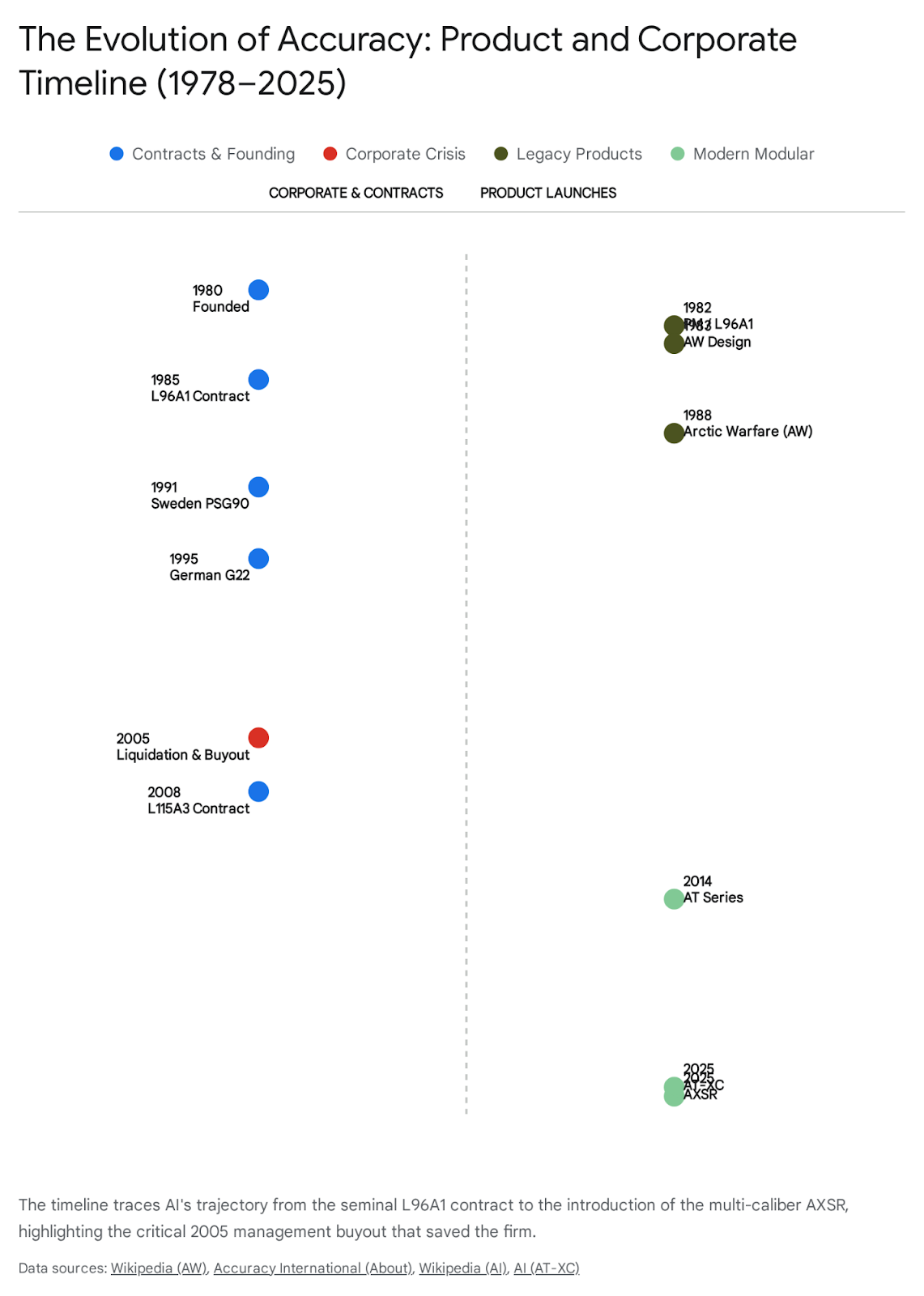
10. Summary of Major Milestones
| Year | Milestone | Context & Significance |
| 1978 | Company Founded | Established by Malcolm Cooper, Dave Walls, and David Caig in Sussex, UK.1 |
| 1982 | PM Prototype | The “Precision Marksman” is created, pioneering the chassis system.1 |
| 1985 | L96A1 Adoption | AI wins the UK MoD contract, beating Parker Hale and entering mass production.10 |
| 1988 | Arctic Warfare (AW) | The L96 is redesigned for the Swedish Army, introducing de-icing features.1 |
| 1991 | PSG 90 Adoption | Sweden adopts the AW as the PSG 90, securing AI’s first major export win.10 |
| 1995 | G22 Adoption | The German Bundeswehr adopts the AWM-F (.300 Win Mag) as the G22.10 |
| 1996 | .338 AWM Launch | Introduction of the.338 Lapua Magnum variant, revolutionizing long-range reach.14 |
| 1997 | AINA Founded | Accuracy International of North America established to service the US market.18 |
| 2005 | Liquidation & MBO | Company enters administration; saved by Walls, Irwin, and Bagshaw via management buyout.5 |
| 2008 | L115A3 Adoption | UK MoD fully transitions to the.338 AWM (L115A3) for all sniper roles.10 |
| 2010 | AX Series Launch | Introduction of the modular AX chassis to compete for the US PSR contract.21 |
| 2013 | PSR Loss | AI loses the USSOCOM Precision Sniper Rifle contract to Remington.27 |
| 2014 | AT Series Launch | The AT replaces the AW/AE, bringing quick-change barrels to the LE market.24 |
| 2019 | ASR Loss | AI loses the USSOCOM Advanced Sniper Rifle contract to the Barrett MRAD.28 |
| 2024 | AT-XC Launch | Launch of the hybrid Sport/Mil AT-XC, replacing the AT and AX308.34 |
| 2025 | Project Shamer | AI positions itself for the UK MoD’s next-generation sniper rifle competition.38 |
If you find this post useful, please share the link on Facebook, with your friends, etc. Your support is much appreciated and if you have any feedback, please email me at in**@*********ps.com. Please note that for links to other websites, we are only paid if there is an affiliate program such as Avantlink, Impact, Amazon and eBay and only if you purchase something. If you’d like to directly contribute towards our continued reporting, please visit our funding page.
Works cited
- Accuracy International Arctic Warfare – Wikipedia, accessed December 21, 2025, https://en.wikipedia.org/wiki/Accuracy_International_Arctic_Warfare
- Accuracy International Early History – Target and F-Class – UK Varminting, accessed December 21, 2025, https://ukvarminting.com/topic/62773-accuracy-international-early-history/
- How Three Men In A Shed Revolutionised Rifles – Bell Bros, accessed December 21, 2025, https://www.bellbrosguns.co.uk/how-three-men-in-a-shed-revolutionised-rifles/
- Accuracy International Arctic Warfare – Weapon Systems, accessed December 21, 2025, https://old.weaponsystems.net/weaponsystem/AA05%20-%20AW.html
- Accuracy International – Wikipedia, accessed December 21, 2025, https://en.wikipedia.org/wiki/Accuracy_International
- The man who fooled the army | The history and development of the L96A1 – YouTube, accessed December 21, 2025, https://www.youtube.com/watch?v=dzZE7JNI1ws
- Accuracy International Arctic Warfare – Gun Wiki | Fandom, accessed December 21, 2025, https://guns.fandom.com/wiki/Accuracy_International_Arctic_Warfare
- Viewpoint – British Army Contract for L96A1 Sniper Rifle (by Gil Boyd B.E.M) – Milsurps, accessed December 21, 2025, https://www.milsurps.com/showthread.php?t=47085
- How three guys in a shed sold thousands of L96A1 sniper rifles to the British Army – Reddit, accessed December 21, 2025, https://www.reddit.com/r/videos/comments/mai652/how_three_guys_in_a_shed_sold_thousands_of_l96a1/
- Over 40 years at the front – Accuracy International, accessed December 21, 2025, https://www.accuracyinternational.com/about-us
- POTD: Accuracy International Arctic Warfare | thefirearmblog.com, accessed December 21, 2025, https://www.thefirearmblog.com/blog/2020/07/08/potd-accuracy-international-arctic-warfare/
- Accuracy International Arctic Warfare – Grokipedia, accessed December 21, 2025, https://grokipedia.com/page/Accuracy_International_Arctic_Warfare
- New sniper rifles from the UK: Accuracy International AX MKIII and AX 50 ELR | all4shooters, accessed December 21, 2025, https://www.all4shooters.com/en/shooting/pro-zone/accuracy-international-ax-mkiii-and-ax-50-elr-sniper-features/
- Accuracy International AWM – Wikipedia, accessed December 21, 2025, https://en.wikipedia.org/wiki/Accuracy_International_AWM
- Arctic Warfare Magnum: Accuracy International L115A3 – YouTube, accessed December 21, 2025, https://www.youtube.com/watch?v=V3IylFIyZss
- Accuracy International – Small Arms Defense Journal, accessed December 21, 2025, https://sadefensejournal.com/accuracy-international/
- GAO-08-885, Private Equity: Recent Growth in Leveraged Buyouts Exposed Risks That Warrant Continued Attention, accessed December 21, 2025, https://www.gao.gov/assets/a280152.html
- Accuracy International Of North America – HigherGov, accessed December 21, 2025, https://www.highergov.com/awardee/accuracy-international-of-north-america-inc-10405556/
- Accuracy International Announcement: | Sniper’s Hide Forum, accessed December 21, 2025, https://www.snipershide.com/shooting/threads/accuracy-international-announcement.15600/
- ACCURACY INTERNATIONAL OF NORTH AMERICA, INC. | Federal Award Recipient Profile | USAspending, accessed December 21, 2025, https://www.usaspending.gov/recipient/c69d7bbe-1b74-ff86-6c97-c7c996616ffd-C/latest
- Accuracy International AX50 – Wikipedia, accessed December 21, 2025, https://en.wikipedia.org/wiki/Accuracy_International_AX50
- ACCURACY INTERNATIONAL – 365+ Tactical Equipment, accessed December 21, 2025, https://www.365-plus.com/data/file/free-catalogue/AI%20brochure-upf4.pdf
- Rifle Accuracy International LTD AXMC (338 Lap.mag.) – Memo-randum.net, accessed December 21, 2025, https://memo-randum.net/katalog/ognestrelnoe-oruzhie/karabiny/vintovka-accuracy-international-ltd-axmc-338-lap-mag-/
- accessed December 21, 2025, https://en.wikipedia.org/wiki/Accuracy_International_Arctic_Warfare#:~:text=In%202014%2C%20Accuracy%20International%20introduced,enforcement%20and%20civilian%20clients%20worldwide.
- Accuracy International models explained | Sniper’s Hide Forum, accessed December 21, 2025, https://www.snipershide.com/shooting/threads/accuracy-international-models-explained.7028851/
- Meet the World’s Top Five Sniper Rifles – The National Interest, accessed December 21, 2025, https://nationalinterest.org/blog/reboot/meet-worlds-top-five-sniper-rifles-199360
- Remington Wins USSOCOM PSR (Precision Sniper Rifle) Contact | thefirearmblog.com, accessed December 21, 2025, https://www.thefirearmblog.com/blog/2013/09/13/remington-wins-ussocom-psr-precision-sniper-rifle-contact/
- Barrett® Awarded USSOCOM ASR Contract, accessed December 21, 2025, https://barrett.net/2019/04/05/barrett-awarded-ussocom-asr-contract/
- Barrett To Deliver First Advanced Sniper Rifles to US SOCOM in Early 2021, accessed December 21, 2025, https://www.thefirearmblog.com/blog/2020/12/23/barrett-receives-first-mk22-delivery-order-from-ussocom/
- Accuracy International Vs TRG | Sniper’s Hide Forum, accessed December 21, 2025, https://www.snipershide.com/shooting/threads/accuracy-international-vs-trg.7132762/
- France Selects FN SCAR-H Precision Rifle | Joint Forces News, accessed December 21, 2025, https://www.joint-forces.com/defence-equipment-news/28702-france-selects-fn-scar-h-precision-rifle
- AXSR Mil long action professional multi cal. sniper rifle – Accuracy International, accessed December 21, 2025, https://www.accuracyinternational.com/axsr-mil
- Accuracy International AXSR precision bolt-action rifle in .338 Lapua Magnum – The upper class | all4shooters, accessed December 21, 2025, https://www.all4shooters.com/en/shooting/rifles/accuracy-international-axsr-multi-caliber-bolt-action-rifle-338-lm-test-report/
- Accuracy International New Product Information 2024 – EDR Magazine, accessed December 21, 2025, https://www.edrmagazine.eu/accuracy-international-new-product-information-2024
- AT-XC short action, low profile competition rifles – Accuracy International, accessed December 21, 2025, https://www.accuracyinternational.com/at-xc-sport
- Accuracy International Intros New AT-X Platform for 2024 – Small Arms Review, accessed December 21, 2025, https://smallarmsreview.com/accuracy-international-intros-new-at-x-platform-for-2024/
- Accuracy International Announce New Products for 2024 | Joint Forces News, accessed December 21, 2025, https://www.joint-forces.com/defence-equipment-news/70554-accuracy-international-announce-new-products-for-2024
- MISSILE, ARTILLERY, HYPERSONICS, BALLISTICS AND SOLDIER SYSTEMS UPDATE, accessed December 21, 2025, https://battle-updates.com/update/missile-artillery-hypersonics-ballistics-and-soldier-systems-update-125/
- UK minister cites “operational security” for sniper rifle query snub – Army Technology, accessed December 21, 2025, https://www.army-technology.com/news/uk-minister-cites-operational-security-for-sniper-rifle-query-snub/