Published: January 6, 2026
| This is a time-sensitive special report and is based on information available as of January 6, 2026. Due to the situation being very dynamic the following report should be used to obtain a perspective but not viewed as an absolute. |
1. Executive Summary: The Physics of State Decapitation
The Venezuelan state system, as of January 2026, has entered a phase of non-linear disequilibrium characterized by the rupture of its primary homeostatic control mechanism: the centralized executive authority of the Chavista hegemony. The United States military operation “Absolute Resolve,” executed on January 3, 2026, which resulted in the targeted extraction of President Nicolás Maduro and First Lady Cilia Flores, has not merely removed a political leader; it has shattered the “Super-Warden” node that arbitrated the complex, competitive equilibrium between the military, criminal syndicates, and ideological factions.
This report employs a rigorous Systems-Dynamic Framework to model the trajectory of the Venezuelan state over the next 36 months (2026–2029). By treating the state not as a static bureaucracy but as a complex adaptive system defined by stocks (legitimacy, oil revenue, infrastructure capacity) and flows (migration, capital flight, violence), we project a trajectory that deviates significantly from the optimistic “democratic transition” narratives prevalent in Washington policy circles.
The central finding of this analysis is that the removal of the apex leader does not dismantle the underlying autopoietic structure of the regime. Instead, it removes the central dampening mechanism for centrifugal forces, accelerating the system toward a state of “Fragmented Warlordism” (Scenario B, 65% Probability). While the “Trump Plan” to utilize US oil majors for reconstruction introduces a theoretical stabilizing inflow of capital, the system’s physical and legal constraints—specifically the degradation of heavy crude upgraders, the $150 billion debt overhang, and the entrenchment of the Tren de Aragua—create massive frictional resistance.
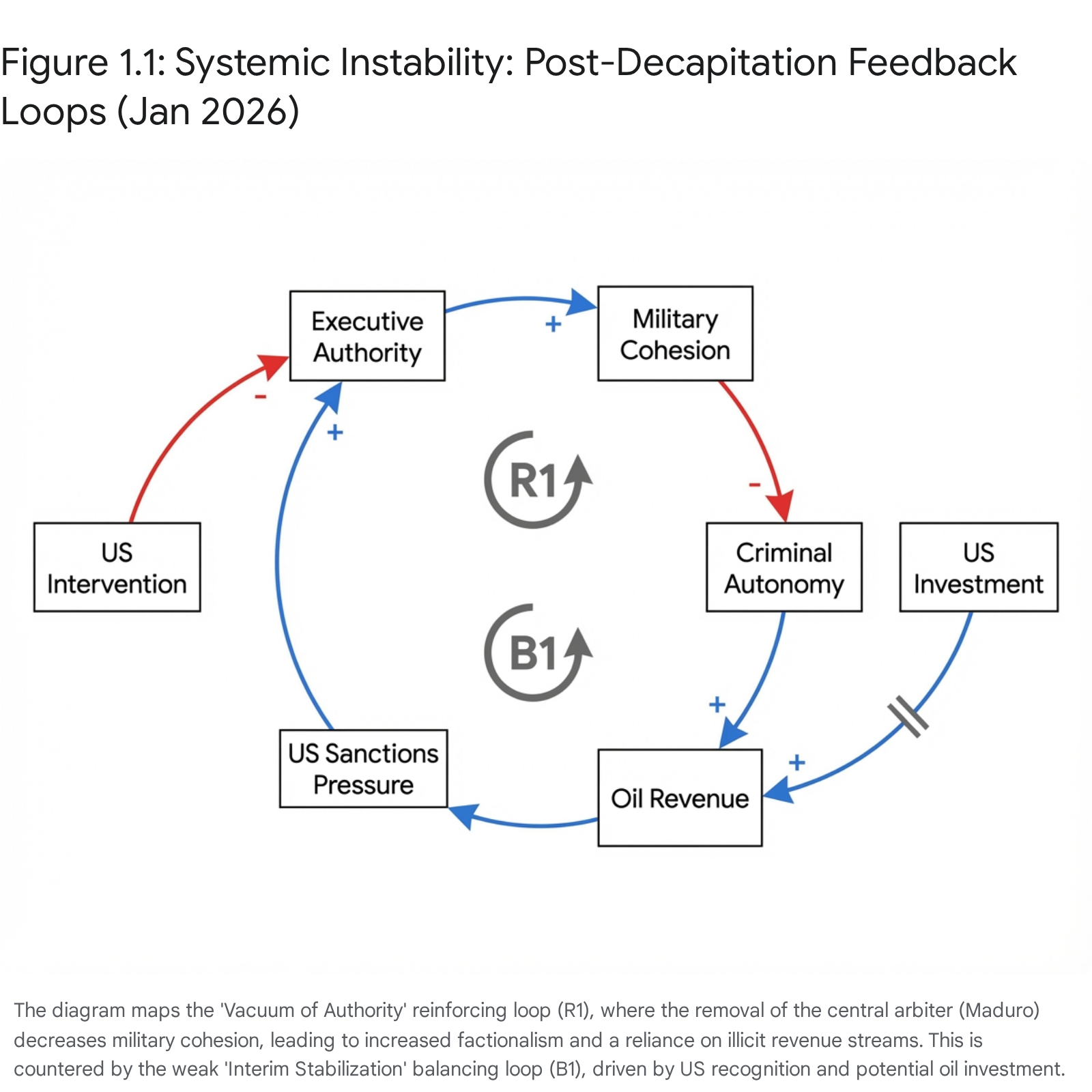
The system is currently dominated by a reinforcing feedback loop of instability (R1), where the vacuum of central authority incentivizes the commodification of violence by the Bolivarian National Armed Forces (FANB) and non-state actors. Without a massive, sustained exogenous injection of capital and security—exceeding current US commitments—the model predicts a fracturing of the state into semi-autonomous criminal fiefdoms by Q4 2027.
2. System Initial Conditions: The “Absolute Resolve” Inflection Point
2.1 The Operational Shock and the “Authority Vacuum”
The trajectory of the Venezuelan state cannot be accurately modeled without a precise accounting of the kinetic energy introduced into the system by Operation Absolute Resolve.1 This was not a standard diplomatic pressure campaign but a high-intensity military shock. On January 3, 2026, the United States deployed over 150 aircraft to conduct precision strikes across northern Venezuela, targeting air defense systems, command and control nodes, and the Ft. Tiuna military installation.2
The operation resulted in significant systemic disruption. Venezuelan officials reported over 80 casualties, including 32 Cuban military and intelligence personnel.3 This specific targeting of the Cuban apparatus is a critical system variable; for two decades, Cuban counterintelligence served as the “nervous system” of the Maduro regime, monitoring loyalty and preventing coups. Its degradation creates an immediate “blindness” within the remaining regime structure, making internal coordination exponentially more difficult.
The extraction of Nicolás Maduro and Cilia Flores created an immediate “Authority Vacuum.” In systems terms, Maduro was not merely a head of state but the “Key Administrator” of the complex web of patronage that kept the military and criminal syndicates in alignment. His removal releases these constituent elements to pursue localized Nash equilibriums—optimizing for their own survival rather than the stability of the central state. The result is an immediate oscillation of power, where orders are issued by the interim government but execution is contingent on the idiosyncratic calculations of local commanders.4
2.2 The “Dual-Executive” Dilemma
The system currently suffers from a “Dual-Executive” dissonance that paralyzes decision-making.
- The De Facto Interim Executive: Delcy Rodríguez, the former Vice President, has assumed the presidency.5 Her authority is derived from the remnants of the 1999 Constitution and the acquiescence of the Padrino López military faction. However, her legitimacy is severely compromised by her previous role as a core pillar of the Maduro autocracy and her precarious need to appease the United States to avoid her own prosecution.
- The Neo-Trusteeship Executive: The US administration, led by President Donald Trump, has asserted a form of neo-trusteeship, claiming the US will “run” Venezuela temporarily until a transition is managed.7 This claim, devoid of clear international legal standing, acts as a “System Override” signal. It emboldens US-aligned actors but triggers a fierce nationalist immune response from the deep state and the populace, complicating any collaborative governance.8
This duality creates a chaotic signal environment. Bureaucrats, military officers, and oil executives are receiving conflicting directives: one set prioritizing national sovereignty and resistance (from the hardline Chavista base), and another prioritizing compliance with US dictates to secure amnesty and investment (from the Rodríguez/US channel).
3. The Political Subsystem: Governance and Legitimacy Dynamics
3.1 The Rodríguez Interregnum: Balancing on the Razor’s Edge
The political subsystem is currently defined by the “Rodríguez Pivot.” Delcy Rodríguez is attempting to execute a maneuver with a historically high failure rate: transitioning from a pariah regime deputy to a US-approved transitional leader while retaining the loyalty of the revolutionary base. Her survival depends on balancing two opposing feedback loops.
The Appeasement Loop (External)
Rodríguez has signaled a willingness to “collaborate” with the Trump administration, dialing down anti-imperialist rhetoric to avoid the “very big price” threatened by the US President.6 This loop is driven by personal survival. To maintain this loop, she must deliver tangible results to Washington: specifically, the extradition of other high-value targets (potential rivals) and the total opening of the oil sector to US firms. However, every step in this direction weakens her position in the internal loyalty loop.
The Loyalty Loop (Internal)
The PSUV (United Socialist Party of Venezuela) and the FANB are built on a foundational mythos of anti-American resistance. Rodríguez’s collaboration is viewed by the colectivos (armed pro-government gangs) and ideological hardliners as a betrayal.3 The system predicts that as she moves closer to the US position to release sanctions pressure, the risk of an internal coup or assassination by hardliners increases exponentially. The “Loyalty Stock” is depleting rapidly, and without Maduro’s personal connection to the rank-and-file, Rodríguez lacks the charisma to replenish it.
3.2 The Marginalization of the Democratic Opposition
A counter-intuitive finding of this systems analysis is the structural marginalization of the democratic opposition, despite the removal of their primary antagonist. María Corina Machado, the Nobel Peace Prize laureate and undisputed leader of the opposition electorate, finds herself in a “Success to the Successful” trap where the US administration has bypassed her in favor of a pragmatic deal with the existing regime structure.10
The US administration’s calculation appears to be that the Chavista state apparatus is too deeply entrenched to be dismantled by an outsider like Machado without triggering a civil war. Therefore, they have opted for a “decapitation and co-optation” strategy—removing the head but keeping the body (Rodríguez) to maintain order.12 This leaves Machado and her proxy, Edmundo González Urrutia, with high moral legitimacy but zero operational control.
Machado’s rejection of Rodríguez 13 places the opposition outside the primary decision-making loop. Unless the opposition can mobilize mass street protests that threaten the stability of the Rodríguez interregnum—a high-risk strategy given the potential for violence from colectivos—their influence on the system’s state variables will remain low in the short term (Q1-Q2 2026). The risk here is political radicalization; finding themselves shut out by both the regime and their supposed US allies, elements of the opposition may turn to disruptive tactics, further destabilizing the system.
4. The Economic-Energy Subsystem: The Inertia of Decay
4.1 The “Trump Plan” vs. Physical Reality
The core stabilizing mechanism proposed by the US administration—the “Trump Plan”—relies on the premise that US oil majors (Chevron, ExxonMobil, ConocoPhillips) will rapidly recapitalize the Venezuelan energy sector, utilizing future oil revenues to reimburse costs and stabilize the economy.14 However, a detailed audit of the “Stock of Infrastructure” reveals that this plan faces massive physical and temporal friction.
The State of Degradation
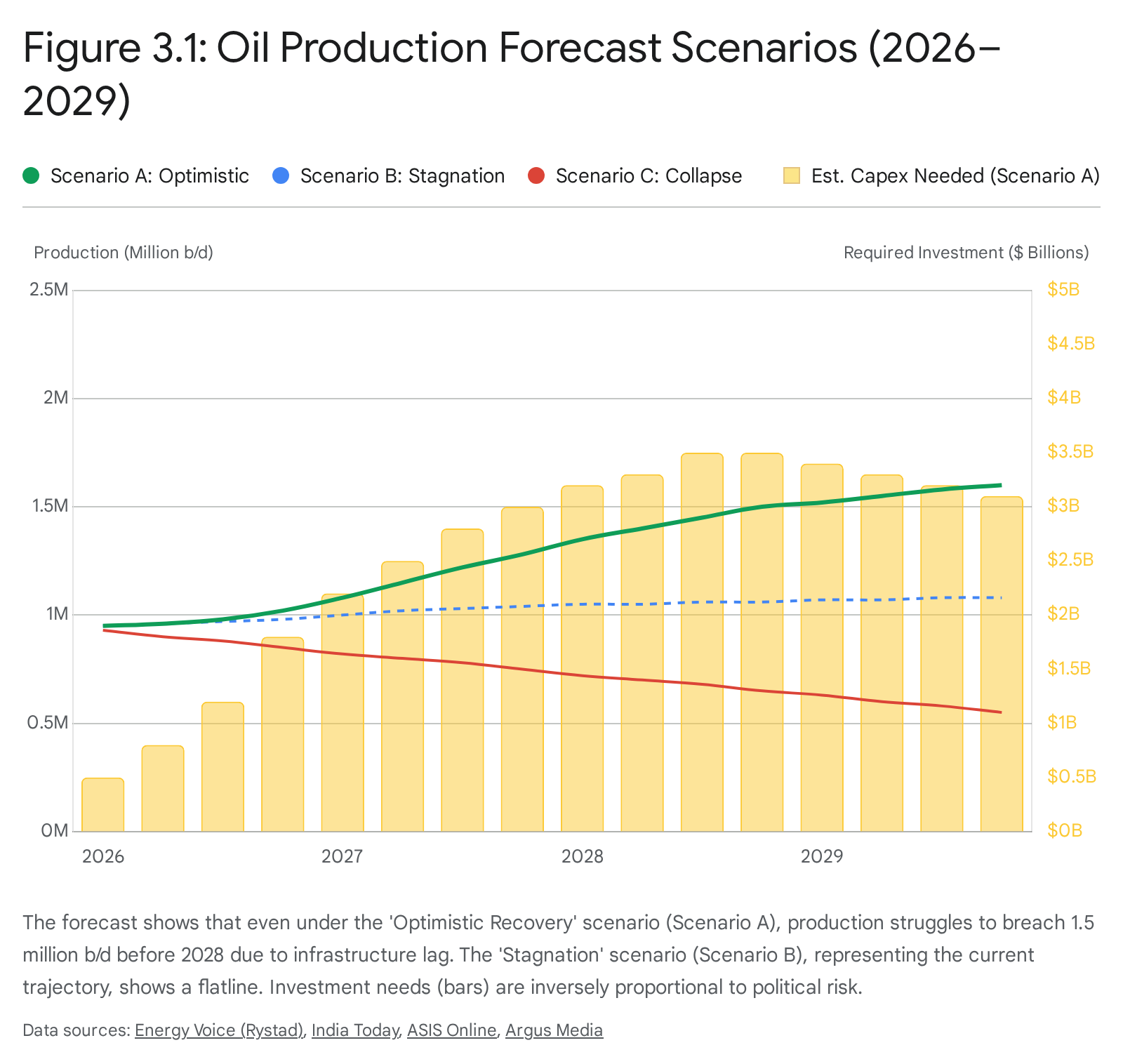
The Venezuelan oil industry is in a state of advanced entropy. Production has collapsed from a peak of 3.5 million b/d in the late 1990s to approximately 934,000 b/d in late 2025.16 This decline is not merely a function of policy but of physical corrosion.
- The Pipeline Crisis: The transport network, consisting of 25 operational pipelines, has not seen significant upgrades in 50 years. It suffers from daily spills and catastrophic integrity failures.18 Moving increased volumes through this vascular system without massive prior repairs invites environmental disaster and operational stoppages.
- The Upgrader Bottleneck: Venezuela’s reserves are primarily extra-heavy crude from the Orinoco Belt, which resembles asphalt. To be exportable, this crude must be processed in massive “upgraders” or blended with imported diluents.17 Most of these upgraders are currently offline or operating at a fraction of capacity due to a lack of spare parts and maintenance. Restarting them is not a matter of turning a key; it requires a complex industrial commissioning process that takes 12-18 months.
The Investment Gap
Industry analysts estimate that restoring production to 3 million b/d would require an investment of approximately $183 billion over 15 years.20 To simply arrest the decline and hold production flat requires $53 billion. The “Trump Plan” suggests US companies will front this capital. However, ExxonMobil and ConocoPhillips have outstanding arbitration claims against Venezuela totaling billions from previous expropriations.21 It is highly improbable that boards of directors will authorize new billions in capital expenditure without a settled legal framework and the resolution of past debts.
4.2 The Debt Trap and Creditor Dynamics
The economic subsystem is heavily constrained by the “Debt Stock,” estimated between $150 billion and $170 billion.21 This creates a powerful Balancing Loop (B2): Any increase in oil revenue immediately triggers claims from a diverse array of creditors, draining the capital available for reinvestment or social spending.
This debt structure functions as a “poison pill” for the recovery:
- Bondholders: Approximately $60 billion is owed to bondholders who have been unpaid since the 2017 default.23
- Arbitration Awards: Billions are owed to companies like Crystallex and ConocoPhillips, who have legal judgments allowing them to seize Venezuelan assets abroad (e.g., Citgo).
- China’s Leverage: China is owed approximately $12 billion and is the main buyer of Venezuelan crude.19 This debt is serviced through oil-for-loan swaps. If the US redirects Venezuelan oil exports to the Gulf Coast to feed US refineries, China loses its repayment mechanism. This creates a geopolitical flashpoint; Beijing could retaliate by halting maintenance on the Chinese-built infrastructure that underpins much of Venezuela’s current grid or by exercising diplomatic vetoes at the UN.25
4.3 The Legal Quagmire
Restructuring this debt is a prerequisite for large-scale capital entry, but the process is historically slow. The “odious debt” argument (that the debt was incurred by a corrupt regime) creates legal uncertainty. A comprehensive restructuring would likely take 18-24 months, during which time Venezuela would remain locked out of international capital markets.24 Consequently, the “petro-state” recovery engine will remain stalled in neutral for the first half of the forecast period (2026–2027).
5. The Security Subsystem: Fragmented Sovereignty and Warlordism
5.1 The Loyalty Metrics of the FANB
The Bolivarian National Armed Forces (FANB) are not a monolithic professional military but a conglomerate of interest groups held together by a system of patronage, mutual surveillance, and shared criminal liability. The removal of Maduro disrupts this cohesion, leading to a “loyalty liquidity crisis.”
The “Loyalty Stock” was previously maintained through the distribution of illicit rents. With Maduro gone and the US scrutinizing financial flows, the incentive structure fractures.
- The Upper Echelon (The Generalato): This group, particularly the Generals and Admirals, is heavily implicated in the Cartel of the Suns (drug trafficking) and human rights abuses.26 Their dominant strategy is survival. They face a prisoner’s dilemma: defect to the US early in exchange for leniency, or entrench and fight to protect their assets. The US designation of the Tren de Aragua and other groups as FTOs signals a hardline approach that may back the Generalato into a corner, making them “spoilers” who have no path to a dignified exit.
- The Mid-Level Officers: Facing economic hardship and demoralization, with many earning poverty wages 28, this stratum is susceptible to bribery or mutiny. However, without a clear alternative leader (since Machado is sidelined), their dissatisfaction is likely to manifest as desertion rather than a coordinated coup.
- The Lower Ranks: Often malnourished and ill-equipped 28, the rank-and-file are the most volatile element. High desertion rates are expected, with many former soldiers likely to sell their skills to criminal syndicates for survival.
5.2 The Rise of Criminal Governance
As the state’s central authority recedes, a phenomenon of “Fragmented Sovereignty” emerges. The state no longer holds a monopoly on violence; instead, it competes with powerful non-state actors who control territory and populations.
The Tren de Aragua (TdA) as a Proto-State
The Tren de Aragua has evolved from a prison gang into a transnational criminal organization with a footprint extending to the US.29 The US government’s designation of TdA as a Foreign Terrorist Organization (FTO) and a Transnational Criminal Organization (TCO) 30 fundamentally alters the conflict landscape. This is no longer a law enforcement issue; it is a counter-terrorism conflict. TdA controls local economies, extorts businesses, and manages migration routes. In the absence of a strong central state, TdA is likely to deepen its territorial control, effectively governing barrios and border towns, providing “security” and social services in exchange for loyalty—a classic warlord model.
The Mining Arc (Arco Minero)
In the resource-rich south (Bolívar and Amazonas states), gold mining is controlled by a toxic mix of military units (operating autonomously), ELN guerrillas, and criminal syndicates.32 This region operates almost independently of Caracas, functioning as a “state within a state.” The illicit gold trade generates an estimated $2-3 billion annually, funds that bypass the national treasury and sustain these armed groups.33 With the central government distracted by the transition in Caracas, these groups will consolidate their hold, creating “no-go zones” for the US-backed administration.
5.3 System Leakage: The Resource Diversion
A critical system failure is the diversion of national resources away from state recovery and into the hands of these non-state actors and creditors. The flow of value in the Venezuelan system is currently bifurcated:
- Legitimate Flows: Oil revenues are heavily encumbered by debt service to China and bondholders. What little remains is often absorbed by corruption or the opaque financial structures of the “Anti-Blockade Law.”
- Illicit Flows: The wealth generated from the Mining Arc (gold, coltan) and the drug trade flows directly to criminal syndicates (TdA, ELN) and corrupt military factions. This capital does not contribute to national reconstruction; instead, it finances the very groups that undermine state authority.
This dynamic creates a “Resource Drain” where the state is starved of the capital needed to rebuild its institutions, while its internal enemies are well-funded and resilient.
6. The Geopolitical Subsystem: Regional and Global Pressures
6.1 The “Neighborhood Effect”: Colombia and Brazil
The US intervention has generated acute anxiety and instability in Venezuela’s immediate neighbors, creating a “Geopolitical Bounding Box” that constrains the new government.
Colombia: The Risk of Spillover
Colombia, under President Gustavo Petro, has taken a highly confrontational stance. Petro has threatened to “take up arms again” if the US intervenes in Colombia, viewing the attack on Maduro as a prelude to a broader imperialist campaign.34 This is not merely rhetoric; Colombia has deployed 30,000 troops to the border.35
- The Insurgency Risk: The border region is a sanctuary for Colombian armed groups like the ELN and FARC dissidents (Segunda Marquetalia). These groups have historically enjoyed safe haven in Venezuela. A hostile relationship between Bogotá and the US-backed Caracas government could lead Petro to turn a blind eye to these groups using Colombian territory to launch attacks into Venezuela, destabilizing the Rodríguez regime.
- Diplomatic Isolation: Colombia’s refusal to recognize the legitimacy of the US intervention complicates logistics for humanitarian aid and diplomatic normalization.
Brazil: The Containment Strategy
President Lula da Silva has condemned the US action as crossing an “unacceptable line”.36 Brazil’s primary concern is the destabilization of the Amazon region and a new wave of refugees. Brazil is likely to pursue a policy of “containment,” reinforcing its borders and seeking to insulate itself from the Venezuelan chaos rather than actively engaging in reconstruction.
6.2 The Great Power Proxy War
While Russia and China have shown “calculated restraint” militarily, avoiding a direct confrontation with the US 37, they serve as powerful asymmetric balancers.
- Asymmetric Response: Russia may utilize its remaining intelligence assets and cyber capabilities to disrupt US operations or support anti-US insurgent factions. The goal would be to mire the US in a “quagmire” that drains American resources and political capital.
- Financial Warfare: China’s leverage as a major creditor is significant. By demanding strict adherence to debt repayment schedules or utilizing lawfare to seize assets, Beijing can effectively block the financial rehabilitation of the Venezuelan state.25 This “debt weaponization” can strangle the interim government’s liquidity, preventing it from delivering the social goods necessary to quell unrest.
6.3 International Law and Legitimacy
The intervention faces a severe legitimacy deficit at the United Nations. The Security Council meeting on January 5, 2026, highlighted the deep divisions, with the Secretary-General warning of a “dangerous precedent”.38 This lack of international consensus means that the US-led reconstruction effort will lack the imprimatur of the UN, complicating the involvement of international financial institutions (IMF, World Bank) and European allies who are wary of endorsing “regime change by force.”
7. The Social Subsystem: Humanitarian Crisis and Migration
7.1 The Humanitarian Baseline
The social fabric of Venezuela is tattered. The ENCOVI survey data indicates that multidimensional poverty remains high, with significant portions of the population suffering from food insecurity and a collapse of public services.40 The humanitarian need is quantified at 7.9 million people requiring urgent assistance.42
7.2 The “Expectation Shock” and Migration
The social subsystem is currently driven by a volatile variable: Public Expectation. The US intervention has generated a surge of hope among some sectors of the population that “rescue” has arrived. However, the structural lags described in Section 4 mean that material conditions (electricity, water, food prices) will not improve immediately—and may arguably worsen in the short term due to transition chaos.
When the “Trump Plan” fails to deliver instant prosperity in Q2 2026, this “Expectation Shock” is likely to transmute into despair and anger. The result will be a reactivation of the Migration Pump.
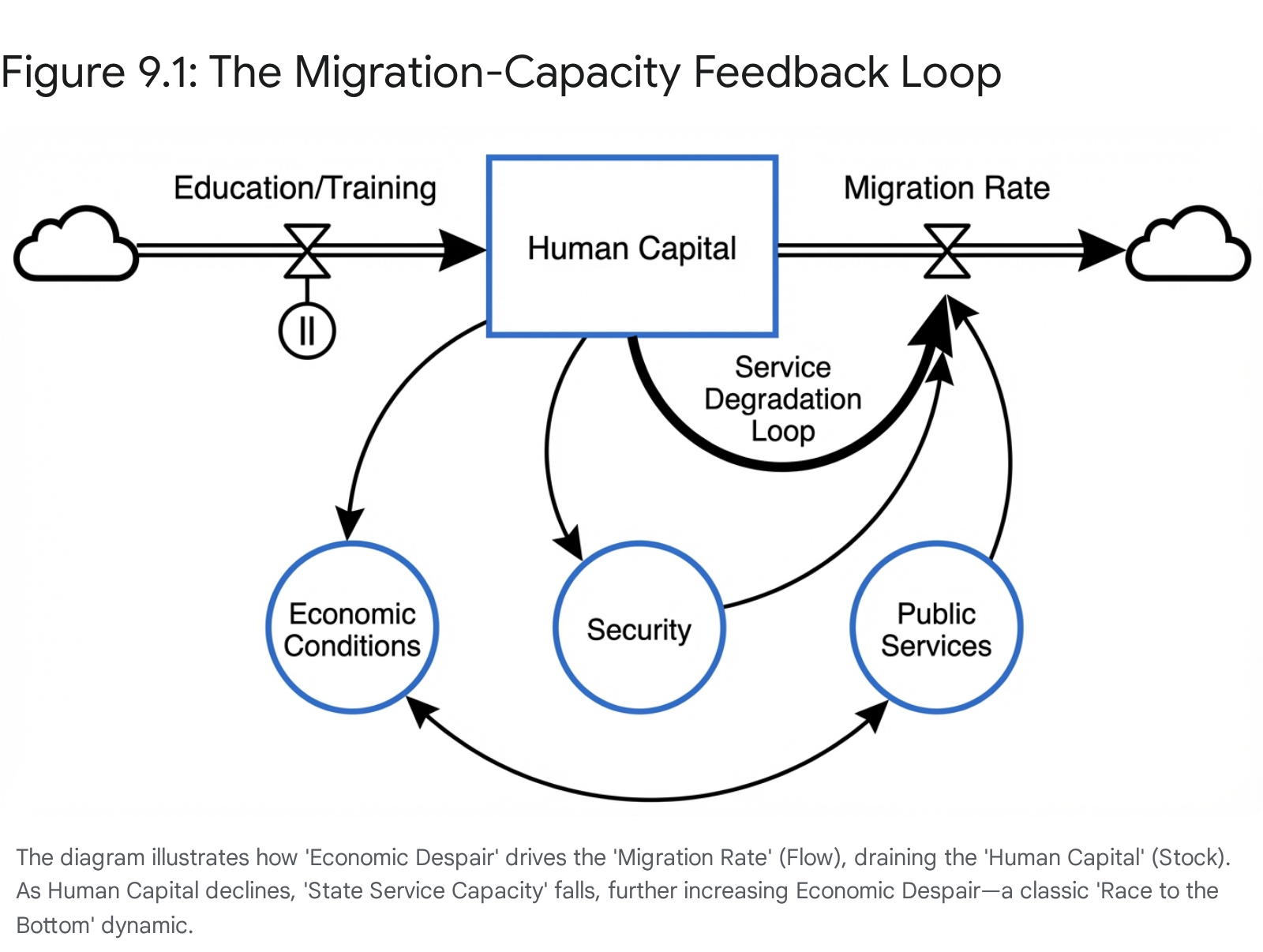
- The Mechanism: Economic despair drives migration -> Loss of human capital (doctors, engineers, teachers) -> Further degradation of state services -> Increased despair.
- The Forecast: We project a renewed outflow of 1-2 million Venezuelans over the next 24 months, straining the already saturated capacities of Colombia, Brazil, and the US border. This creates a feedback loop where the loss of “human infrastructure” makes the physical reconstruction of the state impossible, creating a “Poverty Trap.”
8. Dynamic Modeling: 36-Month Forecast Scenarios (2026–2029)
Based on the complex interaction of the political, economic, security, and geopolitical subsystems, we present three probabilistic scenarios for the Venezuelan state trajectory.
Scenario A: The “Petro-State Restoration” (Probability: 15%)
- Mechanism: Delcy Rodríguez successfully transitions the PSUV into a nationalist-corporatist party, effectively purging the criminal elements in the military. The US provides massive bridge loans and legal shields against creditors. Oil majors rush in, rapidly repairing key facilities.
- Outcome: Oil production hits 2 million b/d by 2028. Social unrest is managed through renewed subsidies funded by oil rents. Venezuela becomes a stable, authoritarian client state of the US (analogous to Egypt).
- Why it is Unlikely: This scenario assumes a level of administrative competence and capital deployment that contradicts the historical record (e.g., Iraq, Libya) and ignores the massive friction of the $150bn debt and infrastructure decay.
Scenario B: “Fragmented Warlordism” (Probability: 65%)
- Mechanism: The central government in Caracas retains control over the capital, the main ports, and the coastal oil terminals, but effectively loses authority over the interior. The “Authority Vacuum” is filled by local power brokers.
- Outcome:
- Caracas: Ruled by a weak interim government dependent on US security guarantees.
- The Hinterland: Ruled by a patchwork of ELN, FARC dissidents, and military warlords controlling gold mines and drug routes.
- Oil Sector: Production recovers modestly (to ~1.2 million b/d) but is plagued by sabotage, theft, and extortion by criminal groups in the producing regions.
- Society: Continued high migration as security collapses in the provinces.
- System Logic: The Reinforcing Failure Loop (Weak State -> Warlordism -> Resource Diversion) dominates the Stabilization Loop. This is the “Libya Model” or the “Mexico Cartel Model.”
Scenario C: “The Quagmire / Insurgency” (Probability: 20%)
- Mechanism: Hardline Chavistas and military units, fearing prosecution and viewing the US presence as an occupation, coalesce into a coherent insurgency. They are supported covertly by Russia and Iran with weapons and intelligence.
- Outcome: Asymmetric warfare against US assets and oil infrastructure. Pipelines are blown up; US personnel are targeted. The “Trump Plan” collapses as oil companies refuse to invest in a war zone. US troops are drawn into a long-term counter-insurgency mission.
- System Logic: The “Occupier’s Dilemma” – increased US presence generates increased nationalist resistance, fueling the insurgency.
9. Conclusion: The Limits of Kinetic Intervention
The systems analysis of the post-Maduro landscape leads to a sobering conclusion: the Venezuelan state is currently in a trajectory of managed disintegration. The removal of the autocrat has not removed the autocracy’s structural pathologies; it has merely decentralized them.
The “Decapitation Strategy” employed by the US was a tactical success but a strategic gamble. By removing the central node of the system without having a viable, pre-positioned replacement architecture (like a unified opposition government with military support), the intervention has triggered a chaotic phase transition. The most likely outcome is not a swift return to democracy or a boom in oil production, but a prolonged period of “Fragmented Warlordism” where the state exists in name only, and power is brokered at the barrel of a gun—whether held by a US marine, a Venezuelan soldier, or a Tren de Aragua gangster.
For the international community and investors, the “Buy” signal on Venezuela is premature. The risks of asset seizure, violence, and legal paralysis remain extreme. The path to a stable equilibrium is measured not in months, but in decades.
If you find this post useful, please share the link on Facebook, with your friends, etc. Your support is much appreciated and if you have any feedback, please email me at in**@*********ps.com. Please note that for links to other websites, we are only paid if there is an affiliate program such as Avantlink, Impact, Amazon and eBay and only if you purchase something. If you’d like to directly contribute towards our continued reporting, please visit our funding page.
Sources Used
- 2026 United States strikes in Venezuela – Wikipedia, accessed January 6, 2026, https://en.wikipedia.org/wiki/2026_Venezuela_explosions
- What we know about a U.S. strike that captured Venezuela’s Maduro | PBS News, accessed January 6, 2026, https://www.pbs.org/newshour/nation/what-we-know-about-a-u-s-strike-that-captured-venezuelas-maduro
- 2026 United States strikes in Venezuela – Wikipedia, accessed January 6, 2026, https://en.wikipedia.org/wiki/2026_United_States_strikes_in_Venezuela
- Venezuela After the Maduro Capture: Tactical Success, Strategic Risk – The Soufan Center, accessed January 6, 2026, https://thesoufancenter.org/intelbrief-2026-january-5/
- Who is Delcy Rodríguez, Venezuela’s interim president after Maduro’s ouster?, accessed January 6, 2026, https://www.pbs.org/newshour/world/who-is-delcy-rodriguez-venezuelas-interim-president-after-maduros-ouster
- Delcy Rodríguez strikes conciliatory tone with US after Trump warning, accessed January 6, 2026, https://www.theguardian.com/world/2026/jan/05/venezuela-delcy-rodriguez-trump
- Donald Trump warns of ‘big price to pay’ if Caracas fails to toe line, accessed January 6, 2026, https://www.theguardian.com/world/2026/jan/04/us-running-venezuela-now-seems-less-likely-but-second-intervention-possible
- Trump’s vague claims of the U.S. running Venezuela raise questions about planning for what comes next, accessed January 6, 2026, https://www.latimes.com/world-nation/story/2026-01-06/trumps-vague-claims-of-u-s-running-venezuela-raise-questions-about-planning-for-what-comes-next
- Trump Warns Venezuela’s Interim Leader She Could Pay ‘Bigger’ Price than Maduro – People.com, accessed January 6, 2026, https://people.com/donald-trump-warns-venezuela-interim-leader-pay-bigger-price-captured-president-nicolas-maduro-11878939
- María Corina Machado vows to return to Venezuela and rejects rule of Maduro’s deputy, accessed January 6, 2026, https://www.theguardian.com/world/2026/jan/06/maria-corina-machado-vows-return-venezuela-rejects-rule-maduro-deputy-delcy-rodriguez
- Maria Corina Machado – Facts – 2025 – NobelPrize.org, accessed January 6, 2026, https://www.nobelprize.org/prizes/peace/2025/machado/facts/
- REACTION: Trump Says U.S. Will “Run” Venezuela After Maduro’s Capture, accessed January 6, 2026, https://americasquarterly.org/article/reaction-trump-says-u-s-will-run-venezuela-after-maduros-capture/
- Venezuela’s Machado vows to return home ‘as soon as possible,’ last spoke to Trump in Oct., accessed January 6, 2026, https://english.alarabiya.net/News/world/2026/01/06/venezuelan-opposition-leader-machado-vows-to-return-home-as-soon-as-possible-
- When Trump’s big Venezuela oil grab runs smack into reality – Responsible Statecraft, accessed January 6, 2026, https://responsiblestatecraft.org/venezuela-oil/
- Venezuela crisis: Donald Trump says US oil firms will enter country; assures supply to China, accessed January 6, 2026, https://timesofindia.indiatimes.com/business/international-business/venezuela-crisis-donald-trump-says-us-oil-firms-will-enter-country-vows-strong-involvement-in-energy-sector/articleshow/126325801.cms
- No upstream gain from US’ Venezuela intervention, accessed January 6, 2026, https://www.argusmedia.com/en/news-and-insights/latest-market-news/2772116-no-upstream-gain-from-us-venezuela-intervention
- Why Venezuela Struggles to Produce Oil Despite Having the World’s Largest Reserves, accessed January 6, 2026, https://www.investopedia.com/why-does-venezuela-struggle-with-oil-production-despite-having-the-worlds-largest-reserves-11879080
- Venezuela oil industry too shaky for U.S. companies to rush to re-enter, experts say, accessed January 6, 2026, https://www.cbsnews.com/news/venezuela-oil-maduro-chevron-exxon-mobil-conocophiillips/
- Reviving Venezuela’s oil industry no easy feat: Update | Latest …, accessed January 6, 2026, https://www.argusmedia.com/en/news-and-insights/latest-market-news/2772065-reviving-venezuela-s-oil-industry-no-easy-feat-update
- Venezuela needs $183bn to revive oil output, Rystad says, accessed January 6, 2026, https://www.energyvoice.com/oilandgas/americas/589136/venezuela-needs-183bn-to-revive-oil-output-rystad-says/
- What the fall of Maduro means for Venezuela’s vast debt to Iran | Iran International, accessed January 6, 2026, https://www.iranintl.com/en/202601055479
- Industry Analysts Weigh In on Venezuela’s Upstream Outlook Post-Maduro, accessed January 6, 2026, https://jpt.spe.org/industry-analysts-weigh-in-on-venezuelas-upstream-outlook-post-maduro
- Venezuela’s billions in distressed debt: Who is in line to collect?, accessed January 6, 2026, https://www.foxbusiness.com/economy/venezuelas-billions-distressed-debt-who-line-collect
- Maduro’s Capture Sends Venezuelan Bonds Soaring, accessed January 6, 2026, https://moderndiplomacy.eu/2026/01/05/maduros-capture-sends-venezuelan-bonds-soaring/
- China demands ‘immediate release’ of Venezuela’s Maduro | Latest Market News, accessed January 6, 2026, https://www.argusmedia.com/en/news-and-insights/latest-market-news/2771768-china-demands-immediate-release-of-venezuela-s-maduro
- Crisis in Venezuela – Wikipedia, accessed January 6, 2026, https://en.wikipedia.org/wiki/Crisis_in_Venezuela
- UNITED STATES DISTRICT COURT SOUTHERN DISTRICT OF NEW YORK UNITED STATES OF AMERICA NICOLAS MADURO MOROS, DIOSDADO CABELLO RONDO – Department of Justice, accessed January 6, 2026, https://www.justice.gov/opa/media/1422326/dl
- In evolving Latin America, US-Venezuela discord remains a constant – LocalNews8.com, accessed January 6, 2026, https://localnews8.com/news/national-world/cnn-world/2025/12/31/in-evolving-latin-america-us-venezuela-discord-remains-a-constant/
- Weaponized Chaos: The Rise of Tren de Aragua as Venezuela’s Proxy Force, 2014–2025, accessed January 6, 2026, https://www.securefreesociety.org/research/weaponized-chaos/
- 2025 National Drug Threat Assessment – DEA.gov, accessed January 6, 2026, https://www.dea.gov/sites/default/files/2025-07/2025NationalDrugThreatAssessment.pdf
- Tren de Aragua: America’s new bogeyman | Opinions – Al Jazeera, accessed January 6, 2026, https://www.aljazeera.com/opinions/2025/2/18/tren-de-aragua-americas-new-bogeyman
- A Curse of Gold: Mining and Violence in Venezuela’s South | International Crisis Group, accessed January 6, 2026, https://www.crisisgroup.org/latin-america-caribbean/andes/venezuela/b53-curse-gold-mining-and-violence-venezuelas-south
- Congressional Report on Gold Mining – U.S. Department of State, accessed January 6, 2026, https://www.state.gov/wp-content/uploads/2024/09/Report-2-Gold-Mining-006067-Accessible-8.19.2024.pdf
- Colombian president says ‘I will take up arms again’ if US invades …, accessed January 6, 2026, https://www.theguardian.com/world/2026/jan/05/trump-colombia-invasion-petro
- Colombia prepares for refugee influx after US strikes on Venezuela, accessed January 6, 2026, https://www.aljazeera.com/features/2026/1/6/colombia-prepares-for-refugee-influx-after-us-strikes-on-venezuela
- Global outcry after US launches strikes on Venezuela and captures president, accessed January 6, 2026, https://www.theguardian.com/world/2026/jan/03/colombia-sends-armed-forces-venezuela-border-concern-refugee-influx
- Decapitation Strategy in Caracas: The Logic, Timing, and …, accessed January 6, 2026, https://lansinginstitute.org/2026/01/03/decapitation-strategy-in-caracas-the-logic-timing-and-consequences-of-the-u-s-operation-in-venezuela/
- Secretary-General’s remarks to the Security Council – on Venezuela, accessed January 6, 2026, https://www.un.org/sg/en/content/sg/2026-01-05
- United States Action in Venezuela Puts Sovereignty of States, International Law at Stake, Many Speakers Tell Security Council, accessed January 6, 2026, https://press.un.org/en/2026/sc16271.doc.htm
- In brief: Poverty declines in Venezuela – LatinNews, accessed January 6, 2026, https://www.latinnews.com/component/k2/item/105563-in-brief-poverty-declines-in-venezuela.html
- The ENCOVI Shows a Geographically Unequal Venezuela – Caracas Chronicles, accessed January 6, 2026, https://www.caracaschronicles.com/2024/03/13/the-encovi-shows-a-geographically-unequal-venezuela/
- Venezuela | Global Humanitarian Overview 2026, accessed January 6, 2026, https://humanitarianaction.info/document/global-humanitarian-overview-2026/article/venezuela-4
- Venezuela: Emergency Meeting : What’s In Blue : Security Council …, accessed January 6, 2026, https://www.securitycouncilreport.org/whatsinblue/2026/01/venezuela-emergency-meeting.php
- Venezuelan VP Delcy Rodríguez Sworn In as Interim President, accessed January 6, 2026, https://www.democracynow.org/2026/1/6/headlines/venezuelan_vp_delcy_rodriguez_sworn_in_as_interim_president
- List: Top 10 countries with biggest confirmed oil reserves, accessed January 6, 2026, https://gulfnews.com/business/energy/list-top-10-countries-with-biggest-confirmed-oil-reserves-1.500399201
- US President announces plans to open Venezuela’s oil sector to US oil companies, accessed January 6, 2026, https://www.enerdata.net/publications/daily-energy-news/us-president-announces-plans-open-venezuelas-oil-sector-us-oil-companies.html
- U.S. Oil Companies Face Significant Costs and Risks When Reentering Venezuela, accessed January 6, 2026, https://www.asisonline.org/security-management-magazine/latest-news/today-in-security/2026/january/oil-companies-venezuela/
- Venezuela Inflation Rate – Trading Economics, accessed January 6, 2026, https://tradingeconomics.com/venezuela/inflation-cpi
- Western Mass rallies against US military action in Venezuela, accessed January 6, 2026, https://atholdailynews.com/2026/01/06/protests-greenfield-trump-venezuela/
- Why did US attack Venezuela? Inside the long road to Maduro’s capture, accessed January 6, 2026, https://www.indiatoday.in/world/story/why-us-attacked-venezuela-nicolas-maduro-captured-oil-drugs-allegations-trump-strikes-explainer-2846075-2026-01-03
- Maduro’s Miscalculations Are a Cautionary Tale for Rodríguez, accessed January 6, 2026, https://americasquarterly.org/article/maduros-miscalculations-are-a-cautionary-tale-for-rodriguez/
- Colombia sends ministers and military commanders to border with Venezuela, accessed January 6, 2026, https://colombiareports.com/colombia-sends-ministers-and-military-commanders-to-border-with-venezuela/
- Regime Change in Venezuela May Enhance U.S. Security, accessed January 6, 2026, https://cis.org/Vaughan/Regime-Change-Venezuela-May-Enhance-US-Security
- Americans evenly split on Maduro’s abduction, poll shows, accessed January 6, 2026, https://www.aljazeera.com/news/2026/1/6/americans-evenly-split-on-maduros-abduction-poll-shows