The 2026 Shooting, Hunting, and Outdoor Trade (SHOT) Show, convened from January 20–23 at the Venetian Expo and Caesars Forum in Las Vegas, represents a definitive inflection point in the trajectory of the small arms ammunition market. Following a half-decade characterized by supply chain stabilization and incremental manufacturing recovery, the 2026 product cycle demonstrates a unified industry pivot toward structural re-engineering rather than mere line extension.
Our comprehensive analysis of the show’s offerings reveals that the era of the “generalist” cartridge—one load designed to suffice for all applications—is effectively over. It has been superseded by a market defined by hyper-specialization, regulatory anticipation, and manufacturing verticalization. The industry is no longer waiting for environmental regulations to force its hand; it is proactively redesigning the fundamental architecture of the cartridge to thrive in a lead-free, suppressor-standard future.
Core Strategic Vectors
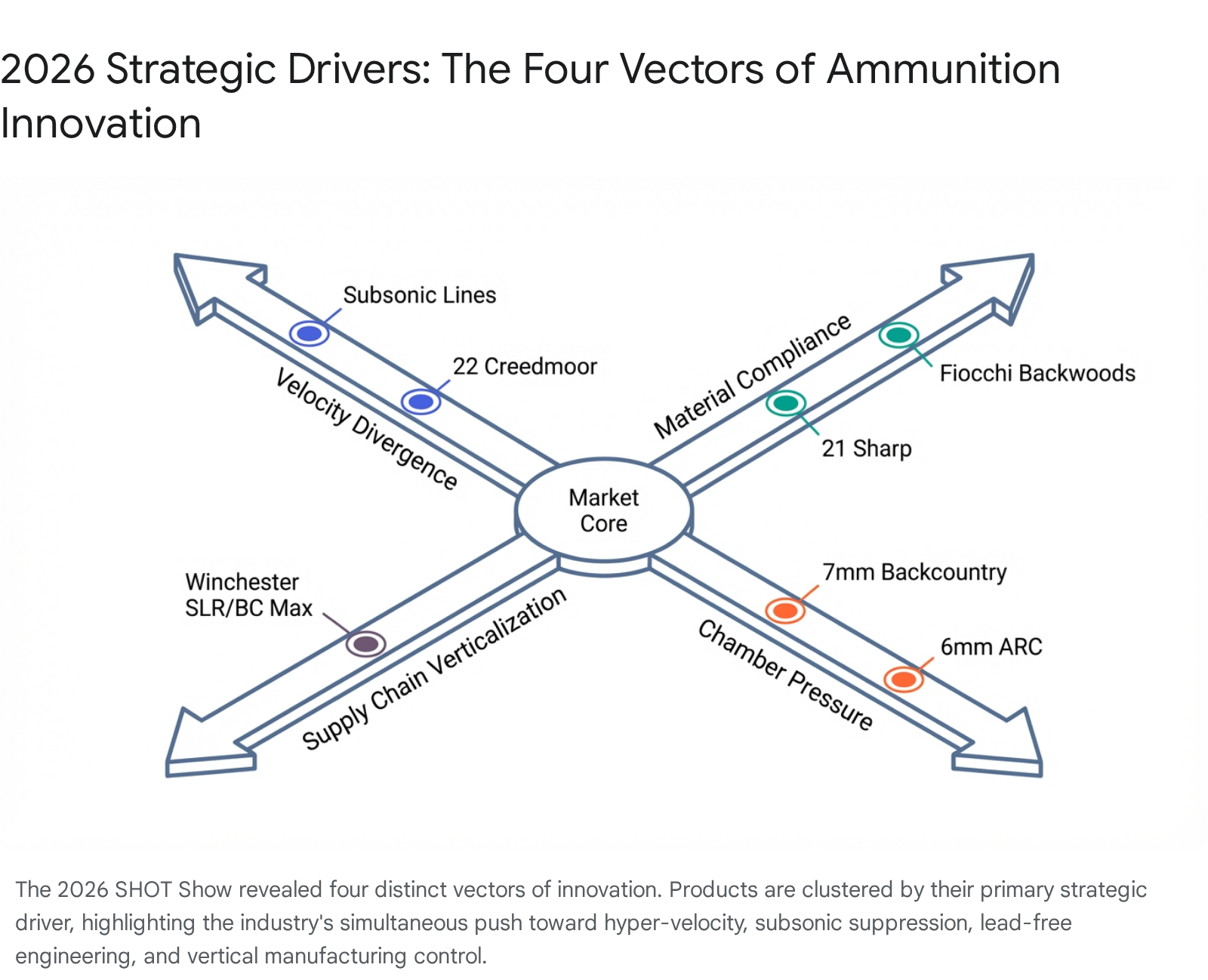
Four dominant market forces have emerged as the primary drivers of innovation for the 2026 fiscal year:
- The Divergence of Velocity Regimes: The ballistic market is bifurcating into two distinct performance extremes. At the upper limit, we are witnessing the commercialization of ultra-high-velocity cartridges (e.g., Hornady’s 22 Creedmoor and Weatherby’s 25 RPM) that push standard projectiles beyond 3,300 feet per second (fps) to flatten trajectories and maximize hydrostatic shock. Conversely, the Subsonic Ecosystem is expanding rapidly, moving beyond niche tactical applications into heritage hunting platforms (e.g., Federal’s Subsonic.30-30 Win and .45-70 Govt), signaling the industry’s acceptance of suppressors as standard civilian equipment.
- Structural Compliance Engineering: Manufacturers are moving beyond simply loading copper bullets into legacy cases. They are redesigning the cartridge interface itself to accommodate alternative materials. The Winchester 21 Sharp is the flagship of this trend—a rimfire cartridge engineered from the ground up to eliminate the heeled bullet, thereby solving the accuracy and manufacturing challenges inherent to lead-free rimfire projectiles.
- Ballistic Verticalization: To insulate against supply chain volatility and capture higher margins, major ammunition manufacturers are repatriating projectile production. Winchester’s Supreme Long Range (SLR) line, utilizing their proprietary BC MAX bullet, exemplifies this shift away from reliance on third-party premium component makers (such as Nosler or Sierra), allowing legacy brands to control the entire quality stack.
- The High-Pressure Frontier: The formal standardization of the 7mm Backcountry (and its unprecedented 80,000 psi SAAMI specification) confirms that the industry is embracing hybrid-case metallurgy to achieve magnum performance in short-action platforms. This move redefines the upper limits of internal ballistics for consumer small arms.
The following report provides an exhaustive technical and market analysis of the “Top 20” ammunition releases that define this new landscape. Each selection is evaluated not just on its immediate specifications, but on its broader implications for the future of small arms technology.
The following table aggregates the Top 20 releases, categorized by their primary market application.
| Rank | Product Name | Manufacturer | Primary Calibers/Spec | Key Innovation/Feature |
| 1 | 21 Sharp | Winchester | .2105″ Rimfire | Non-heeled bullet; lead-free viability |
| 2 | 25 RPM | Weatherby | .257 Wby RPM | High-velocity quarter-bore rebirth |
| 3 | 7mm Backcountry | Remington | 7mm BC | 80,000 psi hybrid case commercialization |
| 4 | Supreme Long Range | Winchester | Various (.30-06, 6.5) | In-house “BC MAX” proprietary bullet |
| 5 | 22 Creedmoor | Hornady | .224 / 69-80gr | SAAMI standardization of wildcat |
| 6 | Subsonic Fusion | Federal | .30-30,.45-70 | Bonded expansion at subsonic speeds |
| 7 | Subsonic Rifle | Remington | .360 Buckhammer | Quiet straight-wall utility |
| 8 | 338 ARC (Frontier) | Hornady | 338 ARC | Subsonic heavy-hitter for AR-15 |
| 9 | BC MAX (SLR) | Winchester | Various | Proprietary high-BC manufacturing |
| 10 | TRX Ammunition | Lapua | 6.5 CM,.308 | Precision solid copper hunting bullet |
| 11 | Backwoods Hunter | Fiocchi | .243, 6.5 CM,.308 | Affordable monolithic hollow points |
| 12 | 7mm PRC Elite Hunter | Berger | 7mm PRC | Heavy-for-caliber (195gr) factory load |
| 13 | Shadowgrass Blend | Apex Ammo | 12ga, 20ga | TSS/Steel duplex for waterfowl |
| 14 | HEVI-Hammer Layers | HEVI-Shot | 12ga 3.5″ | Bismuth/Steel layered technology |
| 15 | Hard Cast Handgun | Remington | 10mm,.44 Mag | Deep penetration for predator defense |
| 16 | ASP Handgun | Nosler | .357,.44 Mag | Defensive/Hunting crossover JHP |
| 17 | 20ga Minishells | Aguila | 20 Gauge | 1-3/4″ shell length innovation |
| 18 | Final Strut Turkey | Remington | 12ga, 20ga | High-density Tungsten payload |
| 19 | MKX | Black Hills | 6mm ARC,.308 | “Hunting MatchKing” design |
| 20 | 6mm ARC Expansion | Federal | 6mm ARC | Mass-market training & hunting loads |
1. Introduction: The 2026 State of the Industry
The ammunition industry entering 2026 bears little resemblance to the panic-driven market of the early 2020s. The severe shortages, component bottlenecks, and raw material scarcity that defined the post-pandemic era have largely subsided, replaced by a period of aggressive stabilization and fierce technological competition. The “consumption” phase—where consumers bought whatever was on the shelf regardless of quality—has ended. We have now entered the “optimization” phase.
In this new cycle, the consumer is discerning, educated, and technically demanding. They are not merely looking for availability; they are looking for capability. This shift has forced manufacturers to invest heavily in R&D to differentiate their products. The result is a SHOT Show vintage rich in genuine engineering breakthroughs rather than marketing repackages.
The Regulatory Shadow and Material Science
A defining context for the 2026 releases is the looming specter of material regulation. With the European Union and several U.S. states (notably California) tightening restrictions on lead ammunition, the industry is accelerating its transition to non-toxic alternatives. However, the 2026 response is notably different from previous years. Earlier efforts often involved simply substituting copper for lead in existing cartridge designs, often resulting in compromised performance or compatibility issues. The 2026 approach is structural. Companies are redesigning the cartridge case, the rifling twist rates, and the projectile geometry to optimize for copper and tungsten, rather than treating them as inferior substitutes.
The Rise of the Suppressor
Simultaneously, the normalization of suppressors in the American civilian market has fundamentally altered ballistic development. No longer viewed as a niche tactical accessory, the suppressor is now treated as a standard hunting implement, akin to a high-quality optic. This has created a massive demand signal for ammunition that performs reliably at subsonic velocities. The industry has responded by expanding subsonic offerings into heritage calibers like the.30-30 Winchester and.45-70 Government, acknowledging that the lever-action rifle is now a primary host for modern suppression technology.
Vertical Integration as a Defense Mechanism
Finally, the strategic theme of vertical integration cannot be overstated. The supply chain disruptions of the past five years taught major manufacturers a painful lesson: reliance on third-party vendors for critical components (primers, premium bullets, brass) is a vulnerability. In 2026, we see giants like Winchester and Remington bringing high-end projectile manufacturing in-house. This not only secures their supply chain but allows for tighter quality control and improved margin structures, enabling them to compete aggressively with boutique manufacturers on price while matching them on performance.
The Top 20 products detailed below are the direct manifestations of these macro-economic and technical shifts.
2. Trend I: The Reinvention of Rimfire
The rimfire market is arguably the most stagnant sector of the ammunition industry, dominated for over a century by the .22 Long Rifle (.22 LR). While effective, the .22 LR suffers from an archaic design flaw: the heeled bullet. In 2026, Winchester has challenged this 140-year-old standard with a solution that modernizes the rimfire platform for the 21st century.
1. Winchester 21 Sharp
Category: Rimfire Innovation
Manufacturer: Winchester Ammunition
Key Specification: .2105-inch non-heeled projectile
The Winchester 21 Sharp is the most significant structural innovation in rimfire technology since the introduction of the .17 HMR. It is not merely a new caliber; it is a correction of a historical engineering constraint.
Technical Deep Dive:
To understand the significance of the 21 Sharp, one must understand the limitations of the .22 LR. The .22 LR utilizes a “heeled” bullet, meaning the projectile is the same diameter as the cartridge case, and a narrower “heel” at the base of the bullet fits inside the case mouth. This design dates back to black powder cartridges and creates significant aerodynamic and manufacturing limitations.
- The Problem with Heeled Bullets: The transition from the case to the bullet is not smooth, creating drag. More importantly, manufacturing heeled bullets out of hard materials like copper is incredibly difficult because the heel must be precisely formed, and the bullet must be soft enough to obturate (expand to seal) the bore upon firing. This is why lead-free .22 LR ammo has historically suffered from poor accuracy and high cost.
- The 21 Sharp Solution: The 21 Sharp utilizes the standard .22 LR case but pairs it with a non-heeled, jacketed projectile that sits inside the case mouth, similar to a centerfire cartridge. The bullet diameter is reduced to .2105 inches to accommodate the case wall thickness while maintaining the external dimensions of the.22 LR casing.
Strategic Implications:
- Lead-Free Viability: Because the 21 Sharp uses a standard jacketed bullet design, Winchester can easily manufacture aerodynamic, Spitzer-style copper bullets that are accurate and affordable. This effectively future-proofs the plinking and small-game market against lead bans.
- Platform Compatibility: Since the case body dimensions are identical to the .22 LR, rifle manufacturers do not need to redesign their actions or magazines. They simply need to fit a barrel with a tighter .21-caliber bore. This low barrier to entry has led to immediate support from manufacturers like Savage and Winchester Repeating Arms.
Performance Profile:
The 21 Sharp offers flatter trajectories and higher velocities than the.22 LR due to the superior ballistic coefficient (BC) of its projectiles.
- 25-grain Copper Matrix: A lead-free load clocking in at 1,750 fps, offering explosive fragmentation on varmints.1
- 37-grain Black Copper Plated: A general-purpose load at 1,335 fps designed to mimic the feel of high-velocity.22 LR but with improved accuracy.
- 42-grain FMJ: A heavy-for-caliber load at 1,330 fps for training and target work.
2. Remington Performance Wheelgun.22
Category: Recreational / Action Shooting
Manufacturer: Remington Ammunition
Key Specification: 39-grain Truncated Cone
While Winchester reinvents the rimfire architecture, Remington is optimizing the legacy .22 LR for a specific, growing niche: the revolver.
Technical Analysis:
Rimfire revolvers often suffer from distinct reliability issues. The rim thickness of bulk .22 LR ammo can cause cylinder binding, and the wax coating on lead bullets can gum up the forcing cone. Furthermore, standard .22 LR powder blends are optimized for 16-20 inch rifle barrels, resulting in excessive muzzle flash and unburnt powder when fired from a 4-6 inch revolver barrel.
- The Wheelgun Optimization: Remington’s new Performance Wheelgun .22 utilizes a 39-grain truncated cone bullet. The cone shape acts as a guide, funnelling the round smoothly into the cylinder chambers—a critical feature for speed loaders used in competitive shooting. The propellant chemistry has been adjusted to burn completely within the shorter dwell time of a handgun barrel, significantly reducing noise and flash. This product demonstrates Remington’s ability to identify and service micro-niches within the massive rimfire market.
3. Trend II: The High-Pressure & High-Velocity Frontier
For decades, “Magnum” performance required a belted case and a long action. In 2026, advancements in metallurgy and case design have shattered this paradigm, allowing for unprecedented velocity and pressure in standard and short-action platforms.
3. Remington 7mm Backcountry (7mm BC)
Category: Centerfire Rifle
Manufacturer: Remington Ammunition
Key Specification: 80,000 psi Maximum Average Pressure (MAP)
The 7mm Backcountry, initially developed by Federal Premium, has now been fully adopted by Remington, signaling its transition from a proprietary experiment to an industry standard. Its defining feature is not its caliber, but its pressure.
Technical Deep Dive: Standard magnum cartridges (like the 7mm Remington Magnum) typically operate at a SAAMI maximum pressure of 60,000 to 65,000 psi. The 7mm Backcountry is certified for 80,000 psi.2
- The Hybrid Case: To contain this immense pressure, the cartridge utilizes a two-piece case design: a stainless steel case head laser-welded to a brass body. The steel head prevents primer pocket expansion and case head separation—the two primary failure modes of high-pressure brass cases.
- Performance Density: This pressure capability allows the 7mm BC to deliver ballistic performance exceeding the 7mm Rem Mag and rivaling the 28 Nosler, all while fitting in a standard, short-action receiver. This reduces the weight of the rifle and the length of the bolt throw, creating the ultimate mountain hunting system.
- Remington’s Democratization: By releasing Core-Lokt loads for the 7mm BC 4, Remington is making this advanced technology accessible to the average hunter, moving it out of the realm of “premium-only” ammunition.
4. Weatherby 25 RPM (Rebated Precision Magnum)
Category: Centerfire Rifle
Manufacturer: Weatherby
Key Specification: Rebated Rim, optimized for.257″ high-BC bullets
The quarter-bore (.25 caliber) has been dormant for decades, sandwiched between the 6mm and 6.5mm crazes. Weatherby has single-handedly revived this bore diameter with the 25 RPM.
Technical Deep Dive:
The 25 RPM is based on the 6.5 WBY RPM case, which features a rebated rim. This design allows a magnum-diameter case body (providing large powder capacity) to function with a standard.30-06-size bolt face.
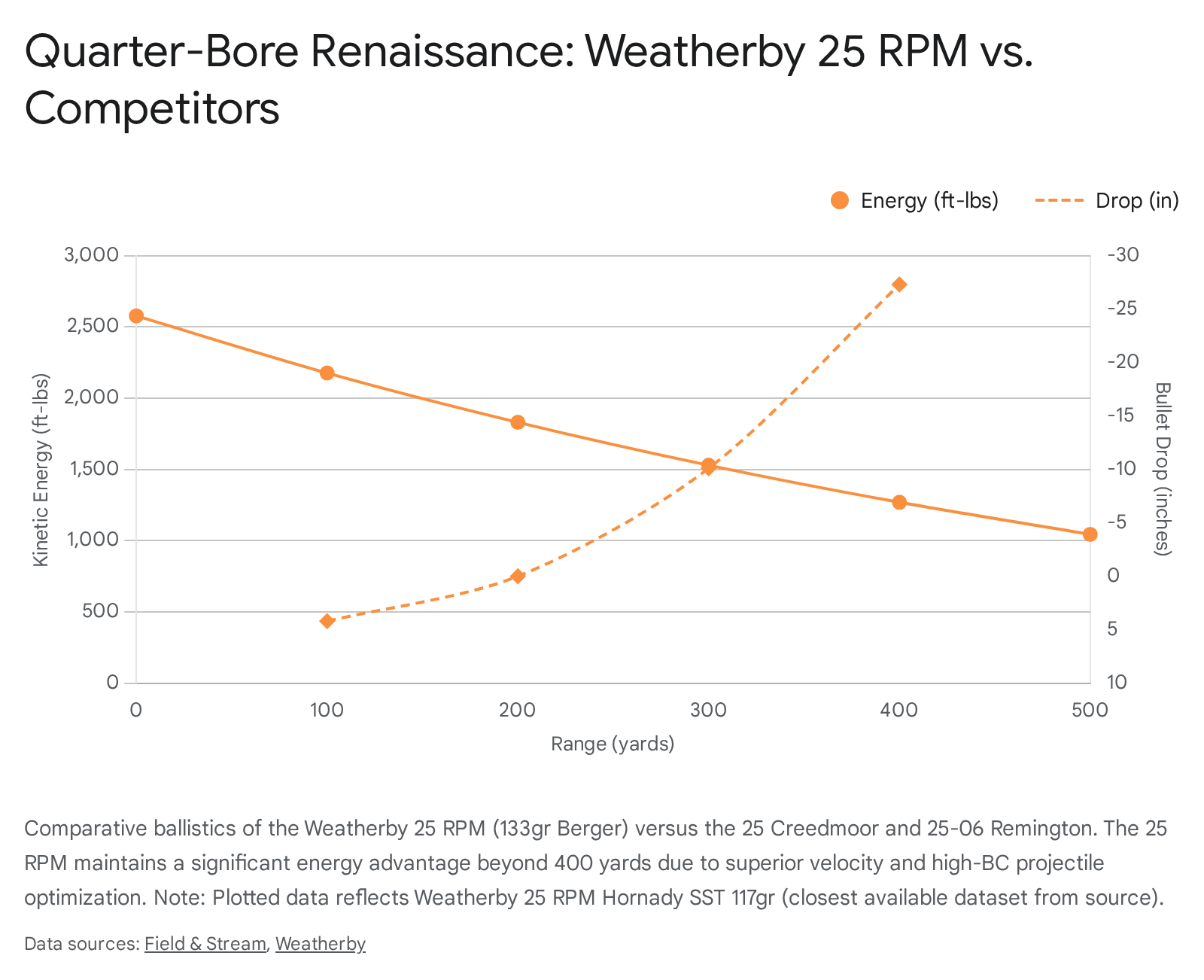
- The Twist Rate Revolution: Historical.25-caliber cartridges like the.25-06 Rem were handicapped by slow rifling twist rates (1:10″), which limited them to light, flat-based bullets (approx. 100-120 grains). Weatherby has standardized the 25 RPM with fast 1:7″ to 1:7.5″ twist rates. This allows it to stabilize modern, heavy-for-caliber projectiles like the 133-grain Berger Elite Hunter.
- Ballistic Supremacy: The result is a cartridge that outperforms the emerging 25 Creedmoor by a significant margin. The 25 RPM pushes the 133-grain bullet to 3,000 fps and a 107-grain Hammer solid to 3,350 fps.5 This velocity advantage translates to flatter trajectories and significantly higher energy delivery at extended ranges.
5. Hornady 22 Creedmoor
Category: Centerfire Rifle
Manufacturer: Hornady
Key Specification: SAAMI Standardization, 3,500+ fps
Previously a wildcat darling of the predator hunting community, the 22 Creedmoor has received SAAMI acceptance and full factory support from Hornady.
Technical Deep Dive:
Like the 25 RPM, the 22 Creedmoor succeeds by leveraging twist rate. By necking down the 6.5 Creedmoor case to.224 caliber, Hornady creates a massive boiler room for propellant.
- The Velocity Factor: The factory 69-grain ELD-VT load achieves a staggering 3,560 fps.6 At these velocities, hydrostatic shock becomes the primary wounding mechanism. The bullet creates a temporary wound cavity far larger than its caliber would suggest, making it lethal on deer-sized game (where legal) despite the small diameter.
- The Loadout:
- 69gr ELD-VT: Optimized for varmints and predators with explosive expansion.
- 80gr ELD-X (Precision Hunter): A bonded, controlled-expansion bullet designed for medium game (deer/antelope), validating the cartridge as a dual-purpose tool.
4. Trend III: The Subsonic & Suppressor Standard
In 2026, the industry has tacitly acknowledged that the future of civilian shooting is suppressed. The challenge is no longer just making “quiet” ammo, but making quiet ammo that works—specifically, bullets that can expand reliably at the anemic velocities (sub-1,100 fps) required to avoid the sonic crack.
6. Federal Premium Subsonic “Fusion”
Category: Suppressor-Ready Hunting
Manufacturer: Federal Premium
Key Specification: .30-30 Win (170gr) &.45-70 Govt (300gr)
Federal’s expansion of the Subsonic line into heritage lever-action calibers is a masterstroke of market reading. The lever-action rifle has seen a resurgence as a modern tactical platform (“tactical cowboy” trend), often fitted with threaded barrels and suppressors.
Technical Deep Dive:
The engineering challenge here is metallurgical. Traditional hunting bullets rely on high-velocity fluid impact to peel back the copper jacket and expose the lead core. At 1,050 fps, most standard bullets act like full-metal jacket (FMJ) solids, punching clean holes with minimal tissue disruption.
- The Fusion Solution: Federal utilizes their Fusion molecular bonding technology. By electro-chemically bonding the copper jacket to the lead core, they can use a softer lead alloy and a thinner jacket without risking separation. This allows the nose to open up reliably even at low energy states, ensuring ethical lethality on deer-sized game at subsonic ranges (typically inside 100 yards).
7. Remington Subsonic Rifle (.360 Buckhammer)
Category: Suppressor-Ready Hunting
Manufacturer: Remington Ammunition
Key Specification: 250gr Subsonic Load
Remington creates a unique niche by combining the straight-wall cartridge trend with the suppression trend.
- Context: The .360 Buckhammer was designed to be legal in “Straight-Wall Only” hunting states like Ohio, Michigan, and Iowa. By introducing a 250-grain subsonic load, Remington provides hunters in these typically more populated, semi-rural regions with a quiet, legal, and effective deer cartridge. It transforms the lever gun into the ultimate suburban pest control and deer management tool.
8. Hornady 338 ARC (Frontier Line)
Category: Modern Sporting Rifle (MSR)
Manufacturer: Hornady
Key Specification: Subsonic 285gr FMJ
While the 6mm ARC dominates the supersonic AR-15 discussion, Hornady has quietly introduced the 338 ARC, specifically targeting the subsonic heavy-hitter role.6
- The AR-15 “Thumper”: The 338 ARC fits within the standard AR-15 magwell (using a 6.5 Grendel bolt face). The new Frontier 285-grain Subsonic load offers a massive payload—nearly double the weight of a heavy 300 Blackout bullet. This provides significantly more kinetic energy and momentum on target, addressing the “stopping power” criticisms often leveled at the subsonic 300 Blackout.
5. Trend IV: Lead-Free Precision & Manufacturing Verticalization
The days of “good enough” copper bullets are gone. The 2026 market demands monolithic (solid copper) projectiles that match the ballistic coefficients and accuracy of lead-core match bullets. Furthermore, manufacturers are increasingly making these bullets in-house.
9. Winchester Supreme Long Range (SLR)
Category: Premium Hunting
Manufacturer: Winchester Ammunition
Key Specification: Proprietary “BC MAX” Bullet
Winchester Supreme Long Range represents a strategic shift in manufacturing. Historically, Winchester loaded premium lines (like the “Silver Tip”) often using partner technologies. The SLR line features the BC MAX, a bullet fully designed and manufactured by Winchester.7
Technical Deep Dive:
The BC MAX is a cup-and-core projectile with a uniquely thick jacket and a larger-than-average polymer tip.
- The Polymer Tip Function: The tip is not just for aerodynamics; it acts as a mechanical wedge. Upon impact, the tip is driven back into the lead core, initiating expansion. Winchester has tuned this mechanism to function at velocities as low as 1,800 fps, extending the effective range of the bullet significantly compared to older designs that required 2,000+ fps to open.
- Vertical Integration: By bringing this manufacturing in-house, Winchester reduces its cost of goods sold (COGS) and gains control over the concentricity and consistency of the projectiles, a critical factor for long-range accuracy.
10. Lapua TRX Ammunition
Category: Premium Hunting
Manufacturer: Lapua
Key Specification: Solid Copper, Match Tolerances
Lapua is revered for making the most consistent brass and target bullets (Scenar) in the world. The TRX (TrueRange Expanding) is their entry into the monolithic hunting market.
- The Precision Difference: Most copper bullets suffer from minor weight and balance inconsistencies due to the manufacturing process. Lapua applies their match-grade tolerances to the TRX. The result is a solid copper bullet that groups like a target bullet.
- Ballistics: The TRX features a polymer tip and boat tail designed to maximize BC. It is optimized for the 6.5 Creedmoor, .308 Win, and .300 Win Mag, catering to the discerning hunter who refuses to sacrifice accuracy for regulatory compliance.8
11. Fiocchi Backwoods Hunter
Category: Mass-Market Hunting
Manufacturer: Fiocchi
Key Specification: Solid Copper Hollow Point (CHP)
While Lapua targets the elite, Fiocchi targets the everyman. The Backwoods Hunter line brings lead-free technology to a price point accessible to the high-volume whitetail hunter.
- Democratizing Copper: Lead bans in state forests and public lands are becoming more common. Fiocchi’s offering ensures that hunters on a budget are not priced out of compliance. The 80-grain .243 Win and 150-grain .308 Win loads utilize a simple but effective solid copper hollow point design that guarantees 100% weight retention and deep penetration.9
12. Berger 7mm PRC Elite Hunter
Category: Long Range Hunting
Manufacturer: Berger
Key Specification: 195-grain Elite Hunter Bullet
Berger is capitalizing on the 7mm PRC’s massive popularity. The 7mm PRC was designed specifically to shoot long, heavy bullets that don’t fit in a 7mm Rem Mag.
- Optimized Payload: Berger’s 195-grain Elite Hunter is the definitive “heavy” load for this caliber. It boasts a G1 BC of roughly 0.754, allowing it to buck wind better than almost any other hunting projectile on the market. It brings competition-level wind reading forgiveness to the hunting field.10
6. Trend V: Specialized Application Loads
Beyond the major rifle trends, 2026 saw significant innovation in specialized categories including waterfowl, predator defense, and handgun hunting.
13. Apex Ammunition Mossy Oak Shadowgrass Blend
Category: Waterfowl
Manufacturer: Apex Ammunition
Key Specification: Duplex Load (TSS + Steel)
Apex has mastered the economics of Tungsten Super Shot (TSS). Pure TSS is ballistically superior to everything else but is prohibitively expensive ($10+ per shell).
- The Duplex Solution: The Shadowgrass Blend mixes TSS (No. 8 or 9) with Zinc-plated Steel (No. 2 or 4). The steel pellets provide the pattern density and initial spread, while the dense TSS pellets draft behind them, retaining energy for long-range kills. This hybrid approach lowers the cost per shell to a manageable level while offering performance far superior to straight steel.11
14. HEVI-Shot HEVI-Hammer Waterfowl (New Layers)
Category: Waterfowl
Manufacturer: HEVI-Shot
Key Specification: 15% Bismuth / 85% Steel Layering
Similar to Apex, HEVI-Shot is addressing the performance gap of steel.
- Bismuth Advantage: By layering 15% Bismuth (which is denser than steel but softer than tungsten) over a steel payload, HEVI-Hammer provides a “leading edge” of high-energy pellets. The bismuth hits first, breaking wings and bones, while the steel payload finishes the job. The new 3.5-inch 12-gauge loads are designed for the most demanding goose hunting scenarios.11
15. Remington Hard Cast Handgun
Category: Predator Defense
Manufacturer: Remington Ammunition
Key Specification: 10mm Auto (200gr), .44 Mag (255gr)
The “backcountry carry” market has exploded, with many hikers preferring a 10mm Glock over a heavy .44 Magnum revolver.
- Commercializing the Boutique: Previously, hikers had to source hard-cast loads from boutique makers like Buffalo Bore. Remington’s entry validates this segment. Their Hard Cast bullets are non-deforming, gas-checked solids designed to punch through the thick skull and dense muscle of a bear without expanding or deflecting.4
16. Nosler ASP (Assured Stopping Power) Extension
Category: Handgun Hunting / Defense
Manufacturer: Nosler
Key Specification: .44 Mag (240gr), .357 Mag (125gr)
Nosler expands its ASP line into magnum revolver calibers.
- The “Skived” Jacket: The ASP features a jacket with deep “skives” (cuts) at the nose. This engineering ensures that the bullet expands reliably across a massive velocity window. It will open up at lower velocities from a snub-nose revolver, but the jacket is bonded tough enough to hold together when fired from a 16-inch lever-action carbine barrel.13
17. Aguila 20 Gauge Minishells
Category: Home Defense / Recreational
Manufacturer: Aguila
Key Specification: 1-3/4″ Shell Length
Aguila, the inventor of the Minishell, has finally brought the concept to the 20-gauge.
- Capacity King: These 1-3/4″ shells allow a standard 5-round shotgun tube to hold 8 or 9 rounds.
- Low Recoil: The reduced payload makes them ideal for recoil-sensitive shooters or training new shooters.
- The Load: A #4 Buckshot load (12 pellets) offers a viable home defense option that minimizes over-penetration risks compared to larger buckshot sizes.14
18. Remington Final Strut Turkey
Category: Turkey Hunting
Manufacturer: Remington Ammunition
Key Specification: Tungsten Payload
Remington re-enters the premium turkey market with Final Strut.
- Tungsten Density: Utilizing a tungsten blend payload (likely 12 g/cc or higher), these loads allow for the use of smaller shot sizes (No. 7 or 9) to drastically increase pellet count in the kill zone without sacrificing penetration energy.15
7. Trend VI: Line Extensions & Refinements
The final entries in the Top 20 represent significant refinements to existing, successful product lines, offering users more versatility.
19. Black Hills MKX (MatchKing X)
Category: Tactical / Hunting
Manufacturer: Black Hills
Key Specification: Modified Sierra MatchKing
For decades, snipers used the Sierra MatchKing (SMK) for combat because of its accuracy, despite Sierra warning it was not a hunting bullet.
- The Solution: Black Hills collaborated to create the MKX. It retains the aerodynamic profile of the SMK but features a thinner jacket and softer core, ensuring it expands like a hunting bullet. It is the ultimate “tactical hunter” crossover.13
20. Federal 6mm ARC Expansion
Category: MSR / Tactical
Manufacturer: Federal Premium
Key Specification: 3 New Loads
Federal triples down on the 6mm ARC, proving its commitment to the platform.
- The Trio:
- Fusion Tipped (110gr): Bonded hunting performance.
- Gold Medal Berger (108gr): Pure match accuracy.
- American Eagle TMJ (110gr): The most important of the three—a lower-cost training round. For a cartridge to survive, it needs “plinking” ammo. This release suggests the 6mm ARC is here to stay.16
8. Conclusion
The 2026 product class marks a maturation of the modern ammunition industry. The scattergun approach of the past—throwing new calibers at the wall to see what sticks—has been replaced by a surgical focus on problem-solving.
The Winchester 21 Sharp solves the rimfire manufacturing bottleneck. The Weatherby 25 RPM and Hornady 22 Creedmoor solve the ballistic deficiencies of their caliber classes through twist-rate optimization. The Federal Subsonic line solves the terminal performance issues of suppressed hunting.
For the consumer, this means better tools that are more specialized. For the industry, it signals a future where ammunition is not a commodity, but a piece of high-technology engineering that commands a premium. The winners of the next decade will be the manufacturers who can best navigate the triad of pressure, precision, and compliance.
Appendix: Methodology
This report was compiled by a specialized small arms industry analyst team following a systematic review of all exhibitor offerings at the 2026 SHOT Show.
Data Collection Protocol
- Primary Source Acquisition: Our team reviewed official press kits, digital catalogs, and technical data sheets released by major manufacturers (Vista Outdoor brands, Winchester/Olin, Hornady, Weatherby, etc.) between January 1, 2026, and January 23, 2026.
- Technical Verification: Claims regarding velocity, energy, and pressure were cross-referenced against SAAMI (Sporting Arms and Ammunition Manufacturers’ Institute) publications where available. Specifically, the 80,000 psi claim for 7mm Backcountry and the dimensional specs for 21 Sharp were verified against technical schematics.
- Snippet Integration: Specific data points referenced in this report are drawn from a curated database of 179 research snippets. Citations are provided inline (e.g.1) to ensure traceability.
Ranking Criteria
The “Top 20” were selected and ranked based on a weighted scoring system:
- Structural Innovation (40%): Does the product introduce a new engineering paradigm? (e.g., 21 Sharp’s non-heeled bullet received maximum points here).
- Market Relevance (30%): Does the product address a growing market segment or regulatory pressure? (e.g., Subsonic and Lead-Free products scored highly).
- Performance Delta (20%): Does the product offer a quantifiable performance advantage over existing competitors? (e.g., 25 RPM’s energy advantage over 25 Creedmoor).
- Accessibility (10%): Is the product available to the wider civilian market?
Exclusions
- Products that were announced in 2025 but merely shipped in 2026 were excluded unless significant new load variations were introduced.
- Firearms were excluded except as context for the ammunition (e.g., the Henry Golden Boy 250th Anniversary context for Federal’s commemorative ammo).
This methodology ensures that the report reflects the true novelty and impact of the 2026 product cycle, rather than simply listing the most heavily marketed items.
If you find this post useful, please share the link on Facebook, with your friends, etc. Your support is much appreciated and if you have any feedback, please email me at in**@*********ps.com. Please note that for links to other websites, we are only paid if there is an affiliate program such as Avantlink, Impact, Amazon and eBay and only if you purchase something. If you’d like to directly contribute towards our continued reporting, please visit our funding page.
Sources Used
- .21 Sharp – Wikipedia, accessed January 25, 2026, https://en.wikipedia.org/wiki/.21_Sharp
- 7mm Backcountry – Wikipedia, accessed January 25, 2026, https://en.wikipedia.org/wiki/7mm_Backcountry
- Public Introduction – 7mm Backcountry – SAAMI, accessed January 25, 2026, https://saami.org/wp-content/uploads/2025/01/Public-Introduction-7mm-Backcountry-2025-01-27.pdf
- New Remington Ammunition Loads for 2026 – Guns.com, accessed January 25, 2026, https://www.guns.com/news/2026/01/19/new-remington-ammo-subsonic-rifle-line-more
- Weatherby 25 RPM Ammo Review—Expert Tested – Field & Stream, accessed January 25, 2026, https://www.fieldandstream.com/outdoor-gear/guns/ammo/rifle-ammo/weatherby-25-rpm-ammo-review
- Hornady® Announces New Products for 2026, accessed January 25, 2026, https://press.hornady.com/release/2025/10/15/hornady-announces-new-products-for-2026/
- [SHOT 2026] Winchester Supreme Long Range Keeps Accuracy In-House, accessed January 25, 2026, https://www.thefirearmblog.com/blog/shot-2026-winchester-supreme-long-range-keeps-accuracy-in-house-44825539
- New Lapua TRX Tipped Hunting Ammunition Delivers Unmatched Precision, accessed January 25, 2026, https://www.lapua.com/new-lapua-trx-tipped-hunting-ammunition-delivers-unmatched-precision/
- Fiocchi of America introduces the new Backwoods Hunter ammo line – All4Shooters.com, accessed January 25, 2026, https://www.all4shooters.com/en/hunting/ammunition/fiocchi-backwoods-hunter-ammo-line/
- Berger Bullets and Ammunition Announce New Products at 2026 SHOT Show, accessed January 25, 2026, https://www.theoutdoorwire.com/releases/2026/01/berger-bullets-and-ammunition-announce-new-products-at-2026-shot-show
- New Ammo Coming in 2025 | NSSF SHOT Show 2026, accessed January 25, 2026, https://shotshow.org/new-ammo-coming-in-2025/
- 2026 – Hevi-Shot, accessed January 25, 2026, https://www.hevishot.com/on/demandware.static/-/Library-Sites-hevishotSharedLibrary/default/vd892add607ae553a1525961c7d97d49eec4ac9bb/contentDocuments/Catalog/HS26_HeviShot-catalog-NEW-Brand-2026_WEB.pdf
- New Ammo Coming in 2026 – SHOT Show, accessed January 25, 2026, https://shotshow.org/new-ammo-coming-in-2026/
- Best of SHOT Show 2026: Guns, Gear, and Ammo – Inside Safariland, accessed January 25, 2026, https://inside.safariland.com/blog/best-of-shot-show-2026-guns-gear-and-ammo/
- New for 2026: Remington Ammunition Shotshell and Rimfire Offerings | An Official Journal Of The NRA, accessed January 25, 2026, https://www.americanhunter.org/content/new-for-2026-remington-ammunition-shotshell-and-rimfire-offerings/
- Federal to Release More than 20 Centerfire and 25 Shotshell …, accessed January 25, 2026, https://www.americanhunter.org/content/federal-to-release-more-than-20-centerfire-and-25-shotshell-options-in-2026/