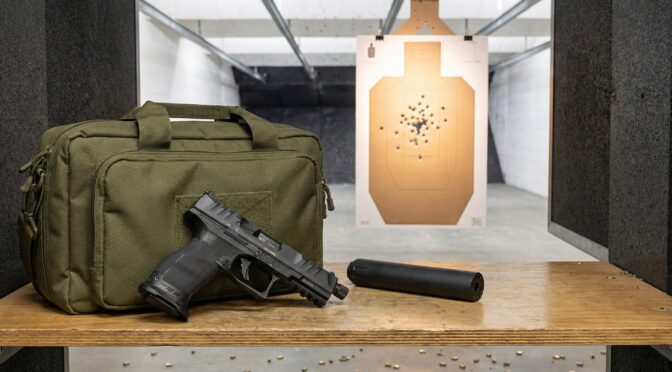
The Walther Performance Duty Pistol (PDP) represents a distinct evolution in the striker-fired service pistol market, marking a deliberate transition from the legacy ergonomics of the PPQ (Police Pistol Quick Defense) to a modular, optics-centric platform engineered for the modern professional. Introduced in 2021, the PDP was designed to address specific operational gaps in contemporary duty handguns—specifically the integration of red dot sights (RDS) as a primary sighting system rather than an aftermarket addition, and the optimization of shooter-firearm interface mechanics.
This comprehensive analysis evaluates the PDP ecosystem, encompassing the standard polymer variants, the biometric-specific F-Series, and the competition-focused Steel Frame models. Our assessment indicates that the PDP platform delivers “best-in-class” fire control characteristics and mechanical accuracy, driven largely by its proprietary stepped chamber geometry and the Performance Duty Trigger (PDT). However, these performance advantages are coupled with a distinct recoil impulse signature—frequently characterized by users as “snappy”—which necessitates a deeper understanding of the platform’s kinematic physics, specifically the interplay between slide mass, bore axis, and chamber obturation.
Market analysis reveals a bifurcation in customer sentiment. While enthusiast and competitive demographics laud the platform for its trigger precision and modularity, casual users often struggle with the recoil dynamics compared to heavier, less aggressively sprung competitors like the Glock 19 or Heckler & Koch VP9. The 2022 introduction of the F-Series and the 2024 expansion into Steel Frame architecture demonstrate Walther’s agile responsiveness to these market signals, effectively diversifying the platform to capture outlier demographics ranging from small-statured shooters to USPSA competitors.
Strategic adoption by major law enforcement agencies, including the Pennsylvania State Police and Germany’s Special Forces (KSK), validates the system’s reliability and duty-readiness under adverse conditions. However, the ecosystem faces logistical friction points, notably the complexity of the optics plate generation change (Version 1.0 vs. 2.0) and a higher Total Cost of Ownership (TCO) driven by magazine and component pricing.
Overall Conclusion: The Walther PDP is an engineered solution for the proficiency-focused user, offering superior interface mechanics that reward sound technique while potentially punishing poor grip fundamentals. It stands as a market leader in shootability and accuracy potential, provided the operator accepts the trade-offs inherent in its high-velocity kinematic design.
1. Historical Context and Market Genesis
To fully appreciate the engineering choices manifest in the Walther PDP, one must analyze the lineage from which it emerged. Walther Arms has historically been a pioneer in polymer-framed service pistols, with the P99 serving as a foundational architecture that influenced decades of design. The PDP is not a clean-sheet design in a vacuum; rather, it is the third iteration of a specific ergonomic and mechanical philosophy that prioritizes the shooter’s interface above manufacturing simplicity.
1.1 The P99 and PPQ Legacy
The lineage began with the P99, introduced in the late 1990s, which revolutionized grip ergonomics with interchangeable backstraps—a feature now standard across the industry. The P99 evolved into the PPQ (Police Pistol Quick Defense) in 2011. The PPQ gained a cult following for its “Quick Defense” trigger, a fully cocked striker system that offered a crisp break and short reset, vastly superior to the partially cocked, “mushy” triggers found in the dominant Glock and Smith & Wesson M&P platforms of the era.1
However, the PPQ had limitations. Its slide geometry was sculpted and tapered, aesthetically pleasing but functional limiting for the mounting of red dot optics, which require a broad, flat surface for stability. As the industry shifted toward RDS as a standard duty requirement (driven by the US Army’s MHS program and FBI adoption trends), the PPQ’s architecture became a liability.
1.2 The “Duty to Be Ready” Philosophy
The PDP launched with a distinct design mandate: “It’s Your Duty to Be Ready.” This was not merely marketing copy but an engineering directive to optimize the pistol for three states of readiness:
- Optical Readiness: Redesigning the slide with a deep, dedicated optics cut and altering the grip angle to facilitate the presentation of the dot to the shooter’s eye.
- Grip Readiness: Implementing a “SuperTerrain” slide serration pattern and a tetrahedron grip texture to ensure positive control in all environmental conditions (blood, water, mud).
- Trigger Readiness: Refining the PPQ’s trigger geometry to further reduce take-up and improve tactile definition, creating the “Performance Duty Trigger” (PDT).3
This shift marked Walther’s aggressive move to capture the U.S. law enforcement market, directly challenging the hegemony of Glock and Sig Sauer by offering a “shooter’s gun” out of the box, negating the need for the extensive aftermarket modifications common to competitor platforms.
2. Engineering Architecture and Design Analysis
The PDP is distinguished by several unique engineering features that separate it from the ubiquitous Browning-Petter-Sig locking systems found in competitors. An in-depth examination of the slide, barrel, and frame mechanics reveals a focus on performance metrics—specifically velocity and accuracy—often at the expense of felt recoil softness.
2.1 The Stepped Chamber: Ballistics and Kinematics
Perhaps the most critical, yet invisible, engineering feature of the PDP is the stepped chamber. Unlike a standard SAAMI-spec straight-walled chamber found in a Glock or Sig P320, the PDP barrel features a distinct taper or “step” in the forward third of the chamber.1
Mechanical Theory:
The stepped chamber is a feature historically associated with the Luger P08 and high-performance target pistols. Its primary function is to create a significantly tighter gas seal (obturation) around the cartridge case mouth upon firing. When the propellant ignites, the brass casing expands to seal the chamber. In a stepped chamber, this seal occurs more rapidly and with greater efficacy because the tolerances at the case mouth are tighter.
Performance Implications:
- Velocity Increase: The enhanced gas seal prevents propellant gases from bypassing the projectile (blow-by). Internal ballistic testing indicates that the PDP generates higher muzzle velocities than competitors with identical barrel lengths. Walther engineers claim the velocity gain is equivalent to adding approximately 0.5 to 1.0 inches of barrel length.2 This results in flatter trajectories and higher terminal energy on target.
- Centricity and Accuracy: The step acts to center the projectile perfectly within the bore before it engages the rifling. This reduction in yaw as the bullet enters the forcing cone contributes to the PDP’s reputation for exceptional mechanical accuracy.1
The Recoil Trade-off:
This engineering choice is the primary driver of the “snappiness” reported by users. According to Newtonian physics ($F=ma$), the increased velocity of the projectile and the efficient gas seal result in higher rearward force. Consequently, the slide cycles at a higher velocity. When this high-velocity slide reaches the end of its rearward travel and impacts the frame, it transfers a sharp impulse to the shooter’s hand. This is perceived as a “snap” or rapid muzzle rise, distinct from the slower “push” of lower-velocity systems.6
2.2 SuperTerrain Slide Serrations
The slide architecture of the PDP departs from traditional subtractive machining. Most pistol serrations are cut into the slide (subterranean). The PDP features SuperTerrain Serrations, which protrude above the primary surface of the slide.3
Operational Utility:
This design increases the effective width of the slide to 1.34 inches, providing a significantly larger surface area for manipulation.
- Friction Coefficient: The raised ridges allow for positive engagement with the skin or gloves without requiring sharp edges that could abrade clothing or skin during concealed carry.
- Manipulation Mechanics: The design is optimized for overhead rack manipulations and press checks, particularly when an optic is mounted. The shooter can grasp the front of the slide without their hand slipping onto the optic lens.8
- Structural Integrity: By building the serrations up rather than cutting them down, Walther maintains the structural wall thickness of the slide, which is critical given the deep milling required for the optics cut.2
2.3 Fire Control Group: PDT vs. DPT
Walther utilizes two distinct trigger systems within the PDP ecosystem, both of which are fully cocked striker designs (single-action equivalent).
Performance Duty Trigger (PDT):
Standard on polymer models, the PDT is an evolution of the PPQ trigger.
- Mechanics: The striker is fully tensioned by the slide cycle. The trigger pull merely releases the striker safety and drops the sear. This eliminates the “mush” associated with partially cocked strikers (like Glocks) that must finish compressing the striker spring during the pull.
- Metrics: The PDT features a measured pull weight of approximately 5.6 lbs (25 N) with a short take-up and a tactile reset of roughly 0.2 inches.4
Dynamic Performance Trigger (DPT):
Standard on Pro SD and Steel Frame models, and available as an upgrade.
- Architecture: The DPT utilizes a flat-faced aluminum shoe and a redesigned sear housing. The geometry reduces take-up by approximately 50% and overtravel is virtually eliminated.
- Break Characteristics: The break is akin to breaking a glass rod—instant and crisp. Pull weights often measure between 3.8 and 4.8 lbs. This trigger reduces the likelihood of the shooter disturbing the sight picture during the break, directly contributing to practical accuracy.10
2.4 Ergonomics and Grip Texture
The PDP grip was designed using a “Tetrahedron” texture pattern.
- Topology: The texture consists of raised pyramids that provide multi-directional friction. It is non-abrasive to clothing (unlike aggressive sandpaper textures) but bites into the skin when grip pressure is applied.
- RDS Optimization: The bottom of the grip features a distinct forward sweep (the “pinky hook”). Walther engineers claim this encourages the shooter to apply pinky pressure, which leverages the muzzle down and helps align the red dot index naturally upon presentation.4
3. Variant Technical Analysis
The PDP is not a monolithic product but a modular platform. Understanding the distinctions between variants is crucial for purchasing decisions.
3.1 Standard Polymer Models (Compact & Full Size)
These models form the core of the duty and carry lineup.
Table 1: Standard Polymer Specifications
| Feature | Compact 4″ | Full Size 4.5″ | Full Size 5″ |
| Barrel Length | 4.0 in | 4.5 in | 5.0 in |
| Capacity (9mm) | 15+1 | 18+1 | 18+1 |
| Height | 5.4 in | 5.7 in | 5.7 in |
| Weight (Unloaded) | 24.4 oz | 25.4 oz | 26.9 oz |
| Grip Length | Short (G19 size) | Long (G17 size) | Long (G17 size) |
| Mag Compatibility | PPQ M2 / PDP Compact | PDP Full Size Only | PDP Full Size Only |
Analyst Note: The Compact frame is compatible with the longer slides (4.5″ and 5″). This allows users to create a “long slide, short grip” configuration (similar to a CCO 1911), which is ideal for concealment as the grip is the hardest part to hide, while the longer barrel increases velocity and sight radius.2
3.2 The F-Series: Biometric Engineering
The F-Series represents a significant deviation in design philosophy. Rather than simply shrinking the grip, Walther re-engineered the operating system to accommodate smaller biometrics, specifically targeting female shooters and those with reduced hand strength.12
Reduced Operating Force:
The F-Series utilizes a unique two-piece striker assembly and a modified recoil spring rate. This mechanical advantage reduces the force required to rack the slide by approximately 20% compared to the standard PDP. This is a critical safety and usability feature for users with arthritis or lower grip strength.14
Ergonomic Reshaping:
- Trigger Reach: The distance from the backstrap to the trigger face is reduced to 2.56 inches (approx. 65mm). This ensures that shooters with shorter fingers can place the pad of their index finger on the trigger face without compromising their grip, preventing the tendency to push shots due to improper finger placement.15
- Grip Circumference: Reduced to approximately 5.5 inches, with flattened side panels to allow for a complete hand wrap.16
Compatibility Warning: Due to the internal changes in the striker and recoil system, the F-Series slides are not cross-compatible with standard PDP frames.17
3.3 The Steel Frame: Mass Damping
Introduced in 2024, the Steel Frame (SF) models target the competition (USPSA/IDPA) and heavy-duty markets.
Physics of the Steel Frame:
- Mass Increase: The SF Full Size weighs 41 oz (unloaded), compared to 26.9 oz for the polymer equivalent. This ~52% increase in static mass drastically alters the recoil equation.18
- Recoil Damping: The added mass acts as a sink for recoil energy. Testing by American Handgunner demonstrated a reduction in muzzle rise of over 1.3 degrees compared to the polymer model, translating to a 0.05-second advantage per shot in split times.20
- Thermal Properties: Users have noted that the steel frame heats up significantly during high strings of fire (rapid thermal conductivity), which can be uncomfortable without gloves during extended range sessions.18
3.4 The Pro SD Series
The Pro SD serves as a bridge between the standard duty gun and a custom shop pistol. It aggregates the most requested aftermarket upgrades into a factory SKU.
- Threaded Barrel: 4.6″ (Compact) or 5.1″ (Full Size) with 1/2×28 threads.
- DPT Trigger: Standard equipment.
- Magwell: Aluminum magwell included (requires specific magazine basepads).
- Value Proposition: The Pro SD MSRP (~$830-$950) represents a significant savings over buying a standard PDP ($650) and adding the trigger ($180), threaded barrel ($200), and magwell ($80) separately.3
4. Operational Performance Analysis
This section synthesizes data from endurance testing, ballistic evaluations, and user reports to assess the platform’s real-world performance.
4.1 Recoil Impulse and “Snappiness”
The “snappy” recoil of the PDP is the single most discussed characteristic in customer sentiment analysis.
The Physics of the Snap:
- High Bore Axis: The PDP retains the high bore axis of the hammer-fired P99. The barrel sits higher above the shooter’s hand than in a Glock or CZ P-10. This creates a longer lever arm, resulting in greater rotational torque (muzzle flip) for the same amount of recoil energy.6
- Slide Velocity: As noted, the stepped chamber increases pressure and slide velocity. A light polymer-model slide moving at high velocity stops abruptly at the rear of travel, transferring a sharp impulse to the frame.22
User Experience:
- Novice Shooters: Often find the recoil jarring or intimidating compared to a Glock 17.
- Expert Shooters: Often appreciate the snap because the slide returns to battery faster. A “soft” recoil impulse often implies a sluggish slide (dip), whereas the PDP snaps up and snaps back immediately, allowing for rapid sight tracking if the shooter has a firm grip.7
4.2 Mechanical Accuracy
The PDP is widely regarded as more mechanically accurate than its peers.
- Data: In bench rest testing, the PDP frequently produces groups in the 1.0 to 1.5-inch range at 25 yards with match ammunition, outperforming standard service pistols that typically group 2.5-3.0 inches.2
- Factors: The combination of the DPT/PDT trigger (preventing shooter disturbance) and the stepped chamber (centering the bullet) creates a system where the pistol exceeds the capabilities of most users.
4.3 Reliability and Endurance
Data from 10,000-round torture tests (e.g., Pew Pew Tactical, Guns & Ammo) indicates high reliability, but with caveats regarding maintenance.
- Lubrication: The tight tolerances of the stepped chamber and slide-to-frame fit require lubrication. The PDP is not a “run dry” gun like a loose-tolerance Glock. Friction increases significantly when the gun is dirty and dry, leading to potential failures to go into battery.23
- User-Induced Malfunctions: The most common issue reported is the slide failing to lock back on the last round. This is almost exclusively due to the shooter’s high support-hand thumb riding the extended, ambidextrous slide stop lever.8
- Durability: No major component breakages (locking block, slide cracks) were reported in the analyzed long-term tests, suggesting the metallurgy (Tenifer treated slide and barrel) is robust.24
5. The Optic Interface Ecosystem
The optic mounting system is a critical component of the PDP’s design, but it introduces logistical complexity.
5.1 Generation 1.0 vs. 2.0
Walther updated the optic cut in 2021/2022, creating two incompatible standards.
- Gen 1.0: The original cut was longer.
- Gen 2.0: The updated cut is shorter and features recoil lugs (grooves) milled into the slide for superior stability.
- Identification: Users must visually inspect the cut (smooth = 1.0, grooved = 2.0) or check the serial number to order the correct plate. Using the wrong plate will result in catastrophic failure of the mounting screws under recoil.26
5.2 Plate Logistics
Walther does not ship optic plates in the box. Users must request a free plate via a QR code or website waltherarms.com/freeoptic.28
- Friction Point: Shipping times for free plates can range from 2 to 6 weeks depending on inventory. This forces many users to purchase aftermarket plates (ZR Tactical, C&H Precision) immediately to use their optic, adding $50-$80 to the TCO.29
- Quality: The aftermarket plates (CNC machined aluminum/steel) are generally considered superior to the OEM plates (often MIM or cast) in terms of tolerance and durability.29
6. Competitive Landscape
Table 2: Comparative Analysis of Duty Pistols
| Feature | Walther PDP | Glock 19/45 MOS | Sig P320 X-Series | HK VP9 OR |
| Trigger | Excellent (5.6lb) | Average (5.8lb mushy) | Good (Flat, 5.0lb) | Very Good (5.4lb) |
| Recoil | Snappy (High Bore Axis) | Moderate (Low Bore Axis) | High (High Bore Axis) | Moderate/Soft |
| Sights | Polymer (Replace!) | Polymer (Replace!) | Steel X-Ray3 (Good) | Steel/Luminescent |
| Optic Mount | Deep Plate (Secure) | MOS (Weak/Plate needed) | Direct Mount (DPP/R1P) | Plate (Secure) |
| Grip | Elite Texture | Slick/Mild | Modular Modules | Ergonomic Panels |
| Aftermarket | Growing | Massive | Large | Moderate |
| Cost (Est) | $650 | $620 | $650 | $750 |
Analysis:
- vs. Glock: The PDP is a better pistol out of the box (trigger, ergonomics, grip). The Glock is a better platform for users who want cheap magazines and parts availability at every gun store in the world.
- vs. Sig P320: The PDP avoids the safety controversies of the P320. However, the P320’s modular Fire Control Unit (FCU) offers true chassis modularity that the PDP cannot match.
- vs. HK VP9: The VP9 is the closest competitor. The PDP edges it out with a better trigger reset and a more aggressive grip texture for duty use, while the VP9 shoots slightly softer.
7. Customer Sentiment and User Experience
Analysis of user feedback from Reddit, WaltherForums, and long-term reviews reveals distinct clusters of sentiment.
7.1 The “Snappy” Debate
- Negative Sentiment: Casual shooters often express disappointment with the recoil, describing it as “jarring.” This group often attempts to fix the issue with heavy brass backstraps or compensators.
- Positive Sentiment: Competitive shooters and tactical instructors argue the recoil is overblown. They emphasize that the sights return to zero reliably and that the “snap” is a necessary by-product of the slide velocity required for extreme reliability.7
7.2 Trigger Praise
There is near-universal consensus that the PDP trigger is the benchmark for the industry. Even detractors of the recoil admit the trigger is superior to almost any stock striker-fired gun. Terms like “glass break,” “predictable,” and “short reset” are ubiquitous in reviews.9
7.3 Ergonomic Feedback
Users consistently praise the grip texture (“velcro for your hand”) and the geometric shaping of the grip (RDS pinky pressure). However, the width of the slide (1.34″) is a common complaint for Inside-the-Waistband (IWB) carry, with users noting it prints more than slimline models.8
8. Strategic Adoptions
The PDP has successfully penetrated the professional market, moving beyond the commercial sector.
8.1 Pennsylvania State Police
In 2024, the PA State Police selected the PDP Compact and F-Series as their standard duty weapon, replacing Sig/Glock platforms. Each pistol is direct-milled for the Aimpoint ACRO P-2.
- Significance: This large-scale adoption validates the F-Series as a viable duty weapon for officers with small hands, proving it is not just a “niche” product but a solution to a widespread law enforcement ergonomic problem.37
8.2 German Special Forces (KSK/KSM)
The German Bundeswehr adopted the PDP (P14 and P14K) for its Special Forces commands.
- Significance: This selection followed a grueling 12-month trial involving environmental torture tests (mud, sand, saltwater). It serves as the ultimate seal of approval for the PDP’s reliability in hostile environments.38
9. Aftermarket and Upgrades Guide
For the industry analyst, the health of the aftermarket indicates the longevity of the platform. The PDP ecosystem is healthy and performance-oriented.
9.1 Recommended Upgrades (Based on Sentiment)
- Guide Rods: The #1 upgrade. Users replace the polymer guide rod with a ZR Tactical Solutions stainless steel or tungsten captured rod (15lb or 13lb spring). This adds nose weight and tunes the recoil impulse, significantly taming the “snap”.40
- Sights: The factory plastic sights are placeholders. Ameriglo or XS Sights (R3D 2.0) suppressor-height sights are required for co-witness with optics.42
- Basepads: Taylor Freelance and Floyd’s Custom Shop offer weighted brass basepads, which improve mag drop speed and balance the pistol.43
- Holsters: Safariland (6360RDS/6390RDS) finally supports the PDP, signaling its acceptance as a mainstream duty gun.44
10. Overall Conclusion
The Walther PDP is a triumph of performance engineering over comfort. It was designed with a specific hypothesis: that modern shooters, aided by red dot sights and proper grip technique, would prefer a pistol that offers maximum mechanical accuracy and trigger precision, even if it requires managing a sharper recoil impulse.
Is it worth buying?
YES, definitively, in the following cases:
- The Optic-Centric Shooter: If you utilize a red dot sight, the PDP’s ergonomics are purpose-built to help you find the dot faster than any other stock pistol.
- The Trigger Connoisseur: If you cannot tolerate the rolling, mushy break of a Glock or M&P, the PDP is the only factory option that delivers a match-grade feel.
- The Biometrically Diverse: The F-Series is the best handgun on the market for shooters with small hands or reduced grip strength, offering genuine mechanical advantages (reduced rack force) rather than just a smaller grip.
- The Competitor: The Steel Frame and Pro SD models offer 2011-level performance at a fraction of the cost ($1,800 vs $4,000).
NO, consider alternatives if:
- Recoil Sensitivity is High: If you are sensitive to recoil and unwilling to tune the gun with aftermarket springs/rods, the HK VP9 or a steel-framed CZ-75 will be more pleasant to shoot.
- Budget is Tight: The Total Cost of Ownership is high. Magazines are $45+, and optic plates are an extra expense if the free one is delayed or lost.
- Deep Concealment is Priority: The PDP is thick (1.34″). For deep concealment, a Sig P365 Macro or Glock 48 is structurally superior.
Final Verdict: The Walther PDP is currently the superior “driver’s car” of the polymer pistol world—responsive, accurate, and exacting—while its competitors remain the reliable, if uninspiring, sedans.
Appendix A: Methodology
Research Scope:
This report was compiled using a multi-source intelligence gathering approach, synthesizing data from official technical documentation, independent ballistic testing, high-round count endurance logs, and verified end-user feedback from professional and civilian sectors.
Data Synthesis Protocol:
- Technical Verification: Specifications (weight, dimensions, spring rates) were cross-referenced between Walther official datasheets 3 and third-party measurements 9 to ensure accuracy.
- Sentiment Analysis: User feedback was aggregated from long-term review logs (2,000+ rounds) 23 and community forums (Reddit, WaltherForums) 30 to identify recurring themes like “snappiness” and slide lock issues.
- Performance Correlation: Engineering features (e.g., Stepped Chamber) were directly correlated with performance outputs (velocity data, accuracy groups) to separate marketing claims from physics-based reality.1
- Market Comparison: Direct A/B comparisons were drawn against market leaders (Glock, Sig, HK) using comparative reviews and standard feature sets to establish relative value.
Limitations:
- Reliability data is based on open-source reporting and may suffer from selection bias (users are more likely to report problems than successes).
- Price data is based on 2024-2025 MSRP and street prices, which are subject to fluctuation.
If you find this post useful, please share the link on Facebook, with your friends, etc. Your support is much appreciated and if you have any feedback, please email me at in**@*********ps.com. Please note that for links to other websites, we are only paid if there is an affiliate program such as Avantlink, Impact, Amazon and eBay and only if you purchase something. If you’d like to directly contribute towards our continued reporting, please visit our funding page.
Works cited
- Larry Vickers on the Walther PDP Features: Stepped Chamber – YouTube, accessed December 6, 2025, https://www.youtube.com/watch?v=2ncJdY4tuOM
- Review: Walther Arms PDP | An Official Journal Of The NRA – American Rifleman, accessed December 6, 2025, https://www.americanrifleman.org/content/review-walther-arms-pdp/
- PDP Pro SD Compact 4.6″ – Walther Arms, accessed December 6, 2025, https://waltherarms.com/defense/pdp/pro/pdp-pro-sd-compact-4-6-in
- Walther PDP Series Features, accessed December 6, 2025, https://waltherarms.com/defense/pdp/pdp-features
- Walther PDP Compact 4 Optic Ready 9mm Pistol – Academy Sports, accessed December 6, 2025, https://www.academy.com/p/walther-pdp-compact-4-optic-ready-9mm-pistol
- Can someone explain recoil/kickback and how hard a gun hits? – Reddit, accessed December 6, 2025, https://www.reddit.com/r/guns/comments/15zqqwh/can_someone_explain_recoilkickback_and_how_hard_a/
- Those Snappy Walthers… A Test – GBGuns Depot, accessed December 6, 2025, https://www.gbgunsdepot.com/post/those-snappy-walthers-a-test
- Walther PDP Review: In-Depth Analysis of Features & Performance – CYA Supply Co., accessed December 6, 2025, https://www.cyasupply.com/blogs/articles/walther-pdp-review-in-depth-analysis-of-features-performance
- Walther PDP Review – 500 Rounds Later – Guns.com, accessed December 6, 2025, https://www.guns.com/news/reviews/walther-pdp-thick-in-size-superb-in-performance
- Unfair Advantage: The Walther PDP Pro-X PMM | An Official Journal Of The NRA, accessed December 6, 2025, https://www.americanrifleman.org/content/unfair-advantage-the-walther-pdp-pro-x-pmm/
- Walther PDP Pro-X 9mm: Full Review – Guns and Ammo, accessed December 6, 2025, https://www.gunsandammo.com/editorial/walther-pdp-prox-9mm-full-review/516605
- PDP F-SERIES | Carl Walther Sport Weapons, accessed December 6, 2025, https://carl-walther.com/defense/news/f-series
- PDP F-Series 3,5″ (2842670) | Carl Walther Sport Weapons, accessed December 6, 2025, https://carl-walther.com/defense/products/p/2842670
- PDP F-Series Standard 3.5″ – Walther Arms, accessed December 6, 2025, https://waltherarms.com/defense/pdp/f-series/pdp-f-series-standard-3-5-in
- Walther PDP-F Series – Lipsey’s Bulletin, accessed December 6, 2025, https://www.lipseysbulletin.com/firearms/walther-pdp-f-series/
- Walther PDP F-Series Review – Elegant & Armed, accessed December 6, 2025, https://elegantandarmed.com/blogs/news/walther-pdp-f-series-review
- Walther PDPs: Polymer vs. Steel Frame | An Official Journal Of The NRA, accessed December 6, 2025, https://www.americanrifleman.org/content/walther-pdps-polymer-vs-steel-frame/
- Walther PDP Match Steel Frame Review – Guns.com, accessed December 6, 2025, https://www.guns.com/news/reviews/walther-pdp-match-steel-frame
- Range Review: Walther PDP Match Steel Frame | An NRA Shooting Sports Journal, accessed December 6, 2025, https://www.ssusa.org/content/range-review-walther-pdp-match-steel-frame/
- Walther Steel PDP Match – American Handgunner, accessed December 6, 2025, https://americanhandgunner.com/handguns/walther-steel-pdp-match/
- PDP Pro SD Full Size 5.1″ – Walther Arms, accessed December 6, 2025, https://waltherarms.com/defense/pdp/pro/pdp-pro-sd-full-size-5-1-in
- Those Snappy Walthers – YouTube, accessed December 6, 2025, https://www.youtube.com/watch?v=s6ShVSjPTxo
- [Video+Review] Walther PDP: 10,000 Rounds & Still Going – Pew …, accessed December 6, 2025, https://www.pewpewtactical.com/walther-pdp-review/
- XD-M 10mm 10,000 Round Torture Test – The Armory Life, accessed December 6, 2025, https://www.thearmorylife.com/xd-m-10mm-10000-round-torture-test/
- Filthy Firearm: AR Accuracy Testing at 10,000 Rounds | An Official Journal Of The NRA, accessed December 6, 2025, https://www.americanrifleman.org/content/filthy-firearm-ar-accuracy-testing-at-10-000-rounds/
- What Optics Ready Plates do Walther Pistols Use?, accessed December 6, 2025, https://www.optics-spot.com/blogs/news/what-optics-ready-plates-do-walther-pistols-use
- Walther PDP Optics Ready Plates: 1.0 and 2.0 Versions Explained, accessed December 6, 2025, https://www.optics-spot.com/blogs/base/walther-pdp-optics-ready-plates-versions-explained
- Free C&H Duty Red Dot Optic – Walther Arms, accessed December 6, 2025, https://waltherarms.com/freeoptic
- Walther PDP RMR Optic Plate – ZR Tactical Solutions, accessed December 6, 2025, https://zrtacticalsolutions.com/shop/firearm-parts/walther/walther-pdp-rmr-optic-plate/
- Glock vs PDP vs VP9 first Handgun – Reddit, accessed December 6, 2025, https://www.reddit.com/r/Glocks/comments/12e5t58/glock_vs_pdp_vs_vp9_first_handgun/
- Walther PDP vs Glock 19: Handgun Comparison – XS Sights, accessed December 6, 2025, https://xssights.com/blog/walther-pdp-vs-glock-19-handgun-comparison/
- Walther PDP vs. HK VP9: Is There a Clear Winner? | The Mag Shack, accessed December 6, 2025, https://themagshack.com/walther-pdp-vs-hk-vp9-is-there-a-clear-winner/
- Duty Pistol Round Up: Walther PDP vs Springfield Echelon vs Glock 45 – The Mag Life, accessed December 6, 2025, https://gunmagwarehouse.com/blog/duty-pistol-round-up-walther-pdp-vs-springfield-echelon-vs-glock-45/
- Walter PDP hate : r/handguns – Reddit, accessed December 6, 2025, https://www.reddit.com/r/handguns/comments/1civvru/walter_pdp_hate/
- opinions on the Walther PDP? : r/handguns – Reddit, accessed December 6, 2025, https://www.reddit.com/r/handguns/comments/106hreu/opinions_on_the_walther_pdp/
- Walther PDP Pro SD Full-Size: American-Made, German DNA – Recoil Magazine, accessed December 6, 2025, https://www.recoilweb.com/walther-pdp-pro-sd-review-183271.html
- Pennsylvania State Police Selects Walther PDP Compact, F-Series – Athlon Outdoors, accessed December 6, 2025, https://athlonoutdoors.com/article/pennsylvania-state-police-selects-walther/
- Walther PDP – Wikipedia, accessed December 6, 2025, https://en.wikipedia.org/wiki/Walther_PDP
- Walther PDP Selected for German Special Forces | An Official Journal Of The NRA, accessed December 6, 2025, https://www.shootingillustrated.com/content/walther-pdp-selected-for-german-special-forces/
- Walther PDP Captured Guide Rod – ZR Tactical Solutions, accessed December 6, 2025, https://zrtacticalsolutions.com/walther-pdp-captured-guide-rod/
- ZR Tactical Solutions: Optimizing The Walther PDP For USPSA Competition | An NRA Shooting Sports Journal, accessed December 6, 2025, https://www.ssusa.org/content/zr-tactical-solutions-optimizing-the-walther-pdp-for-uspsa-competition/
- 10 Best Walther PDP Upgrades – Pew Pew Tactical, accessed December 6, 2025, https://www.pewpewtactical.com/best-walther-pdp-upgrades/
- Walther Parts | BSPS – Ben Stoeger Pro Shop, accessed December 6, 2025, https://benstoegerproshop.com/gun-parts/walther/
- Holsters for Walther PDP 5 – Safariland, accessed December 6, 2025, https://safariland.com/pages/walther-pdp-5-holsters
- New Product Highlight: New Safariland Holsters for the Walther PDP – Pew Pew Tactical, accessed December 6, 2025, https://www.pewpewtactical.com/new-product-highlight-safariland-6360rds-walther-pdp/
- Walther PDP Problems: How to fix major Walther PDP issues? – Craft Holsters, accessed December 6, 2025, https://www.craftholsters.com/walther/guides/pdp-problems
- Testing a CCW Gun: Todd Green & The 2,000-Round Challenge | An Official Journal Of The NRA – Shooting Illustrated, accessed December 6, 2025, https://www.shootingillustrated.com/content/testing-a-ccw-gun-todd-green-the-2-000-round-challenge/
- Help me decide – Sig P320 XFULL or Walther PDP full : r/CAguns – Reddit, accessed December 6, 2025, https://www.reddit.com/r/CAguns/comments/1nie6zj/help_me_decide_sig_p320_xfull_or_walther_pdp_full/