
Steyr Arms, historically renowned as Steyr Mannlicher, stands as a paragon of European industrial resilience and engineering precision. From its genesis in the iron-rich enclaves of Upper Austria in the mid-19th century to its current status as a key asset within a trans-European defense holding, the company has navigated the collapse of empires, the devastation of world wars, and the cyclical shifts of the global defense market.
The company’s evolution can be segmented into three distinct strategic epochs. The Imperial Era (1864–1918) was defined by the symbiotic relationship between industrialist Josef Werndl and engineer Ferdinand Ritter von Mannlicher, whose innovations in mass production and repeating rifle mechanisms armed the Austro-Hungarian Empire and numerous foreign powers. The Cold War Renaissance (1955–1989) saw the company re-emerge from the ashes of World War II to redefine modern infantry doctrines through the introduction of the StG 58 battle rifle, the SSG 69 sniper system, and the revolutionary bullpup Steyr AUG. These platforms established Steyr not merely as a manufacturer, but as a vanguard of polymer technologies and modular weapon design.
The current epoch, the Global Consolidation Era (1989–Present), is characterized by the company’s navigation of post-Cold War market contraction, its strategic expansion into the United States civilian sector to mitigate regulatory import barriers, and its recent acquisition by the Czech investment group RSBC in April 2024. This acquisition marks a pivotal transition from a privately held Austrian heritage brand (under SMH Holding) to a strategic component of a broader Central European defense portfolio, paired with Slovenian manufacturer AREX Defense.
Financially, Steyr Arms reported revenues exceeding €45 million in 2023, underpinned by a diverse mix of institutional contracts—most notably the 2024 grenade launcher agreement with the German Bundeswehr—and high-margin civilian sales in the hunting and sporting sectors. The company’s operational footprint now spans the Atlantic, with a critical manufacturing hub in Bessemer, Alabama, ensuring compliance with U.S. 18 U.S.C. § 922(r) regulations while serving the world’s largest firearms market.
This report offers an exhaustive analysis of Steyr Arms’ corporate lineage, technological contributions, and future strategic outlook. It examines the technical nuances of their flagship platforms, the geopolitical forces shaping their business decisions, and the implications of the RSBC takeover for the global small arms industry.
1. The Forge of Empire: Origins and Industrial Ascension (1864–1889)
The industrial identity of Steyr Arms is deeply rooted in the geological and metallurgical history of its home region. Located at the confluence of the Enns and Steyr rivers, the city of Steyr sits atop the historic “Iron Road” (Eisenstraße), a region that has supplied iron ore to Central Europe since the Roman Empire.1 By the 16th century, the city had already established itself as a premier hub for musket production for the Habsburg Imperial Army, creating a multigenerational workforce skilled in the arts of blacksmithing and metalworking.1 It was upon this foundation of artisanal heritage that the Werndl dynasty would build an industrial titan.
1.1 The Werndl Dynasty and the Shift to Mass Production
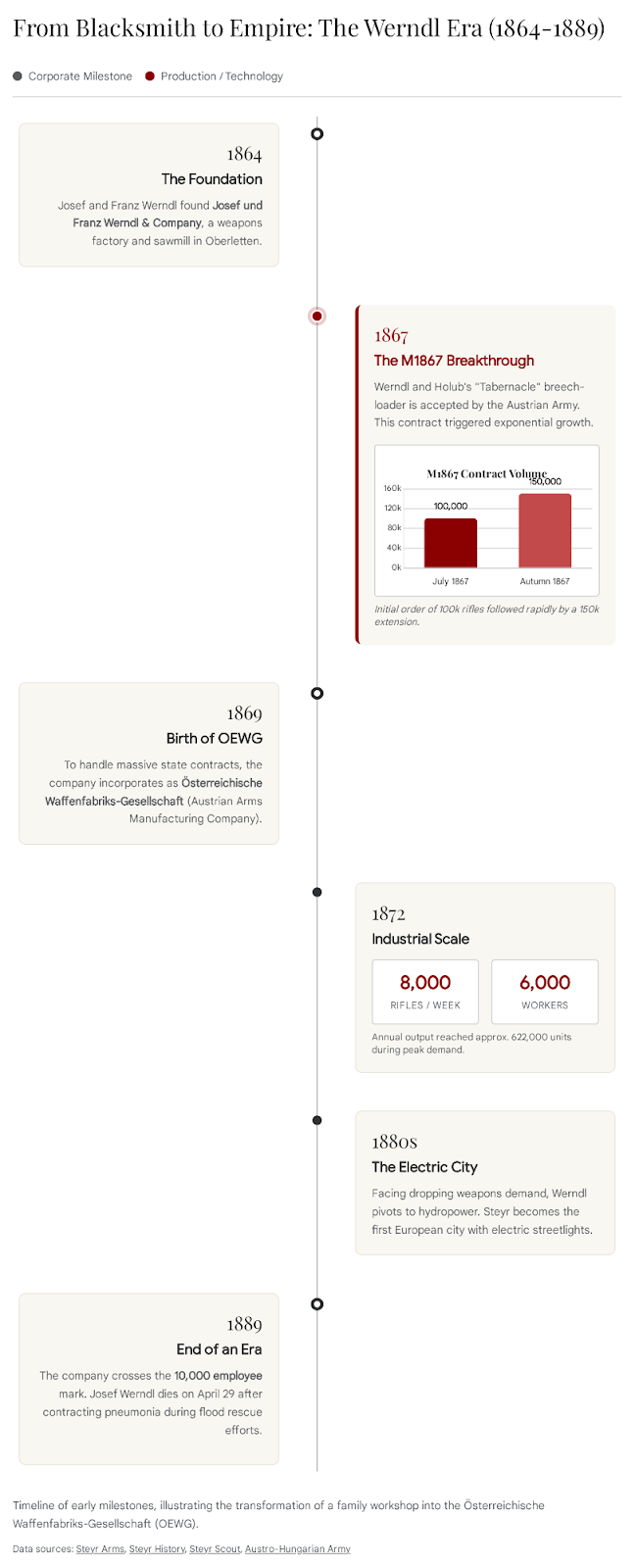
The transition from guild-based gunsmithing to industrial manufacturing began in earnest on April 16, 1864.2 Josef Werndl, a visionary 24-year-old blacksmith, partnered with his brother Franz to establish “Josef und Franz Werndl & Company, Waffenfabrik und Sägemühle in Oberletten” (Weapons Factory and Sawmill).2 Unlike his predecessors, Josef Werndl recognized that the future of armaments lay not in individual craftsmanship but in the standardization of parts and the utilization of hydraulic and electrical power.
The fledgling company’s pivotal moment arrived with the development of the “Tabernacle” breech-loading system. Designed by Werndl in collaboration with his technical director, Karl Holub, this mechanism represented a quantum leap over the muzzle-loading muskets of the era.4 The system utilized a rotating drum breech that was robust, simple to operate, and impervious to the fouling that plagued early breech-loaders.
1.2 The M1867 Contract: Scaling for the Empire
In 1867, the Austro-Hungarian Empire, reeling from its defeat in the Austro-Prussian War (where the Prussian breech-loading Dreyse needle gun had decimated Austrian muzzle-loaders), sought to modernize its arsenal. The Werndl-Holub rifle was adopted as the M1867.4
The scale of this contract was unprecedented for the region. The Imperial Army placed an initial order for 100,000 rifles, followed almost immediately by a supplemental order for 150,000 units.2 To fulfill this massive demand, the Werndl brothers could no longer operate as a family partnership. In 1869, the firm was incorporated as a joint-stock company, the Österreichische Waffenfabriks-Gesellschaft (OEWG) (Austrian Arms Manufacturing Company).2
This capitalization allowed for rapid industrial expansion. By 1872, OEWG had grown into an industrial behemoth employing 6,000 workers and achieving a production cadence of 8,000 rifles per week.2 This throughput was achieved through the implementation of advanced assembly line techniques and the utilization of the region’s hydroelectric potential.
1.3 Electrification and Social Infrastructure
Josef Werndl’s impact extended beyond the factory floor. He was a pioneer in the industrial application of electricity. In the 1880s, facing a downturn in weapons demand, Werndl leveraged the factory’s hydroelectric infrastructure to electrify the facility.5 He subsequently extended this innovation to the city itself, making Steyr the first city in Europe to feature electric street lighting.5
Werndl operated with a paternalistic industrial philosophy typical of the era but notable for its scale. The company built housing estates for workers, established social welfare programs, and integrated the factory into the civic fabric of Steyr.5 By the time of his death in 1889—contracted from pneumonia while personally supervising rescue operations during a catastrophic flood—OEWG employed over 10,000 workers and stood as the largest armory in Europe.4
2. The Mannlicher Revolution: Engineering Dominance (1886–1918)
If Josef Werndl provided the industrial muscle, Ferdinand Ritter von Mannlicher provided the intellectual capital that would define the company’s technological trajectory for decades. Born in 1848 to a prominent family, Mannlicher was a railway engineer by training, a background that informed his approach to firearms design: he viewed the rifle as a machine that required efficiency of motion and structural integrity.5
2.1 The Straight-Pull Paradigm
Mannlicher’s defining contribution to military small arms was the refinement of the straight-pull bolt action. In the late 19th century, most military rifles (like the Mauser) utilized a turn-bolt action, which required the soldier to perform four distinct movements to cycle the weapon: lift the bolt handle, pull it rearward, push it forward, and lock it down.
Mannlicher engineered a system that simplified this to two motions: a straight pull to the rear and a push forward. The bolt head rotated internally to lock and unlock, driven by camming grooves within the bolt body.7 This design theoretically offered a higher rate of fire, a critical advantage in the infantry doctrines of the time which emphasized volume of fire.
This mechanism was paired with the Mannlicher en-bloc clip system. Unlike stripper clips where rounds are stripped into the magazine and the clip is discarded, the Mannlicher system inserted the entire clip—holding five rounds—into the internal magazine. When the last round was chambered, the empty clip would drop out of a hole in the bottom of the magazine floorplate.8 This allowed for incredibly rapid reloading.
2.2 The M1895 and Global Exports
The culmination of this technology was the Mannlicher M1895 (Steyr-Mannlicher M95), adopted as the standard service rifle of the Austro-Hungarian Army.3 Known to Austrian troops as the “Ruck-Zuck” (Back-and-Forth) rifle due to its action speed, the M1895 was produced in the millions.
OEWG’s dominance was not limited to the Habsburg Empire. The factory became a premier exporter, supplying variants of Mannlicher’s designs to nations globally:
- Romania: Adopted the Md.1893.8
- Netherlands: Adopted the Dutch Mannlicher M.95.3
- Portugal: The M1904 Mauser-Vergueiro, which hybridized Mauser and Mannlicher features.8
- Export Restrictions: It is notable that while the German Empire utilized the Mauser system, Steyr held exclusive export rights for derivatives of the German Commission Rifle (Gewehr 88), which utilized Mannlicher’s magazine system.8
2.3 The Mannlicher-Schönauer: A Civilian Masterpiece
While Mannlicher focused on military efficiency, his collaboration with factory director Otto Schönauer produced what many consider the finest sporting rifle ever made: the Mannlicher-Schönauer.4
Patented in 1900, this system featured a revolutionary rotary magazine. Unlike the stacked box magazines of the time, the Schönauer magazine used a spring-loaded spool that separated each cartridge. This prevented the bullet tip of one round from resting against the primer of the next (a safety issue with pointed bullets) and ensured perfectly smooth feeding.11
The 1903 model was adopted by the Greek Army, but the rifle found its true calling in the hands of civilian hunters and explorers. Chambered in the efficient 6.5x54mm cartridge, the rifle became a favorite of writers like Ernest Hemingway and Robert Ruark, and elephant hunters like W.D.M. Bell, who prized its deep penetration and surgical precision.4 The “butter-knife” bolt handle and the seamless action became hallmarks of Steyr quality.
2.4 World War I and the Steyr-Hahn
The outbreak of World War I in 1914 pushed OEWG to its absolute limits. The factory operated around the clock to arm the Dual Monarchy. Beyond rifles, Steyr produced the Steyr M1912 (Steyr-Hahn), a robust, stripper-clip-fed semi-automatic pistol chambered in 9mm Steyr.4 This handgun was renowned for its durability in the harsh conditions of the Alpine and Eastern fronts.
However, the war’s end in 1918 brought catastrophe. The dissolution of the Austro-Hungarian Empire left OEWG without a domestic market, and the Treaty of Saint-Germain-en-Laye imposed draconian restrictions on Austrian arms production, effectively banning the manufacture of military weapons.8
3. The Interwar Metamorphosis and Dark Times (1918–1945)
The collapse of the monarchy and the treaty restrictions forced a radical pivot. The company that had armed an empire now had to survive in a truncated republic. This necessity birthed a diversified industrial conglomerate.
3.1 Diversification: Automobiles and the 1934 Merger
To survive the ban on arms production, OEWG turned to its manufacturing strengths: precision machining and assembly. The company began producing bicycles (Waffenrad), ball bearings, and automobiles.14
The economic pressures of the Great Depression forced consolidation across the Austrian industrial landscape. In 1934, Steyr-Werke AG merged with Austro-Daimler-Puchwerke A.G. to form Steyr-Daimler-Puch AG.14 This merger was a strategic accumulation of engineering talent:
- Steyr: Mass production, metallurgy, arms heritage.
- Austro-Daimler: Luxury automotive engineering (Ferdinand Porsche had served as technical director earlier in the century).
- Puch: Motorcycles, bicycles, and small engines.
This new entity was the largest industrial firm in Austria, a diversified giant capable of producing everything from compact cars (Steyr 50 “Baby”) to heavy trucks.15
3.2 The Anschluss and Integration into the Reich War Machine
The annexation of Austria by Nazi Germany (Anschluss) in 1938 fundamentally altered the company’s trajectory. The Nazi regime, seeking to harness Austrian industrial capacity for rearmament, forced the previous owners (Creditanstalt) to relinquish control. Steyr-Daimler-Puch was dissolved as an independent entity and incorporated into the Reichswerke Hermann Göring, a state-controlled industrial conglomerate.13
Under German management, the Steyr facilities were converted to total war production. The output shifted to equip the Wehrmacht:
- K98k Rifles: Steyr produced the standard German service rifle under the manufacturer code ‘bnz’.13
- MG 42 and MG 34: Components and assembly of machine guns.
- Vehicles: The Steyr RSO (Raupenschlepper Ost), a fully tracked prime mover designed for the muddy conditions of the Eastern Front.
- Aircraft Engines: Bearings and components for the Luftwaffe.14
3.3 Forced Labor and the Gusen Connection
This era represents the darkest chapter in the corporate history. To meet the insatiable labor demands of the war economy, Steyr-Daimler-Puch utilized forced labor on a massive scale. The company operated production lines within the Mauthausen-Gusen concentration camp complex.
By the end of 1943, approximately 1,300 prisoners were forced to work for Steyr-Daimler-Puch. Following severe Allied bombing raids on the main Steyr plant in February 1944 (conducted by the U.S. 15th Air Force), the company relocated critical production, including barrel manufacturing, into the underground tunnels of Gusen to protect them from air strikes.5 By the war’s end, some 5,000 concentration camp prisoners were enslaved in the production of Karabiner rifles and aircraft engines for the firm.17
4. Reconstruction and the Cold War Arms Race (1945–1980)
In 1945, Steyr lay in ruins. The city was a point of contact between American airborne/tank units and the Soviet Red Army, eventually falling under U.S. occupation.5 The Allied High Commission initially banned all weapons production.
4.1 The StG 58: Rebuilding Military Capability
It was not until 1950, with the encouragement of American officers who fondly remembered the pre-war Mannlicher-Schönauer sporters, that the Allies permitted the resumption of sporting rifle production.5
The true military renaissance began with the establishment of the Second Republic’s Armed Forces (Bundesheer) in 1955. Austria, constitutionally neutral but situated on the Iron Curtain, needed a credible defense force. In 1958, Steyr secured the license to manufacture the Belgian FN FAL battle rifle.
Designated the StG 58 (Sturmgewehr 58), the Steyr-produced FAL is widely regarded by firearms historians as the finest iteration of the platform ever built.4 Steyr utilized superior steel and manufacturing tolerances, equipping the rifle with a distinctive cold-hammer-forged barrel and a high-quality bipod. This project re-established the factory’s military production lines and trained a new generation of engineers in modern automatic weapons technology.
4.2 The SSG 69: The Sniper Revolution
In the late 1960s, Steyr revolutionized the concept of the sniper rifle. Until this point, most sniper rifles were simply accurized versions of standard infantry rifles or modified sporting rifles with wooden stocks. Wood, however, is susceptible to warping in changing humidity, which shifts the rifle’s point of impact.
In 1969, Steyr released the Scharfschützengewehr 69 (SSG 69).3 This was the first mass-produced high-precision rifle to utilize a composite (polymer) stock.
- Technological Leaps: The use of green “Cycolac” synthetic material provided absolute dimensional stability. The barrel was cold-hammer-forged, leaving the distinctive spiral mandrel marks on the exterior—a visual signature of Steyr barrels to this day.5
- Locking Action: The bolt featured rear-locking lugs, allowing for a short 60-degree bolt throw and a massive receiver ring for rigidity.
- Impact: The SSG 69 set world records for accuracy and became the standard issue for western military and police units, including the Austrian Army and the U.S. Border Patrol.5
4.3 The AUG: Birth of a Bullpup Icon
By the 1970s, the StG 58 was showing its age. The world was moving to intermediate cartridges (5.56x45mm). Under the leadership of Colonel Walter Stoll and Steyr engineers Horst Wesp, Karl Wagner, and Karl Möser, development began on a radical new weapon system.19
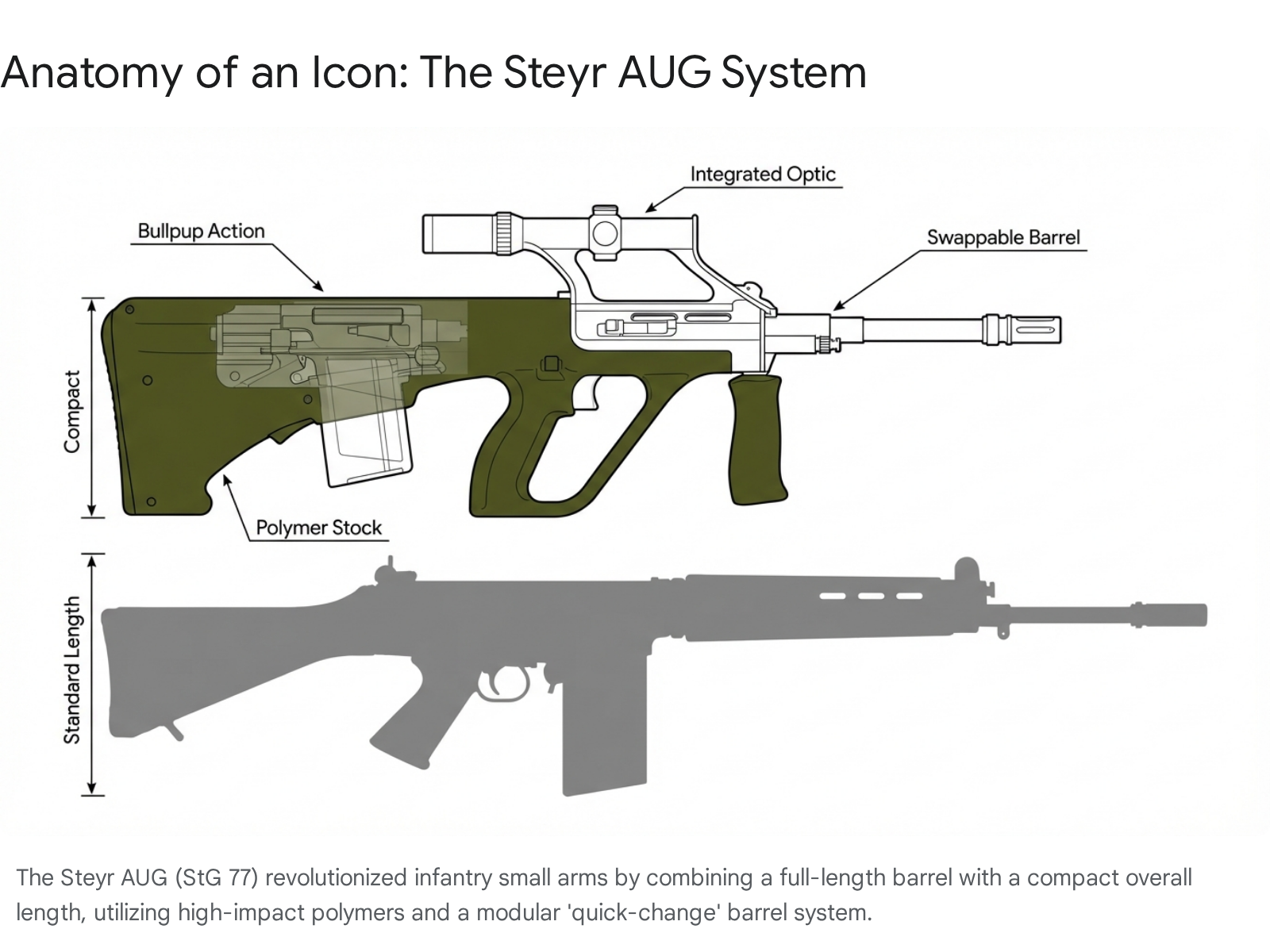
In 1977, the Austrian Army adopted the StG 77, commercially known as the Steyr AUG (Armee-Universal-Gewehr). The AUG shattered conventions:
- Bullpup Configuration: By placing the action and magazine behind the trigger group, the rifle achieved a compact overall length while retaining a full 20-inch barrel for optimal ballistics.21
- Polymer Construction: The receiver housing, hammer, and magazine were made of high-impact polymers, reducing weight and production cost.
- Modularity: A quick-change barrel system allowed the rifle to transform from a carbine to a squad automatic weapon (HBAR) in seconds.20
- Integrated Optics: The A1 model featured a built-in 1.5x Swarovski optic, making Austria the first nation to issue magnified optics as standard to general infantry.23
The AUG became a global export success, adopted by Australia, New Zealand, Ireland, Tunisia, Saudi Arabia, and many others, securing Steyr’s financial foundation for the next two decades.4
5. The Era of Independence and Innovation (1989–2018)
As the Cold War ended, the industrial landscape of Europe shifted. The era of the massive, diversified conglomerate was waning, giving way to specialization.
5.1 The Breakup of Steyr-Daimler-Puch
Between 1987 and 1998, the colossal Steyr-Daimler-Puch AG was dismantled and sold off in parts.24
- Two-Wheelers: The Puch bicycle and moped division was sold to Piaggio (Italy) in 1987.
- Automotive: The automotive technology division was acquired by Magna International in 1998, becoming Magna Steyr.24
- Heavy Defense: The heavy vehicle division eventually became part of General Dynamics European Land Systems (GDELS-Steyr).
In 1989, the small arms division was spun off as an independent entity: Steyr Mannlicher AG.3 This separation allowed the company to focus exclusively on firearms without the bureaucratic overhead of the automotive giant.
5.2 The Scout Rifle and Jeff Cooper
In the late 1990s, Steyr collaborated with the legendary American firearms instructor Lt. Col. Jeff Cooper to realize his concept of the “Scout Rifle”—a general-purpose rifle capable of taking any game up to 400kg, yet light enough to be carried all day.26
Released in 1999, the Steyr Scout was a radical departure from traditional aesthetics. It featured:
- An integrated bipod folded into the polymer stock.
- A forward-mounted rail for a long-eye-relief scope.
- Backup “ghost ring” iron sights.
- A spare magazine stored in the stock.
While controversial among traditionalists for its futuristic look, the Scout demonstrated Steyr’s willingness to innovate and established a cult following in the U.S. market.28
5.3 Modernization and Rebranding
Throughout the 2000s and 2010s, the company continued to refine its portfolio.
- Pistols: The M-series pistols introduced unique trapezoidal sights and extremely low bore axes to mitigate recoil.29
- Hunting: The Steyr Monobloc was introduced in 2018, featuring a barrel and action machined from a single piece of steel to maximize rigidity and accuracy.14
- Rebranding: In 2019, to better align with its international identity, Steyr Mannlicher officially changed its name to Steyr Arms.24
6. The Transatlantic Bridge: Steyr Arms USA and 922(r) Compliance
A critical component of Steyr’s modern strategy is its robust presence in the United States, the world’s largest civilian firearms market.
6.1 The Bessemer Hub
Steyr Arms Inc., the U.S. subsidiary, is headquartered in Bessemer, Alabama. The company moved to this facility from Trussville in 2013 and announced a significant $2.9 million expansion in 2018/2019.30
This facility is not merely a sales office; it is a manufacturing hub essential for regulatory compliance. Under 18 U.S.C. § 922(r), it is unlawful to assemble a semi-automatic rifle from imported parts if the rifle is not generally recognized as suitable for sporting purposes.32 This law effectively bans the direct importation of military-configuration rifles like the AUG.
6.2 Domestic Manufacturing Strategy
To bypass these restrictions, Steyr Arms USA manufactures key components domestically.
- Receivers & Barrels: The Bessemer facility machines receivers and utilizes cold-hammer-forging equipment to produce barrels locally.34
- Compliance: By ensuring that a sufficient number of parts (such as the receiver, barrel, and trigger components) are U.S.-made, the company can legally sell the AUG A3 M1 to American civilians.35
This strategy, spearheaded by U.S. CEO Scott O’Brien, has allowed Steyr to double its workforce in Alabama and secure a steady revenue stream from the U.S. market, insulating it from fluctuations in European military procurement.30
7. Financials and Corporate Strategy: The RSBC Era
The most transformative event in recent history occurred in April 2024, signaling a shift from independence to strategic consolidation.
7.1 The Acquisition by RSBC
On April 23, 2024, the Czech investment group RSBC, founded by Robert Schönfeld, acquired 100% of Steyr Arms from its previous owner, SMH Holding GmbH.37 While the transaction price was undisclosed, the acquisition included both the Austrian headquarters and the U.S. subsidiary.
Financial Scale: Steyr Arms reported revenues exceeding €45 million in 2023, with a workforce of over 200 employees across Austria and the USA.38
7.2 The Strategic Logic: Synergy with AREX
RSBC is an active strategic investor in the defense sector. In 2017, the group acquired AREX Defense, a Slovenian manufacturer known for its high-quality pistols (Rex Zero 1, Delta) and ammunition links.38
The acquisition of Steyr Arms creates a powerful Central European defense holding. The two companies are highly complementary:
- Steyr Arms: Specializes in long guns (Assault Rifles, Sniper Rifles, Hunting) and carries a premium heritage brand.
- AREX Defense: Specializes in handguns and training ammunition, offering high value-for-money products.40
7.3 New Leadership
The combined holding is led by Tim Castagne, a seasoned executive with over three decades of experience at major industry players like SIG Sauer and Heckler & Koch.38 His appointment suggests a move towards aggressive international sales and a unified marketing strategy that leverages Steyr’s brand equity to elevate AREX products, while using AREX’s cost-efficiency to compete in markets where Steyr was previously too expensive.

8. Strategic Outlook: Products and Markets (2025–2030)
Looking ahead, Steyr Arms is positioned to leverage its new ownership structure to capture market share in both the defense and civilian sectors.
8.1 Recent Wins: The Bundeswehr Contract
A major validation of Steyr’s continued relevance occurred in April 2024, when the company won a contract to supply the GL-40 grenade launcher to the German Bundeswehr.41 This launcher will be mounted on the new HK416 (G95) assault rifles. Winning a contract with the German military—beating out domestic competitors—demonstrates that Steyr’s engineering remains top-tier.
8.2 Product Innovation
- The Steyr GAMS: In the hunting sector, Steyr recently launched the GAMS (Chamois), a specialized ultra-lightweight rifle for mountain hunting featuring a carbon fiber stock.43 This targets the high-end European demographic and reinforces the brand’s Alpine heritage.
- AUG Modernization: With the U.S. Army moving to the Next Generation Squad Weapon (NGSW), the era of the 5.56mm NATO round is evolving. Steyr will likely need to continue iterating the AUG (potentially exploring new calibers or “smart” rail integration) to keep the platform relevant for existing users like Australia and Austria.
8.3 Industry Trends
The firearms industry is seeing a trend of consolidation, where mid-sized heritage brands are acquired by investment groups (e.g., Remington’s breakup, Colt’s acquisition by CZ). Steyr’s absorption into RSBC follows this pattern. The challenge for Steyr will be to maintain its reputation for uncompromising quality—often associated with higher costs—while operating under the financial imperatives of an investment group seeking growth and efficiency.
9. Summary of Major Milestones
| Year | Event | Significance |
| 1864 | Founding of Josef und Franz Werndl & Co. | Establishment of industrial arms manufacturing in Steyr. |
| 1867 | Adoption of M1867 Werndl-Holub Rifle | First major military contract (Austro-Hungarian Army). |
| 1869 | Establishment of OEWG | Transformation into a joint-stock company (Österreichische Waffenfabriks-Gesellschaft). |
| 1886 | Introduction of Mannlicher Action | First straight-pull bolt action service rifle. |
| 1889 | Death of Josef Werndl | End of the founding era; company employs 10,000+. |
| 1895 | Adoption of Mannlicher M1895 | The definitive Austro-Hungarian service rifle of WWI. |
| 1903 | Mannlicher-Schönauer Licensed | Start of the legendary rotary-magazine sporting rifle lineage. |
| 1912 | Steyr-Hahn M1912 Pistol | Adoption of a robust semi-automatic service pistol. |
| 1918 | End of WWI | Collapse of Austro-Hungarian Empire; forced diversification into autos/cycles. |
| 1934 | Merger to Steyr-Daimler-Puch AG | Consolidation of Steyr, Austro-Daimler, and Puch. |
| 1938 | Anschluss | Incorporation into Reichswerke Hermann Göring; switch to Wehrmacht production. |
| 1944 | Bombing of Steyr | Severe damage to facilities by Allied air raids. |
| 1950 | Production Resumes | Allied permission granted to restart sporting rifle production. |
| 1958 | StG 58 (FN FAL) Production | Licensing of the FAL re-establishes military manufacturing capability. |
| 1969 | Launch of SSG 69 | The first mass-produced synthetic-stocked sniper rifle. |
| 1977 | Adoption of StG 77 (AUG) | The first successful widespread adoption of a bullpup rifle. |
| 1987 | Breakup of Conglomerate Begins | Steyr-Daimler-Puch begins selling off divisions (Puch sold to Piaggio). |
| 1989 | Independence of Steyr Mannlicher | Small arms division spun off as a separate company. |
| 1998 | Magna Acquisition of Auto Division | The remaining automotive arm becomes Magna Steyr. |
| 1999 | Launch of Steyr Scout | Collaboration with Jeff Cooper creates the Scout Rifle concept. |
| 2004 | Headquarters Move | Company moves to new modern facility in Kleinraming. |
| 2013 | Expansion in Bessemer, AL | Steyr Arms USA moves to larger facility to support US market. |
| 2019 | Rebranding | “Steyr Mannlicher” officially rebrands to “Steyr Arms”. |
| 2024 | Acquisition by RSBC | Steyr Arms acquired by Czech investment group RSBC; joins AREX Defense. |
If you find this post useful, please share the link on Facebook, with your friends, etc. Your support is much appreciated and if you have any feedback, please email me at in**@*********ps.com. Please note that for links to other websites, we are only paid if there is an affiliate program such as Avantlink, Impact, Amazon and eBay and only if you purchase something. If you’d like to directly contribute towards our continued reporting, please visit our funding page.
Sources Used
- Where it Started | Steyr Arms USA, accessed December 21, 2025, https://steyr-arms.us/blog/where-it-started/
- Steyr-Mannlicher, accessed December 21, 2025, http://www.steyrscout.org/steyr.htm
- Steyr Arms – Wikipedia, accessed December 21, 2025, https://en.wikipedia.org/wiki/Steyr_Arms
- Our History, accessed December 21, 2025, https://static.secure.website/wscfus/9015682/uploads/Steyr_History.pdf
- About Us | Steyr Arms USA, accessed December 21, 2025, https://steyr-arms.us/about-us/
- Josef Werndl – Austro-Hungarian Army, accessed December 21, 2025, https://www.austro-hungarian-army.co.uk/biog/werndl.htm
- Ferdinand von Mannlicher | steyrerpioniere – WordPress.com, accessed December 21, 2025, https://steyrerpioniere.wordpress.com/2011/07/10/ferdinand-von-mannlicher/
- I saw we are Turn-Bolt-Mannlicher Posting – Md.1893, M. 95, Y:1903 and Y:1903/14 – Reddit, accessed December 21, 2025, https://www.reddit.com/r/milsurp/comments/1etr3v8/i_saw_we_are_turnboltmannlicher_posting_md1893_m/
- Last Of The Mannlicher Systems – GUNS Magazine, accessed December 21, 2025, https://gunsmagazine.com/guns/rifles/last-of-the-mannlicher-systems/
- Mannlicher M1895 – Wikipedia, accessed December 21, 2025, https://en.wikipedia.org/wiki/Mannlicher_M1895
- Mannlicher–Schönauer – Wikipedia, accessed December 21, 2025, https://en.wikipedia.org/wiki/Mannlicher%E2%80%93Sch%C3%B6nauer
- A Forgotten Giant: A Brief Look at Military Small Arms Production at Steyr, Austria 1864-1900, accessed December 21, 2025, https://americansocietyofarmscollectors.org/wp-content/uploads/2019/06/2002-B85-A-Forgotten-Giant-A-Brief-Look-at-Milita.pdf
- Steyr | laststandonzombieisland, accessed December 21, 2025, https://laststandonzombieisland.com/tag/steyr/
- History | STEYR ARMS, accessed December 21, 2025, https://www.steyr-arms.com/en/company/history/
- Steyr-Daimler-Puch AG – Archived 5/2001 – Forecast International, accessed December 21, 2025, https://www.forecastinternational.com/archive/disp_old_pdf.cfm?ARC_ID=399
- Steyr Daimler Puch, accessed December 21, 2025, https://www.allisons.org/ll/4/Steyr/
- Steyr-Daimler-Puch AG. – KZ-Gedenkstätte Gusen, accessed December 21, 2025, https://www.gusen-memorial.org/en/History/Forced-Labour/Steyr-Daimler-Puch-AG-
- The Steyr AUG: AUS-yeah (VIDEO) – Guns.com, accessed December 21, 2025, https://www.guns.com/news/2014/01/15/steyr-aug-bullpup-top-dog-video
- The Steyr AUG: A Revolutionary Bullpup in Military History – Bereli Inc., accessed December 21, 2025, https://www.bereli.com/blog/the-steyr-aug-a-revolutionary-bullpup-in-military-history/
- The Illustrious History of the AUG | Steyr Arms USA, accessed December 21, 2025, https://steyr-arms.us/blog/the-illustrious-history-of-the-aug/
- The Steyr AUG: A Legendary Bullpup Rifle Built for Performance | Heresy Design, accessed December 21, 2025, https://heresydesign.com/2025/07/18/steyr-aug-rifle-overview/
- steyr AUG | laststandonzombieisland, accessed December 21, 2025, https://laststandonzombieisland.com/tag/steyr-aug/
- Steyr AUG – Wikipedia, accessed December 21, 2025, https://en.wikipedia.org/wiki/Steyr_AUG
- Steyr-Daimler-Puch – Wikipedia, accessed December 21, 2025, https://en.wikipedia.org/wiki/Steyr-Daimler-Puch
- history of the company Steyr-Daimler-Puch – Haflinger Ersatzteile, accessed December 21, 2025, https://www.haflinger-ersatzteile.at/index.php/en/home/members-area/history-of-the-company-steyr-daimler-puch
- A History Of The Steyr Scout, accessed December 21, 2025, http://www.steyrscout.org/scouthis.htm
- Scout rifle – Grokipedia, accessed December 21, 2025, https://grokipedia.com/page/Scout_rifle
- Throwback Thursday: The Scout Rifle Realized | An Official Journal Of The NRA, accessed December 21, 2025, https://www.americanrifleman.org/content/throwback-thursday-the-scout-rifle-realized/
- Timeline Express Announcements Archive | Page 2 Of 4 | STEYR ARMS, accessed December 21, 2025, https://www.steyr-arms.com/en/announcement/page/2/
- Steyr Arms to expand facility in Bessemer, add manufacturing component, accessed December 21, 2025, https://www.bessemeral.org/steyr-arms-to-expand-facility-in-bessemer-add-manufacturing-component/
- Steyr Arms Hiring for Alabama Manufacturing Plant | An Official Journal Of The NRA, accessed December 21, 2025, https://www.shootingillustrated.com/content/steyr-arms-hiring-for-alabama-manufacturing-plant/
- 922(r) and You: A Breakdown : r/guns – Reddit, accessed December 21, 2025, https://www.reddit.com/r/guns/comments/1v8wyh/922r_and_you_a_breakdown/
- 922r Compliance: Everything You Need to Know – FastBound, accessed December 21, 2025, https://www.fastbound.com/ffl-blog/what-is-922r-compliance/
- OEM Manufacturing | Steyr Arms USA, accessed December 21, 2025, https://steyr-arms.us/oem-manufacturing/
- So new AUG rifles are USA made? – Reddit, accessed December 21, 2025, https://www.reddit.com/r/AUG/comments/1ebaiu8/so_new_aug_rifles_are_usa_made/
- Steyr Arms to add manufacturing at Alabama operation in $2.9M expansion, accessed December 21, 2025, https://www.madeinalabama.com/2017/06/steyr-arms/
- RSBC acquires leading European arms manufacturer, Austrian STEYR ARMS, accessed December 21, 2025, https://www.rsbcgroup.com/en/media/rsbc-acquires-leading-european-arms-manufacturer-austrian-steyr-arms
- Czech financial investor RSBC announces the takeover of Austrian firearm manufacturer STEYR ARMS | all4shooters, accessed December 21, 2025, https://www.all4shooters.com/en/shooting/culture/czech-rsbc-group-buys-arms-manufacturer-steyr-arms/
- RSBC Group acquires Steyr Arms | GUNSweek.com, accessed December 21, 2025, https://gunsweek.com/en/gun-industry/news/rsbc-group-acquires-steyr-arms
- AREX | RSBC, accessed December 21, 2025, https://www.rsbcgroup.com/en/activities/investment-funds/arex
- Future equipment of the German Army – Wikipedia, accessed December 21, 2025, https://en.wikipedia.org/wiki/Future_equipment_of_the_German_Army
- STEYR ARMS Secures Contract for New Grenade Launcher with the German Bundeswehr, accessed December 21, 2025, https://fragoutmag.com/steyr-arms-secures-contract-for-new-grenade-launcher-with-the-german-bundeswehr/
- Gams | STEYR ARMS, accessed December 21, 2025, https://www.steyr-arms.com/en/hunting-rifles/gams/