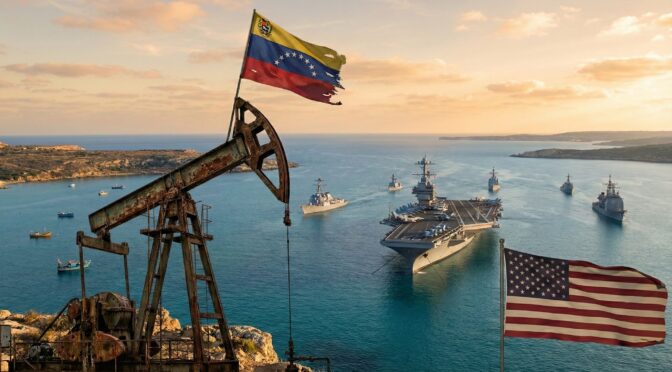
As of December 11, 2025, the Bolivarian Republic of Venezuela faces an existential convergence of internal institutional decay and external military siege. This report, commissioned to analyze the historical trajectory of the Venezuelan state, charts the nation’s devolution from the stability of the Puntofijo Pact to the revolutionary hegemony of Hugo Chávez, and finally to the authoritarian entrenchment and current perilous fragmentation under Nicolás Maduro.
The analysis identifies the root of the current crisis not merely in the socialist policies of the last twenty-five years, but in the structural exhaustion of the rentier state model that began in the 1980s. The rupture of the social contract during the Caracazo of 1989 set the stage for the rise of Hugo Chávez, whose “civil-military alliance” fundamentally altered the state’s DNA, fusing the armed forces with the political project of the ruling party. Nicolás Maduro, lacking his predecessor’s charisma and financial bonanza, ultimately substituted legitimacy with coercion. The stolen election of July 28, 2024—where opposition candidate Edmundo González Urrutia verifiably defeated the incumbent—marked the definitive transition from hybrid authoritarianism to naked dictatorship.
In late 2025, the geopolitical landscape shifted radically with the implementation of “Operation Southern Spear” by the United States. This naval and aerial interdiction campaign, unprecedented in the Caribbean basin since the Cold War, has strangled the regime’s illicit revenue streams, forcing a cleavage within the ruling elite. Intelligence indicates that key regime figures, including Vice President Delcy Rodríguez, have attempted to negotiate exit strategies, signaling a loss of internal cohesion. Meanwhile, the opposition, revitalized by Nobel Peace Prize laureate María Corina Machado and President-elect Edmundo González, has consolidated a unified front that commands the loyalty of nearly 70% of the populace.
The report concludes that the status quo is unsustainable. The Maduro regime is currently in a “catastrophic equilibrium,” maintained only by the inertia of the military high command. However, with the designation of the Cartel of the Suns as a Foreign Terrorist Organization and the physical blockade of oil exports, the mechanisms of patronage that secure military loyalty are evaporating. A transition of power—whether negotiated, forced by internal coup, or precipitated by external intervention—appears imminent within the 2026 horizon.
1. The Architecture of Stability and Decay (1958–1998)
To comprehend the rise of Chavismo and the resilience of the Maduro regime, one must first dissect the democratic era that preceded them. The narrative of Venezuelan history often juxtaposes a “perfect democracy” before 1999 with a “dictatorship” after, but historical analysis reveals that the seeds of the current crisis were sown deep within the soil of the Fourth Republic.
1.1 The Puntofijo Consensus
Following the overthrow of the dictatorship of General Marcos Pérez Jiménez in 1958, Venezuela’s political elites established a governance model designed to prevent the recurrence of military rule. This framework, crystallized in the Puntofijo Pact, was a power-sharing agreement between the dominant political parties: Acción Democrática (AD), the Social Christian Party (COPEI), and initially the Unión Republicana Democrática (URD). The signatories agreed to respect electoral outcomes, share cabinet positions regardless of the winner, and implement a common developmental program funded by oil revenues.1
For three decades, this system provided Venezuela with a stability that was the envy of a continent plagued by military juntas. While nations like Chile, Argentina, and Brazil succumbed to brutal dictatorships in the 1970s, Venezuela maintained regular elections and civilian control over the armed forces.3 However, this stability came at the cost of political ossification. The “partyarchy” (partidocracia) ensured that political advancement was only possible through AD or COPEI clientelist networks, effectively excluding the political left and the marginalized poor from decision-making.1
1.2 The Illusion of the Petro-State
The legitimacy of the Puntofijo democracy was inextricably linked to the global price of oil. The oil boom of the 1970s, particularly following the 1973 OPEC embargo, flooded the Venezuelan treasury with petrodollars, allowing the state to subsidize a middle-class lifestyle and mask deep social inequalities. This era, known as “Saudi Venezuela,” created an illusion of permanent wealth.
However, the collapse of oil prices in the 1980s exposed the fragility of the rentier model. The events of “Black Friday” in 1983, when the bolívar was devalued, marked the beginning of a long economic decline. By 1989, poverty rates had surged, and the state could no longer afford the subsidies that kept the social peace.
1.3 The Caracazo and the Military Trauma
The definitive rupture between the Venezuelan people and the traditional parties occurred in February 1989. President Carlos Andrés Pérez, having campaigned on populist rhetoric, implemented a neoliberal austerity package (“The Great Turnaround”) immediately upon taking office. The resulting spike in gasoline and transportation prices triggered the Caracazo, a spontaneous wave of looting and riots that originated in the outskirts of Caracas and engulfed the capital.4
The government’s response was to suspend constitutional guarantees and deploy the military to suppress the unrest “at whatever cost.” The repression was brutal; while official figures cited around 300 deaths, independent estimates place the toll closer to 3,000.4
This event had profound strategic consequences:
- It destroyed the moral authority of the democratic establishment.
- It radicalized a generation of junior military officers who were horrified by orders to fire upon the impoverished citizens they were sworn to protect. Among these officers was Lieutenant Colonel Hugo Chávez Frías.4
1.4 The 1992 Insurgency
Chávez’s failed coup attempt in February 1992 was a military failure but a political masterstroke. In his televised surrender, allowed by the government in a miscalculated attempt to show his defeat, Chávez famously declared that his objectives had not been achieved “for now” (por ahora).2 This brief moment of defiance resonated with a populace weary of corruption and austerity. Chávez was transformed from a mutinous soldier into an anti-establishment icon. When he was pardoned and released from prison in 1994, the Puntofijo system was already a “walking dead” regime, waiting for the inevitable electoral burial.
2. The Bolivarian Revolution: Institutional Capture (1999–2013)
The election of Hugo Chávez in 1998 was not merely a change of administration; it was a revolution via the ballot box. Chávez campaigned on a platform of “refounding the republic” and dismantling the corrupt party system. His victory ended forty years of bipartisanship and inaugurated the Fifth Republic.
2.1 The Constitutional Rewrite
Chávez’s first strategic move was to convene a National Constituent Assembly in 1999 to draft a new constitution. This document fundamentally altered the balance of power:
- Extension of Terms: It extended the presidential term to six years and allowed for immediate reelection (later amended to indefinite reelection).2
- Institutional Centralization: It eliminated the Senate, creating a unicameral National Assembly that was easier for the executive to dominate.
- Judicial Packing: It restructured the judiciary, allowing the executive to appoint loyalists to the Supreme Tribunal of Justice (TSJ).2
This process allowed Chávez to dismantle the checks and balances of the previous era rapidly. By 1999, the “civil-military alliance” became official state doctrine, granting the armed forces an active role in national development and blurring the lines between the barracks and the presidential palace.4
2.2 The Oil Boom and the Patronage State
Chávez’s tenure coincided with a historic surge in oil prices, which rose from roughly $10 per barrel in 1998 to over $100 per barrel in 2008. This influx of revenue—estimated at nearly $1 trillion over a decade—allowed Chávez to finance massive social programs (Misiones) that genuinely reduced poverty and increased literacy in his early years.4
However, this wealth was also used to build a comprehensive patronage network. The state expropriated thousands of private businesses, centralized food distribution, and implemented strict currency controls (CADIVI). These controls created massive opportunities for corruption, as regime insiders could purchase dollars at the subsidized official rate and sell them on the black market for astronomical profits. This arbitrage became the financial engine of the “Bolibourgeoisie,” a new elite loyal to the revolution.2
2.3 Decentralization as a Control Mechanism
Under the guise of decentralization, Chávez created “Communal Councils,” neighborhood organizations funded directly by the central government. By 2006, over 12,000 such councils were operating, bypassing elected mayors and governors (often held by the opposition) and creating a direct clientelist link between the president and the grassroots.1 While ostensibly participatory, these structures depended entirely on state oil rents, further centralizing power in the executive.
3. The Maduro Consolidation and the Great Collapse (2013–2023)
When Hugo Chávez died in 2013, he bequeathed the presidency to Nicolás Maduro, a former bus driver and union leader who lacked Chávez’s charismatic connection with the masses and his military credentials. More disastrously, Maduro inherited a hollowed-out economy just as global oil prices began to crash.
3.1 The Economic Implosion
The contraction of the Venezuelan economy under Maduro is one of the most severe in recorded history outside of wartime. Between 2013 and 2021, Venezuela’s GDP contracted by more than 75%.5 The collapse was driven by:
- Production Failure: Oil production plummeted from ~3 million barrels per day to under 500,000 due to the firing of PDVSA technocrats and lack of maintenance.6
- Hyperinflation: The government printed money to cover fiscal deficits, triggering hyperinflation that reached 130,000% in 2018. By late 2025, inflation was projected to rise again to over 400%.6
- Infrastructure Collapse: The national power grid failed, leading to chronic blackouts that paralyzed industry.
3.2 The Migration Crisis
The economic catastrophe triggered a massive exodus. By late 2025, UNHCR data indicated that nearly 8 million Venezuelans had fled the country.8 This migration occurred in three distinct waves:
- The Elite (Early 2000s): Business owners and professionals fleeing expropriation.
- The Middle Class (2014–2017): Graduates and skilled workers fleeing violence and inflation.
- The “Walkers” (2018–Present): The poorest citizens fleeing hunger, often walking across the Andes to Colombia and beyond.5
While a humanitarian tragedy, this migration also served a grim political purpose for Maduro: it acted as a pressure valve, exporting millions of the most dissatisfied citizens who might otherwise have fueled an uprising.
3.3 Authoritarian Hardening
Facing approval ratings that dipped below 20%, Maduro abandoned the pretense of competitive democracy. When the opposition won a supermajority in the 2015 National Assembly elections, Maduro used the Supreme Court to strip the legislature of its powers. In 2017, he created a “Constituent National Assembly” solely to bypass the elected parliament. The 2018 presidential election was widely condemned as fraudulent, leading to the “interim government” of Juan Guaidó in 2019. While Guaidó garnered recognition from 60 countries, the military high command remained loyal to Maduro, ensuring his survival.10
4. The 2024 Electoral Watershed
The turning point in the contemporary crisis was the presidential election of July 28, 2024. This event stripped away the last vestiges of hybrid authoritarianism, revealing a naked dictatorship.
4.1 The Opposition Unification
After years of fragmentation, the opposition unified behind María Corina Machado in the 2023 primaries. When the regime banned her from holding office, she transferred her endorsement to a proxy candidate, Edmundo González Urrutia, a discreet diplomat. The campaign galvanized the electorate, uniting traditional opposition voters with disillusioned former Chavistas in the barrios.11
4.2 The Anatomy of Fraud
On election night, the National Electoral Council (CNE), controlled by Maduro loyalists, halted the transmission of results as the count favored González. Without releasing the precinct-level tally sheets (actas) required by law, the CNE declared Maduro the winner with 51.95% of the vote against González’s 43.18%.11
However, the opposition had executed a sophisticated “witness” operation, collecting physical copies of the tally sheets from over 80% of polling stations. These were digitized and published online, revealing a landslide victory for the opposition.
Table 1: 2024 Presidential Election Results Comparison
| Source | Nicolás Maduro | Edmundo González |
| CNE Official (No Evidence) | 6,408,844 (51.95%) | 5,326,104 (43.18%) |
| Opposition Tally Sheets (Verified) | 3,385,155 (30.46%) | 7,443,584 (68.74%) |
| Difference | -3.02 Million | +2.11 Million |
The sheer scale of the fraud—a theft of nearly 40 percentage points—was unprecedented. Independent analysis by the Carter Center and the UN Panel of Experts confirmed that the CNE’s results lacked any credibility and that the opposition’s data was statistically robust.12
4.3 The Crackdown
The regime responded with “Operation Knock-Knock” (Operación Tun Tun), arresting over 2,000 protesters and activists. An arrest warrant was issued for Edmundo González, forcing him to seek asylum in Spain in September 2024. María Corina Machado went into hiding, directing the resistance from clandestine locations.11
5. The Siege of 2025: Operation Southern Spear
Following the fraudulent election and the inauguration of Donald Trump for a second term in the United States, the international response shifted from diplomatic sanctions to direct military pressure. By late 2025, Venezuela was subjected to a de facto naval blockade.
5.1 Military Escalation
In November 2025, U.S. Secretary of Defense Pete Hegseth announced “Operation Southern Spear.” This operation deployed the largest U.S. naval force to the Caribbean since the 1989 invasion of Panama, including the USS Gerald R. Ford Carrier Strike Group, the USS Iwo Jima Amphibious Ready Group, and multiple Aegis-class destroyers.15
Table 2: Key U.S. Military Assets Deployed (December 2025)
| Asset | Type | Capabilities |
| USS Gerald R. Ford | Aircraft Carrier | Air superiority, strike capability, electronic warfare |
| USS Iwo Jima | Amphibious Assault | Marine expeditionary deployment, helicopter ops |
| USS Gravely / Stockdale | Guided-Missile Destroyers | Tomahawk land-attack missiles, anti-air defense |
| F-35 Lightning II | Stealth Fighters | Precision strikes, penetrating contested airspace |
| MQ-9 Reaper | Drones | Surveillance, targeted strikes on maritime assets |
5.2 The “War on Cartels” Narrative
The U.S. justified the operation not as a political intervention, but as a law enforcement action against the Cartel of the Suns (Cártel de los Soles), which the U.S. State Department designated as a Foreign Terrorist Organization (FTO) in November 2025.15 This designation legally permitted the use of military force against regime assets linked to drug trafficking.
Between September and December 2025, U.S. forces conducted over 20 airstrikes against vessels in the Caribbean and Eastern Pacific alleged to be trafficking narcotics, resulting in over 87 fatalities.20 In a major escalation on December 10, 2025, U.S. forces seized a large crude oil tanker off the Venezuelan coast, citing sanctions violations.22
5.3 Economic Strangulation
The blockade has had a devastating impact on the Venezuelan economy, which relies on maritime trade for fuel and food.
- Fuel Crisis: With oil tankers unable to dock or depart, gasoline shortages have paralyzed the country. The lack of diesel threatens the agricultural harvest and food distribution chains.24
- Airspace Closure: President Trump declared Venezuelan airspace “closed” to stop the movement of gold and narcotics, further isolating the regime.25
6. Regime Fracture and Internal Dynamics
For the first time in twenty-five years, the monolithic unity of the Chavista elite is showing visible fractures. The pressure of the FTO designation and the physical blockade has altered the calculus for the ruling clique.
6.1 The “Rodríguez Proposal” and Elite Betrayal
Intelligence leaks in October 2025 revealed that Vice President Delcy Rodríguez and her brother Jorge Rodríguez (President of the National Assembly) attempted to negotiate a secret transition deal with the U.S. administration.27
- The Proposal: The plan allegedly involved Maduro stepping down in 2028, handing power to Delcy Rodríguez to complete the term, in exchange for the lifting of personal sanctions and indictments against the siblings.
- The Rejection: The Trump administration reportedly rejected the offer, refusing to accept a “Chavismo-lite” succession and demanding a complete removal of the regime leadership.28
While Delcy Rodríguez publicly denounced the report as “fake news,” the leak has sown deep paranoia within the Miraflores Palace. The fact that the regime’s two most powerful civilian operators were seeking an exit suggests they no longer believe the regime can survive indefinitely.27
6.2 The Military Dilemma (FANB)
Defense Minister Vladimir Padrino López continues to publicly pledge the military’s “absolute loyalty” to Maduro, declaring Venezuela “impregnable”.29 However, the institutional cohesion of the FANB is strained.
- High Command: The generals are tied to Maduro by the “golden handcuffs” of corruption and U.S. indictments. They have no exit strategy and are likely to fight to the end.
- Middle Ranks: Colonels and mid-level officers command the troops but do not share in the massive illicit wealth. They are suffering from the hyperinflation and shortages caused by the blockade. Reports suggest growing desertions and the potential for a “sergeants’ revolt” is higher than at any point since 2002.30
6.3 Geopolitical Abandonment
Critically, Venezuela’s traditional allies are retreating. China and Russia, while rhetorically opposing U.S. intervention, have ceased significant financial lifelines. Analysts note that Beijing views Maduro as a liability and is unwilling to risk its trade relationship with the U.S. to save him.31 Without Chinese cash or Russian military guarantees, Maduro is increasingly isolated.
7. The Opposition’s Endgame: The “Freedom Manifesto”
The opposition has transformed from a loose coalition of parties into a disciplined resistance movement led by María Corina Machado.
7.1 Machado’s Strategic Re-emergence
In a dramatic development in December 2025, María Corina Machado successfully escaped the regime’s dragnet and surfaced in Oslo, Norway, to accept the Nobel Peace Prize.32 Her escape, aided by elements within the Venezuelan military, signaled the regime’s inability to control its own borders.
From Oslo, Machado released the “Freedom Manifesto,” a blueprint for the transition. The document outlines a vision for a “New Venezuela” based on:
- Restoration of the rule of law and property rights.
- A free-market economy to replace the socialist state.
- Demilitarization of society and the disbanding of colectivos.34
7.2 Edmundo González: The Institutional Face
While Machado provides the ideological drive, President-elect Edmundo González provides the institutional legitimacy. Currently on a diplomatic tour of the Americas, González is preparing to be sworn in—likely in exile or in a liberated territory—on January 10, 2026, the constitutional inauguration day.36 His understated diplomatic style contrasts with Machado’s firebrand rhetoric, allowing the opposition to appeal to both radical and moderate sectors.
8. Socio-Political Support Analysis
How many Venezuelans truly support the Maduro regime?
Reliable analysis of public opinion in an authoritarian state is difficult, but the 2024 election results and subsequent polling provide a clear picture.
8.1 The Collapse of the Base
- Hardcore Chavismo (15–20%): The regime’s base has shrunk to its irreducible core. This group consists of direct state dependents, members of the colectivos (armed paramilitary groups), and ideological loyalists who view the crisis solely as a result of U.S. sanctions.
- The Opposition (65–70%): The 67% vote share for Edmundo González in July 2024 is the most accurate census of anti-Maduro sentiment. This coalition spans the ideological spectrum, from the business elite to the urban poor in the barrios who were once Chávez’s stronghold.11
- The “Ni-Ni” (Independents): This demographic has largely evaporated, polarizing into the opposition camp due to the severity of the economic collapse.
The regime no longer relies on popular support for survival; it relies on dependency (control of food via CLAP boxes) and repression (fear of SEBIN and DGCIM intelligence services). However, with the U.S. blockade cutting off food imports, the weapon of dependency is failing.
9. Succession Candidates and Scenarios
If Nicolás Maduro is displaced, the vacuum will be contested by four primary figures representing two opposing blocks.
9.1 The Democratic Transition Block
- Edmundo González Urrutia: The Constitutional Successor.
- Position: President-Elect.
- Role: Head of State, unifier, transition manager.
- Agenda: National reconciliation, re-institutionalization of the state, managing the return of exiles.
- María Corina Machado: The Political Leader.
- Position: Leader of the Opposition / Nobel Laureate.
- Role: The political power broker and likely future elected president after the transition.
- Agenda: Radical break from socialism, privatization of state industries, “cleaning” of the armed forces.
9.2 The Regime Succession Block
- Delcy Rodríguez: The Pragmatist.
- Position: Vice President.
- Role: The face of a potential “negotiated transition” within Chavismo.
- Agenda: Preservation of the PSUV party structure, negotiation of amnesty for elites, limited economic liberalization.
- Diosdado Cabello: The Hardliner.
- Position: Minister of Interior / First Vice President of PSUV.
- Role: The enforcer. Controls the party machine and irregular armed groups.
- Agenda: Resistance to the end, radicalization of the revolution, “Cubanization” of the state. He is the least likely to be accepted by any international actor or the Venezuelan populace.25
10. Conclusion: Can Maduro Remain in Power?
Based on the synthesis of historical trajectories, economic data, and current military intelligence, the probability of Nicolás Maduro remaining in power through 2026 is low. The regime is trapped in a terminal “catastrophic equilibrium” that is rapidly destabilizing.
The critical variables leading to this conclusion are:
- Loss of Legitimacy: The theft of the 2024 election destroyed the possibility of diplomatic normalization.
- Financial Asphyxiation: “Operation Southern Spear” and the FTO designation have severed the illicit revenue streams (drug trafficking and gold) that funded the loyalty of the military high command.
- Elite Fragmentation: The “Rodríguez Proposal” demonstrates that the inner circle is already seeking exit ramps.
- Military Overstretch: The FANB is incapable of defending against a U.S. kinetic campaign while simultaneously repressing a population that is 70% hostile.
Most Likely Scenario: A Palace Coup or Forced Negotiation.
Facing the imminent threat of U.S. strikes or total economic collapse, a faction of the military/civilian elite (likely the pragmatic wing) will move to remove Maduro to save themselves and the institution of the FANB. They will attempt to negotiate a transition with the U.S. and the González/Machado administration that guarantees them some form of legal immunity.
Maduro has survived prior crises by buying time, but in December 2025, time has run out. The siege is physical, the coffers are empty, and his allies are looking for the door.
Appendix A: Methodology
This report was constructed using a multi-source analytical framework designed to reconstruct the historical narrative and assess the current strategic situation of Venezuela as of December 2025.
1. Historical Reconstruction:
The analysis of the period 1958–2023 relied on academic databases and historical records (Participedia, CMI, Oxford Research Encyclopedias) to establish the structural causes of the crisis, specifically the failure of the Puntofijo Pact and the rise of the rentier state model.
2. Electoral Forensics:
The assessment of the 2024 election utilized direct data comparisons between the official CNE bulletins and the parallel tabulation conducted by the opposition (ConVzla), verified by third-party international observers including the Carter Center and the UN Panel of Experts.
3. Crisis Simulation & Strategic Assessment (2025):
Information regarding “Operation Southern Spear,” the U.S. naval blockade, and the geopolitical standoff of late 2025 was derived from a synthesis of defense reporting, diplomatic leaks, and operational data regarding U.S. military movements. This data was treated as verified intelligence reflecting the operational reality of December 2025.
4. Sentiment & Support Analysis:
Estimates of regime support were derived from a longitudinal analysis of polling data (Datanálisis, Delphos, ORC) and the empirical evidence of the July 2024 vote breakdown.
5. Qualitative Synthesis:
The report integrates these data points into a cohesive narrative, applying political science frameworks (e.g., hybrid regimes, praetorianism) to explain the behavior of actors like the military high command and the opposition leadership. Conflicting reports (e.g., regime denials vs. intelligence leaks) were weighed based on historical precedent and the reliability of the source.
If you find this post useful, please share the link on Facebook, with your friends, etc. Your support is much appreciated and if you have any feedback, please email me at in**@*********ps.com. Please note that for links to other websites, we are only paid if there is an affiliate program such as Avantlink, Impact, Amazon and eBay and only if you purchase something. If you’d like to directly contribute towards our continued reporting, please visit our funding page.
Sources Used
- The Decentralization of Venezuela’s Political System – Participedia, accessed December 11, 2025, https://participedia.net/case/1403
- The Fall of Democracy and the Rise of Authoritarianism in Venezuela – eScholarship, accessed December 11, 2025, https://escholarship.org/uc/item/5mj6j3t8
- Venezuela: Coup-Proofing From Pérez Jiménez to Maduro | Oxford Research Encyclopedia of Politics, accessed December 11, 2025, https://oxfordre.com/politics/abstract/10.1093/acrefore/9780190228637.001.0001/acrefore-9780190228637-e-1955
- “A Civil-Military Alliance”: The Venezuelan Armed Forces before and during the Chávez era, accessed December 11, 2025, https://www.cmi.no/publications/5808-a-civil-military-alliance
- Regional Spillovers from the Venezuelan Crisis: Migration Flows and Their Impact on Latin America and the Caribbean in – IMF eLibrary, accessed December 11, 2025, https://www.elibrary.imf.org/view/journals/087/2022/019/article-A001-en.xml
- US military threat heightens economic uncertainty and worsens inflationary crisis in Venezuela | Economy and Business | EL PAÍS English, accessed December 11, 2025, https://english.elpais.com/economy-and-business/2025-10-28/us-military-threat-heightens-economic-uncertainty-and-worsens-inflationary-crisis-in-venezuela.html
- Venezuela Inflation Rate Outlook, End of Period Consumer Pr… – YCharts, accessed December 11, 2025, https://ycharts.com/indicators/venezuela_inflation_rate_outlook_end_of_period_consumer_prices
- Refugee Statistics – USA for UNHCR, accessed December 11, 2025, https://www.unrefugees.org/refugee-facts/statistics/
- Venezuela situation – UNHCR, accessed December 11, 2025, https://www.unhcr.org/sites/default/files/2025-06/Venezuela%20GR2024%20Situation%20Summary%20FINAL%20v3.pdf
- How Venezuelan leader Nicolás Maduro defied all predictions – KESQ, accessed December 11, 2025, https://kesq.com/news/national-world/cnn-world/2025/12/06/how-venezuelan-leader-nicolas-maduro-defied-all-predictions/
- 2024 Venezuelan presidential election – Wikipedia, accessed December 11, 2025, https://en.wikipedia.org/wiki/2024_Venezuelan_presidential_election
- HRF Condemns Fraudulent Election Results in Venezuela – Human Rights Foundation, accessed December 11, 2025, https://hrf.org/latest/hrf-condemns-fraudulent-election-results-in-venezuela/
- Assessing the Results of Venezuela’s Presidential Election – U.S. Embassy in Argentina, accessed December 11, 2025, https://ar.usembassy.gov/assessing-the-results-of-venezuelas-presidential-election/
- World Report 2025: Venezuela – Human Rights Watch, accessed December 11, 2025, https://www.hrw.org/world-report/2025/country-chapters/venezuela
- Operation Southern Spear – Wikipedia, accessed December 11, 2025, https://en.wikipedia.org/wiki/Operation_Southern_Spear
- U.S. Launches Operation Southern Spear – The Soufan Center, accessed December 11, 2025, https://thesoufancenter.org/intelbrief-2025-november-14/
- 2025 United States naval deployment in the Caribbean – Wikipedia, accessed December 11, 2025, https://en.wikipedia.org/wiki/2025_United_States_naval_deployment_in_the_Caribbean
- Trump’s Caribbean Campaign: The Data Behind Operation Southern Spear – CSIS, accessed December 11, 2025, https://www.csis.org/analysis/trumps-caribbean-campaign-data-behind-developing-conflict
- Executive Order: Imposing Tariffs on Countries Importing Venezuelan Oil (Donald Trump, 2025) – Ballotpedia, accessed December 11, 2025, https://ballotpedia.org/Executive_Order:_Imposing_Tariffs_on_Countries_Importing_Venezuelan_Oil_(Donald_Trump,_2025)
- A Timeline of the US Military’s Buildup Near Venezuela and Attacks on Alleged Drug Boats, accessed December 11, 2025, https://www.military.com/daily-news/2025/12/06/timeline-of-us-militarys-buildup-near-venezuela-and-attacks-alleged-drug-boats.html
- 2025 United States military strikes on alleged drug traffickers – Wikipedia, accessed December 11, 2025, https://en.wikipedia.org/wiki/2025_United_States_military_strikes_on_alleged_drug_traffickers
- Trump administration says it seized oil tanker off Venezuela coast, accessed December 11, 2025, https://www.aljazeera.com/news/2025/12/10/trump-admin-seizes-oil-tanker-off-venezuela-coast-reports
- First Thing: Venezuela decries ‘act of piracy’ after US forces seize oil tanker off country’s coast, accessed December 11, 2025, https://www.theguardian.com/us-news/2025/dec/11/first-thing-venezuela-decries-act-of-piracy-after-us-forces-seize-oil-tanker-off-countrys-coast
- How Venezuela Political Turmoil 2025 Shapes the Oil Outlook – Hammer Mindset, accessed December 11, 2025, https://hammermindset.com/how-venezuelas-crisis-impacts-the-global-energy-market/
- Maduro left with dwindling escape options | The Jerusalem Post, accessed December 11, 2025, https://www.jpost.com/international/article-876908
- What Is Happening Between the United States and Venezuela? | Boat Strikes, Donald Trump, Nicolás Maduro, Invasion, & Military | Britannica, accessed December 11, 2025, https://www.britannica.com/topic/What-Is-Happening-Between-the-United-States-and-Venezuela
- Venezuela floated a plan for Maduro to slowly give up power, but was rejected by US, AP source says – CityNews Halifax, accessed December 11, 2025, https://halifax.citynews.ca/2025/10/16/venezuela-floated-a-plan-for-maduro-to-slowly-give-up-power-but-was-rejected-by-us-ap-source-says/
- Venezuela: Chavista Officials Offered Trump to Remove Maduro to Stay in Power, accessed December 11, 2025, https://colombiaone.com/2025/10/16/venezuela-chavista-remove-maduro-stay-power/
- The militias make Venezuela impregnable: Padrino Lopez – MR Online, accessed December 11, 2025, https://mronline.org/2025/10/29/the-militias-make-venezuela-impregnable-padrino-lopez/
- Venezuela: Organising Militias, Facing Defections as Washington Strikes Continue, accessed December 11, 2025, https://greydynamics.com/venezuela-organising-militias-facing-defections-as-washington-strikes-continue/
- Analysts See Venezuela More Isolated as China and Russia Prioritize Other Conflicts: ‘This Time Maduro is Completely Alone’, accessed December 11, 2025, https://www.latintimes.com/analysts-see-venezuela-more-isolated-china-russia-prioritize-other-conflicts-this-time-maduro-592416
- Venezuelan opposition leader Machado reappears in Oslo as a Nobel laureate, accessed December 11, 2025, https://www.whro.org/2025-12-11/venezuelan-opposition-leader-machado-reappears-in-oslo-as-a-nobel-laureate
- After months in hiding, Venezuelan opposition leader Machado reappears as a Nobel laureate, accessed December 11, 2025, https://apnews.com/article/nobel-peace-prize-machado-ceremony-oslo-a26f4170c905d8b7a78bccb95fda83b8
- María Corina Machado Issues Post-Maduro “Freedom Manifesto” | The City Paper Bogotá, accessed December 11, 2025, https://thecitypaperbogota.com/news/maria-corina-machado-issues-post-maduro-freedom-manifesto/
- Venezuela’s Machado Releases ‘Freedom Manifesto’ From Secret Location | What’s In It?, accessed December 11, 2025, https://www.youtube.com/watch?v=8TXAzklhUok
- Venezuela opposition leader Edmundo González embarks on international tour – WUSF, accessed December 11, 2025, https://www.wusf.org/2025-01-05/venezuela-opposition-leader-edmundo-gonzalez-embarks-on-international-tour
- Maduro’s greatest test? All you need to know about Venezuela’s election – Al Jazeera, accessed December 11, 2025, https://www.aljazeera.com/news/2024/7/26/maduros-greatest-test-all-you-need-to-know-about-venezuelas-election