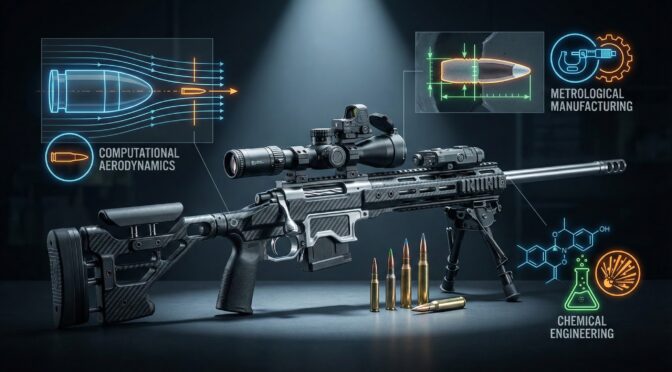
The trajectory of small arms development over the first quarter of the 21st century represents one of the most significant leaps in mechanical capability in the history of firearms. For nearly a century, the standard of accuracy for a military service rifle was roughly 3 to 4 Minutes of Angle (MOA), while a dedicated sniper system was deemed exceptional if it could consistently hold 1 MOA (approximately 1 inch at 100 yards). Today, these standards have been rendered obsolete by a systemic revolution in engineering, manufacturing, and data science. In 2025, production-grade precision rifles firing factory-loaded match ammunition routinely achieve 0.5 MOA performance, and specialized competition platforms push the boundaries of dispersion into the 0.1s and 0.2s.1
This report, commissioned to analyze the drivers of this transformation, posits that the “Accuracy Revolution” is not the product of a single breakthrough but a convergence of three distinct industrial vectors: Computational Aerodynamics, Metrological Manufacturing, and Chemical Engineering. The synergy between these fields has transformed the rifle cartridge from a mass-produced commodity into a precision-engineered delivery system. We have moved from an era of “artisan” accuracy—where hand-loading and black magic were required—to an era of “industrial” accuracy, where consistency is baked into the manufacturing process through automation and physics-based modeling.
This document serves as a comprehensive technical treatise for industry stakeholders. It dissects the physics of the “little difference” range, profiles the current dominant cartridge architectures in civilian and military sectors, and forecasts the hyper-velocity, intelligent-munition future that lies ahead.
2. The Physics of Consistency: Manufacturing Advancements and Metrology
The fundamental axiom of precision shooting is that consistency equals accuracy. If every variable—muzzle velocity, ballistic coefficient, center of gravity, and barrel exit time—can be held constant, the projectile will impact the same point in space every time. The last 25 years have seen the industrial elimination of variables that were previously thought uncontrollable.
2.1 The Projectile: Perfecting the Flight Vehicle
The projectile is the flight vehicle, and its geometric integrity is paramount. In the late 20th century, mass-produced bullets suffered from “jacket runout”—variations in the thickness of the copper jacket that caused the bullet’s center of gravity (CG) to diverge from its center of geometric form. Upon exiting the muzzle at rotational speeds exceeding 200,000 RPM, this offset induced a violent wobble (yaw) as the bullet attempted to spin around its CG, resulting in dispersion that grew non-linearly with distance.3
2.1.1 Advanced Jacket Forming and Concentricity
Modern manufacturing has aggressively attacked concentricity. The shift from simple cup-and-draw methods to advanced, multi-stage swaging processes has been critical. Companies like Hornady, with their AMP (Advanced Manufacturing Process) jackets, and Berger, with their J4 jackets, utilize carbide tooling with tolerances measured in the millionths of an inch. By drawing the copper jacket with near-perfect uniformity, the CG is forced to align with the geometric axis.4
The process involves deep-drawing metal grains parallel to the long axis of the jacket. This unidirectional grain structure prevents the jacket from peeling or deforming unevenly upon firing or impact.5 Furthermore, new “coining” dies trap the jacket completely, supporting every surface surface during the final forming of the ogive. This contrasts with older methods where the nose was formed by simply forcing the core into the jacket, often leading to slight asymmetries in the nose curve.5 The result is “zero runout” projectiles that fly true from the instant of uncorking.
2.1.2 Meplat Uniformity and Aerodynamic Heating
A subtle but critical advancement has been the management of the meplat (the tip of the bullet). In traditional Open Tip Match (OTM) bullets, the jagged, uneven tip left by the jacket forming process created inconsistent drag profiles. While minor at 100 yards, these variations in the Ballistic Coefficient (BC) caused significant vertical stringing at 1,000 yards.
Two primary solutions have emerged:
- Mechanical Meplat Reduction: Technologies like Berger’s Meplat Reduction Technology (MRT) effectively “mash” or point the tip into a uniform, closed shape. This process increases the BC by streamlining the airflow and ensures that every bullet in a lot has an identical drag signature.6
- Heat-Shield Tips: As Doppler radar revealed that standard polymer tips were melting and deforming due to aerodynamic heating at high Mach numbers (shifting BC mid-flight), manufacturers introduced heat-resistant polymers. The Hornady Heat Shield™ tip, for example, retains its shape even at the scorching stagnation temperatures of Mach 3 flight, ensuring the BC remains consistent from muzzle to target.4
2.2 The Cartridge Case: From Container to Combustion Chamber
The brass cartridge case is more than a container; it is a gasket and a combustion chamber. Inconsistent internal volume leads to inconsistent pressure, which leads to Velocity Standard Deviation (SD)—the enemy of long-range precision.
2.2.1 Metallurgy and Annealing
Modern case manufacturing places a premium on hardness consistency. The neck and shoulder must be annealed (softened) to seal the chamber instantly upon firing, while the case head must remain hard to withstand 60,000+ PSI without expanding the primer pocket. Automated induction annealing machines now treat every case with precise dwell times and temperatures, ensuring uniform neck tension. Consistent neck tension is vital; if one bullet requires 40 lbs of force to release and the next requires 60 lbs, the pressure curve changes, and the bullet exits the muzzle at a different point in the barrel’s harmonic vibration.3
2.2.2 Flash Hole Deburring and Primer Pocket Uniformity
In the past, match shooters manually deburred flash holes (the channel between primer and powder). Today, premium brass from manufacturers like Lapua, Peterson, and Alpha Munitions features drilled (rather than punched) flash holes. Drilled holes are perfectly circular and burr-free, ensuring the primer flame propagates into the powder column symmetrically. This seemingly minor detail significantly reduces ignition delays and velocity spread.7
2.3 Automated Metrology: The Rise of 100% Inspection
Perhaps the most transformative change in the manufacturing environment is the shift from statistical quality control (inspecting 1 in 100) to 100% automated inspection using machine vision and laser profilometry.
Systems such as the General Inspection Gi-360T and Mectron SQ-7500 utilize arrays of lasers and high-speed cameras to create a 3D digital twin of every single cartridge produced.8 These machines can inspect parts at rates of hundreds per minute, checking for:
- Dimensional Compliance: Length, diameter, and headspace datum lines.
- Surface Defects: Dents, scratches, or corrosion that could weaken the case.
- Primer Seating Depth: Measuring the depth of the primer relative to the case head to the micron.
- Mouth Runout: Ensuring the case mouth is perfectly circular.
Recent patents describe systems that use statistical learning algorithms to identify defect patterns that human operators would miss, effectively “learning” what a perfect cartridge looks like and rejecting anything that deviates.8 This ensures that “flyers”—rounds that inexplicably impact away from the group—are filtered out at the factory gate. For the end-user, this means box-to-box consistency that was previously impossible.
3. The Aerodynamic Revolution: Digital Ballistics and Radar
While manufacturing built a better bullet, the science of External Ballistics evolved to predict its path with unprecedented fidelity. The industry has moved from rough approximations based on 19th-century artillery tables to real-time, physics-based modeling.
3.1 The Obsolescence of G1 and the Dominance of G7
For decades, the industry relied on the G1 Drag Model, based on a flat-based, blunt projectile standard from the late 1800s. While adequate for short-range hunting, the G1 model fits poorly with modern, boat-tailed, long-ogive match bullets. The mismatch required shooters to use different BCs for different velocity bands, a cumbersome and error-prone process.12
The adoption of the G7 Drag Model as the standard for long-range ballistics was a critical correction. The G7 standard projectile shares the geometry of modern low-drag bullets (secant ogive, 7.5-degree boat tail). As a result, a G7 BC remains relatively constant across a wide range of velocities, providing a much more accurate prediction of drop and wind drift at extended ranges.14 This shift, driven largely by the work of ballisticians like Bryan Litz, educated the consumer market to demand G7 data from manufacturers.
3.2 The Doppler Radar Disruption
The democratization of Doppler Radar is arguably the single most important tool in modern ballistics development. Previously, measuring drag required expensive light-gate ranges or massive military tracking radars. Today, portable units like the LabRadar and compact industrial units from Weibel and Infinition allow engineers and even hobbyists to track a bullet’s velocity continuously from the muzzle out to 100-200 yards or more.15
3.2.1 Custom Drag Models (CDM)
Doppler radar revealed that even G7 BCs are approximations. The radar trace provides the exact drag coefficient ($C_d$) of a specific bullet at every Mach number. This led to the creation of Custom Drag Models (CDM). Instead of using a reference number (BC) to compare the bullet to a standard, the ballistic solver uses the actual radar-measured drag curve of that specific bullet.17
- Impact: A firing solution based on G7 might be accurate to ±5 inches at 1,000 yards. A CDM-based solution is accurate to ±1 inch, isolating the error almost entirely to the shooter’s wind call.
3.2.2 Personalized Drag Models (PDM)
The technology has advanced to the point of Personalized Drag Models (PDM). Applied Ballistics mobile laboratories can measure a shooter’s specific rifle and ammunition combination. This captures the subtle effects of the rifle’s rifling engraving, muzzle brake turbulence, and barrel harmonics on the bullet’s drag.17 It is the ultimate expression of “data-driven” shooting, removing the estimation from the equation entirely.
3.3 Transonic Stability
Radar data also illuminated the behavior of bullets in the Transonic Zone (Mach 1.2 to Mach 0.8). As the bullet slows, the shockwave moves from the tip to the body, shifting the Center of Pressure (CP). If the CP moves ahead of the CG, the bullet becomes dynamically unstable and tumbles.
Radar testing allowed engineers to redesign boat-tail angles and CG locations to ensure bullets remain stable through this turbulent transition. This has extended the effective range of cartridges like the.308 Winchester and.338 Lapua well beyond the supersonic threshold, allowing for predictable impacts even at subsonic velocities.19
4. Internal Ballistics: The Chemistry of Consistency
The engine of the system is the propellant. The last two decades have seen a shift from maximizing velocity to maximizing stability.
4.1 Temperature Stable Propellants
Historically, smokeless powder (nitrocellulose) was highly sensitive to temperature. A cartridge that generated safe pressure and 2,800 fps at 70°F might spike to dangerous pressures at 110°F or drop to 2,700 fps at 20°F. In long-range shooting, a 50 fps loss can mean a miss of several inches or feet at 1,000 yards due to increased drop.20
The introduction of the Hodgdon Extreme line (e.g., Varget, H4350) and the IMR Enduron series revolutionized this. Through advanced grain coatings and chemistry modifications (often trade secrets, but involving deterrents and stabilizers), these extruded powders achieved near-linear temperature response. They exhibit minimal velocity variance across extreme operational ranges (-40°F to +125°F).
- Operational Benefit: A sniper or competitor can use the same “dope” (elevation data) regardless of the weather, removing a massive variable from the firing solution.21
4.2 Decoppering and Flash Suppression
Modern military propellants, such as those used in the Mk262 and Mk318 rounds, incorporate advanced additives.
- Decoppering Agents: Compounds like tin dioxide or bismuth are added to the propellant matrix. Upon combustion, they react with the copper deposits left by the bullet jacket, making them brittle and easily swept out by the next shot. This maintains the barrel’s internal geometry and accuracy over high round counts.22
- Flash Suppression: Chemical additives interrupt the secondary combustion of hydrogen and carbon monoxide at the muzzle. This reduces the visual signature, critical for concealing a sniper’s position, without degrading the propellant’s energy density.23
4.3 Primer Chemistry and Ignition
The primer initiates the chain reaction. Inconsistent ignition leads to “hang fires” or variable pressure curves. The industry has moved toward automated primer seating that relies on force-feedback rather than distance. This ensures that every primer is seated to the optimal “crush” (pre-stressing the anvil), guaranteeing consistent sensitivity and ignition timing.24
Furthermore, environmental regulations have driven the development of lead-free primers (e.g., Diazodinitrophenol or DDNP based). While early versions suffered from shelf-life and power issues, modern lead-free formulations now rival traditional lead styphnate in reliability and consistency, ensuring the industry can meet future regulatory hurdles without sacrificing performance.25
5. The Operational Divide: Average vs. Match Cartridges
A common query from end-users concerns the “value proposition” of match ammunition. When does the extra cost translate to tangible results on target? The answer lies in the physics of Dispersion and Probability of Hit ($P_{hit}$).
5.1 The “Little Difference” Range: 0–300 Yards
Within the envelope of 0 to 300 yards, the difference between “Average” (Bulk/M855) and “Match” (Mk262/Gold Medal Match) ammunition is often masked by the shooter’s error and the mechanical limitations of the weapon system.
- Mechanical Dispersion: A standard rack-grade rifle might be a 2-3 MOA system. Bulk ammunition is typically 3-4 MOA. At 300 yards, 4 MOA is ~12 inches. A standard torso target is 18-20 inches wide. Thus, purely mechanically, bulk ammo will hit the target.
- External Factors: At short range, velocity variations (SD) have not yet had time to translate into significant vertical separation. The time of flight is so short that gravity’s effect on bullets of slightly different speeds is negligible.
- Conclusion: For general combat training, plinking, or engagements inside 300 meters, bulk ammunition is operationally indistinguishable from match ammo for hitting man-sized targets.1
5.2 The Divergence Point: 300+ Yards
Beyond 300 yards, the performance curves diverge radically.
- Velocity SD: This is the killer. Bulk ammo often has a Velocity SD of 30-50 fps. Match ammo is typically SD < 10-15 fps.
- At 800 yards, a 50 fps variation results in a vertical spread of over 20 inches—a complete miss on a standard target.
- Match ammo with low SD keeps that vertical spread to <5 inches.
- BC Consistency: Bulk bullets have variable jacket concentricity, meaning their BC fluctuates. This causes them to drift differently in the wind. Match bullets with consistent BCs drift predictably.
- Transonic Stability: Bulk ammo (like M855) often destabilizes as it enters the transonic zone (~700-800 yards), tumbling and losing all accuracy. Match bullets are designed to fly stable through this zone, extending effective range to 1,000+ yards.23
Table 1: Comparative Performance Matrix – Bulk vs. Match Ammunition
| Metric | Average / Bulk Cartridge (e.g., M855 / M193) | Match Cartridge (e.g., Mk262 / 6.5 CM Match) | Operational Implication |
| Projectile Type | FMJ, Open Base, Variable Concentricity | OTM / Polymer Tip, Zero Runout, Uniform Core | Match bullets fly straighter and retain velocity. |
| Ballistic Coefficient | Low (G7 ~0.15 – 0.18) | High (G7 ~0.25 – 0.35+) | Match ammo resists wind and drops less. |
| Velocity SD | High (25 – 50 fps) | Low (5 – 12 fps) | Bulk ammo suffers massive vertical dispersion >400y. |
| Accuracy Standard | 2 – 4 MOA | 0.5 – 1.0 MOA | Match ammo enables point-target engagement. |
| Indistinguishable Range | 0 – 300 Yards (Torso Target) | N/A | Use bulk for close-range drills; Match for precision. |
| Effective Range | ~500 Yards (Point Target) | ~800 – 1,100+ Yards | Match ammo doubles the effective engagement zone. |
6. Current State of the Art: The Dominant Match Cartridges of 2025
The landscape of precision cartridges has shifted away from the 20th-century standard of.308 Winchester. The current meta is defined by efficiency, recoil management, and aerodynamics.
6.1 The Civilian Competition Arena (PRS/NRL)
The Precision Rifle Series (PRS) is the crucible of modern rifle development. Competitors demand cartridges that shoot laser-flat, buck wind like a magnum, but recoil like a.223 to allow them to spot their own impacts.
- The 6mm Hegemony: In 2024-2025, 6mm cartridges dominate, representing ~70% of top shooters. The 6mm (0.243″) bore size offers the perfect balance of bullet weight (105-110gr) and BC, without the recoil penalty of the 6.5mm.28
6.1.1 The Reigning Kings: 6mm Dasher and 6mm GT
- 6mm Dasher: Currently the gold standard. It is a wildcat-turned-factory round based on the 6mm BR. It features a blown-out case with a sharp 40-degree shoulder and increased capacity (approx 41gr H2O). The steep shoulder creates a “turbulence point” that keeps combustion consistent and prevents brass flow, leading to incredible barrel life and velocity consistency.7
- 6mm GT: Designed by George Gardner and Tom Jacobs to fix the feeding issues of the short, stubby Dasher. The GT has a longer body and a 35-degree shoulder, optimized to feed flawlessly from AICS magazines while retaining 6mm BR-like accuracy.30
6.1.2 The Rising Challenger: The 25 Caliber
A major trend in 2025 is the rise of the .25 Caliber (6.35mm). Usage among top 25 pros jumped to 40%.28
- The Logic: Heavy.25 cal bullets (133-135gr) have BCs that rival the 6.5mm but can be pushed faster than 6mm bullets. They occupy a “Goldilocks” zone—better wind performance than a 6mm, less recoil than a 6.5mm.
- Cartridges: The 25 Creedmoor and 25 GT are the vehicles for this caliber, often requiring fast-twist barrels (1:7.25 or 1:7) to stabilize the long solids and hybrids.32
6.2 The Bleeding Edge: Benchrest Records
While PRS focuses on practical accuracy, Benchrest shooting focuses on raw precision. The records here define the absolute mechanical limit of current technology.
- 600-Yard Record: In 2023, Mike Wooten shot a 1.2867 inch 5-shot group at 600 yards. That is roughly 0.2 MOA at over a third of a mile.34
- 1000-Yard Record: The Heavy Gun 10-shot record stands at 3.048 inches (approx 0.3 MOA) shot by Joel Pendergraft. Light Gun records are similarly impressive, with groups often hovering in the 3-4 inch range.2
These records are typically set with cartridges like the 6mm Dasher, 30 BR, or BRA, proving the inherent superiority of the short, fat case geometry with steep shoulders for combustion efficiency.
6.3 Military Sniping: The Magnum Renaissance
The military has moved away from the.308 and even the.300 Win Mag for extreme range, adopting the Precision Sniper Rifle (PSR) program (Barrett Mk22).
- The New Standards: .300 Norma Magnum and .338 Norma Magnum. These cartridges were selected because they are ballistically superior to the.338 Lapua Mag and.300 Win Mag. They feature less body taper and sharper shoulders, allowing for longer, heavier bullets to be seated without intruding into powder space.36
- Capability: These systems extend the anti-personnel effective range to 1,500+ meters and anti-materiel range to 2,000 meters, utilizing the full suite of Doppler-derived drag data.
Table 2: The Top Tier – Match Cartridge Hierarchy (2025)
| Rank / Category | Cartridge | Primary Application | Key Technical Characteristics |
| #1 PRS (Civilian) | 6mm Dasher | Precision Competition | 40° shoulder, ultra-efficient, low recoil, current record holder. |
| #2 PRS (Civilian) | 6mm GT | Competition / Tactical | Optimized for magazine feeding (AICS), 35° shoulder, 105-110gr bullets. |
| Rising Star | 25 Creedmoor | Competition | “Goldilocks” caliber; 135gr bullets offer superior wind bucking vs 6mm. |
| Military Standard | Mk262 (5.56) | DMR / SPR | 77gr OTM in AR-15 platform; maximizes lethality out to 600-800m. |
| Military Sniper | .300 Norma Mag | Long Range Sniper (Mk22) | The new NATO standard for extreme range; superior to.338 Lapua ballistically. |
| Legacy King | 6.5 Creedmoor | General / Hunting | The most popular “off-the-shelf” match cartridge; excellent factory support. |
7. The Rifle-Ammunition Interface: Systemic Integration
Accuracy is a system. The cartridge must be mated to a barrel and chamber designed to exploit its potential.
7.1 Throat Geometry and Leade
Modern match chambers (like those for 6.5 CM or 6 GT) are designed with “freebore” that keeps the bullet’s bearing surface out of the case. This maximizes powder capacity. Crucially, the leade angle (the angle at which the rifling begins) is often shallower (1.5 degrees) compared to older steep designs. This allows the bullet to engrave gently into the rifling, reducing deformation and peak pressure spikes.33
7.2 Barrel Harmonics and Tuners
The barrel whips like a tuning fork when fired. “Tuning” a load traditionally meant adjusting the powder charge so the bullet exited when the barrel was at a “node” (a point of minimal movement).
Modern systems now often use muzzle tuners (adjustable weights) to mechanically tune the barrel’s harmonic frequency to the load. This allows shooters to use factory ammo and simply “dial” the barrel to match the ammo, rather than reloading the ammo to match the barrel.38
7.3 Barrel Coatings: DLC and CrN
High-velocity cartridges (like the 25 Creedmoor or 6mm variants) are “barrel burners,” eroding the throat in 1,500-2,000 rounds. To combat this, the industry is adopting Diamond-Like Carbon (DLC) and Chromium Nitride (CrN) coatings applied via PVD (Physical Vapor Deposition).
- Benefit: These coatings are incredibly hard and heat resistant, reducing friction and heat transfer to the steel. This can extend barrel life by 50% or more without degrading accuracy, making high-performance calibers economically viable for high-volume shooters.39
7.4 Gain Twist Rifling
While less common, Gain Twist (or progressive twist) rifling is seeing a resurgence in specific applications. The rifling starts slow (e.g., 1:16) at the breech and tightens to the final twist (e.g., 1:7) at the muzzle.
- Physics: This reduces the initial torque and engraving pressure on the bullet as it enters the rifling. Lower pressure allows for hotter powder charges. It also reduces the stress on the jacket, preventing failure in high-velocity, fast-twist scenarios.42
8. Future Trends: The Next Horizon (2025–2030)
The industry stands at the precipice of the “High Pressure Era,” driven largely by the US Army’s Next Generation Squad Weapon (NGSW) program.
8.1 Hybrid Case Technology and 80,000 PSI
The limiting factor in ballistics has always been the brass case, which flows and ruptures around 60,000–65,000 PSI.
Sig Sauer’s Hybrid Case (steel head, brass/polymer body) solves this. By using a steel base to contain the pressure at the case head (the weakest point), cartridges like the 6.8x51mm (.277 Fury) can operate at 80,000 PSI.45
- Implication: This allows short-barreled rifles (13-16 inches) to achieve velocities previously requiring 24-inch barrels. It flattens trajectories and reduces wind drift significantly. We will see this technology trickle down to hunting and competition cartridges, enabling “Magnum” performance from standard short actions.
8.2 General Purpose Calibers (6.8mm / 7mm)
The binary choice between 5.56 and 7.62 is ending. The industry is coalescing around the 6.8mm to 7mm range as the optimal “General Purpose Caliber.” These diameters offer the sectional density for long-range penetration and the capacity for high BCs, without the weight penalty of.30 caliber systems.47
8.3 Smart Scopes and Ballistic Integration
The “dumb” rifle is dying. The future is the Smart Scope (like the Vortex XM157). These optics feature integrated laser rangefinders and ballistic solvers.
- The Future: Ammunition packaging will contain RFID or QR codes with the exact Doppler radar data for that specific lot. The scope will scan this data, measure the air density, range the target, and instantaneously project the correct aim point. This closes the final loop: connecting the manufacturer’s perfect consistency with the shooter’s execution.48
8.4 Automated Sorting and AI in Manufacturing
Factory ammo will continue to get better. As AI vision systems become cheaper, even budget ammo lines will likely undergo 100% inspection. The distinction between “Match” and “Standard” may blur as the cost of quality control drops, raising the baseline of performance for the entire industry.49
9. Conclusion
The transformation of rifle cartridge accuracy over the last 25 years is a triumph of systems engineering. We have moved from the “Art of Shooting” to the “Science of Ballistics.”
- The Drivers: The shift was powered by the demise of G1 ballistics in favor of Doppler-verified Custom Drag Models, the revolution in projectile concentricity via AMP/swaging technology, and the chemical mastery of temperature-stable propellants.
- The Status: Today, a factory 6.5 Creedmoor or 6mm Dasher rifle can outperform the custom hand-loaded sniper rifles of the year 2000.
- The Future: The frontier is no longer mechanical precision—we have effectively solved that. The future is energy density (High Pressure/Hybrid Cases) and computational integration (Smart Scopes), ensuring that the mechanical potential of the rifle is fully realized in the chaotic environment of the field.
Appendix A: Research Methodology
This report was compiled using a multi-layered, open-source intelligence (OSINT) methodology designed to mimic the workflow of a defense industrial analyst. The research prioritized primary technical data and competitive results over marketing literature.
1. Data Source Hierarchy
The analysis relied on a three-tier information structure:
- Tier 1: Empirical & Metrological Data: This included ballistic coefficient databases (Applied Ballistics), Doppler radar traces (LabRadar/Weibel reports), and SAAMI/CIP pressure specifications. This data provided the “ground truth” for physics claims.
- Tier 2: Competitive Verification: Data from the Precision Rifle Series (PRS), National Rifle League (NRL), and National Benchrest Shooters Association (NBRSA) was used to validate theoretical performance. If a cartridge is theoretically superior but fails to win championships, it was excluded from the “Dominant” list. World records served as the benchmark for maximum mechanical potential.
- Tier 3: Defense & Industrial Documentation: Analysis of US Army program requirements (NGSW, PSR), patent filings (for inspection machines and hybrid cases), and corporate white papers (Hornady, Berger, Nammo) provided insight into manufacturing processes and future R&D directions.
2. Analytical Techniques
- Comparative Ballistics Analysis: Cartridges were evaluated not just on velocity, but on efficiency (velocity per grain of powder) and stability (gyroscopic stability factor $S_g$).
- Dispersion Modeling: The “Little Difference” range was determined by modeling the angular dispersion (MOA) of various ammunition grades against standard target sizes (E-Type Silhouette) to find the crossover point where ammunition quality becomes the statistically significant variable.
- Trend Extrapolation: Future trends were forecasted by analyzing current patent activity (e.g., hybrid cases, machine vision) and active military solicitations, distinguishing between “vaporware” and funded development.
3. Exclusions and Limitations
The report focuses on external and internal ballistics. Terminal ballistics (lethality) was discussed only in the context of projectile stability and design (e.g., OTM vs. polymer tip). Proprietary manufacturing rejection rates and classified military performance data were approximated using available open-source proxies.
If you find this post useful, please share the link on Facebook, with your friends, etc. Your support is much appreciated and if you have any feedback, please email me at in**@*********ps.com. Please note that for links to other websites, we are only paid if there is an affiliate program such as Avantlink, Impact, Amazon and eBay and only if you purchase something. If you’d like to directly contribute towards our continued reporting, please visit our funding page.
Works cited
- What is Match Ammo and Is It Worth Using? – AmmoMan.com, accessed November 26, 2025, https://www.ammoman.com/blog/what-is-match-ammo/
- 1000-Yard Record « Daily Bulletin, accessed November 26, 2025, https://bulletin.accurateshooter.com/tag/1000-yard-record/
- Bullet Concentricity Basics — What You Need to Know – Accurate Shooter Bulletin, accessed November 26, 2025, https://bulletin.accurateshooter.com/2019/02/bullet-concentricity-basics-what-you-need-to-know/
- Heat Shield® Technology ‑ Hornady Manufacturing, Inc, accessed November 26, 2025, https://www.hornady.com/heat-shield
- Small Arms Ammunition Manufacturing: Background and Practices – Guns and Ammo Witness, accessed November 26, 2025, https://gunsandammowitness.com/wp-content/uploads/2021/07/AMC-v6-2021.pdf
- Manufacturing Effects on BC | Berger Bullets, accessed November 26, 2025, https://bergerbullets.com/nobsbc/manufacturing-effects-on-bc/
- Peterson Cartridge Introduces 6mm Dasher, accessed November 26, 2025, https://petersoncartridge.com/blog/peterson-cartridge-introduces-6mm-dasher
- Automated Ammunition Inspection – Mectron Inspection Systems, accessed November 26, 2025, http://www.mectroninspection.com/ammunition-inspection
- Ammunition Inspection & Sorting Systems, accessed November 26, 2025, https://geninsp.com/ammunition-inspection/
- VisionLab Ammunition – General Inspection, accessed November 26, 2025, https://geninsp.com/visionlab-ammunition/
- US9424634B2 – Machine vision system for identifying and sorting projectiles and other objects – Google Patents, accessed November 26, 2025, https://patents.google.com/patent/US9424634B2/en
- G1 vs G7 The Real Story – YouTube, accessed November 26, 2025, https://www.youtube.com/watch?v=SCqkCfItRFs
- G1 vs. G7 Ballistic Coefficient Models — What You Need to Know « Daily Bulletin, accessed November 26, 2025, https://bulletin.accurateshooter.com/2023/07/g1-vs-g7-ballistic-coefficient-models-what-you-need-to-know-2/
- G1 & G7 Ballistic Coefficients… What’s the Difference? – Kestrel Meters, accessed November 26, 2025, https://kestrelmeters.com/pages/g1-g7-ballistic-coefficients-what-s-the-difference
- New technology in wound ballistics: the Doppler radar – PubMed, accessed November 26, 2025, https://pubmed.ncbi.nlm.nih.gov/8606419/
- Uses of Radar 2000 during Projectile Development & Production – prodas, accessed November 26, 2025, https://prodas.com/Documents/Uses%20of%20Radar%202000%20during%20Projectile%20Development.pdf
- Aerodynamic Drag Measurement and Modeling for Small Arms – Improving on Ballistic Coefficients By Doc Beech, accessed November 26, 2025, https://appliedballisticsllc.com/wp-content/uploads/2021/06/Aerodynamic-Drag-Measurement-and-Modeling-for-Small-Arms-Improving-on-Ballistic-Coefficients.pdf
- G1 BC vs G7 BC vs Bullet-Specific Drag Models – PrecisionRifleBlog.com, accessed November 26, 2025, https://precisionrifleblog.com/2019/06/09/g1-vs-g7-vs-custom-drag-models/
- Aerodynamic Drag Measurement and Modeling for Small Arms – Shooting Sports USA, accessed November 26, 2025, https://www.ssusa.org/content/aerodynamic-drag-measurement-and-modeling-for-small-arms/
- Temperature Effects on Gunpowder Explained – Guns and Ammo, accessed November 26, 2025, https://www.gunsandammo.com/editorial/temperature-effects-gunpowder/389257
- Powder Temperature Sensitivity: The Hidden Factor Affecting Your Long-Range Accuracy, accessed November 26, 2025, https://precisionrifleblog.com/2025/03/08/powder-temperature-sensitivity/
- Influence of Various Flame Temperatures of the Gun Propellant on the Effectiveness of the Erosion Inhibitor and Relevant Mechanisms | ACS Omega, accessed November 26, 2025, https://pubs.acs.org/doi/10.1021/acsomega.3c08812
- The Best 5.56 NATO Loads Ranked! #m855 #m995 #m855a1 #m193 #mk262mod1 #Mk318 – YouTube, accessed November 26, 2025, https://www.youtube.com/shorts/8gkTbRfnnhs
- Primer Selection for Small Arms Ammunition – DTIC, accessed November 26, 2025, https://apps.dtic.mil/sti/tr/pdf/AD0717356.pdf
- Small Caliber Ammunition Market – Forecast & Report | 2025 – 2030 – Mordor Intelligence, accessed November 26, 2025, https://www.mordorintelligence.com/industry-reports/small-caliber-ammunition-market
- At what point does the difference between bulk ammo and match grade ammo begin to matter? : r/longrange – Reddit, accessed November 26, 2025, https://www.reddit.com/r/longrange/comments/u5cwil/at_what_point_does_the_difference_between_bulk/
- 5.56mm IMI 77 gr. Razor Core (MK262) and M855 vs Windshield – YouTube, accessed November 26, 2025, https://www.youtube.com/watch?v=Z2ryxsMwXEk
- Best Rifle Caliber: What The Pros Use – PrecisionRifleBlog.com, accessed November 26, 2025, https://precisionrifleblog.com/2025/08/30/best-rifle-caliber-2/
- 6mm Dasher | The Pocket Rocket – LoadDevelopment.com, accessed November 26, 2025, https://www.loaddevelopment.com/6mm-dasher/
- 6mm GT ‑ Hornady Manufacturing, Inc, accessed November 26, 2025, https://www.hornady.com/6mm-gt
- 6mm GT: What is It & Why It’s Taking PRS by Storm, accessed November 26, 2025, https://www.pewpewtactical.com/6mm-gt-what-is-it-why-its-taking-prs-by-storm/
- Austin Orgain – Top Shooter Spotlight & His Experiment With 25-Calibers – PrecisionRifleBlog.com, accessed November 26, 2025, https://precisionrifleblog.com/2023/08/18/austin-orgain-top-shooter-spotlight-experiment-with-25-calibers/
- 25 Creedmoor: The Best of the Creedmoor Family? – Inside MDT, accessed November 26, 2025, https://mdttac.com/us/blog/25-creedmoor-the-best-of-the-creedmoor-family-inside-mdt
- Long Range 600 Yard Records – International Benchrest Shooters, accessed November 26, 2025, https://internationalbenchrest.com/records/longrange
- 1000 Yard Winners and Records – Lilja Barrels, accessed November 26, 2025, https://riflebarrels.com/winners-world-records/1000-yards/
- Oregon Army National Guard Upgrades Sniper Rifles, accessed November 26, 2025, https://www.army.mil/article/273647/oregon_army_national_guard_upgrades_sniper_rifles
- Oregon Army National Guard Upgrades Sniper Rifles, accessed November 26, 2025, https://www.nationalguard.mil/News/Article-View/article/3673133/oregon-army-national-guard-upgrades-sniper-rifles/
- Ep. 137 – GAIN TWIST and Then Some – YouTube, accessed November 26, 2025, https://www.youtube.com/watch?v=pQqK9UIbDK8
- Coatings & Applications – Industrial Hard Carbon, accessed November 26, 2025, https://industrialhardcarbon.com/coatings/
- CrN – Cajun Gun Works, accessed November 26, 2025, https://cajungunworks.com/refinishing/crn-2/
- CrN – Barrel Coating Service – Vulcan Machine Werks, accessed November 26, 2025, https://vulcanmachinewerks.com/crn-barrel-coating-service/
- Can we talk about gain twist (progressive twist, t-rifling, etc) and the effects on ballistic performance? : r/guns – Reddit, accessed November 26, 2025, https://www.reddit.com/r/guns/comments/1uhxea/can_we_talk_about_gain_twist_progressive_twist/
- Rifling – Wikipedia, accessed November 26, 2025, https://en.wikipedia.org/wiki/Rifling
- Does Barrel Twist Rate Affect Muzzle Velocity? (Litz Test) – Accurate Shooter Bulletin, accessed November 26, 2025, https://bulletin.accurateshooter.com/2015/02/does-barrel-twist-rate-affect-muzzle-velocity-litz-test/
- Could This Cartridge Case Revolutionize Hunting? – MeatEater, accessed November 26, 2025, https://www.themeateater.com/hunt/firearm-hunting/could-this-cartridge-case-revolutionize-hunting
- Upcoming Changes to Military Small Arms – SilencerCo, accessed November 26, 2025, https://silencerco.com/blog/upcoming-changes-military-small-arms
- Chambering the Next Round: Emergent Small-calibre Cartridge Technologies, accessed November 26, 2025, https://www.smallarmssurvey.org/sites/default/files/resources/SAS-WP23-cartridge-technologies.pdf
- Envisioning the Deep Future of Small Arms 2022-2042 – Public Intelligence, accessed November 26, 2025, https://info.publicintelligence.net/USArmy-SmallArmsFuture.pdf
- Visual Inspection Camera Systems – Stevanato Group, accessed November 26, 2025, https://www.stevanatogroup.com/en/technologies-equipment/visual-inspection/inspection-technologies/