Executive Overview
The final week of January 2026 has witnessed the Islamic Republic of Iran navigating a convergence of existential threats that have fundamentally altered its domestic governance and international strategic posture. The reporting period ending January 31 is characterized by three primary developments: the transition of internal dissent from mass mobilization to radicalized insurgency, the physical and operational seclusion of the supreme leadership, and the formalization of a trilateral geopolitical alliance with the Russian Federation and the People’s Republic of China (PRC) designed to neutralize United States military pressure.1 Following the unprecedented violence of the mid-month crackdown, the regime has achieved a fragile kinetic stability in major urban centers, yet it remains vulnerable to the systematic collapse of the national currency and the emergence of a “shadow government” managed by the Supreme Leader’s immediate kin.3
On the international front, the arrival of a significant United States naval carrier strike group in the Arabian Sea has prompted Tehran to accelerate its integration into a nascent Eastern-led security architecture. The signing of the Trilateral Strategic Pact on January 29, 2026, between Iran, Russia and China represents a decisive pivot intended to provide a “Great Power Shield” against unilateral Western strikes.1 Simultaneously, the stabilization of the Levant via the comprehensive integration of the Syrian Democratic Forces (SDF) into the Syrian state signifies a consolidation of the regional “land bridge,” albeit under a new Syrian leadership that balances Iranian, Turkish, and American interests.6
Internal Stability and the Evolution of Civil Unrest
From Mass Mobilization to Radicalized Insurgency
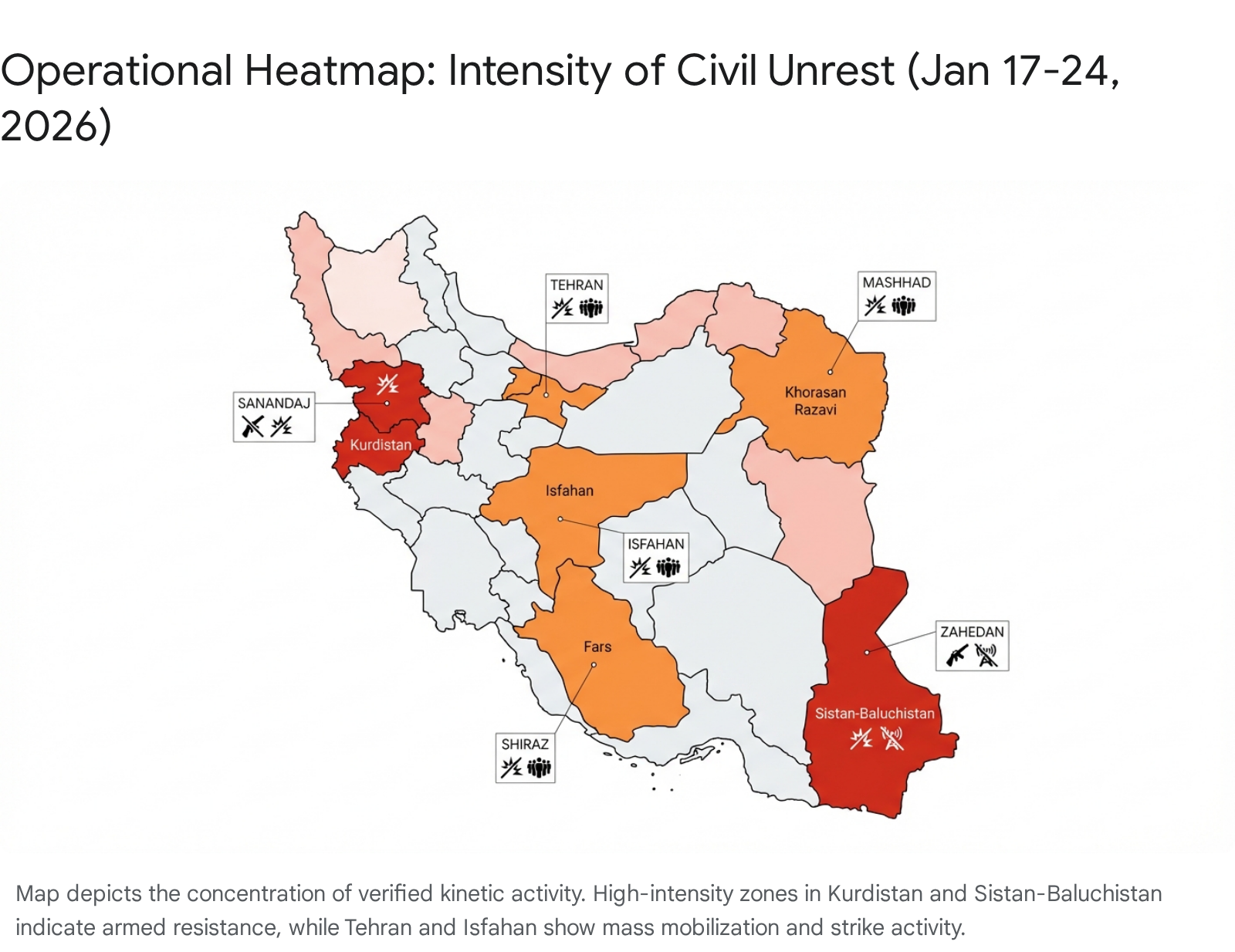
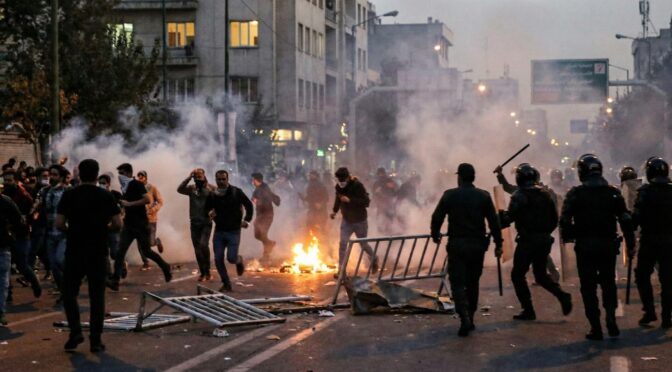
The protest wave that erupted on December 28, 2025, initially driven by the “shopkeeper strikes” in response to hyperinflation, has entered a secondary phase of clandestine and violent resistance.8 While the “Winter 2026” protests matched the scale of the 2022 movements, they lacked a unifying centralized leadership, which allowed the state to employ overwhelming kinetic force to clear public squares by mid-January.8 However, the cessation of mass street gatherings does not indicate a restoration of order; rather, it reflects a tactical shift by opposition elements. In the current reporting week, “rebellious youth” have intensified targeted attacks against regime symbols and suppression centers in cities such as Isfahan, Arak, and Shiraz.11
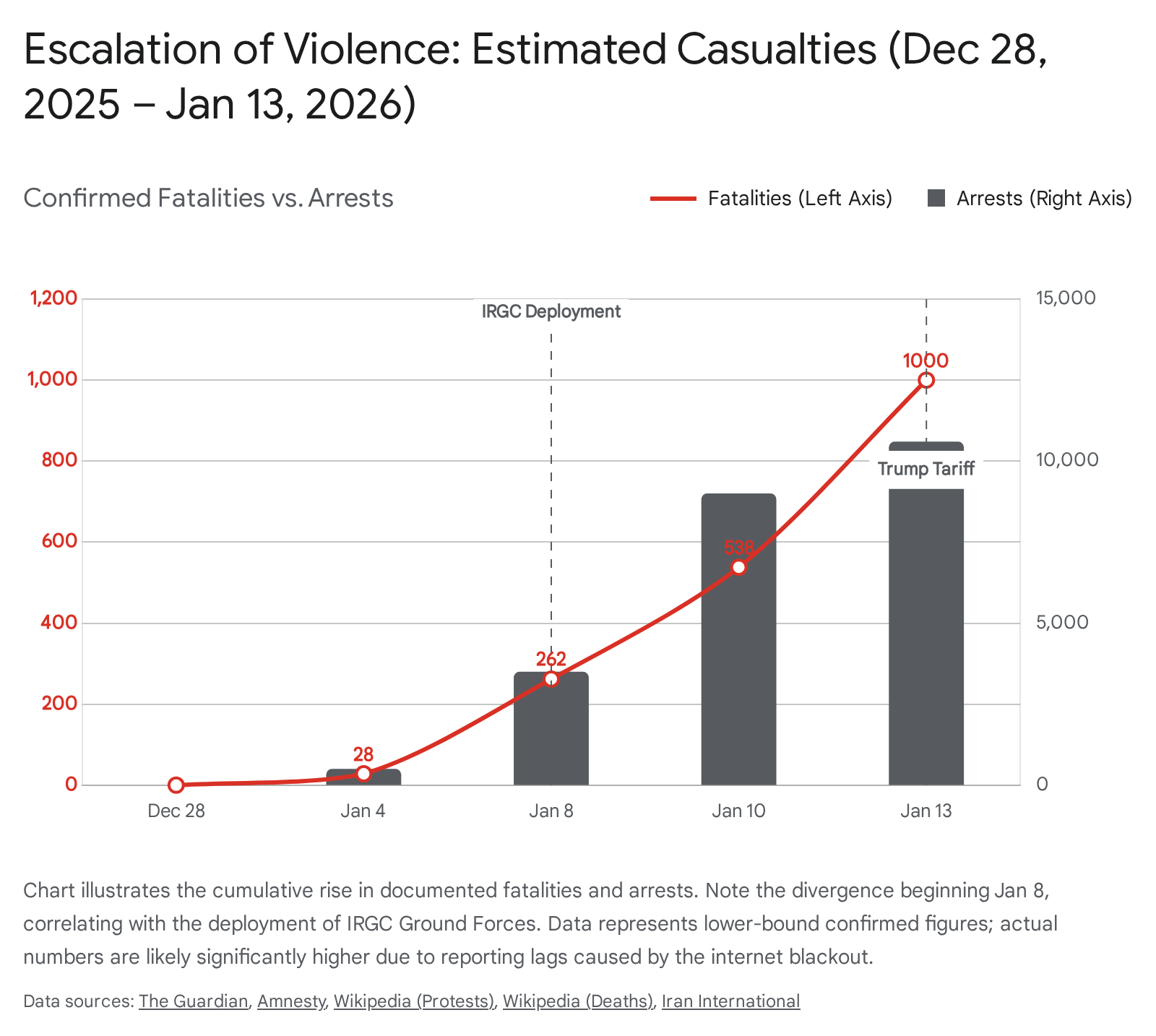
The regime’s response has been defined by an unprecedented level of brutality, with security forces maintaining loyalty despite the intensity of the unrest.8 Monitoring organizations report that the crackdown has resulted in thousands of deaths and tens of thousands of arrests. The systematic nature of the violence is evidenced by the “enforced silence” in cities like Kermanshah, where internet blackouts were used to facilitate extrajudicial killings and the organized disposal of bodies away from international scrutiny.11
Table 1: Comparative Casualty and Detention Estimates (As of Jan 30, 2026)
| Source Organization | Estimated Fatalities | Estimated Detentions | Key Reported Incidents |
| Iran Human Rights (Norway) | 3,428 | 40,000 | Intensive suppression in Zahedan/Sistan-Baluchestan 8 |
| HRANA (US-Based) | 6.092 | 42,500 | Investigation into additional 17,091 reported deaths 8 |
| Classified Leaked Documents | 36,500 | Not Reported | Deaths concentrated during the Jan 8-9 communications blackout 12 |
| Iranian Ministry of Health | 3,117 | Not Reported | Includes 690 individuals labeled as “terrorists” by the state 13 |
The geographic scope of the unrest remains a primary concern for the security apparatus. While the regime has historically managed urban dissent in Tehran, the “Winter 2026” movement saw simultaneous eruptions in all 31 provinces, stretching the capacity of the Law Enforcement Command (LEC) and the Basij.14 This forced the deployment of IRGC Ground Forces, such as the 29th Nabi Akram Division, which were previously reserved for external defense or border security.4
Border Instability and Ethnic Insurgency
The southeastern province of Sistan and Baluchestan has emerged as a critical theater of instability during the current reporting period. On January 2, 2026, protests spread to Zahedan, where the prominent Sunni cleric Moulana Abdol Hamid issued a direct challenge to the regime’s legitimacy, stating that “Iranians’ lives have reached a dead end”.15 This rhetoric has provided political cover for militant groups such as Jaish al-Adl, which has reportedly joined a coalition known as the Mobarizoun Popular Front (MPF).15
This week, Iranian border guards engaged in lethal clashes with militants attempting to infiltrate from Pakistani territory near the city of Saravan.18 Jaish al-Adl has claimed responsibility for several attacks on IRGC border patrols, signaling a shift from a purely separatist agenda toward a role in the wider Iranian opposition movement.17 The group’s use of cryptocurrency for fundraising and its stated goal of disrupting the “Makran Coastal Development Plan”—which it views as a sectarian project to settle 7 million Shia in Baloch territory—indicates a sophisticated and long-term insurgency model.17
Leadership and Succession: The “Bunker” Paradigm
Physical Seclusion and Administrative Devolution
A defining feature of the week ending January 31 has been the reported relocation of Supreme Leader Ali Khamenei to a fortified underground shelter in Tehran Province.4 Senior Iranian officials reportedly assessed that the risk of a potential United States military strike reached a critical threshold, prompting the leader’s withdrawal to a site described as a “fortified complex with interconnected tunnels”.5
This seclusion has necessitated a radical shift in the management of the Leader’s Office (Bayt-e Rahbari). Reports confirm that the Supreme Leader’s third son, Masoud Khamenei, has assumed day-to-day oversight of the office, serving as the primary channel of communication between the leadership and the government’s executive institutions.4 This development has profound implications for regime stability:
- Communication Monopolization: Masoud Khamenei now functions as the de facto gatekeeper for all intelligence and policy coordination, potentially isolating the Supreme Leader from dissenting views or accurate battlefield assessments, a phenomenon previously observed during the June 2025 conflict.5
- Succession Signaling: While Masoud manages the operational conduit, his brother Mojtaba Khamenei remains the primary political contender for the successorship. The physical distance between the “bunker” leadership and the public further fuels rumors regarding the 86-year-old leader’s mental and physical health.22
- Symbolic Erosion: The Supreme Leader’s prolonged absence has led to the derogatory moniker “Moush-Ali” (Rat-Ali) among protesters, characterizing his withdrawal as timidity and undermining the cult of the “steadfast commander”.23
The Assembly of Experts and the Succession Shortlist
As of late January 2026, the Assembly of Experts is reportedly monitoring a shortlist of three potential successors identified by Khamenei.24 The process is complicated by the 2024 election of the 92-year-old Ayatollah Mohammad-Ali Movahedi Kermani as the new chairman of the Assembly, suggesting a conservative bias toward maintaining the current ideological trajectory.22
Table 2: Leading Candidates for the Successorship
| Candidate | Current Role | Institutional Support | Strategic Risk |
| Mojtaba Khamenei | Clerical influence; Bayt management | IRGC; inner circle hardliners 24 | Accusations of “hereditary” rule; lack of political experience 27 |
| Alireza Arafi | Deputy Chair, Assembly of Experts | Qom Seminary; Guardian Council 24 | Perceived as a bureaucratic placeholder with limited charisma |
| Hashem Hosseini Bushehri | Head of Qom Seminary Society | Assembly of Experts; Traditionalists 24 | Possible internal friction with the IRGC’s “Young/Pious” faction |
Evidence suggests that if the transition is triggered by an assassination or sudden death, a Provisional Leadership Council—comprising President Masoud Pezeshkian, the Chief Justice, and a cleric from the Guardian Council—would assume interim duties until a permanent successor is selected.22 However, President Pezeshkian has warned that such a rupture could cause internal factions to turn on each other, leading to a total regime collapse.22
Economic Breakdown and Sanctions Resilience
Macroeconomic Destabilization
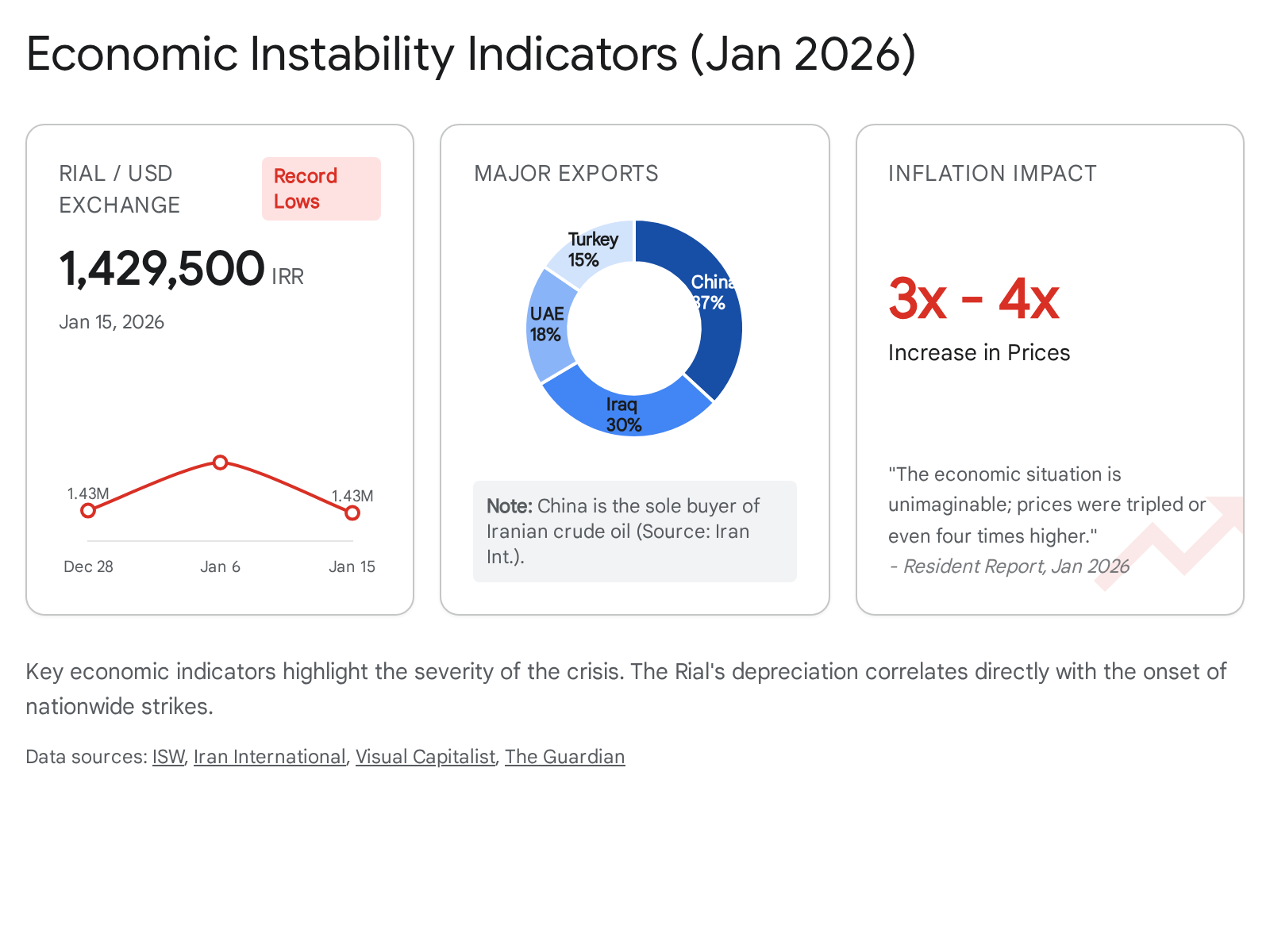
The Iranian economy began 2026 in a state of terminal freefall, with the rial surpassing record lows against the US dollar. On January 14, 2026, the currency plummeted to over 1.1 million rials per dollar, rendering purchasing power almost non-existent for imported goods.3 This currency crash is the primary driver of the current unrest, as food price inflation has exceeded 70%, and over 57% f the population is experiencing some level of malnourishment.14
The World Bank projects that the economy will shrink through both 2025 and 2026, with annual inflation rising toward 60%.14 The Central Bank chief’s resignation in mid-January signaled the government’s inability to stem the crisis through traditional monetary policy.8 Instead, the state has resorted to printing money to finance its budget, further accelerating the inflationary cycle.29
Oil Exports and the “Shadow Fleet” Infrastructure
Despite the “Maximum Pressure” campaign revived by the United States, Iran’s energy exports remained largely intact throughout 2025 and early 2026. Data from the reporting period indicates that Iran delivered an average of 1.38 million barrels per day (bpd) of crude oil and gas condensate to China, representing a marginal decline of only 7% compared to previous years.30 By January 2026, China’s share of Iran’s seaborne crude exports approached 90%.31
The resilience of this trade is attributed to a mature “shadow fleet” of approximately 1,500 oil tankers that utilize flag changes, ship-to-ship transfers, and disabled transponders to avoid detection.30 Iranian crude routinely trades at a discount of $10 to $15 per barrel below Brent, making it economically attractive to China’s independent “teapot” refineries.31
Table 3: Economic and Energy Indicators (Jan 2026)
| Metric | Current Value | Context/Source |
| Exchange Rate | million IRR / 1 USD | Record low reached on Jan 27, 2026 3 |
| Food Inflation | 70%+ | Impacting 100% of household budgets 14 |
| Daily Oil Exports | million bpd | Primarily to PRC “teapot” refineries 30 |
| Floating Storage | million barrels | Highest since 2023; indicates lag in Chinese demand 9 |
| Internet Shutdown Cost | million USD daily | Digital economy and online sales fell by 80% 3 |
The capture of Venezuelan President Nicolás Maduro by US forces in early January 2026 has introduced a new challenge for Tehran, as the two nations have long-established economic ties to offset sanctions, including the trade of oil and drones.14 The interception of the vessel Bella 1 (renamed Marinera), part of the “shadow fleet” carrying sanctioned oil, further highlights the increasing risks associated with these covert channels.14
Nuclear Program: Fortification and IAEA Obstruction
Strategic Fortification of Damaged Facilities
Following the June 2025 strikes by Israel and the United States, which targeted facilities at Natanz, Isfahan, and Fordow, Iran has prioritized the rapid “hardening” of its nuclear sites. Satellite imagery from late January 2026 shows new roof structures built over destroyed structures at Natanz and Isfahan.33 These coverings effectively block satellite observation of ground activity, a critical defensive measure as Tehran continues to bar IAEA inspectors from the sites.33
Intelligence suggests that the roofs are part of an operation to recover assets, such as stocks of highly enriched uranium or specialized centrifuges, that survived the strikes.33 Furthermore, excavation continues near Natanz at “Pickaxe Mountain” (Mount Kolang Gaz La), where analysts believe Iran is constructing a new underground facility that could be deeper than Fordow, potentially reaching between 260 and 330 feet.33
Enrichment Status and Proliferation Risks
Iran’s nuclear program remains at the threshold of weaponization. As of November 2024, the stockpile included 182 kg of uranium enriched to 60% —a level with no practical civilian application.35 Current assessments for January 2026 indicate:
- Breakout Capability: Iran can produce enough weapons-grade uranium (WGU) for a single bomb in less than two weeks and enough for 5-6 bombs in under a month if it resumes full-scale enrichment at its advanced centrifuge cascades.35
- Fortified Enrichment: The monthly production of 60% material at the deeply buried Fordow facility was projected to jump from 4.7 kg to 37 kg by feeding 20% enriched uranium into two cascades of IR-6 centrifuges.35
- Detonation Research: Construction has resumed at the “Taleghan 2” site within the Parchin military complex, which previously housed equipment for high-explosive testing related to nuclear weaponization. The facility is reportedly being encased in a concrete “sarcophagus” to resist future penetration attacks.4
Table 4: Iranian Nuclear Stockpile Status (Projected Jan 2026)
| Material Type | Enrichment Level | Estimated Mass (kg) | Proliferation Relevance |
| UF6 | 60% | 400-450 | Direct precursor to weapons-grade 35 |
| UF6 | 20% | 800-900 | Rapidly convertible to 90% HEU 35 |
| UF6 | 5% | 5,500+ | Industrial-scale enrichment feedstock 35 |
| UF6 | 2% | 2,200+ | Base-level enrichment material 36 |
Tehran officially ended all JCPOA-mandated restrictions in October 2025, declaring all limits on its nuclear program void.36 Foreign Minister Abbas Araghchi has stated that while Iran welcomes a “new deal,” its missile and defense capabilities are not subject to negotiation, emphasizing that the “brave Armed Forces are prepared with their fingers on the trigger”.37
Military Posture and the Naval Standoff
Arrival of the United States “Armada”
Tensions between Washington and Tehran escalated sharply in the week ending January 31 following the arrival of the USS Abraham Lincoln Carrier Strike Group in the Middle East.39 President Trump has reiterated that a “massive armada” is heading toward the Gulf, positioning US forces within striking distance of Iran’s nuclear and military infrastructure.42 The deployment includes the aircraft carrier, three Arleigh Burke-class destroyers (USS Frank E. Petersen Jr., USS Spruance, and USS Michael Murphy), and advanced fighter squadrons.40
The Trump administration’s objective is described as “strategic submission” rather than regime change—compelling Tehran to accept permanent constraints on its nuclear and missile programs through the threat of overwhelming force.44 Defense Secretary Pete Hegseth has emphasized that “all options” are on the table, while Secretary of State Marco Rubio has highlighted the buildup as a measure to “preemptively prevent” Iranian attacks on US personnel.42
IRGC Live-Fire Exercises and the Strait of Hormuz
In a direct counter-move, the Islamic Revolutionary Guard Corps (IRGC) announced live-fire naval exercises in the Strait of Hormuz, scheduled to begin on Sunday, February 1, 2026.46 The IRGC Navy has reportedly deployed “hundreds of fast, missile-launching vessels” in close proximity to the USS Abraham Lincoln.34
CENTCOM has issued a formal warning that it will not tolerate “unsafe” IRGC actions, listing specific unacceptable behaviors:
- Overflight of US military vessels engaged in flight operations.46
- Low-altitude or armed overflights of US military assets when intentions are unclear.46
- High-speed boat approaches on a collision course with US military vessels.46
- Weapons being trained at US forces.46
The Iranian Navy commander, Rear Admiral Shahram Irani, confirmed that all forces are on “full alert” to meet any US military action with a “decisive and swift response”.12
Regional Influence and the Syrian Pivot
The SDF-Syria Integration Agreement
On January 30, 2026, the Syrian transitional government and the Kurdish-led Syrian Democratic Forces (SDF) announced a comprehensive agreement for the phased integration of Kurdish forces and administrative bodies into the Syrian state.6 This deal, mediated by US envoy Tom Barrack, aims to stave off a potentially bloody battle for the northeast after Syrian government forces captured swathes of territory in early January.6
- Military Reorganization: The SDF will be integrated into the Syrian Army as four new brigades—three forming a division in the northeast (Hasakah/Qamishli) and one in the Kobani area.6
- Security Deployment: Syrian Interior Ministry forces will enter the centers of Hasakah and Qamishli to assume control of government institutions, while local Kurdish police continue to patrol.48
- Civil Rights: The agreement includes constitutional recognition of Kurdish civil and educational rights and guarantees the return of displaced persons.48
For Iran, this integration stabilizes the Syrian state under President Ahmed al-Sharaa but may complicate the IRGC’s traditional proxy-based influence. While the deal preserves Syrian territorial integrity, the Sharaa government’s alignment with US and Turkish mediation suggests a more independent Damascus that might limit Iran’s “land bridge” freedom of movement.52
ISIS Detainee Transfers and Regional Volatility
A critical component of the regional security landscape this week has been the US-led operation to transfer up to 7,000 ISIS detainees from Syrian prisons to secure facilities in Iraq.53 This mission, launched by CENTCOM on January 21, is designed to mitigate the “grave risks” of uncoordinated handovers as Syrian government forces take control of detention centers previously held by the SDF.54
The Iraqi government has confirmed the arrival of the first 150 fighters, and the Iraqi judiciary has announced that it will launch legal proceedings against the detainees regardless of nationality.55 Secretary of State Marco Rubio has commended Iraq’s leadership in this transfer but emphasized that “a government controlled by Iran cannot successfully put Iraq’s own interests first” or keep the country out of regional conflicts.57
Table 5: Regional Security and Proxy Status (Week Ending Jan 31, 2026)
| Entity | Current Status | Key Actions/Threats |
| Hezbollah | Rebuilding/Reconstitution | Warning of “total war” if Iran is attacked; Radwan Unit restoration 58 |
| Houthi Rebels | Operational | Hinting at resumption of Red Sea shipping attacks; release of “Soon” video 12 |
| Kataib Hezbollah | Mobilized | Direct threat of regional war in support of Tehran 12 |
| Syrian Gov/SDF | Integrated | 15-day ceasefire extension; military unification underway 7 |
| ISIS Detainees | In Transit | US-led transfer of 7,000 suspects to Iraqi facilities 53 |
Geopolitical Alignment: The Trilateral Strategic Pact
Formalization of the “Eastern Bloc”
On January 29, 2026, Iran, China, and Russia signed a comprehensive trilateral strategic pact, marking a major shift in 21st-century international relations.1 While not a formal mutual defense treaty akin to NATO’s Article 5, the pact explicitly coordinates the three powers on nuclear sovereignty, economic cooperation, and military strategy.1
- Geopolitical Coalitions: The pact serves as a buffer against unilateral US military pressure, linking Iran’s 25-year cooperation agreement with China and its 20-year treaty with Russia into a unified framework.1
- Sanctions Defiance: Tehran, Beijing, and Moscow have jointly dismissed European efforts to reinstate UN sanctions, calling the “snapback” move legally baseless and politically destructive.1
- Military Integration: The agreement commits the parties to strengthening defense cooperation, including joint practices against common threats and ensuring the Caspian Sea remains a zone of peace without the presence of third-state forces.62
The “International Human Shield” Strategy
The intelligence community views the announcement of joint naval maneuvers involving Iranian, Chinese, and Russian vessels in the Sea of Oman as a “wild card” intended to deter American strikes.2 The presence of Chinese and Russian naval assets in the anticipated zone of operations creates a strategic tripwire; US commanders cannot realistically launch Tomahawk strikes if there is an unacceptable risk of hitting a Russian or Chinese destroyer.2 This strategy effectively internationalizes the crisis and forces Washington to choose between immediate escalation—before the allied forces fully integrate—or a return to diplomacy.2
Cyber Domain: Control and Vulnerability
The “Barracks Internet” and Digital Sovereignty
Following the January 8 internet shutdown, which was the harshest in decades, the Iranian regime has sought to transform its digital infrastructure into a “Barracks Internet”.32 This model allows access to the global web only through a “white list” for security-cleared organizations, while the National Information Network (NIN) isolates domestic traffic.32
The NIN’s physical heart is located in the Pardis IT Town, a subterranean data center designed to withstand missile strikes.65 However, cybersecurity experts noted that the “hermetic seal” applied in January created a “Signal-to-Noise Inversion”.65 By removing the noise of civilian traffic (Netflix, WhatsApp, e-commerce), the state’s command-and-control signals became starkly visible to international monitors, allowing for the mapping of the regime’s digital footprint.65
Table 6: Cyber Operations and Digital Impact (Jan 2026)
| Event | Date | Strategic Impact |
| Nationwide Blackout | Jan 8 – 28 | Concealed the scale of the Jan 8-9 massacres 32 |
| IRIB Cyberattack | Jan 18 | Aired footage of Reza Pahlavi calling for defections 3 |
| “Barracks Internet” | Ongoing | Centralization of traffic for monitoring and control 32 |
| Israeli Cyber Law | Jan 2026 | New Israeli legislation formalized cyber-defense and CERT coordination 66 |
Israel’s National Cyber Directorate reported over 26,000 cyber incidents in 2025, a 55% increase, emphasizing that “the government sets a strategy… allowing Israel to be prepared for the first cyber war”.67 This suggests that any US military action against Iran will likely be preceded or accompanied by intensive cyber operations targeting the NIN and the Pardis infrastructure.68
Strategic Outlook and Recommendations
The situation report for the week ending January 31, 2026, indicates that the Islamic Republic is operating under a state of high-intensity siege. The regime has successfully suppressed the kinetic phase of the “Winter 2026” uprising, but it has done so by depleting its domestic legitimacy and exhausting its currency reserves.3 The shift of leadership into underground bunkers and the reliance on familial conduits for governance suggest a narrowing of the decision-making circle that increases the risk of strategic miscalculation.4
The immediate military risk centers on the Strait of Hormuz. The IRGC’s live-fire drills, occurring in close proximity to the US “armada,” represent a deliberate brinkmanship strategy.34 If Tehran assesses that the Trilateral Strategic Pact with Russia and China provides a sufficient “human shield” to deter a US strike, it may engage in increasingly provocative maneuvers to demonstrate regional dominance.1 Conversely, the United States appears committed to “strategic submission,” where the threat of force is maintained until Tehran agrees to permanent nuclear and missile constraints.42
In the regional theater, the SDF-Syria integration and the ISIS detainee transfers suggest a stabilization of the Levant, though the potential for a “hardline” Kurdish insurgency remains a spoiler for Syrian state consolidation.6 The next 15 days will be critical as the US concludes the detainee transfers and the IRGC completes its naval maneuvers. Analysts should monitor for:
- Security personnel defections: A key indicator of regime instability if the brutal crackdown continues.4
- Rial stabilization attempts: Any failure to stem the currency’s fall below 1.2 million will likely trigger a new, more desperate protest wave.3
- Russian/Chinese naval integration: The degree to which allied vessels actually coordinate with the IRGC will define the effectiveness of the “Great Power Shield”.2
The Islamic Republic remains “on the edge,” and its survival is increasingly contingent on external diplomatic life-support from its new trilateral partners (China and Russia) and the continued loyalty of a security apparatus that has been forced to war against its own population.1
If you find this post useful, please share the link on Facebook, with your friends, etc. Your support is much appreciated and if you have any feedback, please email me at in**@*********ps.com. Please note that for links to other websites, we are only paid if there is an affiliate program such as Avantlink, Impact, Amazon and eBay and only if you purchase something. If you’d like to directly contribute towards our continued reporting, please visit our funding page.
Sources
- Iran, China and Russia sign trilateral strategic pact – Middle East Monitor, accessed January 31, 2026, https://www.middleeastmonitor.com/20260129-iran-china-and-russia-sign-trilateral-strategic-pact/
- Great Power Shield: China & Russia naval move forces Trump into strike-or-stand-down moment – TA NEA, accessed January 31, 2026, https://tanea.com.au/en/great-power-shield-china-russia-naval-move-forces-trump-into-strike-or-stand-down-moment/
- Iran Update, January 27, 2026, accessed January 31, 2026, https://understandingwar.org/research/middle-east/iran-update-january-27-2026/
- Iran Update, January 24, 2026 | Critical Threats, accessed January 31, 2026, https://www.criticalthreats.org/analysis/iran-update-january-24-2026
- Report: Khamenei Moved to Underground Bunker in Tehran, accessed January 31, 2026, https://www.algemeiner.com/2026/01/24/report-khamenei-moved-to-underground-bunker-in-tehran/
- Syrian government, Kurdish forces announce integration deal – World – DAWN.COM, accessed January 31, 2026, https://www.dawn.com/news/1969903/syrian-government-kurdish-forces-announce-integration-deal
- Syrian government and Kurdish forces reach deal on permanent truce | Syria – The Guardian, accessed January 31, 2026, https://www.theguardian.com/world/2026/jan/30/syria-government-kurdish-forces-truce-agreement
- Iran protests 2026: UK and international response – The House of Commons Library, accessed January 31, 2026, https://commonslibrary.parliament.uk/research-briefings/cbp-10462/
- Iran Update January 2026 – Crude Oil Peak, accessed January 31, 2026, https://crudeoilpeak.info/iran-update-january-2026
- 2026 Iranian Protests | Cause, Events, Leaders, Crackdown, 12-Day War, Trump, Islamic Revolution, Reza Pahlavi, Shah, & Israel | Britannica, accessed January 31, 2026, https://www.britannica.com/event/2026-Iranian-Protests
- Iran News in Brief – January 25, 2026 – NCRI, accessed January 31, 2026, https://www.ncr-iran.org/en/news/iran-news-in-brief-news/iran-news-in-brief-january-25-2026/
- Iran-US tensions highlights: Amid US warning, Hezbollah chief says …, accessed January 31, 2026, https://www.hindustantimes.com/world-news/iran-us-tensions-live-updates-khamenei-trump-us-fleet-abraham-lincoln-protests-tehran-warning-latest-news-101769391842352.html
- Scale of Iran’s nationwide protests and bloody crackdown come into focus even as internet is out – ClickOrlando.com, accessed January 31, 2026, https://www.clickorlando.com/news/world/2026/01/24/scale-of-irans-nationwide-protests-and-bloody-crackdown-come-into-focus-even-as-internet-is-out/
- Iran: What challenges face the country in 2026? – The House of Commons Library, accessed January 31, 2026, https://commonslibrary.parliament.uk/research-briefings/cbp-10456/
- Iran Update, January 2, 2026 | ISW – Institute for the Study of War, accessed January 31, 2026, https://understandingwar.org/research/middle-east/iran-update-january-2-2026/
- 2025–2026 Iranian protests – Wikipedia, accessed January 31, 2026, https://en.wikipedia.org/wiki/2025%E2%80%932026_Iranian_protests
- Separatist Group Jaish Al-Adl Rebrands As Wider Iranian Opposition – Radio Free Europe, accessed January 31, 2026, https://www.rferl.org/a/jaish-al-adl-new-group-iran-opposition/33621554.html
- Iran reports clashes between border guards, militants near Pakistan border – Anadolu, accessed January 31, 2026, https://www.aa.com.tr/en/asia-pacific/iran-reports-clashes-between-border-guards-militants-near-pakistan-border/3788604
- Jaysh al-Adl – Wikipedia, accessed January 31, 2026, https://en.wikipedia.org/wiki/Jaysh_al-Adl
- Khamenei has gone into hiding ahead of possible US attack, opposition-affiliated news site reports | The Times of Israel, accessed January 31, 2026, https://www.timesofisrael.com/liveblog_entry/khamenei-has-gone-into-hiding-ahead-of-possible-us-attack-opposition-affiliated-news-site-reports/
- Khamenei moves to underground bunker as US fleet heads towards region: Report, accessed January 31, 2026, https://www.hindustantimes.com/world-news/iran-khamenei-moves-to-underground-bunker-as-us-fleet-heads-towards-region-report-101769321767970.html
- Next Supreme Leader of Iran election – Wikipedia, accessed January 31, 2026, https://en.wikipedia.org/wiki/Next_Supreme_Leader_of_Iran_election
- ‘Rat-Ali’: Iran’s protest nickname targets Ali Khamenei’s time underground | Iran International, accessed January 31, 2026, https://www.iranintl.com/en/202601272440
- Khamenei successor: Who are the three candidates that could become the next supreme leader of Iran? Key details – The Economic Times, accessed January 31, 2026, https://m.economictimes.com/news/international/us/khamenei-successor-who-are-the-three-candidates-that-could-become-the-next-supreme-leader-of-iran-key-details-ali-khamenei-successor-news-iran-news/articleshow/121910789.cms
- Iran’s Khamenei said to pick three potential successors as he hides in bunker, accessed January 31, 2026, https://www.timesofisrael.com/khamenei-said-to-pick-three-potential-successors-as-he-hides-in-bunker/
- As the threat of conflict grows, Khamenei’s son is back in the spotlight – Atlantic Council, accessed January 31, 2026, https://www.atlanticcouncil.org/blogs/iransource/israel-iran-succession-khamenei-mojtaba-video/
- Why Khamenei is unlikely to pick his son to succeed him as Iran’s supreme leader, accessed January 31, 2026, https://mei.edu/publication/why-khamenei-unlikely-pick-his-son-succeed-him-irans-supreme-leader/
- Iranian economic crisis – Wikipedia, accessed January 31, 2026, https://en.wikipedia.org/wiki/Iranian_economic_crisis
- How US sanctions and external threats destroyed Iran’s economy | Middle East Eye, accessed January 31, 2026, https://www.middleeasteye.net/news/how-us-sanctions-external-threats-destroyed-irans-economy
- Iran’s energy trade defies year of US maximum pressure sanctions | Iran International, accessed January 31, 2026, https://www.iranintl.com/en/202601226536
- Why ‘Maximum Pressure’ Hasn’t Crippled Iran’s Oil Sector – Middle …, accessed January 31, 2026, https://www.meforum.org/mef-observer/why-maximum-pressure-hasnt-crippled-irans-oil-sector
- 2026 Internet blackout in Iran – Wikipedia, accessed January 31, 2026, https://en.wikipedia.org/wiki/2026_Internet_blackout_in_Iran
- Satellite images show Iran building roofs over damaged nuclear …, accessed January 31, 2026, https://www.indiatoday.in/world/story/satellite-images-show-iran-building-roofs-over-damaged-nuclear-sites-after-israeli-us-strikes-2860719-2026-01-31
- Iran Update, January 29, 2026 | Critical Threats, accessed January 31, 2026, https://www.criticalthreats.org/analysis/iran-update-january-29-2026
- The Status of Iran’s Nuclear Program | Arms Control Association, accessed January 31, 2026, https://www.armscontrol.org/factsheets/status-irans-nuclear-program-1
- Nuclear Power in Iran, accessed January 31, 2026, https://world-nuclear.org/information-library/country-profiles/countries-g-n/iran
- No talks under pressure — Iran responds to Trump’s threats, U.S. naval enforcement in Middle East – China Military, accessed January 31, 2026, http://eng.chinamil.com.cn/2025xb/W/N/16439919.html
- Iran ready for ‘fair’ talks with US but not on defence capabilities | Ariana News, accessed January 31, 2026, https://www.ariananews.af/iran-ready-for-fair-talks-with-us-but-not-on-defence-capabilities/
- Iran’s nuclear chief to IAEA: If sites have been destroyed, what are you looking for?, accessed January 31, 2026, https://www.iranintl.com/en/202601284216
- Aircraft carrier reaches Middle East, bolstering Iran options for Trump, accessed January 31, 2026, https://www.washingtonpost.com/national-security/2026/01/26/aircraft-carrier-iran-trump-navy/
- US aircraft carrier arrives in the Middle East as tensions with Iran remain high, accessed January 31, 2026, https://apnews.com/article/aircraft-carrier-iran-protests-us-military-58e6da912f9167df94f913d7dafe5af4
- US sends another warship to Middle East amid Iran tensions: Report, accessed January 31, 2026, https://www.aa.com.tr/en/americas/us-sends-another-warship-to-middle-east-amid-iran-tensions-report/3814873
- US warship docks in Gulf of Aqaba as fears of Iran strike grow | Middle East Eye, accessed January 31, 2026, https://www.middleeasteye.net/news/us-warship-moves-gulf-aqaba-fears-iran-strike-grow
- Trump’s objective is to force Iran into strategic submission | Chatham House, accessed January 31, 2026, https://www.chathamhouse.org/2026/01/trumps-objective-force-iran-strategic-submission
- A look at the US military assets in the Middle East, accessed January 31, 2026, https://apnews.com/article/us-military-middle-east-iran-protests-b7a56659d708f2f11f66a18135f44c40
- US warns Iran over naval drills in Strait of Hormuz – Türkiye Today, accessed January 31, 2026, https://www.turkiyetoday.com/region/us-warns-iran-over-naval-drills-in-strait-of-hormuz-3213814
- US warns IRGC against ‘escalatory behavior’ in international waters, accessed January 31, 2026, https://www.jpost.com/middle-east/iran-news/article-885100
- Syria’s Kurdish-led force and the Damascus government reach a new agreement to stabilize ceasefire – AP News, accessed January 31, 2026, https://apnews.com/article/syria-ceasefire-sdf-integration-44da669e838078e386813d1a1c64f17f
- Syrian government, Kurdish forces announce integration deal | Arab News, accessed January 31, 2026, https://www.arabnews.com/node/2631157/middle-east
- Syria: Kurdish-led SDF and government agree integration deal – DW, accessed January 31, 2026, https://amp.dw.com/en/sdf-ypg-syria-ceasefire-integration-al-sharaa/a-75724282
- 2026 northeastern Syria offensive – Wikipedia, accessed January 31, 2026, https://en.wikipedia.org/wiki/2026_northeastern_Syria_offensive
- Iran Update, January 30, 2026 | ISW, accessed January 31, 2026, https://understandingwar.org/research/middle-east/iran-update-january-30-2026/
- Iraq Security and Humanitarian Monitor, Monitoring the Crisis (ISHM): January 22 – 29, 2026, accessed January 31, 2026, https://reliefweb.int/report/iraq/iraq-security-and-humanitarian-monitor-monitoring-crisis-ishm-january-22-29-2026
- Iran Update, January 23, 2026, accessed January 31, 2026, https://www.criticalthreats.org/analysis/iran-update-january-23-2026?utm_campaign=22129330-FDP_NLR%20CTP%20Iran%20Update&utm_medium=email&_hsenc=p2ANqtz–v7a9TicwusgW0b430MBfziSNodTeYIrHRD6KFVbn-4cV5B-_SPJ2XwAkMdoyS4PpufEoYLZXoQl-9Tia7TgMCms8mnF8Pm_a7jJ4VIyDnNuj_YHc&_hsmi=400145394&utm_content=400145394&utm_source=hs_email
- U.S. Forces Launch Mission in Syria to Transfer ISIS Detainees to Iraq – centcom, accessed January 31, 2026, https://www.centcom.mil/MEDIA/PRESS-RELEASES/Press-Release-View/Article/4383698/us-forces-launch-mission-in-syria-to-transfer-isis-detainees-to-iraq/
- Iraq says it will start legal proceedings against ISIS detainees moved from Syria, accessed January 31, 2026, https://www.timesofisrael.com/iraq-says-it-will-start-legal-proceedings-against-isis-detainees-moved-from-syria/
- Rubio discusses transfer of ISIS terrorists to Iraqi facilities with al-Sudani, accessed January 31, 2026, https://www.aa.com.tr/en/americas/rubio-discusses-transfer-of-isis-terrorists-to-iraqi-facilities-with-al-sudani/3810659
- AP News Summary at 1:31 p.m. EST | National | wandtv.com, accessed January 31, 2026, https://www.wandtv.com/news/national/ap-news-summary-at-1-31-p-m-est/article_56a7d8c5-62b8-5c89-ac8e-5c54376f9121.html
- Key Points of Hezbollah’s Current Military Status January 2026, accessed January 31, 2026, https://israel-alma.org/key-points-of-hezbollahs-current-military-status-january-2026-situation-assessment/
- Iran Update, January 26, 2026 | ISW, accessed January 31, 2026, https://understandingwar.org/research/middle-east/iran-update-january-26-2026/
- Links: Iran, China and Russia sign trilateral strategic pact – iroon.com, accessed January 31, 2026, https://www.l.iroon.com/irtn/link/63912/iran-china-and-russia-sign-trilateral-strategic-pact/
- Full text of Iran-Russia Comprehensive Strategic Partnership Agreement, accessed January 31, 2026, https://irangov.ir/detail/456479
- Iran, Russia Sign Foreign Ministry Cooperation Plan for 2026-2028 – Caspian News, accessed January 31, 2026, https://caspiannews.com/news-detail/iran-russia-sign-foreign-ministry-cooperation-plan-for-2026-2028-2025-12-21-0/
- How Tehran tried to control the story after January’s bloodshed | Iran International, accessed January 31, 2026, https://www.iranintl.com/en/202601303689
- The Signal in the Silence: Strategic Implications of Iran’s 2026 Internet Blackout for Cyber Threat Intelligence and Narrative Control – FalconFeeds.io, accessed January 31, 2026, https://falconfeeds.io/blogs/the-signal-in-the-silence-irans-2026-internet-blackout-cti-narrative-control
- Israel Publishes Draft Bill on National Cyber Protection – Pearl Cohen, accessed January 31, 2026, https://www.pearlcohen.com/israel-publishes-draft-bill-on-national-cyber-protection/
- Israel Saw Over 26,000 Cyber-Attacks in 2026, accessed January 31, 2026, https://israel.com/technology/israel-saw-over-26000-cyber-attacks-in-2026/
- What Iran’s Digital Blackout Reveals About Cyber Power | Hudson Institute, accessed January 31, 2026, https://www.hudson.org/cybersecurity/what-irans-digital-blackout-reveals-zineb-ribuoa-about-cyber-power