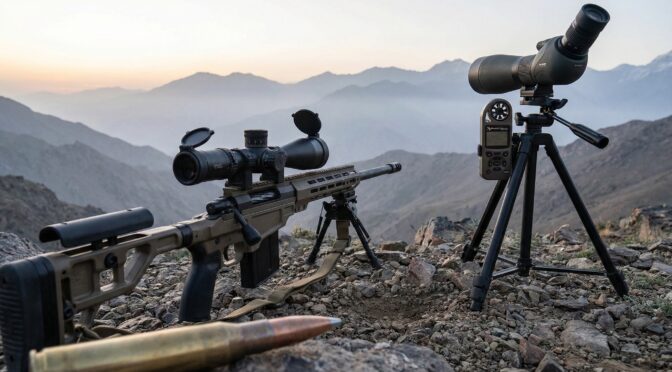
The domain of Extreme Long Range (ELR) engagement—defined herein as precision rifle fire extending beyond 1,500 meters and pushing the envelope to 3,200 meters (2 miles) and beyond—represents the apex of small arms ballistics engineering. This discipline requires a seamless integration of aerodynamic efficiency, internal ballistic consistency, chemical stability of propellants, and the mechanical precision of the launch platform.
This report serves as a comprehensive technical dossier evaluating four primary cartridges that currently dominate or define this landscape: the legacy .50 Browning Machine Gun (BMG), the transitional .408 CheyTac, the reigning competition standard .375 CheyTac, and the optimized modern solution, the .375 EnABELR.
Our analysis adopts a multidisciplinary approach, synthesizing insights from small arms industry analysis, firearms engineering, chemical engineering, and competitive marksmanship. We move beyond simple muzzle velocity comparisons to examine the “whole system” efficiency. This includes analyzing aerodynamic consistency via Doppler radar data, kinetic energy retention profiles, internal ballistic stability (specifically the phenomenon of velocity migration), and the logistical constraints imposed by weapon system mass and magazine geometry.
The findings indicate a distinct evolutionary timeline. The .50 BMG, while possessing immense raw power, is hampered by its machine-gun lineage, resulting in aerodynamic inefficiencies and recoil impulses that degrade precision at extreme ranges. The CheyTac family (.408 and .375) revolutionized the field by introducing the concept of “balanced flight” and ultra-high ballistic coefficients (BC), significantly extending the supersonic threshold. The .375 EnABELR represents the maturation of this science, applying chemical and mechanical engineering solutions to solve the internal ballistic instability inherent in “overbore” cartridges while forcing high-performance ballistics into a magazine-feedable form factor.
2. Theoretical Framework: The Physics of ELR
To understand the comparative analysis of these cartridges, one must first establish the physical constraints of ELR engagements. Unlike traditional long-range shooting (out to 1,000 yards), where a projectile remains supersonic and relatively flat-shooting, ELR involves complex aerodynamic transitions and environmental susceptibilities.
2.1 The Supersonic, Transonic, and Subsonic Regimes
A projectile’s flight is governed by its Mach number.
- Supersonic Flight: The bullet creates a bow shockwave. Drag is high but predictable. Stability is maintained by gyroscopic spin.
- Transonic Transition: As the bullet slows to approximately Mach 1.2 down to Mach 0.8 (roughly 1,340 fps to 890 fps at sea level), the shockwave moves aft along the bullet body. This shift alters the Center of Pressure (CP) relative to the Center of Gravity (CG). If the CP shifts too dramatically, the bullet suffers from dynamic instability, leading to yaw, tumble, or non-linear dispersion—a phenomenon known as “transonic buffet.”
- Subsonic Flight: Below Mach 0.8, the shockwave dissipates. Drag decreases significantly, but wind susceptibility remains.
For an ELR cartridge to be viable, it must maintain supersonic velocity as long as possible to avoid the unpredictability of the transonic zone.1
2.2 Kinetic Energy and Momentum
While velocity hits the target, energy destroys it. Kinetic Energy (Ek) is a function of mass (m) and velocity (v) squared. Ek=0.5 * m * v^2.
In ELR, the ability to retain velocity is far more critical than initial muzzle velocity because velocity is squared in the energy equation. A lighter, faster bullet that sheds velocity quickly (low BC) will arrive with less energy than a heavier, slower bullet that retains its speed (high BC).
2.3 The “Overbore” Phenomenon and Velocity Migration
From a chemical engineering perspective, many ELR cartridges are “overbore,” meaning the case capacity (volume of propellant) is excessively large relative to the bore area (diameter of the barrel). This ratio dictates the expansion ratio of the gases.
- Velocity Migration: In highly overbore cartridges, the immense heat and pressure cause rapid throat erosion and significant copper/carbon fouling within the first few inches of rifling. As this fouling builds up during a string of fire, friction increases, causing chamber pressures and muzzle velocities to spike. This “velocity migration” (e.g., shot 1 is 3,000 fps, shot 20 is 3,025 fps) is catastrophic for ELR accuracy, where a 20 fps variation can result in a vertical miss of several feet at 2 miles.3
3. The Legacy Titan:.50 Browning Machine Gun (12.7x99mm)
3.1 Historical Lineage and Engineering Constraints
The.50 BMG was standardized in 1921, born from a requirement for an anti-armor and anti-aircraft cartridge.4 Its primary design criteria were reliability in belt-fed machine guns (M2 Browning) and the delivery of massive payloads. This lineage creates the fundamental “genetic defect” of the.50 BMG in precision applications: the cartridge case dimensions, chamber tolerances, and throat geometry were originally designed for the loose tolerances required by automatic fire, not the tight lock-up of a precision bolt-action rifle.
3.2 Ballistic Performance Profile
Despite its age, the.50 BMG remains a formidable force due to sheer displacement. Modern advancements have attempted to modernize the cartridge for long-range use, most notably with match-grade projectiles like the Hornady 750gr A-MAX.
- Muzzle Energy: The.50 BMG is the undisputed heavyweight in short-range energy. The Hornady 750gr A-MAX load generates approximately 13,241 ft-lbs at the muzzle (2,820 fps).5 This is nearly double the muzzle energy of the.375 CheyTac variants.
- Aerodynamic Efficiency: The 750gr A-MAX boasts a G1 Ballistic Coefficient (BC) of 1.050 and a G7 BC of roughly 0.581.6 While these numbers are impressive on paper, the massive frontal surface area of the.510 caliber bullet creates significant drag.
- Transonic Transition: This is the.50 BMG’s Achilles’ heel in ELR. While it starts with high velocity, the high drag coefficient causes it to bleed velocity relatively quickly compared to narrower, more efficient projectiles. Ballistic data indicates the 750gr A-MAX enters the transonic zone (approaching 1,125 fps) between 2,400 and 2,500 yards.7 Beyond this distance, the projectile becomes dynamically unstable.
3.3 System Limitations for ELR
The primary limitation of the.50 BMG in competitive ELR is recoil management and spotting.
- Recoil Impulse: The physics of firing a 750-grain projectile at 2,820 fps generates massive recoil energy.8 Even with advanced muzzle brakes, the shooter experiences a violent shove that often displaces the rifle’s sight picture.
- Spotting Impacts: In ELR, the shooter must be able to spot their own “splash” (dust impact) or “trace” (vapor trail) to make rapid corrections. The heavy recoil of the.50 BMG often knocks the shooter off target, blinding them to the impact point. This necessitates a spotter, whereas lower-recoil calibers allow for self-spotting.
- Platform Weight: To tame this recoil,.50 BMG precision rifles are exceedingly heavy. Systems like the Accuracy International AX50 or the McMillan TAC-50 often approach 30-40 lbs fully equipped. While weight aids stability, it restricts mobility and classification in certain competition categories.9
3.4 Chemical Engineering Perspective: Propellant Volume
The.50 BMG case has a capacity of approximately 292 grains of H2O.4 Igniting this massive column of powder requires very slow-burning propellants (e.g., Hodgdon H50BMG, Vihtavuori 20N29). The sheer volume of powder creates a significant “rocket effect” at the muzzle, contributing to the blast signature and recoil.
4. The Bridge to Modernity:.408 CheyTac (10.36x77mm)
4.1 The “Balanced Flight” Philosophy
Developed by Dr. John D. Taylor and William O. Wordman in 2001, the.408 CheyTac was purpose-built to bridge the gap between the.338 Lapua Magnum and the.50 BMG.10 The design goal was an anti-personnel/anti-material system effective to 2,200 yards (2,000 meters).10
The core innovation was the “Balanced Flight Projectile.” The original 419gr solid copper-nickel alloy bullet was designed such that the linear drag and rotational drag were balanced. This theoretical balance allows the bullet to remain stable through the transonic barrier, a feat the.50 BMG struggles to achieve.2
4.2 Ballistic Superiority over Legacy Systems
The.408 CheyTac utilizes a specialized case based on the.505 Gibbs, strengthened to handle high pressures (63,000+ psi).12
- Velocity Retention: With a muzzle velocity of approximately 2,850 – 3,000 fps (depending on barrel length) pushing a 419gr projectile 1, the.408 maintains supersonic flight well past 2,300 yards.1
- Energy Crossover: A critical insight for the analyst is the “energy crossover” point. While the.50 BMG starts with ~13,000 ft-lbs, the.408 starts with ~7,700–8,000 ft-lbs. However, due to the superior aerodynamics of the.408 (G1 BC ~0.949), it retains velocity so efficiently that it actually retains more kinetic energy than the.50 BMG past 700-800 yards.1 This validates the.408 as a superior long-range anti-material cartridge despite its smaller caliber.
4.3 The “Middle Child” Syndrome
Despite its revolutionary design, the .408 CheyTac currently occupies an awkward position in the market.
- Recoil vs. Performance: It generates more recoil than the .375 variants but lacks the ballistic flatness of the .375.
- Component Ecosystem: The projectile selection for .408 (10.36mm) is significantly more limited than the .375 (9.5mm). While the .375 caliber has seen immense R&D from companies like Berger, Warner Tool, and Cutting Edge, the .408 has fewer match-grade options.14
- Terminal Energy: It remains superior to the .375 for hard-target interdiction (penetration) due to projectile mass density, making it preferred for military anti-material roles over pure competition.15
5. The Competition Standard: .375 CheyTac (9.5x77mm)
5.1 The Pursuit of Velocity and BC
The.375 CheyTac is essentially a.408 CheyTac case necked down to 9.5mm (.375 in). This modification created what many analysts consider the “sweet spot” for ELR shooting. By reducing the caliber while maintaining the massive powder column of the parent case, the.375 CheyTac acts as a “super-magnum,” driving lighter, more aerodynamic bullets at significantly higher velocities.
5.2 Dominance in “King of 2 Miles”
The.375 CheyTac has become the de facto standard for ELR competitions like the King of 2 Miles (Ko2M).
- Velocity Profile: It is capable of driving 350gr solids at 3,000 – 3,200 fps or heavier 400gr solids at ~2,950 fps.15
- Trajectory: This high velocity results in a trajectory that is 30-50% flatter than the.408 CheyTac or.50 BMG.17 In ELR, a flatter trajectory increases the margin of error for distance estimation—a critical factor when shooting at unknown distances.
- Projectile Technology: The.375 caliber benefits from the most advanced projectile development in the industry. Monolithic solids from manufacturers like Cutting Edge Bullets (CEB) (e.g., 400gr Lazer) and Warner Tool Company (Flatline) offer consistent G1 BCs exceeding 1.00 and G7 BCs around 0.552.16
5.3 The “Mag-Feed” Limitation
From a firearms engineering standpoint, the primary drawback of the .375 CheyTac is cartridge overall length (COAL). To maximize the performance of heavy 400gr+ solids, the bullets must be seated “long” (shallow in the case) to preserve powder capacity.
- Single Feed Only: When loaded for peak performance with modern ultra-high BC bullets, the .375 CheyTac cartridge becomes too long to fit in standard magazines designed for the CheyTac action. It effectively becomes a single-shot cartridge.18 This slows down the rate of fire, which can be detrimental in competitions with time limits or military scenarios requiring rapid follow-up shots.
- Action Size: The cartridge requires a massive receiver (CheyTac size), which is larger and heavier than standard magnum actions, increasing the logistical footprint of the weapon system.19
6. The Engineered Solution: .375 EnABELR (9.5x70mm)
6.1 Genesis: Solving the “Overbore” Crisis
The .375 EnABELR (Engineered by Applied Ballistics for Extreme Long Range) was developed by applied physics/ballistics experts Bryan Litz and Mitchell Fitzpatrick.3 It was designed specifically to address the shortcomings of the.375 CheyTac and other wildcats like the.375 Lethal Magnum.
The central problem with high-performance .375 wildcats is “Velocity Migration”.3 In highly “overbore” cartridges (where case volume is massive relative to bore diameter), rapid throat erosion and fouling cause the muzzle velocity to increase erratically during a string of fire (e.g., increasing 20 fps over 50 shots). In ELR, a velocity shift of 20 fps causes a vertical miss of several feet at 2 miles.
6.2 Design Characteristics and Magazine Compatibility
The EnABELR case is shorter and wider than the CheyTac, sharing dimensional similarities with the.338 Norma Magnum but scaled up.18
- Magazine Compatibility: The shorter case length allows the round to be loaded with extremely long, high-BC solids (like the Berger 407gr Solid) and still fit inside a standard CIP-length magazine.18 This offers a massive tactical and competitive advantage: follow-up shots can be cycled rapidly without breaking position to hand-load a round.
- Ballistic Consistency: By optimizing the powder column geometry (shorter and wider), the EnABELR achieves more efficient powder burn. Applied Ballistics testing demonstrated significantly reduced velocity migration compared to the.375 Lethal Magnum.3
- Performance: It achieves near-parity with the.375 CheyTac, pushing a 379gr solid at 2,900 fps and a 407gr solid at 2,800 fps from a 30-inch barrel.20
6.3 The Bullet Synergy
The EnABELR was co-developed with Berger Solids.
- Berger 379gr & 407gr Solids: These projectiles are turned from solid copper and feature optimized drag profiles. The 407gr solid has a G7 BC of 0.523 and a G1 BC exceeding 1.0.21 The synergy between the case design and these specific bullets allows for a system that is “turn-key” for ELR, removing the guesswork often associated with wildcatting.20
7. Comparative Ballistics Analysis
This section synthesizes data from Applied Ballistics Doppler radar testing, manufacturer specifications, and competitive firing logs to provide a direct head-to-head comparison.
7.1 Velocity Retention and Transonic Transition
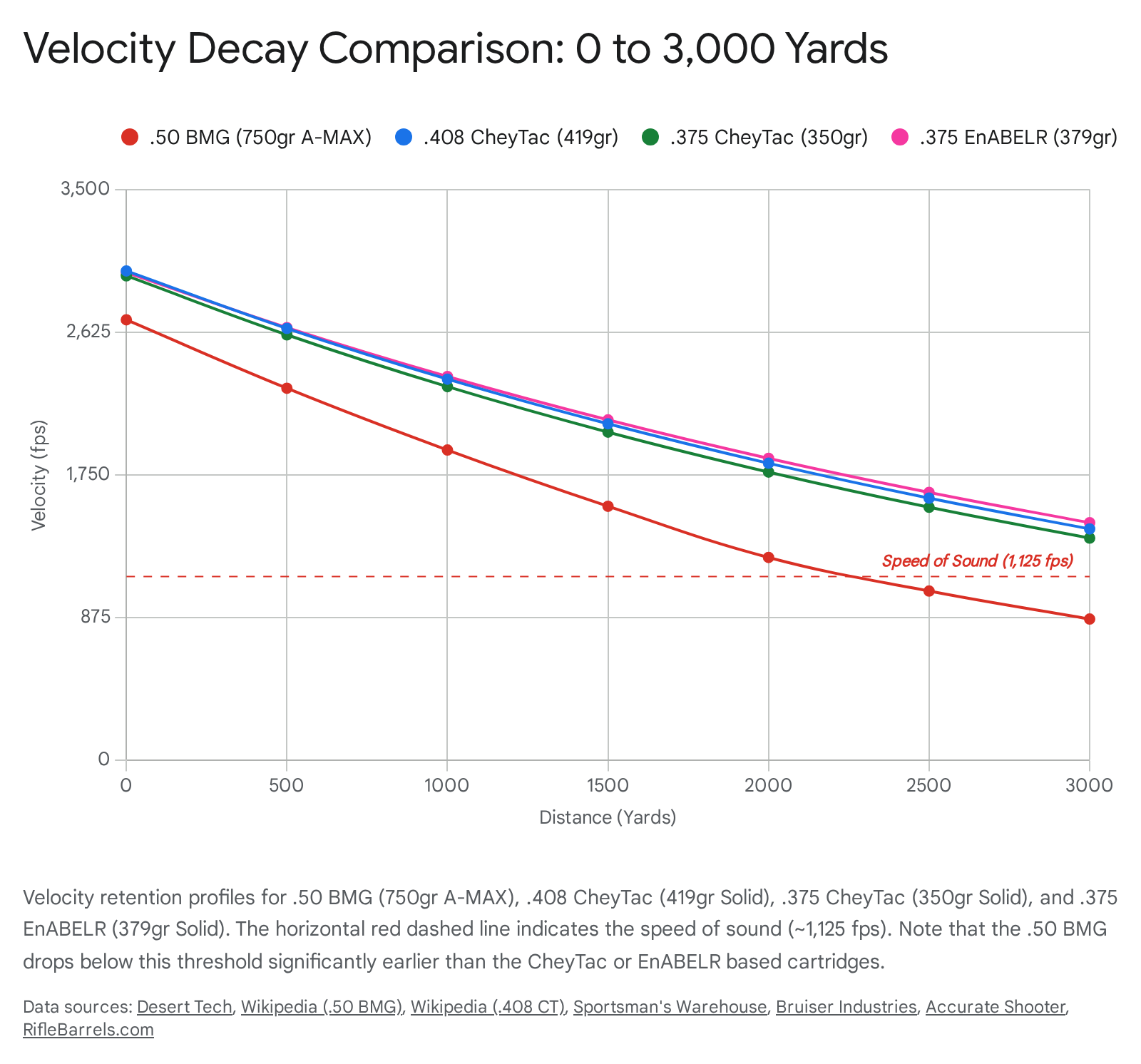
Velocity retention is the primary determinant of ELR consistency. The “Transonic Zone” (approx. 1,300 fps down to 1,000 fps) is where drag curves become non-linear and bullet stability is threatened. A cartridge that stays supersonic longer is inherently more predictable.
Table 1: Velocity Decay (fps) Comparison
Conditions: Standard Atmosphere (Sea Level, 59°F)
| Distance (Yards) | .50 BMG (750gr A-MAX) | .408 CheyTac (419gr) | .375 CheyTac (400gr Lazer) | .375 EnABELR (379gr Solid) |
| Muzzle | 2,820 | 2,850 | 2,950 | 2,900 |
| 500y | 2,376 | 2,550 | 2,700 | 2,650 |
| 1,000y | 1,960 | 2,280 | 2,460 | 2,410 |
| 1,500y | 1,590 | 2,020 | 2,230 | 2,180 |
| 2,000y | 1,280 | 1,780 | 2,010 | 1,960 |
| 2,500y | 1,050 (Subsonic) | 1,560 | 1,800 | 1,750 |
| 3,000y | Subsonic (Unstable) | 1,350 | 1,600 | 1,550 |
Analysis:
The data unequivocally demonstrates the ballistic limitations of the .50 BMG. By 2,500 yards, the .50 BMG has transitioned into the subsonic regime 7, rendering it largely ineffective for precision fire due to transonic instability. In stark contrast, both .375 variants remain deeply supersonic (1,500+ fps) at 3,000 yards, confirming their status as true ELR cartridges. The .408 CheyTac holds the middle ground, remaining supersonic to roughly 2,300–2,400 yards.2
7.2 Kinetic Energy Retention
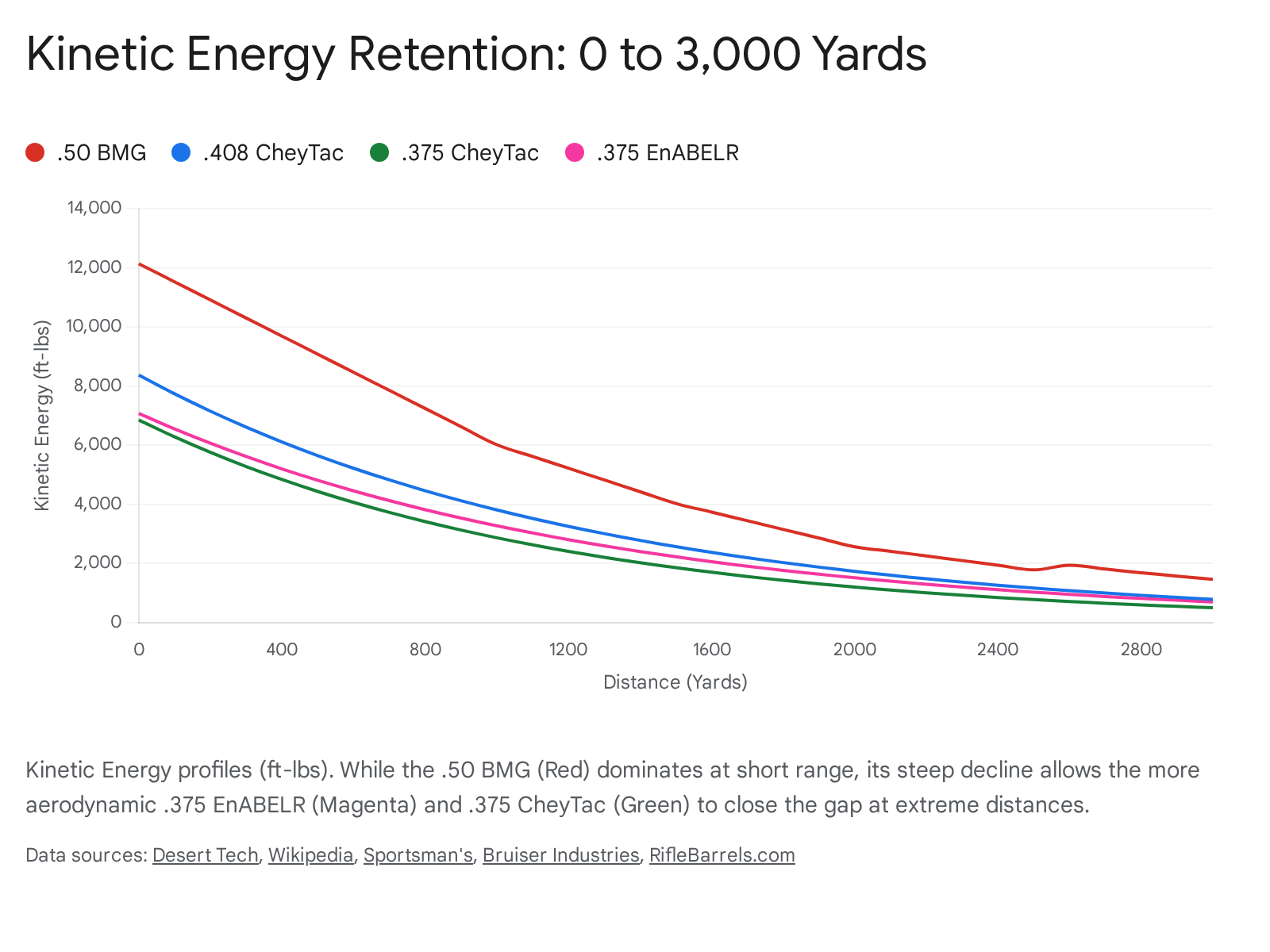
While the .50 BMG dominates at the muzzle, the “crossover effect” in retained energy is a critical insight for anti-materiel applications.
Table 2: Kinetic Energy (ft-lbs) Comparison
| Distance (Yards) | .50 BMG (750gr A-MAX) | .408 CheyTac (419gr) | .375 CheyTac (400gr) | .375 EnABELR (379gr) |
| Muzzle | 13,241 | 7,700 | 7,700 | 7,080 |
| 1,000y | 6,400 | 4,800 | 5,300 | 4,900 |
| 2,000y | 2,700 | 2,900 | 3,600 | 3,250 |
| 2,500y | 1,800 | 2,250 | 2,850 | 2,600 |
Analysis:
At the muzzle, the .50 BMG has a nearly 2:1 energy advantage over the CheyTac family. However, due to drag efficiency, the .375 CheyTac actually delivers more kinetic energy than the.50 BMG at distances past 2,000 yards.17 The .408 CheyTac also surpasses the .50 BMG in retained energy at extreme ranges. This data overturns the common assumption that “bigger is always better” for long-range destruction; at ELR distances, aerodynamic efficiency translates directly to terminal energy.
7.3 Wind Deflection (The Equalizer)
Wind reading is the most difficult skill in ELR shooting. A cartridge that resists wind drift effectively “buys” the shooter points by increasing the error budget.
Table 3: Wind Drift at 2,500 Yards (10mph Full Value Crosswind)
| Cartridge | Wind Drift (Inches) | Wind Drift (Mils) |
| .50 BMG (750gr A-MAX) | ~320 inches | ~3.5 Mils |
| .408 CheyTac (419gr) | ~210 inches | ~2.3 Mils |
| .375 CheyTac (400gr) | ~165 inches | ~1.8 Mils |
| .375 EnABELR (379gr) | ~175 inches | ~1.9 Mils |
Analysis:
The .50 BMG suffers from nearly double the wind drift of the .375 CheyTac at 2,500 yards. This means a 1 mph error in wind call with a.50 BMG results in a miss, whereas the .375 shooter might still impact the edge of the target. This reduction in wind drift (30-40% improvement) is the primary reason why.375 variants dominate competition.17
8. Internal Ballistics and System Engineering
8.1 Chemical Engineering: Propellant Dynamics
The performance of these cartridges is heavily dependent on the propellant used. ELR cartridges typically use ultra-slow burning extruded powders like Hodgdon H50BMG, Retumbo, Reloder 50, or Vihtavuori 20N29 / N570.
- Burn Efficiency: The .375 EnABELR’s shorter, wider powder column promotes a more uniform ignition flame front compared to the long, slender column of the.375 CheyTac or the massive column of the.50 BMG. This “short-fat” efficiency concept, proven in benchrest cartridges like the 6mm PPC, scales up to ELR to provide lower Standard Deviation (SD) in muzzle velocity.
- Temperature Stability: Modern double-base powders (like the Vihtavuori N500 series) offer high energy but can be sensitive to temperature and cause accelerated throat erosion due to higher flame temperatures. Single-base powders (like H50BMG) are generally more stable but offer less energy density. The choice of powder is a trade-off between barrel life and raw velocity.
8.2 Velocity Migration and Barrel Life
A critical, often overlooked factor is Velocity Migration.
- The Phenomenon: As high-capacity cartridges are fired, copper fouling and carbon build-up in the throat increase friction and pressure. In “overbore” wildcats (like the.375 Snipetac or .375 Lethal Mag), this can cause velocity to spike by 15-30 fps over a 20-round string.3
- The EnABELR Solution: The .375 EnABELR was explicitly designed to mitigate this. By optimizing the case capacity to bore ratio (similar to the efficient.338 Norma), Applied Ballistics achieved a design that maintains velocity stability over long strings of fire.3 This allows a shooter to trust their ballistic solver solution late in a match without constantly “truing” their data.
8.3 Barrel Life Expectancy
- .50 BMG: Barrels can last 3,000 – 5,000 rounds due to lower operating pressures (~55,000 psi) and large bore surface area which dissipates heat effectively.
- .375 CheyTac / EnABELR: High-performance barrels are considered “consumables.” Peak match accuracy may only last 800 to 1,200 rounds.22 The high powder volume (130+ grains) pushing through a relatively small 9.5mm bore creates immense heat and throat erosion (“fire cracking”). This cost must be factored into the logistics of fielding these systems.
9. Economic and Logistical Analysis
9.1 Cost Per Round
- .50 BMG: Benefiting from military surplus and mass production, match-grade.50 BMG ammo is the most affordable, often ranging from $5.00 – $9.00 per round.5
- .375 /.408 CheyTac: Factory ammunition is expensive and scarce, often exceeding $12.00 – $18.00 per round.17 Most competitors hand-load.
- .375 EnABELR: As a proprietary cartridge supported by Applied Ballistics and Peterson Cartridge, brass and loaded ammo are premium products. Brass availability is good (Peterson), but loaded ammo is a niche item requiring significant investment.
9.2 Rifle Platform Availability
- .50 BMG: Widely available from Barrett, Armalite, McMillan, AI, and Steyr.
- .375 /.408 CheyTac: Available from CheyTac USA, Desert Tech (HTI), Cadex Defence, and custom builders. The large action size limits options.
- .375 EnABELR: Requires specialized actions or barrels for existing large-action platforms (like the Desert Tech HTI or Cadex). It is currently a niche ecosystem driven by custom builds.
10. Conclusions and Strategic Recommendations
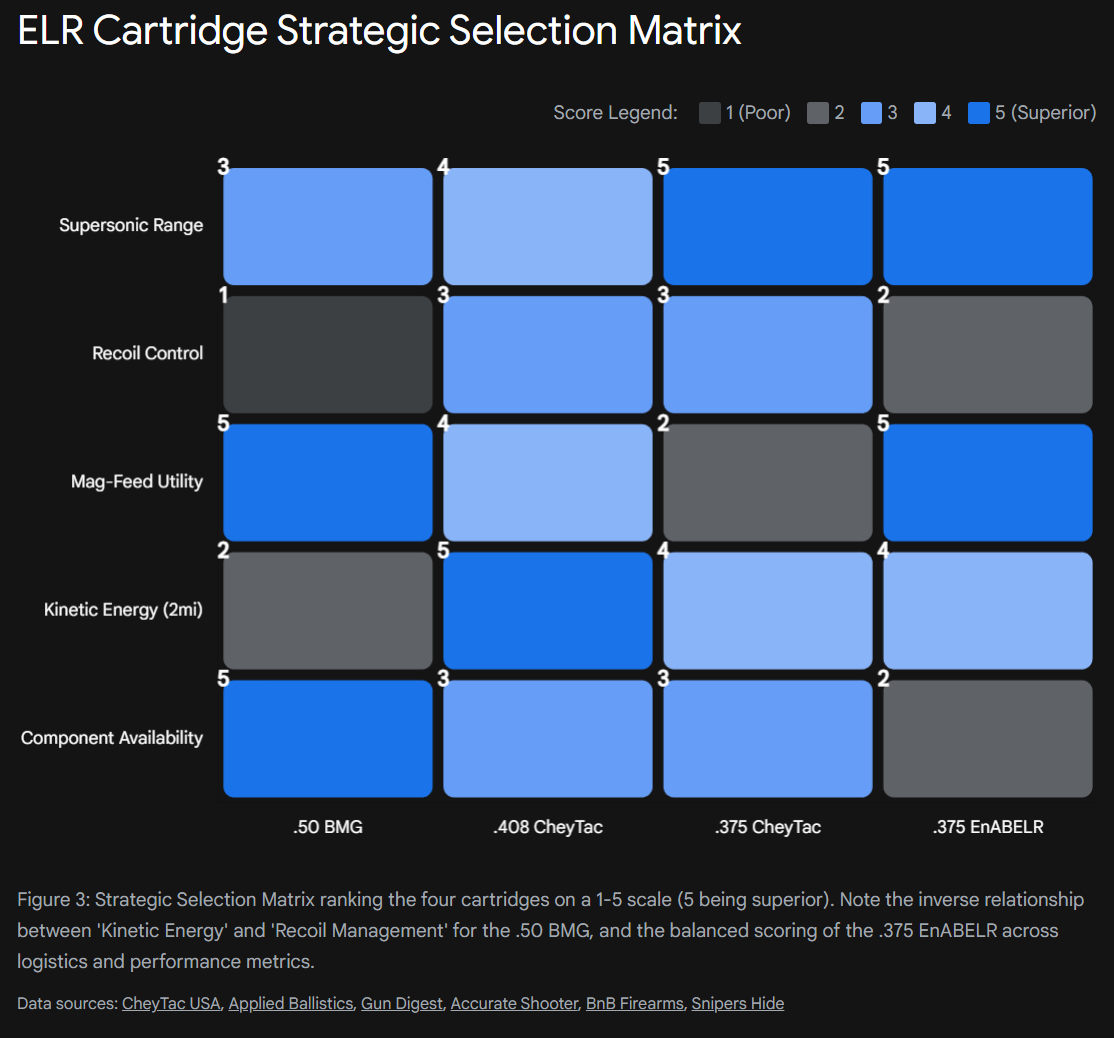
10.1 Summary of Findings
- The .50 BMG is a legacy heavy-lifter. It excels at delivering massive payloads at short-to-medium ranges but is ballistically inefficient for precision work beyond 2,000 yards due to early transonic transition and immense recoil.
- The .408 CheyTac is a highly capable bridge cartridge. It offers excellent ballistic balance and significant terminal energy, making it a viable military interdiction round, though it lacks the flat trajectory of the.375s for pure competition.
- The .375 CheyTac remains the king of raw performance. For shooters seeking the absolute flattest trajectory and highest BCs regardless of logistical constraints (single feeding, action size), it is the top choice.
- The .375 EnABELR is the “thinking man’s” ELR cartridge. It sacrifices a negligible amount of raw velocity (vs. the wildest.375 wildcats) to gain logistical superiority (mag feeding), internal ballistic consistency (stable velocities), and system compatibility (standard actions).
10.2 Strategic Recommendations
- For Military Anti-Materiel: The .50 BMG remains relevant due to payload options (API/HE) and global availability.
- For Military Anti-Personnel/Sniper: The .375 EnABELR offers the optimal balance of portability (shorter actions, mag feed) and hit probability at extreme range.
- For ELR Competition (Unlimited Class): The .375 CheyTac (or its wildcat variants) loaded with 400gr solids offers the highest raw probability of hit due to wind bucking capabilities.
- For ELR Competition (Tactical/Light Class): The .375 EnABELR is superior, allowing the use of lighter, mag-fed platforms that meet weight restrictions while delivering near-CheyTac performance.
If you find this post useful, please share the link on Facebook, with your friends, etc. Your support is much appreciated and if you have any feedback, please email me at in**@*********ps.com. Please note that for links to other websites, we are only paid if there is an affiliate program such as Avantlink, Impact, Amazon and eBay and only if you purchase something. If you’d like to directly contribute towards our continued reporting, please visit our funding page.
Sources Used
- Everything You Need To Know About .408 CheyTac – Gun Digest, accessed January 8, 2026, https://gundigest.com/gear-ammo/ammunition/408-cheytac
- CHEYTAC INTERVENTION™ – US Armorment, accessed January 8, 2026, https://usarmorment.com/pdf/cheytac408.pdf
- The 375 & 338 EnABELR Cartridges – Applied Ballistics, accessed January 8, 2026, https://appliedballisticsllc.com/the-375-338-enabelr-cartridges/
- .50 BMG – Wikipedia, accessed January 8, 2026, https://en.wikipedia.org/wiki/.50_BMG
- 50 BMG Ammunition for Sale. Hornady 750 Grain A-MAX Match – 10 Rounds – Ammo To Go, accessed January 8, 2026, https://www.ammunitiontogo.com/10rds-50-cal-bmg-hornady-750gr-amax-match-ammo
- DTM Ammo .50BMG 750gr A-MAX Premium Match – Desert Tech, accessed January 8, 2026, https://deserttech.com/dtm-ammo-50bmg-750gr.html
- 50 BMG goes subsonic at 1500 Yards? Effect? | Sniper’s Hide Forum, accessed January 8, 2026, https://www.snipershide.com/shooting/threads/50-bmg-goes-subsonic-at-1500-yards-effect.72414/
- A question for ELR enthusiasts | Shooters’ Forum, accessed January 8, 2026, https://forum.accurateshooter.com/threads/a-question-for-elr-enthusiasts.3939242/
- Building a ELR for rifle 1 and 2 mile Matches, Need Gun Specification and Gun classes, accessed January 8, 2026, https://forum.accurateshooter.com/threads/building-a-elr-for-rifle-1-and-2-mile-matches-need-gun-specification-and-gun-classes.4029527/
- .408 Cheyenne Tactical – Wikipedia, accessed January 8, 2026, https://en.wikipedia.org/wiki/.408_Cheyenne_Tactical
- CheyTac® .408/419 gr Ammunition | CheyTac, accessed January 8, 2026, https://cheytac.com/product/cheytac-408-419-gr-ammunition/
- .408 Chey Tac | Gate To The Stars Wiki – Fandom, accessed January 8, 2026, https://gate-to-the-stars.fandom.com/wiki/.408_Chey_Tac
- History – CheyTac Rifles, accessed January 8, 2026, https://cheytacrifles.com/history/
- Caliber .408 Chey Tac Reloading Data, accessed January 8, 2026, https://www.xxlreloading.com/caliber-load-data/.408-chey-tac
- 375 Cheytac vs. .408 Cheytac: A Comparison of Extreme Long-Range Prec – B&B Firearms, accessed January 8, 2026, https://bnbfirearms.com/blogs/news/375-cheytac-vs-408-cheytac-a-comparison-of-extreme-long-range-precision
- B&B .375 CT 400gr – B&B Firearms, accessed January 8, 2026, https://bnbfirearms.com/products/375-cheytac-400gr-ammo
- CheyTac® .375/350 gr Ammunition | CheyTac, accessed January 8, 2026, https://cheytac.com/product/cheytac-375-350-gr-ammunition/
- 375 Enabler — Extreme Ammo for Extreme Long Range (ELR) – Accurate Shooter Bulletin, accessed January 8, 2026, https://bulletin.accurateshooter.com/2021/06/375-enabler-extreme-ammo-for-extreme-long-range-elr/
- 37XC vs 375 ct | Sniper’s Hide Forum, accessed January 8, 2026, https://www.snipershide.com/shooting/threads/37xc-vs-375-ct.6946734/
- Shooting ELR: Applied Ballistics EnABELR – Bruiser Industries, accessed January 8, 2026, https://bruiserindustries.com/shooting-elr-applied-ballistics-enabelr/
- 375 Caliber 407 Grain ELR Match Solid Bullets Rifle Bullet – Berger Bullets, accessed January 8, 2026, https://bergerbullets.com/product/375-caliber-407-grain-elr-match-solid-bullets/
- Cheytac barrel life ? How many rounds ? | Shooters’ Forum, accessed January 8, 2026, https://forum.accurateshooter.com/threads/cheytac-barrel-life-how-many-rounds.4054085/
- 375 Cheytac Barrel Life | Sniper’s Hide Forum, accessed January 8, 2026, https://www.snipershide.com/shooting/threads/375-cheytac-barrel-life.7143830/