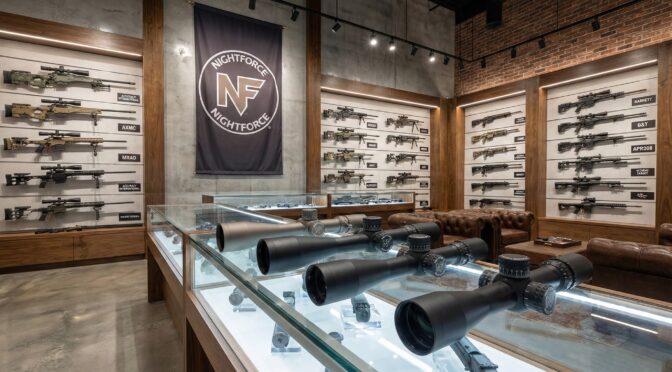
This comprehensive research report provides an exhaustive analysis of Nightforce Optics, Inc., a company that has fundamentally altered the landscape of precision rifle optics over the last three decades. Born from the pragmatic necessities of Australian nocturnal hunting, the company has evolved from a niche manufacturer of varmint scopes into a primary supplier for the United States Special Operations Command (USSOCOM) and a global standard-bearer for ruggedized optical systems.
The analysis traces the company’s trajectory from its founding by Dr. Raymond Dennis in the early 1990s, detailing the strategic pivot from Lightforce Performance Lighting to a dedicated optics subsidiary. It examines the technical and operational decisions—specifically the relocation to Orofino, Idaho, and the hybrid manufacturing partnership with Japanese optical glass specialists—that allowed Nightforce to produce the “Varminter” and “Precision Benchrest” series. These early successes laid the groundwork for the NXS™ (Nightforce Xtreme Scope) line, which became the cornerstone of the company’s reputation for “Rugged, Reliable, Repeatable” performance.
Central to this report is a deep dive into the company’s integration with military doctrine. The adoption of the NXS 5.5-22×56 by the US Navy SEALs for the Mk13 Mod 5 sniper system is identified as the singular event that legitimized the brand in the tactical sphere. The report further scrutinizes the engineering innovations that followed, including the patented ZeroStop™ mechanism and the transition to First Focal Plane (FFP) technology with the ATACR™ and B.E.A.S.T.™ families.
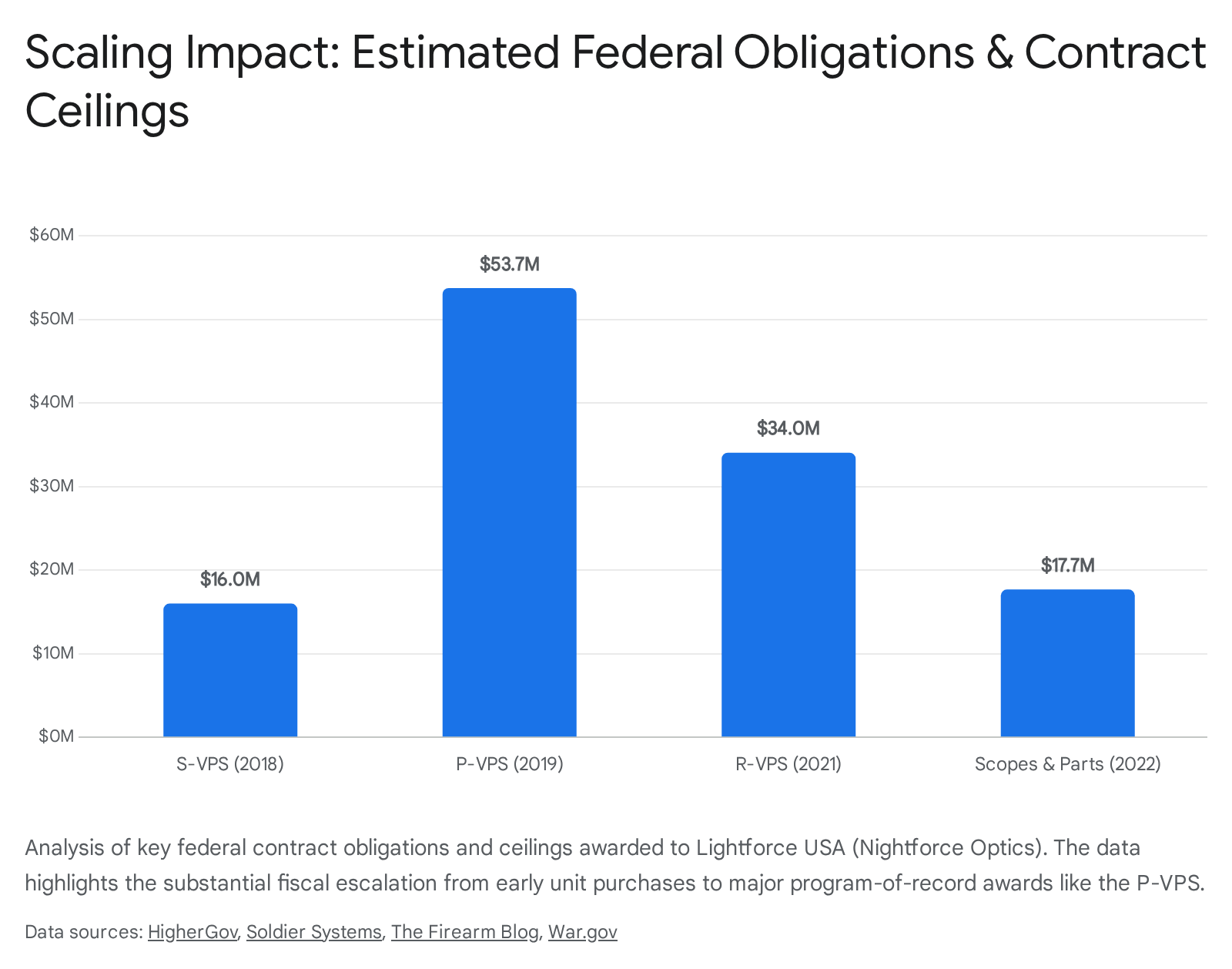
Financially and strategically, the report assesses the impact of recent major federal contracts, including the S-VPS, P-VPS, and R-VPS awards, which have cemented Nightforce’s status within the defense industrial base. The analysis concludes with a forward-looking perspective on the 2025 market landscape, evaluating Nightforce’s positioning against emerging threats from digital electro-optics and commoditized manufacturing, while highlighting their continued investment in intelligent optical systems and integrated ballistics.
1. Origins and Foundation: The Australian Genesis and the “Spotlight Gap”
1.1 The Founder’s Vision: Dr. Raymond Dennis and the Requirements of the Outback
To understand the engineering philosophy of Nightforce Optics, one must first understand the environmental and operational context of its genesis. The company’s origins are not found in the sterile laboratories of European optical giants or the industrial parks of American defense contractors, but in the rugged, unforgiving expanse of the Australian Outback.
In the mid-1980s, Dr. Raymond Dennis, a practicing dentist in South Australia, faced a persistent logistical challenge. An avid hunter, Dennis was engaged in the culling of invasive species—specifically rabbits and foxes—which often required hunting at night.1 In Australia, unlike many jurisdictions in the United States, nocturnal hunting with spotlights was not only legal but a necessary method for population control of vermin species.3
The equipment available to Australian shooters in this era was largely insufficient for the task. The spotlighting method involved mounting high-intensity lights on vehicles and traversing rough terrain to locate game. This operational profile placed two specific demands on equipment: extreme durability to withstand the relentless vibration of off-road driving, and exceptional optical clarity to resolve targets under artificial illumination.4
Dennis first addressed the illumination problem. In 1986, he founded Lightforce Australia Pty. Ltd. in Hindmarsh, South Australia. The existing market for spotlights was dominated by heavy, fragile metal units that were cumbersome to operate. Dennis applied an innovative approach, utilizing injection-molded polymers to create lightweight housings and pairing them with 100-watt halogen bulbs and highly polished 7-inch reflectors. The result was a light capable of illuminating targets at distances exceeding 400 yards, yet light enough to be manipulated easily by a hunter.2
However, the creation of a superior light revealed the deficiencies in the available sighting systems. The European riflescopes of the time, while optically pristine, were often fragile and lacked the necessary parallax adjustment to focus sharply on targets illuminated by spotlights at varying ranges. American scopes, conversely, frequently suffered from small objective lenses that limited light transmission—a critical flaw when hunting at night—and featured wire reticles that could snap under the recoil of heavy calibers or the vibration of the vehicle.2
This “Spotlight Gap”—the disparity between the capability of the illumination and the capability of the sighting system—was the catalyst for Nightforce. Dennis realized that if he wanted a scope that could survive the “ute” (utility vehicle) rides and maximize the potential of his lights, he would have to build it himself.5
1.2 The Establishment of Lightforce USA and Market Entry
In a bold strategic move designed to bypass the limitations of the smaller Australian market, Ray Dennis took his concepts to the United States. He attended the 1986 SHOT Show in New Orleans, primarily to market his Lightforce spotlights.2 While the reception to the lights was initially tepid—Americans were not as culturally accustomed to vehicle-based night hunting—Dennis engaged deeply with the US shooting industry.
He recognized that the United States represented the single largest firearms market in the world. To tap into this potential, he established a subsidiary, Lightforce USA, initially based in Seattle, Washington.4 This entity would eventually do business as Nightforce Optics.
The early years in Seattle were characterized by market research and the establishment of a supply chain that remains central to the company’s identity today. Dennis sought a manufacturing partner capable of producing optical glass and mechanical components to his exacting specifications. He found this partner in Japan. Specifically, industry analysis points to Light Optical Works (LOW), a premier original equipment manufacturer (OEM) in Japan, as the likely partner.4 Japanese optical manufacturing in the 1990s was reaching a zenith, offering glass quality that rivaled the best German and Austrian houses (Zeiss, Swarovski) but with a manufacturing flexibility that allowed for the rugged, heavy-duty tube construction Dennis required.
1.3 The Strategic Relocation to Orofino, Idaho
In 1998, a decision was made that would fundamentally shape the corporate culture and brand identity of the company: the relocation of the US headquarters from the urban center of Seattle to the small, rural town of Orofino, Idaho.7
Orofino, situated in the Clearwater River valley, is a community deeply entrenched in the logging, hunting, and outdoor lifestyle. This move was not merely logistical; it was cultural. By embedding the company in a location where the employees were also the end-users, Nightforce fostered a culture of practical excellence. The rugged terrain of northern Idaho provided an immediate, natural testing ground for their products. Engineers and assemblers could build a scope in the morning and test it on a ridgeline in the afternoon. This feedback loop accelerated the refinement of their designs and cemented the company’s commitment to durability.8
The Orofino facility became the hub for final assembly, quality control, and distribution. While the components (lenses, machined tubes) arrived from Japan, the “heart” of the scope—the assembly of the erector system, the purging of the tube with inert gas, and the rigorous impact testing—occurred in Idaho.4 This allowed Nightforce to maintain tight control over the final product quality while leveraging the specialized manufacturing capabilities of their Japanese partners.
2. The Formative Years (1992–1998): Defining the Niche
2.1 The Varminter and Precision Benchrest Series
Before Nightforce became synonymous with military snipers, it established its reputation in the demanding worlds of varmint hunting and benchrest competition. Launched in the early 1990s, the “Varminter” (later evolved into the NXS) and “Precision Benchrest” (BR) series were radical departures from the market norms of the time.7
The defining characteristic of these early scopes was the massive 56mm objective lens. At the time, most American hunting scopes utilized 40mm or perhaps 50mm objectives. The 56mm lens allowed for a significantly larger exit pupil and greater light transmission, directly addressing the low-light issues Dennis had encountered in Australia.11
Furthermore, these scopes featured magnification ranges that were unheard of in standard production optics. Models like the 8-32x56mm and 12-42x56mm provided benchrest shooters with the ability to see bullet holes on paper targets at 1,000 yards.10
2.2 Technical Differentiation: The Adjustable Objective and Illuminated Reticle
Technically, these early models introduced features that set the brand apart. They utilized an Adjustable Objective (AO) on the front bell of the scope to correct for parallax error. While common on target scopes, Nightforce built these with a robustness that allowed them to be used in the field, not just on a sterile range.
Additionally, Nightforce was a pioneer in illuminated reticles. Unlike the simple “red dot” center points of some competitors, Nightforce often illuminated the entire reticle or significant portions of the ranging scale. This required complex etching processes on the glass elements, moving away from the fragile wire crosshairs that were prone to breaking under the recoil of high-powered varmint rifles or the heavy.50 BMG target rifles that were gaining popularity.7
The “Benchrest” series, in particular, became a cult favorite in the F-Class and 1,000-yard competition circuits. The tracking reliability of the turrets—the ability to dial up 40 MOA (Minutes of Angle) for a long shot and return exactly to zero—became the stuff of legend in a sport where a mechanical error of 0.25 MOA could mean the difference between winning and losing.13
3. The NXS Revolution and Military Dominance (1998–2010)
3.1 The Birth of the NXS (Nightforce Xtreme Scope)
In 1998, coincident with the move to Idaho, Nightforce introduced the product line that would define its future: the NXS™ (Nightforce Xtreme Scope).7 The NXS was not simply an update to the Varminter; it was a comprehensive re-engineering of the riflescope platform designed explicitly to meet the emerging needs of military special operations and extreme tactical shooters.
The NXS was built on a 30mm main tube, which was becoming the standard for tactical optics (replacing the 1-inch American standard). However, Nightforce machined these tubes from 6061-T6 aircraft-grade aluminum bar stock with walls that were two to three times thicker than those of their competitors. This “over-built” approach ensured that the scope body was virtually impervious to crushing forces, denting, or thermal warping that could impinge on the internal optical train.7
Key Innovations of the NXS Series:
- Hi-Speed Turrets: Recognizing that tactical engagements required rapid adjustments, Nightforce eventually introduced turrets that offered 10 or 20 MOA of travel per revolution, significantly faster than the standard target turrets of the day.14
- Glass-Etched Reticles: The NXS cemented the use of etched glass for reticles. This durability was non-negotiable for military users who might subject the weapon system to the violent recoil of grenade launchers or.50 caliber fire.
- Broad Magnification Ranges: The 3.5-15×50 NXS and 5.5-22×56 NXS became the gold standards for versatility. The 3.5-15x offered a wide field of view for closer engagements while retaining enough power for 1,000-yard shots, making it a favorite for designated marksmen.
3.2 The Mk13 Mod 5 and the Global War on Terror
The defining moment for Nightforce’s transition from a high-end civilian brand to a military necessity occurred in the crucible of the Global War on Terror (GWOT). Following the invasions of Afghanistan (2001) and Iraq (2003), US Special Operations Forces (SOF) found themselves engaging targets at distances that far exceeded the effective range of standard service rifles.
The US Navy SEALs, in particular, relied on the Mk13 sniper system, a bolt-action rifle chambered in.300 Winchester Magnum. Earlier variants (Mod 0/1) had utilized scopes from other manufacturers like Leupold, but reports from the field indicated issues with durability and magnification under the intense operational tempo and the punishing recoil of the.300 Win Mag.15
In 2005, the Naval Surface Warfare Center, Crane Division (NSWC Crane), awarded a contract for the Mk13 Mod 5 variant, which famously selected the Nightforce NXS 5.5-22×56 as the day optic.16 These scopes, often marked “NAV-SPEC” or “MIL-SPEC,” featured specific reticles (like the Mil-Dot) and were subjected to even more rigorous acceptance testing than commercial units.
The adoption of the NXS by the Navy SEALs provided an incalculable boost to the brand’s reputation. In the firearms industry, SOF selection is the ultimate validator. It signaled to the entire market—law enforcement, other military branches, and civilian shooters—that Nightforce optics were capable of surviving the harshest combat environments on earth.18
3.3 The “Frozen Scope” Legend and Marketing Durability
During this period, the brand’s marketing—and the user community’s lore—began to focus heavily on extreme durability. This was quantified in Nightforce’s internal testing protocols, which Ray Dennis and his engineers devised to ensure no scope would fail in the field.
These protocols included:
- Forward Impact Testing: Scopes were mounted on a device that simulated recoil forces exceeding 1,250 Gs, repeated thousands of times.19
- Thermal Shock: Units were frozen to -40°F and then rapidly heated to 158°F within one hour to test for seal integrity and fogging.19
- Submersion: Pressure testing equivalent to depths of 100 feet.
This engineering reality birthed the famous “Frozen Scope” demonstration. In a widely circulated video and marketing campaign, a Nightforce NXS was frozen solid in a block of ice, the block was shot with a shotgun (or rifle), and the scope was then thawed, mounted on a rifle, and shown to hold zero perfectly.20 While such tests were theatrical, they effectively communicated the core value proposition of the brand: reliability above all else. In a market where a failed scope could mean a missed trophy for a hunter or a mission failure for a sniper, Nightforce positioned itself as the insurance policy against failure.
4. Technological Innovations and Intellectual Property
4.1 The ZeroStop™ Patent: Solving the “Lost Zero”
One of Nightforce’s most significant contributions to the mechanics of long-range shooting was the invention of the ZeroStop™ technology. As engagement distances increased, shooters were required to dial significantly more elevation into their turrets—often multiple full rotations.
In the stress of combat or competition, returning to the original 100-yard “zero” setting was fraught with risk. A shooter might dial down but lose track of the rotations, ending up a full revolution (e.g., 20 MOA) below or above their actual zero.
To solve this, Nightforce developed a mechanical clutch mechanism that allowed the user to set a hard physical stop at their zero point. No matter how many times the turret was rotated up, the shooter could simply spin it back down until it hit the hard stop, guaranteeing a return to zero without even looking at the dial.
This innovation was protected under US Patent 6,643,970 B2, filed in 2002 and granted in 2003 (assigned to Lightforce USA, Inc.).22 The ZeroStop became a mandatory requirement for almost all future military solicitations and forced competitors to develop their own variations of zero-retention mechanics.2
4.2 DigIllum™: Digital Reticle Illumination
As the use of Clip-On Night Vision Devices (CNVDs) proliferated in the military, the control of reticle illumination became critical. Traditional analog rheostats were often too bright for use with night vision (causing “blooming” or washout) or unreliable.
Nightforce introduced DigIllum™, a digital microprocessor-controlled illumination system. This technology allowed for:
- Precise, distinct brightness settings, including ultra-low intensity modes compatible with night vision.
- Memory functions that returned the illumination to the last used setting upon activation.
- Dual-color capability (Red and Green) within the same unit, selectable by the user.24
This technology was integrated into the NXS and later ATACR lines, further differentiating them from older designs.
5. Expansion and Modernization (2011–2018)
By 2011, the optics market was shifting. European competitors like Schmidt & Bender were dominating the ultra-premium sector with superior glass and First Focal Plane (FFP) designs. Nightforce’s NXS, while durable, utilized Second Focal Plane (SFP) reticles and optical formulas that were a decade old. To remain competitive, the company launched a multi-pronged expansion strategy.
5.1 The ATACR™ (Advanced Tactical Riflescope)
In 2013, Nightforce launched the ATACR™ series to serve as its new flagship. The ATACR was designed to compete directly with “Alpha Glass” manufacturers. It utilized ED (Extra-low Dispersion) glass to eliminate chromatic aberration and improve resolution and contrast.5
The ATACR also featured a larger 34mm main tube, which allowed for significantly more internal elevation travel—up to 120 MOA in some models. This was crucial for the emerging sport of Extreme Long Range (ELR) shooting, where targets were being engaged at 2,000 yards and beyond. The ATACR 5-25×56 quickly became the new standard for heavy tactical rifles.
5.2 The B.E.A.S.T.™ and the FFP Pivot
Also in 2013, Nightforce released the B.E.A.S.T.™ (Best Example of Advanced Scope Technology) 5-25×56 F1. This optic was an engineering tour de force, likely developed for the USSOCOM Precision Sniper Rifle (PSR) program.2
The BEAST was Nightforce’s definitive entry into the First Focal Plane (FFP) market. In an FFP scope, the reticle grows and shrinks with magnification, ensuring that the subtensions (the hash marks used for ranging and holdovers) remain accurate at any magnification setting. This was becoming the doctrinal standard for military snipers.
The BEAST featured a unique elevation control system: a primary lever for coarse adjustments (0.5 MOA or 0.2 Mil) and a fine-tune lever for precision (0.25 MOA or 0.1 Mil). While complex, it demonstrated Nightforce’s ability to innovate at the cutting edge of mechanical design.24
5.3 The SHV™: Democratizing Quality
Recognizing that the $2,500+ price point of the NXS and ATACR excluded a vast segment of the hunting market, Nightforce introduced the SHV™ (Shooter, Hunter, Varminter) line in 2014.5
The SHV strategy was simple: keep the high-quality glass and reliable tracking but strip away the “over-engineered” features necessary for combat but superfluous for hunting. The SHV used simpler turret designs (often capped) and slightly less robust tube walls (though still stronger than average). This allowed Nightforce to offer a product in the $900–$1,200 range, effectively capturing the mid-tier market and preventing competitors like Vortex from dominating that segment completely.
6. The SOCOM Era: Dominating the Defense Sector (2018–Present)
The most transformative period in Nightforce’s recent history began in 2018, as the company transitioned from being a supplier of unit-purchase items to a winner of major “Programs of Record” for USSOCOM. This cemented Nightforce as a prime defense contractor.
6.1 The “Triple Crown” of SOCOM Contracts
Nightforce secured three pivotal contracts that effectively standardized their optics across the entire spectrum of Special Operations small arms.
6.1.1 S-VPS (Squad-Variable Power Scope)
In 2018, USSOCOM awarded Nightforce a contract worth approximately $16 million (initial ceiling) for the Squad-Variable Power Scope.27
- The Optic: ATACR 1-8×24 F1.
- Strategic Shift: This award marked the end of the dominance of fixed-power optics (like the Trijicon ACOG or Elcan SpecterDR) on the M4A1 carbine. The military acknowledged the superiority of the Low Power Variable Optic (LPVO), which offers a true 1x setting for Close Quarters Battle (CQB) and 8x magnification for positive target identification and engagement at 600+ meters.28
- Significance: Nightforce beat out major competitors to define the modern infantry optic.
6.1.2 P-VPS (Precision-Variable Power Scope)
In December 2019, Nightforce won the P-VPS contract with a ceiling of $53.7 million.29
- The Optics: ATACR 5-25×56 F1 and ATACR 7-35×56 F1.
- The Platform: These scopes were selected for the Mk22 Advanced Sniper Rifle (ASR), the Barrett MRAD system that is replacing the M2010 and Mk13 in SOCOM, Army, and Marine Corps service.
- Capability: The inclusion of the 7-35x model highlights the push toward Extreme Long Range capabilities, requiring optical performance that remains crisp at 35x magnification.
6.1.3 R-VPS (Ranging-Variable Power Scope)
In 2021, Nightforce completed the trifecta with the R-VPS contract, with a ceiling of $34 million.30
- The Optic: ATACR 4-20×50 F1.
- The Role: This optic fills the gap between the S-VPS (1-8x) and the P-VPS (5-25x). It is designed for the Designated Marksman (DM) role, optimized for mid-range engagements where field of view and light transmission are balanced against magnification.
6.2 The NX8: Miniature Agility
Leveraging the technology developed for the S-VPS trials, Nightforce launched the NX8™ series commercially in 2018. The NX8 line is characterized by its 8x zoom ratio (e.g., 1-8x, 2.5-20x, 4-32x) packaged in incredibly compact bodies.32
The NX8 2.5-20×50 is particularly notable; it offers the magnification reach of a full-size NXS 5.5-22x but in a package that is nearly the size of a compact hunting scope (approx. 12 inches long). This addressed a growing market demand for “crossover” optics that could be used on lightweight mountain rifles and tactical carbines alike, without the weight penalty of the ATACR line.
7. Current Operational Architecture and Market Position (2024–2025)
7.1 Manufacturing and Supply Chain
Nightforce continues to operate under its successful hybrid model. The company maintains a “Made in USA” designation for its flagship ATACR and military lines by performing substantial transformation in Idaho. The lenses and tube blanks are sourced from Japan (Light Optical Works), which remains the global benchmark for high-performance optical glass production.4
This supply chain is robust but faces challenges from the Berry Amendment and other “Buy American” statutes. However, Nightforce has successfully navigated these by demonstrating that domestic US glass manufacturing (which is extremely limited) cannot meet the volume or quality requirements for these specific high-end optics, while the assembly and QA labor—the value-add—remains domestic.
7.2 The Rise of the “Clone” Market
In a savvy marketing move, Nightforce has recently capitalized on the civilian desire for military authenticity. In late 2023 and continuing into 2024, the company released limited runs of “Contract” riflescopes—commercial units that are laser-engraved with the specific military data plates (e.g., “SU-294/PVS”) found on issued S-VPS and P-VPS scopes.30 These units, often sold at a premium, cater to the thriving “Cloner” community—enthusiasts who build exact replicas of military service rifles. This strategy monetizes the brand’s military prestige directly in the civilian collector market.
7.3 Reticle Evolution: MIL-XT and MOAR
The battle for optical supremacy is now often fought in the reticle. Nightforce has aggressively updated its reticle portfolio to keep pace with the Precision Rifle Series (PRS) and NRL Hunter competitions.
- MIL-XT™: A “Christmas Tree” style reticle designed for holding windage and elevation without dialing. It was created to compete with the Horus H59 and Tremor3, offering a cleaner sight picture for spotting impacts.34
- MOAR™ Evolution: In 2025, Nightforce announced new MOA reticle options for Benchrest and LPVO platforms, reaffirming their commitment to the MOA shooter base despite the industry’s general shift toward Milliradians (MRAD).8
8. Future Outlook and Strategic Horizon (2025+)
8.1 Intelligent Optics and Digital Integration
The next frontier for the optics industry is the fusion of analog glass with digital data. Competitors like Vortex Optics (with the XM157 fire control) and Sig Sauer (with the BDX system) are pushing heavily into “smart scopes.”
Nightforce has not remained idle. Patent filings suggest active R&D into “intelligent” optical systems. Specifically, Patent US 2013/0199074 A1 (associated with Nightforce inventors) discusses sighting systems with integrated wind sensors and display elements that visualize wind uncertainty.35
Furthermore, Nightforce has established integration partnerships with Kestrel and Garmin. While currently this involves external ballistic calculators communicating with the shooter, the logical next step is an ATACR variant with an integrated Heads-Up Display (HUD) that projects the Kestrel’s firing solution directly into the field of view, creating an “Augmented Reality” firing solution while retaining the reliability of a glass etched reticle.36
8.2 Risks and Challenges
Despite its dominant position, Nightforce faces distinct risks in the coming decade:
- Commoditization of Performance: Manufacturing capabilities in China and the Philippines are improving rapidly. Brands like Athlon and Arken are producing scopes with “90% of the performance for 20% of the price.” Nightforce must maintain its “Made in USA” and “Battle Proven” distinctiveness to justify its premium pricing.
- The Digital Pivot: If the US military decides to replace all glass optics with digital fire control systems (like the Next Generation Squad Weapon’s fire control), Nightforce’s expertise in mechanical optics could become less relevant. The company must prove that analog glass is still the failsafe backup that digital systems cannot replace.
9. Summary of Key Milestones
The following table encapsulates the chronological evolution of Nightforce Optics, marking the events that transformed it from an Australian startup to a global defense titan.
| Year | Milestone Event | Strategic Significance | Source |
| 1986 | Ray Dennis founds Lightforce Australia. | Identified the need for rugged equipment for night hunting; established the parent company. | 3 |
| 1992 | Nightforce Optics established. | Formal entry into the US optics market with Varmint/Benchrest models featuring 56mm objectives. | 3 |
| 1998 | Headquarters moved to Orofino, Idaho. | Strategic centralization of US assembly and operations; Launch of the NXS™ series. | 7 |
| 2002 | ZeroStop™ Patent Filed. | Innovation of the mechanical return-to-zero system (granted 2003/2006); became a military standard. | 22 |
| 2005 | Mk13 Mod 5 Adoption. | Navy SEALs select NXS 5.5-22×56; cements the brand’s reputation for military durability. | 17 |
| 2010 | High-Speed Turrets Standardized. | Upgraded NXS line for faster tactical adjustments (20 MOA/rev). | 7 |
| 2013 | ATACR™ Series Released. | Introduction of ED glass and 34mm tubes to compete with European “Alpha Glass.” | 5 |
| 2013 | B.E.A.S.T.™ Released. | First Focal Plane (FFP) innovation with hybrid 0.1 Mil / 0.2 Mil controls; technical showcase. | 5 |
| 2014 | SHV™ Series Released. | Entry into the mid-tier hunting market ($1k price point) to capture broader market share. | 5 |
| 2018 | NX8™ Series Released. | Introduction of 8x zoom ratio technology in compact packages (1-8x, 2.5-20x). | 5 |
| 2018 | S-VPS Contract Awarded. | USSOCOM selects ATACR 1-8×24 for M4A1 carbines ($16M ceiling). | 27 |
| 2019 | P-VPS Contract Awarded. | USSOCOM selects ATACR 5-25x and 7-35x for Sniper Systems ($53M ceiling). | 29 |
| 2021 | R-VPS Contract Awarded. | USSOCOM selects ATACR 4-20×50 for Designated Marksman roles ($34M ceiling). | 30 |
| 2023 | Limited “Clone” Release. | Commercial release of mil-spec marked contract overruns, capitalizing on collector market. | 30 |
| 2025 | New MOA Reticles. | Expansion of reticle options for Benchrest and LPVO platforms, sustaining legacy support. | 30 |
Conclusion
Nightforce Optics stands as a paragon of focused engineering. By refusing to compromise on mechanical durability, the company successfully transitioned from a niche Australian lighting subsidiary to a cornerstone of the American military-industrial complex. Their trajectory—from the heavy, over-built NXS of the late 90s to the compact, optically brilliant NX8 and ATACR lines of today—mirrors the evolution of modern precision shooting itself. As the industry pivots toward digital integration, Nightforce’s challenge will be to integrate “smart” features without sacrificing the mechanical ruggedness that defines their legacy. The “Rugged, Reliable, Repeatable” ethos is not merely a slogan; it is the strategic moat that protects them in an increasingly crowded marketplace.
If you find this post useful, please share the link on Facebook, with your friends, etc. Your support is much appreciated and if you have any feedback, please email me at in**@*********ps.com. Please note that for links to other websites, we are only paid if there is an affiliate program such as Avantlink, Impact, Amazon and eBay and only if you purchase something. If you’d like to directly contribute towards our continued reporting, please visit our funding page.
Sources Used
- Interview with Nightforce Optics Founder Ray Dennis – The Firearm Blog, accessed December 20, 2025, https://www.thefirearmblog.com/blog/2017/02/16/interview-nightforce-optics-founder-ray-dennis/
- Nightforce Optics – Wikipedia, accessed December 20, 2025, https://en.wikipedia.org/wiki/Nightforce_Optics
- Blog – Page 6 – Nightforce Optics, accessed December 20, 2025, https://www.nightforceoptics.com/blog/?page=6
- Where are Nightforce Riflescopes Made? – Optics Trade Blog, accessed December 20, 2025, https://www.optics-trade.eu/blog/where-are-nightforce-riflescopes-made/
- 2022 PRODUCT CATALOG – Scopelist.com, accessed December 20, 2025, https://www.scopelist.com/PDF/nf-product-catalog-2022.pdf
- NF scopes – Made in USA or Made in Japan? | Sniper’s Hide Forum, accessed December 20, 2025, https://www.snipershide.com/shooting/threads/nf-scopes-made-in-usa-or-made-in-japan.69387/
- Nightforce Riflescopes – Scopelist Blog, accessed December 20, 2025, https://blog.scopelist.com/nightforce-riflescopes/
- Nightforce Optics | Rugged, Reliable, Repeatable, Optics, accessed December 20, 2025, https://www.nightforceoptics.com/
- Nightforce manufacturing Question | Shooters’ Forum, accessed December 20, 2025, https://forum.accurateshooter.com/threads/nightforce-manufacturing-question.3896699/
- NF – 8-32x56mm – Nightforce Optics, accessed December 20, 2025, https://www.nightforceoptics.com/riflescopes/competition-and-benchrest/precision-benchrest-8-32×56
- Nightforce 3-15×56 Varminter Lighted Reticle Minty | eBay, accessed December 20, 2025, https://www.ebay.com/itm/386935624264
- NXS – 8-32x56mm – Nightforce Optics, accessed December 20, 2025, https://www.nightforceoptics.com/riflescopes/nxs/nxs-8-32×56
- Competition and Precision Benchrest – Nightforce Optics, accessed December 20, 2025, https://www.nightforceoptics.com/riflescopes/competition-and-benchrest
- Nightforce NXS 5.5-22×56 Rifle Scope, accessed December 20, 2025, https://www.sportoptics.com/nightforce-nxs-5-5-22×56-rifle-scopes.html
- Mk 13 rifle – Wikipedia, accessed December 20, 2025, https://en.wikipedia.org/wiki/Mk_13_rifle
- My MK13 Mod 5 Build | Sniper’s Hide Forum, accessed December 20, 2025, https://www.snipershide.com/shooting/threads/my-mk13-mod-5-build.6995277/
- Mk 13 Mod 0 stock | Page 10 | Sniper’s Hide Forum, accessed December 20, 2025, https://www.snipershide.com/shooting/threads/mk-13-mod-0-stock.6343157/page-10
- Nightforce 5.5-22×56 MILSPEC NAVSPEC (MK13) – Thoroughbred Armament, accessed December 20, 2025, https://www.thoroughbredarmco.com/product/491/mk13-kit
- About Our Technology – Nightforce Optics, accessed December 20, 2025, https://www.nightforceoptics.com/technology/
- Nightforce Torture Test: Can It Handle This Beating? – YouTube, accessed December 20, 2025, https://www.youtube.com/watch?v=srQozdIgdLo
- Nightforce Scope Torture Test – YouTube, accessed December 20, 2025, https://www.youtube.com/watch?v=JQRe_-fgmGQ
- Zero stop adjustable rifle scope – US6643970B2 – Google Patents, accessed December 20, 2025, https://patents.google.com/patent/US6643970B2/en
- Evolution Of Precision Shooting: New Nightforce Scopes Unveiled – KHTS Radio, accessed December 20, 2025, https://www.hometownstation.com/featured-stories/evolution-of-precision-shooting-new-nightforce-scopes-unveiled-481546
- Nightforce B.E.A.S.T 5-25x56mm F1 Rifle Scope – Xtreme Guns And Ammo, accessed December 20, 2025, https://xtremegunsandammo.com/optics-for-sale/rifle-scopes-for-sale/nightforce-rifle-scopes-for-sale/nightforce-beast/
- THE REMARKABLE NEW 4-14×56. WE CUT NO CORNERS. ONLY THE PRICE., accessed December 20, 2025, https://soldiersystems.net/blog1/wp-content/uploads/2013/12/NFO_2014v1ProductCatalog_Mktg_Dec172013.pdf
- SHV – Nightforce Optics, accessed December 20, 2025, https://www.nightforceoptics.com/riflescopes/shv
- US SOCOM Selects Night Force ATACR For Squad-Variable Powered Scopes (FFP), accessed December 20, 2025, https://www.thefirearmblog.com/blog/2018/10/04/ussocom-selects-night-force-atacr/
- NIGHTFORCE® OPTICS BEGINS FULL RATE PRODUCTION FOR US SPECIAL OPERATIONS COMMAND, accessed December 20, 2025, https://www.nightforceoptics.com/nightforce-optics-begins-full-rate-production-for-us-special-operations-command
- USSOCOM Selects Nightforce Optics for Precision-Variable Power Scope – Soldier Systems, accessed December 20, 2025, https://soldiersystems.net/2019/12/12/ussocom-selects-nightforce-optics-for-precision-variable-power-scope/
- NIGHTFORCE® OPTICS AWARDED USSOCOM P-VPS CONTRACT, accessed December 20, 2025, https://www.nightforceoptics.com/nightforce-optics-awarded-ussocom-p-vps-contract
- Contracts for April 29, 2021 – Department of War, accessed December 20, 2025, https://www.war.gov/News/Contracts/Contract/Article/2590381/
- NX8 – Nightforce Optics, accessed December 20, 2025, https://www.nightforceoptics.com/riflescopes/nx8
- Nightforce Introduces Four New SFP NX8 Scopes – The Firearm Blog, accessed December 20, 2025, https://www.thefirearmblog.com/blog/2020/08/10/nightforce-sfp-nx8-scopes/
- Nightforce rifle scopes and reticles – Optics Database – Sage rat hunting, accessed December 20, 2025, https://sageratsafaris.com/nightforce-rifle-scopes-and-reticles/
- US20130199074A1 – Optical device having projected aiming point – Google Patents, accessed December 20, 2025, https://patents.google.com/patent/US20130199074A1/en
- Kestrel Software Partners – Hornady Ballistics, Applied Ballistics, WeatherBird & More – Kestrel Meters, accessed December 20, 2025, https://kestrelmeters.com/pages/software-partners
- Pairing a Kestrel Wind Sensors to a Foretrex 901 With Applied Ballistics – Garmin Support, accessed December 20, 2025, https://support.garmin.com/en-US/?faq=Nkhdvo2eyK9BrgSCJXE339