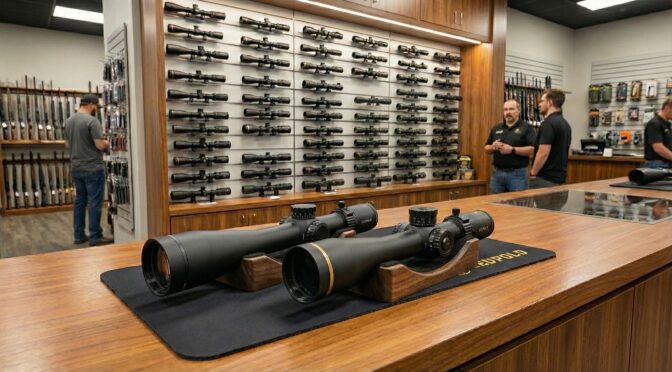
The contemporary small arms optics market has bifurcated into distinct segments driven by the divergent requirements of military precision engagement, law enforcement designated marksman roles, and civilian competitive shooting. Leupold & Stevens, a foundational pillar of the American industrial defense base, has responded to this fragmentation with two flagship product lines that, while optically similar, represent fundamentally different engineering philosophies and strategic intents: the Mark 5HD and the Mark 4HD.
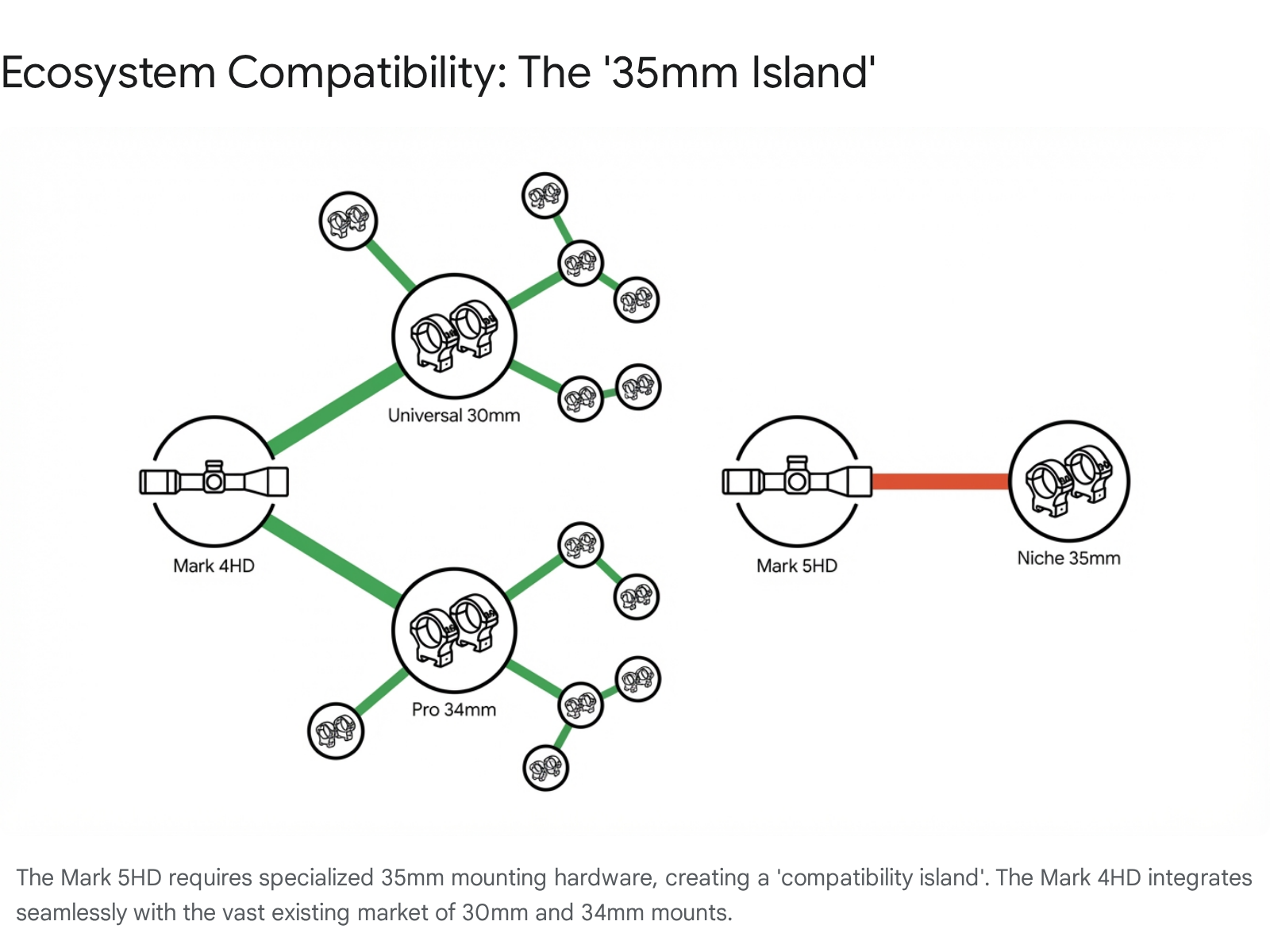
The Mark 5HD, introduced in 2018, was a radical departure from Leupold’s legacy architecture. It was engineered specifically to address the emerging requirements of the U.S. Army’s Precision Sniper Rifle (PSR) program and the burgeoning Extreme Long Range (ELR) civilian market. Its defining characteristic—a non-standard 35mm maintube—was a calculated engineering decision designed to maximize erector system travel, achieving unrivaled elevation adjustment capabilities essential for modern heavy-ballistic cartridges like the.300 Norma Magnum and.338 Lapua Magnum. However, this optimization for travel created significant friction in the mounting ecosystem, isolating the optic from standard 34mm hardware.
The Mark 4HD, released in 2024, represents a strategic correction and a broadening of the tactical portfolio. It is not merely a “budget” alternative but a specialized system designed to resolve the compatibility issues of the Mark 5HD while delivering “Professional-Grade” optical performance at a mid-tier price point ($999–$1,599). By reverting to industry-standard 30mm and 34mm maintubes and utilizing a 4:1 zoom ratio, Leupold has created a platform that prioritizes logistical seamlessness and optical stability over maximum mechanical travel.
Critical Analysis of Improvements and Mistakes:
The transition from Mark 5HD to Mark 4HD demonstrates a clear responsiveness to end-user feedback regarding mounting logistics and parallax capabilities. The Mark 4HD’s 25-yard minimum parallax is a significant improvement over the Mark 5HD’s 50-yard limit, expanding its utility into the rimfire and airgun training markets. However, the Mark 4HD is not without its own engineering oversights; specifically, the reduction in the size of the turret set screws has introduced a durability concern regarding field maintenance, a regression from the robust fasteners found on the Mark 5HD.
Procurement Recommendations:
For military units utilizing long-action sniper systems requiring engagement capabilities beyond 1,500 meters, the Mark 5HD remains the mandatory choice due to its superior elevation travel. Conversely, for Law Enforcement agencies equipping patrol rifles and Designated Marksman Rifles (DMRs) for engagements inside 1,000 meters, the Mark 4HD is the superior procurement option. It offers identical optical resolution, greater mounting compatibility with existing inventory, and significant cost efficiencies that allow for broader deployment across squad-level assets.
1. Industry Context and Leupold’s Heritage
To fully appreciate the positioning of the Mark 4HD and Mark 5HD, one must first understand the tectonic shifts that have occurred in the tactical optics industry over the last twenty years. The transition from the Global War on Terror (GWOT) era, defined by static engagements and specific engagement distances, to the modern era of multi-domain operations and precision competition has fundamentally altered the requirements for small arms optics.
1.1 The Legacy of the Mark 4 LR/T and ER/T
For the better part of three decades, Leupold & Stevens held a near-monopoly on U.S. military sniper optics. The Mark 4 LR/T (Long Range/Tactical) and later the ER/T (Extended Range/Tactical) were the standard-issue optics for iconic weapon systems such as the M24 Sniper Weapon System (SWS), the Mk12 Special Purpose Rifle (SPR), and the M110 Semi-Automatic Sniper System (SASS).1 These optics were characterized by their rugged simplicity: standard 30mm maintubes, wire reticles (often Mil-Dot), and conservative 3:1 zoom ratios (e.g., 3.5-10x, 4.5-14x).
The engineering philosophy of the legacy Mark 4 was durability above all else. Leupold engineered these scopes to survive the “two atmospheres” test—submersion to 66 feet—and the brutal recoil impulses of heavy machine guns. However, as the 2010s progressed, the limitations of the Mark 4 architecture began to show. The 30mm tube limited elevation travel, restricting the effective range of emerging cartridges like the.338 Lapua Magnum. Furthermore, the 3:1 zoom ratio was insufficient for the dual requirements of close-quarters identification and long-range precision that modern urban warfare demanded.
1.2 The Shift to High-Magnification and FFP
The rise of the Precision Rifle Series (PRS) in the civilian sector and the solicitation for the Precision Sniper Rifle (PSR) in the military sector drove a rapid evolution in optical standards. Competitors such as Nightforce, Schmidt & Bender, and Vortex Optics began introducing scopes with 5:1 or even 8:1 zoom ratios, massive 34mm tubes, and complex First Focal Plane (FFP) reticles that allowed for accurate holdovers at any magnification.
Leupold initially responded with the Mark 6 and Mark 8 lines. While these optics were engineering marvels—offering 6x and 8x zoom ratios in compact packages—they were plagued by high manufacturing costs, immense complexity, and optical compromises such as tight eyeboxes and parallax sensitivity. The market rejected the extreme cost of the Mark 8 for general issue, creating a vacuum in Leupold’s lineup between the aging Mark 4 and the exotic Mark 8. This gap necessitated a “clean sheet” design, leading directly to the development of the Mark 5HD.
1.3 Domestic Manufacturing as a Strategic Asset
A critical differentiator for Leupold in this competitive landscape is its manufacturing model. Unlike many competitors who outsource glass production to Japan (Light Optical Works) or assembly to the Philippines, Leupold maintains a vertically integrated manufacturing facility in Beaverton, Oregon.2 This domestic production capability is not merely a marketing point; it is a strategic asset for U.S. government procurement, simplifying compliance with the Berry Amendment and ensuring supply chain security. Both the Mark 4HD and Mark 5HD benefit from this lineage, utilizing American-machined aluminum housings and lenses coated and assembled in the United States, although the raw glass substrates are often sourced from premium international suppliers before undergoing Leupold’s proprietary finishing processes.
2. The Mark 5HD Platform: An Engineering Deep Dive
Released in 2018, the Mark 5HD was Leupold’s aggressive re-entry into the alpha-tier tactical market. It was designed with a singular purpose: to dominate the intersection of weight, travel, and optical performance.
2.1 The 35mm Tube Controversy and Justification
The most controversial and defining feature of the Mark 5HD is its 35mm maintube. In an industry standardized on 30mm and 34mm tubes, the decision to use 35mm was a calculated engineering risk.
From a physics perspective, the internal diameter of the maintube dictates the maximum range of motion for the erector tube—the internal cylinder that houses the reticle and magnification lenses. As the elevation turret is dialed, the erector tube physically tilts within the main housing. A larger maintube allows for a greater angle of tilt before the erector tube strikes the inner wall of the scope body.
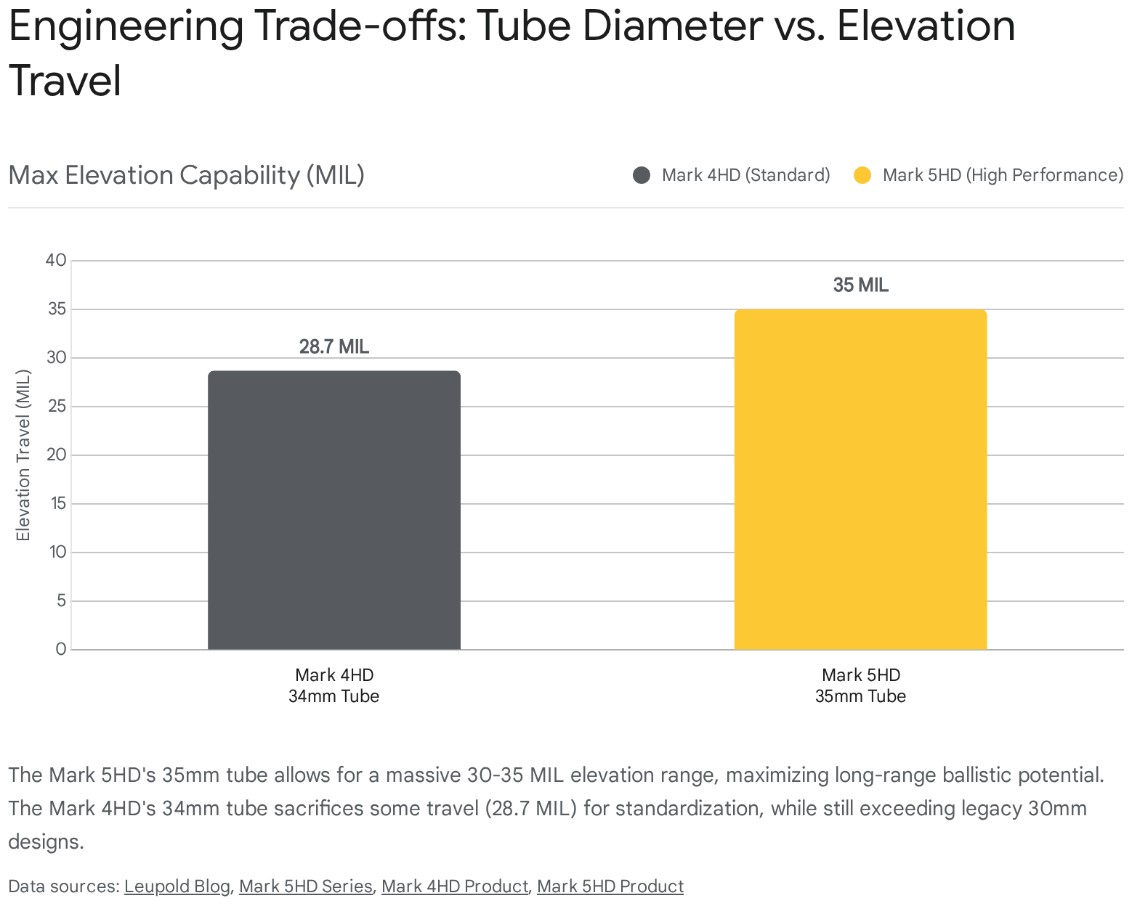
- The Engineering Payoff: By increasing the diameter by just 1mm over the 34mm standard, Leupold engineers were able to squeeze out significantly more elevation travel—up to 35 MILs (120 MOA) in the 5-25x model.4 This additional travel is critical for the.300 Norma Magnum and.338 Norma Magnum cartridges selected for the USSOCOM Mk22 Advanced Sniper Rifle (ASR), which remain supersonic well beyond 1,500 meters.
- The Logistical Friction: While mechanically superior, the 35mm tube created a “compatibility island.” Users could not utilize their existing high-end mounts from manufacturers like Spuhr or Geissele without purchasing new, proprietary 35mm variants. This increased the total cost of ownership and created a barrier to entry for casual users or agencies with deep inventories of 34mm hardware.5
2.2 The 5:1 Zoom Ratio and Optical System
The Mark 5HD utilizes a 5:1 zoom ratio across its entire lineup (2-10x, 3.6-18x, 5-25x, 7-35x). Achieving a 5x zoom factor requires a sophisticated erector lens assembly with high-index glass to control spherical aberration and color fringing at the extremes of the magnification range. Leupold markets this as the “Professional-Grade Optical System”.6
- Lightweight Construction: Despite the large tube and complex internals, the Mark 5HD is exceptionally light. The 5-25×56 model weighs approximately 30 ounces 4, significantly lighter than the Nightforce ATACR 5-25×56 (~39 oz) or the Vortex Razor HD Gen II 4.5-27×56 (~48 oz). This weight reduction was a primary factor in its selection for the U.S. Army PSR program, as it allowed the total weapon system weight to remain within stringent solicitation requirements.
2.3 The M5C3 ZeroLock Turret
The M5C3 turret (Mark 5,.1 MIL, 3 Revolutions) is widely regarded as one of the best tactile interfaces in the industry.
- Mechanism: It features a top-mounted push-button lock that automatically disengages when the button is depressed, allowing for rapid adjustments. The lock re-engages automatically at the zero position, preventing accidental rotation in the field.
- Revolution Indicator: The turret provides a visual and tactile indication of which revolution the user is on (1st, 2nd, or 3rd). This prevents the “lost turret” syndrome, where a sniper might be an entire revolution (10 MILs) off target without realizing it.7
3. The Mark 4HD Platform: Strategic Correction and Expansion
The release of the Mark 4HD in 2024 was a tacit acknowledgment that while the Mark 5HD was a technical triumph, it left a significant portion of the market underserved. The Mark 4HD is designed to capture the “mid-tier professional” user who requires the reliability of the Mark 5HD but cannot justify the price or the logistical headache of the 35mm tube.
3.1 Return to Standardization: 30mm and 34mm Architectures
The Mark 4HD completely abandons the 35mm standard in favor of broader compatibility.
- 30mm Models (1-4.5×24, 2.5-10×42): These models are optimized for the AR-15/M4 carbine and SPR platforms. The use of a 30mm tube reduces the overall bulk of the optic and allows it to be mounted with ubiquitous, lightweight cantilever mounts. This makes the 2.5-10×42 specifically an ideal candidate for law enforcement patrol rifles that require magnification for identification but must remain handy for clearing structures.8
- 34mm Models (4.5-18×52, 6-24×52, 8-32×56): These models cater to the long-range precision market. The 34mm tube is the current industry standard for professional-grade optics, ensuring compatibility with the vast majority of heavy-duty mounts already in circulation. While this reduces the maximum elevation travel to approximately 29 MILs (100 MOA) compared to the Mark 5HD’s 35 MILs, this range is still more than sufficient for 99% of ballistic profiles out to 1,500 yards.6
3.2 The 4:1 Zoom Ratio: A Physics-Based Compromise
The decision to utilize a 4:1 zoom ratio (e.g., 6-24x, 2.5-10x) is the central cost-saving and optical stability mechanism of the Mark 4HD.
- Manufacturing Efficiency: A 4x erector assembly is exponentially easier to manufacture than a 5x or 6x assembly. The cam slots that guide the lens movement are less steep, and the tolerances for lens centering are slightly more forgiving. This reduces the rejection rate during manufacturing, lowering the unit cost.8
- Optical Stability: By limiting the zoom range, engineers can optimize the optical prescription for a narrower band of performance. This often results in a “sweet spot” where edge-to-edge clarity and light transmission are exceptionally high for the price point. Users report that the Mark 4HD’s image quality is indistinguishable from the Mark 5HD, suggesting that the “Professional-Grade Optical System” performs even better within the relaxed constraints of a 4:1 system.9
3.3 The “Set Screw” Vulnerability
One area where the Mark 4HD has faced immediate scrutiny is the durability of its turret cap assembly. Unlike the Mark 5HD, which uses robust fasteners to secure the turret cap to the internal spline, the Mark 4HD utilizes extremely small set screws (requiring a 0.050 hex key).10
- The Issue: Field reports indicate that these screws can be prone to stripping or loosening if not torqued to precise specifications using specialized micro-tools. In a tactical environment, the ability to reset zero in the field is paramount. Relying on microscopic fasteners that require non-standard tools is a potential failure point that agencies must consider during testing and evaluation (T&E). This represents a “mistake” in the design ethos of an optic labeled “Mark 4,” a name synonymous with bomb-proof reliability.
4. Comparative Engineering Analysis
A direct head-to-head analysis reveals where Leupold prioritized performance versus cost in the two lines.
4.1 Optical Performance: Parity in Glass, Divergence in Capability
Both the Mark 4HD and Mark 5HD utilize Leupold’s “Professional-Grade Optical System.” This designation refers to the specific recipe of glass types (lanthanum-based high-index glass), lens geometry, and coatings (Twilight Max HD).
- Resolution and Contrast: In controlled optical bench testing, both scopes resolve high-contrast line pairs with equal efficacy. The Mark 4HD does not suffer from being the “cheaper” optic in terms of glass quality.
- Parallax Adjustment: Here, the Mark 4HD actually surpasses the Mark 5HD. The Mark 5HD has a minimum parallax setting of roughly 50 to 75 yards. This makes it difficult to use for indoor dry-fire practice or rimfire competitions where targets may be as close as 15 yards. The Mark 4HD features a 25-yard minimum parallax, correcting this deficiency and making it a far superior crossover optic for training platforms.6
4.2 Illumination Systems: Analog vs. Digital
The illumination control represents a significant divergence in user interface design.
- Mark 5HD (Analog Dial): The illumination is controlled by a dial integrated into the side focus knob. This allows for rapid, intuitive brightness changes. It is preferred by military users who may need to adjust illumination while wearing heavy gloves or under night vision devices (NVDs).
- Mark 4HD (Digital Push-Button): The Mark 4HD uses a push-button interface located on the side focus turret. While this creates a sleeker profile and reduces the width of the optic, it is functionally slower. Cycling through brightness settings requires multiple button presses, which can be cumbersome under stress. However, it does feature Leupold’s Motion Sensor Technology (MST), which automatically deactivates the illumination after 5 minutes of inactivity to preserve battery life—a critical feature for law enforcement patrol rifles that may sit in a cruiser rack for weeks.6
4.3 Turret Systems: M5C3 vs. M1C3
Both optics utilize the ZeroLock mechanism, but the implementation differs slightly.
- Elevation: Both feature the M5C3 (Mil) or M1C3 (MOA) elevation turret. The tactile feel is crisp and audible on both.
- Windage: The Mark 5HD typically utilizes a capped windage turret. The philosophy is that windage is rarely dialed in the field; snipers prefer to hold wind using the reticle grid. The cap ensures that the zero is never inadvertently lost during transport.
- Windage (Mark 4HD): The Mark 4HD introduces an exposed, locking windage turret on many models. This caters to the competition shooter who may prefer to dial windage for high-precision shots. The lock provides the security of a cap with the speed of an exposed dial, representing a “best of both worlds” improvement over the Mark 5HD’s rigid doctrine.
4.4 Weight and Physical Footprint
Leupold has consistently led the industry in weight reduction, often using lighter aluminum alloys and more compact erector housings than competitors like Nightforce.
- Mark 5HD 5-25×56: ~30 oz.
- Mark 4HD 6-24×52: ~27.5 oz.
The Mark 4HD is lighter, primarily due to the smaller 34mm tube and the slightly smaller objective lens (52mm vs 56mm). This makes the Mark 4HD 6-24x an exceptional choice for western hunters who count every ounce but still demand tactical features.
5. Competitive Landscape Comparison
The tactical optics market is crowded. Understanding the direct competitors for each specific SKU is vital for procurement officers.
5.1 Mark 5HD Competitors (The Alpha Tier)
The Mark 5HD competes in the $2,000–$3,500 bracket.
- Nightforce NX8 4-32×50 F1: The NX8 provides an 8:1 zoom ratio, significantly higher than the Mark 5HD’s 5:1. However, this comes at the cost of a very tight eyebox and shallow depth of field. The Mark 5HD is generally considered to be more “forgiving” and easier to get behind in awkward shooting positions.
- Vortex Razor HD Gen III 6-36×56: The Razor offers superior optical resolution and a massive field of view. However, it weighs nearly 46 ounces—over a pound heavier than the Mark 5HD. For a static benchrest rifle, the Razor wins; for a field-deployable sniper system, the Mark 5HD wins on mobility.
- Nightforce ATACR 5-25×56: The ATACR is legendary for durability. While the Mark 5HD is tough, the ATACR is widely considered “indestructible.” The ATACR commands a higher price premium (~$3,000+) but is the direct competitor for military contracts.
5.2 Mark 4HD Competitors (The Mid-Tier)
The Mark 4HD competes in the $1,000–$1,600 bracket.
- Vortex Viper PST Gen II 5-25×50: For years, this was the default “entry-level” tactical scope. The Mark 4HD is significantly more expensive (~$1,200 vs ~$800) but offers “Professional-Grade” glass that is noticeably superior in low light and glare handling. The Mark 4HD effectively renders the PST Gen II obsolete for users who can stretch their budget slightly.
- Trijicon Credo 2.5-15×42: A direct competitor to the Mark 4HD 2.5-10×42. The Trijicon offers excellent glass and Japanese build quality. However, many users find the Trijicon’s turrets to be less tactile than Leupold’s ZeroLock system. The Mark 4HD also offers the advantage of domestic support and warranty service.12
- Bushnell Match Pro ED 5-30×56: This optic disrupts the market with ED glass at a sub-$800 price point. While the optical quality is surprisingly close to the Mark 4HD, the Bushnell lacks the Leupold brand pedigree and the assurance of U.S. assembly, which is a disqualifying factor for many government agencies.
6. Strategic Analysis: Improvements and Mistakes
6.1 Improvements in the Mark 4HD (The “Fixes”)
The Mark 4HD can be seen as a “patch” for the ecosystem gaps left by the Mark 5HD.
- Parallax Correction: The shift to a 25-yard parallax minimum is a direct response to the explosion of the.22LR precision market (NRL22/PRS Rimfire). The Mark 5HD was effectively locked out of this segment due to its inability to focus at close range. The Mark 4HD captures this market share.
- Mounting Standardization: By returning to 30mm and 34mm tubes, Leupold has removed the single biggest objection to the Mark 5HD. Users no longer need to scrap their expensive Spuhr or Badger Ordnance mounts when switching to a Leupold optic.
- Windage Turret Evolution: The inclusion of locking exposed windage turrets on the Mark 4HD addresses the needs of competitors who were frustrated by the Mark 5HD’s capped windage. It provides a more versatile solution that adapts to both hunting (locked) and competition (dialing) roles.
6.2 Mistakes and Oversight
- The 35mm Isolation (Mark 5HD): In hindsight, the decision to use a 35mm tube for the Mark 5HD was a strategic error in terms of commercial adoption. While it secured military contracts by meeting weight and travel specs, it alienated the broader commercial market. Had Leupold engineered the Mark 5HD with a 34mm tube, it likely would have captured even more market share from Nightforce.
- Fastener Durability (Mark 4HD): The use of undersized set screws on the Mark 4HD turrets is a manufacturing “mistake” that prioritizes aesthetics or cost over field-hardened durability. Reports of these screws stripping suggest a potential recall or in-line manufacturing change may be necessary in future revisions.11
- Illumination Interface (Mark 4HD): The push-button illumination, while modern, is a step backward in functional ergonomics compared to the analog dial. It represents a “consumer-grade” feature creeping into a “professional-grade” optic.
7. Procurement Recommendations
7.1 For Law Enforcement Agencies
Recommendation: Buy the Mark 4HD.
For the vast majority of LE applications, the engagement distance is well within 500 yards. The extreme elevation travel of the Mark 5HD is superfluous capability that wastes budget.
- Patrol Rifles: The Mark 4HD 1-4.5×24 or 2.5-10×42 offers the ideal balance of magnification and situational awareness. The 30mm tube allows for lightweight mounting solutions.
- SWAT / Sniper: The Mark 4HD 4.5-18×52 is the sweet spot. It provides sufficient magnification for positive identification (PID) and precision shots, fits standard 34mm sniper mounts, and costs nearly $800 less per unit than the Mark 5HD. This savings allows departments to allocate funds to other critical needs like night vision or thermal clip-ons.
7.2 For Military Procurement
Recommendation: Buy the Mark 5HD (for Long Action).
For platforms chambered in.300 Win Mag,.300 Norma, or.338 Lapua, the Mark 5HD 5-25×56 is the only Leupold option that provides the necessary elevation travel to exploit the full ballistic envelope of the cartridge. The 35mm tube is a necessary trade-off for this capability.
Recommendation: Buy the Mark 4HD (for DMR/SPR).
For 5.56mm Mk12-style SPRs or 7.62mm M110 platforms, the Mark 4HD 2.5-10×42 or 4.5-18×52 is a superior choice due to weight savings and compatibility with existing inventory of 34mm mounts.
7.3 For Civilian Competitors
Recommendation: Buy the Mark 4HD (for Production Class / Rimfire).
The price point allows competitors to stay under the “Production Class” MSRP limits while using top-tier glass. The 25-yard parallax is essential for rimfire cross-training.
Recommendation: Buy the Mark 5HD (for Open Class).
The 5:1 zoom ratio and massive elevation travel are advantages that Open Class shooters cannot ignore. The ability to dial for extremely distant targets without holding over in the reticle is a competitive advantage in ELR matches.
8. Development Timeline & Specifications
8.1 Timeline of Leupold Tactical Development
| Era | Year | Model | Key Innovation / Context |
| GWOT | 1980s | Ultra M3A | The progenitor. Fixed power (10x), steel tube. Established the M3 turret standard. |
| GWOT | 2004 | Mark 4 LR/T | The standard bearer. Variable power, 30mm tube, Mil-Dot reticle. Defined the M24/M110 capability. |
| GWOT | 2010 | Mark 4 ER/T | First Focal Plane (FFP) introduction. “Extended Range” indicated the need for >1000m engagement. |
| Transition | 2014 | Mark 6 / 8 | High-zoom experiments (6x, 8x). 34mm tubes. Engineering complexity and high cost limited adoption. |
| Modern | 2018 | Mark 5HD | The “Clean Sheet.” 35mm tube, 5:1 zoom, M5C3 turret. Optimized for PSR and ELR. |
| Modern | 2024 | Mark 4HD | The “Correction.” Return to 30/34mm, 4:1 zoom. Democratization of professional glass. |
8.2 Technical Specification Comparison
| Feature | Leupold Mark 4HD | Leupold Mark 5HD | Implication |
| Magnification Ranges | 1-4.5x, 2.5-10x, 4.5-18x, 6-24x, 8-32x | 2-10x, 3.6-18x, 5-25x, 7-35x | Mk5HD offers wider zoom versatility; Mk4HD offers more specific SKU targeting. |
| Main Tube | 30mm (Low/Mid) / 34mm (High) | 35mm (All Models) | Mk4HD wins on compatibility; Mk5HD wins on raw travel. |
| Elevation Travel | ~29 MIL (100 MOA) | ~35 MIL (120 MOA) | Mk5HD mandatory for ELR (>1500m); Mk4HD sufficient for standard LR. |
| Parallax Minimum | 25 Yards | 50-75 Yards | Critical Win for Mk4HD for rimfire/training use. |
| Illumination | Push-Button (Digital) | Dial (Analog) | Mk5HD is faster/tactical; Mk4HD is sleeker. |
| Glass Quality | Professional-Grade System | Professional-Grade System | Parity. No optical penalty for choosing Mk4HD. |
| Turret Fasteners | Small Set Screws (0.050 Hex) | Robust Hex Bolts | Mk5HD is more field-serviceable and durable. |
| Price (MSRP) | $999 – $1,599 | $1,999 – $3,299 | Mk4HD provides ~90% capability for ~60% cost. |
If you find this post useful, please share the link on Facebook, with your friends, etc. Your support is much appreciated and if you have any feedback, please email me at in**@*********ps.com. Please note that for links to other websites, we are only paid if there is an affiliate program such as Avantlink, Impact, Amazon and eBay and only if you purchase something. If you’d like to directly contribute towards our continued reporting, please visit our funding page.
Sources Used
- Honoring the Mark 4’s Legendary Military Service – Leupold, accessed December 22, 2025, https://www.leupold.com/blog/post/30-years-of-service
- Leupold Mark 5HD Selected by Army Precision Sniper Rifle Program, accessed December 22, 2025, https://www.leupold.com/blog/post/leupold-mark-5hd-selected-by-army-precision-sniper-rifle-program
- Embracing the American Spirit – Leupold, accessed December 22, 2025, https://www.leupold.com/blog/post/american-manufacturing-heritage
- Mark 5HD 5-25×56 M5C3 FFP PR2-MIL Riflescope – Leupold, accessed December 22, 2025, https://www.leupold.com/mark-5hd-5-25×56-m5c3-ffp-pr2-mil-riflescope
- Your experience with the mark 5hd | Long Range Only, accessed December 22, 2025, https://www.longrangeonly.com/forum/threads/your-experience-with-the-mark-5hd.15803/
- Mark 4HD vs. Mark 5HD: Which Leupold Riflescope is Right for You?, accessed December 22, 2025, https://www.leupold.com/blog/post/mark4hd-vs-mark5hd
- Mark5 Riflescope Manual (Pdf) – Leupold, accessed December 22, 2025, https://www.leupold.com/media/manuals/mark5-riflescope-manual.pdf
- Leupold Mark 4HD Riflescope: Full Review – Guns and Ammo, accessed December 22, 2025, https://www.gunsandammo.com/editorial/leupold-mark-4hd-review/503687
- Leupold Leads the Pack with New Mark 4HD Scopes – Guns.com, accessed December 22, 2025, https://www.guns.com/news/reviews/leupold-mark-4hd-scopes
- 15 Best Rifle Scopes for Hunting in 2025 – Backfire, accessed December 22, 2025, https://backfire.tv/best-scopes-for-hunting/
- So…what’s the deal with the mk4hd? : r/longrange – Reddit, accessed December 22, 2025, https://www.reddit.com/r/longrange/comments/1dau4tg/sowhats_the_deal_with_the_mk4hd/
- Leupold Mk4HD 2.5-10×42 VS Trijicon Credo 2-10×36 : r/longrange – Reddit, accessed December 22, 2025, https://www.reddit.com/r/longrange/comments/1islpmn/leupold_mk4hd_2510x42_vs_trijicon_credo_210x36/