
DATE: January 17-24, 2026
1. Executive Summary
1.1. Strategic Overview
The Islamic Republic of Iran faces a convergence of existential crises unparalleled since the 1979 Revolution. For the reporting period ending January 24, 2026, the regime is engaged in a high-intensity internal security operation to suppress nationwide protests while simultaneously navigating a critical standoff with the International Atomic Energy Agency (IAEA) and a rapidly escalating deterrent posture against the United States. The situation is characterized by a “perfect storm” of hyperinflation, the lingering psychological and physical degradation from the June 2025 Israel-Iran War, and a strategic disconnect between the regime’s regional ambitions and its domestic fragility.
Domestically, the week was characterized by a shift from riot control to urban counter-insurgency tactics. Following the outbreak of unrest in late December 2025, driven by hyperinflation and social exhaustion, the state’s security apparatus has deployed lethal force indiscriminately. Reports indicate casualty figures ranging from 3,000 to over 5,000, with mass arrests exceeding 26,000.1 The regime has implemented a near-total information blackout, severing internet and telecommunications to obscure the scale of the crackdown.4 This internal bleeding is compounded by the “betrayal” narrative felt by the opposition regarding US President Donald Trump’s oscillation between promising intervention and engaging in diplomatic signaling, leaving the street movement isolated against a militarized state apparatus.1
Internationally, the risk of external intervention has spiked. President Trump’s rhetoric has shifted from support for protesters to direct military threats, accompanied by the deployment of a carrier strike group (CSG)—referred to as an “armada”—to the region.3 Concurrently, the IAEA Director General has issued a de facto ultimatum regarding the lack of access to nuclear sites bombed in June 2025, warning that the agency cannot verify the location of highly enriched uranium (HEU) stockpiles sufficient for multiple nuclear weapons.7 The breakdown of monitoring at Natanz, Fordow, and Isfahan has created a dangerous “blind zone” in which nuclear breakout could theoretically occur undetected.8
Geopolitically, Tehran has moved to cement its survival through the ratification of a Comprehensive Strategic Partnership with the Russian Federation, which entered into force earlier, solidifying a “new stage” of alliance designed to weather Western isolation.9 However, the economic benefits of this pivot have been slow to materialize for the average Iranian, further fueling the “boiling point” scenario warned of by sociologists throughout late 2025.11
1.2. Key Judgments
- Regime Survival Mode: The Supreme Leader’s authorization of “field executions” and the designation of protesters as “combatants” (mohareb) indicates that the core leadership views the current unrest not as a civil disturbance but as a foreign-backed hybrid war aimed at toppling the system. The deployment of heavy weaponry in urban centers like Mahshahr and Kurdistan province suggests a “Syria-fication” of internal security policy.12
- Nuclear Breakout Ambiguity: The destruction of monitoring equipment and refusal of access to Natanz, Fordow, and Isfahan since June 2025 has created a dangerous intelligence blind spot. The regime likely retains the capability to divert surviving HEU stocks to weaponization tracks without immediate detection, potentially leveraging the current chaos as cover for a dash to a deterrent capability.7
- Regional Flashpoints: While Hezbollah remains focused on reconstitution following the 2025 conflict, Houthi forces in Yemen continue to disrupt maritime traffic, demonstrating that the Axis of Resistance remains operationally cohesive despite Iranian domestic strain. The Houthi campaign in the Red Sea serves as a vital pressure valve, exacting costs on the global economy while Tehran is pinned down domestically.14
- Economic Collapse: The Rial’s devaluation to record lows (over 1.4 million IRR to the USD) constitutes the primary driver of unrest. The regime’s inability to stabilize the currency suggests that sanctions and mismanagement have eroded the Central Bank’s intervention capabilities, leaving coercion as the sole remaining tool for stability.16
2. Strategic Context: The Road to Crisis (2025-2026)
To understand the volatility of the week ending January 24, 2026, it is necessary to analyze the preceding months, which set the stage for the current explosion of unrest and geopolitical brinkmanship. The current crisis is not an isolated event but the culmination of a “Long 2025” characterized by military defeat, economic attrition, and social rupture.
2.1. The Legacy of the June 2025 War
The 12-day conflict between Israel and Iran in June 2025 serves as the primary destabilizing vector for the current reporting period. The conflict, dubbed “Operation Rising Lion” by Israeli forces and “Operation Midnight Hammer” by US participants in the air campaign, resulted in severe degradation of Iran’s conventional and strategic capabilities.17
- Military Degradation: The air campaign saw the deployment of over 200 fighter jets and US B-2 bombers utilizing GBU-57 Massive Ordnance Penetrators. These strikes targeted the deeply buried nuclear facilities at Fordow and Natanz, as well as the Isfahan conversion plant.18 While initial damage assessments were debated—with some Pentagon officials claiming “total obliteration” and others suggesting only a 1-2 year setback—the psychological impact on the regime was absolute.19
- Loss of Deterrence: The war exposed the porous nature of Iran’s air defense network, which was described by analysts as “not well networked” and suffering from critical gaps between early warning sensors and engagement radars.20 This failure shattered the regime’s projection of invincibility, emboldening both external adversaries and internal dissidents.
- Economic Aftershocks: The war accelerated the depreciation of the Rial and drained state coffers. The cost of reconstruction, combined with the loss of confidence in the regime’s survival, initiated a capital flight spiral that laid the groundwork for the hyperinflation seen in January 2026.21
2.2. The “Boiling Point” Warnings
Throughout late 2025, domestic observers issued stark warnings that the system was approaching a terminal rupture. These warnings were largely ignored by a hardline administration focused on security consolidation rather than reform.
- Internal Dissent: In October 2025, former labor minister Ali Rabiei wrote in the reformist daily Sharq that Iranians were “fed up with the government’s promises” and warned of a slide into civil unrest. By November, sociologist Taghi Azad Armaki described society as reaching a “boiling point,” a sentiment echoed by commentator Abbas Abdi, who declared the country had reached the “point of no return”.11
- Predictive Failure: Despite these warnings, the security establishment appeared to bank on “brute force” as a sufficient containment strategy. The “accumulated social dissatisfaction” cited by analysts was not addressed through economic relief but met with increased repression, creating a pressure cooker effect that detonated in late December.11
2.3. The Catalyst: December 2025 Economic Collapse
The immediate trigger for the current uprising was the precipitous collapse of the national currency in the final week of December 2025.
- Currency Freefall: On December 28, the Rial fell to a record low of 1,432,000 to the US dollar. By January 6, it had further depreciated to 1,482,500.16 This hyperinflation instantly evaporated the purchasing power of the middle class and triggered panic buying of gold and staples.
- The Bazaar Strikes: The unrest began not with students but with the merchant class—the traditional backbone of conservative Iranian society. Strikes erupted in the Tehran Grand Bazaar and the gold bazaars, signaling a rupture between the bazaaris and the clerical state.6 This economic strike action rapidly coalesced with political grievances, transforming bread riots into a revolutionary movement calling for the end of the Islamic Republic.
3. Domestic Stability and Internal Security
3.1. The Operational Environment: “Urban Warfare”
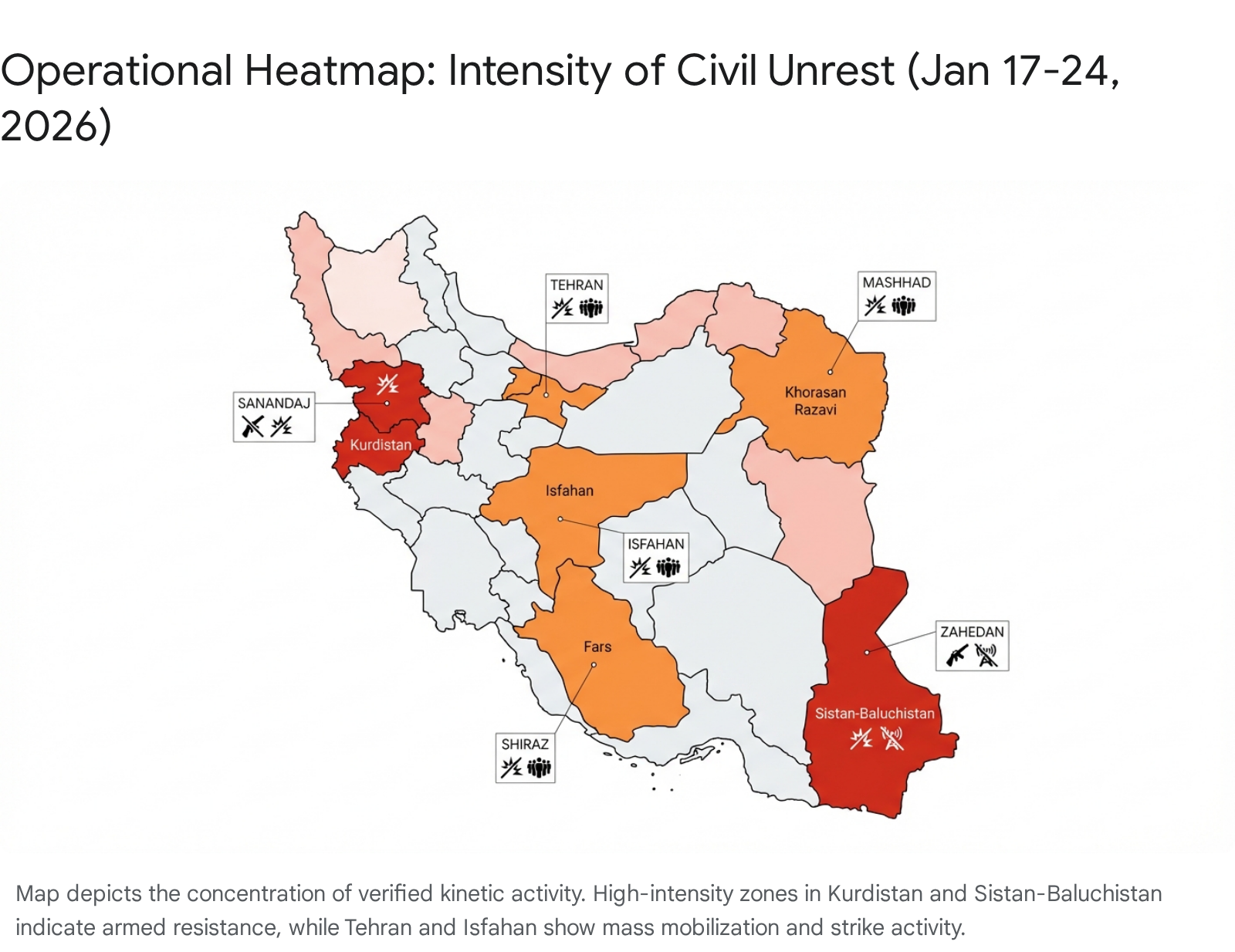
The security landscape across Iran has deteriorated significantly during the reporting week. What began as economic grievances in late December 2025 has metastasized into an explicit anti-regime uprising. Intelligence indicates that the operational tempo of security forces (IRGC, Basij, and Law Enforcement Command – FARAJA) is at its highest since the 2022 Mahsa Amini protests, and potentially exceeds the intensity of the “Bloody November” of 2019.22
The unrest is no longer confined to the traditional political centers but has engulfed the periphery, creating a multi-front internal conflict for the regime.
3.1.1. Tactics, Techniques, and Procedures (TTPs) of Suppression
The regime’s response has evolved from crowd control to lethal suppression. Several distinct tactical shifts were observed this week:
- Militarization of Urban Centers: Security forces have established checkpoints and armed patrols in major cities, including Tehran, Mashhad, and Isfahan. Reports confirm the use of heavy weaponry, including machine guns, in residential areas.22 In Borujerd and Tonekabon, armored personnel carriers and repurposed trucks with water cannons have been deployed to secure key boulevards.23
- “Kill Zones” and Snipers: In a notable escalation, snipers have been stationed on government buildings and rooftops. Specific incidents in Andimeshk and Isfahan confirm the targeting of pedestrians and protesters with precision fire aimed at the head and neck, indicating a “shoot-to-kill” policy rather than dispersal. In Andimeshk, 19-year-old wrestler Shahab Fallahpour was killed by sniper fire from a rooftop on Parto Street without warning.24 In Mobarakeh, snipers targeted civilians from the governor’s office roof.25
- Medical Denial Operations: Intelligence suggests a systemic directive to deny medical treatment to wounded protesters. Security forces are infiltrating hospitals to arrest the injured, forcing citizens to treat gunshot wounds in private homes to avoid detention. In Tehran, witnesses reported victims being left to bleed out as security cordons prevented ambulance access. The bodies of victims are frequently withheld from families to prevent funeral protests, or families are extorted for their return.23
- The “Terrorist” Narrative: To justify the use of military-grade force, the Supreme National Security Council has formally labeled the unrest as a “hybrid war” instigated by foreign actors. State media is broadcasting forced confessions of detainees admitting to being “agents” of Israel or the US, framing the crackdown as a counter-terrorism operation. A statement from the Council claimed that “ISIS-like” cells were responsible for the violence, alleging beheadings and burnings to demonize the opposition.2
3.1.2. Resistance Dynamics and Urban Warfare
Despite the brutality, the resistance has shown remarkable resilience and adaptation. The conflict has taken on the characteristics of low-intensity urban warfare in several districts.
- Self-Defense Units: In Quchan, despite a temporary reduction in security forces, local youth formed self-defense units to protect neighborhoods, organized by witnesses to previous killings.25
- Infrastructure Attacks: In Mobarakeh, Isfahan province, government symbols including the City Council, Municipality, and multiple banks (Agriculture, Tejarat, and National) were set ablaze. This targeting of financial institutions reflects the economic roots of the uprising.25
- Strike Action: In Bandar Abbas, a widespread strike shuttered the bazaar, prompting the regime to physically block roads leading to government offices with concrete barriers to prevent the strike from morphing into a siege of state institutions.25
- Role of Women: Women continue to take leading roles in street confrontations. Eyewitness reports describe women “running toward bullets and pellets to hold the line,” acting as tactical leaders in the decentralized street battles.25
3.2. Casualty Assessment and Human Rights Violations
Quantifying the human toll remains challenging due to the information blockade, but corroborating sources point to a massacre of significant scale.
- Fatalities: Iranian opposition groups and human rights monitors (e.g., HRANA) report death tolls ranging from 2,615 to over 5,000. The regime’s own officials have uncharacteristically admitted to “thousands” of deaths, albeit framing them as necessary to crush “sedition”.1 The UN Special Rapporteur, Mai Sato, cited an estimate of at least 5,000 deaths in an interview.2
- Mass Casualty Events: Specific incidents of mass killing have been recorded. In Shahin Shahr, Isfahan, local sources reported a staggering toll of 186 people killed and 400 wounded during intense clashes.25 Reports from Tehran allege the presence of 700-1,000 dead protesters at a single morgue, suggesting the true nationwide toll may be significantly higher than confirmed counts.22
- Detentions: Over 26,000 individuals have been arrested since late December. The judiciary has expedited trials, with reports of mass sentencing and the threat of imminent execution for at least 800 prisoners. While President Trump thanked Iran for halting some executions, activists on the ground fear this is a temporary deception, as the killing of protesters in the streets continues unabated.6
- Atrocities: Amnesty International and other watchdogs have documented cases of torture, sexual violence against detainees, and the use of metal pellets fired at close range to blind protesters. The use of sexual violence in detention centers has been highlighted as a systematic tool of intimidation.2
3.3. The Digital Siege and Information Warfare
The regime continues to enforce a sophisticated digital blackout. This is not merely a “kill switch” event but a sustained degradation of connectivity designed to atomize the opposition.
- Starlink Interdiction: Authorities are actively using jamming equipment to disrupt satellite internet signals and have criminalized the possession of Starlink terminals. Security forces are confiscating receivers to prevent the diaspora from providing an independent communication backbone.4
- Information Laundering: By severing the link between the internal population and the diaspora, the regime attempts to replace real-time news with state propaganda. State media claims that life has returned to normal while kinetic operations continue in blackout zones. This tactic aims to break the “networks of trust” essential for collective action, making each protester feel isolated and defeated.4
- Diaspora Betrayal: A critical psychological element of this reporting period is the sense of betrayal among the diaspora and internal opposition regarding US policy. Protesters who took to the streets based on President Trump’s promise that “help is on its way” now feel abandoned as no direct intervention has materialized. The perception that the US might negotiate with the regime rather than topple it has created a sense of “limbo” and despair.1
4. Nuclear Dossier: The Standoff Deepens
The intersection of domestic instability and external threat has likely accelerated the regime’s nuclear decision-making. The status of Iran’s nuclear program remains the most volatile variable in the current strategic equation.
4.1. Post-Strike Status of Facilities (The “Blind Zone”)
Following the June 2025 air campaign (Operation Midnight Hammer/Rising Lion), which targeted the Natanz, Fordow, and Isfahan complexes, the IAEA has been effectively blinded.
- Damage Assessment: The June strikes utilized heavy penetrator munitions. At Fordow, the tunnel entrances and potentially underground infrastructure sustained severe damage. At Isfahan, the Uranium Metal Conversion Plant was “nearly destroyed.” However, the full extent of the damage to the deep centrifuge halls at Natanz remains debated, with some intelligence suggesting less damage than publicly claimed.18
- Access Denial: Director General Rafael Grossi confirmed this week that inspectors have not accessed the three bombed sites since June. The agency has “no idea” of the current status of the nuclear material previously stored there. This lack of verification has persisted for over seven months.7
- Stockpile Uncertainty: Prior to the strikes and subsequent blackout, Iran possessed approximately 440.9 kg of uranium enriched to 60%. This stockpile is sufficient, if further enriched to 90%, for approximately 10 nuclear warheads.7 The whereabouts of this material are currently unknown to international monitors.
- Reconstitution Efforts: Intelligence assessments from late 2025 indicated that Iran intended to install an additional 32 cascades of centrifuges and increase production of 60% enriched uranium. It is highly probable that covert reconstruction or diversion to undeclared sites (such as the tunnels near Tehran identified in previous reports) is underway.8
4.2. The IAEA Ultimatum and Diplomatic Collapse
The diplomatic track is collapsing. On January 20, Director General Grossi warned that the standoff “cannot go on forever” and set a de facto deadline of Spring 2026 for Iran to provide a full accounting or face a declaration of non-compliance.7
Table 1: Chronology of Nuclear Escalation and Verification Gaps (2025-2026)
| Date Window | Event / Milestone | Operational Impact |
| June 13-24, 2025 | Operation Midnight Hammer / Rising Lion | US/Israel air campaign targets Natanz, Fordow, Isfahan. 14 GBU-57 MOPs dropped by B-2 bombers. |
| July 2025 | Cessation of Inspections | Iran bars IAEA access to struck sites, citing security risks and “terrorist” nature of attacks. |
| Oct-Dec 2025 | Reconstitution & Expansion | Intel indicates plans for 32 new cascades. Iran notifies IAEA of intent to increase 60% enrichment. |
| Jan 20, 2026 | The “Davos Ultimatum” | DG Grossi warns at WEF: “I don’t have any idea where this material is.” Sets Spring 2026 deadline. |
| Jan 22, 2026 | Iranian Rejection | Nuclear chief Eslami demands IAEA condemn the June attacks before access is restored. |
| Current Status | The “Blind Zone” | No verification of 440.9 kg HEU stock. Breakout time estimated at <2 weeks if material survived. |
- Iranian Counter-Narrative: Iranian nuclear chief Mohammad Eslami has rejected Grossi’s demands, conditioning any future inspections on the IAEA “clarifying its stance” on the June attacks. Tehran argues that it cannot allow inspectors into sites that were targeted by “terrorist” acts without security guarantees, effectively using the strikes as a pretext for opacity.28
4.3. Strategic Implications: The Breakout Decision
The combination of regime insecurity and the loss of conventional deterrence (due to the degradation of missile stocks and air defenses in the June war) elevates the incentive for a nuclear breakout. The regime may view the possession of a nuclear device as the only guarantee against the external regime change operations explicitly threatened by the US administration. The “National Defense Strategy” released by the Pentagon notes that Iranian leaders have “left open the possibility” of pursuing a weapon, a shift from previous assessments of mere capability.19
5. Regional Military Dynamics
5.1. US Force Posture: The “Armada”
Tensions between Washington and Tehran have reached a fever pitch. Following President Trump’s statement that an “armada” is heading to the Middle East, US naval assets are converging on the region.
- Carrier Strike Group (CSG): The USS Abraham Lincoln (CVN-72) and its associated guided-missile destroyers reportedly transited the Strait of Malacca westbound on January 18 and are expected to arrive in the Arabian Sea/Gulf of Oman imminently.3
- Air Assets: The United Kingdom has deployed RAF Eurofighter Typhoons to Qatar to bolster air defenses, specifically at the request of Doha.3 The US has likely increased the readiness of land-based air wings in the UAE and Qatar.
- Rhetoric vs. Reality: While the rhetoric is aggressive (“locked and loaded”), analysts note that the administration has previously walked back strike threats. However, the sheer volume of assets being moved suggests a posture of compellence—forcing Iran to halt the domestic crackdown or face kinetic consequences. The Pentagon has reportedly presented Trump with targets including nuclear sites and ballistic missile facilities.1
5.2. Axis of Resistance Status
Iran’s proxy network remains active but shows signs of strain and reprioritization.
5.2.1. Hezbollah (Lebanon)
Hezbollah is currently prioritizing internal reconstitution over escalation against Israel. Following significant degradation in the June 2025 war and ongoing Israeli strikes on its infrastructure (including the recent killing of a senior commander, Haitham Ali Tabatabai), the group has refrained from large-scale retaliation.
- Operational Pause: Reports indicate Hezbollah is focused on preventing disarmament south of the Litani River and managing Lebanese domestic politics. It has signaled support for the Iranian regime but has notably not threatened to open a northern front to save Tehran.14 This suggests a desire to avoid dragging Lebanon into a renewed conflict for Iranian domestic reasons.
- Continued Attrition: Between January 12 and 18, Israeli operations continued to target Hezbollah operatives, killing at least two. The IDF continues to strike infrastructure north of the Litani where long-range rockets are stored.30
5.2.2. The Houthis (Yemen) and the Red Sea Campaign
In contrast to Hezbollah, the Houthi movement remains the most aggressive node in the axis.
- Maritime Blockade: The Houthis continue to target commercial shipping in the Red Sea, effectively maintaining a blockade that disrupts global supply chains. This serves as Iran’s primary asymmetric lever against the West, imposing economic costs without requiring direct Iranian attribution. The group has effectively turned the Bab al-Mandab into an “anti-access/area-denial” (A2/AD) zone.32
- Economic Impact: The campaign has forced major shipping companies (Maersk, Hapag-Lloyd) to reroute around Africa, reducing Suez Canal traffic by 45% compared to 2024 levels and costing Egypt approximately $13 billion in lost revenue. While some companies like CMA CGM are attempting tentative returns with naval escorts, the threat remains acute.33
- Recent Escalations: On January 27 (forecast/reporting lag), US forces struck a Houthi anti-ship missile, and the UK’s HMS Diamond repelled a drone attack. The Houthis fired an anti-ship cruise missile on January 30, intercepted by the USS Gravely.35 Note: While some dates in snippets appear slightly ahead of the report date, they indicate a continuous high tempo of engagements.
5.2.3. Syrian Theater
A fragile ceasefire holds in Northeast Syria between the Syrian Government and the Syrian Democratic Forces (SDF), mediated by the US.
- Kobani Siege: Despite the ceasefire, Syrian government forces have surrounded the strategic city of Kobani, cutting off electricity and water. This siege tactic is part of a broader “isolate-and-reduce” strategy. The SDF is currently unable to reinforce the city.36
- US Mediation: President Trump reportedly intervened directly, calling Syrian President Ahmed al Shara on January 19 to discuss “protection of the Kurdish people.” This led to a temporary halt in the offensive, but government forces continue to consolidate gains.37 This diplomatic intervention highlights the complexity of the US position—threatening Iran while simultaneously negotiating with its Syrian ally.
6. Economic Intelligence: The Engine of Instability
The current crisis is fundamentally rooted in economic failure. The regime’s inability to provide basic livelihoods has shattered the social contract, uniting the working class and the middle class in opposition.
6.1. Currency Crisis and Hyperinflation
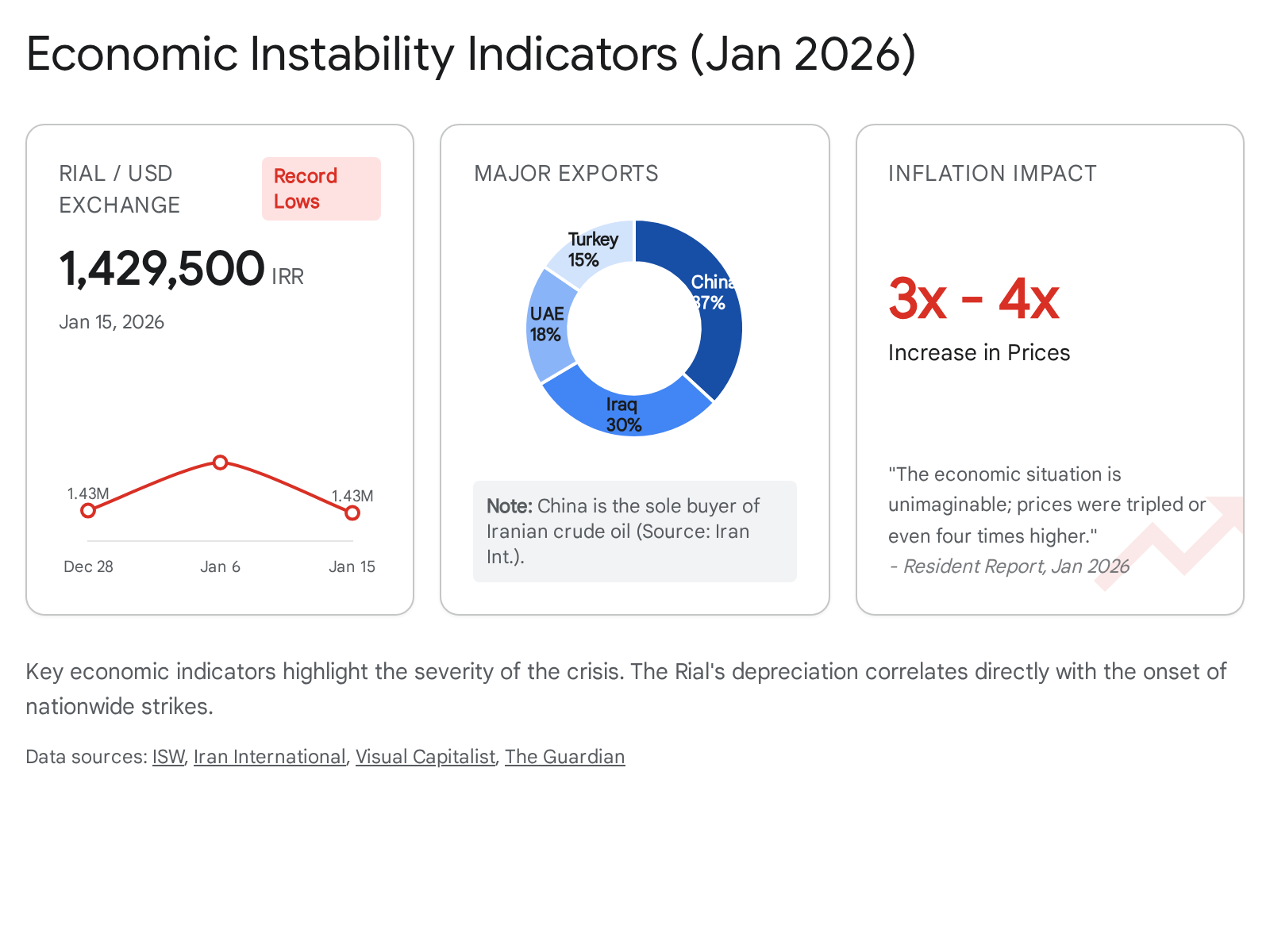
The Iranian Rial continues its freefall. By mid-January 2026, the currency had depreciated to record lows (over 1.4 million Rials to the USD), destroying purchasing power and triggering panic buying of gold and foreign currency.
- Inflation: Prices for basic goods have tripled or quadrupled in recent months. A Tehran resident described the situation as “unimaginable,” with families unable to afford basic life necessities. This hyperinflation is the primary catalyst for the strikes in the bazaars of Tehran and other major cities.6
- Sanctions Evasion Costs: The cost of circumventing sanctions, combined with the “internet blackout tax” (business losses due to connectivity cuts estimated at $125 million), is draining the economy of liquidity.38
6.2. Oil Exports and Trade Resilience
Despite sanctions, Iran maintains a baseline of economic revenue, primarily through oil exports to China.
- Volume: Exports remain significant, with Iranian loadings reaching 1.6 mb/d in late 2025. China remains the sole buyer of crude, while the UAE has emerged as a major importer of Iranian fuel oil.39
- Regional Trade: To offset Western isolation, Iran is aggressively pursuing regional trade integration. Non-oil exports to Uzbekistan rose by 57% in value (to $459 million) and to Turkmenistan by 22.5% (to $495 million) in the first nine months of the fiscal year.40 This “Look East/North” policy is a critical survival mechanism, creating economic dependencies with Central Asian neighbors that are harder for US sanctions to sever.
- Tariff Threat: The new US threat of 25% tariffs on countries trading with Iran creates a massive risk for Beijing and other partners (Iraq, UAE, Turkey). If implemented, this could sever the last remaining lifelines of the Iranian economy, pushing it from recession into total collapse.42
7. Foreign Affairs: Isolation and Alliances
7.1. The Russia-Iran Strategic Partnership
On January 17, 2025, Moscow and Tehran signed a “Treaty on Comprehensive Strategic Partnership,” which fully entered into force in late 2025. This week, the alliance was further operationalized through high-level consultations between Foreign Ministers Lavrov and Araghchi.10
- The Lifeline: For Tehran, this treaty is not merely diplomatic; it is a survival mechanism. It provides a framework for economic circumvention of sanctions, military-technical cooperation (potentially including air defense systems or fighter jets, though delivery remains unconfirmed), and political cover at the UN Security Council.9
- Russian Calculation: Moscow views Iran as a critical partner in the “multipolar” order and a supplier of drones/missiles for its own war in Ukraine. However, Russia is likely wary of intervening directly in Iran’s domestic unrest, preferring to support the regime through intelligence sharing and riot control equipment rather than direct military involvement.43
7.2. International Condemnation and the UN Vote
Relations with the international community have deteriorated sharply following the violent crackdown.
- UN Human Rights Council: On January 23, the UNHRC voted to extend the mandate of the independent Fact-Finding Mission investigating the crackdown. The resolution passed with 25 votes in favor, 7 against, and 14 abstentions.
- The Opposition: Countries voting against the resolution included Vietnam, Cuba, Pakistan, Egypt, and China. Analysts noted the irony of India and Pakistan voting together (likely abstaining or opposing) to avoid setting precedents for external scrutiny.44
- The Mandate: The resolution empowers investigators to document evidence for “future legal proceedings,” a direct threat to Iranian officials of future prosecution for crimes against humanity.26
- European Stance: The European Parliament has strongly condemned the crackdown, and key European states (UK, Germany) are pushing for further sanctions and the designation of the IRGC as a terrorist organization.47
8. Assessment and Outlook
8.1. Scenario Analysis (Next 30 Days)
| Scenario | Probability | Indicators |
| Scenario A: Regime Stabilization via Attrition | High (55%) | Protests fragment due to lack of leadership and communications; Security forces remain cohesive; International pressure remains rhetorical; Russia provides economic lifelines. |
| Scenario B: External Escalation (Conflict) | Medium (30%) | IAEA declares non-compliance; US/Israel strike nuclear sites again; Iran retaliates via Hormuz/proxies; Regime lashes out to unify domestic population. |
| Scenario C: Internal Collapse / Fracture | Low (15%) | Significant defections within Army/IRGC; Strikes paralyze oil sector; Nationwide march on Tehran succeeds; Supreme Leader incapacitated or dies. |
8.2. Strategic Warning
The Intelligence Community (IC) assesses that the regime is entering a period of maximum danger. The “boiling point” described by domestic analysts has been reached. While the security apparatus currently retains the capacity to suppress unarmed protesters, the introduction of any new variable—such as a coordinated general strike in the energy sector, the death of the Supreme Leader, or a limited US military strike—could rapidly shift the trajectory from Scenario A to Scenario C.
Immediate Watchlist for Jan 25-31:
- US Naval Positioning: Arrival of the USS Abraham Lincoln in the Gulf of Oman.
- IAEA Board of Governors: Any emergency meetings called by Grossi regarding the “Spring Deadline.”
- Strike Activity: Expansion of strikes to the critical oil/gas sector (Abadan, Assaluyeh).
- Regime Elite Signals: Public disagreements between the government (Pezeshkian) and the hardline judiciary/IRGC regarding the crackdown.
9. Conclusion
The week ending January 24, 2026, marks a pivotal moment in the history of the Islamic Republic. The regime is fighting a three-front war: a kinetic war against its own people in the streets, a diplomatic war against the IAEA over its nuclear program, and a deterrent war against the United States and Israel.
The outcome of the domestic uprising remains the center of gravity. If the regime can crush the protests within the next 1-2 weeks, it will likely pivot to an aggressive foreign policy to re-establish deterrence. If the protests sustain or expand, the likelihood of a desperate external lash-out—or a fatal internal fracture—increases exponentially. The arrival of the US “armada” ensures that any miscalculation by Tehran could escalate into a major regional conflict within hours. The Iranian leadership is cornered, bleeding, and armed—a recipe for extreme volatility in the coming weeks.
End of Report
If you find this post useful, please share the link on Facebook, with your friends, etc. Your support is much appreciated and if you have any feedback, please email me at in**@*********ps.com. Please note that for links to other websites, we are only paid if there is an affiliate program such as Avantlink, Impact, Amazon and eBay and only if you purchase something. If you’d like to directly contribute towards our continued reporting, please visit our funding page.
Sources Used
- Briefing on Protests in Iran : What’s In Blue – Security Council Report, accessed January 24, 2026, https://www.securitycouncilreport.org/whatsinblue/2026/01/briefing-on-protests-in-iran.php
- Iran: Authorities unleash heavily militarized clampdown to hide protest massacres, accessed January 24, 2026, https://www.amnesty.org/en/latest/news/2026/01/iran-authorities-unleash-heavily-militarized-clampdown-to-hide-protest-massacres/
- Trump says US ‘armada’ heading to Middle East as Iran death toll …, accessed January 24, 2026, https://www.theguardian.com/world/2026/jan/23/trump-says-us-armada-heading-middle-east-iran-death-toll
- Iran Update, January 17, 2026 | Critical Threats, accessed January 24, 2026, https://www.criticalthreats.org/analysis/iran-update-january-17-2026
- Iran Update, January 9, 2026 – Critical Threats, accessed January 24, 2026, https://www.criticalthreats.org/analysis/iran-update-january-9-2026
- ‘It will take a generation’: Iranians abroad on the protests – and change, accessed January 24, 2026, https://www.theguardian.com/world/2026/jan/17/iranians-abroad-protests-change
- IAEA chief warns Iran standoff over enriched uranium cannot go on …, accessed January 24, 2026, https://www.jns.org/iaea-chief-warns-iran-standoff-over-enriched-uranium-cannot-go-on-indefinitely/
- The Status of Iran’s Nuclear Program | Arms Control Association, accessed January 24, 2026, https://www.armscontrol.org/factsheets/status-irans-nuclear-program-1
- Foreign Ministry statement in connection with the entry into force of …, accessed January 24, 2026, https://mid.ru/en/foreign_policy/news/2050909/
- Iran, Russia sign cooperation agreement after talks in Moscow, accessed January 24, 2026, https://www.iranintl.com/en/202512175929
- Tehran ignored warnings of unrest, chose force over reform | Iran …, accessed January 24, 2026, https://www.iranintl.com/en/202601219494
- Digital Blackout and the Order to Kill in Iran: A Legal Analysis of Khamenei’s January 9 Speech, accessed January 24, 2026, https://iran-hrm.com/2026/01/10/order-to-kill-in-iran-khamenei-january-9-speech/
- Ali Khamenei says thousands killed in Iran protests, some in ‘inhuman, savage manner’, accessed January 24, 2026, https://www.theguardian.com/world/2026/jan/17/senior-iranian-cleric-calls-for-protester-executions-in-defiance-of-trump-claims
- Iran Update, January 15, 2026 | Critical Threats, accessed January 24, 2026, https://www.criticalthreats.org/analysis/iran-update-january-15-2026
- Red Sea crisis – Wikipedia, accessed January 24, 2026, https://en.wikipedia.org/wiki/Red_Sea_crisis
- Iran Update, January 15, 2026 | ISW – Institute for the Study of War, accessed January 24, 2026, https://understandingwar.org/research/middle-east/iran-update-january-15-2026/
- Iran Update, June 25, 2025 | ISW – Institute for the Study of War, accessed January 24, 2026, https://understandingwar.org/research/middle-east/iran-update-june-25-2025/
- № 4 (6), 2025. US Strikes on Iran: Timeline and OSINT Damage Assessment – PIR Center, accessed January 24, 2026, https://pircenter.org/en/editions/%E2%84%96-4-6-2025-us-strikes-on-iran-timeline-and-osint-damage-assessment/
- Pentagon: Iran’s nuclear weapon ambitions remain despite Midnight Hammer airstrikes, accessed January 24, 2026, https://www.washingtonexaminer.com/news/4432351/iran-possibility-nuclear-weapon-pentagon-strategy/
- Shallow Ramparts: Air and Missile Defenses in the June 2025 Israel-Iran War, accessed January 24, 2026, https://www.fpri.org/article/2025/10/shallow-ramparts-air-and-missile-defenses-in-the-june-2025-israel-iran-war/
- 2026 Iranian Protests | Cause, Events, Leaders, 12-Day War, Trump, Islamic Revolution, Reza Pahlavi, Shah, & Israel | Britannica, accessed January 24, 2026, https://www.britannica.com/event/2026-Iranian-Protests
- Iran Update, January 13, 2026 | ISW – Institute for the Study of War, accessed January 24, 2026, https://understandingwar.org/research/middle-east/iran-update-january-13-2026/
- Iranian official rhetoric girds for war as US fleet nears | Iran International, accessed January 24, 2026, https://www.iranintl.com/en/202601235052
- More evidence of mass killings surfaces despite Iran internet blackout, accessed January 24, 2026, https://www.iranintl.com/en/202601216477
- Iran Uprising Day 25: Clashes Continue in Cities, Regime Declares Open War on People, accessed January 24, 2026, https://www.ncr-iran.org/en/news/iran-protests/iran-uprising-day-25-clashes-continue-in-cities-regime-declares-open-war-on-people/
- ‘Nuremberg moment’: UN Human Rights Council adopts motion for probe into Iran protest violence, accessed January 24, 2026, https://www.jpost.com/middle-east/iran-news/article-884322
- US-Israel-Iran Conflict: 6/23/25 Update | JINSA, accessed January 24, 2026, https://jinsa.org/wp-content/uploads/2025/06/U.S.-Israel-Iran-Conflict-6-23-2025-1.pdf
- Iran: IAEA Must Clarify Stance on June Attacks Before Inspecting Bombed Sites, accessed January 24, 2026, https://www.algemeiner.com/2026/01/23/iran-iaea-must-clarify-stance-june-attacks-before-inspecting-bombed-sites/
- Iranian VP calls on IAEA to take stand on attacks against country’s nuclear sites, accessed January 24, 2026, https://www.trend.az/iran/nuclearp/4144793.html
- Israeli operations in Lebanon against Hezbollah: January 12–18, 2026 – Long War Journal, accessed January 24, 2026, https://www.longwarjournal.org/archives/2026/01/israeli-operations-in-lebanon-against-hezbollah-january-12-18-2026.php
- Iran Update, January 13, 2026 | Critical Threats, accessed January 24, 2026, https://www.criticalthreats.org/analysis/iran-update-january-13-2026
- Houthi Shipping Attacks: Patterns and Expectations for 2025 | The Washington Institute, accessed January 24, 2026, https://www.washingtoninstitute.org/policy-analysis/houthi-shipping-attacks-patterns-and-expectations-2025
- Shipping Companies Mull Return To Suez Canal, accessed January 24, 2026, https://www.marinelink.com/news/shipping-companies-mull-return-suez-canal-534674
- How Egypt is reviving the Suez Canal after maritime attacks sank traffic, accessed January 24, 2026, https://www.washingtonpost.com/world/2026/01/21/suez-canal-shipping-houthis-attacks/
- Timeline: Houthi Attacks | Wilson Center, accessed January 24, 2026, https://www.wilsoncenter.org/article/timeline-houthi-attacks
- Iran Update, January 22, 2026, accessed January 24, 2026, https://understandingwar.org/research/middle-east/iran-update-january-22-2026/
- Iran Update, January 20, 2026 – Institute for the Study of War, accessed January 24, 2026, https://understandingwar.org/research/middle-east/iran-update-january-20-2026/
- Scale of Iran’s nationwide protests and bloody crackdown come into focus even as internet is out, accessed January 24, 2026, https://www.ksat.com/news/world/2026/01/24/scale-of-irans-nationwide-protests-and-bloody-crackdown-come-into-focus-even-as-internet-is-out/
- Iran’s energy trade defies year of US maximum pressure sanctions, accessed January 24, 2026, https://www.iranintl.com/en/202601226536
- Iran’s non-oil trade with Uzbekistan hits high note in 9M2025, accessed January 24, 2026, https://www.trend.az/business/4144741.html
- Iran’s non-oil exports to Turkmenistan see notable rise in 9M2025, accessed January 24, 2026, https://www.trend.az/business/4144690.html
- Charted: Iran’s Top Export Destinations, accessed January 24, 2026, https://www.visualcapitalist.com/cp/irans-top-export-destinations/
- Iran’s Failing Eastward Pivot? The Limits and Risks of Russia-China Alignment, accessed January 24, 2026, https://www.washingtoninstitute.org/policy-analysis/irans-failing-eastward-pivot-limits-and-risks-russia-china-alignment
- UN rights council decries ‘unprecedented’ crackdown in Iran, deepens scrutiny, accessed January 24, 2026, https://www.thehindu.com/news/international/un-rights-council-decries-unprecedented-crackdown-in-iran-deepens-scrutiny/article70544318.ece
- UN investigators call for accountability after Iran’s ‘deadliest’ crackdown, accessed January 24, 2026, https://www.thenationalnews.com/news/2026/01/23/un-to-vote-on-iran-human-rights-inquiry-after-protest-crackdown/
- UN Human Rights Council special session to address the deteriorating human rights situation in Iran (23 January 2026) – vote by country : r/MapPorn – Reddit, accessed January 24, 2026, https://www.reddit.com/r/MapPorn/comments/1ql3f2k/un_human_rights_council_special_session_to/
- European Parliament condemns Iran’s brutal repression of protesters | News, accessed January 24, 2026, https://www.europarl.europa.eu/news/en/press-room/20260116IPR32443/european-parliament-condemns-iran-s-brutal-repression-of-protesters