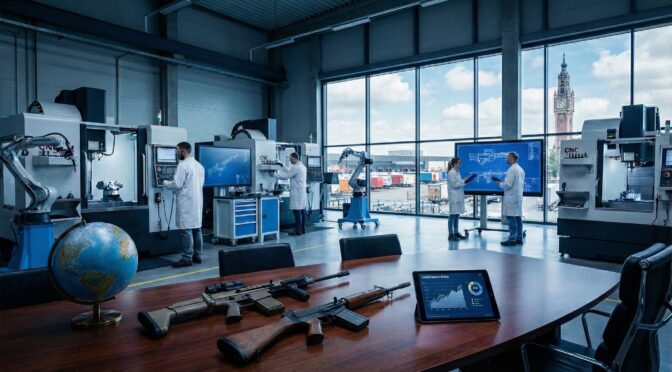
Fabrique Nationale Herstal (FN Herstal), operating today as the Defense & Security division of the FN Browning Group, represents one of the most enduring and influential industrial entities in the history of military armaments. Established in 1889 in the Meuse Valley of Belgium—a region with a metallurgical lineage dating back to the Middle Ages—the company was born from a geopolitical imperative to arm the Belgian state against rising continental threats. From these origins as a syndicate of Liège craftsmen, FN Herstal evolved into a global defense hegemon through two distinct strategic epochs: a commercial golden age defined by the genius of American inventor John Moses Browning, and a post-World War II military industrial dominance where it functioned as the “Right Arm of the Free World,” supplying the primary infantry weapons for the North Atlantic Treaty Organization (NATO).
The historical analysis reveals a corporate trajectory marked by extreme resilience. FN Herstal navigated two devastating German occupations, the collapse of the global arms market post-Cold War, and the disastrous acquisition by French conglomerate GIAT Industries in the 1990s. Its survival was secured through the intervention of the Walloon Regional Government, which nationalized the company in 1997. This unique governance structure—a state-owned enterprise with a mandate for economic sustainment in Wallonia—has allowed for patient capital investment in research and development, insulating the firm from the short-term pressures of public equity markets while maintaining a portfolio of iconic brands including Browning and Winchester Firearms.
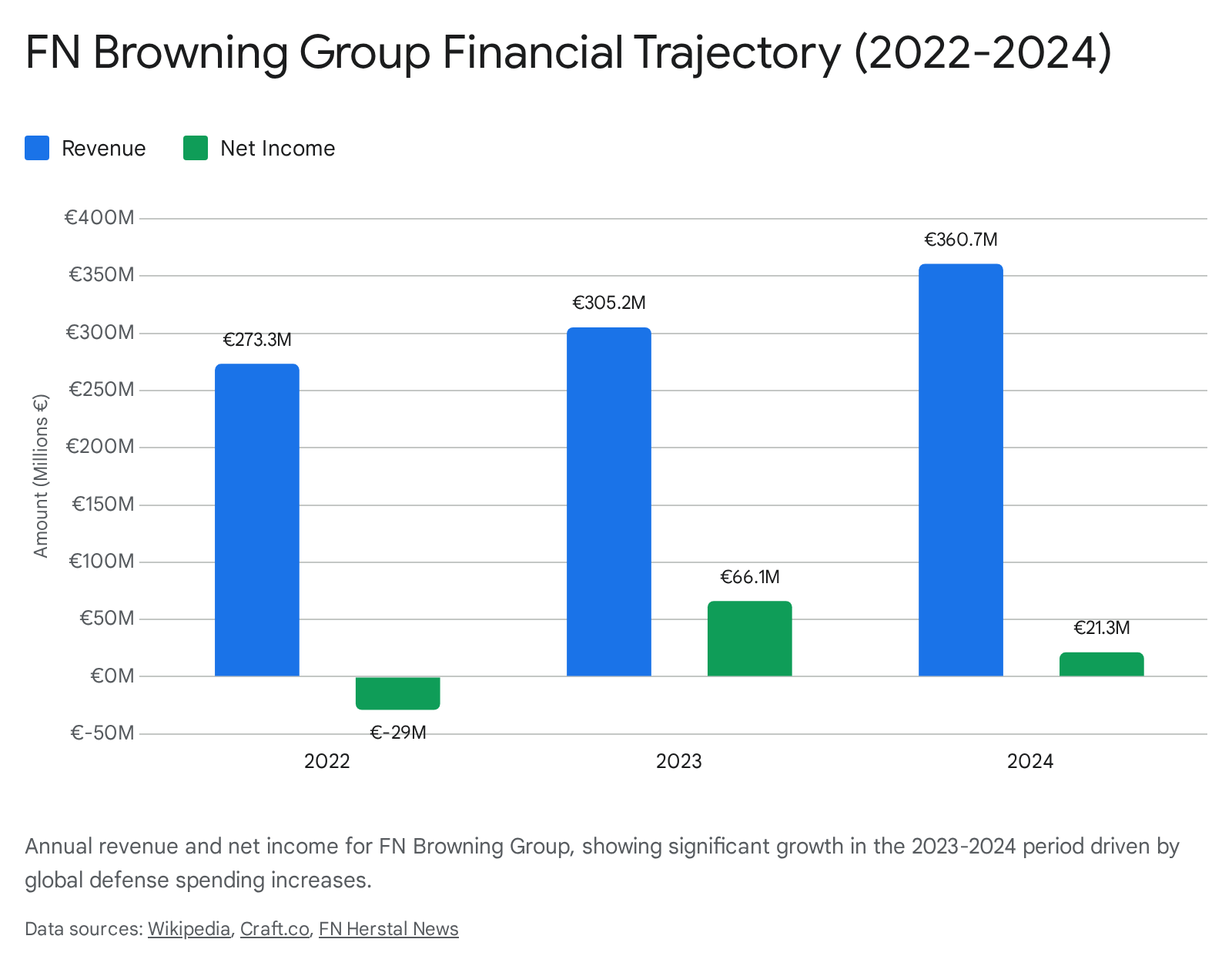
In the contemporary security environment, FN Herstal is executing a complex strategic pivot. The analysis of current operations indicates a transition from purely mechanical engineering to “e-novation”—the integration of ballistics with digital optoelectronics and fleet management software. The company’s recent financial performance is historic, with the FN Browning Group reporting record revenues exceeding €900 million in the 2023 fiscal year, driven by the restocking of European arsenals and sustained demand from the United States military.1 Simultaneously, the company is deepening its integration with U.S. defense programs through its subsidiary, FN America, evidenced by the recent award of the Precision Grenadier System (PGS) prototype contract, which aims to redefine squad-level lethality with 30mm airburst munitions.4
This report provides an exhaustive examination of FN Herstal’s history, its mastery of the machine gun and rifle markets, its corporate maneuvering, and its future outlook as a central pillar of both European strategic autonomy and the U.S. military-industrial base.
1. Introduction: The Industrial Genesis in Liège and the Syndicate of 1889
To understand the strategic culture of Fabrique Nationale Herstal, one must first analyze the unique industrial ecosystem of the Liège region in the late 19th century. The Meuse River Valley had been a center of ironworking and weapons manufacturing since the 14th century, fostering a decentralized network of highly skilled, independent gunsmiths.6 By the 1880s, this “feudal” system of production—characterized by individual artisans crafting specific components in home workshops—was facing an existential crisis. The industrial revolution was demanding standardization and mass production, capabilities that the fragmented Liège gun trade struggled to provide.
The Mauser Imperative and the Formation of the Syndicate
The catalyst for consolidation came from the Belgian government. In 1887, seeking to modernize its military capabilities in response to the rapid rearmament of neighboring Germany and France, Belgium initiated trials for a new service rifle. The German Mauser design, specifically the Model 1889 chambered in 7.65x53mm, was selected over domestic competitors including designs by Nagant and Pieper.6
The Belgian government placed an order for 150,000 rifles—a staggering quantity that no single existing manufacturer in Belgium could fulfill. Recognizing that this contract would go to foreign firms if domestic capacity were not created, the leading arms manufacturers of the Liège region put aside their rivalries. A consortium was formed, led by notable industrialists such as Henri Pieper. On July 3, 1889, this syndicate was formally incorporated as Fabrique Nationale d’Armes de Guerre (National Factory of Weapons of War).7
The Transition to Industrial Rationalization
The establishment of the factory in Herstal marked the definitive transition of the Belgian arms industry from the artisanal to the industrial age. The facility was designed from the ground up for modern mass production, utilizing steam power and the latest precision machinery. The production of the Mauser Model 1889 required strict interchangeability of parts, a concept that was still relatively novel in European manufacturing. By New Year’s Eve 1891, the first completed rifles were delivered to the Belgian government.9
This initial success, however, created a secondary strategic challenge: the “slow years.” The cyclical nature of government defense procurement meant that once the 150,000 rifles were delivered, the factory faced a precipitous drop in utilization. To maintain the workforce and capital equipment, FN’s management diversified into consumer goods. In 1896, the company began manufacturing bicycles, leveraging its expertise in steel tubing and precision machining.9 This diversification was not merely a survival tactic; it unwittingly set the stage for the most consequential partnership in the history of firearms. The bicycle division’s success led FN to send its sales manager, Hart O. Berg, to the United States to study American manufacturing techniques—a trip that would bridge the Atlantic and bring John Moses Browning to the Meuse Valley.9
2. The Transatlantic Catalyst: The Browning Era (1897–1926)
The trajectory of FN Herstal was fundamentally altered in 1897 through its alliance with John Moses Browning, widely regarded as the “Father of Modern Firearms”.9 This partnership was not inevitable; it was born of Browning’s friction with his previous partners in the United States, specifically Winchester.
The Friction with Winchester and the Meeting in Hartford
For decades, John Browning had sold his designs to Winchester for a flat fee. However, with his revolutionary semi-automatic shotgun (the Auto-5), Browning recognized the immense commercial potential and demanded a royalty-based arrangement. Winchester refused. Browning then approached Remington, but the president of Remington died of a heart attack while Browning was waiting in the reception area, stalling negotiations.
It was in this context of frustration that Hart O. Berg, FN’s representative in the U.S., encountered Browning in Hartford, Connecticut. Berg was there to study bicycle manufacturing, but he recognized the opportunity to secure a diverse product line for FN that would fill the gaps between military contracts. On July 17, 1897, a contract was signed that would bind the Belgian factory to the American inventor for nearly thirty years.9
The Commercial Revolution: Model 1900 and Auto-5
The collaboration yielded immediate and spectacular results. FN began production of the Browning Model 1899, the first commercially viable semi-automatic pistol. This was quickly refined into the Model 1900, which was adopted by the Belgian military and saw production numbers exceed 700,000 units.9 The pistol effectively saved the company financially, providing a steady stream of revenue independent of government procurement cycles.
In 1903, FN launched the Browning Auto-5, the world’s first mass-produced semi-automatic shotgun. The “humpback” design became an icon of sporting arms and remained in production for nearly a century. This period established a dual-revenue model for FN that persists to this day: a “Defense” wing focused on government contracts and a “Commercial” wing (later branded under Browning) focused on civilian hunters and shooters. This diversification provided financial ballast; when military spending contracted, civilian sales often sustained the enterprise.
The Rise of Dieudonné Saive
During this golden era, a young Belgian engineer named Dieudonné Saive joined the company. Saive became Browning’s personal assistant and protégé when the American visited Herstal. This transfer of institutional knowledge was critical. Browning was the visionary inventor; Saive was the industrial engineer who understood how to optimize those inventions for mass production. Upon Browning’s death in 1926—which occurred at the Herstal factory while he was working on a new over-under shotgun—Saive inherited the mantle of chief designer.10 This succession ensured that the culture of innovation survived the founder’s passing.
3. The Interwar Crucible and the Hi-Power Legacy
The period between the World Wars and through the Second World War was one of extreme turbulence for FN Herstal, characterized by occupation, forced labor, and the genesis of one of the most significant military pistols in history.
The Quest for “Grand Rendement”
In the early 1920s, the French military issued a requirement for a new service pistol characterized by “Grand Rendement” (High Efficiency) or “Grande Capacité” (High Capacity). They sought a magazine capacity of at least 15 rounds—unheard of in an era where 7 or 8 rounds was the standard (e.g., the Colt 1911 or Luger P08).
John Browning was initially skeptical of the double-stack magazine concept, believing it would make the grip too bulky. However, Dieudonné Saive, working in the background, engineered a staggered-column magazine that effectively doubled capacity without significantly increasing the grip width. Saive presented this magazine to Browning, who then designed a prototype pistol around it. Following Browning’s death in 1926, the project stalled until the patents on the Colt 1911 expired in 1928, allowing FN to incorporate the 1911’s superior locking mechanism into the new design.11
Saive spent the next decade refining the pistol, culminating in the Browning Hi-Power (Grande Puissance) or GP35, launched in 1935. It was a masterpiece of synthesis, combining the ergonomic genius of Browning with the capacity innovations of Saive. The Hi-Power became the standard sidearm for over 50 nations and remains in service in some capacities today.7
The Schism of World War II
The German invasion of Belgium in 1940 placed FN Herstal under Nazi control for the second time in the century. The factory was seized by the Wehrmacht and designated DWM Werk Lüttich. Under duress, the factory produced thousands of Hi-Power pistols (designated Pistole 640(b)) and K98k Mauser rifles for the German war effort.7
Simultaneously, a contingent of FN engineers and management escaped to the United Kingdom and later Canada. Working with the John Inglis Company in Toronto, they established a parallel production line for the Hi-Power pistol (the “Inglis Hi-Power”) and the Bren light machine gun for Allied forces. This created a unique historical anomaly: the Hi-Power was one of the few weapons used extensively by both Axis and Allied forces during the conflict. The technical drawings and engineering expertise preserved by the exiles allowed FN to rapidly restart operations and reassert its independence immediately after the liberation of Liège in 1944.9
4. The Cold War Triumvirate: Arming the Free World
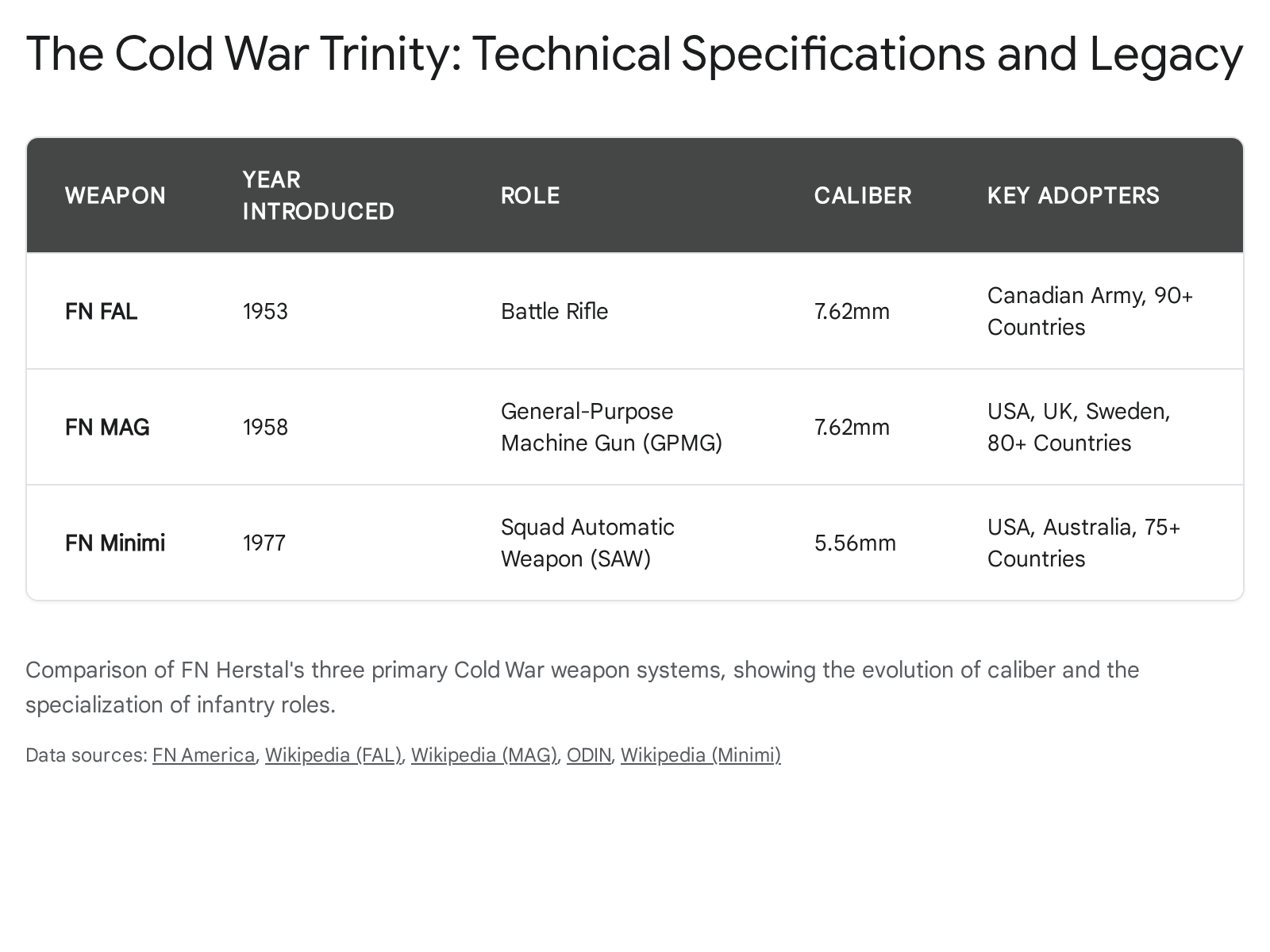
The post-World War II era, from 1946 to 1989, represents the zenith of FN Herstal’s geopolitical influence. As the Iron Curtain descended, the newly formed North Atlantic Treaty Organization (NATO) sought to standardize its small arms to simplify logistics. FN Herstal, through a combination of engineering brilliance and astute diplomacy, positioned itself as the primary supplier for this alliance. Three weapons—the FAL, the MAG, and the Minimi—formed a triumvirate that would define Western infantry firepower for half a century.
4.1 The FN FAL: Diplomacy by Caliber
In 1947, Dieudonné Saive unveiled the prototype of the FN FAL (Fusil Automatique Léger). The design was originally chambered for the.280 British intermediate cartridge, a forward-thinking round that balanced controllability in automatic fire with sufficient range. This design aligned with the British EM-2 rifle and represented a modernized approach to infantry combat.9
However, the United States Army Ordnance Corps was adamant that any NATO standard cartridge must maintain the full power of the.30-06 Springfield. They pushed the T65 cartridge (7.62x51mm) and refused to consider the intermediate.280. In a “quid pro quo” arrangement that is still debated by historians, it was understood that if the European NATO members adopted the American 7.62mm cartridge, the United States would adopt the FN FAL (designated T48 in US trials) as its service rifle.13
FN re-engineered the FAL to handle the powerful 7.62x51mm round. The rifle performed exceptionally well in trials. Yet, in 1957, the U.S. reneged on the perceived agreement, adopting the domestic T44 (M14) instead. Despite this betrayal, the FAL dominated the rest of the non-Communist world. It was adopted by the UK, Canada, Australia (as the L1A1 Self-Loading Rifle), Germany (G1), Israel, Brazil, and dozens of others. Over 90 countries eventually fielded the weapon, earning it the moniker “The Right Arm of the Free World”.9 The FAL’s ubiquity was such that in conflicts like the Falklands War, it was the primary service rifle of both belligerents.
4.2 The FN MAG: The General Purpose Standard
While the FAL secured the rifleman’s role, FN turned its attention to the machine gun. In the 1950s, armies were moving toward the “General Purpose Machine Gun” (GPMG) concept—a single weapon that could serve as a squad automatic weapon on a bipod and a sustained-fire support weapon on a tripod.
Ernest Vervier, Saive’s successor, led the development of the FN MAG (Mitrailleuse d’Appui Général). The brilliance of the MAG lay not in radical invention, but in the pragmatic synthesis of proven systems. Vervier took the gas-operated locking mechanism of the Browning Automatic Rifle (BAR)—flipped upside down to allow belt feeding from the top—and mated it with the belt-feed pawl mechanism of the German MG42.15
The result was a weapon of extraordinary reliability and durability. Introduced in 1958, the MAG 58 crushed its competitors in trials worldwide. Its crowning achievement came in 1977, when the U.S. Army selected it to replace the M60 as the coaxial machine gun for tanks (M240). Impressed by its reliability, the U.S. military eventually replaced all M60 infantry machine guns with the M240B variant in the 1990s. Today, the FN MAG remains the GPMG standard for NATO, with over 200,000 units produced.15
4.3 The FN Minimi: Revolutionizing Squad Tactics
By the 1970s, the limitations of the 7.62mm cartridge for squad-level automatic fire were becoming apparent. The rounds were heavy, limiting the ammunition load, and the recoil made automatic fire from the shoulder uncontrollable. NATO began looking toward the 5.56x45mm cartridge.
FN Herstal anticipated this shift and developed the FN Minimi (Mini Mitrailleuse), introduced in 1974. The Minimi created an entirely new category of infantry weapon: the Squad Automatic Weapon (SAW). It was light enough (approx. 7kg) to be carried by a single rifleman but belt-fed to provide sustained suppressive fire. It also featured a unique dual-feed mechanism, allowing it to use standard rifle magazines in an emergency if the belt ran dry.17
In 1982, the U.S. Army adopted the Minimi as the M249 SAW, securing FN’s future in the massive American market. To fulfill the “Buy American” requirements of U.S. law, FN established a manufacturing subsidiary, FN Manufacturing, in Columbia, South Carolina. This plant would grow to become a cornerstone of the U.S. small arms industrial base, eventually producing the majority of the U.S. military’s M4 carbines and M16 rifles alongside the machine guns.19
5. The Calibration Crisis: The 5.7x28mm System
While the 20th century was dominated by the FAL and MAG, the late 1980s presented a new tactical problem: body armor. The proliferation of Kevlar vests among Soviet rear-echelon troops and paratroopers meant that the standard 9mm pistol cartridge was becoming obsolete. NATO issued a request for a new Personal Defense Weapon (PDW) cartridge capable of penetrating body armor at 200 meters.21
FN Herstal responded with a holistic systems approach, developing a new high-velocity, small-caliber cartridge: the 5.7x28mm. Around this cartridge, they built two revolutionary weapons:
- The FN P90: A submachine gun featuring a bullpup layout (action behind the trigger) and a unique top-mounted 50-round magazine where rounds were stored perpendicular to the barrel and rotated 90 degrees before chambering. Its futuristic ergonomics and downward ejection made it fully ambidextrous.21
- The FN Five-seveN: A companion pistol introduced in 1998, offering high capacity (20 rounds) and extremely low weight due to polymer construction.23
The 5.7mm system demonstrated superior performance to the competing German 4.6x30mm (from Heckler & Koch) in NATO trials. However, the standardization process was paralyzed by political maneuvering; Germany blocked the adoption of the FN cartridge. It would take nearly two decades for the deadlock to break. In 2021, NATO finally standardized the 5.7x28mm cartridge (STANAG 4509), validating FN’s long-term investment. In the interim, the P90 became a cultural icon and a preferred tool for elite protection details, including the U.S. Secret Service.21
6. The Modular Revolution: SCAR and the Global War on Terror
The attacks of September 11, 2001, and the subsequent Global War on Terror shifted military requirements from static Cold War defense to highly mobile, adaptable special operations. In 2004, USSOCOM (United States Special Operations Command) issued a solicitation for the SCAR (Special Operations Forces Combat Assault Rifle). The requirement called for a modular system that could be reconfigured in the field for different calibers and barrel lengths.26
FN Herstal won the competition, defeating industry incumbents. The resulting FN SCAR family marked a departure from the AR-15/M4 platform that had dominated U.S. service.
- SCAR-L (Mk 16): Chambered in 5.56mm, intended to replace the M4.
- SCAR-H (Mk 17): Chambered in 7.62mm, providing battle rifle capability in a lightweight package.
- Mk 20 SSR: A sniper support variant for precision fire.
While the U.S. military eventually cancelled the purchase of the Mk 16 (deciding that the performance gain over the M4 did not justify the cost), the Mk 17 SCAR-H became a beloved asset for special operators in Afghanistan, who valued its ability to punch through barriers and engage targets at extended ranges—capabilities the 5.56mm M4 lacked. The SCAR program solidified FN’s reputation not just as a mass manufacturer, but as a premier innovation partner for elite units. Commercially, the semi-automatic versions (SCAR 16S and 17S) became highly sought-after status symbols in the civilian market.26
7. Corporate Metamorphosis: From GIAT to Wallonia
Behind the product successes, FN Herstal’s corporate history in the late 20th century was fraught with instability.
The GIAT Misadventure
In 1990, FN’s parent company, the Belgian conglomerate Société Générale, sold the arms maker to GIAT Industries, a French state-owned defense giant (now KNDS France). The vision was to create a “European champion” in small arms. However, the merger was a failure. Cultural differences, GIAT’s own financial struggles, and a lack of synergy led to a precarious situation for the Belgian factories.29
Nationalization by the Walloon Region
By 1997, FN Herstal faced insolvency. The collapse of the company would have been a catastrophic economic blow to the Liège region. In a decisive act of industrial policy, the Walloon Regional Government stepped in. Through its investment arm (now Wallonie Entreprendre), the region purchased FN Herstal, Browning, and U.S. Repeating Arms from GIAT.
This created the Herstal Group (renamed FN Browning Group in 2024). This ownership structure is unique among major Western defense contractors. It is a 100% state-owned enterprise, but it operates with significant commercial autonomy. The dividends from the group flow back to the Walloon government, funding regional development. This structure protects the company from hostile takeovers and allows for long-term R&D planning, but it also binds the company’s export licenses to the political will of the Walloon parliament, which can be restrictive regarding human rights concerns in destination countries.1
The Browning and Winchester Brand Strategy
A critical component of this acquisition was the brand portfolio. FN owns the Browning brand (acquired in 1977) and the license to manufacture Winchester firearms (acquired in 1987). It is important to note the distinction: Olin Corporation owns the Winchester ammunition business, while FN Herstal produces Winchester firearms (like the Model 70 rifle and SXP shotgun) under license.33 This multi-brand strategy allows the group to segment the market: FN for tactical/defense, Browning for premium hunting/sporting, and Winchester for heritage/mass-market sporting.
8. Strategic Autonomy and the Modern Industrial Base (US & Europe)
FN Herstal today serves as a critical node in two distinct military-industrial bases: the European Union and the United States.
The United States: FN America
The U.S. remains the largest single customer for FN products. In 2014, FN consolidated its U.S. operations—manufacturing in Columbia, SC, and sales in McLean, VA—into FN America, LLC.35 The Columbia facility is designated as a critical defense asset. It produces the M4A1 carbine, the M240 machine gun, and the M249 SAW for the U.S. Department of Defense. The “Buy American” laws (Berry Amendment) require these weapons to be manufactured domestically, meaning FN America operates with a high degree of autonomy from the Belgian parent, securing its status as a “domestic” supplier in the eyes of the Pentagon.37
Europe: Strategic Autonomy
In Europe, the war in Ukraine has accelerated the drive for “Strategic Autonomy”—the ability of the EU to defend itself without total reliance on external powers. FN Herstal is central to this. The company is involved in major European Defence Fund (EDF) initiatives, such as MARSEUS (precision strike) and MARTE (next-gen main battle tank architecture).39 Furthermore, the acquisition of UK manufacturing assets (creating FN UK) has secured 10-year contracts with the British Ministry of Defence to support their heavy machine gun fleets, ensuring that FN remains embedded in the post-Brexit UK defense architecture as well.40
9. The Digital Pivot: E-Novation and Integrated Systems
The most profound shift in FN’s modern strategy is the recognition that mechanical ballistic improvements have reached a point of diminishing returns. The future of lethality lies in connectivity and data. FN markets this strategy as “FN e-novation.”
SmartCore and Digital Fleet Management
Military logistics are often plagued by a lack of data. Weapons are maintained on fixed schedules regardless of usage. FN developed the FN SmartCore, a small, battery-free device embedded in the weapon (SCAR, Minimi, or M3M) that detects the shock of firing. It records the exact round count, distinguishing between live fire, blanks, and dry fire. This data is uploaded to the FN SAM (Small Arms Management) software, allowing armorers to track barrel wear and predict maintenance needs accurately. This transforms the weapon from a dumb mechanical tool into a networked node in a logistics system.41
FN Elity: The Ballistic Computer
To improve shooter performance, FN introduced the FN Elity. This weapon-mounted device integrates a laser rangefinder, infrared pointer, and ballistic calculator. It can connect via Bluetooth to tactical situational awareness apps (like Android Team Awareness Kit – ATAK). This allows a sniper to range a target and instantly share those coordinates with the rest of the squad or call in air support, effectively turning the rifle into a sensor platform.43
10. Future Horizons: The Precision Grenadier and Next-Gen Lethality
The immediate future of FN Herstal is anchored by the Precision Grenadier System (PGS). In late 2024 and 2025, the U.S. Army awarded FN America prototype contracts worth $2 million to develop the FN MTL-30 (Multi-Purpose Tactical Launcher).4
The Significance of the MTL-30
Current squad grenade launchers (like the M203/M320) fire low-velocity 40mm rounds with a high-arcing trajectory, making them difficult to aim precisely. The FN MTL-30 uses a new 30mm medium-velocity round with a flat trajectory. Combined with a computerized fire control system, it allows soldiers to “program” the round to detonate in the air (airburst) at a specific distance. This capability is critical for defeating enemies hiding behind cover (defilade) or engaging small drones—a threat profile that has become dominant in modern conflicts like Ukraine. If adopted, the PGS would replace the M320 in U.S. Army squads, securing a massive, multi-decade contract for FN America and validating the company’s pivot to smart munitions.45
The Ultralight Machine Gun: Evolys
Simultaneously, FN is pushing the adoption of the FN Evolys, launched in 2021. This machine gun utilizes 3D printing and modern polymers to achieve a weight reduction of nearly 30% compared to the Minimi. It addresses the “burden of the soldier” while maintaining the firepower of a belt-fed weapon. Its unique lateral feed mechanism fixes the most common ergonomic complaint of the Minimi (awkward reloading), positioning FN to dominate the next cycle of machine gun procurement.47
11. Milestone Summary
The following table summarizes the key chronological milestones in the history of FN Herstal, tracing its evolution from a desperate industrial syndicate to a global defense leader.
| Year | Milestone Event | Strategic Significance |
| 1889 | Founding of Fabrique Nationale d’Armes de Guerre | Formed by a syndicate of Liège gunmakers to produce 150,000 Mauser rifles for the Belgian government. |
| 1896 | Diversification into Bicycles | Strategic move to maintain factory utilization during the “slow years” between contracts; leads to US market research. |
| 1897 | Partnership with John Moses Browning | Sales manager Hart O. Berg signs agreement with Browning; secures rights to the Model 1899 pistol. |
| 1900 | Release of Model 1900 Pistol | The first commercially successful semi-automatic handgun enters mass production, saving the company financially. |
| 1903 | Release of the Auto-5 Shotgun | The world’s first mass-produced semi-automatic shotgun; establishes dominance in the sporting market. |
| 1926 | Death of John Moses Browning | Browning dies at the Herstal factory; Dieudonné Saive takes over as chief designer. |
| 1935 | Launch of the Browning Hi-Power (GP35) | Completed by Saive; sets the global standard for high-capacity 9mm military pistols. |
| 1940 | German Occupation (WWII) | Factory seized by Nazis; exiles establish parallel production (Inglis Hi-Power) in Canada. |
| 1947 | Prototype of the FN FAL | Development begins on the rifle that would become the “Right Arm of the Free World.” |
| 1953 | Adoption of FN FAL | Production begins; eventually adopted by over 90 non-Communist nations. |
| 1958 | Introduction of the FN MAG | General Purpose Machine Gun combining BAR and MG42 mechanisms; later adopted as US M240. |
| 1974 | Introduction of the FN Minimi | Creates the modern “Squad Automatic Weapon” (SAW) class; later adopted as US M249. |
| 1977 | Acquisition of Browning Arms Company | FN purchases its long-time commercial partner, consolidating the brand. |
| 1982 | US Adoption of M249 SAW | Secures FN’s long-term foothold in the US military industrial base; leads to SC manufacturing expansion. |
| 1987 | Acquisition of US Repeating Arms (Winchester) | FN acquires the license to manufacture Winchester brand firearms (but not ammunition). |
| 1990 | Launch of FN P90 / Sale to GIAT | Introduction of the PDW concept; ownership transfers to French conglomerate GIAT Industries. |
| 1997 | Walloon Region Acquires FN | Regional government nationalizes the company to save it from bankruptcy; forms “Groupe Herstal.” |
| 1998 | Launch of Five-seveN Pistol | Completes the 5.7x28mm weapon system family. |
| 2004 | USSOCOM SCAR Contract Win | FN wins the competition for the Special Operations Forces Combat Assault Rifle. |
| 2014 | Formation of FN America | Merger of FN Manufacturing and FNH USA into a single, unified US entity. |
| 2021 | Launch of FN Evolys | Introduction of the ultralight machine gun; NATO standardizes 5.7x28mm cartridge. |
| 2023 | Record Financial Performance | Group reports historic €900M+ revenue; €75M net profit due to global rearmament. |
| 2024 | Rebranding to FN Browning Group | Parent company changes name to better reflect its primary brand assets. |
| 2025 | PGS Contract Award | FN America wins contract to develop the MTL-30 30mm grenade launcher for the US Army. |
If you find this post useful, please share the link on Facebook, with your friends, etc. Your support is much appreciated and if you have any feedback, please email me at in**@*********ps.com. Please note that for links to other websites, we are only paid if there is an affiliate program such as Avantlink, Impact, Amazon and eBay and only if you purchase something. If you’d like to directly contribute towards our continued reporting, please visit our funding page.
Sources Used
- FN Browning Group – Wikipedia, accessed December 21, 2025, https://en.wikipedia.org/wiki/FN_Browning_Group
- FN BROWNING GROUP & FINANCIAL RESULTS 2023 – FN HERSTAL, accessed December 21, 2025, https://fnherstal.com/en/news/fn-herstal-parent-company-changes-name-and-announces-results-for-2023/
- 2023 FINANCIAL RESULTS – FN Browning Group, accessed December 21, 2025, https://fnbrowninggroup.com/2024/06/11/2023-financial-results/
- FN to continue developing Army’s next-gen precision grenadier system – Military Times, accessed December 21, 2025, https://www.militarytimes.com/news/your-military/2025/10/10/fn-to-continue-developing-armys-next-gen-precision-grenadier-system/
- The U.S. Army awards FN Herstal a contract to develop a new 30mm grenade launcher, accessed December 21, 2025, https://www.zona-militar.com/en/2025/10/15/the-u-s-army-awards-fn-herstal-a-contract-to-develop-a-new-30mm-grenade-launcher/
- FN: The First 125 Years | An Official Journal Of The NRA – American Rifleman, accessed December 21, 2025, https://www.americanrifleman.org/content/fn-the-first-125-years/
- The Untold FN Story – Guns and Ammo, accessed December 21, 2025, https://www.gunsandammo.com/editorial/the-untold-fn-story/248546
- FN Herstal – Wikipedia, accessed December 21, 2025, https://en.wikipedia.org/wiki/FN_Herstal
- About Us | FN® Firearms – FN America, accessed December 21, 2025, https://fnamerica.com/about-fn/
- Dieudonné Saive – Wikipedia, accessed December 21, 2025, https://en.wikipedia.org/wiki/Dieudonn%C3%A9_Saive
- Dieudonné Saive – Wikiwand, accessed December 21, 2025, https://www.wikiwand.com/en/articles/Dieudonn%C3%A9_Saive
- FN FAL – Wikipedia, accessed December 21, 2025, https://en.wikipedia.org/wiki/FN_FAL
- The History Of The FN FAL | An Official Journal Of The NRA – Shooting Illustrated, accessed December 21, 2025, https://www.shootingillustrated.com/content/the-fn-fal/
- The Right Arm of the Free World: A Look into the History of the FN FAL – ITS Tactical, accessed December 21, 2025, https://www.itstactical.com/warcom/firearms/right-arm-free-world-look-history-fn-fal/
- FN MAG – Wikipedia, accessed December 21, 2025, https://en.wikipedia.org/wiki/FN_MAG
- FN MAG: Best of the Western GPMGs – Forgotten Weapons, accessed December 21, 2025, https://www.forgottenweapons.com/fn-mag-best-of-the-western-gpmgs/
- FN Minimi – Grokipedia, accessed December 21, 2025, https://grokipedia.com/page/FN_Minimi
- FN Minimi Belgian 5.56mm Light Machine Gun – ODIN – OE Data Integration Network, accessed December 21, 2025, https://odin.tradoc.army.mil/WEG/Asset/0870bdd7256b895b1582bb1b324d19b6
- The FN Minimi Light Machine Gun – Hobby Works, accessed December 21, 2025, https://www.hobbyworks.com/cproduct/12936%2Fthe-fn-minimi-light-machine-gun
- FN Minimi – Weaponsystems.net, accessed December 21, 2025, https://weaponsystems.net/system/1298-FN+Minimi
- FN P90® | FN® Firearms, accessed December 21, 2025, https://fnamerica.com/products/rifles/fn-p90/
- History of the P90 – McCluskey Arms, accessed December 21, 2025, https://mccluskeyarms.com/gunsmithing-blog/history-of-the-p90
- FN Model Five-seveN 5.7×28 FN Variant-7 – Genitron, accessed December 21, 2025, https://www.genitron.com/Handgun/Fabrique-Nationale/Pistol/Five-seveN/57×28-FN/Variant-7
- FN Five-seven – Wikipedia, accessed December 21, 2025, https://en.wikipedia.org/wiki/FN_Five-seven
- FN Five-Seven: The 90s Pistol of the Future – Lucky Gunner Lounge, accessed December 21, 2025, https://www.luckygunner.com/lounge/fn-five-seven-the-90s-pistol-of-the-future/
- FN SCAR | laststandonzombieisland, accessed December 21, 2025, https://laststandonzombieisland.com/tag/fn-scar/
- SOCOM Cancels Mk-16 SCAR – ShadowSpear Special Operations, accessed December 21, 2025, https://shadowspear.com/threads/socom-cancels-mk-16-scar.6446/
- FN SCAR – Wikipedia, accessed December 21, 2025, https://en.wikipedia.org/wiki/FN_SCAR
- History of Groupe Herstal S.A. – FundingUniverse, accessed December 21, 2025, https://www.fundinguniverse.com/company-histories/groupe-herstal-s-a-history/
- KNDS France – Wikipedia, accessed December 21, 2025, https://en.wikipedia.org/wiki/KNDS_France
- accessed December 21, 2025, https://en.wikipedia.org/wiki/FN_Herstal#:~:text=FN%20Herstal%20is%20owned%20by,Repeating%20Arms%20Company%20(Winchester).
- Our Group – FN Browning Group, accessed December 21, 2025, https://fnbrowninggroup.com/our-group/
- Historic Timeline – Browning, accessed December 21, 2025, https://www.browning.com/support/historic-timeline.html
- Winchester Repeating Arms Company – Wikipedia, accessed December 21, 2025, https://en.wikipedia.org/wiki/Winchester_Repeating_Arms_Company
- FN America Completes Legal Merger | Oklahoma City – H&H Shooting Sports, accessed December 21, 2025, https://hhshootingsports.com/fn-america-completes-legal-merger/
- FN Manufacturing and FNH USA, accessed December 21, 2025, https://fnherstal.com/en/news/us-operations/
- FN Awarded U.S. Army Contract for M4 and M4A1 Carbines | FN® Firearms, accessed December 21, 2025, https://fnamerica.com/press-releases/fn-awarded-u-s-army-contract-for-m4-and-m4a1-carbines/
- FN America Wins Army Contract | Gun Talk Media, accessed December 21, 2025, https://www.guntalk.com/post/fn-wins-army-contract
- European Projects – FN Herstal, accessed December 21, 2025, https://fnherstal.com/en/european-projects/
- FN UK AWARDED 10-YEAR CONTRACT BY UK MOD, accessed December 21, 2025, https://fnherstal.com/en/news/fn-uk-awarded-10-year-contract-by-uk-ministry-of-defence/
- FN e-novation, Aiming Solutions, Training Solutions and Small Arms Management Solutions – Army Technology, accessed December 21, 2025, https://www.army-technology.com/products/fn-enovation-aiming-solutions/
- FN SMARTCORE® Shot Counter – FN Herstal, accessed December 21, 2025, https://fnherstal.com/en/security/small-arms-management/fn-smartcore-shot-counter/
- AIMING – FN Herstal, accessed December 21, 2025, https://fnherstal.com/en/defence/fn-e-novation/
- FN ELITY® BALLISTIC CALCULATOR | FN® Firearms, accessed December 21, 2025, https://fnamerica.com/products/e-novation-military/fn-elity-ballistic-calculator/
- FN America awarded US Army contract to further develop its MTL-30 – Euro-sd, accessed December 21, 2025, https://euro-sd.com/2025/10/major-news/47058/fn-to-further-develop-mtl-30/
- FN WINS U.S. ARMY DEVELOPMENT CONTRACT FOR THE PRECISION GRENADIER SYSTEM | FN® Firearms – FN America, accessed December 21, 2025, https://fnamerica.com/press-releases/fn-wins-u-s-army-development-contract-for-the-precision-grenadier-system/
- Fn evolys light machine gun – CAT-UXO, accessed December 21, 2025, https://cat-uxo.com/explosive-hazards/salw/fn-evolys-light-machine-gun
- Exclusive Hands-On with the New FN Evolys: Live Fire & Full Breakdown with expert Jonathan Ferguson – YouTube, accessed December 21, 2025, https://www.youtube.com/watch?v=KRqJFsEK4t0