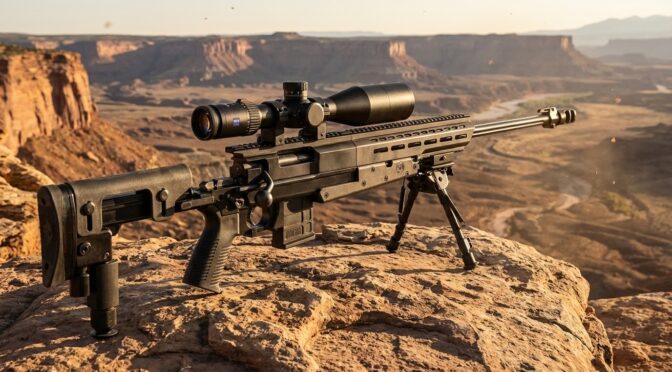
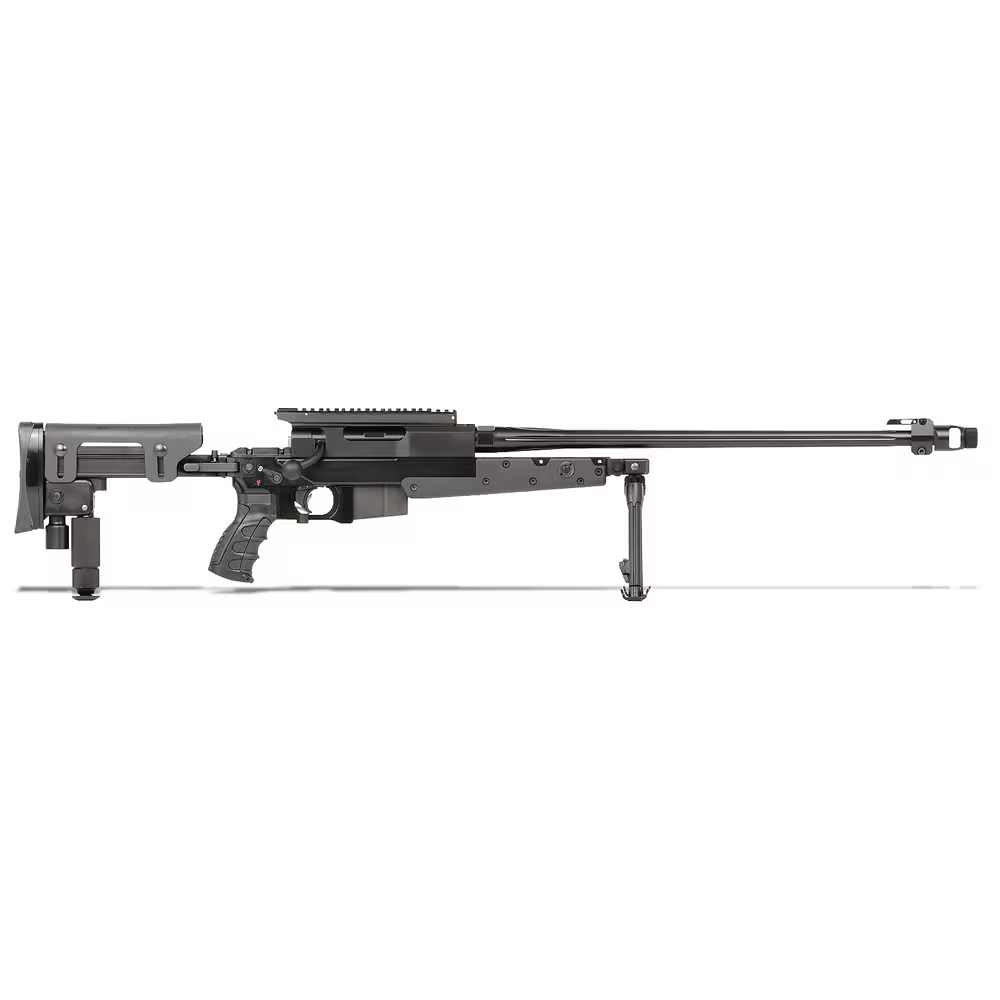
The Brügger & Thomet (B&T) APR338 stands as a definitive artifact of early 21st-century precision rifle engineering—a platform that prioritizes dedicated, structural rigidity and specific anti-personnel efficacy over the modular adaptability that has since come to define the sector. This comprehensive market and engineering analysis evaluates the Advanced Precision Rifle (APR) in.338 Lapua Magnum, examining its technical architecture, ballistic capabilities, and market positioning relative to peer competitors such as Accuracy International, Barrett Firearms, and Sako.
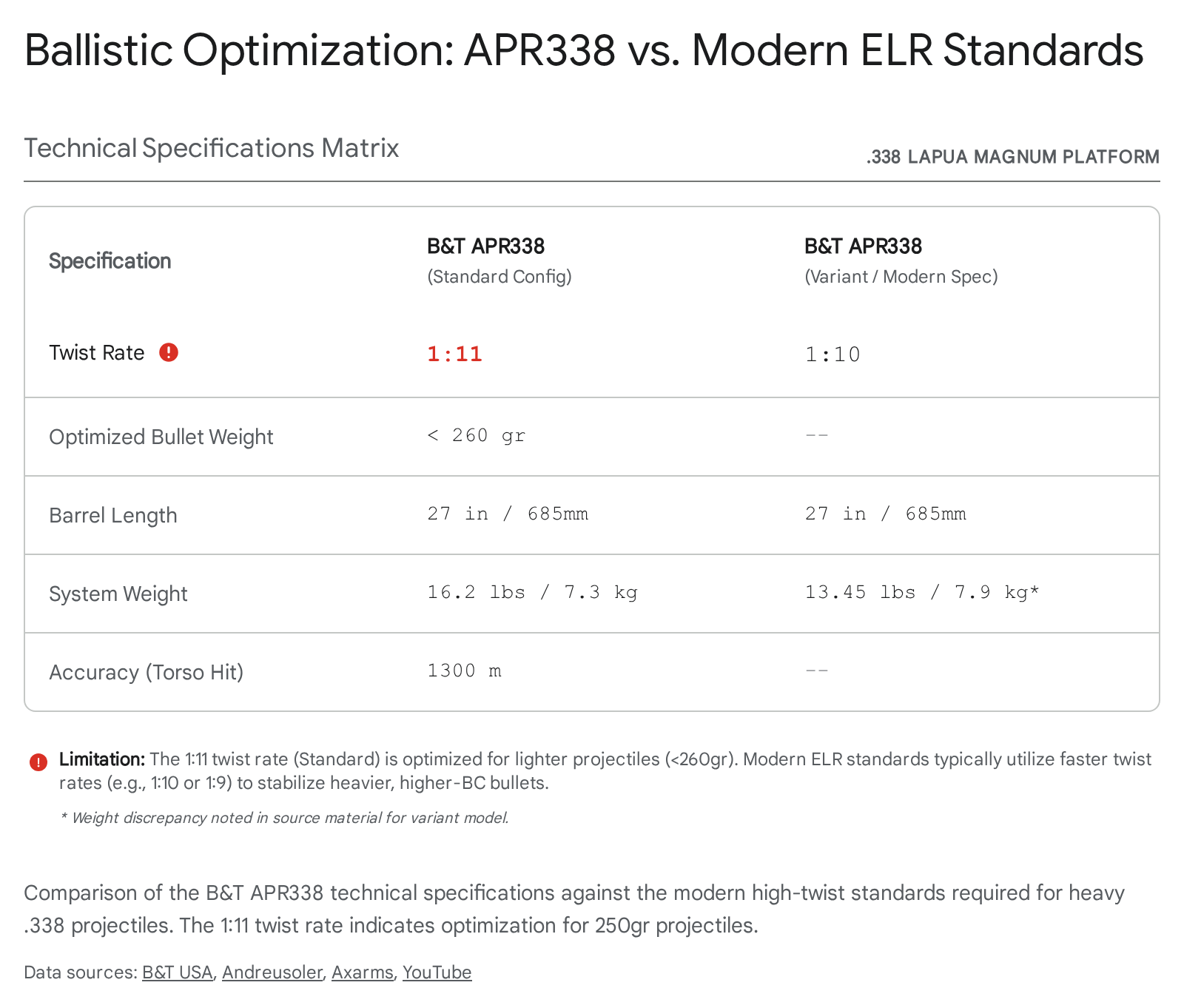
Technically, the APR338 is a masterpiece of Swiss manufacturing, evolved from the PGM Précision Hécate lineage. It features a specialized lower-receiver chassis system that provides an unconventional but highly effective bedding surface, contributing to the manufacturer’s guarantee of hitting a head-sized target at 600 meters and a torso-sized target at 1,300 meters with a 99% first-round hit probability. The system utilizes a 27-inch, cold hammer-forged barrel with a 1:11 twist rate. While this twist rate was the NATO standard during the rifle’s development, engineering analysis indicates it is optimized for 250-grain projectiles, limiting the platform’s ability to stabilize modern, ultra-high-ballistic-coefficient (BC) solids (285gr+) required for Extreme Long Range (ELR) engagements beyond 1,500 meters.
From a strategic market perspective, the APR338 occupies a precarious position in the “Super Magnum” segment. Priced in the ultra-premium tier (approximately $10,000 – $12,000 USD), it competes directly against multi-caliber systems like the Accuracy International AXSR and the Barrett MRAD, which have swept recent military procurement contracts (e.g., USSOCOM’s ASR and PSR programs). The APR338 lacks the user-level quick-change barrel capabilities that have become the operational standard, locking the user into a single-caliber logistics chain. Customer sentiment analysis reveals a bifurcation in the ownership experience: while users express deep appreciation for the rifle’s fit, finish, and intrinsic accuracy, there is significant anxiety regarding proprietary logistical support, particularly in North American markets where parts scarcity can render the platform inoperable for extended periods.
The overall conclusion of this report suggests that the APR338 is a “Purist’s Rifle.” It is recommended for institutional users and dedicated collectors who prioritize specific anti-personnel precision within 1,300 meters and value mechanical refinement over adaptability. For operators demanding mission flexibility, ELR ballistic advantages, or widespread logistical support, the platform is technically and doctrinally outclassed by contemporary multi-caliber systems.
| Note: EuroOptics has the B&T APR338 in stock. Click here to see the page. |
1. Strategic Context and Historical Lineage
To fully appreciate the engineering decisions and market placement of the APR338, it is essential to analyze the historical and doctrinal context in which it was conceived. The rifle is not a spontaneous invention but the result of a deliberate evolutionary process rooted in French precision doctrine and Swiss manufacturing philosophy.
1.1 The PGM Précision Genesis
The architectural DNA of the B&T APR338 can be traced directly to the designs of PGM Précision, a French firearms manufacturer renowned for the Hécate II and Ultima Ratio intervention rifles.1 In the late 1990s and early 2000s, Brügger & Thomet served as a distributor for PGM, gaining intimate familiarity with the skeletal, chassis-based construction method that distinguished PGM rifles from the traditional “action-in-stock” designs of the era, such as the Remington 700 or Accuracy International AW.
The PGM design philosophy was characterized by a “form follows function” brutality, utilizing a central metallic spine to mount components. This offered superior thermal management and modularity compared to wood or composite stocks. However, when PGM faced financial and restructuring challenges in the early 2000s, B&T moved to secure the design rights and refine the concept for a broader market.2 The result was the APR308, introduced in 2003, followed by the APR338 in 2007.
The divergence between the French original and the Swiss derivative is significant. While PGM rifles were built for the rugged, dusty environments of French foreign interventions (often in Africa), B&T applied high-precision Swiss machining tolerances to the design. The goal was to create a system that retained the ruggedness of the PGM architecture but offered the refinement and ergonomic sophistication required by European special police units and the Singapore Army.1
1.2 The Haenel Connection: A German Sibling
A critical but often overlooked aspect of the APR338’s lineage is its relationship with the Haenel RS9, which serves as the G29 sniper rifle for the German Bundeswehr.3 The Haenel RS9 and B&T APR series share a common design heritage, effectively making them “cousins” in the engineering sense. Both utilize similar bolt geometries, receiver structures, and safety mechanisms, reflecting a shared intellectual property background.
The adoption of the Haenel RS9 by the Kommando Spezialkräfte (KSK) and Kommando Spezialkräfte Marine (KSM) provides valuable proxy data for the durability of the APR338 architecture.3 The G29 was selected to replace the Accuracy International AWM in German service, proving that the fundamental design architecture of the APR/RS family is capable of surviving Tier 1 military selection trials involving distinct climate categories (A1-3, B1-3, C0-2) according to STANAG 4370.3 While the B&T APR338 is branded and finished differently—often with a greater focus on export market aesthetics and smoothness—the core mechanical reliability has been validated in the crucible of German military testing.
1.3 Doctrinal Shifts: The Rise of the.338 Lapua Magnum
The APR338 was released in 2007, a peak period for the.338 Lapua Magnum (8.6x70mm) cartridge.1 Developed originally as a dedicated long-range sniper cartridge to bridge the gap between the 7.62x51mm NATO and the.50 BMG (12.7x99mm), the.338 LM offered the trajectory of a 7.62mm with the terminal energy closer to a.50 BMG.
At the time of the APR338’s design, the prevailing military doctrine focused on dedicated platforms. A sniper team would deploy with a specific rifle for a specific mission profile. The concept of a “switch-barrel” or multi-caliber system was in its infancy and not a mandatory requirement for procurement. Consequently, the APR338 was engineered as a dedicated.338 LM host. This decision, while valid in 2007, has become the platform’s primary strategic liability in the 2020s, as USSOCOM’s Precision Sniper Rifle (PSR) and Advanced Sniper Rifle (ASR) programs shifted the global standard toward modularity.5
2. Engineering Architecture and Technical Specifications
The B&T APR338 represents a departure from traditional rifle bedding techniques. Instead of mating a cylindrical receiver to a stock via pillars and epoxy, the APR utilizes a chassis system where the lower receiver serves as the primary structural component.
2.1 The Integrated Lower Receiver Chassis
The foundational element of the APR338 is its lower receiver. Machined from high-strength aluminum alloy (likely 7075-T6 or similar aerospace grade), this component acts as the spine of the rifle.7
- Structural Integration: The upper receiver, which houses the bolt and barrel extension, bolts directly onto this lower chassis. The contact surface extends along the majority of the receiver’s length. B&T describes this as an “unconventional bedding surface”.8 From an engineering standpoint, this massive contact area maximizes rigidity. By eliminating the variance found in composite stocks or traditional glass bedding, the APR338 ensures that the relationship between the optic (mounted on the upper) and the shooter’s interface (stock, grip, trigger on the lower) remains absolutely static under recoil.
- Vibration Management: The mass and stiffness of the lower receiver act to dampen the harmonic vibrations generated during firing. In the.338 LM caliber, these vibrations are significant. The chassis helps to “deaden” the rifle, reducing the “tuning fork” effect that can occur in lighter, skeletal stocks. This contributes to the rifle’s ability to maintain a consistent point of impact (POI) across wide temperature ranges, a capability B&T explicitly highlights in their marketing regarding desert and arctic testing.8
- Thermal Dissipation: The open architecture of the fore-end allows for rapid cooling. Unlike a fully enclosed composite stock which can insulate the barrel, the APR’s design facilitates airflow around the barrel shank—the hottest part of the system. This is critical for maintaining accuracy during rapid engagement sequences, where heat mirage and thermal expansion can degrade precision.
2.2 Barrel Assembly and Metallurgy
The barrel is the primary determinant of a rifle’s accuracy potential. B&T utilizes a 27-inch (690mm) barrel for the APR338, a length chosen to optimize the velocity of the.338 Lapua Magnum cartridge.9
- Cold Hammer Forging: The barrel is manufactured using cold hammer forging. In this process, a hardened steel mandrel with the reverse rifling pattern is inserted into a barrel blank. Massive hammers pound the outside of the blank, compressing the steel onto the mandrel. This process aligns the grain structure of the steel and work-hardens the bore surface. The result is a barrel that is exceptionally durable, with B&T claiming a service life of approximately 7,000 rounds.8 This is significantly higher than the typical 2,500-round accuracy life expected from button-rifled stainless steel barrels in this caliber, offering a lower long-term cost of ownership for high-volume institutional users.
- Twist Rate Analysis (1:11): The rifle features a 1:11 (one turn in 11 inches) right-hand twist rate.9
- Historical Context: When the APR338 was designed, the standard military load for.338 LM was the 250-grain Lapua Scenar or LockBase. A 1:11 twist is perfectly optimized for this weight, providing a Gyroscopic Stability factor (Sg) well above 1.5, ensuring stable flight through the transonic zone.
- Modern Limitation: The current trend in Extreme Long Range (ELR) shooting involves heavier, high-BC projectiles such as the 285-grain Hornady ELD-M or 300-grain Berger Hybrid. These bullets are longer and require faster twist rates (typically 1:9.4 or 1:10) to stabilize adequately. The APR338’s 1:11 twist is marginal for these modern heavyweights, potentially leading to instability and keyholing at extended ranges. This engineering constraint effectively caps the APR338’s ballistic potential compared to newer rivals like the Barrett MRAD (1:9.4 twist).11
2.3 Bolt and Action Mechanics
The APR338 employs a manual bolt action with a three-lug configuration.10
- Three-Lug Design: The use of three locking lugs spaced 120 degrees apart allows for a 60-degree bolt throw. This is a significant ergonomic advantage over the 90-degree throw found in two-lug systems (like the Remington 700). The shorter throw allows for faster cycling and ensures that the bolt handle clears large ocular housings on high-magnification scopes.
- Lock-Up and Safety: The bolt locks directly into the barrel extension, a feature that enhances safety by containing the pressure within the barrel assembly rather than the receiver. The safety mechanism is a firing pin block located on the bolt shroud. This allows the operator to manipulate the bolt (load/unload) while the weapon is on “Safe,” reducing the risk of negligent discharge during administrative handling.4
- Extraction: The system uses a robust extractor and a plunger ejector. The reliability of extraction is paramount in.338 LM rifles due to the high chamber pressures (over 60,000 psi) which can cause cases to stick. The APR’s camming action provides significant primary extraction force to break the case seal.
2.4 Trigger Module Comparison
The trigger group of the APR338 is a detachable module, representing a distinct divergence from the Remington 700 footprint used by many custom precision rifles.8
- Adjustability: The unit is a two-stage trigger, adjustable for pull weight between 1.5 kg and 2.5 kg (3.3 lbs – 5.5 lbs).10 The trigger path can be adjusted externally without disassembling the rifle.
- Reliability vs. Compatibility: The modular design enhances field reliability; if the trigger mechanism becomes fouled with sand or ice, the entire module can be removed and cleaned or swapped. However, this proprietary design means the user cannot upgrade to aftermarket triggers from Timney, TriggerTech, or Bix’n Andy, which are standard upgrades for Remington 700-pattern rifles.12 The user is effectively married to the factory B&T trigger. While the factory trigger is widely praised for its crisp break (“glass rod” feel), the lack of aftermarket options is a limitation for competitors who prefer ultra-light (<1 lb) pull weights.
2.5 Interface and Ergonomics
The APR338 features a side-folding stock, a critical requirement for a rifle measuring 1236mm (48.7 inches) in total length.9
- Stock Mechanism: The stock folds to the left, reducing the length to 1002mm. The hinge is a robust steel-on-steel lockup, designed to eliminate any “wobble” that could affect accuracy. The stock features an adjustable cheek rest and butt plate spacers to customize the length of pull (LOP).
- Integral Monopod: A folding butt-spike (monopod) is integrated into the stock.9 This provides a stable third point of contact for long-duration observation, reducing muscle fatigue for the sniper.
- Rail System: The upper receiver features a continuous MIL-STD-1913 Picatinny rail with a 40 MOA (Minute of Angle) inclination.7 This cant is essential for.338 LM shooting, as it preserves the internal elevation travel of the riflescope, allowing the shooter to dial corrections for shots beyond 1,500 meters.
3. Operational Performance and Ballistics
The true measure of any sniper system is its performance downrange. The APR338 is engineered to deliver specific terminal effects at extended distances.
3.1 Accuracy Guarantees and Expectations
B&T offers a specific performance guarantee: the system is capable of a first-round hit on a head-sized target at 600 meters and a torso-sized target at 1,300 meters, with a hit probability of greater than 99%.10
- Translation to MOA: A “head-sized target” is approximately 20cm (8 inches). At 600 meters, 1 MOA is roughly 17.5cm (6.9 inches). Therefore, hitting a head target requires accuracy of approximately 1.2 MOA or better. Since the rifle is mechanically capable of sub-MOA (often <0.5 MOA) precision with match ammunition, this guarantee is conservative regarding the rifle’s capability but realistic regarding environmental factors (wind calls).
- Real-World Precision: User reports and reviews consistently cite the APR338’s ability to print sub-0.5 MOA groups with factory Lapua ammunition.9 The structural rigidity of the chassis system plays a major role here, ensuring that the rifle behaves consistently shot after shot.
3.2 Recoil Management Comparison
The.338 Lapua Magnum generates significant free recoil energy—often exceeding 35 ft-lbs, which is comparable to a heavy shotgun slug but with a sharper velocity. Managing this recoil is essential for “spotting trace”—the ability of the shooter to see the vapor trail of the bullet and its impact through the scope.
- Muzzle Brake: The APR338 ships with a factory double-chamber muzzle brake.9 This device is rated to reduce felt recoil by 40%.8 It works by redirecting the high-pressure gases expanding behind the bullet laterally and rearward, pulling the rifle forward to counteract the rearward recoil impulse.
- Suppressor Integration: The muzzle brake serves as a mounting interface for B&T’s Rotex suppressor line.14 Using a suppressor is highly advantageous for.338 LM; it not only reduces the acoustic signature (masking the shooter’s position) but also acts as an effective recoil reducer by trapping gas and adding mass to the muzzle. The APR338 is “suppressor ready” out of the box, a feature that aligns with modern tactical requirements.
3.3 Environmental Reliability
The B&T APR338 has been tested in diverse environmental extremes, from the heat of deserts to the freezing conditions of the Arctic.8
- Cold Weather: The polymer stock covers touchpoints to prevent the shooter’s skin from freezing to the metal chassis. The trigger guard is enlarged to accommodate heavy winter gloves.9
- Debris Tolerance: The fluted bolt body allows for sand, ice, or mud to migrate into the flutes rather than jamming between the bolt and receiver wall. This feature, derived from the PGM legacy, ensures reliability in environments where tighter-tolerance benchrest rifles might fail.
4. The Competitive Landscape: Market Comparison
In the high-end precision rifle market, the APR338 competes against established titans. This section compares the APR338 against its primary peers: the Accuracy International AXSR, the Barrett MRAD, and the Sako TRG M10.
4.1 Comparative Analysis Matrix
| Feature | B&T APR338 | AI AXSR | Barrett MRAD | Sako TRG M10 |
| Origin | Switzerland | United Kingdom | USA | Finland |
| System Type | Dedicated Chassis | Multi-Caliber Chassis | Multi-Caliber Chassis | Multi-Caliber Chassis |
| Barrel Change | Workshop (Tools Req.) | Field (Tool-less) | Field (User Level) | Field (Tool-less) |
| Twist Rate (.338) | 1:11″ | 1:9.35″ | 1:9.4″ | 1:10″ |
| Weight | 16.2 lbs (7.3 kg) | ~15.2 lbs | 14.5 lbs | 14.6 lbs |
| Action Throw | 60° | 60° | 60° | 60° |
| Price (MSRP) | ~$12,000 | ~$12,500 | ~$6,200 – $9,000 | ~$11,500 |
| Primary Advantage | Fit/Finish, Simplicity | Durability, Ecosystem | Modularity, Cost | Ergonomics |
| Primary Weakness | Proprietary Design | High Cost | “Clunky” Feel | Accessory Cost |
9
4.2 The “Quick Change” Disadvantage
The defining strategic weakness of the APR338 in the modern market is its lack of a user-level quick-change barrel system.
- The Competitor Standard: The AI AXSR and Barrett MRAD utilize systems that allow the user to swap barrels and bolt heads in minutes using a single tool or no tools at all.16 This allows a single rifle chassis to train with inexpensive.308 Winchester or 6.5 Creedmoor ammunition and then deploy with.338 Lapua Magnum or.300 Norma Magnum.
- The B&T Approach: The APR338 barrel replacement is a maintenance procedure.21 It requires a vice, barrel wrench, and torque verification. It is not designed to be done in the field.
- Strategic Implication: This locks the APR338 owner into a “one rifle, one caliber” paradigm. With.338 LM ammunition often exceeding $5.00 – $8.00 per round, the inability to swap to a cheaper trainer caliber drastically increases the training cost and reduces the rifle’s versatility compared to the MRAD or AXSR.
4.3 King of 2 Miles (KO2M) Context
The absence of the APR338 from the leaderboards of Extreme Long Range (ELR) competitions like the “King of 2 Miles” is telling.22
- Winning Platforms: Recent winners utilize custom rifles chambered in.375 CheyTac,.416 Barrett, or.338 EnABELR. These cartridges vastly outperform the standard.338 Lapua.
- Modularity Gap: Even within the.338 class, competitors prefer actions (like the Surgeon, Defiance, or AI) that allow them to spin up custom barrels with fast twist rates (1:9) to stabilize 300-grain solids. The APR338’s fixed 1:11 barrel puts it at a ballistic disadvantage in this arena, rendering it a non-starter for serious ELR competition usage.
5. Logistics, Maintenance, and Supply Chain
For the prospective buyer—whether institutional or civilian—the logistics of ownership are as critical as the rifle’s performance. In this domain, the B&T APR338 presents significant challenges compared to its peers.
5.1 The Proprietary Trap
The APR338 relies heavily on proprietary components that are not cross-compatible with industry standards.
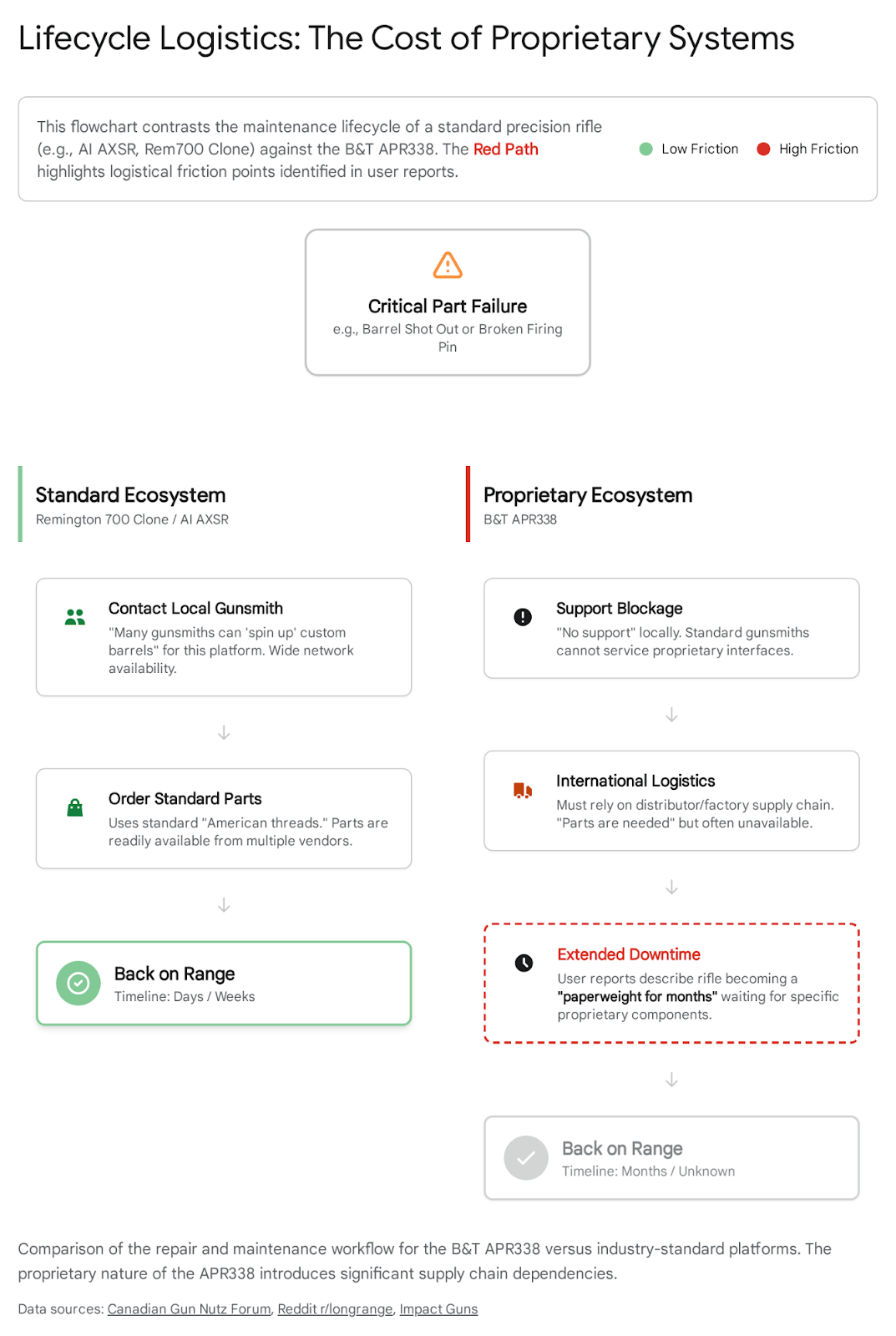
- Magazines: The rifle uses a unique B&T 10-round magazine.25 It does not accept the industry-standard Accuracy International Chassis System (AICS) magazines.26 This is a major logistical friction point. AICS magazines are ubiquitous, available from multiple manufacturers (Magpul, MDT, AI), and relatively affordable. B&T magazines are sole-source items, often backordered, and command premium pricing.
- Parts Availability: User sentiment from forums such as Canadian Gun Nutz and Snipers Hide highlights a “paperweight risk”.6 If a critical component like an extractor or firing pin breaks, replacement parts must often be sourced directly from B&T in Switzerland or through a slow-moving distributor network. In contrast, parts for Remington 700-based systems are available at virtually any gunsmith, and Accuracy International parts are stocked by specialized major retailers like Mile High Shooting.28
5.2 Maintenance and Barrel Replacement
The maintenance philosophy of the APR338 reflects a depot-level repair doctrine rather than field-level repair.21
- Barrel Swaps: Changing the barrel requires specialized tools (barrel wrench, vice, torque wrench) and a specific procedure to ensure headspace is correct. It is not designed for the end-user to perform casually.
- Contrast: The Barrett MRAD uses two Torx screws to clamp the barrel. A user can change calibers in the field in under two minutes with a simple T-handle wrench.20 This difference defines the operational flexibility of the systems: the MRAD is an adaptive weapon system; the APR338 is a precision instrument that requires a workshop for major changes.
6. Customer Sentiment and User Experience
Synthesizing feedback from long-range shooting communities, verified owners, and industry discussion boards provides a qualitative assessment of the ownership experience.
6.1 The “Fit and Finish” Halo
Positive sentiment is overwhelmingly focused on the tangible quality of the rifle.
- Machining Quality: Owners consistently describe the APR338 as having “jewel-like” precision.8 The action is described as “silky smooth,” contrasting favorably with the perceived “clunky” or utilitarian feel of the Barrett MRAD.7
- Turn-Key Solution: Users appreciate that the APR338 ships as a complete, coherent system. It includes the bipod, the brake, the scope mount, and the cleaning kit.30 This appeals to buyers who want a “done” solution without the need to research and assemble disparate aftermarket components.
6.2 The “Orphan” Anxiety
Negative sentiment is dominated by the logistical isolation of the platform.
- Lack of Community Knowledge: Because the rifle is rare, there is very little institutional knowledge in the civilian community. Unlike the AI AXSR, which has thousands of users sharing load data, troubleshooting tips, and modification guides, the APR338 owner is often on their own.9
- Resale Depreciation: Due to the niche nature of the rifle and the high cost of ammunition, the APR338 suffers from steeper depreciation than its competitors. It is harder to sell a used APR338 because the buyer pool is limited to those who specifically want that rifle, whereas an AXSR or MRAD has a broad, active market.6
7. Use Case Analysis and Recommendations
Based on the technical and market analysis, the suitability of the APR338 can be categorized by user profile.
7.1 Recommended Use Case: The Institutional Specialist
For Law Enforcement agencies that require a dedicated.338 LM asset for vehicle interdiction or long-range overwatch, the APR338 is an excellent choice.
- Why: Agencies typically issue weapons as fixed assets; they do not need to swap calibers in the field. The ruggedness, accuracy, and turn-key nature of the APR338 fit the departmental procurement model well. The 1,300m effective range covers 99.9% of police engagement scenarios.
7.2 Recommended Use Case: The “Purist” Collector
For the private enthusiast who values mechanical excellence and exclusivity over versatility.
- Why: The APR338 offers a tactile experience and pride of ownership that is distinct from the more utilitarian American designs. It is a “statement piece” that also happens to be a sub-MOA performer.
7.3 NOT Recommended: The Competitor or High-Volume Shooter
For PRS/ELR competitors or shooters who fire thousands of rounds a year.
- Why: The lack of a quick-change barrel system makes training prohibitively expensive. You cannot swap to.308 Win for cheap practice. Furthermore, the 1:11 twist rate puts the shooter at a ballistic disadvantage against competitors running custom 1:9 twist barrels with 300gr solids.
8. Conclusion
The B&T APR338 is a triumph of specific engineering over modular adaptability. It was designed in an era where a sniper rifle was a dedicated tool for a singular purpose. In that role, it excels. It is accurate, incredibly durable, and built with a level of precision that few manufacturers can match.
However, the market has evolved. The paradigm shift toward modular, multi-caliber chassis systems—driven by USSOCOM’s PSR and ASR programs—has rendered the fixed-caliber, proprietary architecture of the APR338 functionally obsolescent for general military and competitive use. The Barrett MRAD offers comparable performance with vastly superior versatility for a lower price. The Accuracy International AXSR offers superior performance and ecosystem support for a similar price.
Overall Verdict:
The APR338 is worth buying only for those who specifically desire the B&T pedigree and the specific mechanical attributes of a dedicated, fixed-barrel system. It is a superb rifle that has been overtaken by a shift in doctrine. For the pragmatist, the multi-caliber alternatives offer a better return on investment; for the connoisseur, the APR338 remains a singular, exquisite machine.
Appendix A: Methodology
This report was compiled using a multi-source intelligence approach, synthesizing technical data, market trends, and user feedback.
- Technical Specifications: Data regarding dimensions, twist rates, and operational limits were sourced directly from B&T operator manuals, technical data sheets, and official distributor listings (B&T USA, EuroOptic).
- Comparative Analysis: Specifications for competitor rifles (AI AXSR, Barrett MRAD, Sako TRG) were aggregated from their respective manufacturer publications and NATO trial results to create a baseline for “industry standard.”
- Sentiment Analysis: User feedback was harvested from high-traffic precision shooting forums (Sniper’s Hide, Reddit r/LongRange, Canadian Gun Nutz). This qualitative data was filtered to separate speculation from verified owner experiences, focusing on recurring themes regarding reliability and support.
- Pricing Data: Current street prices were derived from major retailers to establish the accurate cost-of-entry for the 2024/2025 fiscal period.
- Ballistic Modeling: Claims regarding hit probability and effective range were cross-referenced against standard ballistic calculators (JBM Ballistics) using known coefficients for.338 LM projectiles to verify the physical plausibility of manufacturer guarantees.
Works cited
- Brügger & Thomet APR – Wikipedia, accessed December 19, 2025, https://en.wikipedia.org/wiki/Br%C3%BCgger_%26_Thomet_APR
- Opinions on which .338 to buy? | Sniper’s Hide Forum, accessed December 19, 2025, https://www.snipershide.com/shooting/threads/opinions-on-which-338-to-buy.142607/
- Haenel RS9 – Wikipedia, accessed December 19, 2025, https://en.wikipedia.org/wiki/Haenel_RS9
- Precision Rifle System RS8 / RS9 – C.G. Haenel, accessed December 19, 2025, https://www.cg-haenel.de/en/products/rs8-rs9/
- Barrett Firearms Secures MRAD Contract with Colombian National Army, accessed December 19, 2025, https://barrett.net/2025/02/12/barrett-firearms-secures-mrad-contract-with-colombian-national-army/
- AI AXSR, B&T APR, Sako TRG M10 or Cadex Kraken? | Canadian Gun Nutz, accessed December 19, 2025, https://www.canadiangunnutz.com/forum/threads/ai-axsr-b-t-apr-sako-trg-m10-or-cadex-kraken.2504759/
- New! B&T APR338 .338 Lapua Magnum Bolt-Action Chassis Rifle – Bass Pro Shops, accessed December 19, 2025, https://www.basspro.com/p/bt-apr338-338-lapua-magnum-bolt-action-chassis-rifle
- B&T APR338 .338 Lapua Mag 27″ 1:11″ Bbl Rifle w/(1) 10rd Mag BT-APR338-CH, accessed December 19, 2025, https://www.eurooptic.com/b-t-apr338-338lm-rifle-27-1-11-bt-apr338
- APR338 – B&T USA, accessed December 19, 2025, https://bt-usa.com/products/apr338/
- B&T APR338 Sniper Rifle System Cal. .338LM: Technical Specifications | PDF – Scribd, accessed December 19, 2025, https://www.scribd.com/doc/40579800/TS-APR338
- MRAD® – Barrett Firearms, accessed December 19, 2025, https://barrett.net/products/firearms/mrad-standard/
- 6 Best Remington 700 Triggers: Maximum Accuracy, accessed December 19, 2025, https://www.pewpewtactical.com/best-remington-700-triggers/
- Which Trigger Company To Use? | Sniper’s Hide Forum, accessed December 19, 2025, https://www.snipershide.com/shooting/threads/which-trigger-company-to-use.7226087/
- B&T APR338 Sniper Rifle System cal. .338LM, accessed December 19, 2025, http://www.andreusoler.com/aasias/PDFs%20productes/BT-APR338_manual_ENG.pdf
- Sniper Rifle Manufacturer Guide – Small Arms Review, accessed December 19, 2025, https://smallarmsreview.com/sniper-rifle-manufacturer-guide/
- AXSR professional long action multi cal. sniper rifle – Accuracy International, accessed December 19, 2025, https://www.accuracyinternational.us/axsr-pro
- TRG M10 – Modular Rifle, accessed December 19, 2025, https://modularrifle.com/wp-content/uploads/2015/08/Sako_TRG_M10_Specifications1.pdf
- B&T APR 338 Lapua Magnum, 27″ Threaded Barrel, Black, 10rd – Impact Guns, accessed December 19, 2025, https://www.impactguns.com/semi-automatic-rifles/b-t-apr-338-lapua-27-barrel-black-anodized-10rd-840225705744-bt-apr338-ch
- B&T APR338 – B&T APR 338 For Sale – Xtreme Guns And Ammo, accessed December 19, 2025, https://xtremegunsandammo.com/rifles-for-sale/b-t/bt-apr338/
- MRAD Barrel Change – YouTube, accessed December 19, 2025, https://www.youtube.com/watch?v=Tr0uGyR8Ezg
- apr308 pro – operator manual – B&T USA, accessed December 19, 2025, https://bt-usa.com/wp-content/uploads/2025/03/APR308-PRO-Operator-Manual.pdf
- King of 2 Miles: Extreme Long-Range Competition | An NRA Shooting Sports Journal, accessed December 19, 2025, https://www.ssusa.org/content/king-of-2-miles-extreme-long-range-competition/
- King of 2 Miles: ELR – Global Precision Group, accessed December 19, 2025, https://www.globalprecisiongroupllc.com/lb-all-articles
- Applied Ballistics Shooters Dominate King of 2 Miles Finals « Daily Bulletin, accessed December 19, 2025, https://bulletin.accurateshooter.com/2016/07/applied-ballistics-shooters-dominate-king-of-2-miles-finals/
- BT-ALM11 – B&T magazine for APR338 10 rounds cal. .338 LM, accessed December 19, 2025, https://bt-parts.com/b-t-magazine-for-apr338-10-rounds-cal-338-lm/
- 338LM Lapua AICS Magazine – XLR Industries, accessed December 19, 2025, https://xlrindustries.com/products/338-cip-box-magazine
- Aics magazine compatibility : r/longrange – Reddit, accessed December 19, 2025, https://www.reddit.com/r/longrange/comments/kdgrxk/aics_magazine_compatibility/
- Accuracy International AXSR Rifles – Mile High Shooting Accessories, accessed December 19, 2025, https://www.milehighshooting.com/accuracy-international/accuracy-international-rifles/axsr/
- Accuracy international or barrett mrad : r/longrange – Reddit, accessed December 19, 2025, https://www.reddit.com/r/longrange/comments/p8rp04/accuracy_international_or_barrett_mrad/
- B&T APR338 Sniper Rifle (Advanced Precision Rifle) chambered in .338 Lapua Magnum, accessed December 19, 2025, https://axarms.com/product/bt-apr338-sniper-rifle-advanced-precision-rifle-chambered-in-338-lapua-magnum/