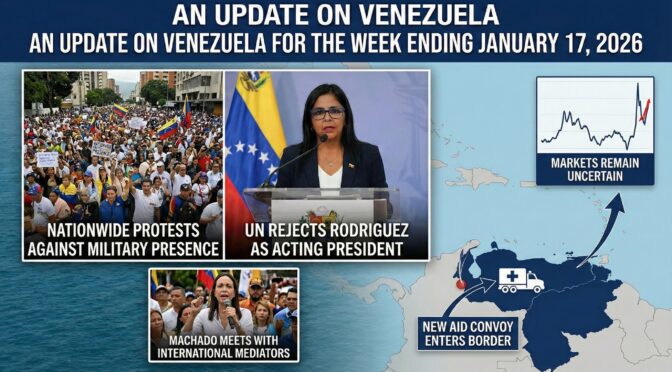
The operational week of January 11–17, 2026, represents a critical juncture in the geopolitical history of the Western Hemisphere, defined by the consolidation of a new, externally managed governance architecture in Venezuela following the execution of Operation Absolute Resolve. The successful extraction of President Nicolás Maduro Moros and First Lady Cilia Flores by United States special operations forces on January 3 has precipitated a radical restructuring of the Venezuelan state, characterized not by immediate democratization, but by the imposition of a technocratic interim administration under Vice President Delcy Rodríguez. This reporting period has seen the transition from the initial tactical shock of the decapitation strike to a complex phase of strategic maneuvering involving domestic power brokers, regional neighbors, and global superpowers.
Our analysis indicates that the United States, operating under the newly articulated “Donroe Doctrine,” has effectively placed the Venezuelan state into a form of geopolitical receivership. This strategy prioritizes the stabilization of energy markets and the neutralization of transnational criminal networks over the immediate restoration of liberal democratic institutions. This priority was starkly illustrated by the diplomatic sidelining of opposition leader María Corina Machado during her January 15 meeting with President Donald Trump, where the administration signaled its intent to work through the existing Chavista apparatus rather than dismantle it.
Domestically, the reporting period was dominated by a high-stakes, opaque power struggle between the civilian leadership of Delcy Rodríguez and the security apparatus controlled by Interior Minister Diosdado Cabello. While the Bolivarian National Armed Forces (FANB) under General Vladimir Padrino López have maintained institutional cohesion and pledged loyalty to the interim government, the loyalty of the paramilitary colectivos and the intelligence services remains a volatile variable. The security environment is further complicated by the asymmetric threat posed by the Tren de Aragua criminal syndicate, now designated a Foreign Terrorist Organization, and persistent tensions on the Guyanese border.
Economically, the country remains in a state of paralysis. The United States’ move to seize control of Venezuelan oil exports has triggered significant market volatility. Despite optimistic rhetoric regarding a production renaissance, the reality on the ground—characterized by a cyber-decimated infrastructure managed via encrypted messaging apps—suggests that a return to pre-1999 production levels remains a distant prospect. Furthermore, the diplomatic fallout has fractured the Latin American consensus, isolating the United States from traditional partners like Brazil and Colombia, who view the intervention as a destabilizing precedent for the region.
This report synthesizes multi-source intelligence to provide a granular assessment of these developments. It argues that while the removal of Maduro has eliminated the figurehead of the Bolivarian Revolution, the underlying structures of the state—including its deep-seated corruption, infrastructural decay, and authoritarian mechanisms—remain intact, presenting the United States with the challenge of managing a “zombie state” for the foreseeable future.
1. The Strategic Context: Operation Absolute Resolve and the Donroe Doctrine
The events of the reporting week cannot be understood without a rigorous analysis of the paradigm shift in United States foreign policy that precipitated them. The intervention in Venezuela marks the operational debut of the “Donroe Doctrine,” a maximalist reinterpretation of the 1823 Monroe Doctrine.
1.1 The Operational Paradigm
Operation Absolute Resolve was a high-intensity, decapitation strike executed on January 3, 2026. The operation involved over 150 U.S. aircraft conducting precision strikes against seven military facilities in Caracas, La Guaira, and Miranda to suppress integrated air defense systems.1 Simultaneously, a specialized apprehension force, reportedly involving the 160th Special Operations Aviation Regiment and Delta Force, infiltrated the presidential compound.2 The extraction resulted in 83 fatalities, primarily among the Venezuelan Presidential Guard and Cuban security detail, with no reported U.S. casualties.2
The psychological impact of this operation on the Venezuelan leadership cannot be overstated. The precision of the strikes and the total failure of the Russian-supplied air defense network created a “sovereignty shock.” During the week of January 11–17, this shock manifested in the total compliance of the surviving leadership with U.S. directives regarding prisoner releases and oil sector management. The lack of a kinetic response from the FANB suggests a pre-planned paralysis or a rapid calculation of survival by the military high command.3
1.2 The “Donroe Doctrine”
President Trump has framed this intervention not merely as a law enforcement action but as a geostrategic imperative. The “Donroe Doctrine” asserts absolute American dominance in the Western Hemisphere, explicitly rejecting the influence of extra-regional powers such as China, Russia, and Iran.4 Unlike the Cold War-era containment strategies, this doctrine appears transactional and resource-focused. The administration’s rhetoric during the week focused heavily on “running” Venezuela and seizing its oil assets to pay for the intervention and benefit the American people.2
This doctrinal shift was codified in the administration’s National Security Strategy, which outlines the permissible use of force to seize strategic assets and combat migration drivers at the source.4 The implications of this were visible throughout the week as U.S. officials, including Secretary of State Marco Rubio and Secretary of Energy Wright, engaged directly with the Venezuelan interim authorities to dictate energy policy, effectively bypassing the concept of national sovereignty in favor of a client-state relationship.2
1.3 Legal Warfare: The Narcoterrorism Indictment
To legitimize the intervention domestically and internationally, the U.S. Department of Justice unsealed a superseding indictment in the Southern District of New York. This legal instrument reframes the Venezuelan state not as a sovereign entity but as a criminal enterprise—the Cartel de los Soles. The indictment charges Maduro, Cilia Flores, Diosdado Cabello, and others with participating in a narcoterrorism conspiracy designed to “flood” the United States with cocaine.7
This legal framework is crucial for understanding the events of Jan 11–17. By designating the leadership as criminal actors, the U.S. justified the bypass of international norms regarding sovereign immunity. During this week, this framework was used to pressure the remaining leadership. While Delcy Rodríguez is recognized as Acting President, the U.S. continues to hold the threat of indictment over other members of the regime, specifically Interior Minister Cabello, creating a coercive lever to ensure compliance.8 This “lawfare” strategy allows the U.S. to maintain diplomatic relations with the institution of the presidency while prosecuting the individuals who inhabit it.
2. Internal Political Dynamics: The Interim Administration
The political landscape in Caracas during the week of January 11–17 was defined by a fragile stability. Contrary to expectations of immediate regime collapse, the Chavista infrastructure demonstrated resilience, quickly coalescing around Vice President Delcy Rodríguez.
2.1 The Technocratic Consolidation of Delcy Rodríguez
Delcy Rodríguez, sworn in as Acting President on January 5, spent the reporting week consolidating her tenuous hold on power. Analysts characterize her administration as “pragmatic authoritarianism.” Unlike the ideological firebrands of the Chavismo movement, Rodríguez is viewed as a technocrat capable of navigating the complex requirements of the U.S. occupation.9
Her strategy during this period has been twofold: performative sovereignty and covert compliance. Publicly, she has maintained the rhetoric of the revolution, describing Maduro’s capture as a “kidnapping” and promising to defend the constitutional order.2 Privately, however, she has facilitated the U.S. takeover of the oil sector and the release of political prisoners. This dual track was evident in her January 14 address to the nation, where she framed the prisoner releases not as a concession to Washington, but as a sovereign decision to “open up to a new political moment”.11
Rodríguez has moved aggressively to secure the loyalty of the state apparatus. A critical development this week was her appointment of Major General Gustavo González to head the General Directorate of Military Counterintelligence (DGCIM).9 This appointment is a strategic coup; the DGCIM is the regime’s internal policing mechanism, responsible for monitoring loyalty within the armed forces. By placing a loyalist at its head, Rodríguez has effectively insulated herself against coups from within the military, reducing the influence of her primary rival, Diosdado Cabello.
2.2 The Power Struggle: The “Octopus” vs. The Palace
The most significant internal threat to the new order comes from Diosdado Cabello, the Minister of the Interior. Known as “The Octopus” for his pervasive influence across the party and security services, Cabello controls the Bolivarian National Police (PNB), the SEBIN intelligence agency, and the paramilitary colectivos.8
Intelligence indicates a severe fracture between the Rodríguez siblings (Delcy and Jorge, President of the National Assembly) and the Cabello faction. The relationship between these power centers is currently a “Cold War” within the Miraflores Palace.
- The Cabello Faction: Represents the hardline, ideological wing of Chavismo with deep ties to illicit networks. Cabello’s power is rooted in his ability to mobilize violence on the streets through the colectivos.
- The Rodríguez Faction: Represents the civilian, transactional wing seeking survival through accommodation with the United States.
- The Arbiter: General Padrino López and the FANB high command, who currently align with Rodríguez to ensure institutional survival.3
During the week of Jan 11–17, Cabello appeared significantly weakened. The U.S. bounty of $25 million on his head has forced him into a defensive posture.13 Reports confirm that he has limited his public movements and is broadcasting his television show, Con el Mazo Dando, from secure, undisclosed locations rather than his usual studio.13 Former regime insiders suggest Cabello is “a walking zombie,” tolerated by the U.S. only as long as he does not disrupt the oil flow, but marked for eventual removal.8 His public appearances with Rodríguez this week were interpreted by analysts as forced displays of unity to prevent panic among the rank-and-file Chavistas.3
2.3 The Opposition Dilemma: The Sidelining of María Corina Machado
For the traditional opposition, the week brought a bitter realization: the removal of Maduro did not equate to their ascension to power. The Trump administration’s strategy relies on the continuity of the state machinery, which means keeping the Chavista bureaucracy in place while changing the leadership’s directives.
This dynamic was brutally illustrated on January 15, 2026, when opposition leader María Corina Machado met with President Trump at the White House.14 In a gesture intended to cement the bond between the two nations, Machado presented Trump with her Nobel Peace Prize medal, drawing a historical parallel to the Marquis de Lafayette gifting a medal to Simón Bolívar.14 The medal was displayed in the White House with an inscription recognizing Trump’s “principled and decisive action”.14
However, despite this symbolic offering, the political outcome was negligible. The White House confirmed it would continue to recognize Delcy Rodríguez as the interim authority.14 Press Secretary Karoline Leavitt stated this decision was based on “realities on the ground,” explicitly noting the opposition’s lack of control over the security forces.14 Trump himself has previously characterized Machado as a “nice woman” who lacks the “respect within the country” necessary to govern.15 This pragmatism has left the opposition movement demoralized, effectively decapitating their political momentum just as the dictatorship they fought against was decapitated militarily.
3. The Economic Theater: Energy, Sanctions, and Collapse
The economic dimension of the intervention is characterized by the United States’ aggressive move to monetize Venezuelan resources to stabilize global energy markets and offset the costs of the operation. However, the reality of the Venezuelan economy—marked by hyperinflation and infrastructural ruin—presents formidable obstacles.
3.1 The Oil Sector: Ambition Meets Decay
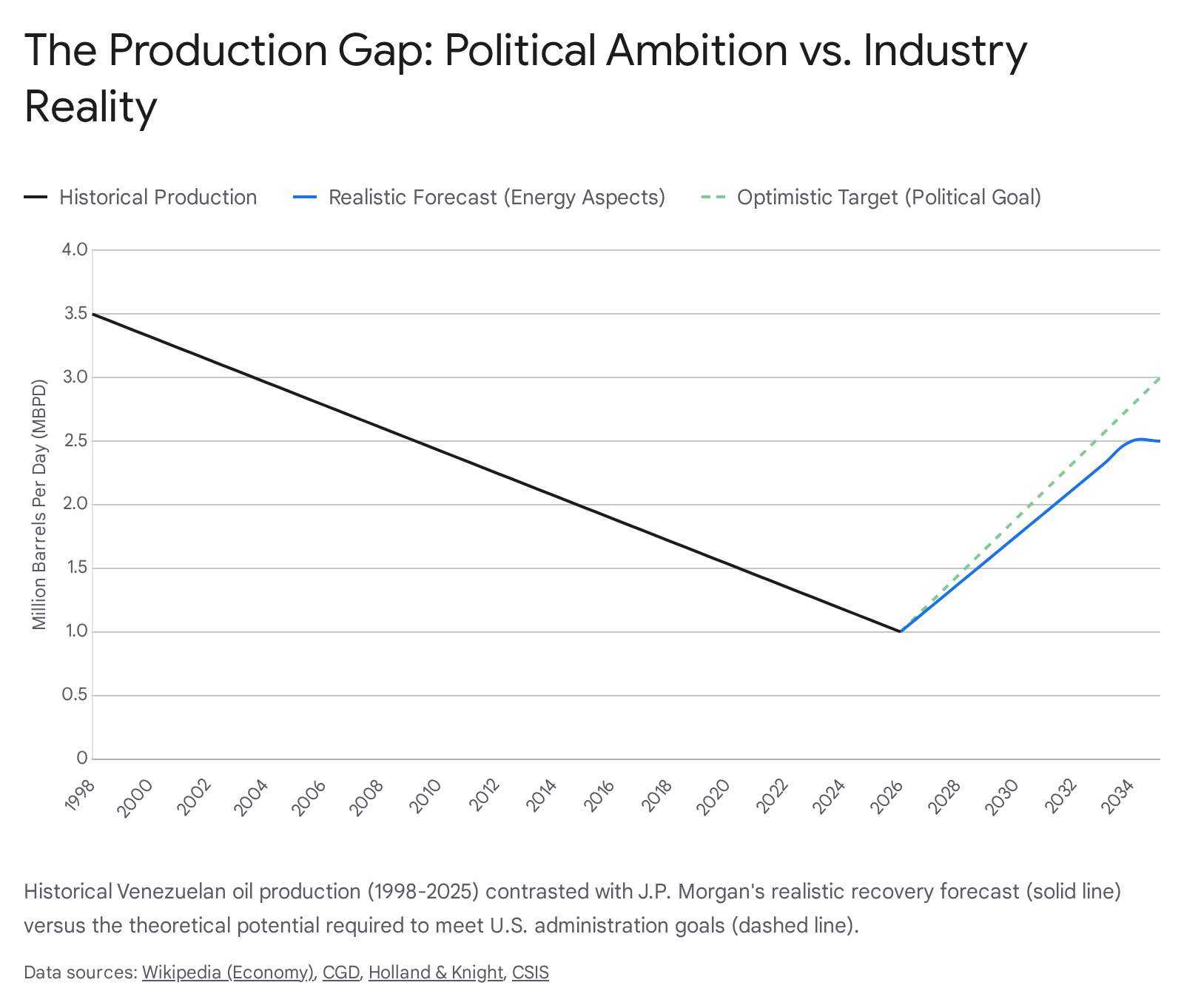
Venezuela possesses the largest proven oil reserves in the world, estimated at 303 billion barrels.16 The Trump administration’s stated goal is to ramp up production rapidly, targeting a return to the 3 million barrels per day (bpd) levels seen in the 1990s. During the reporting week, the U.S. announced plans to sell 30–50 million barrels of seized Venezuelan crude and encouraged U.S. oil majors to re-enter the market.5
However, the gap between this political ambition and the industrial reality is immense. Current production is estimated between 860,000 and 1.1 million bpd, a fraction of its potential.17 The infrastructure of Petróleos de Venezuela, S.A. (PDVSA) is in a state of catastrophic disrepair due to decades of mismanagement, corruption, and sanctions.
The Cyber-Physical Crisis: A critical and underreported development this week was the revelation that PDVSA is operating without its central digital nervous system. A cyberattack in mid-December—which remains unattributed but is widely suspected to be state-sponsored—destroyed the company’s SAP enterprise resource planning software and compromised the SCADA (Supervisory Control and Data Acquisition) systems that manage refineries and pipelines.19
During the week of Jan 11–17, operations were reportedly being managed via WhatsApp and Telegram. Logistics, payments to contractors, and production data were being handled through handwritten notes and encrypted messages, creating an environment of total opacity and high risk.19 This “analog” management style makes the rapid scaling of exports logistically impossible and raises severe safety concerns regarding the operation of high-pressure infrastructure.
Major oil companies, including ExxonMobil, have signaled that the country remains “uninvestable” in the short term. CEO Darren Woods explicitly stated that the heavy, sour nature of Venezuelan crude, combined with the degraded infrastructure, makes a quick return on investment unlikely.20 Estimates suggest that stabilizing production would require $50 billion over 15 years, while restoring it to 3 million bpd would cost nearly $180 billion.5
3.2 Macroeconomic Paralysis
The broader economy remains trapped in a hyperinflationary spiral. The International Monetary Fund (IMF) projects Venezuela’s inflation rate to reach 682% in 2026, the highest globally.21 The intervention initially exacerbated this by disrupting the flow of illicit funds that had been propping up the parallel currency market.
During the week, the Venezuelan Bolívar (VES) experienced extreme volatility, trading as high as 800 VES/USD on the black market before strengthening to approximately 341 VES/USD after the interim government announced the resumption of dollar auctions.22 This stabilization is artificial, predicated on the expectation of U.S. dollars entering the system from permitted oil sales. However, with 64% of the population citing the economy as their primary concern, the social pressure on the Rodríguez administration is immense.24 The humanitarian crisis continues, with shortages of medicine and food reported in the barrios, where citizens like “Calderon” report an inability to afford basic protein due to skyrocketing prices.25
4. Geopolitical Repercussions: A Hemispheric Fracture
The external dimension of the Venezuelan crisis has exposed deep fault lines in the international order, particularly within the Western Hemisphere. The U.S. intervention has forced a realignment of regional politics.
4.1 United States Domestic Politics: The Senate Showdown
Domestically, the Trump administration faced a significant constitutional challenge regarding the legality of the intervention. On January 14, the U.S. Senate voted on a war powers resolution designed to limit the President’s authority to conduct further military operations in Venezuela without congressional approval.26
The vote resulted in a dramatic 50-50 tie, broken by Vice President JD Vance to defeat the measure. This legislative battle highlighted a rift within the Republican party between interventionists and constitutionalists. Senators Rand Paul, Lisa Murkowski, and Susan Collins voted with the Democrats, arguing that the “Donroe Doctrine” and the seizure of a foreign head of state constituted acts of war requiring legislative oversight.27 The administration secured victory only after intense pressure was applied to wavering Republican Senators Todd Young and Josh Hawley, who flipped their votes at the eleventh hour after receiving “assurances” regarding the scope of future operations.28 This victory effectively grants the executive branch a blank check for the occupation, signaling the erosion of congressional war powers in the face of the “narcoterrorism” legal framework.
4.2 Latin American Division: The “Pink Tide” Fracture
The intervention has shattered the diplomatic consensus in Latin America. The region is now divided into two distinct blocs based on their reaction to the U.S. operation.
- The Condemnation Bloc: Led by Brazil and Colombia, this bloc views the intervention as an existential threat to regional sovereignty. Brazilian President Luiz Inácio Lula da Silva condemned the action as crossing an “unacceptable line,” while Colombian President Gustavo Petro described it as a “kidnapping”.30 Both leaders fear that the precedent of “regime decapitation” could be applied to any government that falls out of favor with Washington. During the week, Petro and Lula engaged in high-level coordination to attempt a diplomatic mediation, but their efforts have been largely sidelined by U.S. unilateralism.32
- The Support Bloc: Right-leaning governments, including Argentina and Paraguay, have tacitly or explicitly supported the removal of Maduro, viewing it as a necessary step to eliminate a regional destabilizer.33
This fracture has paralyzed regional bodies like the Organization of American States (OAS) and CELAC, leaving the region without a unified voice.
4.3 Great Power Silence: Russia and China
Conspicuously absent from the crisis is any meaningful counter-move by Venezuela’s traditional patrons, Russia and China.
- Russia: Occupied with the war in Ukraine, Moscow has offered only rhetorical condemnation. The Kremlin’s inaction confirms that its alliance with Venezuela was opportunistic rather than strategic; it is unwilling to risk direct confrontation with the U.S. in the Caribbean theater.34
- China: Beijing faces the potential loss of billions in loans. With the U.S. seizing oil revenues, China’s primary mechanism for repayment is threatened. However, China’s response has been cautious, prioritizing its broader trade relationship with the U.S. over the fate of the Maduro regime.35 This passivity has reinforced the U.S. claim to hegemony under the Donroe Doctrine.
5. Security and Defense Assessment
While the initial invasion was swift, the security situation in Venezuela remains a powder keg. The risk of insurgency, criminal violence, and border conflict persists.
5.1 The Loyalty of the Armed Forces (FANB)
The Bolivarian National Armed Forces have maintained a surprising degree of cohesion. Defense Minister Vladimir Padrino López has aligned the military with the interim presidency of Delcy Rodríguez, preventing a fragmentation of command.3 This loyalty is likely transactional: the military controls vast sectors of the economy, including mining and food distribution, and the senior command has likely been offered guarantees of immunity or continuity by the interim administration in exchange for stability. The military’s refusal to mobilize in defense of Maduro on January 3 suggests a pre-arranged acquiescence to the inevitable.
5.2 Asymmetric Threats: Tren de Aragua and Colectivos
The vacuum of authority has emboldened non-state actors.
- Tren de Aragua: This transnational gang, now designated a Foreign Terrorist Organization, poses a direct threat to U.S. interests and regional stability. On January 2, a U.S. Navy strike targeted a Tren de Aragua vessel, killing 11 operatives.37 The gang has vowed retaliation. Intelligence suggests they may leverage their networks to target U.S. assets or citizens in the region.
- Colectivos: Pro-government paramilitary groups remain active in the barrios. Reports from the week indicate colectivos setting up roadblocks and searching vehicles for U.S. citizens.38 These groups, historically armed by the state to defend the revolution, now operate as rogue militias. The U.S. State Department’s “Do Not Travel” advisory explicitly cites the threat of colectivo violence against Americans.38
5.3 The Guyana Border Flashpoint
Tensions on the eastern border remain critical. The dispute over the Essequibo region is a dormant volcano. The Guyana Defence Force (GDF) remains on high alert, conducting routine leadership engagements at border bases to ensure readiness.39 The government of Guyana has activated its “security architecture” and is in constant communication with U.S. Southern Command.40 While the chaos in Caracas has temporarily paused Venezuelan aggression, there is a risk that rogue elements of the Venezuelan military could stage a border incident to distract from the humiliation in the capital or to rally nationalist sentiment.
6. Human Rights and Social Stability
The human rights situation is evolving as the new government uses political prisoners as bargaining chips.
6.1 The Politics of Prisoner Releases
The release of political prisoners has become a key metric of cooperation between the Rodríguez administration and Washington. As of January 14, the government claimed to have released 406 prisoners, although the NGO Foro Penal could only verify 68.2 The releases are chaotic and conditional.
The tragic case of Edilson Torres, a police officer detained on political charges, illustrates the human cost of the crisis. Torres died of a heart attack in prison on January 10, just days before his potential release.41 His death underscores the brutal conditions within the detention system. Furthermore, released prisoners often face “precautionary measures,” meaning they remain under state surveillance and can be re-arrested at will.43 This “revolving door” strategy allows the government to signal compliance to the U.S. while maintaining a mechanism of social control.
6.2 Social Control and Public Sentiment
Despite the dramatic political changes, there has been no mass uprising. The population, exhausted by years of crisis, is focused on survival. Protests by Maduro loyalists have been small and contained.44 The release of prisoners has generated a flicker of hope, but the prevailing sentiment is one of uncertainty. The lack of a clear timeline for elections and the palpable presence of U.S. power have created a “wait and see” attitude among the populace.
Appendix: Methodology
Research Approach:
This report was produced by a multi-disciplinary team utilizing Open Source Intelligence (OSINT) and qualitative analysis of provided research snippets. The methodology involved:
- Source Verification: Claims regarding prisoner releases and economic data were cross-referenced between government statements (Venezuelan and U.S.), NGO reports (Foro Penal), and independent media analysis.
- Geopolitical Analysis: Events were interpreted through the lens of international relations theory, specifically realism, to understand the strategic calculations of the U.S., Russia, and China.
- Technical Assessment: Energy sector analysis relied on technical data regarding crude grades, infrastructure status (SCADA/SAP systems), and historical production curves to validate political claims.
Data Limitations:
- Opaque Decision Making: The specific agreements between the Trump administration and the Rodríguez interim government regarding the “Donroe Doctrine” implementation remain classified.
- Economic Data Reliability: Official Venezuelan economic statistics are unreliable. The report relies on estimates from the IMF, World Bank, and private energy consultancies.
- Operational Security: Details on specific U.S. military dispositions and the internal communications of the FANB are limited to public disclosures and inferred from troop movements.
Source Material:
The analysis is based on 109 distinct research snippets covering the period of January 2026. All factual claims are cited using the alphanumeric Source ID format.
Works cited
- Q&A: How stable is post-Maduro Venezuela?, accessed January 17, 2026, https://acleddata.com/qa/qa-how-stable-post-maduro-venezuela
- 2026 United States intervention in Venezuela – Wikipedia, accessed January 17, 2026, https://en.wikipedia.org/wiki/2026_United_States_intervention_in_Venezuela
- Military remains loyal after Maduro ouster, Venezuelan exiles say – Arab News, accessed January 17, 2026, https://www.arabnews.com/node/2628409/amp
- Future Center – Unpacking Russia’s and China’s Calculations on the U.S. Attack on Venezuela, accessed January 17, 2026, https://futureuae.com/en-US/Mainpage/Item/10741
- Barreling Blindly Ahead: The Seizure of Venezuela’s Oil, accessed January 17, 2026, https://www.cgdev.org/blog/barreling-blindly-ahead-seizure-venezuelas-oil
- Venezuela Oil Sector: Context for Recent Developments – Congress.gov, accessed January 17, 2026, https://www.congress.gov/crs_external_products/IN/PDF/IN12637/IN12637.2.pdf
- UNITED STATES DISTRICT COURT SOUTHERN DISTRICT OF NEW YORK UNITED STATES OF AMERICA NICOLAS MADURO MOROS, DIOSDADO CABELLO RONDO – Department of Justice, accessed January 17, 2026, https://www.justice.gov/opa/media/1422326/dl
- ‘The real ringleader’: the Venezuelan security chief with a $25m bounty on his head, accessed January 17, 2026, https://www.theguardian.com/world/2026/jan/13/venezuelan-security-chief-diosdado-cabello-profile
- Venezuela’s New President Moves to Consolidate Power as Divisions Widen, accessed January 17, 2026, https://moderndiplomacy.eu/2026/01/17/venezuelas-new-president-moves-to-consolidate-power-as-divisions-widen/
- Maduro’s Miscalculations Are a Cautionary Tale for Rodríguez – Americas Quarterly, accessed January 17, 2026, https://www.americasquarterly.org/article/maduros-miscalculations-are-a-cautionary-tale-for-rodriguez/
- Venezuela regime claims release of political prisoners is sign of new era, accessed January 17, 2026, https://www.theguardian.com/world/2026/jan/14/venezuelan-political-prisoners-released
- US had months of quiet talks with Venezuela’s Diosdado Cabello before and after Maduro raid — is Delcy Rodriguez’s position at risk?, accessed January 17, 2026, https://timesofindia.indiatimes.com/world/us/us-had-months-of-quiet-talks-with-venezuelas-diosdado-cabello-before-and-after-maduro-raid-is-delcy-rodriguezs-position-at-risk/articleshow/126619610.cms
- Venezuela’s Delcy Rodriguez consolidates power after Maduro ouster, accessed January 17, 2026, https://www.japantimes.co.jp/news/2026/01/17/world/politics/venezuela-rodriguez-consolidates-power/
- María Corina Machado presents Trump with her Nobel peace prize …, accessed January 17, 2026, https://www.theguardian.com/world/2026/jan/15/maria-corina-machado-says-she-presented-trump-with-her-nobel-peace-prize-medal
- The US capture of Nicolás Maduro – The House of Commons Library, accessed January 17, 2026, https://commonslibrary.parliament.uk/research-briefings/cbp-10452/
- Markets News, Jan. 15, 2026: Stocks Rise to Snap 2-Day Skid; Chip, Bank Shares Lead Gains; Oil Price Drops as Trump Lowers Iran Tensions, accessed January 17, 2026, https://www.investopedia.com/dow-jones-today-01152026-11885871
- Venezuela: Navigating a New Era of Uncertainty | Insights – Holland & Knight, accessed January 17, 2026, https://www.hklaw.com/en/insights/publications/2026/01/venezuela-navigating-a-new-era-of-uncertainty
- Venezuela’s Oil Industry in Global Market – January 2026 – Lodi 411, accessed January 17, 2026, https://lodi411.com/lodi-eye/venezuelas-oil-industry-in-global-market-january-2026
- Venezuelan Oil Industry Is Running on WhatsApp After Cyberattack, accessed January 17, 2026, https://www.insurancejournal.com/news/international/2026/01/16/854637.htm
- Experts Say Venezuela Events Move Oil Markets, With Limited Impact on Kazakhstan, accessed January 17, 2026, https://astanatimes.com/2026/01/experts-say-venezuela-events-move-oil-markets-with-limited-impact-on-kazakhstan/
- Mapped: Global Inflation Forecasts by Country in 2026, accessed January 17, 2026, https://www.visualcapitalist.com/global-inflation-forecasts-by-country-in-2026/
- Venezuela to resume dollar sales after US oil blockade disruption By Investing.com, accessed January 17, 2026, https://za.investing.com/news/forex-news/venezuela-to-resume-dollar-sales-after-us-oil-blockade-disruption-4067014
- Venezuelan Bolivar – Quote – Chart – Historical Data – News – Trading Economics, accessed January 17, 2026, https://tradingeconomics.com/venezuela/currency
- Decade of Distress Clouds Venezuela’s Future – Gallup News, accessed January 17, 2026, https://news.gallup.com/poll/700568/decade-distress-clouds-venezuela-future.aspx
- Venezuelans struggle with crumbling economy as Trump promises economic renaissance, accessed January 17, 2026, https://www.pbs.org/newshour/world/venezuelans-struggle-with-crumbling-economy-as-trump-promises-economic-renaissance
- Vance, most Republicans block Senate resolution to curb Trump’s Venezuela efforts, accessed January 17, 2026, https://www.cbc.ca/news/world/trump-republicans-senate-vote-war-powers-9.7045911
- Venezuela war powers resolution fails in Senate as 2 Republicans bow to Trump pressure, accessed January 17, 2026, https://apnews.com/article/trump-venezuela-senate-war-powers-2350b162d116090759a7428c4b915eea
- US Senate defeats war powers resolution designed to rein in Trump, accessed January 17, 2026, https://www.aljazeera.com/news/2026/1/15/us-senate-defeats-war-powers-resolution-designed-to-rein-in-trump
- Senate Republicans defeat Venezuela war powers resolution as Trump pressures 2 GOP senators to flip, accessed January 17, 2026, https://www.coloradopolitics.com/2026/01/14/senate-republicans-defeat-venezuela-war-powers-resolution-as-trump-pressures-2-gop-senators-to-flip/
- U.S. capture of Maduro divides Latin America, thrilling Trump’s allies and threatening his foes – PBS, accessed January 17, 2026, https://www.pbs.org/newshour/politics/us-capture-of-maduro-divides-latin-america-thrilling-trumps-allies-and-threatening-his-foes
- How the World Is Reacting to the U.S. Capture of Nicolas Maduro | TIME, accessed January 17, 2026, https://time.com/7342925/venezuela-maduro-capture-reaction/
- Brazil’s Lula, Colombia’s Petro hold phone call on Venezuela | Agência Brasil, accessed January 17, 2026, https://agenciabrasil.ebc.com.br/en/internacional/noticia/2026-01/brazils-lula-colombias-petro-hold-phone-call-venezuela
- Regime change in Venezuela and the crisis of global order – The Kathmandu Post, accessed January 17, 2026, https://kathmandupost.com/columns/2026/01/13/regime-change-in-venezuela-and-the-crisis-of-global-order
- Russia’s Non-Response to US Actions in Venezuela Reveal a Kremlin Balancing Act, accessed January 17, 2026, https://understandingwar.org/research/adversary-entente/russias-non-response-to-us-actions-in-venezuela-reveal-a-kremlin-balancing-act/
- Taylor Quoted in La Presse Article on Reaction of China and Russia on US Operation in Venezuela, accessed January 17, 2026, https://www.maxwell.syr.edu/news/article/taylor-quoted-in-la-presse-article-on-reaction-of-china-and-russia-on-us-operation-in-venezuela
- Venezuela & ALBA News 1.5.2026: Latest Updates on US Attack on the Bolivarian Revolution; Days of Anti-War Actions for Venezuela, accessed January 17, 2026, https://afgj.org/venezuela-days-of-anti-war-actions-for-venezuela
- U.S. Confrontation With Venezuela | Global Conflict Tracker, accessed January 17, 2026, https://www.cfr.org/global-conflict-tracker/conflict/instability-venezuela
- US urges its citizens to flee Venezuela amid reports of paramilitaries, accessed January 17, 2026, https://www.theguardian.com/us-news/2026/jan/10/us-citizens-venezuela-paramilitaries
- GDF conducts routine leadership engagements across border locations and bases – News Room Guyana, accessed January 17, 2026, https://newsroom.gy/2026/01/03/gdf-conducts-routine-leadership-engagements-across-border-locations-and-bases/
- Guyana activates security plan as US bombs Venezuela – Jamaica Observer, accessed January 17, 2026, https://www.jamaicaobserver.com/2026/01/04/guyana-activates-security-plan-us-bombs-venezuela-20260104-1042-070000/
- Hundreds more in Venezuela say their loved ones are ‘political prisoners’, accessed January 17, 2026, https://christianindex.org/stories/hundreds-more-in-venezuela-say-their-loved-ones-are-political-prisoners,105304
- Hundreds more in Venezuela say their loved ones are ‘political prisoners’, accessed January 17, 2026, https://apnews.com/article/venezuela-prisoners-released-us-maduro-rodriguez-7dc52c3ed6251f561b7754fd50182588
- Q&A on Venezuela: Two things can hold true, and Venezuelans need support now – WOLA, accessed January 17, 2026, https://www.wola.org/analysis/qa-on-venezuela-two-things-can-hold-true-and-venezuelans-need-support-now/
- Caracas, Jan 11, 2026 (AFP) – Maduro loyalists stage modest rally as Venezuelan govt courts US | NAMPA, accessed January 17, 2026, https://www.nampa.org/text/22828809