The discipline of military precision engagement has entered a period of unprecedented technological disruption and doctrinal realignment. As of 2025, the global landscape of sniper cartridges is characterized by a definitive shift away from the “generalist” ballistics of the 20th century toward highly specialized, mission-specific aerodymanic profiles. This report, prepared from the perspective of a defense industry analyst and ballistics engineer, provides an exhaustive evaluation of the top ten sniper cartridges currently fielded by major military powers, including the United States, NATO member states, the Russian Federation, and the People’s Republic of China.
For nearly fifty years, the 7.62x51mm NATO and its Eastern counterpart, the 7.62x54mmR, served as the ubiquitous standards for marksmen. However, the modern battlefield—defined by improvements in personal protective equipment (PPE), the proliferation of long-range observation optics, and the necessity of engaging targets beyond 1,200 meters—has rendered these legacy intermediate cartridges insufficient for the dedicated sniper role. The analysis reveals that the United States Special Operations Command (USSOCOM) has successfully spearheaded a revolution in small arms lethality through the Advanced Sniper Rifle (ASR) program, effectively dethroning the belted magnums of the Cold War in favor of the beltless, mathematically optimized Norma Magnum family.
The findings of this report indicate three primary trends driving the industry. First, the unification of logistics is reshaping procurement; the selection of the.338 Norma Magnum for both precision rifles and next-generation lightweight machine guns allows for a single heavy-caliber solution to dominate the battlespace from 800 to 1,800 meters. Second, the intermediate calibration shift is undeniable, with the 6.5 Creedmoor rapidly replacing the 7.62x51mm NATO in semi-automatic Designated Marksman Rifle (DMR) platforms due to its superior sectional density and doubled hit probability. Third, the geopolitical bifurcation of ballistics continues, as Russia and China modernize their indigenous heavy cartridges (12.7x108mm and 5.8x42mm) to maintain parity with Western advancements, creating two distinct global spheres of ballistics engineering.
This report ranks the top ten cartridges based on a weighted index of effective supersonic range, terminal energy transfer, probability of hit (P(hit)), and current volume of military adoption. While the.50 BMG remains the undisputed king of anti-materiel capabilities, the technical superiority of the.338 Norma Magnum positions it as the defining anti-personnel sniper cartridge of the coming decade.
1. Introduction
1.1 The Evolution of the Precision Engagement Matrix
To understand the current hierarchy of sniper cartridges, one must first analyze the changing requirements of the mission. Historically, the military sniper was a specialized asset used for reconnaissance and opportunistic target interdiction, often at ranges within 600 to 800 meters. In that era, standard infantry cartridges selected for match-grade consistency—such as the.30-06 Springfield or 7.62x51mm NATO—were adequate.
However, the Global War on Terror (GWOT) and subsequent near-peer conflicts in Eastern Europe have fundamentally altered this profile. Snipers are now expected to provide overmatch capability against adversaries equipped with heavy machine guns and anti-tank guided missiles (ATGMs). This necessitates engagement distances that push well into the “extreme long range” (ELR) spectrum, often defined as ranges exceeding 1,500 meters. At these distances, the primary adversary is not just the enemy combatant, but the environment itself. Wind drift, vertical dispersion caused by velocity inconsistencies, and the transonic transition zone become the dominant factors in hit probability.
Consequently, the engineering philosophy behind military ammunition has shifted from “accuracy” (precision at 100 yards) to “aerodynamic efficiency” (retaining velocity at 1,000+ yards). This has driven the adoption of projectiles with extremely high Ballistic Coefficients (BC)—long, sleek bullets that slice through the atmosphere with minimal drag. The cartridges ranked in this report are those that best facilitate the launch of these modern low-drag projectiles while fitting within the weight and logistical constraints of a man-portable weapon system.
1.2 Methodology of Analysis and Ranking
The ranking presented in this report is not merely a comparison of muzzle velocities. It is a holistic assessment of the cartridge as a component of a complete weapon system. The “Top 10” were selected and ranked based on the following weighted criteria:
- Ballistic Efficiency (30%): Measured by the G7 Ballistic Coefficient and the ability to remain supersonic beyond 1,500 meters. This metric determines the “forgiveness” of the round; a flatter shooting round with less wind drift requires less perfect estimation from the shooter.
- Terminal Ballistics (20%): The capacity to transfer lethal energy or penetrate modern ceramic body armor (Level IV/ESAPI) and light vehicle armor at engagement ranges.
- Military Adoption & Logistics (30%): The current status of the cartridge in active service. A technically superior cartridge that is not fielded (wildcats) does not qualify. We analyze procurement contracts, such as USSOCOM’s ASR awards, and standard-issue documentation from foreign militaries.
- System Versatility (20%): The adaptability of the cartridge to different platforms (bolt action vs. semi-automatic) and roles (anti-personnel vs. anti-materiel).
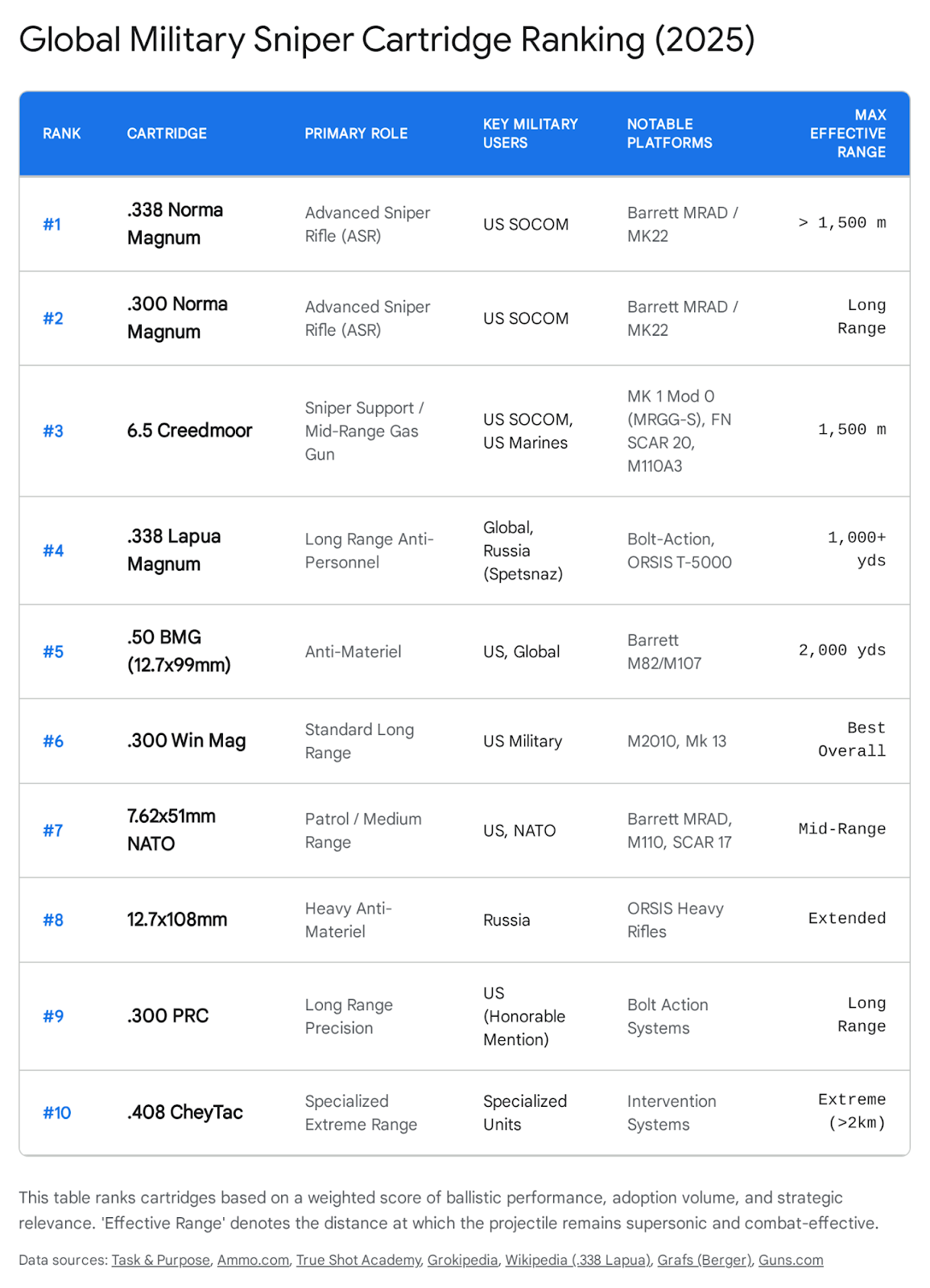
The following table serves as the primary reference guide for the rankings, summarizing the key strategic and technical data points that define the current state of military sniping.
2. Comprehensive Analysis of the Top 10 Cartridges
Rank 1:.338 Norma Magnum (8.6x63mm)
2.1.1 Strategic Origin and Military Adoption
The ascension of the.338 Norma Magnum to the premier rank of military sniper cartridges is the result of a deliberate, data-driven modernization effort by the United States Special Operations Command. For years, the.338 Lapua Magnum held this title, but despite its legendary status, it possessed inherent design limitations when adapted for very long, high-BC projectiles. The US military’s Advanced Sniper Rifle (ASR) program sought a solution that could outperform the Lapua while adhering to strict overall length (OAL) constraints for magazine feeding.1
The.338 Norma Magnum was officially selected as the heavy-caliber component of the Mk22 Mod 0 Advanced Sniper Rifle (Barrett MRAD), replacing the.300 Winchester Magnum and.50 BMG in many anti-personnel applications. Crucially, its adoption extends beyond the rifle; it has also been selected for the lightweight medium machine gun (LWMMG) programs, such as the SIG Sauer MG 338. This dual-adoption strategy creates a unified logistical footprint, allowing sniper teams and machine gunners to share ammunition—a force multiplier that cannot be overstated in sustained combat operations.3
2.1.2 Technical Engineering Profile
The genius of the.338 Norma Magnum lies in its internal geometry. Designed by Jimmie Sloan, the cartridge utilizes the.416 Rigby as a parent case, shortened to 2.492 inches (63.3 mm). This is significantly shorter than the.338 Lapua Magnum’s 2.724-inch case.4 While a shorter case might imply reduced performance, the opposite is true in the context of modern aerodynamics.
The shorter case body allows for a longer neck and, more importantly, permits the seating of extremely long, high-drag projectiles (like the 300-grain Berger Hybrid OTM or Sierra MatchKing) further out from the case mouth without exceeding the maximum cartridge overall length (COAL) of standard magazines (approx. 3.68 inches). In the.338 Lapua, these long bullets must be seated deeply into the case, displacing powder capacity and creating variable ignition characteristics. The.338 Norma avoids this, maintaining a full powder column and ensuring consistent ignition.3
- Case Capacity: Approximately 108 grains of water.
- Operating Pressure: CIP maximum pressure of 440.00 MPa (63,817 psi).
- Projectile Specification: The standard US military load (XM1162) utilizes a 300-grain projectile with a G1 BC of roughly 0.822 and a G7 BC of 0.421.6
- Muzzle Velocity: From a 26-27 inch barrel, the cartridge generates muzzle velocities in the range of 2,725 fps (830 m/s).6
2.1.3 Ballistic and Terminal Performance
The ballistic superiority of the.338 Norma Magnum is most evident in the transonic zone. Because the projectile is stable and retains velocity efficiently, it remains supersonic well beyond 1,500 meters. The “fat” powder column promotes a highly efficient burn, which reduces the velocity standard deviation (SD). Low SD is the holy grail of long-range shooting; if shots vary in speed by only 5-8 fps, the vertical dispersion at 1,500 meters is minimized, ensuring that a good hold results in a hit.3
Terminally, the 300-grain projectile carries massive kinetic energy. At 1,000 meters, it retains more energy than a.44 Magnum has at the muzzle. This allows it to penetrate Level IV body armor and defeat light materiel targets such as radar dishes, unarmored vehicles, and communications equipment, bridging the gap between a sniper rifle and an anti-materiel rifle.
Rank 2:.300 Norma Magnum (7.62x63mm)
2.2.1 Strategic Origin and Military Adoption
If the.338 Norma Magnum is the heavy hammer, the.300 Norma Magnum is the laser-guided scalpel. It was selected alongside its.338 sibling for the USSOCOM ASR program, specifically to fill the anti-personnel role at extreme ranges.1 This selection marked the beginning of the end for the.300 Winchester Magnum in Tier 1 units. The requirement was simple but demanding: maximize the probability of hit (P(hit)) on a human-sized target at 1,500 meters. The.300 Norma Magnum was the only cartridge capable of meeting the stringent accuracy and trajectory requirements set forth by the solicitations.7
2.2.2 Technical Engineering Profile
The.300 Norma Magnum is essentially the.338 Norma Magnum case necked down to hold a.308 caliber (7.62mm) bullet. This creates a “super-overbore” condition, where a massive volume of powder is pushing a relatively light and narrow projectile.
- Projectile Selection: It is optimized for the 215-grain Berger Hybrid Target or the 230-grain Berger Hybrid OTM. These bullets are masterpieces of drag reduction, featuring long ogives and boat tails.7
- Velocity: The 215-grain projectile is launched at velocities exceeding 3,017 fps (920 m/s).8
- Barrel Life: The primary engineering trade-off is barrel life. The intense heat and pressure of the large powder charge funneling into the 7.62mm bore cause rapid throat erosion. Military barrels for this caliber may retain peak accuracy for only 1,200 to 1,500 rounds, necessitating a robust logistical plan for barrel replacements—a feature facilitated by the quick-change barrel system of the Mk22 MRAD.9
2.2.3 Ballistic and Terminal Performance
The trajectory of the.300 Norma Magnum is exceptionally flat. Compared to the.338 Lapua or Norma, the.300 Norma drops significantly less at 1,000 meters, reducing the need for extreme elevation adjustments. More importantly, the time of flight (TOF) is shorter. A shorter TOF means gravity and wind have less time to act on the bullet.
At 1,500 meters, the.300 Norma Magnum remains supersonic and retains sufficient energy to incapacitate a human target. The high sectional density of the heavy.30 caliber bullets ensures deep penetration, while the high velocity ensures that even at extended ranges, the hydrostatic shock potential remains high. It effectively renders the.300 Winchester Magnum obsolete in terms of raw performance, offering a 20-30% improvement in hit probability at ELR distances.11
Rank 3:.338 Lapua Magnum (8.6x70mm)
2.3.1 Strategic Origin and Military Adoption
The.338 Lapua Magnum (LM) is the reigning champion of the post-Cold War sniper world, holding the third spot only because the Norma variant has slightly edged it out in recent US trials. Developed in the 1980s by Research Armament Industries and later refined by Lapua of Finland, it was the first cartridge designed from the ground up specifically for military sniping, rather than being a repurposed hunting or machine gun round.4
It is the standard long-range cartridge for the British Army (L115A3 Long Range Rifle), the Finnish Defense Forces (TRG-42), the Russian Federation (Orsis T-5000), and dozens of other nations.12 Its combat record is extensive; it was used by British Corporal of Horse Craig Harrison to achieve a confirmed kill at 2,475 meters in Afghanistan, a record that stood for years and validated the cartridge’s extreme capabilities.4
2.3.2 Technical Engineering Profile
The.338 Lapua Magnum uses a robust, rimless, bottlenecked case designed to withstand high chamber pressures of up to 420 MPa (60,916 psi).
- Standard Loadings: The classic military load uses a 250-grain Lapua LockBase or Scenar projectile roughly moving at 3,000 fps (914 m/s). More modern loadings have shifted to 300-grain projectiles to match the ballistic coefficients of the Norma, although this comes with the seating depth issues previously mentioned.4
- Case Geometry: The case is longer and has more taper than the Norma. While this aids in extraction reliability under fouling—a key consideration for military weapons—it is less efficient for the powder burn dynamics required for ultra-heavy bullets.
2.3.3 Ballistic and Terminal Performance
The.338 Lapua Magnum was designed to penetrate standard military body armor at 1,000 meters, a requirement it meets with ease. It delivers approximately 5,000 ft-lbs (6,700 J) of energy at the muzzle.4 Its trajectory is flat, and its resistance to wind drift is far superior to any.30 caliber magnum.
While the.338 Norma has a slight edge in drag efficiency with 300-grain bullets, the.338 Lapua remains a formidable system. Its widespread availability means that ammunition can be sourced from multiple NATO partners, a logistical resiliency that keeps it firmly in the top tier. Furthermore, the terminal performance of the 250-grain and 300-grain projectiles is devastating, capable of structural defeats that would stop a.300 Win Mag cold.14
Rank 4:.300 Winchester Magnum (7.62x67mm)
2.4.1 Strategic Origin and Military Adoption
The.300 Winchester Magnum (Win Mag) is the veteran workhorse of the Western sniper community. Originally a commercial hunting cartridge introduced in 1963, it was adopted by the US military to extend the effective range of snipers beyond the capabilities of the 7.62x51mm NATO. It serves as the primary chambering for the US Army’s M2010 Enhanced Sniper Rifle (ESR) and the US Navy’s Mk13 series.15 Despite the adoption of the Norma Magnums by SOCOM, the “Big Army” and Marine Corps maintain vast fleets of.300 Win Mag rifles and millions of rounds of ammunition, ensuring its continued relevance.
2.4.2 Technical Engineering Profile
The.300 Win Mag is a “belted magnum,” a design feature carried over from the.375 H&H Magnum where the belt was used for headspacing. In modern shoulder-headspaced chambers, the belt is largely vestigial and can complicate chamber alignment and reloading. Additionally, the cartridge features a notoriously short neck (less than one caliber in length), which limits the tension on the bullet and the ability to seat long projectiles without intruding into the powder space.
Despite these “flaws,” US military ballisticians have optimized the cartridge through the Mk248 Mod 1 program.
- Mk248 Mod 1 Specification: This load utilizes a 220-grain Sierra MatchKing (SMK) projectile fired at 2,850 fps (869 m/s). It uses a specialized flash-suppressed powder that is temperature stable, ensuring consistent velocity across environmental extremes from Arctic cold to Desert heat.17
- Chamber Pressure: The Mod 1 load pushes the SAAMI pressure limits to achieve its performance, requiring robust actions like the Remington 700 long action used in the M2010.
2.4.3 Ballistic and Terminal Performance
With the Mk248 Mod 1 ammunition, the.300 Win Mag is effective out to 1,300 meters (approx. 1,500 yards).16 It offers a 50% increase in kinetic energy over the 7.62 NATO and significantly better wind bucking. While it cannot match the laser trajectory of the.300 Norma or the payload of the.338s, it represents the “good enough” solution for the vast majority of sniper engagements. Its terminal performance is characterized by rapid expansion and massive energy dump, making it highly lethal against soft targets.
Rank 5: 6.5mm Creedmoor (6.5x48mm)
2.5.1 Strategic Origin and Military Adoption
The 6.5mm Creedmoor represents the most radical shift in military small arms philosophy in half a century: the move to “intermediate” calibers that rely on aerodynamic efficiency rather than raw mass. Originally a commercial target round developed by Hornady in 2007, it has been aggressively adopted by USSOCOM and the Department of Homeland Security (Secret Service) to replace the 7.62x51mm NATO in Designated Marksman Rifles (DMR).19
This adoption is driven by the Mid-Range Gas Gun (MRGG-S) program, which sought a rifle with the portability of an AR-10 but the hit probability of a bolt-action sniper rifle. The 6.5 Creedmoor was the clear winner, with the US Navy recently awarding a $40 million contract for DODIC AC58 special ball ammunition.21
2.5.2 Technical Engineering Profile
The 6.5 Creedmoor fits into a standard short-action receiver (2.800 inch OAL), identical to the 7.62 NATO. However, it uses a 6.5mm (.264 caliber) projectile.
- Aerodynamics: The 6.5mm diameter is the “sweet spot” for ballistic coefficients. A 140-grain 6.5mm bullet has a higher BC (approx. 0.600+ G1) than a 175-grain.308 bullet (approx. 0.496 G1).
- Recoil: Because it fires a lighter bullet with less powder, the recoil impulse is roughly 30% less than the 7.62 NATO. This is critical for semi-automatic sniper systems, allowing the shooter to spot their own trace and impacts, and enabling rapid follow-up shots.19
2.5.3 Ballistic and Terminal Performance
The US military’s testing concluded that the 6.5 Creedmoor doubles the hit probability at 1,000 meters compared to the 7.62 NATO.19 This is primarily due to reduced wind drift. At 1,000 yards, a 6.5 Creedmoor bullet will drift roughly 30-40% less than a 7.62 NATO bullet in a 10 mph crosswind. Furthermore, the 6.5 CM remains supersonic beyond 1,200 yards, whereas the 7.62 NATO often goes subsonic (and unstable) around 900 yards.
This cartridge has redefined the “sniper support” role, giving the spotter or designated marksman a weapon capable of engaging targets at ranges previously reserved for the primary sniper’s bolt gun.
Rank 6:.50 BMG (12.7x99mm NATO)
2.6.1 Strategic Origin and Military Adoption
The.50 Browning Machine Gun (BMG) cartridge is the most recognizable heavy caliber in the world. Designed by John Browning towards the end of World War I as an anti-aircraft and anti-tank round, it has shown remarkable longevity. In the sniper role, it gained prominence in the 1980s and 90s with the introduction of the Barrett M82 “Light Fifty.” It remains the primary heavy anti-materiel cartridge for almost all NATO forces and US allies.13
2.6.2 Technical Engineering Profile
The.50 BMG is a massive cartridge with an overall length of 5.45 inches. It operates at high pressures (approx. 55,000 psi) and consumes huge quantities of slow-burning powder (approx. 230 grains).
- Ammunition Diversity: The key to the.50 BMG’s ranking is the sheer variety of payloads available. The standard M33 Ball is used for training and general targets. However, for combat, snipers utilize the Mk 211 Mod 0 “Raufoss” Multipurpose round. This projectile contains a tungsten penetrator, an explosive charge, and an incendiary tip, allowing it to penetrate armor, explode inside the target, and start fires simultaneously.25
- Precision Loads: To improve accuracy, the M1022 Long Range Sniper ammunition was developed, utilizing a green-tipped projectile optimized for ballistic consistency, capable of sub-MOA accuracy in bolt-action platforms like the McMillan Tac-50.
2.6.3 Ballistic and Terminal Performance
The.50 BMG generates roughly 13,000 to 14,000 ft-lbs (18,000 J) of energy at the muzzle.25 This is an order of magnitude greater than small arms. It can stop a vehicle by destroying the engine block, penetrate thick brick walls to eliminate combatants hiding inside, and detonate IEDs from a safe standoff distance.
However, it ranks 6th because of its limitations as a pure sniper round. The recoil is punishing, requiring heavy muzzle brakes that create massive dust signatures. The rifles are heavy (25-30 lbs), hindering mobility. Furthermore, standard.50 BMG machine gun ammo is not precise enough for long-range personnel interdiction, forcing snipers to rely on expensive match-grade lots.
Rank 7: 12.7x108mm (Russian/Chinese)
2.7.1 Strategic Origin and Military Adoption
The 12.7x108mm is the Eastern Bloc’s answer to the.50 BMG. It serves the identical strategic role: heavy anti-materiel engagement and counter-sniper operations. It is the standard heavy cartridge for the Russian Federation (fielded in the OSV-96 and ASVK rifles) and the People’s Republic of China (M99, QBU-10).26 Its ranking reflects the massive scale of its use in current global conflicts, particularly in Eastern Europe and the Middle East.
2.7.2 Technical Engineering Profile
The 12.7x108mm case is 9mm longer than the.50 BMG (12.7x99mm), giving it a slightly larger case capacity. Historically, this potential was wasted on poor-quality machine gun production standards. However, recent modernization efforts have changed this.
- Russian Modernization: Russia has developed the 7N34 sniper load specifically for this caliber. This 59.2-gram (914 grain) projectile features a hardened tool-steel tip and a lead body, optimized for both accuracy and penetration.28
- Chinese Innovations: The PLA has integrated this cartridge into the QBU-10 system, which includes a computerized fire control system with laser rangefinding and atmospheric sensors to compensate for the round’s trajectory.26
2.7.3 Ballistic and Terminal Performance
The performance of the 12.7x108mm is functionally identical to the.50 BMG. The 7N34 load is rated to defeat light armored vehicles at 1,500 meters and penetrate 10mm of rolled homogeneous armor (RHA) at 800 meters.28 Its primary utility is destruction. Like the.50 BMG, it is a heavy, recoiling beast of a cartridge, but one that provides the operator with the ability to reach out and touch hardened targets that would shrug off a.338.
Rank 8: 7.62x54mmR (Russian)
2.8.1 Strategic Origin and Military Adoption
The 7.62x54mm Rimmed (7.62x54R) holds the distinction of being the longest-serving military cartridge in history, first adopted by Imperial Russia in 1891. Despite its age, it remains the standard sniper/designated marksman cartridge for Russia, China (in older platforms), and dozens of nations aligned with former Soviet doctrine. It is the fuel for the SVD Dragunov, the SV-98, and the modern Chukavin (SVCh) rifle.29
2.8.2 Technical Engineering Profile
The defining feature of this cartridge is its rimmed case, an archaic design that dates back to the era of lever-action and early bolt-action rifles. The rim makes magazine design difficult, necessitating the extreme curvature of SVD magazines to prevent “rim lock” (where the rim of the top cartridge catches behind the rim of the one below it).
- Projectile Evolution: To keep this ancient cartridge relevant, Russian engineers have continuously updated the projectile. The original 7N1 sniper load (steel core, knocker in the tip) has been replaced by the 7N14. The 7N14 features a sharp, hardened steel penetrator designed to defeat modern body armor while maintaining match-grade accuracy.31
- Ballistics: The 7N14 load fires a 151-grain projectile at approximately 2,723 fps (830 m/s).31
2.8.3 Ballistic and Terminal Performance
Ballistically, the 7.62x54R is comparable to the 7.62x51mm NATO. It is effective out to 800 meters, perhaps 1,000 meters in the hands of an expert. It ranks 8th because while it lacks the long-range efficiency of the magnums or the Creedmoor, its ubiquity is unmatched. It is a rugged, reliable cartridge that has proven it can kill effectively in every major conflict of the last century. The new 7N14 load ensures it remains lethal against troops equipped with ceramic plates.
Rank 9: 5.8x42mm (Chinese DBP88/DBP10)
2.9.1 Strategic Origin and Military Adoption
The 5.8x42mm is a unique outlier in the global market—an indigenous Chinese cartridge developed to replace both the 7.62x39mm (AK) and 7.62x54R (Sniper) with a single unified caliber. The People’s Liberation Army (PLA) uses this cartridge in the QBU-88 (Type 88) designated marksman rifle and the new QBU-191.32 This decision reflects a doctrine that prioritizes weight savings and logistical simplicity over extreme range.
2.9.2 Technical Engineering Profile
The 5.8x42mm is an intermediate cartridge, physically larger than the 5.56 NATO but smaller than the 7.62 NATO.
- The “Heavy” Round: For sniper applications, the PLA developed the DBP88 (and later consolidated into the DBP10) heavy load. This utilizes a 5-gram (77 grain) projectile with a streamlined shape and a steel core.34
- Velocity: Fired from the longer barrel of the QBU-88, it achieves velocities of roughly 2,936 fps (895 m/s).34
- BC: The G7 BC is approximately 0.210, which is relatively low compared to Western sniper rounds.34
2.9.3 Ballistic and Terminal Performance
The PLA claims the 5.8mm heavy round outperforms the 5.56 NATO and approaches the 7.62x51mm in penetration at medium ranges. However, physics is a harsh mistress. The relatively light 77-grain bullet sheds energy rapidly past 600 meters and is highly susceptible to wind drift. Its effective range is cited as 800 meters.34 It ranks 9th because while it is the standard for the world’s largest standing army, it is ballistically inferior to every other cartridge on this list for dedicated sniping roles. The PLA acknowledges this gap by retaining 7.62x51mm and.338 platforms for their specialized sniper units, relegating the 5.8mm to the squad marksman role.29
Rank 10:.408 CheyTac (10.36x77mm)
2.10.1 Strategic Origin and Military Adoption
The.408 Cheyenne Tactical (CheyTac) is a niche, specialized cartridge designed for one specific purpose: Extreme Long Range (ELR) interdiction. It is not a general-issue round. Instead, it is found in the armories of elite Tier 1 units, such as the Polish GROM, Turkish Special Forces (SAT), and others who require the ability to engage targets beyond 2,000 meters.35
2.10.2 Technical Engineering Profile
The.408 CheyTac sits physically between the.338 Lapua and the.50 BMG.
- Projectile Design: It utilizes solid copper-nickel alloy projectiles (monolithic turned solids) that are computer-designed for perfect balance. These bullets (typically 419 grains) have incredibly high ballistic coefficients and are machined to tolerances that mass-produced lead-core bullets cannot match.35
- Balanced Flight: The rotational stability of the bullet is tuned to match its drag deceleration, keeping it stable through the transonic zone at extreme distances (2,000+ meters).
2.10.3 Ballistic and Terminal Performance
The.408 CheyTac remains supersonic out to 2,200 meters.35 At 2,000 meters, it retains more kinetic energy than a.338 Lapua, yet the rifle system is significantly lighter than a.50 BMG (typically 20 lbs vs 30 lbs). It represents the pinnacle of ballistic engineering for chemically propelled small arms. It ranks 10th only because of its cost, rarity, and limited logistical footprint compared to the NATO standard cartridges. It is a Ferrari in a world of Humvees—unbeatable performance, but high maintenance and rare.
3. Comparative Technical Analysis
To understand the practical differences between these cartridges, we must examine their performance in the crucial “transonic zone”—the range where the bullet slows to Mach 1.2 and begins to lose stability.
3.1 The Battle of the.338s: Lapua vs. Norma
The rivalry between the.338 Lapua and.338 Norma is the defining technical debate of the decade. As illustrated in the schematic below, the difference is not in caliber, but in case geometry and bullet seating.
The.338 Norma’s shorter case body (2.492″ vs 2.724″) allows the 300-grain projectile to extend further out of the neck while still fitting in the magazine. This preserves the “boiler room” (powder space) and aligns the bullet better with the bore’s rifling leade. The result is a system that handles the heaviest, most aerodynamic bullets more consistently than the Lapua.3
3.2 Terminal Energy and Barrier Defeat
- Soft Targets: The.300 Norma and.300 Win Mag deliver massive hydrostatic shock. The velocity of the.300 Norma (3,000+ fps) creates a temporary wound cavity that is devastating to biological tissue.
- Hard Targets: The.338s and.50s rely on sectional density and mass. A.338 AP round can punch through engine blocks that would deflect a.300 Win Mag. The.50 BMG/12.7x108mm remains the only choice for penetrating brick or concrete cover to kill targets on the other side.
4. Strategic Implications and Future Outlook
4.1 The Unification of Logistics
The most significant trend is the collapse of the barrier between sniper and machine gun ammunition. The US adoption of the.338 Norma for the General Purpose Machine Gun (GPMG) role means that a platoon can carry one type of heavy ammo for both its area suppression weapon and its precision rifle. This reduces the logistical burden and ensures that snipers have access to belt-linked ammunition reserves if needed.3
4.2 Material Science Advances
By 2030, we expect to see:
- Polymer Cases: Companies like True Velocity are finalizing polymer-cased ammunition that reduces weight by 30%. This is critical for heavy calibers like.338 and.50 BMG, allowing soldiers to carry more rounds.
- Barrel Technology: The primary weakness of high-performance rounds like the.300 Norma is barrel life (1,200 rounds). New barrel liners and metallurgy (e.g., flow-formed barrels, advanced coatings) are being developed to extend this to 2,500+ rounds, making the logistical cost of these high-pressure rounds manageable.
4.3 Fire Control Systems
The cartridge is becoming a sub-component of a digital system. The XM157 Next Generation Fire Control and similar optics utilize built-in laser rangefinders and ballistics computers. These systems actively calculate the firing solution, displaying a disturbed reticle. This technology disproportionately benefits cartridges with consistent velocity (low SD), like the.338 Norma and 6.5 Creedmoor, as the computer can predict their flight path with near-certainty.
5. Conclusion
The 2025 ranking of military sniper cartridges reflects a mature understanding of long-range physics. The industry has moved past the “magnum wars” of the 20th century and entered an era of efficiency.
The .338 Norma Magnum takes the top spot because it represents the perfect convergence of lethality, range, and logistical utility. It is the future standard for Western heavy sniping. The .300 Norma Magnum follows closely as the ultimate anti-personnel tool, offering trajectory performance that feels almost unfair to the adversary. Meanwhile, the 6.5 Creedmoor has quietly revolutionized the squad marksman role, proving that smarter aerodynamics can outperform heavier payloads.
While legacy rounds like the.300 Win Mag,.338 Lapua, and.50 BMG remain potent and widely used, they are now “legacy” technology. The future belongs to cartridges designed with Doppler radar and computational fluid dynamics, ensuring that when a modern sniper pulls the trigger, the result is a mathematical certainty.
Works cited
- SOCOM is officially getting its hands on the new sniper rifle everyone in the US military wants – Task & Purpose, accessed December 22, 2025, https://taskandpurpose.com/tech-tactics/us-military-sniper-rifle-barrett-mrad-special-operations-command/
- New Army sniper weapon system contract awarded to Barrett Firearms, accessed December 22, 2025, https://www.army.mil/article/244821/new_army_sniper_weapon_system_contract_awarded_to_barrett_firearms
- Why do the US military choosing .338 Norma rather than .338 Lapua : r/WarCollege – Reddit, accessed December 22, 2025, https://www.reddit.com/r/WarCollege/comments/1n3w004/why_do_the_us_military_choosing_338_norma_rather/
- .338 Lapua Magnum – Wikipedia, accessed December 22, 2025, https://en.wikipedia.org/wiki/.338_Lapua_Magnum
- 300 Norma Magnum – Discussion Forums, accessed December 22, 2025, https://www.ballisticstudies.com/Resources/Discussion+Forums/x_forum/18/thread/13739.html
- Berger: 338 Norma Magnum, 300 gr, OTM Tactical, 20/Box – Mile High Shooting Accessories, accessed December 22, 2025, https://www.milehighshooting.com/berger-338-norma-magnum-300-gr-otm-tactical-20-box/
- The SOCOM Advanced Sniper Rifle Cartridges – Uncle Zo, accessed December 22, 2025, https://unclezo.com/2020/10/14/the-socom-advanced-sniper-rifle-cartridges/
- 300 Norma Magnum 215 Grain Hybrid Target Rifle Ammunition – Berger Bullets, accessed December 22, 2025, https://bergerbullets.com/product/300-norma-magnum-215gr-hybrid-target/
- 300 Norma Mag barrel life | Shooters’ Forum, accessed December 22, 2025, https://forum.accurateshooter.com/threads/300-norma-mag-barrel-life.3943664/
- 300 Norma vs 338 Lapua – Caliber Comparison by Ammo.com, accessed December 22, 2025, https://ammo.com/comparison/300-norma-vs-338-lapua
- 300 Norma Magnum Cartridge – A True One Mile Performer! – Rifle Talks, accessed December 22, 2025, https://www.rifletalks.com/ballistics-by-rifletalks/300-norma-magnum-cartridge-the-king-of-1-mile/
- ORSIS – Grokipedia, accessed December 22, 2025, https://grokipedia.com/page/ORSIS
- List of sniper rifles – Wikipedia, accessed December 22, 2025, https://en.wikipedia.org/wiki/List_of_sniper_rifles
- These Russian Rifles Are So Deadly They Can Beat Body Armor, accessed December 22, 2025, https://www.bodyarmornews.com/youre-not-safe-these-russian-rifles-are-so-deadly-they-can-beat-body-armor/
- .300 Winchester Magnum – Wikipedia, accessed December 22, 2025, https://en.wikipedia.org/wiki/.300_Winchester_Magnum
- Unsung Hero: The Mk 248 MOD 1 | An Official Journal Of The NRA – American Rifleman, accessed December 22, 2025, https://www.americanrifleman.org/content/unsung-hero-the-mk-248-mod-1/
- MK248 Mod 1 – What’s It Good For?, accessed December 22, 2025, https://www.wideners.com/blog/mk248-mod-1-a-brief-history/
- New US Military .300 Win Mag Match MK 248 MOD 1 | Sniper’s Hide Forum, accessed December 22, 2025, https://www.snipershide.com/shooting/threads/new-us-military-300-win-mag-match-mk-248-mod-1.17639/
- SOCOM’s latest rifles embrace the 6.5 Creedmoor cartridge | Sandboxx, accessed December 22, 2025, https://www.sandboxx.us/news/socoms-latest-rifles-embrace-the-6-5-creedmoor-cartridge/
- Secret Service Eyes New 6.5mm Semi-Automatic Sniper Rifle – The War Zone, accessed December 22, 2025, https://www.twz.com/land/secret-service-eyeing-new-6-5mm-designated-marksman-rifles
- Navy Orders $40 Million worth of 6.5 Creedmoor Ammo – Guns.com, accessed December 22, 2025, https://www.guns.com/news/2025/08/22/navy-orders-40-million-worth-of-65-creedmoor-ammo
- US Navy and USMC Order 6.5 Creedmoor Ammunition Worth 40 Million USD – MILMAG, accessed December 22, 2025, https://milmag.pl/en/us-navy-and-usmc-order-6-5-creedmoor-ammunition-worth-40-million-usd/
- Special ops snipers will soon shoot this new rifle that can fire three different calibers, accessed December 22, 2025, https://www.militarytimes.com/news/your-military/2019/03/13/special-ops-snipers-will-soon-shoot-this-new-rifle-that-can-fire-three-different-calibers/
- New Marine Sniper Rifle Reaches Full Operational Capability Ahead of Schedule, accessed December 22, 2025, https://www.military.com/daily-news/2024/11/22/marine-corps-new-sniper-rifle-officially-ready-fight.html
- In terms of penetration and raw power, which is stronger, the Dushka machine gun or the M2 Browning? Which is stronger according to these two criteria? – Quora, accessed December 22, 2025, https://www.quora.com/In-terms-of-penetration-and-raw-power-which-is-stronger-the-Dushka-machine-gun-or-the-M2-Browning-Which-is-stronger-according-to-these-two-criteria
- M99 Chinese 12.7mm Sniper Rifle – ODIN, accessed December 22, 2025, https://odin.tradoc.army.mil/WEG/Asset/M99_Chinese_12.7mm_Sniper_Rifle
- Small Arms of Belarusian Special Forces | thefirearmblog.com, accessed December 22, 2025, https://www.thefirearmblog.com/blog/2017/07/14/small-arms-belarusian-special-forces/
- 12.7 × 108 mm – Wikipedia, accessed December 22, 2025, https://en.wikipedia.org/wiki/12.7_%C3%97_108_mm
- China’s Snipers Could Be the Threat You Never See Coming – The National Interest, accessed December 22, 2025, https://nationalinterest.org/blog/reboot/chinas-snipers-could-be-threat-you-never-see-coming-183587/
- Russian vs Ukrainian Marksman Rifles – 5D Tactical, accessed December 22, 2025, https://www.5dtactical.com/blog/russian-vs-ukrainian-marksman-rifles/
- 7.62×54mmR – Wikipedia, accessed December 22, 2025, https://en.wikipedia.org/wiki/7.62%C3%9754mmR
- QBU-88 – Gun Wiki | Fandom, accessed December 22, 2025, https://guns.fandom.com/wiki/QBU-88
- DBP87 5.8x42mm: China’s High-Velocity Cartridge – Guns and Ammo, accessed December 22, 2025, https://www.gunsandammo.com/editorial/dbp87-5-8x42mm-chinas-high-velocity-caliber/248020
- 5.8×42mm – Wikipedia, accessed December 22, 2025, https://en.wikipedia.org/wiki/5.8%C3%9742mm
- Everything You Need To Know About .408 CheyTac – Gun Digest, accessed December 22, 2025, https://gundigest.com/gear-ammo/ammunition/408-cheytac
- Current military use of the 408 CT? | Sniper’s Hide Forum, accessed December 22, 2025, https://www.snipershide.com/shooting/threads/current-military-use-of-the-408-ct.1635/