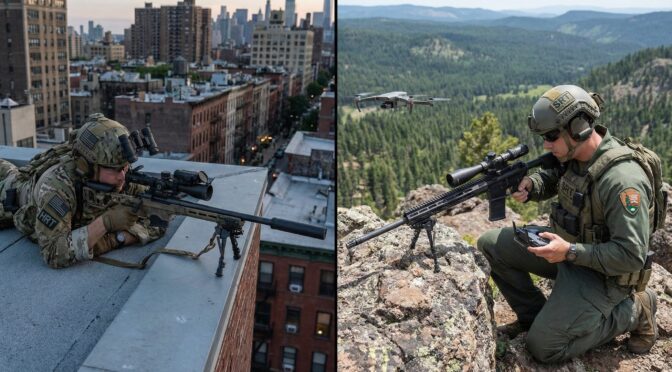
The strategic landscape of federal law enforcement in the United States has undergone a profound transformation in the post-9/11 era, necessitating a paradigm shift in the application of precision rifle fire. No longer confined to the traditional reactionary role of “police sniping”—typically characterized by 75-yard engagements in static hostage scenarios—federal marksman units have evolved into proactive, intelligence-driven assets capable of operating in diverse and non-permissive environments. This report provides an exhaustive analysis of the top 20 sniper groups within the U.S. Federal Government, ranking them based on operational tempo, mission complexity, training rigor, and equipment modernization.
Our analysis reveals a distinct stratification within the federal sector. At the apex, “Tier 1” equivalent domestic assets, such as the Federal Bureau of Investigation’s Hostage Rescue Team (HRT) and the United States Secret Service Counter Sniper Team (CS), operate with budgets, selection processes, and mission profiles that mirror the Department of Defense’s Special Mission Units. These entities have pioneered the integration of multi-caliber chassis systems, aerial use of force, and advanced night vision capabilities into domestic law enforcement. Below this tier, a robust network of specialized response teams within agencies like the Department of Energy, Customs and Border Protection, and the U.S. Marshals Service provides critical niche capabilities, ranging from nuclear convoy protection to high-angle mountain warfare.
A dominant trend identified in this assessment is the wholesale modernization of small arms and ballistics. The era of the fixed-stock, law enforcement-grade Remington 700 firing.308 Winchester ammunition is ending. It is being superseded by modular systems such as the Accuracy International AT-X and Barrett MRAD, which allow operators to reconfigure calibers in the field. Furthermore, the federal sector is aggressively adopting high-ballistic-coefficient cartridges like the 6.5mm Creedmoor and.300 Precision Rifle Cartridge (PRC) to extend effective engagement distances and mitigate wind drift—a critical factor in the protection of dignitaries and the interdiction of threats across vast borderlands.
This report serves as a definitive reference for understanding the capabilities, limitations, and strategic value of these elite federal assets.
1.0 Strategic Context: The Evolution of the Federal Marksman
To evaluate the capabilities of federal sniper groups, one must first understand the doctrinal divergence between military and law enforcement precision fire, and how federal units increasingly bridge this gap. Historically, the law enforcement sniper was viewed as a defensive instrument—a “safety valve” to be utilized only when negotiation failed and an immediate threat to life existed. The engagement distances were short, typically under 100 yards, and the requirement was absolute precision: a “craniel vault” shot to instantly incapacitate a suspect.
However, the modern federal operating environment defies this simplistic categorization. Federal agents today may find themselves engaging cartel gunmen in the Sonoran Desert at 800 meters, providing overwatch for a diplomatic convoy in a war zone, or disabling the engine of a drug-running go-fast boat from a helicopter. These scenarios demand a hybrid doctrine that combines the legal restraint and accountability of policing with the fieldcraft, ballistics knowledge, and tactical aggression of military sniping.
1.1 The Shift to Asymmetric Warfare Paradigms
The militarization of federal tactical teams is often a subject of public discourse, but from an operational standpoint, it is a response to the “weaponization” of the threat. Criminal organizations and domestic extremists possess body armor, night vision, and long-range weaponry. Consequently, federal units like the Department of Energy’s Office of Secure Transportation (OST) or the Diplomatic Security Service (DSS) train for complex ambushes rather than simple barricaded subjects. This shift drives the procurement of semi-automatic precision rifles (like the SR-25/M110) that allow for rapid engagement of multiple targets, a capability less critical in traditional municipal SWAT operations.
1.2 The Technological Overmatch Doctrine
Federal agencies are increasingly adopting a doctrine of “technological overmatch.” Recognizing that the human factor is the primary limitation in precision fire, agencies are investing heavily in force multipliers. This includes clip-on thermal imagers that allow for target identification through obscurants, laser rangefinders integrated with ballistic computers that provide instant firing solutions, and suppressor systems that mask the shooter’s location and facilitate communication. The rankings in this report heavily weight the integration of these technologies, as they represent the difference between a legacy capability and a modern, adaptive force.
2.0 Methodology of Assessment
The ranking of these 20 units was conducted using a rigorous, multi-variable scoring matrix designed to isolate operational capability from reputation. The methodology prioritizes objective metrics such as training hours, equipment sophistication, and deployment diversity.
2.1 Evaluation Criteria
The assessment model utilizes four weighted categories:
- Mission Criticality and Complexity (30%): This metric evaluates the consequences of failure and the difficulty of the operating environment. A unit charged with protecting nuclear weapons or the President faces higher stakes than one conducting regulatory enforcement. Complexity considers environmental factors (maritime, aerial, urban, rural) and the requirement for specialized insertion techniques (fast-rope, SCUBA, parachute).
- Training Pipeline and Selection (25%): The quality of a sniper unit is defined by its human capital. This factor analyzes the length and attrition rate of selection courses, the duration of basic sniper training, and the frequency of sustainment training (e.g., weekly vs. monthly vs. quarterly). It also considers whether the unit trains with Tier 1 military assets (Delta Force, DEVGRU).
- Equipment Modernization (25%): This evaluates the agency’s armory. High scores are awarded for the adoption of modern chassis systems, multi-caliber capability, advanced night vision/thermal integration, and ballistic computers. The transition to modern cartridges (6.5 CM,.300 PRC/NM) is a key differentiator.
- Operational Tempo and Interoperability (20%): This measures how often the unit deploys and its ability to integrate with other forces. High-tempo units that deploy globally or support multi-agency task forces score higher than static, facility-specific teams.
(A detailed breakdown of the scoring matrix and methodology is provided in Appendix A.)
3.0 The Top 20 Federal Sniper Groups: Profiles and Capabilities
Rank #1: Federal Bureau of Investigation (FBI) – Hostage Rescue Team (HRT)
Justification: The FBI HRT is the premier non-military counter-terrorism tactical unit in the United States. Ranking #1, the HRT sniper section operates with resources, training cycles, and mission capabilities that are indistinguishable from National Mission Force military units. Their ability to deploy domestically or internationally within four hours, combined with full-time training status, places them in a category of their own.1
Background: Established in 1983 to provide a civilian counter-terrorist solution for the 1984 Los Angeles Olympics, the HRT is based at the FBI Academy in Quantico, Virginia.2 Unlike regional SWAT teams where members have investigative day jobs, HRT operators are full-time tactical specialists. The sniper element is integral to the team’s “Save Lives” mission, providing intelligence gathering, overwatch, and lethal resolution options in the most complex hostage sieges imaginable.
Equipment Profile:
- Primary Precision Rifle: The HRT has historically utilized the H-S Precision Pro Series 2000, a custom-built bolt-action rifle in.308 Winchester known for sub-0.5 MOA accuracy.3 However, recent trends show a transition toward the Barrett MRAD (Mk 22) system, aligning with USSOCOM’s Advanced Sniper Rifle program to allow multi-caliber flexibility (.308,.300 Norma Mag,.338 Norma Mag).1
- Semi-Automatic Platforms: For multiple-target engagements, the unit employs the Heckler & Koch MSG90 (a militarized PSG1) and the Knight’s Armament Company (KAC) SR-25/Mk11 series in 7.62x51mm.1
- Anti-Materiel: The Barrett M82 and M107.50 BMG rifles are maintained for hard-target interdiction (engine blocks, fortified barriers).
- Optics & Accessories: The unit employs top-tier glass from Nightforce (ATACR series) and Leupold (Mark 6/8). They heavily utilize clip-on night vision (PVS-27/30) and thermal devices to maintain 24-hour dominance.
Operational Doctrine: HRT snipers are masters of “command fire”—the simultaneous engagement of targets by multiple shooters on a countdown. They possess specialized maritime capabilities, honed through joint training with DEVGRU, allowing them to shoot from helicopters and unstable vessels.4 Their proficiency is validated annually at the USASOC International Sniper Competition, where they consistently place in the top tier alongside Army Special Forces and Rangers, demonstrating their ability to compete with the world’s best military snipers.5
Rank #2: United States Secret Service (USSS) – Counter Sniper Team (CS)
Justification: If HRT is the scalpel, the USSS CS is the shield. Ranked #2, this unit has a singular, zero-fail mission: the protection of the President of the United States (POTUS). They are the undisputed global experts in “green-side” observation and urban hide construction, tasked with detecting and neutralizing threats before they can act.
Background: Formed in 1971, the CS Team supports the Presidential Protective Division.7 Members are recruited from the Uniformed Division and undergo a grueling selection process followed by an 11-week basic training course. Their qualification standards are among the most stringent in the world, requiring cold-bore hits out to 1,000 yards monthly—a standard far exceeding typical law enforcement requirements.8
Equipment Profile:
- The “JAR”: The unit is famous for its custom-built bolt-action rifles, colloquially known as “JARs” (Just Another Rifle). These are typically Remington 700 long actions mated to Accuracy International chassis systems, chambered in .300 Winchester Magnum to ensure flat trajectories and sufficient energy at extended ranges.7
- Modernization & 6.5mm Creedmoor: The USSS is currently leading a major shift in federal ballistics. They have solicited requirements for a gas-operated semi-automatic rifle in 6.5mm Creedmoor to replace their 7.62mm KAC SR-25s.10 This move prioritizes ballistic coefficient and wind resistance over pure bullet weight. Furthermore, they are seeking new modular bolt-action rifles capable of firing.300 Win Mag,.300 Norma Mag, and.300 PRC, pushing their lethal envelope well beyond 1,500 meters.11
- Optics: Schmidt & Bender PM II series scopes are the standard, chosen for their ruggedness and optical clarity.7
Operational Doctrine: The CS Team operates in shooter/spotter pairs. Their primary weapon is often their optics; they scan thousands of windows and rooftops to identify subtle anomalies. Unlike SWAT snipers who deploy for specific incidents, CS snipers are constantly deployed worldwide, advancing locations and establishing overwatch for every presidential movement.8
Rank #3: United States Coast Guard (USCG) – Maritime Security Response Team (MSRT) – Precision Marksman Observer Team (PMOT)
Justification: The USCG MSRT holds the #3 position due to the extreme difficulty of their primary domain: the maritime environment. Shooting from a moving helicopter into a moving boat requires complex physics calculations and mastery of “Aerial Use of Force” (AUF) that few other units possess.
Background: The MSRT is the Coast Guard’s counter-terrorism force, part of the Deployable Specialized Forces (DSF). The PMOT provides overwatch for Direct Action Sections during Visit, Board, Search, and Seizure (VBSS) operations against non-compliant vessels or terrorist targets.12
Equipment Profile:
- Rifles: PMOT operators primarily utilize semi-automatic platforms like the Mk 11 Mod 0 and KAC M110 SASS in 7.62x51mm.14 The semi-automatic action is critical for engaging moving targets from unstable platforms where rapid follow-up shots are necessary.
- Optics: Tactical scopes with illuminated reticles are essential for low-light maritime interdiction.
- Specialized Gear: They utilize gyro-stabilized mounts for aerial operations and are equipped with advanced thermal imagers to detect heat signatures against the cold ocean background.
Operational Doctrine: MSRT snipers are trained to disable the engines of fast boats from helicopters, a tactic that requires precision fire into a small, erratic target while the shooter is also moving. They also provide cover fire for boarding teams climbing onto large vessels. Their skill set is highly respected in the special operations community, evidenced by their 9th place finish in the 2024 USASOC Sniper Competition, beating many dedicated military units.6
Rank #4: U.S. Border Patrol – Border Patrol Tactical Unit (BORTAC)
Justification: BORTAC ranks #4 because they operate in the most austere and physically demanding environments of any federal agency. They are the federal government’s experts in rural tracking, reconnaissance, and irregular warfare tactics along the nation’s borders.
Background: Established in 1984 to quell disturbances in detention facilities, BORTAC has evolved into a global special response capability.15 They deploy to border zones to interdict high-value targets, cartel sicarios, and terrorist threats. Their selection course is modeled after U.S. Special Forces assessment and is notoriously difficult.16
Equipment Profile:
- Rifles: While historically using the Remington 700 LTR and M40 XBKS, BORTAC recently executed a significant modernization by selecting the Accuracy International AT-X as their new “Modular Precision Weapon Platform”.17 This chassis-based system allows for superior ergonomics, accessory mounting, and multi-caliber flexibility.
- Optics: They employ high-end optics from Leupold and Nightforce, often utilizing Horus-style reticles for rapid holdovers in dynamic wind conditions.
- Fieldcraft: BORTAC gear is characterized by its focus on durability and camouflage, utilizing ghillie suits and terrestrial surveillance sensors.
Operational Doctrine: BORTAC snipers, or Primary Marksmen/Observers, specialize in “green-side” operations. They can stalk a target for days through mountainous or desert terrain, remaining undetected while gathering intelligence. Their doctrine emphasizes autonomy and survival skills, allowing them to operate far from logistical support.18
Rank #5: Department of Energy (DOE) – Office of Secure Transportation (OST) Federal Agents
Justification: The OST holds the #5 spot due to the existential stakes of their mission: protecting nuclear weapons in transit. Unlike static guards, OST Federal Agents are sworn law enforcement officers who operate mobile fortresses. Their training focuses on repelling complex, paramilitary ambushes.
Background: Formed in 1975, OST is responsible for the safe transport of nuclear warheads and special nuclear material across the continental U.S. They operate in convoys of heavily modified armored tractor-trailers.20
Equipment Profile:
- Rifles: The SR-25 (Mk 11/M110) is a staple of the OST arsenal, providing the semi-automatic firepower needed to suppress and eliminate multiple attackers during a rolling ambush. They also employ Barrett M82.50 caliber rifles to disable chase vehicles or penetrate engine blocks.22
- Sidearms: Notably, OST has transitioned to the high-performance ZEV OZ-9 pistol, a custom-grade modular handgun, indicating a budget and procurement philosophy focused on “best-in-class” tools rather than lowest-bidder contracts.23
Operational Doctrine: OST snipers train for “force-on-force” convoy defense. They must be proficient in shooting from moving vehicles and using vehicles as cover. Their Rules of Engagement (ROE) regarding the protection of nuclear assets allow for a level of aggressive defense unique in federal law enforcement.
Rank #6: Diplomatic Security Service (DSS) – Mobile Security Deployments (MSD)
Justification: As the tactical arm of the State Department, MSD teams operate in the world’s most dangerous “high-threat” diplomatic posts. Their #6 ranking reflects their high operational tempo in conflict zones like Iraq, Afghanistan, and Libya, where they serve as the last line of defense for U.S. diplomacy.
Background: MSD consists of Tactical Support Teams (TST) that augment protective details for the Secretary of State and defend embassies during crises. Their training pipeline, known as “Green Team,” is a rigorous six-month course.24
Equipment Profile:
- Rifles: MSD relies heavily on the Mk 11 Mod 1 and the Mk 12 Special Purpose Rifle (SPR). The Mk 12, a 5.56mm precision platform, is ideal for the intermediate ranges (0-600 meters) typical of urban ambushes and embassy compound defense.24
- Machine Guns: Unlike most domestic LE, MSD is trained and equipped with belt-fed weapons like the Mk 46 and M240, providing their designated marksmen with substantial suppressive fire support.
Operational Doctrine: MSD snipers focus on counter-assault tactics (CAT). They provide overwatch for motorcades and establish defensive positions on embassy rooftops. Their doctrine is heavily influenced by U.S. military urban combat tactics due to their operating environment.26
Rank #7: U.S. Marshals Service (USMS) – Special Operations Group (SOG)
Justification: The USMS SOG is the federal government’s premier “manhunting” unit. Ranked #7, their snipers are experts in urban surveillance and rural tracking, tasked with closing the net on the nation’s most dangerous fugitives.
Background: Based at Camp Beauregard, Louisiana, SOG is a deployable tactical unit that supports high-threat trials, witness security, and fugitive task forces nationwide.27
Equipment Profile:
- Rifles: SOG employs a mix of bolt-action and semi-automatic precision rifles. While specific loadouts are operationally sensitive, they utilize Remington 700 actions in modern chassis systems (such as Accuracy International or similar) and SR-25 type semi-autos for multi-target capability.28
- Surveillance: Their sniper teams are heavily equipped with high-powered spotting scopes and digital recording devices to gather evidence before the arrest team moves in.
Operational Doctrine: SOG snipers frequently establish observation posts (OPs) days in advance of a raid. They excel at the “soft” skills of sniping: staying hidden in a van, an attic, or a woodline for extended periods to develop a “pattern of life” on a target. When the dynamic entry occurs, they transition instantly to lethal cover fire.
Rank #8: FBI Enhanced SWAT Teams
Justification: While the HRT receives the glory, the FBI’s Enhanced SWAT teams function as a vital Tier 2 national asset. Located in large field offices, these teams possess advanced capabilities and larger rosters than standard SWAT, earning them the #8 spot.
Background: The FBI maintains SWAT teams in all 56 field offices, but 9 are designated “Enhanced.” These teams are trained to augment HRT on large-scale operations and can deploy regionally to handle complex barricades.2
Equipment Profile:
- Rifles: Standard issue includes the H-S Precision.308 and Custom Remington 700 platforms. Enhanced teams often have access to .300 Win Mag rifles and semi-automatic systems similar to HRT’s inventory to ensure ballistic compatibility during joint operations.3
- Integration: They utilize standardized communications and night vision equipment to seamlessly plug into an HRT perimeter.
Operational Doctrine: Enhanced SWAT snipers train to a national standard that ensures interoperability. They are proficient in rapid deployment and provide a surge capability for national security events or manhunts (e.g., the Boston Marathon bombing response).
Rank #9: Department of Energy (DOE) – Protective Forces (ProFor) Special Response Teams (SRT)
Justification: These units guard the nation’s static nuclear production and storage facilities (like Pantex and Y-12). Although often contractor-operated (e.g., by SOC or CNS), they function under strict federal regulation and command, training to repel battalion-strength terrorist attacks. Their heavy weaponry earns them the #9 rank.
Background: ProFor protects Category I Special Nuclear Material. Their “Design Basis Threat” (DBT) models involve defending against large, well-equipped paramilitary forces attempting to steal nuclear material.22
Equipment Profile:
- Heavy Weapons: Their arsenal is more militarized than almost any other domestic force. In addition to SR-25s and M24 sniper systems, they deploy Barrett M82.50 BMG rifles to stop vehicle-borne IEDs. Uniquely, they man static positions and vehicles equipped with M134 Miniguns and Mk 19 grenade launchers.22
Operational Doctrine: ProFor snipers train for “recapture/recovery” missions—fighting into their own facility to retake stolen nuclear material. This requires aggressive Close Quarters Battle (CQB) and precision fire in industrial environments characterized by steam pipes, catwalks, and hazardous materials.
Rank #10: Drug Enforcement Administration (DEA) – Special Response Teams (SRT)
Justification: With the disbandment of the foreign-focused FAST teams, the DEA SRTs have absorbed the primary high-risk tactical role for counter-narcotics. They rank #10 for their high operational tempo against violent cartels.
Background: DEA SRTs support domestic field divisions in executing high-risk warrants, vehicle interdictions, and dismantling clandestine labs. They operate in a threat environment where suspects are frequently armed with automatic weapons.30
Equipment Profile:
- Rifles: While the Rock River Arms LAR-15 is the standard entry carbine, sniper elements utilize Remington 700 tactical variants in.308 and increasingly employ LaRue OBR or Daniel Defense semi-automatic precision rifles to handle multiple threats at stash houses.31
- Camouflage: Given the nature of marijuana grow operations, DEA snipers often utilize jungle or woodland camouflage and ghillie suits.
Operational Doctrine: DEA snipers are adept at “rural ops”—stalking through national forests to interdict cartel grow sites—as well as urban surveillance. They provide critical overwatch during “buy-bust” operations where undercover agents are at high risk.
Rank #11: Bureau of Alcohol, Tobacco, Firearms and Explosives (ATF) – Special Response Teams (SRT)
Justification: ATF SRTs handle suspects specifically involved in illegal firearms trafficking and explosives. The volatility of their targets secures them the #11 spot.
Background: Located in key cities (Detroit, Washington D.C., Dallas, Los Angeles, Jacksonville), ATF SRTs were shaped by the lessons of Waco. They emphasize tactical discipline, standoff capabilities, and overwhelming force.30
Equipment Profile:
- Rifles: Standard police tactical sniper rifles, typically Remington 700 PSS derivatives and AR-10 style semi-autos (.308).
- Tech: ATF integrates robotics and technical surveillance heavily to augment human snipers during barricades involving explosives.
Operational Doctrine: ATF snipers excel in “dynamic entry” overwatch. They are experts in covering raid teams breaching fortified structures. Their training emphasizes the identification of booby traps and the neutralization of suspects attempting to access heavy weaponry.
Rank #12: U.S. Immigration and Customs Enforcement (ICE) – Homeland Security Investigations (HSI) SRT
Justification: HSI is the second-largest federal investigative agency, and their SRTs are the tip of the spear for combating transnational gangs (like MS-13) and human trafficking.
Background: With approximately 17 teams nationwide, HSI SRTs have a high operational tempo. They frequently execute warrants in high-crime urban areas.32
Equipment Profile:
- Rifles: HSI has access to SOCOM-grade equipment via DHS procurement channels. Snipers use Remington 700 chassis systems and Colt/KAC semi-autos.
- Integration: They train with military special operations units, ensuring their Tactics, Techniques, and Procedures (TTPs) remain cutting-edge.32
Operational Doctrine: HSI snipers provide cover for undercover agent rescues and raid execution. They are versatile, operating in both border environments and dense urban centers.
Rank #13: U.S. Capitol Police – Containment and Emergency Response Team (CERT)
Justification: Protecting the Legislative Branch involves unique challenges in the dense, vertical terrain of Capitol Hill. CERT holds the #13 rank for their specialized urban capabilities.
Background: CERT is the full-time tactical unit for the Capitol Police. They train to neutralize active shooters and complex assaults on the Capitol complex.34
Equipment Profile:
- Rifles: Precision rifles tailored for urban use, likely HK417 or similar 7.62mm semi-autos, allowing for rapid engagement of multiple threats in a crowd.
- Training: They utilize high-end private training facilities (like Northern Red) to hone CQB and precision fire skills.34
Operational Capability: CERT snipers must be experts in “angle shooting”—engaging targets from rooftops down into streets or across building rotundas. Target identification is paramount due to the high density of civilians and dignitaries in their area of operations.
Rank #14: Pentagon Force Protection Agency (PFPA) – Emergency Response Team (ERT)
Justification: The PFPA ERT protects the seat of the Department of Defense. They have a dedicated “Counter-Sniper Unit,” earning them the #14 spot.
Background: ERT officers are responsible for neutralizing threats to the Pentagon reservation. The Counter-Sniper Unit focuses on long-range observation of the facility and surrounding high-ground.36
Equipment Profile:
- Rifles: Given their DoD affiliation, they utilize military-standard weaponry, including M24 and Mk 11 systems.
- Role: Strictly defensive/reactionary force for a specific high-value target.
Operational Capability: Their capability is highly specialized to one geographical location, allowing them to have perfectly ranged “dope cards” for every approach to the Pentagon. They maintain a constant vigilant posture against external attacks.
Rank #15: U.S. Park Police – SWAT
Justification: While their jurisdiction appears recreational, USPP SWAT protects the National Mall, the Statue of Liberty, and massive events in D.C., securing the #15 rank.
Background: Established in 1975, USPP SWAT has a long history of counter-sniper operations during Presidential inaugurations and protests. They are a primary tactical asset for the Department of the Interior.37
Equipment Profile:
- Rifles: .308 bolt-action platforms are standard issue.
- Aviation: They work closely with the USPP Aviation Unit (Eagle), providing one of the few domestic law enforcement aviation tactical insertions in the National Capital Region.37
Operational Capability: USPP snipers are experts in crowd overwatch. Their ability to distinguish threats in dense crowds during events like the 4th of July or Inauguration is a critical national security function.
Rank #16: NASA – Emergency Response Team (ERT)
Justification: NASA protects critical technology and launch infrastructure. The ERT at Kennedy Space Center operates like a SWAT team for a small, high-tech city.
Background: NASA ERT is capable of aerial operations and long-range perimeter defense of launch pads.39
Equipment Profile:
- Rifles: Precision rifles capable of engaging across the vast, flat expanses of launch complexes.
- Tech: Heavy use of Night Vision Goggles (NVGs) for night patrols and aerial surveillance of the space center’s perimeter.40
Operational Capability: The unique terrain of KSC (flat, swampy, industrial) requires snipers who can shoot effectively from towers and helicopters. They train to stop intruders before they can reach sensitive flight hardware.
Rank #17: Federal Bureau of Prisons (BOP) – Special Operations Response Team (SORT)
Justification: SORT teams handle the toughest environment of all: inside federal penitentiaries. They rank #17 for their specialized “tower” and “yard” capabilities.
Background: Formed to handle riots, hostage situations, and escapes, every high-security federal facility maintains a SORT.41
Equipment Profile:
- Rifles: The McMillan M86 SR and Remington 700 are standard. The M86 is a specialized tool often used for its ruggedness.41
- Lethality: BOP snipers train for “stop shooting”—incapacitating an inmate threatening immediate lethal violence against staff or other inmates in a crowded yard.
Operational Capability: While their fieldcraft might be less emphasized than BORTAC, their precision under stress (shooting into a chaotic melee) is vital. They are the ultimate “overwatch” element in the prison system.
Rank #18: U.S. Customs and Border Protection – Air and Marine Operations (AMO)
Justification: AMO provides the “eye in the sky” and tactical aviation support for BORTAC and other agencies.
Background: AMO agents operate Predator B UAS and Black Hawk helicopters. While often supporting, their tactical interdiction crews are armed and capable of aerial use of force.42
Equipment Profile:
- Platforms: H125 A-Star and UH-60 Black Hawk helicopters equipped with sensor suites.
- Weapons: Crew-served weapons and precision rifles for disabling fire.
Operational Capability: AMO provides the platform for aerial sniping. Their ability to stabilize a sensor or weapon system from the air warrants inclusion, as they facilitate the precision fires of other DHS components.
Rank #19: USDA Forest Service / BLM – Law Enforcement Tactical Teams
Justification: These officers fight the “drug war” on public lands. Cartel grow operations in national forests are guarded by armed irregulars, requiring a dedicated tactical response.
Background: Forest Service and BLM law enforcement officers (LEOs) form ad-hoc tactical teams for Operation Reclamation and other interdiction missions.44
Equipment Profile:
- Rifles: .308 semi-autos (AR-10 type) and bolt actions are used for overwatch during raids on grow sites.
- Environment: Extreme rural, wooded terrain requiring ghillie suits and patience.
Operational Capability: These “rural snipers” are experts in woodsmanship. They lack the budget of the FBI but possess immense local terrain knowledge and tracking ability.
Rank #20: Amtrak Police – Special Operations Unit (SOU)
Justification: Protecting the nation’s rail network, specifically the Northeast Corridor, earns the Amtrak SOU the final spot.
Background: SOU conducts high-visibility patrols and counter-terror sweeps. They train for active shooters on trains and in stations.46
Equipment Profile:
- Rifles: Patrol rifles and designated marksman rifles for station overwatch.
- Mission: Counter-surveillance and rapid response to transit hubs.
Operational Capability: While a niche capability, the requirement to shoot in long, linear environments (tunnels, platforms) presents unique ballistic challenges that SOU trains to address.
4.0 Summary Table of Federal Sniper Rankings
| Rank | Unit / Agency | Primary Role | Key Weaponry | Justification Highlights |
| 1 | FBI HRT | CT / Hostage Rescue | H-S Precision, SR-25, Barrett MRAD | Tier 1 domestic capability; full-time training status; dominant USASOC competition performance. |
| 2 | USSS CS | Presidential Protection | .300 WM “JAR”, SR-25, 6.5mm (Pending) | Zero-fail mission; industry-leading 1,000-yard qualification standards. |
| 3 | USCG MSRT | Maritime CT | Mk 11, SR-25 | Experts in aerial use of force and unstable platform shooting; high competition ranking. |
| 4 | CBP BORTAC | Border Special Ops | AI AT-X, Rem 700 | Extreme environment capability; masters of rural tracking and stalking. |
| 5 | DOE OST | Nuclear Convoy Security | SR-25, Barrett M82, ZEV OZ-9 | Force-on-force convoy defense; heavy firepower for counter-ambush. |
| 6 | DSS MSD | Diplomatic Security | Mk 11, Mk 12 SPR, Mk 46 | High-threat overseas deployment; specialized in counter-assault during motorcades. |
| 7 | USMS SOG | Fugitive Recovery | Rem 700 Chassis, SR-25 | High operational tempo; mastery of urban surveillance and manhunt tactics. |
| 8 | FBI Enhanced SWAT | Regional SWAT | Custom Rem 700,.308 Semi-Auto | Key augmentation force for HRT; trains to national precision standards. |
| 9 | DOE ProFor | Nuclear Site Security | Barrett M82, M24, Miniguns | Heavily militarized posture; defense against battalion-strength paramilitary assault. |
| 10 | DEA SRT | Counter-Narcotics | Rem 700, LaRue OBR | High-risk cartel interdiction; adept in both rural and urban raids. |
| 11 | ATF SRT | Explosives/Guns | Rem 700 PSS, AR-10 | Specialized in raids on heavily armed suspects and explosive environments. |
| 12 | ICE HSI SRT | Cross-Border Crime | Rem 700, Colt/KAC Semi | High warrant tempo; integration with military SOF training pipelines. |
| 13 | USCP CERT | Capitol Protection | HK417 / 7.62 Semi | Specialized in complex urban/vertical terrain and dignitary protection. |
| 14 | PFPA ERT | Pentagon Protection | M24 / Mk 11 | Dedicated counter-sniper mission for specific DoD high-value assets. |
| 15 | USPP SWAT | Icon/Event Security | .308 Bolt Action | Experts in crowd overwatch and large-scale event security (National Mall). |
| 16 | NASA ERT | Critical Infrastructure | Precision Rifle / M4 | Long-range defense of launch pads; specialized night vision expertise. |
| 17 | BOP SORT | Prison Tactical | McMillan M86 SR | Unique “tower/yard” ballistic challenges; riot control and hostage rescue. |
| 18 | CBP AMO | Aerial Interdiction | Aerial Platforms | Aviation support for ground snipers; surveillance and interdiction. |
| 19 | USFS/BLM LE | Rural Interdiction | .308 AR/Bolt | “Green-side” tactics; interdiction of illegal grow operations on public lands. |
| 20 | Amtrak SOU | Rail Security | DMR Platforms | Transit-specific corridor protection; station overwatch. |
5.0 Technical Analysis & Emerging Trends
5.1 The Shift to Modular Chassis Systems
The research indicates a decisive move away from traditional “hunting stock” profiles (like the McMillan A4 or H-S Precision stocks) toward modular chassis systems. This is best exemplified by BORTAC’s adoption of the Accuracy International AT-X and the FBI/military move toward the Barrett MRAD. Chassis systems allow for:
- User-Configurability: Rapid adjustment of length-of-pull and cheek height for different shooters or clothing layers (e.g., bulky body armor).
- Accessory Mounting: Integrated M-LOK or KeyMod rails allow for the seamless addition of night vision clips (CNVDs), rangefinders, and ballistics computers without shifting the rifle’s zero or point of balance.
- Barrel Interchangeability: The ability to switch calibers (e.g., from.308 for training to.300 Norma Mag for long-range ops) at the operator level reduces logistical footprints.
5.2 The “Overmatch” Ballistics Doctrine
Federal agencies are no longer satisfied with the 800-meter limitation of the.308 Winchester. The US Secret Service’s pursuit of 6.5mm Creedmoor and .300 PRC signifies a doctrine of “ballistic overmatch.” By adopting cartridges with higher ballistic coefficients, federal snipers can:
- Reduce wind drift (the #1 cause of missed shots in field conditions).
- Maintain supersonic velocity at greater distances, extending the “danger space” where the bullet remains effective.
- Deliver more kinetic energy to targets wearing modern body armor or positioned behind intermediate barriers (such as laminated automotive glass).
5.3 Integration of Technology
The modern federal sniper is less of a lone gunman and more of a systems administrator. Rifles are now commonly paired with a suite of electronic force multipliers:
- Clip-on Night Vision/Thermal: Devices like the Knight’s Armament PVS-30 allow day optics to function at night, a capability heavily used by HRT and USSS.
- Laser Range Finders (LRF): Integrated into binoculars or mounted directly on the weapon, these provide instant distance data.
- Ballistic Computers: Kestrel weather meters running Applied Ballistics software are standard issue. These link via Bluetooth to LRFs to provide an immediate elevation and windage hold, removing the need for manual math under stress.
Appendix A: Methodology for Ranking
The ranking was established using a weighted scoring model derived from open-source intelligence (OSINT), government reports (GAO), solicitation data, and historical performance metrics. This data-driven approach removes subjectivity and provides a clear hierarchy of capability based on the “shoot, move, and communicate” standard of modern tactical operations.
1. Mission Profile (30 points):
- Tier 1 (30 pts): Counter-Terrorism/Hostage Rescue, Presidential Protection (e.g., HRT, USSS).
- Tier 2 (20 pts): High-Risk Warrants, Border Security, Nuclear Security (e.g., BORTAC, OST, SOG).
- Tier 3 (10 pts): Site Security, Event Security (e.g., USPP, NASA).
2. Training Standards (25 points):
- Elite (25 pts): Selection course >2 weeks, daily/weekly sustainment, documented high failure rate (e.g., HRT Selection, BORTAC Selection).
- Advanced (15 pts): Basic SWAT school + Dedicated Sniper school, monthly sustainment training.
- Standard (10 pts): Basic marksman course, quarterly qualification.
3. Equipment (25 points):
- Modern (25 pts): Chassis systems, multi-caliber capability, high-end NVG/Thermal integration, adoption of advanced calibers (.300WM/6.5mm).
- Standard (15 pts): Legacy bolt actions (.308), basic day optics without advanced electronics.
- Dated (5 pts): Surplus military gear, limited night capability.
4. Operational History/Interoperability (20 points):
- Global/Joint (20 pts): Deploys overseas, trains with JSOC, top competition results (e.g., USASOC Sniper Competition).
- National (15 pts): Deploys nationwide, leads inter-agency task forces.
- Local/Static (5 pts): Limited to specific facilities or jurisdictions.
If you find this post useful, please share the link on Facebook, with your friends, etc. Your support is much appreciated and if you have any feedback, please email me at in**@*********ps.com. Please note that for links to other websites, we are only paid if there is an affiliate program such as Avantlink, Impact, Amazon and eBay and only if you purchase something. If you’d like to directly contribute towards our continued reporting, please visit our funding page.
Sources Used
- Hostage Rescue Team – Wikipedia, accessed December 5, 2025, https://en.wikipedia.org/wiki/Hostage_Rescue_Team
- FBI Special Weapons and Tactics Teams – Grokipedia, accessed December 5, 2025, https://grokipedia.com/page/FBI_Special_Weapons_and_Tactics_Teams
- FBI Special Weapons and Tactics Teams – Wikipedia, accessed December 5, 2025, https://en.wikipedia.org/wiki/FBI_Special_Weapons_and_Tactics_Teams
- FBI Hostage Rescue Team (HRT): Domestic Delta – Grey Dynamics, accessed December 5, 2025, https://greydynamics.com/fbi-hostage-rescue-team-hrt-domestic-delta/
- USASOC 2024 Sniper Competition Results – SFA Chapter 62, accessed December 5, 2025, https://sfa62.org/usasoc-2024-sniper-competition-results/
- 3rd Special Forces Wins 2024 USASOC International Sniper Competition with Eagle Eye 308 Win, accessed December 5, 2025, https://www.eagleeyeammo.com/blog/3rd-special-forces-wins-2024-usasoc-international-sniper-competition-with-eagle-eye-308-win/
- United States Secret Service Uniformed Division – Wikipedia, accessed December 5, 2025, https://en.wikipedia.org/wiki/United_States_Secret_Service_Uniformed_Division
- What to know about the Secret Service’s Counter Sniper Team | AP News, accessed December 5, 2025, https://apnews.com/article/trump-shooting-secret-service-counter-sniper-team-4b37fd13def3199f5235518b41a02909
- A U.S. Secret Service counter-assault team member carries a sniper rifle through Lafayette Park as then US President Donald Trump held a photo opportunity in front of St. John’s Episcopal Church. (818×540) : r/MilitaryPorn – Reddit, accessed December 5, 2025, https://www.reddit.com/r/MilitaryPorn/comments/meg1ib/a_us_secret_service_counterassault_team_member/
- Secret Service Eyes New 6.5mm Semi-Automatic Sniper Rifle – The War Zone, accessed December 5, 2025, https://www.twz.com/land/secret-service-eyeing-new-6-5mm-designated-marksman-rifles
- Secret Service Wants New Sniper Rifles – The War Zone, accessed December 5, 2025, https://www.twz.com/land/secret-service-wants-new-sniper-rifles
- MSRT Precision Marksmen Observer Team – American Special Ops, accessed December 5, 2025, https://www.americanspecialops.com/photos/coast-guard/msrt-snipers.php
- Deployable Specialized Forces – Wikipedia, accessed December 5, 2025, https://en.wikipedia.org/wiki/Deployable_Specialized_Forces
- Inside the Coast Guard’s Elite Counter-Terror Sniper Team – Military.com, accessed December 5, 2025, https://www.military.com/kitup/2011/04/inside-the-coast-guards-elite-counter-terror-sniper-team.html
- BORTAC – Wikipedia, accessed December 5, 2025, https://en.wikipedia.org/wiki/BORTAC
- BORTAC: United States Border Patrol Tactical Unit – SWAT Survival | Weapons | Tactics, accessed December 5, 2025, https://www.swatmag.com/article/bortac-united-states-border-patrol-tactical-unit/
- Accuracy International USA wins Modular Precision Weapon Platform tender from the U.S. Customs and Border Protection (CBP) | all4shooters, accessed December 5, 2025, https://www.all4shooters.com/en/shooting/pro-zone/u-s-c-b-p-selected-the-accuracy-international-at-x-rifle-as-m-p-w-platform/
- BORTAC: The US Border Patrol Tactical Unit – Grey Dynamics, accessed December 5, 2025, https://greydynamics.com/bortac-the-us-border-patrol-tactical-unit/
- What is BORTAC and why is it patrolling the streets of Portland? – World Socialist Web Site, accessed December 5, 2025, https://www.wsws.org/en/articles/2020/07/27/bort-j27.html
- Office of Secure Transportation | Department of Energy, accessed December 5, 2025, https://www.energy.gov/nnsa/office-secure-transportation
- Transportation of Safeguards Material – Teppinfo.com, accessed December 5, 2025, https://teppinfo.com/resources/merrtt-module-12.pdf
- Federal Protective Forces – Wikipedia, accessed December 5, 2025, https://en.wikipedia.org/wiki/Federal_Protective_Forces
- U.S. Nuclear Convoy Guards’ New Pistol Looks Right Out Of John Wick – The War Zone, accessed December 5, 2025, https://www.twz.com/u-s-nuclear-convoy-guards-new-pistol-looks-right-out-of-john-wick
- Mobile Security Deployments – Wikipedia, accessed December 5, 2025, https://en.wikipedia.org/wiki/Mobile_Security_Deployments
- Mobile Security Deployments – United States Department of State, accessed December 5, 2025, https://2017-2021.state.gov/mobile-security-deployments/
- Mobile Security Deployments (MSD) – United States Department of State, accessed December 5, 2025, https://www.state.gov/mobile-security-deployments-msd
- Tactical Operations | U.S. Marshals Service, accessed December 5, 2025, https://www.usmarshals.gov/what-we-do/tactical-operations
- U.S. Marshals Service Special Operations Group (SOG): Everything You Need to Know – General Discharge, accessed December 5, 2025, https://gendischarge.com/blogs/news/us-marshals-sog
- Protective Force Operations in Support of Pantex – SOC-USA, accessed December 5, 2025, https://www.soc-usa.com/portfolio/protective-force-at-pantex
- Special Response Teams | ATF, accessed December 5, 2025, https://www.atf.gov/careers/rapid-response-teams/special-response-teams
- DEA SRT HEAT HIGH-RISK ENTRY APPREHENSION TEAM vêlkrö INSIGNIA SWAT PATCH | eBay, accessed December 5, 2025, https://www.ebay.com/itm/315414037214
- Homeland Security Investigations (HSI) Special Agent – Career Profiles, accessed December 5, 2025, https://www.careerprofiles.info/hsi-agent.html
- Homeland Security | SRT – U.S. Elite TACTICAL Agents! – YouTube, accessed December 5, 2025, https://www.youtube.com/watch?v=pLWLqDOGpxw
- USCP Response to OIG Report #4 | United States Capitol Police, accessed December 5, 2025, https://www.uscp.gov/media-center/press-releases/uscp-response-oig-report-4
- EXECUTIVE SUMMARY – Congress.gov, accessed December 5, 2025, https://www.congress.gov/117/meeting/house/112754/witnesses/HHRG-117-HA00-Wstate-BoltonM-20210615-SD001.pdf
- Careers | ERT Officer – PFPA, accessed December 5, 2025, https://www.pfpa.mil/Careers/ERT-Officer/
- Special Forces – United States Park Police (U.S. National Park Service), accessed December 5, 2025, https://www.nps.gov/subjects/uspp/special-forces-office.htm
- Special Weapons and Tactics – United States Park Police (U.S. National Park Service), accessed December 5, 2025, https://www.nps.gov/subjects/uspp/special-weapons-and-tactics-swat.htm
- Emergency Response Team Places in Top 10 at Annual SWAT Round-Up International Competition – NASA, accessed December 5, 2025, https://www.nasa.gov/centers-and-facilities/kennedy/emergency-response-team-places-in-top-10-at-annual-swat-round-up-international-competition/
- Emergency Response Training Focuses on Technology, Innovation – NASA, accessed December 5, 2025, https://www.nasa.gov/technology/emergency-response-training-focuses-on-technology-innovation/
- Special Operations Response Team – Wikipedia, accessed December 5, 2025, https://en.wikipedia.org/wiki/Special_Operations_Response_Team
- Border Security Aerial Patrols – Air and Marine Operations (AMO) | CBP – YouTube, accessed December 5, 2025, https://www.youtube.com/shorts/CgFcnNgF6yg
- Airbus – AS350 / h125 a-star – U.S. Customs and Border Protection, accessed December 5, 2025, https://www.cbp.gov/sites/default/files/2025-04/250429%20FY24%20AMO_02_Airbus%20AS350%20A-Star.pdf
- Law Enforcement: What We Do – Bureau of Land Management, accessed December 5, 2025, https://www.blm.gov/programs/law-enforcement/what-we-do
- Rural Law-Enforcement Snipers: Same Mission, Different Environment – S.W.A.T. Magazine, accessed December 5, 2025, https://www.swatmag.com/article/rural-law-enforcement-snipers-mission-different-environment/
- Amtrak Security Measures, accessed December 5, 2025, http://media.amtrak.com/wp-content/uploads/2021/01/Amtrak-Security-Measures.pdf
- Amtrak Security Measures, accessed December 5, 2025, https://media.amtrak.com/wp-content/uploads/2021/10/Amtrak-Security-Measures-2021.pdf