
The optical ecosystem supporting modern military sniper operations has undergone a profound structural and technological transformation between 2019 and 2025. We are witnessing the end of the “legacy era,” characterized by fixed-power or 4x zoom ratio optics (e.g., the 3-12x generation), and the solidification of a new paradigm defined by the “5-7x Super-Zoom” and integrated digital lethality. This report, designed for defense industry stakeholders, military procurement officers, and technical analysts, provides an exhaustive technical and operational evaluation of the ten most significant sniper optical systems currently fielded by Tier 1 military units and government agencies worldwide.
The impetus for this shift is doctrinal. The transition from dedicated anti-personnel platforms (like the M24 or M40 series) to multi-caliber Precision Sniper Rifles (PSR) and Advanced Sniper Rifles (ASR)—exemplified by the Barrett MRAD (Mk22) and Accuracy International AX series—has necessitated a parallel evolution in optics. These new rifle systems are capable of engaging targets from 100 meters to 1,500 meters (using.300 Norma Magnum) and beyond 2,000 meters (using.338 Norma Magnum or.338 Lapua Magnum). Consequently, the optical interface must provide distinct capabilities: massive elevation travel to compensate for supersonic trajectories at extreme range, wide fields of view for situational awareness, and robust integration with ancillary devices such as clip-on thermal imagers and ballistic computers.
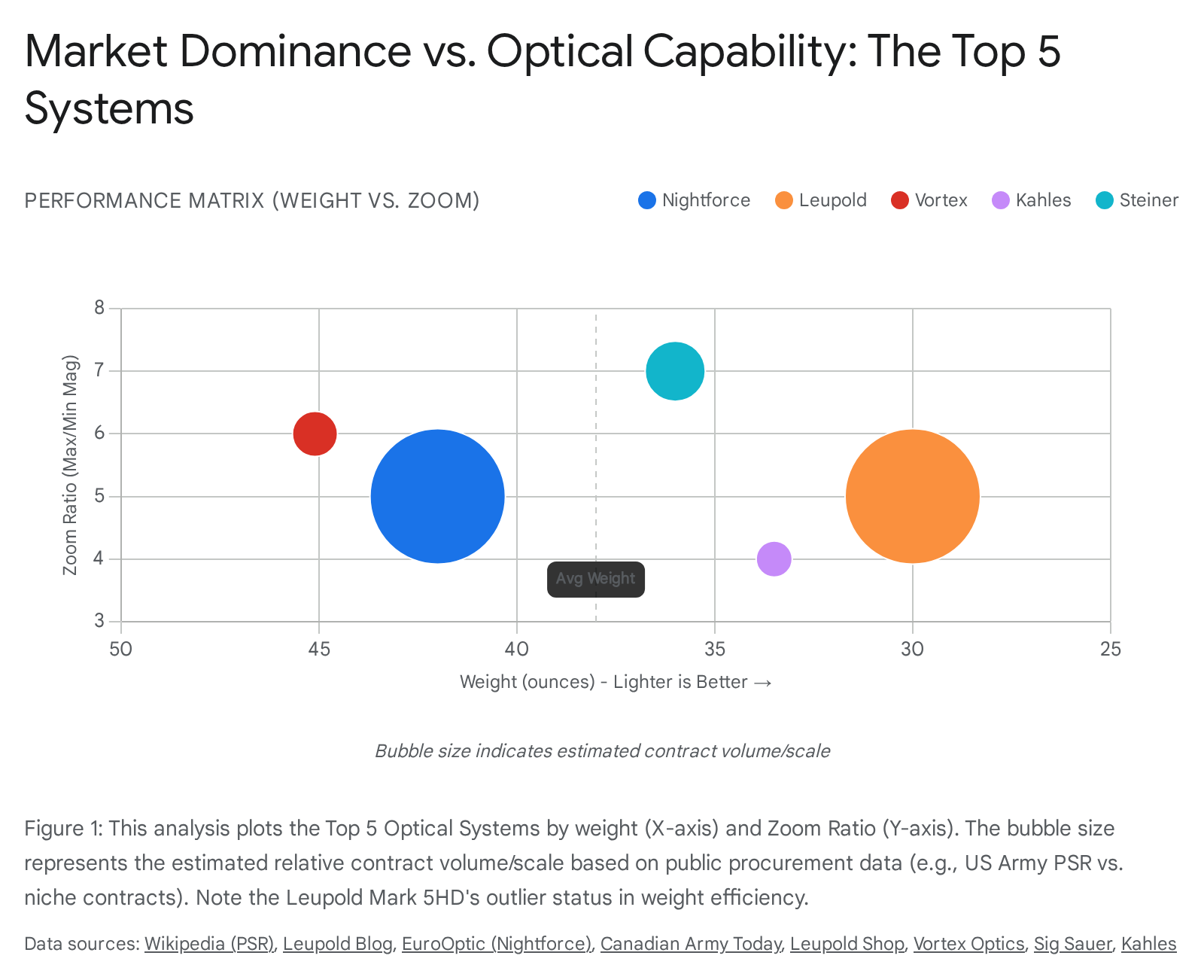
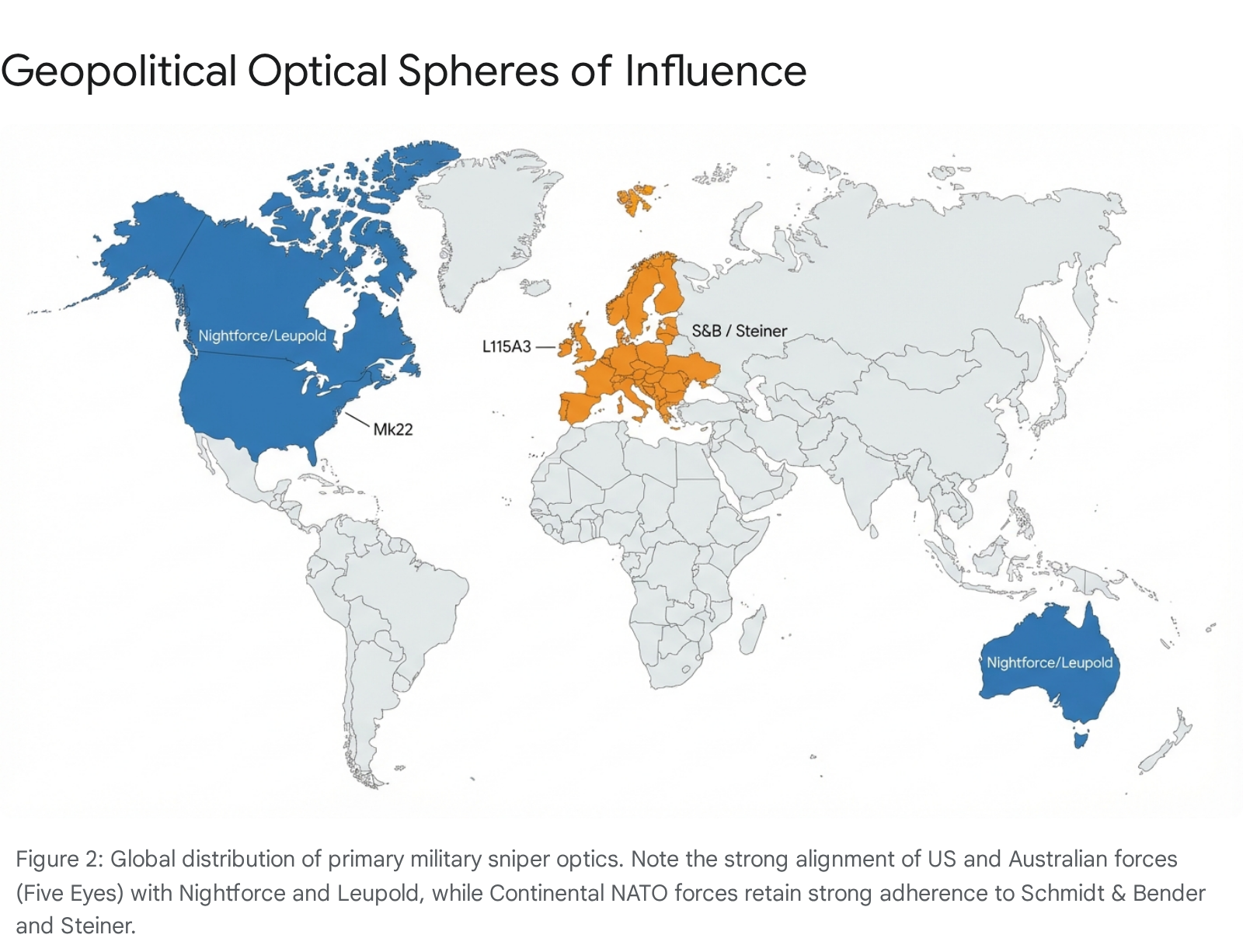
Our analysis identifies a strategic bifurcation in global procurement. The United States Special Operations Command (USSOCOM) and the United States Marine Corps (USMC) have prioritized optical dominance and ruggedization above all else, standardizing on the Nightforce ATACR series. This choice reflects a doctrine of “Overmatch,” where the sniper’s ability to identify and resolve targets at extreme distances is paramount, regardless of the system’s weight penalty. In contrast, the United States Army, tasked with equipping a much larger force structure, has prioritized mobility and modularity. Their selection of the Leupold Mark 5HD for the Precision Sniper Rifle program underscores a “Lightweight Lethality” doctrine, shaving critical pounds from the soldier’s load while maintaining requisite precision.
Meanwhile, the European theater remains a bastion of high-precision optical engineering, though the landscape is shifting. Schmidt & Bender, long the undisputed hegemon of the sector, faces fierce competition from Steiner Optik—which has secured key contracts in Germany and Canada—and boutique manufacturers like Tangent Theta and Zero Compromise Optic (ZCO), who are capturing the ultra-elite segment of the market with mechanically flawless instruments.
This report ranks these systems based on a weighted matrix of Current Fielded Status (confirmed contracts and volume), Optical & Mechanical Performance (engineering specifications), Durability (environmental hardening), and Strategic Relevance (influence on future requirements). It further explores the emerging “Sensor-to-Shooter” ecosystem, where the day optic serves merely as the analog backbone for a digital fire control suite.
1. Introduction and Strategic Ranking
The selection of a primary day optic for a military sniper weapon system is a high-stakes engineering decision that balances the “Iron Triangle” of optical physics: Optical Clarity (Resolution/Transmission), Mechanical Durability (Tracking/Zero Retention), and Physical Characteristics (Size/Weight). It is impossible to maximize all three simultaneously; physics dictates that increasing light transmission requires larger objective lenses and heavier glass, while increasing durability requires thicker housing walls and heavier erector assemblies. Therefore, every procurement decision represents a specific strategic compromise tailored to the end-user’s mission profile.
In the early 2000s, during the initial phases of the Global War on Terror (GWOT), the Schmidt & Bender PM II series was the undisputed monarch of this domain, setting the NATO standard for the 34mm tube and 5-25x magnification range. However, data from the 2019–2024 procurement cycles indicates a massive market disruption. American manufacturers, specifically Nightforce and Leupold, have captured the lion’s share of high-volume US contracts through aggressive innovation in magnification ratios (moving to 5x and 7x zoom ranges) and successful navigation of the Berry Amendment and “Buy American” mandates. Simultaneously, the European market has diversified, with Steiner capturing regular army contracts and boutique firms pushing the envelope of mechanical perfection for special operations.
The following ranking reflects the current operational reality of these systems, prioritizing those that are currently fielded in significant numbers or have been selected for major modernization programs.
Global Ranking: Top 10 Military Sniper Optical Systems
| Rank | Optical System | Manufacturer | Primary Users / Contracts | Key Characteristics |
| 1 | ATACR 7-35×56 F1 | Nightforce Optics (USA/Japan) | USSOCOM (Mk22 ASR, Mk13 Mod 7), USMC, Australian ADF (Land 159), FBI HRT | The new global standard for SOF. Massive 7-35x range, bombproof reliability, selected for P-VPS. |
| 2 | Mark 5HD 5-25×56 | Leupold & Stevens (USA) | US Army (Mk22 PSR), US Army (M110A1 SDMR – 3.6-18x var.) | Selected for low weight (20-30oz lighter than peers) and cost-efficiency at scale. 35mm tube. |
| 3 | 5-25×56 PM II | Schmidt & Bender (Germany) | UK MOD (L115A3), US Secret Service, US Coast Guard (HITRON), NATO Standard | The “Gold Standard” legacy. Proven combat history. “Tunneling” issues fixed in newer iterations. |
| 4 | M7Xi 4-28×56 | Steiner Optik (Germany/Italy) | Canadian Army (C21), German Army (G29/G22A2 – M5Xi var.), French Army (related contracts) | Dominant in European/Commonwealth procurement. High light transmission, rugged German engineering. |
| 5 | Tango6 5-30×56 | SIG SAUER (USA/Global) | US Army (DVO/SDMR var.), India, General Purpose Forces | Rapidly growing market share. Part of SIG’s total system integration strategy. LevelPlex technology. |
| 6 | TT525P (5-25×56) | Tangent Theta (Canada) | Elite Specialized Units (CANSOFCOM), Unit Discretionary Purchases | Regarded as mechanically “perfect.” Tool-less re-zero. Heavy, expensive, but zero compromise on tracking. |
| 7 | K624i / K525i DLR | Kahles (Austria) | Austrian Army (ÖF ZF624i), Competition/Civilian Crossover | Ergonomic leader with top-mounted parallax and ambidextrous windage. Unmatched FOV. |
| 8 | 3-20×50 PM II Ultra Short | Schmidt & Bender (Germany) | German Army (DMR), US/NATO (Gas Gun applications) | Specialized for compactness. Critical for rail space management with clip-on thermals. |
| 9 | ZC527 (5-27×56) | Zero Compromise Optic (Austria/USA) | Elite European Units, Niche SOF | The new challenger for optical supremacy. 36mm tube, highest light transmission, extremely compact length. |
| 10 | ZF 3.5-26×56 | Hensoldt (Zeiss) (Germany) | German Special Units, Legacy High-Tier | Incredible engineering pedigree, extremely compact, integrated mounting. Expensive and seeing stiff competition. |
2. Technical Primer: The Physics of Modern Sniping
To understand the ranking and selection of these optical systems, one must first understand the physical and engineering challenges inherent in modern long-range engagement. The optics listed above are not merely “telescopes”; they are precision measurement instruments designed to survive high-G impacts.
The Challenge of Supersonic Flight
Modern military cartridges, such as the .300 Norma Magnum and .338 Norma Magnum (central to the Mk22 ASR/PSR programs), maintain supersonic velocity well beyond 1,500 meters. Engaging a target at this distance requires the scope to provide a massive amount of internal elevation adjustment. When a bullet travels 1,500 meters, gravity causes it to drop significantly—often requiring the scope’s reticle to be adjusted (or “dialed”) down by 15 to 20 milliradians (MILS) or more.
Legacy scopes with 30mm tubes typically offered 60-70 MOA of travel, which is insufficient for these ranges without using extreme canted bases. The modern standard of 34mm (Nightforce, S&B, Steiner) and 36mm (ZCO) main tubes allows for larger internal erector assemblies, providing 100+ MOA (29+ MRAD) of travel. This allows the sniper to dial the turret for the specific range while keeping the image quality high, rather than having to “hold over” in the reticle where optical aberrations are more pronounced.
Optical Transmission and “Trace”
A critical requirement for military spotters and snipers is the ability to see “bullet trace.” Trace is the visible disturbance in the air caused by the compression of airwaves (shockwave) surrounding a supersonic projectile. It appears as a flicker or a distortion moving rapidly toward the target. Watching the trace allows the shooter or spotter to see exactly where the bullet passed relative to the target if it misses, enabling an immediate second-round correction.
High-quality glass—specifically Extra-low Dispersion (ED) or High Density (HD) glass containing fluorite crystals—is required to resolve this subtle atmospheric disturbance. Inferior glass will blur the trace or fail to render the contrast required to see it against complex backgrounds (like desert scrub or urban debris). This is why units like USSOCOM and CANSOFCOM are willing to pay $4,000+ per unit for Nightforce or Tangent Theta optics; they are paying for the ability to see trace and guarantee a second-round hit.
The First Focal Plane (FFP) Mandate
All scopes on this top 10 list utilize First Focal Plane (FFP) reticles. In an FFP system, the reticle is etched onto the glass at the front of the erector assembly. This means that as the magnification is increased or decreased, the reticle grows or shrinks in proportion to the target image.
The tactical advantage is absolute: the subtensions (hash marks) on the reticle remain accurate at any magnification setting. A sniper can range a target or hold for wind using the reticle whether the scope is set to 7x or 35x. In older Second Focal Plane (SFP) systems, the reticle remained a constant size, meaning the hash marks were only mathematically accurate at one specific magnification (usually the highest). In the chaos of combat, relying on SFP introduces a catastrophic failure point if the sniper forgets to check their magnification ring. FFP eliminates this variable.
3. Nightforce Optics ATACR 7-35×56 F1: The SOCOM Standard
System Identification & Operational Context
The Nightforce Advanced Tactical Riflescope (ATACR) 7-35×56 F1 is currently the dominant optical system within the United States Special Operations community and allied Tier 1 forces. Its preeminence was formalized through the Precision-Variable Power Scope (P-VPS) contract awarded by USSOCOM. This Indefinite Delivery/Indefinite Quantity (IDIQ) contract, with a ceiling of $53.7 million, selected the ATACR 7-35×56 as the “Long Range” solution and the ATACR 5-25×56 as the “Standard” solution for the Miniature Aiming Systems – Day Optic (MAS-D) program.
This optic is the primary interface for the Mk22 Advanced Sniper Rifle (ASR), a modular bolt-action system based on the Barrett MRAD, as well as the Mk13 Mod 7 (.300 Win Mag) platform used by the US Marine Corps. Furthermore, it has been selected by the Australian Defence Force under the LAND 159 Lethality System Project and is widely fielded by the FBI Hostage Rescue Team (HRT), replacing legacy Leupold and Schmidt & Bender inventory.
Technical Characteristics & Performance Analysis
The ATACR 7-35×56 represents a shift towards “Super-Zoom” capabilities, offering a 5x zoom ratio that pushes the upper limit of magnification to 35x.
- Magnification and PID: The 35x top-end magnification is a strategic asset for Positive Identification (PID). In complex rules-of-engagement (ROE) environments, such as urban counter-insurgency, the ability to discern whether a target is holding a weapon or a non-combatant object at 1,000 meters is critical. Previously, this required a separate spotting scope; the ATACR allows the shooter to perform this verification through the rifle optic itself.
- Mechanical Robustness: Nightforce built its reputation on durability, a legacy of its NXS series which was favored by NAVSPECWAR (Navy SEALs) for its ability to withstand submersion and abuse. The ATACR continues this with a thick-walled 34mm main tube. It is rated to withstand the recoil impulse of.50 BMG and.338 systems repeatedly without shifting zero.
- Elevation Travel: The scope offers 100 MOA (29 MRAD) of internal elevation travel. When paired with a 20 MOA or 40 MOA canted rail, this allows the system to utilize the full ballistic potential of the.300 Norma Magnum cartridge out to its transonic transition zone beyond 1,500 meters.
- Reticle Ecosystem: The USSOCOM contract standardized the Horus TREMOR3 reticle. This “Christmas Tree” reticle provides a grid of wind dots and elevation holds, allowing for rapid engagement of multiple targets at varying distances without touching the turrets. It also features “Time of Flight” wind dots, calibrated for standard military cartridges, simplifying wind calls.
Strategic Analysis: The “P-VPS” Effect
The selection of the ATACR 7-35×56 for the P-VPS contract was a watershed moment in the industry. It signaled the displacement of Schmidt & Bender from its long-held position as the default US SOF optic.
- Supply Chain Security: Nightforce, while utilizing premium Japanese glass (manufactured by Light Optical Works), performs final assembly, rigorous quality control, and zeroing in Orofino, Idaho. This satisfies US Department of Defense requirements for supply chain security and “Made in USA” preferences more easily than European competitors.
- System Integration: The ATACR was designed to integrate with the “Next Generation” of sniper accessories. Its objective bell clearance and optical axis are optimized for inline mounting of the Teledyne FLIR HISS-XLR thermal sight and the Wilcox RAPTAR-S laser rangefinder. This “Systems Approach” was a key factor in its selection; the scope is not just a sight, but the central hub of a fire control network.
4. Leupold Mark 5HD 5-25×56: The Army’s Lightweight Workhorse
System Identification & Operational Context
While USSOCOM pursued maximum performance with Nightforce, the United States Army (“Big Army”) adopted a divergent philosophy for its Precision Sniper Rifle (PSR) program. In a contract valued at $49.9 million, the Army selected the Leupold Mark 5HD 5-25×56 to pair with the Barrett Mk22 MRAD. This optic is now being fielded to thousands of snipers in infantry, cavalry, and engineer units, representing the largest volume procurement of high-end sniper optics in the world.
Technical Characteristics & Performance Analysis
The defining engineering achievement of the Mark 5HD is its weight efficiency.
- The Weight Advantage: The Mark 5HD 5-25×56 weighs approximately 30 ounces (850g). By comparison, the Nightforce ATACR 7-35x weighs over 39 ounces (1,100g), and the Schmidt & Bender PM II weighs roughly the same. For a dismounted infantry sniper who must carry the Mk22 (which weighs ~15 lbs fully dressed), ammunition, body armor, and sustainment gear, saving over half a pound on the optic is a significant ergonomic advantage.
- 35mm Main Tube: Leupold utilized a non-standard 35mm main tube for this optic. This engineering choice was deliberate; it allows for a larger erector system (providing 120 MOA of travel, superior to many 34mm scopes) while avoiding the heavy housing thickness required for 34mm scopes to achieve similar travel.
- M5C3 ZeroLock Turrets: The turret system features a visual and tactile revolution indicator. The “C3” designation implies it can dial three full revolutions of elevation (over 30 MILS), sufficient for extreme long range. The “ZeroLock” is a button that locks the turret at the zero position, preventing accidental movement during transport—a frequent complaint from soldiers carrying rifles in drag bags or rucksacks.
- Optical Compromises: To achieve the weight and cost targets, the Mark 5HD uses what Leupold terms “Twilight Max HD” light management. While excellent, independent optical testing suggests it sacrifices a small degree of chromatic aberration control and edge-to-edge resolution compared to the heavier glass used by ZCO or Tangent Theta. However, for the Army’s requirement, the glass is more than sufficient for target engagement capabilities.
Strategic Analysis: The Shift to Domestic Production
The Army’s selection of Leupold (based in Beaverton, Oregon) reinforces a strategic priority on domestic industrial base capability. Unlike the P-VPS contract which accepted Japanese glass, the PSR contract heavily favored a purely domestic supply chain. Leupold designs, machines, and assembles the Mark 5HD in the United States. This logistical independence is a critical strategic asset, ensuring that in a high-intensity conflict, the US military is not dependent on trans-Pacific supply lines for its primary sniper optics.
5. Schmidt & Bender 5-25×56 PM II: The Global Benchmark
System Identification & Operational Context
For two decades, the Schmidt & Bender Police Marksman II (PM II) 5-25×56 has been the “Gold Standard” against which all other sniper scopes are measured. Despite recent losses in US contracts, it remains the incumbent heavy-hitter globally. It is the standard optic for the British Army’s L115A3 Long Range Rifle, the US Secret Service Counter-Sniper teams, and the US Coast Guard’s Helicopter Interdiction Tactical Squadron (HITRON).
Technical Characteristics & Performance Analysis
The PM II is renowned for its optical purity and mechanical track record.
- Low Light Performance: S&B glass is famous for its high transmission rates in the blue/violet spectrum, which enhances contrast in low-light conditions (dawn and dusk). This is a critical operational window for sniper overwatch missions.
- The “Tunneling” Phenomenon: Early generations of the PM II 5-25x suffered from “tunneling” at low magnification, where the field of view did not increase as the magnification was dialed down from ~7x to 5x. While newer iterations (like the PM II High Power) have rectified this, the classic 5-25x remains in service due to its proven ruggedness.
- Turret Diversity: S&B offers the widest array of turret configurations in the industry. The Double Turn (DT) turret, which features a tactile “pop-up” cylinder to indicate the second revolution, is an intuitive design that has prevented countless “lost zero” incidents in combat. The Multi-Turn (MT) and Locking (L) variants allow users to customize the optic to their specific doctrine.
Strategic Analysis: The Specialized User
The continued reliance on S&B by agencies like the US Secret Service and US Coast Guard highlights a preference for proven reliability over “new” features.
- US Coast Guard HITRON: This unit conducts Airborne Use of Force (AUF) from helicopters to disable drug-running go-fast boats. They utilize the Barrett M107.50 caliber rifle, often paired with the PM II. The operational environment is brutal: high vibration, salt spray, and shifting thermal gradients. The PM II’s ability to hold zero under the recoil of a.50 BMG fired from a vibrating airframe is a testament to its mechanical fortitude.
- US Secret Service: For Presidential protection, the “No Fail” standard is absolute. The agency’s counter-snipers require an optic that provides absolute clarity for facial recognition at distance. The S&B PM II’s resolution capabilities ensure that a threat can be positively identified before a shot is taken, minimizing collateral risk.
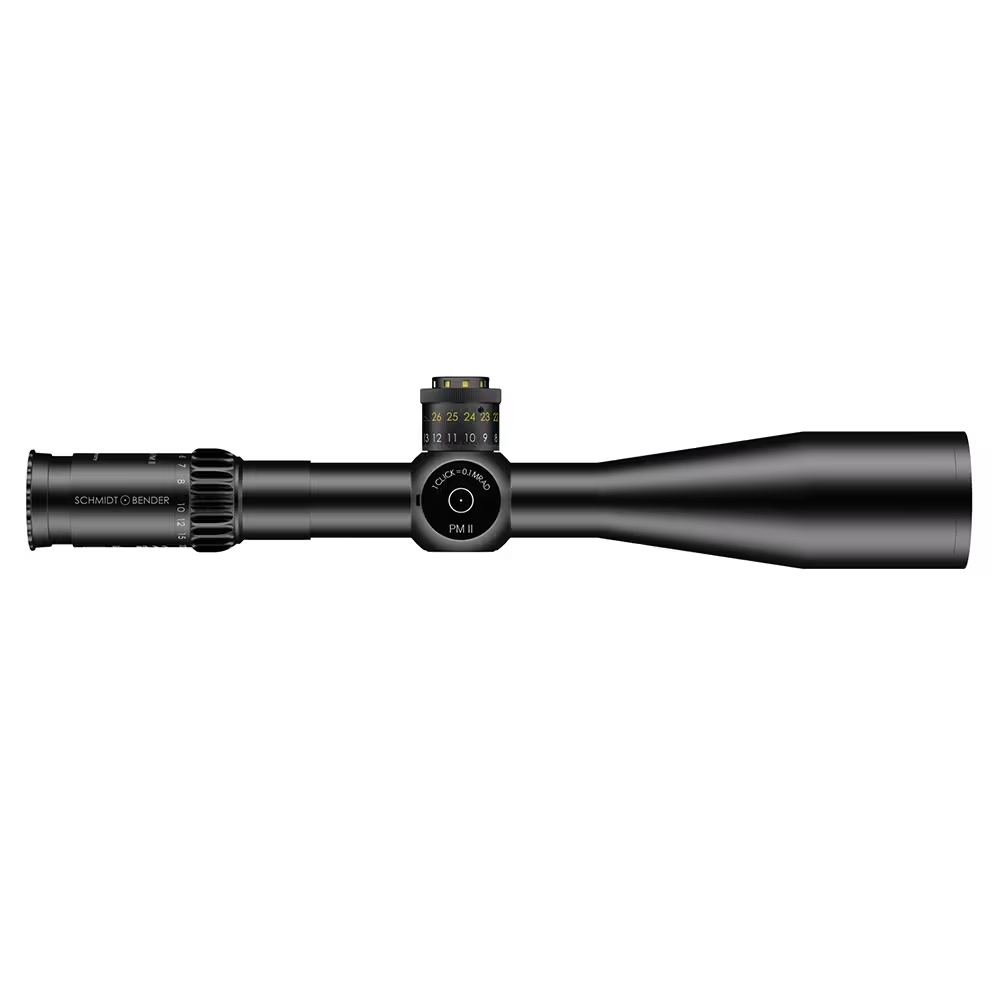
EuroOptic carries a number of models of this scope. Click here to visit their page.
6. Steiner M7Xi 4-28×56: The Euro-NATO Challenger
System Identification & Operational Context
Steiner Optik, a German subsidiary of the Beretta Defense Technologies group, has aggressively targeted the military market with its M-series optics. The M7Xi 4-28×56 has emerged as the primary competitor to S&B in Europe and the Commonwealth. It secured the Canadian Army’s C21 Sniper Rifle contract (pairing with the Sako TRG M10) and is the standard optic for the German Army’s G29 (Haenel RS9) and modernized G22A2 platforms (often in the M5Xi or M7Xi variant).
Technical Characteristics & Performance Analysis
The M7Xi represents the “7x Zoom” generation of European optics.
- Compactness: The M7Xi is notably shorter than many of its competitors in the 25x+ magnification class. This reduced overall length is a deliberate engineering choice to facilitate the mounting of clip-on night vision and thermal devices. On a sniper rifle, “rail estate” (available space on the Picatinny rail) is a finite resource; a shorter day scope allows for a longer, more powerful thermal sight to be mounted in front of it without bridging the handguard gap.
- Light Transmission: Steiner claims a light transmission rate of over 94%, a figure that rivals or exceeds the industry leaders. This high transmission is vital for operations in Northern Europe and Canada, where overcast conditions and long twilight hours are common.
- Intelligent Firing Solution (IFS): Steiner is pioneering the digitization of the scope with the M7Xi IFS variant. This model features a built-in ballistic calculator and a Heads-Up Display (HUD) projected into the field of view. While the standard M7Xi is the primary issue item, the IFS represents the future of the platform, allowing the sniper to see bullet drop and windage corrections without breaking their cheek weld or looking at an external device.
Strategic Analysis: The Beretta Advantage
Steiner’s success is partly due to its integration within the Beretta Defense Technologies (BDT) conglomerate. BDT owns Sako (rifles), Tikka (rifles), Steiner (optics), and Burris (optics). This allows BDT to offer a “turnkey” sniper system to governments—rifle, scope, mount, and accessories all from a single prime contractor. The Canadian C21 contract is a prime example of this synergy, where the Sako TRG M10 and Steiner M7Xi were selected as a complete package. This simplifies procurement and warranty support for the purchasing government, giving Steiner a competitive edge over standalone optics manufacturers.
7. SIG SAUER Tango6 5-30×56: The System Integrator
System Identification & Operational Context
SIG SAUER has transformed from a firearms manufacturer into a total systems provider. Their Electro-Optics division has seen rapid adoption. While the Tango6T (1-6x) is famous for winning the US Army’s SDMR (Squad Designated Marksman Rifle) and DVO contracts, the long-range Tango6 5-30×56 is the dedicated sniper variant. It is fielded by the US Army (as part of the wider Tango6 family contracts) and has seen significant export success, notably to India (paired with Sig 716 capabilities) and other General Purpose Forces.
Technical Characteristics & Performance Analysis
- LevelPlex Technology: A standout feature of the Tango6 series is the LevelPlex digital anti-cant system. Traditional snipers mount a physical bubble level to their scope tube to ensure the rifle is not canted (tilted) left or right, which causes horizontal dispersion at long range. LevelPlex integrates digital sensors to display yellow arrows at the edges of the reticle, guiding the shooter to level the rifle intuitively. This creates a faster workflow and removes an external snag hazard.
- HDX Optics: Sig utilizes a proprietary glass formula known as “HDX,” which combines High Definition (HD) and High Transmittance (HT) glass. While critical analysis suggests it may strictly trail the absolute optical purity of ZCO or Tangent Theta, it offers a price-to-performance ratio that is highly attractive for large-scale procurement.
- 6x Zoom Ratio: The 5-30x magnification range offers a versatile 6x zoom, striking a balance between the 5x of the Mark 5HD and the 7x of the ATACR.
Strategic Analysis: The “Apple” of Defense
Sig Sauer’s strategy mirrors the tech industry’s “walled garden” approach. By manufacturing the weapon (MCX/Cross), the ammunition (Sig Ammo), the suppressor (SLX), and the optic (Tango6), they control the entire vertical integration of the sniper system. This allows them to optimize the system’s performance holistically. For example, the BDX (Ballistic Data Xchange) technology allows Sig laser rangefinders to communicate directly with Sig scopes via Bluetooth, illuminating the correct holdover dot on the reticle. While currently more prevalent in the commercial/hunting sector, this technology is migrating to military applications, offering a glimpse of the connected battlefield.
8. Tangent Theta TT525P (5-25×56): The Mechanical Masterpiece
System Identification & Operational Context
Tangent Theta, based in Halifax, Nova Scotia, occupies a unique position in the market. It is not a mass-production house; it is a boutique engineering firm dedicated to creating the most mechanically precise optical instrument possible. The TT525P is the standard for CANSOFCOM (Canadian Special Operations Forces Command) and is widely purchased via discretionary funds by elite units globally (e.g., US Delta Force, UK SAS) who demand capability beyond standard issue.
Technical Characteristics & Performance Analysis
Tangent Theta scopes are legendary for their mechanical feel and tracking reliability.
- Tool-Less Re-Zero: The defining feature of the TT525P is its proprietary re-zeroing mechanism. In traditional scopes, re-zeroing the turrets after sighting in requires small Allen keys or coins—tools that are easily lost in the mud or snow of a combat environment. Tangent Theta’s turrets allow the shooter to loosen the top cap with their fingers, dial the turret to “0”, and lock it back down. This is a game-changing capability for field maintenance.
- The “Heavy” Click: The turret mechanism is engineered to provide distinct, heavy, tactile clicks. This is designed for operators wearing thick tactical gloves or arctic mittens. There is zero ambiguity when dialing; the shooter can feel and hear every tenth of a milliradian adjustment.
- Legacy of Premier Reticles: Tangent Theta was formed by the engineering team behind Premier Reticles, a defunct but legendary brand that supplied US Marine Corps Scout Snipers. The optical formula is derived from this heritage, prioritizing depth of field and color contrast.
Strategic Analysis: The “Zero Compromise” Philosophy
Tangent Theta represents the extreme high end of the cost spectrum, with unit prices often exceeding $5,000 USD. They are heavy and lack the “super-zoom” ranges of Nightforce. However, they rank on this list because for the specific user set—Special Operations snipers taking shots where a mechanical failure is unacceptable—the cost is irrelevant. The brand’s refusal to compromise on internal material quality (using stainless steel internals where others use brass or aluminum) ensures that the scope will track perfectly after thousands of dial adjustments, a durability metric that mass-produced scopes often fail to meet over time.
9. Kahles K624i / K525i DLR: Ergonomic Innovation
System Identification & Operational Context
Kahles, a sister company to Swarovski Optik based in Austria, holds the distinction of being the world’s oldest scope manufacturer. The K624i (6-24×56) and the newer K525i DLR (Dynamic Long Range) are the primary optical systems for the Austrian Army (Bundesheer), designated as the ÖF ZF624i. They are also widely used by European police tactical units.
Technical Characteristics & Performance Analysis
Kahles is the industry leader in ergonomic innovation.
- Top-Mounted Parallax: Almost every other scope on this list places the parallax adjustment knob on the left side of the turret housing (co-axial with the illumination knob). Kahles patented a design where the parallax wheel is located around the elevation turret on top of the scope. This makes the adjustment ambidextrous and allows the sniper to adjust parallax with either hand without breaking their shooting position or reaching across the rifle.
- Left-Side Windage: Kahles offers the option to place the windage turret on the left side of the scope (for right-handed shooters). Standard scopes have windage on the right. By moving it to the left, the right-handed shooter can dial windage with their left hand while maintaining control of the trigger and bolt with their right hand. This significantly increases the speed of engagement.
- Field of View (FOV): The K525i DLR is engineered for an exceptionally wide field of view. This is critical for “Dynamic” situations where the sniper must scan for targets or track moving vehicles. The wider the FOV, the easier it is to acquire the target in the scope.
Strategic Analysis: The User-Centric Design
Kahles ranks in the top 10 because it challenged the 100-year-old orthodoxy of scope layout. For military users focused on “Time to Engagement,” the ergonomic advantages of the top parallax and left-side windage offer measurable speed improvements. While they may not have the massive contract volume of Leupold, their influence on design is palpable, and they remain a preferred choice for units that have the latitude to select equipment based on ergonomic preference.
10. Zero Compromise Optic ZC527: The New Contender
System Identification & Operational Context
Zero Compromise Optic (ZCO) is the youngest company on this list, founded by former executives from Nightforce and Kahles. Their mission was explicitly to build a scope that outperformed S&B and Nightforce. The ZC527 (5-27×56) has rapidly gained a foothold in the market, being adopted by niche European Special Operations and police units that require the absolute pinnacle of optical performance.
Technical Characteristics & Performance Analysis
- 36mm Main Tube: ZCO introduced a 36mm main tube standard. This 2mm increase over the 34mm standard allows for larger internal lenses and greater elevation travel (35 MRAD / 120 MOA) without the massive length usually associated with high-magnification scopes.
- Optical Transmission: Independent spectrometer testing consistently ranks ZCO as having the highest total light transmission (92%+) and best color fidelity in the class. The resolution is such that it allows for identification of threat details (e.g., weapon type, radio presence) that might be blurred in lesser optics.
- Compact Length: Despite its massive tube and high magnification, the ZC527 is relatively short (15.24 inches). This compactness is a critical design feature for compatibility with forward-mounted thermal clip-ons, fitting the entire “Sensor-to-Shooter” stack on a standard receiver rail.
Strategic Analysis: The “Formula 1” of Optics
ZCO represents the bleeding edge of what is physically possible in optical engineering. They are ranked #9 primarily due to their relatively recent entry into the market and lower volume of fielded units compared to the giants like Nightforce. However, their strategic relevance is high; they are forcing the legacy manufacturers to innovate. ZCO proves that there is still room for improvement in the high-end optical market, particularly in the balance of size, weight, and optical performance.
Emerging Trends: The “Sensor-to-Shooter” Ecosystem
A sniper scope is no longer an isolated instrument; it is the visual interface of a Fire Control System. The ranking above must be understood in the context of the accessories that pair with these scopes. The “Day Optic” is now the hub of a three-part system:
- The Day Optic (The Hub): Provides the reticle and base magnification.
- The Clip-On Thermal (The Sensor): Devices like the Teledyne FLIR HISS-XLR or HISS-HD mount in front of the day optic. These “cooled” thermal sights allow the sniper to see heat signatures at 2,000+ meters. The sniper looks through their day scope at the screen of the thermal. This requires the day scope to have a specific optical design (parallax forgiveness) to focus on the thermal screen effectively.
- The Laser Rangefinder/Ballistic Computer (The Data): Devices like the Wilcox RAPTAR-S mount to the scope or the rail. They lase the target, measure atmospherics (temp, pressure), calculate the bullet drop, and display the solution on a screen. The sniper then dials this solution on the scope turrets or holds it in the reticle.
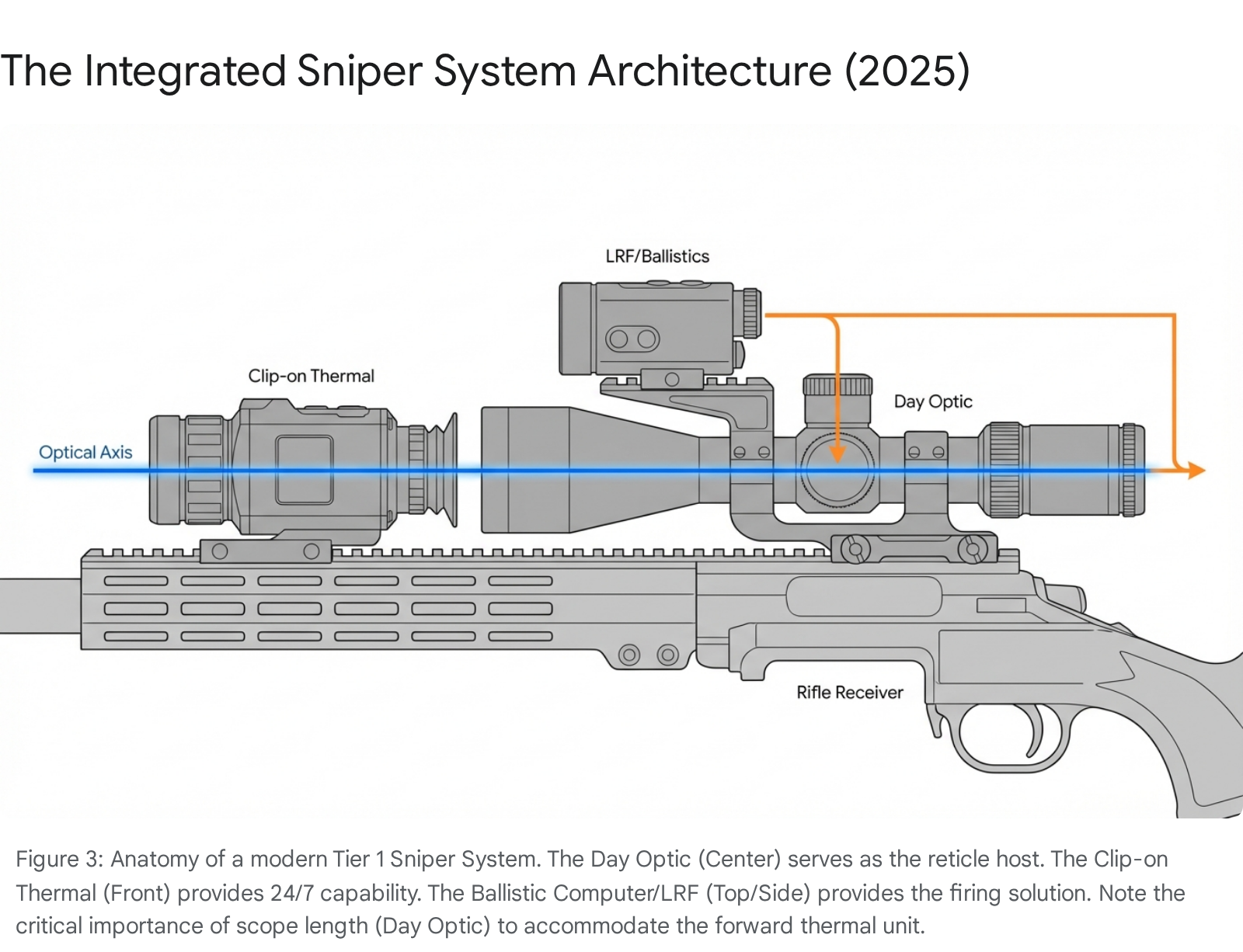
The integration of these three components is the defining challenge of modern sniper craft. Scopes like the Nightforce ATACR and Leupold Mark 5HD are ranked highly not just because they are good scopes, but because they physically and optically integrate best with this ecosystem.
Conclusion
The era of the solitary sniper scope is over. The top-ranked systems in this report—led by the Nightforce ATACR and Leupold Mark 5HD—have risen to the top not just because of their glass quality, but because they are successfully engineered to function as nodes in a lethal network.
USSOCOM’s standardization on the Nightforce ATACR 7-35×56 signals a doctrine that values Target Identification and Durability above all else. The US Army’s shift to Leupold signals a recognition that Mobility is a lethality factor in near-peer conflicts. Meanwhile, the European industry (S&B, Steiner, ZCO) continues to push the boundaries of Physics, creating optical instruments of breathtaking precision that serve as the benchmark for elite, low-volume users.
For the defense industry analyst, the trend is clear: Future rankings will likely be determined by digital integration. The scope that can best display data from a drone, a laser rangefinder, or a thermal imager directly into the sniper’s field of view—without adding excessive weight—will claim the #1 spot in the next decade.
If you find this post useful, please share the link on Facebook, with your friends, etc. Your support is much appreciated and if you have any feedback, please email me at in**@*********ps.com. Please note that for links to other websites, we are only paid if there is an affiliate program such as Avantlink, Impact, Amazon and eBay and only if you purchase something. If you’d like to directly contribute towards our continued reporting, please visit our funding page.
Works cited
- Barrett MRAD – Wikipedia, accessed December 22, 2025, https://en.wikipedia.org/wiki/Barrett_MRAD
- Barrett® Awarded United States Army’s Precision Sniper Rifle Contract, accessed December 22, 2025, https://barrett.net/2021/04/07/barrett-awarded-united-states-armys-precision-sniper-rifle-contract/
- Leupold Mark 5HD Selected by Army Precision Sniper Rifle Program, accessed December 22, 2025, https://www.leupold.com/blog/post/leupold-mark-5hd-selected-by-army-precision-sniper-rifle-program
- Nightforce ATACR Riflescopes Win USSOCOM P-VPS Contract For MK22 Advanced Sniper Rifle System! – EuroOptic, accessed December 22, 2025, https://www.eurooptic.com/blog/post/nightforce-atacr-riflescopes-win-ussocom-p-vps-contract-for-mk22-advanced-sniper-rifle-system
- The Army has selected an optic for its new sniper rifle – Task & Purpose, accessed December 22, 2025, https://taskandpurpose.com/news/army-precision-sniper-rifle-optic-leupold/
- NIGHTFORCE® OPTICS AWARDED USSOCOM P-VPS CONTRACT, accessed December 22, 2025, https://www.nightforceoptics.com/nightforce-optics-awarded-ussocom-p-vps-contract
- USSOCOM Selects Nightforce Optics for Precision-Variable Power Scope – Soldier Systems, accessed December 22, 2025, https://soldiersystems.net/2019/12/12/ussocom-selects-nightforce-optics-for-precision-variable-power-scope/
- Canadian Military Snipers Getting New Rifles – Canada.ca, accessed December 22, 2025, https://www.canada.ca/en/department-national-defence/news/2022/06/canadian-military-snipers-getting-new-rifles.html
- L115a3 Long Range Rifle – Elite UK Forces, accessed December 22, 2025, https://www.eliteukforces.info/weapons/l115a3-long-range-rifle/
- British Army’s New Sniper Rifle – SWAT Survival | Weapons | Tactics, accessed December 22, 2025, https://www.swatmag.com/article/british-armys-new-sniper-rifle/
- About That Huge Rifle The Secret Service Sniper Was Carrying During Trump’s Photo Op Walk – The War Zone, accessed December 22, 2025, https://www.twz.com/33818/about-that-huge-rifle-the-secret-service-sniper-was-carrying-during-trumps-photo-op-walk
- U.S. Marine Corps Chooses Nightforce for Mk13 Mod 7 Sniper System | An Official Journal Of The NRA – Shooting Illustrated, accessed December 22, 2025, https://www.shootingillustrated.com/content/u-s-marine-corps-chooses-nightforce-for-mk13-mod-7-sniper-system/
- News – Zero Compromise Optic, accessed December 22, 2025, https://www.zcompoptic.com/en-us/news
- TFB Review: Schmidt & Bender 3-20×50 PM II Ultra Short Riflescope | thefirearmblog.com, accessed December 22, 2025, https://www.thefirearmblog.com/blog/2024/06/06/tfb-review-schmidt-bender-3-20×50-pm-ii-ultra-short/
- K624i – KAHLES: Riflescopes, accessed December 22, 2025, https://www.kahles.at/us/sport/riflescopes/k624i-6-24x56i_us
- U.S. Army Contracting Command Issues Award to SIG SAUER for MCX, MPX, and 716G2 Rifles, along with SP2022 Pistols, TANGO6 Riflescopes, and Suppressors, accessed December 22, 2025, https://www.sigsauer.com/blog/u-s-army-contracting-command-issues-award-to-sig-sauer-for-mcx-mpx-and-716g2-rifles-along-with-sp2022-pistols-tango6-riflescopes-and-suppressors