
The trajectory of Avidity Arms serves as a compelling case study in the modern firearms industry, illustrating the complex, often perilous journey from theoretical doctrine to tangible manufacturing. Founded in the mid-2010s on the premise of creating a purpose-built defensive handgun derived directly from the instructional experiences of Rob Pincus, the company has navigated a turbulent decade characterized by initial fanfare, significant supply chain disruptions, the catastrophic collapse of a primary distribution partner, and a complete operational restructuring. Unlike major manufacturers that rely on iterative updates to established platforms, Avidity Arms attempted to introduce a “clean sheet” design focused on a specific, arguably underserved, niche: the “shootable” single-stack 9mm.
The company’s flagship product, the PD10, was conceived in 2013/2014 as a corrective measure to the prevailing market gaps in concealed carry handguns. However, the development timeline coincided with—and ultimately lagged behind—one of the most aggressive periods of innovation in the compact pistol segment. By the time the PD10 reached full retail maturity in 2023, the market had shifted decisively toward “micro-compact” double-stack designs. Despite this, Avidity Arms has successfully carved a sustainable niche by adhering strictly to a “defensive” rather than “tactical” or “competitive” design philosophy, prioritizing ergonomics and reliability over modularity and capacity trends.
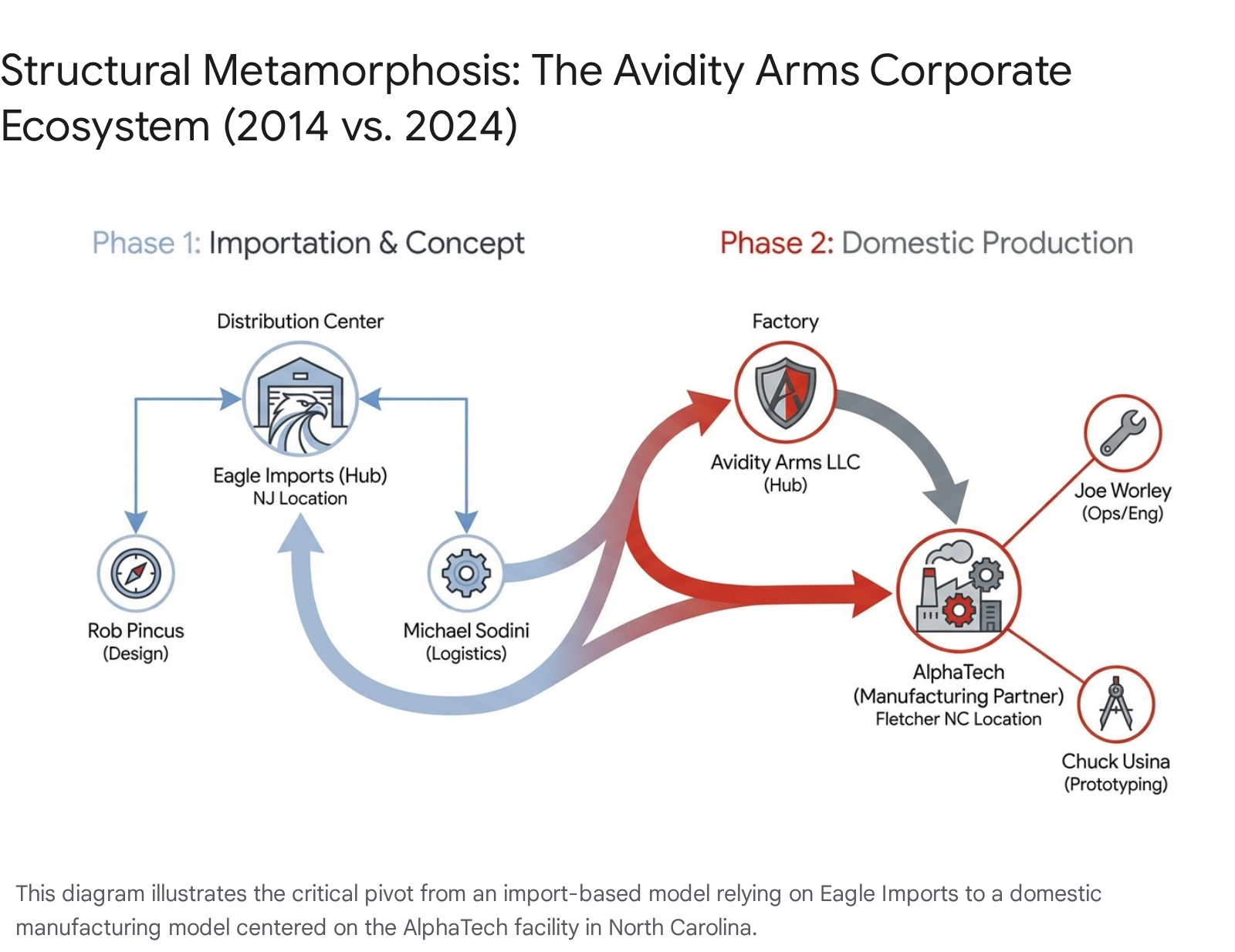
The operational history of Avidity Arms is bifurcated into two distinct eras: the “Eagle Imports Era” (2014–2020), marked by importation partnerships and eventual stagnation due to the distributor’s insolvency; and the “AlphaTech Era” (2022–Present), characterized by domestic manufacturing autonomy in Fletcher, North Carolina. This pivot to a partnership with Joe Worley and AlphaTech has stabilized production, allowing for the expansion into new calibers like the.30 Super Carry and new platforms such as the A-SAR rifle.
Looking forward to 2025 and beyond, Avidity Arms appears poised to operate as a specialized boutique manufacturer rather than a mass-market competitor to industry giants. Their strategy relies on deep integration with the training community, leveraging the personal brand of its founder, and adopting emerging calibers that align with their capacity-maximization goals. While the company faces headwinds regarding brand momentum and market saturation, its lean manufacturing model and clear ideological identity provide a resilient foundation for future growth.
1. Introduction: The Intersection of Doctrine and Design
The concept of the “instructor-designed” firearm is not novel, but it is rare for such a project to transition from a customized version of an existing platform to a completely new manufacturing entity. Historically, figures like Jeff Cooper influenced the design of the Bren Ten or the Scout Rifle, but these were often collaborations with established major manufacturers. Avidity Arms represents a different path: the attempt to build a new firearms company from the ground up, centered entirely around the doctrinal preferences of a single instructional philosophy.
Avidity Arms was not established merely to manufacture guns, but to manufacture a specific kind of gun—one that hardware-codified the software (training) principles of its founder, Rob Pincus. This “Design & Engineering Focused on Defense” philosophy 1 distinguishes Avidity from competitors who often chase military contracts or competition glory. Avidity’s singular focus is the private citizen defender.
This report provides an exhaustive analysis of Avidity Arms, tracing its lineage from a conversation in a bar to a functioning manufacturer in North Carolina. It examines the technical and business challenges that nearly derailed the company, the strategic pivots that saved it, and the current product portfolio that seeks to redefine the “defensive pistol” category. Through this analysis, we gain insight not just into one company, but into the broader challenges of innovation, supply chain management, and brand survival in the highly competitive American firearms market.
2. The Strategic Context of 2013-2015: A Market in Transition
To understand the genesis of Avidity Arms, one must first understand the firearms market of 2013 and 2014. This period was characterized by a massive surge in concealed carry permits and a subsequent demand for smaller, lighter handguns. The era of the “Wonder Nine” double-stack service pistols (e.g., Glock 17, Beretta 92) had given way to a surging demand for concealable, single-stack 9mm handguns.
2.1 The “Single-Stack” Revolution and Its Limitations
In the early 2010s, the market for concealed carry was dominated by compromises. Shooters generally had two choices:
- Sub-Compact Double Stacks: Guns like the Glock 26 offered capacity (10 rounds) and shootability but were thick (1.18+ inches), making them harder to conceal inside the waistband (IWB) for smaller-framed individuals.
- Micro Single Stacks: Guns like the Kel-Tec PF9, Ruger LC9, and later the Smith & Wesson Shield and Glock 43, prioritized thinness and lightness. However, they achieved this by drastically shortening the grip and barrel.
This second category, while easy to carry, presented significant training issues. Professional instructors, including Rob Pincus, noted that students often struggled to shoot these “pocket pistols” effectively. The short grips left the pinky finger dangling, reducing recoil control. The short sight radiuses magnified aiming errors. The lightweight frames made the recoil impulse snappy and unpleasant, discouraging practice.
2.2 The “Shootability” Gap
It was in this gap that the concept for Avidity Arms was born. The market lacked a “Goldilocks” gun: a pistol that was thin enough to carry effortlessly (like a single stack) but large enough to shoot effectively (like a service pistol). Pincus observed that while sub-compacts were easy to carry, they were difficult to shoot well due to limited grip surface and short sight radiuses. The vision for what would become the PD10 was a pistol with a full-size grip (to accommodate all fingers), a slim profile (for concealment), and a 4-inch barrel (for ballistics and sight radius).2
This insight—that “concealability” and “shootability” were being treated as mutually exclusive trade-offs—formed the foundational thesis of Avidity Arms. The goal was to create a pistol that did not require the user to compromise on their ability to fight with the gun in exchange for the comfort of carrying it.
3. The Founders and the Vision
The identity of Avidity Arms is inextricably linked to the biographies and professional networks of its founders. Unlike a corporate spin-off, Avidity was a personality-driven enterprise from day one.
3.1 Rob Pincus: The Doctrinal Architect
Rob Pincus brought nearly two decades of professional experience to the table at the company’s founding. His background combined law enforcement service with a high-profile career as a private trainer.
- Law Enforcement Roots: Pincus began his career in law enforcement and executive protection, later serving as a commissioned officer in the U.S. Army Reserve after graduating from Norwich University.3
- The Valhalla Era: He gained significant prominence as the Director of Operations at the Valhalla Training Center in Colorado, where he developed the Combat Focus Shooting (CFS) program. This program emphasized working with the body’s natural reactions to stress (e.g., flinch responses) rather than fighting against them.3
- Media Presence: By 2014, Pincus was a media fixture, hosting TV shows like The Best Defense on the Outdoor Channel and managing the Personal Defense Network.3 This gave him a massive, ready-made audience of students and followers who trusted his insights on defensive gear.
Pincus’s role at Avidity was effectively that of the “Chief Product Officer” and “Chief Marketing Officer.” He defined what the gun needed to do and why it needed to exist.
3.2 Michael Sodini: The Logistics Veteran
If Pincus was the “software,” Michael Sodini was the intended “hardware.” Sodini was a firearm industry veteran, having spent over two decades in sales and distribution.4 Most notably, he was the operating force behind Eagle Imports, the exclusive U.S. distributor for brands like Bersa, Metro Arms, and Grand Power.5
- Eagle Imports: Based in New Jersey, Eagle Imports was a powerhouse in the budget-friendly import market. They had successfully established the Bersa Thunder.380 as a staple of the American concealed carry market.
- Mental Health Advocacy: Later in his career, Sodini would found Walk The Talk America (WTTA), a non-profit bridging the gap between the firearms industry and mental health resources, further cementing his reputation as a progressive thinker in the industry.4
Sodini’s role was to provide the “rails” on which the company would run: the supply chain, the importation licenses, the distribution networks, and the capital.
3.3 The “Napkin” Moment
The company’s founding mythos centers on a conversation in a bar in 2013 between Pincus and Sodini.4 Pincus lamented the lack of a perfect defensive pistol, sketching out the dimensions of a gun that used a single-stack magazine (for thinness) but had a full grip and a 4-inch barrel. Sodini, recognizing the gap in Eagle Imports’ portfolio (which relied heavily on the smaller Bersa Thunder), agreed to back the project. Thus, Avidity Arms was born not as a manufacturer, but as a brand partnership leveraging Eagle’s infrastructure.
4. The Eagle Imports Era (2014–2020): Ambition vs. Infrastructure
The initial phase of Avidity Arms was defined by the “Eagle Imports Model.” The strategy was straightforward: design the gun in the U.S. (driven by Pincus), manufacture the components overseas (likely in the Philippines or Argentina, where Eagle had existing relationships), and import the finished product or major components for assembly.
4.1 The Prototype Debut and “Plan A”
The PD10 made its public debut at SHOT Show 2016 and again in 2017 at the Eagle Imports booth.6 These early prototypes were tangible proof of concept. They featured a polymer frame and were positioned as an affordable, high-capacity, single-stack option.
- The Magazine Choice: A critical early decision was to design the gun around an existing, proven magazine: the 9mm 1911 single-stack magazine.2 This was a brilliant logistical move. It meant the magazine—the most common point of failure in new pistol designs—was already a solved problem. It also allowed the grip to be exceptionally thin.
- The Price Point: Early marketing suggested a retail price that was “easy on the wallet,” implying a target MSRP in the $400 range, consistent with Eagle Imports’ other offerings.6
4.2 Engineering Reality Checks
However, the “Plan A” of utilizing Eagle Imports’ existing infrastructure encountered severe quality and engineering hurdles. Converting a sketch into a mass-producible firearm is exponentially more difficult than prototyping.
- The Rail Failure: In a candid 2019 interview, Pincus admitted that the early prototypes, which utilized all-plastic rear frame rails (similar to some Ruger designs), failed durability testing. Around the 4,000–5,000 round count mark, the rails would degrade or crack.7
- The Redesign: This failure necessitated a complete redesign of the mold to incorporate metal rail inserts. In the world of injection molding, changing a mold is not a quick fix; it is a capital-intensive, time-consuming process that involves re-tooling steel molds, testing flow rates, and re-validating the part. This pushed the timeline back by over a year.
4.3 The Collapse of Eagle Imports
While Avidity battled engineering delays, a “perfect storm” was brewing for their parent partner. Eagle Imports had been a staple of the industry since 1988, but by 2020, the company faced insurmountable challenges.
- Supply Chain Crisis: The COVID-19 pandemic caused massive offshore shipping delays. For an importer, this was catastrophic. Inventory was stuck in containers, while overhead costs skyrocketed.5
- Loss of Key IP: Eagle Imports lost the importation rights for its best-selling brand, Bersa, to a competitor, Talon Distributing.8 Without the revenue from Bersa sales to subsidize operations, Eagle’s financial foundation crumbled.
- Insolvency: Eagle Imports closed its doors permanently in late 2020.5
For Avidity Arms, this was an existential threat. The entity responsible for funding, logistics, and distribution was gone. The PD10 project, which was inextricably linked to Sodini and Eagle Imports, was effectively orphaned in terms of manufacturing infrastructure. The company had a design and a brand, but no factory and no supply chain.
5. The Crisis of Stagnation: Navigating the “Vaporware” Label (2017–2021)
The period between the initial announcement and the eventual release was a dangerous time for the brand. In the firearms industry, products that are announced but fail to materialize for years are derisively labeled “vaporware.”
5.1 The Reputation Hazard
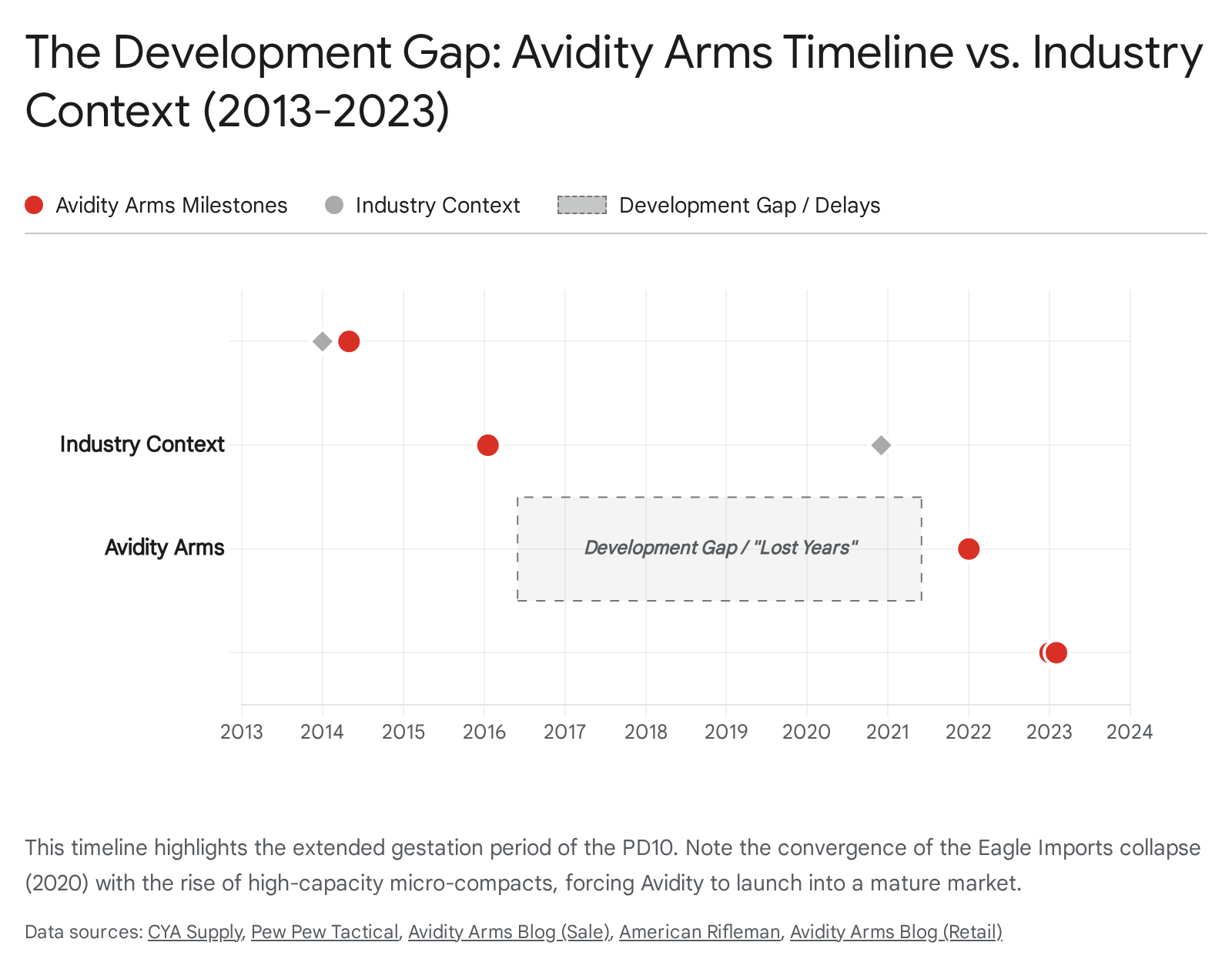
Pincus and Avidity faced significant skepticism. Online forums and social media comments from this era reflect a growing impatience and cynicism from the consumer base.9 The “coming soon” announcements at consecutive SHOT Shows (2016, 2017, 2018, 2019) began to lose their impact. The delay was particularly damaging because the market was not standing still.
- 2015: Glock 43 releases (6 rounds).
- 2018: Sig P365 releases (10 rounds, micro-compact).
- 2019: Glock 43X and 48 release (10 rounds, slimline).
- 2019: Springfield Hellcat releases (11 rounds).
By the time Avidity was dealing with the Eagle Imports collapse, the market gap they intended to fill—a slim 10-round 9mm—had been flooded by major competitors. The Sig P365, in particular, revolutionized the market by offering 10 rounds in a package smaller than the PD10.
5.2 Maintaining the Pulse
Despite the setbacks, Pincus maintained a steady stream of communication. He utilized his personal social media channels and the Personal Defense Network to explain the delays, often citing a refusal to release a sub-par product. “We are at the point where the (PD-10) people shot yesterday is really the production gun,” he stated in 2019, attempting to reassure the market that the finish line was near.7 This transparency helped retain a core group of loyalists, even as the broader market moved on.
6. The Renaissance: The AlphaTech Partnership and Relocation
Rob Pincus and Mike Sodini stood at a crossroads in 2020: dissolve the company or find a completely new way to manufacture the gun. They chose the latter, embarking on a search for a domestic manufacturing partner that would eliminate the reliance on volatile international supply chains.
6.1 Enter AlphaTech and Joe Worley
The solution lay in Fletcher, North Carolina. AlphaTech, a precision manufacturing company run by Joe Worley, was looking to expand its footprint in the firearms industry.
- Legacy of Precision: AlphaTech was not a startup; it was a second-generation manufacturer founded in 1974. Joe Worley had modernized the family business, investing in state-of-the-art CNC machining and automation.4
- Strategic Alignment: AlphaTech had already begun manufacturing firearms parts (likely OEM work for other brands) and ammunition components. They possessed the machinery and the engineering talent but lacked a proprietary brand. Avidity Arms had the brand and the design but lacked the machinery. It was a perfect symbiosis.
6.2 The New Structure (2022)
In 2022, the partnership was formalized. Avidity Arms relocated its headquarters from Florida (where it had briefly established a presence after leaving New Jersey/Eagle Imports) to Fletcher, North Carolina.10
- Ownership Evolution: The ownership team expanded to include Joe Worley (overseeing engineering and manufacturing) and Chuck Usina, a gunsmith and range owner who had been involved in the prototyping phase since 2019.4 This created a balanced leadership triptych: Pincus (Design/Marketing), Sodini (Industry Relations), and Worley (Manufacturing).
Regulatory Reset: Moving a firearms manufacturer is not as simple as renting a new office. It involves obtaining new Federal Firearms Licenses (FFL) and setting up compliant manufacturing processes. This transition period accounted for much of the delay between the Eagle collapse and the 2023 launch.11
6.3 The “Florida” Collectibles
An interesting side effect of this relocation was the creation of an accidental collector’s item. Before the move to North Carolina was finalized, Avidity had produced a small batch of pistol frames stamped with their previous location in Florida. However, due to ATF regulations, once the license moved to NC, the manufacturing location markings had to change. This left a finite number of “Florida-marked” frames in existence, which the company has since marketed as pre-production collectibles for brand enthusiasts.11
7. The PD10 Platform: A Technical and Philosophical Analysis
The PD10 finally reached the commercial market in early 2023. The production model retained the core characteristics of the original vision but featured refined materials and manufacturing processes courtesy of the AlphaTech collaboration.
7.1 Technical Specifications
The PD10 is a striker-fired, polymer-framed pistol. Its dimensions place it in a unique “crossover” category that defies easy classification:
- Caliber: 9mm Luger (initially).
- Barrel Length: 4.0 inches.
- Overall Length: 6.94 inches.
- Width: ~1.0 inch (at the slide).
- Weight: ~18.8 oz (unloaded).
- Capacity: 10+1 rounds (using a proprietary modification of the 1911 9mm magazine geometry).
7.2 The “Active Shooter” Design Doctrine
The PD10 is perhaps the most “opinionated” pistol on the market. Every feature—and every omitted feature—is a deliberate reflection of Rob Pincus’s training doctrine. It is not designed to be modular; it is designed to be correct according to that doctrine.
1. The Slide Stop Philosophy:
Pincus teaches that fine motor skills degrade under stress. Therefore, relying on a small lever to release the slide during a reload is a liability. He advocates for the “overhand rack” method (grabbing the slide and ripping it back). Consequently, the PD10 features a slide stop that is essentially flush with the frame. It acts only as a stop to hold the slide open; it is intentionally difficult to use as a release.12 This forces the user to adopt the gross motor skill method.
2. Sights as Mechanical Tools:
The gun comes standard with “I.C.E. Claw” sights. The rear sight features a steep, concave front face. This is not an aesthetic choice; it is a mechanical one. It allows the user to rack the slide one-handed by hooking the sight against a belt, holster, or shoe heel—a critical capability if one arm is injured in a fight.12
3. The Rejection of Forward Serrations:
In 2023, almost every tactical pistol featured aggressive serrations on the front of the slide to facilitate “press checks” (checking if a round is chambered). The PD10 has a completely smooth front slide. Pincus argues that placing hands near the muzzle for administrative handling is unsafe for the average user. By removing the serrations, the design discourages this behavior and forces manipulation from the rear, which provides more leverage and keeps hands safe.12
4. The “Caveman” Ejector:
A notable feature of the PD10 is its robust extraction and ejection system. Reviews have noted the reliability of the system, often attributing it to the extensive testing and redesigns during the “wilderness years.” The gun utilizes a heavy-duty extractor designed to function even when the gun is dirty or dry, aligning with the “defensive tool” ethos.13
7.3 Market Reception: Validation and Critique
Upon its release, the PD10 faced a polarized reception.
- The “Sneaky Good” Verdict: Experienced shooters and reviewers often found themselves surprised by the gun. Bucky Lawson from Safariland noted that while the gun missed the single-stack trend, it might be the “best of the bunch,” citing its slimness and full grip as a “sneaky good” combination for concealment and control.14 The ability to get a full firing grip on the draw—without the need for magazine extensions—was validated as a significant advantage over the Sig P365 or Hellcat.
- The Trigger Critique: The trigger is often described as “Glock-like” or “utilitarian.” It has a distinct wall and some travel. In an era where Canik and Walther are producing match-grade triggers in carry guns, the PD10’s trigger was criticized by some as feeling dated. Pincus defends this, arguing that a defensive trigger should have travel to prevent negligent discharges under stress.14
- The Capacity Issue: The most common criticism was the capacity. 10 rounds of 9mm in a gun the size of a Glock 19 (roughly) seemed inefficient when the Glock 19 holds 15 and the smaller P365 holds 10-12. This criticism highlighted the primary strategic vulnerability of the PD10: it was physically larger than its capacity suggested it should be, a trade-off made for the sake of ergonomics.
8. The.30 Super Carry Gamble: Innovation or Obscurity?
In 2024, Avidity Arms made a significant strategic move to address the capacity criticism without compromising the slim profile. They announced the adoption of the .30 Super Carry (30SC) cartridge.
8.1 The Logic of the Cartridge
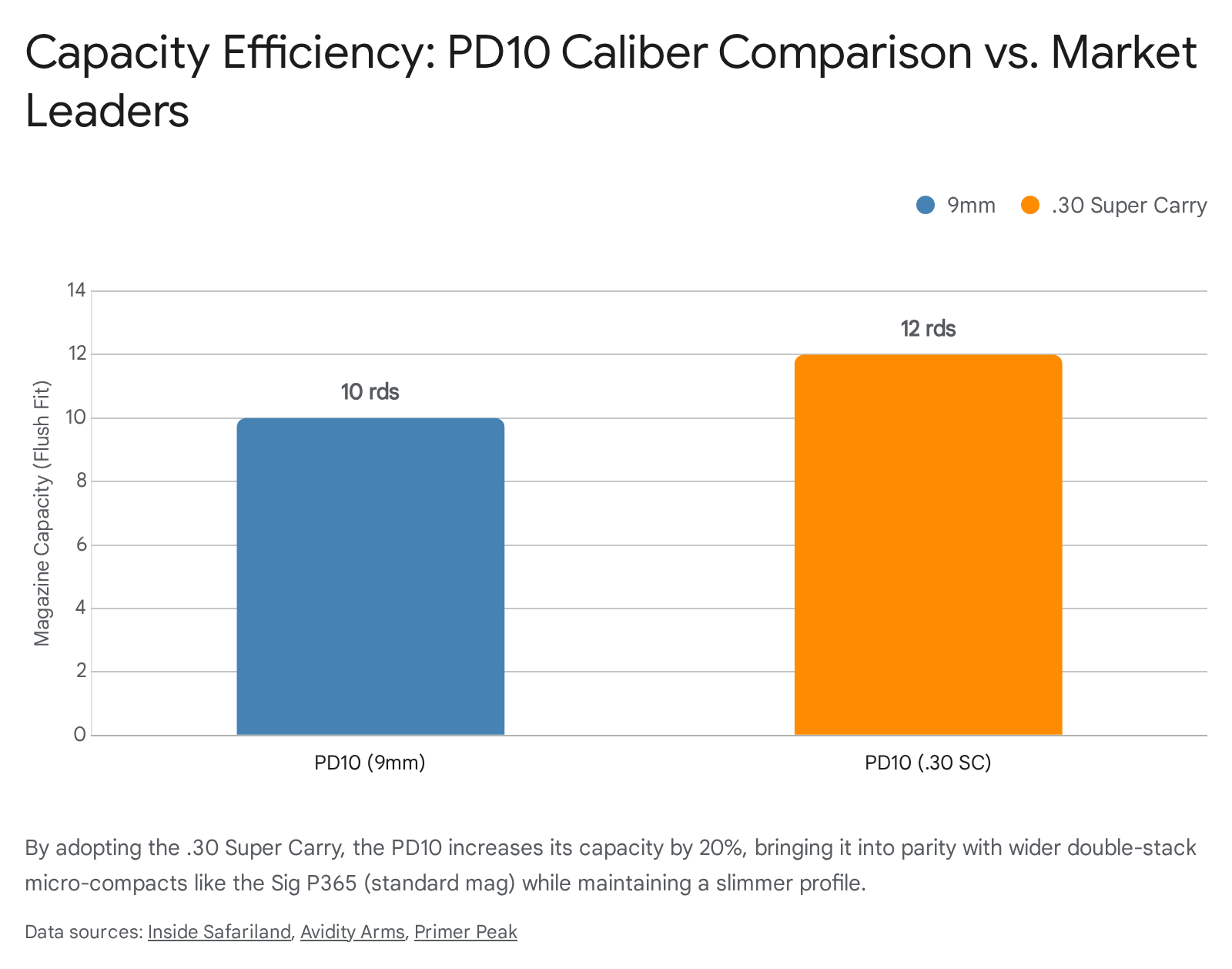
Developed by Federal Premium, the.30 Super Carry was designed to fill the gap between.380 ACP and 9mm. It offers terminal ballistics (penetration and expansion) that effectively match 9mm Luger, but with a smaller case diameter. This allows for roughly 20% more capacity in the same magazine footprint.
For Avidity Arms, the 30SC was a “magic bullet” (figuratively). The PD10’s primary limitation was its single-stack geometry, which limited it to 10 rounds of 9mm. By switching to 30SC, Avidity could fit 12 rounds into the same magazine tube, instantly bringing the gun’s capacity into parity with double-stack micro-compacts like the Sig P365, while retaining the extreme slimness of the single-stack design.15
8.2 The Ballistic Advantage
Avidity touted the PD10 30SC as the “optimal host” for the new caliber. Most other 30SC pistols (like the Shield Plus) had short barrels (3.1 inches). The PD10’s 4-inch barrel allowed the high-pressure 30SC cartridge to achieve its full velocity potential, maximizing the hydrostatic shock and expansion reliability. Gel tests conducted by the company and independent reviewers supported this, showing impressive performance.16
8.3 Strategic Risk
Adopting 30SC is a high-risk strategy. The caliber has struggled to gain widespread traction due to the “chicken and egg” problem: people won’t buy guns for a caliber they can’t find ammo for, and ammo companies won’t make ammo for a caliber no one buys guns for.17 By betting on 30SC, Avidity tied a portion of its future to the success of Federal Premium’s marketing. However, this also positioned them as an innovator and a brand for the “thinking shooter” who prioritizes data over convention.
9. Expanding the Arsenal: The Avidity Semi-Automatic Rifle (A-SAR)
In 2024, Avidity Arms signaled its intent to move beyond being a “one-trick pony” by announcing the Avidity Semi-Automatic Rifle (A-SAR). This move into the saturated AR-15 market was surprising but strategically calculated.
9.1 The Collaborative Model: Avidity x NEMO
Building a high-quality AR-15 requires significant infrastructure. Rather than reinventing the wheel, Avidity collaborated with NEMO Arms, a premium manufacturer famous for their OMEN.300 Win Mag rifles and recoil reduction technologies.
- The Division of Labor: The A-SAR utilizes a NEMO-produced upper receiver (the Battle-Light 2.0 Slim Upper), ensuring reliability and accuracy. The lower receiver, however, is designed and manufactured by Avidity Arms at the AlphaTech facility.18
- The “Avidity Touch”: The lower receiver features distinct ergonomic enhancements. The most notable is the IF Mag Well™ (Internally Funneled Magazine Well). Unlike competition rifles that use massive external flares to guide the magazine, the IF Mag Well machines the funnel geometry inside the standard mag well dimensions. This allows for faster blind reloads without adding bulk that would snag on gear—a purely defensive design choice.18
9.2 Marketing to the Base
Avidity employed a clever loyalty strategy for the A-SAR launch. They offered a “Serial Number Matching” program, allowing existing PD10 owners to pre-order an A-SAR with a serial number that matched their pistol.19 This move accomplished two things:
- Cash Flow: It generated immediate capital through pre-order deposits ($500).
- Brand Loyalty: It solidified the bond with their early adopters, turning them into “Avidity collectors” rather than just customers.
10. Operational Realities in 2025: Manufacturing, Sales, and Logistics
As of 2025, Avidity Arms operates as a stabilized, albeit boutique, manufacturer. The chaos of the Eagle Imports years has been replaced by the steady rhythm of the AlphaTech production line.
10.1 The Boutique Business Model
The production capacity at the Fletcher, NC facility is precise but limited. Avidity is not set up to compete with the volume of Ruger or Smith & Wesson. Instead, they operate on a “batch” production model. This aligns with the boutique nature of their product. They are selling to a specific subset of the market: the student of defensive shooting.
10.2 Distribution Channels
Avidity has established a robust distribution network, primarily through Davidson’s, one of the industry’s largest distributors.20 This partnership is critical. It allows local gun stores (LGS) across the country to order the PD10 without Avidity needing to maintain a massive internal sales force. The “Optic Cut” models, for example, were initially exclusive to Davidson’s, ensuring that the distributor had a vested interest in promoting the brand.
10.3 Brand Engagement
The company continues to rely heavily on Rob Pincus’s personal brand for marketing. Pincus remains the primary face of the company, utilizing the Personal Defense Network and social media to drive awareness. While this is efficient, it also poses a risk: the brand is inextricably tied to one individual. However, the addition of Mike Sodini’s Walk The Talk America advocacy has helped broaden the brand’s appeal, associating Avidity with mental health awareness and responsible ownership, a unique angle in the industry.
11. Future Outlook and Strategic Roadmap
What does the future hold for Avidity Arms? The company has survived its infancy and adolescence, periods that kill most firearms startups. Now, it faces the challenge of maturity.
11.1 Product Expansion
Rob Pincus has publicly discussed plans for a 5-inch “Target/Duty” model of the PD10. Prototypes exist, and the longer slide would further enhance the “shootability” ethos, potentially making the gun viable for IDPA competition or home defense roles where concealment is less critical.16 While there is no official timeline, the modular nature of the design (especially with the metal rail inserts) makes this a logical next step.
11.2 The 30 Super Carry Factor
A significant portion of Avidity’s long-term growth potential is tied to the 30 Super Carry. If the caliber succeeds and gains widespread adoption by law enforcement or more civilians, Avidity will be remembered as a pioneer, and the PD10 30SC will be a highly desirable platform. If the caliber fades into obscurity, Avidity will have a niche variant that appeals only to reloaders and collectors.
11.3 Sustainability
The partnership with AlphaTech provides a high degree of sustainability. Because AlphaTech has other revenue streams (OEM manufacturing), Avidity does not need to sell hundreds of thousands of units a year to keep the lights on. They can afford to be a “slow growth” company, focusing on quality and margin rather than volume. This resilience suggests that Avidity Arms will remain a fixture in the industry, continuing to produce thoughtful, unorthodox tools for the dedicated defensive shooter.
12. Summary of Key Milestones
| Year | Milestone Event | Strategic Significance |
| 2013 | Founding Concept | Rob Pincus and Michael Sodini conceive the idea for a “shootable” single-stack 9mm during a discussion. |
| 2014 | Project Initiation | The “PD10” design is officially established as the company’s first project; partnership with Eagle Imports begins. |
| 2016 | Prototype Debut | The PD10 prototype is unveiled at SHOT Show 2016. It features a polymer frame but encounters durability issues in testing. |
| 2017 | Design Setback | Durability testing reveals failure in polymer rear rails; design is overhauled to include metal rail inserts, delaying production. |
| 2019 | Team Expansion | Chuck Usina joins the ownership team, bringing gunsmithing and prototyping expertise. |
| 2020 | Eagle Imports Closure | Primary partner Eagle Imports shuts down due to financial/supply chain issues; Avidity loses its distribution and logistics arm. |
| 2022 | The AlphaTech Pivot | Joe Worley joins ownership; company relocates to Fletcher, NC. Manufacturing shifts to AlphaTech, securing domestic production capabilities. |
| 2023 | Commercial Launch | The production PD10 officially launches at SHOT Show 2023; first retail sale occurs in New Jersey in January. |
| 2024 | Expansion (30SC & Rifle) | Avidity announces the PD10 in.30 Super Carry and the A-SAR rifle (collab with NEMO Arms) at NRAAM. |
| 2025 | Market Maturation | PD10 establishes stable sales channels; continued promotion of A-SAR and 30SC models; “Florida” marked frames identified as collectibles. |
Works cited
- Design & Engineering Focused on Defense – Avidity Arms, accessed December 29, 2025, https://avidityarms.com/design-engineering-focused-on-defense/
- Avidity Arms PD10 – GUNS Magazine, accessed December 29, 2025, https://gunsmagazine.com/guns/avidity-arms-pd10/
- Rob Pincus | Personal Defense Network, accessed December 29, 2025, https://www.personaldefensenetwork.com/post/rob-pincus
- The Avidity Arms Story and Our Ownership Team, accessed December 29, 2025, https://avidityarms.com/avidity-arms-information-page/
- Eagle Imports: 1988-2020 | An Official Journal Of The NRA – American Rifleman, accessed December 29, 2025, https://www.americanrifleman.org/content/eagle-imports-1988-2020/
- [SHOT ’17] Avidity Arms PD10 Pistol Debut – The Firearm Blog, accessed December 29, 2025, https://www.thefirearmblog.com/blog/2017/01/15/avidity-arms-pd10/
- Rob Pincus offers update on Avidity Arms PD-10 – Guns.com, accessed December 29, 2025, https://www.guns.com/news/2019/01/23/rob-pincus-offers-update-on-avidity-arms-pd-10
- New Bersa Importer/Distributor – Reddit, accessed December 29, 2025, https://www.reddit.com/r/Bersa/comments/ogtutt/new_bersa_importerdistributor/
- What Happened to the Avidity Arms PD10? – Pew Pew Tactical, accessed December 29, 2025, https://www.pewpewtactical.com/what-happened-avidity-arms-pd10/
- The First PD10 Sold at retail… in New Jersey! – Avidity Arms, accessed December 29, 2025, https://avidityarms.com/the-first-pd10-sold-at-retail-in-new-jersey/
- Florida Marked PD10 Pistols will be Rare. – Avidity Arms, accessed December 29, 2025, https://avidityarms.com/florida-marked-pd10-pistols-will-be-rare/
- Avidity Arms attacks compact, striker-fired pistol market with PD10 (PHOTOS) – Guns.com, accessed December 29, 2025, https://www.guns.com/news/2017/01/21/3049025
- Shooter’s Log Reviews the PD10! – Avidity Arms, accessed December 29, 2025, https://avidityarms.com/shooters-log-reviews-the-pd10/
- Purpose Built: The Avidity Arms PD10 Concealed Carry Pistol – Inside Safariland, accessed December 29, 2025, https://inside.safariland.com/blog/purpose-built-the-avidity-arms-pd10-concealed-carry-pistol/
- 30 Super Carry PD10 Pistol – Avidity Arms, accessed December 29, 2025, https://avidityarms.com/30-super-carry-pd10/
- Avidity Arms PD10 in .30 Super Carry Review [2024] – Primer Peak, accessed December 29, 2025, https://www.primerpeak.com/avidity-arms-pd10-in-30-super-carry-review/
- Thoughts on 30 Super Carry : r/liberalgunowners – Reddit, accessed December 29, 2025, https://www.reddit.com/r/liberalgunowners/comments/1bh3dn2/thoughts_on_30_super_carry/
- Avidity Semi-Automatic Rifle, accessed December 29, 2025, https://avidityarms.com/a-sar/
- A-SAR with PD10 Serial Number Match PRE-ORDER – Avidity Arms, accessed December 29, 2025, https://avidityarms.com/product/a-sar-with-pd10-serial-number-match-pre-order/
PD10 Sale Date Announced! – Avidity Arms, accessed December 29, 2025, https://avidityarms.com/pd10-sale-date-announced/