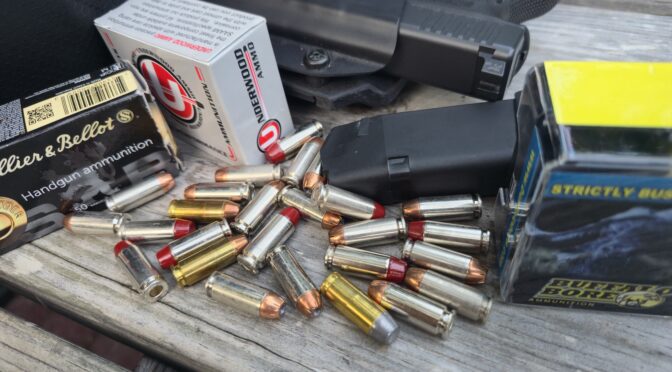
The 10mm Auto cartridge represents a singular anomaly within the contemporary small arms market. In an era dominated by the standardization of the 9x19mm Parabellum—a trend driven by advancements in projectile technology and a doctrinal shift toward capacity and shootability—the 10mm Auto has not only survived its mid-1990s obsolescence but has entered a period of robust resurgence. This report provides a comprehensive industry analysis of the cartridge, assessing its engineering merits, ballistic capabilities, and the sociological factors driving its fervent “cult” following.
From a technical perspective, the 10mm Auto is a high-pressure, high-velocity cartridge designed to bridge the gap between the lethality of the.357 Magnum revolver and the capacity of the semi-automatic pistol. Operating at a SAAMI maximum average pressure of 37,500 psi, the cartridge is capable of driving 200-grain projectiles at velocities exceeding 1,200 feet per second (fps), generating muzzle energy figures that eclipse standard service calibers by margins of 50% to 80%.1 This performance, however, comes at the cost of increased recoil impulse, accelerated airframe wear, and a higher cost of training.
The “cult” status of the 10mm Auto is not merely a product of contrarian consumerism but is rooted in a specific operational requirement: the need for a “do-it-all” sidearm capable of effectively neutralizing both human threats and large North American predators. The market’s shift toward “backcountry defense” pistols has validated the 10mm’s existence, creating a functional monopoly for the cartridge in the semi-automatic sector where.45 ACP lacks the penetration and 9mm lacks the mass.
Despite its merits, the cartridge remains bifurcated. The market is split between “FBI Lite” training loads that mimic the.40 S&W and “Nuclear” full-power loads that realize the cartridge’s true potential. This report concludes that while the 10mm Auto is overkill for standard urban defense and presents a steeper learning curve for the average shooter, its engineering capabilities justify the hype for the specific demographic of “tactical hunters” and rural defense practitioners who require magnum performance in a high-capacity platform.
1. Introduction: The Anomalous Position of the 10mm Auto
In the taxonomy of handgun cartridges, the 10mm Auto (10x25mm) occupies a polarizing niche. It is too powerful for the average police recruit to master quickly, yet arguably too light for hunting truly dangerous game compared to magnum revolvers. And yet, it persists. To understand the 10mm Auto is to understand a rejection of compromise. The modern firearms industry has largely coalesced around the concept of “good enough”—the idea that modern 9mm terminal ballistics are sufficient for law enforcement and civilian defense, allowing for lighter firearms and higher capacity. The 10mm Auto stands in direct opposition to this doctrine.
This report analyzes the cartridge through the dual lenses of the engineer and the industry analyst. The engineer sees a fascinating exercise in internal ballistics: a case capacity designed to push heavy projectiles at supersonic velocities, challenging the structural integrity of the tilting-barrel locking system. The analyst sees a market phenomenon: a product that failed its initial institutional adoption (the FBI) but was rescued by a dedicated user base that valued raw performance over logistical ease.3
The “cult” of the 10mm is often dismissed as internet meme culture, typified by slogans like “10mm is Best Millimeter”.5 However, our analysis suggests this enthusiasm is grounded in tangible performance metrics. The 10mm Auto offers a ballistic profile that is flatter shooting than the.45 ACP and more destructive than the 9mm, effectively duplicating the performance of the.357 Magnum in a platform that holds 15 rounds rather than six.6 This combination of power and capacity creates a unique value proposition that no other mainstream caliber currently matches.
2. Historical Engineering and Doctrinal Evolution
The 10mm Auto is not just a cartridge; it is the physical manifestation of a specific combat philosophy. Its history is a sequence of theoretical optimization followed by collision with logistical reality.
2.1 The Theoretical Ideal: Cooper’s Concept
The spiritual father of the 10mm Auto is Colonel Jeff Cooper, the founder of Gunsite Academy and a seminal figure in modern pistolcraft. Cooper was a staunch advocate of the.45 ACP but recognized its limitations, specifically its “rainbow” trajectory at extended ranges and its inability to defeat intermediate barriers.8 In the 1970s, Cooper envisioned a “Combat Service Pistol” (CSP) that would fire a.40 caliber projectile (10mm). His theoretical ideal was a 200-grain bullet traveling at 1,000 fps. This specification was calculated to provide optimal sectional density for penetration and sufficient energy transfer at 50 yards to neutralize a human adversary decisively.9
Cooper’s logic was sound: a.40 caliber bullet offers a frontal area advantage over the 9mm (.355″) while maintaining a higher ballistic coefficient than the stubby.45 ACP (.452″). Ideally, this cartridge would be “the one gun” solution—flatter shooting than a.45, harder hitting than a 9mm, and holding more rounds than a 1911.
2.2 The “Hot-Rodding” by Norma
When the concept moved from Cooper’s theory to manufacturing reality, the execution was handed to FFV Norma AB of Sweden. Norma, unconstrained by the conservative pressure standards of American ammunition manufacturers of the era, looked at the case capacity of the proposed 10x25mm shell and saw wasted potential in Cooper’s 1,000 fps specification.
Norma’s engineers “hot-rodded” the design. The initial production loads released in 1983 drove a 200-grain bullet at 1,200 fps and a 170-grain bullet at 1,300 fps.8 This was a radical departure from Cooper’s concept. Instead of a “heavy, flat-shooting service round,” Norma created a semi-automatic magnum. The energy levels jumped from the intended ~450 ft-lbs to over 650 ft-lbs. While this delighted ballistic enthusiasts, it fundamentally altered the recoil characteristics of the platform, creating a violent impulse that would later plague the cartridge’s adoption.9

2.3 The Bren Ten Debacle
The delivery vehicle for this new cartridge was the Bren Ten, manufactured by Dornaus & Dixon. Based on the highly regarded CZ-75 design, the Bren Ten was scaled up to handle the 10mm’s pressure. However, the company faced insurmountable hurdles. The magazines, manufactured in Italy, were prone to deformation and were often not delivered with the pistols, leading to the infamous situation of customers owning expensive paperweights.3
The bankruptcy of Dornaus & Dixon in 1986 should have killed the 10mm Auto. Historically, proprietary cartridges die with their host guns (e.g., the.41 Action Express). That the 10mm survived is a testament to the sheer ballistic appeal of the cartridge. Colt’s decision in 1987 to chamber the Delta Elite (a standard Government Model 1911) in 10mm Auto was the critical lifeline.3 It legitimized the round, moving it from “exotic prototype” to “industry standard,” albeit a niche one.
2.4 The FBI Miami Shootout and the “Lite” Load
The pivotal event in 10mm history was the 1986 FBI Miami Shootout. Two bank robbers, despite being hit multiple times with 9mm and.38 Special rounds, continued to fight, killing two agents and wounding five others.3 The subsequent forensic analysis concluded that the 9mm rounds had failed to penetrate deeply enough to reach vital organs. The FBI Firearms Training Unit (FTU) sought a replacement with superior terminal ballistics.
The 10mm Auto was selected for its ability to penetrate automotive glass and heavy clothing while retaining lethal energy. However, when the FBI issued 10mm pistols (the Smith & Wesson Model 1076) to the field, reality set in. The recoil of full-power Norma loads was unmanageable for the average agent, leading to slow follow-up shots and low qualification scores.3
The FBI’s solution was to download the cartridge. They requested a load driving a 180-grain bullet at 980 fps—essentially duplicating Cooper’s original concept but well below the cartridge’s potential.11 This became known as the “FBI Lite” load. Engineers at Smith & Wesson and Winchester quickly realized that this reduced performance did not require the long 25mm case of the 10mm Auto. By shortening the case to 22mm, they could fit the round into a smaller frame (9mm size) while matching the FBI’s ballistic requirement. Thus, the.40 S&W was born.4
The birth of the.40 S&W effectively relegated the 10mm Auto to obsolescence in the law enforcement sector. However, it inadvertently fueled the “cult” status of the 10mm. To the enthusiast, the.40 S&W was a “neutered” cartridge, a symbol of bureaucratic compromise and weakness. The 10mm became the badge of the ballistically literate—the shooter who could handle the power that the FBI could not.
3. Engineering the 10mm: Internal Ballistics & Architecture
To assess the merit of the 10mm Auto, one must analyze the physics of its construction. It is a cartridge defined by high pressure and significant case capacity, creating unique challenges for firearm designers and reloaders.
3.1 SAAMI Specifications and Case Dynamics
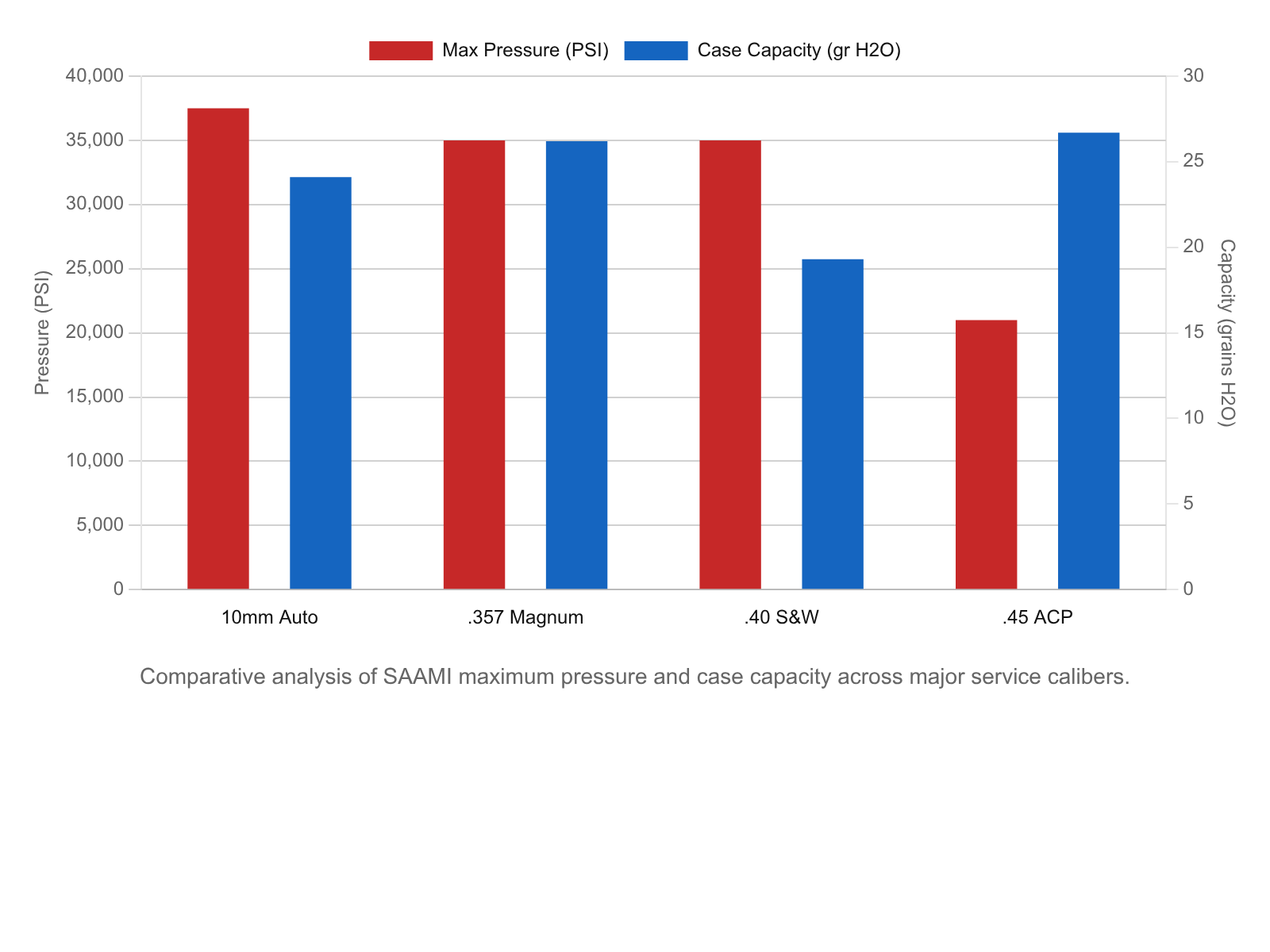
The Sporting Arms and Ammunition Manufacturers’ Institute (SAAMI) sets the maximum average pressure for the 10mm Auto at 37,500 psi.1 This is a critical figure. It places the 10mm in the same pressure tier as the.357 SIG and significantly higher than the.45 ACP (21,000 psi) and the standard.40 S&W (35,000 psi).
Table 1: Comparative Engineering Specifications
| Specification | 10mm Auto | .45 ACP | .40 S&W | .357 Magnum |
| Max Pressure (SAAMI) | 37,500 psi | 21,000 psi | 35,000 psi | 35,000 psi |
| Case Length | 0.992 in | 0.898 in | 0.850 in | 1.290 in |
| Bullet Diameter | 0.400 in | 0.451 in | 0.400 in | 0.357 in |
| Case Capacity (H2O) | ~24.1 gr | ~26.7 gr | ~19.3 gr | ~26.2 gr |
| Base Diameter | 0.425 in | 0.476 in | 0.424 in | 0.379 in |
| Primer Type | Large Pistol | Large Pistol | Small Pistol | Small Pistol |
Figure 1: Cartridge Dimensions Comparison
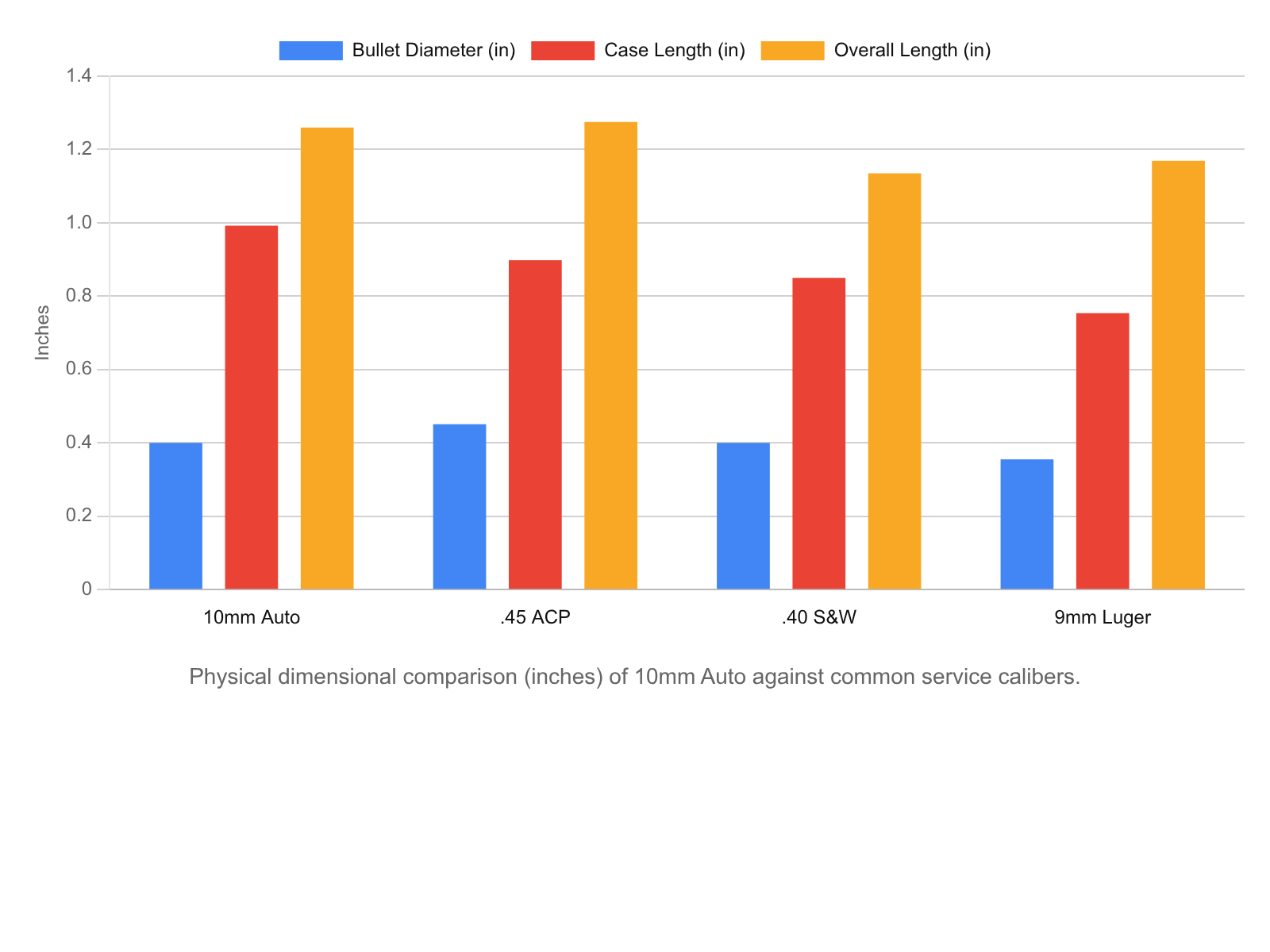
Figure 2: Comparative Engineering Specifications
The engineering challenge here is the combination of pressure and case geometry. The 10mm uses a Large Pistol primer, unlike the Small Pistol primer used in the.40 S&W and most 9mm loads. This larger primer pocket reduces the amount of brass available at the case web (the base of the cartridge), which is the critical failure point in high-pressure rounds.
3.2 The “Glock Smile” and Chamber Support
A defining technical issue for the 10mm Auto is the phenomenon known as the “Glock Smile.” This refers to a distinct bulge found on the case web of brass fired from early generations of Glock pistols (specifically the Glock 20 and 29).15
In a tilting-barrel locking system (modified Browning), a feed ramp is cut into the bottom of the chamber to facilitate the feeding of the cartridge from the magazine into the barrel. To ensure reliability with various bullet shapes, engineers often cut this feed ramp deeply, intruding into the chamber support. In a low-pressure round like the.45 ACP, this is negligible. However, with the 10mm operating at 37,500 psi, the brass case acts as a gasket. If a portion of the case web is unsupported by the steel chamber wall during peak pressure, the brass yields, bulging outward.16
This bulge weakens the brass, making it dangerous to reload. While catastrophic case ruptures (“Kabooms”) are rare with factory ammunition, they remain a genuine concern for reloaders pushing the limits with “nuclear” loads. This engineering compromise—reliability vs. case support—has driven a thriving aftermarket for fully supported barrels from manufacturers like KKM and Bar-Sto, which 10mm enthusiasts often install to safely shoot maximum-pressure heavy loads.17
3.3 Reloading Nuances and Powder Selection
The 10mm Auto is a favorite among handloaders because of the versatility provided by its case capacity. Unlike the.40 S&W, which is often compressed with heavy bullets, the 10mm offers room for slower-burning powders that maximize velocity without spiking peak pressure too early in the curve.18
- Blue Dot: A classic powder for 10mm, known for producing impressive velocities and a massive muzzle flash (“fireballs”). It offers excellent case fill but can be temperature sensitive.18
- Longshot: A modern favorite, allowing for high velocities (1,250+ fps with 180gr) while maintaining manageable pressures. It is often cited as the “go-to” for mimicking full-power factory loads.18
- Accurate #9: Preferred for the heaviest loads (200gr-220gr) due to its slow burn rate, enabling high energy numbers for bear defense loads.18
The reloader essentially holds the key to the 10mm’s potential. While factory “FBI Lite” ammo renders the 10mm ballistically identical to the.40 S&W, the reloader can unlock the “magnum” performance that defines the cartridge’s engineering merit.
4. External Ballistics: The Trajectory of Power
The “cult” following often claims the 10mm Auto is “flat shooting.” An analysis of the external ballistics confirms that compared to its big-bore peers, the 10mm offers a significantly more forgiving trajectory, extending the effective range of the service pistol.
4.1 Trajectory Comparison
The standard.45 ACP (230gr at 850 fps) has a trajectory akin to a mortar round at extended handgun distances. In contrast, a full-power 10mm (180gr at 1,250 fps) flies much flatter.
Table 2: Trajectory Drop (Zeroed at 25 Yards)
| Cartridge | Load | Muzzle Vel. | 50 Yards | 75 Yards | 100 Yards |
| 10mm Auto | 180gr FMJ | 1,250 fps | +0.7″ | -1.5″ | -4.5″ |
| .45 ACP | 230gr FMJ | 850 fps | +1.4″ | -3.5″ | -12.3″ |
| 9mm Luger | 115gr FMJ | 1,150 fps | +0.9″ | -2.1″ | -7.0″ |
Figure 3: Trajectory Drop Comparison
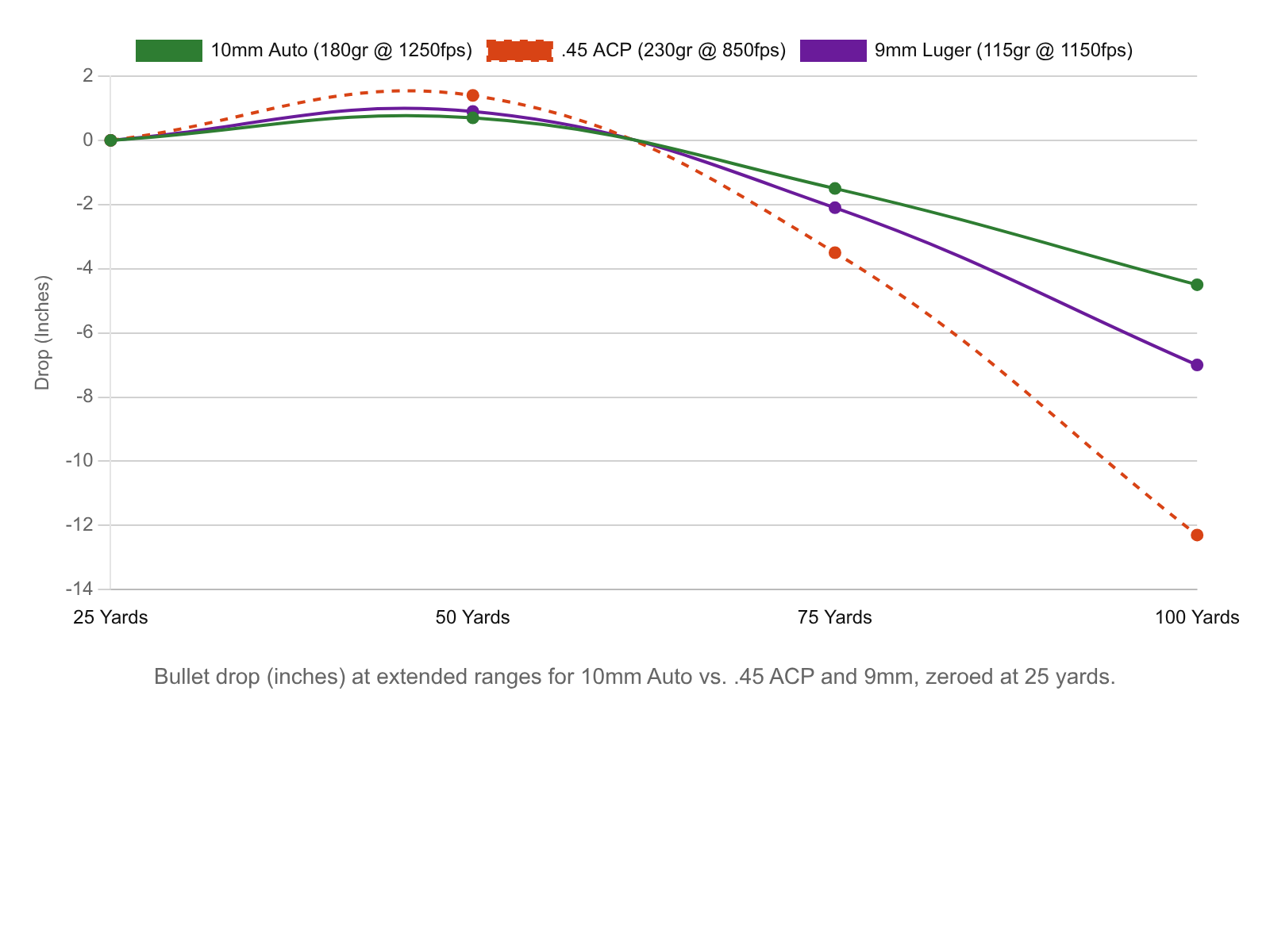
At 100 yards, the difference is stark. A 10mm shooter holds virtually on target (a mere 4-inch drop is mechanically negligible for a torso-sized target with iron sights), while the.45 ACP shooter must compensate for a foot of drop. This capability is what allows 10mm platforms like the Glock 40 MOS (6-inch barrel) to be viable hunting tools for deer and hogs at ranges where other service calibers would be unethical.23
4.2 Energy Density and Retention
Energy is where the 10mm Auto merits the hype. The “magnum” threshold is generally considered to be around 500 ft-lbs of energy. The 10mm comfortably exceeds this, with standard full-power loads generating between 600 and 750 ft-lbs.6
Table 3: Muzzle Energy Comparison
| Cartridge | Bullet Weight | Velocity | Energy (ft-lbs) | Relative Power Factor |
| 10mm Auto (Underwood) | 135gr | 1,600 fps | 768 | 100% (Baseline) |
| 10mm Auto (Buffalo Bore) | 220gr | 1,200 fps | 703 | 92% |
| .357 Magnum | 158gr | 1,400 fps | 688 | 90% |
| .45 ACP +P | 230gr | 950 fps | 461 | 60% |
| 9mm +P | 124gr | 1,200 fps | 396 | 52% |
| .40 S&W | 180gr | 1,000 fps | 400 | 52% |
Figure 4: Muzzle Energy Comparison
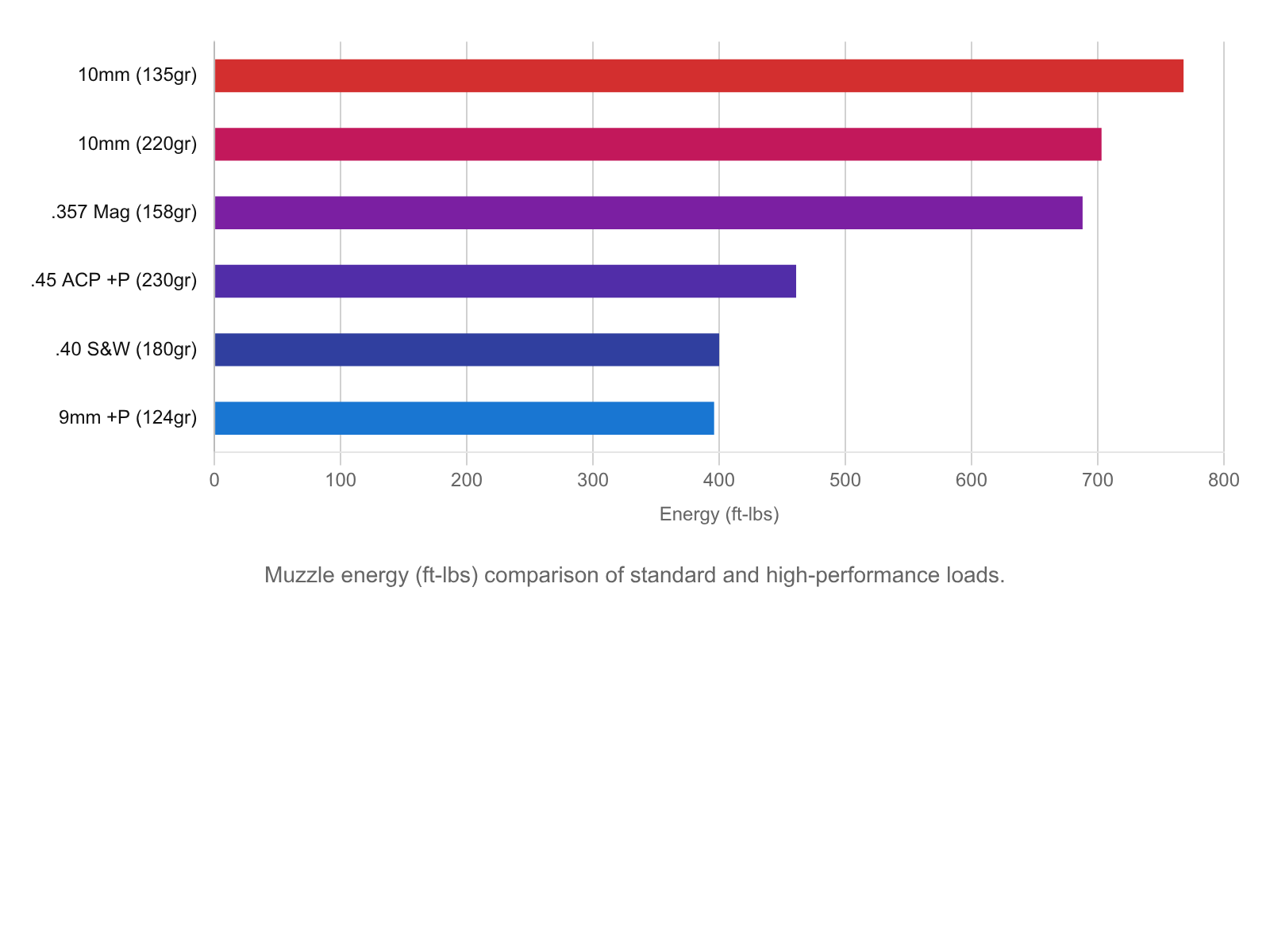
The data reveals that a high-performance 10mm load offers nearly double the kinetic energy of a standard 9mm or.40 S&W defensive load. Furthermore, it eclipses the.45 ACP +P by a significant margin (~250 ft-lbs). This energy density allows the 10mm to impart massive hydrostatic shock and damage to tissue that lesser calibers rely solely on crush-cavities to achieve.
5. Terminal Performance: The Mechanics of Lethality
The allure of the 10mm Auto is not just paper ballistics; it is the terminal effect. However, the application of this power requires a nuanced understanding of projectile selection. The cartridge excels in two distinct, almost contradictory roles: urban defense and wilderness protection.
5.1 The Urban Load: Controlled Expansion
For defense against human threats, the primary concern is over-penetration. A 10mm bullet moving at 1,300 fps will pass through a human target with significant retained energy, posing a risk to bystanders. Therefore, urban loads prioritize rapid expansion to dump energy quickly.
- Hornady Critical Duty (175gr FlexLock): Designed for the FBI protocol, this round uses a polymer tip to prevent clogging and control expansion. It penetrates 12-18 inches in gelatin but expands reliably, mitigating over-penetration risks.27
- Speer Gold Dot (200gr): A bonded core projectile that retains weight well. Even at 10mm velocities, the bonding prevents the jacket from separating, ensuring the bullet holds together to create a wide wound channel.29
In this role, the 10mm is arguably “overkill.” While it expands more aggressively than a 9mm, the difference in incapacitation time for a thoracic hit is marginal compared to the increased recoil and reduced split times. The analyst concludes that for pure anti-personnel use, the 10mm offers diminishing returns over modern 9mm +P.
5.2 The Wilderness Load: The “Nuclear” Option
This is the domain where the 10mm has no peer in the semi-automatic world. The “Backcountry Defense” market requires a bullet that will not expand. When facing a brown bear or moose, expansion is a liability; it slows the bullet down before it can reach vital organs protected by thick hide, heavy muscle, and dense bone.30
The solution is the Hard Cast Lead bullet. These projectiles are cast from lead alloys with high antimony content, achieving a Brinell hardness of 21 or higher (compared to ~6 for pure lead). They do not deform. They function as solid penetrators.
- Buffalo Bore 220gr Hard Cast: This load, leaving the muzzle at ~1,200 fps, is designed to crush through bone. Independent testing consistently shows penetration depths exceeding 36 inches in ballistic gelatin and synthetic media.24
- Momentum vs. Energy: While a lighter bullet might have more kinetic energy ($1/2 mv^2$), the heavy 220gr bullet has superior momentum ($p = mv$). Momentum is the driver of penetration. The high sectional density of the 220gr.40 caliber bullet allows it to track straight through tissue without deflecting, a critical requirement when shooting at a charging animal’s skull or shoulder.31
This capability validates the 10mm’s “cult” status. It allows a hiker to carry a Glock 20 with 15 rounds of bear-capable ammunition in a package weighing ~40 ounces loaded. The alternative—a.44 Magnum revolver—holds 6 rounds and weighs significantly more (or has punishing recoil in a lightweight frame). The engineering efficiency of the 10mm platform in this role is undeniable.
6. Platform Engineering: Taming the Centimeter
The 10mm cartridge is abusive. Its recoil impulse and slide velocity exert forces on the firearm that can lead to rapid wear or catastrophic failure if not properly managed. This section analyzes how different platforms engineer solutions to the “10mm Problem.”
6.1 Slide Velocity and Dwell Time
In a recoil-operated pistol, the slide must remain locked to the barrel until the bullet leaves the muzzle and pressure drops to safe levels. The 10mm’s high pressure accelerates the slide violently. If the recoil spring is too weak, the slide will unlock too early (risking case rupture) or slam into the frame stops with excessive force (frame battering).32
Standard 1911s in.45 ACP use a 16lb recoil spring. Converting to 10mm often requires increasing this to 20-24lbs.32 However, heavy springs make the slide difficult to rack and can cause “nose-dive” feeding malfunctions.
6.2 The Colt Delta Elite and Frame Stress
When Colt introduced the Delta Elite, early models suffered from stress cracks in the frame rails near the slide stop cut. The force of the slide impact was simply too great for the standard metallurgy and geometry of the 1911 frame. Colt solved this by removing the bridge of metal above the slide stop cutout (the “rail cut”), allowing the frame to flex slightly without cracking.3 Modern Delta Elites also use a dual-recoil spring system to progressively decelerate the slide, a feature borrowed from the compact Officer’s model.34
6.3 The Polymer Advantage: Glock 20/29
Glock’s dominance in the 10mm market is partly due to material science. The polymer frame of the Glock 20 acts as a shock absorber. High-speed video analysis shows the frame flexing significantly during firing. This flex dissipates a portion of the recoil energy that would otherwise be transferred directly to the shooter’s wrist or the slide rails.35 This makes the Glock 20 one of the most durable and “softest shooting” 10mm platforms despite its light weight.36
6.4 Advanced Mitigation: Rotating Barrels and DPM
Innovations continue to emerge to tame the 10mm:
- Grand Power P40 (Rotating Barrel): Instead of the barrel tilting down to unlock, the P40’s barrel rotates on a helical cam. This rotation consumes energy. The torque generated by the bullet engaging the rifling works against the rotation of the barrel, delaying unlocking. This system converts some of the recoil energy into angular momentum, creating a flatter, smoother recoil impulse that reduces muzzle flip.38
- DPM Mechanical Recoil Systems: These aftermarket guide rods use a multi-spring “telescopic” design. As the slide moves rearward, it engages progressively stiffer springs. This ensures reliable unlocking (light initial resistance) but prevents frame battering (heavy terminal resistance) at the end of the stroke. Engineering analysis suggests these systems are highly effective for 10mm, protecting the frame and reducing felt recoil.40
7. Contemporary Platforms and Market Analysis
The 2024-2025 market has seen a resurgence of 10mm platforms, moving beyond the legacy Glock and 1911 options.
7.1 The Standard Bearers: Glock
The Glock 20 Gen 5 MOS remains the industry baseline. With a 15-round capacity and a loaded weight of ~39oz, it is the workhorse of the genre. The introduction of the MOS (Modular Optic System) acknowledges the modern requirement for red dot sights, which are particularly useful for the distances 10mm is capable of reaching.37 The Glock 40 MOS (6-inch barrel) is a specialized hunting tool, squeezing an extra ~50-100 fps out of the cartridge due to longer burn time.43
7.2 The Tactical Contenders: FN and Sig
- FN 510 Tactical: This pistol is currently disrupting the market. FN engineered it from the ground up for the 10mm, rather than scaling up a 9mm/45. It features a massive 22+1 capacity (with extended mag), a threaded barrel for suppressors/compensators, and suppressor-height sights. It addresses the “Glock Smile” issue with a fully supported chamber, making it safer for nuclear loads.23
- Sig Sauer P320-XTEN: Using the modular FCU chassis, the XTEN features a heavy bull barrel and X-Series ergonomics. At 33oz empty, it is relatively light but uses a specialized recoil system. However, market reports indicate some magazines struggle with the varied Overall Length (OAL) of 10mm reloads, specifically wide flat-nose hard cast bullets binding in the mag body.45
7.3 The 1911 Legacy
- Springfield XD-M Elite: A polymer competitor to Glock, offering 16+1 capacity and a “META” trigger that is superior to the Glock’s stock trigger. It has gained a reputation for reliability and ergonomic comfort.47
- Colt Delta Elite Rail: The classic option. Heavy steel (38oz empty) soaks up recoil, but the 8-round capacity is a significant limitation in the modern era. It is a “barbecue gun”—beautiful and functional, but technologically surpassed.34
Table 4: Flagship Platform Comparison
| Model | Capacity | Barrel Length | Weight (Empty) | Price (MSRP) | Key Feature |
| FN 510 Tactical | 22+1 | 4.71″ | 32.0 oz | ~$1,139 | Highest Capacity |
| Glock 20 Gen 5 | 15+1 | 4.61″ | 27.3 oz | ~$620 | Reliability Standard |
| Sig P320-XTEN | 15+1 | 5.0″ | 33.0 oz | ~$800 | Bull Barrel / Modular |
| Springfield XD-M | 16+1 | 4.5″ | 31.0 oz | ~$653 | High Value / Ergo |
| Colt Delta Elite | 8+1 | 5.0″ | 38.0 oz | ~$1,299 | Classic Steel / Trigger |
Data Sources: 23
8. The Cult of the Ten: Market Psychology & Sociology
The “cult” status of the 10mm Auto is a fascinating case study in consumer psychology. It is driven by a mix of objective performance needs and subjective identity signaling.
8.1 The “Best Millimeter” Narrative
The internet meme “10mm is Best Millimeter” is ubiquitous in gun forums.5 This slogan encapsulates a rejection of the 9mm. While the industry (FBI, military, police) has standardized on 9mm for its shootability and capacity, the 10mm user views this as a compromise. The 10mm enthusiast identifies as a shooter who does not need the “crutch” of low recoil. They are willing to master the snappy impulse of the 10mm to gain the ballistic advantage.
8.2 The “Do-It-All” Mythos
The strongest driver of the cult is the versatility argument. A 10mm owner believes they possess the “One Gun” that can do everything.
- Home Defense? Load it with 135gr Underwood JHP (1,600 fps) for explosive fragmentation.25
- Range Day? Load it with cheap 180gr FMJ (downloaded to.40 S&W specs).
- Elk Hunting? Load it with 220gr Hard Cast.
This versatility is unmatched. A 9mm cannot hunt elk; a.44 Magnum cannot easily be concealed for self-defense. The 10mm sits in the “Goldilocks” zone of maximum power in a carry-able package.52
8.3 Disdain for the.40 S&W
A core tenet of the 10mm cult is a disdain for the.40 S&W. The.40 is viewed as the “Short & Weak”—a cartridge born from the FBI’s inability to handle the 10mm. Carrying a 10mm is a symbolic rejection of that failure. It is an assertion of ballistic dominance. This rivalry fuels sales, as users will often choose 10mm over.40 simply to avoid the stigma of the “compromise” round.4
9. Comparative Economics and Logistics
While engineering and psychology favor the 10mm, economics is the gatekeeper.
9.1 The “Magnum Tax”
Shooting 10mm is expensive. An analysis of 2025 bulk ammo prices shows a stark contrast.
Table 5: Ammunition Cost Analysis (2025)
| Caliber | Bulk FMJ (per round) | Premium Defensive (per round) | Nuclear/Bear (per round) |
| 10mm Auto | $0.40 – $0.50 | $1.50 – $2.00 | $2.00 – $2.50 |
| 9mm Luger | $0.22 – $0.25 | $1.00 – $1.25 | N/A |
| .45 ACP | $0.38 – $0.45 | $1.25 – $1.50 | N/A |
Training with 10mm costs roughly double that of 9mm. Furthermore, affordable bulk 10mm is often loaded to “FBI Lite” specs (180gr at 1,030 fps), which means the user is paying a premium for.40 S&W performance in a longer case.29 To train with true full-power ammo, the cost skyrockets. This ensures that the 10mm user base remains composed of dedicated enthusiasts with higher disposable income or specific needs (hunters), filtering out the casual gun owner.
9.2 The Reloader’s Advantage
The high cost of factory ammo makes 10mm a premier cartridge for reloaders. By reloading fired brass, an enthusiast can produce full-power “nuclear” loads for roughly the cost of factory 9mm ($0.25-$0.30). This economic loophole strengthens the cult; the barrier to entry (reloading equipment and knowledge) acts as a rite of passage, creating a community of knowledgeable, technical shooters who share load data for powders like Longshot and Blue Dot.15
10. Conclusion: Verdict on the Hype
Does the 10mm Auto merit the hype?
Yes, but with qualifications.
From an engineering standpoint, the 10mm Auto is a triumph. It successfully packages magnum-level energy (700+ ft-lbs) into a semi-automatic platform that is concealable and reliable. It offers a ballistic coefficient and sectional density profile that allows for legitimate hunting applications out to 100 yards, something no other common service caliber can claim.
From a market standpoint, the hype is justified by the “Backcountry Defense” niche. For the hiker, fisherman, or rural resident, the 10mm offers the best balance of firepower and portability in existence. It renders the heavy.44 Magnum revolver obsolete for all but the largest coastal brown bears.
However, for general urban defense, the hype is overstated. The recoil penalty, blast, and cost make it less efficient than a 9mm for the average engagement. The 10mm is a specialist’s tool masquerading as a generalist’s sidearm.
The “cult” following is rational. It is a community that values the potential of their equipment. They accept the higher cost and recoil in exchange for the knowledge that, should they need to penetrate a car door or stop a charging bear, their “Best Millimeter” is capable of the task. In a world of compromises, the 10mm Auto remains the defiant option for those who refuse to settle.
| Note: The author is huge fan of the 10mm cartridge. There is such a thing as using the right tool, or cartridge, for a given situation. There is a time and a place for 10mm and a time and a place where other calibers are a better choice. |
Appendix: Methodology
This report was constructed using a comprehensive analytical framework combining historical review, technical specification analysis, and market sentiment evaluation.
- Literature Review: A dataset of 123 research snippets was analyzed, covering historical articles (Guns & Ammo, American Rifleman), technical specifications (SAAMI, Wikipedia), and market reviews (Lucky Gunner, Pew Pew Tactical).
- Engineering Analysis:
- Internal Ballistics: Pressure curves and case capacities were compared using SAAMI data and reloading manual excerpts (Hornady, Lyman).
- External Ballistics: Trajectory and energy tables were calculated based on manufacturer-published velocity data (Buffalo Bore, Underwood, Federal) normalized for barrel length (5″).
- Mechanical Systems: Recoil mitigation strategies (spring rates, rotating barrels) were evaluated based on engineering principles of impulse and momentum.
- Market Assessment:
- Product Landscape: Current firearm offerings (2024-2025) were categorized by features, capacity, and price to determine market trends.
- Cost Analysis: Ammunition prices were aggregated from bulk suppliers (BulkAmmo, LuckyGunner) to establish the economic “cost of ownership.”
- Sentiment Analysis: “Cult” behavior was assessed through qualitative analysis of user discussions on forums (Reddit r/10mm, r/guns) to identify psychological drivers (memes, identity signaling).
- Comparative Matrix: The 10mm was systematically compared against its three primary competitors (.45 ACP,.40 S&W, 9mm) across key metrics: Energy, Capacity, Recoil, and Cost.
This methodology ensures that the conclusions presented are not merely opinion, but are supported by verifiable technical data and observable market phenomena.
If you find this post useful, please share the link on Facebook, with your friends, etc. Your support is much appreciated and if you have any feedback, please email me at in**@*********ps.com. Please note that for links to other websites, we are only paid if there is an affiliate program such as Avantlink, Impact, Amazon and eBay and only if you purchase something. If you’d like to directly contribute towards our continued reporting, please visit our funding page.
Sources Used
- 10mm vs .45 ACP Showdown: Comparing Specs, Uses, and More | Academy, accessed December 12, 2025, https://www.academy.com/expert-advice/10mm-vs-45-acp
- 10mm vs Other Calibers: A Practical Comparison for Power-Minded Shooters – ProArmory, accessed December 12, 2025, https://proarmory.com/blog/comparisons/10mm-vs-other-calibers-a-practical-comparison-for-powerminded-shooters/
- 10mm Auto – Wikipedia, accessed December 12, 2025, https://en.wikipedia.org/wiki/10mm_Auto
- Why 10mm Auto Was a Total Disaster for the FBI – Lucky Gunner Lounge, accessed December 12, 2025, https://www.luckygunner.com/lounge/why-10mm-auto-was-a-total-disaster-for-the-fbi/
- Is the “10mm is best mm” meme I see on here true? Relatively new to guns. – Reddit, accessed December 12, 2025, https://www.reddit.com/r/guns/comments/bsufon/is_the_10mm_is_best_mm_meme_i_see_on_here_true/
- 357 Magnum vs 10mm – What’s Best for Your Needs? – Ammo To Go, accessed December 12, 2025, https://www.ammunitiontogo.com/lodge/357-magnum-vs-10mm/
- 10mm vs 357 – Handgun Cartridge Comparison by Ammo.com, accessed December 12, 2025, https://ammo.com/comparison/10mm-vs-357
- A History of the 10mm Auto – Guns and Ammo, accessed December 12, 2025, https://www.gunsandammo.com/editorial/a-history-of-the-10mm-auto/248500
- Nine Lives of the 10 mm Auto | An Official Journal Of The NRA – American Rifleman, accessed December 12, 2025, https://www.americanrifleman.org/content/nine-lives-of-the-10-mm-auto/
- Bren Tens: History and Development | Rock Island Auction, accessed December 12, 2025, https://www.rockislandauction.com/riac-blog/bren-tens-for-sale
- 10mm vs 45 ACP – Field & Stream, accessed December 12, 2025, https://www.fieldandstream.com/outdoor-gear/guns/ammo/10mm-vs-45-acp
- 357 Magnum vs 10mm Auto: 2025 Old School vs. New School – Gun University, accessed December 12, 2025, https://gununiversity.com/357-magnum-vs-10mm-auto/
- .40 S&W vs. .45 ACP I Natchez Shooting & Outdoors, accessed December 12, 2025, https://www.natchezss.com/blog/s-and-w-vs-45-acp
- 10mm vs 357 Magnum | MidwayUSA, accessed December 12, 2025, https://www.midwayusa.com/knowledge-center/articles/357-magnum-vs-10mm
- Glock Bulge still a thing? : r/reloading – Reddit, accessed December 12, 2025, https://www.reddit.com/r/reloading/comments/18fg759/glock_bulge_still_a_thing/
- Supported Vs. Unsupported Chambers – Detroit Ammo Co., accessed December 12, 2025, https://detroitammoco.com/blog/unsupported-chambers
- Thoughts On The Glock Smile – YouTube, accessed December 12, 2025, https://www.youtube.com/watch?v=RW6OhDRWuIo
- Go-to 10mm Loads – Brian Enos’s Forums, accessed December 12, 2025, https://forums.brianenos.com/topic/246019-go-to-10mm-loads/
- 10mm Auto and Blue Dot ? | Page 3 | Shooters’ Forum, accessed December 12, 2025, https://forum.accurateshooter.com/threads/10mm-auto-and-blue-dot.4074312/post-38531414
- 10MM 180gr FMJ / Longshot Loads? : r/reloading – Reddit, accessed December 12, 2025, https://www.reddit.com/r/reloading/comments/1g1n5rh/10mm_180gr_fmj_longshot_loads/
- 10mm vs. 45 ACP: Old Reliable, or New and Undeniable? – Ammo.com, accessed December 12, 2025, https://ammo.com/comparison/10mm-vs-45-acp
- 45 ACP VS 10mm – Handgun Cartridge Comparison, accessed December 12, 2025, https://www.wideners.com/blog/45-acp-vs-10mm/
- The Best 10mm Handguns of 2025 | MeatEater Gear, accessed December 12, 2025, https://www.themeateater.com/gear/general/best-10mm-handguns
- Best 10mm Ammo for Bear Defense to Be Confident and Safe, accessed December 12, 2025, https://ammo.com/best/best-10mm-ammo-for-bear-defense
- Underwood Ammo Standard 10mm Auto 135gr Nosler Jacketed Hollow Point Bullet 20Rnd Handgun Ammunition – Nexgen Outfitters, accessed December 12, 2025, https://nexgenof.com/underwood-ammo-standard-10mm-auto-135gr-nosler-jacketed-hollow-point-bullet-20rnd-handgun-ammunition/
- Buffalo Bore Ammunition 21C/20 Outdoorsman 10mm Auto 220 gr Hard Cast Flat Nose (HCFN) Handgun Ammo – 20 Rounds – Dirty Bird Industries, accessed December 12, 2025, https://dirtybirdusa.com/products/buffalo-bore-ammunition-21c-20-outdoorsman-10mm-auto-220-gr-hard-cast-flat-nose-hcfn-handgun-ammo-20-rounds/
- 10mm Ammunition Guide: Self-Defense & Hunting Picks – Cordelia Gun Exchange, accessed December 12, 2025, https://www.cordeliagunexchange.com/best-10mm-ammo/
- Hornady Critical Defense vs Federal HST – AmmoMan.com, accessed December 12, 2025, https://www.ammoman.com/blog/hornady-critical-defense-vs-federal-hst/
- Best 10mm Ammo Picked By Our Ammo.com Experts, accessed December 12, 2025, https://ammo.com/best/best-10mm-ammo
- 10mm bear rounds? – Reddit, accessed December 12, 2025, https://www.reddit.com/r/10mm/comments/18u8016/10mm_bear_rounds/
- The Best 10mm Ammo of 2025, Tested and Reviewed – Field & Stream, accessed December 12, 2025, https://www.fieldandstream.com/outdoor-gear/guns/ammo/best-10mm-ammo
- Pistol Recoil Management | Shoot On, accessed December 12, 2025, https://shoot-on.com/pistol-recoil-management/
- Pistol Recoil Springs: The Ultimate Guide, accessed December 12, 2025, https://pistolwizard.com/guides/recoil-spring
- First Look: Colt Delta Elite Rail Gun, accessed December 12, 2025, https://gundigest.com/tactical/first-look-colt-delta-elite-rail-gun
- Slide to frame impact, the physics. – RangeHot – Expert Firearms Reviews & Guides, accessed December 12, 2025, https://rangehot.com/slide-to-frame-impact-the-physics/
- 10mm Auto Review: Uses, Characteristics, Pros and Cons | Craft Holsters®, accessed December 12, 2025, https://www.craftholsters.com/10mm-auto-review
- Bear Defense: Glock g20 Gen 5, Sig 320 XTEN, or FN 510 MRD : r/10mm – Reddit, accessed December 12, 2025, https://www.reddit.com/r/10mm/comments/19ejqjh/bear_defense_glock_g20_gen_5_sig_320_xten_or_fn/
- Renaissance Firearms Instruction Review: Grand Power P40 IN 10mm – YouTube, accessed December 12, 2025, https://www.youtube.com/watch?v=AWxVrTOUHZA
- Preview – Grand Power P40 10mm – Recoil Magazine, accessed December 12, 2025, https://www.recoilweb.com/preview-grand-power-p40-10mm-93345.html
- Products | DPM Systems Technologies Ltd, accessed December 12, 2025, https://www.dpmsystems.com/en-gb/dpm-products
- DPM Systems Technologies Mechanical Recoil Reduction System – Sig Sauer P320-X-TEN 10mm – Rainier Arms, accessed December 12, 2025, https://www.rainierarms.com/dpm-systems-technologies-mechanical-recoil-reduction-system-sig-sauer-p320-x-ten-10mm/
- A Perfect 10: Best 10mm Pistol Options – Gun Digest, accessed December 12, 2025, https://gundigest.com/gear-ammo/ammunition/10mm-auto-resurgence
- The Top 10mm Pistols for 2025 | The Mag Shack, accessed December 12, 2025, https://themagshack.com/top-10mm-pistols-2025/
- Best 10mm Handgun: Which is right for you? – Gun University, accessed December 12, 2025, https://gununiversity.com/best-10mm-handguns/
- SIG Sauer P320-XTEN 10mm Pistol | Optic-Ready XSeries Grip | 320X5-10-BXR3-R2, accessed December 12, 2025, https://www.provenoutfitters.com/sig-sauer/p320-xten-1659
- The Sig P320-XTEN: Expanding the Big Bore 10mm Field – Athlon Outdoors, accessed December 12, 2025, https://athlonoutdoors.com/article/sig-p320-xten/
- NRA Gun Of The Week: Springfield Armory XD-M Elite 4.5” OSP In 10 mm Auto, accessed December 12, 2025, https://www.americanrifleman.org/content/nra-gun-of-the-week-springfield-armory-xd-m-elite-4-5-osp-in-10-mm-auto/
- XD-M® Elite 4.5″ OSP™ 10mm Handgun – XDME94510BHCOSP – Springfield Armory, accessed December 12, 2025, https://www.springfield-armory.com/xd-series-handguns/xd-m-elite-handguns/xd-m-elite-45-osp-10mm-handgun/
- COLT Delta Elite Rail 10mm Auto 5″ BBL (1)8RD Mag Stainless/Black SKU – Brownells, accessed December 12, 2025, https://www.brownells.com/guns/handguns/semi-auto-handguns/delta-elite-5in-10mm-stainless-81rd/?sku=430100081
- Best 10mm Pistols & Handguns: Go Big or Go Home – Pew Pew Tactical, accessed December 12, 2025, https://www.pewpewtactical.com/best-10mm-handguns/
- Sig Sauer P320 XTen 10mm 5″ 15rd Pistol – RifleGear, accessed December 12, 2025, https://www.riflegear.com/p-18795-sig-sauer-p320-xten-10mm-5-15rd-pistol.aspx
- What is up with 10 mm? : r/Glocks – Reddit, accessed December 12, 2025, https://www.reddit.com/r/Glocks/comments/saw9re/what_is_up_with_10_mm/
- 9mm vs. 10mm Cartridges – 1mm Makes a Difference – SecureIt Gun Storage, accessed December 12, 2025, https://www.secureitgunstorage.com/9mm-vs-10mm-cartridges-1mm-makes-a-difference/
- 10mm Ammo | Bulk 10mm Auto Ammunition For Sale Cheap – Lucky Gunner, accessed December 12, 2025, https://www.luckygunner.com/handgun/10mm-ammo
- Buy Bulk 10mm Ammo Online at BulkAmmo.com – Available and Ready to Ship, accessed December 12, 2025, https://www.bulkammo.com/handgun/bulk-10mm-ammo
- 9mm vs. 10mm: Why Are They Different? – BulkMunitions, accessed December 12, 2025, https://bulkmunitions.com/blog/9mm-vs-10mm/