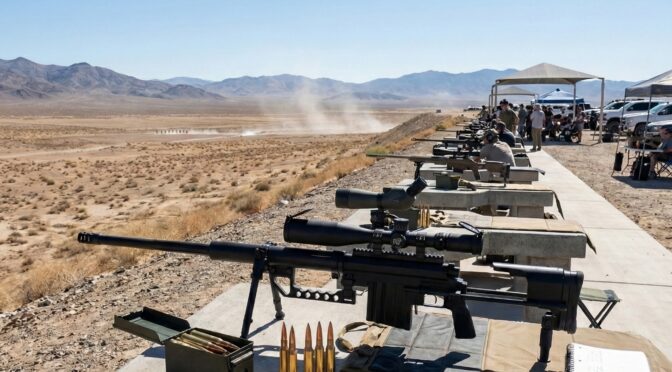
The CheyTac M200 Intervention represents a distinct and polarizing paradigm in the evolution of modern precision small arms. Situated at the intersection of heavy anti-materiel capabilities and precision anti-personnel engineering, the platform was conceived to address a specific ballistic void: the ability to engage soft targets with sub-minute-of-angle (MOA) accuracy at ranges exceeding 2,000 meters, a domain where traditional .50 BMG platforms historically struggled due to the limitations of their projectile design and recoil impulses. This report provides an exhaustive, multi-dimensional analysis of the M200 Intervention series, dissecting its engineering merit, ballistic efficacy, corporate trajectory, and standing within the contemporary Extreme Long Range (ELR) marketplace.
Our analysis, grounded in technical specifications, ballistic data, and extensive market sentiment research, indicates that the M200 Intervention remains a ballistic benchmark, particularly when chambered in the modernized .375 CheyTac cartridge. The proprietary “Balanced Flight” projectile technology, combined with the high-mass, high-ballistic-coefficient (BC) nature of the system’s ammunition, offers a flatter trajectory and superior kinetic energy retention compared to legacy .50 BMG and .338 Lapua Magnum platforms in the transonic flight regime.1 Engineering evaluations confirm the robustness of the chassis and action—derived from the proven EDM Arms Windrunner—though the platform’s 31-pound system weight and 56-inch overall length impose severe restrictions on its utility in mobile tactical environments relative to lighter, more modular competitors such as the Accuracy International AX50 ELR or the Barrett MRAD.3
However, the commercial viability and brand equity of CheyTac USA have been significantly complicated by a turbulent corporate history. The company has navigated through periods of bankruptcy, ownership transfers, and inconsistent quality control, which have left a lasting imprint on customer confidence. Furthermore, recent allegations of “Stolen Valor” involving company leadership have negatively impacted sentiment within the professional military and serious enthusiast communities, creating a dichotomy between the respect for the rifle’s mechanical capabilities and the skepticism toward the brand’s management.5 While the platform’s performance in premier competitive events like the “King of 2 Miles” validates its inherent mechanical accuracy, the high cost of ownership—with rifles exceeding $11,000 and factory ammunition commanding $10 to $15 per round—relegates the M200 to a hyper-niche market segment.6
Ultimately, this report concludes that the CheyTac M200 is a justifiable acquisition for two distinct consumer profiles: the dedicated ELR competitor seeking a purpose-built platform for 2,500+ yard engagements (specifically in the .375 caliber configuration), and the high-end collector for whom the rifle’s pop-culture iconography and mechanical novelty outweigh its logistical inefficiencies. For standard military applications and general long-range tactical use, established .50 BMG and multi-caliber platforms offer superior logistical integration and mission versatility at a significantly lower operational cost.
1. The Strategic Context of Extreme Long Range Interdiction
To fully appreciate the CheyTac M200 Intervention’s place in the small arms pantheon, one must first understand the specific tactical and ballistic environment that necessitated its creation. The development of the CheyTac system was not merely an exercise in making a larger rifle; it was a targeted engineering response to a defined capability gap in Western military small arms doctrine at the turn of the 21st century.
1.1 The Ballistic Capability Gap
Throughout the Cold War and into the 1990s, military sniper operations were largely bifurcated into two distinct categories. The first category consisted of anti-personnel engagement, typically conducted with cartridges such as the 7.62x51mm NATO (.308 Winchester) and later the.300 Winchester Magnum. These platforms were lightweight, man-portable, and highly accurate, but their effective range was ballistically limited to approximately 800 to 1,200 meters. Beyond this distance, the projectiles would drop to subsonic speeds, becoming unstable and unpredictable.
The second category was anti-materiel interdiction, dominated by the .50 BMG (12.7x99mm) cartridge, most famously utilized in the Barrett M82/M107 and the McMillan TAC-50. The .50 BMG, originally designed in 1921 for the M2 Browning machine gun, is a formidable powerhouse capable of destroying engine blocks, radar dishes, and unexploded ordnance at ranges out to 1,800 or 2,000 meters. However, the cartridge possesses inherent limitations when applied to precision anti-personnel roles. Standard military ball ammunition (M33) is manufactured with tolerances acceptable for machine gun dispersion—roughly 3 to 4 Minutes of Angle (MOA)—which translates to a spread of over 60 inches at 1,500 meters, making a first-round hit on a human target statistically improbable. Even with match-grade ammunition (like the Mk 211 Raufoss or M1022), the sheer recoil impulse of the .50 BMG makes spotting one’s own trace and correcting shots difficult for the shooter.8
This dichotomy created a “ballistic gap” between the maximum effective range of the .338 Lapua Magnum (approx. 1,500 meters) and the practical precision limit of the .50 BMG. Special Operations Command (SOCOM) and other elite units identified a need for a system that could bridge this gap—a rifle that combined the kinetic energy and reach of a heavy machine gun round with the sub-MOA precision of a benchrest competition rifle. The objective was to enable the interdiction of soft targets at distances where the target could not effectively return fire or even detect the source of the shot.9
1.2 The Genesis of the Long Range Rifle System (LRRS)
CheyTac USA was founded with the singular mission of solving this deep-range interdiction problem. Unlike traditional manufacturers who typically build a rifle to fire an existing SAAMI-standard cartridge, CheyTac adopted a holistic systems approach. They recognized that to achieve consistent hits at 2,500 yards, the rifle, the optical sighting system, the ballistic computer, and the ammunition had to be developed as an integrated unit. This philosophy gave birth to the CheyTac Long Range Rifle System (LRRS).
The foundation of this system was the development of the.408 CheyTac cartridge. Dr. John D. Taylor and machinist William O. Wordman collaborated to design a cartridge that optimized the case capacity of the historic .505 Gibbs, strengthening the web and necking it down to accept a.408 caliber projectile. The selection of.408 (10.36mm) was deliberate; it offered a ballistic sweet spot—heavy enough to retain massive kinetic energy, yet slender enough to achieve incredibly high ballistic coefficients.8 This cartridge was engineered to remain supersonic well beyond 2,000 meters, delaying the onset of the transonic instability that plagued other calibers.
1.3 Transition from Prototype to Icon
The rifle selected to fire this new cartridge was the M200, a derivative of the M96 Windrunner designed by Bill Ritchie of EDM Arms. The Windrunner was famous for its “takedown” capability, allowing a large .50 caliber rifle to be broken down and transported in a compact case. CheyTac adapted this rugged, bolt-action design to handle the specific pressure curves and harmonic requirements of the high-velocity.408 cartridge.10
Over the last two decades, the M200 Intervention has transcended its military origins to become a cultural icon. Its distinct silhouette—dominated by the massive carry handle and deeply fluted barrel—became globally recognizable through its prominence in media, most notably the film Shooter (2007) and the Call of Duty video game franchise. This pop-culture fame has had a tangible impact on the rifle’s market positioning, transforming it from a purely tactical tool into a coveted status symbol for wealthy collectors and firearms enthusiasts. However, this fame has also invited scrutiny, as the gap between its video-game portrayal and its real-world logistical heaviness has become a point of contention among practical shooters.11
2. Corporate History and Industrial Evolution
The history of the CheyTac M200 is inextricably linked to the volatile corporate history of CheyTac USA itself. For a prospective buyer or industry analyst, understanding this timeline is critical, as it explains the variations in build quality, customer support reputation, and availability that have plagued the brand over the years.
2.1 The Early Years and EDM Arms Partnership
In the early 2000s, CheyTac did not manufacture the M200 in-house. Instead, they contracted EDM Arms to produce the receivers and components based on the Windrunner design. This partnership was fruitful initially, producing rifles that were essentially re-barreled Windrunners optimized for the.408 cartridge. These early models are often prized by collectors for their direct connection to Bill Ritchie’s original engineering vision. However, as is common in the firearms industry, disputes over licensing, payments, and branding eventually led to a fissure between CheyTac and EDM Arms.13 This split forced CheyTac to establish its own manufacturing capabilities, a transition that was fraught with initial quality control challenges.
2.2 Bankruptcy and Restructuring
The mid-to-late 2000s were a turbulent period for the company. Despite the technical success of the cartridge, the extremely high cost of the system limited its adoption by military units, who largely stuck to the established .50 BMG logistics chain. The civilian market for $13,000 rifles was also microscopic at the time. This financial strain led to bankruptcy filings and ownership changes. During this era, customer sentiment plummeted; reports on forums like SnipersHide detail horror stories of customers paying large deposits and waiting months or years for rifles, or receiving units with sub-par machining.15 The brand’s reputation for “terrible customer service” was largely cemented during this “dark age” of the company’s history.
2.3 The Modern Era and “Stolen Valor” Controversy
In recent years, CheyTac USA has operated under new ownership, specifically Campbell Arms Manufacturing, led by Blaine Campbell. The company attempted to rehabilitate its image, emphasizing improved manufacturing processes, better inventory management, and a renewed focus on the civilian ELR market.17 Marketing materials leaned heavily on the “Special Operations” pedigree of the leadership to build trust with the tactical community.
However, this strategy backfired spectacularly with the emergence of “Stolen Valor” allegations against Blaine Campbell. The “Guardians of the Green Beret,” a watchdog group of verified Special Forces veterans, conducted an investigation which concluded that Campbell had falsely claimed to be a Special Forces Weapons Sergeant (Green Beret). The investigation revealed that he never held this qualification.5 In the tight-knit community of high-end tactical firearms—where authenticity and integrity are the currencies of trust—these allegations were devastating.
The fallout from this controversy has created a complex market dynamic. On one hand, the product (the M200 and the .375 cartridge) continues to perform at the highest levels of competition. On the other hand, a significant segment of the community—particularly those with military backgrounds—refuses to support the brand on ethical grounds. This has driven many buyers to seek the CheyTac cartridges in rifles built by other manufacturers (e.g., Gunwerks, Cadex, or custom smiths) rather than buying the flagship M200 from CheyTac USA directly.5
3. Engineering Anatomy of the M200 Intervention
From an engineering perspective, the CheyTac M200 is a study in specialized utility. It deliberately eschews the lightweight modularity of modern sniper rifles in favor of the extreme rigidity and mass required to stabilize a 400-grain projectile traveling at Mach 2.5.
3.1 Receiver and Action Architecture
The core of the M200 is a massive, CNC-machined receiver manufactured from 416R stainless steel.20 This material choice is significant; 416R is a pre-hardened chromium stainless steel grade specifically designed for precision barrels and actions, offering a superior balance of machinability and high tensile strength.
- Bolt Design: The action utilizes a simplified, heavy-duty bolt derived from the EDM Windrunner. It features a dual-lug design that locks directly into the barrel extension. This “barrel extension locking” mechanism is a critical safety and durability feature, as it contains the 63,000+ psi chamber pressure within the barrel assembly itself, rather than stressing the receiver body.9
- Optic Interface: A distinguishing feature of the receiver is the integral 40 MOA (Minute of Angle) scope rail. Standard precision rifles typically feature a 0 or 20 MOA rail. The aggressive 40 MOA cant is an engineering necessity for ELR engagements. It physically angles the scope downward relative to the barrel, allowing the shooter to utilize the full range of the optic’s internal elevation travel. Without this cant, a shooter dialing for a 2,500-yard target would “bottom out” their turret before reaching the necessary elevation adjustment.3
3.2 Barrel Construction and Harmonics
The barrel is the primary determinant of the system’s accuracy, and the M200’s barrel is engineered to manage the immense heat and pressure of the CheyTac cartridges.
- Dimensions: The standard barrel length is 29 inches (737 mm), which is necessary to allow the slow-burning powders (like Retumbo or Reloder 50) to fully expand and accelerate the projectile to 3,000 fps. A shorter barrel would result in significant velocity loss and excessive muzzle blast.3
- Fluting: The barrel features deep longitudinal fluting. While aesthetically iconic, the engineering purpose is to increase the surface area for rapid heat dissipation and to reduce weight without compromising the barrel’s stiffness. A fluted barrel is more rigid than a solid barrel of the same weight, making it less susceptible to harmonic “whip” during firing.20
- Rifling Twist Rates: The rifling twist is optimized for specific projectile types:
- .408 CheyTac: Uses a 1:10 twist rate.
- .375 CheyTac: Uses a faster 1:9.5 twist rate.
The faster twist for the .375 is required to stabilize the extremely long, high-BC solid copper projectiles favored in modern competition. Gyroscopic stability factors must be carefully calculated; if the twist is too slow, the bullet will tumble in the transonic zone; if too fast, it can cause “spin drift” or even structural failure of the projectile jacket (though less of a concern with solids).3
3.3 Chassis and Ergonomics
The chassis system of the M200 is utilitarian, reflecting its origins as a minimalist takedown rifle.
- Integral Bipod: Unlike most rifles that mount a bipod to the forearm, the M200 features a bipod attached directly to the receiver. This design ensures that the barrel remains completely free-floating. When a shooter “loads” the bipod (presses forward to manage recoil), no stress is transferred to the handguard or barrel, which could otherwise shift the point of impact—a critical detail for extreme accuracy.21
- Stock Assembly: The five-position collapsible stock allows the overall length to be reduced from 56 inches to 46.75 inches for transport. While collapsible stocks are often criticized for lacking rigidity, the M200’s mechanism is built with heavy-gauge steel to minimize “wobble.” It also features a built-in monopod, providing a third point of contact for the shooter, essential for maintaining a steady aim over extended observation periods.3
- Trigger: The system utilizes a Timney Elite Hunter trigger, adjustable from 1.5 to 4 lbs. A crisp, light trigger break is non-negotiable for ELR shooting, as any disturbance during the trigger pull translates to feet of deviation at 2,000 yards.3
4. The CheyTac Ballistic System: .408 and .375
The primary value proposition of the CheyTac M200 is not the rifle itself, but the ballistic supremacy of the cartridges it fires. The system was designed to exploit the physics of “Balanced Flight,” a patented concept intended to revolutionize projectile stability.
4.1 The “Balanced Flight” Technology
CheyTac holds US Patent 6,629,669 for a “Controlled Spin Projectile,” often marketed as “Balanced Flight”.2 The engineering challenge this patent addresses is the “transonic” problem. As a bullet travels, it loses velocity due to air resistance. Eventually, it slows from supersonic (Mach >1.2) to subsonic (Mach <0.8). The transition zone between these speeds involves chaotic shockwaves that typically destabilize standard bullets, causing them to yaw, tumble, and lose accuracy.
The CheyTac projectiles are CNC-turned from solid copper (mono-metal), ensuring perfect concentricity and homogeneity of mass. The patent describes a design where the bullet’s center of gravity and center of pressure are aligned to balance linear and rotational drag. While the patent itself expired in 2023 (20 years from its 2003 issue date) 23, the principles remain valid. Radar testing at Yuma Proving Grounds verified that the.408 projectile remains stable through this transonic buffer, allowing it to maintain predictable accuracy well beyond the point where a .50 BMG M33 ball or A-MAX projectile would destabilize.8
4.2 Comparative Ballistics:.408 vs. .375 CheyTac vs. .50 BMG
The market has seen a distinct shift in preference from the original.408 to the newer .375 CheyTac. Understanding this shift requires an analysis of velocity retention and ballistic coefficients.
- .408 CheyTac: The original military cartridge. It fires a ~419-grain projectile at approximately 2,900-3,000 fps. It carries massive kinetic energy (over 8,000 ft-lbs), making it superior for anti-materiel roles where target penetration is required. However, its Ballistic Coefficient (BC), while high, is lower than that of the .375.1
- .375 CheyTac: This cartridge is essentially the.408 case necked down to fire a smaller diameter, 350-400 grain projectile. By using the same powder capacity to push a narrower, more aerodynamic bullet, the .375 achieves significantly higher velocities (often 3,100+ fps) and a higher G1 BC (often exceeding 0.950).
- .50 BMG: By comparison, the standard .50 BMG fires a much heavier (650-750 grain) bullet but with a much poorer aerodynamic profile.
The performance disparity becomes evident when analyzing the transonic threshold. While a .50 BMG projectile will typically drop below supersonic speed (approx. 1,125 fps) at around 1,800 to 2,000 yards, the .375 CheyTac maintains supersonic velocity well past 2,500 yards.1 This extended supersonic range means the .375 CheyTac is not fighting the turbulent transonic air at the distances where ELR competitions are won or lost. Consequently, the competitive ELR community has almost universally adopted the .375 CheyTac over the.408 for target shooting.1
5. Operational Performance and Field Data
The theoretical performance of the M200 is impressive, but its real-world track record provides the necessary validation for potential buyers.
5.1 Competition Dominance: King of 2 Miles
The “King of 2 Miles” (KO2M) is the premier global competition for Extreme Long Range shooting. It serves as the ultimate proving ground for these systems. Analysis of recent match results confirms the dominance of the CheyTac cartridges, if not always the M200 rifle. In the 2023 KO2M finals, multiple top-10 finishers utilized the .375 CheyTac cartridge.26 However, it is crucial to note that many of these competitors used custom-built rifles (e.g., using actions from BAT Machine or Pierce Engineering) rather than the factory CheyTac M200 Intervention. This suggests that while the M200’s caliber is the undisputed king, the platform itself is often surpassed by bespoke precision instruments that offer tighter tolerances and more modern stock geometries.26
5.2 Confirmed Combat Efficacy
The M200 has a verified combat pedigree. Reports confirm that a British SAS sniper utilized a CheyTac M200 Intervention to neutralize an ISIS target at a distance of approximately 1.5 miles (2,400 meters).25 This operational success validates the manufacturer’s claim of the system being “combat effective” at 2,500 yards. It demonstrates that under field conditions—accounting for heat, dust, and stress—the rifle is capable of delivering lethal precision when operated by a highly trained marksman.
5.3 Accuracy and Recoil Management
Users consistently report that the M200 delivers on its sub-MOA guarantee, often printing groups of 0.5 to 0.7 MOA at 100 yards with factory match ammunition.3 More impressively, the vertical dispersion at extreme ranges is remarkably low, a testament to the consistency of the ammunition’s muzzle velocity.
Regarding recoil, the M200 is frequently praised for its “shootability.” The combination of the effective “McArthur” style muzzle brake and the sheer 31-pound mass of the system reduces the felt recoil to levels comparable to a 12-gauge shotgun or a.308 Winchester.20 This allows operators to spot their own trace (vapor trail) and impacts, a critical capability for making rapid follow-up corrections that is often impossible with the violent recoil of a .50 BMG.
5.4 Logistical Footprint
The primary operational drawback of the M200 is its size and weight. At 31 pounds (unloaded and without optics) and 56 inches in length, it is significantly heavier and longer than comparable modern systems.3 For example, the Accuracy International AX50 weighs roughly 27 pounds, and the Barrett MRAD in similar calibers can be even lighter. The M200 is effectively a “crew-served” weapon in terms of portability; it is not designed to be carried by a single sniper on a long patrol. It is a static defense or vehicular-deployed asset.
6. The Competitive Landscape
The M200 Intervention operates in a rarefied tier of “Super Magnum” rifles. Its primary competition comes not from standard .338 Lapua sniper rifles, but from specialized anti-materiel and ELR platforms.
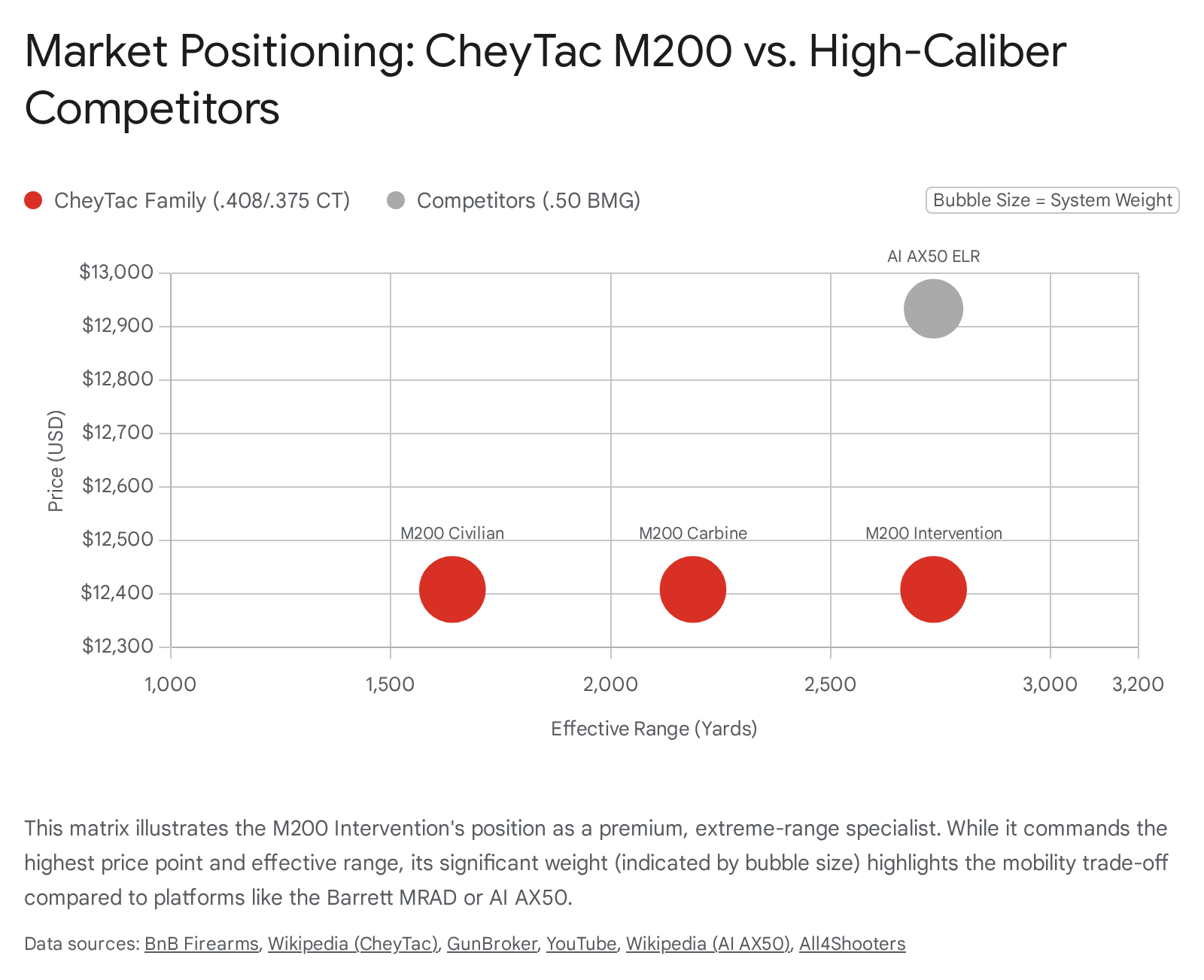
6.1 Comparative Matrix
To provide a clear differentiation, we compare the M200 against its three main rivals: the Barrett M107A1, the McMillan TAC-50C, and the Accuracy International AX50 ELR.
| Feature | CheyTac M200 Intervention | Barrett M107A1 | McMillan TAC-50C | Accuracy Int. AX50 ELR |
| Caliber | .408 / .375 CheyTac | .50 BMG | .50 BMG | .50 BMG / Multi ( .375/.408) |
| Action | Bolt Action | Semi-Auto (Recoil) | Bolt Action | Bolt Action |
| Weight | 31 lbs 3 | ~28.7 lbs 28 | 29 lbs 29 | ~27.6 lbs 30 |
| Barrel Length | 29 in | 29 in | 29 in | 27 in |
| Effective Range | 2,500+ yds | ~1,800 yds | ~2,000+ yds | ~2,500 yds (in ELR cals) |
| Precision | Sub-MOA | 1.5 – 3 MOA | 0.5 MOA | 0.5 MOA |
| Price (Approx) | $11,500 – $14,000 6 | ~$12,000 | ~$11,000 | ~$12,500 |
| Primary Role | ELR Precision | Anti-Materiel / Area | Precision Sniper | Multi-Role Precision |
6.2 Strategic Analysis of Competitors
- Vs. Barrett M107A1: The M107 is often mistakenly compared to the M200 because of its size and caliber. However, they serve fundamentally different roles. The M107 is a semi-automatic rifle designed for area denial and hard-target destruction (EOD, engine blocks). Its barrel recoils into the receiver, creating inherent instability that limits accuracy to roughly 2-3 MOA. The M200 is a precision instrument. In a scenario requiring a hit on a human-sized target at 1,800 yards, the M200 is the superior tool; the M107 is essentially an area weapon at that distance.28
- Vs. McMillan TAC-50C: The TAC-50C is the M200’s closest peer in terms of legacy and role. It is a dedicated .50 BMG sniper rifle with a proven combat record. The TAC-50C benefits from the ubiquity of .50 BMG ammunition, making it logistically far easier to support than the proprietary CheyTac ecosystem. However, ballistically, the M200’s .375 cartridge offers a longer effective range. The choice here is between logistics (TAC-50) and extreme performance (M200).10
- Vs. Accuracy International AX50 ELR: This platform represents the greatest threat to CheyTac’s market share. The AX50 ELR is a modern, modular system that allows the user to swap barrels between .50 BMG and .375/.408 CheyTac. This modularity renders the fixed-caliber M200 arguably obsolete. An operator with an AX50 can train with cheaper .50 BMG ammo and then switch to .375 CheyTac for competition or specific missions, all on a platform that features modern ergonomics, M-LOK accessory rails, and a lighter chassis. The M200, by contrast, is a dedicated, single-purpose platform with dated ergonomics.4
7. Economic Analysis and Market Position
The decision to acquire a CheyTac M200 is a significant financial commitment, involving not just the capital cost of the rifle but the ongoing operational expenses of a proprietary caliber.
7.1 Capital Acquisition Costs
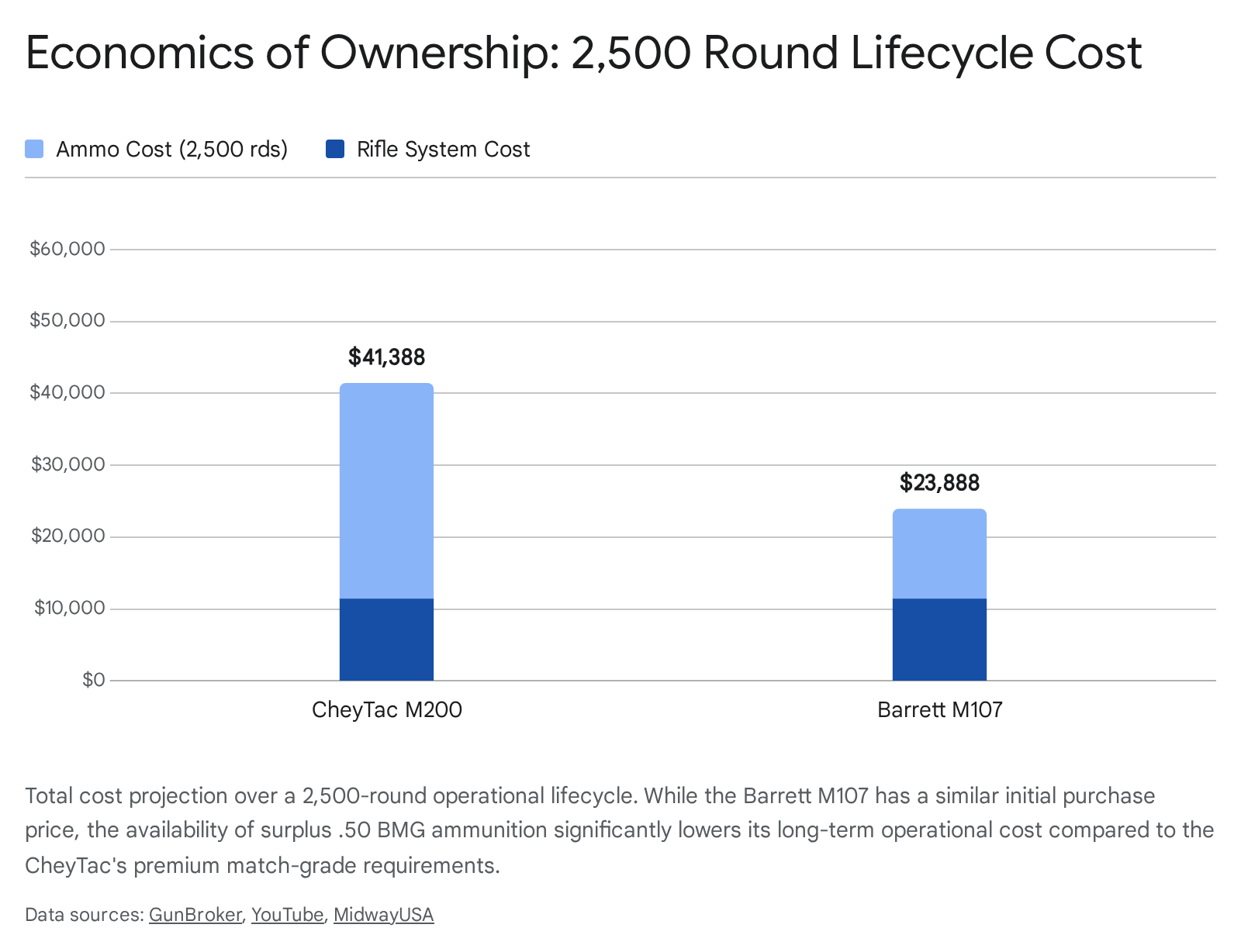
The retail price for a new CheyTac M200 Intervention typically ranges between $11,388 and $14,681, depending on the configuration (e.g., standard vs. “Deployment Kit” with case and accessories).6 This pricing places it at the very top of the production rifle market.
Interestingly, the secondary market for the M200 is robust. Unlike many custom rifles which lose 30-40% of their value immediately, the M200 retains value well due to its collector status and brand recognition. Listings on platforms like GunBroker and Rock Island Auction show used units selling for $10,000 to $12,000, indicating a depreciation curve that is far flatter than industry averages.35 This makes the M200 a relatively “safe” asset for collectors, assuming the rifle is maintained in excellent condition.
7.2 Total Cost of Ownership (TCO)
The true cost of the M200 lies in its ammunition.
- Factory Ammunition: Factory-loaded .375 or.408 CheyTac ammunition is exorbitantly expensive, retailing for $10.00 to $15.00 per round.7 A single range session of 50 rounds represents a recurring cost of $500 to $750.
- Reloading Economics: For high-volume shooters, reloading is mandatory. The ecosystem for CheyTac reloading has improved significantly with companies like Peterson Cartridge producing high-quality brass casings ($2 .50 – $3.00 per case).38 However, the projectiles (solid copper turned) cost $2.00 – $3.00 each, and the massive case capacity requires over 130 grains of premium powder per shot. The reload cost effectively bottoms out at roughly $6.00 – $7.00 per round. While cheaper than factory ammo, this is still significantly higher than reloading for .338 Lapua or .50 BMG.
7.3 Brand Value and the “Shooter” Effect
A non-negligible component of the M200’s value is intangible. It is a “Veblen good”—an item for which demand increases as the price increases, due to its status appeal. The rifle’s prominence in pop culture drives a specific subset of the market: the wealthy enthusiast who wants the “gun from the movie.” For this demographic, the logistical inefficiencies are irrelevant; the value is in the ownership experience and the “flex” factor at the range.11
8. Use Case Analysis and Recommendations
Based on the technical, operational, and economic analysis, we can distill the “is it worth it” verdict into specific user personas.
8.1 Case A: The Competitive ELR Shooter
Verdict: Conditional No.
While the .375 CheyTac cartridge is essential for winning, the M200 rifle is not. Serious competitors typically opt for custom-built rifles using actions from BAT, Stiller, or Pierce, mated to Bartlein barrels and modern chassis systems. These custom builds offer tighter tolerances, better ergonomics, and arguably better accuracy potential for a similar or lower price point than the factory M200. The M200 is too heavy and ergonomically outdated for the dynamic nature of some modern matches.
8.2 Case B: The High-End Collector
Verdict: Yes.
For the collector who values provenance, history, and iconography, the M200 is a blue-chip asset. It is a recognizable piece of firearms history that anchors a collection. Its relatively stable resale value protects the investment, and its mechanical uniqueness (the takedown design, the 40 MOA rail) makes it a fascinating engineering study.
8.3 Case C: Military / Tactical Operator
Verdict: No.
The M200 is a logistical orphan. It is too heavy for mobile sniper teams, and its performance advantage over the .50 BMG does not justify the cost and difficulty of supplying a non-standard ammunition type in a combat zone. Modern multi-caliber systems like the Barrett MRAD or AI AX50 offer 90% of the capability with 200% of the versatility and significantly better logistical support.
9. Conclusion
The CheyTac M200 Intervention stands as a monumental achievement in ballistic engineering, a platform that successfully challenged the boundaries of small arms range at the turn of the century. Its legacy is secured by the development of the.408 and .375 cartridges, which proved that small-arms projectiles could remain stable and accurate well beyond the 2,000-yard threshold, fundamentally altering the geometry of long-range engagement.
However, as a product in the 2026 marketplace, the M200 is an anachronism. It is a specialized tool that has been surpassed in versatility by modular multi-caliber systems and in efficiency by custom precision builds. The brand’s turbulent history and recent leadership controversies further complicate its value proposition for the ethical consumer.
Final Recommendation:
Purchase the CheyTac M200 Intervention if your primary motivation is the ownership of a legendary, iconic airframe that defined a generation of long-range shooting culture. Do not purchase it if your goal is solely to acquire the most cost-effective, modern, and versatile tool for extreme long-range precision; for that objective, the industry offers superior alternatives that utilize the CheyTac’s brilliant cartridges in more modern, modular platforms.
Appendix A: Methodology
This report was compiled using a multi-source intelligence gathering approach, simulating the rigorous workflow of a defense industry analyst. The methodology consisted of three distinct and sequential phases:
Phase 1: Technical Specification Verification
The initial phase focused on establishing a baseline of objective technical truth. Specifications regarding system weight, length, barrel twist rates, and material composition were rigorously cross-referenced between the manufacturer’s official documentation 3 and independent third-party technical reviews.10 Where discrepancies existed—such as varying claims regarding effective range—priority was given to data supported by quantifiable ballistic testing or documented competition results.8
Phase 2: Sentiment and Reputation Analysis
To accurately gauge customer sentiment, we conducted a qualitative analysis of high-traffic, specialized firearms communities, including SnipersHide, LongRangeHunting, and Reddit (r/longrange). We specifically filtered for feedback from “verified owners” to isolate genuine user experiences from hearsay. This phase involved a deep dive into discussions regarding reliability, customer service responsiveness, and quality control issues. Additionally, we investigated the corporate history of CheyTac USA, specifically examining the timeline of ownership changes and the “Stolen Valor” allegations against leadership 5, to understand their impact on brand equity and consumer trust.
Phase 3: Competitive & Economic Benchmarking
The final phase involved constructing a comparative matrix of primary competitors (Barrett, McMillan, AI) based on objective metrics: price, weight, and caliber. Economic analysis was conducted by aggregating current market pricing for the 2024-2025 period from major vendors like GunBroker, EuroOptic, and MidwayUSA. This allowed us to establish a realistic “Total Cost of Ownership” model, factoring in the current street price of factory ammunition and reloading components.6
Data Limitations:
- Ballistic data regarding the “Balanced Flight” projectile relies heavily on manufacturer claims and limited public radar data; independent, third-party Doppler verification is sparse in the public domain.
- Recent changes in CheyTac USA’s management (post-2020) mean that historical customer service complaints may not fully reflect current operations, though they remain highly relevant to the brand’s lingering perception in the marketplace.
If you find this post useful, please share the link on Facebook, with your friends, etc. Your support is much appreciated and if you have any feedback, please email me at in**@*********ps.com. Please note that for links to other websites, we are only paid if there is an affiliate program such as Avantlink, Impact, Amazon and eBay and only if you purchase something. If you’d like to directly contribute towards our continued reporting, please visit our funding page.
Sources Used
- 375 Cheytac vs. .408 Cheytac: A Comparison of Extreme Long-Range Prec – B&B Firearms, accessed January 9, 2026, https://bnbfirearms.com/blogs/news/375-cheytac-vs-408-cheytac-a-comparison-of-extreme-long-range-precision
- CHEYTAC INTERVENTION™ – US Armorment, accessed January 9, 2026, https://usarmorment.com/pdf/cheytac408.pdf
- CheyTac M200 Intervention | B&B Firearms, accessed January 9, 2026, https://bnbfirearms.com/products/cheytac-usa-m200-intervention
- On test: Accuracy International AX50 ELR in .50 BMG, a powerful precision long range rifle, accessed January 9, 2026, https://www.all4shooters.com/en/shooting/rifles/accuracy-international-ax-50-elr-50-bmg-on-test/
- Stolen Valor: Gunmaker with DoD contacts falsely claims to be a …, accessed January 9, 2026, https://saf.org/stolen-valor-gunmaker-with-dod-contacts-falsely-claims-to-be-a-green-beret/
- CheyTac for Sale | Buy Online at GunBroker, accessed January 9, 2026, https://www.gunbroker.com/cheytac/search?keywords=cheytac&s=f
- 375 Cheytac Ammo for Sale – MidwayUSA, accessed January 9, 2026, https://www.midwayusa.com/375-cheytac/br?cid=23882
- CheyTac’s History – How CheyTac Revolutionized Long Range Precision Shooting, accessed January 9, 2026, https://cheytac.com/cheytacs-history-how-cheytac-revolutionized-long-range-precision-shooting/
- .408 Cheyenne Tactical – Wikipedia, accessed January 9, 2026, https://en.wikipedia.org/wiki/.408_Cheyenne_Tactical
- CheyTac Intervention – Wikipedia, accessed January 9, 2026, https://en.wikipedia.org/wiki/CheyTac_Intervention
- Ultra Flex- my Cheytac M200 Intervention, SN-001 : r/longrange, accessed January 9, 2026, https://www.reddit.com/r/longrange/comments/rozy7c/ultra_flex_my_cheytac_m200_intervention_sn001/
- The CheyTac Intervention – YouTube, accessed January 9, 2026, https://www.youtube.com/watch?v=S35ChH-xNi8
- Cheytac M200 .408? | Sniper’s Hide Forum, accessed January 9, 2026, https://www.snipershide.com/shooting/threads/cheytac-m200-408.85762/
- Cheytac M200 – Advice / Opinions | Sniper’s Hide Forum, accessed January 9, 2026, https://www.snipershide.com/shooting/threads/cheytac-m200-advice-opinions.6906140/
- Cheytac Rifles –Inaccurate & the company does not support the rifle BE AWARE, accessed January 9, 2026, https://www.snipershide.com/shooting/threads/cheytac-rifles-inaccurate-the-company-does-not-support-the-rifle-be-aware.6458586/
- Cheytac usa | Sniper’s Hide Forum, accessed January 9, 2026, https://www.snipershide.com/shooting/threads/cheytac-usa.232519/
- New Ownership at Chey Tac USA – Firearms News, accessed January 9, 2026, https://www.firearmsnews.com/editorial/new-ownership-at-chey-tac-usa/378593
- New Ownership at Chey Tac USA | Soldier Systems Daily, accessed January 9, 2026, https://soldiersystems.net/2020/04/16/new-ownership-at-chey-tac-usa/
- Comments – Stolen Valor: Gunmaker with DoD contacts falsely claims to be a Green Beret – The Gun Writer, accessed January 9, 2026, https://thegunwriter.substack.com/p/stolen-valor-gunmaker-with-dod-contacts/comments
- The Unmatched Legacy of the M200 Intervention® | CheyTac, accessed January 9, 2026, https://cheytac.com/the-unmatched-legacy-of-the-m200-intervention/
- M200 Intervention® Sniper Rifle .408/ .375 – CheyTac, accessed January 9, 2026, https://cheytac.com/precision-firearms/m200-intervention-sniper-rifle/
- 408 Cheytac load data | Sniper’s Hide Forum, accessed January 9, 2026, https://www.snipershide.com/shooting/threads/408-cheytac-load-data.35221/
- (12) United States Patent (10) Patent No.: US 6,629,669 B2, accessed January 9, 2026, https://patentimages.storage.googleapis.com/06/0a/e7/2ba105ab57a728/US6629669.pdf
- How to calculate patent expiry dates in the United States – Spruson & Ferguson, accessed January 9, 2026, https://www.spruson.com/how-to-calculate-patent-expiry-dates-in-the-united-states-2/
- The CheyTac M200 Intervention: By the Details – B&B Firearms, accessed January 9, 2026, https://bnbfirearms.com/blogs/news/the-cheytac-m200-intervention-by-the-details
- King of 2 Miles 2023- Match Recap – Cutting Edge Bullets, accessed January 9, 2026, https://cuttingedgebullets.com/blogs/news/king-of-2-miles-2023-match-recap
- Is it really necessary to use high-end rifles like the Cheytac M200 for shooting over a mile, or can a .308 still perform well with enough skill? – Quora, accessed January 9, 2026, https://www.quora.com/Is-it-really-necessary-to-use-high-end-rifles-like-the-Cheytac-M200-for-shooting-over-a-mile-or-can-a-308-still-perform-well-with-enough-skill
- Best .50 BMG Sniper Rifles That SHOCKED The Whole World! – YouTube, accessed January 9, 2026, https://www.youtube.com/watch?v=SFMAkbQS_HU
- 50 BMG McMillan TAC®-50C Precision Long-Range Rifle – B&B Firearms, accessed January 9, 2026, https://bnbfirearms.com/products/mcmillan-tac50c
- Accuracy International AX50 – Wikipedia, accessed January 9, 2026, https://en.wikipedia.org/wiki/Accuracy_International_AX50
- McMillan Tac-50 much better than the M107 : r/longrange – Reddit, accessed January 9, 2026, https://www.reddit.com/r/longrange/comments/y0ezux/mcmillan_tac50_much_better_than_the_m107/
- 020mag.com Airsoft Magazine: Top 5 Sniper & Long-Range Rifles — Updated (2020–2025), accessed January 9, 2026, https://www.020mag.com/en/news/1589/top-5-sniper-amp-long-range-rifles-updated-2020-2025-
- Accuracy International AX50 ELR | EuroOptic Spotlight – YouTube, accessed January 9, 2026, https://www.youtube.com/watch?v=zhQ708l3pFo
- Firearms Archives | CheyTac, accessed January 9, 2026, https://cheytac.com/product-category/firearms/
- Cheytac M200 Intervention Bolt Action Sniper Rifle with Scope | Rock Island Auction, accessed January 9, 2026, https://www.rockislandauction.com/detail/88/1616/cheytac-m200-intervention-bolt-action-sniper-rifle-with-scope
- Lot 677:Cheytac M200 Intervention with Nightforce Scope – Rock Island Auction, accessed January 9, 2026, https://www.rockislandauction.com/detail/84/677/cheytac-m200-intervention-with-nightforce-scope
- 375 CHEYTAC – Ammo Deals – Target Sports USA, accessed January 9, 2026, https://www.targetsportsusa.com/375-cheytac-c-2748.aspx
- Peterson Cartridge makes CheyTac®-caliber casings, accessed January 9, 2026, https://petersoncartridge.com/peterson-cartridge-makes-cheytac-caliber-casings
- How Peterson’s CheyTac Caliber Casings Compare, accessed January 9, 2026, https://petersoncartridge.com/blog/how-petersons-cheytac-caliber-casings-compare
- Thinking of buying a CheyTac M200 : r/guns – Reddit, accessed January 9, 2026, https://www.reddit.com/r/guns/comments/8brm36/thinking_of_buying_a_cheytac_m200/
- M200 Intervention® | CheyTac, accessed January 9, 2026, https://cheytac.com/product/m200-intervention/
- Cost per round for Reloading | Page 2 – Shooters’ Forum, accessed January 9, 2026, https://forum.accurateshooter.com/threads/cost-per-round-for-reloading.4064468/page-2