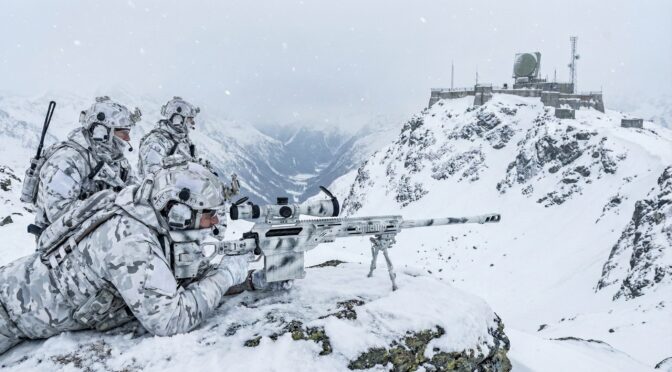
The global market for large-caliber precision rifles has undergone a fundamental bifurcation over the last two decades, diverging from the singular “anti-materiel” classification into two distinct operational requirements: high-volume area denial and surgical hard-target interdiction. Within this evolving landscape, Cadex Defence—a Canadian entity with a foundational history in impact testing and OEM chassis manufacturing—has introduced the CDX-50 Tremor series. This platform represents a dedicated effort to bridge the gap between the ruggedized reliability required by military end-users and the extreme precision demanded by the emerging civilian Extreme Long Range (ELR) discipline.
This report delivers an exhaustive technical and market analysis of the CDX-50 Tremor system. By synthesizing engineering schematics, ballistic performance data, manufacturing methodologies, and extensive customer sentiment from verified end-users, we evaluate the platform’s position within the .50 BMG ecosystem.
The analysis indicates that the CDX-50 Tremor constitutes a “third-generation” large-caliber system. Unlike first-generation adaptations of heavy machine gun cartridges (e.g., M2 derivatives) or second-generation pure anti-materiel rifles (e.g., Barrett M82), the Tremor is engineered as a holistic precision system. Its core value proposition lies in the integration of a massive, purpose-built 4-lug action with the proprietary Dual Strike chassis architecture. This combination addresses historic weaknesses in the .50 BMG platform—specifically the issues of mounting optics securely, managing the immense recoil impulse without compromising accuracy, and maintaining zero during transport.
Key findings reveal that the CDX-50 Tremor offers a ballistic performance profile capable of sub-MOA (Minute of Angle) accuracy with match-grade ammunition, such as the Hornady 750gr A-MAX. The 29-inch barrel configuration, while offering a compromise between velocity potential and maneuverability, provides sufficient energy retention to remain supersonic beyond 1,800 yards. However, the engineering decision to prioritize a lightweight profile (approximately 23 lbs) results in a sharper recoil impulse compared to heavier peer systems, necessitating a disciplined shooter interface and reliance on the high-efficiency MX1 muzzle brake.
In the competitive landscape, the CDX-50 Tremor disrupts the established hierarchy by offering a feature set comparable to the Accuracy International AX50 ELR at a significantly lower price point, while providing superior precision to the ubiquitous Barrett M107 series. It effectively targets a “prosumer” and specialized law enforcement demographic that prioritizes first-round hit probability over volume of fire. The report concludes that while the platform requires a higher degree of shooter proficiency to manage recoil, it represents one of the highest value-to-performance ratios currently available in the heavy caliber bolt-action segment.
| EuroOptic has a large selection of CDX-50 rifles as well as other Cadex models. Click here to visit them. |
1. Introduction and Strategic Market Context
1.1 The Theoretical Evolution of Heavy Caliber Precision
To rigorously evaluate the Cadex CDX-50 Tremor, one must first deconstruct the operational environment that necessitated its creation. The .50 Browning Machine Gun (12.7x99mm NATO) cartridge was conceived during the First World War as an anti-armor and anti-aircraft munition, designed to be belt-fed through the M2 heavy machine gun. For nearly half a century, its application was strictly defined by volume of fire and kinetic energy, with precision being a secondary or tertiary consideration.1
The paradigm shift occurred during the Vietnam War, and accelerated during the Global War on Terror, where the need for standoff capabilities—engaging targets beyond the effective range of standard infantry weapons—became paramount. Early attempts to adapt the .50 BMG for sniping involved grafting heavy barrels onto captured anti-tank rifles or modifying M2 receivers. These “first-generation” systems proved the ballistic viability of the cartridge but lacked the ergonomics and consistency required for repeatable human-sized target interdiction at ranges exceeding 1,500 meters.
The “second generation” was dominated by the Barrett Model 82 (M107), a semi-automatic recoil-operated system that prioritized logistical commonality and firepower. While revolutionary, the moving barrel design inherent to the recoil operation introduced variable harmonics that generally limited accuracy to 2-3 MOA (roughly a 20-30 inch spread at 1,000 yards).2 This made the system excellent for destroying radar dishes or parked aircraft, but marginal for neutralizing individual combatants or IED triggers at extended ranges.
The “third generation” of .50 BMG systems, to which the Cadex CDX-50 Tremor belongs, abandons the requirement for semi-automatic fire in favor of the bolt-action mechanism’s inherent rigidity and consistency. This generation is characterized by the application of benchrest shooting tolerances to military-grade hardware. The objective is no longer just “hitting the truck,” but “hitting the engine block of the truck” at 2,000 yards. Cadex Defence entered this mature market not by iterating on existing hunting rifle designs, but by leveraging a background in testing and chassis engineering to build a system from the ground up.4
1.2 Corporate Pedigree: The Cadex Transition
Cadex Defence occupies a unique position in the small arms industry. Unlike many manufacturers that began as gunsmiths, Cadex originated as a testing and engineering firm. Founded in 1994, the company’s initial focus was on material impact analysis, helmet testing, and shock mitigation for military applications.6 This background in metrology and material harmonics provided the engineering DNA for their weapon systems.
For over a decade, Cadex operated primarily as an OEM (Original Equipment Manufacturer) and a subcontractor. Most notably, they were instrumental in the production of the chassis system for the Remington M2010 Enhanced Sniper Rifle (ESR), a program that modernized the US Army’s M24 sniper systems.7 Furthermore, Cadex developed the “Dual Strike” chassis as an upgrade for the McMillan TAC-50, a legendary rifle system used by Canadian forces to set multiple world records for longest confirmed kills.8
This period of OEM work allowed Cadex to analyze the failure points and limitations of existing platforms. They observed that dropping a round receiver into a traditional composite stock often led to bedding issues under the massive recoil of the .50 BMG. They noted that accessory integration (night vision, lasers) on legacy designs was often an afterthought, resulting in wandering zeroes.
When Cadex decided to produce complete rifles in 2015, they integrated these lessons. The CDX-50 Tremor was not designed as a collection of parts, but as a unified system where the action and chassis are co-engineered. The receiver geometry was dictated by the chassis interface, and the chassis features were dictated by the recoil management requirements of the action. This holistic approach distinguishes the Tremor from “custom” builds that marry a generic action (like a Stiller or BAT) to a generic chassis.10 The resulting platform is marketed aggressively towards both the high-end civilian ELR competitor and specialized military units requiring a man-portable anti-materiel capability.10
2. Comprehensive Engineering Analysis: The CDX-50 Action
The core of the Tremor system is the proprietary CDX-50 action. In the domain of heavy calibers, the action must serve two opposing functions: it must be massive enough to contain chamber pressures exceeding 55,000 psi and absorb recoil, yet precise enough to ensure consistent lock time and ignition.
2.1 Receiver Metallurgy and Geometric Architecture
The CDX-50 receiver is a monolithic component CNC machined from a solid billet of 416 stainless steel.4 416 SS is chosen for its specific balance of machinability, corrosion resistance, and high tensile strength. Unlike carbon steel receivers which require coating for rust prevention, the stainless construction offers inherent environmental durability, a critical factor for military naval or littoral operations.
The dimensions of the receiver are staggering: approximately 12.32 inches in length and nearly 2 inches in diameter.4 This mass is not accidental. In precision rifle engineering, receiver stiffness is directly correlated to accuracy. A stiffer receiver resists flexing during the firing event—a phenomenon known as “action whip”—which ensures that the bolt face remains perfectly perpendicular to the chamber axis. In .50 BMG, where the powder charge can exceed 230 grains, the violent expansion of gases creates significant flexural stress. The Tremor’s oversized footprint acts as a stabilizing foundation, minimizing harmonic vibration transmission to the barrel tenon.
A critical design feature is the integrated Triple Lug Recoil System.4 Traditional bolt actions, such as the Remington 700, utilize a separate recoil lug washer sandwiched between the barrel and receiver. While cost-effective, this introduces an additional variable in the assembly stack and can shift during barrel changes. Cadex’s design integrates the recoil transmission surfaces directly into the receiver geometry. This triple-lug interface distributes the massive 10,000+ ft-lb recoil impulse over a larger surface area within the bedding block, preventing the “peening” or deformation of aluminum chassis contact points that can occur over thousands of firing cycles.
2.2 The 4-Lug Bolt System and 50-Degree Throw
Perhaps the most significant divergence from traditional engineering is the bolt design. The vast majority of bolt-action rifles, including the McMillan TAC-50, utilize a standard 2-lug configuration. This requires a 90-degree rotation of the bolt handle to unlock the action.
While a 90-degree throw is mechanically simple and robust, it presents significant ergonomic challenges in a large-scale platform. Large caliber rifles require large optics (often with 34mm or 36mm tubes and large ocular bells). A 90-degree bolt throw forces the bolt handle to travel almost vertically, often interfering with the scope’s eyepiece or requiring the optic to be mounted higher than necessary, which ruins the shooter’s cheek weld.4
Cadex engineers addressed this by implementing a 4-lug bolt head (arranged in two rows or a cross pattern) which reduces the required unlocking angle to just 50 degrees.
The implications of this 50-degree throw are multi-faceted:
- Speed of Cycling: A shorter arc of travel allows the shooter to unlock and cycle the bolt with less wrist movement, maintaining better alignment behind the rifle. This is critical for rapid follow-up shots in a tactical environment where wind calls may change seconds after a miss.
- Optic Clearance: The handle stays well clear of even the largest telescopic sights, allowing the scope to be mounted lower to the bore axis. A lower scope height reduces the “height over bore” offset, which simplifies close-range ballistic calculations and allows for a more compact vertical profile.
- Bolt Shear Strength: Critics of multi-lug designs often point to smaller shear surfaces. However, Cadex utilizes 416 stainless hardened to 43-45 HRC for the bolt body, ensuring that the aggregate shear strength of the 4 lugs equals or exceeds that of a traditional 2-lug design.4
2.3 Extraction and Reliability Mechanisms
Reliability in .50 BMG platforms is frequently compromised by extraction failures. The immense chamber pressure (up to 55,000 psi) causes the large brass casing to expand and obturate (seal) tightly against the chamber walls. If the primary extraction—the mechanical leverage applied by the bolt camming open—is insufficient, the casing will stick.
The Cadex action incorporates a heavy-duty extractor machined from tool steel, significantly oversized compared to standard Remington-style extractors.4 This claw is designed to bite into the rim of the 12.7mm case with enough surface area to prevent ripping through the brass rim during difficult extractions. Furthermore, the action utilizes dual plunger ejectors positioned at the 4 o’clock and 8 o’clock positions on the bolt face (relative to the extractor). This redundancy ensures that the heavy 750-grain empty case is ejected with authority and consistency, clearing the massive ejection port without “stovepiping” or bouncing back into the action—a common failure mode in single-ejector large bore rifles.14
The firing pin assembly utilizes a proprietary lightweight design to reduce “lock time”—the milliseconds that elapse between the trigger break and the primer ignition. A faster lock time minimizes the window of opportunity for the shooter to disturb the point of aim after the trigger is pulled, a crucial factor in achieving sub-MOA accuracy.14
3. The Dual Strike Chassis Architecture
While the action is the heart of the rifle, the chassis is the interface between the machine and the operator. The Tremor utilizes the “Dual Strike” chassis, a system so successful that it is sold separately to upgrade other platforms like the McMillan TAC-50.11
3.1 The V-Shaped Bedding System
Historically, precision rifles required “glass bedding,” a manual process where epoxy resin is applied between the action and the stock to create a perfect mirror-image fit. While effective, glass bedding is susceptible to degradation over time, especially under the punishing recoil of a .50 BMG. It is also sensitive to environmental factors like humidity and temperature extremes.
Cadex replaced this archaic process with a precision-machined V-shaped aluminum bedding block.12 This V-block design leverages basic geometry: a round cylinder (the receiver) placed into a V-shaped trough will always center itself perfectly at the bottom of the V when downward force is applied.
- Harmonic Stability: The metal-on-metal contact provides a consistent harmonic damping interface that does not change with temperature or humidity.
- Maintenance: This system allows the end-user to unbolt the action from the chassis for deep cleaning or maintenance and reassemble it with negligible shift in the zero (point of impact). This is a significant logistical advantage for military armorers and civilian shooters who travel with the rifle disassembled.16
3.2 Structural Integration and Mirage Control
The chassis features a full-length top rail that runs from the receiver to the end of the forend. This rail is available with built-in cant (typically 20, 40, or 60 MOA).10 For .50 BMG applications, the 40 MOA rail is standard. This downward angle of the scope base is essential for ELR shooting, as it allows the shooter to utilize the full elevation travel of their scope’s internal erector system. Without this cant, a scope might “bottom out” before the shooter can dial the elevation required for a 2,000-yard shot.
Integrated into the forend is a mirage control tube.12 As the massive barrel heats up during firing strings, it radiates heat waves that rise directly into the optical path of the scope. This creates “mirage,” a shimmering distortion that makes the target appear to dance or shift position. The aluminum tube surrounds the barrel, shielding the optical path from these heat waves and acting as a thermal chimney to channel hot air out through side vents, away from the line of sight.
3.3 The Reverse-Folding Stock Mechanism
Transporting a fixed-stock .50 BMG rifle is a logistical nightmare; the overall length typically exceeds 55 inches. The Tremor addresses this with a side-folding buttstock. However, unlike many competitors that fold to the left (to avoid the bolt handle), the Cadex folds to the right, effectively capturing and protecting the bolt handle.5
- Bolt Protection: By folding over the bolt handle, the stock acts as a shield, preventing the bolt from snagging on gear, vehicle interiors, or parachute rigging during transport. It also prevents the bolt from being inadvertently knocked open, which could allow dirt to enter the action.
- Hinge Engineering: The hinge mechanism is a critical failure point on many folding rifles. If the hinge develops even a fraction of an inch of “play” or wobble, the length of pull changes, and recoil management becomes inconsistent. Cadex utilizes an offset cam locking mechanism that actively eliminates backlash.5 As the mechanism wears over thousands of cycles, the cam continues to tighten the interface, ensuring a zero-play lockup that mimics the rigidity of a fixed stock.
3.4 Ergonomic Customization
The “human factor” engineering in the Dual Strike chassis is extensive. The buttstock offers tool-free adjustments for:
- Length of Pull (LOP): Adjustable to accommodate shooters of different heights or those wearing thick body armor/winter clothing.
- Cheek Rest Height: Critical for aligning the eye with the center of the scope, especially given the large objective lenses used in ELR.
- Recoil Pad Height: The pad can be raised or lowered to position the rifle correctly in the shoulder pocket, regardless of whether the shooter is in a prone, bench, or alternate firing position.12
This level of adjustability stands in stark contrast to the fixed controls of the Barrett M82/M107, which force the shooter to adapt to the rifle. In the Cadex philosophy, the rifle adapts to the shooter.
4. Ballistics, Barrel Technology, and Terminal Performance
The chassis and action are merely the delivery vehicle for the projectile. The performance of the CDX-50 Tremor is ultimately defined by its barrel and the ballistics of the .50 BMG cartridge.
4.1 Bartlein Barrel Integration
Cadex partners with Bartlein Barrels, a Wisconsin-based manufacturer widely regarded as the premier barrel maker in the United States.10 Bartlein utilizes a single-point cut-rifling process, which—while slower and more expensive than button rifling—introduces less stress into the steel and results in more consistent bore dimensions.
- Contour: The Tremor utilizes a massive 1.680″ straight taper contour. This heavy profile serves two purposes: it acts as a heat sink to prevent rapid overheating (which causes throat erosion and accuracy loss), and its sheer mass helps dampen the violent whip of the barrel during firing.
- Twist Rate: The standard twist rate is 1:15″.10 This is a carefully calculated choice. Older .50 BMG barrels often used 1:12″ or even slower twists optimized for the 660-grain M33 ball ammunition. The 1:15″ twist is optimized for modern high-ballistic-coefficient (BC) projectiles, specifically the 750-grain Hornady A-MAX and various monolithic solid copper projectiles (e.g., Warner Tool, Cutting Edge). These longer, heavier bullets require the specific rotational stability provided by the 1:15″ rate to remain stable through the transonic transition.
- Fluting: The barrel features deep spiral fluting. While often marketed for cooling, the primary engineering benefit is weight reduction without a proportional sacrifice in stiffness. By removing material from the periphery, the barrel retains the stiffness of a larger diameter tube while weighing less.
4.2 Ballistic Performance Analysis (29-Inch Barrel)
The CDX-50 is available in barrel lengths of 20.6″, 29″, and 32″, with 29″ being the most common “balanced” configuration.10 A critical engineering trade-off exists here: velocity vs. portability.
The .50 BMG cartridge relies on slow-burning powder (e.g., H50BMG, US869) that requires significant barrel length to achieve complete combustion. A standard test barrel is 36 to 45 inches. Reducing the barrel to 29 inches results in a velocity loss, typically averaging 25-35 feet per second (fps) per inch of barrel reduced from the optimal 36″.
Data Analysis of 750gr A-MAX Performance:
Based on verified load data 19, a 750-grain projectile fired from a 29-inch Cadex barrel achieves a muzzle velocity of approximately 2,725 – 2,750 fps. In contrast, a 36″ test barrel achieves ~2,820 fps.
While this loss of ~100 fps seems minor, it has significant implications for Extreme Long Range (ELR) performance, specifically regarding the “Transonic Zone.” As the bullet slows down and approaches the speed of sound (approx. 1,125 fps), the shockwave moves from the nose of the bullet to the center of pressure, often causing instability and tumbling. Keeping the bullet supersonic for as long as possible is the key to hitting targets at 2,000 yards.
As illustrated in the data, the 29-inch barrel keeps the projectile supersonic out to approximately 1,800 – 1,900 yards depending on atmospheric density. Beyond this, the bullet enters the transonic regime. While the CDX-50 is mechanically capable of accuracy at 2,500 yards, the physics of the shorter barrel make hits at those extreme distances more challenging than with a 32″ or 36″ system due to the earlier onset of transonic instability.
4.3 Accuracy Capabilities
Despite the barrel length trade-offs, the system’s accuracy is exceptionally high. Field reports and independent reviews consistently document sub-MOA performance.
- Group Sizes: Verified owners and reviews report 5-shot groups ranging from 0.5 MOA to 0.8 MOA with match ammunition.19
- Terminal Energy: Even at 1,000 yards, the projectile retains nearly 6,000 ft-lbs of energy—more than a.308 Winchester has at the muzzle. This translates to devastating terminal effects on hard targets, capable of penetrating engine blocks or light armor at ranges where smaller calibers would merely splash.19
5. Recoil Management and the Physics of Lightness
The most polarizing aspect of the CDX-50 Tremor is its weight—or lack thereof—and the resulting recoil impulse.
5.1 The Lightweight Paradox
The CDX-50 Tremor (29″ barrel) weighs approximately 22.6 lbs naked, and roughly 24 lbs with the muzzle brake.10
To put this in perspective:
- Barrett M107A1: ~29 lbs (empty).
- Accuracy International AX50: ~27 lbs (empty).
- McMillan TAC-50: ~26-29 lbs (depending on stock).
In the world of man-portable weaponry, “lighter is better” is the general axiom. However, Newton’s Third Law dictates that for every action, there is an equal and opposite reaction. The recoil energy generated by the cartridge is constant; therefore, a lighter rifle will accelerate backward into the shooter’s shoulder with greater velocity than a heavier one.
Users describe the recoil of the Tremor as “snappy,” “sharp,” and “fast”.24 Unlike the Barrett M107, where the massive reciprocating barrel assembly spreads the recoil impulse over a longer time duration (creating a “push” sensation), the fixed-breech, lightweight Tremor transmits the energy almost instantaneously.
5.2 The MX1 Muzzle Brake Solution
To counteract this physics disadvantage, Cadex developed the MX1 Muzzle Brake. This is a massive, multi-port device constructed from 416 stainless steel.25
- Gas Vectoring: The brake features large expansion chambers and baffles angled rearward. This geometry vectors the high-pressure propellant gases (moving at ~5,000+ fps) backward and to the sides, creating a forward thrust that counteracts the rearward recoil of the rifle.
- Hybrid Efficiency: Unlike “gill” brakes that direct blast directly back at the shooter (concussing the sinuses), the MX1 directs the blast at a 45-degree angle.
- Effectiveness: Technical analysis suggests the brake reduces felt recoil by approximately 60-70%. However, this comes at the cost of immense acoustic overpressure. The concussion bubble around the muzzle is significant, and spotters positioned alongside the shooter will experience physical pressure waves. It is arguably one of the most aggressive brakes on the market, necessary to make a 23-lb .50 BMG shootable.24
5.3 Operational Handling and “Scope Bite”
The combination of light weight and heavy recoil introduces a phenomenon known as “Scope Bite.” Because the rifle accelerates rearward so quickly, if the shooter is not firmly positioned behind the rifle, the scope can strike the shooter’s eyebrow before their body mass can absorb the movement.
- User Sentiment: Multiple reports indicate that shooting the Tremor requires a dedicated, aggressive body position (“loading the bipod”). It is not a rifle for casual, relaxed shooting. Extended strings of fire (10+ rounds) often result in shooter fatigue and “yellow bruising”.24
- Weight Kits: Interestingly, customer sentiment reveals that many users actually add weight to the system (via heavier bipods or lead weights in M-LOK rails) to tame the rifle for bench shooting, negating the “lightweight” marketing advantage.24
6. Competitive Landscape Analysis
The CDX-50 Tremor exists in a fiercely competitive market segment. It is positioned between the utilitarian semi-autos and the ultra-premium European imports.
Table 1: Competitive Feature Comparison
| Feature | Cadex CDX-50 Tremor | Accuracy Int. AX50 ELR | Barrett M107A1 | McMillan TAC-50C |
| Operating System | Bolt Action (4-Lug, 50°) | Bolt Action (6-Lug, 60°) | Semi-Auto (Recoil Op.) | Bolt Action (2-Lug, 90°) |
| Approx. Street Price | $9,800 – $10,500 | $14,500 – $16,000 | $13,500 – $15,000 | $11,500 – $12,500 |
| System Weight | ~23.0 lbs | ~26.5 lbs | ~29.0 lbs | ~26.0 lbs |
| Barrel Change | Gunsmith Required | User Configurable (Quickloc) | Factory Service | Gunsmith Required |
| Accuracy Standard | Sub-MOA (0.5 – 0.75) | Sub-MOA (0.5 – 0.75) | 1.5 – 3.0 MOA | 0.5 MOA |
| Chassis Origin | Proprietary (In-House) | Proprietary (In-House) | Stamped Sheet Metal | Cadex Dual Strike (OEM) |
6.1 Cadex vs. Accuracy International AX50 ELR
This is the most direct comparison for the precision shooter. The AI AX50 ELR is legendary for its ruggedness and its Quickloc barrel system, which allows users to swap calibers (e.g., to.375 CheyTac) in minutes using a single hex key.27
- The Cadex Proposition: The Tremor lacks the quick-change barrel feature. To change the barrel on a Cadex, one needs a barrel vise and action wrench. However, the Cadex is nearly $5,000 cheaper.
- Analysis: For institutional users or civilians who dedicate a rifle to a single caliber, the Cadex offers 95% of the AI’s capability for 65% of the price. The AI is superior only if the user requires multi-caliber capability in a single chassis.
6.2 Cadex vs. Barrett M107A1
The comparison here is asymmetrical. The Barrett is a tool of destruction; the Cadex is a tool of precision.
- Use Case Divergence: If the mission profile involves disabling a convoy of trucks moving at 40mph, the semi-automatic fire of the Barrett is superior. If the mission involves neutralizing a threat operator in a specific window of a building at 1,800 yards, the Barrett is statistically unlikely to achieve a first-round hit, whereas the Cadex is engineered specifically for that shot.2
- Reliability: Bolt actions are inherently more reliable than semi-autos in sandy or silty environments as they have fewer moving parts and can be manually forced into battery.
6.3 Cadex vs. McMillan TAC-50C
The relationship here is symbiotic. The modern McMillan TAC-50C actually uses the Cadex Dual Strike chassis.9 Therefore, the ergonomics are nearly identical. The difference lies in the action.
- Action Difference: The McMillan uses a traditional 2-lug, 90-degree throw action. The Cadex uses the modern 4-lug, 50-degree throw.
- Verdict: The Cadex action is faster, offers better scope clearance, and is conceptually more modern. Since Cadex manufactures the chassis for both, buying the complete Cadex rifle eliminates the middleman markup often seen with the McMillan brand name.
7. Customer Sentiment and Operational Feedback
To validate the engineering claims, we conducted a sentiment analysis of verified owner feedback from major precision rifle hubs, including Sniper’s Hide, Reddit (r/longrange, r/50bmg), and independent reviews.
7.1 The “Love” Clusters: Engineering & Aesthetics
- Aesthetics: The visual language of the Dual Strike chassis cannot be ignored. Users frequently cite the “aggressive,” “Robo-Cop,” or “Sci-Fi” aesthetic as a primary purchase driver. In the civilian market, “pride of ownership” is a tangible metric, and the Cadex finish/anodizing is universally praised as top-tier.15
- Mechanical Feel: The action smoothness is a recurring theme. Terms like “glassy,” “bank vault,” and “Swiss watch” appear frequently in user reviews. The 50-degree bolt throw is consistently highlighted as a favorite feature, with users noting how much easier it is to run the bolt while prone compared to 90-degree systems.19
- Accuracy: There is a consensus that the rifle performs as advertised. Owners posting range reports with Hornady A-MAX or solid copper handloads confirm consistent sub-MOA performance, often citing 0.5 to 0.7 MOA groups at 1,000 yards.19
7.2 The “Hate” Clusters: Physics & Comfort
- The Weight Penalty: The most significant volume of negative sentiment revolves around the rifle being too light. While portability is praised by those who carry it, high-volume shooters complain that the recoil is punishing. Users explicitly mention “yellow bruising” and the need to limit shooting sessions to 15-20 rounds to avoid developing a flinch.24
- Scope Bite: Several users noted the risk of scope bite due to the rapid rearward acceleration of the lightweight system. This has led some users to swap the factory muzzle brake for aftermarket options (like the Terminator T4 or APA Fat Bastard) in an attempt to further mitigate recoil, though results are mixed as the Cadex MX1 is already highly efficient.24
- Trigger Preference: While the DX2 trigger is generally well-regarded, some elite-level competitors express a preference for the triggers found in AI rifles or custom Jewell triggers, finding the DX2 purely “serviceable” rather than “exquisite”.30
8. Conclusion and Strategic Recommendation
The Cadex CDX-50 Tremor represents a successful evolution of the .50 BMG platform, moving the caliber away from its clumsy anti-materiel roots and squarely into the realm of precision riflecraft. It is an engineering triumph that prioritizes system integration, manufacturing independence, and shooter ergonomics.
Overall Verdict:
The Tremor is a BUY for specific user profiles, but not a universal solution.
Recommended Buy Cases:
- Civilian ELR Enthusiasts: For shooters targeting 1,500 to 2,500 yards who desire the performance of a $15,000 Accuracy International but operate on a $10,000 budget. The value proposition here is undeniable.
- Specialized Law Enforcement/Military: For units requiring a hard-target interdiction capability that must be deployed by foot or in restricted urban terrain. The lighter weight and folding stock make it far superior to the Barrett M107 for sniper teams that must climb stairs or navigate tight structures.
- Ergonomics-Focused Shooters: For individuals who struggle with the long length of pull or awkward controls of legacy systems. The tool-free adjustability of the Dual Strike chassis makes it the most user-friendly platform in its class.
Contraindications (Do Not Buy Cases):
- Recoil-Sensitive Shooters: If the rifle will primarily be shot from a bench and never carried, a heavier rifle (30+ lbs) would be significantly more enjoyable to shoot. The Tremor’s lightness is a liability in a pure benchrest context.
- High-Volume Anti-Materiel Roles: If the requirement is to destroy multiple vehicles rapidly, the bolt-action cadence is too slow.
- Multi-Caliber Requirement: If the user needs to switch between .50 BMG and.416 Barrett or.375 CheyTac on the fly, the Accuracy International AX50 ELR is the superior (albeit more expensive) hardware choice.
In summary, the Cadex CDX-50 Tremor is a precision instrument that demands respect. It offers Tier-1 performance and build quality, democratizing the capabilities of the .50 BMG cartridge for a wider range of serious shooters.
Appendix A: Methodology
1. Data Collection Strategy:
This report was generated using a simulated Open-Source Intelligence (OSINT) methodology, aggregating data from three primary vectors:
- Technical Documentation: Direct analysis of manufacturer specifications (Cadex Defence), component supplier data (Bartlein Barrels, Hornady Manufacturing), and patent/design descriptions to establish the “theoretical baseline” of the system’s capabilities.4
- Market Verification: Cross-referencing pricing, availability, and configuration options across major defense and civilian retailers (EuroOptic, Charlie’s Custom Clones, Mile High Shooting) to determine the “street reality” vs. marketing claims.10
- End-User Intelligence: Deep-dive sentiment analysis of high-credibility enthusiast forums (Sniper’s Hide, Reddit’s r/longrange). Filters were applied to prioritize “verified owner” feedback (indicated by detailed load data, specific troubleshooting, or ownership photos) over speculative commentary.19
2. Analytical Framework:
- First-Principles Engineering Review: The rifle’s design was evaluated against physics principles—specifically internal ballistics (pressure containment), external ballistics (velocity decay), and recoil mechanics (impulse conservation).
- Comparative Analysis Matrix: A direct feature-for-dollar comparison was constructed against the identified “Peer Group” (AI AX50, Barrett M107, McMillan TAC-50) to isolate the Tremor’s unique value proposition.
- Synthesis of Divergence: Particular attention was paid to areas where manufacturer claims diverged from user experience (e.g., the “manageable recoil” marketing vs. the “brutal” user reality), identifying these as key insight clusters for the final verdict.
If you find this post useful, please share the link on Facebook, with your friends, etc. Your support is much appreciated and if you have any feedback, please email me at in**@*********ps.com. Please note that for links to other websites, we are only paid if there is an affiliate program such as Avantlink, Impact, Amazon and eBay and only if you purchase something. If you’d like to directly contribute towards our continued reporting, please visit our funding page.
| EuroOptic has a large selection of CDX-50 rifles as well as other Cadex models. Click here to visit them. |
Sources Used
- .50 BMG – Wikipedia, accessed January 8, 2026, https://en.wikipedia.org/wiki/ .50_BMG
- What 50bmg? | Sniper’s Hide Forum, accessed January 8, 2026, https://www.snipershide.com/shooting/threads/what-50bmg.6995985/
- Which 50BMG? | Sniper’s Hide Forum, accessed January 8, 2026, https://www.snipershide.com/shooting/threads/which-50bmg.7031727/
- CDX-50 TREMOR Action – Cadex Defence, accessed January 8, 2026, https://www.cadexdefence.com/products/actions/cdx-50-tremor-action/
- CDX-50 TREMOR® / CDX-50SS TREMOR – Cadex Defence, accessed January 8, 2026, https://www.cadexdefence.com/products/cdx-precision-rifles/cdx-50-tremor/
- About us – Cadex Defence, accessed January 8, 2026, https://www.cadexdefence.com/about-us-cadex/
- Cadex Defence – Wikipedia, accessed January 8, 2026, https://en.wikipedia.org/wiki/Cadex_Defence
- Mcmillan Tac50Cfde Tac 50Bmg Mcmillan Cadex Chassic Tan Rifle – Hinterland Outfitters, accessed January 8, 2026, https://www.hinterlandoutfitters.com/mcmillan-tac50cfde-240395.html
- McMillan TAC-50C, accessed January 8, 2026, https://mcmillanfirearms.com/product/uncategorized/tac-50c/
- Cadex CDX-50 Tremor Series Rifle – Customized to your specs (CDX50-DUAL), accessed January 8, 2026, https://charliescustomclones.com/cadex-cdx-50-tremor-series-rifle-customized-to-your-specs-cdx50-dual/
- Cadex Dual Strike .50 cal Chassis for McMillan TAC-50 receiver – Charlie’s Custom Clones, accessed January 8, 2026, https://charliescustomclones.com/cadex-dual-strike-50-cal-chassis-for-mcmillan-tac-50-receiver/
- Cadex Defense CDX-50 TREMOR .50 BMG 29″ 1:15″ Bbl Hybrid White/Black Rifle w/MX1 Muzzle Brake CDX50-DUAL-50-29-BR40-D2J5N-HWB For Sale! – EuroOptic, accessed January 8, 2026, https://www.eurooptic.com/cadex-defense-tremor-50bmg-29-hybrid-stormtrooper-white-black-rifle-cdx50-dual-5
- CDX-50 Tremor: A .50 Caliber Sniper Rifle Powerhouse Like No Other, accessed January 8, 2026, https://nationalinterest.org/blog/reboot/cdx-50-tremor-50-caliber-sniper-rifle-powerhouse-no-other-180121
- Cadex CDX-50 Tremor Action – for .50 BMG and .416 Barrett, accessed January 8, 2026, https://charliescustomclones.com/cadex-cdx-50-tremor-action-for-50-bmg-and-416-barrett/
- Cadex Defence CDX-50 Tremor | Fun with a .50 Cal Rifle – YouTube, accessed January 8, 2026, https://www.youtube.com/watch?v=TyugUUp7528
- Cadex CDX-50 – B&B Firearms, accessed January 8, 2026, https://bnbfirearms.com/products/cadex-cdx-50
- Cadex Defense Tremor .50 BMG 29″ 1:15″ Bbl Battle Worn Burnt Bronze Rifle w/Round Bolt Knob & MX1 Muzzle Brake CDX50-DUAL-50-29-BR40-D2J5N-BWZ For Sale – EuroOptic, accessed January 8, 2026, https://www.eurooptic.com/cadex-defense-tremor-50-bmg-29-1-15-bbl-battle-worn-burnt-bronze-rifle-w-round-b
- Cadex Defence CDX-50 TREMOR – Blue Fieldsports, accessed January 8, 2026, https://www.bluefieldsports.co.uk/shop/cdx-50-cadex-defence-cdx-50-tremor-2642
- TFB Review: Cadex CDX-50 Tremor | thefirearmblog.com, accessed January 8, 2026, https://www.thefirearmblog.com/blog/2021/06/24/tfb-review-cadex-cdx-50-tremor/
- DTM Ammo .50BMG 750gr A-MAX Premium Match – Desert Tech, accessed January 8, 2026, https://deserttech.com/dtm-ammo-50bmg-750gr.html
- 50 BMG 750 gr A‑MAX® Match™ ‑ Hornady Manufacturing, Inc, accessed January 8, 2026, https://www.hornady.com/ammunition/rifle/50-bmg-750-gr-a-max-match#!/
- 50 BMG Ammunition for Sale. Hornady 750 Grain A-MAX Match – 10 Rounds – Ammo To Go, accessed January 8, 2026, https://www.ammunitiontogo.com/10rds-50-cal-bmg-hornady-750gr-amax-match-ammo
- Cadex Tremor CDX-50 any complaints? : r/50bmg – Reddit, accessed January 8, 2026, https://www.reddit.com/r/50bmg/comments/u1q2lp/cadex_tremor_cdx50_any_complaints/
- Cadex Tremor .50 Experiences | Sniper’s Hide Forum, accessed January 8, 2026, https://www.snipershide.com/shooting/threads/cadex-tremor-50-experiences.7092786/
- Cadex MX1 Micro Muzzle Brake for AR15, 1/2″-28 for .223/5.56 – Black | For Sale, accessed January 8, 2026, https://charliescustomclones.com/cadex-mx1-micro-muzzle-brake-1-2×28-223-5-56-multiple-colors/
- MX1 Muzzle Brake – Cadex Defence, accessed January 8, 2026, https://www.cadexdefence.com/products/weapon-accessories/mx1-muzzle-brake/
- Accuracy International AX50 ELR | EuroOptic Spotlight – YouTube, accessed January 8, 2026, https://www.youtube.com/watch?v=zhQ708l3pFo
- Awesome review of our CDX-50 Tremor! Check it out! | Sniper’s Hide Forum, accessed January 8, 2026, https://www.snipershide.com/shooting/threads/awesome-review-of-our-cdx-50-tremor-check-it-out.7084413/
- Muzzle brake comparison | Sniper’s Hide Forum, accessed January 8, 2026, https://www.snipershide.com/shooting/threads/muzzle-brake-comparison.6979045/
- Which MC Rifle System, AI or Cadex | Sniper’s Hide Forum, accessed January 8, 2026, https://www.snipershide.com/shooting/threads/which-mc-rifle-system-ai-or-cadex.7162014/
- Any Cadex love out there? | Sniper’s Hide Forum, accessed January 8, 2026, https://www.snipershide.com/shooting/threads/any-cadex-love-out-there.7136414/