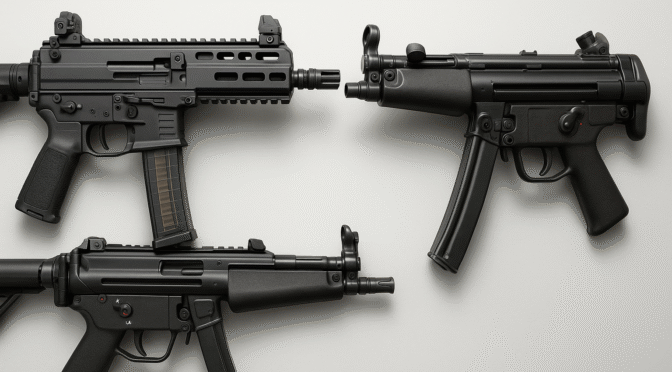
This report provides an exhaustive comparative analysis of two definitive 9mm platforms: the legacy Heckler & Koch (H&K) MP5 and the modern Brügger & Thomet (B&T) APC9. The objective is to assess their respective design histories, engineering principles, platform-level advantages and disadvantages, and current market standing to determine which platform represents the contemporary leader in the Submachine Gun (SMG) / Pistol Caliber Carbine (PCC) space.
The analysis confirms that while the H&K MP5 established the gold standard for 20th-century SMGs through its revolutionary roller-delayed blowback system, its 1960s-era design is now operationally obsolete from an ergonomic and modularity standpoint. The B&T APC9, designed explicitly as a 21st-century successor, systematically addresses every key deficiency of the MP5.
Key findings include:
- Engineering Trade-Off: The MP5’s roller-delayed action remains mechanically superior in providing a softer recoil impulse and theoretically quieter suppressed performance. However, this comes at a significant cost of manufacturing complexity and specialized armorer-level maintenance. The APC9’s simple blowback action, enhanced by an innovative hydraulic buffer, provides a viable and cost-effective alternative that is simpler to maintain.
- System-Level Superiority: The APC9 is a demonstrably superior weapon system. Its design features full ambidextrous controls, a non-reciprocating charging handle, an AR-style manual of arms for reloads, a native monolithic optics rail, and—most critically—interchangeable lower receivers that allow logistical commonality with Glock and SIG Sauer service pistols.
- Market Validation: The institutional market has rendered a clear verdict. The B&T APC9K’s selection by the U.S. Army as its new Sub Compact Weapon (SCW) in 2019, specifically over modern MP5 variants, confirms that modern procurement doctrine prioritizes the APC9’s systems-level modularity and ergonomics over the MP5’s marginal gains in recoil smoothness.
Conclusion: The H&K MP5 remains an iconic and treasured firearm, but it is no longer the leader. The B&T APC9 is the definitive modern standard for professional 9mm sub-weapon platforms, as evidenced by its superior design, logistics, and capture of key institutional contracts.
2.0 Introduction: The Evolving Doctrine of the 9mm Sub-Weapon
The role of the 9mm sub-weapon has undergone a significant doctrinal evolution. In the 1980s, platforms like the MP5 were frontline offensive weapons for counter-terrorist (CT) and special operations teams. However, the proliferation of body armor has largely relegated pistol-caliber weapons to a more specialized niche.1 The 5.56x45mm short-barreled rifle (SBR) has become the new general-purpose standard, offering barrier and armor penetration in a compact package.1
This shift has not eliminated the 9mm sub-weapon but rather re-focused its mission. The modern 9mm SMG/PCC has found a renaissance in roles where concealability, reduced signature (suppression), and a high volume of accurate, low-collateral-damage fire at close ranges are paramount.3 This is the doctrine of the Personal Security Detail (PSD), VIP protection, and low-visibility operations.
This report frames its analysis within this doctrinal context. The H&K MP5 was the undisputed standard of the 20th-century’s CT-focused doctrine.4 The B&T APC9 was designed from a clean slate to meet the specific demands of the 21st-century’s specialized PDW/SCW doctrine.6 The central conflict to be analyzed is whether the MP5’s mechanically elegant roller-delayed blowback system 9 is more valuable to the modern operator than the APC9’s superior ergonomics, logistics, and systems-level modularity.11
3.0 Analysis of the Legacy Standard: Heckler & Koch MP5
3.1 Development History: From Rifle Program to Counter-Terror Icon
The Heckler & Koch Maschinenpistole 5 (MP5) was developed in West Germany during the 1960s by a team of H&K engineers including Tilo Möller, Manfred Guhring, Georg Seidl, and Helmut Baureuter.4 Its development, which began in 1964, was not a “clean sheet” submachine gun design. Instead, it was a direct, scaled-down application of H&K’s successful G3 battle rifle operating principle.15
This origin is the single most important factor in understanding the MP5’s design, performance, and eventual market dominance. While contemporary SMGs were typically simple, heavy, open-bolt blowback guns (such as the Uzi), the H&K team applied a sophisticated, closed-bolt, roller-delayed operating system to the 9x19mm pistol cartridge.4 The result was a weapon, initially designated the HK54, that offered rifle-like precision in a compact package.16 In 1966, German authorities, including the Federal Police and border guards, formally adopted it as the MP5.14
Despite its domestic success, the MP5 was largely overshadowed on the global stage by its Israeli competitor, the Uzi.17 Its ascent to “iconic status” 15 and its establishment as the Western world’s premier SMG can be traced to a single, televised event: the 1980 Iranian Embassy siege in London.18 On May 5, 1980, the British Army’s Special Air Service (SAS) executed “Operation Nimrod,” assaulting the embassy to rescue hostages.5 The world watched as black-clad operators, wielding MP5s, demonstrated a new level of surgical precision.5
This event was a marketing catalyst unparalleled in modern small arms history. It cemented the MP5 as the quintessential counter-terrorist weapon, leading to its adoption by “almost every major military and special police unit worldwide”.5 For the next four decades, it was the “most widely adopted submachine gun of all time”.4 H&K developed a vast ecosystem of variants, including the integrally suppressed MP5SD, the ultra-compact MP5K for VIP protection, and the reinforced MP5F for French forces.16 The MP5’s success was so total that it effectively stifled significant innovation in the SMG market for decades.
3.2 Engineering Analysis: The Roller-Delayed Blowback System
The genius of the MP5 is its operating system, which is frequently misunderstood. It is a roller-delayed blowback system, not a true roller-locked system.4 The bolt is never rigidly locked to the breech at the moment of firing.
The bolt assembly consists of a relatively light bolt head and a heavy, separate bolt carrier. These are connected by a wedge-shaped “locking piece”.10 The bolt head contains two rollers that, when in battery, are forced outward by the locking piece into angled recesses in the receiver’s trunnion.10
The sequence of operations upon firing is a masterpiece of applied physics:
- The 9x19mm cartridge ignites. Gas pressure pushes the cartridge case rearward, exerting force on the bolt head.
- The bolt head, however, cannot move straight back, as its rollers are wedged into the trunnion recesses.10
- The immense force is redirected by the rollers against the angled faces of the locking piece. This use of mechanical disadvantage translates the rearward force on the bolt head into a much faster, accelerated rearward movement of the heavy bolt carrier.10
- This “delay” 4—during which the heavy carrier moves back while the bolt head and casing barely move—allows chamber pressure to drop to safe levels before extraction begins.4 To aid this, the chamber is fluted, using gas to “float” the casing and prevent it from rupturing during extraction.4
- After the bolt carrier has moved a set distance, the locking piece is pulled free, which in turn retracts the rollers from the trunnion recesses. The entire bolt assembly, now mechanically linked, is free to travel rearward, extracting and ejecting the spent case.10
This complex sequence has two profound benefits. First, it dramatically reduces felt recoil. In a simple blowback gun, a massive, heavy bolt must reciprocate, creating a harsh impulse.28 In the MP5, the initial reciprocating mass is only the heavy bolt carrier; the bolt head’s movement is delayed. This, combined with firing from a closed bolt, is the mechanical source of the MP5’s legendary accuracy and light, “soft” recoil.4
Second, this system is inherently superior for suppression.9 By delaying the breech opening until chamber pressure drops, it drastically reduces “port pop”—the loud, sharp noise of high-pressure gas escaping the ejection port—and minimizes gas blowback in the operator’s face.9 This is why the MP5SD, which pairs this action with a ported, integrally-suppressed barrel, remains a benchmark for quiet operation.21
3.3 Platform Analysis: Armorer-Level Pros and Cons
An armorer-level assessment reveals the MP5 as a platform of extreme trade-offs.
Pros:
- Shooting Impulse: It is a legendarily “soft shooter”.29 The roller-delay mechanism creates an almost non-existent recoil impulse, enabling exceptionally fast and accurate follow-up shots.10
- Accuracy: Firing from a closed bolt with a fixed barrel, the MP5 delivers rifle-like accuracy at typical engagement distances.14
- Reliability & Suppression: The system is robust and reliable when properly maintained 32 and is widely considered one of the best 9mm suppressor hosts ever produced.9
Cons:
- Ergonomics: The 1960s-era design is fatally outdated.34 The fire control selector is notoriously stiff and poorly positioned for rapid manipulation with a firing grip.34 The manual of arms is complex and non-intuitive for operators trained on modern platforms.
- Reloading: The “rock-and-lock” magazine insertion and separate, forward-mounted charging handle are dramatically slower than the straight-insertion, button-release design of AR-pattern rifles.30 The famous “HK slap” is a required (and inefficient) step to charge the weapon, not an optional flourish.34
- Modularity: The stamped steel receiver lacks any native integration for modern optics, lasers, or lights.34 All such accessories must be added via heavy, “bolt-on” claw mounts that add weight and increase height-over-bore, a distinct disadvantage compared to modern monolithic rails.
- Maintenance & Cost: The roller-delayed system is complex and expensive to manufacture.26 For an armorer, it is a logistical burden. It requires specialized knowledge and tools to check “bolt gap”—the critical headspace tolerance.10 Furthermore, the system must be tuned for different ammunition pressures (e.g., standard vs. +P vs. subsonic) by swapping the angled “locking piece”.10 Failure to do so, as noted in the H&K armorer’s manual, can lead to failures to extract, damage to the buffer, or “permanent damage to the weapon… [or] receiver”.27 This maintenance requirement is a significant liability for an institutional user.
4.0 Analysis of the Modern Challenger: Brügger & Thomet APC9
4.1 Development History: The “Advanced Police Carbine”
Brügger & Thomet (B&T) of Switzerland was founded in 1991, not as a firearms company, but as a high-end suppressor manufacturer and an Original Equipment Manufacturer (OEM) of parts for major firearms companies, including Heckler & Koch.8 This background gave B&T a unique, ground-level understanding of the institutional market’s needs and the logistical complaints armorers had about existing platforms.
B&T entered firearms manufacturing after acquiring the rights to the Steyr TMP (Tactical Machine Pistol), which it subsequently evolved into the B&T MP9.8 The Advanced Police Carbine (APC), first produced in 2011, was B&T’s first “clean slate” design.6
The APC9’s origin is market-driven, whereas the MP5’s was engineering-driven. The platform was explicitly designed to be a modern, more cost-effective alternative to the MP5.13 It was developed based on years of customer feedback from MP9 users 6, and its design systematically solves every major complaint leveled against the MP5:
- MP5 Ergonomics: The APC9 is fully ambidextrous.12
- MP5 Reload: The APC9 has an AR-style magazine release and bolt hold-open.12
- MP5 Modularity: The APC9 has a monolithic, full-length Picatinny rail.37
- MP5 Logistics: The APC9 PRO offers modular lowers that accept common Glock or P320 magazines.11
The APC9’s manufacturing is thoroughly modern, utilizing a high-tech aluminum extrusion for the upper receiver and a polymer lower/grip housing.36 This process is significantly less complex and costly than stamping, welding, and assembling the MP5’s roller-delayed action, even in a high-cost country like Switzerland.36 The “PRO” series, introduced around 2019, represents the platform’s full evolution, incorporating a non-reciprocating, auto-folding charging handle, AR-15 grip compatibility, and the crucial modular lower receiver system.11
4.2 Engineering Analysis: The Hydraulic-Buffered Blowback System
The 9mm variants of the B&T APC9 use a simple, closed-bolt, straight blowback operating system.6 In a typical PCC, this design choice would be a fatal flaw. Straight blowback requires a massive, heavy bolt to provide the inertia needed to safely delay breech opening until pressure drops.28 This heavy reciprocating mass results in a famously harsh, “unpleasant” recoil impulse that is difficult to control, especially in full-auto.28
B&T’s entire design is enabled by its one, truly innovative component: a proprietary hydraulic buffer system.12 This buffer, integrated into the stock assembly or receiver end cap, consists of a piston and cylinder filled with hydraulic fluid.43
As the APC9’s heavy bolt travels rearward, it impacts and compresses this hydraulic buffer. The hydraulic fluid provides powerful, non-linear resistance, “gradually slowing down the bolt carrier group”.43 This dampening effect 43 is an elegant solution to the physics problem of blowback recoil. According to B&T, this system:
- Significantly reduces felt recoil.12
- Eliminates “bolt bounce,” a common issue in full-auto blowback guns that can cause out-of-battery ignition.
- Reduces wear and tear on the weapon and, critically, on mounted optics.12
- Results in “much tighter burst groups” during automatic fire.12
This design is a compromise. It does not fully replicate the “non-existent” smoothness of the MP5’s roller-delay; the APC9’s bolt is still “several times heavier than the MP5 bolt”.45 However, the buffer narrows the performance gap to what many shooters describe as a “marginal” difference 45, all while retaining the simplicity, reliability, and lower manufacturing cost of a blowback system. It makes the platform viable for professional use in a way un-buffered blowback guns are not.
4.3 Platform Validation: The U.S. Army SCW Contract
The single most important validation of the APC9 platform occurred in 2019, when B&T USA won the U.S. Army’s Sub Compact Weapon (SCW) contract.3 This was a landmark event, representing the first official adoption of an SMG by the U.S. Army since the M3 “Grease Gun” in 1943.11
The contract was for an initial 350 units, with options for up to 1,000, at a value of over $2.5 million.3 The U.S. Air Force later “piggy-backed” on this contract to procure 65 of its own units.47 The winning weapon was the B&T APC9K PRO.3
The Army’s requirement was for a highly concealable weapon for its Personal Security Details (PSDs), intended to protect high-risk personnel.3 The goal was to provide these teams with a platform, more capable than a pistol, to “engage threats ‘with a high volume of lethal force while accurately firing at close range with minimal collateral damage'”.3
Key Army requirements that the APC9K met included:
- A 9x19mm chambering, optimized to fire 147-grain (subsonic) ammunition.3
- A collapsible/retracting stock (a specific requirement that some folding-stock competitors did not meet).48
- A rail system for accessories like aiming lights and lasers.3
The most telling detail of the competition is that B&T won against a field of major competitors, including SIG Sauer 3 and, significantly, submissions that included “modern versions of the Heckler & Koch MP5 sub gun design”.3
The U.S. Army was given a direct choice between a modern MP5 and the APC9K, and it selected the APC9K. This victory proves that for a 21st-century institutional user, the MP5’s dated ergonomics and lack of native modularity are disqualifying failures. The APC9K’s native accessory rails, superior ambidextrous controls, compact retracting-stock package, and familiar AR-style manual of arms were the decisive factors. The Army voted for the superior weapon system, not just the superior recoil impulse.
Table 1: U.S. Army SCW Contract Requirement Analysis
| SCW Requirement | B&T APC9K Feature | Analytical Rationale |
| Concealable Weapon for PSDs | Ultra-compact “K” variant; 4.3″ barrel (110mm), 15.2″ folded length 6 | Met the stringent size requirement for low-visibility protection details. |
| Retracting Stock | Collapsible (retracting) stock | This was a specific requirement that B&T met, whereas some competitors offered side-folders.48 |
| Rail System for Accessories | Monolithic Picatinny rail on upper; M-LOK compatible handguard 12 | Native, modern-standard integration for optics (e.g., Aimpoint) and lasers.3 |
| High Volume of Lethal Force | Full-automatic capability 3 | Standard SMG feature, but the hydraulic buffer tames this for “tighter burst groups”.12 |
| Minimal Collateral Damage | 9x19mm caliber, optimized for 147-grain ammo 3 | 147-grain 9mm is ideal for suppressed, close-range use with less over-penetration risk than 5.56mm. |
| Modern Controls | Fully ambidextrous selector, mag release, and bolt-hold-open 12 | Superior manual of arms for operators under stress, a key failure of the MP5 design. |
5.0 Comparative Analysis: H&K MP5 vs. B&T APC9
5.1 Platform Specifications
A direct comparison of the standard models reveals the design-philosophy differences, particularly in weight and dimensions. The APC9’s modern materials and design make it a lighter and more compact package.
Table 2: Key Platform Specifications
| Metric | H&K MP5A3 (Typical) | B&T APC9 PRO (Standard) |
| Caliber | 9x19mm | 9x19mm |
| Operating System | Roller-Delayed Blowback 4 | Straight Blowback w/ Hydraulic Buffer 6 |
| Bolt Type | Closed-Bolt 14 | Closed-Bolt 6 |
| Barrel Length | 8.9 in (225 mm) 23 | 6.8 in (175 mm) 38 |
| Overall Length (Ext.) | ~31.7 in | ~24.5 in 38 |
| Overall Length (Col.) | ~25.6 in | ~15.2 in (Stock Folded) 6 |
| Weight (Unloaded) | ~6.8 lbs (3.1 kg) | ~5.3 lbs (2.4 kg) 38 |
| Receiver Material | Stamped Steel | Aluminum Upper 36, Polymer Lower 39 |
| Magazine Type | H&K Proprietary | B&T Proprietary, Glock, or SIG P320 11 |
| Fire Controls | Right-hand selector (most models) | Fully Ambidextrous 12 |
5.2 Recoil Impulse, Accuracy, and Suppressor Performance
- Recoil: The MP5’s roller-delayed system, with its lower reciprocating mass at the moment of firing, has a mechanically superior recoil impulse. It is universally lauded as a “soft shooter”.29 The APC9’s hydraulic buffer is highly effective at mitigating the harshness of its heavy blowback bolt 12, but many purists and some instructors still find the MP5 “smoother” or “softer”.34
- Accuracy: For all practical purposes, this is a tie. Both platforms fire from a closed bolt 6 and are capable of exceptional “deadly accurate” precision at typical SMG engagement distances of 25-100 yards.20
- Suppression: The MP5, particularly the MP5SD, is the “gold standard”.9 Its delayed breech opening results in less noise escaping the ejection port 10, making it inherently quieter at the ear than a blowback gun.33 The APC9 also suppresses very well, and B&T offers its own “SD” variant.51 A significant logistical advantage for the APC9-SD is that its suppressor and barrel are far easier to clean than the notoriously difficult-to-maintain MP5SD barrel and shroud.54
5.3 Ergonomics, Modularity, and Manual of Arms
This is the central battleground of the comparison, and the B&T APC9 wins decisively. A firearm is a tool to be used under stress, and the APC9 is an objectively superior tool in every aspect of operator-weapon interaction.
- Controls: The MP5 is a right-handed-only design.34 The APC9 PRO is fully ambidextrous.12 The safety, magazine release, and bolt catch/release are mirrored on both sides of the weapon.12
- Charging Handle: The MP5’s handle is forward-mounted, non-ambidextrous, and requires the operator to break their firing grip (or use their support hand) to manipulate it.34 The APC9 PRO’s handle is dual, non-reciprocating, and folds forward, allowing operation from either side with either hand.12
- Reloading: The MP5’s reload is slow and complex, requiring a “rock-and-lock” magazine insertion followed by a “slap” of the charging handle to release the bolt.30 The APC9’s reload is identical to an AR-15: straight-insert the magazine, then press a button (the bolt release) to chamber a round.34 This manual of arms is dramatically faster and, for Western military and police, requires zero new training.
- Modularity (Optics): The MP5 requires a claw mount or custom-welded rail.34 The APC9 has a monolithic, full-length Picatinny rail from the factory, ready for any optic or laser.12
- Modularity (Logistics): This is the APC9’s single greatest advantage. The MP5 takes one type of expensive, proprietary magazine. The APC9 PRO offers interchangeable polymer lower receivers.11 An agency can issue a single, serialized APC9 upper and provide its operators with lowers compatible with their standard-issue sidearm magazines, such as the Glock 17 or SIG P320/M17.11 This simplifies logistics, reduces cost, and allows operators to share a common magazine pool between their primary and secondary weapons. This is a revolutionary logistical advantage that the MP5 platform cannot answer.
5.4 Reliability and Maintenance
The two platforms present a clear “no free lunch” trade-off between complex design and high-stress simplicity.
- MP5: The roller-delayed system is reliable if and only if it is properly configured and maintained. As noted previously, it is highly sensitive to ammunition type and requires the correct locking piece to be installed.27 It is complex to disassemble and clean, especially the bolt group and fluted chamber.55 An armorer’s failure to check bolt gap or use the correct parts can lead to weapon failure or receiver damage.10
- APC9: The blowback system is mechanically simple, easy to field strip, and easy to clean.55 However, this simplicity creates a high-stress environment for the parts. A high-round-count (11,000) user report detailed significant failures, including “a substantial piece inside the lower” breaking at 8,000 rounds and a critical spring failure at 11,000 rounds.58 The recommended service interval from a B&T dealer was every 5,000 rounds.58 Furthermore, the trigger group is not fully AR-15 specification, and using aftermarket triggers (like Geissele) can lead to “deformed hammer” or “snap[ped]… firing pin” failures.59
The trade-off is clear: The MP5 fails from improper configuration. The APC9 fails from material fatigue at high round counts. For a modern, institutional armorer, the APC9’s maintenance (e.g., “replace buffer and springs every 5,000 rounds”) is a simpler and more predictable logistical task than the MP5’s (e.g., “diagnose bolt gap and select correct locking piece for this new ammunition”).
Table 3: Qualitative Pros & Cons Matrix
| Performance Metric | H&K MP5 | B&T APC9 |
| Recoil Impulse | Pro: Mechanically superior. “Softer”.29 | Con: Heavier bolt; “harsher” than MP5, but mitigated by buffer.45 |
| Suppression Host | Pro: Gold standard. Delayed action = less port pop.10 | Neutral: Very good, but blowback is inherently louder at-ear.45 SD model easier to clean.54 |
| Modularity (Rails) | Con: Outdated. Requires bolt-on mounts.34 | Pro: Native monolithic rail.12 |
| Modularity (Logistics) | Con: Proprietary magazines. | Pro: Modular lowers for Glock/SIG mags.11 |
| Ergonomics (Ambi) | Con: Poor. Right-hand only.34 | Pro: Fully ambidextrous.12 |
| Ergonomics (Reload) | Con: Slow, complex “rock-and-lock”.30 | Pro: Fast, familiar AR-style straight-insert.34 |
| Maintenance | Con: Complex, parts-sensitive (rollers, locking piece, bolt gap).10 | Pro: Simple blowback design, easy to field strip.55 |
| Durability (Armorer) | Con: Risk of receiver damage from wrong parts/ammo.35 | Con: High-stress system. Wear on lowers/springs at high counts.58 |
6.0 Market & Sentiment Analysis
6.1 Institutional Adoption (Military & LE)
The institutional market provides the clearest, most objective answer.
- MP5: The MP5 was the standard. It is still in service with thousands of agencies globally.5 However, its adoption trend is negative. It is a legacy platform. Most agencies are either replacing their 9mm SMGs entirely with 5.56mm SBRs 1 or, if the 9mm SCW role is retained, they are actively replacing their MP5s with modern platforms.
- APC9: The APC9’s adoption trend is unequivocally positive. It is actively winning contracts and displacing legacy MP5s. Adopters include:
- United States Army (APC9K) 3
- United States Air Force (APC9K) 47
- Miami Beach Police Department (APC9K Pro) 6
- Westchester County Police (APC9SD) 6
- Hillsborough County Sheriff’s Office (APC9K Pro) 6
- Military Police of São Paulo State, Brazil (APC40 PRO) 6
- Belgian Customs/Border Patrol (APC9 PRO) 6
- Slovak Police Force (APC9) 6
The institutional market has already decided. The U.S. Army’s SCW contract was the bellwether, and the APC9 is the new institutional standard for the specialized 9mm SCW niche.
6.2 Civilian Market & Social Media Performance
The high-end civilian market, populated by “prosumers” and collectors, provides a valuable look at user sentiment. This market is far more emotional but often mirrors the technical debate of the professional world.
- MP5 (Sentiment: The “Icon”): On social media platforms like Reddit and YouTube, the MP5 (and its high-quality civilian clones like the H&K SP5) is revered for its nostalgia and shooting experience.33 It is “The Jordan” to the APC9’s “Lebron”.64 It is praised as the “icon” 29, “smoother” 34, and “quieter suppressed”.33 However, even its staunchest defenders readily admit its “ergos kind of suck” 33, it has “horrible ergo” 34, and it is, in effect, an “outdated boomer stick”.34 The MP5 is bought for pleasure and nostalgia.
- APC9 (Sentiment: The “Modern Tool”): The APC9 is discussed as the practical, modern choice.55 Users praise its “modern ergonomics and controls” 34, AR-15 familiarity 63, and superior accessory-mounting options.34 The online consensus from a practical standpoint is often blunt: “the APC is the better weapon. That’s not even debatable.”.66 The APC9 is bought for performance and practicality.
This social media discourse perfectly captures the core technical conflict: MP5 fans are defending the superiority of the operating system. APC9 fans are defending the superiority of the weapon system. The most telling comments often come from users who own both platforms. Their consensus is almost universal: they love shooting the MP5 for its history and smoothness, but the APC9 is the one they would choose for any “real work”.33
7.0 Conclusion: The Leader in 2024
The H&K MP5 is, and will remain, one of the most significant, influential, and iconic firearms of the 20th century. Its roller-delayed blowback system is an engineering marvel 4 that, in a vacuum, remains the superior action for mitigating recoil and suppressing a 9mm carbine.9
However, a firearm is a system, not just an action. The MP5’s 1960s-era design 14 is a fatal liability in 2024. Its poor ergonomics, right-hand-only controls, complex manual of arms, and complete lack of native modularity for optics and accessories make it operationally obsolete for a modern, professional operator.30
The B&T APC9 is the definitive leader today. It was designed from the outset to be the “modern-day MP5” 13, and it has succeeded in every practical metric. Its brilliant use of a hydraulic buffer 12 makes its simple, reliable, and cost-effective blowback action good enough to compete, while its vastly superior systems-level design—full ambidextrous controls 12, an AR-style manual of arms 34, monolithic rails 37, and game-changing modular lowers 11—makes it the superior weapon.
The market has confirmed this. The civilian heart may still belong to the MP5, but the institutional head—and the procurement contracts—belong to the APC9.3 The U.S. Army’s selection of the APC9K over modern MP5 variants 3 was the final, definitive judgment. The MP5 is a legend and a prized collector’s piece; the APC9 is the issued tool.
Appendix A: Methodology for Comparative Small Arms Systems Analysis
1.0 Objective
The objective of this report’s methodology is to conduct a formal comparative systems analysis 67 to determine the “best value” 68 and identify the definitive “leader” between the H&K MP5 and B&T APC9 weapon systems for a modern institutional (military or law enforcement) end-user.
2.0 Analytical Framework
This analysis employs a multi-faceted approach, mirroring U.S. Department of Defense (DoD) procurement practices, by combining quantitative and qualitative performance analysis with market/sentiment analysis.68 The evaluation addresses the systems “for use by typical users in realistic operational environments”.70
3.0 Quantitative & Qualitative Performance Analysis
This analysis framework is based on the system evaluation methodology described in DoD technical analyses 68 and the criteria from the U.S. Army’s Modular Handgun System (MHS) trials.71
3.1. Define Relevant Variables: The systems are compared across a weighted set of variables critical to modern procurement.70 These are:
- Performance Variables 68:
- Reliability: Assessed via Mean Rounds Between Failure (MRBF) data, parts sensitivity, and required service life.27
- Suitability/Lethality: Closed-bolt accuracy, recoil impulse (as it relates to follow-up shots), and effectiveness as a suppressor host.68
- Maintainability: Armorer-level complexity, required service intervals, ease of field stripping, and parts commonality.68
- Ergonomic & Modular Variables 71:
- Ergonomics: Assessed by the presence of ambidextrous controls, efficiency of the manual of arms (reload speed, safety manipulation), and operator handling.71
- Modularity: Assessed by the native ability to mount “targeting enablers” (optics, lasers) 71, compatibility with different stocks/grips, and logistical modularity (e.g., magazine/lower receiver interchangeability).73
3.2. Weighting and Decision Matrix: This analysis utilizes a weighted decision matrix, as described in formal systems analysis.70 A key component of this 2024 analysis is the high weighting applied to Ergonomic & Modular Variables. Modern procurement doctrine 71 recognizes that operator-system-interface (ergonomics, modularity) is a critical component of effectiveness, equal to or greater than marginal differences in pure mechanical performance (e.g., recoil impulse).
4.0 Market & Sentiment Analysis
4.1. Institutional Adoption: Analysis of active military and law enforcement (LE) procurement contracts 3 serves as the primary, objective indicator of institutional validation and de facto leadership.67 A platform winning new contracts is deemed superior in the “best value” analysis.69
4.2. Social/Civilian Market: Analysis of consumer behavior 74, industry publications 76, and social media sentiment 63 is used as a qualitative data source. This measures “Market Sentiment” and identifies emergent trends and user-defined pro/con arguments, which often serve as leading indicators for future institutional requirements.
5.0 Conclusion
The “leader” is determined not by a single metric (e.g., “smoothest shooter”) but by the platform’s aggregate score across this entire weighted matrix. The final, decisive validation is provided by the institutional market, where objective, data-driven procurement decisions 3 supersede the nostalgia or subjective preferences found in the civilian market.
If you find this post useful, please share the link on Facebook, with your friends, etc. Your support is much appreciated and if you have any feedback, please email me at in**@*********ps.com. Please note that for links to other websites, we are only paid if there is an affiliate program such as Avantlink, Impact, Amazon and eBay and only if you purchase something. If you’d like to directly contribute towards our continued reporting, please visit our funding page.
Sources Used
- Is the HK MP5 now considered an obsolete weapon for hostage rescue? – Reddit, accessed November 16, 2025, https://www.reddit.com/r/WarCollege/comments/13ws8c6/is_the_hk_mp5_now_considered_an_obsolete_weapon/
- What gun is the U.S. Secret Service requesting to replace the current MP5? – Quora, accessed November 16, 2025, https://www.quora.com/What-gun-is-the-U-S-Secret-Service-requesting-to-replace-the-current-MP5
- The Army picked this sub gun for security details to use while …, accessed November 16, 2025, https://www.armytimes.com/news/your-army/2019/04/01/the-army-picked-this-sub-gun-for-security-details-to-use-while-protecting-top-commanders/
- Inside the MP5, the History and Function of Roller-Delay – Sonoran Desert Institute, accessed November 16, 2025, https://sdi.edu/2021/05/20/inside-the-mp5-the-history-and-function-of-roller-delay/
- 8 Major HK MP5 Variants — A History – The Mag Life, accessed November 16, 2025, https://gunmagwarehouse.com/blog/8-hk-mp5-variants-a-history/
- Brügger & Thomet APC – Wikipedia, accessed November 16, 2025, https://en.wikipedia.org/wiki/Br%C3%BCgger_%26_Thomet_APC
- B&T Advanced Police Carbine – Small Arms Defense Journal, accessed November 16, 2025, https://sadefensejournal.com/bt-advanced-police-carbine/
- Why the U.S. Army Loves This New Machine Gun – The National Interest, accessed November 16, 2025, https://nationalinterest.org/blog/buzz/why-us-army-loves-new-machine-gun-51107
- Roller-Delayed vs. Direct Blowback: An Overview – Zenith Firearms, accessed November 16, 2025, https://zenithfirearms.com/roller-delayed-vs-direct-blowback-an-overview/
- How Roller-Delayed Firearms Work and Why it Matters, accessed November 16, 2025, https://internationalsportsman.com/how-roller-delayed-firearms-work-and-why-it-matters/
- History | B&T USA, accessed November 16, 2025, https://bt-usa.com/support/history/
- APC PRO – 04 – 04 2020.indd – B&T AG, accessed November 16, 2025, https://bt-ag.ch/wp-content/uploads/2020/07/APC_PRO-04-20201.pdf
- The B&T APC9k — What the MP5 Wishes it Was | RECOIL, accessed November 16, 2025, https://www.recoilweb.com/the-bt-apc9k-what-the-mp5-wishes-it-was-153558.html
- [History] Heckler & Koch MP5: A Pop Culture SMG Icon – Pew Pew Tactical, accessed November 16, 2025, https://www.pewpewtactical.com/hk-mp5-history/
- Heckler & Koch MP5 – Wikipedia, accessed November 16, 2025, https://en.wikipedia.org/wiki/Heckler_%26_Koch_MP5
- The H&K MP5: A Comprehensive History, Design, and Legacy – AV Guns, accessed November 16, 2025, https://store.avguns.com/blog/the-hk-mp5-a-comprehensive-history-design-and-legacy/
- A Brief History of the MP5 – Zenith Firearms, accessed November 16, 2025, https://zenithfirearms.com/brief-history-mp5/
- Iranian Embassy siege – Wikipedia, accessed November 16, 2025, https://en.wikipedia.org/wiki/Iranian_Embassy_siege
- Iranian Embassy Siege SAS Extended Pistol Magazines – YouTube, accessed November 16, 2025, https://www.youtube.com/watch?v=G-V-YECfHU8
- Operation Nimrod – GUNS Magazine, accessed November 16, 2025, https://gunsmagazine.com/guns/rifles/operation-nimrod/
- MP5 – Heckler & Koch, accessed November 16, 2025, https://www.heckler-koch.com/en/Products/Military%20and%20Law%20Enforcement/Submachine%20guns/MP5
- MP5K – HK USA, accessed November 16, 2025, https://hk-usa.com/product/mp5k/
- Heckler & Koch MP5 (& variants) – Small Arms Survey, accessed November 16, 2025, https://www.smallarmssurvey.org/sites/default/files/SAS-weapons-sub-machine-guns-Heckler-Koch-MP5.pdf
- Understanding the Roller-Delayed Blowback Mechanism: Spotlight on HK P9, Korth PRS, HK MP5, and HK G3 – Korriphila, accessed November 16, 2025, https://korriphila.org/understanding-the-roller-delayed-blowback-mechanism-spotlight-on-hk-p9-korth-prs-hk-mp5-and-hk-g3/
- Roller Delayed Blowback System: A Detailed Look – The Mag Life, accessed November 16, 2025, https://gunmagwarehouse.com/blog/roller-delayed-blowback-system-a-detailed-look/
- What is roller delayed blowback and what makes it better? : r/guns – Reddit, accessed November 16, 2025, https://www.reddit.com/r/guns/comments/bmag52/what_is_roller_delayed_blowback_and_what_makes_it/
- Hk Mp5 ARmorers Manual.pdf – Tiropratico.com, accessed November 16, 2025, https://www.tiropratico.com/manuali-pdf/2015-H/Hk%20Mp5%20ARmorers%20Manual.pdf
- Straight and Delayed Blowback: Five PCC Operating Systems – Bad Moon Armory, accessed November 16, 2025, https://badmoonarmory.com/delayed-blowback-straight-blowback-pcc/
- TFB Review: The HK SP5K – The Firearm Blog, accessed November 16, 2025, https://www.thefirearmblog.com/blog/2019/07/18/tfb-review-the-hk-sp5k/
- MKE AP5SD Review: Better Than The Original? – Gun Digest, accessed November 16, 2025, https://gundigest.com/gun-reviews/ap5sd-review
- The Development of the Heckler and Koch MP5 Submachine Gun – SOFREP, accessed November 16, 2025, https://sofrep.com/gear/development-heckler-koch-mp5-submachine-gun/
- What are the advantages and drawbacks of roller delayed blowback firearms? – Quora, accessed November 16, 2025, https://www.quora.com/What-are-the-advantages-and-drawbacks-of-roller-delayed-blowback-firearms
- Thoughts on HK SP5 from B&T owners : r/BT_APC – Reddit, accessed November 16, 2025, https://www.reddit.com/r/BT_APC/comments/1gluimc/thoughts_on_hk_sp5_from_bt_owners/
- SP5/MP5 Preferred over APC9. : r/BT_APC – Reddit, accessed November 16, 2025, https://www.reddit.com/r/BT_APC/comments/106ykbr/sp5mp5_preferred_over_apc9/
- Full text of “Hk Mp5 ARmorers Manual” – Internet Archive, accessed November 16, 2025, https://archive.org/stream/gunmanual_Hk_Mp5_ARmorers_Manual/Hk%20Mp5%20ARmorers%20Manual_djvu.txt
- B&T APC-9: The Swiss Answer to the MP5 – YouTube, accessed November 16, 2025, https://www.youtube.com/watch?v=xHRlR2WrdXU
- B&T APC9 Submachine Gun | thefirearmblog.com, accessed November 16, 2025, https://www.thefirearmblog.com/blog/2011/10/25/bt-apc9-submachine-gun/
- APC9 – B&T USA, accessed November 16, 2025, https://bt-usa.com/products/apc9/
- APC9 – B&T USA, accessed November 16, 2025, https://bt-usa.com/product-category/apc-smg/
- Eliminate RECOIL and increase ACCURACY on your blowback PCC – YouTube, accessed November 16, 2025, https://www.youtube.com/watch?v=5xOrc6nszU0
- B&T APC9 Pro Setup and Overview – Inside Safariland, accessed November 16, 2025, https://inside.safariland.com/blog/bt-apc9-pro-setup-and-overview/
- B&T Hydraulic Reduced Recoil Buffer for APC9/10/40/45, accessed November 16, 2025, https://armsunlimited.com/bt-hydraulic-reduced-recoil-buffer-apc9/
- The Science Behind Hydraulic Buffers: Understanding the Mechanism and Its Advantages, accessed November 16, 2025, https://www.blitzkriegcomponents.com/The-Science-Behind-Hydraulic-Buffers-Understanding-the-Mechanism-and-Its-Advantages-_b_7.html
- Unlocking the Benefits of Hydraulic Buffers for Pistol Caliber Carbines, accessed November 16, 2025, https://www.blitzkriegcomponents.com/Unlocking-the-Benefits-of-Hydraulic-Buffers-for-Pistol-Caliber-Carbines_b_3.html
- B&T Apc9 Pro – The modern day Mp5 : r/GunPorn – Reddit, accessed November 16, 2025, https://www.reddit.com/r/GunPorn/comments/m7226j/bt_apc9_pro_the_modern_day_mp5/
- The B&T APC9 – True Shot Ammo, accessed November 16, 2025, https://trueshotammo.com/academy/the-bt-apc9/
- Army’s New 9mm Submachine Guns Are Ready To Help Protect VIPs – The War Zone, accessed November 16, 2025, https://www.twz.com/armys-new-9mm-submachine-guns-are-ready-to-help-protect-vips
- This Is The Army’s New Submachine Gun – The War Zone, accessed November 16, 2025, https://www.twz.com/27261/this-is-the-armys-new-submachine-gun
- Army Selects B&T APC9K for New Sub Compact Weapon – Athlon Outdoors, accessed November 16, 2025, https://athlonoutdoors.com/article/army-bt-apc9k-sub-compact-weapon/
- B&T USA Announces Commercial Release of Its APC9K SD2 US Army Submission, accessed November 16, 2025, https://www.firearmsnews.com/editorial/bt-usa-apc9k-sd2-us-army-submission/480007
- New video breaking down the B&T SPC9 : r/BT_APC – Reddit, accessed November 16, 2025, https://www.reddit.com/r/BT_APC/comments/os9nny/new_video_breaking_down_the_bt_spc9/
- APC9 SD Compact Pistol – B&T USA, accessed November 16, 2025, https://bt-usa.com/products/apc9-sd-compact-pistol/
- The B&T APC9 Pro series, discussing four variants – YouTube, accessed November 16, 2025, https://www.youtube.com/watch?v=_EYrSiaN-10
- Range Report: B&T APC9 SD MBT – As good or better than the Hk MP5? – YouTube, accessed November 16, 2025, https://www.youtube.com/watch?v=HxDMA6NIM34
- B&T APC9 Pro: The Swiss Answer to the MP5 : r/BT_APC – Reddit, accessed November 16, 2025, https://www.reddit.com/r/BT_APC/comments/1o376da/bt_apc9_pro_the_swiss_answer_to_the_mp5/
- Trigger Groups (Semi-Auto) – B&T Parts and Accessories, accessed November 16, 2025, https://bt-parts.com/accessories/trigger-groups/
- How to Clean and Lube an B&T APC9 Pro – YouTube, accessed November 16, 2025, https://www.youtube.com/watch?v=zz12UZ0Oatg
- APC9 after 11k rounds experience : r/BT_APC – Reddit, accessed November 16, 2025, https://www.reddit.com/r/BT_APC/comments/m0izof/apc9_after_11k_rounds_experience/
- Geissele Trigger APC9: Long-Term Issues? : r/BT_APC – Reddit, accessed November 16, 2025, https://www.reddit.com/r/BT_APC/comments/1n87b1y/geissele_trigger_apc9_longterm_issues/
- Any one tried drop a AR15 trigger in APC9 pro? : r/BT_APC – Reddit, accessed November 16, 2025, https://www.reddit.com/r/BT_APC/comments/heimg9/any_one_tried_drop_a_ar15_trigger_in_apc9_pro/
- Hillsborough Sheriff’s Office Adopts B&T APC9 Pro For School Resource Officers | RECOIL, accessed November 16, 2025, https://www.recoilweb.com/hillsborough-sheriffs-office-adopts-bt-apc9-pro-for-school-resource-officers-176383.html
- HK SP5 vs B&T APC9 – If I Could Only Choose One – YouTube, accessed November 16, 2025, https://www.youtube.com/watch?v=CB3PYkSVrxQ
- B&T SPC-9 vs HK SP5 : r/BT_APC – Reddit, accessed November 16, 2025, https://www.reddit.com/r/BT_APC/comments/xqd229/bt_spc9_vs_hk_sp5/
- LEGEND v MODERN — MP5 v APC9 – YouTube, accessed November 16, 2025, https://www.youtube.com/watch?v=lqabN25zwCQ
- B&T vs MP5 options : r/tacticalgear – Reddit, accessed November 16, 2025, https://www.reddit.com/r/tacticalgear/comments/sdq846/bt_vs_mp5_options/
- Apc9 vs Mp5? : r/BT_APC – Reddit, accessed November 16, 2025, https://www.reddit.com/r/BT_APC/comments/1ds6oc1/apc9_vs_mp5/
- Systems Analysis in the U.S. Army Weapons Command | Article, accessed November 16, 2025, https://www.army.mil/article/281950/systems_analysis_in_the_u_s_army_weapons_command
- A comparative analysis of current and planned small arms weapon systems, accessed November 16, 2025, https://www.semanticscholar.org/paper/A-comparative-analysis-of-current-and-planned-small-Jenkins-Lowrey/69f7c96d32029175a68354b6188c56b57054f986
- File:A comparative analysis of current and planned small arms weapon systems (IA acomparativenaly109459904).pdf – Wikimedia Commons, accessed November 16, 2025, https://commons.wikimedia.org/wiki/File:A_comparative_analysis_of_current_and_planned_small_arms_weapon_systems_(IA_acomparativenaly109459904).pdf
- A Comparative Analysis of Current and Planned Small Arms … – DTIC, accessed November 16, 2025, https://apps.dtic.mil/sti/tr/pdf/ADA429392.pdf
- XM17/XM18 Modular Handgun System (MHS) – Director Operational Test and Evaluation, accessed November 16, 2025, https://www.dote.osd.mil/Portals/97/pub/reports/FY2018/army/2018mhs.pdf?ver=2019-08-21-155807-603
- Sig Sauer M18 sets new standard for Army’s Modular Handgun System reliability testing, accessed November 16, 2025, https://www.militarytimes.com/off-duty/gearscout/2019/02/11/sig-sauer-m18-sets-new-standard-for-armys-modular-handgun-system-reliability-testing/
- XM17 Modular Handgun System competition – Wikipedia, accessed November 16, 2025, https://en.wikipedia.org/wiki/XM17_Modular_Handgun_System_competition
- Top Industry Research Reports – NSSF, accessed November 16, 2025, https://www.nssf.org/research/top-industry-research-reports/
- Firearms Market Size, Share, Trends | CAGR of 6.3%, accessed November 16, 2025, https://market.us/report/firearms-market/
- Best Expensive 9mm Carbine: H&K MP5 vs. B&T APC-9 …, accessed November 16, 2025, https://www.thefirearmblog.com/blog/2023/10/10/best-expensive-9mm-carbine-hk-mp5-vs-bt-apc-9/