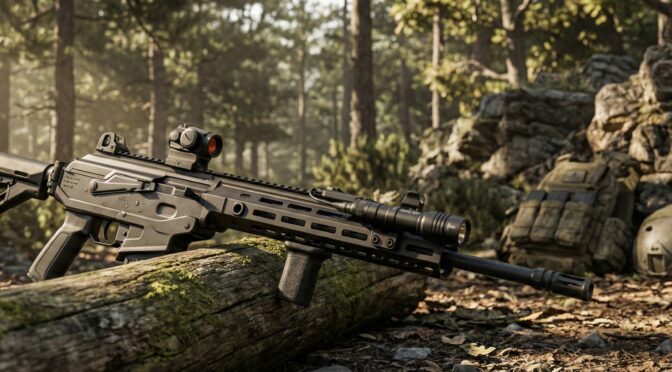
The Israel Weapon Industries (IWI) Galil ACE Gen II represents a significant iterative evolution in the lineage of Kalashnikov-derivative small arms, specifically designed to bridge the operational gap between the rugged reliability of Eastern Bloc engineering and the modular, ergonomic expectations of the Western market. This report provides a comprehensive small arms industry analysis of the Gen II family, evaluating its engineering characteristics, performance metrics across multiple calibers (5.56x45mm, 7.62x39mm, 5.45x39mm, and 7.62x51mm), and its standing within the competitive landscape of modern battle rifles and intermediate carbines.
Our analysis indicates that the Galil ACE Gen II succeeds as a “hybrid” platform, offering the documented reliability of the long-stroke gas piston system housed within a modernized, milled steel receiver that enhances accuracy potential beyond typical stamped-receiver competitors. The integration of a free-floating M-LOK handguard, updated trigger profile, and compatibility with AR-15 buttstocks addresses the primary criticisms of the previous generation. However, these engineering choices necessitate trade-offs, primarily in terms of system weight and a distinct recoil impulse derived from the heavy reciprocating mass.
Market sentiment analysis reveals a bifurcated customer base: widely praised by users prioritizing absolute environmental reliability and caliber diversity, yet critiqued by purists for its departure from traditional aesthetics and by dynamic shooters for its front-heavy weight distribution. Financially, the platform occupies a unique high-value niche, particularly in the 7.62x51mm NATO segment, where it provides a reliable piston-driven alternative to the FN SCAR 17S at approximately half the market cost.
The report concludes that the Galil ACE Gen II is an optimal acquisition for users requiring a hard-use defensive rifle in 7.62x39mm or 7.62x51mm, or for those operating in adverse environments where maintenance intervals may be irregular. It is less suitable for users whose primary requirements are lightweight handling or sub-MOA precision, roles currently better served by direct-impingement AR-15 systems. The existence of a robust aftermarket ecosystem—specifically regarding gas system tuning and lower receiver modification—further enhances the platform’s viability for specialized end-users.
1. Historical Evolution and Design Philosophy
To fully appreciate the engineering nuances of the Galil ACE Gen II, it is essential to contextualize its development within the broader history of Israeli small arms. The ACE is not a 21st-century invention ex nihilo; it is the culmination of over five decades of iterative refinement of the Kalashnikov architecture, filtered through the specific operational requirements of the Israel Defense Forces (IDF) and global export markets.
1.1 The Valmet and Galil Origins
The genesis of the Galil platform lies in the aftermath of the Six-Day War in 1967. During this conflict, the IDF identified significant deficiencies in their then-standard issue FN FAL rifles, particularly regarding reliability in fine desert sand and maneuverability in mechanized warfare.1 Conversely, the IDF was impressed by the reliability of the AK-47s captured from Arab forces. This led to a solicitation for a new domestic rifle that could match the AK’s reliability while maintaining the accuracy and ergonomics required by a Western-trained army.
The winning design, submitted by Yisrael Galili and Yaacov Lior, was heavily based on the Finnish Valmet Rk 62—itself a high-quality derivative of the AK-47. The Valmet utilized a milled receiver, which provided greater structural rigidity than the stamped receivers of the AKM, contributing to better accuracy at the cost of increased weight.1 The original Galil adopted this milled construction, the robust long-stroke gas piston, and the rotating bolt mechanism. It introduced distinct improvements, such as an ambidextrous thumb safety on the left side of the pistol grip (mechanically linked to the dust cover lever) and a vertically upturned charging handle to facilitate ambidextrous manipulation.2
Adopted in 1972, the Galil served as the standard-issue rifle for the IDF until it was largely displaced by American-supplied M16s and M4s, which were lighter and provided at low cost via US military aid. However, the Galil remained in service with armored corps and artillery units, and crucially, became a major export success, serving in South America, Africa, and Asia.1
1.2 The Transition to the ACE (Gen I)
In the late 2000s, IWI sought to revitalize the Galil platform for the modern export market. The result was the Galil ACE (Gen I). The primary engineering objectives for the ACE were weight reduction, improved ergonomics, and the integration of accessory rails—features that had become standard on modern service rifles like the M4 and HK416.1
To achieve weight reduction, IWI redesigned the receiver. While the upper section remained milled steel to ensure the integrity of the bolt lock-up and optic mounting capabilities, the lower section—comprising the magazine well, trigger guard, and pistol grip—was reimagined using high-strength impact-modified polymer.1 This hybrid construction reduced weight relative to the all-steel original while maintaining durability.
Ergonomically, the ACE Gen I moved the charging handle to the left side of the receiver. This was a significant departure from the AK tradition, allowing a right-handed shooter to charge the weapon with their support hand without breaking their firing grip or removing their finger from the vicinity of the trigger guard. To prevent debris ingress through the charging handle slot, IWI designed a spring-loaded dust cover plate that slides with the handle, keeping the action sealed when the bolt is forward—a substantial improvement over the open slot of the AK safety lever.5
1.3 The Gen II Evolution: “Americanization”
The Galil ACE Gen II, introduced to the US market around 2021, was a direct response to customer feedback and the evolving standards of the American civilian and law enforcement markets. While the Gen I was functionally robust, it faced criticism for its bulky aesthetics, proprietary handguard system, and limited buttstock options.4
The Gen II represents a targeted refinement of the platform, focusing on modularity and “American-style” customization. The most visible change is the replacement of the Gen I’s fixed polymer handguard with a free-floating aluminum M-LOK handguard. This not only slimmed the profile of the rifle, making it more comfortable to grip using modern “C-clamp” techniques, but also allowed for the direct mounting of lights, lasers, and grips without the need for bulky Picatinny rail covers.4
Furthermore, the Gen II replaced the proprietary folding stock knuckle with a standard AR-15 buffer tube interface. This allows end-users to install any aftermarket AR-15 stock that fits a commercial or mil-spec tube, vastly expanding customization options compared to the proprietary cheek-piece stock of the Gen I.4 Finally, the iron sights—a staple of the Gen I—were removed in favor of a full-length, uninterrupted Picatinny top rail, reflecting the modern dominance of optical sighting systems.6
2. Systems Engineering Analysis
The Galil ACE Gen II operates on a unique engineering architecture that blends 1940s Soviet reliability principles with 2020s manufacturing precision. This section deconstructs the weapon’s subsystems to evaluate their mechanical efficacy and the implications for the end-user.
2.1 Receiver Construction and Metallurgy
At the heart of the Galil ACE is its receiver. Unlike the majority of modern AK derivatives, which utilize a 1mm or 1.5mm stamped sheet metal receiver folded into a U-shape, the ACE receiver is milled from a solid billet of ordnance steel.1
Structural Rigidity: The primary advantage of the milled receiver is structural rigidity. During the firing cycle of a high-pressure cartridge, stamped receivers can experience minute flexing. While this elasticity prevents cracking, it can introduce variables in harmonic vibration that degrade accuracy. The milled receiver of the ACE is effectively rigid, providing a stable platform for the barrel and bolt lock-up. This is a key factor contributing to the ACE’s ability to consistently print smaller groups than typical stamped AKs.8
Durability vs. Weight: Milled receivers are exceptionally durable and resistant to crushing forces. However, they are inherently heavier than stamped counterparts. IWI engineers attempted to mitigate this mass penalty by machining “lightening cuts” into the receiver’s exterior—visible as distinct horizontal grooves and pockets on the receiver sides.9 Despite these efforts, the ACE remains a heavy weapon relative to its size, with the 16-inch 5.56mm variant weighing approximately 8.8 lbs unloaded, compared to ~6.5 lbs for a standard AR-15.9
2.2 The Long-Stroke Gas Piston System
The ACE utilizes a long-stroke gas piston system, mechanically identical to the AK-47 and derived from the M1 Garand.
Mechanism of Action: In this system, the piston head, piston rod, and bolt carrier group (BCG) form a single, massive reciprocating unit. When the cartridge is fired, gas is tapped from the barrel into the gas block, impinging on the piston head and driving the entire assembly rearward.11
Physics of Reliability: The reliability of the ACE is largely a function of momentum. The combined mass of the bolt carrier and piston is substantial. Once this mass is in motion, it possesses significant kinetic energy, allowing it to plow through carbon fouling, unburnt powder, sand, mud, and debris that would arrest the movement of a lighter short-stroke piston or direct-impingement system. This “over-match” capability is why the platform is favored for adverse environments.9
Recoil Implications: The trade-off for this reliability is the “secondary recoil” impulse. The shooter experiences the initial recoil of the round firing, followed milliseconds later by the sensation of the heavy bolt carrier group reaching the end of its travel and impacting the rear trunnion. This creates a distinct, multi-stage recoil sensation often described as “chunky” or a “ker-chunk” motion, contrasting with the sharper, singular “snap” of an AR-15.8
2.3 Hybrid Construction: The Polymer Lower Module
A defining, and controversial, feature of the ACE architecture is the integration of polymer. While the upper receiver is steel, the lower interface—comprising the trigger guard, pistol grip, and magazine well (on some variants)—is a single injection-molded polymer unit.4
Weight Reduction Strategy: This design choice was driven by the requirement to shed weight from the original all-steel Galil ARM. By replacing the steel pistol grip tang and trigger guard with polymer, IWI saved critical ounces.1
The Integration Issue: On the 7.62x39mm and 5.45x39mm Gen II variants, the pistol grip is molded as an integral part of the polymer lower chassis. This means the pistol grip cannot be simply unscrewed and replaced with a standard AK or AR grip, a limitation that has frustrated users accustomed to the modularity of the AR-15 platform.14 This engineering decision has spawned a specific aftermarket solution known as the “Plastic Delete Kit,” which will be discussed in Section 6.
2.4 Trigger Mechanism
The Gen II features an updated trigger profile compared to the Gen I.
Profile and Geometry: The Gen II trigger shoe is straighter and flatter than the curved “hook” style found on the Gen I and standard AKs. This profile provides better tactile leverage and consistency for the shooter’s finger placement.6
Performance Characteristics: Modeled on the M1 Garand’s two-stage trigger, the ACE trigger typically presents a noticeable take-up (first stage) followed by a defined wall and a clean break. Pull weights are generally reported in the 4.5 to 5.0 lb range.1 While not match-grade by precision rifle standards, it is widely regarded as superior to standard military AK triggers, offering a smoother pull and a positive reset that facilitates rapid follow-up shots.9
2.5 Charging Handle and Dust Cover
The relocation of the charging handle to the left side of the receiver is one of the ACE’s most significant ergonomic upgrades.
Operational Advantage: This placement allows a right-handed shooter to charge the weapon or clear malfunctions using their support hand, keeping their firing hand on the pistol grip and their eye on the target. This supports modern manual of arms techniques that emphasize maintaining weapon control at all times.4
Sealing Mechanism: To accommodate the left-side handle, a long slot is machined into the receiver. To prevent this from becoming an entry point for dirt, IWI engineered a spring-loaded dust cover plate that travels with the charging handle. When the bolt is forward, the slot is completely sealed. This effectively solves the “open lever” vulnerability of the traditional AK design.5
Reciprocation: It is critical to note that the charging handle reciprocates—it moves back and forth with every shot. This requires operator awareness; gripping the magwell too high or bracing the left side of the rifle against a barricade can result in the handle striking the hand or object, potentially causing injury or inducing a malfunction.16
3. Variant-Specific Technical Evaluation
The Galil ACE Gen II is not a monolithic entity; its performance, market value, and operational utility vary significantly depending on the chambering. Each caliber variant presents a distinct set of engineering compromises and advantages.
3.1 7.62x39mm (The Core Variant)
The 7.62x39mm model is widely considered the “flagship” of the ACE Gen II line, representing the most optimized harmonization of the platform’s AK lineage with modern features.
Magazine Compatibility: A primary engineering achievement of this variant is its compatibility with standard AK-47/AKM magazines. AK magazines are notorious for their wide variances in tolerance depending on the country of origin (Russian, Bulgarian, Romanian, Chinese). The ACE’s ability to reliably feed from the vast majority of these—including Magpul PMAGs, Circle 10 polymer mags, and surplus steel—is a testament to the tolerance stacking calculations performed by IWI engineers.9
Ballistic Efficiency: The ACE Gen II is available in 8.3-inch, 13-inch, and 16-inch barrel lengths. The 7.62x39mm cartridge is particularly well-suited for shorter barrels, losing relatively little velocity compared to 5.56mm. This makes the 8.3-inch and 13-inch pistol/SBR variants exceptionally capable Personal Defense Weapons (PDWs), delivering substantial terminal energy in a compact package.17
Manual of Arms: Unlike the 5.56mm variant, the 7.62x39mm ACE adheres to the manual of arms of the original AK-47; it does not feature a last-round bolt hold open (LRBHO) mechanism. When the magazine is empty, the bolt closes on an empty chamber, requiring the operator to manually charge the weapon after reloading. The magazine release is a paddle style, accessible from both sides, rather than a push-button.4
3.2 5.56x45mm NATO
The 5.56mm variant attempts to bridge the gap between the AK and the AR-15, but it faces the stiffest competition in the US market.
AR-15 Controls: To appeal to Western users, the 5.56mm ACE features a magazine well adapter that accepts standard STANAG (AR-15) magazines. It incorporates a last-round bolt hold open and an ambidextrous push-button magazine release, mimicking the ergonomics of the M4.4
The Weight Penalty: The primary critique of this variant is weight. At approximately 8.8 lbs unloaded, the 5.56mm ACE is significantly heavier than a standard DI AR-15 (approx. 6.5 lbs) or even other piston guns like the HK416. While the weight aids in recoil mitigation, making it an incredibly soft shooter, many users find it difficult to justify the extra mass for a 5.56mm carbine when reliable, lighter options are ubiquitous.4
3.3 5.45x39mm (The “Unicorn”)
The 5.45x39mm variant was produced in limited runs (e.g., initially 545 units), creating a high demand among collectors and enthusiasts.1
Performance Characteristics: The 5.45mm cartridge, developed by the Soviets to compete with the 5.56mm, is known for its low recoil and flat trajectory. When fired from the heavy Galil ACE platform, recoil is virtually negligible, allowing for extremely rapid and accurate follow-up shots. The “poison pill” 7N6 projectile historically associated with this caliber offers unique terminal ballistics due to its tumbling effect.19
Compatibility Issues: This variant uses AK-74 pattern magazines. However, users have reported issues with certain “Bakelite” magazines (early Soviet production) not seating correctly due to interference with the ACE’s polymer lower receiver geometry.19 Additionally, the recent bans on Russian ammunition imports have made feeding this variant significantly more expensive and difficult in the US market.
3.4 7.62x51mm NATO (.308 Win)
The 7.62 NATO variant positions itself as a modern battle rifle, competing directly with platforms like the FN SCAR 17S.
Magazine Strategy: A major advantage of the ACE.308 is its use of SR-25/AR-10 pattern magazines (e.g., Magpul PMAGs). These are inexpensive, reliable, and widely available, in sharp contrast to the proprietary and expensive magazines required by the SCAR 17S.13
Value Proposition: In the battle rifle segment, the ACE .308 is arguably the market leader in value. It offers reliability comparable to the SCAR 17S—often cited as the gold standard—but at a price point of ~$1,700-$2,000 versus the SCAR’s ~$4,000. While slightly heavier and with more felt recoil than the SCAR, its ruggedness makes it a preferred choice for users who cannot justify the SCAR’s premium.21
4. Performance Metrics and Reliability Data
4.1 Accuracy Comparison
The Galil ACE Gen II generally outperforms stamped AKs but does not typically match the sub-MOA precision of high-end AR platforms.
Data Analysis:
- 7.62x39mm: Independent testing reports groups ranging from 1.68″ to 2.5″ at 100 yards depending on ammunition quality (brass vs. steel case). This is markedly superior to the 3-4 MOA typical of a WASR-10 or standard AKM.9
- 5.56mm: Reviews indicate groups of 1.0″ to 2.0″ with match-grade ammunition, widening to ~2.8″ with bulk ball ammo.10
- 7.62 NATO: This variant is capable of 1.0″ to 1.5″ accuracy with quality loads, making it a viable Designated Marksman Rifle (DMR) candidate for engagement distances out to 600 yards.23
Structural Factors: The milled receiver and the Gen II’s free-floating M-LOK handguard contribute significantly to this performance by reducing barrel deflection and receiver flex during the firing cycle.4
4.2 Endurance and Environmental Reliability
Reliability is the core competency of the Galil ACE.
High Round Count Testing: Independent evaluators, including the AK Operators Union, have subjected the platform to 5,000-round endurance tests. Reports consistently indicate zero malfunctions attributable to the rifle across mixed ammunition types (brass, steel, lacquer-coated) without cleaning.9
Environmental Hardening: The sealed action (via the dust cover) and the over-gassed piston system allow the ACE to function in sand, mud, and snow conditions that would induce stoppages in tighter-tolerance systems. The “over-gassed” nature ensures the bolt carrier has sufficient velocity to overcome friction caused by fouling or debris.12
4.3 Recoil Impulse Analysis
- 7.62x39mm / 5.56mm: The substantial weight of the rifle absorbs much of the free recoil energy. However, the heavy reciprocating mass creates a distinct “double impulse” sensation—the rearward impact of the bolt carrier followed by its forward return. Users describe this as a soft but “chunky” recoil.8
- 7.62 NATO: Recoil in the.308 variant is stout but manageable. While the muzzle brake is effective, the recoil impulse is often described as sharper than the SCAR 17S, which utilizes a more sophisticated reciprocating mass dampening system and a polymer lower to absorb vibration. Conversely, the ACE is smoother than the roller-delayed blowback impulse of the PTR 91/G3, which is known for a harsh “push”.22
4.4 Suppressor Suitability and Gas Tuning
Out of the box, the Galil ACE Gen II is a suboptimal host for suppressors due to its gas system design.
The Over-Gas Problem: Because the rifle is tuned from the factory to cycle reliably in the worst possible conditions, it is significantly over-gassed. Adding a suppressor increases backpressure, which accelerates the bolt carrier to violent speeds. This results in excessive wear on the rear trunnion, massive gas blowback into the shooter’s face (“gas face”), and erratic ejection patterns where brass is thrown 15-20 feet away.25
The KNS Piston Solution: To rectify this, the installation of a KNS Precision Adjustable Gas Piston is widely considered a mandatory upgrade for suppressor users. This aftermarket piston allows the user to vent excess gas at the gas block, tuning the carrier velocity to optimal levels. With the KNS piston installed, the ACE becomes an excellent suppressor host, offering a smooth, tunable recoil impulse without the damaging carrier velocity.25
5. Ergonomics and Human Systems Integration
The transition to Gen II focused heavily on Human Factors engineering, attempting to resolve the ergonomic complaints levied against the Gen I.
5.1 Handguard and Thermal Dynamics
The Gen II replaced the thick, round plastic handguards of the Gen I with a slim, M-LOK aluminum rail.
Ergonomic Gains: The slim profile allows for a modern “C-clamp” support grip, giving the shooter better leverage to control muzzle rise and transition between targets. The full-length top rail provides ample space for optics, magnifiers, and night vision devices, correcting the Gen I’s segmented rail limitation.4
Thermal Issues: The trade-off for the aluminum construction is heat transfer. The gas tube, situated directly under the top rail, generates immense heat during rapid fire. Aluminum conducts this heat to the shooter’s hand much faster than the insulating plastic of the Gen I. Users frequently report the handguard becoming uncomfortably hot after 2-3 magazines of rapid fire, often necessitating the use of gloves or rail covers (e.g., Slate Black Industries panels).4
5.2 Stock and Buffer Tube Interface
The shift to a standard AR-15 buffer tube interface allows users to mount almost any commercial AR stock (Magpul CTR, B5 Sopmod, etc.).
Folding Mechanism: The stock folds to the right side of the receiver. The hinge mechanism is robust and locks up tightly in both positions. However, firing the weapon with the stock folded can be problematic on the 5.56 and 7.62 NATO versions if the user’s hand obstructs the ejection port or if the reciprocating charging handle interferes with the folded stock body, though it is technically functional.4
Cheek Weld: Because the Galil’s gas tube sits higher relative to the bore than an AR-15, the optic rail is elevated. To compensate, the factory-supplied Magpul stocks often include a snap-on cheek riser to ensure proper eye alignment with the optic. Without this riser, users may struggle to achieve a consistent cheek weld.9
5.3 Safety Selector Mechanics
The safety selectors are ambidextrous, but their implementation varies by side.
Left Side: A thumb lever located above the pistol grip, similar in placement to an AR-15 selector. On the Gen II, IWI reduced the throw distance of this lever, making it easier to engage and disengage without shifting the firing grip.
Right Side: A traditional AK-style lever that physically blocks the trigger mechanism and dust cover path (though the dust cover is internal on the ACE).
Actuation Force: A common point of customer feedback is that the safety levers are stiff out of the box and require a break-in period or manipulation to loosen up.4
6. The Aftermarket Ecosystem and Modifications
The “hybrid” nature of the Galil ACE has spawned a specific aftermarket ecosystem designed to correct its idiosyncrasies.
6.1 The “Plastic Delete” Kit
The most prominent aftermarket modification is the “Plastic Delete Kit,” primarily produced by KNS Precision.
The Problem: On the 7.62x39mm and 5.45x39mm Gen II variants, the pistol grip is integrated into a large polymer molding that covers the magazine well. This prevents users from changing the grip to a standard AR or AK grip and can interfere with the insertion of drum magazines or wider aftermarket magazines.14
The Solution: The KNS Plastic Delete Kit allows the user to surgically remove the factory polymer lower section and replace it with a billet aluminum adapter. This adapter accepts any standard non-beavertail AR-15 pistol grip. This modification is highly prized as it allows for ergonomic customization and the use of high-capacity drum magazines that would otherwise impact the factory magwell flare.15
6.2 ALG Defense Trigger Upgrade
While the Gen II factory trigger is an improvement, enthusiasts often seek the performance of the ALG Defense AGT-UL (Ultimate with Lightning Bow) trigger.
Performance: This trigger reduces the pull weight to a crisp ~3.5 lbs and significantly shortens the reset, transforming the shootability of the rifle.
Installation Complexity: Unlike a drop-in AR trigger, installing the ALG trigger in a Galil ACE is complex. It often requires fitting a roll pin to function as a safety stop (to prevent the weapon from firing on “Safe”) and modification of the trigger tail to work with the ACE’s safety linkage. It is generally recommended that this installation be performed by a gunsmith.28
6.3 RS Regulate Handguards
For users who find the factory Gen II handguard too short or bulky, RS Regulate offers slim, extended M-LOK handguards (e.g., GAR-10M-N). These rails are highly regarded for their ergonomics and heat dissipation properties, further refining the “C-clamp” capability of the platform.8
7. Market Analysis and Customer Sentiment
7.1 Customer Sentiment Analysis
Analysis of user forums, retail reviews, and social media commentary reveals a distinct polarization in sentiment.
Praises:
- “The Hebrew Hammer”: Owners universally laud the build quality. The fit and finish are frequently described as “bank vault” tight, far exceeding the standards of stamped AKs like the WASR or PSA offerings.9
- Reliability: The reputation for eating any ammo—steel, brass, dirty, clean—is the platform’s strongest selling point.
- Value: Particularly for the.308 variant, users feel they are obtaining a premium battle rifle for significantly less than the competition.
Complaints:
- Weight: The most consistent complaint is the weight. The milled receiver makes the rifle heavy to carry for extended durations, a significant disadvantage compared to the lighter DI AR-15 or the SCAR.6
- No Iron Sights: The removal of iron sights on the Gen II is a sore point. Users resent having to purchase aftermarket backup sights for a rifle marketed as a rugged “battle rifle”.6
- Plastic Lower: Purists and customizers strongly dislike the integrated plastic grip on the 7.62x39mm model, driving the demand for the delete kits.15
7.2 Competitive Landscape
Category 1: The High-End AK Market
- Competitors: Arsenal SAM7SF, Rifle Dynamics, Meridian Defense.
- Analysis: The Galil ACE is competitively priced ($1,700-$1,900) against the Arsenal SAM7SF ($2,000+). The ACE offers superior out-of-the-box modernization (rails, ergonomics), whereas the Arsenal appeals to those wanting a traditional military-pattern AK. The ACE is the “pragmatist’s” high-end AK.4
Category 2: The Battle Rifle Market (7.62 NATO)
- Competitors: FN SCAR 17S, Sig Sauer 716i, PTR 91.
- Analysis: The SCAR 17S is the benchmark but costs nearly double the ACE. The PTR 91 is cheaper ($1,200) but relies on dated 1950s ergonomics (no bolt hold open, heavy recoil). The Galil ACE.308 dominates the “mid-tier” price point, offering near-SCAR performance for a sub-$2,000 price.21
Category 3: The Modern 5.56 Carbine
- Competitors: AR-15 (Daniel Defense, BCM), Sig MCX, CZ Bren 2.
- Analysis: Against a high-quality Direct Impingement AR-15, the Galil is heavy and proprietary. An 8.8 lb 5.56mm rifle is a hard sell when reliable 6.5 lb ARs exist. Against the piston-driven MCX or Bren 2, the Galil is heavier but simpler and more robust internally. It is a niche choice in 5.56mm.32
Table 1: Comparative Value Proposition (MSRP Estimates)
| Feature | IWI Galil ACE Gen II | FN SCAR 17S (NRCH) | Arsenal SAM7SF | Sig MCX Spear LT |
| Caliber | 7.62×39 / 7.62×51 | 7.62×51 | 7.62×39 | 5.56 / 7.62×39 |
| Approx. Street Price | $1,700 – $1,900 | $3,800 – $4,200 | $2,000 – $2,200 | $2,500 – $2,700 |
| Operating System | Long-Stroke Piston | Short-Stroke Piston | Long-Stroke Piston | Short-Stroke Piston |
| Receiver Material | Milled Steel | Extruded Aluminum | Milled Steel | Aluminum |
| Weight (16″ bbl) | ~8.7 – 9.0 lbs | ~8.0 lbs | ~8.5 lbs | ~7.5 lbs |
| Handguard | Free-float M-LOK | Picatinny (Short) | Polymer | Free-float M-LOK |
| Mag Compatibility | Cheap (AK/AR10) | Proprietary ($50+) | AK | AR / AK |
| Folding Stock | Yes (AR Tube) | Yes (Ugg Boot) | Yes (Tubular) | Yes (Folding) |
Market Insight: The Galil ACE Gen II dominates the “value-for-performance” metric. It provides 90% of the capability of the SCAR/MCX class at 50-70% of the cost.
8. Conclusion and Recommendations
The IWI Galil ACE Gen II stands as a triumph of modernization applied to a legacy platform. It successfully brings the Kalashnikov architecture into the 21st century with M-LOK compatibility, improved ergonomics, and optics readiness, without sacrificing the legendary reliability that defined its predecessors.
Overall Verdict:
The Galil ACE Gen II is a BUY for specific user profiles, but with caveats regarding weight and modularity.
Specific Recommendations:
- Buy the 7.62x39mm Variant IF: You desire the ultimate modernization of the AK platform. It is arguably the best 7.62x39mm combat rifle available on the US market, offering a feature set that surpasses the Arsenal SAM7 series at a competitive price. It is the ideal choice for users heavily invested in the 7.62x39mm cartridge who want modern ergonomics.
- Buy the 7.62 NATO (.308) Variant IF: You require a robust battle rifle but cannot justify the $4,000 price tag of a SCAR 17S. The ACE.308 is reliable, accurate enough for DMR work, and uses inexpensive, common magazines. It represents the best value in the piston-driven.308 segment.
- Buy the 5.45x39mm Variant IF: You are a collector or enthusiast deeply invested in the 5.45 ecosystem. It is a smooth-shooting, accurate host for this cartridge, though ammunition supply issues make it a risky choice for a primary defensive rifle.
- DO NOT Buy the 5.56mm Variant IF: You are primarily an AR-15 shooter looking for a lighter, faster-handling carbine. A high-quality Direct Impingement AR-15 will be 2+ lbs lighter, have vastly superior parts availability, and perform equally well in 99% of civilian scenarios. The Galil 5.56 is only recommended if you specifically require a piston system for adverse environmental conditions or simply desire mechanical variety.
In summary, the Galil ACE Gen II is a heavyweight contender—literally and figuratively. It trades ounces for durability and reliability, a strategic compromise that appeals strongly to the pragmatic operator and the AK enthusiast, but perhaps less so to the dynamic tactical shooter accustomed to the lightweight agility of the AR-15.
Appendix A: Research Methodology
Data Collection Strategy
The research for this report utilized a multi-source data aggregation approach, focusing on technical specifications, expert reviews, and user sentiment analysis.
- Technical Specification Extraction: Official manufacturer data (IWI US) and armorer manuals were analyzed to establish baseline metrics for weight, dimensions, rifling twist rates, and material composition.11
- Comparative Engineering Analysis: A review of engineering schematics was conducted to contrast the internal mechanisms (gas systems, trigger groups) of the Galil ACE against the AKM, SCAR, and AR-15 platforms to determine mechanical advantages and disadvantages.11
- Performance Verification: Data from third-party independent reliability tests (e.g., AK Operators Union 5,000 round test, Garand Thumb reviews) was analyzed to verify claims of reliability and accuracy. Group sizes reported in these tests were averaged to produce the performance metrics cited.9
- Market Sentiment Analysis: Forums (Reddit r/gundeals, r/ak47), retail customer reviews (OpticsPlanet, Rainier Arms), and comment sections were scraped to identify recurring user complaints (e.g., “plastic delete” demand, weight issues) and praises.15
- Pricing Analysis: Current street prices were derived from active listings on GunBroker, Palmetto State Armory, and other major retailers to establish the “Comparative Value Proposition” table.34
Analytical Framework
The analysis applied a “Capabilities-Based Assessment” (CBA) framework:
- Functional Needs Analysis: Does the weapon cycle reliably under stress? (Answered via reliability logs).
- Structural Analysis: Does the milled receiver offer tangible benefits over stamped alternatives? (Answered via metallurgy and accuracy comparisons).
- Economic Analysis: Does the feature set justify the MSRP relative to competitors? (Answered via the Value Proposition table).
If you find this post useful, please share the link on Facebook, with your friends, etc. Your support is much appreciated and if you have any feedback, please email me at in**@*********ps.com. Please note that for links to other websites, we are only paid if there is an affiliate program such as Avantlink, Impact, Amazon and eBay and only if you purchase something. If you’d like to directly contribute towards our continued reporting, please visit our funding page.
Sources Used
- IWI Galil ACE – Wikipedia, accessed December 5, 2025, https://en.wikipedia.org/wiki/IWI_Galil_ACE
- Galil vs. AK – Comparing Two of the World’s Finest Battle Rifles – Guns.com, accessed December 5, 2025, https://www.guns.com/news/reviews/galil-vs-ak-comparing-two-battle-rifles
- Galil ACE Series | Modernized Semi-Auto Rifles | IWI US, accessed December 5, 2025, https://iwi.us/firearms/galil-ace/
- IWI Galil ACE Gen 2: A Modern Take on the AK-47 Design – The Mag Life, accessed December 5, 2025, https://gunmagwarehouse.com/blog/iwi-galil-ace-gen-2-a-modern-take-on-the-ak-47-design/
- Review: IWI US Galil ACE Pistol | An Official Journal Of The NRA – American Rifleman, accessed December 5, 2025, https://www.americanrifleman.org/content/review-iwi-us-galil-ace-pistol/
- New and Improved: IWI US Galil ACE Gen II Rifle Review – Cordelia Gun Exchange, accessed December 5, 2025, https://www.cordeliagunexchange.com/iwi-galil-ace-gen-2-rifle-review/
- Review: IWI US Galil ACE Gen II Rifle | An Official Journal Of The NRA – Shooting Illustrated, accessed December 5, 2025, https://www.shootingillustrated.com/content/review-iwi-us-galil-ace-gen-ii-rifle/
- IWI Galil Ace Gen 1 vs. Gen 2 – YouTube, accessed December 5, 2025, https://www.youtube.com/watch?v=lMW-nGD9KyU
- TFB Review: The IWI Galil ACE Gen II | thefirearmblog.com, accessed December 5, 2025, https://www.thefirearmblog.com/blog/2024/03/05/tfb-review-iwi-galil-ace-gen-ii/
- IWI Galil Ace 5.56 Gen 2 Review – Gun University, accessed December 5, 2025, https://gununiversity.com/iwi-gailil-ace-gen-2-review/
- GALIL 5.56mm Assault Rifle – Public Intelligence, accessed December 5, 2025, https://info.publicintelligence.net/galil_arm.pdf
- The Galil Ace Modern Battle Rifle | Ammunition Depot, accessed December 5, 2025, https://www.ammunitiondepot.com/blog/galil-ace-modern-evolution-of-a-classic-battle-rifle
- Best .308/7.62 Semi-Auto Rifles Reviewed – ProArmory.com, accessed December 5, 2025, https://proarmory.com/blog/best/best-308762-semiauto-rifles-reviewed/
- KNS Galil ACE Plastic Grip Delete – KNS Precision Inc., accessed December 5, 2025, https://knsprecisioninc.com/kns-galil-ace-plastic-grip-delete/
- KNS Precision Galil ACE 7.62×39 Plastic Delete Kit | 23% Off 4.9 Star Rating w/ Free Shipping and Handling – OpticsPlanet, accessed December 5, 2025, https://www.opticsplanet.com/kns-precision-galil-ace-7-62×39-plastic-delete-kit.html
- [Video+Review] Galil ACE Gen 2: Best Modern AK Variant? – Pew Pew Tactical, accessed December 5, 2025, https://www.pewpewtactical.com/galil-ace-gen-2-review/
- Galil Ace Gen 2 – Modernized AK Rifles | IWI US, accessed December 5, 2025, https://iwi.us/firearms/galil-ace-gen-2/
- IWI Galil ACE Gen II Pistol | 7.62x39mm, 8.3″ Barrel | Tactical Firearm with Brace, accessed December 5, 2025, https://www.provenoutfitters.com/iwi/galil-ace-pistol-gen2-7-62×39-8-3-3312
- IWI Galil Ace Gen II Modern AK Review – Guns.com, accessed December 5, 2025, https://www.guns.com/news/reviews/iwi-galil-ace-gen-ii-545
- IWI US’s Galil ACE GEN II 5.45×39 Pistol: Be Thankful It Made to Market at All!, accessed December 5, 2025, https://smallarmsreview.com/iwi-uss-galil-ace-gen-ii-5-45×39-pistol-be-thankful-it-made-to-market/
- Opinion: The IWI Galil ace Gen 2, especially in .308, is just as reliable and as much a quality Battle rifle as the sig spear or the FN scar. And for half the price. – Reddit, accessed December 5, 2025, https://www.reddit.com/r/GunPorn/comments/1cz6t8h/opinion_the_iwi_galil_ace_gen_2_especially_in_308/
- Decisions: SCAR 17S vs Competitors : r/FNSCAR – Reddit, accessed December 5, 2025, https://www.reddit.com/r/FNSCAR/comments/1hj4k33/decisions_scar_17s_vs_competitors/
- Galil ACE .308 – Finally a .308 Battle Rifle / Hog Hunter That Meets My Do-It-All Demands, accessed December 5, 2025, https://shwat.com/galil-ace-308-finally-a-308-battle-rifle-hog-hunter-that-meets-my-do-it-all-demands/
- Small Arms & Tactical Equipment | Page 17 | Strategic Front Forum, accessed December 5, 2025, https://www.strategicfront.org/forums/threads/small-arms-tactical-equipment.114/page-17
- AK Adjustable Gas Piston – KNS Precision Inc., accessed December 5, 2025, https://knsprecisioninc.com/ak-adjustable-gas-piston/
- KNS Galil ACE Adjustable Gas Piston Rifle 5.56 NATO and 7.62×39 – IWI, accessed December 5, 2025, https://iwi.us/product/kns-galil-ace-adjustable-gas-piston-rifle-5-56-nato-and-7-62×39/
- KNS Precision Galil ACE 7.62×39 / 5.45 Plastic Grip Delete Kit For Gen 2 – Primary Arms, accessed December 5, 2025, https://www.primaryarms.com/kns-precision-galil-ace-762×39-545-plastic-grip-delete-kit-for-gen-2
- GALIL 2-Stage – HIPERFIRE®, accessed December 5, 2025, https://www.hiperfire.com/product/galil-2-stage/
- ALG Galil Trigger – IWI US, accessed December 5, 2025, https://iwi.us/product/alg-galil-trigger/
- GALIL TRIGGER – IWI, accessed December 5, 2025, https://iwi.us/wp-content/uploads/2024/04/ALG_-_AGT-UL_Instructions.pdf
- Handguards – RS Regulate, accessed December 5, 2025, https://rsregulate.com/product-category/handguards/
- Sig Sauer MCX-SPEAR LT IR 5.56mm NATO 16in Gen II NiR Cerakote Semi Automatic Modern Sporting Rifle – 30+1 Rounds | Sportsman’s Warehouse, accessed December 5, 2025, https://www.sportsmans.com/shooting-gear-gun-supplies/modern-sporting-rifles/sig-sauer-mcx-spear-lt-ir-556mm-nato-16in-gen-ii-nir-cerakote-semi-automatic-modern-sporting-rifle-301-rounds/p/1899471
- GALIL ACE – Buds Gun Shop, accessed December 5, 2025, https://www.budsgunshop.com/prod_mans/21277-0415005039-002.pdf
- IWI Galil Ace Firearms – Shop Now | Palmetto State Armory, accessed December 5, 2025, https://palmettostatearmory.com/brands/iwi/galil-ace.html
- Galil Ace Gen 2 for Sale | Buy Online at GunBroker, accessed December 5, 2025, https://www.gunbroker.com/galil-ace-gen-2/search?keywords=galil%20ace%20gen%202&s=f