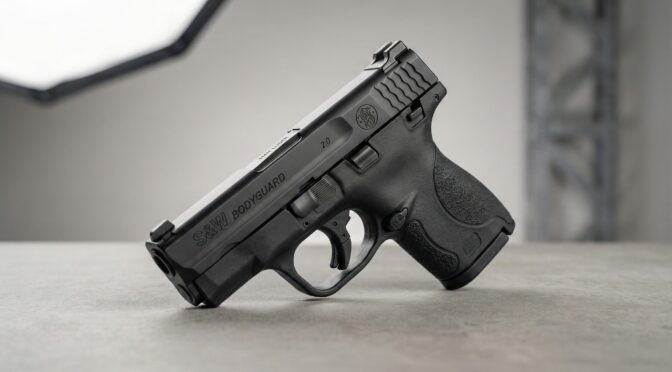
The distinct evolution of the micro-compact firearm market has reached a pivotal inflection point with the release of the Smith & Wesson Bodyguard 2.0. For decades, the.380 ACP “pocket pistol” segment was dominated by a singular engineering philosophy: the compromise of shootability for concealability. Historical platforms, primarily Double-Action-Only (DAO) hammer-fired mechanisms, were designed as “carry often, shoot seldom” tools—belly guns intended for contact-distance defense where sighting systems and trigger characteristics were secondary to snag-free profiles and safety against negligent discharge.
The Bodyguard 2.0 represents a clean-sheet departure from this legacy architecture. By successfully miniaturizing the striker-fired mechanism of the M&P 2.0 duty series and integrating a high-density “stagger-stack” magazine, Smith & Wesson has attempted to disrupt the hegemony of the Ruger LCP series and the Glock 42.
This report provides an exhaustive technical and market analysis of the Bodyguard 2.0. The findings indicate that while the platform offers class-leading ergonomics and capacity-to-weight ratios—effectively rendering single-stack competitors obsolete—it suffers from specific initial production quality control issues related to sighting system tolerances and feed ramp geometry incompatibilities with flat-nosed ammunition. Despite these teething challenges, the Bodyguard 2.0 effectively redefines the operational envelope for deep-concealment firearms.
1. Historical Context and Design Lineage
To fully appreciate the engineering significance of the Bodyguard 2.0, one must analyze the lineage of the “Bodyguard” nomenclature within the Smith & Wesson portfolio. The name has historically signified a specific doctrinal approach to personal protection: maximum concealment with immediate readiness.
1.1 The Revolver Origins (1955–2010)
Smith & Wesson first introduced the “Bodyguard” moniker in 1955 with the Model 38 (aluminum frame) and Model 49 (steel frame) J-frame revolvers.1 The defining feature of these platforms was the “humpback” shroud that covered the hammer. This design allowed for a snag-free draw from a pocket or coat—critical for the detective or civilian defender—while still permitting single-action operation via a small, exposed hammer spur. This established the “Bodyguard” brand as synonymous with deep concealment and snag-free operation.
1.2 The Polymer Transition (2010–2023)
In 2010, acknowledging the market shift toward semi-automatic pistols, Smith & Wesson released the original Bodyguard 380 (later the M&P Bodyguard 380).2 While innovative for its time, incorporating an integrated laser sight, it retained the philosophical DNA of the revolver era: it was a hammer-fired, Double-Action-Only (DAO) pistol.3
- Engineering Limitations: The DAO trigger was deliberately long and heavy (often exceeding 9 lbs) to serve as a mechanical safety against stress-induced discharge.4 While effective for safety, this rendered the pistol difficult to shoot accurately at speed, reinforcing the “get off me” gun stereotype.
- Capacity Constraints: It utilized a single-stack magazine, capping capacity at 6+1 rounds, a standard that has since been eclipsed by modern magazine geometry.
1.3 The 2.0 Paradigm Shift (2024–Present)
The Bodyguard 2.0 shares almost no mechanical commonality with its predecessor beyond the caliber and the polymer construction material.5 It is not an iteration; it is a replacement. The shift to a striker-fired action and a staggered magazine represents a fundamental change in the engineering priorities of the micro-compact sector, moving from “mechanical safety first” to “performance and shootability first.”
2. Engineering Architecture and Specifications
The Bodyguard 2.0 is engineered around a polymer frame with a stainless steel chassis system. The primary design objective appears to be the miniaturization of the M&P M2.0 duty pistol architecture into a footprint compatible with pocket carry.
2.1 Chassis and Frame Construction
The firearm utilizes a high-strength polymer frame reinforced with steel structural inserts. The frame geometry is notable for its aggressive texturing and ergonomic prioritization. Unlike the “blocky” grips of the Glock 42 or the extremely slender, slick grip of the original LCP, the Bodyguard 2.0 features a grip texture that mimics the M&P 2.0 duty series—aggressive enough for recoil management but mitigated for skin contact during concealed carry.6
Dimensional Analysis:
The frame dimensions are critical to its market positioning. With a maximum width of 0.88 inches and a height of 4.0 inches, it achieves a footprint nearly identical to lower-capacity competitors while housing a 10-round flush-fit magazine.6
- Width Constraint: The 0.88-inch width is a critical threshold. Many “micro-9s” (like the Sig P365) hover around 1.0 to 1.1 inches. By staying under 0.9 inches, the Bodyguard 2.0 maintains “pocket viability,” fitting into standard pant pockets without the tell-tale bulge associated with wider frames.8
2.2 Action Mechanism: The Striker Advantage
The most significant engineering divergence from the original Bodyguard 380 is the abandonment of the internal hammer-fired system.
- Striker Assembly: The Bodyguard 2.0 utilizes a pre-cocked striker-fired assembly.5 This system provides a consistent trigger pull weight from the first shot to the last, averaging between 4.5 and 5.5 lbs in independent testing.4 This is a massive reduction from the ~9.75 lb pull of the previous generation, directly translating to improved practical accuracy.
- Striker Block Safety: The mechanism incorporates a passive firing pin block (striker block) located in the slide.10 This spring-loaded plunger physically blocks the striker channel. It is only depressed (clearing the path for the striker) when the trigger bar moves rearward during a deliberate trigger pull.11 This ensures the firearm is drop-safe, a non-negotiable requirement for modern duty and defensive arms.
2.3 Barrel Kinematics and Lock-Up
The Bodyguard 2.0 utilizes a short-recoil, locked-breech system based on the Browning tilting barrel design.12
- Mechanism: Upon firing, the barrel and slide move rearward together for a short distance. The barrel is then cammed downward by the locking block, disengaging the barrel lug from the ejection port lock-up surface on the slide. This arrests the barrel’s movement while the slide continues rearward to extract and eject the spent casing.
- Comparison to Blowback: This is a critical distinction from straight-blowback designs often found in older.380 ACP pistols (e.g., Walther PPK or Bersa Thunder). Blowback actions rely on slide mass and spring tension to delay opening. Defeating the chamber pressure of defensive ammunition requires heavy springs and slides, which transmit recoil energy directly to the shooter’s hand. The locked-breech system of the Bodyguard 2.0 absorbs a portion of this energy during the unlocking phase, resulting in a significantly softer recoil impulse.13
2.4 Bore Axis Physics and Recoil Management
A standout engineering achievement of the Bodyguard 2.0 is its extraordinarily low bore axis.13 The vertical distance between the shooter’s grip (the fulcrum) and the centerline of the barrel (the vector of force) determines the magnitude of rotational torque (muzzle flip).
$$Torque (\tau) = Force (F) \times Moment Arm (r)$$
By minimizing $r$ (the bore axis height), Smith & Wesson has reduced the torque $\tau$ applied to the wrist.
- High Grip Undercut: The frame features a deep undercut at the rear of the trigger guard and a high beavertail.6 This allows the shooter’s hand to sit higher on the frame, further reducing the moment arm.
- Result: Field reports consistently indicate that the Bodyguard 2.0 has less muzzle flip than the Ruger LCP Max, despite similar weights, allowing for faster follow-up shots.7
2.5 Slide and Sights
- Slide Material: Stainless steel with Armornite® finish (a nitride hardening process), providing corrosion resistance essential for a pistol carried close to the body (sweat).6
- Serrations: The slide features aggressive forward and rear cocking serrations. These “fish scale” cuts 16 are deeper than typical for this class, facilitating slide manipulation for users with lower hand strength—a common demographic for.380 pistols.
- Sight System: Unlike the integrated “bumps” on the LCP or the polymer sights of the Glock 42, the Bodyguard 2.0 uses a steel, dovetail-mounted sight system. The front sight includes a tritium insert for low-light visibility, paired with a U-notch rear.6 This setup mimics duty pistol sight pictures, aiding in rapid acquisition.
Table 1: Technical Specifications Matrix
| Feature | Specification | Engineering Note |
| Caliber | .380 Auto (ACP) | Optimized for short-barrel ballistics |
| Action | Striker-Fired | Pre-cocked; approx. 4.5-5.5 lb pull |
| Barrel Length | 2.75 inches | Stainless Steel, 1:10 RH Twist 6 |
| Capacity | 10+1 (Flush), 12+1 (Ext) | Stagger-stack geometry |
| Width | 0.88 inches | Slimmest in class for capacity tier |
| Height | 4.0 inches | Includes flush fit magazine |
| Weight | 9.8 oz (Unloaded) | Polymer chassis construction |
| Sights | Tritium Front, U-Notch Rear | Drift adjustable (dovetail) 6 |
| Safety | Thumb Safety (Optional) | Ambidextrous, frame-mounted |
| MSRP | ~$449 | Street price ~$399 7 |
3. The Capacity Paradigm: Stagger-Stack Engineering
The Bodyguard 2.0’s defining market feature is its capacity-to-size ratio.
3.1 Magazine Geometry
The magazine utilizes a “stagger-stack” or “1.5 stack” geometry.1 The cartridges are arranged in a staggered formation at the base of the magazine (optimizing width) and taper to a single feed position at the top.
- Engineering Benefit: This design allows for 10 rounds in a flush-fit tube that is barely wider than a standard 6-round single-stack magazine. It maximizes the internal volume of the grip without expanding the external dimensions beyond the critical concealment thresholds.
- Comparison: The Glock 42 holds 6 rounds in a single stack. The Bodyguard 2.0 holds 10 in a shorter vertical footprint and 12 in a slightly extended one.17 This represents a 66% to 100% increase in on-board firepower for the same concealment penalty.
3.2 The 12-Round Extended Magazine
The pistol ships with both a 10-round flush fit and a 12-round extended magazine.8
- Ergonomic Function: The 12-round magazine includes a grip extension that allows most users to establish a full three-finger grip on the pistol.6 This dramatically improves control during rapid fire, as the pinky finger provides significant leverage against recoil torque.
- Concealment Trade-off: The extension adds approximately 0.39 inches to the height 1, which may compromise pocket carry in shallower pockets but is negligible for Inside-the-Waistband (IWB) carry.
4. Market Positioning and Comparative Analysis
The introduction of the Bodyguard 2.0 has initiated a “generational flush” in the.380 micro-compact sector. Prior to this release, the market was bifurcated into “shootable but large”.380s (e.g., S&W Shield 380 EZ, Walther PK380) and “concealable but unpleasant” pocket pistols (e.g., Ruger LCP II, Kel-Tec P3AT).
4.1 Direct Competitor: Ruger LCP Max
The Ruger LCP Max was the market leader in high-capacity micro.380s prior to the Bodyguard 2.0’s release.
- Ergonomics: The Bodyguard 2.0 is widely considered superior due to a higher undercut on the trigger guard.6 The LCP Max has a notoriously “snappy” recoil impulse due to its lighter slide mass and lower grip purchase capabilities.7
- Trigger: The LCP Max retains a hammer-fired internal mechanism that, while improved over the LCP II, still possesses a rolling break. The Bodyguard 2.0’s flat-faced striker trigger offers a defined wall, crisp break, and tactile reset.6
- Reloading Risks: The LCP Max’s short grip can lead to “blood blisters” or pinching during reloads if the user’s hand flesh overhangs the magwell. The Bodyguard 2.0’s slightly longer grip frame mitigates this risk.19
4.2 Legacy Competitor: Glock 42
The Glock 42 is renowned for its reliability and soft recoil but criticized for its size-to-capacity inefficiency.
- Capacity Gap: The G42 holds only 6+1 rounds. The Bodyguard 2.0 holds 10+1 or 12+1 in a package that is physically smaller in length and width.17
- Size Efficiency: The Bodyguard 2.0 is lighter (9.8 oz vs 13.76 oz) and narrower (0.88″ vs 0.94″) than the Glock 42.17
- Obsolescence: While the G42 remains a pleasant shooter, the Bodyguard 2.0 effectively renders it obsolete on paper. It matches the G42’s shootability while offering double the ammunition capacity.20
4.3 The “Micro-9” Cross-Shop: Sig P365-380
The Sig Sauer P365-380 is a “detuned” version of the 9mm P365.
- Size Disparity: The P365-380 is significantly larger than the Bodyguard 2.0, sharing the footprint of a micro-9mm. It is not a true “pocket pistol” for most users in the same way the Bodyguard is.
- Shootability: The P365-380 is incredibly soft shooting due to its larger mass, but it cannot compete with the Bodyguard 2.0 for deep concealment applications (e.g., gym shorts, suit pants).18
Table 2: Competitive Landscape Metrics
| Metric | S&W Bodyguard 2.0 | Ruger LCP Max | Glock 42 | Sig P365-380 |
| Capacity | 10/12 + 1 | 10/12 + 1 | 6 + 1 | 10/12 + 1 |
| Weight (oz) | 9.8 | 10.6 | 13.76 | 15.7 |
| Width (in) | 0.88 | 0.97 | 0.94 | 1.1 |
| Overall Length (in) | 5.5 | 5.2 | 5.94 | 5.8 |
| Trigger Type | Striker | Internal Hammer | Striker | Striker |
| MSRP | ~$449 | ~$479 | ~$479 | ~$599 |
5. Operational Performance Analysis
From an engineering perspective, miniaturizing a locked-breech semi-automatic pistol introduces significant reliability challenges. The slide mass is low, meaning the recoil spring must be stiff to ensure proper timing, which narrows the window of reliability for ammunition variances.
5.1 Recoil Impulse and “Shootability”
Subjective analysis from multiple field tests indicates the Bodyguard 2.0 has the best recoil impulse in its weight class.5 The combination of the 18-degree grip angle, deep beavertail, and aggressive texture locks the firearm into the hand.
- Endurance: Users report being able to shoot 150+ rounds in a session without the web-of-hand pain associated with the LCP series.13 This transforms the gun from a “carry only” piece to a “trainable” platform.
5.2 Ammunition Reliability Profile: The Flat Nose Issue
Reliability testing reveals a critical dichotomy in performance based on ammunition geometry.
- Reliable Ammunition: The firearm demonstrates high reliability with standard SAAMI-spec Full Metal Jacket (FMJ) Round Nose and ogive-shaped hollow points (e.g., Hornady Critical Defense, Fiocchi XTP). Cycling is consistent, and ejection patterns are positive.22
- Problematic Ammunition: There is a documented, reproducible failure mode with flat-nosed ammunition (e.g., Winchester white box flat nose, some hard cast loads) and uniquely shaped projectiles like Underwood Xtreme Defender.24
Root Cause Analysis (RCA): The Split Feed Ramp
The Bodyguard 2.0 utilizes a “split feed ramp” design where the lower portion of the ramp is machined into the locking block insert of the frame, and the continuation of the ramp is on the barrel itself.24
- Mechanism of Failure: In micro-compacts, the feed angle is necessarily steep due to the short slide travel distance. Round-nosed bullets can “glance” off the lower ramp and transition smoothly across the gap to the barrel ramp. Flat-nosed projectiles, however, lack the curvature to bridge this gap. The flat face of the bullet strikes the junction between the frame ramp and barrel ramp, causing a “nose-down” failure to feed (FTF).
- Implication: This is an inherent geometric constraint of the design. Users must vet their carry ammunition. Hornady Critical Defense is highly recommended due to its conical polymer tip which facilitates feeding.24
5.3 Trigger Characteristics
The trigger is a flat-faced polymer design with a blade safety.
- Take-up: Moderate, described as having a longish pre-travel (approx 5mm) which serves as a safety buffer.18
- Break: Crisp, occurring at 90 degrees.
- Reset: Tactile and audible, though some users note a “springiness” or noise in the return spring assembly.7
- Consistency: Pull weight is highly consistent compared to the stacking nature of the DAO predecessor.6
5.4 Accuracy and Barrel Length
The 2.75-inch barrel poses ballistic challenges..380 ACP is a marginal defensive cartridge, and velocity loss from short barrels can affect hollow point expansion.
- Practical Accuracy: Despite the short sight radius, the mechanical accuracy is high. Users report hitting 6-inch plates at 50 yards, a feat nearly impossible with the sights of the original LCP.26
- Terminal Performance: Users should select ammunition optimized for short barrels (e.g., Federal Hydra-Shok Deep) to ensure expansion thresholds are met despite the lower velocity.23
6. Variant Analysis: The Performance Center Carry Comp
S&W has introduced a Performance Center variant known as the “Carry Comp”.27
6.1 Design Features
- PowerPort System: This model features a ported barrel and slide. The port directs expanding gases upward, generating a downward force vector to counteract muzzle rise.
- ClearSight Cut: The slide cut is designed to divert the gas away from the front sight picture to prevent carbon fouling from obscuring the tritium dot.
- Performance Benefits: While porting in a.380 may seem superfluous given the low recoil, in a 9.8 oz gun, every reduction in muzzle flip contributes to faster split times. However, porting does result in a slight loss of velocity, which is already a concern in.380 ACP.
7. Manufacturing Quality and Consumer Sentiment
While the design is sound, the initial rollout (Batch 1, mid-2024) has been plagued by specific quality control (QC) escapes.
7.1 The Front Sight Drift Issue
A widespread issue involves the front sight dovetail. Numerous users and reviewers have reported front sights that are either visibly misaligned from the factory or become loose and drift (“fall off”) during live fire.28
- Engineering Assessment: This suggests a tolerance stacking issue between the slide dovetail milling and the sight base dimensions. It may also indicate insufficient interference fit calculation for the thermal expansion coefficients experienced during rapid fire.
- User Remediation: Many users are forced to drift sights manually or install aftermarket solutions. Some report shooting consistently left, which they attribute to this alignment issue or barrel lock-up variance.29
7.2 Extraction Failures
Isolated incidents of extractor breakage have been reported.31 While not systemic like the sight issue, the MIM (Metal Injection Molded) construction of small parts in micro-compacts requires strict void-detection QC.
7.3 Customer Sentiment Clusters
- Positive: “Finally, a shootable micro.” Users love the ergonomics and capacity.21 The value proposition at ~$400 is considered excellent.20
- Negative: “Beta Tester Fatigue.” The front sight issue has caused significant frustration. Users feel they are doing QC work for S&W.28 The “ammo pickiness” regarding flat nose rounds is a major point of contention for those who prefer hard cast woods loads.24
8. The Ecosystem: Accessories and Support
The Bodyguard 2.0 uses a proprietary accessory ecosystem.
8.1 Weapon Mounted Lights (WML)
The pistol lacks a standard Picatinny rail. It requires specific trigger-guard mounted lights.
- Streamlight TLR-6: This is the primary option. However, fitment is specific. The Bodyguard 2.0 requires a dedicated housing; the “Universal” or Shield kits do not fit perfectly.33
- Limitations: The narrow dust cover limits the platform to lower-output lights (100 lumens for standard TLR-6). High-output options like the TLR-7 Sub are incompatible.35
8.2 Sights
The sights are standard dovetail cuts, allowing for replacement.
- XS Sights R3D 2.0: A popular aftermarket upgrade featuring a “glow dot” front and serrated rear. This is often used to correct the factory sight drift issue.37
- Design Critique: A notable design flaw is that the rear sight must be removed to access the striker channel/safety plunger for deep cleaning.30 This discourages user maintenance of the internal slide components.
8.3 Holsters
Holster compatibility is not retroactive. Bodyguard 380 holsters do not fit the 2.0 due to different slide geometry and widths.40
- Available Options: Manufacturers like Vedder (LightTuck), Muddy River Tactical, Crossbreed, and JX Tactical have released dedicated molds.26 The fitment includes options for both Thumb Safety (TS) and Non-Thumb Safety (NTS) models.43
9. Maintenance and Disassembly
The Bodyguard 2.0 simplifies the maintenance process compared to the LCP.
- Takedown Lever: It utilizes a rotating takedown lever similar to the M&P Shield.
- Safety Feature: Unlike the Glock or LCP which often require a trigger pull or pin removal, the Bodyguard 2.0 allows for disassembly without pulling the trigger if the sear deactivation lever is used (though many users still dry fire to disassemble for speed).1
- Field Strip: The slide removes easily, revealing the captive recoil spring assembly and barrel. Cleaning is straightforward, though the aforementioned rear-sight blockage of the striker channel is a hindrance for detailed armorers.30
10. Strategic Conclusions and Recommendations
The Smith & Wesson Bodyguard 2.0 is a technically superior replacement for the previous generation of.380 ACP pocket pistols. By successfully scaling down the striker-fired architecture of the M&P 2.0, S&W has created a firearm that offers the concealability of a mouse gun with the shootability of a sub-compact.
10.1 Buying Advice: Is it Worth It?
YES, but with conditional caveats regarding ammunition selection and initial inspection.
Primary Use Cases:
- Deep Concealment: For non-permissive environments (gym, office, formal wear) where a micro-9 prints too much.
- Recoil Sensitivity: Ideally suited for shooters with lower hand strength who cannot manage the snap of an LCP or the slide rack weight of blowback pistols.
- Backup Gun (BUG): Excellent for law enforcement due to the manual of arms similarity with duty weapons.
Caveats:
- Avoid Flat Nose Ammo: Do not rely on flat-nosed FMJ or hard cast rounds for defense. Use ogive/conical hollow points like Hornady Critical Defense.
- Check the Sights: Upon purchase, verify the front sight is secure. Consider budgeting $100 for aftermarket XS Sights if the factory manufacturing tolerance is loose.
10.2 Final Verdict
The Bodyguard 2.0 is a Category Leader. It renders the Glock 42 functionally obsolete regarding capacity-to-weight ratio and surpasses the Ruger LCP Max in shootability ergonomics. Once the initial production teething issues (sights) are normalized in subsequent manufacturing batches, it is projected to become the standard-bearer for the micro.380 segment.
Appendix A: Methodology
This report was compiled using a multi-vector open-source intelligence (OSINT) approach, synthesizing technical specifications, user field reports, and comparative data.
- Data Aggregation: Research snippets were collected from primary sources (Smith & Wesson official engineering specs), secondary technical reviews (American Rifleman, Shooting Illustrated), and tertiary user-generated content (Reddit r/CCW, YouTube reliability tests).
- Technical Verification: Claims regarding dimensions and weight were cross-referenced against multiple independent reviews to verify factory spec accuracy. Mechanism descriptions (striker block, tilt barrel) were verified against exploded view diagrams and armorer discussions.
- Sentiment Scoring: User feedback was categorized into “Functional Reliability,” “Ergonomics,” and “Manufacturing Quality.” Recurring issues (e.g., front sight drift) were flagged as systemic only after appearing in multiple independent data sources (e.g., both Reddit threads and formal editorial reviews).
- Comparative Analysis: Competitor metrics (LCP Max, G42) were derived from current manufacturer datasheets to ensure apples-to-apples comparison on weight, width, and capacity.
- Exclusion Criteria: Marketing copy (“Game Changer,” “Ultimate”) was stripped from the analysis to focus solely on measurable kinematics and reported failure rates.
Appendix B: Troubleshooting Matrix
| Symptom | Probable Cause | Recommended Action |
| Failure to Feed (FTF) | Flat-nosed ammunition hitting split feed ramp geometry. | Switch to conical/ogive profile bullets (e.g., Hornady Critical Defense, Fiocchi XTP). Avoid Winchester White Box Flat Nose. |
| Front Sight Loose | Tolerance stacking in dovetail cut. | Apply red Loctite (temporary fix) or install XS Sights R3D 2.0 (permanent fix). |
| POI Left | Sight misalignment or grip torque/trigger push. | Bench rest test to confirm mechanical zero. Drift rear sight right. Ensure finger placement is not pushing the small frame. |
| Slide Not Locking Back | Grip interference with slide stop. | Adjust grip to ensure thumbs are not riding the slide stop lever (common on micro guns due to small surface area). |
| Trigger “Springiness” | Return spring resonance. | Normal operation for this striker assembly; serves as audible reset confirmation. |
If you find this post useful, please share the link on Facebook, with your friends, etc. Your support is much appreciated and if you have any feedback, please email me at in**@*********ps.com. Please note that for links to other websites, we are only paid if there is an affiliate program such as Avantlink, Impact, Amazon and eBay and only if you purchase something. If you’d like to directly contribute towards our continued reporting, please visit our funding page.
Sources Used
- Review: Smith & Wesson Bodyguard 2.0 NTS | An Official Journal Of The NRA, accessed November 23, 2025, https://www.americanrifleman.org/content/review-smith-wesson-bodyguard-2-0-nts/
- Smith & Wesson’s Latest Bodyguard 2.0 is More than a Makeove – Shooting Times, accessed November 23, 2025, https://www.shootingtimes.com/editorial/smith-wesson-bodyguard-makeover/516647
- Review: Smith & Wesson Bodyguard 2.0 NTS – Sage Brush Arms, accessed November 23, 2025, https://sagebrusharms.com/blog/review-smith-wesson-bodyguard-20-nts/
- Smith & Wesson’s New Bodyguard 2.0: Ultimate .380 CCW Pistol – Shooting Times, accessed November 23, 2025, https://www.shootingtimes.com/editorial/smith-wesson-bodyguard-2-review/509779
- Review: Smith & Wesson Bodyguard 2.0 | An Official Journal Of The NRA, accessed November 23, 2025, https://www.shootingillustrated.com/content/review-smith-wesson-bodyguard-2-0/
- FIRST TEST: Smith & Wesson Bodyguard 2.0 | Shoot On, accessed November 23, 2025, https://shoot-on.com/first-test-smith-wesson-bodyguard-2-0/
- New Product Highlight: Smith & Wesson Bodyguard 2.0 – Pew Pew Tactical, accessed November 23, 2025, https://www.pewpewtactical.com/new-product-highlight-smith-wesson-bodyguard-2-0/
- Rifleman Review: Smith & Wesson Bodyguard 2.0 – YouTube, accessed November 23, 2025, https://www.youtube.com/watch?v=8SvHNq_O14Q
- Smith & Wesson Bodyguard 2.0 Review | Tyrant CNC, accessed November 23, 2025, https://www.tyrantcnc.com/blog/review-the-new-smith-&-wesson-bodyguard-2.0
- Smith & Wesson M&P Bodyguard 380 Firing Pin Block: MGW – Midwest Gun Works, accessed November 23, 2025, https://www.midwestgunworks.com/page/mgwi/prod/396840000
- Bodyguard 2.0 Safety Reliability : r/CCW – Reddit, accessed November 23, 2025, https://www.reddit.com/r/CCW/comments/1kltz2a/bodyguard_20_safety_reliability/
- “Why does the barrel tilt when the slide is locked back?” : r/guns – Reddit, accessed November 23, 2025, https://www.reddit.com/r/guns/comments/1p3ek2/why_does_the_barrel_tilt_when_the_slide_is_locked/
- Smith & Wesson Bodyguard 2.0: Full Review – Guns and Ammo, accessed November 23, 2025, https://www.gunsandammo.com/editorial/smith-bodyguard-2/505182
- How the New S&W Bodyguard 2.0 Sucks…Sorta – Swift | Silent | Deadly, accessed November 23, 2025, https://swiftsilentdeadly.com/how-the-new-sw-bodyguard-2-0-sucks/
- Being Your Own Bodyguard: Smith & Wesson’s Bodyguard 2.0 Micro Pistol – NRA Women, accessed November 23, 2025, https://www.nrawomen.com/content/being-your-own-bodyguard-smith-wesson-s-bodyguard-2-0-micro-pistol
- Quick Review: Smith & Wesson Bodyguard 2.0 – The Ultimate Concealed Carry Pistol?, accessed November 23, 2025, https://www.crossbreedholsters.com/blog/quick-review-smith-wesson-bodyguard-2-0-the-ultimate-concealed-carry-pistol/
- First Shots: Smith & Wesson Bodyguard 2.0 vs Glock 42 – Better Protectors, accessed November 23, 2025, https://betterprotectors.com/first-shots-smith-wesson-bodyguard-2-0-vs-glock-42/
- First Look: Smith and Wesson’s new Bodyguard 2.0 TS | R. Doug Wicker — Author, accessed November 23, 2025, https://rdougwicker.com/2024/07/27/first-look-smith-and-wessons-new-bodyguard-2-0-ts/
- Smith & Wesson Bodyguard 2.0 VS Ruger LCP Max – Which one should you purchase? | The Tactical Rabbi – YouTube, accessed November 23, 2025, https://www.youtube.com/watch?v=Kxq95AJHTes
- PPT Review: Smith & Wesson Bodyguard 2.0 – Pew Pew Tactical, accessed November 23, 2025, https://www.pewpewtactical.com/smith-wesson-bodyguard-2-0-review/
- New Smith & Wesson Bodyguard 2.0 Gun Review – YouTube, accessed November 23, 2025, https://www.youtube.com/watch?v=4z7Jv_OVAII
- Bodyguard 2.0 reliability issues : r/CCW – Reddit, accessed November 23, 2025, https://www.reddit.com/r/CCW/comments/1ocrgnc/bodyguard_20_reliability_issues/
- Ammo That Causes Failures in the S&W Bodyguard 2.0 380 ACP – YouTube, accessed November 23, 2025, https://www.youtube.com/watch?v=8fZIFb0pu6w
- Bodyguard 2.0 Failure To Feed Fix : r/CCW – Reddit, accessed November 23, 2025, https://www.reddit.com/r/CCW/comments/1erkcog/bodyguard_20_failure_to_feed_fix/
- Smith And Wesson Bodyguard 2.0 Feeding Issue : r/CCW – Reddit, accessed November 23, 2025, https://www.reddit.com/r/CCW/comments/1eo9wr8/smith_and_wesson_bodyguard_20_feeding_issue/
- S&W Bodyguard 2.0 Problems, Solutions & Range Time – YouTube, accessed November 23, 2025, https://www.youtube.com/watch?v=TYEtAHt3nzI
- PERFORMANCE CENTER® S&W® BODYGUARD® 2.0 CARRY COMP® NO THUMB SAFETY – Smith & Wesson, accessed November 23, 2025, https://www.smith-wesson.com/product/performance-center-s-w-bodyguard-2-0-carry-comp-no-thumb-safety
- Are all the minor issues with the new S&W bodyguard 2.0 worked out yet? – Reddit, accessed November 23, 2025, https://www.reddit.com/r/CCW/comments/1lbl8q9/are_all_the_minor_issues_with_the_new_sw/
- Bodyguard 2.0 sights misaligned. How do I adjust them? : r/liberalgunowners – Reddit, accessed November 23, 2025, https://www.reddit.com/r/liberalgunowners/comments/1ggemj9/bodyguard_20_sights_misaligned_how_do_i_adjust/
- PSA S&W Bodyguard 2.0 – Potential widespread factory front sight misalignment : r/guns, accessed November 23, 2025, https://www.reddit.com/r/guns/comments/1fj00b2/psa_sw_bodyguard_20_potential_widespread_factory/
- Bodyguard 2.0 failure : r/CCW – Reddit, accessed November 23, 2025, https://www.reddit.com/r/CCW/comments/1odd1n1/bodyguard_20_failure/
- Ruger LCP or bodyguard 2.0 : r/CCW – Reddit, accessed November 23, 2025, https://www.reddit.com/r/CCW/comments/1jl3bxq/ruger_lcp_or_bodyguard_20/
- TLR-6® | Tactical Weapon-Mounted Light | Streamlight®, accessed November 23, 2025, https://www.streamlight.com/products/detail/tlr-6
- Streamlight 69273 Trigger Guard Light/Laser TLR-6 for M&P Shield/Plus 9/40 – Tulster, accessed November 23, 2025, https://tulster.com/streamlight-69273-trigger-guard-light-laser-tlr-6-for-m-p-shield-9mm-40/
- Streamlight TLR-6 Flashlight and Laser Sight for Handguns – Reddit, accessed November 23, 2025, https://www.reddit.com/r/flashlight/comments/1055uvz/streamlight_tlr6_flashlight_and_laser_sight_for/
- S&W Bodyguard 2.0 Question : r/guns – Reddit, accessed November 23, 2025, https://www.reddit.com/r/guns/comments/1h9we5y/sw_bodyguard_20_question/
- R3D 2.0 Night Sights – Smith and Wesson, accessed November 23, 2025, https://xssights.com/products/r3d-2-0-night-sights-smith-and-wesson.html
- Is This The Best Sight Upgrade For The Bodyguard 380? – YouTube, accessed November 23, 2025, https://www.youtube.com/watch?v=olzKkpxiCpU
- XS Sights R3D 2.0 Night Sights | Smith & Wesson, accessed November 23, 2025, https://www.smith-wesson.com/product/xs-sights-r3d-2-0-night-sights
- Smith & Wesson Bodyguard .380 Holsters, accessed November 23, 2025, https://aliengearholsters.com/collections/smith-wesson-bodyguard-380-holsters
- Smith & Wesson S&W Bodyguard 2.0 with Thumb Safety Holsters, accessed November 23, 2025, https://www.vedderholsters.com/s-w-bodyguard-2-0-w-thumb-safety-holsters/
- S&W Bodyguard 2.0 vs Carry Comp Comparison | Best Holsters for Bodyguard 2.0, accessed November 23, 2025, https://jxtactical.com/pages/blog-tips-gear-insights-tactical-news.htmlsw-bodyguard-20-vs-carry-comp-comparison-best-holsters-for-bodyguard-20/
- Best Holster Options for the Smith & Wesson Bodyguard 2.0 & Carry Comp – Four Brothers, accessed November 23, 2025, https://fourbrothersinc.com/blogs/news/best-holster-options-for-the-smith-wesson-bodyguard-2-0-and-carry-comp
- How to Disassemble and Reassemble Smith & Wesson Bodyguard 2.0 (Field Strip), accessed November 23, 2025, https://www.youtube.com/watch?v=SXZtu5sFPYM
- Detail Strip Guide: S&W Bodyguard .38 Revolver – Apex Gunsmithing, accessed November 23, 2025, http://apexgunsmithing.com/detail-strip-guide-sw-bodyguard-38-revolver/