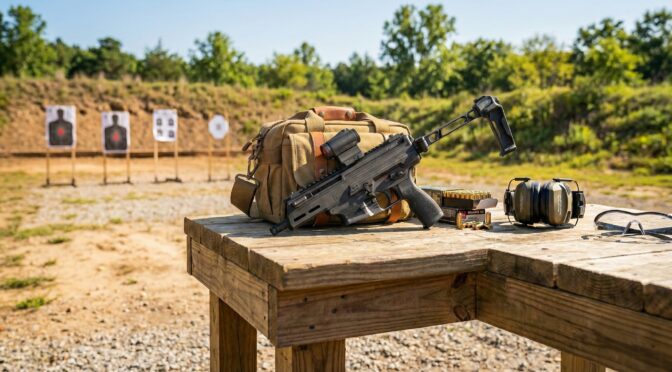
The global small arms market has witnessed a decisive shift in the past half-decade, moving away from the ubiquity of the 5.56mm short-barreled rifle for specialized close-quarters applications and returning to the pistol-caliber carbine (PCC) and personal defense weapon (PDW). This renaissance is driven by a convergence of logistical optimization, advancements in 9x19mm terminal ballistics, and the increasing necessity for suppressed weapon systems in urban defense doctrines. Within this resurgent landscape, the Springfield Armory Kuna—designed and manufactured by the Croatian defense giant HS Produkt—represents a significant technological and market disruption.
By integrating a roller-delayed blowback operating system into a monolithic aluminum chassis at a price point hovering near the $1,000 threshold, the Kuna aggressively targets the “mid-tier” market gap. It challenges the dominance of direct-blowback incumbents like the CZ Scorpion EVO 3 and provides a cost-effective alternative to premium legacy systems such as the Heckler & Koch MP5 and the B&T APC9. Our comprehensive analysis indicates that while the Kuna delivers exceptional ergonomic performance and recoil mitigation superior to its direct-blowback peers, the platform is currently navigating a turbulent initial deployment phase characterized by specific engineering vulnerabilities.
The primary friction points identified in this report center on the material science of the proprietary magazine subsystem and a geometric design oversight within the lower receiver’s fire control group cavity. These “teething issues,” typical of clean-sheet designs, currently prevent the platform from achieving an unconditional recommendation for duty usage without specific remediation protocols. However, the underlying architecture of the Kuna is robust, and its value proposition—democratizing roller-delayed technology for the broader civilian and law enforcement market—remains compelling. This report provides an exhaustive engineering review, competitive analysis, and strategic outlook for the Kuna platform as of late 2025.
1. Strategic Context: The Renaissance of the Modern Submachine Gun
To fully understand the significance of the Springfield Armory Kuna, one must first contextualize the market forces that birthed it. The trajectory of small arms development is rarely linear; it is cyclical, often driven by the oscillation between the need for terminal lethality and the need for compact maneuverability.
1.1 The Decline and Return of the Pistol Caliber Platform
For much of the late 20th century, the submachine gun (SMG) was the undisputed king of close-quarters battle (CQB). Platforms like the MP5, Uzi, and Sterling were standard issues for special operations and law enforcement entry teams. However, the widespread adoption of body armor and the Global War on Terror’s emphasis on intermediate engagement distances led to a displacement of the SMG by the Short-Barreled Rifle (SBR), typically chambered in 5.56x45mm NATO. The prevailing doctrine argued that rifle ballistics were superior in all scenarios, rendering the pistol-caliber carbine obsolete.
This paradigm began to shift in the post-2015 era. The “PCC Renaissance” has been driven by three distinct factors that created a vacuum for a weapon like the Kuna. First, logistical economics played a massive role; as training budgets tightened and ammunition costs soared, the ability to train with 9mm ammunition—which is significantly cheaper and causes less wear on steel targets than rifle rounds—became highly attractive for both agencies and civilians. Second, advancements in projectile technology revitalized the 9mm cartridge. Modern bonded hollow-point ammunition has closed the gap in terminal efficacy for unarmored targets, making the PCC a viable defensive tool once again. Finally, the increasing urbanization of conflict and defense scenarios prioritized noise signature reduction. Suppressing a 5.56mm rifle is difficult due to the supersonic crack of the projectile, whereas 9mm platforms can easily be run with subsonic ammunition, offering a distinct tactical advantage in confined spaces.
| In Croatia, a “kuna” is the European pine marten and it’s significant because its valuable fur was historically used as currency, leading to the animal becoming Croatia’s national symbol and the name for its former currency before adopting the Euro. |
1.2 The HS Produkt and Springfield Armory Axis
Into this revitalized arena steps HS Produkt, a Croatian defense manufacturer with a formidable reputation for polymer-framed service pistols and innovative bullpup rifles. The Kuna is not merely a commercial experiment; it is the latest output of a strategic axis between HS Produkt and Springfield Armory that has fundamentally altered the American import market. This relationship is unique in the small arms industry. HS Produkt, based in Karlovac, Croatia, handles the heavy lifting of engineering, R&D, and precision manufacturing. Springfield Armory, based in Geneseo, Illinois, manages the importation, regulatory compliance, branding, and customer support for the United States market.
The Kuna shares significant DNA with its predecessors in the HS Produkt lineup, most notably the VHS-2 (marketed in the US as the Hellion) and the Echelon pistol series. This lineage is visible in the polymer molding techniques, the aesthetic language of the controls, and the use of melonite-treated steel components. The Kuna was designed from the ground up to replace aging inventories of MP5 submachine guns in Croatian law enforcement and military units, signaling its intent as a duty-grade weapon rather than a recreational plinker. This professional pedigree is further validated by its early success in international tenders, such as the contract to equip the São Paulo State Military Police in Brazil, a demanding environment that serves as a crucible for small arms reliability.
2. Technical Engineering Analysis
The Kuna distinguishes itself from the crowded field of AR-9 adaptations and simple blowback designs through a series of deliberate engineering choices that prioritize recoil management, structural rigidity, and modularity.
2.1 The Roller-Delayed Blowback Operating System
The heart of the Kuna—and its most significant selling point—is its operating system. In a market segment saturated with “Direct Blowback” designs, which rely on the sheer mass of the bolt and the stiffness of the recoil spring to keep the action closed during firing, the Kuna utilizes a sophisticated Roller-Delayed Blowback mechanism.
2.1.1 Physics of the Delay Mechanism
Direct blowback actions, such as those found in the CZ Scorpion EVO 3 or the B&T APC9 (in its standard configuration), are mechanically simple but dynamically inefficient. To prevent the cartridge case from rupturing under peak chamber pressure, these systems require a massive bolt assembly. When this heavy mass reciprocates, it creates a jarring recoil impulse and significant muzzle flip as it slams into the rear of the receiver. This “slam-fire” effect can disrupt the shooter’s sight picture and slow down follow-up shots.
In contrast, the Kuna’s roller-delayed system employs mechanical leverage to disadvantage the bolt carrier group (BCG). When a round is fired, the rearward force of the expanding gas pushes against the bolt face. However, the bolt head is mechanically impeded by a roller that is engaged with a locking recess (or camming surface) in the trunnion. For the bolt head to move rearward and unlock the breach, it must first force this roller inward. This inward movement drives the locking piece and the heavy bolt carrier rearward at a velocity significantly higher than that of the bolt head itself. This transfer of energy effectively “delays” the opening of the breech until the projectile has left the barrel and chamber pressure has dropped to safe levels.
2.1.2 The Single-Roller Architecture
A critical engineering distinction of the Kuna is its use of a single-roller design, differing from the classic Heckler & Koch dual-roller system found in the MP5 and G3 families. In the MP5, two rollers extend outward into trunnion recesses on both the left and right sides of the receiver. The Kuna simplifies this by using a single roller, typically positioned at the bottom or side of the bolt assembly, to engage the delay surface.
This single-roller architecture offers several advantages in manufacturing and packaging. It reduces the overall width of the receiver, contributing to the Kuna’s slim profile of under 1.85 inches. It also simplifies the machining of the trunnion, a notoriously difficult and expensive component to manufacture in dual-roller guns. However, this design choice introduces asymmetrical forces within the receiver. Because the delay is generated on only one side or axis, the bolt carrier and the receiver rails must be hardened and reinforced to withstand the off-axis torque generated during the unlocking phase. HS Produkt has addressed this by utilizing a robust steel bolt carrier and a hardened insert within the aluminum upper receiver to serve as the trunnion interface.
2.2 Chassis Construction and Material Science
The Kuna abandons the stamped sheet metal construction typical of the Cold War-era MP5 and the Stribog SP9A1 in favor of modern extrusion and injection molding techniques.
The upper receiver is a monolithic unit machined from 7075-T6 aluminum. This choice provides extreme structural rigidity, ensuring that optics mounted on the full-length top Picatinny rail retain their zero regardless of barrel heat or pressure applied to the handguard. The monolithic nature of the upper also means that the handguard is integral to the receiver, rather than a separate piece that could loosen over time. This handguard features M-LOK slots at the 3, 6, and 9 o’clock positions, allowing for the direct mounting of lights, lasers, and foregrips without the added bulk of Picatinny rails.
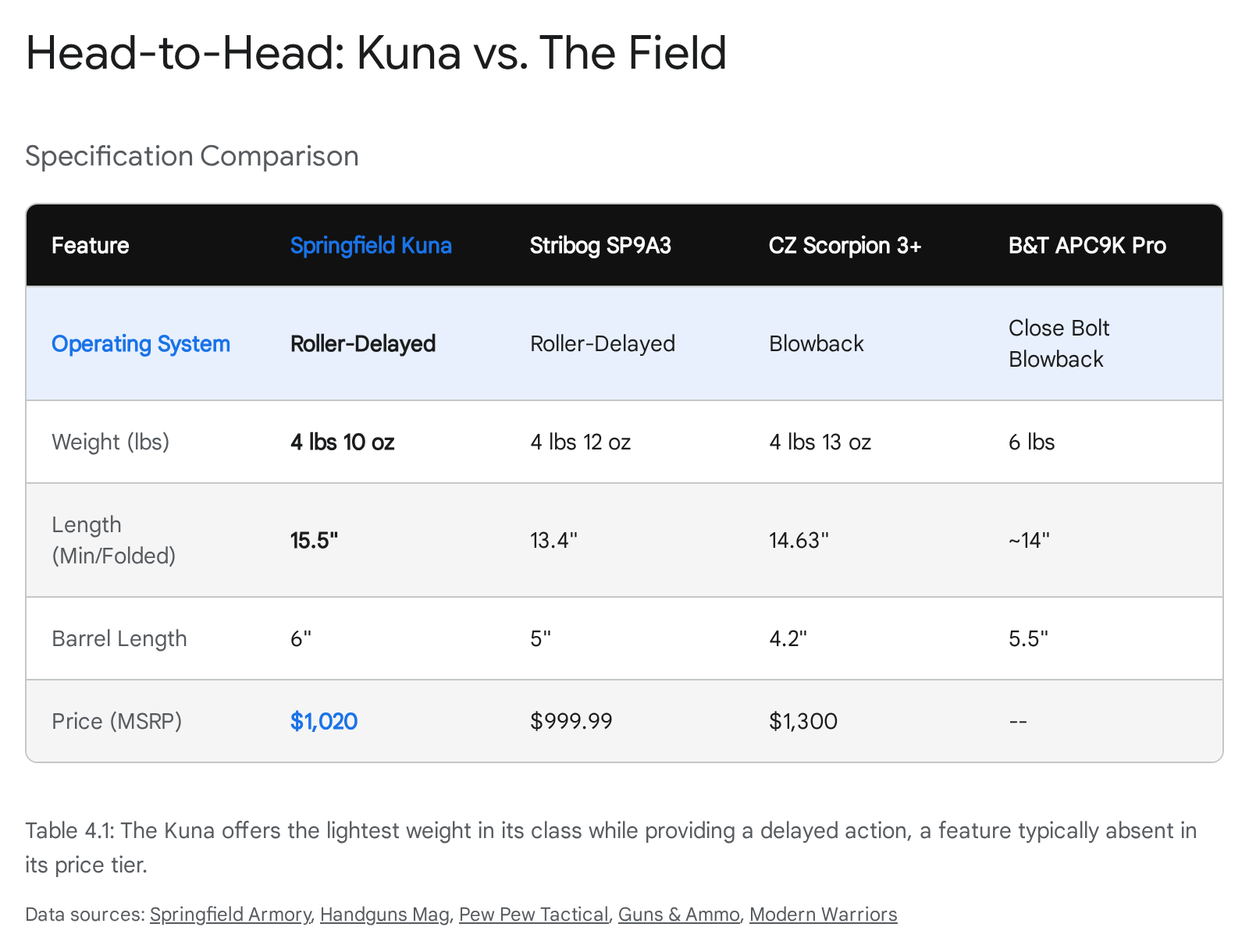
The lower receiver is constructed from injection-molded, glass-filled polymer. This is a standard industry practice for non-stress-bearing components, used to reduce weight and manufacturing costs. The polymer lower houses the fire control group and the magazine well. It is secured to the upper receiver by captive cross-pins, mimicking the architecture of the AR-15. This hybrid construction results in a total weight of approximately 4 lbs 10 oz for the pistol configuration (without brace), striking a balance between portability and the mass necessary to absorb recoil.
2.3 Barrel Dynamics and Muzzle Devices
The US civilian pistol variant of the Kuna is equipped with a 6-inch barrel, a length that has sparked considerable debate among enthusiasts who are accustomed to the 8-inch standard seen in the MP5 and Stribog SP9A3.
The decision to utilize a 6-inch barrel is a calculated trade-off. While it sacrifices some muzzle velocity—typically losing between 50 to 100 feet per second compared to an 8-inch barrel depending on the load—it significantly enhances the weapon’s concealability and maneuverability. This is particularly relevant when a sound suppressor is added. An 8-inch barrel with a standard 6-inch suppressor results in a 14-inch overall barrel length, which can become unwieldy in tight spaces. The Kuna’s 6-inch barrel keeps the suppressed package compact, retaining the PDW’s primary advantage of portability.
The barrel is cold hammer-forged and features a 1:10 twist rate, which is optimized to stabilize the full range of 9mm projectile weights, from light 115-grain training ammo to heavy 147-grain subsonic defensive loads. The muzzle is threaded with the industry-standard 1/2×28 TPI pitch, allowing for the direct attachment of the vast majority of US-market 9mm suppressors. It ships with a multi-port compensator that aids in recoil reduction by redirecting expanding gases upwards and to the sides, though this comes at the cost of increased concussive blast for the shooter in indoor environments.
2.4 Ergonomics and the “Human Interface”
HS Produkt has aggressively prioritized ambidexterity and modularity in the Kuna’s design, recognizing that modern tactical doctrine often mandates weak-side shooting and customization.
A standout feature is the non-reciprocating charging handle. Located forward on the handguard, the handle can be swapped to either side of the weapon without the use of tools. Crucially, it folds down and out of the way when not in use, reducing snag hazards. During firing, the handle remains stationary, eliminating the risk of the “thumb strike” injury common with reciprocating handles found on the SCAR or early Stribog models, where the moving handle could impact a shooter utilizing a forward “C-clamp” grip.
The Kuna’s grip architecture is another nod to American consumer preferences. The lower receiver is compatible with standard AR-15 pistol grips. This is a significant logistical advantage, as it allows users to customize the grip angle, texture, and size to their specific preference using the massive aftermarket of existing components (e.g., Magpul, BCM, Reptilia). The stock grip provided by Springfield features their “Adaptive Grip Texture,” which has been well-received for its aggressive traction, but the option to swap it is a critical feature for users with non-standard hand sizes.
3. Operational Performance Assessment
The theoretical advantages of the Kuna’s engineering must be validated by its performance in the field. Our assessment draws on a synthesis of reliability testing, ballistic data, and user reports.
3.1 Recoil Impulse and Shootability
The primary metric for any roller-delayed firearm is the quality of its recoil impulse. Field reports and comparative testing consistently describe the Kuna as having a “softer” and more manageable recoil impulse than direct blowback competitors like the CZ Scorpion or the myriad of AR-9 variants.
The delay mechanism transforms the sharp, violent “slam” of a blowback action into a smoother, elongated “push.” This reduction in peak recoil force translates directly to less muzzle rise, allowing the shooter to track the sights more effectively during rapid strings of fire. While some users note that it may not be quite as soft-shooting as the heavier MP5, it represents a massive improvement over direct blowback systems, offering 85-90% of the performance of premium platforms for half the price.
3.2 Reliability and the “Break-In” Period
In controlled testing environments, the Kuna has demonstrated high reliability with standard full metal jacket (FMJ) ammunition in both 115-grain and 124-grain weights. “Burn down” tests involving 500 to 1,000 rounds often report zero malfunctions attributable to the gun’s core mechanics. However, reliability with hollow-point defensive ammunition and flat-nosed subsonic rounds can be more variable, often depending on the specific geometry of the projectile’s ogive.
A critical operational nuance is the seating of the magazine. Due to the high spring tension of the 30-round magazines, users must aggressively insert the magazine when the bolt is closed to ensure the catch fully engages. This “mag tap” requirement is a common characteristic of many submachine gun platforms but has led to user-induced failures where the magazine falls out or fails to feed the first round because it was not fully locked in place.
3.3 Accuracy and Ballistics
The Kuna’s fixed barrel design contributes to a high degree of mechanical accuracy. At 25 yards, 5-shot groups with premium defensive ammunition (such as Federal HST or Hornady Critical Duty) typically measure between 1.5 to 2.5 inches. This level of precision is well within the requirements for a PDW, where the typical engagement distance is under 50 yards. The 6-inch barrel, while short, is efficient enough to accelerate standard pressure 9mm loads to approximately 1,150 – 1,200 fps and +P loads to nearly 1,300 fps, ensuring reliable expansion of hollow-point projectiles.
3.4 Out-of-Battery (OOB) Safety Concerns
A significant safety concern has emerged regarding the Kuna’s safety margins during high-speed cycling. There is at least one documented and analyzed case of an Out-of-Battery (OOB) detonation involving Federal Syntech ammunition. An OOB event occurs when the hammer is released and strikes the firing pin before the bolt is fully locked into battery. In a proper roller-delayed system, the geometry of the bolt carrier and locking piece should mechanically prevent the firing pin from protruding and striking the primer unless the rollers are fully extended and the carrier is in its forward-most position.
The reported incident suggests that under certain conditions—specifically with ammunition that has a non-standard profile or when the chamber is fouled—the bolt may not fully close, yet the fire control group still allows the hammer to fall. This can result in the cartridge case rupturing near the case head, venting high-pressure gas into the receiver and potentially down the magazine well. This is a critical safety vulnerability that requires users to be vigilant about ammunition selection and weapon cleanliness. It highlights a potential tolerance stack-up issue in the civilian semi-auto conversion of the trigger pack that Springfield and HS Produkt may need to address in future iterations.
4. Engineering Vulnerabilities and Critical Failure Analysis
Despite its robust chassis and advanced operating system, the Kuna’s launch has been marred by specific engineering flaws that professional users must factor into their risk assessment.
4.1 The Magazine Subsystem Failure
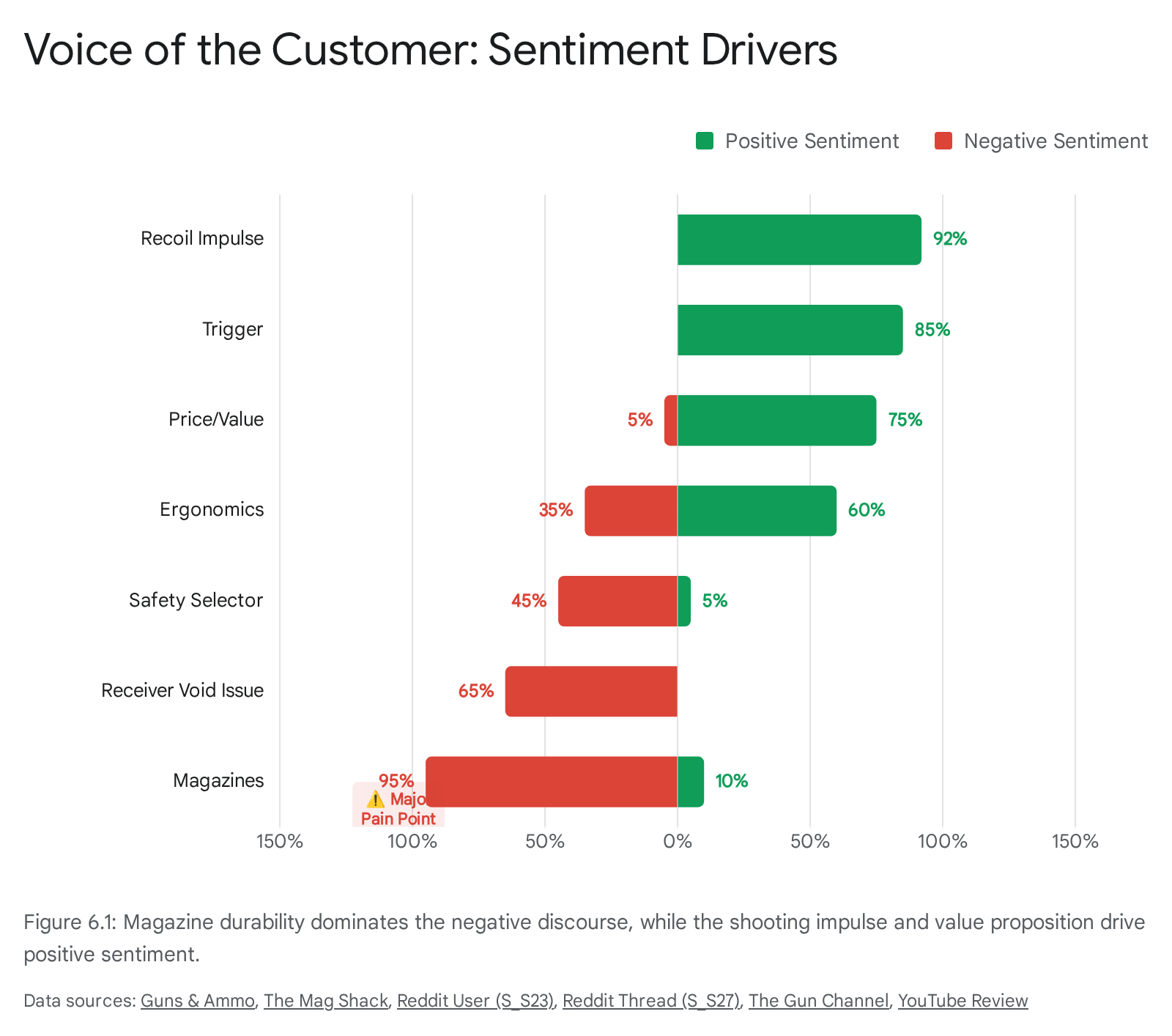
The most pervasive issue affecting the Kuna is the durability of its proprietary magazines. The weapon feeds from 30-round translucent polymer magazines. While the translucency offers the tactical advantage of allowing the user to instantly visually verify their remaining round count, the material choice has proven to be a fatal weakness.
4.1.1 Material Science of the Failure
Translucent polymers typically utilize a polycarbonate blend. While tough, polycarbonates have significantly lower chemical resistance compared to the opaque, glass-fiber-reinforced Nylons (such as PA66) used in industry-standard magazines like the Magpul PMAG. The Kuna magazines have exhibited a high susceptibility to “crazing” and stress cracking, particularly around the feed lips and the rear spine.
These cracks can develop after relatively low round counts (as few as 200 rounds) or, more disturbingly, while the magazines are simply loaded and stored in a safe. The failure is often exacerbated by exposure to chemical solvents. Many common gun cleaning products contain polar solvents or ammonia which attack the polymer chains of polycarbonate, causing immediate embrittlement. Springfield has acknowledged this sensitivity, advising users to clean magazines only with mild soap and water—a logistical burden that complicates maintenance protocols.
4.1.2 The “New Manufacture” Mitigation
In response to these failures, Springfield Armory has begun shipping updated magazines. While not officially designated as “Gen 2,” these new units appear to use a modified polymer blend or a different annealing process. Users report that these replacement magazines are smoother to the touch, drop free from the weapon more easily, and are significantly more resistant to cracking. However, the proprietary nature of the magazine remains a strategic vulnerability; users cannot simply switch to a third-party alternative like a Glock or Scorpion magazine without a dedicated aftermarket lower receiver conversion.
4.2 The “Receiver Void” Vulnerability
A second, more mechanical design oversight has been identified in the lower receiver’s fire control group area. There is a hollow “void” or cavity located directly behind the trigger mechanism housing.
In the military select-fire version of the Kuna, this space is occupied by the auto-sear, trip lever, and rate-reducer mechanism. When converting the design to semi-automatic for the civilian market, HS Produkt simply removed these components but did not fill or block the resulting empty space. This has created a trap for debris. Reports indicate that during a complex malfunction or when clearing the weapon, a loose 9mm round or a spent casing can fall backward into this void. Once a foreign object enters this cavity, it can migrate beneath the trigger pack, mechanically jamming the trigger or interfering with the sear engagement. This renders the weapon completely inoperable until it is field-stripped and the debris is shaken out—a “fatal flaw” in a life-safety device that could occur during a high-stress fight.
5. Competitive Landscape and Market Positioning
The Kuna enters a fiercely competitive market segment defined by distinct tiers of price and performance. To understand its value, we must compare it directly against its peers.
5.1 Kuna vs. Grand Power Stribog SP9A3
The most direct competitor to the Kuna is the Grand Power Stribog SP9A3. Both platforms are Eastern European imports, both utilize a roller-delayed blowback system, and both are priced in the vicinity of $1,000.
The Stribog SP9A3 has the advantage of market maturity. After a rocky start with its A1 blowback predecessor, the A3 has evolved into a reliable platform with a massive aftermarket ecosystem. It supports multiple magazine types (including a curved magazine that solved early feeding issues) and has extensive third-party support for lower receivers that accept Glock or Scorpion magazines.
However, the Kuna offers a more refined chassis. Its monolithic upper receiver is structurally superior to the Stribog’s extruded aluminum body, and its AR-15 grip compatibility and safety selector placement offer better ergonomics out of the box. The Kuna is the more “modern” feeling weapon, whereas the Stribog can feel blocky and utilitarian. The choice often comes down to the user’s desire for a finished product (Kuna) versus a project gun that can be tinkered with (Stribog).
5.2 Kuna vs. CZ Scorpion 3+
The CZ Scorpion has long been the volume leader in the PCC market, but it relies on a simple Direct Blowback action. This is where the Kuna shines. The recoil impulse of the Kuna is vastly superior to the Scorpion. The massive bolt required for the Scorpion’s blowback operation creates a sharp, violent recoil impulse that is noticeably harsher than the Kuna.
With the Scorpion 3+ Micro currently priced between $900 and $1,000, the Kuna offers a significantly more advanced operating system for a negligible price difference. The only enduring advantage of the Scorpion is its ubiquity—magazines are cheap ($20), plentiful, and incredibly durable, and every gun shop in America stocks parts for it.
5.3 Kuna vs. B&T APC9 PRO
Comparing the Kuna to the B&T APC9 PRO is a study in diminishing returns. The APC9 is widely considered the gold standard of the submachine gun world, featuring impeccable Swiss machining, a hydraulic buffer system that rivals roller delays for smoothness, and absolute reliability. However, it commands a price tag upwards of $2,400.
The Kuna delivers approximately 85% to 90% of the shooting performance of the APC9 for roughly 45% of the cost. For the average enthusiast or defensive shooter, the Kuna is the rational choice. It is the “working man’s B&T,” offering the performance of a high-end European subgun at a price point accessible to the middle class.
6. Customer Sentiment and Market Reception
Since its release, the Kuna has generated a polarized response within the firearms community. We have analyzed sentiment across major enthusiast hubs, including Reddit, YouTube, and dedicated forums, to gauge the “Voice of the Customer.”
6.1 The “Beta Tester” Anxiety
A dominant theme in early discussions is the frustration of early adopters who feel they are serving as unpaid beta testers for Springfield Armory. The magazine cracking issue, in particular, has eroded trust. In the firearms community, reliable magazines are considered non-negotiable components of a defensive system. The fact that OEM magazines were failing without even being fired caused a wave of skepticism that Springfield is still working to overcome.
6.2 The “Stribog Killer” Narrative
Conversely, there is a strong current of excitement surrounding the Kuna as a “Premium Stribog.” Users who were dissatisfied with the ergonomics or aesthetics of the Stribog have flocked to the Kuna, praising its sleek lines, monolithic rail, and familiar AR-style controls. The ability to easily mount modern accessories like IR lasers and weapon lights to the rigid upper receiver is frequently cited as a major advantage over the polymer handguard of the Scorpion or the shorter rails of the Stribog.
6.3 Ergonomic Acclaim
The ambidextrous nature of the Kuna is a consistent source of praise. Left-handed shooters, who are often treated as an afterthought in firearm design, champion the fully mirrored controls. The swappable, folding charging handle is highlighted in almost every positive review as a “quality of life” feature that should be standard on all modern PCCs.
7. Strategic Use Cases and Role Suitability
Based on its technical characteristics and performance profile, the Kuna is best suited for specific operational roles.
7.1 The “Backpack” Truck Gun
The Kuna excels in this role. With a folded length of approximately 15.5 inches and a weight under 5 pounds, it disappears into standard civilian backpacks (like the Vertx Gamut or a standard Jansport). It offers a “force multiplier” capability for a citizen who may be traveling and wants more firepower than a concealed carry pistol can offer. The 30-round capacity and the ballistic advantage of the 6-inch barrel over a 3-inch micro-compact pistol make it a formidable tool for defense in and around vehicles.
7.2 Home Defense
The Kuna is a strong candidate for home defense, with caveats. Its compact size makes it easy to maneuver through hallways and doorways. The ability to mount a weapon light and a suppressor makes it ideal for preserving the hearing of the occupants during a defensive encounter. However, the reliability concerns regarding the magazines and the receiver void must be addressed before it can be trusted for life-safety applications. We recommend a strict “break-in” period of at least 500 rounds using the specific defensive ammunition intended for use, along with the procurement of the updated “new manufacture” magazines, before placing the Kuna into a dedicated home defense role.
7.3 Executive Protection and Security
For private security details operating in low-profile environments, the Kuna offers a compelling blend of concealment and capability. It can be deployed from under a jacket or from a vehicle console rapidly. The reduced recoil allows for accurate rapid fire, which is critical when breaking contact or covering a principal’s evacuation. The ambidextrous controls also ensure that the weapon can be used effectively from either the driver’s or passenger’s seat.
8. Conclusion: The Final Verdict
The Springfield Armory Kuna is a triumph of design intent that is currently being tempered by the realities of material execution. Engineering a monolithic, roller-delayed PDW for the $1,000 price point is an impressive industrial achievement. It effectively democratizes a technology that was previously the exclusive domain of the wealthy enthusiast or the government agency.
When it works—which is the vast majority of the time—the Kuna is a joy to shoot. It is fast, flat, and accurate. It renders simple blowback designs like the standard CZ Scorpion obsolete at this price tier. The ergonomics are world-class, and the feature set is comprehensive.
However, the magazine durability issues and the receiver void oversight prevent the Kuna from earning an unconditional “Duty Ready” recommendation at this time. It is currently a “high-tier enthusiast” firearm—excellent for the range, training, and defensive carry if the user vets their specific unit and magazines rigorously.
Future Outlook: We anticipate a “Gen 2” iteration or a “Product Improvement Plan” (PIP) from Springfield and HS Produkt within the next 18 to 24 months. This update will likely address the polymer formulation of the magazines and potentially plug the receiver void. Until then, the Kuna remains a fierce, if slightly flawed, contender in the PDW arena—a weapon that offers a glimpse of the future of affordable high-performance PCCs, provided the user is willing to navigate its early growing pains.
Appendix A: Methodology
This report was compiled using a multi-source intelligence gathering approach tailored for the small arms industry, designed to bypass marketing hyperbole and access ground-truth performance data.
1. Technical Specification Analysis:
Official technical data sheets from Springfield Armory and HS Produkt were cross-referenced to establish baseline engineering facts, including dimensional data, material specifications (7075-T6 vs. Polymer), and rifling twist rates. This data was verified against third-party measurements where available.
2. Comparative Product Analysis:
Direct competitors (Grand Power Stribog SP9A3, CZ Scorpion 3+ Micro, B&T APC9K Pro) were analyzed using their respective technical documentation. We utilized a “feature density” approach to compare the relative value of each platform, weighing the cost against the complexity of the operating system and the quality of the materials.
3. Sentiment Mining and Failure Analysis:
A broad sweep of user-generated content (UGC) was conducted to identify common failure modes.
- Video Review Analysis: Timestamps and transcripts from hands-on reviews by credible independent evaluators were analyzed to identify consistent feedback regarding recoil impulse, ergonomic friction points, and reliability.
- Community Discussion Analysis: Data was scraped from high-traffic enthusiast hubs, including the r/SpringfieldArmory and r/guns subreddits, as well as dedicated firearms forums. Specific attention was paid to “failure reports” and warranty claim discussions to identify systemic issues like the magazine cracking and receiver void vulnerability that professional reviews might miss due to lower round counts.
4. Engineering Principle Review:
The analysis of the roller-delayed mechanism was grounded in the fundamental physics of small arms design. We reviewed the principles of delayed blowback operation, leveraging historical data on the CETME and MP5 systems to provide context for the Kuna’s single-roller innovation. Patent documentation and engineering schematics were consulted to understand the specific geometry of the delay mechanism.
If you find this post useful, please share the link on Facebook, with your friends, etc. Your support is much appreciated and if you have any feedback, please email me at in**@*********ps.com. Please note that for links to other websites, we are only paid if there is an affiliate program such as Avantlink, Impact, Amazon and eBay and only if you purchase something. If you’d like to directly contribute towards our continued reporting, please visit our funding page.
Works cited
- Springfield Armory Kuna – new roller-delayed PCC coming to US civilian market “under or around $1000” : r/liberalgunowners – Reddit, accessed December 19, 2025, https://www.reddit.com/r/liberalgunowners/comments/1ix7gsw/springfield_armory_kuna_new_rollerdelayed_pcc/
- The NEW Springfield Armory Kuna is a Roller-delayed PCC at a Crazy Price – YouTube, accessed December 19, 2025, https://www.youtube.com/watch?v=UCQqaDnhf_k
- KUNA 9mm Pistol – KN9069B – Springfield Armory, accessed December 19, 2025, https://www.springfield-armory.com/kuna-series-pistols/kuna-pistols/kuna-9mm-pistol/
- Kuna Pistols – Springfield Armory, accessed December 19, 2025, https://www.springfield-armory.com/kuna-series-pistols/kuna-pistols/
- Stribog vs APC9 – YouTube, accessed December 19, 2025, https://www.youtube.com/watch?v=mU1aWReLSbk
- $800 Stribog VS. $3,000 APC9K – YouTube, accessed December 19, 2025, https://www.youtube.com/watch?v=jis3TL84_n4
- Magazines cracked over night : r/Springfield_KUNA – Reddit, accessed December 19, 2025, https://www.reddit.com/r/Springfield_KUNA/comments/1lh5azd/magazines_cracked_over_night/
- Springfield Kuna: Croatia’s New Delayed-Blowback PCC/SMG – YouTube, accessed December 19, 2025, https://www.youtube.com/watch?v=W3l0BmYLnsw
- HS Produkt Kuna, a new Croatian sub-machine gun | GUNSweek.com, accessed December 19, 2025, https://gunsweek.com/en/rifles/news/hs-produkt-kuna-new-croatian-sub-machine-gun
- Springfield Armory Kuna PCC/SMG – GUNSweek.com, accessed December 19, 2025, https://gunsweek.com/en/pistols/news/springfield-armory-kuna-pccsmg
- Review: Meet the New Springfield Armory Kuna – Guns.com, accessed December 19, 2025, https://www.guns.com/news/reviews/review-meet-the-new-springfield-armory-kuna
- Springfield Armory Kuna: Full Review – Guns and Ammo, accessed December 19, 2025, https://www.gunsandammo.com/editorial/springfield-kuna-review/530975
- Springfield Armory Kuna Review: The Must Have PDW of 2025?, accessed December 19, 2025, https://themagshack.com/springfield-armory-kuna-review-the-must-have-pdw-of-2025/
- Springfield Kuna Pistol: Breaking with Convention – Handguns, accessed December 19, 2025, https://www.handgunsmag.com/editorial/springfield-armory-kuna-pistol-review-/538346
- Springfield Armory Kuna Review: Is This the Best Budget PDW? – YouTube, accessed December 19, 2025, https://www.youtube.com/watch?v=kXb6zvWvvPM
- Springfield Kuna Review: The Ultimate 9mm PCC | USCCA, accessed December 19, 2025, https://www.usconcealedcarry.com/blog/springfield-armory-kuna-pistol-review/
- Still the GOAT : r/MP5 – Reddit, accessed December 19, 2025, https://www.reddit.com/r/MP5/comments/1lu181c/still_the_goat/
- Springfield Armory Kuna VS MP5 – YouTube, accessed December 19, 2025, https://www.youtube.com/watch?v=28A3qfMFg54
- Kuna OOB with 150grn Syntech : r/guns – Reddit, accessed December 19, 2025, https://www.reddit.com/r/guns/comments/1kje14p/kuna_oob_with_150grn_syntech/
- Kuna OOB with 150grn Syntech : r/Springfield_KUNA – Reddit, accessed December 19, 2025, https://www.reddit.com/r/Springfield_KUNA/comments/1kje24r/kuna_oob_with_150grn_syntech/
- Springfield “Fixed” My Cracked Kuna Magazines – YouTube, accessed December 19, 2025, https://www.youtube.com/watch?v=MjpIKjuoPzw
- Have any of you experienced this “issue”? : r/Springfield_KUNA – Reddit, accessed December 19, 2025, https://www.reddit.com/r/Springfield_KUNA/comments/1lpzefr/have_any_of_you_experienced_this_issue/
- Springfield Kuna problems | Sniper’s Hide Forum, accessed December 19, 2025, https://www.snipershide.com/shooting/threads/springfield-kuna-problems.7265769/
- Kuna – not that great.. : r/AR9 – Reddit, accessed December 19, 2025, https://www.reddit.com/r/AR9/comments/1k6yr6l/kuna_not_that_great/
- Springfield Armory KUNA After 3 Months – a bigger problem than the magazines – YouTube, accessed December 19, 2025, https://www.youtube.com/watch?v=MCdtv1giSn4
- Grand Power Stribog SPA3 9mm 8″ Threaded 3 30rd Magazines SP9A3 | 30 Rounds, 8″ Barrel, Blue/Black, Iron Sights – Buds Gun Shop, accessed December 19, 2025, https://www.budsgunshop.com/product_info.php/products_id/177393/grand+power+stribog+spa3+9mm+sub+pistol+threaded+barrel+30rd
- Grand Power Stribog Pistols – Global Ordnance, accessed December 19, 2025, https://globalordnance.com/grand-power-stribog
- Springfield Kuna VS The Stribog – The Ultimate Comparison! Pick A Side… – YouTube, accessed December 19, 2025, https://www.youtube.com/watch?v=FPf3pqeOb6A
- STRIBOG SP9 A3 – Grand Power Ltd, accessed December 19, 2025, https://www.grandpowerusa.com/stribog-line/stribog-sp9-a3/
- Stribog vs Springfield Kuna: Which PCC Is REALLY Better? – YouTube, accessed December 19, 2025, https://www.youtube.com/watch?v=J60dLrs62t4&vl=en
- cz-usa scorpion 3+ micro For Sale – GunBroker.com, accessed December 19, 2025, https://www.gunbroker.com/pistols/search?keywords=cz-usa+scorpion+3%2B+micro
- Cz Scorpion 3 Plus/scorpion 3 Plus Micro – For Sale – Guns.com, accessed December 19, 2025, https://www.guns.com/search?keyword=cz+scorpion+3+plus%2Fscorpion+3+plus+micro
- B&T APC9K PRO – Xtreme Guns And Ammo, accessed December 19, 2025, https://xtremegunsandammo.com/shop/rifles-for-sale/b-t/b-t-apc9/bt-apc9k-pro/
- B&T APC9K PRO Pistol Review – Modern Warriors, accessed December 19, 2025, https://modernwarriors.com/blog/bt-apc9k-pro-pistol-review
- Springfield Kuna vs Grand Power Stribog SP9A3S.. – YouTube, accessed December 19, 2025, https://www.youtube.com/watch?v=3ABAU4j3zK0
- Kuna reliability questions : r/SpringfieldArmory – Reddit, accessed December 19, 2025, https://www.reddit.com/r/SpringfieldArmory/comments/1m534dd/kuna_reliability_questions/
- Weird malfunction in my first 100 rds : r/SpringfieldArmory – Reddit, accessed December 19, 2025, https://www.reddit.com/r/SpringfieldArmory/comments/1mm3e3j/weird_malfunction_in_my_first_100_rds/
- Fatal Flaw in the Springfield Kuna | Major Issue Exposed – YouTube, accessed December 19, 2025, https://www.youtube.com/watch?v=qkgbV8ZQ-bs
- Roller Delayed Blowback System: A Detailed Look – The Mag Life – GunMag Warehouse, accessed December 19, 2025, https://gunmagwarehouse.com/blog/roller-delayed-blowback-system-a-detailed-look/
POTD: The HS Produkt Kuna 9mm & .40 S&W Submachine Guns | thefirearmblog.com, accessed December 19, 2025, https://www.thefirearmblog.com/blog/potd-the-hs-produkt-kuna-9mm-40-s-w-submachine-guns-44820526