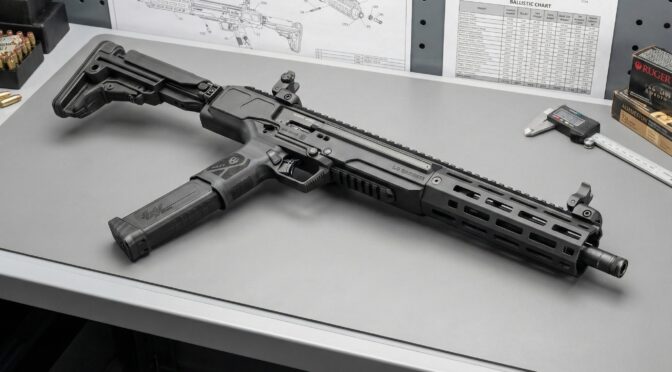
The introduction of the Ruger LC Carbine chambered in 10mm Auto marks a significant inflection point in the civilian semi-automatic rifle market, specifically within the Pistol Caliber Carbine (PCC) sector. This report provides an exhaustive technical and market analysis of the platform, evaluating its engineering architecture, ballistic performance, market positioning, and customer sentiment. As the PCC market matures, the demand for cartridges offering terminal ballistics superior to the ubiquitous 9x19mm Parabellum has driven a resurgence of the 10mm Auto. Ruger’s entry targets a specific “capability gap” between budget-tier blowback carbines and premium delayed-blowback systems.
Our analysis indicates that the Ruger LC Carbine effectively democratizes the 10mm cartridge for the general consumer by leveraging a modified straight blowback operating system that utilizes a bolt-over-barrel configuration to mitigate the handling penalties typically associated with heavy reciprocating masses. While the platform exhibits the characteristic recoil impulse of a blowback action, the engineering compromises made—specifically the decision to prioritize reliability and magazine compatibility over weight reduction—result in a highly utilitarian firearm.
Ballistic data synthesized from multiple testing vectors confirms that the 16.25-inch barrel provides a velocity increase of approximately 20% to 25% over standard handgun variants, elevating the 10mm cartridge into a ballistic tier suitable for ethical medium-game hunting and robust defensive applications. However, the platform is not without its detractors; the significant physical weight, the quality of the trigger pull, and the inherent limitations of the blowback action regarding suppression remain primary points of critique among technical users.
From a market perspective, the LC Carbine occupies a strategic “Goldilocks” zone. It offers significantly greater refinement, capacity, and modularity than the Hi-Point 1095TS, yet retains a price point roughly half that of the CMMG Banshee or Kriss Vector. Customer sentiment remains largely positive, particularly regarding the weapon’s reliability with diverse ammunition types and its integration with the ubiquitous Glock magazine ecosystem. This report concludes that the Ruger LC Carbine 10mm is a premier choice for users prioritizing utility, durability, and logistical commonality, though it may lack the refinement required for specialized competition use.
1. Introduction: The Strategic Resurgence of the 10mm Auto
1.1 Historical Context and Market Evolution
To fully appreciate the engineering and market placement of the Ruger LC Carbine, one must first understand the trajectory of the 10mm Auto cartridge. Originally developed in the 1980s to provide law enforcement with a flat-shooting, hard-hitting projectile capable of penetrating intermediate barriers, the 10mm Auto was briefly adopted by the FBI before being sidelined in favor of the.40 S&W. For decades, the 10mm remained a niche cartridge, championed by a dedicated cult following but largely ignored by major manufacturers of carbine platforms.1
However, the 2020s have witnessed a renaissance for the caliber. The modern civilian shooter increasingly demands “crossover” capability—firearms that can transition seamlessly between defensive roles against human aggressors and outdoor roles involving dangerous wildlife such as feral hogs, black bears, and cougars. The 9mm, while efficient for anti-personnel use, lacks the sectional density and kinetic energy required for ethical hunting or defense against large predators. The 10mm Auto bridges this gap, offering energy levels comparable to the.357 Magnum in a high-capacity, semi-automatic format.2
1.2 The Pistol Caliber Carbine (PCC) Renaissance
Concurrently, the PCC market has exploded. Shooters have recognized the utility of sharing ammunition and magazines between their sidearm and their long gun. While the AR-15 platform dominates the 5.56mm rifle market, it is less optimized for pistol calibers due to magazine well geometry and gas system incompatibility. This created a vacuum for dedicated PCC designs.
Ruger entered this space aggressively with the PC Carbine (9mm/.40 S&W) and subsequently the LC (Lightweight Compact) Carbine platform, initially in 5.7x28mm. The extension of the LC line to include the 10mm Auto is a calculated move to capture the demographic of shooters who own Glock 20 or Glock 40 pistols and desire a companion carbine that offers increased effective range and energy without the logistical burden of stocking a rifle cartridge.3
1.3 Strategic Product Positioning
The 10mm carbine market has historically been bifurcated. On the lower end of the spectrum lay the Hi-Point 1095TS, a functional but crude implement priced for maximum accessibility but lacking in ergonomics, capacity, and modularity.5 On the upper end resided the Kriss Vector and CMMG Banshee—highly engineered, delayed-blowback systems commanding premium prices often exceeding $1,500.6
Ruger has positioned the LC Carbine 10mm to inhabit the middle ground. With an MSRP of approximately $1,049 and street prices often lower, it offers the ergonomic refinement, capacity (30 rounds), and modularity (M-LOK, threaded barrels) of the high-end options, but utilizes a simpler blowback operating system to keep costs manageable.6 This “blue-collar premium” positioning targets the practical shooter who demands quality but is price-sensitive regarding diminishing returns.
2. Comprehensive Engineering Analysis
The design of a 10mm carbine presents unique engineering challenges. The cartridge operates at high pressures (SAAMI maximum 37,500 psi), significantly higher than the.45 ACP (21,000 psi) and comparable to high-pressure 9mm loads but with much heavier projectiles. Managing this energy in a lightweight package requires innovative solutions.
2.1 Operating System Architecture: Straight Blowback
Ruger opted for a straight blowback operating system for the LC Carbine.1 In this system, the barrel is fixed, and the breech is held closed solely by the mass of the bolt and the tension of the recoil spring. There is no mechanical locking of the breech (lugs, rollers, or rotating bolts) to delay opening.
The physics of blowback operation dictate that as cartridge pressure increases, the bolt mass must increase to prevent the breech from opening before chamber pressure drops to safe levels. For a robust cartridge like the 10mm, this necessitates a massive bolt. In traditional designs (like the Hi-Point or simple AR-9 conversions), this results in a heavy block of steel moving back and forth, creating a “pogo-stick” recoil impulse and shifting the weapon’s center of gravity rearward.
2.2 The “Bolt-Over-Barrel” Innovation
To mitigate the drawbacks of the heavy bolt required for 10mm blowback operation, Ruger engineers employed a telescoping bolt or bolt-over-barrel design.8
Instead of the entire bolt mass residing behind the chamber, a significant portion of the bolt’s mass extends forward, wrapping over the barrel itself. This engineering choice has profound implications for the handling characteristics of the firearm:
- Center of Gravity Management: By shifting mass forward, the carbine balances centrally between the shooter’s hands rather than feeling butt-heavy. This improves “pointability” and reduces shooter fatigue during extended carry or ready-up drills.3
- Bore Axis and Recoil Control: The telescoping design allows for a relatively compact receiver. Furthermore, the linear arrangement of the recoil assembly directly inline with the shoulder stock helps to direct recoil forces straight back into the shooter’s pocket, minimizing muzzle rise despite the heavy reciprocating mass.1
- Compromise vs. Optimization: While this design effectively manages the static balance of the gun, it cannot eliminate the dynamic recoil impulse inherent to moving a heavy mass. The shooter still experiences the “thump” of the bolt stopping at the rear of travel, a distinct characteristic that differentiates it from gas-operated or delayed-blowback systems.10
2.3 Receiver Construction and Material Science
The LC Carbine utilizes a hybrid construction method to balance durability with weight.
- Upper Receiver/Handguard: The upper assembly is a unified component machined from aluminum alloy and finished with Type III hard-coat anodizing.8 This monoblock approach ensures structural rigidity, which is critical for maintaining zero on optics mounted to the full-length Picatinny rail. The handguard features M-LOK slots machined directly into the extrusion on seven sides, maximizing accessory compatibility without the added weight of bolt-on rails.
- Lower Grip Frame: The lower section, comprising the grip, trigger guard, and magazine well, is constructed from high-strength polymer.9 This reduces the overall weight of the non-stress-bearing components. The decision to integrate the magazine well into the pistol grip (similar to the Uzi or MP7) drastically reduces the overall length of the receiver compared to a traditional AR-style magwell located forward of the trigger.12
2.4 The Magazine Ecosystem Strategy
Perhaps the most significant strategic engineering decision was the adoption of Glock-pattern magazines for the 10mm variant.8
- Logistical Superiority: The Glock 20/40 magazine is the global standard for 10mm feeding devices. They are ubiquitous, relatively inexpensive, and proven reliable. By designing the grip geometry to accept these magazines, Ruger instantly tapped into an existing supply chain, relieving them of the burden of developing and supporting a proprietary magazine.
- Technical Implementation: The magazine feeds through the pistol grip. This “hand-finds-hand” reload mechanic is intuitive and facilitates reloading in low-light conditions.9 The carbine ships with a 30-round magazine from SGM Tactical, indicating Ruger’s confidence in third-party support for the platform.4
- Engineering Challenges: Designing a grip to accept the large-frame Glock magazine results in a grip circumference that may be substantial for shooters with smaller hands. However, the ergonomics are generally reported as comparable to the handgun itself.9
2.5 Fire Control and Trigger Mechanics
The LC Carbine utilizes Ruger’s Secure Action™ fire-control system.4
- Mechanism: This is an internal hammer-fired system, distinct from striker-fired designs. It features a bladed safety trigger shoe, similar to many modern polymer pistols.
- Performance Characteristics: The trigger pull is consistently described as “serviceable” but heavy, averaging around 6 lbs 5 oz.9 There is a noted presence of overtravel. While adequate for a defensive carbine or “brush gun,” it lacks the crisp break of a match-grade AR-15 trigger. The internal hammer design, however, contributes to reliable ignition of hard primers often found in hunting ammunition.
3. Ballistic Performance and Capability Analysis
The raison d’être of the 10mm carbine is the ballistic advantage gained by lengthening the barrel. The 10mm Auto cartridge typically utilizes slower-burning powders than the 9mm or.45 ACP, meaning it continues to accelerate the projectile well past the 4- or 5-inch length of a standard pistol barrel.
3.1 Internal and External Ballistics
Analysis of independent ballistic testing reveals substantial performance gains when moving from a handgun to the LC Carbine’s 16.25-inch barrel.
- Velocity Enhancement: Chronograph data indicates that standard 180-grain loads, which clock around 1,095 fps from a pistol, accelerate to approximately 1,338 fps from the 16-inch carbine barrel.13
- Energy Transfer: This velocity increase translates to a significant jump in kinetic energy.
- Pistol: ~480 ft-lbs energy.
- Carbine: ~715 ft-lbs energy.
- Implication: This energy level (over 700 ft-lbs) pushes the 10mm carbine into the lower tier of rifle ballistics, surpassing the standard.357 Magnum and approaching the performance of light.44 Magnum or.30 Carbine loads.3 This transformation is critical for its viability as a hunting arm.
3.2 Accuracy Potential
The mechanical accuracy of the LC Carbine is enhanced by its fixed-barrel design (unlike the tilting barrel of the Glock pistol).
- Group Sizes: Professional reviews consistently report group sizes of 1.5 to 2.0 inches at 50 yards using quality ammunition.1
- Effective Range: While the cartridge drops significantly past 125 yards due to the poor ballistic coefficient of pistol bullets, the carbine is mechanically capable of effective hits on man-sized or deer-sized targets out to 150 yards, provided the shooter understands the trajectory.3
3.3 Suppression Dynamics
The barrel comes threaded with a .578″-28 pitch, the standard for .45 caliber and large-bore pistol accessories.8 While the LC Carbine is “suppressor ready,” the blowback action introduces specific variables:
- Port Noise: Because the bolt begins to move rearward immediately upon ignition (overcoming inertia), there is a potential for “port pop”—sound escaping from the ejection port before chamber pressure has fully dissipated. This can make the firearm louder at the shooter’s ear compared to a locked-breech rifle.10
- Backpressure: Suppressors increase backpressure, which accelerates the bolt velocity. This can lead to increased recoil and gas blowback. However, the side-charging, closed-receiver design of the LC Carbine generally deflects gas away from the shooter’s face more effectively than a standard T-handle AR-15.10
3.4 Summary Table: Ballistic Performance
The following table summarizes the observed performance metrics of the LC Carbine 10mm across various ammunition types.1
| Load Type | Bullet Weight | Muzzle Velocity (Carbine) | Kinetic Energy (Carbine) | Accuracy (50 yds) |
| Federal American Eagle | 180 gr FMJ | ~1,338 fps | ~715 ft-lbs | 1.50″ |
| Hornady Critical Duty | 175 gr FlexLock | ~1,306 fps | ~663 ft-lbs | 1.50″ |
| Remington Core-Lokt | 200 gr | ~1,246 fps | ~689 ft-lbs | 1.75″ |
| Standard Pistol (Ref) | 180 gr | ~1,095 fps | ~479 ft-lbs | N/A |
4. Operational Evaluation: Reliability and Ergonomics
4.1 Reliability and Durability
Reliability in a blowback system is generally high due to the simplicity of the mechanism—there are fewer moving parts to fail compared to gas-operated systems.
- Ammunition Tolerance: The LC Carbine utilizes a heavy bolt and strong recoil springs to manage the high pressures of full-power 10mm loads (e.g., Buffalo Bore, Underwood). However, this heavy springing can theoretically cause issues with weak, low-pressure “practice” ammunition that may not generate enough force to cycle the heavy bolt fully.15 Despite this theoretical limitation, field reports indicate the carbine is remarkably omnivorous, cycling a wide range of hollow points and flat-nosed FMJ rounds without issue.14
- Magazine Reliability: The primary failure point identified in user reports is the magazine. While Glock OEM magazines are highly reliable, the included SGM Tactical magazines can sometimes cause feed issues if the springs are weak or if debris enters the mag body.18 The reliability of the firearm is practically synonymous with the reliability of the magazine used.
- Maintenance: The tool-less takedown capability allows for easy field stripping. The separation of the upper and lower receivers allows for thorough cleaning of the bolt face and chamber, which is essential in blowback guns that tend to run “dirty” due to carbon blow-by.4
4.2 Ergonomics and Handling
Ruger has invested significantly in making the LC Carbine user-friendly.
- Ambidexterity: The charging handle is reversible, allowing setup for left- or right-handed shooters. The safety is ambidextrous.8
- Controls: The magazine release is multi-faceted, featuring a standard button location and an extended paddle, accommodating different hand sizes and grip styles.
- Stock Adjustability: The folding stock adjusts for length of pull (LOP) from 12.6″ to 14.6″.4 This adaptability is crucial for users wearing heavy winter coats or tactical body armor.
- Weight: At 7.4 lbs unloaded, the LC Carbine is not a “featherweight.” It is heavier than many AR-15s. However, this weight is a necessary component of the recoil mitigation system. A lighter gun would transmit significantly more recoil to the shooter. The mass absorbs the energy, making the shooting experience smoother.15
5. Comparative Market Analysis
To determine the true value of the Ruger LC Carbine, it is essential to benchmark it against its direct competitors in the 10mm carbine space.
5.1 The Competitor Landscape
The primary competitors are the CMMG Banshee Mk10, the Kriss Vector CRB Gen 2, and the Hi-Point 1095TS.
5.1.1 Ruger LC Carbine vs. CMMG Banshee Mk10
- Technology: The CMMG Banshee utilizes a Radial Delayed Blowback (RDB) system. This mechanical delay allows for a much lighter bolt and buffer, resulting in a lighter firearm overall (~5.6 lbs vs 7.4 lbs) and a softer recoil impulse.6
- Price: The Banshee commands a premium price, typically $1,600 – $1,800.
- Analysis: The Banshee is the superior technical platform for competition or speed shooting due to its lighter weight and faster sight recovery. However, the Ruger offers the same ballistic capability and magazine compatibility for roughly half the price. The Ruger is the “value” choice; the CMMG is the “performance” choice.
5.1.2 Ruger LC Carbine vs. Kriss Vector CRB
- Technology: The Kriss Vector uses the Super V Recoil Mitigation System, which directs the bolt downwards behind the magazine well to counteract muzzle climb.19
- Ergonomics: The Vector has distinct, polarized ergonomics. It is tall, blocky, and has a very short length of pull in some configurations. Many users find it awkward for standard rifle manipulation.20
- Analysis: While the Vector is technologically fascinating, the Ruger offers a more traditional manual of arms that is easier for most shooters to master. The Vector is often viewed as a “range toy” or specialized CQB tool, whereas the Ruger is a utilitarian field rifle.
5.1.3 Ruger LC Carbine vs. Hi-Point 1095TS
- Value: The Hi-Point is the budget leader at ~$450. It functions reliably but is crude, heavy, difficult to disassemble, and limited to single-stack 10-round magazines.5
- Analysis: The Ruger is a massive upgrade over the Hi-Point. The capacity increase (30 vs 10), the ability to mount standard optics and accessories, and the vastly superior ergonomics justify the price difference for any serious user. The Ruger is a professional-grade tool; the Hi-Point is a budget-constrained compromise.
5.2 Summary Table: Competitive Matrix
| Feature | Ruger LC Carbine | CMMG Banshee Mk10 | Kriss Vector CRB | Hi-Point 1095TS |
| Operating System | Straight Blowback (Bolt-Over-Barrel) | Radial Delayed Blowback | Super V Recoil System | Straight Blowback |
| Unloaded Weight | 7.4 lbs | ~5.6 lbs | ~8.0 lbs | 7.0 lbs |
| Magazine Type | Glock 20/40 | Glock 20/40 | Glock 20/40 | Proprietary (10-rd) |
| Stock Type | Folding / Adjustable | RipBrace / Fixed | Folding / Fixed | Fixed Skeletonized |
| MSRP (Approx) | ~$1,049 | ~$1,700+ | ~$1,600 | ~$450 |
| Recoil Character | Heavy Thump | Soft / Smooth | Downward Push | Sharp / Cheek Slap |
6. Customer Sentiment and Market Reception
Evaluating the “voice of the customer” provides critical insight into the long-term ownership experience beyond the initial specification sheets.
6.1 The “Working Class” Hero
User sentiment across forums and retail reviews paints a picture of the LC Carbine as a “working class” hero. It is praised for being a robust, reliable tool that doesn’t require babying.
- Reliability: The most consistent praise centers on reliability. Users report that the gun “eats everything,” from cheap range ammo to expensive defensive hollow points. This reliability is paramount for a firearm marketed for defense and backcountry protection.17
- Magazine Compatibility: The decision to use Glock magazines is universally lauded. Many buyers cite this as the primary reason for choosing the Ruger over other options. The ability to share magazines with a sidearm is a massive logistical advantage.12
6.2 The Weight Debate
The most common critique is the weight. Users expecting a lightweight polymer carbine are often surprised by the density of the LC Carbine.
- The Complaint: “It is a bit heavy for a PCC” is a frequent comment.15 Users note that carrying it for long distances can be fatiguing compared to lighter AR-based options.
- The Counterpoint: Experienced shooters often defend the weight, noting that it soaks up recoil. “Don’t count on doing a thirty round mag dump without bruising your shoulder” if the gun were lighter.17 The weight is recognized as a necessary trade-off for the blowback simplicity.
6.3 Trigger Feedback
The trigger receives mixed reviews. While few describe it as “bad,” few describe it as “great.” It is viewed as a safety-conscious, utilitarian trigger. Some users express a desire for aftermarket trigger packs to lighten the pull and reduce overtravel for precision work.14
7. Strategic Use Case Scenarios
Based on the engineering capabilities and performance data, the Ruger LC Carbine excels in specific roles while being suboptimal for others.
7.1 Home Defense
Verdict: Highly Recommended.
The compact nature of the LC Carbine (especially with the stock folded or collapsed) makes it excellent for maneuvering in confined spaces like hallways. The 30-round capacity of 10mm Auto offers overwhelming firepower compared to a standard handgun. The ability to mount a weapon light and a red dot sight enhances its utility in low-light scenarios. The energy transfer of the 10mm is decisive, though users must select ammunition carefully to mitigate over-penetration risks.2
7.2 Medium Game Hunting (Hogs/Deer)
Verdict: Recommended (Within Range).
For hunting feral hogs or whitetail deer within 100-125 yards, the LC Carbine is a potent tool. The 1,300+ fps velocity and 700+ ft-lbs of energy are sufficient for ethical harvesting. The semi-automatic action allows for rapid follow-up shots, which is particularly valuable when controlling pest populations like hogs. It serves as an excellent, rugged “brush gun”.2
7.3 Backcountry Defense / “Truck Gun”
Verdict: Ideally Suited.
This is perhaps the strongest niche for the LC Carbine. For hikers, fishermen, or ranchers in bear country, the LC Carbine offers a comforting level of firepower. It is more shootable under stress than a heavy magnum revolver and offers 30 rounds of capacity. Its folding mechanism allows it to be stored discreetly in a vehicle or strapped to a backpack.2
7.4 Competition Shooting
Verdict: Not Recommended.
For USPSA or IDPA PCC divisions, the LC Carbine is at a disadvantage. It is heavier than optimized AR-9 builds, the trigger is slower, and the recoil impulse is sharper than tuned delayed-blowback systems. While it can be used, it will not be competitive against high-end race guns.
8. Conclusion
The Ruger LC Carbine 10mm is a triumph of pragmatic engineering. It represents a strategic understanding of the civilian market’s desire for a high-power, high-capacity utility rifle that remains affordable. Ruger has successfully navigated the physics of the 10mm cartridge by employing a clever bolt-over-barrel design that mitigates the inherent handling penalties of a blowback system.
While it lacks the mechanical elegance of the CMMG Banshee or the futuristic recoil mitigation of the Kriss Vector, it delivers 95% of the practical capability for 60% of the cost. It is a firearm built to be used—thrown behind a truck seat, carried through brush, and relied upon to defend property or harvest game.
Final Recommendation:
The Ruger LC Carbine 10mm is worth buying for any shooter who:
- Already invests in the 10mm / Glock ecosystem.
- Needs a durable, compact rifle for rural defense or hunting.
- Desires 10mm power but cannot justify the price tag of premium boutique carbines.
It is a “working man’s” power tool—unpretentious, slightly heavy, but undeniably effective.
Appendix: Research Methodology
1. Data Aggregation and Sourcing
This report was constructed using a multi-source data ingestion strategy to ensuring a holistic view of the product. Information was categorized into three primary vectors:
- Technical Specifications: Direct analysis of manufacturer data sheets 7 was used to establish baseline engineering facts (weight, dimensions, materials).
- Performance Verification: Independent third-party data was synthesized from professional media reviews (American Rifleman, Shooting Illustrated, Gun Digest) and video analysis.1 This included extracting chronograph data to mathematically verify velocity claims against standard physics models ($E_k = 1/2 mv^2$).
- Sentiment Analysis: Qualitative data was mined from user-generated content on discussion platforms (Reddit r/guns, r/tacticalgear) and retail feedback loops (Buds Gun Shop, GrabAGun) to identify recurring themes in reliability and ownership satisfaction.12
2. Analytical Framework
The analysis employed a comparative framework:
- Engineering Critique: The straight blowback system was evaluated against the physics of the 10mm cartridge to understand the necessity of the bolt mass and the innovation of the telescoping design.
- Market Positioning: A comparative matrix was established to benchmark the LC Carbine against its peer group (CMMG, Kriss, Hi-Point) based on price-to-performance ratios.
- Use-Case Modeling: Technical features were mapped against real-world scenarios (e.g., “Folding Stock” + “High Caliber” = “Backcountry Defense”) to derive suitability ratings.
3. Data Verification
All ballistic claims were cross-referenced. For example, the claim of increased velocity was verified by comparing advertised pistol velocities against the chronograph results from the 16-inch barrel reviews. Reliability claims were stress-tested against forum reports of failure modes to distinguish between isolated incidents and systemic design flaws.
If you find this post useful, please share the link on Facebook, with your friends, etc. Your support is much appreciated and if you have any feedback, please email me at in**@*********ps.com. Please note that for links to other websites, we are only paid if there is an affiliate program such as Avantlink, Impact, Amazon and eBay and only if you purchase something. If you’d like to directly contribute towards our continued reporting, please visit our funding page.
Sources Used
- Review: Ruger LC Carbine In 10 mm Auto | An Official Journal Of …, accessed December 11, 2025, https://www.americanrifleman.org/content/review-ruger-lc-carbine-in-10-mm-auto/
- Ruger LC Carbine: 10MM of Pure Fun! – Keystone Shooting Center, accessed December 11, 2025, https://keystoneshootingcenter.com/blog/ruger-lc-carbine-10mm-of-pure-fun
- Ruger LC10 Pistol Caliber Carbine Review | Hook & Barrel Magazine, accessed December 11, 2025, https://www.hookandbarrel.com/insider-ruger/ruger-lc-10-pcc
- First Look: Ruger 10mm LC Carbine | An Official Journal Of The NRA – Shooting Illustrated, accessed December 11, 2025, https://www.shootingillustrated.com/content/first-look-ruger-10mm-lc-carbine/
- 10mm Carbine on a budget: a review of Hi-Point’s 1095TS – The Mag Life, accessed December 11, 2025, https://gunmagwarehouse.com/blog/10mm-carbine-on-a-budget-a-review-of-hi-points-1095ts/
- Best 10mm Carbines [Tested] – Gun Digest, accessed December 11, 2025, https://gundigest.com/rifles/10mm-carbine-what-are-your-options
- LC Carbine – Ruger, accessed December 11, 2025, https://ruger.com/products/lcCarbine/models.html
- Ruger LC Carbine 10mm Semi Auto Rifle w/Folding Stock, Flip Up Sights, 30+1, accessed December 11, 2025, https://www.budsgunshop.com/product_info.php/products_id/171077/ruger+lc+carbine+10mm+semi+auto+rifle+w+folding+stock+flip+up+sights+30+1
- Ruger LC Carbine 10mm: Highly Adaptable Rifle – RifleShooter, accessed December 11, 2025, https://www.rifleshootermag.com/editorial/ruger-lc-carbine-10mm-review/529484
- Let the pcc hate begin : r/guns – Reddit, accessed December 11, 2025, https://www.reddit.com/r/guns/comments/1f55otd/let_the_pcc_hate_begin/
- Ruger LC Carbine 10mm 30rd 16″ Threaded Barrel LE Pricing – GT Distributors, accessed December 11, 2025, https://www.gtdist.com/ruger-lc-carbine-10mm-30rd-16-threaded-barrel.html
- Ruger LC 10mm – New Acquisition – Initial thoughts/set up; Or PCC Bliss????, accessed December 11, 2025, https://www.thearmorylife.com/forum/threads/ruger-lc-10mm-new-acquisition-initial-thoughts-set-up-or-pcc-bliss.23141/
- 10MM Barrel Length and Chronograph Speeds….. – YouTube, accessed December 11, 2025, https://www.youtube.com/watch?v=-Go8yphNZuI
- Review: Ruger LC Carbine 10 mm | An Official Journal Of The NRA – Shooting Illustrated, accessed December 11, 2025, https://www.shootingillustrated.com/content/review-ruger-lc-carbine-10-mm/
- Issues I should be aware of if I get a Ruger LC Carbine? : r/guns – Reddit, accessed December 11, 2025, https://www.reddit.com/r/guns/comments/1kf0uvr/issues_i_should_be_aware_of_if_i_get_a_ruger_lc/
- Ruger PC 10MM ? | Shooters’ Forum, accessed December 11, 2025, https://forum.accurateshooter.com/threads/ruger-pc-10mm.3988557/
- Customer Reviews for Ruger LC Carbine 10mm Semi Auto Rifle w/Folding Stock, Flip Up Sights, 30+1 – Buds Gun Shop, accessed December 11, 2025, https://www.budsgunshop.com/product_reviews.php/products_id/171077/reviews_id/289508
- Ruger 10/22 Cycling issues – GunSite South Africa, accessed December 11, 2025, https://www.gunsite.co.za/forums/showthread.php?82929-Ruger-10-22-Cycling-issues
- 10mm Battle: Kriss Vector SDP SB Enhanced vs CMMG Banshee 300 – Athlon Outdoors, accessed December 11, 2025, https://athlonoutdoors.com/article/10mm-kriss-vector-vs-cmmg-banshee/
- Should I Consider the 10mm KRISS Vector or Stick with Good Old 9mm : r/guns – Reddit, accessed December 11, 2025, https://www.reddit.com/r/guns/comments/1ngdk1q/should_i_consider_the_10mm_kriss_vector_or_stick/
- Review: Hi-Point 1095 TS 10mm Carbine – RifleShooter, accessed December 11, 2025, https://www.rifleshootermag.com/editorial/review-hi-point-1095-ts-10mm-carbine/359228
- Ruger LC carbine worth it? : r/tacticalgear – Reddit, accessed December 11, 2025, https://www.reddit.com/r/tacticalgear/comments/1gn7fm2/ruger_lc_carbine_worth_it/