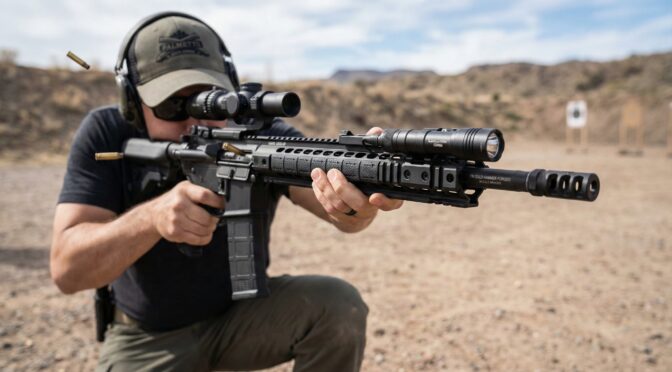
The Palmetto State Armory (PSA) Sabre AR-15 product line represents a significant strategic inflection point in the American small arms market, marking a deliberate departure from the company’s historical dominance of the budget-oriented, commodity firearm sector. Launched to bridge the chasm between “hobby-grade” economy rifles and “professional-grade” duty weapons, the Sabre platform leverages vertical integration and aggressive supply chain management to disrupt the mid-tier market segment. This report provides an exhaustive, forensic analysis of the Sabre platform, evaluating its engineering characteristics, material selection, manufacturing methodologies, and performance in high-stress environments.
Our analysis, based on a synthesis of technical specifications, metallurgical data, and extensive open-source operational testing, indicates that the Sabre is not merely a cosmetic refresh of PSA’s standard PA-15 line but a fundamentally different product architecture. By incorporating premium components such as FN Cold Hammer Forged barrels, Geissele/RifleSpeed gas systems, and Sprinco springs, the Sabre offers a price-to-performance ratio that challenges the traditional pricing structures of the AR-15 market. The platform’s durability, validated by high-round-count destruction testing, suggests it meets the mechanical requirements for defensive and duty use, particularly in its forged configurations.
However, the platform is characterized by a complex dichotomy between its “Forged” and “Billet” sub-lines, which offer divergent value propositions regarding structural durability versus ergonomic flexibility. Furthermore, the proprietary “Sabre Lock-Up” rail system introduces a novel mechanical interface that, while rigid, presents specific serviceability challenges. This report concludes that the PSA Sabre, specifically the variants equipped with FN Cold Hammer Forged (CHF) barrels, represents a viable “duty-grade” system that undercuts legacy competitors by substantial margins, provided the end-user navigates the specific nuances of its control layout and assembly specifications.
1. Market Context and Strategic Pivot
To fully appreciate the engineering and commercial significance of the Sabre, one must first analyze the market vacuum it was designed to fill. For the better part of the last decade, the civilian AR-15 market in the United States has been bifurcated into two distinct and largely impermeable strata: the Commodity Grade and the Professional Grade.
1.1 The Bifurcation of the Modern Rifle Market
At the entry level, typically the $400 to $600 price bracket, the market has been dominated by high-volume manufacturers. Palmetto State Armory’s own PA-15 Freedom line, along with offerings from Anderson Manufacturing and others, defined this space. These rifles are characterized by batch-testing quality control (QC) protocols, the use of 4150 or 4140 steel barrels with nitride finishes, and standard mil-spec furniture.1 While functional for recreational use, these platforms generally lack the individual high-pressure testing (HPT) and magnetic particle inspection (MPI) of critical components that define professional confidence.
Conversely, the Professional Grade sector, occupying the $1,500 to $2,500 range, has been the stronghold of heritage brands such as Daniel Defense, Bravo Company Manufacturing (BCM), Geissele Automatics, and Knights Armament. These manufacturers justify their premium pricing through rigorous individual component testing, the use of chrome-lined barrels designed for high thermal loads, and meticulous assembly standards. For years, the conventional wisdom in the industry was that reliability was linearly correlated with price; to achieve “duty grade” reliability, one had to pay a “duty grade” premium.
A notable “Mid-Tier” void existed between $800 and $1,200. This segment was populated by a mix of products, including the IWI Zion-15, the Springfield Saint Victor, and various Aero Precision build combinations. These rifles offered improvements over the budget tier—such as free-float handguards and better furniture—but often lacked the core metallurgical upgrades (specifically Cold Hammer Forged, Chrome-Lined barrels) found in the top tier. The Sabre initiative was PSA’s calculated maneuver to dominate this middle ground, not by incremental improvement, but by aggressively democratizing the supply chain of premium components.2
1.2 The “Duty Grade” Thesis and Vertical Integration
The term “duty grade” is often dismissed as nebulous marketing nomenclature, but in engineering terms, it implies a statistical probability of reliability under adverse conditions. A duty-grade rifle must survive thermal cycles that would warp hobby-grade barrels, maintain zero under impact, and cycle ammunition consistently despite significant carbon fouling. The Sabre attempts to achieve this status by leveraging PSA’s massive economies of scale to source proven sub-components.1
PSA’s strategy relies on vertical integration. Unlike competitors who must purchase every screw and spring from third-party vendors, marking up each step of the chain, PSA manufactures a significant portion of the Sabre’s chassis in-house. They then act as a systems integrator for the critical components they do not make, sourcing bolt carrier groups (BCGs) from MicroBest and barrels from FN America—both of whom are primary suppliers for military contracts.4 This allows PSA to sell a rifle with a specification sheet nearly identical to a $1,800 firearm for significantly less, effectively challenging the consumer to find the compromise.
2. Engineering Anatomy: The Upper Receiver Group
The upper receiver group (URG) is the mechanical heart of the weapon system, dictating its ballistics, accuracy, reliability, and thermal endurance. The Sabre line presents a divergent approach here, offering two primary barrel tiers and a unique rail interface that significantly alter the platform’s capability profile.
2.1 Barrel Metallurgy: The Core Differentiator
The barrel is the single most critical component for the longevity and performance of a rifle. The Sabre line offers two distinct metallurgical paths, creating a tiered performance structure within the brand itself.
2.1.1 4150V Nitride Barrels: The Precision Option
The base models of the Sabre line utilize 4150V Chrome Moly Vanadium steel with a nitride finish.5 It is crucial to understand the metallurgy here. “4150” refers to the AISI grade steel with approximately 0.50% carbon content, which offers higher tensile strength than the 4140 steel often found in budget barrels. The “V” denotes the addition of Vanadium, which refines the grain structure and improves toughness and wear resistance.
Nitriding (often branded as Melonite or QPQ) is a surface hardening treatment that diffuses nitrogen and carbon into the steel, creating a case-hardened surface typically reaching 60+ HRC (Rockwell C Hardness).
- Engineering Insight: Nitriding offers exceptional corrosion resistance, superior even to chrome lining in salt spray tests. Furthermore, because it is a surface treatment rather than an additive coating, it does not alter the dimensions of the bore. This typically results in higher intrinsic accuracy potential compared to chrome-lined barrels, where inconsistencies in the chrome thickness can degrade uniformity.
- Limitation: The limitation of nitride lies in extreme thermal endurance. In high-rate-of-fire scenarios—such as automatic fire or aggressive suppressed usage—the surface hardness of nitride can begin to anneal (soften) at temperatures exceeding 1,000°F. Once this threshold is crossed, throat erosion accelerates rapidly compared to chrome.
2.1.2 FN Cold Hammer Forged (CHF) Chrome-Lined Barrels: The Duty Standard
The premium tier Sabre models feature barrels manufactured by FN America, utilizing their proprietary “Machine Gun Steel”.6 This is the single most significant value proposition of the Sabre line.
- Cold Hammer Forging (CHF): This manufacturing process involves inserting a negative mandrel (a rod with the rifling pattern in relief) into an oversized barrel blank. Massive hydraulic hammers then pound the outside of the steel, forging the barrel around the mandrel. This process works-hardens the steel and aligns the grain structure continuously along the rifling’s spiral. This results in a barrel with significantly higher tensile strength and resistance to hoop stress (the outward pressure of the burning powder).
- Chrome Lining: These barrels feature a double-thickness chrome lining. Chromium is a metal with a melting point vastly higher than steel. By plating the bore with chrome, the barrel gains a thermal shield that resists the erosive effects of hot propellant gases. This is the “duty” standard for military weapons (M4, M249) because it prolongs barrel life under sustained fire.
- Implication: The inclusion of an FN CHF barrel on a sub-$1,000 rifle is a disruptive market force. Competitors using similar barrels (e.g., BCM, Centurion, Spikes Tactical) typically charge $300 to $400 for the barrel assembly alone. This component creates a durability floor for the Sabre that far exceeds its price point, effectively guaranteeing a barrel life of 15,000 to 20,000 rounds or more, provided maintenance is performed.8
2.2 Gas System Dynamics and Tuning
The AR-15 is a gas-operated system, and the tuning of this system is the primary determinant of recoil impulse and reliability. The Sabre predominantly utilizes a Mid-Length Gas System for its 13.7″, 14.5″, and 16″ barrels.9
2.2.1 The Physics of Dwell Time
The choice of a mid-length system over the shorter carbine-length system is an engineering decision driven by the physics of “dwell time.” Dwell time refers to the duration the bullet remains in the barrel after it passes the gas port but before it exits the muzzle. During this time, pressurized gas is fed back into the receiver to cycle the bolt.
- Carbine System Issues: On a 16-inch barrel, a carbine gas system (port ~7 inches from chamber) leaves a large amount of barrel length after the port. This results in excessive dwell time, keeping the system pressurized for longer. This often leads to “over-gassing,” where the bolt unlocks while residual chamber pressure is still high, causing harsh recoil and hard extraction.
- Mid-Length Advantage: The mid-length system places the port approximately 9 inches from the chamber. This reduces the dwell time to an optimal window. The result is a lower port pressure and a smoother unlocking action. Slower extraction places less stress on the extractor rim of the cartridge case and the extractor claw itself, directly correlating to longer component life and higher reliability.9
2.2.2 Adjustable Gas Blocks (AGB)
A distinctive feature of select Sabre models is the inclusion of adjustable gas blocks (AGB), including the highly regarded RifleSpeed system on top-tier variants.11
- Suppressor Optimization: An AGB allows the user to mechanically restrict gas flow. This is critical when shooting with a sound suppressor. Suppressors increase “backpressure” by trapping gas at the muzzle, which forces more gas down the tube and into the receiver. Without an AGB, a suppressed rifle is often severely over-gassed, leading to increased bolt velocity, receiver wear, and “gas face” for the shooter.
- Market Rarity: The inclusion of AGBs as a standard factory option is a rarity in the sub-$1,000 market. Most manufacturers opt for a fixed gas block to save cost and reduce the complexity of user-induced failures. PSA’s decision to include this acknowledges the growing prevalence of civilian suppressor ownership.12
2.3 The “Sabre Lock-Up” Rail System: Mechanical Analysis
PSA introduced a proprietary rail interface known as the “Sabre Lock-Up”.13 This system warrants a critical mechanical analysis as it deviates from industry-standard pinch-bolt or wedge-lock designs.
2.3.1 Mechanism of Action: The Threaded Interface
Unlike traditional rails that slide onto a smooth barrel nut and clamp down via friction (pinch bolts) or expansion (wedge lock), the Sabre Lock-Up uses a threaded interface.
- The Design: The barrel nut itself features external threads. The handguard has matching internal threads at the receiver end. The installation process involves screwing the handguard directly onto the barrel nut until it bottoms out.13
- Timing and Alignment: Threaded rails historically suffer from alignment issues—when the rail is tightened to the necessary torque, the top Picatinny rail may not align perfectly with the upper receiver’s rail (e.g., it might stop at the 11 o’clock or 1 o’clock position). PSA solves this with a multi-step mechanical timing process. The barrel nut utilizes a spring-loaded collar or specific thread timing that allows for 22.5-degree increment adjustments.
- The Torque Procedure: The user (or factory assembler) tightens the rail to a specific torque setting (referenced as 35 ft-lbs in instructional materials) to achieve the final 12 o’clock alignment.14 Once aligned, anti-rotation set screws are driven into the system to lock it permanently in place.14
2.3.2 Anti-Rotation and Rigidity
A critical requirement for any modern rail is the ability to hold zero for laser aiming modules (LAMs) such as the PEQ-15 or DBAL. If the rail rotates or flexes, the laser loses alignment with the barrel.
- Anti-Rotation Tabs: The Sabre rail features an integrated “anti-slip and anti-rotation design”.15 Unlike some competitors like SLR Rifleworks, which use a tab that indexes partially on the gas tube 17, the Sabre’s anti-rotation mechanism appears to rely on the interplay between the threaded torque and the supplementary set screws that bite into the barrel nut or receiver interface.
- Structural Analysis: This threaded connection creates an exceptionally rigid, continuous structural unit. Because the rail is screwed on rather than clamped around, it offers high resistance to vertical deflection (droop) caused by loading a bipod or pulling down on a vertical foregrip. It eliminates the “bridge” gap often seen in pinch-bolt rails where the rail might shift forward under recoil.
2.3.3 Serviceability Concerns and Comparisons
While rigid, the Sabre Lock-Up system introduces serviceability trade-offs compared to the “Wedge Lock” systems found on high-end rifles like those from Sons of Liberty Gunworks (SOLGW) or Triarc.
- Wedge Lock vs. Threaded: Wedge Lock rails use a camming wedge to expand and grab the barrel nut.18 They are slim, extremely strong, and relatively easy to remove. The Sabre’s threaded system, by contrast, requires precise timing.
- Removal Difficulty: Reports indicate that the barrel nuts on factory-assembled Sabre uppers are often installed with extremely high torque, sometimes exceeding standard specifications to ensure alignment. Some users have colloquially noted that “industrial machinery” or excessive force is required to break the barrel nut loose for barrel swaps.20
- Risk of Thread Damage: The threaded timing system is susceptible to cross-threading if the user attempts to remove and reinstall the rail without perfect alignment. Images from user reports have shown galled threads on the barrel nut when proper care was not taken, or potentially due to factory installation errors.21 This makes the Sabre a less attractive option for “tinkerers” who plan to frequently swap barrels or gas blocks compared to a standard pinch-bolt system.
3. Engineering Anatomy: The Lower Receiver Group
The lower receiver houses the fire control group, buffer system, and the primary user interface controls. The Sabre line bifurcates here into two distinct architectures: Forged and Billet, each serving a different philosophy of use.
3.1 Material Science: Forged vs. Billet
The choice between forged and billet aluminum is often misunderstood as a choice between “standard” and “premium,” but structurally, it is a choice between “strength” and “geometry.”
- Forged (7075-T6 Aluminum): The forged lower starts as a raw slug of aluminum that is stamped (forged) into shape under immense hydraulic pressure. This process aligns the metallic grain structure of the aluminum continuously along the contours of the part.22 This grain alignment maximizes the strength-to-weight ratio and fatigue resistance. Forged receivers are the military standard because they are less likely to crack under catastrophic impact.
- Billet (6061-T6 or 7075-T6 Aluminum): Billet receivers are CNC machined from a solid block of extruded aluminum. While they allow for complex aesthetic geometries—such as integrated trigger guards, flared magwells, and stylized strengthening ribs—they lack the continuous grain structure of forgings.23 They rely on the bulk material strength of the aluminum.
- Assessment: While billet receivers are often marketed as “premium” due to the higher cost of machine time and material waste, forged receivers are structurally superior for combat arms application where impact durability is paramount.22 PSA’s decision to offer both allows them to cater to two markets: the Forged line for duty/defense users prioritizing durability, and the Billet line for competition/enthusiast users prioritizing aesthetics and features.
3.2 Ambidextrous Controls: A Detailed Analysis of Implementation
A key selling point of the Sabre is “ambidexterity,” but the implementation is radically different between the Forged and Billet lines, a distinction that is often glossed over in marketing materials.
3.2.1 The Billet Ambidexterity
The Sabre Billet lowers feature a true, fully ambidextrous control suite. This includes a bolt release and bolt catch mechanism integrated into the right side of the receiver.25 This allows a right-handed shooter to lock the bolt to the rear using their trigger finger while maintaining a firing grip—a significant advantage for clearing malfunctions or showing clear at a competition.
3.2.2 The Forged “Ambidexterity” Limitation
The Forged Sabre lowers utilize a more restricted definition of ambidexterity. The right-side control on the forged receiver is primarily a bolt release, not a lock/catch mechanism.9
- Mechanism: It typically uses a lever that pivots to push the standard bolt catch paddle via a connecting bar or pin. While it allows a right-handed shooter to drop the bolt and chamber a round with their trigger finger (increasing reload speed), it does not allow them to easily lock the bolt to the rear without engaging the standard left-side paddle.
- Operational Impact: For clearing Type 3 malfunctions (double feeds), the ability to lock the bolt back with the firing hand is a major ergonomic advantage found in high-end lowers like the LMT MARS-L or Radian ADAC. The Sabre Forged lower lacks this specific capability. While it is superior to a standard mil-spec lower, it is functionally a tier below “true” ambidextrous receivers. It is comparable to the “PDQ” lever style modification or the Teal Blue Bravo approach.
3.3 Fire Control and Buffer System
The Sabre moves beyond the gritty, heavy “mil-spec” triggers that characterize the PA-15 Freedom line.
- Trigger Mechanism: Most Sabres ship with either the Hiperfire RBT trigger or a PSA Custom DLC 2-stage trigger.4
- The Hiperfire RBT (Refined Battle Trigger) utilizes varied cam geometries and spring rates to reduce the sensation of creep and lower the pull weight while maintaining reliable primer ignition energy.
- The DLC (Diamond-Like Carbon) coating on the PSA 2-stage trigger provides a surface with a very low coefficient of friction. This results in a “glass rod” break and a smooth reset, significantly aiding in precision shooting compared to a phosphate-coated mil-spec trigger.
- Buffer System Metallurgy: PSA utilizes Sprinco buffer springs (specifically the “White” standard or “Blue” enhanced power) and adjusted buffer weights.10
- The Sprinco Advantage: Standard buffer springs are made from music wire, which is susceptible to metal fatigue and heat. Over thousands of cycles, they lose their spring constant (length), leading to “bolt bounce” or failure to return to battery. Sprinco springs are constructed from chrome silicon wire, heat-treated, and cryogenically processed. They have a cycle life hundreds of thousands of rounds longer than standard springs. This seemingly small upgrade is critical for the long-term reliability of the system, preventing the “buffer spring sag” that plagues high-round-count budget rifles.
4. Manufacturing and Quality Control Nuances
The primary skepticism surrounding PSA products stems from their historical reputation for “quantity over quality.” The Sabre line attempts to address this through a separate assembly cell and higher QC standards, but data suggests a complex reality.
4.1 Vertical Integration and QC
PSA controls almost every aspect of production, from raw aluminum to finished assembly.1 This vertical integration allows them to undercut competitors on price. However, it also means that if a machine calibration is off, a large batch of parts can be affected. The Sabre line is reportedly assembled by a dedicated team of more experienced builders within PSA, distinct from the high-volume entry-level lines.11
4.2 The Torque Specification Issue
A recurring theme in technical feedback is the excessive torque applied to barrel nuts and castle nuts.
- Industrial Torque: Users have reported needing breaker bars and specialized reaction rods to remove barrel nuts, implying torque values far exceeding the standard 30-80 ft-lbs range.20
- Implication: While this ensures the rifle effectively never vibrates loose under recoil—a common failure in budget builds—it complicates user serviceability. The high torque on the Sabre Lock-Up nut specifically can lead to the deformation of the aluminum nut or the receiver threads if removal is attempted without applying heat to break the thread locker.
4.3 The “Lemon” Factor
Despite the “Sabre” branding, the human element of assembly remains. Sentiment analysis from Reddit threads 6 suggests that while major catastrophic failures are rare, minor issues like misaligned gas blocks or cosmetic blemishes still occur. PSA’s warranty is robust (“Lifetime”) and they are known to pay for shipping both ways 1, which mitigates this risk financially. However, for a “duty” rifle, the time cost of a return is a non-trivial factor.
5. Performance Analysis: The “Meltdown” Context
A critical data point in the Sabre’s history is the “meltdown” test conducted by the prominent firearms evaluator Garand Thumb.29 This test serves as a proxy for extreme accelerated wear and catastrophic failure analysis.
5.1 The Test Parameters
The test involved firing approximately 6,000 rounds of ammunition through a PSA upper in full-auto, suppressed, without cleaning or lubrication, until failure. This represents a thermal load that no civilian or law enforcement rifle will likely ever experience in a single event.
5.2 Forensic Interpretation of Failures
Critics labeled the result a “failure” because the rifle eventually stopped working, but from an engineering standpoint, the specific failure modes validated the design.
- Failure 1: Extractor Spring (approx. 4,000 rounds): The extractor spring lost tension, leading to failures to extract.31 This is a common thermal failure; as the bolt heats up, the spring temper is drawn out. The fact that the bolt body did not crack is the more important finding, validating the Carpenter 158 steel and heat treat of the MicroBest BCG.
- Failure 2: Barrel Accuracy (approx. 5,000-6,000 rounds): The rifling eventually eroded to the point where bullets were keyholing (tumbling) and accuracy was lost.30 This is expected physics. The intense heat of continuous automatic fire softens the barrel steel, and the friction of the bullets strips the rifling away.
- Failure 3: Gas Tube Burst: The gas tube eventually melted/burst.30 In the AR-15 design, the gas tube is intended to be the sacrificial link. It is better for the cheap gas tube to fail and vent pressure than for the barrel or receiver to explode.
- Validation: The fact that the receiver, bolt lugs, and carrier survived this stress test validates the metallurgy of the core components. For a civilian or police user who will never fire 6,000 rounds in a single afternoon, this test proves the rifle possesses a safety margin far exceeding realistic “SHTF” (Shit Hits The Fan) scenarios.32 It demonstrates that the Sabre can withstand abuse levels comparable to rifles costing three times as much.
6. Comparative Market Analysis
To determine the true value of the Sabre, it must be weighed against its peers in the 2025 marketplace.
Table 1: Competitive Landscape Analysis (2025 Data)
| Feature | PSA Sabre (Forged) | IWI Zion-15 | BCM RECCE-16 | Daniel Defense DDM4 V7 |
| Street Price (Approx) | $850 – $950 2 | $825 – $900 2 | $1,200 – $1,400 (Upper + Lower) | $1,800+ 2 |
| Barrel Material | FN CHF Chrome Lined | 4150 CMV Nitride | BCM CHF Chrome Lined | CHF Chrome Lined |
| Gas System | Mid-Length (Tuned) | Mid-Length | Mid-Length | Mid-Length |
| Handguard | Sabre Lock-Up (Threaded) | Free Float M-LOK (Wedge/CMT) | MCMR (Friction/Bolt) | RIS III (Bolt-Up) |
| Trigger | Hiperfire / DLC 2-Stage | Mil-Spec Improved | Mil-Spec PNT | Mil-Spec / Geissele (varies) |
| Ambi Controls | Right Side Release Only | None | None (Usually) | Fully Ambidextrous |
| Charging Handle | Radian Raptor LT | Standard | BCM GFG | DD Grip-N-Rip |
| Warranty | Lifetime | Limited | Lifetime | Lifetime |
6.1 Sabre vs. IWI Zion-15
The Zion-15 is the Sabre’s closest combatant in the sub-$1,000 “duty” space.1
- The Zion Advantage: IWI offers a proven track record of QC consistency. As a military factory, their commercial lines benefit from institutional process controls. The rail mounting system (CMT style wedge) is simpler and less prone to user error during maintenance.
- The Sabre Advantage: Barrel Quality and Feature Set. The Zion uses a nitrided barrel. The Sabre (in the FN configuration) uses a CHF Chrome Lined barrel. For long-term durability and heat resistance, the Sabre wins decisively. Additionally, the Sabre includes roughly $200 worth of aftermarket upgrades (Radian charging handle, Radian safety, Hiperfire trigger) out of the box that the Zion lacks. To bring a Zion to Sabre specs, a user would need to spend an additional $300+.
- Verdict: If the user plans to leave the rifle stock, Sabre wins on value. If the user prioritizes strict QC probability over features, Zion is the safer, albeit less feature-rich, bet.
6.2 Sabre vs. BCM
BCM is often considered the “gold standard” of duty-grade reliability for civilian purchase.
- The Gap: A complete BCM rifle often exceeds $1,400. The Sabre offers nearly identical technical specifications (FN barrel vs BCM barrel is essentially a wash, as they are likely sourced from similar supply chains) for $400-$500 less.
- The Trade-off: With BCM, the consumer pays for the “QC Premium”—the assurance that every single bolt was HP/MPI tested and inspected by a human who fears firing. With PSA, the consumer trusts the statistical process. The Sabre closes the performance gap to arguably 95%, but that last 5% of QC assurance is what BCM charges for. For a user on a budget, the Sabre allows the purchase of the rifle plus a high-quality optic and light for the price of a naked BCM.
7. Customer Sentiment and Brand Forensics
Analyzing data points from user discussions in late 2024 and 2025 reveals clear trends in sentiment.
7.1 The “Just as Good” Narrative Shift
The Reddit community (r/ar15), historically hostile to budget brands, has shifted its narrative regarding the Sabre. The consensus has moved from “don’t buy” to “verify, then trust.”
- Positive Clusters: Users consistently praise the component list. The combination of MicroBest BCGs, FN barrels, and Radian controls is universally recognized as legitimate.6 The “sum of parts” calculation is the primary driver of positive sentiment.
- Negative Clusters: Complaints center on shipping delays, minor cosmetic blemishes on “new” rifles, and the aforementioned over-torqued barrel nuts.20 There is also significant confusion regarding the myriad of SKU variations (Forged vs. Billet, Nitride vs. CHF), leading some buyers to accidentally purchase the lower-tier specs thinking they acquired the premium configuration.
7.2 The “Influencer” Effect
The Garand Thumb meltdown video 29 acted as a watershed moment for the brand. While nominally a “destruction” video, the community reaction interpreted it as a validation of PSA’s durability. It legitimized the brand in the eyes of tactical enthusiasts who previously ignored it, proving that the underlying engineering was sound even if the finish wasn’t “Gucci.”
8. Conclusion and Recommendations
The PSA Sabre is a masterclass in supply chain leverage. By aggregating premium components into a house-brand chassis, Palmetto State Armory has created a rifle that offers the feature set of a $1,600 firearm for under $1,000. Mechanically, the “Forged” line with the FN CHF barrel is the superior choice for serious use, offering better structural integrity and barrel life than the Billet options.
8.1 Is it Worth Buying?
Yes, absolutely. But the “Yes” comes with specific caveats based on the user profile.
8.2 Strategic Recommendations by Use Case
Case A: The “Duty” / Patrol Officer (Self-Purchase)
- Verdict: APPROVED (Conditional)
- Configuration: Sabre Forged with FN CHF Barrel and Quad Rail or Lock-Up Rail.
- Reasoning: The CHF barrel is non-negotiable for duty use due to its erosion resistance. The forged receiver is more durable against drop impacts than billet.
- Caveat: The user must verify gas block alignment and witness mark all screws upon receipt. Once vetted with 500 rounds of duty ammunition, this rifle is capable of professional service.
Case B: Home Defense / Preparedness Civilian
- Verdict: HIGHLY RECOMMENDED
- Configuration: Sabre Forged 13.7″ Pin & Weld with Radian controls.
- Reasoning: The mid-length gas system and potential for suppressor mounting (KeyMo/ASR muzzle devices usually included) make it ideal for home defense. The price savings vs. a Daniel Defense allow the user to purchase a weapon light, sling, and red dot—essential tools that matter more than marginal barrel accuracy in a hallway.
Case C: The Competition Shooter / Range Toy
- Verdict: RECOMMENDED (Billet Models)
- Configuration: Sabre Billet with Nitride Barrel.
- Reasoning: The Billet lower offers true ambidextrous controls (locking and releasing from the right side), which aids in complex stage planning and malfunction clearance. The Nitride barrel offers slightly better potential accuracy for 3-Gun matches where heat buildup is manageable. The aesthetics of the billet receiver fit the “race gun” vibe.
Case D: The Tinkerer / Builder
- Verdict: NOT RECOMMENDED
- Reasoning: The Sabre Lock-Up rail and proprietary barrel nut torque make swapping barrels or handguards frustrating. If you plan to change parts immediately, buy a stripped receiver set, not a complete Sabre.
Final Verdict
The PSA Sabre is the current “Value King” of the AR-15 market in 2025. It effectively renders the “budget build” obsolete—you cannot build a rifle with these individual components (FN barrel, MicroBest BCG, Radian CH, Hiperfire Trigger, B5 stock) for the price PSA sells the complete assembled unit. It is a triumph of vertical integration over component markup, providing a democratized “duty grade” option for the American citizen.
Appendix A: Analytical Framework and Research Protocols
1. Objective:
To conduct a multi-vector analysis of the PSA Sabre AR-15 platform, assessing its engineering viability, market competitiveness, and consumer reputation.
2. Data Collection Strategy:
- Technical Specification Analysis: Primary source data (PSA product pages) was harvested to establish a baseline of materials (4150V vs FN CHF), dimensions (gas system lengths), and sub-component sourcing (MicroBest, Sprinco, Radian).
- Open Source Intelligence (OSINT) Aggregation: A wide net was cast over user-generated content platforms (Reddit r/ar15, r/PalmettoStateArmory, YouTube). Specific focus was placed on “high-value” feedback—posts detailing failure modes, high round count reports, and direct comparisons to peer rifles.
- Forensic Video Analysis: Frame-by-frame analysis of endurance testing videos (Garand Thumb, 704 Tactical) was used to identify failure points (gas tube erosion, extractor spring failure) and validate durability claims.
3. Analytical Frameworks Applied:
- Metallurgical Hierarchy: Ranking materials based on industry standards (e.g., Carpenter 158 > 9310 for bolts; CHF Chrome Lined > Nitride for duty barrels).
- Cost-Benefit Ratio Calculation: Comparing the aggregate MSRP of individual components against the retail price of the complete Sabre rifle to determine “sum of parts” value.
- Sentiment Analysis: Categorizing qualitative user feedback into quantitative clusters (QC issues vs. User Error vs. Design Flaws) to determine the “Lemon Rate” probability.
If you find this post useful, please share the link on Facebook, with your friends, etc. Your support is much appreciated and if you have any feedback, please email me at in**@*********ps.com. Please note that for links to other websites, we are only paid if there is an affiliate program such as Avantlink, Impact, Amazon and eBay and only if you purchase something. If you’d like to directly contribute towards our continued reporting, please visit our funding page.
Sources Used
- 15 Best AR-15 Rifles in 2025: The Ultimate List – CAT Outdoors, accessed November 23, 2025, https://catoutdoors.com/best-ar-15/
- Best AR-15s: Ultimate Hands-On Guide, accessed November 23, 2025, https://www.pewpewtactical.com/best-ar-15/
- IWI Zion-15 or PSA Sabre-15? : r/ar15 – Reddit, accessed November 23, 2025, https://www.reddit.com/r/ar15/comments/159ovk2/iwi_zion15_or_psa_sabre15/
- TFB 1000 Round Review: PSA Sabre 15 (Duty Grade Or Don’t-y Grade?), accessed November 23, 2025, https://www.thefirearmblog.com/blog/tfb-1-000-round-review-psa-sabre-15-duty-grade-or-don-t-y-grade-44816554
- PSA “Sabre” Forged 14.5″ .223 Wylde M4 13″ Sabre Lock Up Rail and Pin/Weld AAC 51T Flash Hider | Palmetto State Armory, accessed November 23, 2025, https://palmettostatearmory.com/psa-sabre-forged-14-5-223-wylde-m4-13-sabre-lock-up-rail-and-pin-weld-aac-51t-flash-hider.html
- PSA Sabre ARs: Worth it or Nah? : r/ar15 – Reddit, accessed November 23, 2025, https://www.reddit.com/r/ar15/comments/1p0hpuk/psa_sabre_ars_worth_it_or_nah/
- NOT Again! PSA Sabre Forged AR-15 Could Be The Best Budget Option – YouTube, accessed November 23, 2025, https://www.youtube.com/watch?v=yHEvQR5zm9g
- Billet PSA Sabre – PSA Products – Palmetto State Armory | Forum, accessed November 23, 2025, https://palmettostatearmory.com/forum/t/billet-psa-sabre/26198
- [Review] PSA SABRE | Hands-on with the best PSA AR-15 – Lynx Defense, accessed November 23, 2025, https://lynxdefense.com/reviews/psa-sabre-ar-15/
- PSA “Sabre” Forged 16″ 5.56 Nitride 15″ Sabre Lock Up Rail Sabre Furniture Rifle – Palmetto State Armory, accessed November 23, 2025, https://palmettostatearmory.com/psa-sabre-forged-16-5-56-nitride-15-sabre-lock-up-rail-sabre-furniture-rifle.html
- Thoughts on PSA Sabre? : r/ar15 – Reddit, accessed November 23, 2025, https://www.reddit.com/r/ar15/comments/1oc43jr/thoughts_on_psa_sabre/
- Can anyone who owns a Psa Sabre tell me about there experience with it. : r/ar15 – Reddit, accessed November 23, 2025, https://www.reddit.com/r/ar15/comments/1mnuuo0/can_anyone_who_owns_a_psa_sabre_tell_me_about/
- PSA Sabre Lock Up Rail System Video | Palmetto State Armory, accessed November 23, 2025, https://palmettostatearmory.com/blog/psa-sabre-lock-up-rail-system.html
- PSA: Sabre Lock Up Rail System – YouTube, accessed November 23, 2025, https://www.youtube.com/watch?v=-IkV094gPC8
- PSA “Sabre” QDSM 13 Rail – Palmetto State Armory, accessed November 23, 2025, https://palmettostatearmory.com/psa-sabre-qdsm-13-rail.html
- PSA “Sabre” QDSM 9.75″ Rail – Palmetto State Armory, accessed November 23, 2025, https://palmettostatearmory.com/psa-sabre-qdsm-9-75-rail.html
- What are anti rotation tabs? And do I need a handguard that utilizes them? : r/ar15 – Reddit, accessed November 23, 2025, https://www.reddit.com/r/ar15/comments/jeefie/what_are_anti_rotation_tabs_and_do_i_need_a/
- How to install a Wedge Lock rail – YouTube, accessed November 23, 2025, https://www.youtube.com/watch?v=OguVOxc3hBA
- WEDGE LOCK HAND GUARD INSTALLATION INSTRUCTIONS | TRIARC Systems, accessed November 23, 2025, https://www.triarcsystems.com/wp-content/uploads/2018/12/TRILOK-Rail-Installation-Instructions.pdf
- Thoughts on the PSA Sabre? : r/ar15 – Reddit, accessed November 23, 2025, https://www.reddit.com/r/ar15/comments/1nggcvx/thoughts_on_the_psa_sabre/
- Saber Upper barrel nut mounting threads issue – AR-15 – Palmetto State Armory | Forum, accessed November 23, 2025, https://palmettostatearmory.com/forum/t/saber-upper-barrel-nut-mounting-threads-issue/37311
- Forged Vs. Billet AR-15 Lower Receivers – Primary Arms, accessed November 23, 2025, https://blog.primaryarms.com/guide/forged-vs-billet-ar15-lower-receivers/
- Billet vs. Forged Lower Receiver: What’s the Difference? : r/ar15 – Reddit, accessed November 23, 2025, https://www.reddit.com/r/ar15/comments/15t7la/billet_vs_forged_lower_receiver_whats_the/
- Forged vs Billet AR Lowers: What’s the Difference? – CAT Outdoors, accessed November 23, 2025, https://catoutdoors.com/forged-vs-billet-ar-lowers/
- PSA Sabre-15 Billet Ambi-Receiver Set, FDE | Palmetto State Armory, accessed November 23, 2025, https://palmettostatearmory.com/psa-sabre-15-billet-ambi-receiver-set-fde.html
- PSA Sabre-15 Forged Lower with Sabre Stock and Grip, Black | Palmetto State Armory, accessed November 23, 2025, https://palmettostatearmory.com/psa-sabre-15-forged-lower-with-sabre-stock-and-grip-black.html
- PSA Sabre forged upper rail and barrel detailed break down. : r/ar15 – Reddit, accessed November 23, 2025, https://www.reddit.com/r/ar15/comments/1224atm/psa_sabre_forged_upper_rail_and_barrel_detailed/
- Thoughts on PSA AR-15s : r/ar15 – Reddit, accessed November 23, 2025, https://www.reddit.com/r/ar15/comments/1o3jime/thoughts_on_psa_ar15s/
- Garand Thumb beats up a PSA AR – Page 2 – PSA Products – Palmetto State Armory | Forum, accessed November 23, 2025, https://palmettostatearmory.com/forum/t/garand-thumb-beats-up-a-psa-ar/35386?page=2
- At what point is this PSA PA-15 not good enough. : r/ar15 – Reddit, accessed November 23, 2025, https://www.reddit.com/r/ar15/comments/1dkhf0v/at_what_point_is_this_psa_pa15_not_good_enough/
- Garand Thumb beats up a PSA AR – PSA Products – Palmetto State Armory | Forum, accessed November 23, 2025, https://palmettostatearmory.com/forum/t/garand-thumb-beats-up-a-psa-ar/35386
- How useful or un useful are these tests? : r/ar15 – Reddit, accessed November 23, 2025, https://www.reddit.com/r/ar15/comments/1f4uqaj/how_useful_or_un_useful_are_these_tests/
- $150 PSA upper durability/ reliability test : r/ar15 – Reddit, accessed November 23, 2025, https://www.reddit.com/r/ar15/comments/1ogtqzy/150_psa_upper_durability_reliability_test/