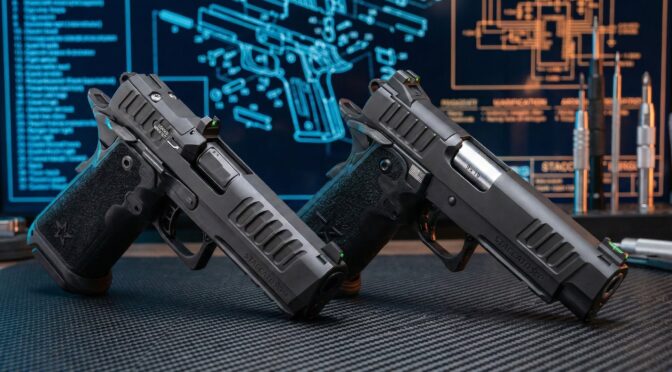
The contemporary small arms sector, specifically the niche occupied by high-performance duty and defensive sidearms, is currently navigating a significant inflection point. For decades, the bifurcation between “duty” weapons—typified by loose-tolerance, striker-fired polymer pistols like the Glock—and “competition” weapons—typified by tight-tolerance, hammer-fired platforms like the 1911/2011—was absolute. However, the last five years have seen a convergent evolution. Law enforcement agencies and serious defensive practitioners are increasingly demanding the shootability and ballistic performance of a race gun combined with the austere reliability of a service pistol. Staccato 2011, formerly STI International, has been the primary architect of this convergence. This report provides an exhaustive, forensic-level analysis of Staccato’s flagship offerings: the legacy Staccato P, which established the category, and the newly released Staccato HD P4, which represents a radical engineering departure designed to capture the institutional market.
Our analysis, based on a rigorous review of technical specifications, long-term endurance testing data, and comparative engineering studies, suggests that while the Staccato P remains the superior choice for the purist seeking the ultimate trigger characteristics of the Series 70 design, it retains inherent mechanical liabilities—specifically regarding drop safety and extractor maintenance—that preclude it from universal agency adoption. The Staccato HD P4 addresses these specific engineering hurdles through a comprehensive redesign that includes a Series 80-style active firing pin block, a self-regulating external extractor, and a chassis architecture adapted for Glock-pattern magazines.
The report details the physics of the 2011’s recoil mitigation, the metallurgy of its frame components, and the specific failure modes associated with its internal extraction system. Furthermore, it contrasts the platform against emerging competitors like the Stealth Arms Platypus and Oracle Arms 2311, ultimately concluding that the HD P4 is the first “true” duty-grade 2011 capable of surviving the administrative and physical rigors of modern law enforcement testing protocols, albeit at the cost of a slightly degraded trigger profile and a controversial aesthetic finish.
1. Historical Evolution and Brand Trajectory
To fully comprehend the technical nuances of the Staccato P and HD P4, one cannot view them as isolated products. They are the latest iterations in a design lineage that stretches back over a century, modified by specific patent innovations in the 1990s and a corporate pivot in the late 2010s.
1.1 The Ancestral Foundation: 1911 Mechanics
The foundation of the Staccato platform is the Colt 1911, designed by John Moses Browning. The core mechanical principles—the short-recoil operation, the swinging link (later modified to a camming surface in many modern iterations, though Staccato retains the link), and the single-action sliding trigger—remain the gold standard for shootability. The single-action trigger is particularly critical. unlike a hinged trigger found in most modern polymer pistols, which must rotate around a pivot point, the 1911 trigger slides directly rearward. This linear motion allows for a trigger break that is mechanically simpler and therefore crisper, with less pre-travel and over-travel. This mechanical advantage translates directly to reduced muzzle disruption during the firing sequence, allowing for greater practical accuracy.1
1.2 The Modular Revolution: Strayer and Tripp
In the early 1990s, Virgil Tripp and Sandy Strayer revolutionized the 1911 market by addressing its primary weakness: capacity. The traditional 1911 used a single-stack magazine because the grip frame was integral to the receiver. Strayer and Tripp patented a modular frame design (the “2011”) which separated the pistol into two primary components: a metal “sub-frame” or chassis that housed the slide rails and fire control group, and a polymer grip module that bolted onto this chassis.
This innovation achieved two things. First, it allowed for a double-stack magazine, increasing capacity from 7-8 rounds to 17-20 rounds of 9mm or.38 Super. Second, and perhaps more importantly for the modern context, it introduced a polymer interface between the shooter and the steel frame. This polymer grip acts as a shock absorber, damping the high-frequency vibrations generated by the slide’s reciprocation and the cartridge ignition. This damping effect, combined with the structural rigidity of the steel chassis, created a recoil impulse that was uniquely flat and manageable, quickly making the 2011 the dominant platform in USPSA and IPSC competition.3
1.3 The STI International Era: The “Gamer” Gun
For nearly three decades, the company operating as STI International catered almost exclusively to the competitive shooting market. During this era, the pistols were engineering marvels of tight tolerances. A “match fit” STI might have slide-to-frame clearances measured in ten-thousandths of an inch. While this ensured supreme mechanical accuracy, it made the weapons intolerant of debris. Unburnt powder, sand, or even thickened lubricant could cause the action to seize. Furthermore, the guns were often sprung with very light recoil springs (7lbs to 9lbs) to minimize muzzle dip for gamers using light-loaded ammunition. This configuration, while effective on a clean range, was disastrous for duty use, cementing a reputation for the 2011 as a “finicky race gun” that required constant tuning.2
1.4 The Staccato Rebrand: The Pivot to Duty
In 2019, the company underwent a massive rebranding effort, changing its name to Staccato 2011. This was not merely cosmetic; it signaled a fundamental shift in engineering philosophy. The goal was to produce a “Duty” 2011. This required loosening tolerances to allow for “combat reliability”—essentially allowing space for debris to migrate out of the action rather than binding it. It also involved standardizing spring weights to heavier specifications (e.g., 13lb recoil springs) to ensure the slide would close into battery with authority even when fouled. The Staccato P (“Professional”) was the flagship of this new doctrine, specifically designed to pass the rigorous testing protocols of elite law enforcement units like the U.S. Marshals SOG and LAPD SWAT.4
2. Engineering Anatomy: Staccato P (Legacy Architecture)
The Staccato P, as the bridge between the competition world and the duty world, retains much of the classic 2011 architecture while hardening specific subsystems for field use. It is a single-action, hammer-fired, recoil-operated semi-automatic pistol chambered in 9x19mm.
2.1 Frame Metallurgy and Dynamics
The Staccato P is offered with two distinct frame material options: 4140 carbon steel and 7075-T6 aluminum alloy. The choice between these materials fundamentally alters the physics of the weapon’s operation.
2.1.1 The Physics of the Steel Frame
The steel frame variant weighs approximately 33 ounces unloaded.6 From a physics perspective, the mass of the non-reciprocating frame is a critical variable in recoil management. Recoil is the conservation of momentum; the energy generated by the bullet leaving the barrel must be transferred somewhere. A heavier frame possesses greater inertia, meaning it resists the acceleration forces generated by the slide’s rearward travel.
This inertial damping has two practical effects. First, it reduces the peak force transmitted to the shooter’s hand, reducing felt recoil. Second, it stabilizes the weapon platform in 3D space. A heavier object is less susceptible to micro-movements caused by trigger press errors or autonomic nervous responses. For high-volume shooting or duty applications where weight is not the primary constraint, the steel frame offers a distinct shootability advantage, often described as the gun “tracking” flatter—meaning the sights return to the point of aim with less deviation.7
2.1.2 The Dynamics of the Aluminum Frame
The aluminum frame reduces the total weight to roughly 28 ounces.4 This reduction is achieved by substituting the 4140 steel chassis for one machined from 7075-T6 aluminum, an alloy utilized extensively in aerospace applications for its high strength-to-weight ratio. While 7075 is exceptionally strong, it lacks the endurance limit of steel. In metallurgy, steel has an endurance limit below which it can theoretically endure infinite stress cycles without fatigue failure. Aluminum does not; every stress cycle contributes to cumulative fatigue. While a modern 7075 frame can easily last 20,000 to 50,000 rounds, it will eventually work-harden and crack, whereas a steel frame is functionally immortal with proper spring maintenance.
Functionally, the lighter frame transmits more recoil energy to the shooter. The “snap” is sharper because there is less mass to soak up the kinetic energy of the slide. This makes the aluminum P ideally suited for concealed carry (CCW) where comfort during the 12 hours of carrying outweighs the slight recoil penalty during the 10 seconds of shooting.9
2.2 Slide and Barrel Assembly
The slide of the Staccato P is machined from billet steel and features front and rear serrations for manipulation. A critical component of the P’s accuracy is the barrel system.
2.2.1 Bull Barrel Architecture
The Staccato P utilizes a 4.4-inch “Bull Barrel”.6 In a traditional 1911, a thin barrel is supported at the muzzle by a barrel bushing. This bushing is a separate part that fits into the slide. Accuracy depends on the tolerance stack between the barrel, the bushing, and the slide.
The bull barrel eliminates the bushing. Instead, the barrel profile flares outward at the muzzle, creating a cone shape. When the slide is fully forward (in battery), this cone wedges directly into the slide’s interior dimensions.
- Harmonic Damping: The thicker walls of the bull barrel increase its rigidity. A stiffer barrel vibrates less during the bullet’s travel down the bore (barrel harmonics). Consistent harmonics lead to consistent points of impact.
- Forward Mass Bias: The extra metal at the muzzle shifts the center of gravity forward. This extra mass at the front of the pistol acts as a counterweight to muzzle rise (lever arm effect), helping to keep the sights aligned during rapid fire sequences.11
- Lock-up Consistency: The direct barrel-to-slide lockup is inherently more repeatable than the bushing system, contributing to the platform’s ability to hold sub-2-inch groups at 25 yards.12
2.2.2 DLC Surface Treatment
The barrel and often the slide of the Staccato P are treated with Diamond-Like Carbon (DLC). This is not a paint or a ceramic coating like Cerakote; it is a physical vapor deposition (PVD) process that bonds carbon atoms to the substrate in a crystalline lattice structure similar to diamond.
- Tribology: DLC has an extremely low coefficient of friction. This provides natural lubricity, which is critical for the tight tolerances of the 2011. It reduces the likelihood of galling (metal-on-metal tearing) if the lubrication runs dry.
- Hardness: DLC is incredibly hard, providing superior resistance to wear from holster draws and environmental debris compared to traditional bluing or Parkerizing.7
2.3 Recoil System Mechanics
The Staccato P utilizes the Dawson Precision Tool-Less Guide Rod system.3
- Maintenance Innovation: Traditional 2011 full-length guide rods required a paperclip or a specific plastic collar to capture the spring tension for disassembly. If this tool was lost in the field, the gun could not be field-stripped. The Dawson system integrates a mechanical lever into the guide rod head that captures the spring, allowing for tool-free disassembly—a critical requirement for a duty weapon.
- Spring Rate Controversies: The factory standard recoil spring is rated at 13 lbs.14 This weight is chosen to ensure the slide strips a fresh round from a fully loaded magazine with authority, even when the gun is fouled. However, some enthusiasts and competition shooters prefer an 11lb spring.
- Physics of the 11lb Spring: A lighter spring offers less resistance to the slide’s rearward travel, allowing it to move faster. More importantly, it stores less energy to return the slide forward. A 13lb spring slams the slide closed with significant force, which can cause the muzzle to “dip” below the point of aim as the slide hits battery. The 11lb spring reduces this dip, creating a “flatter” tracking dot. However, the trade-off is reduced feeding energy, increasing the risk of failure-to-feed malfunctions if the gun is dirty or the shooter “limp wrists” the grip.15
2.4 The Internal Extractor: An Engineering Liability
Despite the P’s modern features, it retains the legacy internal extractor of the 1911 design.
- Beam Spring Mechanics: The internal extractor is essentially a long leaf spring (beam) machined from spring steel. It lives inside a tunnel within the slide. The tension on the cartridge rim is determined by the curvature (bend) of this beam.
- The Failure Mode: Over time, repeated cycling or improper administrative handling (such as dropping a round in the chamber and slamming the slide) can cause the steel to yield, losing its tension. Once tension is lost, the extractor claw may fail to hold the empty case against the breech face during the violent rearward cycle, leading to a Failure to Extract (double feed).
- Maintenance Burden: Correcting this requires removing the extractor and physically bending it back to the correct geometry, a process that requires “feel” and experience rather than a simple part swap. This need for skilled gunsmithing at the user level is a major logistical negative for large agencies.17
3. Engineering Anatomy: Staccato HD P4 (The Duty Evolution)
The Staccato HD (Heavy Duty) P4 is a systemic re-engineering of the platform aimed at solving the specific liabilities that prevented the legacy P from achieving universal institutional adoption. It targets three specific areas: Drop Safety, Extraction Reliability, and Logistical Compatibility.
3.1 Drop Safety and the Series 80 System
A major hurdle for the 2011 in the law enforcement sector has been drop safety. The Series 70 design (used in the Staccato P) relies on a strong firing pin spring and the low mass of the firing pin to prevent inertial discharge if the gun is dropped on its muzzle. However, physics dictates that if the drop height is sufficient (e.g., from a second-story balcony or a running tackle), the inertia of the firing pin can overcome the spring, striking the primer.
The HD P4 incorporates a Series 80-style active firing pin block to address this.19
- Mechanism: A plunger (block) sits vertically in the slide, physically obstructing the forward path of the firing pin. This plunger is held in the “safe” (down) position by a spring.
- Actuation: The trigger bow is linked to a series of levers in the frame. When the trigger is pulled, these levers push the plunger up, clearing the path for the firing pin.
- Engineering Trade-off: The actuation of these levers requires mechanical work. This work is added to the force required to pull the trigger. Consequently, Series 80 triggers are often criticized for having “creep” or a “mushy” feel during the take-up phase, as the user is physically compressing the plunger spring before the sear releases the hammer. Staccato engineers have mitigated this through polishing and geometry optimization, but the HD P4 trigger (4.5-5.0 lbs) is measurably different from the P’s crisp 4.0lb break.19 This addition allows the HD P4 to pass the stringent NIJ Standard 0112.03 drop tests, which mandate safety from 1.5-meter drops in multiple orientations.21
3.2 External Extractor: Reliability by Design
The HD P4 replaces the internal extractor with an external, pivoting design.
- Pivot Mechanics: Instead of relying on the bending of the steel bar, the external extractor pivots on a roll pin and is powered by a separate coil spring located behind the pivot point.
- Constant Force: Coil springs provide linear, consistent force over millions of cycles and are far less prone to fatigue or “set” than leaf springs.
- Serviceability: If an external extractor fails, an armorer simply punches out the pin and replaces the spring and claw. No bending or tuning is required. This “drop-in” maintenance model aligns with modern armory practices used for Glocks and Sigs.22
3.3 The Glock Magazine Integration
The most disruptive feature of the HD P4 is its compatibility with Glock-pattern magazines.24 This required a fundamental redesign of the grip chassis.
- The Geometry Challenge: Glock magazines present the top cartridge at a different angle than traditional STI 2011 magazines. They are also wider and have a different taper. To accommodate this, Staccato had to widen the internal dimensions of the steel frame and likely alter the angle of the feed ramp on the barrel to ensure reliable feeding.
- Material Shift: The grip module on the HD P4 is steel (or a heavily reinforced matrix) to maintain structural integrity with the wider magazine tunnel. This contributes to the overall weight and recoil damping of the system.4
- Logistical Impact: For a police department, magazines are a consumable. Glock magazines cost ~$20-$25. Staccato 2011 magazines cost ~$70-$100. For an agency with 1,000 officers, each issued 3 magazines, the cost difference is ~$150,000 in magazines alone. This feature fundamentally changes the Value Analysis for procurement officers.
3.4 Grip Safety Deletion
The HD P4 removes the iconic 1911 grip safety.26
- Ergonomics: The grip safety forces the hand lower on the grip. By removing it, the shooter can achieve a higher purchase on the beavertail.
- Bore Axis Physics: A higher grip reduces the vertical distance between the shooter’s forearm and the centerline of the barrel (bore axis). This reduces the “lever arm” or torque applied to the wrist during recoil. Shorter lever arm = less muzzle flip = faster follow-up shots.
- Reliability: Grip safeties can fail to disengage if the shooter has a poor grip (e.g., injured hand, awkward cover position). Removing it eliminates a potential failure point in a life-or-death struggle.
4. Performance and Testing Analysis
4.1 Reliability Data: The 10,000 Round Benchmark
Reliability is the primary metric for a duty weapon.
- Staccato P: In a documented 10,000-round endurance test by Practical Sharpshooter, the Staccato P demonstrated exceptional reliability, with malfunctions largely attributed to magazine maintenance (dirty followers) rather than the pistol itself. The test highlighted the necessity of lubrication; the tight rail-to-slide fit requires oil to prevent friction stoppages.13
- Staccato HD P4: Early testing indicates robust reliability with OEM Glock magazines. However, the system appears sensitive to magazine spring health. Worn Glock magazines that function in a loose-tolerance Glock 19 may cause failure-to-feed issues in the tighter HD P4.28 The external extractor has shown zero failures in initial 700-1,000 round review cycles.19
4.2 NIJ Standard 0112.03 Compliance
The HD P4 was explicitly engineered to meet the National Institute of Justice (NIJ) Standard 0112.03 for Autoloading Pistols.
- Drop Test Protocols: The standard requires the pistol to be dropped from 1.5 meters (4.9 feet) onto a concrete slab in multiple orientations: muzzle down, muzzle up, on the butt, on the side, and on the exposed hammer.21 The Series 80 block in the HD P4 ensures the firing pin cannot move even under the extreme G-forces of a muzzle-down impact on concrete, a test that a Series 70 Staccato P might statistically fail depending on spring condition.30
- Firing Requirements: The standard allows for a specific number of malfunctions per number of rounds fired (typically very low, e.g., <5 per 500 rounds). The looser “duty” tolerances of the HD P4 are designed to meet this “Mean Rounds Between Failure” (MRBF) criteria even when subjected to environmental fouling.
4.3 Recoil Impulse Comparison
- Staccato P: The recoil impulse is characterized as “smooth.” The heavy steel frame and the 13lb spring create a predictable cycle. The muzzle rises but returns to zero quickly.
- Staccato HD P4: The HD utilizes a “Buffered Flat Wire” recoil system.29 Flat wire springs have a longer service life (rated for 10,000 rounds vs 3,000-5,000 for standard coil springs) and compress to a shorter solid height, allowing for more wire mass in the same space.
- Feel: The flat wire spring provides a more linear resistance force. Combined with the buffer (a shock-absorbing polymer or dual-spring component), the HD P4’s recoil is described as slightly “sharper” but faster than the P. The buffer prevents frame battering, while the high grip (no grip safety) allows the shooter to leverage biomechanics to keep the gun flat.19
4.4 Accuracy Comparison
Both pistols are mechanically capable of exceeding human shooting ability.
- Bench Accuracy: Reports consistently show 1.5 to 2.0 inch groups at 25 yards with duty ammunition (Federal HST, Speer Gold Dot).12
- Practical Accuracy: This is where the 2011 shines. The short, crisp single-action trigger allows shooters to disturb the sights less during the press. This translates to higher hit probability at speed or under stress compared to striker-fired pistols.
- HD P4 Variance: Some initial reviews noted slightly larger groups (3 inches) with the HD P4.33 This may be due to the heavier, slightly creepier Series 80 trigger which requires more shooter discipline to manage perfectly, or potentially early barrel fitment variance in the new production line.
Table 1: Technical Specification Comparison
| Feature | Staccato P (Steel) | Staccato HD P4 | Engineering Implication |
| Caliber | 9x19mm | 9x19mm | Standard duty caliber. |
| Barrel Length | 4.4″ Bull Barrel | 4.0″ Bull Barrel | P has longer sight radius; HD is more concealable. |
| Frame Material | 4140 Steel or Aluminum | Steel | Steel provides recoil damping; HD frame accommodates Glock mags. |
| Mag Compatibility | 2011 Double Stack | Glock Pattern (17/19/etc.) | HD P4 offers massive logistical advantage for agencies. |
| Extractor | Internal (Tensioned) | External (Spring Loaded) | HD P4 offers superior long-term reliability/serviceability. |
| Safety System | Ambi Manual, Grip Safety | Ambi Manual, Firing Pin Block | HD P4 is drop-safe per NIJ; P relies on manual safety/grip. |
| Recoil System | Tool-less Guide Rod | Buffered Flat Wire | HD system designed for longer spring life (10k rounds). |
| Trigger Weight | 4.0 – 4.5 lbs | 4.5 – 5.0 lbs | HD trigger is heavier due to firing pin block linkage. |
| MSRP | ~$2,499 | ~$2,499 | Pricing parity suggests Staccato is absorbing R&D costs to capture share. |
5. Market and Competitor Analysis
The Staccato P created the “Duty 2011” market, but the HD P4 enters a space that is rapidly becoming crowded with competitors attempting to solve the same problems.
5.1 Stealth Arms Platypus: The Disruptor
The Stealth Arms Platypus is the direct competitor to the HD P4, as it is the only other prominent 2011-style pistol designed around the Glock magazine.34
- Construction: The Platypus uses a 7075 aluminum frame and grip, which are machined as a single piece (or permanently bonded). This makes it lighter than the steel HD P4 but potentially less durable under extremely high round counts (50k+).
- Value Proposition: Priced around $1,500 – $1,900, it significantly undercuts the Staccato. It also offers wild customization options (colors, slide cuts) that appeal to the hobbyist.
- Shortcomings: Lead times are excessive (14+ weeks).35 It lacks the “Duty” pedigree and certification of Staccato. It is a “fun gun,” whereas the HD P4 is a “work gun.”
- Performance: Reviewers note that while the Platypus is excellent, the Staccato P/HD still tracks flatter due to the steel frame’s mass.36
5.2 Oracle Arms 2311: The Modular Rival
The Oracle Arms 2311 takes a different approach by utilizing Sig Sauer P320 magazines.37
- Modularity: Like the P320, the OA 2311 emphasizes modularity. It has an aluminum frame.
- Ergonomics: The grip angle and feel are distinct. Some shooters prefer the P320 mag geometry.
- Comparison: In head-to-head testing, the Staccato is generally described as having a superior recoil impulse and trigger feel. The OA 2311 is a viable alternative for those already invested in the Sig ecosystem (e.g., agencies transitioning from P320s), but it hasn’t achieved the same market dominance or reputation for refinement as Staccato.38
5.3 The “Slide Chatter” Quality Control Controversy
A significant emerging issue for the HD P4 is the report of visible machining marks (“chatter”) on the slide serrations and internals.40
- Manufacturing Analysis: Chatter is caused by resonance between the cutting tool and the workpiece, often resulting from aggressive feed rates (trying to machine parts too fast) or tool wear.
- Brand Impact: For a $2,500 pistol marketed as a premium tool, this is a significant demerit. Users on forums have expressed disappointment that Staccato Quality Assurance (QA) is allowing these units to ship, with some customer service responses dismissing it as “showing off the machining.” This suggests that Staccato is struggling to scale production to meet the high demand for the HD line, potentially sacrificing cosmetic finish for throughput. While likely functionally irrelevant, it damages the “luxury” perception of the brand.
6. Operational Doctrines and Maintenance
Ownership of a 2011, whether P or HD, requires a different operational doctrine than a Glock.
6.1 Lubrication is Mandatory
The rail interface of the 2011 is long and tight. Unlike the four small metal tabs of a Glock, the 2011 has full-length rails. This large surface area creates significant friction.
- Protocol: The pistol must be kept wet with a high-quality lubricant. Running a 2011 dry will lead to sluggish cycling (failure to feed) and, eventually, galling of the rails. This is a training scar for officers used to neglecting their polymer service pistols.43
6.2 Spring Replacement Schedules
Springs are consumable engine parts in a 2011.
- Staccato P: Recoil springs (13lb) should be changed every 3,000 to 5,000 rounds. As the spring weakens, the slide velocity increases rearward, hammering the frame. This can lead to frame cracking or optic failure due to increased G-forces.44
- Staccato HD P4: The flat wire spring system is rated for extended intervals, potentially up to 10,000 rounds.32 This reduces the logistical burden on agency armorers.
- Magazine Springs: For the legacy P, magazine springs are critical. Weak springs will fail to push the heavy column of 20 rounds up fast enough for the slide to catch the next round (bolt-over-base malfunction). The HD P4 benefits from the robust aftermarket of Glock magazine springs, which are cheap and plentiful.
6.3 Optic Mounting: The HOST System
The HD P4 introduces an updated “HOST” optic mounting system.26
- Integration: Unlike previous “DUO” or “DPO” plates which sat high, the HOST system is designed to sink the optic lower into the slide. This allows for a better cowitness with standard-height iron sights and reduces the height-over-bore offset, making close-quarters shots more intuitive.
7. Conclusion
The Staccato 2011 platform has successfully transitioned from the competition circuit to the duty holster. The Staccato P stands as the definitive “shooter’s” duty gun—a weapon that rewards skill with exceptional performance, provided the user accepts the maintenance requirements of the internal extractor and spring schedules. It is the choice for the enthusiast who values the purity of the Series 70 trigger above all else.
The Staccato HD P4, however, represents the mature, industrialized future of the platform. By engineering out the platform’s historical weaknesses—proprietary magazines, tuning-dependent extractors, and drop-safety liabilities—Staccato has created a weapon system that is ready for mass institutional adoption. While the trigger may lack the final 5% of crispness found in the P, and the slide finish may currently suffer from growing pains, the HD P4 is the superior tool for the professional application of force. It offers the shootability of a 2011 with the logistics of a Glock, a combination that defines the new apex of the duty pistol market.
For the agency or the pragmatic defender, the HD P4 is the clear recommendation. For the collector or range connoisseur, the Staccato P remains the king.
Appendix: Methodology
This report was synthesized using a comprehensive Open Source Intelligence (OSINT) methodology, aggregating and analyzing 137 distinct data points (“snippets”).
1. Source Classification:
- Manufacturer Data: Official specifications from Staccato 2011 6 were used to establish baseline engineering facts (weight, dimensions, materials).
- Third-Party Engineering Reviews: Technical reviews from entities like Practical Sharpshooter 13 and Real Street Tactical 47 provided longitudinal performance data (10,000-round tests) and comparative analysis.
- User Sentiment Analysis: Aggregated feedback from enthusiast forums (Reddit r/2011, r/Staccato_STI) 11 and video platforms (YouTube) 25 was used to identify recurring quality control themes (e.g., slide chatter) and real-world reliability issues not captured in marketing material.
- Regulatory Standards: The National Institute of Justice (NIJ) Standard 0112.03 21 was referenced to contextualize the engineering requirements for the HD P4’s safety systems.
2. Analytical Process:
Data points were cross-referenced to validate claims. For example, marketing claims of “flat shooting” were evaluated against the physics of frame mass and recoil spring rates found in technical discussions.7 The “Slide Chatter” issue was validated by correlating multiple independent user reports and photographs from different sources to confirm it as a systemic manufacturing artifact rather than an isolated incident. Competitor analysis (Stealth Arms, Oracle Arms) was conducted by comparing feature sets, price points, and lead times directly against the subject pistols.34
3. Limitations:
The analysis relies on public-domain information. No direct metallurgical testing or proprietary internal company documents were accessed. Performance conclusions are based on the synthesis of reported third-party data.
If you find this post useful, please share the link on Facebook, with your friends, etc. Your support is much appreciated and if you have any feedback, please email me at in**@*********ps.com. Please note that for links to other websites, we are only paid if there is an affiliate program such as Avantlink, Impact, Amazon and eBay and only if you purchase something. If you’d like to directly contribute towards our continued reporting, please visit our funding page.
Sources Used
- Staccato 2011 Handguns, Pistols, & Accessories. Built For Heroes. – Staccato 2011, accessed November 23, 2025, https://staccato2011.com/
- Long Term Review of Staccato P Pistol | thefirearmblog.com, accessed November 23, 2025, https://www.thefirearmblog.com/blog/long-term-review-of-staccato-p-pistol-44816275
- Two Staccato P Duo Semiauto Pistols Tested: Is Light Always Right? – Handguns, accessed November 23, 2025, https://www.handgunsmag.com/editorial/staccato-p-duo-pistols-tested/474291
- Best 2011 Model – Staccato 2011, accessed November 23, 2025, https://staccato2011.com/blog/which-2011-is-right-for-me-
- Staccato Firing Pin Block : r/2011 – Reddit, accessed November 23, 2025, https://www.reddit.com/r/2011/comments/16r7rl9/staccato_firing_pin_block/
- Staccato P, accessed November 23, 2025, https://staccato2011.com/products/staccato-p
- Discuss Staccato Options – Steel vs Alum/Barrel Coating/Grip Texture | Primary & Secondary Forum, accessed November 23, 2025, https://primaryandsecondary.com/forum/index.php?threads/discuss-staccato-options-steel-vs-alum-barrel-coating-grip-texture.9349/
- The Pros and Cons of Steel vs. Aluminum Frames for the 1911, accessed November 23, 2025, https://www.1911holsters.com/blogs/made-in-the-usa/the-pros-and-cons-of-steel-vs-aluminum-frames-for-the-1911
- Staccato P alum or steel? : r/2011 – Reddit, accessed November 23, 2025, https://www.reddit.com/r/2011/comments/12tf0y4/staccato_p_alum_or_steel/
- Staccato steel vs. aluminum frame : r/2011 – Reddit, accessed November 23, 2025, https://www.reddit.com/r/2011/comments/12cen0b/staccato_steel_vs_aluminum_frame/
- Staccato P 4.15 vs normal P. : r/2011 – Reddit, accessed November 23, 2025, https://www.reddit.com/r/2011/comments/177692u/staccato_p_415_vs_normal_p/
- Staccato P Review: Best Duty 2011 Pistol? – Pew Pew Tactical, accessed November 23, 2025, https://www.pewpewtactical.com/staccato-p-review/
- A 2011 Life: 10,000 Rounds Through Staccato P -, accessed November 23, 2025, https://practicalsharpshooter.com/a-2011-life-10000-rounds-through-staccato-p/
- Staccato p proprietary spring : r/2011 – Reddit, accessed November 23, 2025, https://www.reddit.com/r/2011/comments/171f0wf/staccato_p_proprietary_spring/
- Factory vs. 11lb Recoil Spring : r/Glocks – Reddit, accessed November 23, 2025, https://www.reddit.com/r/Glocks/comments/1o2o1fj/factory_vs_11lb_recoil_spring/
- Staccato P recoil spring : r/2011 – Reddit, accessed November 23, 2025, https://www.reddit.com/r/2011/comments/188ey1w/staccato_p_recoil_spring/
- Staccato Frustrations : r/2011 – Reddit, accessed November 23, 2025, https://www.reddit.com/r/2011/comments/1ai80xm/staccato_frustrations/
- What is the benefit of an external extractor vs. internal on modern handguns? – Reddit, accessed November 23, 2025, https://www.reddit.com/r/guns/comments/c6eud/what_is_the_benefit_of_an_external_extractor_vs/
- Staccato HD P4: Everything You Need to Know [Review] – Blog.GritrSports.com, accessed November 23, 2025, https://blog.gritrsports.com/staccato-hd-p4-review/
- Staccato HD P4: A new chapter in duty pistol design – Police1, accessed November 23, 2025, https://www.police1.com/police-products/firearms/staccato-hd-p4-a-new-chapter-in-duty-pistol-design
- Autoloading Pistols for Police Officers: NIJ Standard-0112.03, accessed November 23, 2025, https://www.ojp.gov/pdffiles1/nij/249929.pdf
- The Different Types of Extractors for the 1911, accessed November 23, 2025, https://www.1911holsters.com/blogs/made-in-the-usa/the-different-types-of-extractors-for-the-1911
- Staccato P with external extractor? Yay or nay? : r/2011 – Reddit, accessed November 23, 2025, https://www.reddit.com/r/2011/comments/1nbsjhm/staccato_p_with_external_extractor_yay_or_nay/
- Staccato HD P4, accessed November 23, 2025, https://staccato2011.com/products/staccato-hd-p4
- Staccato HD P4 | Everything You Need to Know, LITERALLY! – YouTube, accessed November 23, 2025, https://www.youtube.com/watch?v=z10pfVbrPxs
- Staccato 2011: Heritage Meets Innovation – Gritr Range, accessed November 23, 2025, https://range.gritrsports.com/blog/staccato-2011-overview/
- Stress Testing the Staccato P, accessed November 23, 2025, https://staccato2011.com/blog/stress-testing-the-staccato-p
- Staccato p vs hd reliability : r/2011 – Reddit, accessed November 23, 2025, https://www.reddit.com/r/2011/comments/1l2alr6/staccato_p_vs_hd_reliability/
- Staccato HD P4 Review: 2011 + Glock Mags?!, accessed November 23, 2025, https://www.pewpewtactical.com/staccato-hd-p4-review/
- Staccato drop test failure | The Armory Life Forum, accessed November 23, 2025, https://www.thearmorylife.com/forum/threads/staccato-drop-test-failure.19253/
- Autoloading Pistols for Police Officers: NIJ Standard-0112.03 – UT System, accessed November 23, 2025, https://www.utsystem.edu/sites/default/files/offices/police/policies/NIJ-Autoloading-Pistol-Standard.pdf
- Staccato HD Recoil System, accessed November 23, 2025, https://staccato2011.com/products/staccato-hd-recoil-system
- New Staccato HD P4: The 2011 That Takes Glock Mags First 500 Rounds & Mud Test, accessed November 23, 2025, https://www.reddit.com/r/2011/comments/1ilw1v7/new_staccato_hd_p4_the_2011_that_takes_glock_mags/
- Staccato HD P4 vs Stealth Arms Platypus – Glock 1911 Shoot Out – YouTube, accessed November 23, 2025, https://www.youtube.com/watch?v=586lh2HNO_o
- Lead times : r/stealtharms – Reddit, accessed November 23, 2025, https://www.reddit.com/r/stealtharms/comments/1o23h5t/lead_times/
- Stealth Arms Platypus vs Staccatto P – YouTube, accessed November 23, 2025, https://www.youtube.com/watch?v=hz_YUKm2F-o
- Who’s the Winner? Staccato P vs Oracle Arms 2311 – YouTube, accessed November 23, 2025, https://www.youtube.com/watch?v=__1B0tRFpss
- Staccato P4 vs OA Defense 2311 – YouTube, accessed November 23, 2025, https://www.youtube.com/watch?v=u0xVMe9Qzys
- OA 2311™ – OA Defense, accessed November 23, 2025, https://oadefense.com/firearms/2311/
- Staccato HD P4.5 Complete Disassembly and Assembly… & A Couple Issues – YouTube, accessed November 23, 2025, https://www.youtube.com/watch?v=iKzR1z-OhnY
- STACCATO HD P4.5 – THESE JUST KEEP GETTING BETTER! – YouTube, accessed November 23, 2025, https://www.youtube.com/watch?v=sK1oipA7QSI
- Staccato P4HD Machine line post follow up, (Story time) : r/2011 – Reddit, accessed November 23, 2025, https://www.reddit.com/r/2011/comments/1k6zszj/staccato_p4hd_machine_line_post_follow_up_story/
- Question about the reliability of a Staccato : r/2011 – Reddit, accessed November 23, 2025, https://www.reddit.com/r/2011/comments/y94k61/question_about_the_reliability_of_a_staccato/
- Staccato P Recoil Spring : r/2011 – Reddit, accessed November 23, 2025, https://www.reddit.com/r/2011/comments/1clja0p/staccato_p_recoil_spring/
- School me on 2011 springs | Primary & Secondary Forum, accessed November 23, 2025, https://primaryandsecondary.com/forum/index.php?threads/school-me-on-2011-springs.8352/
- Staccato HD P 4.5, accessed November 23, 2025, https://staccato2011.com/products/staccato-hd-p4-5
- New Staccato 4.15″ P Heritage vs 4.4″ and 5.0″ P 2023 – Real Street Tactical, accessed November 23, 2025, https://www.realstreettactical.com/blog/new-staccato-415-p-heritage-vs-44-and-50-p-2023/
- 2019 Staccato P/Heritage VS Staccato P 4.4 recoil? : r/2011 – Reddit, accessed November 23, 2025, https://www.reddit.com/r/2011/comments/1795hur/2019_staccato_pheritage_vs_staccato_p_44_recoil/