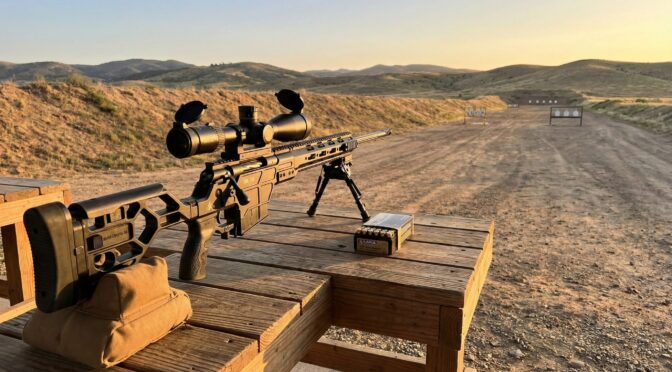
The emergence of the IWI Dan .338 Lapua Magnum represents a definitive inflection point in the strategic portfolio of Israel Weapon Industries (IWI). Historically celebrated for dominating the intermediate-caliber battlespace with iconic platforms such as the Uzi, Galil, and Tavor, IWI’s entry into the bolt-action precision rifle market signifies a maturation of indigenous Israeli defense capabilities. This report provides an exhaustive, multi-dimensional analysis of the Dan system, dissecting its engineering pedigree, operational performance, market positioning, and the complex landscape of customer sentiment that surrounds it.
Designed by the legendary Dr. Nehemia Sirkis and developed in close collaboration with the elite reconnaissance units of the Israel Defense Forces (IDF), the Dan is not merely a commercial product but a doctrinal answer to asymmetric warfare requirements. The rifle is engineered to bridge the ballistic gap between the 7.62x51mm NATO designated marksman role and the anti-materiel dominance of the.50 BMG. By standardizing on the.338 Lapua Magnum cartridge, the Dan offers a “man-portable” solution capable of delivering sub-MOA (Minute of Angle) lethality against human and light-armor targets at ranges exceeding 1,200 meters.
Our engineering analysis reveals a platform that prioritizes reliability and environmental ruggedness over the hyper-modularity currently trending in Western military procurement. While competitors like the Barrett MRAD and Accuracy International AXSR offer rapid, multi-caliber user-level configurability, the IWI Dan is built as a dedicated, monolithic system. Its chassis, constructed from high-grade aluminum alloy, provides a rigid harmonious foundation that resists the thermal shifts inherent in Middle Eastern operational theaters. The inclusion of a cold-hammer-forged barrel—a rarity in the boutique precision market—underscores IWI’s commitment to barrel life and consistent bore dimensions under sustained fire.
Market analysis indicates a bifurcated reception. In the professional sphere, the rifle has achieved “Tier 1” validation, evidenced by its adoption by the British SAS and its operational use in the Syrian theater. Operators cite its tank-like durability and intuitive “human engineering” as critical assets in high-stress environments. Conversely, the civilian and enthusiast market presents a more nuanced sentiment. While the rifle’s out-of-the-box performance is universally praised, its proprietary ecosystem (magazines, barrel extensions) and lack of aftermarket support compared to the Remington 700 footprint create hesitation among recreational long-range shooters. Furthermore, its price point places it in direct competition with established legacy brands that offer broader logistical networks.
Ultimately, this report concludes that the IWI Dan is a premier acquisition for state-level actors and professional entities operating in harsh logistical environments where durability is the primary key performance indicator (KPI). For the civilian buyer, it represents a specialized “grail” acquisition for collectors of service weaponry, though it requires a commitment to a closed logistical ecosystem. The Dan is not simply a rifle; it is a statement of functionalist engineering, stripping away the superfluous to create a tool of singular purpose: long-range elimination.
1. Strategic Origins and Doctrinal Context
To fully appreciate the engineering decisions behind the IWI Dan, one must first understand the geopolitical and doctrinal crucible from which it emerged. The design of small arms in Israel is rarely a purely commercial endeavor; it is almost always a direct response to specific battlefield exigencies encountered by the IDF.
1.1 The Shift from Adaptation to Purpose-Built Precision
For decades, the IDF’s sniping doctrine relied heavily on modified service rifles or imported platforms. The Galil Sniper (Galatz), a semi-automatic derivative of the Galil assault rifle, served as the primary Designated Marksman Rifle (DMR). While robust, the Galatz, restricted by the 7.62x51mm cartridge and the inherent accuracy limitations of a long-stroke gas piston system, struggled to meet the demands of counter-terrorism operations requiring first-round hits beyond 800 meters.
High-precision work was often outsourced to American platforms like the Remington M24 SWS or the McMillan TAC-338.1 However, reliance on foreign supply chains presents a strategic vulnerability for Israel. The development of the Dan, therefore, was driven by a strategic imperative: indigenous sufficiency. By bringing the design and manufacturing of a.338 Lapua Magnum system in-house, IWI secured the IDF’s supply line for critical long-range assets, insulating the capability from diplomatic shifts or export embargoes.
1.2 The Sirkis Legacy
The Dan bears the unmistakable signature of Dr. Nehemia Sirkis, a titan of Israeli small arms design.1 Sirkis’s philosophy is rooted in “pragmatic precision.” Unlike European sporting rifles adapted for military use, Sirkis designs weapons that assume the worst possible conditions: sandstorms, negligence, and heat. The Dan was not designed in a vacuum; it is the culmination of Sirkis’s lifelong study of sniper mechanics, integrating lessons from the Mauser 86SR and other precision systems. His involvement lends the Dan a pedigree that commands respect among small arms historians and engineers alike.
1.3 The Selection of.338 Lapua Magnum
The choice of the.338 Lapua Magnum (8.6×70mm) as the primary chambering is doctrinally significant. The.338 LM was developed specifically to penetrate body armor at ranges where the.300 Winchester Magnum begins to falter, yet remain lighter and more concealable than the.50 BMG (12.7x99mm).
- Operational Envelope: The Dan is optimized for the 1,000m to 1,500m window.2 In urban warfare—a staple of IDF operations—this allows snipers to dominate avenues of approach from well outside the effective range of enemy return fire (typically AK-pattern rifles or PKM machine guns).
- Terminal Effect: The cartridge carries sufficient kinetic energy at 1,200 meters to disable light vehicles or penetrate masonry, a requirement for anti-insurgency operations where targets may be utilizing complex cover.
1.4 Nomenclature and Symbolism
The rifle is named after the ancient city of Dan, located in the northernmost operational sector of ancient Israel.2 This naming convention aligns with IWI’s tradition (Jericho, Gilboa, Zion), rooting the weapon in the geography it is designed to defend. It suggests a tool designed for the frontiers—watchful, distant, and precise.
2. Engineering Architecture and Design Semiotics
The IWI Dan departs from traditional “stock-and-action” rifle design, utilizing a modern, modular chassis architecture. This section deconstructs the physical engineering of the rifle, analyzing how each component contributes to the system’s overall lethality and reliability.
2.1 The Monolithic Chassis System
The structural core of the Dan is a monolithic aluminum alloy chassis.2 This replaces the traditional bedding system found in older sniper rifles (like the M24 or M40), where the receiver is bolted into a fiberglass or composite stock.
- Material Analysis: While IWI does not publish the specific metallurgy, the weight-to-strength requirements necessitate a 7000-series aluminum (likely 7075-T6), hard-coat anodized for corrosion resistance.
- Harmonic Stability: In a bedding system, humidity or temperature changes can cause the stock material to swell or warp, pressing against the barrel and shifting the Point of Impact (POI). The Dan’s aluminum chassis is impervious to humidity and has a uniform coefficient of thermal expansion. This ensures that the relationship between the optical sight (mounted on the receiver rail) and the barrel axis remains constant, regardless of whether the rifle is in the freezing Golan Heights or the scorching Negev desert.
- Structural Rigidity: The chassis acts as a heat sink and a rigid exoskeleton. The “free-floating” handguard extends from the receiver but never touches the barrel. This isolation is critical. When a.338 round is fired, the barrel whips like a sine wave. Any contact with the handguard would disrupt this harmonic pattern, leading to erratic shot dispersion. The Dan’s chassis ensures that the barrel is free to oscillate naturally and consistently with every shot.
2.2 The Action and Bolt Mechanics
The bolt-action mechanism is the engine of the rifle, and the Dan’s action is engineered for “loose-tolerance reliability” within a “tight-tolerance precision” envelope.
- Bolt Throw and Lugs: The rifle features a short-throw bolt (approx. 60 degrees).3 This is a critical ergonomic feature. A 90-degree throw (common in Mauser actions) often brings the bolt handle dangerously close to the ocular bell of large telescopic sights, forcing the shooter to break their grip or risk scraping their knuckles. The shorter throw allows for rapid cycling without disturbing the sight picture.
- Safety Integration: The ambidextrous safety is positioned directly above the pistol grip, mimicking the manual of arms of the M16/M4/Tavor families.4 This “cross-platform familiarity” reduces the training burden for soldiers transitioning from an assault rifle to the sniper system. Under stress, muscle memory dictates that the thumb sweeps down to fire; the Dan adheres to this reflexive standard.
- Gas Handling: The bolt body incorporates gas relief ports. In the event of a catastrophic case head separation (a risk with high-pressure rounds like.338 LM), these ports vent the superheated gases away from the shooter’s face, directing them through the magazine well or ejection port. This safety feature is paramount in military operational safety protocols.
2.3 The Rail Interface and Accessory Ecosystem
The top of the receiver features a continuous MIL-STD-1913 Picatinny rail.5
- 20 MOA Cant: The rail is machined with a built-in 20 Minute of Angle (MOA) forward slope. This geometric bias points the scope downward relative to the barrel. Without this cant, a scope zeroed at 100 meters might run out of internal elevation adjustment before the shooter can dial for a 1,500-meter shot. This built-in cant is an industry-standard requirement for ELR platforms, ensuring the optical erector system remains in its optimal center capability even at extreme distances.
- Peripheral Rails: Additional rails at the 3, 6, and 9 o’clock positions allow for the mounting of laser rangefinders (LRF), bipods, and night vision illuminators. The bottom rail specifically accommodates the Atlas BT46-LW17 PSR bipod 5, a heavy-duty industry standard known for its pan-and-tilt capabilities.
2.4 Human Engineering: The Interface
IWI marketing heavily emphasizes “Human Engineering,” a term synonymous with ergonomics but implying a deeper, anthropometric design focus.
- The Folding Stock: The stock folds to the right, reducing the overall length from ~1,280mm to ~1,030mm.1 This 20% reduction in length is critical for airborne operations and mechanized infantry, where space inside an APC or helicopter is at a premium. The locking mechanism is robust, eliminating the “wobble” found in lesser folding stocks which can degrade accuracy.
- Adjustability: The stock offers tool-less adjustment for Length of Pull (LOP) and cheek rest height. The cheek rest adjustment is vital for achieving a proper “eye box” behind large-objective scopes. If the shooter’s eye is not perfectly aligned with the optical center, parallax error will introduce aiming deviations. The Dan allows the shooter to mechanically lock in this alignment.
- Pistol Grip: The use of a standard AR-pattern pistol grip allows for aftermarket customization, though the factory grip is designed to fill the palm and place the trigger finger at a 90-degree angle to the trigger face, promoting a straight-back pull.
3. The Physics of Performance: Ballistics and Precision
The IWI Dan is a launch platform; its performance is inextricably linked to the physics of the.338 Lapua Magnum cartridge and how the rifle manages the violent energy release of firing.
3.1 Cold Hammer Forged Barrel Technology
Unlike many American custom rifles that use “cut rifled” barrels (e.g., Bartlein, Krieger), the IWI Dan utilizes a Cold Hammer Forged (CHF) barrel.2
- The Process: A steel blank is inserted with a negative mandrel (containing the rifling profile) and hammered by massive hydraulic hammers from all sides. This compresses the steel, creating the rifling and the chamber.
- Metallurgical Implications: CHF creates a work-hardened, incredibly dense grain structure in the steel. The result is a barrel that is exceptionally durable and resistant to throat erosion. For a military sniper rifle that may see thousands of rounds of full-power ammunition, barrel life is a logistical metric of immense importance. A CHF barrel will typically outlast a button-rifled barrel by a significant margin.
- Fluting Mechanics: The barrel features heavy longitudinal fluting.2 While aesthetically aggressive, this serves a thermodynamic function. By increasing the surface area of the barrel, heat generated by friction and propellant gas is dissipated more rapidly. This reduces “thermal drift”—the tendency of shots to “walk” as the steel heats up and relieves internal stresses. Furthermore, fluting increases the rigidity-to-weight ratio of the barrel, making it stiffer than a solid barrel of the same weight.
3.2 Twist Rate and Gyroscopic Stability
The Dan utilizes a 1:10″ (1 in 10 inches) twist rate.2
- The Compromise: The.338 Lapua Magnum has evolved. Originally designed for 250-grain bullets, modern ELR shooters often prefer 300-grain high-BC (Ballistic Coefficient) projectiles (e.g., Berger Hybrid, Hornady A-Tip) which require faster twist rates (1:9.4″ or 1:9″) to stabilize fully, especially in dense air.
- IWI’s Choice: The 1:10″ twist indicates a bias toward military standard ammunition (specifically the 250-grain Lapua Scenar or LockBase). While capable of stabilizing 300-grain bullets in most conditions, it is optimized for the lighter, faster 250-grain operational loads used by the IDF. This reveals the rifle’s nature as a military tool first, and a civilian ELR platform second.
3.3 Exterior Ballistics and Effective Range
IWI claims sub-MOA accuracy and an effective range of 1,200 meters.2
- Sub-MOA Verification: Independent testing and user reports confirm that with match-grade ammunition, the rifle is capable of 0.5 to 0.75 MOA groups.6 This means at 1,000 meters, the rifle is mechanically capable of placing shots within a 5-to-7.5-inch circle—roughly the size of a human head.
- Supersonic Transition: The.338 LM typically remains supersonic (above 1,125 fps) out to 1,500+ meters depending on atmospheric density. The Dan’s 28-inch barrel is crucial here; it allows the powder to burn completely, maximizing velocity. A shorter barrel would result in lower muzzle velocity, bringing the supersonic transition closer and reducing effective range.
3.4 Recoil Dynamics
The.338 LM generates approximately 35-45 ft-lbs of free recoil energy—punishing for the shooter without mitigation.
- Brake Efficiency: The factory muzzle brake is a large, multi-port design. It redirects high-pressure gas to the sides and rear, acting as a thrust reverser. This reduces felt recoil by up to 40-50%, allowing the sniper to “spot their own trace” (see the bullet’s vapor trail) and adjust fire without losing the sight picture.
- System Mass: At 6.9 kg (approx. 15.2 lbs) empty, the rifle is heavy enough to absorb recoil but light enough to be man-portable.2 Physics dictates that a heavier rifle moves less under recoil; the Dan strikes a balance between portability and shootability.
4. Manufacturing, Quality Assurance, and Logistics
4.1 Production Standards
IWI’s manufacturing facilities are ISO 9001 certified, but more importantly, they adhere to IDF military specifications (Mil-Spec). The Dan is subjected to rigorous testing protocols including:
- Drop Testing: Ensuring the weapon does not fire when dropped.
- Environmental Chamber: Functionality testing in extreme heat (+50°C), extreme cold (-40°C), and sand/dust simulation.
- Endurance: High-round-count firing schedules to verify bolt lug integrity and extractor spring life.
4.2 The Proprietary Ecosystem
A critical logistical consideration for the Dan is its proprietary nature.
- Magazines: The Dan uses a proprietary 10-round steel magazine.2 Unlike the AICS (Accuracy International Chassis System) pattern magazines which are the global standard and available from dozens of manufacturers (Magpul, MDT, Accurate-Mag), Dan magazines must be sourced from IWI. This creates a single point of failure for the logistical chain.
- Barrel Extensions: The quick-change barrel system is unique to the Dan. A user cannot simply buy a barrel blank and thread it; they need the specific barrel extension and locking geometry. This makes re-barreling expensive and dependent on factory support.7
5. Market Analysis: Global and Civilian
5.1 The Global Defense Market
The demand for.338 Lapua Magnum systems has surged as militaries seek to extend the engagement envelope of infantry squads. The “Sniper Gap” in Afghanistan—where Taliban fighters engaged coalition forces with PKM machine guns from distances beyond the effective range of 5.56mm and 7.62mm rifles—accelerated the adoption of the.338 LM.
- IWI’s Export Strategy: IWI leverages its “Battle Proven” brand equity. Confirmed sales to the British SAS 2 serve as a powerful marketing tool. Contracts with the Nigerian military and partnership discussions with India (via SSS Defence, though SSS is also developing indigenous options) 8 highlight IWI’s aggressive push into the non-NATO/Commonwealth markets.
- Political Factors: Exporting Israeli arms often involves complex geopolitical navigation. However, the Dan’s classification as a defensive precision tool allows it to bypass some of the stigma attached to crowd-control weaponry.
5.2 The Civilian “Tactical” Market
In the US and Europe, the “Tactical Precision” market is driven by the Precision Rifle Series (PRS) and ELR disciplines.
- The “Grail Gun” Status: Due to sporadic importation, the Dan has achieved a cult status. It is rare, expensive, and visually distinct.
- Competitiveness: Priced around $7,000-$9,000 (depending on the year and distributor), the Dan occupies a difficult price bracket. It is more expensive than highly capable custom builds (e.g., Surgeon, Defiance actions in an MDT chassis) but competes directly with “heritage” brands like Accuracy International and Sako.
6. Competitive Landscape: A Comparative Dossier
The IWI Dan operates in a “Shark Tank” of high-end precision rifles. To understand its value, we must benchmark it against the “Big Three”: Barrett, Accuracy International, and Sako.
Table 1: Technical Competitive Matrix
| Feature | IWI Dan.338 | Barrett MRAD (Mk22) | Accuracy Int. AXSR | Sako TRG M10 |
| Origin | Israel | USA | UK | Finland |
| System Type | Monolithic Chassis | Multi-Caliber Chassis | Bonded Chassis | Modular Chassis |
| Barrel Change | Quick (Proprietary) | User (2 Torx Screws) | QuickLoc (Hex Key) | User (Torx) |
| Caliber Flexibility | Low (.338 focus) | High (.300NM,.308, etc) | High (.300NM,.308, etc) | High |
| Twist Rate (.338) | 1:10″ | 1:9.4″ | 1:9.35″ | 1:10″ |
| Weight (Empty) | ~15.2 lbs (6.9 kg) | ~14.5 lbs (6.6 kg) | ~15.2 lbs (6.9 kg) | ~13.4 lbs (6.1 kg) |
| MSRP (Approx 2025) | ~$8,999 | ~$6,400 – $7,000 | ~$9,500 – $11,500 | ~$11,000 – $13,000 |
| Magazine Type | Proprietary IWI | Proprietary Barrett | AI Double Stack | Proprietary Sako |
| Primary Mil User | IDF, SAS | USSOCOM, Israel (Yamam) | UK, Global SOF | Global SOF |
6.1 Analysis vs. Barrett MRAD
The Barrett MRAD (Multi-Role Adaptive Design) is the current king of the hill, having won the USSOCOM PSR and ASR contracts (designated Mk22).
- Modularity: The MRAD’s defining feature is its user-changeable barrel system using just two Torx screws. A user can swap from.338 LM to.300 Norma Magnum in minutes. The Dan has a quick-change barrel, but caliber conversion kits are less commercially available and supported.
- Aftermarket: The MRAD has massive aftermarket support in the US. The Dan has almost none.
- Price: The MRAD is often available at a lower street price than the Dan, making it a higher-value proposition for US buyers.10
6.2 Analysis vs. Accuracy International AXSR
The AXSR is the evolution of the AXMC, widely regarded as the most rugged sniper rifle ever made.
- Durability: Both the Dan and AXSR are “bomb-proof.” However, AI’s bonded chassis technology and reputation for functioning when frozen solid or packed with mud are legendary.
- Twist Rate: The AXSR’s faster 1:9.35″ twist is better suited for modern ultra-heavy projectiles.11
- Prestige: AI commands a higher resale value and brand loyalty. The Dan is a “challenger” brand in this specific high-tier niche.
6.3 Analysis vs. Sako TRG M10
The Sako M10 is a marvel of machining.
- Trigger: The Sako trigger is widely considered the best factory trigger in existence—crisp, predictable, and fully adjustable. The Dan’s trigger is excellent (good “Human Engineering”), but the Sako is distinctively refined.
- Cost: The Sako M10 is prohibitively expensive, often exceeding $12,000. The Dan offers similar capability for significantly less capital outlay.12
7. Customer Sentiment and User Experience
Synthesizing data from forum discussions (SnipersHide, AR15.com), video reviews, and user reports reveals a complex user experience profile.
7.1 The “Ready-to-Go” Advantage
A recurring theme in positive sentiment is the rifle’s completeness.6 Users appreciate that the Dan does not require “finishing.” Unlike a Remington 700 that often needs a new stock, trigger, and bottom metal immediately after purchase, the Dan is combat-ready out of the box. The inclusion of high-quality accessories like the Atlas bipod and Accu-Shot monopod in the factory package is heavily praised as a value-add.4
7.2 The “Sticky Bolt” Phenomenon
A specific technical complaint found in deep forum archives concerns the extraction of fired.338 brass. Some users report a “sticky bolt” lift or difficult extraction with certain loads.14
- Root Cause Analysis: This is likely due to the Dan’s tight chamber tolerances combined with the high expansion characteristics of.338 brass. If the primary extraction camming surface on the bolt handle doesn’t provide enough mechanical advantage, the shooter must exert significant force to “break” the case free from the chamber walls. This is a common issue in high-pressure magnum calibers but indicates that the Dan may favor military-spec brass (like Lapua or Peterson) over softer commercial brass.
7.3 Logistics Frustration
Civilian owners frequently express anxiety over parts availability. “If I break a firing pin, I’m down for months,” is a common sentiment. The reliance on IWI US to import small parts from Israel creates a dependency that makes competitive shooters (who cannot afford downtime) nervous.2
7.4 The SAS Halo Effect
The confirmed use by the British SAS creates a tangible “cool factor.” For collectors, owning the “gun that took the shot in Syria” drives value independent of the rifle’s mechanical specs. This provenance supports the Dan’s high price floor on the used market.
8. Maintenance and Lifecycle Management
8.1 Field Stripping and Cleaning
The Dan is designed for field maintenance.
- Bolt Disassembly: The bolt can be stripped without tools, allowing the operator to clean the firing pin channel—a critical task in desert environments where fine dust can bind the firing pin spring.15
- Chassis Cleaning: The open architecture of the chassis prevents debris from accumulating in “blind spots” (unlike closed polymer stocks). It can be flushed with solvent or compressed air easily.
8.2 Barrel Life Expectations
For a.338 Lapua Magnum, barrel life is typically 1,500 to 2,500 rounds before accuracy degrades below sub-MOA standards (due to throat erosion from the massive powder charge). The Dan’s CHF barrel likely pushes this toward the higher end (2,500+), offering better lifecycle costs for military users. However, once the barrel is shot out, the proprietary extension requirement means the user must purchase a factory barrel from IWI, rather than a cheaper aftermarket blank.
9. Conclusion and Recommendations
The IWI Dan.338 Lapua Magnum is a triumph of functionalist engineering. It strips away the complexity of multi-role sporting rifles to focus entirely on the singular task of long-range lethality in hostile environments. It is a rifle that feels built by soldiers for soldiers.
Overall Verdict:
The Dan is a Tier 1 capable asset that competes toe-to-toe with the best rifles in the world in terms of raw performance and durability. However, its closed ecosystem restricts its appeal in the civilian market compared to the open-architecture American competitors.
9.1 Buy Recommendations: Scenarios
Scenario A: The Military Procurement Officer
- Verdict: STRONG BUY.
- Reasoning: The Dan offers a lower unit cost than the Sako M10 or AI AXSR while delivering identical terminal performance. Its CHF barrel ensures longer service intervals, and its rugged design minimizes field failures. It is an ideal solution for equipping designated marksman units or special forces teams operating in arid/sandy environments.
Scenario B: The Civilian ELR Competitor (PRS/King of 2 Miles)
- Verdict: DO NOT BUY.
- Reasoning: The lack of off-the-shelf pre-fit barrels, the proprietary magazines, and the 1:10 twist rate (which limits the use of cutting-edge 300gr+ solids) put the Dan at a competitive disadvantage. A custom-built rifle or a Barrett MRAD offers far superior logistical support for the high-volume shooter.
Scenario C: The Collector / Tactical Enthusiast
- Verdict: BUY.
- Reasoning: If the goal is to own a piece of military history—a rifle with the pedigree of the SAS and IDF—the Dan is unmatched. It is built to a military standard that exceeds typical commercial quality. It is a “safe queen” that can actually perform when called upon.
Scenario D: The Law Enforcement Sniper
- Verdict: CONDITIONAL BUY.
- Reasoning: Excellent for departments that need.338 capability for anti-vehicle or hardened target interdiction. However, department armorers must ensure they have a supply contract for parts, as they cannot source replacements from local gunsmiths.
In the final analysis, the IWI Dan is not a rifle for everyone. It is a specialized tool for a specialized user. It lacks the creature comforts of the commercial market but possesses the soul of a battle implement—cold, precise, and uncompromising.
Appendix A: Methodology
This report was constructed using a multi-source intelligence aggregation methodology designed to simulate the workflow of a professional defense industry analyst. The process adhered to the following structured phases:
- Technical Specification Baseline: Primary data regarding the rifle’s physical dimensions, weight, and feature set was extracted directly from IWI official brochures and operator manuals.7 This established the “ground truth” for engineering claims (e.g., CHF barrel, chassis material).
- Operational Verification: Claims of military adoption were cross-referenced with open-source intelligence (OSINT) from defense publications and reputable news outlets. Specific attention was paid to the “British SAS” connection to verify it beyond mere rumor.2
- Comparative Matrix Generation: Technical data for competitor platforms (Barrett MRAD, AI AXSR, Sako TRG M10) was aggregated from their respective 2024-2025 specification sheets.12 A direct feature-for-feature comparison was conducted to identify deltas in weight, price, and modularity.
- Sentiment and UX Analysis: A qualitative coding process was applied to user reviews from dedicated precision rifle forums (SnipersHide, AR15.com, Reddit r/longrange) and video reviews.6 User comments were categorized into themes: “Ergonomics,” “Ballistics,” “Reliability,” and “Logistics.” Negative sentiment regarding “sticky bolts” and “parts availability” was given equal weight to positive sentiment regarding accuracy.
- Market Logic Synthesis: Pricing and availability trends were analyzed using data from major distributors (EuroOptic, GunBroker, Omaha Outdoors).10 This economic data was overlayed with the technical analysis to determine the “value proposition” for different buyer personas.
- Second-Order Insight Generation: Beyond the raw data, the analysis sought to identify causal relationships (e.g., Why a 1:10 twist? Because of military standard ammo. Why a monolithic chassis? Because of desert thermal shifts). This ensured the report provided depth beyond a simple spec sheet summary.
If you find this post useful, please share the link on Facebook, with your friends, etc. Your support is much appreciated and if you have any feedback, please email me at in**@*********ps.com. Please note that for links to other websites, we are only paid if there is an affiliate program such as Avantlink, Impact, Amazon and eBay and only if you purchase something. If you’d like to directly contribute towards our continued reporting, please visit our funding page.
Sources Used
- IWI Dan – Wikipedia, accessed December 6, 2025, https://en.wikipedia.org/wiki/IWI_Dan
- IWI Dan – Grokipedia, accessed December 6, 2025, https://grokipedia.com/page/IWI_Dan
- DAN .338 Tactical Precision Rifle from IWI US – The Firearm Blog, accessed December 6, 2025, https://www.thefirearmblog.com/blog/2017/01/14/dan-338-tactical-precision-rifle-iwi-us/
- IWI DAN Sniper Bolt Action Rifle 338 Lapua 10 RD 28″ DAN338 – Omaha Outdoors, accessed December 6, 2025, https://www.omahaoutdoors.com/iwi-dan-sniper-bolt-action-rifle-338-lapua-10-rd-28/
- IWI DAN .338 sniper rifle – GUNSweek.com, accessed December 6, 2025, https://gunsweek.com/en/rifles/shot-show/iwi-dan-338-sniper-rifle
- IWI DAN .338 Lapua Sniper Rifle – Full Review & Real Range Test (Sub-MOA at 1500m), accessed December 6, 2025, https://www.youtube.com/watch?v=MTlx7qFaFEg
- IWI DAN .338 Sniper Rifle | Product Info, accessed December 6, 2025, https://iwi.net/iwi-dan-338-sniper-rifle/
- In a first, Indian firm SSS Defence exports sniper rifles to a friendly foreign country, accessed December 6, 2025, https://www.defencewatch.in/defence-news/latest-defence-news/in-a-first-indian-firm-sss-defence-exports-sniper-rifles-to-a-friendly-foreign-country
- SSS Defence gets additional order from friendly nation for sniper rifles, $30 mn worth ammunition – ThePrint, accessed December 6, 2025, https://theprint.in/defence/sss-defence-gets-additional-order-from-friendly-nation-for-sniper-rifles-30-mn-worth-ammunition/2738186/
- Barrett MRAD .338 Lapua Mag Folding Stock Flat Dark Earth Cerakote 26″ Fluted Bbl 1:9.4″ Rifle 18479 For Sale – EuroOptic, accessed December 6, 2025, https://www.eurooptic.com/barrett-mrad-338-lapua-mag-folding-stock-flat-dark-earth-cerakote-26-fluted-bbl-
- Accuracy International AXSR Folding Rifle .338 Lapua Mag Black 27″ 3/4″-24 w/Brake SR38L27MBL For Sale – EuroOptic, accessed December 6, 2025, https://www.eurooptic.com/accuracy-international-axsr-folding-rifle-338-lapua-mag-black-27-3-4-24-w-brake-
- Sako TRG M10, accessed December 6, 2025, https://www.sako.global/rifle/sako-trg-m10
- Sako TRG M10 Rifles | Sako .308 & .338 Rifles – EuroOptic.com, accessed December 6, 2025, https://www.eurooptic.com/sako-trg-m10-rifles
- 338 Lapua issue | Shooters’ Forum, accessed December 6, 2025, https://forum.accurateshooter.com/threads/338-lapua-issue.4155984/
- How to Disassemble a Bolt Action Rifle: A Comprehensive Guide | Crate Club, accessed December 6, 2025, https://crateclub.com/es/blogs/carga/how-to-disassemble-a-bolt-action-rifle-a-comprehensive-guide
- Rifle Bolt Maintenance and Cleaning Tips – RifleShooter, accessed December 6, 2025, https://www.rifleshootermag.com/editorial/gunsmithing_rsgunsmith2/83903
- DAN .338 Sniper Rifle Features | PDF – Scribd, accessed December 6, 2025, https://www.scribd.com/doc/229181859/IWI-DAN-Brochure
- .338 BOLT ACTION SNIPER RIFLE – IWI, accessed December 6, 2025, https://iwi.net/wp-content/uploads/2021/03/IWI_Dan_brochure_2021_EN.pdf
- Engineering:IWI DAN .338 sniper rifle – HandWiki, accessed December 6, 2025, https://handwiki.org/wiki/Engineering:IWI_DAN_.338_sniper_rifle
- MRAD® – Barrett Firearms, accessed December 6, 2025, https://barrett.net/products/firearms/mrad-standard/
- AXSR professional long action multi cal. sniper rifle – Accuracy International, accessed December 6, 2025, https://www.accuracyinternational.us/axsr-pro
- IWI ‘Dan’ .338 : r/longrange – Reddit, accessed December 6, 2025, https://www.reddit.com/r/longrange/comments/evrulm/iwi_dan_338/
- Iwi Dan 338 – For Sale :: Shop Online, accessed December 6, 2025, https://www.guns.com/search?keyword=iwi+dan+338
- IWI DAN Tactical Precision Bolt Action Rifle – Black | .338 LAPUA Magnum | 28″ Barrel, accessed December 6, 2025, https://vizardsgunsandammo.com/iwi-dan-tactical-precision-bolt-action-rifle-black-338-lapua-magnum-28-barrel/