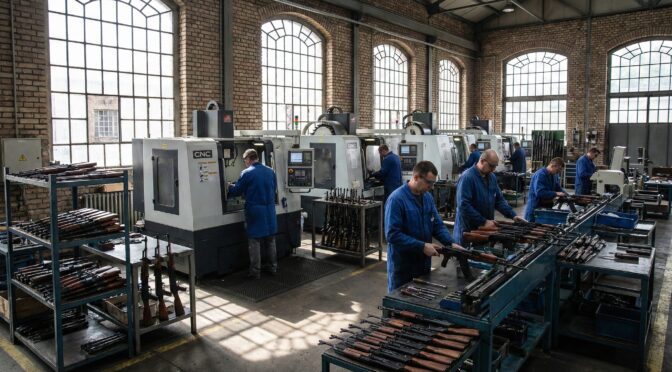
In the volatile ecosystem of the global small arms trade, few events in 2025 generated as much systemic disruption and analytical speculation as the six-month export moratorium imposed by the Republic of Serbia. Announced abruptly in June 2025 by President Aleksandar Vučić and partially reversed for specific entities in late November, this blockade effectively severed the supply chain for Zastava Arms USA, the premier purveyor of Kalashnikov-pattern rifles to the North American civilian market, and created critical shortages in the ammunition sector dominated by Prvi Partizan (PPU).
To the casual observer or the frustrated consumer, the oscillation of Serbian policy—from a total “armed neutrality” lockdown to a quietly negotiated “exception”—appeared erratic, raising suspicions of market manipulation. A prevalent narrative within the firearms community posited that the ban was a sophisticated “marketing stunt,” a calculated manufacture of artificial scarcity designed to drive demand and justify price hikes in a softening post-election market.
However, a comprehensive forensic analysis of the geopolitical, financial, and industrial indicators reveals a far more complex reality. This report argues that the export ban was not a commercial ploy but a desperate geopolitical hedging strategy executed by Belgrade to navigate existential diplomatic pressures from the Russian Federation and the Western alliance. The “stunt” hypothesis is decisively refuted by the severe liquidity crises inflicted upon state-owned enterprises (SOEs), the mobilization of trade unions against the government, and the concurrent imposition of punitive U.S. tariffs that threatened the commercial viability of Serbian exports.
The eventual resumption of exports in December 2025, framed as a “hard-won exception,” represents not the climax of a marketing campaign but the capitulation of political posturing to economic necessity, brokered through high-level strategic dialogue with the United States. This document provides an exhaustive examination of the crisis, analyzing the interplay of Serbian neutrality, Russian intelligence operations, the “circular trade” of ammunition to Ukraine, and the resilience of the U.S. import market.
1. The Strategic Landscape: Zastava’s Rise in the Post-Russian Market
To understand the gravity of the June 2025 moratorium, one must first contextualize the position of Zastava Oružje within the United States market. The dynamics of 2025 were shaped by a decade of shifting geopolitical alliances that fundamentally altered the availability of Eastern Bloc firearms for American consumers.
1.1 The “AK Vacuum” and the Serbian Ascendancy
For decades, the U.S. market for Avtomat Kalashnikova (AK) platforms was dominated by Russian imports—specifically the Saiga and Vepr series manufactured by Izhmash and Molot. These rifles were viewed as the “gold standard” of collectibility and manufacturing pedigree. However, the imposition of sanctions following the 2014 annexation of Crimea, and their intensification after the 2022 full-scale invasion of Ukraine, resulted in a total cessation of Russian firearm imports. By the period of 2020–2024, Russian AK imports had plunged by 64% compared to the previous five-year block.1
This geopolitical exclusion created a massive supply vacuum. American demand for the AK platform, driven by a mix of historical interest, rugged reliability, and counter-culture appeal against the ubiquitous AR-15, did not wane. Into this void stepped three primary competitors: Romania (Cugir), Bulgaria (Arsenal), and Serbia (Zastava).
Zastava Oružje, based in Kragujevac, possessed a unique competitive advantage. Unlike the stamped-receiver commodities from Romania or the increasingly exorbitant milled-receiver options from Bulgaria, Zastava offered a “heavy duty” intermediate option. Their rifles, based on the Yugoslav M70 pattern, featured a 1.5mm reinforced receiver and a bulged trunnion—design features originally intended to sustain the pressures of rifle-grenade launching.1 For the American shooter, these features translated into perceived durability and higher build quality.
1.2 The Zastava Arms USA Model
In 2019, Zastava made a strategic pivot that would prove crucial to their 2025 market dominance. Historically, Zastava had relied on third-party importers (such as Century Arms) to bring their products to the U.S. These importers often modified the rifles to meet “922r” compliance in ways that sometimes compromised fit and finish.
Recognizing the potential of the market, Zastava established Zastava Arms USA in Des Plaines, Illinois, becoming the only former Eastern Bloc arsenal to establish a direct factory subsidiary in the United States.1 This vertical integration allowed for better quality control, improved customer service, and a direct marketing channel to the consumer.
By early 2025, Zastava Arms USA had cornered a significant plurality of the import market. Analysts projected that, barring regulatory intervention, Zastava was on track to capture 40–50% of the regional AK import market in North America.1 The brand had transcended the “surplus” stigma to become a premier tier offering. The ZPAP M70 became the flagship, supported by the M90 (5.56 NATO), M77 (.308 Win), and M92/M85 pistols.
1.3 The Ammunition Ecosystem: Prvi Partizan (PPU)
Parallel to the hardware dominance of Zastava was the logistical indispensability of Prvi Partizan (PPU). Based in Užice, PPU is one of the oldest and largest ammunition manufacturers in Europe. For the U.S. market, PPU served two critical functions:
- The Metric Backbone: PPU was a primary source of reloadable, brass-cased 7.62x39mm and 7.62x54R ammunition, offering a higher-quality alternative to the steel-cased Russian surplus that was also disappearing due to sanctions.
- The Curator of Obsolescence: PPU maintained production lines for “dead” calibers essential to the collector market, such as 6.5 Carcano, 8mm Lebel, and.303 British.3
By 2025, Serbia was the 16th largest source of firearms imports to the U.S., trailing only major Western producers.4 The interdependence was absolute: American consumers needed Serbian production, and Serbian factories needed American liquidity. It was this symbiosis that President Vučić threatened to shatter in June 2025.
2. The June Directive: Anatomy of a Shutdown
The crisis began not with a gradual policy shift but with a sudden, unilateral executive shock. The timeline and mechanism of the ban provide the first clues that this was a reaction to immediate external stimuli rather than a planned commercial strategy.
2.1 The Announcement: June 23, 2025
On June 23, 2025, following a meeting with the extended collegium of the Chief of the General Staff of the Serbian Armed Forces, President Aleksandar Vučić emerged to address the press. His statement was categorical and sweeping.
“We are not exporting anything now. We have stopped everything and, if something is to be allowed, special and specific decisions must be made. Then, we will see how we will act, in accordance with the interests of Serbia.” — President Aleksandar Vučić.5
This verbal directive was immediately operationalized. The Ministry of Defence (MoD) issued a statement confirming that the export of “all weapons and military equipment manufactured in the Republic of Serbia” was suspended.7 Crucially, the MoD clarified the new administrative hurdle: future exports would require the explicit consent of the National Security Council (NSC).4
2.2 The Mechanism of Control: Centralizing Authority
Prior to this directive, arms exports in Serbia were regulated by a constellation of ministries—Trade, Defence, Interior, and Foreign Affairs—which granted permits based on technical compliance and international treaties. The introduction of the NSC as the ultimate gatekeeper fundamentally altered the governance of the defense sector.
The NSC is chaired by the President of the Republic and includes the Prime Minister, the Ministers of Defence and Interior, and the Directors of the Security Services (BIA, VOA). By shifting approval authority to this body, Vučić effectively removed the ability of state-owned enterprises (SOEs) to conduct autonomous commerce. Every crate of rifles and every pallet of ammunition now required a political stamp of approval from the highest office in the land.
This centralization suggests the motivation was not regulatory or logistical, but deeply political. It allowed the President to turn the export “tap” on and off in real-time response to diplomatic pressure, bypassing the slower, bureaucratic processes of the standard ministries.
2.3 The Official Rationale: “Empty Barracks” vs. “Full Warehouses”
The public justification for the ban centered on national readiness. President Vučić and the MoD cited the deteriorating security situation in the region, particularly in Kosovo, as the primary driver. The narrative was that the Serbian Armed Forces (SAF) needed to replenish their stockpiles to ensure deterrence.5
“Serbia is not preparing for waging a war, but has done everything to de-escalate conflicts… Everything must be prepared in case of aggression against the Republic of Serbia.” 8
However, this “scarcity” narrative was immediately contradicted by intelligence from within the factories. Military analyst Aleksandar Radić and union leaders reported a starkly different reality: warehouses were not empty; they were overflowing.
- Zastava Oružje: Reports indicated that the factory had full inventory but was legally barred from shipping it. The ban applied even to hunting and sporting weapons, which have zero utility for the Serbian military’s tactical requirements.9
- Ammunition Plants: Factories like Sloboda Čačak were reported to be “filled with unsold ammunition,” with production continuing at a high tempo but no outlet for the finished goods.9
This discrepancy—the government claiming a need for supplies while factories claimed a surplus of un-shippable goods—is the definitive evidence that the ban was a pretext. The SAF did not need 20,000 semi-automatic sporting rifles destined for American gun stores. The blockage of these specific civilian goods points to the ban being a “blanket” diplomatic signal rather than a targeted logistical necessity.
3. The Geopolitical Catalyst: The Russian Connection
If the ban was not driven by domestic military needs or a marketing department’s desire for hype, what was the true driver? The evidence points overwhelmingly to the Russian Federation and the conflict in Ukraine.
3.1 The “Circular Trade” and the SVR Allegations
Since the onset of the Russian invasion of Ukraine in 2022, Serbia has attempted to walk a geopolitical tightrope. As an EU candidate country, it faced pressure to align with Brussels on sanctions. As a historic ally of Russia dependent on Gazprom energy, it faced pressure to maintain neutrality.
Serbia’s solution was a policy of “passive” support for Ukraine via the “circular trade.” Serbian state factories would sell ammunition to friendly nations—the Czech Republic, Bulgaria, Turkey, and the United States—who would then donate or re-sell the ordnance to Kyiv.10
This arrangement functioned quietly until mid-2025, when the scale of the transfer became impossible for Moscow to ignore. In May 2025, Russia’s Foreign Intelligence Service (SVR) publicly accused Belgrade of supplying thousands of artillery rockets and shells to Ukraine. The SVR claimed that Serbian factories were using “false end-user certificates” to maintain plausible deniability.10
Financial Times investigations estimated the value of this “backdoor” aid at nearly €800 million.10 For the Kremlin, this was a betrayal. The appearance of Serbian 122mm Grad rockets and 155mm artillery shells raining down on Russian positions demanded a response.
3.2 The June Ban as a Performative Correction
The June 23 ban must be viewed as President Vučić’s direct response to this Russian pressure. By declaring a total moratorium on all exports, Vučić achieved two objectives:
- Plausible Compliance: He could demonstrate to Vladimir Putin that he was “shutting down the leaks.” If no one can export, then Ukraine cannot receive Serbian shells.
- Sovereign Posturing: He framed the decision not as a concession to Russia, but as a “Serbia First” policy of self-reliance, insulating him from domestic nationalist criticism.11
The ban was a blunt instrument used to reset the board. It froze the pipeline to Ukraine (via intermediaries) but, to appear neutral and consistent, it also had to freeze the pipeline to the United States (Zastava commercial exports) and Israel (which had been receiving Serbian ammo, causing friction with Iran).5
3.3 The “End-User” Paranoia
The inclusion of civilian sporting arms in the ban highlights the depth of the “end-user” paranoia. President Vučić explicitly questioned the destination of Serbian exports:
“I can’t export to Asia, I can’t export to Africa, I can’t export to Europe, I can’t export to America. So, where do you want us to export ammunition — to Antarctica?” 6
The regime feared that even civilian arms sent to the U.S. could be theoretically repackaged and sent to conflict zones, or simply that allowing any exports would weaken the “total blockade” narrative presented to Moscow. Thus, Zastava Arms USA became collateral damage in a dispute over artillery shells.
4. Inside the Industrial Base: A Sector Divided
The impact of the ban was not uniform across the Serbian defense industry. A nuanced analysis reveals a sector sharply divided between the “winners” (ammunition giants) and the “losers” (firearms manufacturers), with a parasitic layer of private dealers extracting value from the chaos.
4.1 The “Winners”: The Ammunition Giants (Sloboda & Krušik)
Ironically, the factories most responsible for the geopolitical crisis—the ammunition producers—were best positioned to weather it.
- Sloboda Čačak: Specializing in artillery ammunition, Sloboda saw its revenue nearly double in 2024 compared to 2022, driven by the massive demand from the Ukraine war (via intermediaries).9
- Krušik Valjevo: This firm saw revenues triple, rising from 5.9 billion dinars to 18.88 billion dinars over the same period.9
These SOEs had amassed significant cash reserves from the pre-ban “gold rush.” While the ban halted their shipments and forced some workers on leave, their balance sheets were robust enough to absorb a temporary freeze. They were “too big to fail” and often enjoyed preferential treatment due to the strategic nature of their product.
4.2 The “Loser”: Zastava Oružje
In stark contrast, Zastava Oružje found itself in a precarious position. Unlike the ammo plants, Zastava’s primary revenue growth had come from the civilian commercial market in the U.S., not state-to-state military contracts for expendable munitions.
- Liquidity Crisis: Zastava operates on tighter margins. The halt of shipments to Zastava Arms USA cut off its most reliable stream of hard currency.
- Operational Risk: By October 2025, union leader Aleksandar Tadić warned that salary payments were at risk. The factory has a history of debt and reliance on government subsidies to stay afloat.9
- Product Mismatch: While the MoD promised government projects to keep the lines moving, analysts noted that the proposed “6.5mm modular rifle” project was commercially unviable and a poor substitute for the high-volume export of AKs.9
4.3 The Parasitic Private Sector
A recurring theme in Serbian defense analysis is the privileged role of private arms dealers. Investigative reports from Radar and other outlets indicated that while state factories languished under the NSC’s microscope, private firms often found ways to navigate the bureaucracy.
- Selective Permitting: Sources suggested that companies linked to influential figures (such as Slobodan Tešić) continued to receive permits or operated through pre-ban contracts that were “grandfathered” in, while SOEs faced a total freeze.10
- Profit Siphoning: The structure of the industry often involves private intermediaries buying from state factories at low prices and exporting at high markups. The ban disrupted this flow but also highlighted the disparity: privateers had offshore accounts and diversified portfolios; the factory workers in Kragujevac did not.
4.4 The Union Factor
The role of the trade unions in 2025 cannot be overstated. The “Samostalni sindikat” (Independent Union) at Zastava has a history of militancy. Facing layoffs and missed paychecks, they escalated pressure on the government.
- Protest Threat: Unions explicitly threatened mass protests if the export blockade continued to threaten livelihoods.15
- Political Alignment: Interestingly, segments of the defense workforce had supported opposition protests, making them a political target for the ruling party, but also a dangerous group to alienate further.9
This internal pressure cooker—full warehouses, angry workers, and a cash-strapped factory—created the domestic imperative that would eventually force Vučić to lift the ban for Zastava.
5. The “Marketing Stunt” Hypothesis: A Forensic Dissection
A pervasive theory in online gun communities (Reddit, forums) was that the ban was a fabrication—a “marketing stunt” orchestrated by Zastava Arms USA or the Serbian government to clear out old inventory and justify price hikes. This section evaluates that hypothesis against the gathered evidence.
5.1 Arguments for the “Stunt” Hypothesis
- Timing: The ban occurred during a period of softening demand (“AR-15 fatigue”) and post-election market saturation.1 A supply shock is a classic way to reinvigorate interest.
- Outcome: The ban did result in hype. Zastava rifles became hot commodities, and the resumption announcement was met with jubilation and high engagement.16
- Previous Behavior: The firearms industry is notorious for “limited run” marketing and utilizing fear of regulation to drive sales.
5.2 Evidence Against the “Stunt” Hypothesis
However, the economic and operational data decisively refute this theory.
- Financial Self-Harm: No rational actor would inflict the level of financial damage seen at Zastava Oružje for a marketing campaign. The factory neared insolvency. The risk of defaulting on payroll and triggering social unrest in Kragujevac far outweighed any potential margin gains from a price hike.9
- The Tariff Complication: The ban coincided with a 35% U.S. tariff on Serbian goods.10 If the goal was to increase profit margins, a tariff is counter-productive—it eats into the margin or kills demand by pushing the price too high. Zastava Arms USA explicitly stated that price increases were due to the tariff, not just the ban.16
- Union Verification: Independent trade unions, often hostile to management, confirmed the crisis. They would not collude in a marketing lie that involved threatening their own members with layoffs.15
- Scope of the Ban: The ban affected the entire defense industry, including companies with no connection to the U.S. civilian market (e.g., those making mortar shells). It is implausible that the Serbian state would shut down its billion-dollar ammunition trade just to help Zastava sell a few thousand more rifles in America.
5.3 Verdict
The “marketing stunt” hypothesis is FALSE. The scarcity and hype were byproducts of the crisis, not its architects. The ban was a genuine geopolitical disruption that inflicted real structural damage on the manufacturer.
6. The U.S. Consumer Experience: Scarcity and Price Shock
The downstream effects of the Belgrade decisions were felt acutely in American gun stores and online retailers.
6.1 The Inventory Cliff
Following the June announcement, Zastava Arms USA initially operated on domestic inventory. The company assured customers that “supply lines remain open,” a standard corporate communication to prevent panic.4 However, as the ban dragged through Q3 2025, these stockpiles evaporated.
- Distribution: Major distributors (RSR, Lipsey’s) saw allocations dry up.
- Retail Level: Big-box stores and local dealers began marking up remaining stock. The “street price” of a ZPAP M70, previously stable around $950-$1,000, climbed on the secondary market.1
6.2 The PPU Ammunition Crisis
The impact on ammunition was even more severe. PPU is a volume business.
- Brand Disruption: PPU produces “white label” ammo for brands like Academy’s “Monarch.” The ban disrupted these supply chains, leaving empty shelves at major retailers.4
- Niche Calibers: Owners of vintage rifles (Enfields, Carcanos) faced a total drought. Unlike 5.56 or 9mm, there are few domestic substitutes for these calibers.
- Price Spikes: While domestic U.S. ammo production (Lake City, etc.) cushioned the blow for standard calibers, the specific Serbian SKUs saw price increases of 20–30% where available.1
6.3 The Tariff Shock
Adding insult to injury was the activation of the 35% tariff. It is unclear if this tariff was a specific punitive measure by the U.S. administration (perhaps in response to Serbia’s cozying up to China or Russia) or part of a broader trade dispute. Regardless, it fundamentally altered the value proposition of the Serbian AK.
- The $1,000 Barrier: The ZPAP M70 had thrived by being the “best AK under $1,000.” The tariff pushed the retail price well over $1,200, putting it in direct competition with the Arsenal SAM7 (Bulgarian) and high-end WBP Jack (Polish) rifles.
7. The Road to Resumption: The Diplomatic Pivot
The resolution of the crisis in late November 2025 was not accidental. It was the result of a calculated diplomatic pivot by President Vučić, leveraging the arms trade to restore equilibrium with the West.
7.1 The “Strategic Dialogue”
Throughout October and November, high-level meetings took place between Serbian officials and U.S. representatives, most notably Ambassador Christopher Hill.
- The Hill-Vučić Meetings: Official press releases from these meetings emphasized “strategic dialogue,” “economic cooperation,” and “regional stability”.17
- The Deal: It is highly probable that the “exception” for Zastava Arms USA was a direct deliverable of these talks. The U.S. likely exerted pressure to normalize trade relations for U.S. businesses (Zastava USA is a U.S. entity employing American workers), while Serbia sought assurances or concessions in other areas (possibly regarding Kosovo or energy sanctions).
7.2 The “Exception” Framework
On November 29, 2025, Zastava Arms USA announced they had “secured an exception”.16 The phrasing is critical.
- Not a Repeal: The general ban remains in effect. This allows Vučić to tell Putin, “The ban is still in place,” while telling Hill, “We are trading with you.”
- NSC Discretion: The exception was granted by the National Security Council. This confirms that the flow of arms is now a discretionary political act, not a right of free trade.
7.3 What “Open-ish” Means
Zastava USA described the new status as “open-ish” pipes.16 This implies:
- Batch Approvals: Every shipment likely requires individual NSC sign-off.
- Volatility: The supply could be cut again instantly if diplomatic relations sour.
- End-User Verification: Stricter controls to ensure the weapons stay in the U.S. civilian market.
8. Conclusion and Strategic Outlook
The 2025 export ban was a watershed moment for the Serbian small arms industry. It demonstrated the fragility of supply chains that run through geopolitically non-aligned nations.
The Verdict:
- Why the Block? To neutralize Russian pressure regarding ammunition supplies to Ukraine and to create a bargaining chip for Western negotiations.
- Why the Reversal? To prevent the bankruptcy of Zastava Oružje, quell union unrest, and satisfy U.S. diplomatic requests during the Strategic Dialogue.
- Stunt or Reality? Reality. The financial damage was real, the union anger was real, and the geopolitical stakes were existential.
Future Outlook:
For the U.S. consumer, the Zastava golden age of cheap, plentiful imports is over. The “New Normal” for 2026 involves:
- Higher Prices: The 35% tariff is a structural reset of the price floor.
- Supply Intermittency: Imports will arrive in waves, dictated by the NSC’s political calendar.
- Geopolitical Risk Premium: Buying a Zastava rifle is now a bet on Balkan stability.
Zastava Arms USA has survived the squeeze, but they operate now on a tighter leash, tethered not just to the market, but to the high-wire act of Serbian foreign policy.
| Table 1: Comparative Impact of 2025 Export Ban on Serbian Defense Firms | |||
| Firm | Primary Product | Pre-Ban Financial Health | Ban Impact (June–Nov 2025) |
| Zastava Oružje | Small Arms (Civilian/Mil) | Moderate; US-dependent | High Severity: Liquidity crisis, salary risks, union strikes. |
| Sloboda Čačak | Artillery Ammo | Excellent (2x Revenue) | Low Severity: Strong cash reserves, inventory stockpiling. |
| Krušik Valjevo | Mortars/Missiles | Excellent (3x Revenue) | Low Severity: State-supported, absorbed production surplus. |
| Prvi Partizan (PPU) | Small Arms Ammo | Good; Global export | Medium Severity: US market share loss, price instability. |
| Table 2: Timeline of the Crisis | |
| May 2025 | Russian SVR accuses Serbia of arming Ukraine via “circular trade.” |
| June 23, 2025 | President Vučić announces total export moratorium. |
| July–Sept 2025 | Factories stockpile goods; Unions warn of layoffs; US inventory dries up. |
| Oct 2025 | Zastava Union warns of salary default; 35% US Tariff implemented. |
| Nov 5–25, 2025 | Vučić-Hill “Strategic Dialogue” meetings; Vučić speaks with Zelenskyy. |
| Nov 29, 2025 | Zastava Arms USA announces “Exception” granted by NSC. |
If you find this post useful, please share the link on Facebook, with your friends, etc. Your support is much appreciated and if you have any feedback, please email me at in**@*********ps.com. Please note that for links to other websites, we are only paid if there is an affiliate program such as Avantlink, Impact, Amazon and eBay and only if you purchase something. If you’d like to directly contribute towards our continued reporting, please visit our funding page.
Sources Used
- 2025 Market Forecast: Demand for Eastern European AKs in America – Zastava Arms USA, accessed December 4, 2025, https://zastavaarmsusa.com/2025-market-forecast-demand-for-eastern-european-aks-in-america/
- Ban on Gun, Ammo Imports from Serbia Heads into 4th Month – Guns.com, accessed December 4, 2025, https://www.guns.com/news/2025/10/13/ban-on-gun-ammo-imports-from-serbia-heads-into-4th-month
- NEWS: Serbia Ceases Arms Exports (PPU) | Canadian Gun Nutz, accessed December 4, 2025, https://www.canadiangunnutz.com/forum/threads/news-serbia-ceases-arms-exports-ppu.2527857/
- Serbia Implements Comprehensive Arms Export Suspension – Black Basin Outdoors, accessed December 4, 2025, https://blackbasin.com/news/serbia-implements-comprehensive-arms-export-suspension/
- Iran-Israel conflict, Vučić: Serbia has stopped arms exports – Balkanweb.com, accessed December 4, 2025, https://www.balkanweb.com/en/Iran-Israel-conflict-Vucic-Serbia-has-stopped-arms-exports/
- Serbia Announces Complete Halt to Weapons Exports – Militarnyi, accessed December 4, 2025, https://militarnyi.com/en/news/serbia-announces-complete-halt-to-weapons-exports/
- Export of weapons and military equipment produced in Serbia suspended, accessed December 4, 2025, https://www.srbija.gov.rs/vest/en/252628/export-of-weapons-and-military-equipment-produced-in-serbia-suspended.php
- Are Zastava Imports to the U.S. on ice? – laststandonzombieisland, accessed December 4, 2025, https://laststandonzombieisland.com/2023/07/13/are-zastava-imports-to-the-u-s-on-ice/
- Serbia’s defense industry faces layoffs as export ban halts deliveries and factories fill with unsold ammunition, accessed December 4, 2025, https://serbia-business.eu/serbias-defense-industry-faces-layoffs-as-export-ban-halts-deliveries-and-factories-fill-with-unsold-ammunition/
- Serbian weapons industry – Private traders more important than state-owned factories, accessed December 4, 2025, https://www.serbianmonitor.com/en/serbian-weapons-industry-private-traders-more-important-than-state-owned-factories/
- Serbia halts all arms exports amid Russian scrutiny over Ukraine – The Kyiv Independent, accessed December 4, 2025, https://kyivindependent.com/serbia-stops-all-ammunitions-exports-amid-criticism-from-russia/
- Vucic Halts Ammunition Exports, Says Supplies Will Go To Serbian Army – RFE/RL, accessed December 4, 2025, https://www.rferl.org/a/serbia-arms-exports-ukraine-russia-vucic/33453578.html
- Serbian President announces halt to arms sales to Israel – WAFA, accessed December 4, 2025, https://english.wafa.ps/Pages/Details/158652
- Export ban threatens Kragujevac-based Zastava’s operations – Workers afraid about salary payments – eKapija, accessed December 4, 2025, https://me.ekapija.com/en/news/5332349/export-ban-threatens-kragujevac-based-zastavas-operations-workers-afraid-about-salary-payments
- Sindikat Zastava oružja upozorava da se problemi nagomilavaju – Pressek.rs, accessed December 4, 2025, https://www.pressek.rs/kragujevac/sindikat-zastava-oruzja-upozorava-da-se-problemi-nagomilavaju/
- Zastava: PAP M70 Rifles Inbound After Months of Waiting – Guns.com, accessed December 4, 2025, https://www.guns.com/news/2025/12/01/zastava-pap-m70-rifles-inbound-after-months-of-waiting
- Hill and Vučić talk about continuing the Kosovo-Serbia dialogue – Reporteri.net, accessed December 4, 2025, https://reporteri.net/en/NEWS/hill-dhe-vuciq-flasin-per-vazhdimin-e-dialogut-kosove-serbi/
- Vucic: Strategic dialogue won’t solve Kosovo issue, but signifies improving relations, accessed December 4, 2025, https://www.kosovo-online.com/en/news/politics/vucic-strategic-dialogue-wont-solve-kosovo-issue-signifies-improving-relations-11-1